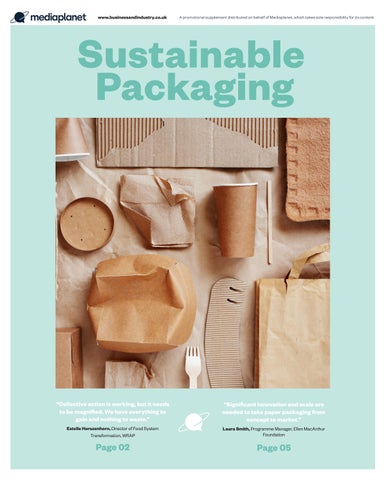

Sustainable Packaging

“Collective action is working, but it needs to be magnified. We have everything to gain and nothing to waste.”
Estelle Herszenhorn, Director of Food System Transformation, WRAP
Page 02

“Significant innovation and scale are needed to take paper packaging from concept to market.”
Laura Smith, Programme Manager, Ellen MacArthur Foundation
Page 05

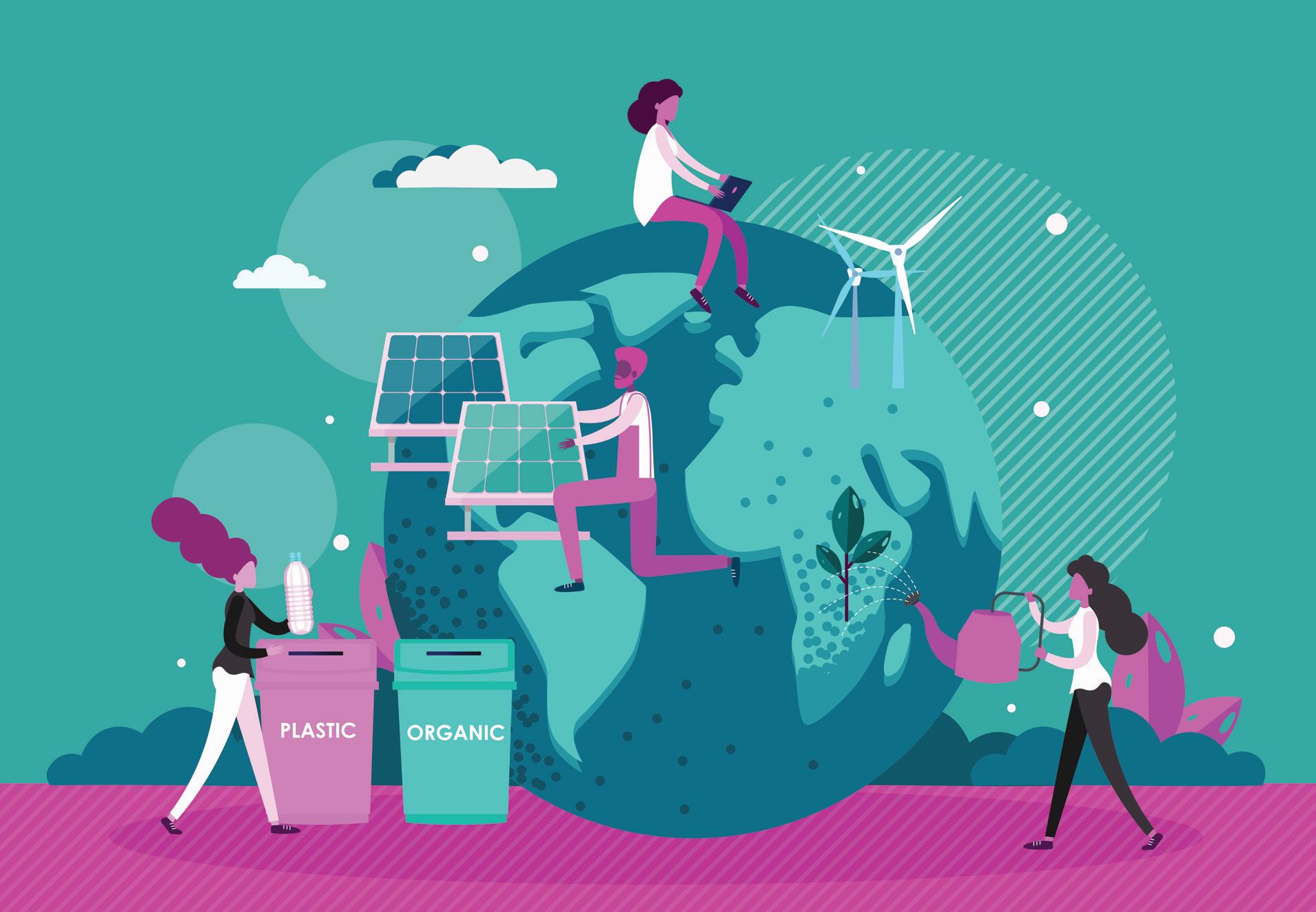
Food waste — the opportunity hiding in plain sight
We can forget net zero if we don’t reduce food waste.
The road to net zero is difficult enough, but it will be impossible if we ignore the impact that food waste has on our changing climate.
Food production and consumption make up around 30% of global CO2 emissions,1 with food waste producing more emissions than the entire aviation sector. People talk about flying less, but why don’t we talk about wasting food less?
To meet net zero, the UK must address food waste Number one on our menu of actions must be a collaborative national endeavour to tackle food waste in our homes, which costs a typical household of four £1,000 a year.2 Get this right, and we can save people money at a time when the cost of living is high, as well as strengthen our climate resilience and food security.
The food sector must change, too.
WRAP has been driving action through the UK Food & Drink Pact and Food Waste Reduction Roadmap, but a year on from our report A Strategic Net Zero Transition Plan for the UK Food System, produced in partnership with IGD and Ernst & Young, and the evidence shows change is too slow, too uneven and off-track.
The dream of transforming our food system to deliver net zero remains just that.
We need to act together — fast
The opportunities are huge — it is possible to
We must cut food waste, fix packaging, transform agriculture and make evidencebased decisions, moving holistically.

reduce emissions by up to 6.45 MtCO2e in 2030 (around 6% reduction from the baseline of 195.3MtCO2e) by meeting the Pact’s food waste targets. 3 Since 2015, GHG emissions associated with UK food consumption have fallen by 14%, leaving a 36% gap to meet 2030 targets. Rapid acceleration is necessary to stay on track to achieve the UK’s 2050 net zero goals. 4
Our food system is subject to unpredictable factors, including being vulnerable to the effects of climate change itself, such as extreme heat and flooding, and we need to reform how we make our food, and how we use it — doing so can contribute towards net zero.
We must cut food waste, optimise packaging, transform agriculture and make evidence-based decisions moving forward together. Collective action is working. We have everything to gain and nothing to waste by scaling the action on food waste.
Reference:
1. WRAP. Reducing greenhouse gas emissions. https://tinyurl.com/ymdpr9mc.
2. WRAP. (2025). Household food and drink waste in the UK 2022. https:// tinyurl.com/2rt6zasr.
3. WRAP. (2021). UK food system GHG emissions. https://tinyurl. com/488z2n6y.
4. WRAP. (2025). Tracking UK food system greenhouse gas emissions: 20152022. https://tinyurl.com/yyds89pj.
information: uk.info@mediaplanet.com or +44 (0) 203 642 0737

WRITTEN BY
Estelle Herszenhorn Director of Food System Transformation, WRAP
Businesses need to realise that increasing complexity in packaging regulation isn’t just happening in the UK
How businesses can keep ahead of changing packaging rules
New, complex packaging rules are tightening in the UK and globally. Access to detailed packaging data is essential for compliance, recyclability and cost savings.
Recent changes to packaging regulations — in the UK and globally — have been seismic. And more are on the way.
Still, this shake-up has been broadly welcomed by businesses, says Jon Brookes, Chief Partnerships & Growth Officer at Ecosurety, which helps major brands manage their packaging data.
“Most customers we talk to understand that we have to do more to encourage the recycling and reprocessing of packaging material,” he reveals.
“We can’t just keep throwing stuff away. Of course, this means there are new commercial and reporting challenges to contend with — and we’ll see and hear frustrations around those. But, generally, the direction has been well-received.” No industry is exempt from this evolving regulatory landscape.
Greater packaging responsibility for producers
From a UK perspective, Extended Producer Responsibility (EPR) has been in effect for two years. It’s a major shift because it makes producers financially responsible for the entire lifecycle of their packaging. Affected businesses are now obliged to report data on the packaging they supply or import and pay waste disposal fees and administrative costs, where necessary.
This comes on top of the Plastic Packaging Tax (PPT), which has been in place since 2022, and applies to any business that has manufactured or imported plastic packaging with less than 30% recycled plastic.
Coming down the tracks is the Deposit Return Scheme (DRS), due in October 2027. This involves certain drink producers paying a producer fee, reporting on the containers they place on the market, applying a deposit to each container and meeting specific labelling requirements. Mandatory labelling is also on the horizon and will involve strict recyclability labelling to help consumers dispose of packaging correctly.
Plus, from an EU perspective, Packaging and Packaging Waste Regulation (PPWR) — which came into force last year and will generally apply from August — ensures that packaging must be recyclable, minimally wasteful and clearly labelled. “Businesses need to realise that increasing complexity in
packaging regulation isn’t just happening in the UK,” says Brookes. “It’s also happening in Europe — and globally.”
Importance of high-quality, good coverage datasets
To mitigate the pressure of rising packaging compliance costs, producers must have access to high-quality, good coverage data sets. An in-depth level of detail about their packaging — including materials, weights, labels, inks etc — will provide them with strategic insights to inform their decisionmaking, improve recyclability and ultimately reduce financial burden.
The ability to drill down into data is important because modulated fees are a component of Extended Producer Responsibility. This means the amount producers pay will vary, depending on the recyclability of their packaging.
“Recyclability methodology assesses packaging data and places it in ‘red’, ‘amber’ or ‘green’ categories,” explains Brookes. “A good quality dataset enables an effective recyclability assessment. But if a producer is missing any data, or if the assessment cannot be made, the packaging will automatically default to ‘red’ and a penalty will be charged.”
Part of Ecosurety’s role is to help customers find and gather the data they need — including data buried in their supply chains — so that it can be mapped, validated and used for effective reporting and strategic insights.
Yet good packaging data isn’t only necessary for compliance purposes, notes Brookes. It can also give businesses a commercial edge. “They can see which elements of their packaging are driving fees,” he says. “So, it’s not just about environmental outcomes. Companies are enabled to build more compelling commercial business cases for improving packaging as they can see the clear pound note upside.”
For any brands preparing for the next phase of packaging regulations, Brookes has this advice. “I’m going to sound like a broken record,” he says. “But you need to focus on getting granular, componentlevel data, and then work on a clear plan to maintain it. It will reduce your pain points going forward and speed up the reporting process.”
INTERVIEW WITH Jon Brookes Chief Partnerships & Growth Officer, Ecosurety
WRITTEN BY Tony Greenway
We need to design packaging that everyone can use
In the drive to create more sustainable packaging, inclusivity can be forgotten. Yet packaging can be made easy to use — and still be better for the environment.

Charlotte Price, Divisional Head of Sustainability, Bunzl, has a clear and concise definition of the term ‘accessible packaging.’
“Essentially, it’s packaging that’s designed with inclusion in mind so that everyone can access products easily,” she says. “It’s easy to open, designed intuitively and safe to handle. For example, contents won’t spill easily when opened, and it presents information clearly and legibly.
Paid for
by
BUNZL

The problem is that packaging accessibility can be neglected in packaging sustainability. “Companies are designing packaging — as they should — to be more material efficient and carbon efficient,” says
Price. “But there’s a risk that they take it too far and create packaging that’s too small and difficult to use.”
“We’ve all encountered packaging that isn’t accessible”, says James Pitcher, Bunzl’s Group Head of Sustainability.
Take vacuum-sealed beef. Minimising beef packaging — or ‘lightweighting’ — admirably reduces waste. But you may need sharp tools to open it, which is challenging for some consumers.
Accessibility seen as ‘extra’ rather than ‘essential’
“Accessibility shouldn’t be a nice-to-have, but fundamental to design. And actually, if you design
for the margins, you’re designing for everybody, making it more accessible,” says Pitcher.
The irony is that some sustainable designs or materials — however wellintentioned — can generate more waste. “For instance, if you peel a film lid off a tray, but it doesn’t come off entirely, it gets messy,” says Pitcher.
“Bits of it end up in the bin instead of being washed and going into the recycling. But if you make it easy for people to recycle, they will. And that’s as much about accessibility as about the materials you use.”
Well-designed and easy-to-open packaging can also improve the customer experience and promote customer loyalty. “People are more likely to buy your product again if they find it easy to use,” says Pitcher.
Better design, not more material
So why isn’t packaging always designed with accessibility in mind? It could be a lack of awareness, a perception that it costs more or a lack of knowledge about how to apply the principles consistently. Also, accessibility is too often seen as ‘an extra’ rather than ‘an essential.’
“Plus, sustainability, design and procurement teams can have their own priorities instead of seeing the whole picture,” says Price. “We bring inclusion and sustainability to life through real-world examples and show how accessible packaging can become part and parcel of the design process.”
Packaging sustainability moves into action
Sustainability is now embedded across packaging design, regulation and supply chains. London Packaging Week 2026 explores how the industry is moving from ambition to implementation.

Rika Kelso Senior Marketing Executive, Easyfairs
Sustainability is no longer a standalone objective in packaging. It’s now embedded across design, regulation, sourcing and commercial decisionmaking. At London Packaging Week 2026, that shift is brought into focus as the industry gathers to explore how sustainable packaging solutions are being developed, tested and scaled in practice.
From ambition to implementation
As UK and European regulations evolve, packaging professionals face increasing pressure from extended producer responsibility, recyclability requirements and upcoming frameworks, including the UK Deposit Return Scheme and the EU Packaging and Packaging Waste Regulation. The challenge is no longer intent, but execution at speed and scale.
London Packaging Week acts as a meeting point for that challenge. It brings together brands, suppliers, designers and regulators to share approaches, compare solutions and explore what works in real-world conditions. Discussions increasingly focus on how businesses can navigate pEPR, build stronger supplier partnerships and optimise packaging systems to improve compliance and cost efficiency. Over 210 exhibitors present materials, technologies and packaging systems designed to reduce environmental impact while maintaining performance and commercial viability. This includes recyclable and compostable substrates, fibre-based alternatives, refill models,
lightweighting strategies and circular design approaches. The conference brings together more than 90 speakers across two stages, with sustainability embedded throughout the agenda. A keynote from PackUK’s Esther Carter opens discussion on national system alignment and long-term packaging targets, while WRAP leads sessions on scaling circularity through cross-value chain collaboration. OPRL examines how labelling and communication must evolve to improve recycling outcomes and consumer understanding. Further sessions explore readiness for the UK Deposit Return Scheme and operational realities of systemwide change across supply chains, with contributions from brands, retailers and recycling organisations.
Recognising measurable progress
Sustainability is also reinforced through the London Packaging Week Innovation Awards. For the first time, it introduces a dedicated ‘Sustainable Packaging Innovation of the Year’ category. The award recognises packaging that demonstrates measurable environmental progress alongside commercial viability, highlighting the growing expectation for sustainability to be embedded within core packaging strategy rather than treated as a standalone objective.
Across the event, the Innovation Gallery, Start-Up Zone and Discovery Theatre continue to showcase emerging materials, technologies and early-stage solutions that challenge established systems.



By bringing together global brands, suppliers and policymakers, London Packaging Week provides a live environment where sustainability isn’t only discussed but tested, challenged and advanced into practical application.

Packaging’s future is collective
As packaging regulations evolve and sustainability expectations increase, businesses are discovering that collaboration across the supply chain is essential to delivering meaningful and lasting change.
WRITTEN BY
The packaging industry is entering a significant period of transformation. Regulatory reforms, including Extended Producer Responsibility (EPR) and Simpler Recycling, are changing how businesses approach packaging design, material selection and end-of-life responsibility. At the same time, consumers, investors and policymakers are placing greater emphasis on measurable sustainability progress.
Navigating industry change
These challenges cannot be addressed by individual organisations working in isolation. Achieving meaningful progress requires collaboration between brands, manufacturers, retailers, recyclers, compliance organisations and policymakers.
Sharing expertise
collection, sorting and recycling outcomes, highlighting the importance of considering the entire packaging lifecycle.
Creating practical solutions
As sustainability requirements become more complex, businesses are increasingly looking beyond their own operations to identify practical solutions.
As sustainability requirements become more complex, businesses are increasingly looking beyond their own operations to identify practical solutions. Sharing knowledge and learning from others across the value chain can help organisations navigate new regulations, improve resource efficiency and accelerate innovation. Collaboration also helps businesses understand the wider impact of packaging decisions. Choices made during design and production can influence
FWhile ambitious sustainability targets are important, turning those ambitions into action requires ongoing dialogue across the industry. Businesses need opportunities to exchange ideas, discuss emerging challenges and explore technologies that can support long-term environmental and commercial goals. Industry events play an important role in facilitating these conversations by bringing together stakeholders from across the packaging ecosystem. They create valuable opportunities to build partnerships, share best practice and identify solutions that may not emerge through individual efforts alone.
A shared opportunity
The transition towards a more circular economy presents both challenges and opportunities for the packaging sector. By working together and sharing expertise, organisations can develop practical, scalable solutions that support compliance, reduce waste and create a more sustainable future for packaging.
When paper packaging is a viable alternative to plastic
Laura Smith, Programme Manager, Ellen MacArthur Foundation, explains what must happen for paper packaging to become a viable alternative to plastic.
lexible plastic packaging, the wrappers and sachets found littering streets, beaches and oceans across the globe, represent one of the most significant barriers in the fight against plastic pollution.
It’s estimated that 20 trillion will enter oceans over the next 15 years.1
Tackling this is one of the most pressing challenges facing businesses and governments, particularly in countries with high rates of environmental pollution.
How paper-based packaging can help tackle plastic pollution
Aside from being recyclable, paperbased packaging can be designed to
biodegrade in the environment in the worst case — if it leaks.
The Ellen MacArthur Foundation released a new report examining the role of paper as an alternative to flexible plastic packaging, outlining six criteria that define the responsible use of paper.2
Guardrails to maximise paper-based packaging’s benefits
For paper packaging to be viable, businesses must ensure that all materials are responsibly sourced and produced, while also being locally recyclable. It must also meet all technical, economic and consumer needs, while avoiding hazardous chemicals and persistent plastic
pollution by being designed to biodegrade in the environment.
The use of paper-based alternatives must also fit within a broader and socially inclusive circular economy strategy: it should always be paired with efforts to help scale effective collection and recycling systems, and efforts to move away from small-format flexible packaging altogether towards reuse and refill should be prioritised wherever feasible.
Correctly applied, paper can become a powerful tool to eliminate plastic pollution. In the worst-case scenario, it may further aggravate forest degradation and water scarcity and still cause harmful and persistent pollution — ultimately replacing one problem with another.
The endorsement of over 45 businesses, NGOs and academics worldwide shows the momentum and alignment behind this vision of responsibly designed paperbased packaging. 2 Now, significant innovation and scale are needed to take paper packaging from concept to market.
References: 1. Ellen MacArthur Foundation. (2025). Tackling flexible plastic packaging waste. https://tinyurl.com/y3vkena7. 2. Ellen MacArthur Foundation. (2026). Paper as one part of the solution to flexible packaging pollution. https://tinyurl. com/4cnewn3x.

Naomi Stewart
Head of Marketing, UKPackaging Expo
WRITTEN BY Laura Smith Programme Manager, Ellen MacArthur Foundation
Packaging at a crossroads: Why moving beyond fossil dependence matters
Packaging underpins modern life, protecting goods, extending shelf life and enabling global trade. Yet it remains dependent on fossil-based materials — an increasingly unsustainable model.

WRITTEN BY
Jen Vanderhoven CEO, BBIA
The issue is structural. Fossil-based packaging follows a linear path: finite resources are extracted, used briefly, then discarded. In the UK, around 12 million tonnes of packaging waste are generated annually, with just over half of plastic packaging recycled.1,2
Much of the remainder is incinerated, releasing an estimated 3 million tonnes of fossil CO2 yearly.3 Materials are designed for performance rather than recovery, and waste systems struggle to keep pace.
Packaging demand also continues to rise, driven by e-commerce and convenience. This creates a system built on finite resources, increasing exposure to supply risks, price volatility and long-term insecurity.
The necessity of sustainable packaging
Reducing fossil dependence is also a resilience imperative. Fossil-reliant packaging systems are vulnerable to geopolitical shocks and market fluctuations. Diversifying toward renewable, bio-based feedstocks offers a more flexible and distributed model.
However, the transition isn’t straightforward. Cost is a major barrier, with bio-based packaging up to 2.5 times more expensive due to limited feedstocks and immature supply chains.3 Infrastructure also lags: existing systems are optimised for conventional plastics, making it difficult for new materials to scale.
Sustainable packaging innovations and benefits
Significant UK investment has driven advances in plant-based coatings, compostable polymers and natural barriers. These solutions show promise but require supportive systems to reach the market.
In the UK, around 12 million tonnes of packaging waste are generated annually, with just over half of plastic packaging recycled.
Packaging is often used for minutes but persists for decades. Low recycling rates, especially for plastics, mean valuable materials are lost, while incineration returns embedded carbon to the atmosphere. Bio-based alternatives, derived from plants, waste streams and algae, offer potential to reduce emissions and expand endof-life options.
The prize is substantial. Bio-based packaging could grow into a £4.2 billion UK industry, supporting 35,000 skilled jobs and strengthening domestic supply chains,4 while positioning the UK as a leader in advanced materials.
This transition will require scaling production, adapting waste infrastructure, aligning design with disposal and sustaining innovation. The challenge isn’t a lack of alternatives, but the pace at which systems can evolve.
References:
1. UK Flexographic Industry Association. UK statistics on waste.
2. Department for Environment, Food & Rural Affairs. (2025). UK statistics on waste. https://tinyurl.com/4b6a76mz.
3. BB-REG-NET. (2025). Fixing fossil market failures: The impact of UK taxes on biobased plastics. https://tinyurl.com/endv3vsf.
4. Royce. (2025). National materials innovation strategy. https://tinyurl.com/43acj9bm.
Why to UK’s infrastructure

Why it’s crucial to strengthen the UK’s recycling infrastructure
The UK is advancing on packaging policy, but without stronger recycling infrastructure, progress risks stalling where it matters most — turning waste into valuable resources.
Extended Producer Responsibility, Simpler Recycling and a future Deposit Return System are all designed to increase collection and accountability.
Policy momentum grows
These measures are essential, but they are heavily weighted towards improving recovery rates rather than strengthening what happens next. Policy focus often centres on collecting materials, while the systems that recycle them receive less attention.
Infrastructure gap remains
This imbalance is becoming more visible. Local authority collections are evolving, particularly with plastic film collection set to expand significantly, yet infrastructure to process these materials is not scaling at the same pace. Without sufficient domestic reprocessing capacity, valuable materials risk being exported or lost from the circular economy. At the same time, UK recyclers continue to face intense competition from lower-cost international markets, making investment in domestic capacity more challenging.
Systems under strain
Recent disruptions to the PRN system highlight how fragile the wider recycling framework can be. Delays and uncertainty have impacted recyclers’ operations and cash flow, especially for smaller businesses operating within tight margins. These pressures illustrate a broader point: the UK’s recycling system is not yet resilient enough to support the scale of change that upcoming policies demand.
A balanced path forward
Delivering a truly circular packaging system requires more than legislation alone. It demands coordinated investment across collection, sorting and reprocessing infrastructure, alongside clear and stable policy frameworks. Without this balance, there is a risk that ambitious targets outpace the systems needed to achieve them.
As an organisation working across the plastics value chain, RECOUP continues to highlight the importance of aligning infrastructure with policy ambition. The opportunity is clear: by strengthening domestic recycling systems, the UK can not only capture materials but keep them in circulation, delivering both environmental and economic value.
WRITTEN BY Steve Morgan Head of Policy and Infrastructure, Recoup