healthawareness.co.uk
A promotional supplement distributed on behalf of Mediaplanet, which takes sole responsibility for its content
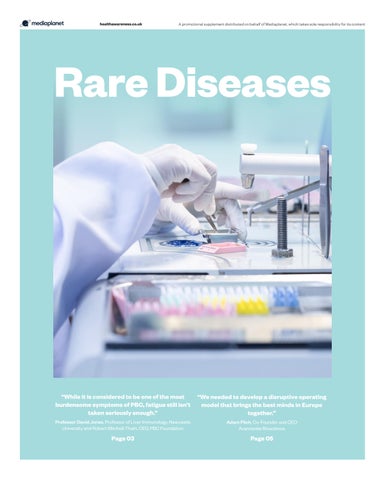
Rare Diseases
“While it is considered to be one of the most burdensome symptoms of PBC, fatigue still isn’t taken seriously enough.”
“We needed to develop a disruptive operating model that brings the best minds in Europe together.”
Professor David Jones, Professor of Liver Immunology, Newcastle University and Robert Mitchell-Thain, CEO, PBC Foundation
Adam Plich, Co-Founder and CEO Avanzanite Bioscience
Page 03
Page 05
A PROMOTIONAL SUPPLEMENT DISTRIBUTED ON BEHALF OF MEDIAPLANET, WHICH TAKES SOLE RESPONSIBILITY FOR ITS CONTENT
Newborn screening across EU needs to become more equitable For many rare diseases, irreversible damage begins before symptoms appear. Newborn screening (NBS) can identify certain conditions shortly after birth, enabling timely care before serious harm occurs.
Y
WRITTEN BY Gulcin Gumus Research and Policy Senior Manager, EURORDIS-Rare Diseases Europe
et, access remains uneven across the EU. Only EURORDIS-Rare Diseases Europe and the wider rare congenital hypothyroidism and phenylketonuria disease community therefore recently published a joint are screened in every Member State, while national position statement calling on the EU to establish a multipanels range from fewer than 10 conditions to stakeholder newborn screening group to support Member more than 40 in Italy. As a result, children with the same States in strengthening their programmes. The group could condition can face very different coordinate evidence reviews, develop prospects depending on where they EU-level guidance and facilitate data are born. sharing, while supporting rather than NBS programmes are replacing national decision-making.
Increasing the odds with NBS
evolving across the EU, but progress remains uneven.
Delayed or inconsistent adoption of NBS for treatable conditions can have devastating consequences. In medium-chain acyl-CoA dehydrogenase (MCAD) deficiency, early diagnosis can prevent metabolic crises that may cause seizures, liver problems, brain damage, coma or sudden death. A 2026 French study estimated that, without newborn screening for SMA, 26% of patients could die by age 15, compared with 2% with screening.1 Rare disease diagnostic journeys can also be extremely long: around one in four rare disease patients wait more than five years for a diagnosis.2
Joint statement to strengthen NBS programmes
NBS programmes are evolving across the EU, but progress remains uneven. No single country will always have enough cases, evidence or expertise to efficiently assess every screening target alone. Greater EU collaboration could reduce duplication and strengthen national decision-making.
Experts commissioned by the European Commission proposed a similar EU-level approach more than a decade ago.3 Since then, screening technologies, evidence and treatments have advanced considerably. The evidence is there. What Europe now needs is the political commitment to turn it into more equal opportunities for earlier diagnosis and care across the EU. Eymere, S., et al. (2026) ‘Cost-effectiveness and public health impact of newborn screening for spinal muscular atrophy in France’, Applied Health Economics and Health Policy, 24, pp. 597–611. doi: 10.1007/s40258-026-01035-5. 2 Dubief, J., et al (2024) Voices on newborn screening: The opinion of people living with a rare disease. Rare Barometer, EURORDIS-Rare Diseases Europe, Screen4Care. 3 Cornel, M., et al. (2014) ‘A framework to start the debate on neonatal screening policies in the EU: an expert opinion document’, European Journal of Human Genetics, 22, pp. 12–17. doi: 10.1038/ejhg.2013.90. 1
Making the rare disease resolution real in Africa The WHA Resolution on rare diseases is historic. In Southern Africa, translating it into care means building from the ground up.
I WRITTEN BY Trudy Nyakambangwe Executive Director, Rare Disorders Zimbabwe (RDZ)
n Zimbabwe, a family can wait several years to receive a diagnosis, not only because genetic testing is scarce, but because rare conditions are still widely attributed to curses or family wrongdoing. That stigma delays diagnosis as much as any shortage of specialists. Health systems were not built with them in mind, and the impact is sharpest in low- or middleincome countries (LMICs).
A resolution written with the world, not just for it In May 2025, the World Health Assembly adopted the first-ever resolution on rare diseases, sponsored by Egypt and Spain and co-sponsored by 39 other member states. It designates rare conditions as a global
@Mediaplanet UK & IE
@MediaplanetUKIE
Political commitment can enable earlier diagnosis
health priority and mandates that the World Health Organization develop a comprehensive 10-year Global Action Plan for Rare Diseases by 2028. Only a handful of African countries co-sponsored the text, but Southern Africa’s voice in implementation cannot be an afterthought. Rare Diseases International, together with its member organisations, including Rare Disorders Zimbabwe, has made building and strengthening registries and evidence from LMICs a strategic priority for exactly this reason.
What implementation looks like on the ground In Southern Africa, access to genetic services remains highly uneven – for example, seven of nine provinces have no genetic services, meaning
that families often travel hundreds of kilometres just for a diagnosis. Community-led referral networks can close that gap; connecting rural clinicians to genetic clinics by WhatsApp, and training community health workers to offer counselling and follow-ups. Diagnosis is only half the picture: sickle cell disease can be managed with an inexpensive drug, yet most African patients still never receive it – lacking a clear pathway from diagnosis to treatment. Equitable access should be designed locally, not imported, given the region’s unique complexities.
The global action plan must be built from here
The Resolution is a floor, not a ceiling. As the WHO drafts the Global Action Plan, LMIC-designed models like ours must inform it directly, not simply receive it once written. That means sustained funding, SouthSouth learning between African rare disease organisations and registries that count LMIC patients, not just cite them.
Contact information: ie.info@mediaplanet.com or +44 (0) 203 642 0737
Please recycle
Strategic Account Manager: Amy Shah amy.shah@mediaplanet.com | Managing Director: Margot Thomas | Designer: Juraj Prikopa Senior Content Manager: Angelica Hackett O’Toole | Paid Media Strategist: Jonni Asfaha Digital Campaign Manager: Jan Martorell | All images supplied by Getty Images, unless otherwise specified
02
MEDIAPLANET
READ MORE AT HEALTHAWARENESS.CO.UK
A PROMOTIONAL SUPPLEMENT DISTRIBUTED ON BEHALF OF MEDIAPLANET, WHICH TAKES SOLE RESPONSIBILITY FOR ITS CONTENT
This article has been commissioned by Ipsen. Ipsen also provided editorial content for this article.
The hidden cost of PBC fatigue Most of us think we understand tiredness: a long day, a short night, a few too many deadlines. Yet, fatigue is different. For many people living with the rare liver disease Primary Biliary Cholangitis (PBC), the exhaustion never fades, no matter how much rest they get.
Professor David Jones Professor of Liver Immunology, Newcastle University
Robert Mitchell-Thain CEO, PBC Foundation
The weight of the invisible
measurement and open dialogue about fatigue, not just as a symptom but as a core part of the condition that severely impacts quality of life. If we want to be true partners in patient care, we must recognise that fatigue is not a subjective feeling of tiredness but a distinct clinical condition that has a significant impact on quality of life,1 independent of other PBC symptoms like pruritus.9 Healthcare professionals must be supported to see and treat the whole person, going beyond treating liver biochemistry to address the symptoms that matter most to people living with PBC fatigue takes more While it is considered to be one of PBC. than energy. It steals moments, the most burdensome symptoms independence and freedom.
Despite being hard to see, the impact of fatigue is clear: up to 80% of people living with PBC experience fatigue,4 with 20% experiencing it as severe.5 The of PBC,3 fatigue still isn’t taken impact is equally undeniable; Listening to the PBC community around 60% of people living Living with a rare disease can seriously enough. with PBC report a loss in work be isolating, particularly when productivity,6 and fewer than 20% symptoms such as fatigue are of those with severe fatigue are misunderstood or overlooked. able to maintain their careers.7 Greater awareness is important, This could be an accountant struggling to keep track but so are the small things: feeling listened to, having your of numbers amidst the brain fog fatigue can bring, or a experiences recognised and knowing there are others who pharmacist unable to continue prescribing life-saving understand the challenges you face. medication under the strain of memory loss and exhaustion 1 Fakuda et al. 1994. The chronic fatigue syndrome: a comprehensive approach to its – these are examples we have come across in our roles that definition and study. Annals of internal medicine. 121.12:953-959. may be familiar to those living with PBC. 2
The science is catching up Sponsored by Ipsen
To find out more about PBC fatigue please visit: pbcfoundation. org.uk
DRSC-UK-001031 September 2026
F
atigue isn’t a temporary sense of exhaustion like tiredness. It is a debilitating daily challenge that doesn’t improve with sleep and rest. It is persistent, profound and almost entirely invisible to everyone other than the person experiencing it.1,2 Fatigue limits not only what a person can do but often what they even attempt to do. While it is considered to be one of the most burdensome symptoms of PBC,3 fatigue still isn’t taken seriously enough.
As our understanding of the mechanisms behind fatigue in PBC continues to evolve, it is increasingly being recognised as a direct manifestation of the underlying autoimmune process. Magnetic resonance brain scans have shown that people with PBC have changes in how certain parts of their brain work and connect with each other. These areas help control things like motivation, emotions, memory and how we process sights, sounds and other sensations.8 These changes are thought to contribute to the experience of fatigue for people living with PBC, helping to explain why it can feel so pervasive, both mentally and physically.8
A call for recognition
While our understanding of the science evolves, there is still a critical need for improved recognition, routine
READ MORE AT HEALTHAWARENESS.CO.UK
Lynch et al. Understanding fatigue in primary biliary cholangitis: from pathophysiology to treatment perspectives. World Journal of Hepatology. 14.6: 1111. 3 Kaps 2020. Symptom burden and treatment response in patients with primary biliary cholangitis. Digestive Diseases and Sciences. 65(10): 3006-3013. 4 Chalifoux SL, et al. 2017. Extrahepatic Manifestations of Primary Biliary Cholangitis. Gut. 15;11(6):771-780. 5 Jopson and Jones 2015. Fatigue in Primary Biliary Cirrhosis: Prevalence, Pathogenesis and Management. Dig Dis. Suppl 2:109-14. 6 Levy et al. 2023. Understanding the experience of patients with primary biliary cholangitis and pruritus. Abstract presented at ISPOR; 7-11 May 2023, Boston. 7 Khanna et al. 2018. Rituximab for the treatment of fatigue in primary biliary cholangitis (formerly primary biliary cirrhosis): a randomised controlled trial. J Hepatol. 69(5 ), pp. 946–953. 8 Mosher et al. 2017. Primary biliary cholangitis alters functional connections of the brain’s deep gray matter. Clinical and translational gastroenterology. 8(7):e107. 9 Jones et al., Elafibranor improves fatigue versus placebo in patients with primary biliary cholangitis, with limited correlation with pruritus: Analyses from the phase III ELATIVE® trial. Poster presented at the EASL Congress May 2025.
MEDIAPLANET
03
A PROMOTIONAL SUPPLEMENT DISTRIBUTED ON BEHALF OF MEDIAPLANET, WHICH TAKES SOLE RESPONSIBILITY FOR ITS CONTENT
Start the PBC conversation to help the unseen patients
Making more robust, fundable decisions in rare diseases
It’s not easy living with an invisible condition: unseen, often undiagnosed, untreated and all too often misunderstood and alone. However, it doesn’t have to be this way.
A
A
tiredness that sleep doesn’t fix; an itch under the skin that cannot be scratched; undetected damage to the liver for years; these are common features of primary biliary cholangitis, a rare autoimmune condition which affects the liver.
PBC care and challenges
As with many invisible conditions, diagnostic tools are available, as are treatments, care and support. There is so much that can be done to treat and to support someone living with PBC. Only 5% of rare diseases have any kind of treatment, and PBC is in that five.1 Yet, there are inherent challenges in getting a timely diagnosis. The invisibility of symptoms, or liver damage, is part of that challenge.
Self-support steps
If you are living with invisible symptoms, you can still be seen, understood, supported and able to make improvements in your life. It just takes the courage to have the next conversation. It may be with your partner, family, work or doctor; but the next conversation you have could help you in your journey. Start by diarising your symptoms. Give them a score where 1 is less impact, and 10 is the worst. Record the impact of those symptoms: emotions, barriers, what you couldn’t do on each day. Then, take it to your doctor, preferably with support, to discuss in detail.
What to do if you suspect PBC
It may be PBC. It may not be. The conversation needs to be had. So many people start their journey towards better health in this way, and you can too. If you are living with PBC, or suspect you may have it, then you can contact the PBC Foundation directly for support and information, all of which is freely available. We have a website, an app and a helpline where we are waiting to support you: all free for you to use. 1
Rare disease health economics is being transformed with a new approach that manages limited data, assesses broader value and supports fairer funding decisions. t its heart, health economics is about squeezing the greatest health benefit from constrained healthcare budgets. That’s hard enough for common conditions, but for rare diseases, it’s an entirely different challenge.
Challenges of having limited rare disease data
Rare disease data is limited because the patient cohort is so small. “This creates a tension between maximising benefit for higher patient volumes and delivering equity and fairness for small numbers of patients,” explains Phil McEwan, CEO of HEOR, an independent market access consultancy. “Rare disease symptoms can also mimic more common conditions, leading to long diagnostic delays.” However, despite the absence of data, rare disease treatments are still expected to meet the same evidential bar as common disease treatments. A payer, such as the National Institute for Health and Care Excellence (NICE), reflects this tension in its thresholds, with standard treatments assessed against a cost-effectiveness threshold of £25,000 to £35,000 per QualityAdjusted Life Year (QALY). For rare diseases assessed via NICE’s Highly Specialised Technologies route, it rises to £100,000 per QALY.
New methodology for better decisionmaking
To make more robust, fundable decisions with limited data, HEOR takes a different approach. Instead of trying to produce one ‘definitive’ number from patchy data, HEOR establishes credible upper and lower bounds. “It’s not necessary to eliminate uncertainty, which is impossible anyway with rare disease data,” says McEwan. The goal is to narrow it enough to support a defensible decision. The method also groups diseases into archetypes based on shared characteristics. “Rather than saying, ‘Here are all the things we don’t know about the disease,’ we describe the things we do know,” says McEwan. The consultancy also argues that real value in rare disease treatment development extends beyond direct healthcare costs and QALYs. After all, management (or lack of treatment) of these conditions creates an economic burden for patients, their families and wider society. “We say this a lot,” notes McEwan. “But the cost of not doing something in healthcare isn’t nothing.”
G ov.uk. 2025. Major change for rare disease treatments on way, signals MHRA. tinyurl.com/3jzfm6a2
Phil McEwan CEO, HEOR
WRITTEN BY Tony Greenway
WRITTEN BY Robert Mitchell-Thain CEO PBC Foundation
Sponsored by HEOR
Local approaches fall short for rare disease patients Rare diseases do not recognise geography. Yet, the infrastructure, funders and healthcare services supporting people affected by them are increasingly regional.
F
or instance, recent changes to The National Lottery Community Fund’s Reaching Communities grant mean it no longer supports national work. Consequently, patient groups face a growing challenge: supporting communities spread across the country while navigating systems designed for local delivery. Rare disease patient groups are national by necessity. For most patients, only one organisation exists for their condition, if any at all. They connect people who may otherwise have no one who understands their experience, creating a collective patient perspective that would not exist without them. Essential to the ecosystem Despite their importance, patient groups are often viewed as an additional layer of support rather than an essential part of the rare disease infrastructure. Without patient groups, the rare disease ecosystem loses one of the few mechanisms capable of consolidating dispersed knowledge, lived experience and clinical insight. By combining the expertise of patients, clinicians, researchers and policymakers, they build a far richer understanding of a condition, helping shape services, treatment and care around the realities of living with a rare disease. These groups cannot operate within local structures without leaving people behind. If funding, infrastructure support and healthcare systems prioritise local delivery, there is a growing risk that organisations providing national support will fall between the gaps — along with the patients they serve. Supporting the future At Beacon, we know the value that patient groups bring to the whole community. Our pioneering Rare Insights Study is exploring the experiences, challenges and opportunities facing patient groups to better understand what they need to thrive and how they can be strengthened for the future. Patient groups are a foundation on which the rare disease landscape depends. Future rare disease policy, healthcare planning and funding decisions must ensure these organisations can be sustained nationally. Doing so will help reduce geographical inequalities by ensuring that people affected by rare diseases can access expertise, representation and community wherever they live — not just where local structures are available.
WRITTEN BY Mary Rose Roberts Chief Operating Officer, Beacon for Rare Diseases
Find out more at heor.co.uk
04
MEDIAPLANET
READ MORE AT HEALTHAWARENESS.CO.UK
A PROMOTIONAL SUPPLEMENT DISTRIBUTED ON BEHALF OF MEDIAPLANET, WHICH TAKES SOLE RESPONSIBILITY FOR ITS CONTENT
Why scientific innovation alone does not deliver patient impact Rare disease innovation matters, but it’s only successful if it has an impact on patients. Cross-sector collaboration can help turn Europe’s complexity into access. Scientific innovation is wonderful, agrees Adam Plich. On its own, it’s simply not enough. In fact, he points out, innovation is worthless if it doesn’t create patient impact.
Not enough approved medicines reach patients Adam Plich Co-Founder and CEO, Avanzanite Bioscience
WRITTEN BY Tony Greenway
Plich has seen too many medicines leave the lab, get through clinical trials and then receive approvals from the world’s leading regulatory authorities. But then, nothing happens. “These therapies are not reaching the people they’re designed for,” he says. “Increasingly, patients in Europe are the ones who are being left behind.” So, he co-founded Avanzanite Bioscience, a specialist pharmaceutical company exclusively focused on rare diseases. Its watchword is ‘no one left behind,’ and its explicit purpose is to get medicines to rare disease patients across all European countries.
A complex picture, but not an insurmountable challenge
Naturally, that’s easier said than done, because there is a set of ‘accepted’ assumptions about the healthcare picture in this part of the world. For example, reimbursement in Europe is lengthy and complicated; plus, ultra-rare medicines can’t be launched sustainably across a single country, several countries or a larger region. Admittedly, the European healthcare picture is extremely complex with its 32 different markets, different languages, pricing, reimbursement, legal complexities and healthcare
requirements. Nevertheless, Plich argues that these challenges are not insurmountable. Part of the answer, he says, is early collaboration between healthcare systems and patient communities to anticipate diagnostic needs, evidence requirements, access barriers, local care pathways and patient support requirements. “Integrating the patient voice into decision-making is so important,” he insists.
Sponsored by Avanzanite Bioscience
Better collaboration between commercial stakeholders He also recognises that better cross-sector collaboration on the commercial side is critical. In response, his company has built the expertise and infrastructure needed to take ownership of biotech companies’ rare-disease medicines through tailored licensing, distribution or acquisition partnerships, ensuring those medicines reach patients in every country across Europe. Rather than ignoring European complexity, the idea is to use local knowledge to unlock potential and opportunity. He says: “We needed to develop a disruptive operating model that brings the best minds in Europe together.” Working together across the ecosystem will create sustainable routes for orphan medicines to reach eligible patients. Yet, Plich admits that time is pressing because 100–150 new orphan medicines are expected to be approved globally in the next five years. “We have never had such an opportunity to make such an impact on rare disease patients,” he says. “We need to catch that momentum.”
Scan the QR code to explore how our platform engages patients in your therapy area. avanzanite.com
Finding the right patient is the breakthrough: why precision matters in rare disease awareness Rare disease innovation keeps advancing. New therapies and new mechanisms mean new hope. But here’s the reality: none of it matters if the people who could benefit are never identified. That’s the gap we need to close.
R
Marcelo Duhalde Chief Growth Officer, smartpatient
Sponsored by smartpatient
are disease symptoms are often non-specific. Conditions get misunderstood. Patients spend years moving between appointments without a clear answer. Families live with uncertainty. Healthcare systems absorb repeated testing and referrals. And pharmaceutical companies watch scientific progress fail to reach the people it was designed for. Broad awareness campaigns help, reducing stigma, increasing understanding and encouraging people to seek advice. But reach alone doesn’t guarantee relevance. The real question is whether the right people encounter information that reflects their experience and helps them take an appropriate next step. This is where precision changes the game.
Identification through smart health tracking At smartpatient, we’ve supported millions worldwide who track their READ MORE AT HEALTHAWARENESS.CO.UK
health through MyTherapy every day. That ongoing relationship gives us something rare in healthcare: a window into how people actually experience their conditions over time. We see patterns in symptoms, treatments and daily routines that can
Patient identification must be educationfirst, transparent and consent-led.
help identify who might benefit from disease-state education, long before a diagnosis is confirmed. We call this Precision Pattern Mapping. It allows us to reach people with relevant information at the right moment, helping them recognise that their experience may be worth discussing with a healthcare
professional. Interactive selfassessments give structure to what they are feeling. Targeted content builds confidence to raise symptoms sooner. The goal is not to diagnose, but to shorten the path to the right conversation.
Supporting patients in taking the next steps
The pathway depends on context and regulation. Some experiences prepare people for an informed consultation. Others provide digital health assistance directly. Both make the next step more visible and less dependent on chance. Trust is essential and must be earned. Patient identification must be education-first, transparent and consent-led. The rare disease community needs awareness that’s useful, not just loud. Finding the right patient is a breakthrough in its own right because every meaningful care pathway depends on reaching the person who needs it.
Scan the QR code to explore how our platform engages patients in your therapy area. smartpatient.eu/ platform
MEDIAPLANET
05
A PROMOTIONAL SUPPLEMENT DISTRIBUTED ON BEHALF OF MEDIAPLANET, WHICH TAKES SOLE RESPONSIBILITY FOR ITS CONTENT
mRNA therapies ‘address the underlying genetic cause of disease’ New mRNA technologies are in development that have the potential to make a major impact on the lives of children and adults with two rare life-limiting genetic conditions.
D
Alan Cohen, MD Chief Medical Officer, Arcturus Therapeutics
WRITTEN BY Tony Greenway
Sponsored by Arcturus Therapeutics
Find out more at ArcturusRx.com
uring the Covid-19 pandemic, a spotlight was Giving the body ‘instructions’ to produce diseaseshone on an exciting medical advance: messenger preventing proteins RNA (mRNA) technology, which was credited with The advantage mRNA medicines have over current speeding up vaccine development. therapies is that they use synthetic mRNA to provide cells The world’s first self-amplifying mRNA Covid vaccine to with the ‘instructions’ to produce the proteins needed to gain approval was developed by prevent or treat a disease. Arcturus Therapeutics, which has “This is transformative for been working on RNA technology rare diseases because mRNA This is transformative for for over 13 years. Currently, technologies address the rare diseases because mRNA the company is in the clinical underlying genetic cause, development stage of evaluating rather than just managing its technologies address the mRNA medicines to treat patients symptoms,” explains Alan Cohen, underlying genetic cause. with two rare, life-limiting MD, Chief Medical Officer at conditions. Arcturus Therapeutics. “Since approximately 80% of all rare Explaining cystic fibrosis and ornithine diseases are genetic and many involve a single missing transcarbamylase deficiency or defective protein, mRNA offers a unique ‘blueprint’ The first is cystic fibrosis (CF), a chronic, progressive genetic solution.” disease affecting over 100,000 people worldwide1 that Nevertheless, developing mRNA medicines for rare primarily damages the lungs and digestive system, resulting diseases can take around 10 years. “However, patients with in malnutrition and poor growth and development in CF lung disease and adults with OTC deficiency currently children and young adults. Arcturus is currently developing enrolling in our Phase 2 studies could gain access to an mRNA therapy, which aims to produce proteins directly in active drug many years before both therapies would be the lungs to thin mucus and prevent infections. approved by the regulatory agencies and widely available,” The second is ornithine transcarbamylase (OTC) says Dr Cohen. “This is an opportunity to make meaningful deficiency, a rare metabolic condition affecting over 10,000 inroads to improve the overall survival and quality of life for people worldwide.2 This occurs when mutations in the OTC those burdened by rare diseases.” gene result in a missing or malfunctioning enzyme, causing 1 Guo, J. et al. Worldwide rates of diagnosis and effective treatment for cystic fibrosis. a build-up of ammonia in the blood, which is highly toxic to 2022. https://doi.org/10.1016/j.jcf.2022.01.009. the brain and nervous system. The company is developing 2 NORD. Ornithine Transcarbamylase Deficiency. 2025. tinyurl.com/4knh2xkd an mRNA medicine that turns the patient’s own liver cells into “factories” that produce the missing OTC enzyme and allow the body to detoxify ammonia naturally.
Future for rare: why the UK needs a policy for rare conditions As the UK Rare Diseases Framework ends, Genetic Alliance UK urges Governments across all four UK nations to renew their policy commitment and guarantee equitable care for everyone living with a rare condition.
T WRITTEN BY Natalie Frankish Director of Public Affairs (Genetic Alliance UK Lead for Scotland)
06
MEDIAPLANET
he UK Rare Diseases Framework recognised that strategic policy was needed to improve care. However, with it ending in January 2027, and a successor policy still to be announced, the rare conditions community is calling for a renewed four-nation policy to maintain progress and address remaining gaps.
A united call for national strategy
This is not only a matter of fairness. Fragmented, reactive care is often more costly than coordinated care, driving avoidable hospital admissions and delayed diagnoses. It also undermines the UK’s ambitions in genomics and life sciences where rare condition research plays an important role. Allowing the framework to lapse without a successor risks losing ground on both fronts.
Genetic Alliance UK’s Future for Rare campaign has brought together over 1,000 people affected by rare conditions, carers, clinicians, researchers and industry leaders through a UK-wide engagement process including a comprehensive community survey, call for evidence, workshops and 11 expert working groups. The community’s ask is clear: for the progress made so far to be protected and for the systematic barriers that have held them back to be properly addressed. Support is strong, with 91% of survey respondents endorsing the original framework’s core priorities. However, key gaps must be addressed, including integrated mental health services, non-healthcare support such as welfare and education and embedded care coordinators across all pathways.
Building clear accountability
Among the emerging recommendations from the expert working groups is designating senior named leads across national, regional and local tiers to establish clear points of responsibility and oversight. They also point to an annual UK-wide patient experience survey and a national disease registration baseline as mechanisms for monitoring success. The Future for Rare campaign will culminate in an expert summit this autumn, but the community has already made its position known. Governments across the UK don’t need to wait to act. They should commit today to a successor policy and work with the rare community to co-produce what comes next.
READ MORE AT HEALTHAWARENESS.CO.UK
A PROMOTIONAL SUPPLEMENT DISTRIBUTED ON BEHALF OF MEDIAPLANET, WHICH TAKES SOLE RESPONSIBILITY FOR ITS CONTENT
‘Appropriate intelligence’ for rare disease conversations AI is already reshaping rare disease diagnosis. What if it could do the same for how we communicate with patients and healthcare professionals?
A breakthrough year
WRITTEN BY Ellie Thomas CCO & Rare Disease Lead, Camino
AI has enabled remarkable progress in rare disease. Among the advances in the last 12 months, AI can now: score genetic variants to flag likely diseasecausing mutations;¹ explore clinical data and literature to suggest possible diagnoses, showing its reasoning;² and reanalyse old genomic data to find cases that were missed.³ All of this is helping hunt down causes behind conditions undiagnosed for years. It’s published, peer reviewed and already changing outcomes.
Communications: playing catch-up
When it comes to using AI to support how we engage patients and healthcare professionals about rare diseases, we’re miles behind. The possibilities are huge for a field with over 7,000 conditions, where expertise is precious and resources are stretched.
A few potential use cases: patient materials that adapt to reading age, language and where someone is on their journey, instead of one leaflet trying to speak to everyone at once; a monitoring tool for healthcare professionals that accounts for how differently a condition can present
Start small: listen to the rare disease community about what they need. from patient to patient; or an AI avatar that can help a newly diagnosed family at 2 am, when the specialist nurse has gone home, answering questions that can’t wait and steering them away from whatever misinformation a late-night Google search throws up. How amazing would that be?
human interaction. Rare disease runs on empathy and nuance, and it always should. With the right care and expertise, though, AI can help us reach more patients and clinicians, and engage them better, with greater impact. Getting there means pharma and biotech leaning into what’s next. We don’t need to reinvent everything overnight. Start small: listen to the rare disease community about what they need. Then, reach for appropriate intelligence – the right blend of AI and human expertise. That means AI driving efficiency and innovation, making possible what wasn’t before, and people bringing the insight and compassion no algorithm can replicate. At Camino, we’re already working alongside the teams brave enough to take that first step. The opportunity is there. Who’s joining us? 1
Human first, always
Sounds great in principle. Yet, nothing, avatars least of all, can replace a clinician’s judgement or
2 3
Sponsored by Camino®
Camino is a medcomms agency with specialist expertise in rare disease and practical applications of AI in pharma. Find Ellie on LinkedIn, or scan for tickets to our Adventures in Pharma® event adventures inpharma.com
Orenbuch, R. et al. Nature Genetics. 2025;57:3165– 3174. Zhao, W. et al. Nature. 2026;651:775–784. Welland, M.J. et al. Nature Medicine. 2026;32:2991– 2999.
Natural history studies for rare diseases: What they are and why they’re important Natural history studies help us learn more about rare diseases and how to treat them. Here’s why they are important and how you can get involved.
A WRITTEN BY Darius EbrahimiFakhari, MD, PhD Director, Movement Disorders Program, Boston Children’s Hospital; Principal Investigator, Spastic Paraplegia Centers of Excellence Research Network (SP-CERN)
natural history study documents the course of a disease over time in the absence of an intervention. Rather than testing a therapy, we observe systematically, applying the same standardised assessments to the same patients across months and years. The objective is to define a disease’s untreated trajectory — its age of onset, rate of progression and the variability between individuals.
Why are these studies important in rare diseases?
The vast majority of rare diseases are genetic in origin, most begin in childhood and are progressive, and for more than 95%1 there is no specific, disease-modifying treatment. Yet robust clinical data remain scarce — patient numbers are small, geographically dispersed and phenotypically heterogeneous. Natural history studies address this directly by characterising how a condition progresses, which clinical features are most informative and how outcomes differ across patients and genotypes. Such insight is essential for designing adequately powered clinical trials and for determining whether a candidate therapy confers genuine benefit. This is particularly consequential in rare diseases, where small patient populations mean the first clinical trial is often
READ MORE AT HEALTHAWARENESS.CO.UK
the only opportunity to get it right from the start; a poorly designed study can foreclose a therapeutic avenue for years.
What is it like to participate?
Participation typically involves periodic study visits with standardised clinical evaluations, often complemented by biospecimen collection or wearable sensors between visits. It requires sustained commitment over years. In our experience, however, patients and families find it meaningful — they are contributing directly to the evidence base for their condition and are building a community around a shared cause.
How can people get involved with natural history studies?
The most direct step is to consult a specialist about studies relevant to a given condition. Patient advocacy organisations are also an essential resource. Active studies can be identified on ClinicalTrials.gov, searchable by diagnosis. Each individual who participates strengthens the evidence base on which the entire rare disease community depends. 1
Elsevier. (2024). The landscape for rare diseases in 2024. www.tinyurl.com/3n79af3b.
MEDIAPLANET
07