businessandindustry.co.uk
A promotional supplement distributed on behalf of Mediaplanet, which takes sole responsibility for its content
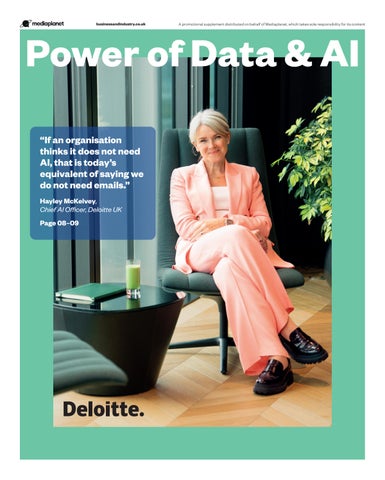
Power of Data & AI “If an organisation thinks it does not need AI, that is today’s equivalent of saying we do not need emails.” Hayley McKelvey, Chief AI Officer, Deloitte UK Page 08–09
A PROMOTIONAL SUPPLEMENT DISTRIBUTED ON BEHALF OF MEDIAPLANET, WHICH TAKES SOLE RESPONSIBILITY FOR ITS CONTENT
Think twice when trusting AI for security and decision-making While AI can accelerate decisions, trust depends on secure data, strong governance and professionals who know when to challenge the technology.
N
Scott Beale, CC Chief Executive Officer, ISC2
early nine in 10 (89%) cybersecurity professionals who use AI have experienced recommendations that led to incorrect outcomes, according to ISC2’s AI Impact report.1 When that happens, half say their organisations ultimately hold human decision-makers accountable. AI may accelerate cybersecurity decisions, but it does not absorb the consequences. As organisations race to adopt AI, building trust may depend less on the tools themselves and more on those responsible for using them.
AI influence in the workplace
AI is rapidly becoming part of business decisions, helping organisations analyse information, automate tasks and improve efficiency. As AI becomes more influential, questions about accuracy, accountability and trust persist. While it can accelerate decision-making, professionals should remain cautious about AI’s reliability and when human intervention is required. Research from ISC2’s AI Impact report shows cybersecurity professionals are concerned about over-reliance on AI recommendations (62%), undetected AI errors that could scale rapidly across systems (61%) and reduced human judgement at critical decision points (56%).1 AI systems depend on data. Inaccurate, incomplete or manipulated inputs can produce unreliable outputs and allow errors to spread at scale. Protecting data throughout its lifecycle underpins AI security, cyber resilience and digital trust.
Keeping humans in the loop
As organisations integrate AI into workflows, cybersecurity professionals remain involved in decision-making and oversight. ISC2’s AI Impact report found that 65% of cybersecurity professionals are spending more time deciding when to trust AI recommendations, while 63% spend more time reviewing or validating AI outputs.1 Strong governance remains essential. Cybersecurity professionals identified understanding when to trust AI outputs (82%), when to override recommendations (80%) and establishing governance frameworks (80%) as critical priorities.1 Organisations often answer technology challenges by buying more technology. However, trustworthy AI requires professionals trained to protect data, test output and know when to override the machine. Building those capabilities through education and professional development will be essential as AI adoption accelerates. Sometimes the best answer to a technology problem is not another tool, but a better-trained person. 1
www.isc2.org/Insights/2026/07/rethinking-ai-impact-on-cybersecurity-roles
The Leading EU Event for Enterprise AI and Big Data 19-20 October 2026 RAI, Amsterdam
@Mediaplanet UK & IE
Join European enterprises, AI pioneers and global technology partners as they move generative AI and autonomous agents from pilot to production. Covering agentic AI, AI governance, and enterprise infrastructure at scale.
@MediaplanetUKIE
Contact information: uk.info@mediaplanet.com or +44 (0) 203 642 0737
Please recycle
Senior Project Manager: Lydia Butler lydia.butler@mediaplanet.com Business Development Manager: Jack Adamson Managing Director: Margot Thomas | Designer: Juraj Prikopa Senior Content Manager: Angelica Hackett O’Toole | Paid Media Strategist: Jonni Asfaha Digital Campaign Manager: Jan Martorell | All images supplied by Getty Images, unless otherwise specified
02
MEDIAPLANET
READ MORE AT BUSINESSANDINDUSTRY.CO.UK
A PROMOTIONAL SUPPLEMENT DISTRIBUTED ON BEHALF OF MEDIAPLANET, WHICH TAKES SOLE RESPONSIBILITY FOR ITS CONTENT
Delaying recovery investments raises business risk As ransomware attacks become more common and recovery outcomes worsen, organisations must prioritise resilient backup and recovery strategies.
E
Pete Hannah VP Sales, Western Europe, Object First
conomic uncertainty is forcing organisations software-based immutability and hardware-enforced to scrutinise every technology investment. immutability.1 Software controls can potentially be disabled Rising operating costs, or bypassed if attackers gain supply chain pressures privileged access. Hardwareand growing investment in enforced approaches are designed AI initiatives are prompting to prevent changes to protected Strong backup architecture many businesses to postpone backup data during the retention infrastructure upgrades. period, helping preserve recovery should combine immutable points against tampering or storage, controlled access Recovery matters most deletion. Backup and recovery systems can Strong backup architecture and -regularly tested recovery appear to be an easy target for should combine immutable processes. budget reductions, particularly storage, controlled access when organisations are focused on and regularly tested recovery prevention technologies. However, processes. Together, these an IDC Spotlight published in capabilities help organisations June 2026 suggests that delaying backup and recovery recover faster and reduce the operational and financial investments may pose greater risks than the savings they consequences of cyber incidents. yield.1 Security controls help to reduce the attack surface, but no The cost of waiting organisation can assume prevention alone will stop every Many organisations delay modernisation projects while attack. When cybercriminals gain access to production waiting for economic conditions to improve. Yet, cyber environments, the ability to recover data quickly and threats do not slow down during periods of financial reliably becomes the foundation of cyber resilience. pressure. The costs associated with ransomware, including In practice, recovery capabilities determine how downtime, lost productivity, recovery efforts, reputational effectively an organisation can withstand operational damage and potential regulatory consequences, can quickly disruption, limit financial losses and maintain customer exceed the investment required to establish a resilient trust following a cyber incident. recovery framework. Organisations face growing expectations from regulators, Ransomware recovery is worsening customers and business stakeholders to demonstrate that The case for continued investment is reinforced by recent they can withstand and recover from cyber incidents. industry research. A study conducted by Omdia found that The UK’s Cyber Security and Resilience Bill reinforces the 83% of organisations experienced a successful ransomware importance of protecting the continuity of essential and attack during the previous 24 months. Recovery is often digital services. For business leaders, this strengthens the slow: in 79% of cases, it took more than five working days, case for treating recovery readiness as a business priority, overrunning the organisation’s Recovery Time Objective with investment decisions grounded in proven recovery (RTO) in most instances. On average, just 61% of the capabilities.4 affected data was recovered. Worryingly, the study points Taken together, the research findings and the UK’s to declining recovery performance compared with previous regulatory direction strengthen the case for treating backup surveys.2 and recovery investment as a business resilience priority.5 The research also revealed that many organisations When prevention fails, recovery capabilities determine understand the importance of recoverability but have not how quickly the business can return to normal operations. modernised the underlying infrastructure needed to deliver Waiting to strengthen those capabilities may ultimately it. prove far more expensive than acting now.
The value of immutability
Attackers increasingly target backup repositories because they recognise that recovery is often the last line of defence. Cyber criminals target backup repositories in 89% of cyberattacks and modify or delete one-third of the repositories targeted.3 If backup data can be encrypted, deleted or altered, recovery becomes difficult or impossible. The IDC Spotlight analysis distinguishes between READ MORE AT BUSINESSANDINDUSTRY.CO.UK
1
2
3
4
5
IDC Spotlight, sponsored by Object First. (2026, June). The Danger of Deferring Backup and Recovery Investments (Doc. #US54572026). Omdia Research, commissioned by Object First. (2026). 2026 Ransomware Recovery Study. tinyurl.com/y2t4mf92. Object First. (n.d.). Cyber Security and Resilience Bill: Compliance Guide & Checklist. tinyurl.com/bdfp7n32 Object First. (n.d.). Cyber Security and Resilience Bill: What It Is and Who It Affects. tinyurl.com/5fr2e9pz Veeam. (2025). 2025 Ransomware Trends Report. tinyurl.com/3s4w3nbj
Paid for by Object First
Find out more at objectfirst.com
MEDIAPLANET
03
A PROMOTIONAL SUPPLEMENT DISTRIBUTED ON BEHALF OF MEDIAPLANET, WHICH TAKES SOLE RESPONSIBILITY FOR ITS CONTENT
Understanding the risks and benefits of workplace ‘vibe coding’ Vibe coding offers big benefits, such as increasing staff productivity. Even so, organisations must be aware of its risks — and the importance of security and good governance.
I
INTERVIEW WITH Ollie Kretovs Partnerships, EMEA, Retool
WRITTEN BY Tony Greenway
Paid for by Retool
Find out more at
04
MEDIAPLANET
f your organisation has the right guardrails in latest AI models have become capable enough to generate place, you’ll find there are some major upsides to fully working applications from a singular prompt (ie. ‘vibe coding’. The trouble is, without the proper one single sentence). On the other, more businesses are protections, there can be some major downsides, being pressured to deliver AI outcomes. In one of our latest too. It’s that lack of governance and security that is giving reports, 90% of senior managers and security leaders said leaders pause for thought and preventing wider adoption they were under increased pressure to enable AI-powered of this ultra-accessible, AI-enabled software development app building.” process. In truth, the benefits and risks that vibe coding present The productivity and money-saving benefits of vibe are not widely recognised — yet — because it’s a relatively coding new term for a relatively new This is why, in theory, vibe coding practice. It was coined by is such an attractive prospect. As artificial intelligence researcher it’s easy to do, staff don’t have to You don’t have to be a coding and computer scientist Andrej for over-stretched technical expert to create applications such wait Karpathy in early 2025 to describe teams to get around to building the a way of building software with as websites, chatbots, dashboards applications they need or want. AI. In a social media post, he said: They can simply do it themselves. and other software tools anymore. “It certainly allows coding to “There’s a new kind of coding I call ‘vibe coding’, where you happen faster,” agrees Kretovs. “It fully give in to the vibes, embrace democratises software building. exponentials, and forget that the code even exists.” When we look at our stats, we see that just 36% of our users are developers. The rest are non-developers.” A quick and efficient way to democratise software It’s precisely because those non-developers are now able building to make their own software apps that vibe coding becomes a In other words, you don’t have to be a coding expert to potential money-saver for a business. “Organisations don’t create applications such as websites, chatbots, dashboards have to hire people on large salaries to do their coding,” and other software tools anymore. Thanks to the way AI has he says. “In that sense, vibe coding is definitely more evolved, pretty much anyone in any organisation can do it cost-effective.” these days. You simply tell the technology what you want in However, stresses Kretovs, this doesn’t make technical plain language — and then sit back and let it do the rest. teams redundant. “We’ve transitioned to the point It sounds simple (and it is), but the results could optimise where writing lines of code is not really central to the the way you work. You might be, say, a health professional programming experience,” he says. “Understanding who wants to build an application to better track patient software concepts such as architecture, testing, security and data, or a finance team that needs a tool to quickly review debugging has become a lot more valuable.” customer contracts. Whatever type of operational software you need, vibe coding can swiftly deliver it for you. Vibe coding risks have been a barrier to its wider adoption “Two forces have converged to bring vibe coding into The positives, then, are plain. However, in practice, the focus right now,” explains Ollie Kretovs, Partnerships, inherent risks of vibe coding are a barrier to its use. One of EMEA at Retool, a secure vibe coding platform which works the biggest concerns is around safety. After all, a vibe-coded with global enterprises of every size. “On one side, the prototype might look wonderful and work well, but if it READ MORE AT BUSINESSANDINDUSTRY.CO.UK
A PROMOTIONAL SUPPLEMENT DISTRIBUTED ON BEHALF OF MEDIAPLANET, WHICH TAKES SOLE RESPONSIBILITY FOR ITS CONTENT
hasn’t been created and tested by a member of the technical control of the AI tools used for vibe coding. In effect, it team, how can users be sure that it’s properly secure? allows technical staff to become administrators of these “The software you build may look and feel impressive,” tools and decide who gets access to them — and who admits Kretovs. “But that can give people a false sense of doesn’t. security. If your staff are building shadow AI applications “A centralised platform also gives technical teams an and spreading them around the business, they may not be overview of the apps that staff are building along with the thinking about the technical aspects and governance that data sources they are using,” explains Kretovs. “It’s a way to make a system safe.” make sure that no one is accessing systems they shouldn’t There are a number of other reasons why vibebe accessing.” Technical teams can then test, monitor and coded prototypes never reach maintain the applications that production. For example, an have been built and ensure they The solution to all of these application will need access to present no security risk — and company systems and data. But they can grant the permissions to challenges is a governed, how can an organisation control access them. It’s a risk mitigation centralised platform which gives innovation that is the key to what data the app can access — and who is allowed to access it? an organisation’s technical team unlocking real adoption of AI and Will the app be able to connect to AI-driven rewards. complete visibility and total any data reliably and securely? Will it be running in the cloud? Understanding what comes next control of the AI tools used for And could it be leaking data in the vibe coding journey vibe coding. outside your four walls? If that Because of technology like this, happens, it could prove to be a Kretovs is optimistic about the costly experience. future of vibe coding in the workplace. If carried out safely Depending on the case, it may expose your organisation and securely, he believes it’s just too good an opportunity to very large fines, notes Kretovs. If, say, customer data is to pass up. “It allows people who have direct knowledge of a compromised, it could result in legal action, too. According problem to build the apps, websites and chatbots needed to to Retool, 39% of users say that integration challenges solve it,” he says. “It means that projects that were proposed between systems are a barrier to continuing with AI but never built — for many different reasons — are able to adoption; while 41% have concerns around data privacy, come to fruition.” governance and protecting proprietary information. Teams at Retool have certainly used vibe coding to Finally, when vibe-coded software is built, who will review increase their productivity. But, as you would expect, robust and test it pre-deployment, and then host, monitor and guardrails secure the entire process. “If I vibe code an app,” manage it post-deployment? Who is ultimately responsible says Kretovs, “it still has to be tested by other teams before for applications that are built by members of staff outside of it’s approved as an official business system.” the software development team? His advice for any organisation new to vibe coding is simple: Take the same care. And make visibility and good Why a centralised platform is key to governance and governance central to your vibe coding journey, rather security than just trying to add it on as an afterthought. “Done the Kretovs believes that the solution to all of these challenges right way, vibe coding will give everyone the chance to turn is a governed, centralised platform which gives an their ideas and experiments into secure live projects,” says organisation’s technical team complete visibility and total Kretovs. “It could help transform the way they work.”
READ MORE AT BUSINESSANDINDUSTRY.CO.UK
MEDIAPLANET
05
A PROMOTIONAL SUPPLEMENT DISTRIBUTED ON BEHALF OF MEDIAPLANET, WHICH TAKES SOLE RESPONSIBILITY FOR ITS CONTENT
A practical data strategy guide for local Government Your data is a strategic asset. Going beyond storage and management sets you up to become a genuinely data-led organisation. With LGR (local government reorganisation) affecting so many in England, this is the time to tackle it.
F
ifty-four per cent of UK councils lack a formal data strategy.1 Let’s get you started, or start checking what’s underway.
Building your data strategy Diana Rebaza Senior Research Analyst, Socitm
06
MEDIAPLANET
1. Establish a data governance framework and start data literacy training (0–6 months): Set a clear structure, defining roles and responsibilities for data management. You’ll need to keep this framework current and keep testing its effectiveness. Find (and repeat) training for yourself and colleagues to improve data management and data-driven decision-making skills. 2. Implement a data integration platform and data quality framework (6–18 months): Implement a unified platform or warehouse for access to data and connected information across all your systems. Create and use
standards and processes so your data is up to date. 3. Set up data security, compliance and decision-making tools (6–18 months): Secure residents’ data while ensuring transparency and trust. Set up dashboards and reporting systems to support your data-driven decision-making.
councils to share best practices and learnings. 6. Monitor (ongoing): Set clear KPIs, milestones and reviews to check progress toward better data management practices.
The timescales are estimates, and the steps don’t need to be sequential. Adapt them to your own priorities, maturity, capacity and local A clear, pragmatic data strategy context. A clear, pragmatic data strategy builds core capabilities (people, builds core capabilities (people, process, technology, governance, process, technology, governance, culture) and aligns place-based culture). outcomes, public trust (data protection and ethics) and service reform goals. Find out what others 4. Create a data-driven culture (18+ are doing. You don’t have to start from months): Support everyone to a blank page. confidently and effectively use data. 1 Local Government Association. (2024). Local Make sure you know where or who government data capacity and capability. to go to for support. https://tinyurl.com/54cfsxdc. 5. Collaborate (6–18 months): Benchmark and check with other READ MORE AT BUSINESSANDINDUSTRY.CO.UK
A PROMOTIONAL SUPPLEMENT DISTRIBUTED ON BEHALF OF MEDIAPLANET, WHICH TAKES SOLE RESPONSIBILITY FOR ITS CONTENT
Britain builds its own AI power As the UK bets billions on sovereign AI, one quiet success story proves data sovereignty isn’t a slogan; it’s already working.
S
Piers Kelly Head of Marketing – Technology & Healthcare, GovNet
omewhere beneath a British liability. without losing control of what matters street, a council engineer UK firms are closing the gap with most. checks pipes, cables and US suppliers in public AI contracts mains before breaking faster than anyone predicted. This is Where this gets decided ground, not by guesswork, but by industrial strategy, and it’s starting to That is exactly the conversation querying the National Underground pay off. happening at DigiGov Expo, Excel, Asset Register (NUAR). This is a single London, on 23 and 24 September, UK-built map of the country’s where public sector leaders will buried infrastructure. debate balancing sovereign control NUAR has already saved cloud scalability, build the Sovereignty isn’t only about who with hundreds of millions of pounds cyber skills pipeline the moment owns the algorithm. It’s grid by preventing accidental strikes demands and learn from real case on gas lines and fibre cables. It’s of what works, and what capacity, GPUs and cyber talent; studies also a working template for what doesn’t, in cloud migration. sovereign data can achieve when NUAR proves sovereign data not just policy. Britain owns the end-to-end isn’t a slogan; it’s deliverable and pipeline. valuable. The question DigiGov Sovereignty is physical Expo puts to 3,000 public sector Backing sovereignty with billions Sovereignty isn’t only about who owns leaders this month is simple: what’s That template matters, because the algorithm. It’s grid capacity, GPUs the next one? Government has placed a serious and cyber talent; not just policy. 1. McKenna, B. (2026). UK government’s £500m bet on the word ‘sovereign’: a £500 Get the infrastructure right, resilient sovereign AI fund bids to commercialise research. million Sovereign AI Unit,1 a £1.1 cloud strategies, edge computing that https://tinyurl.com/66ss8z7a. billion national supercomputer keeps data close to home, a workforce 2. Horwood, P. (2026). AI Hardware Plan combines 2 commitment and a National Data trained to defend what we build, investments in sovereign compute, chip Library turning public data into a and Britain can keep benefitting development, capital and skills. https://tinyurl. strategic asset rather than a scattered from global research and innovation com/2f5tvcer.
READ MORE AT BUSINESSANDINDUSTRY.CO.UK
MEDIAPLANET
07
A PROMOTIONAL SUPPLEMENT DISTRIBUTED ON BEHALF OF MEDIAPLANET, WHICH TAKES SOLE RESPONSIBILITY FOR ITS CONTENT
Strong leadership critical to AI implementation Businesses must not lose sight of strong leadership and the value of their human workforce as they strive to build AI into the fabric of their organisations, according to a leading expert in the field.
D
irection from the C-suite — either from the CEO or a designated executive taking responsibility for the introduction, use and objectives of AI — is essential. According to Deloitte UK’s Chief AI Officer Hayley McKelvey, this defines AI’s deployment while reassuring the workforce that may be apprehensive about its adoption.
AI depends on leadership
“The AI opportunity is a leadership, rather than a technological challenge, but that is sometimes not fully grasped,” she says. “That’s why organisations need to have that job at an executive level.” McKelvey suggests that companies that put AI on the executive agenda make “demonstrably more progress.” “AI is incredibly systemic and goes through the veins of an organisation. It needs somebody with permission and experience to look across the whole organisation and think about how to affect change coherently across a multitude of different places.” However, reality paints a different picture. A 2025 Deloitte survey of 1,854 executives showed that only 10% of companies have their CEO as the primary AI lead.1
Scaled impact Spread paid for by Deloitte
08
MEDIAPLANET
With the ability to connect trusted data, provide analytics and offer AI-enabled automation, AI implementation has become an imperative, with 96% of FTSE 100 companies referencing it in their annual reports, though the maturity level of those organisations differs dramatically.2 “That is often relative to size, the level of regulation and technological debt, as well as risk appetite and the ability to
transform,” she adds. “When it comes to people, workers are definitely keen to experiment with AI and are using it quite prolifically, but most organisations are still on a journey of connecting that use, curiosity and experimentation and turning it into scaled impact across the business.” McKelvey has recently stepped into the role of Chief AI Officer at Deloitte, having been with the company for 23 years and previously overseeing AI in its Tax and Legal business. Her appointment — the first at C-suite level in Deloitte — highlights the importance of high-level leadership in the AI arena.
INTERVIEW WITH Hayley McKelvey Chief AI Officer, Deloitte UK
Workforce survey
Deloitte closely monitors AI growth in the workplace, with its GenAI Workforce Survey of 25,000 UK workers highlighting how employees use the tool and how organisations are responding.3 Some 63% use generative AI (GenAI) for work, including drafting emails, searching for information and creating summaries. Of these, 46% are using free tools, 34% use external tools paid for by their employer and 17% use in-house tools. But some workers pay for their own GenAI tools for work, showing that some employees are embracing the technology quicker than organisations are making it available.
WRITTEN BY Mark Nicholls
Clear AI vision empowers employees
Additionally, 65% report a lack of convincing leadership on how GenAI should be used in their organisation, prompting McKelvey to suggest companies must be clear on why they are using AI. “Unless you can explain why you are doing READ MORE AT BUSINESSANDINDUSTRY.CO.UK
A PROMOTIONAL SUPPLEMENT DISTRIBUTED ON BEHALF OF MEDIAPLANET, WHICH TAKES SOLE RESPONSIBILITY FOR ITS CONTENT
continues. “You are asking humans to become increasingly polymathic — to be great at interacting with AI but also retain what they are good at as a human and not just taking what AI says as a given.”
AI costs are rising
Scan to find out more about the Deloitte GenAI Workforce Survey
Cost remains a factor in deciding AI deployment. Deloitte say 85% of organisations increased their AI investment in 2025, but ROI remains at two to Leaders who understand four years compared to the typical what the business is trying to payback period of seven to 12 months expected for technology achieve, stratifying where they investments.1 Across industries, generative AI has become the can use AI and for what end, line item in breed confidence throughout a fastest-growing corporate technology budgets, it, what it should look like and to already consuming up to half of IT company. what end, it is very difficult for spend in some firms.4 organisations to create enterprise Companies must measure value out of the use of AI,” she adds. and manage the total cost of AI ownership. Deloitte helps That clarity of vision can empower employees and reduce clients to understand the cost and the rapidly developing fear of AI, particularly among those feeling stressed or economics of AI. AI cost is shaped by what you run and anxious about their jobs. As companies strive to turn AI how you run it. Deloitte’s recently launched open model ambition into measurable business value, employees should engineering practice specifically supports clients to scale be given the space to learn to use the tools effectively. agentic AI using a mix of open and proprietary models. “You cannot shortcut this,” she says. “Learning to work with AI depends on the job you’re doing; one size does not AI trustworthiness fit everyone.” Consequently, leaders who understand what With its immense power and the ability to enable the business is trying to achieve, stratifying where they can businesses to harness data, AI is the technical present, and use AI and for what end, breed confidence throughout a most definitely the future. “If an organisation thinks it does company. not need AI, that is today’s equivalent of saying we do not need emails,” warns McKelvey. Efficiency, innovation, resilience Companies, she adds, should be circumspect, but “It is so important for organisations to know what they also optimistic in looking at the business opportunities stand for when it comes to AI,” she adds. “AI represents a and risks. But the question remains: can AI be trusted? significant opportunity for many brilliant things to happen “Business leaders should always think carefully about trust but also has a lot of scary prospects around it. I think it is and risk,” says McKelvey. “But today’s business challenge possible to feel both optimism and trepidation at the same is not superintelligence. Today’s challenge is responsible time.” implementation. We’ve already seen examples that remind Organisations must think consciously about how they us how powerful technologies need oversight, testing and bring AI into the workplace, balancing AI and the human governance. That’s why organisations need clear policies, workforce. “We should not surrender human judgement human accountability and robust controls around AI use.” to AI systems,” explains McKelvey. “Creativity, ethical The lesson isn’t ‘don’t use AI.’ The lesson is ‘use AI judgement and decision-making remain fundamentally responsibly.’ She adds: “There is a lot that can be done from human strengths. AI can support these activities, but it a technical architecture, governance and people training should not replace our role in them. perspective to create safe and robust environments so that “If you take the things that are uniquely human with people can benefit from AI without leaving an organisation those that are incredibly powerful about AI and push them exposed.” together, that is where value lies and where organisations, 1 Michalski, J. (2025). AI ROI: The paradox of rising investment and elusive returns. and their people, will do really well.” As AI becomes more tinyurl.com/3h3kb8xz. prevalent, McKelvey believes that human relationships 2 Deloitte. (2026). Deloitte CFO Survey Q2 2026: Growing AI optimism. tinyurl.com/ become more important. mvaju5hx. “It might feel paradoxical, but as businesses increasingly 3 Deloitte. (2026) GenAI Workforce Survey 2026. tinyurl.com/3p46mutv 4 weave AI into their fabric, and people work with AI Deloitte. (2026). Navigate the economics of AI. tinyurl.com/au3vksch colleagues, the need for human relationships, proximity and empathy arguably increases rather than falls away,” she
READ MORE AT BUSINESSANDINDUSTRY.CO.UK
MEDIAPLANET
09
A PROMOTIONAL SUPPLEMENT DISTRIBUTED ON BEHALF OF MEDIAPLANET, WHICH TAKES SOLE RESPONSIBILITY FOR ITS CONTENT
ICO: how data protection builds trust AI is transforming how organisations operate and how people access information, products and services. The Information Commissioner’s Office (ICO) is the UK’s independent regulator for data protection. WRITTEN BY Richard Nevinson Director of Technology Regulation, ICO
F
rom the training of underlying models to the decisions they inform, AI systems rely on personal data at every stage. Where personal data is used, data protection law applies. But only 33% of people trust companies to protect their personal data when using AI.1 Thus, the organisations that benefit most from AI will be those that build and maintain public trust by protecting their data. Getting data protection right helps organisations to invest in, develop and scale innovative technologies that people will genuinely want to use.
Four steps to prioritise data protection
Adopt privacy by design: Build privacy, transparency and accountability into AI-powered products and services from the outset, so organisations and people understand what data is being used and how it shapes outcomes. Put people at the centre of AI decisions: Fairness and bias testing should be continuous, not one-off. Organisations are responsible for the impact of their systems on people at every stage of their lifecycle. Access support to innovate responsibly: ICO Innovation
10
MEDIAPLANET
Services offer tailored support, from quick turnaround advice to longer-term regulatory sandbox analysis, helping organisations test new ideas and embed privacy into products and services. Stay updated: With AI evolving rapidly, organisations should stay up to date on regulatory expectations. We have a range of guidance focused on data protection compliance in AI and will continue to produce as the technology develops.
Focus on the foundations
Public confidence in AI adoption won’t happen by default. It requires organisations to take their legal obligations seriously and make privacy and security central to their development and use of AI, rather than an afterthought. As the data protection regulator, we’re here to support organisations to innovate with confidence. But we will act where organisations fall short and put people at risk. Data protection isn’t just a legal obligation — it’s the foundation for AI innovation that people can trust. 1
Ipsos AI Monitor. (2025). The Ipsos AI Monitor 2025. https://tinyurl.com/mpr4v3vs.
READ MORE AT BUSINESSANDINDUSTRY.CO.UK
A PROMOTIONAL SUPPLEMENT DISTRIBUTED ON BEHALF OF MEDIAPLANET, WHICH TAKES SOLE RESPONSIBILITY FOR ITS CONTENT
It’s time enterprise AI moved beyond pilot stage I recently asked a room of enterprise and business leaders why they believe AI agents stall after launch. It became clear that after the hype has subsided, the road ahead feels more uncertain.
T
he evolution from generative to agentic AI is redefining how enterprises interpret data, make decisions and deliver customer experience. As evidence of ROI grows, appetite for agentic AI is undeniable, so why have so few moved past the pilot stage?
Customer experience AI divide
Good data governance powers AI
I don’t believe it’s a technology problem. The technology is here: agile, proven and accessible. It’s enterprise maturity (in IT architecture and governance) holding back meaningful progress. Real deployment needs to work across legacy systems, multiple languages and channels and strict compliance requirements — all with zero tolerance for getting a customer-facing interaction wrong. Projects stall here because of the gap between what AI can do in a controlled environment and what it delivers in the real world, against real customers, systems and complexity. We call this the CX AI Divide.
What ‘enterprise-ready’ really means
Good data governance, not clever algorithms, turns AI from a costly gamble into a genuine business advantage.
G
Lisa Ventura MBE FCIIS Founder, AI & Cyber Security Association (AICSA)
artner predicts organisations will abandon 60% of AI projects through 2026 because the data behind them isn’t ready.1 A separate Gartner survey found 63% of data leaders lack the right data management practices or are unsure they have them.2 Good governance changes the picture.
Governance builds digital trust
Under UK GDPR, the accountability principle set out by the Information Commissioner’s Office requires organisations to demonstrate, not merely claim, responsible data handling. This discipline protects customers and pays for itself. Gartner research puts the average cost of poor data quality at $12.9 million a year for a typical organisation.2 A Forrester study found over a quarter of organisations lose more than $5 million a year to poor data, with 7% losing $25 million or more.3 Strong governance cuts this risk and builds customer trust.
What good governance looks like
Good governance starts with clear ownership of data, defined quality standards and honest audits of what an organisation holds. Appointing a named data owner in each team assigns accountability, rather than leaving governance to chance. READ MORE AT BUSINESSANDINDUSTRY.CO.UK
Training staff to treat data as a shared asset, not an afterthought, matters too. A short data audit, run twice a year, catches problems before they reach a live AI system. Regular audits and clear accountability for data quality deliver results faster than any algorithm alone.
Data good enough to make any algorithm worth using is the real win. Organisations getting governance right gain genuine value from AI: faster decisions, fewer errors and systems people trust. Staff spend less time firefighting bad data and more time on work worth doing. The prize isn’t a smarter algorithm. Data good enough to make any algorithm worth using is the real win. Good governance isn’t a barrier to innovation, but the foundation innovation stands on. 1
2
3
Gartner. (2025). Lack of AI-ready data puts AI projects at risk. https://tinyurl.com/y76xx7vb. Gartner. Data quality: best practices for accurate insights. https://tinyurl.com/4642xpnp. Forrester. (2024). Millions lost in 2023 due to poor data quality, potential for billions to be lost with AI without intervention. https://tinyurl.com/mr53zy4h.
As part of our recent ‘State of Agentic CX’ study*, we tested this gap directly, evaluating 10,000 enterprise websites and conducting 4,000 live chat and voice interactions. The results were stark, with 92.5% of the chatbots we could classify still running on inflexible rule-based systems, not real AI. Just 8.9% of chat conversations resolved the customer’s issue. This is the problem AI agents are meant to solve. Yet, too often, behind the ambition sits a decades-old infrastructure that’s unable to support the potential of agentic AI. Enterprise-ready AI needs a firm foundation with governance, regular testing and safety controls built in from day one. The practical fix is in better operating discipline. An AI agent isn’t software you configure once. It needs continuous testing, monitoring and optimisation as products, policies and customer expectations shift. Sustained improvement, and ultimately ROI, will come from treating every deployment as an ongoing, evolutionary requirement. The appetite to reinvent customer experience is there. Closing the gap means building a strong foundation – in the tech stack, in the data and in the teams who make it work. *
Parloa ‘State of Agentic CX’ Study, 2026
Malte Kosub Co-Founder & CEO, Parloa
Paid for by Parloa Find out more at: www.parloa.co.uk
MEDIAPLANET
11
A PROMOTIONAL SUPPLEMENT DISTRIBUTED ON BEHALF OF MEDIAPLANET, WHICH TAKES SOLE RESPONSIBILITY FOR ITS CONTENT
AI’s biggest infrastructure opportunity lies beyond individual systems AI-led solutions can potentially build and support the infrastructure to meet growing electricity demand. But too often, debate is dominated by concerns around AI’s electricity use.
F
or too long, AI, compute and advanced connectivity technologies have been thought of in isolation, each treated as a separate infrastructure challenge. They must be considered collectively to improve existing infrastructure and unlock new opportunities. Luke Sperrin Head of Clean Energy Industries, Digital Catapult
Using AI to better utilise existing infrastructure
One area where AI can make a difference is asset management and network planning. The IEA estimates that widespread AI use could unlock up to 175 GW of additional transmission capacity from existing power lines, allowing operators to better utilise existing infrastructure.1 This is equivalent to approximately three times Great Britain’s 2024 peak electricity demand.2 The UK Government’s Review of AI Deployment in the Electricity Networks also identifies forecasting, optimisation and energy flexibility as areas where existing approaches will need to evolve as the electricity system becomes more complex.
Moving towards whole-system optimisation
Improving individual assets is only part of the answer. The UK’s energy, compute and connectivity infrastructure is increasingly interdependent, and planning each separately risks creating inefficiencies elsewhere. Decisions on where to locate new data centres, for example, need to consider
12
MEDIAPLANET
grid capacity, access to renewable energy and storage and high-capacity connectivity. Together, these factors can help make better use of existing infrastructure and limit the additional pressure AI places on the electricity system. DeepMind has demonstrated that machine learning can increase the value of wind energy by approximately 20%, using AI-based forecasting to better predict wind power output and optimise commitments to the electricity grid.3 At Digital Catapult, we’re working with industry to support AI integration in telecommunications networks and its responsible use across energy networks and infrastructure. This includes giving businesses the expertise and environments to test new approaches and make informed decisions about deployment. The challenge is no longer simply proving what AI can do. That’s why we’re providing high-quality, interoperable data, trusted environments for testing new applications and closer collaboration between technology innovators and infrastructure operators to turn promising ideas into realworld infrastructure. 1 2
3
IEA. AI for energy optimisation and innovation. tinyurl.com/5n8wsrb4. NESO, 2025. Future Energy Scenarios: Pathways to Net Zero. tinyurl.com/ y7kdwvwy Elkin & Witherspoon, 2019. Machine learning can boost the value of wind energy. Google DeepMind. tinyurl.com/57h88xrx
READ MORE AT BUSINESSANDINDUSTRY.CO.UK
A PROMOTIONAL SUPPLEMENT DISTRIBUTED ON BEHALF OF MEDIAPLANET, WHICH TAKES SOLE RESPONSIBILITY FOR ITS CONTENT
READ MORE AT BUSINESSANDINDUSTRY.CO.UK
MEDIAPLANET
13
A PROMOTIONAL SUPPLEMENT DISTRIBUTED ON BEHALF OF MEDIAPLANET, WHICH TAKES SOLE RESPONSIBILITY FOR ITS CONTENT
Power of data, from months to minutes Meaningfully utilised, data can positively impact nations.
I
t begins with one measurement. A sensor clipped to a buried pipe records nothing more than sound. On its own, it’s meaningless.
Data’s impact Dr Mehdi Snene Senior Advisor to the United Nations Secretary-General’s Special Envoy on Digital and Emerging Technology, UN-ODET
14
MEDIAPLANET
from public space agencies with climate data and ground observations, scanning millions of square kilometres and converting them into near real-time alerts. Multilateral bodies, national agencies and community monitors see the same alert on the same day. Measure the distance travelled. Satellites have watched the tropics since the 1970s, but the picture arrived months late, in formats few institutions could read. Digital and emerging technologies have collapsed that lag from months to minutes.
Multiply it by 75,000, and something changes. Across London, that many acoustic sensors listen to the water mains, up from last year’s 21,000. Machine learning separates the signature of escaping water from traffic, footfall and construction, Capability may be abundant, but while satellite imagery flags the soil disturbance a rupture leaves Signal already exists; cooperation reach is not, and reach is what above ground. Two data streams, decides who hears it cooperation delivers. combined, roughly doubled Capability may be abundant, but detection accuracy. reach is not, and reach is what Raise the scale, and that logic cooperation delivers. Shared crosses a border. In the Amazon standards let an observation made and Sumatra, solar-powered in one system be read in another, monitors listen from a canopy no satellite can see through. so that a country need not rebuild what already exists. The models must learn a harder distinction: a falling Settled data governance determines who owns a recording branch from a two-stroke engine, ambient forest from an and who controls an alert, questions no algorithm answers. approaching truck. When the pattern matches, alerts reach Public infrastructure, from open satellite feeds to open indigenous patrol teams in minutes rather than at the end models, keeps the raw material available to every state, not of a reporting cycle. just those that can afford it. And capacity building decides Raise it once more, and it becomes planetary. Platforms whether an alert that lands in a ministry with no analysts is such as Global Forest Watch fuse radar and optical feeds acted on or archived. READ MORE AT BUSINESSANDINDUSTRY.CO.UK
A PROMOTIONAL SUPPLEMENT DISTRIBUTED ON BEHALF OF MEDIAPLANET, WHICH TAKES SOLE RESPONSIBILITY FOR ITS CONTENT
READ MORE AT BUSINESSANDINDUSTRY.CO.UK
MEDIAPLANET
15
A PROMOTIONAL SUPPLEMENT DISTRIBUTED ON BEHALF OF MEDIAPLANET, WHICH TAKES SOLE RESPONSIBILITY FOR ITS CONTENT
16
MEDIAPLANET
READ MORE AT BUSINESSANDINDUSTRY.CO.UK