



“Access to high-performance infrastructure and
trained
models is reshaping who anticipates disruption and who merely absorbs it.”

Dr Mehdi Snène, Senior Advisor, United Nations Office for Digital and Emerging Technologies Page 06



“True supply chain responsibility acts as an early warning system against modern operational disruption.”
Abe Eshkenazi, CEO, ASCM Page 02
“Resilience is shifting from an operational compliance issue to a strategic source of competitive advantage.”
Fiona Watson, Vice President, Corporate Performance and Accountability, WBCSD Page 04
Geopolitical tensions highlight the vital role of shipping and seafarers.

WRITTEN BY Arsenio Dominguez Secretary-General, International Maritime Organization
Shipping has always shown remarkable resilience in the face of global crises. Throughout every major challenge, ships and the people who operate them kept the world moving.
During the COVID-19 pandemic, when much of the world came to a standstill, seafarers continued working tirelessly to ensure that essential goods reached every corner of the planet. During tensions in the Red Sea and the Black Sea, the industry adapted under immense pressure to keep supply chains functioning.
Today, in the Strait of Hormuz, that resilience is being tested in unprecedented ways.
Around 20,000 seafarers on hundreds of vessels remain stranded in the Persian Gulf, exposed to significant risks and enduring immense psychological strain. Beyond the human toll, the disruption to international shipping carries far-reaching consequences for global trade, energy markets and food security.
For more than seven decades, the International Maritime Organization (IMO) has brought 176 Member States together to uphold a robust regulatory framework that protects these principles and those who work at sea.
Maintaining safety standards and adapting to new threats
Since the 1980s, IMO has consistently worked to strengthen maritime safety standards and adapt them to emerging threats. The current geopolitical landscape demonstrates just how crucial these multilateral efforts are to maintaining maritime security and global stability. Seafarers must never be used as collateral victims of conflict.
Throughout every major challenge, ships and the people who operate them kept the world moving.
At an extraordinary session of the IMO Council in March 2026, Member States reaffirmed four core principles: respect for freedom of navigation; the paramount importance of seafarer safety; the recognition that seafarers must never be used as pawns in geopolitical tensions; and the essential role of dialogue and diplomacy in restoring stability.
Protecting the principles of freedom of navigation and seafarers
The world is fast realising an overlooked truth – shipping is indispensable. Our daily lives depend on the principles of freedom of navigation and on safe, secure seas.
Transforming your complex supply network into an ethical, transparent ecosystem is no longer just a defensive compliance exercise; it is the modern engine of true corporate stability.
When organisations align their environmental and social stewardship with core business goals, they unlock innovative circular workflows that actively mitigate resource scarcity and transform volatile vulnerabilities into predictable longterm value.
For decades, the standard playbook viewed responsible sourcing, decarbonisation and carbon tracking as cost centres. Traditional metrics prioritised short-term transaction margins above almost all else. However, the vulnerability of that narrow focus is now crystal clear, and top-performing supply chains prove time and again that ethical and transparent practices are the foundation of structural resilience.
Mitigating fragility and risk
True supply chain responsibility acts as an early warning system against modern operational disruption. As such, supply chain organisations
As we confront this crisis, I urge the global community to recognise the indispensable role of shipping and the human beings who make it possible. We must not take them for granted.

with deep visibility into their multitiered supplier networks are far better equipped to anticipate geopolitical friction, resource scarcity and climate disruptions before they manifest. Further, by auditing for fair labour and environmental impacts, leaders simultaneously uncover hidden operational bottlenecks and singlesource vulnerabilities.
Capturing circular value
Another essential practice is transitioning from a linear take-makewaste approach toward a circular economic model. This is another area where corporate responsibility directly translates into measurable financial value. Embracing circularity enables businesses to recapture materials, reduce raw dependency and shield themselves from volatile commodity pricing shocks. Designing for reclamation means creating a self-sustaining loop that lowers waste disposal fees while securing precious inputs.
Modern corporate equity is closely tied to transparent operations. Increasingly, consumers, investors and regulatory bodies are uniformly demanding proof of ethical stewardship across the entire value chain. Therefore, organisations that prioritise transparency and proactively share verifiable data have the opportunity to build immense brand equity and consumer loyalty. Ultimately, operational responsibility is impossible without a stable, ethical and sustainable foundation. Navigating this shift requires a commitment to world-class professional education, cross-industry collaboration and a truly global perspective. By aligning international standards with localised network execution, supply chain organisations can turn these complex ethical mandates into enduring competitive advantages.

Our people are the real reason why our customers stay with us.
is the
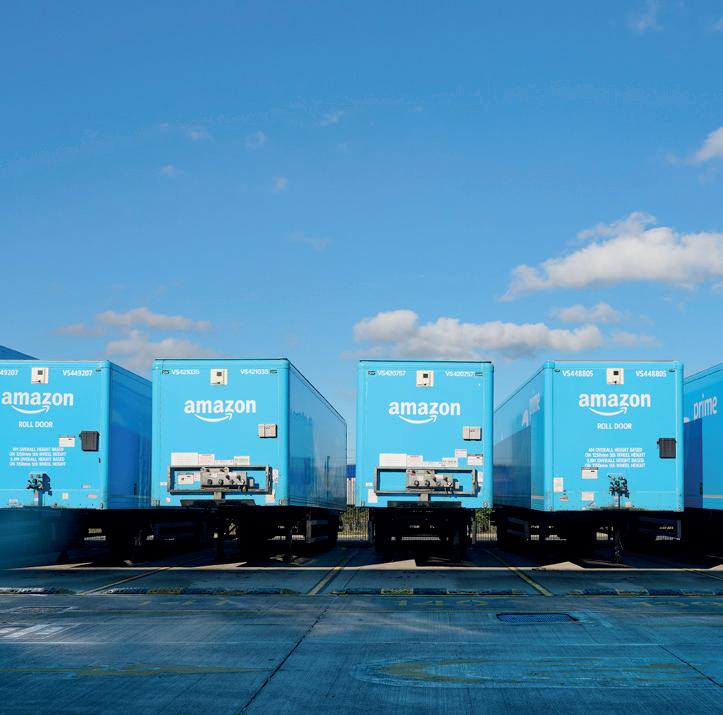
Logistics businesses are only as good as the people who work in them. It’s why one company is nurturing its employees with more meaningful interactions and strategies.

Ask any manager to name the most important part of their business, and chances are they’ll say “our people.” But this manager really means it. Human beings, Chris Roe insists, are the beating heart of his organisation.
“You can hear the passion I have for this topic,” says Roe, Managing Director, Amazon Freight EU. “And it’s not just me; it’s a passion that runs throughout the Group.”
Freight is fundamentally “a trust business,” says Roe, who leads an organisation of over 500 people. And trust is a human emotion that requires a human response.
“Our customers need to know there are real people building the solutions they are using; and real people helping them achieve their goals,” he explains. “AI is helping to boost the capabilities of our teams. It’s allowing each individual to extend further and increase the scope of their job. But as good as AI is, it can’t automate the instinct to pick up the phone if a customer has a problem. And it can’t automate our relationships with our customers. Our people are the real reason why our customers stay with us.”
Supporting professional and personal development
To get the best out of people, Roe thinks it’s important to get to know them properly and beyond their job titles. “You’ve got to be deliberate about it and create deliberate mechanisms,” he says.
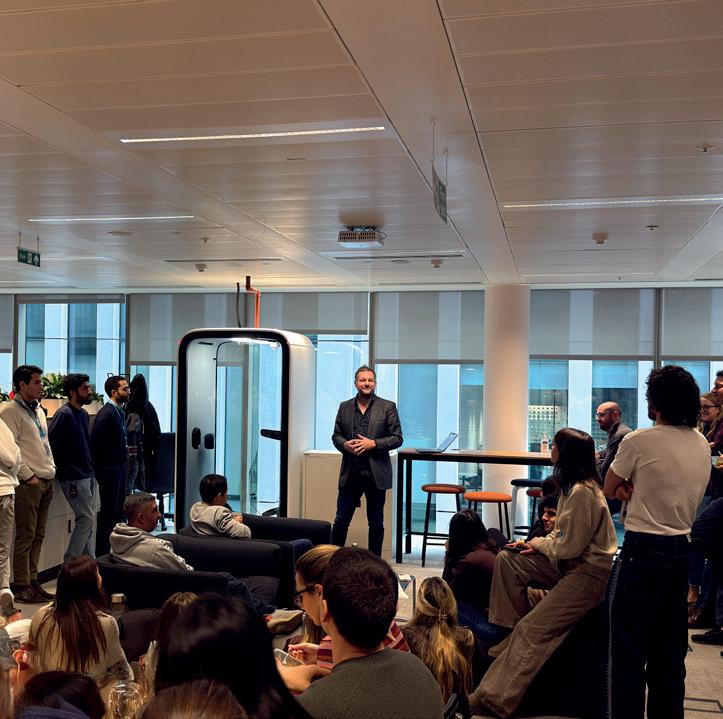
For example, Roe holds an informal monthly online chat with colleagues celebrating their birthday that month on topics ranging from hobbies to favourite films and more. “We have lots of teams, so it’s easy to become siloed,” he notes. “It’s important to bring people together for some light hearted conversations. And, I have to say, it’s one of the highlights of my month.”



Beyond employee engagement activities people also want to know that their organisation is invested in their professional development. In Amazon’s case, any kind of career development is possible because it’s so large and offers opportunities everywhere. “We want to ensure career development can be under the employee’s control. Our organisation is one of the most complex for job diversity and we want to encourage

more development transfers between teams,” Roe explains. “We funnel aspirations through monthly career development discussions with managers.”
“The organisation has extraordinary internal mobility, so it’s not always like going up a career ladder, but more like climbing a wall,” says Roe. “Sometimes you’ll go directly up, diagonally and sometimes you’ll take a few steps to the side.”
Understanding the team is also key to supporting personal development. “For instance, one person is ex-forces and saw some difficult things that affected his mental health,” reveals Roe. “He now channels that by giving mental health talks across the org, which we fully support.”
The future of the organisation is its people Sometimes, Roe will hear a personal story that affects him deeply. One colleague talked openly and vulnerably about his difficult upbringing; then revealed that the person who made the most positive impact on his career, personal growth and mental health was his current Amazon Freight manager. “When I heard that,” says Roe, “it really hit home. It reminded me that we all impact the people we work with.”
Roe is a people person. He couldn’t do his job if he wasn’t. “There are three groups I care hugely about,” he says. “There are the people here in the business. Then there are our 3,000+ customers across UK, Germany, France, Italy and other EU countries. They’re why we’re here, and we focus our time and attention on doing the right thing for them. Lastly, there is the network of carriers and drivers which we offer to any business, which undeniably creates a community impact in each region we operate in. “I feel strongly about making sure we do the right thing for everyone,” Roe adds. “What’s the future for the business? Who knows. But it’s definitely our people.”
For the past three decades, most global organisations have been built for efficiency. That model is now under strain as the nature of risk itself is changing.

WRITTEN BY
Fiona Watson
Vice President, Corporate Performance and Accountability,
Business
Geopolitical disruption, economic fragmentation and rising physical risks due to the changing environment are no longer sporadic or isolated. Local shocks, such as extreme weather or infrastructure issues, spread through supply chains, increasing costs, causing delays and reducing revenue unpredictably.
Factors that drive operational disruption and their impact
Operational disruption is being driven less by rare catastrophic events and more by frequent secondary perils, increasing the impact of business interruption. These impacts show up as persistent pressure on margins through supply chain breakdowns, productivity loss, asset damage and rising insurance premiums. They are increasingly felt by customers and monitored by investors.
Resilience is shifting from an operational compliance issue to a strategic source of competitive advantage.
Financial models are struggling to keep up. Traditional one-year insurance cycles are increasingly misaligned with long-term risk exposure and opaque forward pricing. Leading organisations are starting to treat insurance and risk financing as strategic planning inputs by integrating multi-year premium forecasts and alternative risk transfer mechanisms into capital allocation decisions. Insurance is no longer simply a hedge against loss; it has become a forward signal of operating viability in exposed markets.
How technology is helping firms build resilience Technology is helping firms respond, but it is also forcing
Is technology adoption the missing link in Britain’s productivity puzzle?
Productivity growth is a major engine of long-term economic prosperity in high-income places. Yet, debates about reviving UK productivity often focus too much on breakthrough innovation and too little on helping businesses adopt existing technologies.

WRITTEN BY
Marco Marchese Policy Analyst, OECD Centre for Entrepreneurship, SMEs, Regions and Cities
For SMEs, the issue is not inventing the next big technology. It is knowing which technologies are worth investing in, how to use them effectively and whether the benefits outweigh the risks.
A recent OECD report1 highlights major differences in technology adoption across the UK economy, depending on the type of technology, firm size, region and sector.
Disparities and barriers in adoption UK firms perform well in adopting mature digital technologies such as cloud computing and data analytics, where many SMEs have narrowed the gap with larger firms. But adoption rates drop sharply for advanced technologies, including robotics and automation, where smaller firms still lag.
harder choices. Detailed mapping of supplier networks, logistics hubs and infrastructure dependencies enables organisations to model disruption across multiple tiers of their value chains and quantify the financial impact of operational shocks before they occur. This insight is informing decisions about where to source, where to produce and how much redundancy to build into global operations. The result is a notable shift from optimising globalisation to building resilience. Resilience is shifting from an operational compliance issue to a strategic source of competitive advantage.
Organisations that have visibility on material risks and opportunities in their value chains are redesigning their operating models and value chains for long-term stability, resource security and sustained growth in a more fragmented world.


London and the South East lead on most indicators of technology uptake, while many regions in Northern England remain behind. These disparities reflect deeper differences in industrial structure, skills, investment and access to local support networks. Cost remains a major barrier. Many SMEs, especially in manufacturing, face high upfront costs, uncertain returns and difficulty identifying solutions suited to their needs.
Many business owners, therefore, adopt a “wait-and-see” approach, investing only after seeing peers using technologies successfully.
Why peer learning matters
This is why peer learning matters. Entrepreneurs are more likely to embrace technologies when they can see competitors or partners
benefiting from them.
Supply chains can also accelerate diffusion when larger firms help smaller suppliers upgrade their capabilities.
Local intermediary organisations, meanwhile, connect firms with expertise, research institutions and public support programmes.
For policymakers, the lesson is clear. Technology adoption strategies must work for ordinary businesses in every region.
As a result, financial support is most effective when combined with practical advice, training and trusted local networks that help firms turn technology into productivity gains.
Reference: 1. OECD. (2026). SME technology adoption in the United Kingdom. https://tinyurl.com/mu7zvwf.
Pay cycles haven’t kept pace with how people actually live. One platform is changing that, giving employees access to wages they’ve already earned.

For many UK workers, the gap between earning and getting paid carries a real financial cost.
According to LiveCareer’s 2025 research,1 40% of UK workers experience financial stress weekly — and 18% experience it daily. Only 12% believe their pay has kept up with inflation, and for 39%, wages haven’t increased at all.
Yet most employee benefits don’t currently address this. While flexible working and mental health resources have transformed the employee experience, there’s now an opportunity to extend that same care to workers’ financial lives.
Pay cycle was never designed for real life
Most UK employees are paid fortnightly or monthly. But bills, emergencies and rent don’t work on the same schedule. When cash runs short before payday, workers find ways to bridge the gap, which often come with fees, interest or debt.
This creates a hidden cost for employers, too. Financial stress is one of the strongest predictors of disengagement, absenteeism and attrition. Workers anxious about money aren’t performing at their best, and they’re looking for employers who understand that.
In fact, the CIPD’s 2025 Good Work Index2— surveying around 5,000 UK employees — found that 31% said money worries had negatively affected their work performance. Among staff earning under £40,000, that figure rises to 37%.
Generational expectations are also worth consideration. Deloitte’s 2026 Gen Z and Millennial Survey3 found that around 40% of UK Gen Z and millennials are living payslip to payslip, and nearly half have delayed major life decisions due to their financial situation.

compliance risk and employee confusion. The employers seeing the most traction embed the capability directly into payroll infrastructure rather than bolting it on alongside.
Deel’s Anytime Pay is built on that premise
Available through Deel Payroll and Deel’s EOR, Anytime Pay gives employees access to a portion of their earned wages before payday. It’s fee-free for both parties, automatically reconciled and built on the same owned infrastructure behind Deel’s realtime payroll processing. Built-in eligibility rules and continuous compliance enforcement ensure it meets local labour standards in every market, without adding workload to HR or finance.
The practical question for HR leaders With the Employment Rights Bill progressing through Parliament, many UK HR leaders are already reviewing their people and payroll infrastructure. It’s a natural moment to explore what a payroll system that actively supports employee financial wellbeing could look like for your team.
Workers anxious about money aren’t performing at their best, and they’re looking for employers who understand that.
Today’s workforce has a fundamentally different relationship with pay flexibility, and its expectations are reshaping what a competitive benefits offering looks like.
The response doesn’t require a new program or complex rollout; it requires rethinking one thing: when employees can access money they’ve already earned. On-demand pay — giving workers access to a portion of their accrued wages before the scheduled pay run — is gaining traction among employers who want to address financial wellbeing without taking on payroll risk or added administration.
Making it work in practice

The barrier for most HR leaders is implementation. Introducing pay flexibility through a disconnected third-party tool can add reconciliation complexity,
On-demand pay is one concrete answer. It’s low-admin, low-risk and directly responsive to what UK workers say they need.
“Anytime Pay has made managing my finances so much smoother,” said Momen Hassan, a System Safety Engineer. “I’ve used it to avoid overdraft fees, plan holidays without stress and even save money in the process.”
For HR leaders thinking seriously about workforce retention and employee experience, it’s worth a closer look. Book a demo to see how to make on-demand pay simple to roll out and easy to manage.
Reference:
1. Kończak, R. (2026). Under pressure: European workers struggle (2025 Report). https://tinyurl.com/2wbmt7v4.
2. CIPD. (2025). CIPD good work index 2025. https://tinyurl.com/3f9br8rk.
3. Deloitte. (2026). 2026 Gen Z and millennial survey. https://tinyurl. com/6reduchk.
As a stronger El Niño arrives, AI forecasting and compute power are rewriting global trade and governance.

Snène
El Niño is back. The WMO confirmed a clear shift in the equatorial Pacific, with sea-surface temperatures rising rapidly and high confidence in the onset of El Niño and further intensification.
Some forecasters have drawn comparisons to the 1877-78 event, considered one of the strongest, when Pacific warming contributed to widespread droughts, triggering famines across Asia, Africa and South America.
The 2023 episode exposed how brittle commodity-dependent trade agreements had become. Cascading shortfalls in rice and palm oil across Southeast Asia revealed frameworks built on historical averages rather than dynamic risk.
This time, with a larger disruption forecasted, policymakers have less excuse for being caught unprepared.
Power of modelling and real-time action
instruments need to move with it.
Compute: a tradeable asset
Geopolitically, the stakes are asymmetric. Nations with advanced computational infrastructure hold a structural advantage in forecast-driven decision-making.
Access to high-performance infrastructure and trained models is reshaping who anticipates disruption and who merely absorbs it. Agreements over AI infrastructure, data-sharing protocols and model interoperability are becoming as consequential as traditional trade deals.
National digital strategies must treat compute capacity as a strategic reserve, equivalent to energy stocks or grain buffers.
Digital transformation has changed what’s possible. AI-driven forecasting models now integrate atmospheric data, shipping telemetry, commodity futures and geopolitical signals into real-time risk assessments. What once required months of inter-agency analysis can be compressed into hours.
The power isn’t just in prediction; it’s in design: running thousands of scenario models to stress-test trade corridors, tariff structures and supply chain dependencies before disruption lands. When a signal crosses a threshold, policy
Building policy frameworks that keep pace Trade agreements need dynamic adjustment clauses that trigger renegotiation when AI-validated disruption signals cross defined thresholds. Multilateral bodies need shared forecasting infrastructure, not just shared data. And national digital strategies must treat compute capacity as a strategic reserve, equivalent to energy stocks or grain buffers.
The gap between what AI systems can detect and what policy instruments can respond to is widening. Closing it means moving from episodic summits to continuous, model-informed policy cycles, where the forecast and the framework evolve together.
From tariffs to geopolitical shocks, volatility is no longer an exception but the operating environment for global trade.

Volatility has become the new baseline for global supply chains.
Across regions, supply networks are reshaping amid disparate forces. Tariff policies continue evolving, often in different directions at once. Recent adjustments to metals tariffs, for example, have lowered duties in some sectors while expanding in others, creating a trade environment that’s dynamic and difficult to predict and manage.
Geopolitical tensions are also changing how goods move. Conflict in critical transit regions — the Strait of Hormuz, for example — has forced the rerouting of shipments, increased costs and extended delivery timelines across industries. These conflicts also impact the availability of oil, fertiliser and other essentials.
Disruptions don’t happen in isolation; they overlap, creating ripple effects across supply chains. Organisations can no longer avoid or plan around volatility; it’s the environment they operate within.
Data and decision-making
This shift is changing how leaders think about supply chains. Trade decisions that once focused on efficiency must now also account for resilience, security and long-term stability. Supply chain performance is also more closely tied to business
Disruptions don’t happen in isolation; they overlap, creating ripple effects across supply chains.
performance, shaping growth, cost and customer outcomes.
There are also clear signals within the data. The ISM Manufacturing PMI® registered 54% in May 2026, indicating continued expansion even as companies manage rising costs and slower supplier deliveries. That
tension reflects an environment where demand remains strong, but pressure across supply networks continues. Within organisations, supply chain and procurement leaders play a more strategic role. Visibility into supplier risk and market signals is essential as they’re often the first to identify disruption and guide response.
From resilience to adaptability
For leaders, the focus must continue to shift toward adaptability. That means building supply chains that can sense change, respond quickly and perform under pressure. Over the next decade, supply chains will increasingly reflect business strategy, national priorities and global alignment. Organisations that succeed won’t avoid disruption entirely. The people, processes and technology will be designed to operate within it.
In today’s global economy, navigating uncertainty isn’t a competitive advantage; it’s the expectation.
why compliance is only the beginning
Payment devices sit at the heart of the global economy. From contactless point-of-sale terminals to ATMs and embedded payment modules, payment devices process billions of transactions daily.

Yet for the manufacturers, operators and financial solution providers behind them, the challenge isn’t only innovation - it’s resilience.
The pressure is constant: accelerate product launches, meet evolving regulatory requirements, pass certification and maintain customer trust. Compliance frameworks are essential. But as we see, in today’s threat landscape, compliance alone doesn’t guarantee security.
Too often, security efforts concentrate on passing an assessment just before release. A checklist turns green, certification is achieved and the product ships. What may remain hidden are deeper weaknesses in firmware, hardware interfaces, transaction logic or third-party software components. Without continuous visibility after launch, newly disclosed vulnerabilities can trigger emergency patches, costly incident response and reputational damage.
Real-world security requires a lifecycle approach
From early design through development, integration, certification, launch and ongoing operation, payment devices must be evaluated as dynamic systems - not static products. Precompliance penetration testing helps manufacturers uncover exploitable paths across hardware, firmware and communication interfaces before formal certification. This proactive approach reduces late-stage surprises, thereby saving additional costs and strengthening assurance before products reach the market.
But launch isn’t the end of the story Modern embedded payment devices depend heavily on third-party and open-source software. As software supply-chain risks grow, and for every third-party component, there are new threats and vulnerabilities, regulators and customers increasingly expect transparency into what’s inside a product. Software Bills of Materials
(SBOMs) are becoming a cornerstone of that transparency. When operationalised correctly, SBOMs move far beyond compliance documentation. By generating or ingesting standardised inventories and linking them to continuously updated vulnerability intelligence, manufacturers gain real-time visibility into affected components when new vulnerabilities are discovered post market-launch. Instead of lengthy “blind spot” investigations after every major CVE (Critical Vulnerabilities and Exposures) disclosure, teams can immediately assess impact, prioritise remediation and respond with precision.
From reactive certification exercises to ongoing security assurance
Continuous, product-focused vulnerability monitoring further strengthens this posture. Tracking emerging threats and mapping them directly to specific device models and firmware versions allows engineering, security and operations teams to work from a shared, actionable view.
As a newly approved Associate Participating Organisation (APO) within the PCI SSC community, PCA Cyber Security supports this shift by helping manufacturers embed security across the entire product lifecycle. Compliance is the baseline. Sustainable trust is built on resilience. For payment device manufacturers navigating an increasingly complex landscape, the question is no longer whether to go beyond compliance, but how.

This year marks our 20th anniversary. We’ve had twenty years of working with industry stakeholders to help secure payment environments worldwide.

During this time, the payments ecosystem has changed significantly, but PCI SSC’s mission has remained the same: to enhance global payment account data security by developing standards and supporting services that drive education, awareness and effective implementation by stakeholders.
Evolving with the dynamic nature of payments
It’s vital we continue that collective work. Businesses and consumers are demanding payments that are fast, simple, and most of all, secure. Transactions are by the tens of thousands every second, and as the industry evolves, so must we.
PCI SSC has the opportunity to continue serving as a trusted resource for the industry through our globally recognised security standards, programmes and training. We bring the community together to advance payment security by supporting secure innovation.
us to understand real-world security threats, help prepare best practice mitigation strategies and facilitate critical information sharing. At the core of our efforts, we’re partnering to enhance security for the payment industry, with the payment industry.
Collaboration means getting actively involved in a community of experts and professionals and making your voice heard on the issues that matter. We provide the platform for all payment stakeholders — including merchants, banks, processors, fintechs, service providers, hardware and software developers, point-of-sale vendors, etc. — to do it. Participating organisations can ensure their voice is heard in the development of critical payment security standards and that our programmes keep pace with evolving technology.
At the core of our efforts, we’re partnering to enhance security for the payment industry, with the payment industry.
Collaborating to set standards for the payments industry, with the industry
Working closely with our stakeholders, including representation from top industry thought leaders, allows
This fall, PCI SSC will host our annual Community Meetings in North America, Europe and Asia. This year’s events will commemorate our 20th anniversary, but also demonstrate our focus on the future. We encourage all organisations involved in any aspect of payments to join us, learn what the future of payment security holds and how they can be part of setting the direction for the next chapter.