“The

“The
James Selka, CEO, MTA Page 04

“The logistics sector is fundamental to the success of the UK’s industrial sector.
Bethany Windsor, Head of Skills Policy and Generation Logistics, Logistics UK Page 06



For years, the UK has debated the need to ‘rebalance’ its economy. Now, with a long-term strategy in place, the conversation must shift decisively from ambition to execution.
Manufacturing today is smaller than in previous eras, but it remains foundational. It underpins 15% of UK value added when supply chains are included, generates the vast majority of export revenue across represented firms and sustains some of the highest productivity growth in the economy.
Output reached £220 billion at the end of 2025, and 44% of manufacturers believe the UK is more competitive than it was a decade ago.1
The potential is evident, but potential isn’t capacity.
Rebuilding capability
Decades of deindustrialisation hollowed out more than headline sectors; they weakened domestic supply chains, eroded foundational industries and reduced end-to-end production capability in strategically important areas.
Meanwhile, global trade has grown more volatile and input costs are less predictable. Make UK’s research repeatedly shows supply chain reliability now ranks alongside skills shortages as one of the most significant barriers to growth.
Modernisation in motion
Encouragingly, business priorities are evolving. Productivity is now the sector’s leading focus, and investment is shifting decisively toward digitalisation and AI.
Over the next five years, more firms expect to prioritise digital technologies than traditional plant and machinery. This signals a sector preparing not simply to expand, but to modernise.
Delivery determines success
Whether that modernisation scales depends on delivery. Publishing a strategy isn’t the same as implementing it.
Long-term frameworks only build confidence if commitments are executed consistently and at pace. For manufacturers making multi-millionpound investment decisions, signals are insufficient — execution unlocks capital.
Internationally competitive energy policy, predictable cost structures, targeted investment incentives and a workforce equipped with advanced technical and digital skills are the enabling conditions of industrial capacity. If delivery falters, investment will divert elsewhere.
The UK doesn’t lack strategy. The test is whether Government can deliver it — with consistency, coordination and resolve — and translate ambition into tangible domestic capability. If it can, manufacturing will anchor a more resilient, productive and secure economy.
References: 1.






Most manufacturers struggle to use data as a live, actionable part of their production strategies. Yet when implemented properly, the benefits can be revolutionary.
“The UK is home to worldclass manufacturing companies,” says Darren Talbot. “The problem is, some of them are working as though it’s still the 1980s.” The result? Their operations aren’t as efficient or as costeffective as they could be.
However, according to Talbot, if manufacturing organisations fully integrate metrology — the science of precision measuring — into their real-time production processes, they’d be able to make faster, more accurate and informed data-led decisions that could alleviate risk, help address skills gaps and generally improve quality assurance.
Using data to improve overall manufacturing processes
Talbot is Head of Sales & Service, Industrial Quality Solutions at ZEISS Industrial Metrology — a business unit of technology enterprise Carl ZEISS UK& IE — which provides metrology

If you have access to realtime data on metrology systems, your processes will improve so much that you won’t have to spend money on buying more machine tools.
solutions to medical, aerospace, defence and automotive manufacturers, among others. He points out that many manufacturing companies have endof-line quality inspections to identify defects in finished products before they leave the factory. But instead, if these businesses used metrology software to capture data in-line — such as between stages of production— they’d be able to influence the manufacturing process as it happens. This could help detect variation early, reduce scrap and rework, analyse performance, identify bottlenecks and automate corrective offsets.
Put simply, live measurement data can improve end-to-end manufacturing processes and save businesses a lot of pain. “Unfortunately, some manufacturers aren’t embracing these benefits,” says Talbot. “I think they’d
rather buy more machine tools than measuring machines. What we’re saying is: ‘If you have access to real-time data on metrology systems, your processes will improve so much that you won’t have to spend money on buying more machine tools.’”
Challenges hampering metrology and inspection processes
Nevertheless, many manufacturing organisations struggle to use measurement data as a live, actionable part of their production strategies.
A major issue is that the data is too fragmented because it’s dispersed across standalone machines, portable devices, legacy software, spreadsheets and manual records. Because it’s not ‘joined up,’ it makes it difficult to perform trend analysis, global reporting, automated tolerance adjustments or closed-loop process control.
That’s where a unified software solution comes into play, explains Talbot, because it turns isolated metrology activities into connected, enterprise-wide ecosystems. As a result, all measurement data can be consolidated into strategic manufacturing intelligence — not just inspection results — to maximise throughput.
Another major challenge is a shortage of skills and labour. However, Talbot notes these can be alleviated with better deployment of existing talent and the introduction of easy-to-use solutions and automation.
Automation and support to reduce reliance on scarce expertise
“Automation in inspection — with the use of vision systems, sensors and advanced metrology software, for instance — will reduce reliance on scarce expertise, stabilise throughput, ensure repeatability and reduce rework,” he says. “All are critical for maintaining quality when skilled labour is difficult to hire or retain.”
Skills shortages also underscore the importance of cross-skilling and upskilling to ensure staff can efficiently operate modern metrology tools.
Finally, Talbot adds that as internal technical capability becomes stretched, external partners — such as software and data-integration specialists — are playing an increasingly important role in supporting resilient production operations.
“For example, we offer our skills, systems, training and Quality Excellence Centre to customers, so they don’t have to build their own expertise,” he says. “With outside support, a manufacturer can accelerate innovation, reduce bottlenecks and its dependency on specialised skills and enable faster deployment of advanced solutions. And they can do all of this without the need for constant new hires. Being data-led is key.”


An upcoming event aims to connect manufacturers and encourage collaboration to address challenges the sector is facing.

The UK manufacturing industry plays a significant role in the UK economy’s success. With over 325,000 small and medium-sized UK manufacturing and engineering enterprises, it contributes £224bn to GVA, provides 2.6 million jobs and delivers nearly half of all UK exports.1,2
For over a century, the Manufacturing Technologies Association (MTA) has been a champion of Industrial Strategy. It’s committed to working closely with the Government, industry partners and other stakeholders to implement strategic initiatives.
The organisation welcomed the Government’s Industrial Strategy, launched in June 2025. It supports and recognises the important role manufacturing will play in the longterm government plan to strengthen and transform the economy by prioritising key sectors, encouraging investment, innovation, skills and productivity, and stimulating sustainable growth.
The Industrial Strategy is closely aligned with MTA’s vision, as it believes the UK needs to be modernised and re-industrialised with advanced technologies and sustainable practices, leveraging our historical strengths in manufacturing and technology to build a resilient and forward-looking economy.
MACH 2026: shaping the future of UK manufacturing MACH exhibition is MTA’s flagship event, and is the UK’s
Britain’s factories matter again — and this time the strategy could stick
For years, industrial strategy in Britain felt like a reluctant afterthought: invoked during crises, quietly abandoned when politics shifted, but that’s beginning to change.
Tlargest engineering-based manufacturing event.
Taking place from 20-24 April in Birmingham, MACH 2026 brings together over 500 exhibitors showcasing the best manufacturing technologies in the country. Amid the challenges and opportunities for manufacturing, this event provides the perfect platform to address these matters through innovation, collaboration and insights for over 26,000 attendees expected to visit.
MACH 2026 is designed to help manufacturers navigate through issues such as rising operational costs, skills shortages, supply chain disruptions and geopolitical uncertainty. It offers plenty of opportunities for solutions to help manufacturers remain competitive in this challenging environment.
Empowering manufacturers today and tomorrow
As the UK manufacturing sector faces both challenges and opportunities, events like MACH, supported by MTA’s commitment to innovation and collaboration, play a crucial role in driving the industry forward. By connecting businesses, showcasing advanced technologies and fostering skills development, MACH helps ensure that UK manufacturing remains competitive, resilient and ready for the future.
References: 1. Enguinity. (2025). Policy centre gives voice to UK SMEs. https://tinyurl.com/3aru3ma2. 2. MTA. (2024). The true impact of British Manufacturing. https://tinyurl.com/mru5fr2m.
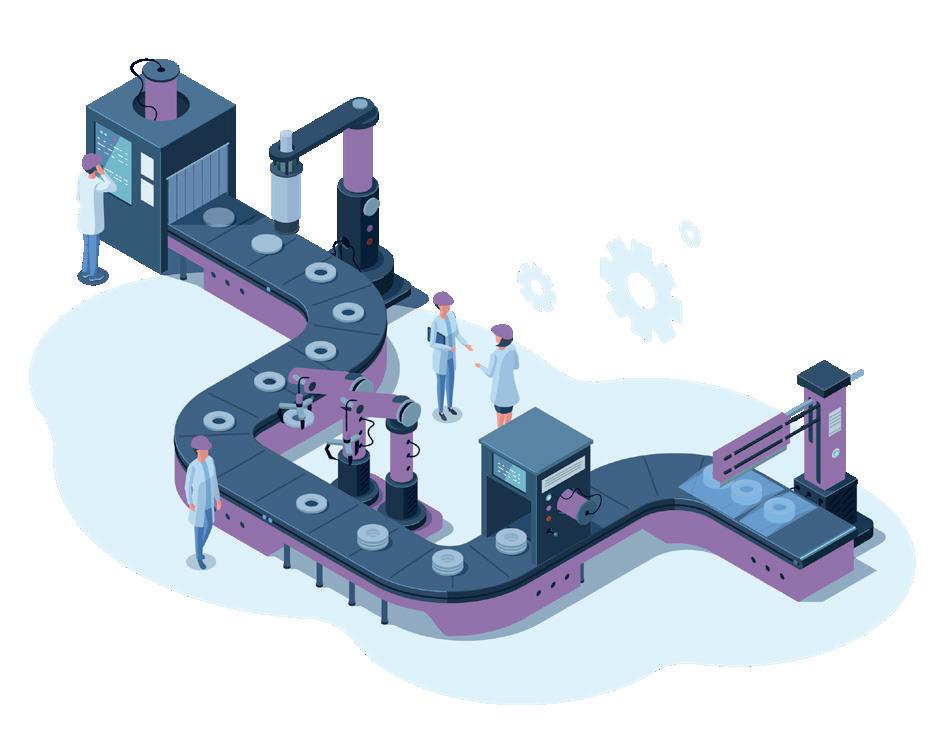
he Advanced Manufacturing Sector Plan, backed by the Government’s Modern Industrial Strategy, marks a return to long-term thinking about how the UK makes things, earns its living and competes in a tougher global economy.
Manufacturing’s path forward Manufacturing is about the future of precision engineering, aerospace, life sciences, robotics and clean technologies — industries that underpin productivity, exports and national resilience. They also provide skilled, well-paid jobs and anchor economic activity in regions often locked out of growth. The strategy acknowledges that Britain’s challenge has never been
ideas or innovation — we remain world-class at R&D, but the gap is scale. Investment decisions are stalled by high energy costs, slow infrastructure delivery, skills shortages and policy uncertainty. Now, those barriers are being addressed together rather than in isolation.
Take energy. UK manufacturers have faced power costs that undermine competitiveness. The renewed focus on cheaper, cleaner energy isn’t just climate policy — it’s industrial policy done properly. Advanced manufacturing will be essential to the net zero transition, producing the batteries, grid equipment, wind turbines and heat pumps that decarbonisation demands. Making those
technologies at home strengthens climate ambition and economic security.
Emphasising skills is equally important Modern manufacturing is increasingly digital and automated, creating demand for technicians, engineers and production specialists. This can support a new generation of highquality industrial jobs and give communities a durable stake in growth.
Manufacturing clusters succeed when national ambition meets local leadership. With mayoral authorities gaining greater economic powers, the foundations are there for regions to shape investment, skills and infrastructure around their industrial strengths.
Delivery will be decisive, but the global context makes this moment different. The US and EU are investing heavily to anchor strategic industries such as semiconductors and defence technologies at home. Britain is no longer debating whether industrial policy is necessary, only whether it can be executed well. If momentum is maintained, manufacturing could once again become a pillar of a more productive, resilient and confident UK economy.

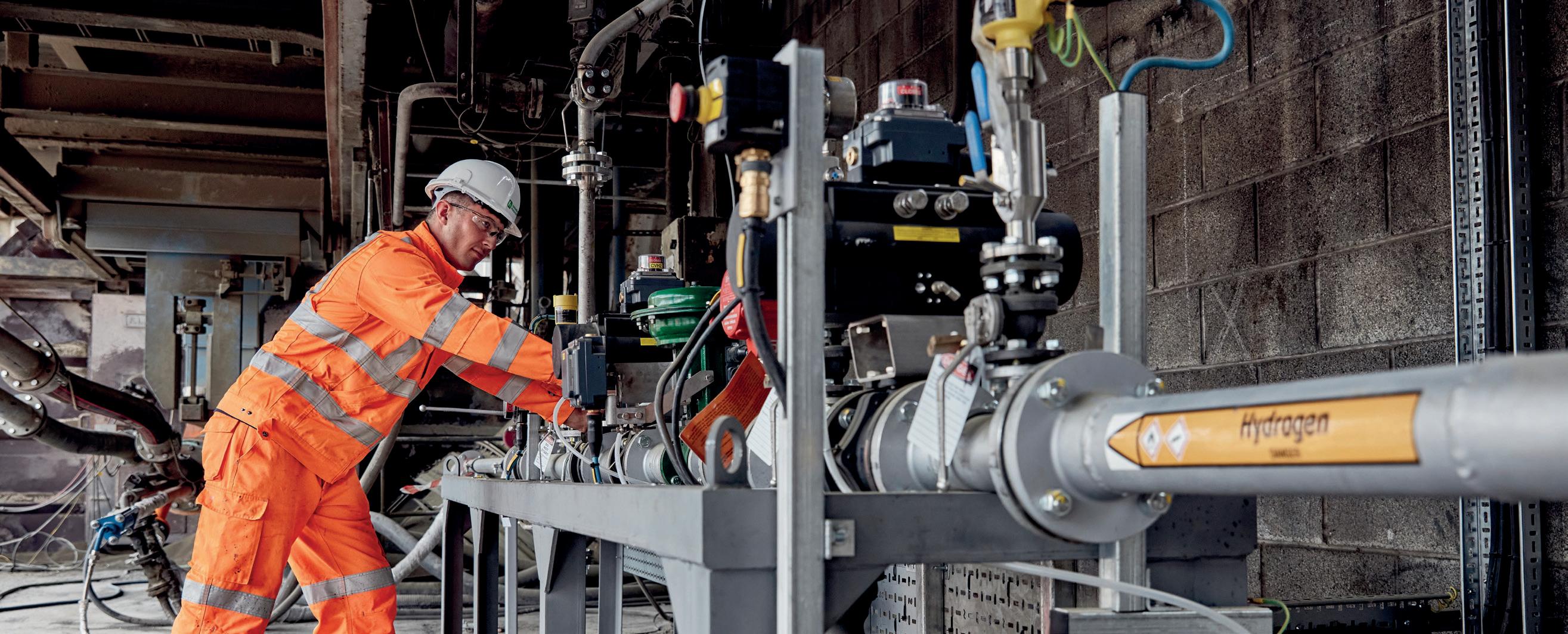
Hydrogen is one of the cleanest forms of energy available. A plentiful supply would present manufacturers with a viable fuel alternative, helping them survive and thrive.

If the British manufacturing sector wants to thrive — not just survive — it’s going to need hydrogen power, insists Dr Angela Needle, Director of Strategy at Cadent, the UK’s biggest gas distribution network.
Benefits of hydrogen When burned, hydrogen doesn’t release carbon emissions, making it one of the cleanest forms of energy available and a vital element in the UK’s net zero strategy.1,2,3 While it presents a huge decarbonisation opportunity for all gas users, it’s especially critical for energy-intensive industries such as glass and paper manufacturers and brick-makers.
“Hydrogen offers a way to balance the green energy system because, in a decarbonised world, we’ll need a renewable gas to generate electricity when it’s not windy or sunny,” explains Dr Needle. Also, she points out, some sort of renewable gas power will be essential for manufacturers, because their industrial processes — which run at very high temperatures — are neither technically feasible nor affordable to electrify. Hydrogen ticks that box.
At present, however, hydrogen isn’t widely used by UK manufacturers.

“Industries thinking about decarbonising with hydrogen want to know that it’s a viable fuel alternative,” explains Dr Needle. “To do that, they need assurance that there’s a plentiful and cost-effective supply. So, it’s still early days.”
The next steps for realising the potential of hydrogen That said, things are changing. Currently, Cadent — which delivers
gas to 11 million homes, businesses and 40,000 industrial customers — is actively developing hydrogen pipelines which support industrial decarbonisation. These include the HyNet project in the northwest and the H2 East Humber to Nottinghamshire Pipeline. Ultimately, the aim is that smaller regional networks will join up to create a secure, reliable and resilient national supply. The Government, meanwhile, has developed a hydrogen strategy focusing on hydrogen use for industry and power generation, and is currently assessing the most suitable locations for pipelines. It has also produced a range of different subsidies to support hydrogen production.
“We’re asking the Government to do with hydrogen what they did with renewable wind,” says Dr Needle.
“That is, help get it established until it’s able to stand on its own.”
UK manufacturers certainly seem interested in hydrogen’s potential, with producers of paper, sugar, ceramics, glass and asphalt, among others, trialling it at their plants. “They’ve found that it’s compatible with their current processes and temperatures,” says Dr Needle. “Another benefit is that it’s a job creator. Making and delivering hydrogen creates jobs — and it also secures the future of manufacturers by enabling them to be globally competitive in a world where people want green goods.”
References:
1. Environment Agency, Natural Resources Wales, Department of the Environment (Northern Ireland) & The Scottish Government. (2024). Hydrogen combustion: comply with emission limit values. GOV.UK. https://tinyurl. com/2bdmw8f6.
2. UK Government. (2025). Carbon Budget and Growth Delivery Plan. https://tinyurl.com/24tj6dem.
3. Department for Energy Security & Net Zero. (2025). Hydrogen Update to the Market. https://tinyurl.com/3zksz6fx.
Hydrogen is important for building materials manufacturer Heidelberg Materials UK due to its specific energy requirements. Cement kilns require a lot of heat (equivalent to 3,000 home boilers per hour). Meanwhile, producing asphalt, used in roads, runways and sports surfaces, has a fluctuating energy requirement, making electrification difficult.
In a world-first trial, the company successfully operated a cement kiln at its Ribblesdale works in Lancashire using a mix of 100% net zero fuels, including hydrogen.
Now, it’s using hydrogen to decarbonise asphalt production at its Criggion plant in mid Wales. During the trial, hydrogen replaced liquid fossil fuels to produce more than 1,300 tonnes of asphalt, without impacting its quality or performance.
The project demonstrated hydrogen as a viable alternative to fossil fuels, achieving a 76% reduction in Scope 1 emissions and a 23% reduction in the overall carbon footprint of the asphalt produced.
According to Simon Willis, Heidelberg Materials UK CEO, “If we’re to reach our net zero ambitions, we need to consider carbon reduction measures across our operations. The success of these hydrogen projects demonstrates our leading position in trialling innovative solutions to enable the production of lower-carbon construction materials.”
Digital transformation in manufacturing is accelerating, but operational impact often lags. Closing the gap between strategy and execution is becoming critical.

Manufacturers are operating in an increasingly complex environment. Supply chain volatility, rising energy costs and persistent labour shortages are placing growing pressure on productivity and margins across the sector.
The execution gap
Digital transformation is widely viewed as the answer. Yet many organisations struggle to translate technology investments into measurable operational improvements. Studies show that while manufacturers continue to invest heavily in digital initiatives, many leaders report that the expected return on investment has yet to materialise, often due to integration complexity and fragmented systems.
The result is what many industry leaders describe as an execution gap: the difference between digital strategies defined at the board level and the operational reality on the factory floor
When systems slow down operations
ERP systems remain the backbone of modern manufacturing operations. However, modernising these core systems alone rarely resolves frontline challenges.
Across many manufacturing plants, technicians and warehouse teams still rely on manual processes, fragmented reporting tools and outdated interfaces. Maintenance tasks may require navigating multiple systems and screens, while


Loperational data is often captured too late, manually and inconsistently.
These inefficiencies limit visibility, slow response times and reduce the impact of wider digital transformation initiatives.
Turning ambition into execution
Closing the execution gap requires digitalisation that reaches the operational processes where work actually happens.
Rather than focusing solely on large transformation programmes, many manufacturers are now prioritising targeted digital initiatives that improve specific workflows.
Mobile applications connected to enterprise systems allow technicians to capture maintenance data in real time, replace paper-based inspections with digital workflows and provide management with immediate operational insight.
The organisations seeing the greatest progress aren’t necessarily those investing the most in technology. They’re the ones focusing on execution, digitising the daily tasks that keep operations running.
Digital transformation succeeds when it improves how work is performed, by real people on the shop floor, in warehouses and across supply chains.
Manufacturers that close this execution gap will be better positioned to respond to global and operational disruption, improve workforce productivity, control production and cost levels and remain competitive in an increasingly demanding industrial landscape.
Why logistics can be the logical choice for manufacturing and engineering careers
Manufacturing and engineering careers don’t immediately bring the logistics sector to mind, yet logistics sits at the heart of both.
ogistics is the quiet enabler that allows these global industries to function by keeping supply chains flowing and production lines moving. The sector is far broader and more innovative than many realise. For people considering careers in engineering or manufacturing, logistics roles can offer varied and wellpaid careers and the chance to shape the systems that keep the modern world running.
For skills gaps, read opportunities
Engineering skills are essential across a wide range of activities within the logistics sector, and the demand is growing as the sector transitions to new technologies and decarbonisation. Currently, the sector is experiencing acute shortages in several engineering roles, which means there are plenty of
opportunities for people starting out on their career journey or looking to switch jobs.
Results from Logistics UK’s annual Logistics Industry Survey show that the most widely reported shortage is among vehicle technicians, compounded by the need to reskill technicians to handle electric and alternative fuel vehicles. Maintenance engineers for automated systems are also in high demand, as are CAA-qualified aviation engineers, heavy vehicle and plant mechanics and technicians who can install and maintain Electric Vehicle (EV) infrastructure.
Need for engineers extends beyond vehicle maintenance Beyond vehicles, there’s an equally pressing requirement for engineers
to support the increasing automation of logistics operations. Warehousing and distribution centres are becoming more reliant on AI technology, robotics, drone-assisted delivery systems and data-driven warehouse management platforms. These developments demand systems designers, project engineers and maintenance specialists who can keep pace with fast-changing technology.
Construction logistics is another field with opportunities as companies move plant and heavy equipment away from diesel. These shifts require new engineering competencies in powertrains and safety systems. These are the skills that will enable the sector to thrive over the coming decades.
The logistics sector is fundamental to the success of the UK’s industrial sector, underpinning clean growth, advanced manufacturing and future mobility. The opportunities for personal growth, progression and promotion are there for everybody.
Whether joining as a school leaver, graduate trainee or career switcher, the logistics sector has a culture of promoting from within. It’s a profession that values on-the-job experience and drives innovation to push at the boundaries of what’s possible. Whether automating manufacturing systems or decarbonising the supply chain, logistics is a profession where talents are appreciated, skills developed and ambitions realised.

The challenge isn’t demand — it’s making sure we have the right facilities, skills and engineering capability to scale next-generation wind technologies here in the UK.
Clean energy is a UK strength — it’s time we made more of it ourselves
To maximise the benefits of clean energy, we must first build the infrastructure, which includes the right facilities, skills and engineering capability.

WRITTEN BY Dr Joanna Dally Chief Business Officer, NCC
The UK is rightly proud of its offshore wind record. We’ve led the world in deployment, built global expertise in turbine design and set ambitious targets for clean, secure energy. But to turn that leadership into lasting value — in jobs, growth, resilience and UK capability — we need to do more than build wind farms. We need to build the industry behind them.
Setting the stage for the wind energy industry
That’s why NCC is developing the Large Structures Innovation Centre (LSIC) — a new open-access facility that gives UK companies the environment, infrastructure and know-how to design, develop and industrialise the large components that underpin clean energy infrastructure — starting with wind turbine blades.
Located on the Isle of Wight and delivered in partnership with government and industry, LSIC will give businesses of all sizes access to the physical space, advanced tools and specialist engineering expertise needed to develop new products at full scale. That means faster routes to market, lower investor risk and stronger supply chains rooted in the UK.
The opportunity is real. Offshore wind alone could add over £25 billion to the UK economy by 2035 and support 100,000 high-quality jobs.1
The challenge isn’t demand — it’s making sure we have the right facilities, skills and engineering capability to scale next-generation wind technologies here in the UK. Right now, most turbine towers and blades are still imported. LSIC will help change that.

It fills a long-standing gap between research and manufacture, where companies need to turn promising designs into full-scale, highvalue products. Without that step, many invest overseas. With it, the UK becomes a far more competitive place to build and grow clean energy manufacturing.

Benefits that extend beyond wind energy
But LSIC is about more than wind. The product and technology leadership it supports — from advanced materials automation to digital engineering — has applications across multiple sectors, including maritime and construction. That broad relevance makes LSIC an investment in innovative, high-growth industries that support national priorities, including clean energy, energy security, export growth and regional priorities.
It’s also designed for speed and impact. By repurposing a high-quality R&D facility on the Isle of Wight — with Vestas as our launch partner — LSIC can move fast, avoiding long development delays. It will anchor new activity in one of the UK’s strongest composites clusters, drawing on a skilled local workforce and mature regional supply chains to deliver national impact.
For large manufacturers, this means a shared, neutral platform to accelerate innovation and reduce risk. For smaller firms, it removes barriers to entry and unlocks opportunities they couldn’t access alone. For the public, it means more clean energy engineered in the UK — supporting jobs, building skills and keeping economic value in the country.
Above all, LSIC is part of a broader shift toward industrial confidence. It shows that with the right support, the UK can lead not just in clean energy deployment, but in design, manufacturing and delivery. It turns ambition into capability, and strategy into action.
Clean energy is one of the UK’s greatest strengths. But to turn that strength into sovereign industrial capability, we need the infrastructure to match our ambition. LSIC is about making the most of what we already have by ensuring the tools to deliver are here, not somewhere else.
Artificial intelligence (AI) promises major transformation for the manufacturing sector. From accelerating design and engineering to improving production efficiency, AI has the potential to reshape how products are developed and delivered.

However, without strong data foundations in place, organisations risk creating technical debt rather than gaining a competitive advantage, according to industry specialist David Hughes.
While manufacturers are eager to adopt AI-driven tools, experts warn that the sector must learn from the mistakes of previous technology waves. During the rapid adoption of new systems in the early 2000s, many organisations prioritised speed over sustainability, leading to a proliferation of disconnected custom-built applications. These systems were often difficult to manage, scale or maintain, leaving businesses burdened with long-term complexity. The results were often a plethora of disconnected, inaccessible information silos.
The technical debt challenge
AI carries a similar risk profile today, Hughes cautions. “The relative ease of building AI capability means organisations run the risk of creating ad-hoc capability that is difficult to maintain and scale – and we’ve been here before. Hopefully, we’ve learnt the lessons of the past and can avoid building technical debt.”
With AI, Hughes argues, “organisations today have multiple systems of record that are domain specific. Real value has always been derived by being able to access these different sources of truth and bring that information together in a rational way,” he explained. “AI has the potential to significantly scale value here.”
Why data foundations matter
According to Hughes, the critical factor in any successful AI strategy is the quality of the data organisations have accumulated over time.
“Those data foundations need to be rock solid for AI to have any real influence,” he said. “AI on its own won’t deliver scalable value, but the ability to access connected data across engineering, manufacturing and service systems is the real enabler of intelligent decision-making. Without that foundation, organisations risk deploying AI that will deliver negligible value. It will just deliver poor results much faster.”
Turning strategy into execution
This is where experienced technology partners play a critical role. Across UK manufacturing, organisations are
working with PTC partners such as PDSVISION to consolidate product data, strengthen governance and ensure core systems are fit for purpose long before AI is introduced. As a Diamond Partner with a strong UK presence and global delivery capability, PDSVISION brings both local industry insight and international best practice to this foundational work.
By addressing data quality, structure and accessibility at the outset, PDSVISION, with the backing of PTC, have helped manufacturers organise their data foundations to deliver business value from the outset. From an AI perspective, this essential groundwork will ultimately determine whether intelligent technologies, when layered on, will deliver long-term value or disappointment.
A more sustainable digital transformation Hughes continues, “Our company brings more than 40 years of experience and, with our continued support to partners such as PDSVISION to help guide manufacturers through digital transformation, we have begun embedding AI capabilities directly into its engineering, manufacturing and service solutions.” However, Hughes remains cautious about organisations attempting to build and scale their own external and interactive AI capability without guardrails in place.
“The organisations that succeed with AI won’t be those that move fastest,” he said. “They’ll be those that take a considered, responsible approach, treating AI as a capability layered on strong data foundations.”
Preliminary studies conducted by PTC indicate that lifecycle processes spanning multiple enterprise data sources can be completed using AI, with time savings of 80% plus in some cases. When scaled across a business over a year, the efficiency gains are significant.
Building value, not risk Ultimately, the ability to access trusted data quickly and confidently is central to the successful adoption of AI. Organisations that prioritise data governance and system coherence are far better positioned to realise AI’s potential, while those that overlook the fundamentals risk creating the next generation of technical debt.
“AI can deliver extraordinary benefits,” Hughes concluded. “But only when it’s built responsibly on foundations designed to last.”