www.businessandindustry.co.uk
A promotional supplement distributed on behalf of Mediaplanet, which takes sole responsibility for its content
Future of Investing
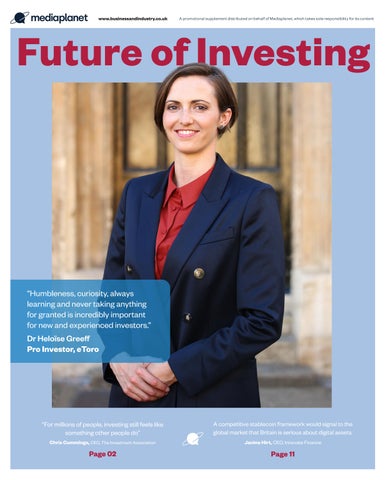
“Humbleness, curiosity, always learning and never taking anything for granted is incredibly important for new and experienced investors.” Dr Heloïse Greeff Pro Investor, eToro
“For millions of people, investing still feels like something other people do”
A competitive stablecoin framework would signal to the global market that Britain is serious about digital assets.
Chris Cummings, CEO, The Investment Association
Janine Hirt, CEO, Innovate Finance
Page 02
Page 11
A PROMOTIONAL SUPPLEMENT DISTRIBUTED ON BEHALF OF MEDIAPLANET, WHICH TAKES SOLE RESPONSIBILITY FOR ITS CONTENTS
Changing how Britain thinks about investing is part of the puzzle
W Gabr ‘Tha
It so feel After years of momentum building behind the idea of getting more Britons investing, eigh another major piece of the puzzle has arrived: the first industry-wide campaign designed to change how the nation thinks and talks about investing.
O WRITTEN BY Chris Cummings CEO, The Investment Association
ver the next few years, Savvy the Squirrel will appear across billboards, bus stops, TV screens and on our high streets to help more people feel that investing might be relevant to them and their future. For millions of people, investing still feels like something other people do. Lack of confidence a big barrier to investing The scale of that challenge is significant. The FCA’s Financial Lives survey shows around seven million adults in the UK hold £10,000 or more in cash savings but no investments.1 Even among those with between £50,000 and £100,000 of investible assets, twothirds are held in cash.1 Britain has become exceptionally good at building cash savings, but far less confident about putting money to work over the long term. Of course, cash matters. Having a savings buffer is essential. But over long periods, holding too much money in cash comes with risks, too. If a saver had put £10,000 into a cash ISA a decade ago, inflation would mean it is worth around £8,400 in real terms today. Invested in a Global Equity Fund over the same period, it would be worth more than £19,700. This is not about a lack of awareness or people being disengaged from their finances. Research for the Invest for the Future campaign found 10 million
savers without investments want to learn more.2 But taking the next step can feel daunting. People worry about losing money. They feel they don’t know enough to get started. And many still feel that investing is something for people with more money, more expertise or more confidence than they themselves have.
Cultural shift needed to encourage investing Part of the challenge is cultural, too. In Britain, we rarely talk openly about investing. Yet research for the campaign found over a third of savers would feel more likely to invest after talking to someone they know.2 This is what the campaign is trying to change. Not by telling people what to invest in, but by making conversations about investing feel more normal, visible differ and accessible. Because the more So people hear conversations about differ investing – in work, around the kitchen table, in everyday settings - gene the more they begin to think about term it. And the more familiar the idea depo £1 an becomes, the more people may begin to feel that perhaps investing the fu For is something for them too. home References: a pla 1. FCA. (2025). Financial Lives 2024 survey. https:// Eithe tinyurl.com/4ava6x3s. An 2. The Investment Association. (2026). Britain genu encouraged to ‘Take The Next Step’ as a new national investing drive launches. https://tinyurl. a Sto com/4ava6x3s. You c world can a every A dec @MediaplanetUKIE Please recycle in an @Mediaplanet UK & IE demo Project Manager: Charlie-Mai Weddell charlie.mai.weddell@mediaplanet.com Project Manager: Sofie Campbell sofie.campbell@ comi mediaplanet.com Business Development Manager: Ollie Edmonds Business Development Manager: Joseph Moore Strategic Account Her Manager: Lucy Harris Managing Director: Margot Thomas | Lead Designer: Ellen Cahill Interim Content Manager: Rachelle Ong | Paid than Media Strategist: Jonni Asfaha Digital Campaign Manager: Jan Martorell | All images supplied by Getty Images, unless otherwise specified it. | Contact information: uk.info@mediaplanet.com or +44 (0) 203 642 0737 Mo 02
MEDIAPLANET
T
READ MORE AT BUSINESSANDINDUSTRY.CO.UKREAD
A PROMOTIONAL SUPPLEMENT DISTRIBUTED ON BEHALF OF MEDIAPLANET, WHICH TAKES SOLE RESPONSIBILITY FOR ITS CONTENTS
w ks is le
WRITTEN BY Gabriel Nussbaum ‘That Money Guy’
Will the next generation ever be able to buy their own home?
It sounds dramatic, but for a lot of young people in the UK, it doesn’t feel far from reality. The average home in England costs around ehind sting, eight times the average salary, and well over ten times in London.
e has paign hinks sting.
Investing today, retiring tomorrow: Making your money work smarter Learn the basics of investing, alongside the risks, potential rewards and practical steps to help build long-term financial confidence and resilience.
WRITTEN BY Oliver Morley CEO, Money and Pensions Service
nt to
out on’t d
e
es
e
l,
d l ng to
T
he average first-time buyer is 34, the oldest in two decades. A generation ago, ible the maths looked very re different. ut So this generation has built a different route. Investing is this ngs - generation’s property. It’s the longout term plan that doesn’t require a ea deposit, the asset you can buy with £1 and the place where ‘saving for ting the future’ actually happens. For some, it’s still a path back to home ownership. For others, it’s a plan that doesn’t depend on it. ps:// Either way, it’s the new default. And for the first time, it’s genuinely accessible. You can open . a Stocks and Shares ISA in minutes. You can invest in companies worldwide from your phone. You can automate it so money goes in every month in the background. A decade ago, none of that existed ecycle in any meaningful way. The democratisation of investing isn’t @ coming; it’s already here. unt Here’s the catch. While it’s easier Paid than ever, people still aren’t doing cified it. Most under-30s I speak to know
CO.UKREAD MORE AT BUSINESSANDINDUSTRY.CO.UK CO.UKREAD
what an ISA is. They’ve heard of index funds. They understand, broadly, that investing matters. They just haven’t started. And even for those who do, the challenge is rarely technical; it’s emotional. The fear of getting it wrong. The instinct to check the app every day. The temptation to wait for the ‘right time,’ which never quite arrives. I started investing at 22, and even as someone who teaches the subject, it took me years to feel comfortable, to stop checking my phone daily. Which is why starting earlier matters more than anything else. The future of UK investing won’t be defined by people who pick the perfect fund or time the market; it’ll be defined by people who actually start. Open the account. Pick a global index fund. Set up a direct debit, even for a pound. Stay consistent. It isn’t easy. But it is simple.
Visit MoneyHelper. org.uk for more information on investing, including our guide on choosing a financial adviser.
A
ccording to Oliver Morley, CEO of Money and Pensions Service, “Investments are something you buy or put your money into to hopefully get a profitable return in the long-term.”
Types of investments Some examples include shares — where you buy a stake in a company, cash – which includes the savings you put in the bank, and property — where you invest in a physical building. ISAs are another type of investment, with cash ISAs offering tax-free interest on savings, and stocks and shares ISAs offering tax-free growth on longterm savings. The contributions made by you and your employer to your pension are also an investment, as the idea is that this money grows over time. The various investments, or ‘assets’ you own, are called your portfolio. Typically, spreading your money between different types of assets helps to lower the risk of your investments going down. Benefits of investing The benefits of investing are that they offer the potential for higher long-term returns compared to cash savings, and some forms of investing, like ISAs, also offer tax benefits. However, there is no such thing as a no-risk investment, and the higher the risk you take, the more you could either get back or lose. The biggest risk with investing is that you could lose some or all of your money. The market is ever-changing, and no one can fully predict what will happen day-today that could impact your money. These changes include market volatility, interest rate changes, poor company performance or unexpected global events. Before you invest money, make sure you still have enough in an instant-access savings account to cover you for unexpected costs, as you can’t fully rely on the money you put into investments to give you the same or higher return as what you put in. For more direct support with investing, you might consider working with a financial adviser. They can give advice that’s tailored to you and your financial situation.
MEDIAPLANET
03
A PROMOTIONAL SUPPLEMENT DISTRIBUTED ON BEHALF OF MEDIAPLANET, WHICH TAKES SOLE RESPONSIBILITY FOR ITS CONTENTS
How Heloïse went from novice to investing pro followed by thousands Dr Heloïse Greeff is a pro investor whose multistrategy portfolio is copied by thousands. She shares some advice and tips for anyone who is new to the world of investing.
B INTERVIEW WITH Dr Heloïse Greeff Pro Investor, eToro WRITTEN BY Tony Greenway
eing a pro investor was never part of Heloïse Greeff’s career game plan. Growing up in South Africa, she was drawn to maths and science at school (“I wanted to build things and solve problems!”), which led her to a Mechatronics Engineering degree at the University of Cape Town. Later, she won a place as a Rhodes Scholar at Oxford University, where she completed a Master’s in Biomedical Engineering, an MBA and a doctorate. Now, however, Dr Greeff is one of the most popular pro-investors on social multi-asset investment platform eToro, with more than 250,000 followers and more than 6,000 ‘copiers’ (i.e. investors who mirror her multi-strategy portfolio). Ten years ago, though, investing was completely new territory to her. “As a child, I had no exposure to the stock market,” she says. “And none of my family members were in finance. I guess I came to it through the side door when the boys in my MBA class were at least claiming to be investing on their phones under their desks.” She finally took the plunge in 2016 when, starting with $300, she began investing in fractional shares to grow a diversified portfolio.
Investing rewards patience and punishes over-confidence.
Busting some common myths and misconceptions Dr Greeff notes there are various misconceptions about investing in the stock market. “The first is that you need to be wealthy to start,” she says. “That’s not true. You can buy pretty expensive stock now for as little as one pound. Secondly, there’s the thinking that ‘investing’ equals ‘gambling’. Unfortunately, everybody knows somebody — who knows somebody — who has not made a good investment for multiple reasons, not always related to the investment itself. Fear-mongering around investing is still very prevalent. The third one is ‘activity equals skill’ — the more you do, the better you are. Actually, the inverse is true. The less activity you have in long-term investing, the more thought you will have put into it.” 04
MEDIAPLANET
The fact is, investing rewards patience and punishes over-confidence, notes Dr Greeff. “Charlie Munger (the late American businessman and investor) said the four cardinal virtues of investing are preparation, patience, discipline and objectivity. One thing I’ve learned over a decade of publicly investing on the stock market is that humbleness, curiosity, always learning and never taking anything for granted is incredibly important for new and experienced investors. So, caution should always be a part of your decision-making. Unfortunately, for many people — including myself — it can be a barrier to taking that first step.” Building a diverse portfolio to spread investment risk For those who have never invested and don’t know where to begin, her advice is: start small. “Invest with an amount that wouldn’t be life-changing or life-altering but helps get you over the barrier of starting immediately,” she says. “Open an ISA on a regulated platform. And then the easiest thing is to set up a monthly direct debit. It takes away the emotional turmoil of having to make that decision because everything is automated.” Dr Greeff also recommends building a diverse portfolio to spread the risk. Plus, don’t expect instant gratification: prepare for an investment time horizon of 5 to 10 years — and think about following or copying a pro investor because it’s a good way to learn more about the market. Also, expect to make mistakes. She did at the start of her investing career, she admits. Finally, get comfortable with the idea that there is no ‘right moment’ to invest. “But if you go in with a little bit of information — which is now freely and excessively available — there is no reason why you shouldn’t be investing,” says Dr Greeff. “The barrier is lower than ever before.”
Dire e
Spread paid for by eToro
To find out more scan the QR Code
READ MORE AT BUSINESSANDINDUSTRY.CO.UKREA
o
A PROMOTIONAL SUPPLEMENT DISTRIBUTED ON BEHALF OF MEDIAPLANET, WHICH TAKES SOLE RESPONSIBILITY FOR ITS CONTENTS
Questioning, having patience, limiting unnecessary risk — that’s not a weakness; that’s a superpower.
Myth: Women lack confidence to invest “The industry told women they were the problem. The data says otherwise.” Stephanie Wilks-Wiffen, on why she launched Loud Investing — and why the industry needs to stop apologising for women.
W
hen Stephanie Wilks-Wiffen, Director of Marketing, eToro UK & DACH, looks at the numbers behind the gender investment gap, she doesn’t see a marketing challenge. She sees a systemic injustice — and one that the financial services industry has been making worse.
WRITTEN BY Stephanie Wilks-Wiffen Director of Marketing at eToro UK & DACH
How negative language impacts female investors “There’s a £574 billion gender investment gap in the UK alone,”1 she says. “And for years, the industry’s response has been to tell women we’re ‘too nervous’ or ‘lack confidence’ to invest. Essentially, that we’re the problem.” It’s a narrative Wilks-Wiffen found not just lazy, but actively damaging. To test its real-world impact, eToro analysed more than 80 UK financial services reports and campaigns published between 2020 and 2025. The findings were stark: more than half framed women negatively on confidence, using phrases like “don’t know where to start” or “too scared of losing money.” Only one in five highlighted women’s genuine strengths as investors. “We also tested what happens when women are actually exposed to that language,” she explains. “We surveyed 2,000 UK women and showed them the headlines financial firms regularly use. One in five said it put them off investing altogether. Almost a quarter felt patronised. Seventeen percent said it left them less motivated. The industry isn’t just failing women — it’s actively discouraging them.” “Women aren’t risk-averse. They’re risk aware. And there’s a world of difference.” What frustrates Wilks-Wiffen most is the gulf between the industry’s assumptions and the actual evidence. Research from Warwick Business School shows that women investors outperform men by nearly 2% per year — precisely because of traits the industry dismisses as weaknesses. Celebrating women’s differences rather than seeing them as weaknesses “The reality is the complete opposite of what women are told,” she says. “Women take a longer-term perspective, trade less frequently and weigh up their options carefully. The industry calls that a lack of confidence. The data calls
CO.UKREAD MORE AT BUSINESSANDINDUSTRY.CO.UK CO.UKREAD
it superior performance. Questioning, having patience, limiting unnecessary risk — that’s not a weakness; that’s a superpower.” That insight sits at the heart of Loud Investing, the movement eToro launched to fundamentally change how the industry talks to women. The approach is deliberately direct: stop telling women to be more like men and start celebrating what makes them effective investors in their own right. “When we showed women the headline ‘Women investors outperform men by 2%’, 44% said it increased their motivation to invest,” she notes. “And among women who don’t currently invest, 26% said they wanted to learn more. That’s the power of getting the framing right. Positive language doesn’t just feel better — it drives action.” Representation equally important as changing the narrative But changing the narrative is only part of the battle. Representation, Wilks-Wiffen argues, is equally critical. eToro’s research found that 41% of women don’t relate to those who talk publicly about investing, with more than half saying it’s mostly men — and mostly people who work in finance. It’s a message rooted in something personal as much as political. Women invest less, retire with less — and yet live longer. The stakes of staying silent, Wilks-Wiffen believes, could not be higher. “Today, 7.4 million women in the UK invest.1 That’s 7.4 million potential role models,” she says. “We’re calling on every single one of them to pay it forward — to have just one conversation about investing with a female friend, colleague or family member who doesn’t currently invest. Tell them why you invest. Tell them what you invest in. Tell them where to go to find out more. Because one conversation could change someone’s entire financial future. That’s what Loud Investing is.” Reference: 1. Boring Money. (2026). UK gender wealth gap widens in 2026 - but more women are investing. https://tinyurl.com/7s4jv8ak.
MEDIAPLANET
05
A PROMOTIONAL SUPPLEMENT DISTRIBUTED ON BEHALF OF MEDIAPLANET, WHICH TAKES SOLE RESPONSIBILITY FOR ITS CONTENTS
T
For institutional investors, the challenge is no longer simply about generating returns; it’s about building resilient portfolios that can adapt to persistent uncertainty.
W N Senior Re
~Nabil Awan, Senior Project Director, Reuters Events
W is in
From hous supp bene
06
MEDIAPLANET
READ MORE AT BUSINESSANDINDUSTRY.CO.UKREAD
A PROMOTIONAL SUPPLEMENT DISTRIBUTED ON BEHALF OF MEDIAPLANET, WHICH TAKES SOLE RESPONSIBILITY FOR ITS CONTENTS
The elite forum for investment leaders navigating what’s next In today’s rapidly evolving financial landscape, the rules of global investing are being fundamentally rewritten.
W WRITTEN BY Nabil Awan Senior Project Director, Reuters Events
hat once defined success — predictable interest rate cycles, clear diversification paths and stable geopolitical conditions — has given way to a more complex and less forgiving environment. For institutional investors, the challenge is no longer simply about generating returns; it’s about building resilient portfolios that can adapt to persistent uncertainty while staying positioned for long-term growth. How private markets are providing more opportunities Structurally higher interest rates have reshaped expectations across asset classes, forcing investors to rethink traditional allocation models. At the same time, geopolitical tensions and regional fragmentation are introducing new risks that cannot be diversified away as easily as before. Against this backdrop, private markets have emerged as a powerful engine of opportunity. Private equity and private credit are no longer peripheral strategies; they’re becoming central to how capital is deployed, offering enhanced yield potential and diversification benefits. New forces redefining value creation Alongside these shifts, new forces are redefining how value is created. ESG considerations are no longer viewed
as compliance exercises but increasingly as drivers of performance and sources of alpha. Meanwhile, AI is transforming the investment process itself, from data analysis and risk modelling to portfolio construction and operational efficiency. These technologies aren’t just enhancing decisionmaking; they’re changing the speed and precision with which investment strategies are executed. London event seeks to inform and empower investors amid a changing landscape Reuters Events Investment London stands at the intersection of these transformative trends. It’s where leading asset allocators, fund managers and solution providers come together to exchange real-world insights rather than theoretical perspectives. Discussions move beyond abstract strategy into actionable frameworks, how to integrate private assets effectively, how to harness AI for measurable outcomes and how to embed ESG in ways that unlock tangible value. For those navigating the future of global investing, this is more than an event — it’s a catalyst. Whether deploying capital, raising funds or shaping the tools that drive markets forward, Investment London provides the network, knowledge and confidence needed to lead in an environment defined by change.
Why real estate is a good investment
UK, and we’re still chronically undersupplied for homes for older people in the so-called ‘later living’ sector.
From residential properties that help meet housing demand to commercial properties that support industry, there are various ways — and benefits — of investing in real estate.
A
round ten years ago, I was in a meeting with a Canadian pension fund, and they said that they wanted to invest in affordable housing because of “the UK’s perennial lack of problem in filling voids.” To me, it was a novel way of expressing that there are long waiting lists for affordable homes. But it betrayed a key point about the country’s real estate market — we have huge demand for more homes of all tenures, for modernised offices and other workplaces, for logistics and advanced manufacturing, for revived town centres and renewed infrastructure. Our challenge is
CO.UKREAD MORE AT BUSINESSANDINDUSTRY.CO.UK
to create an environment where that demand can be matched to the supply of global and domestic capital. Residential property investments It’s striking how varied investment opportunities are around the country. There’s obvious demand for housing, particularly in urban areas, and build-to-rent homes aren’t just being delivered in major conurbations like Birmingham or Glasgow but also in previously unconsidered locations like Derby or Norwich. Student accommodation also continues to be developed in many university locations around the
Commercial property investments Pension funds and other long-term patient capital are key players in science parks and lab space, not just in the ‘Golden Triangle’ of London, Oxford and Cambridge, but also Liverpool, Newcastle and Manchester. Logistics also has its own ‘Golden Triangle’ — the well-connected centre of the UK between Leicester, Coventry and Northampton — where huge investment is taking place to support our ‘just-in-time’ supply chains. And retail has turned a corner in terms of viability — with prime retail centres in some cities and well-performing retail parks beginning to look like worthwhile investment again after a turbulent decade or more. So, there are opportunities galore for real estate investment in the UK — and who better to ask if you want to know more than the newly formed trade body for the sector, Real Estate:UK?
WRITTEN BY Dominic Curran Head of Communications, Real Estate: UK
MEDIAPLANET
07
A PROMOTIONAL SUPPLEMENT DISTRIBUTED ON BEHALF OF MEDIAPLANET, WHICH TAKES SOLE RESPONSIBILITY FOR ITS CONTENTS
WRITTEN BY Nick Brooks Policy Director CryptoUK
UK crypto: From uncertainty to opportunity
Why private credit may be one of the smartest moves savers can make Successful retirement planning requires patience, consistency and a long-term mindset. Savers who build capital steadily, diversify effectively and avoid reacting to short-term market noise are typically better rewarded than trend chasers.
Crypto has grown into a multi-trillion-dollar sector similar in size to the UK economy. This is a remarkable success for an asset class originating from a whitepaper published during the 2008 financial crisis.
T
he digital assets industry regime for crypto firms. is reshaping global finance The ‘same risk, same outcome’ and its infrastructure. principle treats crypto firms Stablecoins now settle as participants in financial more value annually than Visa services, not exceptions, and gives and Mastercard combined, on a authorised firms the regulatory payments rail that didn’t exist characteristics that banks, auditors fifteen years ago. and corporate treasurers already The industry’s lack of regulatory understand how to underwrite. clarity has become its main friction point, too often resulting Addressing concerns in innovative businesses moving The standard objection runs offshore, alongside jobs, tax that compliance costs make UK revenue and operations technical uneconomic talent. and firms will When the FCA’s This is why relocate to lighter authorisation gateway CryptoUK jurisdictions. has been While we opens, regulatory working with recognise these uncertainty will be HM Treasury concerns, the and the FCA argument replaced by a framework to develop a where enabling deeper integration misreads framework that the value lies. of the crypto industry. transforms The growth UK regulation opportunity is from a hurdle in institutional into an engine of growth for adoption, and institutional capital the UK economy. flows through jurisdictions that possess a credible regulatory FCA authorisation gateway perimeter. Tokenised mortgages, When the FCA’s authorisation equities, payroll and even gilts gateway opens in September 2026, become viable when the settlement regulatory uncertainty will be layer sits inside the compliance of replaced by a framework enabling the financial system. deeper integration of the crypto Sterling stablecoins become a industry with the UK financial payment infrastructure only when sector. For compliant firms, it backed by transparent reserves provides access to the institutional under FCA supervision. The firms market. that complete authorisation ahead HM Treasury and the FCA have of the September gateway, and the embedded digital assets into full cutover in October 2027, will be existing financial services law: the the counterparties through which FCA Handbook, CASS safeguarding, institutional capital enters the UK SM&CR, Consumer Duty and the market. new CRYPTOPRU prudential
08
MEDIAPLANET
WRITTEN BY Jiří Król Deputy CEO, Global Head of Government Affairs, AIMA
A
growing area of interest for savers applying these principles is private credit – a segment of the corporate finance markets whereby businesses that need long-term loans obtain them from asset management firms rather than banks. The Alternative Credit Council (ACC), the private credit affiliate of AIMA, estimates the global private credit market is greater than US$3.5 trillion.1 This scale means that what was previously regarded as an adjunct to traditional bank lending is now established as a core funding channel, giving investors direct access to financing the real economy. Diversification is essential For savers, the emergence of new lenders matters for resilient portfolios. Diversification has always been essential — the only free lunch in financial markets. With private credit an essential part of the lending markets, traditional diversification approaches across equities, bonds and cash can be supplemented with new sources of returns. Institutional investors have already recognised this. ACC data shows they represent 76% of the private credit market, drawn by risk-adjusted returns, diversification benefits and regular income.1 Performance data from MSCI reinforces this appeal, with the index provider estimating rolling internal rates of return (IRRs) for private credit at 8.9% over three years, 9.6% over five years.2 The consistency of these returns over several years also highlights their resilience across market cycles. Long-term assets Part of what supports those benefits is the asset class’s long-term nature. Private credit loans are generally held to maturity rather than traded, so private credit funds often include redemption restrictions — meaning investors might not be able to withdraw their capital at a moment’s notice. These restrictions are an important feature that helps align investor liquidity with the underlying assets. Private credit is now a core part of corporate finance markets and a key source of differentiated and consistent returns to investors. These features make it attractive for savers taking a patient, consistent and long-term approach to growing their capital. References: 1. Krol, J. & Ma, C. (2025). Financing the economy 2025. https://tinyurl.com/2zsefkp4. 2. MSCI. (2025). MSCI private capital benchmarks report. https://tinyurl.com/47dnsnev.
READ MORE AT BUSINESSANDINDUSTRY.CO.UKREAD