www.businessnews.ie
A promotional supplement distributed on behalf of Mediaplanet, which takes sole responsibility for its content
Future of Energy
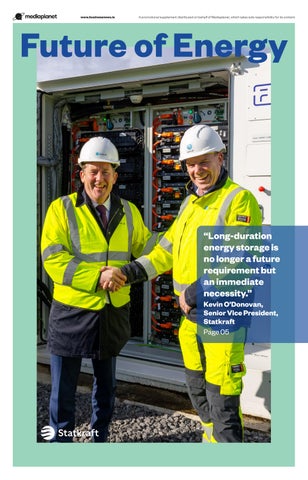
“Long-duration energy storage is no longer a future requirement but an immediate necessity.” Kevin O’Donovan, Senior Vice President, Statkraft Page 05
AN INDEPENDENT SUPPLEMENT FROM MEDIAPLANET WHO TAKE SOLE RESPONSIBILITY FOR ITS CONTENT
Building a cleaner, more secure energy future Ireland is accelerating renewables, strengthening its electricity network and expanding European interconnection to build a cleaner, more secure and affordable energy system.
T
he lasting way out of fossil fuel dependency and high energy costs is to shift electricity generation to renewable sources, electrify our economy rapidly and strengthen interconnection with Europe. This Government is making progress across all three areas.
Strengthening the grid and European connections Minister Darragh O’Brien Department of Climate, Energy and the Environment
We are prioritising renewable electricity and reforming our planning to make clean energy projects easier to deliver. Under Price Review 6, the Commission for Regulation of Utilities (CRU) approved up to €18.9 billion of investment in the electricity system by EirGrid and ESB Networks. We already have interconnectors with Britain, and construction is underway on the Celtic Interconnector to France, which is due to be commissioned in 2028.
Renewable generation gathers pace Ireland now regularly generates 40–50% of its electricity from renewables. The challenging, achievable target is 80%. Since 2015, renewable electricity’s share has more than doubled, rising from 19% to over 40% in 2025. In March, Ireland reached 8 GW of renewable generation connected to the electricity system, including more than 5 GW of onshore wind. When wind generation is high, average wholesale electricity prices can fall significantly; strong
Powering homes and strengthening energy security A rooftop solar revolution is underway. More than 120,000 homes have received Solar PV grants, and funding for the scheme will remain in place for the lifetime of this Government, up to 2030. Free solar panels have also been provided to 2,000 schools. Through microgeneration, households can sell excess electricity back to the grid. The affordability challenges of recent years demonstrate why we must accelerate the transition. Every megawatt of renewable electricity reduces our dependence on imported fossil fuels, strengthens our energy security and helps create a more stable energy system. My ambition is clear: a cleaner, more secure and more affordable energy future for Ireland. By investing in renewables, strengthening our grid, electrifying our economy and connecting with Europe, we can build an energy system that works for households, businesses and future generations.
Ph
o to
Cr ed
it :
i
St oc
k
How to turn energy challenges into business opportunities
output in February and March helped reduce the impact of wholesale price increases. Solar is also transforming the system. Ireland’s capacity rose from just 2 MW in 2015 to 3 GW by August, more than a thousandfold increase. Solar is now the third-largest source of indigenously generated electricity supplied to the national grid.
Unlock new value from energy assets you already own.
A
Sponsored by Enel X
re rising energy costs making your business less competitive? Would a power interruption threaten business continuity? Is your business delivering on its green commitments? When factors outside your control determine electricity costs, it makes sense to maximise the value of what you can control. Energy is no longer only an overhead. Businesses can earn revenue by being available to reduce or shift electricity use when required. Many sites have more flexibility in their electricity demand than they realise.
What is demand response? Enel X provides demand response and virtual power plant solutions in Ireland. You can reach Enel X at enelxireland@enel. com or visit enelx.ie
Demand response allows large energy users to temporarily adjust consumption when the grid is under pressure, or increase it when there is plenty of wind or solar power. This helps prevent blackouts, keeps costs down, and enables greater use of wind and solar.
@Mediaplanet UK & IE
@MediaplanetUKIE
capacity across 13 countries. Flexibility operations and grid events across international markets are supported from Enel’s Global Network Operations Centre in Dublin, which operates around the clock. During the peak of June’s heatwave, Enel X provided almost 573MWh of flexibility to the Irish grid. Enel X calculated that this could power every Dart train in Dublin, or meet the electricity needs of up to 7,500 typical households, for the week-long heatwave.
Power your business and the grid New power plants and grid infrastructure are still essential, but they take time to build. Demand response can move faster because it uses assets and capacity already in place, supporting the system while new infrastructure is developed.
Flexibility and widespread power Enel X, part of the Enel Group, brings this flexibility together through a group of connected energy assets that can quickly help the electricity system when needed. These can include battery energy storage systems, onsite generation and flexible electricity demand. Globally, the Enel Group manages more than 11GW of demand response
Participating businesses can earn revenue, lower the impact of high-price periods and get more value from existing infrastructure. Participants include data centres and businesses across sectors such as pharmaceuticals and aggregates. They invest heavily in backup energy infrastructure to meet their reliability requirements. Some of that capacity can support the grid at times of pressure while continuing to deliver their operations. Demand response should be a core part of Ireland’s energy security toolkit. It can reduce costs for the State and consumers, make the electricity system more reliable, reduce pressure at the busiest times and create revenue for participating businesses.
Contact information: ie.info@mediaplanet.com or +44 (0) 203 642 0737
Please recycle
Strategic Account Manager: Lucy Harris lucy.harris@mediaplanet.com Strategic Account Manager: Jen Church | Managing Director: Margot Thomas | Designer: Juraj Príkopa Senior Content Manager: Angelica Hackett O’Toole | Paid Media Strategist: Jonni Asfaha Digital Campaign Manager: Jan Martorell | All images supplied by Getty Images, unless otherwise specified
02
MEDIAPLANET
READ MORE AT BUSINESSNEWS.IE
AN INDEPENDENT SUPPLEMENT FROM MEDIAPLANET WHO TAKE SOLE RESPONSIBILITY FOR ITS CONTENT
Powering up Ireland’s electricity grid for a clean energy future Cathal Marley, Chief Executive of EirGrid, outlines how strategic investment in grid infrastructure will power secure, clean and affordable electricity and strengthen Ireland’s energy security.
M Cathal Marley Chief Executive, EirGrid
Sponsored by EirGrid
Find out more at www.eirgrid.ie
eeting Ireland’s climate and energy ambitions A key component of the programme is the delivery of 29 major cannot depend on renewable energy generation transmission priority projects identified as offering the greatest alone; it will require a modern, resilient electricity benefit to the State. These include three electricity projects grid capable of connecting new sources of power identified for support in the first round under Government’s and delivering them to homes, businesses and communities Critical Infrastructure Bill, the North-South Interconnector, across the country. Moneypoint Series Capacitor As Ireland’s Transmission and Letterkenny Station Offshore wind and interconnection System Operator, EirGrid is Redevelopment. will play a transformative role in responsible for operating the electricity transmission system Ireland’s energy future, open the door Working towards a cleaner securely and reliably, while energy system to large-scale renewable generation planning for the country’s longThe future energy system will term energy needs. also rely heavily on offshore wind and greater long-term energy and opportunities for greater independence. Developing infrastructure for a interconnections across Europe. future-ready grid The Celtic Interconnector, “While this work progresses, we are continuing to maximise currently under construction between Ireland and France, the capacity of our existing grid through the use of different will allow electricity to flow between both countries and, once technologies. To meet the needs of a growing economy operational, will have the capacity to power up to 450,000 and an increasingly electrified society, we need a grid that homes. is stronger, smarter and ready for the future,” says Marley. “Offshore wind and interconnection will play a The infrastructure we deliver today will underpin Ireland’s transformative role in Ireland’s energy future, open the door to competitiveness, energy security and climate ambitions for large-scale renewable generation and greater long-term energy decades to come.” independence,” Marley explains. To meet these challenges, EirGrid is delivering the most Delivering the grid of tomorrow will require meaningful ambitious programme of transmission infrastructure engagement with local communities, and this remains central development in Ireland’s history, with 381 transmission projects to EirGrid’s approach as it develops major infrastructure across planned nationwide over the next five years, supported by an the country. €18.9 billion investment programme to strengthen Ireland’s “EirGrid will not deliver the energy transition alone; we must electricity grid. continue to collaborate with communities and stakeholders “Our strategy is about building the backbone of Ireland’s and communicate the critical role infrastructure plays in electricity grid. It sets out how we will deliver grid supporting our economy, society and our climate ambitions,” infrastructure at pace and at scale, while continuing to operate he concludes. a safe, secure and reliable electricity system every day,” he says.
Shared grid connections could meet Ireland’s renewable energy needs Ireland needs more renewable energy. Households want affordable, secure electricity that isn‘t hostage to international gas markets. As renewable energy developers, we’re ready to deliver it.
T
here is one frustrating reality standing in the way: In many parts of the country, the electricity grid is straining to accommodate any more energy.
TJ Hunter Managing Director Ireland and UK, Perigus Energy
Sponsored by Perigus Energy
Find out more at perigusenergy.ie
A stronger, more resilient electricity system is essential if Ireland is serious about delivering its climate targets, supporting economic growth and electrifying transport, heat and industry. However, building new transmission infrastructure takes years. It requires significant public investment, lengthy planning processes, procurement and major engineering works. None of that can happen overnight. What can we do while we wait? The answer: make better use of the infrastructure we already have.
Likewise, shouldn‘t battery storage be allowed to sit alongside existing renewable projects? Batteries can absorb excess renewable electricity when generation is high and release it back onto the system when demand rises or when renewable output falls. They improve flexibility, strengthen security of supply and make every existing grid connection work harder. Technically, this is achievable. In practice, however, often impossible. Current rules continue to treat wind, solar and battery storage as separate technologies competing for scarce grid capacity, rather than complementary assets capable of sharing the same connection intelligently. Infrastructure capable of delivering significantly greater value remains underutilised, while new renewable projects wait in the queue for connections that are years away.
Sharing the same grid connection
Achieving energy security
Many renewable developers already have valuable grid connections serving existing wind farms. Could those same connections also accommodate solar generation? When the wind eases on a summer afternoon, solar panels could continue producing clean electricity using the very same grid connection.
Across Europe, co-located renewable projects are becoming increasingly common because they maximise existing infrastructure, reduce costs and accelerate decarbonisation. Ireland should do the same. Every megawatt of renewable electricity that can be generated
Ireland already has the grid infrastructure
READ MORE AT BUSINESSNEWS.IE
from an existing grid connection is a megawatt that does not require years of waiting for new infrastructure before it can contribute to lower emissions, greater energy security and more stable electricity prices.
Every megawatt of renewable electricity that can be generated from an existing grid connection is a megawatt that does not require years of waiting. Removing barriers to sharing the grid If the Government is serious about accelerating renewable deployment, it should also remove the barriers preventing developers from combining wind, solar and battery storage behind existing and new grid connections. Doing so would require little or no additional public spending. It would make better use of existing infrastructure. It would unlock clean electricity years sooner than waiting for new grid capacity alone. Ireland cannot afford to leave renewable energy sitting on the sidelines because of rules designed for a different era. The infrastructure we have can do more. We should let it.
MEDIAPLANET
03
AN INDEPENDENT SUPPLEMENT FROM MEDIAPLANET WHO TAKE SOLE RESPONSIBILITY FOR ITS CONTENT
Ireland lost 15% of its cheapest electricity to grid constraints This year, Ireland lost 15% of our most affordable electricity because our grid was not strong enough to carry all the power generated by wind farms to Irish homes and businesses.
M
ore expensive gas generation, powered primarily by imported fuel, was brought on to make up the shortfall. Consequently, consumers end up paying more for dirtier energy. Every unit of renewable electricity lost is a missed opportunity to reduce our dependence on imported fossil fuels and lower electricity costs for Irish households and businesses.
Volatile gas markets Accelerating investment in the electricity grid, energy storage and other enabling technologies is crucial. The more renewable power we can use when it is available, the less exposed Ireland will be to volatile international gas markets. This is not just an investment challenge. A focus on public engagement, clear communications and tackling misinformation will be essential to maintaining and building broad, popular support for the infrastructure required for energy independence. The long-term solution is investment in Ireland’s electricity network. We welcome the work already underway by EirGrid and
04
MEDIAPLANET
ESB Networks to strengthen the grid and prepare it for a more electrified future. Ensuring they have continued public and political support will be key to delivering the infrastructure needed to power Ireland’s future.
Solutions for today New infrastructure cannot be built overnight. We need solutions that can make a difference today. We should use every tool available now to make better use of the electricity network we already have. Wind farms are still not allowed to store power in batteries on the same site. Instead of storing excess renewable electricity, they must switch off. At the same time, technologies that can increase the capacity of existing power lines are only beginning to be deployed. These are not necessarily easy fixes, but they can be done much more quickly than new power lines can be built. Ireland has a world-class wind resource. With the right investment, we can turn more of that renewable energy into more affordable, secure and clean electricity to power homes and businesses across the country.
Justin Moran Director of External Affairs, Wind Energy Ireland
READ MORE AT BUSINESSNEWS.IE
AN INDEPENDENT SUPPLEMENT FROM MEDIAPLANET WHO TAKE SOLE RESPONSIBILITY FOR ITS CONTENT
Im
ag
ep ro
vid ed
Long-duration energy storage required to meet Ireland’s renewables ambition
by
St
at k raf t
Ireland has set itself the task of reaching 80% renewable electricity by 2030. This ambitious target is essential to reducing emissions, strengthening energy security and protecting consumers from volatile fossil fuel prices.
A
gap remains between Ireland’s ambition and the infrastructure needed to deliver it. One of the most significant elements in bridging that gap is long-duration energy storage (LDES).
Kevin O’Donovan Senior Vice President, Statkraft
Strategy to meet storage targets
History has shown it can take time to establish and run auctions. If EirGrid are not ambitious enough in terms of volume for the first round, the risk that Ireland deviates even further on climate targets increases, and our ability to Role and benefits of long-duration energy storage integrate high levels of renewables on the grid in an efficient, Discussions about the energy transition often focus on secure and stable manner is jeopardised. building wind and solar farms and electricity networks. Statkraft believes that the target volume for the first These developments remain procurement round should be crucial, but as renewable 1GW, with an additional 1GW generation increases, the in the second round. Storage challenge is no longer projects can take years to LDES allows Ireland to capture producing clean electricity. We develop, finance and construct. renewable electricity and make it must also ensure that it can be Decisions made today will used when consumers need it. determine whether Ireland available when demand rises. LDES such as battery storage has sufficient flexibility in the are highly flexible assets and early 2030s, when renewable add significant value to an penetration is expected to be at islanded grid network operating its highest. Restricting volumes on high levels of renewables. LDES can store electricity now risks creating a bottleneck that could undermine our during periods of high generation and release it when output wider energy ambitions. falls, matching consumer demand. It can also reduce the curtailment of renewable energy, improve grid stability, Policy frameworks to support long-term deployment strengthen security of supply and enable much higher levels Frameworks such as RESS and DS3 helped establish the of integration of renewables. LDES is not an optional add-on; country as a leader in renewable system integration, it will be a keystone to Ireland’s ability to achieve its climate attracting substantial interest in storage technologies. When goals. policymakers provide long-term certainty and credible market signals, investors respond. Reducing renewable energy waste Government, regulators and system operators should Ireland has an advantage because of its wind resources. establish a clear route to market with more ambitious scale Yet, increasing volumes of renewable electricity are being and volume, provide visibility and certainty on future constrained or curtailed because the system lacks the procurement and develop a long-term deployment roadmap flexibility to absorb and use the power being generated. extending beyond the first auction. The success of RESS Every unit of renewable electricity that cannot be used is demonstrates the value of consistency, transparency and wasted and lost value for consumers. forward planning. Storage requires the same treatment. LDES allows Ireland to capture renewable electricity and make it available when demand rises. This means more Necessity for long-duration energy storage now renewables on the system, lower emissions and more Statkraft has extensive experience developing and operating efficient use of infrastructure. storage and flexibility assets. It recently delivered Ireland’s Because of its strategic importance, plans need to reflect first four-hour battery project and is constructing four the ambition required. Industry understands that the first synchronous condenser projects across the island to help proposed the first proposed LDES auction being run by strengthen power system stability. the Transmission System Operator (EirGrid) to target 201Industry is ready, capital is available, and the technology 300MW but remain hopeful that this will increase. While is capable. What is needed now is a procurement framework it is a welcome first step, it should, at the very least, align and policy environment that matches Ireland’s future with the Government’s own Electricity Storage Policy needs. Long-duration energy storage is no longer a future Framework guide volume of 500MW.” requirement but an immediate necessity.
READ MORE AT BUSINESSNEWS.IE
Sponsored by Statkraft
Find out more at www.statkraft.ie
MEDIAPLANET
05
AN INDEPENDENT SUPPLEMENT FROM MEDIAPLANET WHO TAKE SOLE RESPONSIBILITY FOR ITS CONTENT
Ireland’s solar success has created its next energy challenge
S Ronan Power CEO, Solar Ireland
Ireland has spent years asking how we can build more renewable electricity. We now need to ask a harder question: how do we make every unit of clean power more valuable?
olar is growing rapidly. Ireland now has 3 GW connected and rooftop systems on more than 195,000 homes. At peak output, utility-scale solar has supplied more than one-third of Ireland’s electricity demand. This success also changes the challenge. Solar generation is concentrated during daylight hours, while electricity is needed around the clock. As more solar connects, the value of timing, flexibility and coordination grows. The future of energy is generation integrated with storage, flexible demand and a grid designed to connect them. Three shifts will determine whether Ireland captures the full value of its solar growth.
Maximising solar’s value First, we must move from generation-only thinking to solar plus storage. Batteries can absorb electricity when solar production is abundant and release it when demand rises or the system needs support. This reduces renewable energy lost through constraints, helps manage peaks and allows solar to serve the system beyond daylight hours. Second, we must connect clean supply with flexible demand. Businesses can schedule suitable energy-intensive activity when renewable electricity is plentiful. Electric vehicles, heat pumps and smart buildings can respond to price and system signals. Homes, farms and commercial sites can generate, store and manage more of their own power. Consumers become active participants rather than the final point in the chain. Third, Ireland must replace fragmented decision-making with whole-system planning. Grid development, planning, renewable auctions, storage policy and market design are still too often treated separately. Yet, a solar farm awaiting
a connection, a battery facing unclear market signals and a business seeking clean power are different parts of the same system challenge.
Making clean energy work Getting this right has consequences beyond climate targets; it affects energy security, electricity costs and Ireland’s ability to attract and retain businesses that increasingly require reliable clean power. It can also support rural incomes, skilled employment and greater community participation in the transition. These questions will be central to Renewable Energy Expo Ireland at the RDS on 21 and 22 October. Jointly delivered by Solar Ireland, Wind Energy Ireland and Energy Storage Ireland, it will bring together the sectors that must solve them. Solar capacity is arriving. Now, the system must catch up. The prize is a more secure, competitive, and resilient Ireland, with clean energy working harder for homes, businesses and communities.
Combining wind, solar and storage to make Ireland’s energy more reliable Ireland can’t be powered by one technology alone. Combining wind, solar and battery storage, an integrated renewable energy platform can deliver clean power more reliably and strengthen energy security.
I
Declan Cullinane Managing Director, Amarenco
n Ireland, the challenge is no longer simply to build more renewable generation. We must create an energy system that is cleaner, more secure and flexible, while supporting Ireland’s continued economic growth. Amarenco has been part of Ireland’s renewable energy story since the company was established in 2013, developing significant expertise in solar energy and, increasingly, battery storage. Our next chapter is about building on that foundation.
Building beyond solar
Find out more at amarencogroup. com/en/
06
MEDIAPLANET
Our evolution into a multi-technology renewable energy platform — wind, solar and battery energy storage systems (BESS) — reflects where Ireland’s energy system needs to go next. Solar will remain fundamental. It is scalable, competitive and capable of delivering significant volumes of clean electricity quickly. Wind offers a balanced daily profile and harnesses one of Ireland’s greatest renewable resources. BESS provides the flexibility needed to bring these technologies together, storing
renewable electricity when generation is abundant and making it available when the system needs it most. The opportunity is not simply to develop more renewable projects. It is to create integrated energy infrastructure that delivers power more consistently and strengthens the resilience of the electricity system.
Meeting Ireland’s growing energy needs Demand for electricity is expected to continue growing as sectors such as data centres, advanced manufacturing, transport and heat increasingly depend on clean power. Meeting this demand while delivering on our climate ambitions will require substantial investment in renewable generation, storage and grid infrastructure. Amarenco’s growth strategy is aligned with this opportunity. By bringing wind, solar and battery storage together, we can build a more balanced and diversified renewable portfolio, strengthen Ireland’s energy security, reduce emissions and create lasting value to communities and investors.
Our ambition is not to choose between technologies but to understand how they can work intelligently together.
Sponsored by Amarenco
Integrated renewable energy infrastructure Ireland needs more renewable energy; but it also needs the right energy infrastructure, developed in the right places and available at the right times. Amarenco’s next chapter exceeds solar and storage. It is about becoming a broader renewable energy platform, capable of helping Ireland build the resilient, flexible and sustainable system its future growth will require. The future of Ireland’s energy system will not be defined by one technology but by how intelligently we combine them.
READ MORE AT BUSINESSNEWS.IE
AN INDEPENDENT SUPPLEMENT FROM MEDIAPLANET WHO TAKE SOLE RESPONSIBILITY FOR ITS CONTENT
Organisations that treat energy as a long-term business asset rather than a short-term operating cost will be better positioned to manage volatility. Photo: Power Capital Renewable Energy
Energy certainty is now a boardroom issue for Ireland’s largest energy users Ireland’s renewable energy sector has made remarkable progress over the last decade. Alongside corporate power purchase agreements (PPAs) and battery storage, Ireland’s largest energy users can secure cost certainty, reduce emissions and support economic growth.
S Caolan Duffy Chief Commercial Officer, Power Capital Renewable Energy
olar, wind and energy storage are moving from emerging technologies to critical infrastructure, helping to strengthen energy security, support climate ambitions and create new opportunities for businesses across the country. Yet, for Ireland’s largest energy users, the conversation has moved beyond sustainability alone. Energy is now a commercial risk, a competitiveness issue and a boardroom priority. Businesses are asking whether they can secure the electricity they need, whether they can manage long-term cost exposure and whether their energy strategy will support growth rather than constrain it.
Growth alongside renewable energy certainty For data centres, advanced manufacturers, life sciences facilities, food producers and other energy-intensive industries, access to reliable and competitively priced electricity is increasingly central to investment decisions. These organisations operate in an environment shaped by rising demand, volatile wholesale markets, more stringent reporting obligations and pressure to reduce emissions (and growing scrutiny of Scope 2 emissions in particular) without compromising performance. The challenge is no longer how Ireland builds more renewable generation; it is how businesses lock in energy certainty in a way that protects margins, supports expansion and reduces carbon exposure. Delivering economic growth, energy security and sustainability together will take more than new capacity; it demands sustained investment in the grid reinforcement, storage and flexible systems that turn generation into reliable supply. That is where the opportunity becomes commercially significant.
Energy procurement is becoming a strategic discipline The organisations that treat energy as a long-term business asset rather than a short-term operating cost will be better positioned to manage volatility, meet customer and investor expectations and plan future growth with confidence. Corporate Power Purchase Agreements (PPAs), dedicated renewable generation, battery storage and integrated energy solutions are becoming practical tools for businesses that need greater control over their energy future.
READ MORE AT BUSINESSNEWS.IE
A corporate PPA, for example, can fix a large user’s power price for 10 to 15 years, converting a volatile operating cost into a predictable, budgetable one. These models can help large energy users improve budget certainty, reduce exposure to market volatility, demonstrate credible decarbonisation progress and support the development of new renewable infrastructure.
Powering long-term competitiveness At Power Capital Renewable Energy, we see first-hand how business energy requirements are evolving. Large energy users are increasingly looking for partners who understand demand profiles, commercial risk, grid constraints, sustainability commitments and the need for solutions that are bankable, deliverable and aligned with long-term operating plans. Caolan Duffy, Chief Commercial Officer, says: “Having partnered with corporate offtakers to deliver over 230MW of new renewable capacity to date, Power Capital is actively supporting organisations to meet their energy requirements in a competitive, long-term fashion whilst decarbonising Ireland’s energy system.”
National renewable energy opportunity With strong renewable resources, a growing solar sector, increasing battery storage deployment and a national ambition to attract high-value investment, Ireland can position energy infrastructure as a competitive advantage. However, that advantage will only be realised if renewable generation is connected to the real needs of businesses that require scale, reliability and certainty. Realising it will require the enabling reforms only Government can deliver — faster grid connections and a more predictable planning and permitting regime — so that consented projects can reach large users at the pace the economy needs. For large energy users, the real question is no longer whether renewable energy should form part of their strategy, but how quickly they can move from ambition to action. The future of energy is no longer just about generation. It is about commercial certainty, resilience and giving Ireland’s largest energy users the confidence to power their next phase of growth.
Sponsored by Power Capital Renewable Energy
Find out more at powercapital.ie
MEDIAPLANET
07
AN INDEPENDENT SUPPLEMENT FROM MEDIAPLANET WHO TAKE SOLE RESPONSIBILITY FOR ITS CONTENT
Ireland doesn’t have enough engineers to meet clean energy demands Rising demand, electrification and geopolitical uncertainty are putting pressure on Ireland’s energy system. A secure, resilient and low-carbon supply is an urgent economic and strategic priority.
A
critical challenge for Ireland will be to meet the engineering workforce requirements necessary for this energy transition.
Dr Keith Sunderland Registrar, Engineers Ireland
the number of appropriately trained engineering graduates in this country. A particular focus should be placed on promotion to women, who currently make up only around 15% of Ireland’s engineering workforce. Range of engineering opportunities Furthermore, support for the expansion of the number of Virtually all major categories of engineer — including civil, engineering apprenticeship programmes accredited at NFQ structural, mechanical, electrical and chemical engineers — level 8 and above could also assist in growing the number of are listed on the Department those entering the profession of Enterprise, Tourism and through non-traditional routes. Employment’s Critical Skills Lastly, five-year integrated Occupation List, indicating master’s degrees, which By including the fifth year within a dearth of engineering allow graduates to meet the the Initiative, more graduates can professionals required for educational requirements the proper functioning of the to obtain the professional be supported on their journeys to economy. title of Chartered Engineer, becoming Chartered Engineers. Ireland also lags significantly are of considerable benefit behind most developed in developing high-quality countries in the proportion engineering graduates, ready to of its graduates of who have enter the workforce. completed engineering, manufacturing or construction Regrettably, however, the fees for the fifth year of this qualifications at third-level, with only 9.95% of Irish programme are not currently paid by the Free Fees Initiative graduates in 2024 having done so, compared to an OECD in the same way other five-year undergraduate, vocationally average of 13.1% and significantly below leading European focused courses (such as medicine) are. By including nations such as Germany (21.3%), Austria (18.9%) and Finland the fifth year within the Initiative, more graduates can (17.1%). be supported on their journeys to becoming Chartered There are a number of key initiatives, however, that can Engineers. help increase the number of students choosing engineering.
Engineering should be made more accessible Greater support for third-level institutions in Ireland in offering and promoting places in engineering courses accredited by Engineers Ireland would assist in growing
Critical need for engineers
Without enough engineers, Ireland’s energy transition, infrastructure delivery and industrial competitiveness objectives will become increasingly difficult to achieve. Greater third-level supports can help address this problem.
25 SUPPORTING THE FUTURE OF DATA CENTRE & BESS LOGISTICS The rapid growth of data centres and renewable energy is driving increased demand for efficient, safe handling of large and heavy loads. Both sectors rely on the safe, efficient movement of large, heavy and often awkward loads within increasingly complex facilities. Combilift is ideally positioned to support this evolving industry with specialised material handling solutions. With decades of expertise in handling long, heavy and challenging loads, Combilift provides innovative material handling solutions that improve efficiency, enhance safety and support the evolving needs of the data centre and energy storage industries. The Combi-SC Straddle Carrier provides a flexible, highly manoeuvrable solution for transporting heavy and oversized loads around data centre and BESS facilities.
CONTACT US TODAY To find out how Combilift can help you unlock every inch of your storage space.
combilift.com Future of Energy IE 330x165.5 wide rev 2.1.indd 1
08
MEDIAPLANET
31/08/2026 11:45:49
READ MORE AT BUSINESSNEWS.IE
AN INDEPENDENT SUPPLEMENT FROM MEDIAPLANET WHO TAKE SOLE RESPONSIBILITY FOR ITS CONTENT
Image credits: Designer Group
Behind the energy transition: why grid interconnectivity will define delivery The current energy challenge for Ireland surrounds delivery and how it builds the generation, grid and supporting infrastructure required to meet industry and community needs.
T
o accommodate a rapidly changing energy system, Ireland must now continue to meet the needs of industry, communities and major energy users.
sources of generation into national transmission systems.
Interconnectors and converter stations
Designer Group has gained direct experience of this infrastructure through its involvement in the Celtic Electricity demand and increased investment Interconnector, the new electricity connection between Over the past year, Designer Group has delivered 430MW of Ireland and France. The project represents a development continuous on-site power for Large Energy User data centre for Ireland’s energy system, strengthening its connection operators in Dublin. To put that with the wider European scale into context, if operated electricity market and continuously, that represents increasing the ability to move enough electricity to match the power between both countries Generation, grid infrastructure and annual electricity consumption as renewable generation grows. of approximately 835,000 renewable projects all ultimately have That experience is now average Irish homes. being carried into another to become functioning assets. Rather than relying solely major energy infrastructure on grid supply, major users project in the UK. The Business are increasingly investing in has secured the electrical dedicated generation, storage, works package for the high-voltage infrastructure and sophisticated energy onshore converter station associated with RWE’s Norfolk management systems. This is creating a more decentralised Vanguard West offshore wind development. These projects energy landscape, where resilience, flexibility and security of demonstrate how power must also be converted, transmitted supply need to be considered alongside overall demand. and successfully integrated into national and international networks.
Decentralised energy landscape in practice
One of the clearest examples is Europe’s first large-scale microgrid-enabled energy centre, delivered in Dublin. Designer Group completed the full mechanical and electrical installation for the facility, integrating on-site generation with complex mechanical and electrical infrastructure to create a highly resilient energy environment. It demonstrates how infrastructure can evolve to meet the needs of large energy users while reducing dependence on constrained grid capacity and creating greater flexibility in how power is generated and managed. The same change can be seen at Echelon’s Dublin campus, where major digital infrastructure is being developed alongside significant dedicated generation and highvoltage infrastructure. Developments of this scale need to be understood not simply as data centres, but as complex energy ecosystems.
Energy ecosystem evolution extends across Europe
Sponsored by Designer Group
As the power requirements of major energy users increase, so too does the scale of the infrastructure required to support them. The Business is currently delivering 400kV high-voltage to medium-voltage substations for large-scale data centre developments in the Netherlands and Belgium, illustrating just how closely digital growth and energy infrastructure are becoming intertwined. Yet, the changing energy landscape extends well beyond large energy users. As renewable generation increases, Europe also needs substantially more infrastructure to move power across regions, between countries and from new
READ MORE AT BUSINESSNEWS.IE
Interconnected developments that will determine success The engineering capability required to support major energy users is also increasingly relevant to the infrastructure needed to connect renewable generation, strengthen national networks and move power across borders. It is this convergence between generation, high-voltage infrastructure, major energy users and grid connectivity that is beginning to define the next phase of the European energy market. Together, these developments point towards an energy system that is becoming more interconnected, decentralised and technically complex.
Practical execution of energy transition For global engineering and construction company Designer Group, the opportunity lies in applying experience gained across generation, grid infrastructure, high-voltage systems and mission-critical environments to the next generation of energy projects. Gary Byrne, Executive Director Energy, believes the next phase will be defined by execution. He concludes: “The conversation around energy has rightly focused on ambition and investment, but the challenge now is delivery. Generation, grid infrastructure and renewable projects all ultimately have to become functioning assets. That requires experienced teams, strong engineering capability and collaboration across developers, utilities, contractors and major energy users.”
Find out more at designergrp.com
MEDIAPLANET
09
AN INDEPENDENT SUPPLEMENT FROM MEDIAPLANET WHO TAKE SOLE RESPONSIBILITY FOR ITS CONTENT
Powering the switch: making electrification attractive Ireland can cut energy costs, reduce fossil fuel imports and strengthen energy security by accelerating affordable electrification.
I
reland spends an estimated €1 million every hour on imported fossil fuels. Electrifying our energy system offers an opportunity to build a more efficient and competitive economy while cutting emissions, reducing exposure to volatile international energy markets and making greater use of renewable electricity produced here in Ireland. The benefits are particularly clear in heating and transport, where heat pumps and electric vehicles are far more energy-efficient than fossil-fuel alternatives. Yet, these sectors account for more than 80% of Ireland’s final energy demand and are still heavily
much per unit. This is the ‘spark gap’ — the ratio between electricity and fossil-fuel prices. SEAI figures indicate that a unit of electricity in Ireland costs around 2.84 times the equivalent unit of gas. The EU’s Electrification Action Plan aims to bring this ratio below 2.5 for households and 2.0 for industry by 2030.
Accelerating electrification Ireland needs practical measures to close this gap and accelerate the transition. For example, the Government could look at a suite of measures to reduce VAT on electricity and change how electricity network
The cost of electricity relative to fossil fuels remains a significant barrier. dependent on imported oil and gas. The challenge is not just encouraging households and businesses to electrify; it is making the switch affordable and financially attractive while strengthening Ireland’s energy independence.
Closing the spark gap The cost of electricity relative to fossil fuels remains a significant barrier. Even if a heat pump is three times more efficient than a gas boiler, consumers will struggle to make the switch if electricity costs three times as
Ireland Electrified will launch a new paper with further recommendations at its Annual Conference in Dublin on 10 September, bringing industry and policymakers together to discuss a cleaner, more secure and affordable energy future. For more information and registration, visit irelandelectrified.ie
10
MEDIAPLANET
charges work, so households and businesses can save money by using electricity at times when demand is lower. People should also be rewarded for using technologies such as heat pumps, batteries and EVs, helping to make the switch to clean energy more affordable. Ireland has made significant progress in renewable electricity. The next step is making clean energy affordable for households and businesses, delivering lower costs, greater energy security and a more competitive economy.
Anna Conlan Head of Ireland Electrified
READ MORE AT BUSINESSNEWS.IE
AN INDEPENDENT SUPPLEMENT FROM MEDIAPLANET WHO TAKE SOLE RESPONSIBILITY FOR ITS CONTENT
Energy certainty made possible by CPPAs for Irish businesses Corporate power purchase agreements (CPPAs) give Irish businesses long-term energy cost certainty, strengthen operational resilience and support investment in renewable electricity infrastructure.
E Russell Keating Director of Sales, SSE Airtricity
nergy market volatility has reinforced an important across the company’s Cruiserath, Plaza and Shannon sites to lesson: future energy costs can no longer be taken renewable electricity generated at SSE’s Mullananalt Wind for granted. Geopolitical events, international gas Farm in Co. Monaghan. markets and wider system costs continue to shape The agreement gives Bristol Myers Squibb clearer what businesses pay for electricity. traceability over part of its electricity supply through a For many organisations, the challenge is not simply about named Irish renewable asset, while supporting long-term securing the lowest possible price today but securing greater operational resilience and sustainability objectives. For large certainty over future costs. That is energy users, that is the value of a one reason why CPPAs are attracting CPPA in practice: bringing together growing interest from large energy renewable electricity, greater visibility users across Ireland. over supply and a more strategic The significance of CPPAs approach to managing future energy extends beyond the CPPA is fundamentally about needs.
certainty
Scan to learn more:
individual businesses involved.
Through a long-term agreement linked to renewable electricity generation, businesses can gain greater visibility over a portion of their future energy costs while supporting their decarbonisation objectives. In an environment where uncertainty remains a feature of global energy markets, that predictability has real value. Importantly, CPPAs are not solely about sustainability credentials. While they undoubtedly contribute to net zero objectives, their growing appeal reflects a commercial reality. Businesses increasingly see energy procurement as a strategic decision connected to competitiveness, operational resilience and long-term planning.
Value of CPPA in practice A practical example is SSE Airtricity’s expanded Corporate Power Purchase Agreement with Bristol Myers Squibb in Ireland, which links a defined portion of electricity demand
READ MORE AT BUSINESSNEWS.IE
Supporting Ireland’s renewable energy infrastructure
The significance of CPPAs extends beyond the individual businesses involved. They can also support investment in new renewable generation by providing greater revenue certainty for renewable generation projects. In that sense, they help align two important objectives: improving affordability and resilience for energy users while supporting the continued development of Ireland’s renewable energy infrastructure. Businesses are no longer focused solely on what electricity costs today. Increasingly, they are rightly asking what it will cost in five, 10 or 15 years and what steps they can take now to reduce uncertainty. The growing interest in CPPAs reflects that shift in thinking. In a more uncertain world, certainty itself has become a form of value. For many Irish businesses, that is becoming just as important as the renewable electricity being supplied.
Sponsored by SSE Airtricity
MEDIAPLANET
11
AN INDEPENDENT SUPPLEMENT FROM MEDIAPLANET WHO TAKE SOLE RESPONSIBILITY FOR ITS CONTENT
Storage and planning hold the key to renewable resources Ireland can turn its abundant renewable resources into secure, investable infrastructure if planning, grid flexibility and market frameworks move at the pace projects require.
I
reland has built a strong policy foundation for its energy transition. The task now is to convert targets, auctions and strategies into projects that generate power.
Ross Moore Partner and Head of Energy, Infrastructure & Natural Resources, A&L Goodbody
John Dallas Partner, Energy, Infrastructure & Natural Resources, A&L Goodbody
David McElroy Partner, Energy, Infrastructure & Natural Resources, A&L Goodbody
Aisling O’Donoghue Partner, Energy, Infrastructure & Natural Resources, A&L Goodbody
Sponsored by A&L Goodbody
Find out more. Scan the QR Code
Offshore wind’s delivery test The State is targeting at least 5 GW of offshore wind by 2030, while more than 3 GW was procured through the first offshore auction. Yet, no project has broken ground. Applications can run to thousands of pages, followed by lengthy requests for further information and uncertain decision dates. For developers competing for mobile international capital, timing is not an administrative detail; it is a core investment risk. John Dallas, Partner, Energy, Infrastructure & Natural Resources at A&L Goodbody, says: “Statutory determination periods, backed by regulators with the people and expertise to meet them, would provide the certainty the market needs.” The aim is not to lower standards, but to make a robust process more predictable. That would help offshore wind move from ambition to construction, supporting regional jobs, supply chains and long-term competitiveness while strengthening energy security.
Flexibility becomes infrastructure As wind and solar supply more electricity, flexibility becomes essential. Variable generation must be balanced from hour to hour, while the system still needs the stability services traditionally supplied by conventional plants. “Electricity storage and grid flexibility have already become essential to maintaining a stable and secure power system,” says Ross Moore, Partner and Head of Energy, Infrastructure & Natural Resources at A&L Goodbody. “Battery storage has moved rapidly from a niche grid service to a core infrastructure requirement,” he adds. “One of the biggest challenges is how storage projects earn their revenues,” says Aisling O’Donoghue, Partner, Energy, Infrastructure & Natural Resources at A&L Goodbody. “Recent reforms, including fairer network charges and allowing batteries to trade directly in the wholesale market, are positive steps. What is still needed is a clear, government-backed procurement route for longer-duration storage that gives investors the certainty to commit at scale.”
Solar’s next phase Solar shows how quickly a technology can advance when policy support and corporate demand align. Competitive support through the Renewable
12
MEDIAPLANET
Electricity Support Scheme helped unlock utility-scale projects, while businesses’ appetite for renewable power created another source of demand. With an 8 GW national target for 2030, the growth opportunity remains substantial. David McElroy, Partner, Energy, Infrastructure & Natural Resources at A&L Goodbody, identifies further potential in ground-mounted solar and commercial rooftops. “Maintaining momentum will depend on grid access and timely planning,” says McElroy. So, solar, storage and network investment must progress as an integrated system.
Earlier engagement, quicker decisions Planning reform runs through every technology. Brendan Curran, Partner, Environmental & Planning at A&L Goodbody, says: “Early engagement between developers, regulators and communities can help. But every new planning policy involves cost, especially
highly technical environmental requirements.” Developers, statutory consultees, prescribed bodies and communities need the capacity and clear timelines to engage before an application is lodged, when concerns can still reshape a project. “Issues identified early are easier and cheaper to resolve, reducing delays and legal challenges,” adds Kristen Read, Senior Associate, Environmental & Planning at A&L Goodbody. “Reform should support timely engagement through better resourcing and clearer response timelines.” Ireland does not lack energy ambition. Its competitive advantage will depend on execution: coordinated institutions, credible timelines and investable market frameworks. Getting those foundations right can turn renewable potential into secure power, economic activity and durable public confidence.
Brendan Curran Partner, Environmental & Planning, A&L Goodbody
Kristen Read Senior Associate, Environmental & Planning, A&L Goodbody
READ MORE AT BUSINESSNEWS.IE