healthawareness.co.uk
A promotional supplement distributed on behalf of Mediaplanet, which takes sole responsibility for its content
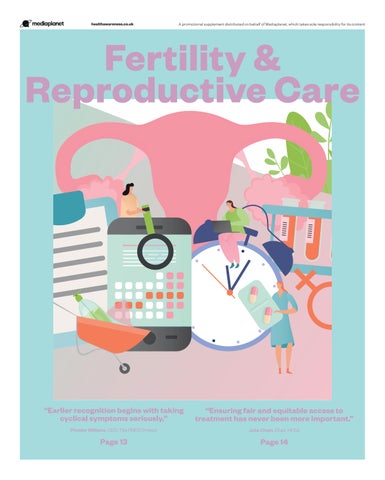
Fertility & Reproductive Care
“Earlier recognition begins with taking cyclical symptoms seriously.”
“Ensuring fair and equitable access to treatment has never been more important.”
Phoebe Williams, CEO, The PMDD Project
Julia Chain, Chair, HFEA
Page 13
Page 14
A PROMOTIONAL SUPPLEMENT DISTRIBUTED ON BEHALF OF MEDIAPLANET, WHICH TAKES SOLE RESPONSIBILITY FOR ITS CONTENT
Not everyone who wants children gets the chance to have them Roughly 2.1 children per woman is what’s plainly called the ‘replacement rate’ at which we should produce children for the UK population to hold steady from births and deaths alone.1
I
n 1900, the UK replacement rate was 3.4. In 1964, at the peak of the baby boom in 1964, it was 2.95. In 2025, England and Wales reported a dramatic fall to 1.39.1 Many factors are driving this cratered fertility rate.
Fertility’s hidden barriers
A recent UK poll found 44% of adults aged 18 to 50 are delaying children or deciding against them altogether.2 Many more people want children but are crashing into barriers they didn’t anticipate. According to the Human Fertilisation and Embryology Authority’s own data, around one in six couples experience fertility problems in the UK, with female and male factors contributing at broadly similar rates.3 PMOS affects an estimated one in 10 women, and endometriosis a further one in 10, both conditions that often go undiagnosed for years.4 For those who actually have a diagnosis and turn to IVF, there’s a brutal postcode lottery waiting.
Katie Rollings Founder/CEO, Fertility Action
become a parent. It is difficult to think of a more personal example of inequality. This is exactly the injustice Fertility Action exists to end. The charity was founded by Katie Rollings out of her own experience of infertility and IVF. We now work alongside patient advocates, clinicians and MPs to close the gap between what NICE recommends and what people actually receive.
Fighting for fertility care access
In January 2025, we took that fight to Parliament with MP Andrew Griffith, pushing for nationwide IVF access and better early diagnosis of male subfertility in primary care too, because this isn’t only a women’s issue. Fertility is a medical need, not a lifestyle choice, and treatment shouldn’t depend on a postcode. We keep pushing because nobody should be denied the chance of a family simply because of where they happen to live. 1
Postcode determines parenthood
NICE recommends three funded cycles for eligible women under 40. Yet, only two of England’s 36 Integrated Care Boards actually offer that. Nearly 70% offer just one cycle, and several regions, including Greater Manchester, cut their funding from three cycles to one in the past year alone.5 Scotland funds three cycles nationally, Wales funds two. How can it be fair that where you live in the UK, not your medical need, is currently what decides how much support you get? The result is a system in which the postcode on your driving licence has an influence on whether, and how, you
2
3
4
5
Closer, 2025. Total Fertility Rate (TFR). closer.ac.uk/contextual-data/total-fertilityrate/ Ipsos, 2025. Half of British women aged 18-50 have delayed or decided against having future children, with cost concerns main factor. tinyurl.com/5eupbhww Stanton AL & Woodward JT, 2014. Infertility. In: Ayers S, Baum A, McManus C, et al., eds. Cambridge Handbook of Psychology, Health and Medicine. Cambridge University Press; 2007:756-758. Endometriosis UK, 2024. Years of being “dismissed, ignored and belittled”; Endometriosis UK urges improvement to deteriorating diagnosis times. endometriosis-uk.org/diagnosis-report Coffey H, 2026. Amid the panic about the birth rate crisis, access to IVF is being quietly decimated. The Independent. tinyurl.com/5ac3s3hs
Expert fertility care for every journey For more than 30 years, our Assisted Conception Unit (ACU) at Guy’s Hospital has been providing specialist fertility treatment and helping individuals and couples on their path to parenthood.
A
s one of the UK’s longestestablished fertility services, the ACU combines specialist expertise with evidencebased, patient-centred care for a wide range of fertility needs, including complex cases, all under one roof.
Dr Julia Kopeika Consultant Gynaecologist and Subspecialist in Reproductive Medicine and Surgery, Assisted Conception Unit (ACU), Guy’s and St Thomas’ NHS Foundation Trust
12
MEDIAPLANET
risk of passing a specific genetic condition to their children. Research and innovation are integral to our work. With patients increasingly faced with a growing range of fertility tests, treatments and add-ons, our specialists help cut
Specialist fertility preservation
The ACU has extensive expertise in fertility preservation, including urgent care for people whose fertility may be affected by cancer treatment or other medical conditions. Working closely with oncology and other specialist teams, we provide egg, Patient-centred fertility care sperm and embryo freezing, as well Every fertility journey is different. Our specialists help cut through as specialist ovarian and testicular Our multidisciplinary team tissue preservation for selected the noise — distinguishing includes fertility consultants, patients, including those for whom embryologists, nurses, counsellors conventional fertility preservation genuine advances from and urologists, working together to not be possible. interventions where the evidence may provide joined-up care tailored to We also support transgender each patient’s circumstances and patients considering genderhas yet to match the promise. goals. affirming treatments and are Alongside IVF, egg freezing committed to providing inclusive and donor treatments, we provide through the noise — distinguishing fertility care in a welcoming and specialist male fertility and andrology genuine advances from interventions supportive environment. services, working closely with where the evidence has yet to match Demand for egg freezing has urologists and offering advanced the promise. increased as more people consider procedures including micro-TESE for “Every patient comes to us with preserving their fertility for the severe male-factor infertility. different circumstances, priorities and future. Our approach is to provide The ACU is also home to the UK’s hopes. Our role is to provide expert, personalised advice about both the largest preimplantation genetic honest and evidence-based advice, potential benefits and limitations, testing (PGT) service, supporting helping people understand their helping patients make realistic, people at risk of passing on serious options and make decisions that are informed decisions. As part of Guy’s inherited genetic conditions. Our right for them,” says Dr Julia Kopeika, and St Thomas’ NHS Foundation specialists help patients understand consultant gynaecologist and clinical Trust, we combine world-renowned their reproductive options and, where lead of the ACU. expertise with safe, trusted care appropriate, use PGT to reduce the grounded in science.
Paid for by Guy’s and St Thomas’ Specialist Care
Find out more at gstspecialistcare. co.uk
READ MORE AT HEALTHAWARENESS.CO.UK
A PROMOTIONAL SUPPLEMENT DISTRIBUTED ON BEHALF OF MEDIAPLANET, WHICH TAKES SOLE RESPONSIBILITY FOR ITS CONTENT
Spot the pattern of PMDD Severe symptoms before a period should not be dismissed. Tracking when they happen can help people recognise premenstrual dysphoric disorder (PMDD) and seek professional support.
P
remenstrual dysphoric disorder, or PMDD, is more than ‘bad PMS.’ It is a serious, cyclical condition that can disrupt work, relationships and daily life. Recognising and demonstrating the pattern is often the first step towards getting appropriate support.
More than a difficult period Phoebe Williams CEO, The PMDD Project
impact and distinguish PMDD from conditions that are present throughout the month but worsen premenstrually. Bring that record to a GP and describe clearly how symptoms affect everyday life. If you feel dismissed, it is reasonable to seek another opinion. Treatment and support are available, but care should be individualised. Options may include psychological support, medication, hormonal treatment and practical changes that help someone manage symptoms.
PMDD causes severe emotional and physical symptoms, usually in the week or two before a period. These can include depression, anxiety, irritability, feeling overwhelmed, problems with sleep or concentration, Recognition can change lives fatigue, pain and bloating. Symptoms generally improve Earlier recognition begins with taking cyclical symptoms within a few days of menstruation seriously. Healthcare starting. However, PMDD does professionals need the not follow the same timetable confidence to ask about timing, Earlier recognition begins for everyone. The symptoms listen to the impact and consider experienced, their severity and PMDD when symptoms follow a with taking cyclical symptoms how quickly they ease can all recurring menstrual pattern. seriously. differ. Phoebe Williams, Founder and PMDD is not caused by having CEO of The PMDD Project, says: ‘too many’ or ‘too few’ hormones. “Too many people tell us they Current understanding points instead to heightened have spent years feeling dismissed or misunderstood. sensitivity to the natural hormonal changes of the Knowing that PMDD exists can give someone the language menstrual cycle. That distinction matters: severe cyclical to describe what is happening and seek the right support.” symptoms deserve proper assessment, not dismissal as an PMDD can feel isolating, but no one should have to inevitable part of having periods. navigate it alone. Better public awareness, informed clinical conversations and evidence-based resources can Look for the pattern shorten the route to support. If symptoms are severe, If symptoms repeatedly appear before a period and speak to a healthcare professional. If you are in immediate ease afterwards, record them alongside the menstrual danger or experiencing a mental health crisis, call 999 or cycle. A daily diary kept for at least two cycles can help go to A&E. a healthcare professional see the pattern, understand its
READ MORE AT HEALTHAWARENESS.CO.UK
MEDIAPLANET
13
A PROMOTIONAL SUPPLEMENT DISTRIBUTED ON BEHALF OF MEDIAPLANET, WHICH TAKES SOLE RESPONSIBILITY FOR ITS CONTENT
What endometriosis means for your fertility After an endometriosis diagnosis, one of the questions I hear most often is: what does this mean for my chances of having children?
W Dr Rebecca Malik Consultant Gynaecologist and RCOG spokesperson
hile endometriosis can affect fertility, a Have a discussion with your care team diagnosis is not a prediction of infertility. Many Whether you are thinking about having children now or are women with the condition conceive naturally. concerned about your future fertility, speak to your GP or For others, becoming pregnant may take longer endometriosis team. They can talk through your individual or require fertility treatment. circumstances and whether you might benefit from further These conversations often take place after women have advice or support. already spent years trying to get a diagnosis. According There is no single right time to start a family, and you to Endometriosis UK, the average time between the should not feel pressured because of your diagnosis. In onset of symptoms and diagnosis in the UK is nine years. some circumstances, your healthcare team may advise Meanwhile, the RCOG Elective thinking about fertility Recovery Tracker shows that or discuss whether There is no single right time to start sooner over 575,000 women are waiting fertility preservation might be for gynaecological care. These appropriate. Talking to a partner, a family, and you should not feel delays can add to the uncertainty friend, support group or national pressured because of your diagnosis. charity can also help. and worsen concerns about the future.
Endometriosis fertility varies by individual factors
It is estimated that around 60–70% of women with endometriosis can become pregnant without fertility treatment. However, an individual woman’s chance of pregnancy will depend on several factors: age, ovarian reserve, the extent and location of the disease, whether the ovaries or fallopian tubes are affected, previous surgery and other individual or partner-related fertility factors can all play a part.1 More research is needed to understand who is most likely to experience fertility difficulties and how best to support them. Earlier diagnosis can give women quicker access to treatment, reliable information and the opportunity to discuss their future fertility.
Specialist support for informed decisions
If you are trying to conceive and having difficulty, your healthcare professional can discuss your options and refer you to a fertility specialist if needed. They can also advise you about preparing for pregnancy and taking appropriate supplements, including folic acid. Women need balanced, individualised information that acknowledges potential fertility difficulties without assuming they will occur. Earlier diagnosis, timely access to specialist care and informed conversations can provide reassurance and help women make the right decisions. 1
Horne & Pearson, 2018. Endometriosis: The Experts’ Guide to Treat, Manage and Live Well with Your Symptoms.
More people in the UK turning to fertility treatment In vitro fertilisation (IVF) is helping more people start and grow their families than ever, with the number of fertility patients tripling in the last three decades.
T Julia Chain Chair, HFEA
he Human Fertilisation and Embryology Authority (HFEA) has been collecting data for decades and has seen the fertility sector continue to grow and evolve. With increasing patient numbers and a variety of family types, more people are turning to fertility treatment to start or grow their families.
What the data says about IVF use
The Office for National Statistics’ birth rates for 20241 showed the UK had reached a record low for the thirdyear running, with our data from the same year finding that 53,000 patients underwent IVF, with more than 21,000 babies born, accounting for roughly one child in every classroom.2 Compared to previous years, the number of fertility patients has tripled, and IVF births have more than doubled — making up more than 3% of all UK births, compared to less than 1.5% 20 years ago.2 Meanwhile, looking at family types, although 14
MEDIAPLANET
most IVF treatments continue to be given to opposite-sex couples (89%), the proportion of treatments among female same-sex couples and single patients has more than doubled from 2012 to 2022.3
than those from White and Mixed ethnic backgrounds, with the biggest difference showing White patients having a birth rate above 35% per embryo transferred (36%) and Black and Asian patients having a birth rate of just 30% per embryo transferred.2
Ensuring fair and equitable access to treatment has never been more important.
Advocating for equitable fertility access
Treatment disparities persist
Despite patient numbers increasing, NHS-funded IVF cycles have continued to decline, from 35% in 2019 to 28% in 2024,2 and single patients and female same-sex couples are three times less likely to receive funding.3 We also continue to see disparities when it comes to birth rates and age when starting treatment. Black and Asian patients aged 18–37 continue to have lower IVF birth rates
The UK has long been a pioneer in fertility treatment, and the sector has grown significantly. Ensuring fair and equitable access to treatment has never been more important, and we will continue to speak up for patients and work with the sector to improve fertility services for those longing for a family. 1
2
3
Office for National Statistics, 2024. Births in England and Wales: 2024. tinyurl.com/3asrbryj. HFEA, 2026. Fertility treatment 2024: trends and figures. tinyurl.com/yeyyhbjw. HFEA, 2024. Family formations in fertility treatment 2022. tinyurl.com/28n7u6ud.
READ MORE AT HEALTHAWARENESS.CO.UK
A PROMOTIONAL SUPPLEMENT DISTRIBUTED ON BEHALF OF MEDIAPLANET, WHICH TAKES SOLE RESPONSIBILITY FOR ITS CONTENT
Fertility doesn’t start with trying Thinking parenthood thoughts? Supporting reproductive health can begin months, even years, before trying. Here’s how to lay the fertility foundations.
T Gail Madalena Wild Nutrition Fertility Nutritional Therapist
Paid for by Wild Nutrition
Scan the QR code to access expert 1:1 fertility support, unlock 50% off three months of Fertility Support† and download The Fertility Disconnect.
raditionally, we’ve been taught foods, fibre, protein, healthy fats, how to prevent pregnancy, fermented foods and key nutrients rather than prepare for it. Yet, such as Folate-rich leafy greens and biologically, fertility doesn’t Omega 3-rich oily fish and walnuts. act like a switch. Nutrition, sleep, One nutrient deserves special stress and lifestyle all play their part, attention before TTC: folic acid. Recent making the months before trying a research finds that fewer than one in valuable window of five women take it opportunity. before pregnancy.3 Quality sleep, stress Yet, it takes time for management and We need to start levels to accumulate earlier for healthy neural regular movement Our research development, all have a role. Think tube from The Fertility ideally at least three Disconnect report months before TTC. small, intentional found that only 44% Look beyond diet. changes. make dietary changes Quality sleep, stress and 32% stop drinking management and alcohol when trying to conceive (TTC).1 regular movement all have a role. However, egg and sperm health have a Think small, intentional changes. much longer lead time. Egg development takes Support for the journey ahead approximately three months while As nutritional therapists, we connect sperm renew roughly every 74 with over 1,300 women a month, days.1 That makes preconception an many navigating fertility after important time for both partners to understandably waiting for the right focus on nutrition, movement, sleep career, home or bank balance. The and alcohol intake. issue is, reproductive biology isn’t Around half of ovarian ageing can be moving with them. influenced by potentially modifiable The Fertility Disconnect found factors, so thinking about reproductive that 79% of respondents want health earlier can be valuable.1 more children than they currently have, while 52% required medical Understand your cycle intervention1 on their fertility journey Your menstrual cycle is one of — poignant reminders that supporting the clearest windows into your your reproductive health doesn’t have reproductive health. However, heavy to begin with a problem. bleeding, pain and irregularity are Understanding your cycle, often normalised, leaving women nourishing your body and asking disconnected from what their cycles questions about your reproductive may be telling them. health can start so much earlier, The Fertility Disconnect found that whether parenthood is three months or 10% of Gen Z know ‘nothing’ about three years away. fertility and only one in five know ‘a 1 The Fertility Disconnect report by Wild Nutrition lot’ about egg health.1 Moreover, 41% surveyed 1,000 UK adults who had tried to conceive in of women don’t know cycle length.2 the past five years. Knowledge is power. Understanding 2 Wainwright, E. et al. (2025), Reproductive Health, your cycle provides valuable signposts 22(1), p. 152. 3 to what’s normal for you and what you Schoenaker, D. et al. (2026), BJOG: An International might need to discuss with a GP. Journal of Obstetrics & Gynaecology. †
Think preparation, not perfection
Start with your plate. Aim for a nutrient-dense diet that’s rich in whole READ MORE AT HEALTHAWARENESS.CO.UK
50% off 3-month subscription orders available to new customers only at wildnutrition.com. Not valid with other offers. Ends 31/10/26.
3 months Egg development
74 days Sperm renewal
52%
Required medical intervention*
44%
Make dietary changes only when TTC*
MEDIAPLANET
15
A PROMOTIONAL SUPPLEMENT DISTRIBUTED ON BEHALF OF MEDIAPLANET, WHICH TAKES SOLE RESPONSIBILITY FOR ITS CONTENT
Understanding hysteroscopy’s role in improved fertility outcomes Women experiencing fertility issues or gynaecological symptoms may be given a medical procedure called a hysteroscopy, which examines the inside of the womb.
I Dr Mahshid Nickkho-Amiry Gynaecologist and Fertility Specialist
n the UK, around one in seven couples are affected by infertility.1 “The medical definition of infertility isn’t being able to achieve pregnancy after 12 months or more of regular unprotected sex,” notes Dr Mahshid NickkhoAmiry, Gynaecologist and Fertility Specialist. “There are different reasons why a woman may struggle to conceive, including uterine factors which affect the structure or function of the womb.” Dr Nickkho-Amiry explains that abnormalities in the womb’s cavity may change its nature and affect implantation (the stage where the fertilised egg attaches to the lining of the uterus). Benign muscular growths called fibroids, soft tissue growths called polyps or anomalies such as tissue scarring can all cause issues associated with infertility. Some women can be affected by fibroids and polyps yet experience no symptoms. Others may experience (in the case of polyps) light bleeding or discharge between periods; or, if fibroids are present, heavy bleeding and/or pelvic pressure or pain.
The benefit of a hysteroscopy is that clinicians can target symptomatic tissue with high accuracy and then remove it. Understanding why a hysteroscopy may be necessary
Paid for by Medtronic
16
MEDIAPLANET
If an investigation is deemed necessary, there are two ways to identify issues. The first is with an ultrasound scan or other form of imaging. The second — and the gold standard2 — is with a hysteroscopy. A hysteroscopy is a procedure performed in a hospital or outpatient setting, where a thin telescope is passed through the vagina and cervix and into the womb. Clinicians can then investigate the cavity of the womb in real time, and find out if any polyps, fibroids and/or scar tissue are present. “There are two types of hysteroscopy,” says Dr NickkhoAmiry. “The first is a diagnostic hysteroscopy, which is used to examine the uterus and the cause of any symptoms. The second is an operative hysteroscopy, which is done to treat any cause of symptoms found during the diagnostic
hysteroscopy. This can be done at the same time and is called a “see and treat” procedure, in which clinicians can look inside the womb and treat problems simultaneously.” Most of these procedures can be performed in the office setting rather than in a conventional theatre. Some studies have associated polyp removal with improved fertility outcomes,3,4,5 although patients experiencing fertility issues should note that a hysteroscopy isn’t routinely given before commencement of IVF or other fertility treatments.
Having the hysteroscopic treatment that’s best for you
Where a hysteroscopy is recommended, Dr Nickkho-Amiry stresses that women should choose the hysteroscopy that’s right for them. “As clinicians, we’re often asked if a hysteroscopy is a painful procedure,” she reveals. “The answer is: the level of discomfort can vary from person to person. That’s why patients have a choice of different types of anaesthetic and pain relief available.” For instance, a hysteroscopy can be carried out with the use of oral painkillers. It can also be performed under local anaesthetic, sedation or general anaesthetic, but patients should have the choice of all modalities. The benefit of a hysteroscopy is that clinicians can target symptomatic tissue with high accuracy6 and then remove it with a mechanical hysteroscopic tissue removal device, without the use of electrical energy. This means it’s minimally traumatic to surrounding healthy tissue and therefore reduces the likelihood of further interventions.6 The procedure can also be used to manage miscarriage by removing Retained Products of Conception (RPOC), such as placental or foetal tissue that may be present in the uterus after a pregnancy has ended.7 Ultimately, Dr Nickkho-Amiry has a simple message for anyone experiencing gynaecological symptoms, or who’s struggling to conceive after a year of trying. “Don’t wait,” she says. “It’s important to see your doctor and get the right support.” 1 2
3 4 5 6
7
NHS UK. (2023). Infertility: Overview. Ergenoglu, AM et al. Can we rely on blind endometrial curettage for complete removal of focal intrauterine lesion? A prospective clinical study. J Gynecol Obstet Hum Reprod. 2020 Apr;49(4):101696. PerezMedina, T et al. Fertility and Sterility, 2005 Spiewankiewicz, B et al. Journal of Obstetrics and Gynaecology Research, 2003 ESHRE & ASRM Guidance: Consensus Statements Hooker A, Aydin H, Brolmann H & Huirne J. Long-term complications and reproductive outcome after the management of retained products of conception: a systematic review. Fertil Steril. 2016;105:156–64. Hamerlynck, T. W., Blikkendaal, M. D., Schoot, B. C., Hanstede, M. M., & Jansen, F. W. (2013). An alternative approach for removal of placental remnants: hysteroscopic morcellation. Journal of minimally invasive gynecology, 20(6), 796-802
To learn more, please scan the QR code
READ MORE AT HEALTHAWARENESS.CO.UK