businessandindustry.co.uk
A promotional supplement distributed on behalf of Mediaplanet, which takes sole responsibility for its content
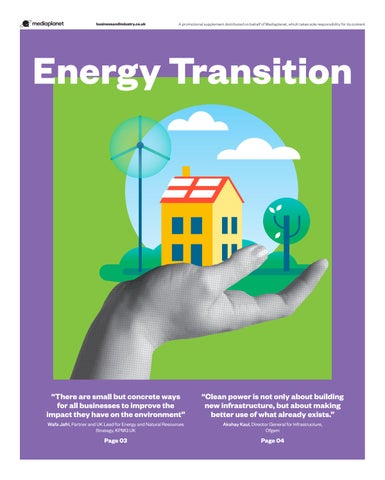
Energy Transition
“There are small but concrete ways for all businesses to improve the impact they have on the environment”
“Clean power is not only about building new infrastructure, but about making better use of what already exists.”
Wafa Jafri, Partner and UK Lead for Energy and Natural Resources Strategy, KPMG UK
Akshay Kaul, Director General for Infrastructure, Ofgem
Page 03
Page 04
A PROMOTIONAL SUPPLEMENT DISTRIBUTED ON BEHALF OF MEDIAPLANET, WHICH TAKES SOLE RESPONSIBILITY FOR ITS CONTENT
From grid strain to grid gain: rethinking data centre growth
How is renewable energy the long-term answer to the current energy crisis?
Data centres are major players in the GB energy system and could account for 12% of all GB electricity demand by 2050.1
We are constantly dealing with the fundamental weakness in Britain’s energy system: events thousands of miles away can determine how much British households pay to keep the lights on.
W
Y
ith network connection requests for data centres skyrocketing, sustainability must be at the forefront of strategic system planning. Yet, the Government’s narrow focus on connections and lack of a wider strategy to manage the impacts of data centres does not reflect this reality.
WRITTEN BY Rachel Cary Head of Industrial Strategy, Energy UK
Making data centres sustainable
The race to connect data centres to the network is clearly a priority, but the consequences for other users are unclear. We risk data centres being prioritised over other critical parts of the economy such as housing, transport,
Strategic demand planning must be led by how data centres contribute to sustainable growth. manufacturing and even clean power projects. There is concern that data centre operators will turn to on-site conventional gas generation to guarantee constant supply to meet significant electricity demand. This doesn’t need to happen. AI has successfully turned data centres into flexible, grid-responsive assets that benefit the energy system. A bold strategy for data centres, focused on making them an asset to the energy system, can reduce system costs and energy bills, accelerate connections for other demand and deliver global leadership without failing on climate.
Utilising waste heat
Alongside high electricity demand, data centres produce substantial amounts of heat. With forward planning, this heat can be recovered to supply surrounding communities. Government funding has been directed towards projects where waste heat from data centres is heating over 10,000 homes and 250,000m2 of commercial space.2 Solutions like this are essential, but require strong, joined-up policy to make it happen. Strategic demand planning must be led by how data centres contribute to sustainable growth. To avoid a mismanaged race to maximise the number of data centres, the Government must set out what it wants from data centres before they connect and consider these sites as part of the solution, not as a necessary problem. 1 2
@Mediaplanet UK & IE
NESO (2025), FES: Data Workbook 2025; Energy UK analysis Hemiko (2025), OPDC announces Hemiko as development and funding partner for innovative new Heat Network. tinyurl.com/tnfjt6wh
@MediaplanetUKIE
et, the political response from some quarters is to argue that Britain should return to North Sea oil and gas. This would risk locking the UK into the same volatile system that caused the crisis in the first place.
Trapped by global gas prices
The UK is already a net importer of gas, and North Sea production is in long-term decline. More domestic extraction would not insulate households from international price shocks because gas is traded on global markets. The price consumers pay is driven by the international wholesale price, not by whether the gas comes from the North Sea or elsewhere. The problem is made worse by how Britain’s electricity market operates. Gas sets the wholesale electricity price for much of the day, meaning a spike in gas prices can increase the cost of electricity even when more than half of our power is being generated from renewable sources. This is why renewables are not simply a climate policy; they are the route out of the energy insecurity created by fossil fuels.
WRITTEN BY Frank Gordon Director of Policy, The Renewable Energy Association
Renewables are energy security
The wind, sun, marine, bioenergy and geothermal resources available in the UK are domestic and endlessly replenished. They have no fuel cost at the point of generation and cannot be disrupted by conflict in the Strait of Hormuz or a decision by an overseas gas supplier. Critics point to high electricity bills and blame renewables. But Britain is upgrading ageing networks,
The price consumers pay is driven by the international wholesale price. replacing power stations reaching the end of their lives and expanding the system to meet growing demand. Much of this investment would be necessary regardless of the technology chosen. Meanwhile, new renewable generation is increasingly cheaper than new fossil fuel capacity and will reduce the underlying cost of energy. If Britain wants to stop foreign wars and global gas markets determining the cost of energy at home, it must accelerate the transition to home-grown clean power and forget the insecure fossil fuel past.
Contact information: info@mediaplanet.com or +44 (0) 203 642 0737
Please recycle
Project Manager: Anokhi Shah Managing Director: Margot Thomas | Lead Designer: Name Surname Content Manager: Angelica O’Toole | Paid Media Strategist: Jonni Asfaha Digital Campaign Manager: Jan Martorell | All images supplied by Getty Images, unless otherwise specified
02
MEDIAPLANET
READ MORE AT BUSINESSANDINDUSTRY.CO.UK
A PROMOTIONAL SUPPLEMENT DISTRIBUTED ON BEHALF OF MEDIAPLANET, WHICH TAKES SOLE RESPONSIBILITY FOR ITS CONTENT
Biomethane is the practical choice for business Biomethane is a proven, renewable gas that can help cut emissions today, using existing infrastructure while turning organic waste into useful energy.
B Stuart Rennie Managing Director, Renewable Gases UK, ENGIE
WRITTEN BY Tony Greenway
Sponsored by ENGIE
iomethane deserves more attention than it gets, insists Stuart Rennie, Managing Director for Renewable Gases UK at global energy group ENGIE. As a renewable gas, it’s a vital and growing part of the UK’s green energy mix - and a practical solution available today.
Turning waste into energy
Biomethane is a renewable, lowcarbon gas produced from organic waste and residues, relying on available and reliable technology. Chemically identical to the methane used in today’s gas system, it can be transported through existing gas networks and used in current industrial and domestic installations, helping homes and businesses to reduce their carbon emissions, particularly for sectors that are difficult to electrify. It can do so without replacing existing gas networks and equipment, offering a practical route to decarbonisation with less disruption
and upfront investment than some alternatives. It also turns organic waste from agriculture, food production and other waste streams into useful renewable energy through anaerobic digestion. “Biomethane takes something we already have - organic waste - and turns it into renewable energy,” says Rennie. “It’s a great example of the circular economy in action.” The benefits continue after the gas is produced. A byproduct of the process is digestate, an organic fertiliser that can be returned to farmland, helping put valuable nutrients back into the soil.
A practical choice for business
For businesses that rely on gas for heating or industrial processes, biomethane offers a way to reduce emissions while continuing to use familiar infrastructure. It can be injected directly into the existing gas network, making it a readily deployable solution for organisations
looking to make progress on decarbonisation today. ENGIE currently operates four anaerobic digestion plants in the UK and injects more than 210 gigawatthours (GWh) of biomethane into the gas network annually.
Growing with customers
Customer partnerships are already helping to demonstrate what biomethane can deliver. ENGIE has signed a 10-year biomethane purchase agreement with PepsiCo UK to support the development of a new anaerobic digestion plant in Yorkshire, expected to become operational in summer 2027. Partnerships like this show how long-term customer demand can unlock investment in new biomethane capacity, while providing businesses with a practical route to reduce emissions. “With the right support, biomethane can play a much bigger role in the UK’s energy transition.”
Affordable, resilient energy is becoming a defining competitive advantage
F
Access to affordable, reliable energy is becoming a defining source of national and commercial competitiveness.
or years, the dominant narrative has been that the world is moving through one shared transition: from fossil fuels to cleaner, more electrified systems. The latest Statistical Review of World Energy tells a more complicated story.
A disorderly transition Wafa Jafri Partner and UK Lead for Energy and Natural Resources Strategy, KPMG UK
Sponsored by KPMG
Total energy demand continues to rise across every major source, while clean energy is scaling at pace. Solar generation grew by 30%1 in 2025, global installed battery capacity rose by 66%1 and electrification continues to accelerate as economies invest in digitalisation, EVs and advanced manufacturing. Yet fossil fuels still account for 86%1 of global energy supply and emissions continue to increase. The global picture masks increasingly different national realities. Clean technologies are growing, but not at the same pace, from the same starting point or for the same reasons in every country. Each economy is making different choices about fuels, technologies and infrastructure, shaped by its resources, affordability constraints, security concerns and ambitions for growth. The result isn’t one orderly global transition, but multiple pathways towards energy resilience.
Different energy choices, different national priorities
China is expanding clean energy rapidly while maintaining fossil fuel reserves as protection against supply shocks. The US is strengthening hydrocarbons and clean power. Europe is reducing reliance on Russian gas while facing
READ MORE AT BUSINESSANDINDUSTRY.CO.UK
new dependencies on LNG and critical minerals. India is accelerating electrification to support growth and reduce import exposure. The Middle East is growing renewables while continuing to maximise value from hydrocarbons. The common thread isn’t decarbonisation alone, but the pursuit of resilience and affordability. A system that’s secure but prohibitively expensive isn’t truly resilient. High energy prices weaken industrial competitiveness, increase pressure on households and can undermine long-term investment. As economies electrify, the race to secure affordable and reliable power is fast becoming a race for competitiveness. Global electricity demand is growing almost twice as fast as overall energy demand, with AI and data centres accelerating pressure. Meeting demand will depend not only on generating more electricity, but on building the grids, storage and transmission networks needed to deliver it. For business leaders, the message is clear: energy cannot be treated as an operational cost. It’s a strategic input influencing investment decisions, supply chain resilience and growth. The winners of the transition’s next phase may not be those that move fastest on clean energy, but those that build the strongest systems around it. 1
Energy Institute, Kearney, KPMG & Ember (2026). Statistical Review of World Energy. https://bit.ly/4gRYEDP.
MEDIAPLANET
03
A PROMOTIONAL SUPPLEMENT DISTRIBUTED ON BEHALF OF MEDIAPLANET, WHICH TAKES SOLE RESPONSIBILITY FOR ITS CONTENT
How Ofgem is helping Britain switch to clean power From powering major seasonal events and rising electricity demand to AI and data centres, the challenge is constant: keeping the power on today while preparing for a cleaner, smarter energy future.
F
WRITTEN BY Akshay Kaul Director General for Infrastructure, Ofgem
or Britain’s energy system, there’s no summer slowdown. That is where Ofgem comes in. Ofgem’s role is to ensure the transition to clean power is fair, affordable and secure, delivering for consumers now and for future generations. Through investment decisions, connections reform and smarter energy solutions, we are helping build the infrastructure Britain needs while holding companies to account for every pound consumers pay. As the Government’s Clean Power 2030 target draws closer, the pace of change is accelerating. We are helping deliver the biggest overhaul of Britain’s electricity transmission network in decades, alongside new electricity distribution price controls and continued scrutiny of new major transmission projects. Our priority is clear: challenge costs, improve efficiency and approve investment only where it delivers long-term consumer value.
Unblocking the queue for clean energy
A faster clean energy transition depends on getting viable projects connected to the grid. Ofgem is working with the National Energy System Operator and Government to make connections quicker, fairer and easier to navigate, so
projects that are ready to proceed can connect sooner. Demand for connections is rising rapidly, driven partly by AI and data centres. Ofgem has consulted on measures to discourage speculative applications and prioritise projects that can be delivered.
Making the system smarter
Clean power is not only about building new infrastructure, but about making better use of what already exists. Flexible technologies such as batteries, long-duration electricity storage and smarter demand can help balance the grid, support renewable generation and strengthen energy security. Ofgem is supporting reforms that encourage investment in these technologies while protecting consumers.
Delivering for consumers
The transition will succeed only if consumers see the benefits through a more secure energy system and less exposure to volatile international gas markets. That’s the work Ofgem is doing now: helping connect clean power faster, making better use of existing infrastructure and ensuring consumers remain at the heart of the transition.
One field, two harvests: what does smarter climate action look like? The climate crisis, biodiversity loss and pollution are deeply connected. Yet, policies to address them are still often designed separately and sometimes create new tensions of their own.
I
WRITTEN BY Tadashi Matsumoto Head of Unit, Sustainable Development and Global Relations, OECD
04
MEDIAPLANET
n Sosa, Japan, solar panels are doing more than generating clean electricity. They are helping keep farmland in production, supporting farmers’ incomes and returning energy revenues to the local community. It is an example of finding environmental solutions that address several challenges at once.
Agrivoltaics protect farmland while generating clean energy
Renewable energy, for example, is essential to cutting emissions, but poorly planned projects can compete for land, disrupt ecosystems or leave local communities feeling that they carry the costs while benefits flow elsewhere. Sosa offers a different model. Like many rural areas in Japan, it has faced a shrinking farming population: the number of farmers fell from 5,315 in 2010 to 2,514 in 2020. This puts more agricultural land at risk of abandonment.
Local citizens and farmers responded with agrivoltaics, or ‘solar sharing,’ which allows crops and solar panels to occupy the same land. Panels are positioned above fields, so farming can continue underneath while electricity is generated overhead. By 2021, more than 4,000 agrivoltaic farms were operating across Japan.
The result is not simply lower emissions
Farmers gain another source of income. Agricultural land remains productive. Part of the revenue from electricity generation is channelled back into the community, helping sustain local livelihoods and, potentially, breathe new life into rural areas facing population decline. OECD research points to the same potential for combined solutions in other domains. Restoring rivers, forests and wetlands can strengthen biodiversity while reducing climate risks. Circular economy policies can
cut pollution while lowering demand for raw materials. Renewable energy can support local livelihoods rather than displacing them.
Decision-making with the local community in mind
Local governments are particularly important because it is at the local level where environmental, economic and social priorities most often meet — in decisions about land, energy, transport, waste and local development. They are well placed to think across systems, ensure communities share in the benefits and design policies whose economic and social gains make environmental action easier. There will always be trade-offs. Yet, the transition becomes more durable when environmental progress also strengthens local economies and communities. Sosa’s lesson is worth remembering: the best green solutions do not ask people to choose between the planet and their place in it. READ MORE AT BUSINESSANDINDUSTRY.CO.UK
A PROMOTIONAL SUPPLEMENT DISTRIBUTED ON BEHALF OF MEDIAPLANET, WHICH TAKES SOLE RESPONSIBILITY FOR ITS CONTENT
I m a ge
sup
plie
db
yP
il k
ing
to
nU
K
New hydrogen infrastructure could transform UK industry The HyNet Hydrogen Network project has been designed to connect the North West’s key industry with low-carbon hydrogen. It’s also an opportunity to future-proof the region’s growth and industrial workforce.
I
ndustrial decarbonisation isn’t just a ‘nice to have’ for the UK’s gas sector. It’s a central feature of the country’s net zero timetable and will future proof critical UK industry for generations to come.
Rob Donovan Project Director, Cadent
WRITTEN BY Tony Greenway
Sponsored by Cadent
is of the essence. Rob Donovan notes that hydrogen project adoption has been delayed in recent years due to different political changes and policy decision updates. Currently, Cadent is waiting for the government to announce a Low-carbon hydrogen distribution competitive process to select the Cadent, the UK’s first regional nation’s largest gas hydrogen network HyNet could also be distribution network, and hopes that, is involved in two HyNet a once-in-a-generation ultimately, flagship projects will be successful. If opportunity to protect it is, Cadent would designed to connect low-carbon hydrogen expect to have the businesses and production and network operational storage with key by 2033. future-proof the regional industrial “It’s a project region’s industrial users. The first is that we have been H2 East, a hydrogen developing for five workforce. pipeline running years,” he says. “We from the Humber believe it’s ideally down to Newark in Nottinghamshire. positioned to deliver at pace and The second scheme — and the most kickstart the hydrogen economy in mature — is HyNet, a 100km lowthe North West — a location that carbon hydrogen distribution network has always innovated and supported running across the North West. industry.” Another advantage is “The benefit of low-carbon hydrogen its geographical proximity to blue is that it can be used across a wide hydrogen production projects, plus range of applications,” explains Rob the underground geological strata in Donovan, Project Director. “It provides the region which can be utilised for high heat and flames which industrial large-scale energy storage. processes need to deliver their critical process’. Having low-carbon hydrogen Protecting businesses and industrial infrastructure in the North West will plants support industrial off-takers now and Apart from aiding the energy in the future — and importantly, will transition, Rob Donovan says that attract new industry, too.” HyNet could also be a once-in-ageneration opportunity to protect Cutting carbon emissions and businesses and future-proof the future-proofing industry region’s industrial workforce. “The HyNet would help the region’s hardindustrial plants in the North West to-abate industries such as glass and have such important heritage,” he chemical manufacturing drastically notes. “They are integral to local cut their carbon emissions, and communities, jobs and skills. We support the Government’s Clean should be proud of them and want to Power 2030 Action Plan. Over time, keep them competitive — and vitally, the hope is that different regional keep them here in the UK, doing hydrogen networks will join up to what they do best. HyNet is a way to create a wider supply. However, speed support that.”
READ MORE AT BUSINESSANDINDUSTRY.CO.UK
Pilkington UK HyNet case study Pilkington UK is a glass manufacturer based in the UK, with its glass being used in some of the world’s best-known buildings, from the Empire State Building to The Shard.
I
t is exploring how it can enable the supply of low-carbon hydrogen to its Greengate Works site in St Helens, which is one of the last primary float glass manufacturing sites in the UK. Flat glass production is inherently energy intensive, requiring continuous hightemperature heat in excess of 1,500°C that’s delivered reliably over furnace campaigns lasting more than a decade.
Hydrogen as a scalable solution to decarbonisation
Decarbonisation represents one of the major challenges facing the sector, but hydrogen provides a viable and scalable solution, with Pilkington UK the first architectural glass manufacturer in the world to trial the firing of hydrogen in a glass furnace back in 2021. It can act as an alternative to the natural gas that powers Pilkington UK’s furnaces and is compatible with the site’s processes, allowing it to maintain product quality and ensure the stability of its operations while reducing its carbon footprint.
Protecting UK manufacturing capability
Hydrogen can also be blended with natural gas in the short-term, providing a flexible transition pathway that will allow the business to make immediate progress on its efforts to reduce emissions by 30% by 2030, and achieve carbon neutrality by 2050. Introducing a hydrogen infrastructure at Greengate Works will help to safeguard a critical UK manufacturing capability while ensuring the industry plays its part in the country’s wider transition to net zero.
MEDIAPLANET
05
A PROMOTIONAL SUPPLEMENT DISTRIBUTED ON BEHALF OF MEDIAPLANET, WHICH TAKES SOLE RESPONSIBILITY FOR ITS CONTENT
Plug-in solar: what it means for UK homes and installers From August 27, 2026, new regulations will allow compliant plug-in solar devices to connect directly to a standard UK socket, bringing a technology widely adopted across parts of Europe into the UK market.
T
Isobel Brown Head of Content & Partnerships, Solar & Storage Live
he way UK households can generate their own to address. How can consumers identify compliant, electricity is about to change. Plug-in solar, often high-quality products? How do we ensure safety without known as ‘balcony solar,’ is a smaller system that creating unnecessary barriers to adoption? And how can offers households a simpler plug-in solar complement, rather route to generating electricity. Its than compete with, the professional arrival could widen access to solar for installation market? renters, flat-dwellers and households Plug-in solar can operate safely for whom a conventional rooftop to tackle industry and within UK domestic electrical Event system is impractical or unaffordable. consumer concerns around plug-in
Questions around safety, consumer confidence and industry opportunities
installations under tested conditions.
Government-backed testing has found that plug-in solar can operate safely within UK domestic electrical installations under tested conditions, provided appropriate product and safety requirements are met. For electrical contractors and solar installers, there’s a question around whether this emerging market represents an opportunity or threat. Although compliant systems are designed to be easier for consumers, households will still need to understand whether their existing electrical system is suitable. Electricians can play an important role in advising consumers, particularly where properties have older wiring, protective devices or previous alterations. There are still important questions for the industry
solar
These questions will be explored at the industry’s largest annual event, Solar & Storage Live UK, taking place at the NEC Birmingham on September 22–24, where a keynote panel discussion will bring together perspectives from the electrical trade, energy suppliers and plug-in solar innovators, chaired by the event’s official partner, Solar Energy UK. The discussion will consider how the industry can balance accessibility with safety, build consumer confidence and understand what this emerging market means for installers. Plug-in solar won’t replace rooftop PV. However, if implemented well, it could introduce more households to generating their own power, save money and ultimately expand the market for the wider UK solar installation sector.
Delivering the industrial supply chains for nuclear’s next era Nuclear energy is attracting renewed interest as governments look for reliable low-carbon power to meet growing electricity demand and address energy security concerns.
T WRITTEN BY King Lee Head of Policy and Industry Engagement, World Nuclear Association
hirty-nine countries, including the UK, have endorsed a declaration to triple global nuclear capacity. This commitment is supported by stated national nuclear targets which could lead to the global nuclear capacity of 1,457 GWe by 2050. The scale of this Government ambition raises a practical question: how can countries turn policy ambition into deliverable programmes of new nuclear construction and reap the reward of long-term jobs and economic benefits?
Nuclear energy at scale
Expanding nuclear capacity will require more than favourable targets. It will require strategic development across the global nuclear value chain: policymakers working with project developers for long-term market frameworks, a predictable and streamlined regulatory environment, investment in key industrial supply 06
MEDIAPLANET
chains and investments to build the skilled workforce that will be required. The scale and pace of global nuclear development will depend on the nuclear sector’s ability to move from individual projects to sustained programmes of new nuclear construction. All of this requires collaboration.
Nuclear energy development projects
A number of Southeast Asian countries are moving forward with nuclear energy project development, with many governments exploring nuclear as part of their future clean energy mix. World Nuclear Association is co-organising the World Nuclear Supply Chain Conference 2026 in Manila, Philippines, to provide the forum for the collaboration that will be essential to growth. This conference will bring together local developers and the global
nuclear industry to share nuclear power programme development ideas and opportunities and to facilitate new business relationships and partnerships. The agenda reflects a practical need: a Business-toGovernment (B2G) and Businessto-Business (B2B) networking programme that connects suppliers, developers and investors with government representatives and agencies driving national nuclear strategies across ASEAN and beyond. The success of nuclear build programmes in a number of countries provides key learnings. The next phase of nuclear growth will be defined by how effectively policymakers and industry work together to deliver nuclear programmes across regions to provide clean energy and economic development.
READ MORE AT BUSINESSANDINDUSTRY.CO.UK
A PROMOTIONAL SUPPLEMENT DISTRIBUTED ON BEHALF OF MEDIAPLANET, WHICH TAKES SOLE RESPONSIBILITY FOR ITS CONTENT
How can energy respond intelligently to the climate crisis? Learn how AI, digitalisation and smart energy technologies can help the UK build a more resilient electricity system in light of rising demand, extreme weather and grid pressures.
T
his summer, the UK has continuously broken heat records, with similar heatwaves across Europe placing fresh pressure on power generation and electricity networks.
Event tackles today’s energy technologies
WRITTEN BY Rose Shohet Sector Manager, Future of Utilities
Electricity demand is rising, weather patterns are becoming more extreme, renewables penetration is increasing intermittency across the system, and the arrival of data centres is adding yet more pressure to an already congested system. So, how intelligently can the system respond? That is the focus of Future of Utilities: Smart Energy, taking place in London on 2–3 November. More than 1,000 senior energy and technology professionals will come together to examine how digitalisation, AI, and data can help build a more resilient energy system, with more than 60% of attendees coming from energy companies and 100+ speakers from across the sector. The agenda goes well beyond the usual AI hype. National Grid’s Head of Portfolio Reporting and Control, Emrah
READ MORE AT BUSINESSANDINDUSTRY.CO.UK
Bingol, will explore what it means to plan grids for and with AI. Sonnedix’s Chief Digital Officer Simon Duckett will discuss best practice on what it means to move new technology into the mainstream.
Digitalisation and energy demand
There is also a pressing question about what happens when the electricity demand of the digital economy itself begins to reshape the system. ‘Is power trading ready for the data centre boom?’ This will tackle that question, alongside sessions on flexibility, home energy management, digital twins and grid-edge technologies. Smart Energy will examine how digitalisation can move from promising Spaces for Future of Utilities: Smart Energy 2026 technology to infrastructure capable of are still available. For more information on how to supporting a more complex, electrified get involved, email us at energy system, across the entire energy enquiries@futureofutilities.com or visit futureofutilities.com/events/smart-energy ecosystem.
MEDIAPLANET
07
A PROMOTIONAL SUPPLEMENT DISTRIBUTED ON BEHALF OF MEDIAPLANET, WHICH TAKES SOLE RESPONSIBILITY FOR ITS CONTENT
To learn more about the energy transtion, visit businessandindustry.co.uk
08
MEDIAPLANET
READ MORE AT BUSINESSANDINDUSTRY.CO.UK