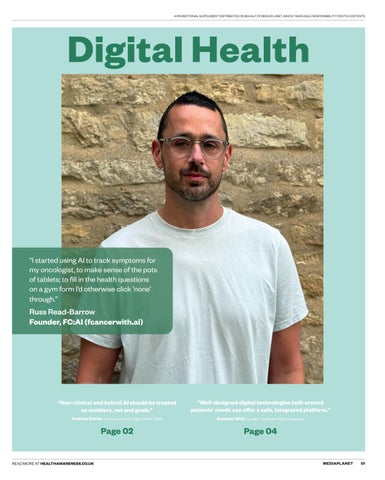
“I started using AI to track symptoms for my oncologist, to make sense of the pots of tablets; to fill in the health questions on a gym form I’d otherwise click ‘none’ through.”
Russ Read-Barrow Founder, FC:AI
(fcancerwith.ai)
“Non-clinical and hybrid AI should be treated as enablers, not end goals.”
Andrew Davies, Executive Director, Digital Health, ABHI
02
“Well-designed digital technologies built around patients’ needs can offer a safe, integrated platform.”
Suzanne Wait, Founder, The Health Policy Partnership
04
I have stage 4 cancer — AI is how I took back control
In 2021, I was diagnosed with bowel cancer at 39. Five years on, I’m at stage 4 — currently deemed incurable. Liver surgery. Bowel surgery. Lung ablation. Radiotherapy. Many rounds of chemo. Whirlwind is the polite word for it.
By open-sourcing my scans and using AI to advocate for myself, I now believe the biggest difference in digital health will come from awareness, openness – and patients who refuse to wait. WRITTEN BY
You must advocate for yourself, and AI can help you do that.
And there’s the data. Blood tests, scan reports, pathology and genomics. Specialists, systems and medical secretaries who probably don’t speak to each other. Even running Known & Cited (knownandcited. com), my AI search consultancy, I struggled to manage. I have no idea how many patients manage it, and I assume most don’t.
AI for symptom tracking I started using AI to track symptoms for my oncologist, to make sense of the pots of tablets; to fill in the health questions on a gym form I’d otherwise click ‘none’
@Mediaplanet UK & IE
through. (I also wanted to design and sell socks, but still haven’t gotten around to them.)
Over the last year, during chemo, I built Fcancerwith. ai (FC:AI) to share the tools I was using in case they were useful to other patients. Lately, it’s become bigger: a way to share my information with specialists I’d never otherwise reach.
Open sourcing my data
Test results, symptoms and my cancer’s genetic markers were all made public. Data sharing is risky, but very quickly, I started to see the upside.
A geneticist got in touch. A genealogist in Australia. A vaccine specialist in Argentina. People reviewing my case from angles not available to me in the NHS. Best case, a cure. Worst case, somebody clones me and takes over my life.
If you have any concerns about your health, see your GP. But when you’re a patient, you can’t count on your medical team to be on top of everything – they’ve got a lot to do. You must advocate for yourself, and AI can help you do that. I don’t expect a miracle to come from all this. Like most people, I’m not yet sure where AI can take us, but patients like me shouldn’t wait to find out.
Contact information: uk.info@mediaplanet.com or +44 (0) 203 642 0737
Project Manager: Yasmin Meads yasmin.meads@mediaplanet.com Senior Business Development Manager: Jack Adamson Managing Director: Margot Thomas | Lead Designer: Ellen Cahill Interim Content Manager: Rachelle Ong | Paid Media Strategist: Jonni Asfaha Digital Campaign Manager: Jan Martorell | All images supplied by Getty Images, unless otherwise specified
Balancing AI ambition with NHS reality
The NHS is embracing AI, but not all AI is treated equally. Immediate operational pressures influence adoption more strongly than long-term digital ambition.
WRITTEN BY Andrew Davies Executive Director, Digital Health (ABHI)
Not all AI carries the same risk level. Non-clinical applications — workforce planning, demand forecasting, pathway optimisation and waiting-list management — sit outside direct decision-making, so governance is lighter, procurement faster and the consequences of failure more contained.
Clinical AI is the opposite. Tools that influence diagnosis, treatment or patient prioritisation must evidence safety, meet regulatory requirements and fit within clinical governance — stretching timelines and increasing delivery risk.
Proven clinical use cases
Diagnostic image analysis is a proven clinical use case. AI supporting radiology and pathology is already deployed across parts of the NHS, helping clinicians triage high-risk cases and manage capacity within established workflows and specialty-led governance.
This shows clinical AI can scale where risk is well understood, benefits are clear and assurance frameworks are mature — conditions not consistent across frontline settings.
Population health management illustrates how the clinical and non-clinical AI boundary is blurring. Analytics can identify at-risk cohorts, predict demand and support planning across care systems. While they shape clinical priorities, they typically sit upstream of individual decisions and attract lower
governance burden. This makes it clinically meaningful, yet often quicker to deploy than point-of-care decision support.
Short-term pressure versus long-term change
Reducing elective backlogs, improving throughput and meeting recovery targets remain immediate imperatives, so AI that delivers measurable productivity gains in months rather than years is easiest to justify.
By contrast, frontline digitisation programmes and clinically embedded AI demand sustained investment, workforce engagement and cultural change. Benefits accrue more slowly, and implementation can absorb scarce capacity — from funding and programme leadership to clinical and operational time — diverting resources from short-term priorities.
This challenge is familiar: balancing short-term delivery with long-term transformation.
Non-clinical and hybrid AI should be treated as enablers, not end goals. Used deliberately, they can build data foundations, governance confidence and delivery capability for clinical digitisation; used narrowly, they risk entrenching optimisation rather than transformation.
NHS leaders must sequence investment so operational pragmatism accelerates, not postpones, the transformation needed for sustainable improvement.
How technology can make integrated care a reality, not just an ambition
The NHS ambition to deliver more joined-up, person-centred care is not new. What’s changed is the opportunity to make it real, with systems that join up around individuals, not organisations.
People regularly move between care settings, often repeating their story as professionals work across disconnected systems. Delays are frequently driven by navigating organisational processes, not clinical complexity.
From fragmentation to coordination
Integrated care means designing services around people, not organisations, with teams working across traditional boundaries to respond to an individual’s needs. Dr
Jonathan Bloor, Medical Director, System C, explains why this shift is so important.
“People are being cared for across multiple teams, including primary, community, social and acute care. This fragmentation creates delays, duplication and barriers to good clinical outcomes,” he explains. “We need to break down the silos preventing organisations from focusing on individuals. Care should feel coherent and connected, not fragmented across services.”
Without the ability to share information and coordinate activity in real time, integration remains difficult to achieve in practice.
Neighbourhood care depends on digital foundations
The NHS 10-year plan is clear: move care closer to communities and use digital technology to enable more connected care. Neighbourhood-based approaches can break down silos, ensuring services are wrapped around individuals rather than organisations.
“Neighbourhoods are where most people access health and support services. They are where local authorities, primary care, community teams and social care providers are best placed to respond to wider determinants of health and wellbeing,” explains Gian Celino, Chief Product Officer at System C.
“Neighbourhoods play a clear role in bridging the divide between care settings. The ambition is to bring together local teams, to connect care services and ensure people stay healthier for longer.”
But proximity alone is not enough. Without shared visibility, even co-located teams can struggle to coordinate effectively. Digital infrastructure turns ambition into dayto-day reality, enabling professionals to access and act on the same information.
AI with purpose
Artificial intelligence is often framed as a future opportunity, but its most immediate value is practical: reducing the administrative burden that takes time away from care.
“Technology has the potential to solve complex care pathways and coordinate care. The opportunity lies in transforming how these systems are used through technologies like AI,” explains Bloor. “By joining up care digitally, professionals can spend more time delivering care and less time navigating processes.”
In practice, AI is already capturing and summarising conversations, reducing documentation burden for clinicians and social care workers, streamlining the pathway from consultation to action by codifying information, prompting next steps and supporting timely communication. Bloor continues, “We’re used to technology removing interaction, but here it’s used to build rapport and improve human engagement, resulting in better care.”
From pilots to real change
Across the NHS, digital innovation is frequently demonstrated through pilots. While these show promise, few are adopted at scale. Bloor highlights that considerable focus will need to be placed on people, process and cultural change around the use of technology.
“AI-enabled capabilities need to be integrated directly into trusted clinical and social care workflows, where they can deliver value at scale,” explains Celino. “We need to move from value proven in pilots to full adoption in everyday practice. Once you begin the journey with AI, it becomes easier to add incremental capabilities and expand functionality. The approach is to scale out horizontally, ensuring practitioner and user understanding, then build value on top.”
Turning ambition into reality
The NHS does not lack digital tools or ambition. It lacks consistent, joined up use of those tools across organisational boundaries.
When systems are connected and information flows with the individual, integration becomes more than a policy goal; it becomes part of everyday care.
And that means something simple but transformative: a system that works as one.
INTERVIEW WITH Jonathan Bloor Medical Director, System C
WRITTEN BY Bethany Cooper INTERVIEW WITH Gian Celino Chief Product Offi cer, System C
Putting patients first in digital health
As digital tools reshape healthcare, trust and transparency are essential to ensure that technologies prioritise patients.
Digital technologies, AI and data analytics are embedded in almost every facet of healthcare. At their core is the understanding that patient data are shared to provide a comprehensive view of their health and care.
Data sharing brings considerable advantages for both patients and clinicians, providing a person-centred and integrated approach.
For research, the potential to combine many data types and sources has facilitated advances in drug development, personalised medicine, epidemiology and other fields.
A matter of trust
Being a patient makes you vulnerable. And that vulnerability may be compounded if someone lacks information about their diagnosis and care, doesn’t understand why different tests are being performed or feels powerless navigating a complex and fragmented health system.
jargon. The language used on any digital platform or app should be inclusive and cater for different levels of ability and digital and health literacy.
Like clinical trials, digital tools should be designed around patients’ needs, not the other way around. To foster trust, these tools must improve people’s experience of care, not create barriers to their confidence and understanding.
Like clinical trials, digital tools should be designed around patients’ needs, not the other way around.
Surveys suggest that patients are more than willing to share their data – as long as they feel confident it’s used for the correct purpose and with robust privacy and security protections.
Hence, information about how data is used and protected must be communicated clearly and transparently without
Why trust, equity and access are key to FemTech’s next chapter
2026 marks ten years since ‘FemTech’ was penned by Ida Tin, founder of period-tracking app Clue. Since then, the sector has gained momentum, with UK-founded women’s health innovation accounting for over $1.5 billion of the global market in 2024.1
With the Government committing to invest heavily in research and innovation, digital health is set to bring real impacts.
Fundamental challenges must be addressed to ensure FemTech is a help, rather than a hindrance. For example, menstrual cycle tracking apps provide women with autonomy to monitor their cycles, understand symptoms and connect with support communities.
Major data protection concerns have triggered impact-driven innovations around privacy. This includes subscription-free period app, 28X, which stores data on the
user’s device.
Patient-centred design
Involving patients in the design of digital platforms ensures that innovations meet their needs. It’s also an opportunity for patients to test the safeguards of the technologies they’ll be using. Even the best system engineers cannot predict how a person will see or experience a new technology. So patient involvement should be seen as a precondition to development, not as a ‘nice to have.’
Well-designed digital technologies built around patients’ needs can offer a safe, integrated platform and ensure that the data follows the patient. But they must make the patient’s experience of care smoother rather than duplicative, and provide them with clear, relevant and timely information.
Reference:
1. Data Saves Lives. Protecting Health Data. https://tinyurl.com/5ajutyzn.
Upskill.Health partners with local women to bring their stories into hospitals through virtual reality (VR), while apps from The Motherhood Group and Taahirah respond to inequitable care, bringing resources and support to underserved populations.
Digital inclusion and access
It’s estimated that up to 22% more women are likely to experience digital poverty, compared to men. 2 This means that FemTech remains out of reach for many people without devices or wifi access.
Patient voice and inequity
National reviews and policy, such as the National Maternity and Neonatal Investigation (expected June 2026) and the Renewed Women’s Health Strategy for England, emphasise the importance of listening to and collaborating with women.
Founders supported by the Health Innovation Network South London have created FemTech solutions based on personal experiences or informed by others’ lived experiences. Maternity training platform
As England’s health services shift from analogue to digital, FemTech must be embedded through hybrid care pathways that offer choice to women. Pelvic health platforms like Squeezy and getUbetter already show how digital technology can complement traditional clinical services, enabling timely diagnosis, informed decision-making and better outcomes.
FemTech must continue to prioritise trust, inclusivity and equitable access. By embedding these foundations, digital technology will improve the lives of women while ensuring sustained investment follows.
References:
1. Women’s Tabloid. (2025). The rise of the UK’s Femtech market and emerging trends. https://tinyurl. com/yzfuzsza.
2. Good Things Foundation. Our Digital Nation. https:// tinyurl.com/3syhy6j3.
WRITTEN BY Sara Nelson Programme Director, DigitalHealth.London and Health Innovation Network South London
WRITTEN BY Suzanne Wait Founder, The Health Policy Partnership
Digital health is weird
How digital twins could transform healthcare
As someone with a nonclinical background attracted to how technology can help people live longer, happier lives, I see current treatments as being one, or a combination of, what you give (medicines), what you do (nonpharmacological interventions, like surgery, irradiation, physiotherapy, etc.) and how you care for someone. That third type, usually involving technology, is different, because it doesn’t primarily work directly: hence this article’s title. Digital health works indirectly, by helping health professionals deliver better care to more people, more efficiently. It does this in the main (there are always exceptions) by enabling ways of delivering care that weren’t previously possible.
Supporting the NHS 10 Year Plan
For example, if a patient measures their blood pressure at home, it can be transmitted directly to their doctor, saving significant medical resources and patient transport and time.
Because it’s now so easy, more frequent readings can be taken, so earlier signs of trouble can be spotted and proactive steps taken. Digital health can also be used to educate people to adopt healthier
lifestyles. Remote treatment, and even remote diagnosis, is becoming common. This supports the NHS’s 10 Year Plan by moving treatment into the community and avoiding the need for treatment by encouraging prevention.
Pilots and changing delivery don’t mix Changing care delivery also requires change management. This means that the common practice of running “pilots” to test a new procedure or medicine is more difficult because it’s difficult for part of an organisation to deliver a new way of providing care when the rest still use long-established practices.
However, many don’t want to give up old practices, so there’s a huge tendency for people in the pilot to keep their heads down, confident that when it closes, they can return to their old ways.
Digital health, unlike other interventions, needs to be delivered as a change programme, not a technology purchase. It also requires a different way of proving benefits because, when it involves a whole system, every part — the technology, people using it and how they’re using it — is essential to benefit generation.
Digital twins are emerging as one of healthcare’s most talked-about technologies, but their greatest potential may lie in helping people live healthier, longer lives.
Most people have never heard of a digital twin, despite growing excitement about its potential in healthcare.
What is a digital twin?
The National Academies of Sciences, Engineering, and Medicine describes a digital twin as a virtual representation of a person or system that’s continuously updated using real-world data to help simulate, predict or guide decisions.
In healthcare, this translates to bringing information from wearables, smartphones, medical devices and health records to create a better picture of the individual’s health over time with their own data. Instead of relying only on occasional appointments or test results, digital health tools could help identify subtle changes earlier and predict health outcomes based on changes in treatments or behaviour.
Much of the conversation has focused on disease, yet their greatest potential may lie in prevention, healthy ageing and helping people stay well for longer.
Wearables can already track sleep, movement, recovery, heart rate and stress patterns. The next step is understanding what they mean.
Future of digital twins
A future digital twin won’t simply monitor activity or sleep quality but recognise when changes in routines, mobility or social interaction suggest someone may need support before becoming unwell.
Research is increasingly pointing to the role of connection, purpose and emotional wellbeing in longterm health outcomes. The US Surgeon General warns that social disconnection carries health risks comparable to smoking up to 15 cigarettes a day.
There’s also a wider shift from STEM towards STEAM, recognising the importance of the arts alongside science and technology. Research led by Daisy Fancourt has linked cultural engagement with healthier ageing, improved wellbeing and even longevity. These data points must also be incorporated into digital twins.
Digital health innovation also carries risks. If digital twins are trained on narrow datasets or on the wrong variables, they risk reproducing those same inequalities at scale. We now have an opportunity to build digital health systems that are not only smarter, but fairer, more preventative and more human.
WRITTEN BY Charles Lowe
CEO Digital Health & Care Alliance (DHACA)
WRITTEN BY Dr Alice Byram Emergency and Family Medicine Physician; Founder and CEO, TwinVita, President of the Digital Health Section, Royal Society of Medicine
Scaling digital health sustainably
Digital health innovation is advancing quickly, but long-term transformation will depend on how effectively systems, people and technology evolve together.
WRITTEN BY Jake Golding Senior Marketing Manager, HETT Show
Digital health tools, from AI-enabled systems to remote monitoring and connected care platforms, are increasingly positioned as part of the solution for pressurised healthcare organisations. Yet the conversation has shifted noticeably in recent years. The question is no longer whether digital innovation has potential, but how it can be implemented safely, consistently and at scale.1
The NHS must move past isolated pilots toward sustainable, systemwide adoption. This requires more than financial investment; digital transformation is ultimately an operational transformation.
Success depends on whether new tools can integrate into clinical workflows, reduce friction for frontline teams and support better decision-making in practice.
In many cases, the barriers aren’t technical, but organisational. 3
Healthcare systems are complex environments where policy, workforce pressures, governance and culture all shape the success of innovation. 3
Supporting frontline teams
AI will inevitably play a role across healthcare, particularly in administration, triage and clinical
Integrated care depends on better connectivity between organisations, services and datasets.
decision support. However, there’s increasing recognition that adoption must be grounded in operational reality rather than technological optimism.1
For overstretched services, the immediate opportunity may be less about replacement and more about reducing administrative burden and giving clinicians greater time on patient care.1,2 That depends heavily on trust, usability and strong data foundations.1
As healthcare becomes increasingly data-driven, cybersecurity and resilience must also be viewed as patient safety issues rather than purely technical concerns.1
Building connected systems
Integrated care depends on better connectivity between organisations, services and datasets. Interoperability remains one of the most persistent challenges, particularly as systems attempt to deliver more joined-up and preventative models of care. 2,3
Transformation also cannot happen in isolation. 3 Collaboration between NHS leaders, clinicians, policymakers and innovators will be critical in ensuring digital health tools deliver meaningful and equitable impact. 2 3
References:
1. Savage, M. (2026). Write up: How to deliver AI innovation without compromising resilience. https://tinyurl.com/4punfm5z.
2. HETT Show. (2026). Building digital capability in a constrained NHS - Productivity or people? NHS transformation in a constrained system. https://tinyurl. com/4wrw7ph6.
3. HETT Show. (2026). Bridging the gap: A sociotechnical reflection on digital transformation in public services.
break down silos and help shape a more connected future for digital health.