healthawareness.co.uk
A promotional supplement distributed on behalf of Mediaplanet, which takes sole responsibility for its content
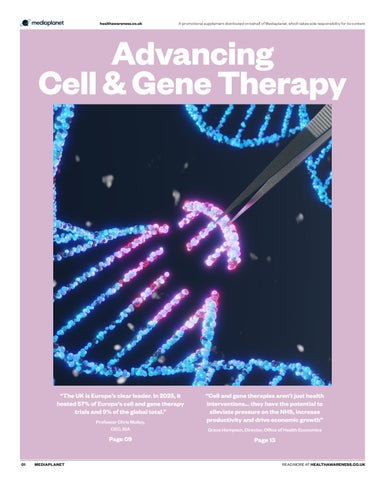
Advancing Cell & Gene Therapy
“The UK is Europe’s clear leader. In 2025, it hosted 57% of Europe’s cell and gene therapy trials and 9% of the global total.” Professor Chris Molloy, CEO, BIA
Page 09
01
MEDIAPLANET
“Cell and gene therapies aren’t just health interventions... they have the potential to alleviate pressure on the NHS, increase productivity and drive economic growth” Grace Hampson, Director, Office of Health Economics
Page 13
READ MORE AT HEALTHAWARENESS.CO.UK
A PROMOTIONAL SUPPLEMENT DISTRIBUTED ON BEHALF OF MEDIAPLANET, WHICH TAKES SOLE RESPONSIBILITY FOR ITS CONTENT
The right strategic partners can open a gateway to Europe and the US
Britain’s cell and gene therapy moment
Post-Brexit, UK-based biotechs wanting to supply final products into Europe may benefit from the services of an EU-based Contract Development and Manufacturing Organisation (CDMO).
W
hen biotech companies move their cell and gene therapy (CGT) programmes from the lab into clinical development, they may not be considering later-stage challenges. Yet, they’ll save huge amounts of time, trouble and expense if they do, says Jakub Cierny.
Specialist third-party services for cell and gene therapy
Cierny is Chief Quality Compliance Officer at SCTbio, a Prague-based CDMO, offering CGT developers specialised services, including cell therapy manufacturing, quality control, leukapheresis collection and final drug product delivery. “Companies can be so focused on the science that they don’t consider the regulatory hurdles,” he explains. For example, any UK- or US-based biotech wanting to supply its final products into the EU faces a major compliance obstacle. The post-Brexit regulatory reality means that Qualified Persons (QPs) operating solely under UK authorisation can no longer release therapeutic batches bound for the continent — an EU-based QP is required. Establishing new EU legal entities for import and batch release is costly and complex. A simpler alternative is partnering with an established EU-based CDMO with in-house analytical testing and integrated QP release capabilities.
From CAR-T manufacturing in Stevenage to CRISPR production in Edinburgh, the UK has built a nationwide engine for advanced therapies. The task now is to lead in scalable, low-cost manufacturing, playing to the UK’s competitive advantage: innovation.
T
Significant cost advantages without compromising quality
CDMOs based in Central Europe offer developers significant cost advantages (eg. lower manufacturing costs and GCP-compliant clinical trials up to 70% cheaper than US equivalents) without compromising quality. “All European member states operate under the same European Medicines Agency standards, which are among the most stringent in the world,” says Cierny. Developers may also choose a CDMO partner deeply connected to the American market, with US Contract Research Organisation (CRO) partners, fully integrated transatlantic logistics and seamless FDA regulatory alignment. “The US is still a huge driver in global cell and gene therapy,” says Cierny. Seeing the bigger drug development picture can prevent unpleasant, costly and time-consuming surprises. “Being well-prepared is better for the developer and ultimately lowers the impact on the patient,” says Cierny. “And the patient always comes first.”
Jakub Čierný Chief Quality Compliance Officer, SCTbio WRITTEN BY Tony Greenway
Sponsored by SCTbio
READ MORE AT HEALTHAWARENESS.CO.UK
Find out more at www.sctbio.com
WRITTEN BY Prof. Chris Molloy CEO of BIA
he UK is Europe’s clear leader. In 2025, it hosted 57% of Europe’s cell and gene therapy trials and 9% of the global total.1 Home-grown companies are transforming outcomes for patients with cancer and inherited rare diseases, backed by growing manufacturing talent.2 The BioIndustry Association (BIA) has long championed the sector, with its Cell and Gene Therapy Advisory Committee convening experts to develop the necessary infrastructure, talent pipeline and regulatory environment.2
Strength across the country
This expertise is well distributed regionally. In Stevenage, the Cell and Gene Therapy Catapult’s Manufacturing Innovation Centre anchors a cluster, with Autolus manufacturing CAR-Ts for use globally, including by the NHS. In Edinburgh, RoslinCT manufactures Casgevy, the world’s first approved CRISPR-based gene therapy.3 Nationwide, the Advanced Therapy Treatment Centre network is strengthening trial infrastructure and NHS delivery, helping to scale adoption. This geographic spread matters to patients and the economy nationwide. It shows how supporting UK life sciences is foundational to delivering the Government’s mission for growth in every postcode. The UK must retain and scale these companies by leading the next
era of manufacturing. Advanced therapies will be reinvented through automation, digitalisation and AI. New models are emerging in the UK creating economies of scale and bringing down unit costs.
A leading environment
The MHRA is proposing new approaches to rare disease, distributed manufacturing and AI, opening the door to earlier engagement and more affordable treatments. Clinical trial reforms helped Quell Therapeutics launch its CAR-Treg CHILL trial in just 113 days.4 The lead is real but not guaranteed. Other countries see the opportunity. To stay ahead, Britain must lead in new modes of production and the regulation that allows advanced therapies and their companies to scale here. Industry, government and regulators must act together, matching manufacturing with faster trials and adoption. Do that, and a head start becomes a lasting advantage. The moment is Britain’s to seize. Cell and Gene Therapy Catapult. 2025. tinyurl. com/4vj6d9hd. 2 UK BioIndustry Association. 2024. Cell and gene therapy. tinyurl.com/29rkcsku. 3 RoslinCT. 2023. RoslinCT To Manufacture First-Ever US FDA Approved CRISPR-Based Gene Therapy CASGEVYTM (Exagamglogene Autotemcel). tinyurl. com/49wssyc9. 4 NIHR. 2026. UK leads the world in rapid activation of complex early-phase ATiMP trial. tinyurl. com/2nk29pud. 1
MEDIAPLANET
02
A PROMOTIONAL SUPPLEMENT DISTRIBUTED ON BEHALF OF MEDIAPLANET, WHICH TAKES SOLE RESPONSIBILITY FOR ITS CONTENT
DNA ‘built without bacteria’ is changing the world of synthetic biology When cell and gene therapy (CGT) developers have access to complex and accurate DNA, it makes it easier for them to translate ambitious therapeutic designs into viable programmes.
J
odi Barrientos, CEO of synthetic biology company Ribbon Bio, says: “In the next five years, we expect to see increasing numbers of biotechs working with cellfree DNA. It’s easier, cleaner and more flexible than traditional synthetic DNA constructs — and it shortens the time to therapeutics.” That’s an attractive proposition for CGT developers who want to translate ambitious therapeutic designs into viable programmes as cleanly and quickly as possible. However, many still work with synthetic template DNA, which is traditionally achieved through molecular cloning in bacteria. Unfortunately, the varied constraints of working this way create bottlenecks that slow research and process development.
Cell-free DNA is changing synthetic biology A major problem of DNA constructs built and propagated in bacterial plasmids is that cloning, plasmid preparation and purification take 11 days on average. Separately, failure rates can be high due to factors including host-derived contamination, among other factors. According to Ribbon Bio, 84% of teams have encountered sequences that their provider couldn‘t manufacture. Moreover, the fermentation process can be unpleasant, and because bacteria are considered a biohazard, labs must be certified. Barrientos’ company eliminates these challenges by building long, complex and accurate DNA without bacteria. “We were one of the first to utilise a cell-free application for the assembly of the template molecule,” she says. “Because it’s bacteria-free, there are no cloning steps and no risk of contamination. It’s less tedious and unpleasant for the labs; and a full-length molecule can be produced in around five days.”
Cell-free is changing synthetic biology
The team now want to explore the possibility of producing a full-length molecule in a matter of hours, which could have a big impact on the lives of patients. In May, the company launched a kit for cellfree DNA assembly, enabling organisations — from small university labs to major research hospitals and biopharmas — to complete their own rapid DNA production. Barrientos concludes: “I believe the market is feeling the pressure, as it should, to shift to cell-free.”
Jodi Barrientos CEO, Ribbon Bio
WRITTEN BY Tony Greenway
Sponsored by Ribbon Bio Find out more at ribbonbio.com
03
MEDIAPLANET
How regulation can drive life sciences innovation for the benefit of patients If penicillin’s discovery marked a turning point in medicine in the twentieth century, then the development of cell and gene therapies, turbocharged by AI, could be the defining moment of the early twenty-first.
T
he evolution of these new therapies represents a paradigm shift in how we treat a wide range of genetic disorders and diseases, including cancers and rare diseases. While welcome, it also presents scientific questions about how we support development, evaluation and approval of these therapies to ensure their quality, safety and efficacy.
How can regulation support pioneering new treatments?
As the UK’s regulator for medicines, medical devices and blood products, we need to keep pace with innovations that can best meet patients’ needs. That’s why we’re evolving new regulatory frameworks and guidance to facilitate the development of these new technologies as soon as we can be confident of their safety and efficacy. For example, we recently conducted a consultation on a proposed new framework to streamline the development, licensing and postmarket oversight for therapies targeting rare conditions. The new Rare Disease Pathway will allow more flexibility for the approval of rare disease therapies where conventional approaches
aren’t feasible. This new approach will cut years from the traditional development timescale without compromising safety.
How does regulation benefit patients?
Our guiding principle is always patient safety first, while facilitating access to new medicines and technologies that can transform lives, as quickly and safely as possible. We recognise that regulation needs to change and evolve to enable innovation that benefits patients, rather than be a barrier to progress. The UK has an opportunity to lead the world in gene therapies — thanks to our single national genomics provider, the NHS as a single-payer system with rich and diverse datasets, diverse population and strong academic base. Our new regulatory approaches will make gene therapy development more commercially viable and help to make the UK a global leader in life sciences. The MHRA is breaking new ground in regulatory science globally, playing a key role in harnessing cutting-edge science and technology, helping to lead innovation for the benefit of patients and protecting public health.
WRITTEN BY Lawrence Tallo CEO, Medicines and Healthcare products Regulatory Agency (MHRA)
READ MORE AT HEALTHAWARENESS.CO.UK
A PROMOTIONAL SUPPLEMENT DISTRIBUTED ON BEHALF OF MEDIAPLANET, WHICH TAKES SOLE RESPONSIBILITY FOR ITS CONTENT
Bioscience clusters drive drug development breakthroughs Bioscience clusters provide pharma companies with wraparound support, helping them accelerate innovation — and potentially deliver transformative medicines to patients.
D
rug and therapeutics development is notoriously time-consuming, expensive and risky. “Typically, it takes 10 years and at least £100 million of investment,” says Andrew Waters, CEO of Stevenage Bioscience Catalyst (SBC). “Unfortunately, the success rate of a new drug candidate moving to final approval is low. Only around 9% make it.”
Golden triangle life science collaboration
WRITTEN BY Tony Greenway
Sponsored by Stevenage Bioscience Catalyst
Nonprofit Stevenage Bioscience Catalyst wants to shorten those odds by making it easier for life science companies to innovate. Formed in 2012 through a collaboration between the Government, GlaxoSmithKline, Wellcome and Innovate UK, it’s based in the ‘golden triangle’ between Oxford, Cambridge and London and has grown into a cluster of over 45 companies ranging from startups to multinationals. Befitting a location with deep roots in cell and gene therapy, it also includes a Cell and Gene Therapy Manufacturing Catapult designed to help companies develop their processes and accelerate commercial-scale production.
Access to state-of-the-art facilities and technologies Find out more at stevenage catalyst.com
Part of the appeal of such a campus is that companies can benefit from a range of wraparound support. In the case of SBC, this includes business workshops and an accelerator programme, plus outreach and STEM initiatives, including mentoring mornings for local sixthform students and an annual work
READ MORE AT HEALTHAWARENESS.CO.UK
experience programme. It also offers facilities and technologies that startups and SMEs might otherwise struggle to access. “That’s been critical for us,” says Dr Rafiq Hasan, Founder and CEO at Complement Therapeutics, which has been based at the Stevenage site since 2023 and is developing a gene therapy for an advanced form of dry macular degeneration, a leading cause of irreversible vision loss. “For example, at one point, we required the use of a specialist piece of equipment called a capillary electrophoresis machine, which we were able to access on campus. The work we’ve carried out in Stevenage has saved us a lot of time and expense. We’ve been able to complete our studies in four years, which is very fast for gene therapy. There’s also a collegial, community approach — a genuine desire among the companies based here to help each other out.” Waters agrees. “We didn’t just want to create a physical environment of laboratories and space,” he says. “We also wanted to develop a broader ‘ecosystem’ of scientists, advisors, mentors, investors and others with connections to pharmaceutical companies. We wanted to make the atmosphere positive and vibrant because if your surroundings are enjoyable, enthralling and inspiring, you’ll deliver better results.” As a result, the Catalyst runs a programme of social events including salsa dancing classes. “Those classes have had a profound effect on networking,” says Waters. “We’re increasingly seeing people from different companies sitting together
and chatting about fun activities — but also discussing science.”
Potential for treatments that offer life-changing results
Results from the campus have been impressive. Innovations include the first approved non-hormonal treatment in a new class of medicines for menopausal symptoms, which began at KaNDy Therapeutics based at SBC before being acquired by Bayer, plus therapies targeting neurodegenerative diseases. Then, there is the headline-grabbing work of Autolus Therapeutics, a biopharma and SBC graduate which grew and scaled at the campus, developing advanced T cell therapies with the potential to deliver life-changing results for cancer patients. Meanwhile, Complement Therapeutics’ lead asset targeting macular degeneration is in earlyphase clinical trials. Dr Hasan says, if successful, “there could be great opportunities to grow our organisation and build out a pipeline of products to treat a host of inflammatory diseases.” For Waters, the aim is to improve on that 9% success rate and see a greater number of therapies making it from bench to bedside. “Precision medicines are expensive,” he admits, “but so is the cost of giving patients years of primary and secondary care and treatment to relieve their symptoms. Curative treatments could offer huge improvements to a person’s quality of life with a one-off cost. We want new treatments to get to patients. That‘s what motivates everyone here.”
Andrew Waters CEO, Stevenage Bioscience Catalyst (SBC)
Dr Rafiq Hasan Founder and CEO, Complement Therapeutics
MEDIAPLANET
04
A PROMOTIONAL SUPPLEMENT DISTRIBUTED ON BEHALF OF MEDIAPLANET, WHICH TAKES SOLE RESPONSIBILITY FOR ITS CONTENT
Genomic data matches patients with new treatments Genomic data is helping to identify eligible patients for groundbreaking treatments, with real opportunity to scale this for wider benefit.
W
e’re in a golden age of medical innovation — Research Library (NGRL) has already helped identify but not access. Breakthroughs in genomics, eligible patients for a major pharmaceutical company’s first artificial intelligence, rapid sequencing and gene therapy trial, supporting investment in a UK trial site. nextgeneration editing tools mean we can now Another global biotech firm has also recently established design therapies that target the root genetic cause of disease a clinical trial site in the UK to treat a rare genetic to help anticipate and prevent disorder, again driven by patient illness. Yet, too many patients with identification through Genomics rare conditions who might benefit England’s NGRL. This is transformative for from these therapies never get the These examples point to a bigger rare diseases because mRNA chance. opportunity. The UK is already a global genomics leader and is technologies address the Eligibility based on biology uniquely positioned to identify underlying genetic cause. Matching the right patient to the patients at scale, link genomic data right trial relies on fragmented to clinical care and help companies data, strict eligibility criteria move from discovery into trials and inconsistent clinical awareness. These barriers create faster. This is the difference between great science and delays and inequity. Eligibility can depend more on where delivering new therapies to people who need them. a patient lives or which clinician they see, rather than the underlying biology that could make them an excellent fit. Development, testing and accessibility in the UK Eligibility based on biology could mean early access If we scale this approach, the UK can become the place to treatments that could improve, extend or save lives. where genomic and rare conditions therapies are Rare conditions have also been publicly acknowledged by consistently developed, tested and accessed, creating pharmaceutical and biotech companies as an “immense greater realworld impact for patients. field of new opportunities,” with medicines only available 1 Adeoye, A. 2026. AstraZeneca highlights rare diseases in $80bn revenue push. for about 5% of rare conditions.1
WRITTEN BY Professor Rich Scott Chief Executive Officer of Genomics England
Financial Times. https://tinyurl.com/dvnn9r5p
Delivering new therapies to patients in need
In genomic medicine, we are seeing a shift from discovery into delivery. Genomics England’s National Genomic
Untapped potential remains in gene therapy The Orphanet knowledge base maps the research landscape in rare diseases, providing important insight into trends in therapy development when coupled with curated disease-gene relationships.
“ WRITTEN BY Dr Ana Rath Unit Director, INSERM, US14 - Orphanet
Although most rare diseases we record are genetic in origin, and a large proportion have an identified causative gene, we observe that only a minority are currently represented in the gene therapy development pipeline,” explains Dr Ana Rath, Unit Director at the French Institute of Health and Medical Research, Orphanet’s host institution. “This trend is particularly observed at the stage of marketauthorised therapies.”
Data demonstrates significant unmet needs
Indeed, an analysis in 2026 of the Orphanet database has demonstrated that gene therapy development has been driven by a relatively limited number of disorders that attract clinical investment. Although disorders with multiple causative genes are actively explored during early research projects, therapeutic 05
MEDIAPLANET
translation appears to be more successful for disorders with a single causative gene. “The gene therapy landscape is highly concentrated at the moment,” explains Dr Rath. “This reflects the progression of only a subset of rare diseases through the development pipeline.” Only 56 of around 6,500 rare diseases in Orphanet’s nomenclature of rare diseases are associated with an approved gene therapy (GT) at this time.1,2 Rare neoplastic diseases account for the largest share of diseases with approved gene therapies, likely reflecting the major role of oncology in the development and clinical implementation of gene therapies, notably CAR-T cell therapies.
Untapped potential for future innovations “Overall, the limited number of approved GTs compared with
preclinical projects and clinical trials highlights both the challenges of therapeutic translation and the considerable potential for future growth in the field,” comments Dr Rath. “Our data can help identify the gaps and the sticking points in the pipeline, where targeted efforts could be made in the future to help deliver more opportunities for the over 300 million people living with a rare disease across the world.2” De Carvalho, M. et al. (2026). Tracing the path from gene discovery to gene therapy possibilities in rare diseases: an Orphanet-based analysis. 2 Lucano, C. et al. (2026) The Orphanet Nomenclature and Classification of Rare Diseases for Improved Patient Recognition and Data Interoperability: Qualitative and Quantitative Analysis. medinform. jmir.org/2026/1/e84553. 3 Wakap, S.N. et al. (2019). Estimating cumulative point prevalence of rare diseases: analysis of the Orphanet database. tinyurl.com/mcfc3ecz. 1
READ MORE AT HEALTHAWARENESS.CO.UK
A PROMOTIONAL SUPPLEMENT DISTRIBUTED ON BEHALF OF MEDIAPLANET, WHICH TAKES SOLE RESPONSIBILITY FOR ITS CONTENT
CGT adoption could generate billions in health and economic value New evaluation model finds that widespread adoption of cell and gene therapies may unlock billions for the UK economy. Structural barriers hinder routine use
WRITTEN BY Grace Hampson Director, Office of Health Economics
When it comes to cell and gene therapies (CGT), the UK is in a strong position, with globally recognised research, MHRAauthorised manufacturing sites, a strong clinical trials ecosystem and a national network of Advanced Therapy Treatment Centres.1 However, wider uptake is held back by barriers across manufacturing, infrastructure, regulation, value assessment and delivery. To support wider adoption of CGTs in the UK, a system-wide approach, in the form of a CGT system-shift, may be needed.
Billions unlocked in value
Analysis by the Office of Health Economics (OHE) and Cell and Gene Therapy Catapult indicates that wider adoption of advanced therapies could unlock billions for the UK economy.2 It evaluates the economic gains that the large-scale adoption of advanced therapies could provide for individuals, the NHS and the UK economy through productivity gains. Every case study in the research demonstrated substantial economic benefits alongside individual health gains. For beta-thalassemia (a rare condition), eliminating the need for lifelong blood transfusions could save the NHS £74 million and deliver £51 million in wider societal gains.2
When the researchers examined acute myeloid leukaemia, a rare and fast-growing blood cancer, they found it delivers individual value of £583 million, as well as NHS offsets of £463 million.2 Future advanced therapies for Alzheimer’s (a prevalent neurodegenerative disease) could provide benefits of £39.6 billion for individuals and their carers,2 resulting from extra years in work and reduced levels of care. It could also save the health and care service £19.9 billion and could add £21.5 billion to the wider economy.2
Cell and gene therapies aren’t just health interventions
Their benefits go beyond direct clinical outcomes: they have the potential to alleviate pressure on the NHS, increase productivity and drive economic growth. By recognising this value and backing the shift, the UK could gain real benefits for its health system, workforce and economy at a time when it is acutely needed. 1
Association of the British Pharmaceutical Industry, Unlocking access to future ATMPs in the UK: comparing international approaches (2024). tinyurl.com/ n3bw262c.
2
Sampson C., et al., The value of cell and gene therapies to the UK economy (2025). tinyurl.com/37dzev5r.
The financial challenges facing cell therapy patients For many patients with blood cancers or disorders, cell therapies like stem cell transplant or CAR T-cell therapy can be lifesaving. Yet, the treatment journey is often intensive and complex.
C WRITTEN BY Yasmin Sheikh Head of policy and public affairs at Anthony Nolan
ell therapy patients often spend prolonged periods of time in hospital and require years of follow-up care. This can result in significant physical, emotional and psychological challenges throughout their treatment journey. In addition to the worries of going through treatment, sadly, many patients have another weight on their shoulders: how they’re going to afford to live.
Significant financial burden of cell therapy treatment
Many families experience a substantial loss of income as patients and carers often reduce their working hours or stop work altogether during treatment and recovery. Research from UK stem cell charity Anthony Nolan found that households can lose an average of £30,000 of income following diagnosis.1 READ MORE AT HEALTHAWARENESS.CO.UK
Alongside the loss of income, families often travel long distances to access treatment. Data from three CAR T-cell centres in England showed that more than half (54%) of patients travelled more than 50 km to access treatment, with one in four travelling over 100 km.2 Anthony Nolan offers patient grants of up to £500 to provide crucial relief for patients and their families. Travel costs are consistently the most common reason people apply, making up a third (33%) of all grants provided in the 2024-25 financial year.3 Whilst undergoing potentially lifesaving treatment, patients shouldn’t have to worry about whether they can afford to pay their bills, nor should they have to rely on charity for support when they are at their most vulnerable.
Limited travel fund for young people with cancer
Earlier this year, the government published the National Cancer Plan and has pledged a £10 million travel fund for young people with cancer. This funding is a significant and welcome step forward, but it is limited to cancer patients under the age of 24. Cell therapy patients of all ages, and across all disease types, face the same financial pressures. This fund must be extended so that no patient is left struggling to access the treatment they need. Anthony Nolan (2024) Cost of Living Patient Survey. Dragoi D, Cusworth S, Oldham L, Sanderson R, Norman J, Chandan JS, et al. CAR T access and outcomes in large B-cell lymphoma according to ethnicity and socioeconomic deprivation in the UK. Br J Haematol. 2025;206(4):117885. Epub 20250116. doi: 10.1111/bjh.19997. PubMed PMID: 39821591. 3 Anthony Nolan Patient Services Grant Data (FY2024-25). 1
2
MEDIAPLANET
06
A PROMOTIONAL SUPPLEMENT DISTRIBUTED ON BEHALF OF MEDIAPLANET, WHICH TAKES SOLE RESPONSIBILITY FOR ITS CONTENT
After the breakthrough: the race for patient access to cell and gene therapies Cell and gene therapies (CGTs) offer a new paradigm of medicine. The scientific community must now work to ensure they reach all patients.
C
GTs use a patient’s own cells – often immune cells or stem cells – and genetically engineer them to address the disease directly. Examples include T-cells for blood cancers like leukaemia and lymphoma, as well as stem cells for sickle cell disease. When the therapy works, the results can be transformative, even lifesaving.
Interview with Jaap Jan Boelens, MD, PhD by Hannah W. Song, PhD and Shyam Bhakta, MD, MBA
Barriers to access
However, costs of CGTs are high, and logistics for delivering them are complex. These barriers, on top of a fragmented healthcare system, mean that most patients can’t reliably access CGTs. For example, of the 18 commercial engineered T-cells available for blood cancers, half are ineligible for insurance reimbursement, and ultimately only three of ten eligible patients receive them1,2 – despite patients achieving longterm remission after therapy. To overcome this, the International Society for Cell and Gene Therapy (ISCT) unites the world’s CGT community to work together on solutions spanning healthcare, laboratory and pharmaceutical industries.
providers and clinicians to bring their unique experience to the table alongside scientists and regulators. “How can we learn from real-world data? The needs in Europe may be different from those in South America or Asia, but there’s significant common ground,” says Boelens. Boelens points to progress made by regional hubs, such as Spain’s ARI Program and India’s ImmunoACT, offering homegrown CGTs priced at a fraction of those from traditional pharmaceutical companies. So far, these therapies seem to deliver similar benefits as their commercial counterparts.
The future of CGTs
The field has made substantial progress, and it continues: the same engineered T-cell therapies developed for blood cancers have also shown early success in reversing autoimmune disorders in highly treatment-refractory patients. While the list of approved CGTs grows, according to Boelens, “We’re still going to face questions of access, side effects and efficacy. It’s only the beginning.” Ge, A.Y. et al. (2026) Global access to commercial CAR T-cell therapies: a crosssectional study of health technology assessment across the G20 countries. Blood. 2 Canales Albendea, M. et al. (2023). Comparative analysis of CAR T-cell therapy access for DLBCL patients: associated challenges and solutions in the four largest EU countries. Front Med (Lausanne). 1
Finding gaps, identifying solutions
Dr Jaap Jan Boelens, Chief, Pediatric Transplantation and Cellular Therapies Service, Memorial Sloan Kettering and Chief Medical Officer of ISCT, recognises the need for
07
MEDIAPLANET
READ MORE AT HEALTHAWARENESS.CO.UK
A PROMOTIONAL SUPPLEMENT DISTRIBUTED ON BEHALF OF MEDIAPLANET, WHICH TAKES SOLE RESPONSIBILITY FOR ITS CONTENT
How sequencing changes childhood Genomic sequencing can change a child’s future, potentially leading to treatment, support and care close to home.
A WRITTEN BY Sharon F. Terry President and CEO, Genetic Alliance
six-year-old girl couldn’t walk. To cross a room, she scooted on her bottom. Her family watched other children run, climb and play while they moved from appointment to appointment without an answer. Then, genomic sequencing identified her rare condition. The treatment was simple, and she began to gain strength. Soon, she was climbing ladders on the playground.
An answer changes a life
This is the promise of genomic medicine made real — not a futuristic breakthrough, but the right test reaching the right child. A diagnosis can end years of uncertainty, prevent further ineffective testing and show clinicians the next step, which is sometimes complex, and other times, remarkably straightforward. Yet, families in under-resourced communities may not have access to a genetic specialist, accredited READ MORE AT HEALTHAWARENESS.CO.UK
laboratory or the money to pay for testing. The science exists, but the delivery system doesn’t.
The science exists, but the delivery system doesn’t. Bringing testing to children
Through Genetic Alliance’s RISE program — rare insights, solutions, empowerment — we work with local clinical teams in low- to middleincome countries and with accredited laboratories to provide clinical genome and exome sequencing at no cost to children with suspected rare genetic conditions. The result is sent to the clinician caring for the child and can guide treatment, monitoring,
counselling and connection to support. We recently crossed the threshold of 4000 children tested. About half received a diagnosis, and 70% saw a change in their care management.1 Though substantial, it’s only the tip of the iceberg. Estimates range in the hundreds of millions of children in need of a diagnosis. For me, this is personal. Thirty years ago, I searched for answers for my own children. I know the fear of wondering what is wrong, what can I do? A diagnosis isn’t the end of that journey; it’s the moment a family can finally begin moving forward — and, sometimes, the moment a child begins to climb. 1
Thorpe E, et al. (2024). The impact of clinical genome sequencing in a global population with suspected rare genetic disease. tinyurl.com/4hcenhmw.
MEDIAPLANET
08