PAID ADVERTISEMENT DECEMBER 2025 | INNOVATINGCANADA.CA
@MediaplanetCA
Please recycle
A SPECIAL INTEREST SECTION BY MEDIAPLANET
Canada’s Energy Transition
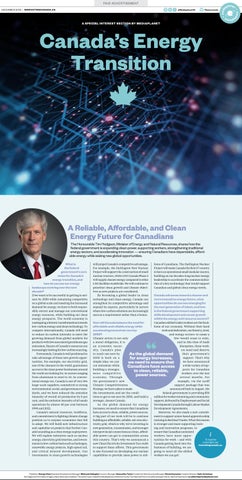
A Reliable, Affordable, and Clean Energy Future for Canadians The Honourable Tim Hodgson, Minister of Energy and Natural Resources, shares how the federal government is expanding clean power, supporting workers, strengthening traditional energy sectors, and accelerating innovation — ensuring Canadians have dependable, affordable energy while seizing new global opportunities. What is the federal government’s core vision for Canada’s energy transition, and how do you see our energy landscape evolving over the next decade? If we want to be successful in getting to netzero by 2050 while remaining competitive on a global scale and meeting the increased demand for energy, we have to both responsibly extract and manage our conventional energy resources, while building our clean energy prospects. The world economy is undergoing a historic transformation towards low-carbon energy and clean technology. To compete internationally, Canada will need to reduce its carbon intensity to meet the growing demand from global markets for products with low associated greenhouse gas emissions. Buyers of Canada’s resources are increasingly looking for low-carbon sourcing. Fortunately, Canada is well positioned to take advantage of these new growth opportunities. For example, our electricity grid, one of the cleanest in the world, guarantees access to the clean power businesses around the world are looking for, in sectors ranging from aluminum to steel to AI. In conventional energy too, Canada is one of very few large-scale suppliers committed to strong environmental, social, and governance standards, and we have reduced the emission intensity of overall oil production by 8 per cent, and the emission intensity of oil sands operations by almost 40 per cent between 1990 and 2022. Canada’s natural resources, workforce, and commitment to fighting climate change position us to surpass economies that fail to adapt. We will build new infrastructure and capitalise on projects that further Canada’s standing as a clean energy superpower. We will explore initiatives such as nuclear energy, electricity grid interties, and investments in low-carbon fuels such as hydrogen, renewable energy projects, high-speed rail, and critical mineral development. Our investments in clean growth technologies
will propel Canada’s competitive advantage. For example, the Darlington New Nuclear Project will support the construction of small nuclear reactors, while LNG Canada Phase 2 will supply cleaner energy compared to other LNG facilities worldwide. We will continue to prioritise clean growth and climate objectives as new projects are considered. By becoming a global leader in clean technology and clean energy, Canada can strengthen its competitive advantage and expand its exports, particularly in sectors where low-carbon solutions are increasingly seen as a requirement rather than a bonus.
lions of Canadians. The Darlington Nuclear Project will make Canada the first G7 country to have an operational small modular reactor, building on our decades-long nuclear energy leadership to accelerate the commercialization of a key technology that would support Canadian and global clean energy needs.
How will Canada balance the need for affordable and reliable energy while accelerating toward net-zero by 2050?
Canadian skilled trades workers are the backbone of our economy. Without their hard work and dedication, our forestry, steel, and energy sectors–to name a few–would cease to exist, and in this time of trade disruption, these workers need and deserve their government’s support. That's why we have announced a wide variety of supports for Canadian workers over the last several months. For example, via the tariff support package that was announced back in August, the federal government is providing $50 million for worker retraining and community support, delivered by Employment and Social Development Canada through Labour Market Development Agreements. Moreover, we also made a new commitment to support union-based apprenticeship training in Red Seal Trades. What this means is stronger and more supporting training and innovation programs, to ensure that Canadian unionized workers have more opporTo read the tunities for work – and with entire Q&A visit Canada getting back into the innovatingcanada.ca. business of building, we are going to need all the skilled workers we can get!
Climate action is not only a moral obligation, it is an economic necessity. Canada’s plan to reach net-zero by 2050 is built on a simple idea: we can cut emissions while building a stronger, more compet it ive economy. Throug h the government’s new Climate Competitiveness Strategy, we have a plan to make the investments and set the conditions to get to net-zero by 2050, and build a stronger, cleaner Canada. As the global demand for energy increases, we need to ensure that Canadians have access to clean, reliable, power sources. A big part of our work will be to continue building an affordable, reliable, net-zero electricity grid, which is why we’re investing in new generation, transmission, and stronger interprovincial connections so clean, affordable power can get to communities across this country. That’s why we announced a new Clean Electricity Investment Tax credit to support these efforts. This government is also focussed on developing our nuclear capabilities to provide clean power to mil-
Canada advances toward a cleaner and more innovative energy future, what opportunities do you see emerging for the next generation of talent, and how is the federal government supporting skills development and career growth within the energy and resource sectors?
As the global demand for energy increases, we need to ensure that Canadians have access to clean, reliable, power sources.
Publisher: George Zhao Business Development Manager: Michaela Gallagher Country Manager: Samantha Taylor Content & Client Success Manager: Nicole Kansakar Creative Director: Kylie Armishaw All images are from Getty Images unless otherwise credited. This section was created by Mediaplanet and did not involve The National Post or its editorial departments. Send all inquiries to ca.editorial@mediaplanet.com.
PAID ADVERTISEMENT 2
READ MORE AT INNOVATINGCANADA.CA
A SPECIAL INTEREST SECTION BY MEDIAPLANET
The University of New Brunswick is Fueling the Next Generation of Energy Leaders From advanced nuclear research to clean-tech startups, UNB is training the leaders who will power Canada’s energy transition.
C
anada is entering the most significant energy transition in its history. As the country moves toward a more electrified, decarbonized and digitally connected economy, our future prosperity will depend on abundant, reliable and secure energy. Meeting this demand will require new thinking, new technologies and a new generation of skilled professionals who can build and protect a diverse energy system. The University of New Brunswick (UNB) plays a critical role in shaping a sustainable future. As the only university east of Ontario to offer a nuclear program option, UNB is a national leader in conventional nuclear technology, renewable energy, small and advanced modular reactors and energy-security research. Its startup incubators also drive energy innovation. Across our campuses, students, faculty and partners are driving solutions that strengthen our energy future. The stories that follow show how UNB is cultivating talent, supporting innovation, advancing research and building industry partnerships that are shaping Canada’s energy landscape.
Dr. Olga Palazhchenko Associate Professor, Centre for Nuclear Energy Research, UNB
Driving nuclear innovation through experiential learning and research
Over the next six years, UNB will play a leading role training up to 60 next-generation experts in nuclear science and engineering through a new multidisciplinary grant program led by Dr. Olga Palazhchenko, P. Eng., associate professor at the university’s Centre for Nuclear Energy Research. By connecting researchers, educaLearners completing CLEAN achieve an tors, industry and experience beyond a typical government organundergraduate or graduate izations across degree, obtaining key technical Canada, Canada’s and professional workforce Life Cycle for Existing readiness skills needed to meet the urgent demand and Advanced Nuclear for a skilled nuclear (CLEAN) —a colworkforce. laboration
The University of New Brunswick Editorial Team
between five post-secondary institutions across the country—will teach beyond the fundamentals of nuclear engineering. Students will receive training in cybersecurity, advanced manufacturing, chemistry and corrosion of nuclear systems and materials, and other areas critical to the industry’s continued success. Through new workshops, Canada-wide research lab exchanges, and industry-driven internships, the program will provide graduates with the technical and professional expertise needed to meet the country’s urgent demand for a skilled nuclear workforce. Funded by a $1.65 million Collaborative Research and Training Experience grant from the Natural Sciences and Engineering Research Council, Palazhchenko developed CLEAN with a diverse group of passionate researchers from the University of Calgary, University of Regina, McMaster University and the Royal Military College of Canada. Its collaborators include experts from organizations across the country, including the Canadian Nuclear Safety Commission, Canadian Nuclear Laboratories, Canada’s Nuclear Waste Management Organization, UNB’s J Herbert Smith Centre, and nearly a dozen others.
How UNB’s startup engine accelerates energy innovation UNB’s J Herbert Smith Centre (JHSC) has a winning formula: find technical graduates with good ideas, teach them business fundamentals, and connect them to capital and customers so Canada’s next wave of energy innovators and tech leaders can shape the world of tomorrow. For 37 years, the JHSC has quietly built one of Atlantic Canada’s most successful startup incubators, supporting more than 290 predominantly student-founded ventures that have raised over $122 million. Led by Dr. Dhirendra Shukla, P. Eng., since 2009, the centre has been positioned as a hub of green energy innovation thanks to his blend of expertise in technology and investment. Two of the centre’s recent master of technology management and entrepreneurship (MTME) graduates further position Atlantic Canada as leaders in the energy transition. In 2017, engineer Sam Poirier, P. Eng., entered the program intending to build an off-road electric vehicle. After testing his market assumptions, he discovered the real opportunity was in vehicle control software. Poirier’s company, Potential Motors, pivoted to develop systems for unpredictable terrain and has since attracted about $14 million in
Our goal has always been to turn technical expertise into entrepreneurial momentum. Every year, master of technology management and entrepreneurship (MTME) graduates leave with the confidence and capability to either build companies that matter or take on influential tech leadership roles. That perspective is what helps them develop solutions that push Canada's energy transition forward.
venture capital. This software has helped set the standard for high-performing electric off-road vehicles. Another MTME graduate applied the same entrepreneurial drive to energy storage. Daniel Larsen, P. Eng., co-founded Stash Energy, which developed thermal storage systems that work with residential heat pumps, essentially turning homes into batteries. By storing heat when electricity is cheap and releasing it during peak demand, Stash helps utilities reduce grid stress while lowering consumer costs. Programs like MTME target engineers and scientists who want to bring transformative ideas to life. Through its intensive one-year program, students do just that while learning about market validation, fundraising, business leadership, and working with mentors, investors and industry partners. As Canada moves towards a greener future, UNB is equipping our workforce with the talent and expertise needed to accelerate innovation and help build the energy systems our country needs for a sustainable future.
Dr. Dhirendra Shukla Chair, J Herbert Smith Centre for TME (Technology Management & Entrepreneurship)
Discover how UNB’s programs, research and partnerships are shaping future leaders at UNB.ca. This article was sponsored by the University of New Brunswick.
PAID ADVERTISEMENT A SPECIAL INTEREST SECTION BY MEDIAPLANET
READ MORE AT INNOVATINGCANADA.CA
Canada Leads in Using Innovation to Build Nuclear Waste Solutions Canada is moving forward with long-term, community-driven plans to safely manage nuclear waste as the country expands its clean energy ambitions. Laurie Swami, President & CEO, Nuclear Waste Management Organization
T Laurie Swami President & CEO, Nuclear Waste Management Organization
his fall, the federal and Ontario governments committed $3 billion in investment in small modular reactors (SMRs), which Prime Minister Mark Carney described as “generational” and extending “Canada’s world leadership in clean energy.” The project is part of Canada’s nation-building strategy, a “generational investment that will build lasting security, prosperity, and opportunities.” That commitment to nuclear power also involves a generational responsibility to safely contain and isolate used nuclear fuel — the by-product of current and future nuclear power generation. That work has been the responsibility of the Nuclear Waste Management Organization (NWMO) for more than 20 years. The NWMO started by considering the longterm storage of used nuclear fuel from Canada’s existing nuclear power facilities. As new nuclear technologies are built, the NWMO is also planning ahead, guided by the vision to lead the way in nuclear waste solutions that create a safe and clean future.
Two decades of progress Over the past 20 years, the NWMO has made significant progress. Through three years of study and dialogue with Canadians and Indigenous Peoples, the NWMO developed Canada’s plan, which recommended isolating used nuclear fuel in a deep geological repository made up of a network of tunnels and placement rooms hundreds of metres underground in a stable rock formation, designed to safely store radioactive waste for tens of thousands of years. Next, the NWMO led a process to find a site for this deep geological repository, a process that took more than a decade. Through engagement with Canadians and Indigenous Peoples — the foundation of many of the NWMO’s activities — 22 communities proactively expressed interest in learning about the project and exploring their potential to host it. In November 2024, the NWMO reached its most significant milestone to date. After extensive technical study and community engagement, the northwestern Ontario communities of Wabigoon Lake Ojibway Nation and the Township of Ignace agreed to support advancing the project.
A milestone decision for Canada’s first repository Today, the NWMO is responsible for leading two deep geological repository projects for Canada to safely manage nuclear waste over the very long term. The repository project in northwestern Ontario is entering a new phase — the multi-year regulatory deci-
For more information about the NWMO, visit nwmo.ca.
sion-making process. This process will provide the federal government with the information and studies it needs to independently confirm the safety of the repository. This process will create new opportunities for the public to continue to have their voices heard. In addition, the NWMO is planning a second repository to manage intermediate- and non-fuel high-level waste — made up of things like reactor components, filters, and by-products from medica l isotope production — as well as used fuel from new nuclear reactors like SMRs. The NWMO took on the mandate for the safe, long-term management of these waste types in 2023, following the federal government’s acceptance of the recommendations in Canada’s Integrated Strategy for Radioactive Waste. In 2025, the NWMO began a two-year process of inviting feedback from Canadians and Indigenous Peoples to help refine the site selection process for this project.
Preparing for the next generation of nuclear technologies
Remaining ready for Canada’s nuclear expansion is a strategic priority for the NWMO and moving both repository projects forward allows that to happen.
The NWMO also continues to collaborate, sharing its experiences with and learning from its global peers. There’s international scientific consensus that a deep geological repository is the safest option to isolate used nuclear fuel. Canada is among a leading group of nations to pursue this approach. Finland’s deep geological repository is scheduled to open this decade, Sweden is in the process of building, and Switzerland and France have identified sites and are at various stages in their regulatory processes. Remaining ready for Canada’s nuclear expansion is a strategic priority for the NWMO and moving both repository projects forward allows that to happen. As the plans for the first and second repositories continue, collaboration remains a cornerstone of the NWMO’s work, ensuring that the voices of Canadians and Indigenous Peoples will be heard.
This article was sponsored by Nuclear Waste Management Organization.
3