ADVERTISEMENT SEPTEMBER 2026 | HEALTHINSIGHT.CA
@MediaplanetCA
Please recycle
A SPECIAL INTEREST SECTION BY MEDIAPLANET
Patient Access & Health Equity
Strengthening Primary Care and Canada’s Health Workforce Investments in primary care and workforce mobility are helping Canadians access timely, high-quality health services where they live.
O
ur government recognizes the essential role that primary care plays in the delivery of health services, including the prevention and treatment of common health problems, the management of ongoing health issues, and the role of the health workforce in helping to ensure that Canadians can access timely, high-quality health services. The Government of Canada is committed to investing in the health care system. This includes close to $200 billion over 10 years through the Working Together to Improve Health Care for Canadians plan. This provides long-term, predictable funding to provinces and territories through the Canada Health Transfer (CHT) and $25
The Honourable Marjorie Miche Minister of Health
billion for bilateral agreements to support health priorities. We are working with provinces and territories to ensure these investments respond to the needs of Canadians in communities across the country. Initial Working Together bilateral agreements were signed with all provinces and territories in 2023 to 2024. These agreements are designed to be flexible and tailored, allowing provinces and territories to address the unique needs of their populations and geography. Improving access also means making it easier for health care professionals to practice where they are needed most. Health Canada is funding the National Registry of Physicians, Canada’s first inte-
grated source of physician licensure data, and NURSYS in Canada, a national platform for nursing licensure data. These initiatives will facilitate information exchange between regulators and make it easier for doctors and nurses to move and practice across Canada. This work can help communities fill urgent staffing gaps faster. Our government will continue working with provinces, territories, and health system partners to improve access to care. Transforming the delivery of primary care can help Canadians get the care they need, including those living in rural and remote communities.
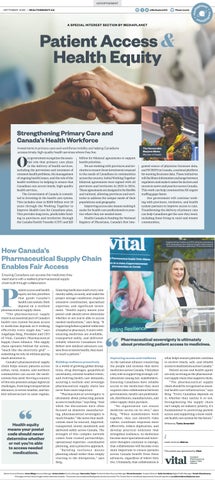
Angelique Berg, President and CEO, addresses attendees at Vital's recent government relations reception held during the Council of the Federation gathering in Prince Edward Island.
How Canada’s Pharmaceutical Supply Chain Enables Fair Access Ensuring Canadians can access the medicines they need starts with a resilient pharmaceutical supply chain built through collaboration.
P
atient access and health equity are key priorities that guide Canada’s health care system. Both depend on a resilient pharmaceutical supply chain. “The pharmaceutical supply chain is an essential part of Canada’s health care system because access to medicines depends on it working effectively every single day,” says Angelique Berg, President and CEO of Vital, Canada’s Pharmaceutical Supply Chain Alliance. This supply chain operates behind the scenes, “much like the electricity grid” — something we rely on without paying much attention to. Canada’s pharmaceutical supply chain helps ensure patients across urban, rural, remote, and northern communities can access the medications they need. Serving a country of this size presents unique logistical challenges, from long transportation distances, to severe weather, and limited infrastructure in some regions.
Health equity means your postal code should never determine whether or not you’re able to access needed medications.
Ensuring medicines reach every community safely, securely, and under the proper storage conditions requires extensive coordination, specialized expertise, and significant investment. “Health equity means your postal code should never determine whether or not you’re able to access needed medications,” says Berg. “It begins long before a patient walks into a hospital or pharmacy. It starts with ensuring medicines are available, transported safely, and delivered reliably wherever Canadians live. Before new medical advances can save lives or restore health, they need to reach a patient.”
Pharmaceutical sovereignty is ultimately about protecting patient access to medicines. Improving access and resilience
Building resilience proactively In a world of growing global disruptions, drug shortages, geopolitical uncertainty, extreme weather events, and evolving health care demands, securing a resilient and sovereign pharmaceutical supply chain has never been more important. “Pharmaceutical sovereignty is ultimately about protecting patient access to medicines,” says Berg. “And while the discussions have often focused on domestic manufacturing, pharmaceutical sovereignty is much broader.” She notes that medications must be sourced, imported, transported, stored, monitored, and delivered safely across Canada. The strength of this complex network comes from trusted partnerships, operational expertise, coordinated planning, and a proactive approach. “Building resilience mea ns planning ahead rather than simply reacting to the disruptions,” says Berg.
As the national alliance connecting the people and systems that move medicines across Canada, Vital plays a key role in supporting strategic collaboration among key stakeholders. Ensuring Canadians have reliable access to the medicines they need requires close collaboration between governments, health care professionals, distributors, manufacturers, and other supply chain partners. “No organization can ensure medicine access on its own,” says Berg. “When stakeholders work together, they can identify risks earlier, coordinate responses more effectively, reduce duplication, and develop practical solutions that strengthen resilience. As medicines become more specialized and innovative therapies continue to emerge, that collaboration will become even more important to ensure patients across Canada benefit from these advances, regardless of where they live. Ultimately, that collaboration is
what helps ensure patients continue to receive timely, safe, and reliable access to medications across Canada.” Patient access and health equity are only as strong as the pharmaceutical supply chain that supports them. “The pharmaceutical supply chain should be recognized as essential health care infrastructure,” says Berg. “Every Canadian depends on it, whether they realize it or not. Strengthening the supply chain isn’t simply an industry priority, it’s fundamental to protecting patient access and supporting a more resilient health care system for the future.” Written by Tania Amardeil
Learn more at vital.ca. This article was sponsored by Vital.
Senior Account Director: Anna Sibiga Account Manager: Arlene Asika Country Manager: Samantha Taylor Content & Client Success Manager: Nicole Kansakar Creative Director: Kylie Armishaw Digital Traffic Manager: Vansh Chandwaney All images are from Getty Images unless otherwise credited. This section was created by Mediaplanet and did not involve The Toronto Star or its editorial departments. Send all inquiries to ca.editorial@mediaplanet.com.
ADVERTISEMENT 2
READ MORE AT HEALTHINSIGHT.CA
A SPECIAL INTEREST SECTION BY MEDIAPLANET
How We Can Help Improve Anaphylaxis Management in Canada Making epinephrine more accessible in public spaces and easier to administer can protect the health and well-being of Canadians with severe allergic reactions.
A
Andrew Desbarats General Manager, ALK Canada
naphylaxis is a serious allergic reaction that can be fatal, but it’s treatable. Timely epinephrine (adrenaline) is the standard treatment and is very effective, but in real-life situations its administration is often delayed. Possible fear of needles, lack of confidence, and uncertainty may cause hesitation.1 Sometimes, epinephrine simply isn’t on hand when an emergency happens. According to a report from the 2026 Anaphylaxis Summit Ontario, approximately two per cent of Canadians are at risk of anaphylaxis, and awareness alone doesn’t ensure preparedness: roughly half of Canadians with a probable food allergy don’t have an epinephrine device. Some aren’t aware they have an allergy at all. Severe allergic reactions can happen anywhere, and emergency preparedness shouldn’t be up to the individual. Having epinephrine available in public places like schools and workplaces — much like automated external defibrillators (AEDs) and naloxone kits are already available in many community settings — could save lives. “We can prevent inadvertent deaths from anaphylaxis if we’re prepared with the right medication at the right time for people, whether they know they’re at risk of anaphylaxis or not,” says Andrew Desbarats, General Manager of ALK Canada.
The role of innovation in protecting Canadians Fear of needles remains one of the reasons for delayed epinephrine administration, and delayed administration contributes to preventable hospitalizations and deaths.1,2 The Anaphylaxis Summit Ontario report
highlighted how, in a recent study of 1,700 children, only 70 per cent of those with access to an epinephrine auto-injector used it when needed. This hesitation can be deadly. An epinephrine nasal spray may help address that barrier, offering a new needle-free option. “Nasal epinephrine is a great example of another option for a condition that for a long time has had a treatment that’s been avoided by people because of the way it’s administered,” says Desbarats. But new options only help if people can access them. Equitable access to treatment means promoting better awareness and education and addressing affordability. Collaboration is critical. Desbarats outlines how governments, health plans, industry, and private insurers need to work together to ensure appropriate treatments are accessible and affordable.
Preparing communities to respond Desbarats notes that schools often rely on children with known allergies bringing their own epinephrine devices to school, and that some children may experience their first anaphylactic reaction at school and therefore not have a device available. “We still don’t have legislation that schools should carry epinephrine on their own,” he says. Community settings like hockey arenas and community centres share the same challenges. Desbarats views it as a shared public health responsibility for schools and other community spaces to have epinephrine treatments available. Change is possible. In Alberta, a bill passed in 2019 established a comprehensive school-based allergy preparedness framework requiring stock epinephrine, trained staff,
We can prevent inadvertent deaths from anaphylaxis if we’re prepared with the right medication at the right time for people, whether they know they’re at risk of anaphylaxis or not.
and written anaphylaxis plans in all Alberta schools. This resulted in a 700 per cent increase in completions of Food Allergy Canada’s Allergy Aware for Educators training program — and a 2026 study found that the policy increased pre-hospital epinephrine use for pediatric school anaphylaxis from 35.7 per cent to 64.5 per cent. 3 The findings support the policy and the use of undesignated stock epinephrine in schools, shifting anaphylaxis readiness from solely an individual responsibility toward a shared one.
Epinephrine as community emergency infrastructure Like AEDs and naloxone kits, having epinephrine readily available as part of public emergency infrastructure is a logical step. “I think the great thing about Canada right now is that we have the infrastructure to do this fairly seamlessly,” says Desbarats. He suggests the idea of a public first aid station, expanding on the existence of AEDs and naloxone kits, with their existing signage and packaging. “We can really expand the types of conditions that we can treat publicly and really help patients who are at risk of some of these severe life-threatening issues,” he adds. The Anaphylaxis Summit Ontario report supports the idea. It points to how survival rates improved when life-saving interventions like AEDs and naloxone were available when emergencies occurred, and outlines how epinephrine access can do the same for anaphylaxis cases. Making epinephrine readily available in schools, childcare set t ing s, recreat ion facilit ie s, transportation hubs, workplaces, and other public venues is an essential part of community emergency readiness. Achieving that requires greater awareness and collaboration across governments, health systems, schools, workplaces, community organizations, and industry. Written by Tania Amardeil
References: 1. Lieberman JA et al. Innovations in the treatment of anaphylaxis: A review of recent data. Ann Allergy Asthma Immunol. 131(2023)185−193 2. Delli Colli L et al. Epinephrine, antihistamines, and corticosteroids: Morethan10yearsofCross-Canada Anaphylaxis Registry data. Ann Allergy Asthma Immunol. 131(2023)752−758
Visit foodallergy canada.ca to learn more.
3. Najem J et al. Effectiveness of a Provincial Law to Improve Epinephrine Use for Anaphylaxis in Schools in Alberta, Canada: A Pre-Post Study. Int Arch Allergy Immunol (2026) https://doi. org/10.1159/000552127
This article was made possible with support from ALK Canada.
ADVERTISEMENT A SPECIAL INTEREST SECTION BY MEDIAPLANET
READ MORE AT HEALTHINSIGHT.CA
3
INDIGENOUS KIDNEY CARE:
An Urgent Call for Change
I
Indigenous Peoples face higher rates of kidney disease and barriers to care. Closing the gaps requires listening to communities and investing in equitable care.
magine receiving a chronic kidney disease (CKD) diagnosis that requires specialized treatment. What might mean a subway ride or short drive in a city can become a 900 kilometre journey, taking you away from your home, family, and culture. This is the reality patient advocate Tamara Beardy has witnessed among loved ones battling CKD in remote Manitoba communities, and a common experience for many Indigenous patients facing persistent systemic barriers to care.
community members to develop and deliver programs and advocate for changes that reflect local cultures, knowledge, and priorities. The Strategic Framework’s recommendations include integrated, person-centred care that includes mental health supports, expanded telehealth, and virtual care to allow follow-ups within the community, and greater access to kidney transplants and living donation. Beardy recalls a peer-led diabetes prevention program in which communities helped develop culturally aligned programming suited to their needs. She believes kidney care should take a similar approach: “People won’t know until they come and sit with us.”
A disproportionate burden Although CKD affects people across Canada, rates among Indigenous populations are two to four times higher than the general population, with a seventy-seven per cent higher mortality rate. Food insecurity, inadequate water infrastructure, systemic racism, and intergenerational inequity are major contributors to chronic disease, particularly in remote communities with limited access to primary care and early screening. This results in delayed diagnosis, more advanced disease, and limited access to dialysis and transplant. Advanced kidney disease can force relocation to urban hospitals, separating patients from family and community supports and contributing to fear, isolation, and emotional distress.
Tamara Beardy
Come visit us and see where we live, so you’ll have a better idea of care delivery for your patients. “You’re a patient being ripped from home and away from family,” Beardy says, describing a cousin with advanced CKD who spent months away from family, navigating an unfamiliar healthcare system and feeling culturally adrift.
of Canada is calling for government action to improve kidney health across the country. This proactive roadmap aims to improve awareness and prioritize prevention, early detection, and prompt intervention, regardless of where people live. To address systemic barriers affecting access to care in remote Indigenous communities, the Foundation works in partnership with
Care shaped by community Through its National Strategic Framework for CKD, The Kidney Foundation
Indigenous people in Canada are approximately
3x more
likely to experience kidney disease than the general population
A call for equitable care Beardy says major gaps remain. She is calling for mobile teams offering screening and education, transport assistance, Indigenous peer support in hospitals, and better family supports, stressing the need for additional accommodations to ensure patients aren’t alone. She urges healthcare and patient organizations to listen directly to Indigenous communities: “Come visit us and see where we live, so you’ll have a better idea of care delivery for your patients.” Written by Adir Schlesinger
A Manitoba study found that
87%
of CKD cases detected were early stage and potentially treatable
To learn more about the National Strategic Framework for CKD, visit kidney.ca/framework This article was sponsored by Kidney Foundation of Canada.
actively engaged with the pan-Canadian Pharmaceutical Alliance (pCPA) and the provincial drug programs to support timely reimbursement decisions and equitable access to treatments for Canadians living with ALS. As new therapies emerge, access pathways must keep pace with scientific progress,” says Tammy Moore, Chief Executive Officer, ALS Canada.
New era of ALS treatments
Surrounded by members of Pam's Posse, Pam Skinner celebrates the power of coming together at the ALS Canada Walk to End ALS. The team of family, friends, and colleagues walked in support of a world free of ALS and the vital work of ALS Canada.
ALS Treatment Access Must Keep Pace with Advances in Research and Care For Canadians living with the SOD1 genetic variant of ALS, access to this new therapy is having a positive impact.
I
n July of 2023, Pam Skinner learned she had amyotrophic lateral sclerosis (ALS), a progressive neurodegenerative disease that causes the nerve cells of the brain and spinal cord to die. Over time, people with ALS lose their ability to walk, talk, swallow, and breathe. Though Skinner was able to continue working at her demanding job as senior vice president of college operations at Niagara College, her mobility was quickly deteriorating.
Pam Skinner shakes hands with Ontario Premier Doug Ford at Queen's Park during ALS Canada Advocacy Day. The event brought together people living with ALS, caregivers, clinicians, and advocates to recognize the Ontario government's investment in the Ontario Provincial ALS Program and its impact on ALS care across the province.
Within a year of diagnosis, she went from limping to using a wheelchair. Through her ALS clinic, Skinner learned she has the superoxide dismutase 1 (SOD1) gene, a genetic variant affecting some people with ALS. Just over a year ago, she started on the first ever therapy to target this gene called Qalsody. “Since then, I’ve noticed no further progression and my hands seem to be getting stronger,” says Skinner.
Faster access pathways needed
Though ALS affects only a small percentage of the population, without better treatments there’s a heavier burden on the healthcare system.
While recent regulatory approval for Qalsody for people with SOD1-ALS is a positive sign, there are many additional steps that must take place before it becomes widely available and covered under public or private drug plans. Skinner was able to access it through Health Canada’s Special Access Program (SAP) while pricing negotiations continue. Although these programs play an important role in providing access, long-term access to approved therapies should not depend on temporary arrangements. For the ALS community, the need
for equitable access to treatments is especially important because ALS often progresses rapidly and treatment delays can have significant consequences for people living with the disease. “Once you lose your ability to swallow or breathe, you’re at death’s door, so there’s an urgency to speed up access to treatment,” says Skinner. ALS Canada is advocating for faster reimbursement and approval processes. “Guided by the lived experiences of the ALS community, we’re
Although only a small percentage of people with ALS have SOD1-ALS, Qalsody represents hope for the ALS community and an important step forward with more effective, targeted treatments. As more therapies emerge and more Canadians learn their genetic status and treatment options, healthcare systems, reimbursement pathways, and support services must be ready to ensure equitable access to care. “Though ALS affects only a small percentage of the population, without better treatments there’s a heavier burden on the healthcare system, so there are both compassionate and practical reasons for having the healthcare system keep pace with advances in ALS research and care,” says Skinner. Ultimately, equitable access to effective ALS treatments like Qalsody benefits patients and their families. It’s thanks to these advancements that Skinner can enjoy things in life that matter most to her. “If they can halt the progression of my ALS to where I am right now, that would be awesome,” she says. Written by Anne Papmehl
To learn more about how ALS Canada is advocating for timely and equitable access to genetic testing, reimbursement, and approved treatments for Canadians living with ALS, visit als.ca.
This article was sponsored by ALS Canada.
ADVERTISEMENT 4
READ MORE AT HEALTHINSIGHT.CA
A SPECIAL INTEREST SECTION BY MEDIAPLANET
Two years is too long. It takes over two years for newly approved medicines to reach Canadians.
Let’s work together to speed up access.
medicinematterscanada.ca