CREATED BY MEDIAPLANET | HEALTHINSIGHT.CA
@MediaplanetCA
A SPECIAL INTEREST SECTION BY MEDIAPLANET
Neurological Conditions
Please recycle
Advancing Brain Health Across Canada Canada is advancing brain health through federal action, research investments, national strategies, and strategic partnerships.
B Closing the Gap Between Innovation and Access in Duchenne Muscular Dystrophy Canada’s Duchenne community is advancing research, but regulatory and access gaps continue to delay promising therapies for families.
F
or the approximately 800 to 1,000 Canadians living with Duchenne muscular dystrophy, a rare, progressive neuromuscular disease. The gap between scientific progress, regulatory approval, and access can have profound consequences. Since 1995, Defeat Duchenne Canada has invested $20.3 million in research worldwide to advance treatments, improve care, and ultimately find a cure. Canada is a long-standing leader in Duchenne research, with Canadian researchers, patients, and families playing an important role in international clinical trials that have contributed to the development of multiple new therapies approved in other countries. Yet, as of October 2025, only one therapy has been approved by Health Canada. This inequity highlights the disconnect between Canada’s research leadership and timely, equitable access to the treatments Canadian families have helped to advance.
families participate in research with hope; not only for their own children, but for every family living with Duchenne,” says Nicola Worsfold, Executive Director of Defeat Duchenne Canada. “We are committed to working with researchers, governments, and industry to ensure that Canadians can benefit from the therapies they have invested their blood, tissue, and time to make possible.” The National Strategy for Drugs for Rare Diseases and Health Canada’s regulatory modernization efforts create an opportunity to reduce delays and improve access to treatment. Now is the time for Canada to build on this momentum to ensure promising Duchenne therapies reach Canadian families.
rain health is an important part of the health and well-being of Canadians. Our government recognizes the significant impact that brain and neurological diseases, disorders, injuries, and other health conditions have on individuals, families, and caregivers. Improving brain health requires collaboration across governments, researchers, health care professionals, patients, and partners. Canada’s approach is focused on advancing research and supporting coordinated action to improve outcomes for people living with neurological conditions. Health Canada, the Public Health Agency of Canada, and the Canadian Institutes of Health Research (CIHR) work together on shared brain health and neurological priorities. Health Canada supports brain health research through the Canada Brain Research Fund Program, in partnership with the Brain Canada Foundation. The program supports researchers in advancing clinical, technological, and health system solutions for brain diseases and disorders. Research is central to improving our understanding of brain health and developing treatments. CIHR supports research, knowledge mobilization, and capacity development. Scientific leadership on neurological conditions is supported across multiple CIHR institutes, notably through the Institute of Neurosciences, Mental Health, and Addiction. Written by Health Canada
Written by Defeat Duchenne Canada
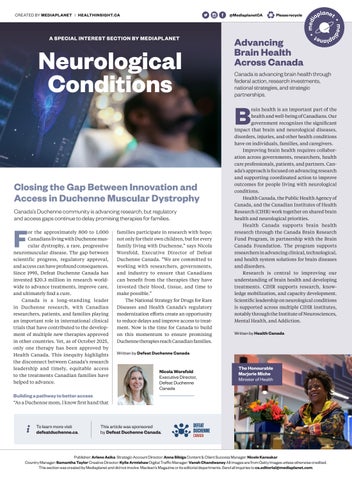
Nicola Worsfold Executive Director, Defeat Duchenne Canada
The Honourable Marjorie Miche Minister of Health
Building a pathway to better access “As a Duchenne mom, I know first hand that
To learn more visit defeatduchenne.ca.
This article was sponsored by Defeat Duchenne Canada.
Publisher: Arlene Asika Strategic Account Director: Anna Sibiga Content & Client Success Manager: Nicole Kansakar Country Manager: Samantha Taylor Creative Director: Kylie Armishaw Digital Traffic Manager: Vansh Chandwaney All images are from Getty Images unless otherwise credited. This section was created by Mediaplanet and did not involve Maclean’s Magazine or its editorial departments. Send all inquiries to ca.editorial@mediaplanet.com.
2
CREATED BY MEDIAPLANET
READ MORE AT HEALTHINSIGHT.CA
New Advances Are Improving Care for Canadians with Autoimmune Neuromuscular Conditions Earlier diagnosis, multidisciplinary care, and innovative treatments are helping improve outcomes and quality of life for Canadians living with gMG and CIDP.
G
eneralized myasthenia gravis (gMG) and chronic inf lammatory demyelinating polyneuropathy (CIDP) are rare autoimmune neuromuscular conditions that can have life-altering impacts. gMG affects the neuromuscular junction, which is the connection between nerves and muscles. “If the ocular muscles are affected, people may experience double vision or droopy eyelids,” says Dr. Hans Katzberg, a professor of neurology at the University of Toronto. “The muscles involved with swallowing or speaking can be affected, as can the extremity and trunk muscles and even the breathing muscles.” In CIDP, it’s the myelin sheath that is attacked. CIDP can cause patients to experience muscle weakness, numbness, and mobility issues.
Why early diagnosis matters Many people living with gMG and CIDP experience delays before receiving a diagnosis. “The signs and symptoms are similar to those of other neurological conditions,” notes Dr. Katzberg.
“Many patients spend months to years seeing multiple specialists, receiving misdiagnoses, or being told their symptoms are psychological,” says Homira Osman, Vice-President of Research, Public Policy and Programs at Muscular Dystrophy Canada.
are also important in supporting quality of life for people living with gMG and CIDP. “Ongoing support from Muscular Dystrophy Canada can help people feel less isolated, connect them with specialists sooner, and support independence and quality of life,” says Osman.
Shaping the future of care
We just need to take the innovation that we’ve moved forward and get it into the hands of patients. “With gMG, the earlier the treatment, the better the chances of controlling the disease early on,” says Dr. Katzberg. “And the longer you go untreated with CIDP, the more longterm nerve damage can occur.” Multidisciplinary care plays a key role in gMG and CIDP management. A care team might include neurologists, rehabilitation specialists, and other health professionals. Patient education and advocacy
Research and innovation are leading to new treatment options that can help improve outcomes for people living with these conditions. “New classes of medications have been tried in gMG and are now being applied to CIDP, including Fc receptor inhibitor technology,” says Dr. Katzberg. It's helpful to have new treatment options available for CIDP, where there hasn't been innovation for the past 30 years. The future is bright for people living with gMG and CIDP, says Dr. Katzberg. “We have a lot more options. We just need to take the innovation that we’ve moved forward and get it into the hands of patients.” WRITTEN BY Tania Amardeil
This article was made possible with support from argenx.
Dr. Hans Katzberg Professor of Neurology, University of Toronto
Homira Osman Vice-President of Research, Public Policy and Programs, Muscular Dystrophy Canada
CREATED BY MEDIAPLANET
READ MORE AT HEALTHINSIGHT.CA
3
Canada Can No Longer Wait for a National Strategy on Brain Injury Canada’s fragmented approach to brain injury comes at a significant human and economic cost.
E
very day, Canadians sustain brain injuries that change the course of their lives. More than 1.5 million Canadians live with acquired brain injury, and an estimated 400,000 experience a concussion each year — approximately one every 90 seconds. Yet Canada ha s no coord inate d nat iona l strategy. For many, recovery means navigating fragmented systems and uneven access to rehabilitation, housing, mental health services, employment supports, and long-term care. While many people with brain injury lead stable and fulfilling lives, others face lasting challenges affecting employment, housing, mental health, substance use, and interactions with the justice system. These impacts extend far beyond healthcare and remain inadequately captured in national data.
The costs of inaction are growing Canadian research estimates that 53 to 70 per cent of people experiencing homelessness have sustained a traumatic brain injury. Correctional Service Canada reports histories of brain injury among 34 per cent of federally incarcerated men and 23 per cent of women. A national strategy would not direct provincial healthcare. It would coordinate data, research and preven-
Brain injury is one of Canada's most significant and least recognized public health issues.
tion, align investments, share best practices, and reduce duplication. A national strategy starts by bringing the right voices to the table. Provinces, territories, Indigenous partners, researchers, clinicians, and community organizations all have a role. Most importantly, people living with brain injury, caregivers, and families must help shape the solutions. Canada has the expertise, evidence, and committed partners. What is needed now is federal leadership to turn that foundation into coordinated action before more Canadians fall through the gaps and the human, social, and economic costs continue to grow.
WRITTEN BY
Michelle McDonald CEO, Brain Injury Canada
Visit braininjurycanada.ca/ national-strategy to learn more and show your support. This article was sponsored by Brain Injury Canada.
Federal Investment in ALS National Strategy Will Ensure No Canadian is Left Behind Research into why Canadian military veterans have a higher likelihood of ALS could help advance care and treatment for all Canadians.
B
ob Gibson is a Canadian military veteran living with amyotrophic lateral sclerosis (ALS). ALS is a progressive neuromuscular disease that destroys nerve cells in the brain and spinal cord. As the disease progresses, people with ALS lose their ability to walk, talk, swallow, and breathe. Little is known about why disease progression varies from person to person and why military veterans like Gibson, are twice as likely to receive an ALS diagnosis.
Urgent call for federal funding ALS Canada is calling for a federal investment of $50 million over the next five years into the Canadian Collaboration to Cure ALS to ensure that no Canadian is left behind. This Collaboration brings together people living with ALS, researchers, clinicians, and organizations across the country to unify Canada’s research efforts by scaling four high-impact ALS research initiatives—CAPTURE (Comprehensive Analysis Platform To Understand, Remedy, and Eliminate) ALS, the Canadian Neuromuscular Disease Registry (CNDR), the Canadian ALS Research
Network (CALS), and Access ALS. “Canada has the talent and capacity to become a world leader in groundbreaking ALS research. The only thing we lack is funding,” says Tammy Moore Chief Executive Officer, ALS Canada.
People living with ALS cannot afford to wait. Behind every diagnosis is a person, a family, and a future that has been forever changed. ALS Canada encourages Canadians to support their call for federal funding so that people living with ALS can access new and innovative therapies. “People living with ALS cannot afford to wait. Behind every diagnosis is a person, a family, and a future that has been forever changed,” says Gibson. Written by Anne Papmehl
Bob Gibson (centre) with (from left) Dr. Christen Shoesmith, Neurologist and Medical Director of the Motor Neuron Diseases Clinic at London Health Sciences Centre; Charmain Gibson; Wendy Toyer; and Kim Barry, Vice-President, Community Services, ALS Canada, on Parliament Hill advocating for federal investment in a coordinated national ALS research effort.
Learn more by visiting: als.ca. This article was sponsored by ALS Canada.