PAID ADVERTISEMENT SEPTEMBER 2026 | HEALTHINSIGHT.CA
@MediaplanetCA
Please recycle
A SPECIAL INTEREST SECTION BY MEDIAPLANET
Neurological Conditions
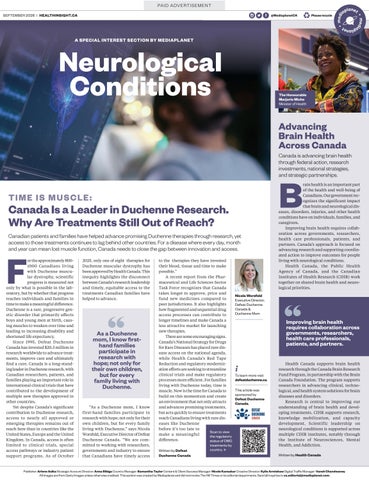
The Honourable Marjorie Miche Minister of Health
Advancing Brain Health Across Canada Canada is advancing brain health through federal action, research investments, national strategies, and strategic partnerships.
B
TIME IS MUSCLE :
Canada Is a Leader in Duchenne Research. Why Are Treatments Still Out of Reach? Canadian patients and families have helped advance promising Duchenne therapies through research, yet access to those treatments continues to lag behind other countries. For a disease where every day, month and year can mean lost muscle function, Canada needs to close the gap between innovation and access.
F
or the approximately 8001000 Canadians living with Duchenne muscular dystrophy, scientific progress is measured not only by what is possible in the laboratory, but by whether that progress reaches individuals and families in time to make a meaningful difference. Duchenne is a rare, progressive genetic disorder that primarily affects boys and young men at birth, causing muscles to weaken over time and leading to increasing disability and shortened life expectancy. Since 1995, Defeat Duchenne Canada has invested $20.3 million in research worldwide to advance treatments, improve care and ultimately find a cure. Canada is a long-standing leader in Duchenne research, with Canadian researchers, patients, and families playing an important role in international clinical trials that have contributed to the development of multiple new therapies approved in other countries. Yet despite Canada’s significant contribution to Duchenne research, access to nearly all approved or emerging therapies remains out of reach here than in countries like the United States, Europe and the United Kingdom. In Canada, access is often limited to clinical trials, special access pathways or industry patient support programs. As of October
2025, only one of eight therapies for Duchenne muscular dystrophy has been approved by Health Canada. This inequity highlights the disconnect between Canada’s research leadership and timely, equitable access to the treatments Canadian families have helped to advance.
As a Duchenne mom, I know firsthand families participate in research with hope; not only for their own children, but for every family living with Duchenne. “As a Duchenne mom, I know first-hand families participate in research with hope; not only for their own children, but for every family living with Duchenne,” says Nicola Worsfold, Executive Director of Defeat Duchenne Canada. “We are committed to working with researchers, governments and industry to ensure that Canadians have timely access
to the therapies they have invested their blood, tissue and time to make possible.” A recent report from the Pharmaceutical and Life Sciences Sector Task Force recognizes that Canada takes longer to approve, price and fund new medicines compared to peer jurisdictions. It also highlights how fragmented and sequential drug access processes can contribute to longer timelines and make Canada a less attractive market for launching new therapies. There are some encouraging signs. Canada’s National Strategy for Drugs for Rare Diseases has placed rare disease access on the national agenda, while Health Canada’s Red Tape Reduction and regulatory modernization efforts are seeking to streamline clinical trials and make regulatory processes more efficient. For families living with Duchenne today, time is muscle. Now is the time for Canada to build on this momentum and create an environment that not only attracts and advances promising treatments, but acts quickly to ensure treatments reach Canadians living with rare diseases like Duchenne before it’s too late to Scan to view make a meaningful the regulatory difference. status of DMD treatments by country. Written by Defeat Duchenne Canada
rain health is an important part of the health and well-being of Canadians. Our government recognizes the significant impact that brain and neurological diseases, disorders, injuries, and other health conditions have on individuals, families, and caregivers. Improving brain health requires collaboration across governments, researchers, health care professionals, patients, and partners. Canada’s approach is focused on advancing research and supporting coordinated action to improve outcomes for people living with neurological conditions. Health Canada, the Public Health Agency of Canada, and the Canadian Institutes of Health Research (CIHR) work together on shared brain health and neurological priorities.
Nicola Worsfold Executive Director, Defeat Duchenne Canada & Duchenne Mom
Improving brain health requires collaboration across governments, researchers, health care professionals, patients, and partners.
To learn more visit defeatduchenne.ca. This article was sponsored by Defeat Duchenne Canada.
Health Canada supports brain health research through the Canada Brain Research Fund Program, in partnership with the Brain Canada Foundation. The program supports researchers in advancing clinical, technological, and health system solutions for brain diseases and disorders. Research is central to improving our understanding of brain health and developing treatments. CIHR supports research, knowledge mobilization, and capacity development. Scientific leadership on neurological conditions is supported across multiple CIHR institutes, notably through the Institute of Neurosciences, Mental Health, and Addiction. Written by Health Canada
Publisher: Arlene Asika Strategic Account Director: Anna Sibiga Country Manager: Samantha Taylor Content & Client Success Manager: Nicole Kansakar Creative Director: Kylie Armishaw Digital Traffic Manager: Vansh Chandwaney All images are from Getty Images unless otherwise credited. This section was created by Mediaplanet and did not involve The Hill Times or its editorial departments. Send all inquiries to ca.editorial@mediaplanet.com.
PAID ADVERTISEMENT 2
READ MORE AT HEALTHINSIGHT.CA
A SPECIAL INTEREST SECTION BY MEDIAPLANET
Improving Access to Innovative Care for Canadians Living with Autoimmune Neuromuscular Conditions Earlier diagnosis, specialized care, investment in research, and access to innovative medicines can improve outcomes for Canadians living with gMG and CIDP.
G
eneralized myasthenia gravis (gMG) and chronic inflammatory demyelinating polyneuropathy (CIDP) are rare autoimmune neuromuscular conditions that can have life-altering impacts. gMG affects the neuromuscular junction, which is the connection between nerves and muscles. During an autoimmune attack, antibodies are directed against the junction, disrupting the communication between nerves and muscles and leading to muscle weakness. “If the ocular muscles are affected, people may experience double vision or droopy eyelids,” says Dr. Hans Katzberg, a neurologist and professor of neurology at the University of Toronto. “The muscles involved with swallowing or speaking can be affected, as can the extremity and trunk muscles. In the most serious scenario, the breathing muscles can be affected and it can be life-threatening.” In CIDP, it’s the myelin sheath (the nerves’ protective covering) that is attacked. CIDP can cause patients to experience muscle weakness, numbness, and mobility issues.
Why early diagnosis matters Many people living with gMG and CIDP experience delays before receiving a diagnosis. “The signs and symptoms are similar to those of other neurological conditions,” notes Dr. Katzberg. “Oftentimes there’s a diagnostic odyssey,” says Homira Osman,
Vice-President of Research, Public Policy and Programs at Muscular Dystrophy Canada. “Many patients spend months to years seeing multiple specialists, receiving misdiagnoses, or being told their symptoms are psychological.” Access to neurologists with expertise in these rare conditions and the specialized nerve testing needed to diagnose them can be a challenge, Dr. Katzberg notes. Early diagnosis for both conditions is critical because it allows for earlier treatment, which can slow or even halt disease progression. “With gMG, the earlier the treatment, the better the chances of controlling the disease early on,” says Dr. Katzberg. “And the longer you go untreated with CIDP, the more longterm nerve damage can occur.”
Patient education and advocacy are also important in supporting quality of life for people living with gMG and CIDP. “Ongoing support from Muscular Dystrophy Canada can help people feel less isolated, connect them with specialists sooner, and support independence and quality of life,” says Osman.
New classes of medications have been tried in gMG and are now being applied to CIDP, including Fc receptor inhibitor technology.
Living beyond the diagnosis “Our goal with treatment is always maximal functioning for the person living with the condition and also the least amount of side effects or burden from the treatment itself,” says Dr. Katzberg. “The encouraging part is that gMG and CIDP are treatable conditions, and we can often make a great difference in quality of life.” Multidisciplinary care plays a key role in gMG and CIDP management. Depending on the condition and the individual, a care team might include neurologists, physiotherapists, occupational therapists, speech-language pathologists, and other specialists.
Shaping the future of care Research and innovation are leading to new treatment options that can help improve outcomes for people living with these conditions. “New classes of medications have been tried in gMG and are now being applied to CIDP, including Fc receptor inhibitor technology,” says Dr. Katzberg. One of these Fc receptor blockers, which reduce harmful antibodies, has been approved as an alternative to CIDP’s traditional treatment, intravenous immunoglobulin (IVIG). “It's
very helpful to have this non-blood product option for CIDP because blood products have their own issues,” says Dr. Katzberg. “People can have reactions. You have to collect blood from healthy donors. There could be supply issues. This is a great alternative option.” Fc receptor blockers, like all treatments, carry their own considerations as well, the most common side effects including upper respiratory tract infections and urinary tract infections. Patients should speak with their health care team to determine which treatment approach is right for them.
Dr. Hans Katzberg Professor of Neurology, University of Toronto
Ensuring Canadians benefit from innovation Despite these innovations, timely and equitable access remains a challenge. “Approval doesn’t mean access,” says Osman. Ensuring that Canadians benefit from these advances will require collaboration among clinicians, researchers, patient organizations, and policymakers, as well as timely public reimbursement for innovative therapies. Earlier diagnosis, multidisciplinary care, and ongoing patient advocacy can all contribute to a better quality of life for people living with gMG and CIDP. “The future is bright,” says Dr. Katzberg. “We have a lot more options. We just need to take the innovation that we’ve moved forward and get it into the hands of patients.” WRITTEN BY Tania Amardeil
Homira Osman Vice-President of Research, Public Policy and Programs, Muscular Dystrophy Canada
This article was made possible with support from argenx.
PAID ADVERTISEMENT A SPECIAL INTEREST SECTION BY MEDIAPLANET
READ MORE AT HEALTHINSIGHT.CA
APPROVAL WITHOUT ACCESS:
Bridging the Gap From Research to Care Health Canada approval confirms a therapy is safe and effective, however, this does not guarantee public coverage. For Canadians living with Duchenne muscular dystrophy, that gap can have lasting consequences.
C
anadian investigators, clinical sites, and families helped advance the evidence for the first and only therapy specifically approved for a neuromuscular disorder, Duchenne muscular dystrophy in Canada through four clinical trials at five Canadian sites. While some patients have received the therapy through clinical trials since 2016, it is still not accessible through drug plans, despite Health Canada approval. This is a stark example of the disconnect between innovation and timely access to treatment in this country. In fact, according to the Canadian Health Policy Institute, Canadians waited an average of four years after Health Canada approval for access to new drugs at the provincial level. This was 2.5 years longer than Americans covered by Medicare and 2.2 years longer than publicly insured Europeans. Health Canada approval means the therapy meets the standards for safety, efficacy, and quality. But it does not mean a treatment is covered by public drug plans. For families living with Duchenne muscular dystrophy, that distinction can be devastating. “This is where families are often caught off guard,” says Homira Osman, PhD, vice-president, research, public policy and programs at Muscular Dystrophy Canada. “Health Canada approval sounds like access, but for families it may mark the beginning of another long wait. Patients and families contact Muscular Dystrophy Canada and their healthcare teams with renewed hope, only to learn that the therapy may still be available solely through private insurance, a manufacturer-supported program or a clinical trial.”
Health and financial costs for patients, families, and the healthcare system For progressive diseases such as Duchenne, time matters. “When treatment access is delayed, it can lead to
earlier loss of independence and greater disability,” says Dr. Hanns Lochmüller, a neurologist at Ottawa Hospital and senior scientist at Children’s Hospital of Eastern Ontario (CHEO) Research Institute. Delays can mean more fatigue, difficulty climbing stairs, a greater need for support, or ageing out of treatment eligibility if the provinces decide to only reimburse treatments for pediatric patients. Delayed treatment initiation also affects families. Parents may reduce work hours or leave jobs to provide care, while covering costs for travel, mobility aids, and accessible transportation. The healthcare system may face increased demand for specialist care, emergency services, mobility devices, and home care services. “We should not assume that every cost would be avoided through treatment. But it is also inappropriate to assess only the price of the drug while ignoring the potential health, family, and system costs associated with disease progression,” Osman says.
Canada cannot lead in research while lagging in access Delays can also affect Canada's reputation as a destination for research and clinical trials. While Canadians contribute to generating evidence used around the world, companies may hesitate to initiate new trials and launch treatments in a country with an unreliable path to patient access. After Health Canada approval, a therapy must go through several additional steps before patients can access it through public drug plans. These include evidence reviews, price negotiations, and separate coverage decisions by provinces and territories. As a result, approval does not automatically mean access. Osman says planning for access should begin before a therapy is approved rather than afterward. “Health Canada, health technology assessment bodies, the provinces, clinicians, patients and manufacturers
should identify evidence requirements and implementation needs while clinical trials are still underway.” Rare-disease patient populations are small, and long-term evidence can take years to accumulate. But uncertainty should be viewed alongside what is known about disease progression. In diseases like Duchenne, slowing down decline or helping a patient maintain function can be meaningful, even without dramatic improvements.
Uncertainty should be managed, not used as a reason for indefinite waiting Canada already has tools that can help address these evidence gaps. Muscular Dystrophy Canada's newly launched Neuromuscular Disease Real-World eXperience Registry (NMD-RWx), the first national, patient-powered registry for people with neuromuscular disorders, can collect information on who is affected, where they live, the treatments they receive, their health outcomes and quality of life, and their access to care, equipment and supports. Dr. Lochmüller says patient registries such as the NMD-RWx and the Canadian Neuromuscular Disease Registry provide a practical solution by allowing access to treatment while monitoring results. “There should be mandatory collection of real-world data through these registries. Reimbursement could be dependent on long-term efficacy and safety.” Osman says, “Canadians are not asking for every therapy to be funded automatically or at any price. They are asking for timely, transparent and evidence-informed decisions and for uncertainty to be actively managed through real-world evidence and ongoing evaluation, rather than used to justify indefinite delay.”
800 patients Homira Osman Vice-President of Research, Public Policy and Programs, Muscular Dystrophy Canada
65 boys Dr. Hanns Lochmüller Neurologist, Ottawa Hospital & Senior Scientist, CHEO Research Institute
with Duchenne from Canada participated in clinical trials for recently approved Health Canada therapy
1
Canada has made a commitment to improve access to drugs for rare diseases. Policymakers must prioritize reducing delays between regulatory approval and patient access, because every month of waiting can mean irreversible loss of function for children with Duchenne muscular dystrophy.
Written by Abigail Cukier
Sign the petition:
This article was made possible with support from Kye pharmaceuticals.
with Duchenne in Canada
8
therapy approved in Canada
therapies approved in US
0 therapies reimbursed publicly in Canada
3
PAID ADVERTISEMENT 4
READ MORE AT HEALTHINSIGHT.CA
A SPECIAL INTEREST SECTION BY MEDIAPLANET
Canada Can No Longer Wait for a National Strategy on Brain Injury Canada’s fragmented approach to brain injury comes at a significant human and economic cost.
E
very day, Canadians sustain brain injuries that change the course of their lives. Brain injury does not discriminate as it affects people of every age, gender, culture, income level, and community. Yet for many, recovery means navigating a fragmented system with unequal access to diagnosis, rehabilitation, community supports, housing, mental health services, and long-term care. While healthcare delivery is a provincial and territorial responsibility, the impacts of brain injury extend well beyond healthcare into employment, housing, justice, education, and social services. These are national challenges that require national leadership. Brain injury is one of Canada's most significant and least recognized public health issues. More than 1.5 million Canadians are living with the effects of an acquired brain injury, and every year an estimated 400,000 more experience a concussion, approximately one every 90 seconds (Brain Injury Canada; PHAC, 2024). Yet despite its prevalence and profound social and economic impact, Canada has no coordinated national strategy.
Federal leadership is not about directing healthcare delivery. It is about providing what no single jurisdiction can achieve alone: coordinating surveillance and data, supporting research, fostering collaboration, sharing best practices, and establishing a shared vision for improving outcomes. Canada has successfully taken this approach for dementia, cancer, autism, diabetes, and mental health. Brain injury deserves the same national commitment via a national strategy on brain injury.
The costs of inaction continue to grow Brain injury contributes to increased reliance on disability supports, reduced workforce participation, housing instability, homelessness, mental health and addictions services, long-term care, and correctional systems. Much of this burden occurs outside healthcare and is not comprehensively captured through existing national data systems. “Canada is effectively pushing the problem downstream,” says Michelle McDonald, CEO of Brain Injury Canada. “Rather than investing in prevention, early intervention, rehabilitation, and
coordinated community supports, we continue paying for avoidable long-term consequences that are more expensive for governments and more devastating for individuals and families.”
Brain injury is one of Canada's most significant and least recognized public health issues. The evidence tells the story. Canadian studies estimate that 53 to 70 per cent of people experiencing homelessness have sustained a traumatic brain injury (Hwang et al., 2008; TopolovecVranic et al., 2012). The Correctional Service of Canada reports that 34 per cent of federally incarcerated men and 23 per cent of women have a history
of brain injury (Correctional Service Canada, 2024).
A national strategy starts by bringing the right voices to the table Provinces, territories, Indigenous partners, researchers, clinicians, community organizations, and cross-sector leaders all have critical roles to play in shaping a national strategy. Most importantly, people living with brain injury, caregivers, and families must help shape the solutions. Their lived experience is essential to identifying barriers, setting priorities, and designing practical, equitable policies. Canada already invests in concussion research, injury prevention, surveillance, and brain health. What is missing is coordination. A National Strategy on Brain Injury would align existing investments, strengthen collaboration, reduce duplication, and improve outcomes. Canada has the expertise, evidence, and committed partners. What is needed now is the federal leadership to bring them together before the human and economic costs grow even higher.
Michelle McDonald Chief Executive Officer, Brain Injury Canada
Visit braininjurycanada.ca/ national-strategy to learn more and show your support. This article was sponsored by Brain Injury Canada.
Why Equitable Treatment and Access Are Critical to Care for Huntington Disease Patients This debilitating genetic disorder may be rare, but with no treatment available, improving access to multidisciplinary care is critical for Canadian patients.
I
t’s the worst disease you’ve never heard of. Huntington disease (HD) is a rare, fatal genetic neurodegenerative disorder that affects one in every 7,000 Canadians. The debilitating condition appears between the ages of 35 and 55 but can occur as early as childhood and late into adulthood. Symptomatically, Huntington disease blends those of ALS, Parkinson’s disease, Alzheimer’s disease and schizophrenia into one, profoundly impacting a patient's physical, cognitive and emotional abilities. Despite desperate attempts within the research community, not only is there no cure, but in Canada there continue to be significant barriers for patients when navigating the complex multidisciplinary care they require. Like with many rare conditions, awareness is limited yet critical to moving toward more equitable care pathways. There is no national model for Huntington disease care, meaning the support required to help patients with the disease varies in access and availability within and between provinces.
Barriers to accessing multidisciplinary care There is no cure for HD, and patients
require a large multidisciplinary team to help manage symptoms including neurologists, physiotherapists, speech language, social and genetic counselling as well as occupational therapy and neuropsychiatry. Each patient needs an individualized treatment plan that may include one or all of these professionals. In smaller communities, access to this level of care can be limited or nonexistent, resulting in 25 per cent of patients reporting having to travel over two hours for their appointments. For more than 50 years, The Huntington Society of Canada (HSC) has been passionately advocating for patients. The organization recently a n nounced t he Cent res for H D Clinical and Research Excellence (CARE) initiative, a national effort to strengthen multidisciplinary care for Canadian patients with an ultimate goal of improving equity and access to this level of care. Success starts with broader awareness. “When you’re going from ‘I don’t even know what that is’, there’s a lot of ground to cover before we can even begin to advocate for policy change,” explains Janice Quirt, HSC Team Lead, Marketing and Communications.
Building a Canadian care framework The Centres for HD CARE Initiative aims to represent all HD patients, highlighting the immense need for improved access to multidisciplinary care, particularly for rural regions. “It’s designed to close a gap between those affected and the extremely specialized care they need by providing equitable service to underserviced and underrepresented populations across Canada,” says Shelly Redman, CEO for HSC.
standard of care,” says Rachel Thompson, National Director of Development. Larger clinics receiving funding like those in major cities will be required to partner with smaller centres to help support their efforts and build equitable care. The organization remains optimistic and hopeful as they prepare for more formal implementation. Redman notes, “We have the ideas, the concepts and the dreams. Now it’s about bringing them to life.”
Written by Sonya Friesen
We want to address gaps and meet a certain standard of care.
The goal is to provide funding to established clinics that can help meet unmet multidisciplinary needs. The initiative will support clinics by offering funding based on a tiered model. “We want to address gaps and meet a certain
To learn more about the Huntington Society of Canada, Centres for HD CARE Initiative and the next steps made towards implementing this vision visit huntingtonsociety.ca/hdcare.
This article was sponsored by The Huntington Society of Canada.
Janice Quirt Team Lead, Marketing and Communications, The Huntington Society of Canada
Shelly Redman CEO, The Huntington Society of Canada
Rachel Thompson National Director of Development, The Huntington Society of Canada