PAID ADVERTISEMENT OCTOBER 2026 | INNOVATINGCANADA.CA
@MediaplanetCA
Please recycle
A SPECIAL INTEREST SECTION BY MEDIAPLANET
Future of Manufacturing
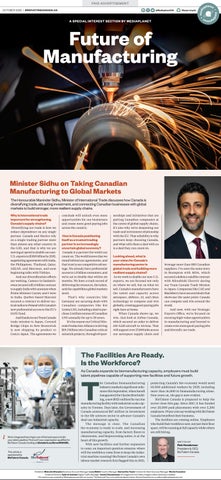
Minister Sidhu on Taking Canadian Manufacturing to Global Markets The Honourable Maninder Sidhu, Minister of International Trade discusses how Canada is diversifying trade, attracting investment, and connecting Canadian businesses with global markets to build stronger, more resilient supply chains. Why is international trade important for strengthening Canada's supply chains? Diversifying our trade is how we reduce dependence on any single partner. Canada and Mexico rely on a single trading partner more than almost any other country in the G20, and that is why we are moving at speed to double our nonU.S. exports to $300 billion by 2035, negotiating agreements with India, the Philippines, Thailand, Qatar, ASEAN, and Mercosur, and soon beginning talks with Türkiye. And our diversification efforts are working. Cameco in Saskatchewan secured a $2.6 billion contract to supply India with uranium when Prime Minister Carney and I were in India. Quebec-based Marconi secured a contract to deliver tactical radios to Poland with Canada's new preferential access to the EU's SAFE fund. And thanks to our Team Canada trade mission to Japan, Covered Bridge Chips in New Brunswick is now shipping its product to Costco Japan. The agreements we
conclude will unlock even more opportunities for our businesses and create more good-paying jobs across the country.
How is Canada positioning itself as a trusted trading partner in an increasingly uncertain global economy? Canada is a partner the world can count on. The world knows that we stand behind our agreements, and that trust is our competitive advantage. We already have preferential access to 1.5 billion consumers, and we're set to double that within six months. We have a track record of delivering the resources, the talent, and the capabilities global markets need. That's why countries like Germany are securing deals with Canadian companies like Ksi Lisims LNG, including a deal to purchase 2 million tonnes of Canadian LNG annually for up to 20 years. It's the reason our Critical Minerals Production Alliance is driving $19.2 billion into Canadian critical minerals projects, through 69 part-
nerships and initiatives that are putting Canadian companies at the centre of global supply chains. It's also why we're deepening our trade and investment relationship with the EU. That reliability is why partners keep choosing Canada, and what tells them a deal with us is a deal they can count on.
Looking ahead, what is your vision for Canada's manufacturing sector in global trade and building more resilient supply chains? As we work to double our non-U.S. exports, we are focused not only on where we sell, but on what we sell. Canada's manufacturers have the talent and capacity across aerospace, defence, AI, and clean technology to compete and win globally, creating good-paying jobs right here at home. When Canada shows up, we win. Just look at Airbus Canada, which secured an order to deliver 150 A220 aircraft to AirAsia. That will support over 27,000 jobs across our aerospace supply chain and
leverage more than 850 Canadian suppliers. I've seen the same story in Brampton with MDA, which secured a defence satellite contract with Mitsubishi Electric during our Team Canada Trade Mission to Japan. Companies like CAE and BlackBerry have secured deals that showcase the same point: Canada can compete and win around the world. And now, with our Strategic Exports Office, we're focused on securing high-value opportunities in manufacturing and beyond to create even more good-paying jobs and diversify our trade.
The Facilities Are Ready. Is the Workforce? As Canada expands its biomanufacturing capacity, employers must build talent pipelines capable of supporting new facilities and future growth.
T Work-integrated learning is one of the best ways to build your talent pipeline. Find out if your organization qualifies for BioTalent Canada funding at biotalent.ca/GrowWithWIL. This article is sponsored by BioTalent Canada.
he Canadian biomanufacturing industry marked a significant milestone this September, when Sanofi inaugurated the Charles Best building, a new $925-million flu vaccine manufacturing facility with industrial-scale capacity in Toronto. Days later, the Government of Canada announced $67 million in investment in the life sciences sector to advance Canada’s dual-use industrial capacity. The message is clear. The Canadian bio-economy is ready to scale, and increasing manufacturing capacity, from factory floors to cleanrooms, and bioprocessing suites, is at the heart of this growth. With new facilities and further expansion to come, an important question remains: where will the workforce come from to keep the industrial machine running? BioTalent Canada's own labour market research first flagged this in 2021,
projecting Canada's bio-economy would need 65,000 additional workers by 2029, including more than 16,000 in biomanufacturing alone. Four years on, the gap is now evident. BioTalent Canada is prepared to help the sector close this gap. Since 2017, it has funded over 20,000 paid placements with over 3,200 employers. 99 per cent say working with BioTalent Canada benefited their business. The facilities are coming online. Employers who build their workforce now, not just their floor space, will be running at full capacity while others are still hiring. WRITTEN BY
Rob Henderson President & CEO, BioTalent Canada
Publisher: Malcolm Sharples Business Account Manager: Luca Bidini Country Manager: Samantha Taylor Content & Client Success Manager: Nicole Kansakar Creative Director: Kylie Armishaw Digital Traffic Manager: Vansh Chandwaney All images are from Getty Images unless otherwise credited. This section was created by Mediaplanet and did not involve The National Post or its editorial departments. Send all inquiries to ca.editorial@mediaplanet.com
PAID ADVERTISEMENT A SPECIAL INTEREST SECTION BY MEDIAPLANET
READ MORE AT INNOVATINGCANADA.CA
Amid Industry Upheaval, Canada's Largest Automakers Get a New Voice The Pacific Manufacturing Association of Canada (PMAC) supports policies that protect Canadian jobs, sustain investment and strengthen the country's automotive manufacturing competitiveness.
C
Brendan Sweeney President and CEO, Pacific Manufacturing Association of Canada (PMAC)
Tim Hollander President, Toyota Motor Manufacturing Canada
Dave Jamieson CEO, Honda Canada Inc.
anada's automotive industry is a cornerstone of the national economy, contributing billions of dollars in economic activity while supporting highly skilled jobs, innovation, and a deeply integrated supply chain. Yet the industry is facing a period of significant change, marked by evolving trade relationships, global competition, workforce pressures, regulatory change, and the transition to lower-emission technologies. Against this backdrop, the Pacific Manufacturing Association of Canada (PMAC) was established to provide a collective voice for Canada's largest automotive manufacturers, Honda and Toyota. Representing Japan-based companies with manufacturing operations in Canada, PMAC engages with governments and industry stakeholders on issues that affect the industry’s long-term competitiveness and success. In addition to contributing to discussions related to trade and automotive policy, the association focuses on electrified vehicles, greenhouse gas emissions, regulatory modernization, and other measures that support Canada's automotive manufacturing industry. Together, PMAC members account for a large majority of Canadian vehicle production and employ more than 60 per cent of the country's vehicle assembly plant workforce. PMAC's founding members, Honda and Toyota, account for more than 75 per cent of all vehicles manufactured in Canada. In 2025, assembly plants operated by PMAC members contributed nearly $4 billion to Canada’s gross domestic product (GDP). “Canada's automotive industry is entering a critical period where competitiveness, investment, and policy alignment will shape future growth,” stated Brendan Sweeney, PMAC’s President and CEO. “PMAC was created to ensure the manufacturers that
build the vast majority of vehicles in Canada have a strong, constructive voice in those discussions.”
Partnerships based on a strong shared history PMAC's approach is rooted in more than four decades of manufacturing, investment and employment by Japanese automakers and suppliers in Canada. Honda, Toyota and their supplier networks have helped establish a world-class automotive manufacturing ecosystem that supports communities, creates skilled jobs, and produces vehicles recognized globally for quality. As a solutions-oriented organization, PMAC works collaboratively with governments and stakeholders on important policy discussions affecting Canada's automotive industry. The association advocates for pragmatic, evidence-based policies that protect jobs, encourage investment, strengthen North American supply chains, and reinforce Canada's position as a competitive place to manufacture vehicles.
A view toward strengthening the industry's future PMAC was created at a time when Canada's automotive industry is navigating unprecedented change. Decisions being made today on trade, regulation, investment, emissions policy, and industrial competitiveness will inf luence where future production, technology, and manufacturing investment occur. By bringing together the manufacturers responsible for three-quarters of the vehicles built in Canada, PMAC provides policy-makers with a focused industry perspective grounded in operational experience and long-term investment. The association serves as a platform for constructive engagement on the issues that matter most to automotive manufacturing, including trade and tariff
The story of PMAC is ultimately a story about Canada's manufacturing future. We want to work with governments and partners to create the conditions that attract investment, support workers, strengthen supply chains, and keep Canadian automotive manufacturing globally competitive for decades to come. – Brendan Sweeney, President and CEO, PMAC
For more than four decades, the teams at Toyota and Honda, along with our suppliers, have invested in Canadian communities, created high-quality jobs, and built vehicles that compete globally. The creation of PMAC reflects the shared responsibility we have as manufacturers to help strengthen the industry’s future. Through PMAC, we look forward to working collaboratively with governments and industry partners to sustain investment, strengthen supply chains, and support the long-term success of Canadian manufacturing. – Tim Hollander, President, Toyota Motor Manufacturing Canada
policy, regulatory modernization, electrification, and supply-chain resilience. The association's importance extends beyond vehicle assembly plants. PMAC's members are connected to a broad network of Japan-based suppliers operating in Canada that employ thousands of Canadians and play a critical role in the country's automotive ecosystem. Policies affecting manufacturing competitiveness have implications throughout this integrated supply chain. At its core, PMAC's mission is straightforward: help ensure Canada remains a reliable, competitive destination for automotive manufacturing investment. By highlighting the contributions of its members and advancing practical policy solutions, the association is helping position the industry for long-term success.
Honda has proudly manufactured vehicles in Canada for four decades, and we remain committed to the people and communities that have contributed to that success. Through PMAC, we have an opportunity to champion policies that strengthen Canada's manufacturing advantage, reinforce integrated North American supply chains, and help secure the industry's future for years to come. – Dave Jamieson, CEO, Honda Canada Inc.
Learn how PMAC is driving Canada’s automotive sector forward at pmac.ca. This article was sponsored by
Pacific Manufacturing Association of Canada.
2