PAID ADVERTISEMENT MARCH 2026 | INNOVATINGCANADA.CA
@MediaplanetCA
Please recycle
A SPECIAL INTEREST SECTION BY MEDIAPLANET
Future of Engineering
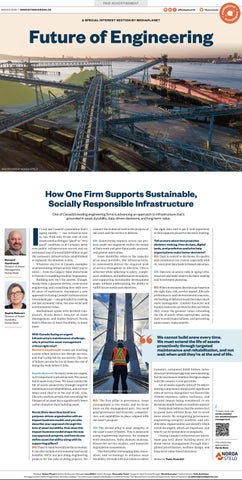
PHOTO CREDIT: NORDA STELO
How One Firm Supports Sustainable, Socially Responsible Infrastructure
I Bernard Gaudreault Director of Asset Management, Norda Stelo
Sophie Boisvert Director of Asset Durability, Norda Stelo
One of Canada’s leading engineering firms is advancing an approach to infrastructure that’s grounded in asset durability, data-driven decisions, and long-term value.
t’s not just Canada’s population that’s aging rapidly — our infrastructure is, too. With only 55 per cent of core assets rated as being in “good” or “very good” condition as of Canada’s latest core public infrastructure survey and an estimated cost of around $300 billion to get the necessary infrastructure rehabilitated or replaced, the situation is dire. Wherever you live in Canada, examples of deteriorating infrastructure likely pop to mind — from the Calgary water main break to Toronto’s crumbling Gardiner Expressway. Building new isn’t the answer, though. Norda Stelo, a purpose-driven, cross-sector engineering and consulting firm with over 60 years of experience, champions a new approach to closing Canada’s infrastructure investment gap — one grounded in creating not just economic value, but also social and environmental value. Mediaplanet spoke with Bernard Gaudreault, Norda Stelo’s Director of Asset Management, and Sophie Boisvert, Norda Stelo’s Director of Asset Durability, to learn more.
connect the technical work to the purpose of the asset and the service it delivers.
the right data and to get it well-organized, as this supports proactive decision-making.
SB: Quantifying impacts across our pro-
Tell us more about that proactive decision-making. How do data, digital tools, and predictive analytics help organizations make better decisions? BG: Data is central to decisions. Its quality
jects made our engineers realize the extent of their work and gave them pride, purpose, and greater motivation. Asset durability refers to the capacity of an asset portfolio, like infrastructures, to consistently deliver the required level of service throughout its lifecycle. This is achieved while adhering to safety, compliance, resilience, and performance standards, and supporting sustainable development goals, without undermining the ability to fulfill future needs and objectives.
Sophie Boisvert: So many items are urgent,
it can also include environmental and social benefits. We’re not just doing engineering projects for the sake of doing projects. We
structure and make smarter decision-making and investment planning.
BG: When investment decisions are based on
We cannot build anew every time. We must extend the life of assets proactively through targeted maintenance and rehabilitation, and not wait when until they’re at the end of life.
a point where failures can disrupt services, and that’s a big risk for our society. The cost of failure can also be 5 to 15 times the cost of doing the work before it fails.
Norda Stelo describes itself as a purpose-driven organization with an impact business model, and you also describe your approach through the lens of asset durability. How does this impact business model shape the way you approach projects, and how do you define asset durability along with its supporting pillars? BG: There is value beyond just the economic;
SB: Data lets us assess risks in aging infra-
the right data, risk, service impact, lifecycle performance, and environmental concerns, the backlog of deferred needs becomes much more manageable. Limited financial and human resources can then be directed where they create the greatest value: extending the life of assets when appropriate, acting early to avoid major failures, and preventing unnecessary replacements.
With Canada facing an urgent infrastructure maintenance challenge, why is proactive asset management critical right now? Bernard Gaudreault: Assets are reaching
so it’s important to prioritize well. We cannot build anew every time. We must extend the life of assets proactively through targeted maintenance and rehabilitation, and not wait when until they’re at the end of life. Also, lifecycle analysis reveals that extending the lifespan of an asset has a significantly lower carbon footprint than building anew.
and consistency are crucial, especially with AI, since poor data leads to biased outcomes.
PHOTO CREDIT: NORDA STELO
BG: The first pillar is governance. Asset management is two words, and we focus more on the management part. You need good governance and structure, competencies, and capabilities in place, aligned with the asset’s purpose.
SB: The second pillar is asset integrity, or the asset’s state of health. This is measured using engineering expertise, for example with simulations, finite element analyses, fitness-for-service studies, and materials degradation assessments. The third pillar is leveraging data, innovation, and technology to enhance asset durability. We work with our clients to collect
Canada’s estimated $300 billion infrastructure investment gap may seem daunting, but the real issue is whether this figure aligns with the country’s true priorities. Are all assets equally critical? Do deteriorating components always pose significant risks of service disruption? Are factors like climate exposure, safety, resilience, and societal impact being considered, or are decisions simply based on condition reports? Norda Stelo believes that the answer isn’t to spend more without focus, but to invest more wisely. By integrating governance, engineering integrity analysis, and reliable data, organizations can identify which needs are urgent, which are important, and which can be postponed strategically. Closing Canada’s infrastructure investment gap isn’t about building more; it’s about better management through disciplined prioritization, resilient design, and long-term value-based decisions.
To learn more, visit norda.com/en/ our-solutions/assetmanagement.
This article was sponsored by Norda Stelo.
Written by Tania Amardeil
Publisher: Nelson Pham Business Development Manager: Luca Bidini Country Manager: Samantha Taylor Content & Client Success Manager: Nicole Kansakar Creative Director: Kylie Armishaw All images are from Getty Images unless otherwise credited. This section was created by Mediaplanet and did not involve The National Post or its editorial departments. Send all inquiries to ca.editorial@mediaplanet.com.