PAID ADVERTISEMENT JUNE 2026 | INNOVATINGCANADA.CA
@MediaplanetCA
Please recycle
A SPECIAL INTEREST SECTION BY MEDIAPLANET
Future of Our Water & Oceans CURIOUS HOW CAN YOU SUPPORT THE BLUE ECONOMY? Gain new skills with UBC’s flexible micro-certificate online courses.
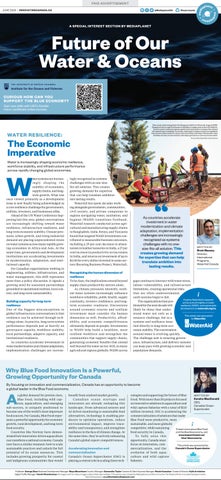
New water pipes being laid in the Bugesera district in Rwanda, August 2025. Bugesera has enough freshwater available to supply everyone in the district, but the water treatment plants need to be improved to increase the volume of treated water available. Currently, rationing is in place and some residents only receive clean water for one or two out of every ten days. Worse still, many families remain unconnected to the water grid and so cannot access water.
WATER RESILIENCE:
The Economic Imperative
Photo Credit: WaterAid/ Leslie Akimana
Water is increasingly shaping economic resilience, workforce stability, and infrastructure performance across rapidly changing global economies.
W
ater systems are increasi n g ly sh api n g t he stability of economies, supply chains, and longterm growth. What was once viewed primarily as a development issue is now finally being acknowledged as a core resilience challenge for governments, utilities, investors, and businesses alike. Ahead of the UN Water Conference happening late this year, global conversations are increasingly shifting toward water resilience, infrastructure readiness, and long-term economic stability. Climate pressures, urban growth, and rising industrial demand are placing unprecedented strain on water systems across many rapidly growing economies in Africa and Asia. At the same time, governments and development institutions are accelerating investments in modernization, adaptation, and institutional capacity. For Canadian organizations working in engineering, utilities, infrastructure, and water management, this shift represents more than a policy discussion. It signals a growing need for sustained partnerships grounded in operational realities, local context, and long-term sustainability.
Building capacity for long-term resilience One of the biggest misconceptions in global infrastructure conversations is that resilience can be achieved through technology alone. In practice, long-term system performance depends just as heavily on governance capacity, workforce stability, local partnerships, adaptive capacity, and institutional readiness. As countries accelerate investment in water modernization and climate adaptation, implementation challenges are increas-
ingly recognized as systems challenges with no one-sizefits-all solution. This creates growing demand for expertise that can help translate ambition into lasting results. WaterAid has spent decades working alongside governments, communities, civil society, and private companies in regions navigating water, sanitation, and hygiene (WASH) transitions firsthand. WaterAid research conducted across agricultural and manufacturing supply chains in Bangladesh, India, Kenya, and Tanzania found that targeted WASH investments contributed to measurable business outcomes, including a 29 per cent decrease in absenteeism in leather tanneries in India, a 27 per cent increase in productivity on tea estates in India, and returns on investment of up to $2.05 for every dollar invested in some sectors (Boosting Business Project, WaterAid).
As countries accelerate investment in water modernization and climate adaptation, implementation challenges are increasingly recognized as systems challenges with no onesize-fits-all solution. This creates growing demand for expertise that can help translate ambition into lasting results.
WRITTEN BY
Brett Massey Director, International Programs, WaterAid Canada
Recognizing the human dimension of resilience To be clear, the implications extend beyond supply chain productivity metrics alone. As climate pressures intensify, resilient water systems increasingly influence workforce reliability, public health, supply continuity, investor confidence, and longterm economic readiness. Discussions around economic returns and resilient investment must consider the human dimension as well. Productivity, affordability, and economic competitiveness ultimately depend on people. Investments in WASH help build a healthier, more resilient workforce and strengthen the communities that support supply chains, generating economic benefits that extend well beyond the water sector. Still, in many agricultural regions globally, WASH access
gaps continue to intersect with water stress, labour vulnerability, and infrastructure limitations, creating operational risks that are often underestimated until systems begin to fail. Explore WaterAid’s research The organizations best posand practical insights on water resilience, WASH, and sustainable itioned for the next decade will development at wateraid.org/ca. likely be those that understand water not only as a This article was sponsored resource challenge, but as a by WaterAid. systems and resilience issue tied directly to long-term economic stability. The conversation around water is evolving quickly. The challenge now is ensuring governance, infrastructure, and delivery systems can keep pace with growing economic and population demands.
Why Blue Food Innovation Is a Powerful, Growing Opportunity for Canada By focusing on innovation and commercialization, Canada has an opportunity to become a global leader in the Blue Food economy.
A
s global demand for protein rises, Blue Food, including wild capture, aquaculture, and emerging sub-sectors, is uniquely positioned to become one of the world’s most important food sources. For Canada, Blue Food represents a powerful opportunity for economic growth, rural development, and long-term food security. Countries like Norway have demonstrated how innovation-driven aquaculture can transform a national economy. Canada now faces a similar moment: how to scale sustainable practices and unlock the full potential of its ocean resources. This includes growing prosperity for coastal and Indigenous communities that would
benefit from seafood market growth. C a n ad ia n o c e a n s t a r t up s a nd innovators are already reshaping this landscape. From advanced sensors and AI-driven monitoring to sustainable feed alternatives, technology is enabling producers to optimize operations, reduce environmental impact, improve traceability and transparency, and strengthen resilience in the face of climate change. At the same time, they’re actively enhancing Canada’s global export competitiveness.
Accelerating innovation and commercialization Canada’s Ocean Supercluster (OSC) is playing a central role in scaling these tech-
nologies and supporting the future of Blue WRITTEN BY Kendra MacDonald Food. With more than 50 projects focused CEO, on innovative solutions in aquaculture and Canada’s Ocean wild capture fisheries with a total of $110 Supercluster million invested, OSC is accelerating the commercialization of solutions that make Blue Food more productive, more sustainable, and more globally competitive, while sustaining To learn more about Blue Food and the Blue Bioeconomy, visit food security in Canada. oceansupercluster.ca/ To fully seize this blue-bioeconomy. opportunity, Canada must focus on innovation, comThis article was sponsored by Canada's Ocean Supercluster. mercialization, and the evolution of both aquaculture and wild capture fisheries.
Publisher: George Zhao Business Development Manager: Maya Mezerhane Country Manager: Samantha Taylor Content & Client Success Manager: Nicole Kansakar Creative Director: Kylie Armishaw Digital Traffic Manager: Vansh Chandwaney All images are from Getty Images unless otherwise credited. This section was created by Mediaplanet and did not involve The National Post or its editorial departments. Send all inquiries to ca.editorial@mediaplanet.com.