PAID ADVERTISEMENT OCTOBER 2026 | INNOVATINGCANADA.CA
@MediaplanetCA
Please recycle
A SPECIAL INTEREST SECTION BY MEDIAPLANET
Circular Economy
OCTOBER IS CIRCULAR ECONOMY MONTH.
Join Circular Innovation Council in celebrating how circular solutions can create a sustainable, resilient economy for Canada.
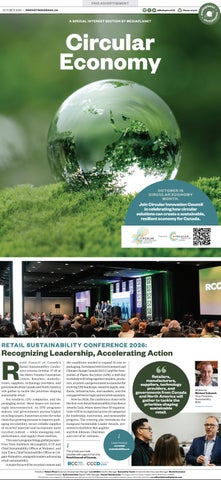
RETAIL SUSTAINABILITY CONFERENCE 2026:
Recognizing Leadership, Accelerating Action
R
etail Council of Canada's Retail Sustainability Conference returns October 27-28 at the Metro Toronto Convention Centre. Retailers, manufacturers, suppliers, technology providers, and governments from Canada and North America will gather to tackle the priorities shaping sustainable retail. For retailers, CPG companies, and the packaging sector, these issues are increasingly interconnected. As EPR programs mature and governments pursue higher recycling targets, businesses across the value chain face growing pressure to improve packaging recyclability, secure reliable supplies of recycled material and incorporate more recycled content — while managing cost, performance, and supply-chain realities. This year's program brings global perspectives from Kathleen McLaughlin, EVP and Chief Sustainability Officer at Walmart, and Ann Tracy, Chief Sustainability Officer at Colgate-Palmolive, alongside leaders advancing retail sustainability. A major focus will be recycled content and
the conditions needed to expand its use in packaging. Developed with Environment and Climate Change Canada (ECCC) and the Association of Plastic Recyclers (APR), a half-day workshop will bring together retailers, producers, recyclers, and government to examine the evolving EPR landscape, material supply, standards, infrastructure, end markets, and the cost gap between virgin and recycled materials. New for 2026, the conference closes with the first-ever Retail Sustainability Excellence Awards Gala, where more than 50 organizations will be recognized across 10 categories for leadership, innovation, and measurable progress. The evening also introduces the inaugural Sustainable Leader Awards, presented to Kathleen McLaughlin and Fisk Johnson, Chairman and CEO of SC Johnson.
This article was made possible with support from the Retail Council of Canada.
Retailers, manufacturers, suppliers, technology providers, and governments from Canada and North America will gather to tackle the priorities shaping sustainable retail.
Learn more at rccretail sustainability.ca.
Publisher: Nelson Pham Business Development Manager: Luca Bidini Country Manager: Samantha Taylor Content & Client Success Manager: Nicole Kansakar Creative Director: Kylie Armishaw Digital Traffic Manager: Vansh Chandwaney All images are from Getty Images unless otherwise credited. This section was created by Mediaplanet and did not involve The National Post or its editorial departments. Send all inquiries to ca.editorial@mediaplanet.com.
Written by Michael Zabaneh Vice-President, Sustainability, RCC
PAID ADVERTISEMENT 2
READ MORE AT INNOVATINGCANADA.CA
A SPECIAL INTEREST SECTION BY MEDIAPLANET
We’re proud to reflect on five decades of putting people and planet at the heart of our business, while continuing to innovate for a more circular future.
Peter Jones Head of Sustainability, experience spanning finance, IKEA U.S. & the UK, Canada, and Sweden. Canada. including Head of Pricing for I
How the Rise of the Circular Economy Is Making Sustainability More Accessible Increasingly, Canadian companies are buying into the idea of a circular business to avoid waste and preserve the value of products and materials. IKEA Canada is doubling down on this concept with ambitious actions.
H
ow does it work? Instead of the traditional linear economy, where goods are produced, sold, u se d a nd t h row n away, the circular economy demands an approach that sees us design products for circularity to be used, repaired, reused, repurposed, remanufactured, recycled, and made again.
Considering the full life cycle “Circularity has been part of the IKEA mindset since we started in business,” says Peter Jones, Head of Sustainability of IKEA U.S. and Canada. “From the way we design our products to the services we offer, our goal is to help products stay in use longer and make sustainable living affordable and accessible to as many people as possible.” IKEA is changing every aspect of its business from the way it sources energy and materials to how it designs products and runs its operations. This means enabling customers to acquire, care for, and pass on products in circular ways, designing more products to be reused, refurbished, or recycled, and using renewable and recycled products wherever possible. It’s also using its global influence to
advocate, collaborate and form partnerships to promote a circular economy.
Sustainability in practice For many of its products, customers can take advantage of IKEA Canada’s Sell-back program. Instead of much-loved furniture going to the landfill, they’ll buy it back and give you an in-store credit. Your furniture then finds a new home through IKEA Canada’s As-is marketplace, where people can fi nd deals that are good for their wallets and the environment. In As-is, you’ll fi nd discontinued and gently used items, and even items from showroom displays. While these may be slightly used, they are thoroughly inspected to ensure functionality and safety, and sold with great discounts. Want to repair your furniture to extend its lifespan? IKEA has you covered with spare parts. You can order small parts for free, such as screws, knobs, and plugs. For larger parts, see your local store. IKEA has always believed that good design, affordability, and sustainability should go hand in hand, which is why it created programs that support circular solutions. “We believe people shouldn’t have to
choose between affordability and sustainability, which is why we continue to focus on solutions that help customers reduce waste, extend the life of their furnishings, and make more sustainable choices at home without large price tags,” says Jones. “As IKEA Canada celebrates its 50th anniversary this year, we’re proud to reflect on five decades of putting people and planet at the heart of our business, while continuing to innovate for a more circular future.”
led work to measure sustaina decision-making.
Before his current role, Peter at Ikano Insight, supporting o business practices, and measu sustainability practical, measu positive impact for people and
Learn how you can benefit from IKEA Canada’s affordable sustainability at IKEA.ca/ sustainability. This article is sponsored by IKEA.
Written by Ken Donohue
The Circular Economy's Hidden Workforce Advantage Canada’s bio-economy is expanding beyond traditional industries, creating new opportunities and demand for skilled talent.
W Work-integrated learning is one of the best ways to build your talent pipeline. Find out if your organization qualifies for BioTalent Canada funding at biotalent.ca/ GrowWithWIL. WRITTEN BY
This article is sponsored by BioTalent Canada.
Rob Henderson President & CEO, BioTalent Canada
hen people think about the bio-economy, they often think about healthcare, biotechnology, or research laboratories. In reality, the bio-economy reaches much further. Across Canada, businesses are transforming food waste, agricultural residues, wood fibre, and other biological resources into new products, materials, fuels, and commercial opportunities. Turning biological resources into commercial products requires organizations that can innovate, scale production, and compete in rapidly evolving markets. It also requires people with the skills to help make that growth possible. The organizations best positioned to grow will be those that can access the talent needed to support research, operations, production and commercialization. For many employers,
especially small and medium-sized enterprises, attracting that talent can be challenging. BioTalent Canada works with employers across the bio-economy, supporting workforce strategies and providing funding to help them grow their talent pipelines. Since 2017, the organization has funded over 20,000 paid placements with over 3,200 employers. 99 per cent of those employers said that working with BioTalent Canada benefited their businesses. Those employers also identified access to students' creativity, knowledge, and skills as the leading benefit of their participation. Canada's circular economy is creating new opportunities for businesses in every region of the country. The organizations that succeed will not be defined solely by the technologies they develop, but by their ability to build the workforce required to bring those innovations to market.
Turning Marine Debris into Valuable Resources Canada can lead the circular economy by transforming plastic pollution into new materials, jobs, and resilient infrastructure.
C
anada can lead the circular economy by transforming plastic pollution into new materials, jobs, and resilient infrastructure. Plastic pollution is one of the greatest environmental challenges facing our world. Plastics continue to escape waste management systems and enter waterways, threatening ecosystems and communities. The challenge is no longer simply managing plastic waste but rethinking the systems that allow valuable resources to become pollution.
Building a circular economy Canada’s transition requires infrastructure capable of managing difficult-to-recycle plastics alongside scalable reuse systems and preventative policies. Ocean Legacy has developed an integrated model that recovers marine plastic pollution and transforms it into high-value recycled materials through cleanup programs, collection infrastructure, and advanced recycling technologies.
Creating value from recovered materials The rise of the linear economy Before disposable plastics, materials were commonly repaired, reused, or repurposed because they retained value. The commercialization of plastics shifted consumer markets toward single-use products and a linear model: extract resources, manufacture products, use them, and discard them. Plastic’s durability becomes a problem when a material designed to last for generations is used for products intended to be quickly discarded.
Visit oceanlegacy.ca
Recovering plastics from shorelines, waterand legacyplastic.ca to learn how Ocean Legacy ways, ports, and coastal communities creates is transforming plastic opportunities to return valuable resources to the pollution. economy while reducing environmental impacts. By incorporating recycled materials into products and procurement decisions, businesses can strengthen markets for recovered plastics. Building This article is made possible with support the infrastructure, partnerships, and markets needed from Ocean Legacy. to keep materials in use can help move Canada toward lasting systems change.
WRITTEN BY
Chloé Dubois, Co-Founder, Ocean Legacy
PAID ADVERTISEMENT A SPECIAL INTEREST SECTION BY MEDIAPLANET
READ MORE AT INNOVATINGCANADA.CA
3
ENGINEERING ELITE AIR:
Inside BMO Field’s LEED Gold Upgrade BMO Field uses energy recovery ventilation to maintain indoor air quality and lower energy use.
B
WRITTEN BY
Bojana Prorok Regional Sales Director, RenewAire
WRITTEN BY
Mitchell Merrilees Marketing Director, Kilmer Environmental
MO Field stands as a premier open-air soccer venue, but behind the pitch, maintaining healthy indoor air quality (IAQ) inside enclosed spaces required a targeted engineering strategy. Enclosed hospitality areas, like luxury suites, can experience high crowd densities during matches, leading to rapid carbon dioxide buildup, humidity spikes, and stale air. To keep these enclosed suites comfortable and healthy during events, the stadium needed to continuously flush out indoor air contaminants with fresh outdoor air rather than recirculating stale indoor air. However, bringing in massive volumes of raw outdoor air would create another problem: it would increase heating and cooling loads, threatening the facility’s strict energy-efficiency goals.
Advanced energy recovery in highoccupancy venues To meet its strict energy goals, BMO Field needed an upgraded ventilation strategy. HVAC experts Kilmer Environmental recommended installing a RenewAire HE10RT energy recovery ventilator (ERV).
Using a static-plate enthalpy core, ERVs can recapture heat and humidity from outgoing air to precondition incoming outdoor air. For the BMO Field application, this meant that incoming warm, humid summer air was precooled and dehumidified, while winter air was pre-heated and humidified. This balanced process maximizes energy savings and maintains optimal comfort during high-capacity events.
By integrating high-efficiency energy recovery ventilation, BMO Field achieved its dual goals of superior IAQ and lower energy consumption.
Achieving world-class sustainability goals By integrating high-efficiency energy recovery ventilation, BMO Field achieved its dual goals of superior IAQ and lower energy consumption. This performance provided a critical pathway toward securing targeted LEED® Gold certification points for increased ventilation and energy savings. With certified static-plate cores and high-grade f iltration, modern ERVs prove that commercial facilities can continuously To learn more about deliver fresh air without optimizing energy with RenewAire ERVs, visit overworking their utility kilmerenv.com. budgets.
This article is sponsored by Kilmer Environmental & RenewAire.
How Alberta Is Putting the “Economy” in “Circular Economy” Alberta’s beverage recycling system shows how thoughtful design and regulation can turn environmental goals into economic value.
I
n Alberta, when you buy a beverage, you pay either a 10- or 25-cent deposit, depending on the volume of the container. Once the beverage has been consumed, Albertans can return the empty container to a bottle depot and receive their deposit back. Like other deposit return systems (DRSs), Alberta’s system was created to reduce litter and protect the province’s natural beauty. The concept was simple: give Albertans an incentive to return empty containers instead of littering or landfilling them. In 2025, Albertans returned 2.2 billion beverage containers, achieving an 82.5 per cent collection rate. Nearly 120,000 metric tonnes of material were diverted from Alberta landfills and shipped to recyclers around the world — more than the combined weight of Canada’s wild and farmed bison populations. These numbers tell an environmental story, but also an economic one.
Circularity is important, but it doesn’t automatically create economic value. Markets, incentives, and system design matter, too. This is where regulation comes in. Strong regulation shapes the incentives, responsibilities, and rules that allow a system to function, adapt, and create value. For Alberta’s DRS, that’s the role the Beverage Container Management Board plays. We help create the ecosystem for Albertans to return containers, for charities and community organizations to raise funds, for businesses to participate, and for recovered materials to re-enter the economy.
For circularity to work, materials, money, and incentives must keep flowing.
A circular economy in motion Last year, 2.7 billion beverage containers were sold in Alberta. The province’s beverage recycling system supported nearly 3,200 jobs, returned more than $220 million in deposits, and generated almost $75 million through the sale of recovered materials. That’s a remarkable amount of economic activity hiding behind an empty beer can, drink pouch, or milk jug. It shows why the word “economy” in “circular economy” matters.
Finding balance
For circularity to work, materials, money, and incentives must keep f low ing. People a nd businesses need reasons to participate beyond altruism. That’s what transforms environmental ambition into a system that can grow and deliver
value. Alberta’s approach is to give all beverage types a place in the system, creating room for innovation. Some materials, such as aluminum, have established markets. Others may require new technologies, approaches, or market development. Regulation must be able to adapt as opportunities and economies change. A successful circular system is not one that pursues circularity at any cost. It balances environmental outcomes, economic realities, and the needs of the people it serves. Achieving that balance requires effective
regulation, meaningful participation, and sustainable markets. That’s why Circular Economy Month should be about more than circularity alone. The conversation should be as broad as the term itself: circular economy.
To learn more visit bcmb.ab.ca. This article is sponsored by Beverage Container Management Board.
Written by Nick Ford Director of Communications & Strategy, Beverage Container Management Board