ADVERTISEMENT MARCH 2026 | HEALTHINSIGHT.CA
@MediaplanetCA
Please recycle
A SPECIAL INTEREST SECTION BY MEDIAPLANET
Children’s Health & Wellness
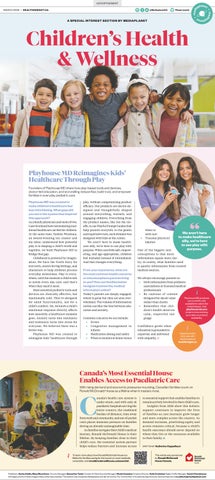
Playhouse MD Reimagines Kids’ Healthcare Through Play Founders of Playhouse MD share how play-based tools and devices, doctor-led education, and storytelling reduce fear, build trust, and empower families in everyday pediatric care. Playhouse MD was created to make children’s healthcare feel less intimidating. What gaps did you see in the system that inspired this approach? As a family physician and mom of two, I saw firsthand how intimidating traditional healthcare can feel for children. At the same time, Sydney Wiseman, an award-winning toy creator and my sister, understood how powerful play is in shaping a child’s world and together, we built Playhouse MD to bridge that gap. Childhood is powered by imagination. We have the Tooth Fairy for lost teeth, stories for big feelings, and characters to help children process everyday milestones. Play is everywhere, until the moment a child is sick or needs every day care, and that’s when they need it most. Most essential pediatric tools and devices are clinically effective, but emotionally cold. They’re designed for adult functionality, not for a child’s comfort. Yet, we know a child’s emotional response directly affects how smoothly a healthcare moment goes. Anxiety turns into resistance and resistance turns into stress for everyone. We believed there was a better way. Playhouse MD was created to reimagine kids’ healthcare through
play, without compromising product efficacy. Our products are doctor-designed and thoughtfully shaped around storytelling, warmth, and engaging children. Everything from the product names, like Jax the Giraffe, to our Playful Prompt Guides that help parents storytell, to the gentle and expressive eyes, each element was designed with kids at the center. We aren’t here to make healthcare silly, we’re here to use play with purpose. When care feels safe, empowering, and age-appropriate, children feel included instead of intimidated. And that changes everything.
From your experience, what are the most common health concerns or misconceptions parents bring to you? How can families better navigate trustworthy medical information online? Today’s parents are deeply engaged, which is great but they are also overwhelmed. The volume of information online can blur the line between education and anxiety. Common concerns we see include: • Fevers • Congestion management in infants • Medication dosing and safety • When to monitor at home versus
•
when to seek care Trauma/physical injuries
We aren’t here to make healthcare silly, we’re here to use play with purpose.
One of the biggest misconceptions is that more information equals more clarity. In reality, what families need is quality information from trusted medical sources.
We always encourage parents to: • Seek information from pediatric associations or licensed medical professionals • Be cautious of content Playhouse MD products designed for shock value are currently only rather than clarity available for sale in the • Remember that chilUnited States. Visit playhousemd.com dren’s health deserves to learn more and stay calm, respectful lanup to date on product availability. guage Confidence grows when education is grounded in expertise and delivered with empathy.
Read the entire interview with the founders at healthinsight.ca.
Canada’s Most Essential House Enables Access to Paediatric Care With rising demand and economic pressures mounting, Canadian families count on Ronald McDonald House as a lifeline when it matters most.
C
anada’s health care system is under strain, and with only 16 paediatric hospitals serving the entire country, the combined burden of distance, time away from work and community, and out-of-pocket costs places immense pressure on families during an already unimaginable time. As families navigate their child’s medical journey, Ronald McDonald House is their lifeline. By keeping families close to their child’s care, the essential system partner helps reduce barriers and increase access To learn more about how Ronald McDonald House is a lifeline for families caring for the country’s most medically vulnerable, visit ronaldmcdonaldhouse.ca/essential.
to essential support that enables families to remain actively involved in their child’s care. Insights from 2025 show this holistic support continues to improve the lives of families as care journeys grow longer and more complex across the country. As demand increases, prioritizing equity and access remains critical, because a child’s health outcomes should never depend on where they live or the resources available to their family. WRITTEN BY Katherine Cappellacci
This article was sponsored by Ronald McDonald House Canada.
Publishers: Sasha Zeldin, Maya Mezerhane Country Manager: Samantha Taylor Content & Client Success Manager: Nicole Kansakar Creative Director: Kylie Armishaw Digital Traffic Manager: Vansh Chandwaney All images are from Getty Images unless otherwise credited. This section was created by Mediaplanet and did not involve The Toronto Star or its editorial departments. Send all inquiries to ca.editorial@mediaplanet.com.
ADVERTISEMENT 2
READ MORE AT HEALTHINSIGHT.CA
A SPECIAL INTEREST SECTION BY MEDIAPLANET
SPEAKING ‘TEEN’:
How to Spark Conversations That Actually Work
H WRITTEN BY
Joanna Regan, BSW, MCD Team Lead, mindyourmind
Agonizing over your teen? Stop searching everywhere for answers. Connect with us right now for immediate, real-time help and practical tools.
ere are three of the most common questions we get about youth: “W hy do t iny things spark huge reactions?” “Why does my teen drop friendships so easily?” “Why do they cling so intensely to new ones?” You’ve probably asked, or at least thought, one of these before. If they sound familiar, you’re not alone. Parenting through youth loneliness, the epidemic of “fake friends,” social media, and rising anxiety can feel heavy. You want to help, but it’s hard to know what’s happening inside their minds, within their social circles, or on their phones.
You’re not alone in this. We’re right here with you. At mindyourmind, part of ConnexOntario, we equip youth and their parents with tools to understand developing minds and the pressures they face.
Here’s how it works. You call ConnexOntario and speak with someone who listens with care and keeps it confidential. Together, you unpack what’s going on and identify next steps. You’ll receive mindyourmind resources that match your situation. If you need added support, ConnexOntario can connect you with services in your community. Then you bring your teen into the conversation with mindyourmind. Our Self-Expression space, zines, and interactive games help young people name what they’re feeling, practise coping skills, and choose next steps that make sense in their world. When youth help design the tools, they find a voice and a path. Our resources are co-created with youth, not just for them. In our Design Labs, young people build alongside artists, developers, and mental health pros, so everything feels real, relatable, and ready to use in everyday life. Our team is build-
If you know someone struggling with the challenges of being a teen or taking care of one, visit mindyourmind.ca or call ConnexOntario at 1-866-531-2600. We’re here for you 24/7/365.
ing real, youth-developed resources, like our Be Safe app and mood. app, which take away the awkwardness and friction that can come when you’re trying to start When youth help a conversation.
Help is here for parents and youth
design the tools, they find a voice and a path. Our resources are cocreated with youth, not just for them.
The goal is simple: give families common language, simple steps, and options that fit real life. We want you to know that questions like “Why do small things spark huge reactions?” do have answers, and those answers can spark conversations, not just conflicts, with the right tools, resources, and support. That’s what we provide.
MY 1
This article was sponsored by mindyourmind.
How School Breakfast Programs Help Kids Thrive School breakfast programs help children explore new foods, build lifelong healthy habits, and start each school day ready to learn.
E
very morning, hundreds of thousands of children arrive at school carrying more than backpacks. They carry growing bodies, developing minds, and sometimes hunger. At Breakfast Club of Canada, we see firsthand how those first moments of the day matter. March is Nutrition Month and it serves as a reminder that food does more than fuel a child’s morning. It shapes how they learn, grow, and build confidence. That’s why school nutrition programs play such an important role: they create an ideal setting for children to discover new foods and be positively influenced by their peers. When children are offered new foods gently, without pressure or
judgment, they become more curious and open to trying new things. In school nutrition programs, we see children build confidence and, over time, develop balanced eating habits that can last a lifetime.
Building confidence Supporting this process requires more than simply serving food. Drawing on its nutrition expertise, the Club works closely with schools across Canada in a variety of ways. This includes helping create varied and balanced menus and providing practical tools that equip partners and school staff with the knowledge and confidence to introduce diverse, nutritious foods in ways that feel accessible.
Work ing alongside schools and valued community partners like the Toronto Foundation for Student Success, the Club helps create breakfast programs where children feel supported and respected. Balanced eating habits are built through trust, repetition, and care. When we give children the chance to explore food in a positive environment, we nourish more than their bodies. We help build their confidence to discover, taste, and grow.
This Nutrition Month, donate to Breakfast Club of Canada to help provide children with nutritious breakfasts. Visit breakfastclubcanada.org to donate. This article was sponsored by Breakfast Club of Canada.
WRITTEN BY Catherine D’Amours, Senior Nutrition Advisor, Breakfast Club of Canada
Walking to Better Health Trexo Robotics was never really about the device. It was about children’s health.
W
Rahul Udasi (Co-founder) Praneit (Manmeet's nephew) and Manmeet Maggu (Co-founder)
hen Manmeet Maggu learned that his nephew Praneit would likely never walk and no solution existed to help him, he and his friend Rahul set out to build one. What began as an act of love grew into something much larger: a technology designed to help children move, grow, and thrive. The science is clear: walking is not just a milestone, it’s medicine. Prolonged inactivity can carry lifelong health consequences. Regular movement supports strength, bone
density, digestion, sleep, and overall development. Since Praneit’s first steps, children using Trexo have taken more than 147 million combined steps. The true measure of impact isn’t the number. It’s the child who walks after being told they never would. The family walking side by side. The graduate crossing the stage independently. Because children’s health isn’t only about treatment. It’s about movement, and possibility, one step at a time. WRITTEN BY Jenn Horowitz
To learn more, visit trexorobotics.com. This article was sponsored by Trexo Robotics.
ADVERTISEMENT A SPECIAL INTEREST SECTION BY MEDIAPLANET
READ MORE AT HEALTHINSIGHT.CA
3
Is My Child Getting Enough Iron? What Every Caregiver Should Know Iron is essential for growing bodies, yet many kids don’t get enough. Knowing what to look for can make a difference.
A WRITTEN BY
Kristen Schiener Registered Holistic Nutritionist, Orange Naturals
s a parent or caregiver, you work hard to keep your child healthy. But growing bodies can sometimes fall short of essential nutrients. Iron deficiency often goes unnoticed because its symptoms are subtle and easily mistaken for other common childhood issues. Iron is the body’s fuel delivery system. It plays a central role in producing hemoglobin, the protein in red blood cells that carries oxygen from the lungs to every tissue and organ in the body. Without adequate iron, that delivery system slows down — and the effects ripple outward, impacting energy, mood, growth, and learning. For children in particular, iron is non-negotiable. It supports healthy physical development, helps maintain strong energy levels, and plays a key role in cognitive function. During the rapid growth phases of infancy, toddlerhood, and adolescence, the body’s demand for iron is especially high, making it one of the most commonly depleted nutrients in children worldwide.1
Recognizing low iron in everyday life • Physical fatigue: Tiring easily during play, getting unusually
winded, needing extra rest, or suddenly preferring sedentary activities
•
•
•
Mood and appetite changes: Uncharacteristic irritability or frustration, frequent emotional outbursts, or a loss of interest in mealtimes, which can further compound nutrient shortfalls over time Physical appearance: Palerthan-usual skin (especially the face or inner eyelids) and persistently cold hands and feet, even in warm environments
Academic and developmental impacts: Difficulty concentrating in school, reduced stamina for learning tasks, or lagging behind peers academically or physically
Understanding and addressing low iron Low iron in children is common, and it’s rarely the result of something a caregiver has done wrong. Growing bodies have high nutritional demands, and iron is a hard nutrient to reliably supply through food alone. Picky eating — a perfectly normal phase for many children — can make things harder if iron-rich foods like meat, legumes, or leafy greens are frequently declined.
If any of the above sounds familiar, the most important first step is to consult your child’s health care provider. Depending on the severity of any deficiency, they may recommend dietary adjustments, addressing any underlying contributing factors, or the addition of a daily iron supplement. Traditional iron supplements based on iron salts are well-known for causing digestive upset, including constipation, nausea, and stomach cramping. A gentler alternative is iron in a polysaccharide iron complex (PIC) form. Unlike iron salts, iron supplements in PIC form can effectively replenish iron stores without the harsh stomach side effects. Supporting healthy iron levels can make a meaningful difference in a child’s energy, mood, and development. If you’re unsure whether your child is getting enough iron, a health care provider can help guide the next steps.
REFERENCES 1. https://pmc.ncbi.nlm.nih.gov/articles/PMC10440944/
Is low iron
slowing them down? When iron levels are low, your kiddo may seem more tired than usual, look pale or have less energy during playtime. Orange Naturals Kids Iron offers gentle support for growing kids.
• 10 mg of elemental iron in every dose • Gentle polysaccharide-iron complex • Made for kids 1 year and up • Natural green apple flavour
Supporting healthy iron levels can make a meaningful difference in a child’s energy, mood, and development.
To learn more about gentle PIC iron supplements designed to support healthy iron levels, visit orange naturals.com/ kids. This article was made possible with support from Orange Naturals.
ADVERTISEMENT 4
READ MORE AT HEALTHINSIGHT.CA
A SPECIAL INTEREST SECTION BY MEDIAPLANET
Protecting Baby’s Skin from Day One
Protection at Every Stage of Your Baby’s Diaper Journey
Diaper rash is common but preventable. Here’s what causes it — and how a thoughtful diaper care routine can help protect your baby’s delicate skin.
F
ew parenting concerns appear as suddenly — or as frequently — as diaper rash. Studies suggest most babies experience it at some point in their first two years. While it’s usually mild and resolves within a few days, it causes discomfort and leaves parents wondering what triggered it and how to prevent it from returning. Understanding diaper rash starts with understanding infant skin. Newborn skin is thinner and more permeable than adult skin, and its protective barrier — which keeps moisture in and irritants out — is still developing. Research published in the Journal of Clinical and Aesthetic Dermatology shows that prolonged exposure to moisture can disrupt this barrier, increasing friction and irritation. In the warm, humid diaper area, those effects can be amplified.
What causes diaper rash? The primary driver of diaper rash is overhydration of the skin. When urine and stool remain in contact with the skin for prolonged periods of time, they alter its pH and weaken its structural integrity. Digestive enzymes in stool — particularly after the introduction of solid foods — can further irritate sensitive skin. Diaper rash usually appears as redness or inflammation on the skin in and around the diaper area. In mild cases, the skin may look pink and irritated on lighter skin tones, or on deeper skin tones, dark brown, purple or gray-like patches. More severe rashes or infections can involve raised bumps, peeling skin, or areas that feel warm and tender. Friction from movement, sensitivity to certain materials, and infrequent diaper changes can make diaper rash more uncomfortable for your baby. Even cleansing practices matter: wipes that are heavily fragranced or not pH-balanced may also contribute to irritation in babies with sensitive skin. In short, diaper rash is rarely caused by one factor alone. It is typically the result of moisture, friction, pH imbalance, and skin vulnerability interacting over time.
Preventing diaper rash starts with the right routine Preventing diaper rash starts with protecting the skin’s barrier before irritation begins. Frequent diaper changes reduce prolonged exposure to wetness, and highly absorbent diapers that pull moisture away from the skin help limit overhydration and friction. Choosing a diaper that fits well and stays in place helps reduce gaps and rubbing — which is
particularly important as babies begin rolling, crawling, and walking. Cleansing is equally important. Fragrance-free wipes formulated for sensitive skin can help remove irritants while maintaining a healthy skin pH. Maintaining a slightly acidic balance supports the skin barrier and reduces irritation. Clinical research supports this multi-step approach. A consistent diaper care regimen that combines effective absorbency with gentle, pH-conscious cleansing has been shown to improve skin condition and reduce irritation in newborns.
Supporting skin from newborn to yoddler To build an effective diaper care routine, product design matters. Pampers is the #1 pediatrician-recommended brand (based on a 2025 survey of U.S. and Canadian pediatricians) and has diaper solutions to help protect children’s skin throughout their first three years of life. For newborns, Pampers Swaddlers are designed with an absorbent KeepDry™ Liner that locks wetness and mess away to help maintain dry, healthy skin. They are dermatologist-tested, hypoallergenic, and free of fragrance, elemental ch lor ine, pa raben s, and latex* (*no natural rubber), making them suitable for delicate newborn skin. As babies become more mobile, Pampers Swaddlers 360° diaper pants feature a 360° stretchy waistband and ultrasoft absorbent layers with Dual-Leak Guard Barriers to help protect where leaks happen most — offering up to 100% leakproof skin protection during active stages. They also feature EZ-Off tabs to help with easy changes. For day one onwards, Pampers Sensitive Wipes are fragrance-free and designed for extra-sensitive skin, helping restore and maintain a healthy pH balance as part of a gentle cleansing routine. And as toddlers move into potty training, Pampers Easy Ups provide a soft, stretchy waistband and an ultra-absorbent core with a LockAway Channel that provides up to 100% leakproof protection to help keep skin dry while supporting growing independence. Diaper rash may be common — but with a preventive approach, it doesn’t have to be inevitable. By focusing on moisture control, gentle cleansing, proper fit, and dermatologist-tested materials, parents can help protect their baby’s skin through every stage of those critical first two years.
NEWBORN ONWARDS
PAMPERS SENSITIVE WIPES
Fragrance-free and designed for extra sensitive skin. Helps restore and maintain healthy pH balance at every change.
NEWBORN ONWARDS (0–6+ MONTHS)
PAMPERS SWADDLERS
KeepDry™ Liner locks wetness and mess away to help maintain dry, healthy skin. Dermatologist tested, hypoallergenic and fragrance free.
ACTIVE BABY (6–18+ MONTHS)
PAMPERS SWADDLERS 360°
360° stretchy waistband adapts to movement. Dual-Leak Guard Barriers help protect where leaks happen most.
WRITTEN BY Emily Hellam
Learn more about protecting your baby’s skin and building an effective diaper care routine at Pampers.ca.
This article was sponsored by Pampers.
POTTY TRAINING (18–24+ MONTHS)
PAMPERS EASY UPS
Gentle, pull-up design with a LockAway Channel to help keep skin dry day and night as independence grows.