































Canada's Minister of Health — Marjorie Michel discusses workforce challenges, health care careers, and the future of care delivery across Canada.
There has never been a more important time to join Canada’s health workforce. Health care is about improving lives, supporting communities, and making a real difference when people need it most. When patients receive the care they need, they can live fuller lives and contribute to a stronger Canada.
Whether you’re interested in becoming a nurse, physician, personal support worker, paramedic, therapist, researcher, or pursuing one of the many other careers that support our health system, you can make a meaningful impact every day.
The Government of Canada is strengthening Canada’s health workforce and creating opportunities for the next generation of health care professionals. This includes nearly $200 billion over 10 years through the Working Together to











Improve Health Care for Canadians Plan, along with investments in workforce recruitment, training, and the integration of internationally educated health professionals.
The Government has also expanded Canada Student Loan Forgiveness to include 10 additional health care and social service occupations, including dentists, pharmacists, midwives, personal support workers, physiotherapists, and psychologists.
At the same time, we are modernizing health care through digital tools and team-based care models to improve efficiency and access. We need talented, compassionate people from all backgrounds to help build a stronger, more accessible health system.
Health care continues to attract Canadians seeking meaningful work, strong demand, and accessible training pathways.
Agrowing number of Canadians are rethinking what they want from their careers. Some are looking for greater job security, while others are searching for work that feels more meaningful. Increasingly, many are fi nding both in health care, a sector where demand remains strong, and opportunities continue to expand.
For those considering a career change or career opportunities, health care offers more than just employment possibilities. From supporting patients directly to ensuring health care organizations run smoothly behind the scenes, the field encompasses a wide range of roles that make a meaningful difference in people’s lives. As demand for health care workers continues to grow, many Canadians are exploring education and training pathways that can help transition them into rewarding careers without putting the rest of their lives on hold.
Making education fit real life
Returning to school can expand horizons or advance an existing career path, but fitting education into an already busy life is easier said than done. Between work schedules, family responsibilities, financial considerations, and other commitments, the idea of returning to a classroom can feel out of reach.
“Most adults can’t afford to forfeit income or commit to years of rigid, scheduled class time,” says Chris Gignac, Managing Director of Academy of Learning Career College. Educational models that offer adaptable schedules and career-focused training can help make a return to school feasible, allowing learners to build new skills while continuing to manage their

With Ontario’s health care system facing significant workforce shortages, enabling nurse practitioners to practise at their full scope benefits everyone.
Workforce shortages across Ontario’s health care system have a direct impact on patient access, continuity of care, and overall system performance. Primary care access is one of the most urgent issues. “Approximately 3.3 million Ontarians don’t have a regular primary care provider, which places added strain on emergency departments and acute care settings,” says Michelle Acorn, a nurse practitioner and CEO of the Nurse Practitioners’ Association of Ontario (NPAO), a notfor-profit professional organization representing nurse practitioners (NPs) in Ontario. To help alleviate this burden, Ontario needs to fully engage all qualified health care professionals, including NPs.
Recruitment and retention challenges persist NPs are autonomous, licensed health professionals who play a vital role in supporting health care. Educated at the master’s or doctoral level, they’re qualified to assess, diagnose, treat, and manage acute and chronic illnesses, order and interpret labs and diagnostic tests, prescribe medications, and perform procedures. “With the right policy and funding support in place, NPs can play a central role in providing high-quality, accessible care across Ontario,” says Acorn.
Written by Anne Papmehl


existing responsibilities.
For nearly four decades, Academy of Learning Career College has helped adult learners gain practical, job-ready skills in high-demand fields, including health care. Through programs designed to prepare students for roles such as Personal Support Worker, Health Care Aide, Medical Office Assistant, and Medical Receptionist, the college aims to provide a direct pathway from education to employment in a high-demand sector.
We measure success by employment, not enrolment. Our programs are designed to help students build the skills employers actually need.
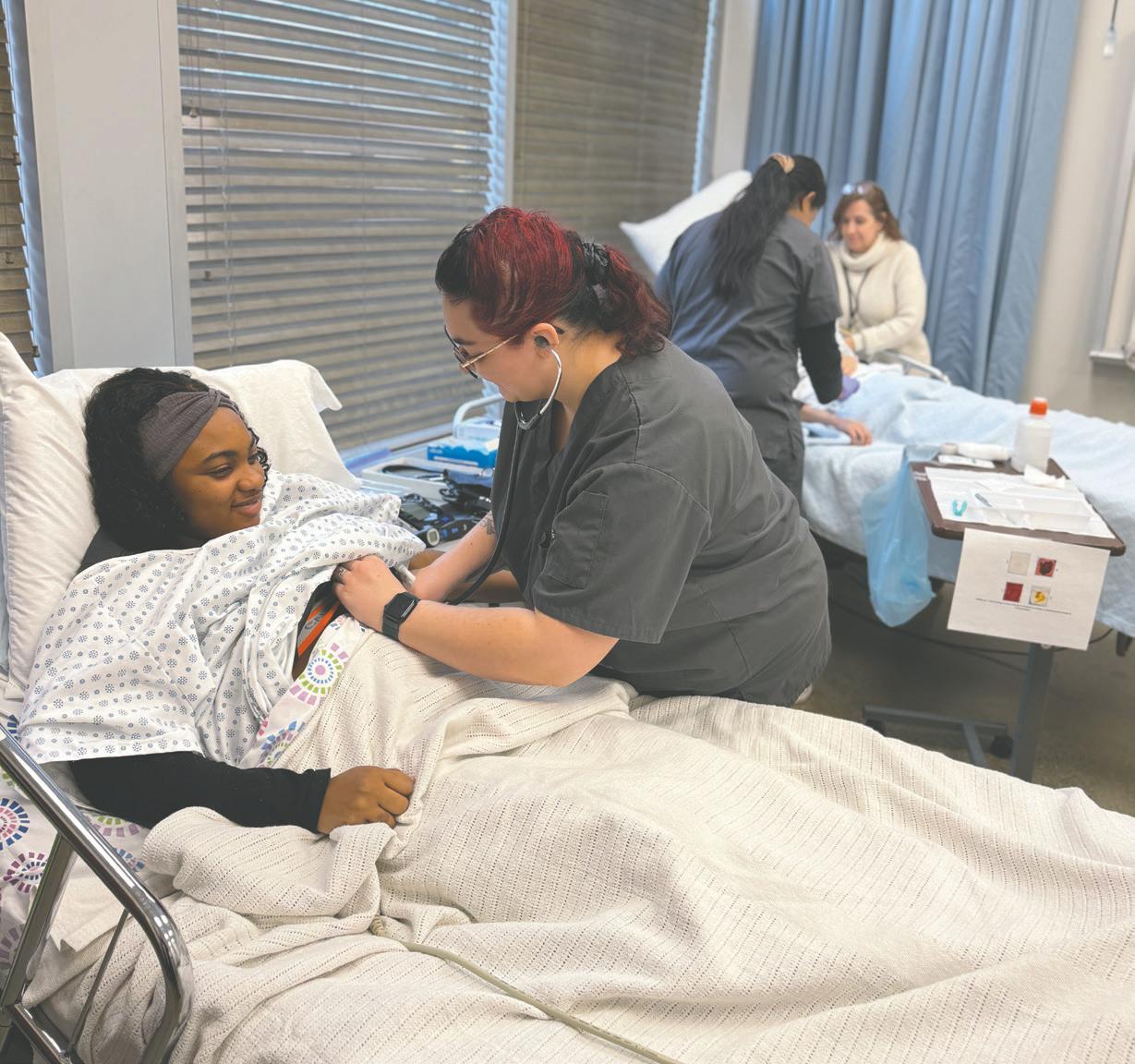
“We measure success by employment, not enrolment,” says Gignac. “Our programs are designed to help students build the skills employers actually need.” According to the college, 65 per cent of graduates secure employment within six months of completing their studies.

Training with employment in mind What distinguishes Academy of Learning is its Integrated Learning System, which grants students the flexibility to learn from home, on campus, or through a hybrid model. Learners can progress at their own pace and begin their studies without waiting for a traditional semester start date.
Flexibility is paired with personalized attention. Each student works with a dedicated Learning Coach who helps monitor progress, provide encouragement, and keep learners on track toward graduation — a particularly valuable approach for mature learners, newcomers to Canada, and individuals balancing other obligations.
Support extends beyond graduation. Academy of Learning emphasizes workforce readiness and offers job placement assistance designed to help students connect their training to tangible employment pathways.
As Canada’s health care sector continues to expand, so does the need for skilled professionals ready to support patients, families, and communities. For adults looking to take the next step in their careers, flexible, employment-focused training can provide a practical pathway into one of the country’s most essential fields.
Written by Emily Hellam
Scan the QR code to learn more about Academy of Learning’s health care programs and take the








Health care professionals choosing New Brunswick benefit from competitive recruitment incentives, collaborative models, and an exceptional quality of life.
Canada is facing a well-documented shortage of health care workers, and New Brunswick is addressing the challenge with a recruitment strategy designed to attract and retain health care talent. Our rapidly aging population has increased demand, many in the health workforce are approaching retirement, and burnout is common among practicing physicians due to crushing workloads. A 2024 report showed that 5.7 million Canadian adults didn’t have a regular health care provider.
“We realize that we’re in a competitive environment,” says Dr. John Dornan, Minister of Health for New Brunswick.
In response, the Government of New Brunswick has developed a recruitment plan that’s attracting health care professionals by offering competitive compensation and addressing their core needs, including sustainable careers, worklife balance, and supportive practice environments.
We polled our health care providers and […] took their responses as our marching orders.
“We polled our health care providers and asked them, ‘What do you need to make this a place where you’d want to come and practise?’ And they responded. We took their responses as our marching orders,” says Dr. Dornan.
A collaborative care clinic model
After consulting physicians, nurses, nurse practitioners, and allied health professionals, the province had a clearer idea of their challenges and what they were looking for in a practice environment.

“Many primary care practitioners run a business,” says Dr. Dornan.
“In addition to their patients, they have to look after overhead expenses, management expenses, employment responsibility, and paperwork. Many said this weighs them down and makes them want to retire early.”
Physicians wanted support, and with solo practice becoming less attractive, they also wanted to be able to share their clinical care with other health care providers, including nurse practitioners, nurses, other physicians, pharmacists, social workers, and dietitians.
New Brunswick’s collaborative care clinics will directly address these challenges, offering more supportive, sustainable, and team-oriented workplaces.
Collaboration, flexibility, and peer support Team-based health care is good for health care providers, and it benefits patients as well. Collaborative care clinics can improve access to care, continuity of care, and care quality. The integration of electronic medical records, which are linked to the provincial health care system, further supports seamless, high-quality patient care.
The model is attracting new graduates and practitioners who value collaboration, flexibility, and peer support. “Modern physicians and new graduates want to be able to share and discuss cases with their colleagues,” says Dr. Dornan. “It’s a level of reassurance and cross-education. The days when a practitioner sat in a solo practice and didn’t talk to other people, we feel that those days are yesteryear.”
Driving the expansion of the collaborative care clinic model, New Brunswick offers competitive compensation packages and recruitment incentives, along with a new physician services agreement that provides one of the most attractive packages in the country.



incentives and compensation packages
Health care providers stressed the importance of appropriate remuneration in the poll, Dr. Dornan shares. “As a result, we’ve negotiated a physician services agreement that gives our colleagues one of the best rates in Atlantic Canada, if not the best rate,” he says. The new agreement also provides flexibility, with options for both salaried and fee-for-service physicians, and includes programs for parental leave and wellness.
New Brunswick offers one of Canada’s most competitive physician compensation and incentive programs. Recruitment incentives range from $50,000 to $100,000, depending on practice location.
“The recruitment incentives aren’t new in New Brunswick,” notes Dr. Dornan. “What’s new is the type of practice they can join: the collaborative care clinics.”
Beyond professional growth, New Brunswick gives health care professionals the opportunity to enjoy a balanced and fulfilling lifestyle. The province boasts a more affordable cost of living, shorter commutes for working professionals, friendly and connected communities, great schools, and a beautiful natural environment with abundant recreational activities available.
“Lifestyle is good, but lifestyle means nothing if you don’t have a good job or one that makes you happy at the end of the day,” says Dr. Dornan. “In New Brunswick, you can have both.”
Health care practitioners are already choosing New Brunswick. “Our medical school graduates are electing to stay and do residencies here, and when people are fi nished their residencies, they’re still staying,” says Dr. Dornan. “Physicians are joining us from other parts of the country including Ontario and Quebec, from the U.S., and even internationally.” New Brunswick’s status as Canada’s only officially bilingual province also appeals to many practitioners.
Written by Tania Amardeil