PAID ADVERTISEMENT SEPTEMBER 2026 | INNOVATINGCANADA.CA
@MediaplanetCA
Please recycle
A SPECIAL INTEREST SECTION BY MEDIAPLANET
Canada’s Innovative Research Partnerships
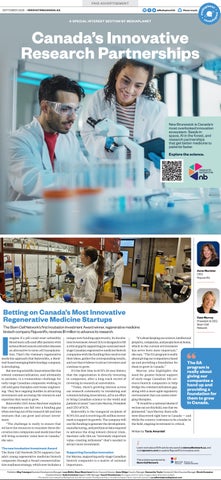
New Brunswick is Canada's most overlooked innovation ecosystem. Seeds in space, AI in the forest, and research partnerships that get better medicine to patients faster. Explore the science.
Anne Marinier CEO, RejuvenRx
Betting on Canada’s Most Innovative Regenerative Medicine Startups
Cate Murray President & CEO, Stem Cell Network
The Stem Cell Network’s first Incubation Investment Award winner, regenerative medicine biotech company RejuvenRx, receives $1 million to advance its research.
I
magine if a pill could reset unhealthy blood stem cells and offer patients with serious blood cancers and other diseases an alternative to stem cell transplantation. That’s the visionary regenerative medicine approach that RejuvenRx, a Montreal-based emerging biotechnology company, is developing. But moving scientific innovations like this toward commercialization, and ultimately to patients, is a tremendous challenge for early-stage Canadian companies working in cell and gene therapies and tissue engineering. They face ongoing hurdles in attracting investment and accessing the resources and expertise they need to grow. RejuvenRx CEO Anne Marinier explains that companies can fall into a funding gap when moving out of the research lab and into ventures that can grow and attract investment. “The challenge is really to ensure that we have the resources to translate these discoveries into companies and medicines that will bring economic value here in Canada,” she says.
unique new funding opportunity. Its Incubation Investment Award (IIA) is designed to fill a critical gap by supporting pre-seed and seedstage Canadian regenerative medicine biotech companies with the funding they need to test their ideas, gather the corresponding results, and use that evidence to attract investors and continue to grow. It’s the first time in SCN’s 25-year history that the organization is directly investing in companies, after a long track record of investing in research at universities. “Today, there’s growing interest across our research community in translating and commercializing innovations, all in an effort to bring Canadian science to the world and patients in need,” says Cate Murray, President and CEO of SCN. RejuvenRx is the inaugural recipient of SCN’s IIA and is receiving a $1 million investment to support its growth. The company will use the funding to generate the development, manufacturing, and preclinical data required to advance the drug toward clinical trials. Marinier calls this an “extremely important value-creating milestone” that’s needed to attract more investment.
The new Incubation Investment Award The Stem Cell Network (SCN) supports Canada’s young regenerative medicine biotech companies through a broad commercialization readiness strategy, which now includes a
Supporting Canadian innovation For Murray, supporting early-stage Canadian biotech companies is a matter of national importance.
“It’s about keeping our science, intellectual property, companies, and people here at home, which in the current environment has never been more important,” she says. “The IIA program is really about giving our companies a hand up and providing a foundation for them to grow in Canada.” Murray also highlights the need for greater federal support of early-stage Canadian life sciences biotech companies to help bridge the commercialization gap, along with a more agile regulatory environment that can assess emerging therapies. “It would be a national shame if we lost out on this field, one that we pioneered,” says Murray. Stem cells were discovered right here in Canada — and while the country continues to be a leader in the field, ongoing investment is critical.
The IIA program is really about giving our companies a hand up and providing a foundation for them to grow in Canada.
Written by Tania Amardeil
Learn more about SCN and its new award at stemcellnetwork.ca, and visit rejuvenrx.com to explore RejuvenRx’s innovative work. This article is sponsored by Stem Cell Network.
Publisher: Meg Yutangco Business Development Manager: Luca Bidini, Maya Mezerhane Senior Account Director: Anna Sibiga Country Manager: Samantha Taylor Content & Client Success Manager: Nicole Kansakar Creative Director: Kylie Armishaw Digital Traffic Manager: Vansh Chandwaney All images are from Getty Images unless otherwise credited. This section was created by Mediaplanet and did not involve The National Post or its editorial departments. Send all inquiries to ca.editorial@mediaplanet.com.
PAID ADVERTISEMENT 2
READ MORE AT INNOVATINGCANADA.CA
A SPECIAL INTEREST SECTION BY MEDIAPLANET
CARLETON UNIVERSIT Y WAS WELCOMED AS A MEMBER OF THE UNIVERSIT Y OF THE ARCTIC (UARCTIC) AT THE NET WORK’ S ANNUAL ASSEMBLY IN INARI , FINL AND IN J UNE 2025 (PHOTO CREDIT: UARCTIC)
Carleton University Advancing Innovation Through Research Partnerships
We are proud to be a partner in research initiatives that are driving innovation, strengthening communities, and delivering real-world impact.
Carleton University’s research partnerships are driving innovation, advancing global initiatives, strengthening communities, and demonstrating real-world impact.
R
esearch partnerships bridge academia, industry, and society to advance innovation. From fast-tracking commercialization of new technologies, to providing hands-on industry experience for students, to discoveries that improve the lives of Canadians, these collaborations play a key role in Canada’s ability to compete in today’s complex global economy. One of Carleton University’s strategic focuses is research partnerships with industry, government, non-profit, and international networks. “We are proud to be a partner in research initiatives that are driving innovation, strengthening communities, and delivering real-world impact,” says Dr. Rafik Goubran, Vice-President (Research, Innovation and International) at Carleton University. “Our researchers are working alongside these partners to advance discoveries in Arctic and northern research, artificial intelligence, advanced communications technologies, and cybersecurity.”
Strengthening northern communities through collaboration In keeping with its history of working with northern communities, Carleton is engaged in major international collaborations focused
on Arctic and northern research. One Carleton researcher is supporting global Arctic observation efforts through funding from Pillar II of Horizon Europe. This work contributes to the larger transdisciplinary Beyond Arctic PASSION project, made up of 34 partners around the world. Another example is Carleton’s recent formal membership in the University of the Arctic (UArctic), a leader in Arctic research and education based in Finland. Carleton’s significant research profile is helping the institution expand the scope and depth of its work. To address the costs and challenges of heating in northern communities, an interdisciplinary group of Carleton researchers is designing and prototyping a solar-driven adsorption thermal energy storage system (SATES).
Driving innovation in artificial intelligence, connectivity, and cybersecurity Connectivity is still unreliable for many communities outside of Canada’s urban areas. Through a collaboration with the University of Ottawa, the National Research Council of Canada (NRC), and the Communications Research Centre Canada, Carleton researchers are using AI, mobile edge computing, and digital twin technologies to model and test new network designs.
In the area of cybersecurity, Carleton researchers from the Norman Paterson School of International Affairs (NPSIA) are leading the Canadian Cybersecurity Centre of Excellence (3CE) on an initiative to boost Canada’s cybersecurity capacity through interdisciplinary education, research, and training. Through the 3CE, more than 160 graduate students and postdoctoral researchers will receive training, professional development, and experiential learning opportunities across the cybersecurity ecosystem. In addition to these collaborations, new degree programs in cybersecurity and systems security engineering will help prepare Carleton students for the workforce and Canada’s digital future. Ongoing funding and growth in these critical research areas will ensure Carleton continues to drive innovation and remain a leading-edge research institution.
Dr. Rafik Goubran Vice-President (Research, Innovation and International), Carleton University
Written by Anne Papmehl
Visit research.carleton.ca to learn more about Carleton’s latest research developments. This article is sponsored by Carleton University.
University of Ottawa — Canada’s Hub for Research Partnerships and Innovation With collaboration at the core of its research model, the University of Ottawa brings together industry, government, and researchers to drive innovation that strengthens Canada’s economy and sovereignty.
K
nown as one of Canada’s top five universities for research intensity and the world’s largest English-French university, the University of Ottawa is well positioned as an innovation leader. Mediaplanet recently sat down with Alexandre Poulain, its new Associate Vice-President, Innovation, Partnerships and Entrepreneurship, to discuss uOttawa’s successes, his vision for the future and why businesses should connect with the institution.
What makes uOttawa an ideal place for innovation? Being in the nation’s capital places us at the intersection of government, industry, and academia, creating opportunities to share expertise and tackle complex challenges together. The uOttawa-IBM Cyber Range is a great example, bringing researchers, students, and partners together to develop and test solutions to real-world cybersecurity threats. Our Kanata North campus, located in Canada’s largest technology park, further strengthens those connections by bringing scientists, entrepreneurs, and industry leaders together in one of the country’s most dynamic innovation ecosystems. We also benefit from a strong health and life sciences sector. Opening in 2027, the Advanced Medical Research Centre (AMRC) will anchor it further by housing the Ottawa Health Innovation Hub, bringing researchers, clinicians, and industry partners under one roof to accelerate the path
from discovery to patient impact. Across all our partnerships, we apply a strong research security lens to ensure that innovations developed here continue to benefit Canada.
What are some of uOttawa’s recent successful partnerships? Industry collaboration is central to how uOttawa conducts R&D, with partnerships ranging from multinational corporations to early-stage startups. Our long-standing partnership with Ciena has enabled students to work alongside industry experts to develop AI solutions, some of which have been incorporated into the company’s products. More recently, we signed a five-year partnership with Kinaxis to co-develop advanced supply chain technologies while providing graduate students with valuable real-world experience. We also work with emerging companies such as Edge Signal, Celestra Health Systems and ReasonX Labs, helping advance innovations ranging from smart insole technologies to edge AI and bringing promising ideas closer to market.
clinic offered through the Faculty of Law’s Entrepreneurship and Innovation Program in partnership with Norton Rose Fulbright Canada. Under the supervision of practicing lawyers, law students acquire clients while entrepreneurs receive free legal support. Our Francophone partnerships are another strength, helping prepare bilingual graduates who can work confidently across disciplines and sectors.
What is your vision for uOttawa’s future? A key priority is empowering graduate students by complementing their academic training with the professional and entrepreneurial skills that reflect the realities of the market. I also want uOttawa to be even more responsive to the needs of industry and to the challenges facing Canada. By strengthening connections between researchers, partners, and communities, we can accelerate the impact of research and turn discoveries into solutions that benefit society.
Written by Anne Papmehl
How does uOttawa’s broad view of innovation set it apart? We take a broad view of innovation that extends beyond patents and startups to include public policy, legal frameworks, and social innovation. That approach leads to interesting cross-fertilizations. One example is our work with Indigenous partners to co-develop methodologies that support truth and reconciliation. Another is the pro bono legal
Come work with us! The University of Ottawa welcomes innovators, entrepreneurs, and problem-solvers from all backgrounds. Whether you’re looking to develop a new idea, advance a discovery, or address a real-world challenge, visit uottawa.ca/research-innovation to learn how we can work together. This article is sponsored by uOttawa.
Alexandre Poulain Associate Vice-President, Innovation, Partnerships and Entrepreneurship, uOttawa
PAID ADVERTISEMENT A SPECIAL INTEREST SECTION BY MEDIAPLANET
READ MORE AT INNOVATINGCANADA.CA
How a Pipeline of Young Talent Is Turning Research Investment Into Business Results Investing in Canadian talent can help businesses turn world-class research and emerging technologies into homegrown innovation, jobs, and economic growth.
M Derek Newton Senior VicePresident, Strategic Partnerships and Business Development, Mitacs
Dr. Christian Weedbrook Founder & Chief Executive Officer, Xanadu
ore than ever, Canada's long-term prosperity depends on sovereign innovation. This means owning as much of the supply chain as possible right here. It's not enough to do the research here; we need the intellectual property, infrastructure, manufacturing, and job opportunities to stay in Canada too. If we control the development and deployment of critical technologies, we are less vulnerable to geopolitical disruption or foreign supply-chain shocks. One way to get there is by investing in talent to support Canada’s businesses and organizations. “Growing and retaining talent in Canada is critically important,” says Derek Newton, Senior Vice-President, Strategic Partnerships and Business Development, Mitacs. “Canada's success depends on having the skilled people, research capacity, and innovation capability needed to compete in an increasingly complex global environment. We need to make sure the talent coming out of our world-class universities, colleges, and polytechnics is connected to Canadian organizations, so great ideas can be developed, adopted, and scaled here at home.”
Skilled talent powers sovereign innovation A huge advocate of sovereign innovation is Toronto-based Xanadu Quantum Technologies, a Canadian tech success story. They
are building the country’s first utility-scale quantum computer manufacturing facility thanks to a historic Government of Canada investment of $195 million. “The difference between Canada being a place where breakthroughs happen and a place where they get commercialized is ensuring the customers, capital, and policy support are found right here,” says Dr. Christian Weedbrook, Xanadu’s Founder and Chief Executive Officer. “Developing homegrown expertise and talent pipelines is foundational.” According to Weedbrook, Canada has been producing world-class talent and science, but the gap has always been what happens next. “Incredible AI researchers were trained in Canada and then got pulled to the U.S. because that's where the companies, funding, and career paths were,” he says. “If we don't build that same pipeline for other technologies, from university lab to job at a Canadian company, we'll repeat the same story.”
Leveraging partnerships to deliver results Canadian tech success stories start by supporting emerging talent from the ground floor, which leads to big wins for our businesses and domestic capacity. Enter Mitacs, one of Canada's leading innovation organizations, connecting businesses, students, and researchers to deliver a measurable return on innovation.
Since 2018, Mitacs has invested over $1.68 billion in R&D, supported 42,000 innovation projects, and partnered with more than 12,500 companies. It has collaborations with 215 postsecondary institutions and 170 innovation incubators across Canada. Businesses find the talent, funding, and expertise to innovate faster and at a greater scale. Post-secondary students access funding, work experience, partnerships, and global networks. Organizations that partner with Mitacs innovate faster, commercialize sooner, and scale and grow stronger. Just ask Xanadu. Xanadu started working with Mitacs in 2019 and recognized early on the unique opportunities it could bring. “Mitacs has been a genuine pipeline of talent for us. They do a great job connecting quantum companies with promising graduate students from across the country and building relationships that often turn into long-term hires,” says Weedbrook. “For growing companies like ours, that kind of national reach is hard to build on our own. Mitacs is a real accelerant for getting Canadian talent into Canadian quantum companies early, which is exactly what this industry needs to keep building on.”
Benefits for the entire ecosystem
We need to make sure the talent coming out of our world-class universities, colleges, and polytechnics is connected to Canadian organizations, so great ideas can be developed, adopted, and scaled here at home.
Mitacs is the essential connector in Canada’s innovation ecosystem. A recent Statistics Canada survey shows that private-sector partners that worked with Mitacs experienced an average 11 per cent boost in productivity, 9 per cent growth in revenue, and 16 per cent increase in sales. “It’s clear that connecting Canadian companies to research institutions and talent, combined with co-investment, leads to tangible results for the economy,” adds Newton. “Mitacs delivers a return on innovation that Canada needs now by connecting big ideas, people, and ambition to turn potential into results.”
- Derek Newton
Written by Ken Donohue
Discover return on innovation at mitacs.ca
Discover what’s possible. mitacs.ca
This article is sponsored by Mitacs.
3
PAID ADVERTISEMENT 4
READ MORE AT INNOVATINGCANADA.CA
A SPECIAL INTEREST SECTION BY MEDIAPLANET
FROM CONSUMER TO CREATOR:
Canada’s AI and XR Future
Fanshawe is building AI and XR ecosystems designed to drive innovation across Canada’s evolving industries.
A Assem Kroma Senior Manager, Immersive Technologies and Simulation, Fanshawe College
Jeff Wright Vice-President, Innovation, Strategy and Enrolment, Fanshawe College
rtificial intelligence is already transforming how Canadians work, learn and do business. Pair it with extended reality (XR) — technologies that include virtual, augmented, and mixed reality — and the possibilities extend even further, from immersive workplace training to healthcare simulation and emergency response preparedness. But for Canada, the bigger question may be whether we simply use these rapidly evolving technologies or help shape what comes next. Assem K roma, Senior Manager, Immersive Technologies and Simulation at Fanshawe College in London, Ontario, believes a shift is already underway. “Over the past few years, Canada has been more of a receiver, or consumer, rather than a producer of AI and XR innovation,” he says. “Now there’s been a shift, starting with our federal and provincial governments.” That shift requires building Canadian expertise, research capacity, infrastructure, and talent, and creating an environment where industry and academia can turn innovation into practical, responsible solutions. Fanshawe is already a key player in this.
Connecting the pieces The College has created an applied research, multidisciplinary ecosystem around AI and XR, meaning individual projects are not created in isolation. Its facilities include a healthcare centre of excellence, the WSIB Centre of Excellence in Immersive Technologies Simulation for Workplace Safety (public safety) and SafeSkills XR (construction), which is also funded by the WSIB. Its broader infrastructure includes simulation labs, immersive 3D simulation rooms, motion capture and biomechanics systems, XR laboratories and an XR content creation studio. Expertise developed in one area serves to strengthen another and can ultimately be transferred to new sectors. For Jeff Wright, Fanshawe’s Vice-President, Innovation, Strategy and Enrolment, that foundation is what makes expansion possible. “Once you have the infrastructure and staff, then scaling is fairly easy,” he explains. “We bring students across disciplines, for example, health sciences, IT, and design, to create simulations based on need, particularly in high-risk environments.”
healthcare centre of excellence. Traditionally, students may practise de-escalating a difficult situation with a trained actor while a faculty member observes. Fanshawe is developing an AI-driven avatar that responds dynamically to what a student says or does, allowing learners to practise repeatedly and receive feedback. The technology adds an immersive training option difficult to achieve in a classroom: virtually unlimited opportunities to practise independently, make mistakes and try again. “Students can potentially experience this at home at 3 a.m., fail with nobody watching and then try again,” says Kroma. “This is how people learn best.” The first version is being designed for the Developmental Services Worker program, but its potential is much broader. “I don’t think we can name a profession where de-escalation isn’t required,” Kroma adds. “The setting changes. The skill doesn’t.”
The power of partnerships Through another initiative, funded by the WSIB, Fanshawe is working with Middlesex-London Paramedic Services to develop immersive experiences supporting first responder resilience and mental health. Instead of beginning with what developers assumed paramedics needed, the team began by listening to paramedics themselves. “We didn’t start with the technology,” says Kroma. “We started with paramedics in a room with sticky notes and a lot of listening.” Those first responders bring lived experience; clinical psychologists, and healthcare researchers provide oversight; and XR, AI, motion capture, 3D modelling, and game design specialists and students help translate that knowledge into immersive experiences. It’s a model that reflects what Wright
Training in a new reality One example is a de-escalation training project being developed through the
Organizations looking to explore AI and XR solutions, workforce development, or applied research partnerships can connect with Fanshawe College through fanshawec.ca/partnerships or contact Candace Miller at 519-777-9519 or cmmiller@fanshawec.ca.
This article is sponsored by Fanshawe College.
sees as an important role for colleges: supporting industry through innovation while preparing students for the workforce. “Students from different disciplines work together on complex, real-world problems — experience that mirrors an increasingly multidisciplinary workplace,” Wright says.
Scaling into new sectors Because the underlying infrastructure and expertise are already in place, Fanshawe sees potential to apply its AI and XR capabilities beyond healthcare, public safety, and construction into sectors such as advanced manufacturing and transportation to start. It also wants to attract the people who will help build that future. For highly skilled, highly experienced XR and AI specialists, Fanshawe aims to be an employer of choice and a place to work on the latest and emerging technologies in the field. For industry, the invitation is equally clear: bring the College a problem and explore what can be built together. If Canada is moving from technology consumer to creator, building the expertise, industry partnerships and capacity to innovate here at home will be critical to determining where AI and XR take us next. “We welcome people who share the same vision to partner with us because the impact we can have together will be remarkable,” says Wright.
Written by Janice Tober
Students from different disciplines work together on complex, real-world problems—experience that mirrors an increasingly multidisciplinary workplace.