The world of work is changing fast, and Canadians, particularly youth, are feeling it. These are challenging times, but the Government of Canada is acting with urgency and purpose to ensure Canadians can access good jobs and build lasting careers. At the same time, demand is growing rapidly: Canada will need an estimated 1.4 million skilled workers by 2033 to build homes, deliver major infrastructure, strengthen supply chains, and support industries. Simply put: this is a good time to get into the skilled trades.
The Honourable Patty Hajdu Minister of Jobs and Families and Minister responsible for the Federal Economic Development Agency for Northern Ontario
&
The Honourable John Zerucelli Secretary of State (Labour)
Canada’s electrification ambitions depend on a skilled workforce. Industry, educators, and government must work together to strengthen talent pipelines. Why the Electrical Industry Offers a Bright Career Future
Canada’s economic growth, energy transition, and infrastructure ambitions all depend on a modern and resilient electrical sector. As the national voice of Canada’s electrical industry, Electro-Federation Canada (EFC) sees firsthand that achieving these ambitions requires more than technology and investment. It requires people.
From housing and transportation to manufacturing and critical infrastructure, electrification is reshaping the Canadian economy and increasing demand for skilled talent across the electrical ecosystem. Industry has an important role to play in helping Canadians better understand the diverse and rewarding career opportunities available throughout the sector.
Meeting future workforce needs will require collaboration among industry, educators, and government to strengthen talent pipelines, raise career awareness, and ensure skills development keeps pace with evolving technologies. Through workforce development initiatives, career awareness efforts, leadership development opportunities, industry networks, and advocacy, EFC is helping strengthen the talent pipeline across Canada’s electrical supply chain.
Building a strong talent pipeline is not simply a workforce issue. It’s an economic imperative that will help determine Canada’s competitiveness and success in the years ahead.
Canada must build the skilled workforce it needs for growth, infrastructure development, and economic resilience.
Canada’s economic future depends on its ability to develop, attract, and retain skilled talent. As governments and industry work to address housing shortages, build critical infrastructure, and strengthen supply chains, apprenticeship remains one of the country’s most effective workforce development solutions.
Across sectors, employers are facing retirements, workforce shortages, and growing demand for skilled workers. Whether in construction, manufacturing, transportation, or energy, meeting Canada’s economic priorities requires a strong pipeline of qualified talent. Apprenticeship offers a practical response. By combining paid employment with structured training, it allows individuals to earn while they learn and helps employers develop the skilled
workforce they need. Apprentices gain valuable hands-on experience and employers benefit from stronger retention, succession planning, and knowledge transfer.
Success requires collaboration. Governments, employers, labour organizations, training institutions, industry associations, and community partners all play a role in creating pathways into apprenticeship and supporting apprentice success.
As Canada looks to meet future workforce demands, apprenticeship must be recognized not simply as a training model, but as a strategic workforce development tool that delivers results for employers, workers, and communities alike.
Written by Canadian Apprenticeship Forum
How CM&E is Driving Operational Excellence Through Training and Upskilling Programs
With rising pressures on manufacturers, Canadian Manufacturers & Exporters is expanding access to training and upskilling to ensure ongoing operational excellence.
As Canada’s manufacturers deal with trade uncertainty, tariffs, and evolving global markets, Canada’s largest trade and industry association, Canadian Manufacturers & Exporters (CM&E), is lending support by expanding access to its training and upskilling programs across Alberta, Saskatchewan, and Manitoba.
Mediaplanet spoke with Brittany Scarrow, Prairies Operations and Business Services at CM&E, to learn more about these programs and how they help to drive operational excellence.
What workforce needs or gaps are CM&E’s training and upskilling programs designed to address?
We help companies with the foundational aspects for building their operational excellence program, which manufactures need to be competitive. These are the core skills needed to manage people and processes in a manufacturing environment, and include lean principles, health and safety, and asset care and reliability. These competencies also complement the technical and trade skills that come from our polytechnics and universities.
What types of workers are these training and upskilling programs intended for?
I always say it’s for the people who do the work. Much of the time it’s supervisors and front-line people, but it’s not uncommon to have a class with a mix of people, from CEO or company owner to operators to front-line staff to managers and supervisors.
How are the courses funded?
Many companies that we work with invest in the training on their own, but now with support from Prairies Economic Development Canada (PrairiesCan) we can offer many of our programs at reduced cost.
How are the courses delivered?
It’s a mixture. Many of our basic 101level courses are delivered online.
Our second-level programs are off ered both online and in person though we fi nd people tend to prefer our in-person programs as they are practical, hands-on courses. We have facilitators across Canada, including the Prairies, and all of them have a manufacturing operations background.
CM&E’s training builds the foundation for operational excellence, so that when you bring in the specialized technical talent and applied skills, you’re able to be a productive organization and leverage the talent appropriately.
How do your training and upskilling courses prepare workers for rapidly changing technologies?
To achieve operational excellence when adopting new technologies, especially information technology, you need to have the right foundation that I mentioned earlier. If your process management isn’t disciplined, whatever emerging technology you’re using, like that AI chat box or your data management software, just tends to add more chaos. The more mature and disciplined you are in your operating system, the more effectively you can use these tools to deliver. I think that’s what’s really driving the need for training and upskilling programs. They’re the foundation for technology adoption.
How important is collaboration between CM&E’s education providers and employers?
It’s critical because as we go forward our training needs to align with industry needs, for both hard and soft skills. The more we can understand industry’s challenges and needs, the better we can be at preparing people to be more successful when they enter the industry. And then everyone will be better off as a result.
How do CM&E’s training and upskilling programs fit into broader workforce development efforts?
CM&E’s training builds the foundation for operational excellence, so that when you bring in the specialized technical talent and applied skills, you’re able to be a productive organization and leverage the talent appropriately.
Can you share a success story that demonstrates the impact of your programs?
We had someone take our programs and implement what he learned in his workplace. In a span of six years, he went from front-line operator to supervisor and then eventually program manager. We often see people’s careers take off as companies invest in their staff and their staff show the results of that investment.
There is also a return on investment to the company. By increasing employee skill levels, they fi nd productivity improvements, report fewer defects, less rework to do, and find it easier to execute. So, the success is on both the individual career development side and the organizational output side.
By supporting companies with the foundational aspects of operational excellence through training and upskilling, CM&E is helping individuals to grow in their careers and manufacturers succeed in their businesses.
Written by Anne Papmehl
Brittany Scarrow Prairies Operations and Business Services, CM&E
How Helmets to Hardhats Turns Military Skills into Workforce Solutions
Helmets to Hardhats Canada is turning military service into skilled trade careers and helping solve the country’s growing construction labour shortage.
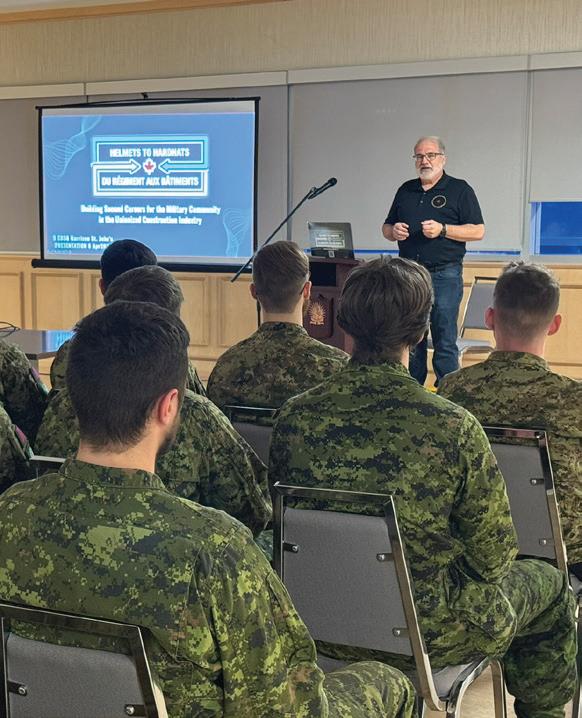
When a member of the Canadian Armed Forces (CAF) hangs up their uniform, the mission doesn’t end — it changes. The discipline, resilience, and team-first mentality forged through military service don’t disappear when they leave the CAF. For thousands of Canadian veterans, those qualities are now building something new: a career, a community, and a stronger national workforce.
Helmets to Hardhats (H2H) Canada bridges the military community and the unionized construction industry. Its mission is to place veterans, reservists, senior cadets, and military family members into meaningful second careers within Canada’s Building Trades Unions, complete with competitive wages, benefits, and pension plans.
The need has never been greater. Canada’s construction sector faces a generational workforce gap, with thousands of skilled tradespeople expected to retire in the coming years. At the same time, thousands of CAF members transition to civilian life each year, carrying discipline, adaptability, safety awareness, and team-
based leadership. These are exactly the qualities employers in the skilled trades are seeking.
Connecting veterans with opportunities
“The military community represents an underutilized talent pool in this country,” says James Hogarth, National Executive Director of H2H Canada. “These are people who already know how to show up, work hard, and perform under pressure. Our job is to connect them with an industry that needs them.”
Veterans who have come through the program are building skilled trades careers across every province as millwrights, boilermakers, pipefitters, elevator constructors, carpenters, operating engineers, and more. Some made the transition within weeks of reaching out. Others discovered a career path they hadn’t previously considered.
“H2H helped ease my transition into the civilian workforce,” wrote one veteran now working as an Ironworker with The International Association of Bridge, Structural, Ornamental and Reinforcing Iron Workers. “Straight away I was doing their training and am now hired on as an apprentice.”
Serving and building Canada For employers and union partners, the value
Why the Skilled Trades Are Critical to Driving Canada’s Mining Future
The need for highly skilled trades workers is increasingly important in mining as global demand for critical minerals continues to grow.
Executive Director, Mining Industry Human Resources Council
Skilled trades professionals are vital to Canada’s mining industry, ensuring operations remain safe, efficient, and productive. From electricians and welders to heavy equipment operators and construction miners, these skilled workers build, maintain, and operate the infrastructure that powers mining activities across the country.
Mining is a key contributor to Canada’s economy, generating more than $112 billion in GDP and supporting hundreds of thousands of jobs nationwide. As global demand for critical minerals continues to grow, driven by the transition to clean energy and technological advances, the need for a highly skilled mining workforce is becoming increasingly important.
Skilled trades are integral to this demand. Mechanics, machinists, HVAC specialists, and many more are essential to daily operations, from maintaining machinery to underground air ventilation and cooling to ensure safe working conditions. Without these workers, production slows and safety risks increase. These jobs require technical knowledge, making proper training and apprenticeship pathways essential.
To help address growing labour shortages, the Government of Canada recently launched the Mining and Minerals Workforce Alliance. This initiative brings together industry, educators, Indigenous communities, and other stakeholders to strengthen talent pipelines and equip workers with the skills needed for modern mining technologies and practices — including those in trade occupations.
Skilled trades professionals support daily operations and drive innovation, enable sustainable resource development, and strengthen Canada’s position as a global mining leader. Efforts like the national Mining Needs You career awareness campaign complement this work by highlighting career pathways and showing Canadian youth the variety of skilled trades opportunities available in mining. Investing in skilled trades is ultimately an investment in the country’s economic future and a more resilient Canadian economy.
The military community represents an underutilized talent pool in this country.
is equally clear. Tony Fanelli, Executive Director of the Construction Labour Relations Association of Ontario, noted that candidates consistently demonstrate the punctuality, efficiency, and on-budget performance that contractors depend on.
At a time when every skilled worker counts, H2H is making sure none are left behind. It also supports women entering the trades, reservists building civilian careers while continuing to serve, and senior cadets and Junior Canadian Rangers taking their first steps toward a skilled trade.
Canada’s skilled labour shortage is a national challenge. H2H is proving, one placement at a time, that those who served Canada in uniform are ready and able to keep building it.
Written by Helmets to Hardhats Canada
How One Union Is Building Careers, Not Just Filling Labour Shortages
As labour shortages in the skilled trades continue, here’s how one organization is providing training, mentorship, and apprenticeship.
CLAC is one of the largest independent, multisector, national unions in Canada. Mediaplanet recently spoke with Wayne Prins, CLAC Executive Director, to learn more about the union’s workforce development initiatives and its outlook for opportunities in skilled trades across Canada.
What type of workers does CLAC support?
Wayne Prins: We represent workers across a range of sectors. Within construction, CLAC supports all trades, including electricians, carpenters, labourers, welders, plumbers, and pipefitters. Our members are working on some of the biggest infrastructure and resource projects across the country.
How is CLAC approaching reconciliation with Indigenous communities?
WP: Our approach to economic reconciliation begins with fostering inclusive, hospitable workplaces. Collective agreements are written to respect Indigenous values and traditions. We also seek to build pathway-to-employment, apprenticeship, and mentoring programs that support meaningful careers for Indigenous people, rather than one-off courses.
Apprenticeships are vital to growing our skilled trades labour force. How does CLAC support apprentices?
WP: CLAC’s apprenticeship supports are designed to guide workers from entry-level training through to Red Seal certification and long-term employment.
How are CLAC’s efforts in supporting the skilled trades helping to build Canada’s economy?
WP: We’ve invested in programs that help remove barriers and create pathways into the industry, such as our Supporting Women in Construction (SWIC) initiative to support women navigating careers in the trades. We also provide extensive safety, skills, and leadership training.
Ultimately, CLAC’s approach is centred on building a resilient, adaptable workforce that can contribute to Canada’s prosperity and security through the construction of infrastructure, energy, and industrial projects while helping workers build stable, long-term careers.
Written by Anne Papmehl
This project is funded in part by the Government of Canada’s Canadian Apprenticeship Strategy.
article was sponsored by Helmets to Hardhats
James Hogarth
Ryan Montpellier
Wayne Prins Executive Director, CLAC
Let Safety Certification Be Your Next Career Step
In today’s high-risk, dynamic work environments, technical skills are not enough. Here’s how recognized safety credentials can be a career booster.
Apprenticeships and skilled trades help to keep Canada’s economy humming and are vital to our country’s future.
“As our population continues to grow, so too will demand for trades in industries such as housing development, mining development, advanced manufacturing and energy,” says Larry Masotti, Chair of the Board of Governors, Board of Canadian Registered Safety Professionals (BCRSP). However, these sectors operate in complex, highrisk environments where safety performance affects productivity, project delivery, and public confidence.
tact with these hazards, so they understand the risks of working in a dynamic environment,” says Masotti. “Providing them with recognized safety credentials allows them to bridge the gap between policy and practice and help translate safety programs into actions that work on real job sites,” says Masotti.
there are several pathways to obtaining this certification, what makes it unique is its acceptance of journeyperson status as qualifying educational background.
Technical skills are no longer enough Today’s worksites require individuals who understand risk and how to embed practical safety controls into day-to-day operations. Who better to lead the charge than skilled tradespeople? “Journeypersons, workers, supervisors, and managers are in close con-
Enhance your employability and earnings potential
The Canadian Registered Safety Technician® (CRST®) designation from BCRSP lets skilled tradespeople do just that within a short time. Since its launch in 2018, the CRST program has been growing quickly. “While there are several pathways to obtaining this certification, what makes it unique is its acceptance of journeyperson status as qualifying educational background,” says Masotti. Aligned with the ISO 17024 standard, the CRST certificate is recognized as a valid and valuable professional credential. “Having
Need More Skilled Workers, and Fast.
Polytechnics are uniquely equipped to deliver the apprenticeship training Canada needs to address its skilled labour shortage.
Written by Larry Rosia President & CEO, Saskatchewan Polytechnic
Canada helps feed the world, powers global industries, and anchors the energy and mining future. But even the strongest engine sputters if it runs out of fuel — and right now, our skilled labour force is running dangerously low.
With hundreds of thousands of tradespeople retiring by 2028 and growing demand, Canada needs more workers — from mining and construction to energy and manufacturing — and we need them now.
Robust apprenticeships are the immediate answer, and polytechnics are the model best suited for apprenticeship training.
Polytechnics support both learners and employers with training, mentorship, supervision, and assessment. They’re equipped to deliver consistent, accredited technical training tied to national and provincial standards. Saskatchewan Polytechnic, for example, delivers training for over 20 trades across multiple communities in partnership with the provincial apprenticeship authority. Polytechnics provide broad-based learning beyond what a single employer could provide while staying closely aligned with industry to ensure training is current and tied to real-world needs. Work-integrated learning connects classroom learning, lab practice, and real-world application.
If Canada wants to build homes, expand energy production, modernize infrastructure, and fuel economic growth, we don’t need to reinvent apprenticeship training; we simply need to invest in the institutions that already deliver it best.
safety technicians who understand the language of both the trades and the occupational health and safety (OH&S) requirements benefits employers by helping to instill a stronger safety culture, more effective training, and improved regulatory compliance,” says Masotti.
Employees also benefit from a credential that can propel them into leadership roles early on in their career. Most of all, having clear, credible pathways from the trades into safety leadership strengthens the workforce and reinforces the shared goal of ensuring people return home safe at the end of every workday.
Written by Anne Papmehl
To learn more about BCRSP’s CRST certification and other safety certifications,
Lethbridge Polytechnic Helps Address the Skilled Labour Shortage
Finding enough skilled labour with the right technical training is a major industry pain point. Here’s how Lethbridge Polytechnic is addressing it.
As industry needs evolve and demand for certain skilled labour grows, Canadian companies are turning to the trade and technical schools for help. “Our industry and community partners tell us their main challenges are finding the right people to fill the jobs and getting them through the technical training fast enough,” says Sheldon Anderson, dean of the Centre for Trades and Technologies, Lethbridge Polytechnic.
Lethbridge Polytechnic offers certificates, diplomas, and degrees, in addition to apprenticeships and applied research that reflect both current workforce demands and future skills requirements.
Meeting workforce demand
To meet local demand, Lethbridge Polytechnic is developing three additional apprenticeship programs to launch (pending government approval) in the fall of 2027 — industrial mechanic, sheet metal worker, and refrigeration and air conditioning mechanic.
Industry engagement is a key part of Lethbridge Polytechnic’s curriculum development process. “We’re constantly meeting with industry to understand their needs and do our best to develop programs that meet these needs,” says Anderson. Any new curriculum changes are monitored by the polytechnic’s program advisory committee and courses are taught by instructors with extensive industry experience.
The polytechnic’s focus on applied research also provides students with opportunities to solve real industry challenges. “If a company or community partner doesn’t know what they need or how to get to where they want to go, we’ll either do the research to help them find out or work with them as research partners. As a result, we’ve been steadily improving our ranking among Canada’s top research colleges and ranked ninth in 2025,” says Anderson.
With the pace of innovation increasing exponentially, so are the ways technology is applied to the trades. And Lethbridge Polytechnic is helping to meet current demand while ensuring future workforce readiness.
Written by Anne Papmehl
Sheldon Anderson Dean of the Centre for Trades and Technologies, Lethbridge Polytechnic
THE NEXT APPRENTICESHIP CHALLENGE: Helping People Find Their Way
Canada has made progress in raising awareness of skilled trades careers. The next challenge is helping aspiring apprentices navigate the path to certification.
Written by Kelly Hoey Executive Director,
Canada’s skilled labour shortage is often framed as a recruitment problem.
Employers need workers. Apprenticeships offer paid, hands-on training and long-term career opportunities. Governments are investing in skilled trades to support housing, infrastructure, advanced manufacturing, clean energy, and other nation-building priorities.
The logic seems simple: encourage more people to enter the skilled trades. And to Canada’s credit, significant progress has been made. Over the past decade, governments, industry associations, employers, educators, and workforce development organizations have invested heavily in raising awareness of skilled trades careers and apprenticeships. More young people are being exposed to career possibilities, and more Canadians are recognizing apprenticeships as valuable pathways to rewarding careers.
Connecting students with career possibilities In Ontario, for example, the Ontario Career Lab connects students with industry volunteers through structured Career Conversations that help them explore careers and understand how education connects to the world of work.
Following Career Conversations, nearly two-thirds of participating students reported being open to exploring skilled trades careers, while more than three-quarters indicated some likelihood of pursuing further conversations about courses connected to skilled trades pathways. The findings suggest that direct engagement with industry professionals can influence what young people are willing to consider for their future.
Generating interest matters. But interest alone does not create apprentices.
As Canada advances major investments in workforce development and apprenticeship training, the more important question may be what happens after someone decides they want to pursue a skilled trades career.
Canada’s apprenticeship navigation challenge
That question matters because “skilled trades” is not a single career. It’s a broad ecosystem of occupations,
employers, training requirements, regional labour-market needs, certification pathways, and support systems designed to help people enter and progress through their careers. Telling someone that the skilled trades are in demand doesn’t tell them which trade is right for them, who’s hiring, how to become registered, or what to do when their fi rst placement ends.
Canada does not simply have an apprenticeship awareness problem. It has an apprenticeship navigation challenge.
For many prospective apprentices, the path is not always clear. They may be interested in becoming an electrician, welder, millwright, carpenter, plumber, or heavy equipment technician, but still not know where to begin. They may need help understanding entry requirements, building a resume, connecting with employers, preparing for interviews, accessing wage supports, or staying employed between projects and training periods.
Supporting individuals through the apprenticeship journey
That navigation support is not a nice-to-have. It can be the difference between someone being interested in a skilled trades career and someone becoming a registered apprentice who successfully completes their training.
This is where organizations such as ApprenticeSearch.com play a critical role. For almost three decades, ApprenticeSearch.com has helped connect aspiring apprentices with employers while supporting individuals through the real, often non-linear journey into and through apprenticeship.
That journey rarely ends with a first job placement.
Effective apprenticeship systems must help people move through multiple transition points: from awareness to occupation selection, from job seeker to candidate, from candidate to employee, from employee to registered apprentice, from apprentice to technical training, and from technical training to completion and certification.
An apprentice working in project-based employment may need to find a new employer when a contract ends. Someone entering technical training may need support understanding available financial assistance or staying connected to employment
after school. A candidate who’s eager but unfamiliar with the system may need one-on-one guidance before they’re ready to approach an employer.
Supporting employers to participate in apprenticeship training
Employers need navigation support, too.
Small- and medium-sized businesses are essential to Canada’s apprenticeship system, but many don’t have dedicated HR departments or apprenticeship specialists. Some want to hire and train apprentices but are unsure how registration works, what incentives are available, how to access wage supports, or what responsibilities come with sponsoring an apprentice. Others are looking for guidance on how to recruit effectively and build the workplace supports and culture needed to help apprentices succeed and stay.
Generating interest matters. But interest alone does not create apprentices.
If Canada wants more employers to participate in apprenticeship training, employers also need practical, responsive, and ongoing support that makes the process easier to understand and act on.
This is an important point as federal investments in skilled trades move forward. Funding matters. Incentives matter. Training capacity matters. But the impact of those investments depends on whether people and employers can actually access, understand, and use them.
The next phase of workforce development
Canada has invested considerable effort in helping people discover the opportunities available in skilled trades. The next phase of workforce development is helping more Canadians successfully move through those opportunities.
Apprenticeship is one of Canada’s strongest workforce-development tools. But like any pathway, its value depends on whether people can successfully navigate it.
ApprenticeSearch.com’s work over the past three decades demonstrates the value of practical navigation support at every stage of the apprenticeship journey.