CREATED BY MEDIAPLANET | HEALTHINSIGHT.CA
@MediaplanetCA
Please recycle
A SPECIAL INTEREST SECTION BY MEDIAPLANET
Accessibility Awareness Q&A
Read the full interview with Ryan at healthinsight.ca.
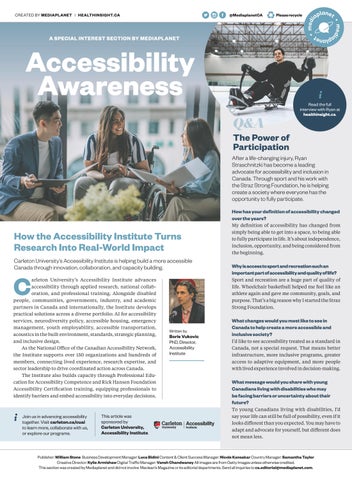
The Power of Participation After a life-changing injury, Ryan Straschnitzki has become a leading advocate for accessibility and inclusion in Canada. Through sport and his work with the Straz Strong Foundation, he is helping create a society where everyone has the opportunity to fully participate. How has your definition of accessibility changed over the years?
How the Accessibility Institute Turns Research Into Real-World Impact Carleton University’s Accessibility Institute is helping build a more accessible Canada through innovation, collaboration, and capacity building.
C
arleton University’s Accessibility Institute advances accessibility through applied research, national collaboration, and professional training. Alongside disabled people, communities, governments, industry, and academic partners in Canada and internationally, the Institute develops practical solutions across a diverse portfolio: AI for accessibility services, neurodiversity policy, accessible housing, emergency management, youth employability, accessible transportation, acoustics in the built environment, standards, strategic planning, and inclusive design. As the National Office of the Canadian Accessibility Network, the Institute supports over 150 organizations and hundreds of members, connecting lived experience, research expertise, and sector leadership to drive coordinated action across Canada. The Institute also builds capacity through Professional Education for Accessibility Competence and Rick Hansen Foundation Accessibility Certification training, equipping professionals to identify barriers and embed accessibility into everyday decisions.
Join us in advancing accessibility together. Visit carleton.ca/cuai to learn more, collaborate with us, or explore our programs.
This article was sponsored by Carleton University, Accessibility Institute.
My definition of accessibility has changed from simply being able to get into a space, to being able to fully participate in life. It’s about independence, inclusion, opportunity, and being considered from the beginning.
Why is access to sport and recreation such an important part of accessibility and quality of life? Sport and recreation are a huge part of quality of life. Wheelchair basketball helped me feel like an athlete again and gave me community, goals, and purpose. That’s a big reason why I started the Straz Strong Foundation.
Written by
Boris Vukovic PhD, Director, Accessibility Institute
What changes would you most like to see in Canada to help create a more accessible and inclusive society? I’d like to see accessibility treated as a standard in Canada, not a special request. That means better infrastructure, more inclusive programs, greater access to adaptive equipment, and more people with lived experience involved in decision-making.
What message would you share with young Canadians living with disabilities who may be facing barriers or uncertainty about their future? To young Canadians living with disabilities, I’d say your life can still be full of possibility, even if it looks different than you expected. You may have to adapt and advocate for yourself, but different does not mean less.
Publisher: William Stone Business Development Manager: Luca Bidini Content & Client Success Manager: Nicole Kansakar Country Manager: Samantha Taylor Creative Director: Kylie Armishaw Digital Traffic Manager: Vansh Chandwaney All images are from Getty Images unless otherwise credited. This section was created by Mediaplanet and did not involve Maclean’s Magazine or its editorial departments. Send all inquiries to ca.editorial@mediaplanet.com.