CREATED BY MEDIAPLANET | HEALTHINSIGHT.CA
@MediaplanetCA
Please recycle
A SPECIAL INTEREST SECTION BY MEDIAPLANET
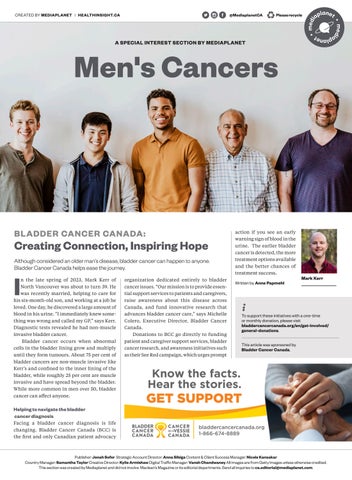
Men's Cancers
BLADDER CANCER CANADA:
Creating Connection, Inspiring Hope Although considered an older man’s disease, bladder cancer can happen to anyone. Bladder Cancer Canada helps ease the journey.
I
n the late spring of 2023, Mark Kerr of North Vancouver was about to turn 39. He was recently married, helping to care for his six-month-old son, and working at a job he loved. One day, he discovered a large amount of blood in his urine. “I immediately knew something was wrong and called my GP,” says Kerr. Diagnostic tests revealed he had non-muscle invasive bladder cancer. Bladder cancer occurs when abnormal cells in the bladder lining grow and multiply until they form tumours. About 75 per cent of bladder cancers are non-muscle invasive like Kerr’s and confined to the inner lining of the bladder, while roughly 25 per cent are muscle invasive and have spread beyond the bladder. While more common in men over 50, bladder cancer can affect anyone.
organization dedicated entirely to bladder cancer issues. “Our mission is to provide essential support services to patients and caregivers, raise awareness about this disease across Canada, and fund innovative research that advances bladder cancer care,” says Michelle Colero, Executive Director, Bladder Cancer Canada. Donations to BCC go directly to funding patient and caregiver support services, bladder cancer research, and awareness initiatives such as their See Red campaign, which urges prompt
action if you see an early warning sign of blood in the urine. The earlier bladder cancer is detected, the more treatment options available and the better chances of treatment success. Written by Anne Papmehl
Mark Kerr
To support these initiatives with a one-time or monthly donation, please visit bladdercancercanada.org/en/get-involved/ general-donations. This article was sponsored by Bladder Cancer Canada.
Helping to navigate the bladder cancer diagnosis Facing a bladder cancer diagnosis is life changing. Bladder Cancer Canada (BCC) is the first and only Canadian patient advocacy
Publisher: Jonah Sofer Strategic Account Director: Anna Sibiga Content & Client Success Manager: Nicole Kansakar Country Manager: Samantha Taylor Creative Director: Kylie Armishaw Digital Traffic Manager: Vansh Chandwaney All images are from Getty Images unless otherwise credited. This section was created by Mediaplanet and did not involve Maclean’s Magazine or its editorial departments. Send all inquiries to ca.editorial@mediaplanet.com.
2
CREATED BY MEDIAPLANET
READ MORE AT HEALTHINSIGHT.CA
Brad Guinn Prostate Cancer Survivor
Why Expanding Supports for Cancer Patients Is Critical to Better Outcomes This Canadian non-profit is advocating for better cancer support for patients and their caregivers, highlighting the importance of connectivity throughout the cancer journey.
N
early one in two Canadians will face a cancer diagnosis in their lifetime, making it the most commonly diagnosed health condition. Hearing the words ‘you’ve got cancer’ can be the start of an incredibly isolating journey, despite so many others having shared the same path. For men, a cancer diagnosis can be particularly surprising, having built a reputation for ignoring worrying symptoms and feeling uncomfortable speaking about their concerns to family or even a doctor. The Canadian Cancer Survivor Network (CCSN) was established with the intention to empower Canadian cancer patients, survivors and their families with knowledge to allow them better access to the supports required throughout diagnosis. Many cancers, like prostate cancer, are treatable when discovered early, yet when diagnosed in a later stage of the disease, these same treatments may not be available or less effective overall. Understanding cancer symptoms and personal risk-factors continue to be the best ways to stay on top of a potential cancer diagnosis, but information and access to these integral support systems can be hard to navigate. CCSN aims to build a future where Canadians have access to the best
possible care with a focus on accessible support, believing that not only is education key to better patient outcomes, but connection is just as critical to a less lonely cancer journey.
Facing the realities of diagnosis Prostate cancer survivor Brad Guinn, 68, explains how connection and support have been critical to his experience.
What was your understanding of prostate cancer prior to your diagnosis? My understanding of prostate cancer was fairly conventional. I viewed it as a common illness of aging that was slow-moving and manageable. Facing the reality of metastatic disease forces you to quickly become an educated self-advocate, learning about genetic testing and the frontier of molecular medicine.
How has connecting with other patients contributed to your own experience? Connecting with fellow patients completely changes the psychological landscape of surviving cancer. It transforms a deeply isolating, clinical experience into a shared human journey. Seeing others survive and thrive gives you the mental fortitude to keep advocating for your own health.
How do cancer support groups and networks help through diagnosis? We need robust support networks like the Canadian Cancer Survivor Network to break that stigma and give patients permission to speak openly about their vulnerability, fear, and side effects. Post-diagnosis support is critical because patients face systemic hurdles that go beyond the operating room.
How can support groups help caregivers? Cancer is never a solo diagnosis; it impacts the entire family unit. Support groups provide caregivers with a dedicated sanctuary to voice their own fears, prevent burnout, and learn how to navigate the healthcare system effectively. By supporting the caregiver, these networks ultimately strengthen the patient's entire frontline defense. CCSN recognizes that through increased education and support, they can promote higher rates of early intervention and offer patients, like Brad, the chance to feel empowered throughout their cancer journey and beyond.
Written by Sonya Friesen
To learn more about the Canadian Cancer Survivor Network and understand why education and support are so critical to the cancer journey visit survivornet.ca. This article was sponsored by Canadian Cancer Survivor Netwrok.
CREATED BY MEDIAPLANET
READ MORE AT HEALTHINSIGHT.CA
3
How Modern Radiation Offers Hope for Prostate Cancer Patients Advances in precision radiation are helping more men achieve lasting cancer control with fewer treatments and fewer life-altering side effects.
P
rostate cancer is the second most commonly diagnosed cancer in men after skin cancer. Over the past 25 years, cure rates have improved and treatment side effects have declined. Men newly diagnosed with prostate cancer should consult both a urologist about surgery and a radiation oncologist about non-surgical options. Hearing both perspectives helps patients weigh their options and make an informed decision. Radiation treatment has advanced greatly since I began practising in 2000, when about half of men with a typical diagnosis experienced treatment failure and treatment could require 40 treatment visits over eight weeks.
cancer remain cancer-free, with very low treatment-related side effects. SBRT has also been shown to be more effective than brachytherapy (internal radiotherapy or “seed therapy”). Incontinence risk with radiotherapy is near zero, and most men with good sexual function before treatment maintain it afterward. Preserving quality of life matters as more men are diagnosed at younger ages. Research in Canada and worldwide suggests that a more precise, two-treatment form of SBRT may further reduce bowel and sexual side effects. Randomized clinical trials are now evaluating these findings.
WRITTEN BY
Five treatments, fewer compromises High-quality clinical trials now show that a more accurate form of radiotherapy, called stereotactic body radiotherapy (SBRT), can safely deliver radiation in five treatments. After 10 years, 95 per cent of men with intermediate-risk prostate
Cure Prostate Cancer Canada funds transformative research and clinical trials to improve cure rates with fewer compromises. Visit cureprostatecancer.ca to learn more and support this work.
Dr. Andrew Loblaw Full Professor, Radiation Oncology, Sunnybrook Health Sciences Centre
This article was sponsored by Cure Prostate Cancer.
Winhan, Diagnosed at 42
I F LU N G C A N C ER CAN CO M E FO R W I NH AN, I T C A N COME FOR YOU.
LEARN MORE AT LUNGCANCERDOESNTCARE.CA