An independent supplement by Mediaplanet to USA Today
November 2026 | futureofpersonalhealth.com
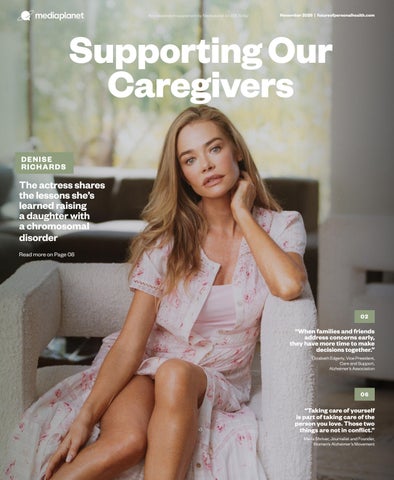
Supporting Our Caregivers DENISE RICHARDS
The actress shares the lessons she’s learned raising a daughter with a chromosomal disorder Read more on Page 08
02
“When families and friends address concerns early, they have more time to make decisions together.” Elizabeth Edgerly, Vice President, Care and Support, Alzheimer’s Association
06
“Taking care of yourself is part of taking care of the person you love. Those two things are not in conflict.” Maria Shriver, Journalist and Founder, Women’s Alzheimer’s Movement
Why Families Often Wait Too Long to Talk About Alzheimer’s Families often spend months questioning what they are seeing, but talking sooner can open the door to treatment and planning.
M
any families can pinpoint the moment they first noticed something was different in a loved one. Maybe a parent suddenly struggled to prepare a favorite recipe they’ve made for years. Maybe they began repeating stories more often, misplaced everyday items, or had difficulty finding the right words during conversation. Often, these changes are subtle enough to be dismissed as a normal part of getting older.
Why the conversation gets delayed In my work with individuals and families affected by Alzheimer’s disease and other dementias, I’ve seen how easy it can be to explain away early warning signs. I’ve also seen how difficult it can be to start a conversation when concerns arise. Parents may be reluctant to discuss memory changes. Adult children often worry about overreacting or causing unnecessary alarm. It’s common for families to spend months, and sometimes years, questioning what they’re seeing before bringing up their concerns with a loved one or healthcare provider. The reality is that conversations about memory and thinking changes can be difficult for everyone involved. No one wants to believe something may be wrong. But dementia is not a normal part of aging, and delaying the conversation can mean missing important opportunities for evaluation, treatment, planning, and support.
@futureofpersonalhealth
What early detection makes possible Because family members are often the first to notice changes in memory, thinking, or behavior, recognizing those changes and discussing them early can play an important role in getting an accurate diagnosis. Early detection can open the door to treatment, care planning, and support. Therapies that may help slow progression are available only to people in the early stages of Alzheimer’s disease, making timely evaluation especially important. An early diagnosis also gives individuals and caregivers more time to plan for the future, access resources, explore clinical trials, and make lifestyle changes that may help maintain quality of life for as long as possible.
To help navigate these moments, the Alzheimer’s Association and the Ad Council created the “Out of Place” public service advertisements as part of the ongoing “Some Things Come with Age” campaign. The initiative uses disruptions in familiar routines and everyday environments to illustrate how early signs of Alzheimer’s can be easy to overlook. The campaign directs people to 10Signs.org to learn about the warning signs of Alzheimer’s, understand the benefits of early detection, and find practical tips for starting conversations with loved ones and healthcare providers. Starting the conversation may feel uncomfortable, but when it comes to Alzheimer’s and other dementias, talking sooner rather than later can make a meaningful difference for the entire family.
Having a family conversation One of the messages I share most often is that a dementia diagnosis is not just a medical conversation. It’s a family conversation. We frequently hear, “I wish we had talked about this sooner.” When families and friends address concerns early, they have more time to make decisions together, communicate their wishes, and focus on what matters most.
@MediaplanetUSA
WRITTEN BY
Elizabeth Edgerly Vice President, Care and Support, Alzheimer’s Association
Contact information: US.editorial@mediaplanet.com
Please recycle
Publisher Emma Petrequin Business Developer Isabella Rawls Managing Director Samantha Taylor Production Manager Dustin Brennan Creative Director Kylie Armishaw Product Strategy & Growth Director Joelle Hernandez Copy Editor Taylor Rice Cover Photo by Ryan Pfluger All photos are credited to Getty Images unless otherwise specified. This section was created by Mediaplanet and did not involve USA Today. 02
MEDIAPLANET
READ MORE AT FUTUREOFPERSONALHEALTH.COM
Sponsored
Self-Care for Caregivers: Your Well-Being Matters, Too At OneAmerica Financial, we have the honor of walking alongside families throughout their caregiving journeys. While each experience is unique, one theme emerges time and again: Caregivers dedicate so much effort to managing the needs of others that they often overlook their own well-being.
M
any don’t even consider themselves to be caregivers. They’re simply doing what family members do for one
another. It often starts small. A ride to a medical appointment. Helping manage medications. Assistance after a hospital stay. Over time, responsibilities can grow into a larger role that includes coordinating complex care and advocating during medical decisions. Caregivers may eventually find themselves juggling it all while keeping up with the demands of everyday life. Because these shifts happen gradually, caregivers may not realize how much they’re carrying until the weight becomes difficult to manage. For many, putting others first becomes second nature. Day after day, they adjust schedules and find ways to meet new challenges as they arise. In the process, their own needs fall to the bottom of growing to-do lists. They’re not alone. According to the OneAmerica Financial 2024 Caregiver Study, 51% of caregivers report struggling to balance caregiving with other responsibilities, and 47% experience emotional stress and burnout. Those findings underscore that caregiving can be deeply rewarding work that also comes with challenges. One message comes through consistently from caregivers and the growing needs facing American families: A healthy caregiver is one of the greatest gifts a loved one can receive. No one is meant to navigate the experience alone, and care for the caregiver is essential.
Small steps, big impact Caregivers may know what they need but aren’t sure where to begin. It can be as simple as taking one small step each week:
Photo by Westend61 (Getty Images) | Photo courtesy of OneAmerica Financial
• Schedule a preventive health appointment that’s been postponed. • Set aside one uninterrupted hour for personal well-being. • Create a list of emergency contacts and support resources. • Ask a family member or friend to take responsibility for one caregiving task. Planning early is equally important. Families that discuss care preferences and responsibilities before a crisis occurs are often better prepared when challenges arise. These conversations are not easy, but they can reduce uncertainty and help families make decisions with greater confidence. What caregivers do matters. Every day, they provide comfort and stability to the people who depend on them. Caregivers deserve that same support in return. Caring for the caregiver isn’t separate from caregiving. It’s an essential part of it.
READ MORE AT FUTUREOFPERSONALHEALTH.COM
Resources are available for those looking for support or a place to start: • The OneAmerica Financial “Caregiving Conversations” podcast series brings together personal stories and industry perspectives to help families prepare for the journey ahead. • The OneAmerica Financial 2024 Caregiver Study offers insights into the experiences and needs of today’s caregivers. • The PBS “Caregiving” documentary from WETA shares the state and stakes of providing care in America.
Scan here to read the OneAmerica Financial 2024 Caregiver Study:
WRITTEN BY
Jeff Levin Vice President, Head of Care Solutions, OneAmerica Financial
WRITTEN BY
Amy Chinn Vice President, Individual Life and Financial Services Claims, OneAmerica Financial
MEDIAPLANET
03
High Tech, High Touch: The Human Connection in Caregiving
Helping Children Navigate Grief, Loss, and Change
As caregiving demands grow, technology and human connection must work together to help families navigate increasingly complex systems of care.
Grief is a normal reaction to loss and change, so how can adults help youth navigate those big emotions?
M
ore than 63 million family caregivers provide most of the support that allows older adults and people with disabilities to live in their communities. As the demand for caregiving grows, so does the need for solutions that help caregivers support both the people they care for and themselves. Technology is becoming an essential part of that solution. Artificial intelligence, telehealth, remote monitoring, and digital care platforms are helping caregivers coordinate appointments, manage medications, access information, monitor health conditions, and stay connected with loved ones from a distance. Yet, the most effective caregiving happens when technology and
human connection work together. Research shows that support services, respite care, counseling, and caregiver support programs are associated with reduced stress and improved caregiver well-being, underscoring the value of human connection, guidance, and community. That’s why the future of caregiving must be both high-tech and high-touch. Technology can make information more accessible and streamline care management, but caregivers also need trusted human connections. A knowledgeable healthcare professional, support group, or fellow caregiver can help families understand their options, connect to services, and find confidence in their next steps. Written by Liza Gundell, Chief Executive Officer, Family Resource Network
G
rief doesn’t occur only after a death. Children can experience grief any time their routine, environment, or family dynamic changes. Grief is a normal reaction, not something to be “fixed” or “cured.” A child struggling with big emotions may act out, withdraw, or appear unchanged on the surface. Do not assume they are “fine.” Ask. Be open and honest in communication. Find a quiet time and place to talk. Sit beside the child, or take a walk or drive together. Ask what they understand about the circumstances affecting their family. Use open-ended questions, avoiding those that can be answered with “yes” or “no.” When caregivers start the conversation, they show they’re
someone the child can trust with their feelings. The first conversation may go nowhere. That’s OK. Try again when the moment feels right. Caregivers do not need to have all the answers. It’s OK to say, “I don’t know.” Showing vulnerability helps children understand that emotions are acceptable. If the caregiver cannot provide the support a child needs, reach out to a trusted family member, friend, or neighbor the child knows. Caregiving is often physically and emotionally exhausting. Asking for help is sometimes necessary, and it also shows children that seeking support is a healthy skill they can use throughout their lives. Written by Stephanie M. Garrity, Executive Director, Rainbows for All Children
Our caregivers bring skill, compassion and dedication to every patient and family they serve. That’s why supporting the people who provide care is at the heart of who we are. To those who care for others every day:
We see you. We value you. And we’re proud to support you. Learn about life at Maxim careers.maximhealthcare.com
04
MEDIAPLANET
READ MORE AT FUTUREOFPERSONALHEALTH.COM
Sponsored
Free Mental Health Tools and Community Stories to Help You Find Your Way Up From mental health assessments to expert guidance and real stories, ThisWayUp provides free resources designed to help people take the next step.
Chris Punsalan and his grandmother | Photo courtesy of Chris Punsalan
Chris Punsalan on the Honor and Challenge of Caregiving Content creator Chris Punsalan opens up about caring for his grandmother and the guilt caregivers rarely admit to. Were there any circumstances that influenced your decision to become a caregiver? My grandmother raised me, so there was a part of me that felt like this was my way of repaying her.
Is there anything you would say to yourself about that experience? I wouldn’t change anything for the world. I learned so many valuable lessons that have contributed to the person that I am today. All I would say is it’s going to be OK. There was so much resentment and uncertainty. I would just tell myself that it’s going to be fine.
Were there any resources you discovered as a caregiver that you wish more people knew about? There was a program that I applied to, and I was able to receive income for being my grandmother’s full-time caregiver. I wish more people knew that there are these programs statewide that allow you to get paid to care for your loved one.
What inspired you to join tendercare? tendercare is a company founded by Shauna Sweeney. We met last year, and
we immediately hit it off. I filmed a documentary for her, and shortly after, she asked me to join her team as the content director. We just try to make the caregiving journey for the family caregiver a little bit simpler, whether it’s tools to help them organize their medication list or pointing them to resources that they’re eligible for that they didn’t know about. I couldn’t imagine any other path for myself post-caregiving than to be of service to those who are in the shoes that I was in.
Is there anything else you want to say to caregivers? I have found so many people harboring this guilt for the resentment they feel for their loved one. Just know that there are millions of others who are feeling the same thing. I felt the same way in the eight years of caring for my grandmother. I can look back and say that it was honorable for a grandson to be his grandmother’s caregiver, but I also was really angry at the world and my grandma and myself. I can’t state that enough: You aren’t alone in that feeling, and you share that with the millions of others who are also going through it.
READ MORE AT FUTUREOFPERSONALHEALTH.COM
S
truggling with your mental health can feel isolating, but no one should have to navigate it alone. ThisWayUp is a completely free online resource helping women and teens find connection, understanding, and practical support for their mental and emotional well-being. At the heart of ThisWayUp is the belief that stories can not only fight stigma but also create connection. When a story resonates with someone who is struggling, it reminds them they are not alone. By sharing personal lived experiences, we can encourage help-seeking and increase opportunities for authentic connection. The platform also offers practical tools, including more than 200 short-form videos, articles, a documentary, and a free mental health assessment that provides a personalized snapshot of areas of your life that may benefit from additional support. As ThisWayUp expands, it is also building community through in-person events and partnerships that allow people to authentically connect with others. By bringing people together through storytelling, expert guidance, and accessible resources, ThisWayUp is building a community where conversations about mental health feel more open, human, and connected.
WRITTEN BY
Catharon Miller Founder, ThisWayUp
Find your place to start with free tools, community stories, and support at ThisWayUp.life
MEDIAPLANET
05
The Next Steps Following a Serious Diagnosis
Maria Shriver | Photo courtesy of Women’s Alzheimer’s Movement
Hearing a serious diagnosis can stop time. While some medical situations require immediate treatment, many diagnoses allow for something equally important: time to think.
O
ne of your first goals should be understanding the diagnosis. Medical language can be confusing, so ask your healthcare provider to explain unfamiliar terms in plain language. It’s also reasonable to ask what led to the diagnosis. Were all likely causes considered? Could there be another explanation for the symptoms? For complex situations such as cancers, cardiovascular diseases, metabolic disorders, and certain neurologic conditions, namely dementia, seeking a second or even a third opinion can be a prudent course of action. A fresh set of expert eyes can sometimes confirm the diagnosis or uncover new information.
Your role in the process Throughout the process, remember that you have an important role in your healthcare decisions. Ask questions, learn your options, and make choices that align with your values and goals. Consider reaching out to relevant nonprofits to find answers and guidance. Finally, extend grace to everyone involved. A person receiving the diagnosis may process the news differently than those who love them. Care partners and family members are often caught off guard and may feel just as overwhelmed. Be patient with one another, show empathy, and remember that facing a difficult diagnosis is a journey best taken together, one thoughtful step at a time.
WRITTEN BY
Kevin Jameson Chief Executive Officer, Dementia Society of America
Maria Shriver Spotlights the Importance of Caregivers in Her Mission to Fight Alzheimer’s Journalist and Women’s Alzheimer’s Movement at Cleveland Clinic founder Maria Shriver shares what caregivers need most, drawn from years of caring for her father.
I
n 2003, when Maria Shriver’s father was diagnosed with Alzheimer’s, her life was upended — not just because the disease had struck Sargent Shriver, an eminent diplomat and activist, but also because she then had to become a dutiful caregiver herself. “Caregiving taught me that caregivers need care, too,” Shriver said. “When someone you love is diagnosed with Alzheimer’s, so much of your attention understandably goes toward that person: the appointments, the medications, the decisions, the changes happening from day to day. It can be very easy for the caregiver to disappear inside that responsibility.” The illustrious journalist and former first lady of California, who was married to actor and former Gov. Arnold Schwarzenegger, went on to found the Women’s Alzheimer’s Movement at Cleveland Clinic as the first organization dedicated exclusively to researching why two out of three brains that develop Alzheimer’s belong to women. “For many cultural, social, and economic reasons, more women than men are caregivers in the United States,” Shriver said, “but the irony is that two-thirds of those with Alzheimer’s are themselves women, so our gender gets hit from both sides.”
— be it emotional, practical, financial, or, frankly, just permission to ask for help,” Shriver continued. “They need people who will check on them, listen to them, and give them a break. They also need information, because most family caregivers are suddenly forced to navigate an incredibly complicated disease with very little preparation.” Shriver has some advice for caregivers, underlining how “taking care of yourself is part of taking care of the person you love. Those two things are not in conflict. You cannot sustainably care for another person if your own health is constantly at the bottom of the list.” With about 38.2 million unpaid elder caregivers in the United States, Shriver wants them to know that they are not alone. “It’s a big club, and it’s growing every day,” she said. “So, I want them to feel like they’re part of a larger community, and not as if they’re twisting alone in the wind. I want them to hear that it isn’t an indulgence to care for themselves and their health, but an absolute necessity. The system is dependent on it. “We need you. Our economy needs you. Our country needs you. Just as you’re working hard to care for your loved one, you need to take care of yourself, too.”
Learning to support caregivers “What caregivers need most is support 06
MEDIAPLANET
Written by Omar Sommereyns READ MORE AT FUTUREOFPERSONALHEALTH.COM
Sponsored
Most Caregivers Wish They’d Planned Sooner. Here’s How to Start. Senior care can be difficult to discuss, and needs can change quickly. Planning ahead gives families more time to understand a loved one’s wishes and prepare for what comes next.
I
came to the United States as a teenager and began helping my mom care for my grandparents. My grandparents did not speak English, and my mom has a hearing disability, so I was often the person talking with doctors, gathering information, and trying to figure out what came next. My grandparents and I were extremely close. Caring for them was one of the great joys of my life. But I saw firsthand how difficult it was to understand the support they needed, what it would cost, and where to begin. Love alone did not prepare us for every decision. Many families plan years or even decades ahead for college and retirement. And yet, most families avoid conversations about senior care until they are already facing a crisis. In fact, our research shows that 77% of family caregivers searching for senior care wish they had started planning sooner. My advice is to begin the conversation as early as possible, ideally before care is needed. This gives families time to understand their loved one’s preferences, discuss finances, and make decisions with less pressure. Here is where to begin.
1. Start the conversation Most seniors will need additional support at some point. Ask your loved one what they would want when that time comes. Would they prefer care at home or in a senior living community? Who should be involved in decisions? What kind of help would they feel comfortable accepting? Be empathetic and prepared to have multiple conversations. The goal is not to resolve everything at once, but to ensure your loved one has a voice in what comes next.
2. Put a flexible plan in place Start with a plan that addresses
Photo courtesy of A Place for Mom
safety, health, care options and family caregiver capacity. Gather key information in one place, including current medications, doctors, health conditions, insurance information, and medical and financial power-of-attorney documents. Then revisit the plan as needs change. A missed medication, an unpaid bill, untouched groceries or a growing need for help at home may signal that additional support is needed. A strong plan also protects the family caregiver. Exhaustion, missed work, or growing resentment can signal that the current arrangement is no longer sustainable. Supporting the caregiver’s well-being is part of supporting the person receiving care.
costs may change as needs increase. Unexpected costs are common: 97% of families who chose senior living and 83% who hired home care encountered at least one unexpected expense. Understanding costs earlier cannot eliminate every surprise, but it creates time to compare options and prepare. Families do not have to navigate these decisions alone. More than 20 million people turn to A Place for Mom each year for free, personalized support. Our advisors can help families understand home care and senior living, compare local options and costs, and explore ways to pay. Whether planning ahead or needing support now, advisors can help identify next steps and find care that reflects a loved one’s needs and preferences.
WRITTEN BY
Tatyana Zlotsky, Chief Executive Officer, A Place for Mom
3. Understand the financial situation Many families are surprised that Medicare does not cover most long-term care. Talk openly about income, savings, benefits, long-term care insurance, and home equity, and consider how
READ MORE AT FUTUREOFPERSONALHEALTH.COM
To learn more about senior care options at no cost to your family, visit APlaceforMom.com or scan the QR code.
MEDIAPLANET
07
Parents Are Caregivers, Too
Denise Richards with daughter Eloise | Photo by Dave Starbuck
The national movement to support caregivers often overlooks parents raising children with serious illness and medical complexity.
I
n our work at Courageous Parents Network, we’ve identified three areas of focus that can make a meaningful difference for families;
1. Pediatric palliative care Pediatric palliative care supports the child and family throughout the child’s life. Its focus is not dying, but living, making every day as good as possible. Parents report that palliative care makes all the difference in their child’s quality of life. Increasing access within hospital systems and communities is essential to easing suffering.
2. Parent-clinician relationships A collaborative relationship is possible when clinicians foster trust, create space for open communication, validate parents’ emotional experiences, and see the child as a whole person whose life is more than their illness. We can better equip clinicians for this work through parent co-led continuing education.
3. Systemic and environmental change Our communities are not designed for children with medical complexity. This must change. Families need programs that provide vital medical equipment, respite, home care nursing, and specialized therapies. They need schools where their children can learn and develop friendships. They need playgrounds that accommodate disabilities and public restrooms that meet their physical needs. As we honor caregivers, let us ensure that parents of children with medical complexity are fully seen within that recognition — not as an afterthought, but as a population with distinct needs.
WRITTEN BY
Chrissy Salley, Ph.D. Director of Clinician Education and Engagement, Courageous Parents Network
08
MEDIAPLANET
Denise Richards on Raising a Daughter With a Rare Disorder Actress Denise Richards doesn’t see herself as a caregiver, but as a mom learning to slow down and celebrate her daughter’s independence. Can you describe Eloise’s genetic condition? First of all, I’d like to say that I don’t think of myself as a caregiver. I just think of myself as Eloise’s mom. Whatever challenges there are with any of my daughters, it’s just what I do as a mom. She has low muscle tone, so it was hard for her to even sit up on her own. She didn’t start crawling until she was 1½, and she didn’t walk until she was 2½ years old. It took a long time to get answers. I think she was about 4½ or 5 years old when she was finally diagnosed. She has a deletion in chromosome 8, and the genes affected by that deletion cause her to have a lot of delays. She’s considered nonverbal. She can say a handful of words. There are times when she’s as aware as a 15-year-old and times when she’s like a toddler.
Are there any resources that have helped you along the way that you wish other people knew about? I started finding a speech therapist and someone to help work on her cognitive skills. I did try a school that had an aide
who worked with her. That did not work out well. The best option we found for her is a one-on-one situation, and that’s been working really well. She will light up, and that’s been a huge lesson for me and my older girls, to see that she’s such a happy girl. For me, the best thing was finding someone who nurtured her strengths and encouraged her.
What do you want people to know, whether they’re going through the same thing or on the outside looking in? I think the biggest thing is that sometimes it’s easy to place judgment. You have no idea what it takes to even get out of the house sometimes.
Is there anything else you would like to say to other parents? The key is finding and focusing on the positives. Eloise has given us such a gift. She has truly made us stop and smell the roses. Eloise notices her surroundings. She’s very observant. She isn’t distracted on her phone; she’s very present and appreciative of the moment.
READ MORE AT FUTUREOFPERSONALHEALTH.COM
Care Before a Crisis: Understanding Your Options as a Caregiver The best caregiving decisions happen before a crisis hits, and knowing your options early can ease the weight for everyone.
I
f you’ve found yourself caring for a loved one, you probably didn’t apply for the job. More than 53 million Americans provide unpaid care to an adult or child with health needs. Often, the role sneaks up on you. You’re simply stepping up to do what needs to be done, whether that’s paying bills, talking with doctors, or being present around the clock. Luckily, resources exist to make this unexpected job just a little bit easier. The first step for caregivers is to have a real conversation. The best decisions happen before a crisis hits. Understanding and discussing topics like advance directives, palliative care, caregiving, and hospice care can feel overwhelming, but having a plan for your loved one’s care will ultimately take stress off both of you.
READ MORE AT FUTUREOFPERSONALHEALTH.COM
The first step for caregivers is to have a real conversation. The best decisions happen before a crisis hits.
Once you have an initial plan in place, it’s important that caregivers consider when additional support is needed. At the National Alliance for Care at Home, we know that home is where care happens. When patients are home with a loved one, dignity is preserved, independence is supported, and meaningful moments with loved ones continue. I encourage everyone to learn about the types of care at home that are available. Lastly, all caregivers must consider their own needs in addition to their loved ones’. You are also going through a major life event and need resources to support yourself. Give yourself grace during the process and permission to prioritize your own health and wellness. Luckily, resources like CaringInfo.org exist to make this unexpected job just a little bit easier.
WRITTEN BY
Jennifer Sheets Chief Executive Officer, National Alliance for Care at Home
MEDIAPLANET
09
Sponsored
When Service to Our Nation Extends to the Family When a service member or veteran needs care, the responsibility often falls quietly on the people closest to them — people who may never call themselves caregivers.
O
ur nation has long viewed caregiving as a private family matter. When people step into the role, they often don’t even see themselves as caregivers. They are simply providing the support a loved one needs. That is the reality for 14.3 million Americans caring for a wounded, ill, or injured service member or veteran. They are spouses, parents, and children navigating health challenges, managing a household, putting careers on hold, and carrying the uncertainty of what comes next. But caregiving comes at a cost — lost income, interrupted careers, and financial strain, along with the emotional weight of adapting to a life that looks very different than expected. For military and veteran families, there is another dimension. These caregivers continue to serve those who served our country, long after military service has ended. At the Elizabeth Dole Foundation, recognizing caregivers means recognizing that their well-being matters, too. Because when we support those who care for our nation’s heroes, we are sustaining the families who sustain our nation.
WRITTEN BY
Steve Schwab, CEO, Elizabeth Dole Foundation
Visit elizabethdolefoundation.org to learn more about military and veteran caregiving and support the Foundation’s work.
10
MEDIAPLANET
Experts Weigh In on the Biggest Gaps in Caregiving Our panel of caregiving leaders shares where families fall through the cracks and why caregivers need to protect their own well-being, too. What are the most significant gaps in the caregiving space? Mary Austin: The biggest gap is coordination. Most family caregivers are managing doctors, medications, transportation, home safety, and insurance, and each one lives in a separate system that doesn’t talk to the others. The caregiver ends up as the go-between, often while working and raising a family of their own. Kellie Lanier: The increasing preference for care at home is driving demand for skilled caregivers faster than the workforce can keep pace. As a result, families may face challenges accessing timely support, while caregivers are asked to manage increasingly complex care needs. Addressing workforce development, caregiver support, and care coordination will be essential so individuals can continue to receive the quality care they need in the place they most want to be: home.
What caregiving challenges tend to be overlooked? KL: The emotional toll of caregiving is often underestimated. Caregivers frequently focus so intently on supporting others that they neglect their own physical and mental well-being. Stress, anxiety, exhaustion, and feelings of isolation can accumulate over time and impact both the caregiver and the person receiving care. It’s important for caregivers to recognize that seeking support is not a sign of weakness. When caregivers have the support they need, they are better equipped to provide compassionate, quality care. Tatyana Zlotsky: The emotional complexity of caregiving is often overlooked. Family caregivers are balancing love and responsibility with uncertainty, grief, and sometimes guilt as they try to make the right decisions for someone they love. Aging can be difficult for the entire family, and there is rarely one perfect answer. Compassion matters because families need practical guidance, but they also need to feel seen and understood as they navigate a deeply personal and often emotional experience.
PANELIST
Mary Austin President, BoldAge PACE
PANELIST
Kellie Lanier Chief Clinical Officer, Maxim Healthcare
PANELIST
Tatyana Zlotsky CEO, A Place for Mom
What is the most important thing you want caregivers to know about supporting those around them and themselves? MA: Your health matters as much as the health of the person you’re caring for. When you’re stretched too thin, they feel it too. Give yourself permission to rest, accept help when it’s offered, and look into programs that coordinate care before you’re forced to make a rushed decision during a crisis. TZ: Asking for help is not a failure of love or of your relationship with your aging loved one. In many ways, it is an expression of it. Caregivers can be deeply present for the people they love while also recognizing when they need additional guidance, resources, or support. No caregiver should feel they have to carry every decision alone.
READ MORE AT FUTUREOFPERSONALHEALTH.COM
Sponsored
Finding the Right Care at Home: 10 Smart Steps for Families Finding the right in-home care for a loved one can feel overwhelming, but a few steps make the search far more manageable.
W
hen someone you love needs help with everyday activities like eating, cooking, driving, or getting dressed, finding help can feel overwhelming. Here are 10 things you can do to get the best help available.
1. Identify what support you need Think about the tasks where help would make the biggest difference, and consider how often support is needed.
2. Include the person receiving care in the decision Ask what kind of help they are comfortable receiving, when they want someone in their home, and what matters to them in a caregiver.
3. Start looking before you are in a crisis Families generally have more choices when they can research options, understand costs, and make decisions before an urgent health event or change in circumstances.
4. Consider the person’s existing affiliation Were they a veteran, a member of a service organization, part of a faith community, or connected to another community organization? These connections may provide access to services, benefits, referrals, or other resources.
5. Start with the Eldercare Locator
checks, training, supervision, insurance, and other protections.
7. Know that you may need to talk with more than one agency Availability, minimum shift requirements, hourly rates, services offered, and caregiver experience can vary considerably. Make sure the agency can provide the type and amount of support you need before signing an agreement.
8. Ask what happens when the regular caregiver is unavailable Ask how the agency handles illness, vacations, weekends, evenings, and last-minute callouts.
9. Understand what Medicare and Medicaid may cover Medicare only covers limited home health services after a qualifying hospitalization or a skilled nursing facility stay. Medicaid is the largest payer of home- and community-based services for low-income individuals who meet eligibility requirements.
10. Ask how AI is being used Ask the home care agency whether it uses artificial intelligence or plans to, how it’s being used, what information is collected, and what privacy and security safeguards are in place. Families should also ask whether it’s being used to inform decisions about care and how those decisions are reviewed by caregivers or supervisors.
The Eldercare Locator is a trusted national resource that can help identify caregiving resources in your community.
6. Look for a licensed home care agency Ask about the agency’s licensing, caregiver screening and background READ MORE AT FUTUREOFPERSONALHEALTH.COM
Photo courtesy of BoldAge Pace
Your Loved One Needs a Care Team. It Doesn’t Have to Just Be You. The appointments, the rides, the calls, the prescriptions, the worrying. For many families, coordinating care is a job of its own. Help is available.
I
f you’re caring for an older adult you love, you’ve probably become the family’s care coordinator. Nobody trains you for the job, and the hours add up fast.
You’re expected to: • Keep every provider in the loop • Track medications and every change • Get your loved one to appointments across town There’s help for that. PACE (Program of AllInclusive Care for the Elderly) brings your loved one’s care together under one team and gives you one number to call. PACE services can include: • • • • • •
Full, head-to-toe medical care Free rides to the doctor Help at home A vibrant activities center Medication management Support for caregivers
PACE is funded through Medicare and Medicaid, so most families pay little or nothing at all. You bring the love. We’ll handle the logistics. Written by Mary Austin, MSN, RN, President, BoldAge PACE
Scan the QR code to see if BoldAge PACE is right for your family, or call 855.801.BOLD (2653). WRITTEN BY
Nicole Howell Director, Direct Care Workforce Development, National Council on Aging
MEDIAPLANET
11
S E E H O W W E B U I L T solutions in hospitals nationwide. 12
MEDIAPLANET
READ MORE AT FUTUREOFBUSINESSANDTECH.COM