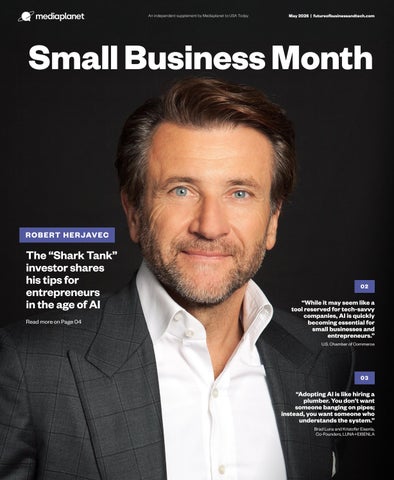
“While
“Adopting
Whether you’re a small business owner or someone considering starting your own venture, you’ve probably heard a lot about artificial intelligence (AI) and wondered how it fits into your daily operations. While it may seem like a tool reserved for tech-savvy companies, AI is quickly becoming essential for small businesses and entrepreneurs who want to save time, grow smarter, and stay competitive.
According to the U.S. Chamber of Commerce’s 2025 Empowering Small Business Technology Report, the adoption of AI among small businesses continues to rise. The use of AI by small businesses increased by 18% compared to 2024 and has more than doubled since 2023.
Over half (58%) of small businesses say they use generative AI. Those already exploring AI say it helps them:
• Level the playing field by providing access to the same data-driven insights and efficiencies once limited to larger competitors.
• Save time and resources by automating repetitive tasks like payroll, scheduling, and customer follow-ups.
• Unlock growth opportunities through smarter marketing, improved customer service, and more efficient supply chain management.
From hesitation to action
At the same time, many small businesses — particularly those in rural communities or led by first-time entrepreneurs — feel uncertain about how to get started. Training, trusted information, and tailored support can make the difference between hesitating at the starting line and running ahead with confidence.
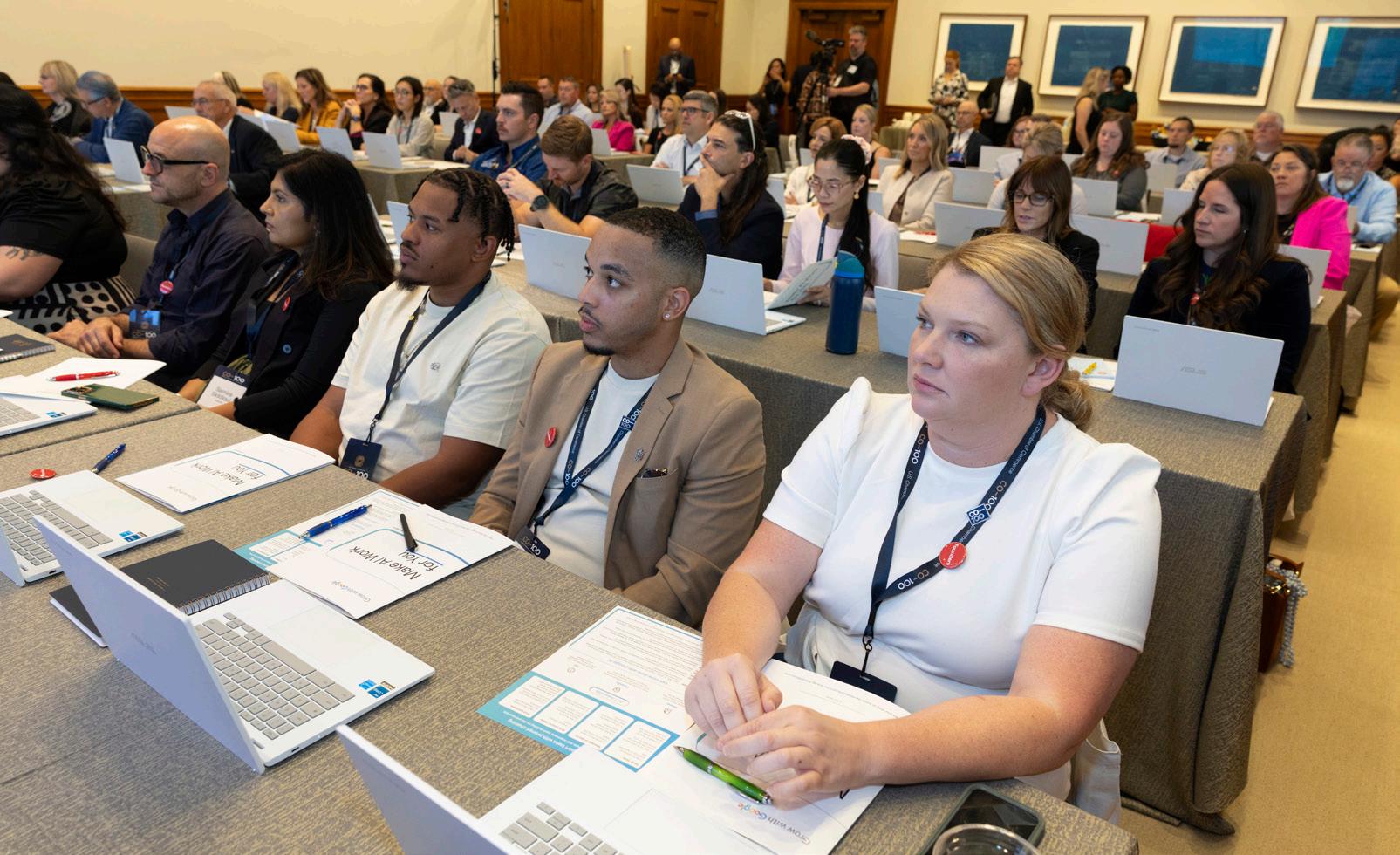
That’s why the U.S. Chamber of Commerce and the U.S. Chamber of Commerce Foundation, with support from Google, launched Small Business B(AI)sics, a national training initiative aimed at empowering 40,000 small businesses over the next three years to harness the potential of AI.
With funding from Google.org’s
AI Opportunity Fund, Small Business B(AI)sics equips entrepreneurs with the tools, knowledge, and confidence they need to leverage AI to grow their businesses and strengthen local economies. The support from Google is part of a series of investments the company announced for small businesses under the AI Works initiative to help advance AI education.
Small Business B(AI)sics offers free training, both in person and online, where business owners can connect directly with experts. The sessions are designed to deliver useful insights that entrepreneurs can apply right away to save time, grow revenue, and reach new customers.
By 2028, the U.S. Chamber, U.S. Chamber Foundation, and Google expect to reach tens of thousands of business owners nationwide, equipping them with both the skills and confidence to make AI work for them.
Whether it’s a Main Street shop owner learning to use AI-driven marketing or a family-run manufacturer streamlining operations, small businesses of every size and from every community have the chance to thrive in a changing world and open new doors of opportunity.
Small businesses can learn more about Small Business B(AI) sics at uschamber.com/co
Written by U.S. Chamber of Commerce

As AI disrupts the old order of business, smaller firms must rethink everything except their values.
Entrepreneurs face a rate of change few could have imagined five years ago. Even as economic uncertainty continues to rattle confidence, new, disruptive technologies like AI have reshaped how work gets done almost overnight. Longstanding norms around staffing, pricing, and productivity are crumbling. Years after the pandemic, its ripple effects persist, with employers and workers continuing to navigate tensions between pandemic-era hybrid work models and return-to-office mandates.
These tectonic shifts expose fault lines across the national business landscape, showing that not all firms are equipped to navigate what comes next. Grounded in both research and our own experience, we offer this bold prediction: Small firms are structurally better optimized than large ones for flexibility and are therefore poised to lead the next transformative chapter, if they are willing to question longheld assumptions.
Our own experience as a founder-led strategic communications firm also informs our belief that smaller firms are uniquely positioned to lead. Founded in 2012, we were focused on building a business resilient enough to survive. Many early decisions we made from necessity have become strategic advantages today.
Young talent is the accelerator for AI adoption
Pew Research Center data indicates that more than 50% of Gen Z workers use AI tools on the job. Indeed, interns and early-career subcontractors pushed us to adopt AI tools and other emerging platforms faster than we otherwise would have, with one intern offering an analogy that stuck: Adopting AI is like hiring a plumber. You don’t want someone banging on pipes; instead, you want someone who understands the system. Small firms must become the plumbers of AI. Clients will pay for mastery, not experimentation.
At the same time, we are clear-eyed about AI’s limits. We often compare AI to a block of marble. It can produce raw material quickly, but it still takes a human touch to shape something meaningful. Otherwise, quantity may increase, but quality will suffer.
Four principles of adaptation for entrepreneurs in 2026
As disruption accelerates, four principles help keep our firm ahead of the curve and may help others do the same.
1. Stay fluid. Rigidity kills small firms. According to Deloitte, adaptable businesses grow more than twice as fast as those clinging to legacy structures.
2. Take risks. Entrepreneurship, by definition, requires embracing greater-than-normal risk. Kauffman Foundation research shows founders who pivot early are far more likely to survive market shocks.
3. Break the box entirely. Incremental change is insufficient during technological upheaval. The fastest-growing agencies aren’t tweaking services; they are rebuilding core systems from scratch.
4. Align innovation with identity. Not every new tool belongs in every business. PwC research shows that most companies adopting technology without strategic alignment see little return on investment. Innovation should strengthen your brand, not dilute it.
The business world will continue to change at a pace that feels uncomfortable. However, for small firms willing to rethink outdated structures, embrace technology thoughtfully, and stay grounded in their core values, this moment represents an opening. The firms that thrive in 2026 will not be the largest or the loudest, but rather the most adaptable.
Written by Brad Luna and Kristofer Eisenla, Co-Founders, LUNA+EISENLA

“Shark
Tank” investor and entrepreneur Robert Herjavec discusses AI, ambition, and why growth is always a good problem to have.
When you look at the small business landscape today, what do you think is the biggest challenge owners are being forced to navigate?
There is an excitement in the air about starting a business. I was recently reading that new small business applications are up by 39%. That’s great. I think there are a couple of factors driving this: “Shark Tank” is one. We have democratized the starting of a business. We have shown people the questions to ask, and if the six of us can do it, literally anyone can.
Second: AI. This is the most powerful technology in our lifetime. You can be a programmer without knowing how to program; you can build scale and efficiency without a large staff. People are starting to realize how powerful AI is, even in traditional businesses. Of course, people are also waking up to the fact that AI is probably the greatest threat to white-collar jobs in our lifetime.
Every business has a heartbeat; it’s up to you as the owner to know what that is, and no two businesses are the same.
Business is so dynamic today that having multi-year plans is nearly impossible. There is too much change. Great entrepreneurs put in the resources their business needs just before it needs them. The other key trait is understanding that you need a team. Great entrepreneurs build great leaders; they aren’t solopreneurs.
For entrepreneurs trying to grow in uncertain conditions, what metrics or signals matter most when evaluating whether the business is actually healthy? Every business has a heartbeat; it’s up to you as the owner to know what that is, and no two businesses are the same. In my business, new client acquisition and cash flow were the key metrics. You could wake me up in the middle of the night, and I could tell you what those numbers were every day. What is the heartbeat of your business? There are lots of important numbers, but there are usually one or two metrics that are critical.
Many entrepreneurs are great at their product or service but struggle to scale the business itself. In your experience, what separates a strong operator from someone who is simply overwhelmed by growth?
First of all, being overwhelmed by growth is a good problem to have. In business, there are lots of bad problems. Growth is a good problem, but it can still be a problem. The trick is being one step ahead of growth.
During Small Business Month, what do you want more people to understand about the resilience, sacrifice, and economic importance of America’s small business community? Anyone can start a business. There is no virtue or talent you need to be born with. I have a classical English degree and built a massive cybersecurity business. The trick is to be realistic with your ambition. Everyone wants to be successful, but few people are willing to pay the price.
Starting and running a business is all-encompassing. At the beginning, there is no balance, there are no days off, and there are no vacations. Look very hard at yourself and ask whether that is the price you are willing to pay. There is nothing more satisfying than building something great for yourself, your family, and your team, but it is a lot of sweat equity.
Business is booming. But, if you’re ready to become one of the millions of business owners in the United States, go in with a plan and know the wealth of resources at your fingertips.
1. Lay the foundation
The Small Business Administration’s Office of Entrepreneurial Development aims to help more people have the opportunity to live the American dream. That dream often begins with the basics of deciding the best legal structure to operate your business; ensuring you have the right licenses and permits at local, state, and federal levels; and making sure that you have adequate amounts and types of insurance (and possibly bonding) to protect you and your venture from liability.
Once you have decided the legal structure of your business, it’s time to move on to your business plan.
2. Build a business model
Business plans come in all shapes and sizes, but one thing is clear: Business owners who methodically plan — and plan in a way that they are able to change course quickly if things don’t go well — are much more likely to succeed. A tried and true comprehensive business plan, which takes you through the process of conducting market research, analyzing competitors, developing financial projections, etc., is the path most traveled for business owners.
Alternatively, a new approach used by many tech-based businesses (one that is spreading to Main Street ventures) is the use of a business model canvas, which is a tool that provokes the entrepreneur to produce a minimally viable product rooted in insight developed from talking to potential customers. No matter which business plan you go with, always remember that planning makes kings.
3. Determine viability
One of your biggest hurdles in the early stages

of your business, especially during the first year, is to validate that you have a viable business model. A key tool to determine viability is a break-even analysis, which is available on the SBA’s website.
Additionally, you can find help walking through the analysis at one of several community resource centers around the country, such as SCORE, a network of volunteer mentors who provide expert assistance; the Small Business Development Center (SBDC), offices usually run by universities or community colleges that offer free business counseling and training; or the Women’s Business Center (WBC), a center that offers services designed for the unique obstacles faced by women entrepreneurs. Do a break-even analysis as early as possible, and update it regularly in your first year of operation.
4. Calculate capital needs
Additionally, startups often fail to understand their full capital needs. This can result in the entrepreneur running up personal debt as opposed to business debt. There are a variety of financing options available, so the entrepreneur should understand the various funding
options available before before accruing personal debt.
SCORE, SBDCs, and WBCs offer free advice to help entrepreneurs make well-informed decisions on financing their businesses.
5. Revisit your roadmap
Business ownership is a journey, and the first year of operating a venture is full of challenges, roadblocks, and the potential need to change course. Regularly visiting your roadmap in the first year and making key course corrections based on how the business is doing is of utmost importance.
One of SBA’s goals is to ensure that small business owners are aware of the counseling and training resources, and other technical assistance provided for free or a low cost to business owners. SBA’s hope is that more people will have the confidence, skills, and resources they need to succeed as small business owners, and we can continue to revitalize a spirit of entrepreneurship in our country.
Written by The U.S. Small Business Administration (SBA)
Industry leaders are turning away from the traditional group insurance model and instead offering employees ICHRA, which allows for more customizable health insurance.

Michele Grant, the CEO of Block and Tackle, felt fed up with the insurance options she was forced to offer her employees in 2022.
Every year, insurance costs rose for the small marketing strategy firm, and the back-end work for Grant did not outweigh the benefits for her employees.
“I remember Googling, ‘How can we offer personalized health benefits?’” Grant said. “There’s got to be a better way to do this.”
She quickly found her answer with an Individual Coverage Health Reimbursement Arrangement, or ICHRA, in which employers provide employees with a fixed monthly allowance to buy their own health insurance. Those employees then go to the individual market and purchase health plans that work for them.
This model, launched in 2020, is gaining popularity. More than 260,000 employees in the United States use this model, and the trend has grown 1,000% in the past six years, according to the HRA Council.
Employers like Grant are opting for this unique approach to insurance. Now, both employers and employees say it’s the insurance of the future.
now spending more on their healthcare than on their mortgages.
Grant had other issues with the group insurance model, especially the rigidity.
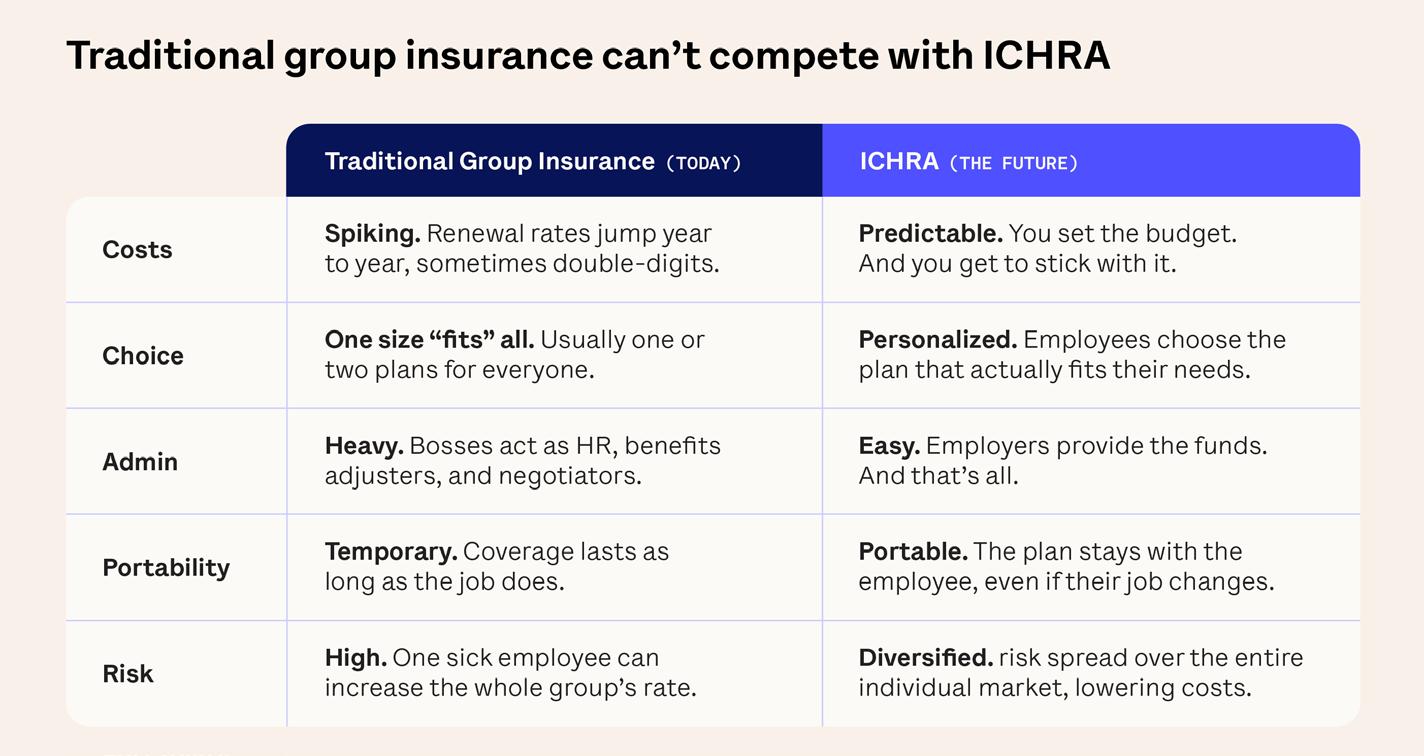
The employer group model is one-size-fits-all. It could be very traumatic for the one or two families who need specific medications or providers.
The traditional insurance model is dated
The employer-sponsored health insurance approach is the norm for most companies in the United States. In this model, employers typically offer two or three plans for employees to choose from during open enrollment.
There’s one big problem here: The options given to employees are broad and not tailored to individual health needs, even though employees have different health situations.
Louis DeStefano, the SVP of Growth at Oscar Health, an insurance company leading the movement toward ICHRA, says employers face the daunting task of choosing a small number of plans — often as many as three — to try to fit the needs of every one of their employees.
“The employer group model is one-size-fitsall. It could be very traumatic for the one or two families who need specific medications or providers,” DeStefano said. “Consumers don’t have a choice on how to spend their dollars.”
That’s normal in the group model. In fact, the average family premium for employer-sponsored health insurance topped $26,000 in 2025, according to KFF’s latest health benefits survey. In many cases, families are
“It’s very difficult to shop for group plans as an employer,” she said, “because you don’t know everybody’s doctors, and you don’t know everybody’s prescription profiles.”
Often, employees have to change doctors each year to find one in-network with the group plan.
Although Grant’s company, Block and Tackle, is located in Atlanta, a lot of her employees are based all over the country, especially after the pandemic. This only further complicated matters for her. ICHRA has solved all these issues — for both employees and employers.
Employees get to choose the health plan that is right for them
The greatest advantage of ICHRA is that employees can purchase plans that fit their needs on the individual marketplace.
Here’s how it works: Employers provide employees with a fixed monthly allowance to buy their own health insurance. This is comparable to the amount the employer subsidized in the traditional group model. The employee then uses that money to purchase plans that meet their health needs. Employees have access to benefit tools that help them choose from hundreds of plans to find what is right for them. There are even plans built around treating specific conditions such as diabetes or COPD.
“Say an employer wants to spend $75 on a Christmas gift. The employee picks what $75 gift they get,” Grant said. “It’s exactly the same.”
DeStefano noted that workers might be looking for plans that cover treatments for specific health concerns, such as diabetes, infertility, or mental health. For example, Oscar
offers Hello Meno, which allows women to purchase plans tailored to their needs during menopause. It also offers plans specifically for chronic conditions.
“If you want to buy a virtual physical therapy option, you can,” DeStefano said. “Those are some of the customizable, curated products around healthcare that you can buy under the ICHRA model. … It gives more power to the employees.”
Employers can customize ICHRA to their specific needs
Grant said she understands that some CEOs or small business owners might be curious about switching to ICHRA, but they might fear the unfamiliar and nontraditional insurance strategy. She said that shouldn’t be the case. Switching to ICHRA simplifies the benefit cycle for employers who can use one platform to handle all plan vetting, enrollment, onboarding, and payments for employees. It also takes employers out of a process they don’t want to control for their employees.
ICHRA also allows for a level of personalization not found in group insurance. Employers can customize eligibility by employee group (e.g., full-time, part-time, seasonal) and can even have 50 employees with 50 different plans across multiple states with no additional administrative headache.
“ICHRA is grounded in the marketplace and gives you the flexibility to treat everyone equally,” Grant said. “If you read up on it, you’ll realize how it’s a sensible, even more straightforward choice.”
Grant did point out, however, that while the process is easier for the employer, she had to provide internal education to help her workers understand what this new insurance model entails. But once everyone understood, all her employees were on board.
“I don’t get any complaints about our health benefits anymore,” Grant said. “I haven’t heard a complaint in two years.”
It is clear that employees are happier, healthier, and more productive because they are buying what is best for them.
While larger employers often do strive to offer multiple plan options and point solutions to meet the diverse health needs of their employee populations, they’re constantly playing Whack-a-Mole trying to support another new population where health costs are rising or more employees are being diagnosed.
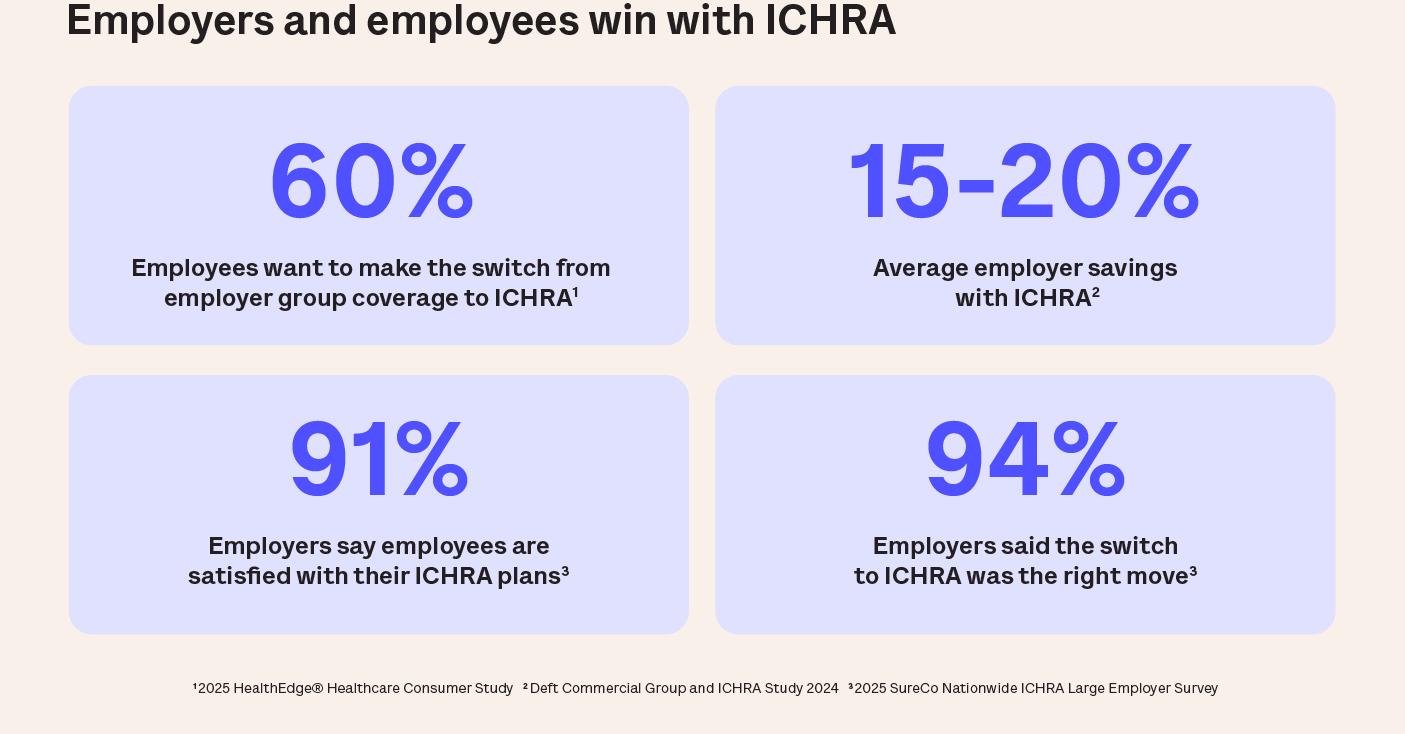
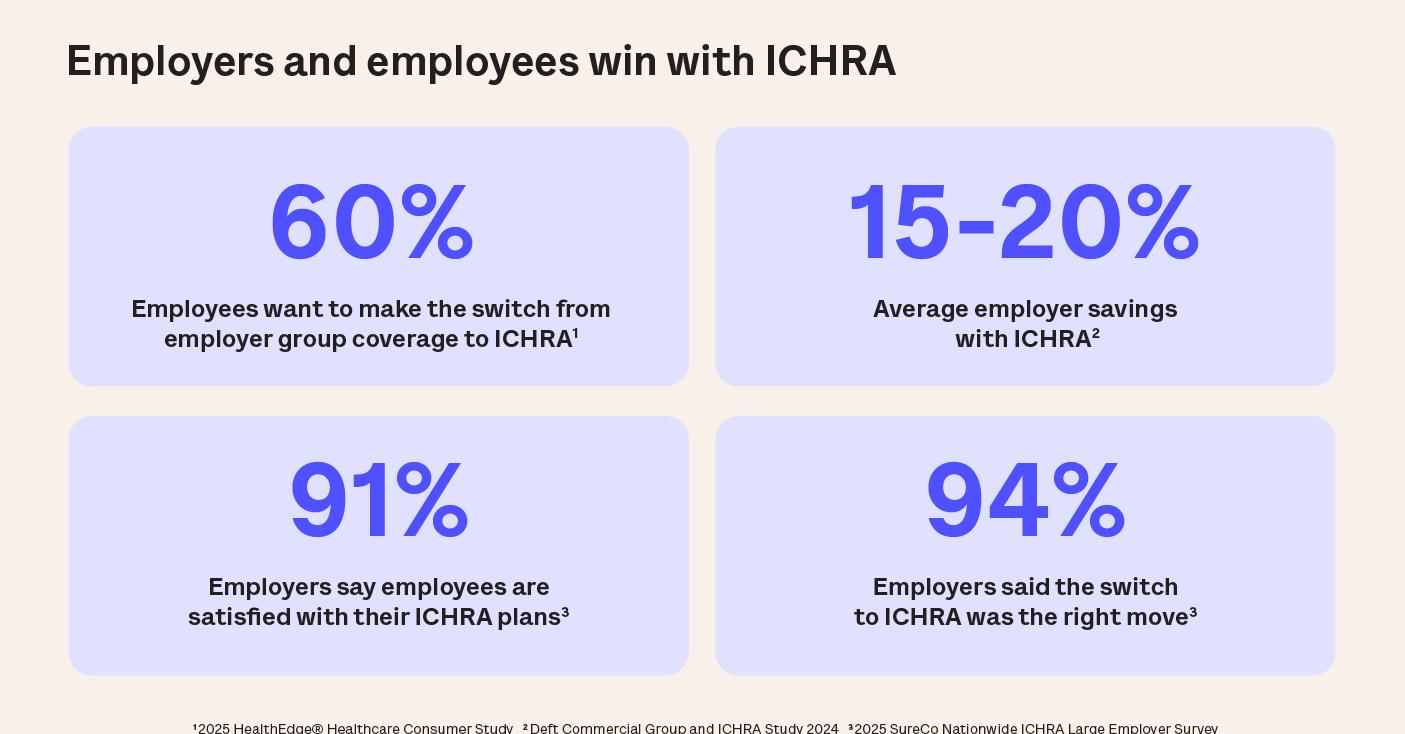
By giving employees choice about their health plans, employees can choose richer plans that will help ensure they get coverage for their higher cost conditions.
Employers can get started with Oscar If you’re an employer, like Grant, who wants to empower your employees and offer them options that better support them, you can start with Oscar.
All you have to do is head to Oscar’s website and answer a few questions, including the state your company is located in and the number of full-time employees you have. Oscar will handle the rest, and you’ll get quotes in under five minutes.
“As an employer, you have a responsibility to take care of your employees,” Grant said. “It starts with us as employers doing right by our employees.”
Written by Frank James