An independent supplement by Mediaplanet to USA Today
September 2025 | futureofpersonalhealth.com
Prostate & Urological Health 02
“Men around the world need to be willing to take off their armor, lower their defenses, and make themselves vulnerable.” Dr. Wayne Kuang, Founder, Man vs Prostate
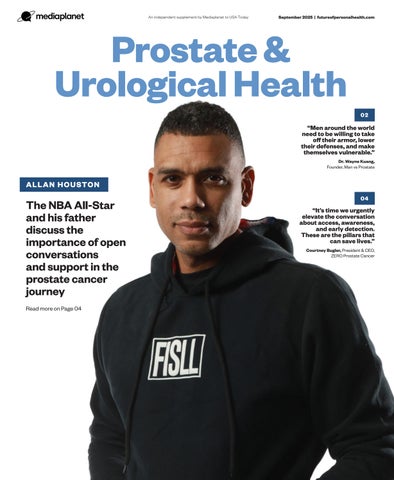
ALLAN HOUSTON
The NBA All-Star and his father discuss the importance of open conversations and support in the prostate cancer journey Read more on Page 04
04
“It’s time we urgently elevate the conversation about access, awareness, and early detection. These are the pillars that can save lives.” Courtney Bugler, President & CEO, ZERO Prostate Cancer
Man vs Prostate®: Breaking the Silence on Men’s Bladder and Prostate Health Founder of the Man vs Prostate campaign, Dr. Wayne Kuang urges men to drop the “I’m fine” façade and seek timely bladder and prostate care. What is the inspiration behind Man vs Prostate? Besides the brain, there’s only one other major organ that cannot be transplanted, and that’s the bladder. The Man vs Prostate campaign is about raising awareness that men need to be proactive about protecting their bladders and preventing late-stage disease.
These men suffer from “‘I’m fine’ syndrome,” when in truth they’re just living a miserable existence because of the cultural silence that we’ve instilled in this generation of men. Men around the world need to be willing to take off that armor, lower their defenses, and make themselves vulnerable.
Why is there such a stigma around talking about men’s urological health?
What advice do you have for men who are potentially experiencing a problem with their urination or bladder health?
In many cultures, too many men wake up and put on this armor of masculinity.
Be willing to take off that armor and have an open dialogue with your doctor.
Your non-replaceable bladder is too important to ignore. You only have one. In this modern era of medicine, there are so many new diagnostic and therapeutic options. You cannot manage what you don’t measure. If you are having problems, get your data. Many diagnostics can be done in the office or even at home. Engage your doctor with one simple question: #WhatAboutMyBladder? Together, we can achieve the vision of all men living their best lives — incontinence-free and catheter-free — when we prioritize bladder health.
INTERVIEW WITH
Dr. Wayne Kuang Founder, Man vs Prostate
Urology Workforce Shortages Are Here. What Can Be Done? If you feel like there’s a long wait to see a urologist, you aren’t alone. Urology is facing physician shortages, only anticipated to worsen with the aging population.
T
he average age of a patient seeking care from a urologist in the United States is 52.3 years, and 34% of all patients seeking urologic care are aged 65 and older. As the U.S. population ages, there is a growing need for urological services. However, there are not enough urologists to meet this demand, and this gap is only expected to widen in the coming years. There are several factors underlying the predicted urologist shortage in the United States. Notably, the urology workforce itself is aging. The average age of a practicing urologist is 55 years,
@futureofpersonalhealth
and nearly 30% are over the age of 65. Recent data have also shown that urologists suffer some of the highest rates of burnout compared to other medical and surgical specialties. This matters because burnout has been shown to contribute to increased medical errors, shortening of work hours, decreased productivity, and can lead to earlier retirement age. The American Urological Association is aware of the workforce shortage concerns, and there are several proposed solutions in place. First, there is an effort to expand the entire physician workforce with the Resident
@MediaplanetUSA
Physician Shortage Reduction Act, which would increase the number of residency spots by over 14,000 over the next seven years. Second, urology is actively employing a growing number of advanced practice providers, such as nurse practitioners and physician assistants, to help meet the growing patient demand. Urologists are working hard and dealing with high levels of burnout to keep up with the increasing demand for their services. Several solutions are in place, but it will take time to see improvements in patient access.
Contact information: US.editorial@mediaplanet.com
WRITTEN BY Michelle E. Van Kuiken, M.D. Assistant Professor of Urology, University of California, San Francisco
Please recycle
Publisher Aaron Palmer Managing Director Gretchen Pancak Production Manager Dustin Brennan Creative Director Kylie Armishaw Director of Client Success Taylor Daniels Designer Celia Hazard Copy Editor Taylor Rice Cover Photo courtesy of ZERO Prostate Cancer All photos are credited to Getty Images unless otherwise specified. This section was created by Mediaplanet and did not involve USA Today. 02
MEDIAPLANET
READ MORE AT FUTUREOFPERSONALHEALTH.COM
Sponsored
INTERVIEW WITH
Dr. Lucas Wiegand Reconstructive Urologist, Orlando Health
an Army veteran in Woodbridge, Va., and BPH patient. “I couldn’t be happier, and I would gladly make that choice again and advise everybody that I care about to do the same thing — even strangers.”
A new standard
Optilume: The Next-Gen BPH and Urethral Stricture Treatment A new, proprietary drug-coated balloon technology is creating a paradigm change in how two common urological disorders — BPH and urethral stricture — are treated.
U
rethral strictures — a common urological disorder — had 40-year-old Orlando resident Brett Hampton going to the bathroom 20 to 25 times per day. “I was building my entire life around this,” Hampton said. “I always had to make sure there was a bathroom nearby.” Hampton’s struggles may sound familiar to the many men with urological disorders that impact their quality of life. Anterior urethral strictures, or a narrowing of the urethra that restricts urine flow, can lead to a variety of medical problems. Another common condition as men age is enlarged prostate, or benign prostatic hyperplasia (BPH). Symptoms include an urgent need to urinate, nighttime urination, bladder damage, urinary tract infections, blood in the urine, incontinence,
and more. BPH affects 70% of men in their 60s and 80% of those in their 70s and beyond.
Transformative balloon technology Historically, BPH treatments included non-curative options, such as medications, which also come with side effects, or invasive surgeries with a higher risk of complication, recurrence, increased patient discomfort, and longer recovery times. Today, there is a paradigm-shifting option that is giving BPH and urethral stricture patients relief. Optilume®, a proprietary drug-coated balloon technology, is a minimally invasive treatment for men suffering from urethral strictures and BPH. The unique combination drug-device therapy technology has proven to be the standard of care for
READ MORE AT FUTUREOFPERSONALHEALTH.COM
peripheral vascular disease and is now being used as a safe, effective, and long-lasting treatment option in the urology space. It’s the only minimally invasive BPH treatment that doesn’t require cutting, burning, steaming, lasering, or a permanent implant, and it doubles flow rate (a higher rate than any other minimally invasive surgical therapy).
Typically quick relief and recovery The procedure can be performed in an office setting and patients typically see immediate relief, a quick recovery, and no impact on sexual function. “My wife and I sat down and chose very carefully something I thought was best for me, and was lucky enough to have the Optilume procedure available in my area,” said Worthington White,
For urethral stricture sufferers, historically, surgery (urethroplasty) was the only possible cure. However, there’s a severe shortage of providers trained to perform it. Other treatments provide only temporary relief, as strictures commonly return. Optilume provides a cure and is simple for physicians trained in dilation, providing a solution to the significant issue of access to care. Hampton, the Orlando resident who suffered from urethral strictures, connected with Dr. Lucas Wiegand, a reconstructive urologist with Orlando Health, who told him about the Optilume procedure. “Urethroplasty was the standard but there’s been a paradigm shift,” Dr. Wiegand said. “My standard of care now is an Optilume balloon up front because it has the same chance of success as urethroplasty but with almost no side effects.” Written by Laborie
If you or a loved one is experiencing symptoms of BPH or urethral strictures, contact a urologist for evaluation. To learn more about Optilume, scan the QR code below:
MEDIAPLANET
03
Prostate Cancer Shouldn’t Be a Death Sentence, but for Too Many, It Still Is Every 15 minutes, a man in the United States dies from prostate cancer. That’s nearly 100 lives lost each day to a disease that is one of the most treatable forms of cancer.
T
he tragedy isn’t just the number. It’s who is dying, and why. Too often, conversations about health outcomes stay confined to genetics or personal lifestyle. However, we cannot ignore the broader context: Where someone lives, what kind of care they can access, how much trust they have in the health system, and whether they’ve been offered routine screening all factor heavily into their chances of surviving a diagnosis. The unfortunate truth is that a person’s ZIP code, income level, and race can have as much bearing on their outcome as the stage of their disease. It’s time we urgently elevate the conversation about access, awareness, and early detection. These are the pillars that can save lives. Yet, across the country, far too many men don’t have access to high-quality, timely care. Many don’t even know they should be getting checked in the first place. This is why we launched Blitz the Barriers, with a goal of saving 100,000 lives by 2035. Through this initiative, we are bringing vital education, screening, and support directly to communities most impacted by prostate cancer. It’s not just about medicine; it’s about listening. It’s about showing up where the need is greatest, building trust, and ensuring no one falls through the cracks because of who he is or where he lives. Written by Courtney Bugler, President & CEO, ZERO Prostate Cancer
04
MEDIAPLANET
How Allan and Wade Houston Spark Generational Conversations on Prostate Cancer
Allan (left) and Coach Wade Houston, during their time as a player-coach duo at the University of Tennessee in the early ‘90s. Photo Courtsey of ZERO Prostate Cancer
NBA All-Star and ZERO Prostate Cancer Board member, Allan Houston and his dad, Coach Wade Houston, talk about their experiences with prostate cancer and discuss why open conversations about men’s health can save lives. Why is it important that we continue to talk about prostate cancer? Allan Houston: It’s a disease that affects African American men at a higher rate, given that we are 70% more likely to be diagnosed with it. So it’s important to understand that early detection can prevent a lot of the medical challenges that happen once it’s discovered. Getting tested early by the right professional is critical to living a full and healthy life if you are diagnosed.
Coach Wade, when you were first diagnosed with prostate cancer, how much of your journey did you share with your son? Wade Houston: Everything, because that’s how we’ve always been as a father and son. It made us that much closer. As African American men, we tend not to share medical issues with family members and friends, and that’s the worst thing you can do because you need that support. Especially when you have a son like Allan, it was so easy for me to share with
him and let him know that he had to get checked, since this disease is hereditary. I wanted him to be aware and get himself checked.
Allan, did you start doing PSA screenings because of your father’s diagnosis? AH: I was doing a lot of screenings, but I had a heightened awareness of when my prostate-specific antigen levels (PSA) started to go up. When he was diagnosed and going through the treatments, the thing that really stuck out to me was his willingness, commitment, and dedication for all of us. Thirteen years later, when I got diagnosed, we talked about all the layers of prostate cancer. You really don’t understand the mental, emotional, and spiritual dynamics that come into play until you go through it yourself.
How can we continue having an intergenerational discussion and break down barriers that Black men face when talking about their health? WH: I think it’s important to
educate Black men about the fact that we’re all susceptible, not only to prostate cancer, but also to other diseases. We can’t be afraid to share experiences, because for such a long time, it was taboo for Black men to talk about these things. We need to continue educating Black men that prostate cancer is a disease that’s curable and can happen to a lot of people, and it’s nothing to be ashamed of. I think the thing that scares most men is the process of checking it, because it’s an invasive process, but you have to say, “I don’t care about that; this is about me and is for my kids.”
What advice do you have for loved ones of men recently diagnosed with prostate cancer? AH: It’s a very vulnerable time for a man to be in this position. Making sure that your partner feels supported, strengthened, and lifted up when he feels down is one of the most important parts of the recovery process.
READ MORE AT FUTUREOFPERSONALHEALTH.COM
Sponsored
A PSA on PSA: Take the Pledge This September What does PSA stand for? It’s short for both a “public service announcement” and an important test for men. If you’re not familiar with the second acronym, it’s time to learn more and share that knowledge with your friends and family.
I
n medicine, PSA stands for prostate-specific antigen. It’s a protein produced by the prostate gland that can provide helpful information about prostate health, something all men should pay attention to. One in eight men will be diagnosed with prostate cancer, but when detected early, it’s often highly treatable. Many people go on to live cancer-free after treatment. Among friends and family, we like to talk about the weather, sports, and favorite TV shows. Prostate cancer doesn’t typically make the list of dinner table conversations. This year, we want to change that.
prostate cancer screening with their doctors starting at age 50 or at age 40 for high-risk individuals. While the average age of diagnosis is 67, 4 out of every 10 cases of prostate cancer are diagnosed in men younger than 65. So, if you haven’t discussed prostate cancer screening with your doctor, you Probably Should Ask. Be sure to talk to your loved ones, because for every pledge made at PSAonPSA. com, Cleveland Diagnostics will donate to ZERO Prostate Cancer to support patient education and resources.
Take the PSA Pledge
Awareness is the first step. Better testing is the next. PSA tests have been a frontline screening tool for decades; however, they don’t tell the full story. These tests can detect if someone’s PSA levels are high, but they don’t reveal why. Sometimes, the cause is benign: for example, certain medications, exercise, and infection can elevate PSA. Other times, it’s a sign of cancer. The good news is that prostate cancer screening is advancing. A blood test called IsoPSA is available to address the shortfalls of the PSA test. Instead of only measuring the amount of
In honor of Prostate Cancer Awareness Month in September, Cleveland Diagnostics has proudly relaunched its PSA on PSA campaign. The campaign has adopted a powerful new call: Take the PSA Pledge. In putting forth the PSA Pledge, we’re challenging folks to talk about prostate cancer screening with their doctor, family, and friends. We can’t readily change the prevalence of prostate cancer, but we can work together to make sure it’s caught early. The American Cancer Society recommends men to discuss
Patient-friendly advances in prostate cancer testing
READ MORE AT FUTUREOFPERSONALHEALTH.COM
A Public Service Announcement on the Prostate-Specific Antigen Test
Prostate cancer doesn’t typically make the list of dinner table conversations. This year, we want to change that.
PSA in the blood, IsoPSA looks at the PSA proteins’ structure. This helps determine if the PSA proteins were made by healthy cells or cancer cells. This additional insight helps doctors better
determine the path forward. It can also help men avoid unnecessary, invasive follow-up tests like biopsies. The world of cancer screening can be complex, but this September, our ask is simple: Take the pledge. Start the conversation.
Written by Chris Fox, VP, Marketing, Cleveland Diagnostics
Visit PSAonPSA.com to learn more
MEDIAPLANET
05
Prostate Treatment and Urinary Leaks: Causes, Care, and Cure
N
While prostate cancer treatments like surgery and radiation are highly effective, they can bring about side effects like urinary incontinence. Understanding why incontinence occurs and how to manage it can improve both physical recovery and emotional well-being.
early all men experience some degree of incontinence after surgery, particularly after catheter removal. Many regain control within six months, but about 6-8% continue to experience significant leakage one year later. Recovery varies by age, overall health, surgical approach, and dedication to rehabilitation. A combination of exercises, lifestyle changes, medication, and, if needed, surgery can improve bladder control and quality of life: • Pelvic floor exercises (Kegels): Strengthen muscles around the bladder and urethra. Doing them before and after surgery can speed recovery. • Lifestyle changes: Stay at a healthy weight, avoid heavy lifting, limit caffeine and alcohol, and try bladder training techniques. • Medications: Drugs like alpha-blockers or antimuscarinics may relieve symptoms, especially urge incontinence. • Surgical options: If incontinence continues after 6-12
months, surgical intervention may be necessary. This may include a male sling (a mesh sling that supports the urethra, ideal for mild to moderate stress incontinence) or an artificial urinary sphincter (an implanted device with a pump in the scrotum allows control of urination — highly effective for moderate to severe incontinence). Many men are caught off guard by the reality of urinary incontinence after prostate cancer treatment. It’s not just a physical issue; it impacts confidence, relationships, and daily life. That’s why it’s so important to educate and prepare men before treatment begins. The National Association for Continence (NAFC) recommends early screening and open communication with your care team, which can reduce side effects and lead to better outcomes. When men know what to expect and are equipped with tools and support, they’re empowered to take control of their recovery and quality of life.
WRITTEN BY
Sarah Jenkins Executive Director, National Association for Continence
Addressing the Impact of the Growing Prostate Cancer Crisis on Black Men
P
More men are now diagnosed with advanced prostate cancer because they forgo screening and only get tested when symptoms appear.
rostate cancer is the leading cause of cancer among American men, relative to any other major cancer. Overall, 1 in 8 men will develop the disease during their lifetime. The burden is heavier on Black men, who are diagnosed at a rate more than 70% higher and who are more than twice as likely to die from prostate cancer as white men. One in 6 Black men will face the disease. When prostate cancer is found while it is still inside the prostate, the fiveyear survival rate approaches 100%. Once the cancer spreads to distant organs or bone, survival drops sharply; only about 37% of men live 5 years, and 06
MEDIAPLANET
fewer than 1 in 5 live 10 years. However, with the increasing number of therapeutic options, men with metastatic prostate cancer are living longer. According to estimates from the American Cancer Society, more than 3 million men are living with prostate cancer as survivors. With Black men suffering a death rate more than twice that of all other men, managing survivorship is critically important following treatment. Here are four steps the Prostate Health Education Network suggests men should take: 1. Monitor your PSA. Understand what your PSA level should be following treatment with your doctor, and establish a schedule for regular
PSA testing. Early detection of a cancer recurrence is critical. 2. Knowledge is your best defense. Join a support group of survivors for in-person or online meetings and educational sessions to stay abreast of new treatments and to learn from other survivors. 3. Consider clinical trials. If you have a cancer recurrence, consider clinical trials as a treatment option. They could be your best option and there could be significant cost benefits. 4. Spread the word. Encourage fathers, brothers, sons, friends, and church members to get informed and get screened.
WRITTEN BY
Thomas A. Farrington President, Prostate Health Education Network
READ MORE AT FUTUREOFPERSONALHEALTH.COM
Sponsored
The Hidden Cost of Stress Urinary Incontinence on Men’s Lives
INTERVIEW WITH
Dr. Melissa Kaufman Functional & Reconstructive Urologist, Vanderbilt University Medical Center
Stress urinary incontinence (SUI) is a common consequence of prostate surgery, especially after radical prostatectomy. According to Dr. Melissa Kaufman, a leading reconstructive urologist at Vanderbilt University, its impact on men’s quality of life is profound — and often underestimated.
“O
ncologic control is the top priority in prostate cancer surgery,” Dr. Kaufman explained. “But continence and erectile function are next, and when continence is compromised, the effects are anything but benign.” Prostate removal results in urethral shortening and bladder neck widening, which may compromise urinary continence and contribute to the development of stress urinary incontinence. While some men recover naturally, many live with leakage for years — sometimes up to five years before seeking help. Why the delay? “Men often hide it,” Dr. Kaufman said. “They don’t want to disappoint their oncologist or discuss something so personal. But during that time, they pay a heavy price — financially, emotionally, socially.”
A constant, inescapable burden Urinary leakage is not just a physical inconvenience — it’s a daily reminder of cancer and its aftermath. “It’s a chronic reminder: I’ve had cancer. Every move brings leakage. It erodes confidence, self-image, and a man’s sense of masculinity,” Kaufman noted. The condition forces lifestyle changes. Men restrict fluids, wear dark clothing to hide stains, and carry extra pads. Many withdraw from activities they once loved — golf, hiking, swimming — because bathrooms aren’t nearby. Even small routines change: “From the second he wakes up, it’s a reminder — bed protection, pads, diapers. And at work, even changing a pad can become stressful.”
Isolation, anxiety, and strain on relationships Dr. Kaufman frequently sees depression and anxiety tied to SUI: “Men stop doing things they love. They pull away socially, which breeds isolation and weight gain. Intimacy suffers, and that affects partners deeply.” READ MORE AT FUTUREOFPERSONALHEALTH.COM
Family life is disrupted, too. Activities with children or grandchildren — like going to the lake — become off-limits. “The condition impacts everyone in the household because daily routines change. It’s not a solitary problem — it’s a shared challenge,” she said. Another overlooked consequence is the financial toll: pads, extra clothes, medical visits, lost work time, and even career changes. Men in physically demanding jobs or highstakes roles feel it most. “I’ve had CEOs terrified of leaking during presentations,” Dr. Kaufman said. “Factory workers apply for disability because they can’t manage their pads on the job.”
The road back Despite the challenges, Dr. Kaufman stresses there is hope. Surgical options — such as slings and artificial urinary sphincters — can restore dignity and function. “When men finally have surgery, the most common thing I hear is, ‘I wish I had done this years ago.’” An exciting development is the ARID II IDE study, sponsored by Levee Medical, now
enrolling patients at up to 30 U.S. clinical sites. This pivotal trial evaluates an investigational device, the Voro Urologic Scaffold, a bioabsorbable implant designed to support the bladder neck and preserve urethral length during radical prostatectomy. The study’s objective is to compare the safety and effectiveness of Voro versus standard care in reducing stress urinary incontinence, with outcomes focused on continence rates and quality of life. For men facing prostate surgery, this research represents hope for fewer complications and faster recovery. Dr. Kaufman’s advice: “You can regain your quality of life and your dignity. You’ve survived cancer — don’t suffer in silence. There are solutions, and research is advancing fast.” Written by Levee Medical
To learn more, visit clinicaltrials.gov and search ARID II.
MEDIAPLANET
07
08
MEDIAPLANET
READ MORE AT FUTUREOFBUSINESSANDTECH.COM