An independent supplement by Mediaplanet to USA Today
October 2026 | futureofpersonalhealth.com
Men’s Mental Health 03
“We’re just scratching the surface of the impact we can make. We’re not stopping here.” Stephen Smith, Co-Founder and CEO, NOCD
10
“Sharing my story changed the trajectory of my life.” Kevin Love, NBA Champion and Founder, Kevin Love Fund
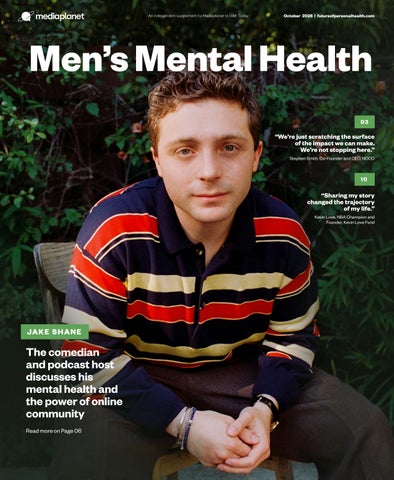
JAKE SHANE
The comedian and podcast host discusses his mental health and the power of online community Read more on Page 06
Howie Mandel Opens Up About OCD (and Why It’s Important for Men to Address Their Mental Health) Decades ago, Howie Mandel was almost at a standstill on “The Howard Stern Show.” The famed Canadian funnyman didn’t want to open the studio door as he was agonizing over touching the handle that a guest had previously touched, a typical phobia associated with people who are diagnosed with obsessivecompulsive disorder (OCD).
T Howie Mandel | Photo by Brian Smith
I knew that I wasn’t happy, and I knew that my life, internally, was a nightmare, but I didn’t know that it was something that was diagnosable, or had a title, or had a way to cope with it. I just thought it was me.
@futureofpersonalhealth
hey thought it was funny,” Mandel said. “They were kind of torturing me. If I grabbed a tissue, they’d take the tissue away from me. I thought we were on a commercial break, and I started having a panic attack, and I said, ‘No, Howard, really. I’ve just been diagnosed with something called OCD, and I’m medicated. If you don’t open the door and let me out right now, I’m probably going to pass out, and you’re going to have to call 911.’ I went out into the hallway and was appalled by the fact that they had still been broadcasting!” Research suggests 1 in 40 adults have OCD or will develop it at some point in their lives. OCD is a disorder in which a person experiences recurrent and unwanted ideas, urges, or thoughts, and must perform a compulsive action to get rid of those thoughts. For Mandel, the compulsions had always gnawed at him. “I wasn’t diagnosed until my late 40s,” he said. “I knew that I wasn’t happy, and I knew that my life, internally, was a nightmare, but I didn’t know that it was something that was
@MediaplanetUSA
diagnosable, or had a title, or had a way to cope with it. I just thought it was me.”
The viability of going forward The difficulties of the mind are being taken more seriously now, and help is around. Mandel points to digital-native resources like NOCD, which aims to make OCD treatment accessible, affordable, and convenient. As Mandel added, “I wish people would take care of their mental health the way we take care of our dental health. Whether you have an issue or not, you go in a couple of times a year and get a cleaning and an X-ray. You don’t even know if you have a cavity. You don’t know that something’s wrong until an expert really takes a look at you. “Mental health is not always part of our curriculum, and it’s not even taken care of financially equally by insurance companies. Yet, a healthy mind is paramount to having a healthy body, too.”
Written by Omar Sommereyns
Contact information: US.editorial@mediaplanet.com
Please recycle
Publisher Emma Goldberg Business Developer Isabella Rawls Managing Director Samantha Taylor Production Manager Dustin Brennan Creative Director Kylie Armishaw Product Strategy & Growth Director Joelle Hernandez Copy Editor Taylor Rice Cover Photo by Carly Sharp All photos are credited to Getty Images unless otherwise specified. This section was created by Mediaplanet and did not involve USA Today. 02
MEDIAPLANET
READ MORE AT FUTUREOFPERSONALHEALTH.COM
Sponsored
The Proven OCD Treatment Model Changing Mental Healthcare A severe onset of obsessive-compulsive disorder (OCD) took Stephen Smith from starting quarterback at his Texas university to housebound in six months. He saw provider after provider, cycling through incorrect diagnoses, before learning the root of his struggle.
A
fter his diagnosis, Smith faced another obstacle: The only therapist in his city trained in exposure and response prevention (ERP) — the gold-standard treatment for OCD — charged $350 per session and had a seven-month waitlist. With family support, Smith eventually received effective treatment, returned to college, graduated, and resumed his football career. His struggle was not unusual. Research suggests that about 4% of people have OCD, yet the American Psychological Association reports that many wait 13 years to receive treatment. Even when their OCD was recognized, they faced high costs and long wait times, and once therapy began — if it began — they were left alone to manage their symptoms between sessions. These were devastating barriers to care for a condition linked to high rates of suicide and premature death. Smith attributed these challenges to a broken system and founded NOCD while still in college. It began as a mobile app with therapeutic exercises, progress tracking, and support between sessions. As the app gained traction and proved there was an opportunity to revamp OCD treatment, Smith partnered with co-founders Anil Vaitla, Ilyas Patanam, and Larry Trusky, along with Chicago-based investor 7wire Ventures. Together, they added peer communities to the NOCD app and studied its effectiveness with Columbia University researchers. But users needed more. “People loved the app, but they told us they couldn’t find an OCD specialist to help them use it — even when they
could, wait times and high costs kept them from accessing care,” Smith recalls. NOCD responded by building a clinical leadership team and hiring, training, and managing therapists to specialize in OCD. After thousands of meetings with payers, leading insurers began covering NOCD Therapy, often reducing out-ofpocket costs for covered members to just a copay.
Specialty access, at scale Today, NOCD is the world’s leading specialty mental healthcare company. 1,500+ fully employed, rigorously trained, and thoroughly evaluated NOCD Therapists deliver millions of sessions annually, 147 million Americans can access NOCD Therapy using insurance, and most members start within seven days. This growth was enabled by Noto, the operating system that powers NOCD. “Delivering treatment for 10 members is different than 100,000,” remarked Anil Vaitla, NOCD’s chief technology officer. A Journal of Medical Internet Research study — the largest of its kind to date — found NOCD Members saw substantial results in under half the therapy time of traditional OCD treatment. A later study, also the largest of its kind to date, demonstrated similar findings with pediatric patients. NOCD’s treatment has a profound impact on the overall healthcare landscape. An Optum Advisory study found NOCD Therapy saved $3,430 in healthcare costs per member per year, and studies from Cigna, HCSC, and NovaOne showed similar results. “When people with OCD get specialized care, the whole person gets better, leading to fewer unnecessary medical
READ MORE AT FUTUREOFPERSONALHEALTH.COM
Photo by Monkey Business (Adobe Stock) | Photo courtesy of NOCD
expenses and downstream health problems,” said Ilyas Patanam, NOCD’s chief growth officer. “We’ve never seen growth at this scale that directly saves lives.”
A new model for mental healthcare NOCD has built a new specialty mental healthcare system, offering accessible, affordable, and convenient treatment with support between sessions. When people need other forms of care, NOCD coordinates with external providers for medication management or more intensive treatment. “Every day our members show us that conquering OCD is possible,” said President Larry Trusky. “It’s our job to get them the right care, at the right time, in the right setting.” In 2023, NOCD launched #KnowOCD with Howie Mandel, a national awareness campaign challenging misconceptions about OCD and encouraging earlier treatment, that has reached tens of millions of people worldwide. “We’re just scratching the surface of the impact we can make,” Smith said. “We’re not stopping here.”
INTERVIEW WITH
Stephen Smith Co-Founder & CEO, NOCD
Learn more at NOCD.com
Written by Kristen Castillo MEDIAPLANET
03
Sponsored
How a Little-Known Depression Treatment Is Offering Hope to Patients Depression looks different for everyone, and so each case requires unique care. One treatment many depression patients may not have heard about is transcranial magnetic stimulation (TMS).
I
n 2008, the U.S. Food and Drug Administration authorized NeuroStar TMS as a treatment for major depressive disorder after not experiencing improvement from a prior antidepressant medication. Insurance often covers treatment for individuals with treatment-resistant depression who have tried at least two antidepressant medications without significant relief. Geoffrey Grammer, M.D., a psychiatrist and the chief medical officer of Greenbrook Mental Wellness Centers, which administers NeuroStar TMS, noted that real-world data shows 83% of patients saw significant improvement in their depression symptoms with treatment.1 “It’s a paradigm changer,” Grammer said. TMS uses magnetic pulses to stimulate brain circuits involved in mood regulation, Grammer said. Treatment happens over seven to nine weeks, with 36 sessions that each last about 20 minutes. Patients can return to normal activities after treatment. The most common side effect is a temporary headache. “My family noticed I was laughing and smiling more [after Neurostar TMS],” said 23-year-old patient Liam Donovan. “I became more active. I was coming out of the hole of depression. After treatment, my dad told me that I looked good and sounded better.”
Breaking the Silence: Men’s Mental Health Deserves Attention and Action Although public awareness about mental health is growing, many men still struggle to access help due to lingering stigma and deeply rooted societal expectations.
C
ultural definitions of masculinity often place value on emotional toughness, independence, and quiet endurance. While these qualities can be strengths, they also discourage emotional openness and create an atmosphere where vulnerability is viewed as a flaw. This can prevent men from speaking up about mental health challenges, leading to symptoms being overlooked or left untreated. Recognizing and addressing mental health symptoms early can be life-changing. When warning signs are spotted early, people are more likely to access the right support. Early intervention not only reduces suffering but also helps prevent mental health crises from escalating into emergencies.
References 1. Sackeim HA, et al. (2020). Clinical Outcomes in a Large Registry of Patients with Major Depressive Disorder Treated with Transcranial Magnetic Stimulation. J Affective Disorders, 277(12):65-74. Visit NeuroStar.com for prescribing and safety information.
04
MEDIAPLANET
Written by Pierluigi Mancini, Ph.D., President and CEO, Multicultural Development Institute; Chair of the Board, Mental Health America (MHA)
Dr. Mark Hyman: Fix Your Body to Fix Your Brain Functional medicine physician Dr. Mark Hyman explains why men’s mental health depends on taking care of their physical health. How can we encourage men to view therapy as a proactive part of overall wellness rather than a last resort?
connection on the calendar the way you’d schedule a workout.
We encourage it by reframing what therapy is — not a rescue for men who are broken, but maintenance for a system worth protecting, the same way we already treat exercise and nutrition.
Why do you believe movement is one of the most effective tools for supporting mental health?
Written by Melinda Carter
Find a NeuroStar TMS provider near you:
To support early action, Mental Health America (MHA) provides a series of free, anonymous online screening tools that help people better understand what they’re experiencing. For men who may feel hesitant to talk about their emotions, these tools offer a safe, pressure-free first step toward gaining clarity and confidence about seeking help. To truly move the needle, we must also create spaces — whether at home, work, or in the community — where men feel safe discussing their emotional struggles. When we shift the narrative, we not only help men live healthier lives; we help our entire society thrive.
Why is human connection so important, and what steps can men take to build stronger support systems? Chronic loneliness is a physical stressor, with some data putting isolation on par with smoking. We’re wired for tribe, and when that wiring is starved, the brain suffers along with the body. As for practical steps, the trap for men is that we build friendships around doing, so when the activity ends, so does the contact. Be deliberate. Put
Exercise steadies blood sugar, balances hormones, cools inflammation, and boosts dopamine, serotonin, and endorphins. That’s the exact chemistry antidepressants try to nudge, except it does it naturally and immediately. There are head-to-head studies where exercise performs as well as medication for mild to moderate depression.
INTERVIEW WITH
Mark Hyman, M.D. Co-Founder and Chief Medical Officer, Function Health
READ MORE AT FUTUREOFPERSONALHEALTH.COM
Why Do Men Have Such a Hard Time Asking For Help? Dr. Gregory Scott Brown, chair of the American Psychiatric Association’s Council on Communications, explains why men hesitate to seek mental health care and how to start the conversation. Are signs of depression in men different from what women experience? Changes in sleep, energy, and appetite are often seen in depression, but there are certain signs — for instance, irritability — that are seen more commonly in men.
How do you know when it’s time to reach out for help with your own mental health? I would never tell someone who’s on the fence about talking to a mental health professional not to do it. If you’re thinking about reaching out to a mental health professional, that’s the time to do it.
If there’s a man in your life who you’re concerned needs to talk, how do you get that conversation started? Gregory Scott Brown, M.D. | Photo courtesy of American Psychiatric Association
Think about inviting them out for lunch or coffee. Connecting with them in a relaxed
atmosphere can help them open up. Sharing your own story can also be very powerful. I can’t tell you the number of times I’ve met with a friend and shared my own experience as a human who has anxiety, just like 40 million-plus other Americans. Once I share my own story, it helps them feel more comfortable sharing theirs.
Where should you turn for good information about mental health? It’s important to look for credible sources. One place to start is mentalhealthcareworks. org, a program of the American Psychiatric Association Foundation. If you or a loved one is in crisis, dial 988. The national suicide and crisis hotline is always available at 988lifeline.org, where you can call, text, or chat 24/7/365.
Sponsored
Even a Diagnosis Isn’t Enough: Why So Many Men Go Untreated for Mental Illness For many men, a diagnosis finally puts a name to what they have been feeling, but the real challenge often begins right after.
A
diagnosis can feel like relief. The exhaustion, the irritability, the days that felt heavier than they should have, finally have an explanation. Yet for many men, that clarity does not lead to professional care. About 20% of men experience a mental illness annually,* and even with a diagnosis confirmed, only 4 in 10 receive professional care each year.** From diagnosis to treatment, what explains the shocking drop-off? Stepping out of your comfort zone to ask for help can be hard enough. Maybe it’s cost. Maybe it’s the appointment wait. Maybe it’s a provider list that hasn’t been updated. Even worse, sometimes
a diagnosis arrives without a next step, not because no one cares, but because lapsed credentials, missed license expirations or a billing issue pulled a provider off the roster before anyone caught it. What closes that gap has little to do with the person and everything to do with the systems that should be supporting them. “As a clinician, I know that a diagnosis only matters if it leads to care,” said Elena Freydin, DNP, APRN, ANP-BC, MBA, chief compliance officer at Lynn Community Health Center. “And as a compliance leader, I also know that reliable systems, clear accountability, and appropriate oversight are what help turn that diagnosis
READ MORE AT FUTUREOFPERSONALHEALTH.COM
into timely treatment and keep patients from being lost along the way.” Somewhere between a diagnosis and getting treatment, care depends on things patients never see: the credentialing, compliance, and oversight that decide whether a provider is ready to see them. That is the behind-the-scenes work Ntracts helps behavioral health organizations do, closing that gap so a diagnosis leads to treatment, not another dead end.
Scan here to learn more:
Written by Ntracts *SAMHSA, National Survey on Drug Use and Health, 2024. **1199SEIU Benefit Funds, “Men’s Mental Health,” 2024 (data from SAMHSA and CDC).
MEDIAPLANET
05
OCD is a very isolating disorder, and it made me feel very alone, so I just hope that opening up conversations about it makes someone else feel less alone.
Jake Shane | Photo by Carly Sharp
Jake Shane Hopes His Openness Helps Others Feel Less Alone Comedian and “Therapuss” host Jake Shane opens up about managing his mental health through movement and community. Many men feel pressured to hide their emotions and push through difficult moments. Can you tell us about some of your early childhood experiences with mental health? As a kid, I came from a very supportive family. I never kept it quiet. I was always like, “I’m so anxious,” and that felt like a normal thing to say. I never thought there was something bad about it, and I think that was because of my parents. I finally got on medication when I was around 20, and that was because it started to impact my work. My dad was super against medication, and I always kind of listened to him. Then I started to notice that it was affecting a job that was paying for my life. When it started affecting something I cared about that 06
MEDIAPLANET
was also making money, I was able to snap out of it and be like, “OK, I do need to go on medication.” Luckily, my parents were receptive.
my body, I know that, scientifically, it makes me feel better. So, even if I don’t feel better, I can be like, “Well, I did this today,” and feel better about something.
You’ve been very open online about your experience with anxiety and obsessivecompulsive disorder (OCD). What did it look like to manage those challenges, and what have you found helpful in becoming comfortable with your mental health?
What has it been like to share personal parts of your life so publicly, and how has being open about those experiences shaped your relationship with your audience?
In terms of what it looked like, I ended up having a lot of mental breakdowns all the time. Every day is different. Today, in therapy, I wanted to log off after 10 minutes, but some days I can speak the whole time. Some days are lazy. Some days are really hard. Something that’s really helped me is working out. When I move
It’s definitely really refreshing to talk about. If I’m ever going through something, then I can speak about it online. It’s just as much for me as it is for someone else. When I’m able to talk about a compulsion that I have and have other people be like, “Oh, I also deal with that,” it makes me feel a lot better. It makes me feel very close to the people that watch my stuff. It’s like, “Oh, well, I
don’t have to tell them about this because they already know.” It feels like they’re my friends.
You’ve built a platform that reaches millions of younger people. Beyond comedy and entertainment, what impact do you hope your openness about mental health leaves on the people who follow your journey online? I just hope that people feel less alone. I was very confused as a kid. I didn’t know what I struggled with for a very long time, and there weren’t many people in the public eye yet who would talk about OCD, which is what I struggled with the most. OCD is a very isolating disorder, so I just hope that opening up conversations about it makes someone else feel less alone.
READ MORE AT FUTUREOFPERSONALHEALTH.COM
Sponsored
Proactivity and Resilience in Personal Health — an Overlooked Indicator of Toughness As patient advocates leading America’s largest kidney patient organization, we are privileged to share insights into how to better manage your health and fulfill your responsibilities to your family, friends, community, and employer.
W
e each manage complex cardiac, kidney, and metabolic conditions and are survivors of multiple cancers. Between the two of us, we have managed kidney disease for 75 years, experienced weakened immune systems and organ failure, undergone dialysis, and received a kidney transplant. Across our health journeys, we have learned what it takes to be psychologically and physically tough. Every morning, we are reminded of life’s fragility and our good fortune to be alive. We take ownership of our prevention and treatment regimens to avoid a medical crisis. We recognize how American medical
research has produced lifesaving diagnostics, drugs, and devices. We have been in the arena, engaged in battles to preserve our health and avoid the potential loss of independence and financial stability — so please consider the following: 1. Be proactive about your health through exercise, a balanced diet, and avoidance of all addictive substances. 2. Choose board-certified and licensed medical experts who listen to your care preferences. When medical professionals fail to meet your standards, fire them. 3. Schedule yearly appointments for physicals and tests. Your calendar is
READ MORE AT FUTUREOFPERSONALHEALTH.COM
one of your most powerful tools — use it to prioritize your health. 4. Manage pre-existing conditions and any new diagnoses with the level of excellence you would demand of any independent contractor. 5. Embrace artificial intelligence to gain greater knowledge of your medical conditions and pose questions to your care team.
To learn more, visit AAKP.org.
Written by Edward V. Hickey, III, President, and Paul T. Conway, Vice President and Chair of Policy and Global Affairs, American Association of Kidney Patients (AAKP)
MEDIAPLANET
07
When every second counts, Solari delivers. Your partner in 988 and crisis response. Connect with our team.
solari-inc.org
Sponsored
The Missing Link in America’s Crisis Response System When someone reaches out to 988, the national Suicide & Crisis Lifeline, every second counts.
A
s Justin Chase, CEO of Solari Crisis & Human Services and a licensed social worker, explains: “Every call to 988 is an opportunity and every call is a risk. And if we’re not able to pick up that phone in a timely fashion, the consequences can be dire. Lives can be lost in that moment.”
Redefining what crisis care looks like Launched nationwide in 2022, 988 represents a major evolution in how the United States responds to mental health crises. Unlike 911, which typically dispatches emergency services, most 988 interactions are resolved in real time through conversation with trained counselors equipped to support individuals and their loved ones. Chase described the hotline as “likely the greatest creation in helping services of my generation.” He emphasized that crisis is not limited to acute emergencies: “A crisis can be self-defined. It is any life stressor that is too heavy to carry on your own.” People reach out for reasons ranging from loneliness and anxiety to substance use and acute distress — making early access to support critical. Fulfilling the promise of this transformative service requires more than answering calls. Today, the system’s biggest gap lies beyond the initial connection. “The value of 988 is restricted to the ability
Photo courtesy of Solari Crisis & Human Services
for us to connect people to care in the communities that they reside,” Chase said. Even the most responsive call center cannot succeed if local systems — mobile crisis teams, outpatient care, and stabilization services — are not equipped to meet demand.
Why consistency — and community understanding — matter Experiences with 988 can vary widely depending on geography. Some states have highly coordinated systems, while others rely on fragmented networks that deliver uneven care. Ensuring a consistent, high-quality response across locations is essential to building trust. At the same time, crisis care must reflect the communities it serves. From rural and frontier regions to tribal lands, agricultural workers, and veterans, effective response requires local resource connection alongside clinical expertise. Strong systems balance established best practices with local knowledge to ensure care is both reliable and relevant.
organization pairs scalable infrastructure with deep local integration. Calls are answered by trained clinicians with degrees and real-world experience in mental health and substance use care. Rather than treating each interaction as a one-time event, Solari connects individuals to a broader network of care and maintains continuity over time. “Some lines operate as one-and-done” Chase noted. If someone calls more than once, he explained, “We need to be able to maintain that relationship to get them to recovery.” Solari also partners closely with 911 systems and local providers to ensure individuals are directed to the most appropriate level of care, reducing unnecessary law enforcement involvement and improving outcomes.
Justin Chase CEO, Solari Crisis & Human Services
A defining moment for crisis care
A more integrated, humancentered model
Federal investment helped launch 988, but long-term success depends on sustained state leadership, funding, and coordination. Without it, disparities in access and quality will continue to grow. “This is a watershed moment,” Chase said. “If we don’t define what’s next, somebody else will.”
Solari’s model is built on that balance. As a multi-state 988 operator, the
Written by Emily Rose
READ MORE AT FUTUREOFPERSONALHEALTH.COM
INTERVIEW WITH
To learn more, visit solari-inc.org
MEDIAPLANET
09
Grief After Suicide: The Trauma Loss Survivors Often Face Alone None of us are immune to suicide. The most recent data show it’s the 10th leading cause of death nationwide. One group often forgotten is the survivors — the family members, friends, coworkers, classmates, and neighbors who carry the profound, unique weight of traumatic grief.
R
esearch shows survivors are at an elevated risk for depression, anxiety disorders, post-traumatic stress disorder, and suicidal ideation and behaviors. From guilt and self-blame to feelings of abandonment and anger, survivors experience a distinct grief that can be incomprehensible for someone who has not been affected by a suicide loss. Though we cannot all understand a survivor’s anguish, we all have the power to help and stand by their side. Talking openly and creating space for sharing stories about the loved one who was lost, while consistently checking in with survivors and acknowledging that grief has no roadmap or timeline, can make a world of difference.
WRITTEN BY
Victor Armstrong Vice President for Health Equity and Engagement, American Foundation for Suicide Prevention
10
MEDIAPLANET
Kevin Love Believes Vulnerability Is a Man’s Greatest Strength NBA champion Kevin Love, founder of the Kevin Love Fund, shares how asking for help reshaped his life and sense of purpose. You’ve been open about your mental health journey. Looking back, what inspired you to share your story publicly? For most of my life, I kept everything in. I had this idea of what being strong was supposed to look like, especially as a man and as an athlete. You push through things. You don’t complain. You definitely don’t show weakness. Then, I had a panic attack during a game in 2017, and it forced me to confront a lot of things I had been avoiding for a long time. I really didn’t know how people were going to respond, but almost immediately, I started hearing from people from all walks of life who saw themselves in some part of my story. Sharing my story changed the trajectory of my life.
What inspired you to create the Kevin Love Fund, and what do you hope its lasting impact will be? I kept thinking about how different my own life might have been if somebody had taught me those skills when I was 12 or 13 instead of me trying to figure them out as an adult. That became a huge focus for us.
Kevin Love | Photo courtesy of Kevin Love Fund
We want to create equity between mental and physical health, and give young people practical, evidence-based tools to understand their emotions, communicate what they’re going through, and know that asking for help is OK.
Why do you believe community and open conversations are so important in helping people feel less alone? When someone tells you, “I’ve felt that,” or “I’m going through that too,” it takes away some of the shame. We don’t necessarily need to have the perfect words or fix somebody’s problems. A lot of the time, people just need to know they have a safe place to be honest and somebody who will listen without judgment.
What do you hope the next generation of men understands about mental health? Vulnerability is a strength. If the next generation of boys and young men can grow up understanding that they can talk about what they’re feeling without it making them any less strong, I think we’ll be in a much healthier place.
READ MORE AT FUTUREOFPERSONALHEALTH.COM
Yung Pueblo on Why Emotional Honesty Is True Strength New York Times bestselling author Yung Pueblo shares how emotional honesty helped him move from addiction toward healing. What was the biggest turning point in your journey with addiction?
you have emotions. Did you ever feel like part of you couldn’t accept that?
I think the biggest turning point really was that rock-bottom moment, where my body just couldn’t handle any more of the abuse that I was forcing upon it. I was filling myself with drugs to get away from my emotions. When I look back, it was really just small steps forward to be able to actually build a better life. I started going on longer walks. I signed up for a gym. When I would feel that inner tension come up again, instead of running away from it, I would challenge myself to just feel it. It was step after step, and now it almost feels like a whole different life.
I think the patriarchy is fully embedded in the crevices of society, where there’s an idea of what strong men are and how they should behave. But one thing I learned from meditating is that this whole universe is based on change. That means you’re going to flow through every emotion. You’re going to flow through multiple emotions throughout the day, and it’s OK to be open about them.
You’ve spoken about the importance of accepting that you’re human and that
INTERVIEW WITH
Yung Pueblo Author, “Journey: The Year that Changes Everything”
Why Workplace Support Matters For Employees With Mental Illness Among employees with lived experience of mental illness, 43% cite a supportive supervisor as the key variable for thriving at work.
A
n estimated 59.3 million U.S. adults report having lived with mental illness, but many never share that reality with their peers or supervisors at work. The fear of judgment or of undermined opportunities breeds suffering in silence. Individuals with lived experience are constantly weighing the risk of disclosure because they know it can impact a supervisor’s view of their potential and keep them from receiving promotions to more responsible and rewarding roles.
Leadership starts with support If you’re an executive, you can empower your workforce with such lived experience by committing to making your workplace a zone of belonging and by broadcasting that promise frequently. As a leader working to shift culture, be sure to include effective education. Immerse yourself in learning led by people READ MORE AT FUTUREOFPERSONALHEALTH.COM
with lived experience, and expose your management team to such contact education. As studies show, this format is effective at reducing stigma, which is essential for team-building. Also, include education on the unique ways people with different brains experience and interact in their professional worlds. Managers need training to recognize and nurture their workers’ neurodistinct strengths and evolving health needs. In a supportive environment, teammates with lived experience will have the freedom to leverage their strengths and build reputations as valuable and reliable contributors.
Reimagining Men’s Mental Health: The Power of Third Spaces Redefining strength and meeting men where they already gather can open the door to the mental health support they need.
I
n the United States, men die by suicide at roughly four times the rate of women and accounted for nearly 80% of suicide deaths in 2024, according to the Centers for Disease Control and Prevention. Behind those numbers are fathers, sons, brothers, friends, and partners who deserve to be seen, supported, and connected before their pain becomes unbearable. For many men and boys, support does not begin in a therapist’s office. It begins where they already feel comfortable and known: in a barbershop, at a gym, on a golf course, in a locker room, at a social club, or gathered around a shared passion. These places can become pathways to deeper conversations and, when needed, care. A trusted coach can open a door. A friend can say, “I’m here. You can talk to me.” A barber can notice when something has changed. Connection is not a substitute for mental health care; it can be the bridge that makes care possible. This means expanding our definition of where mental health support can begin, what that support can entail, and who can help start the conversations. We need to meet men and boys where they feel safe and seen, while making care easier to access when it is needed.
WRITTEN BY
Chris Drapeau, Ph.D. Assistant Vice President, Research & Evaluation, Vibrant Emotional Health
WRITTEN BY WRITTEN BY
Brandon Staglin Co-Founder and Chief Advocacy Officer, One Mind
Johnell Lawrence, MSW Assistant Vice President, Community Engagement, Vibrant Emotional Health
MEDIAPLANET
11
12
MEDIAPLANET
READ MORE AT FUTUREOFBUSINESSANDTECH.COM