An independent supplement by Mediaplanet to USA Today
September 2026 | futureofbusinessandtech.com
Future of the Workforce 06
“Encouragingly, a vast majority of employers view themselves as having a responsibility to ensure workers are mentally, emotionally, and financially well.” Jake Spiegel, Senior Research Associate, Employee Benefit Research Institute (EBRI)
10
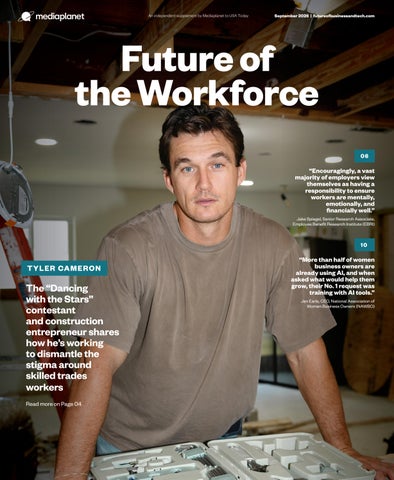
TYLER CAMERON
The “Dancing with the Stars” contestant and construction entrepreneur shares how he’s working to dismantle the stigma around skilled trades workers Read more on Page 04
“More than half of women business owners are already using AI, and when asked what would help them grow, their No. 1 request was training with AI tools.” Jen Earle, CEO, National Association of Women Business Owners (NAWBO)
Closing the Skills Gap: Building Tomorrow’s Workforce Today
Reducing Fall Risk: Building Safer Workplaces for Skilled Trades
Guiding the next generation of students into direct pathways to employment relies on meaningful connection between industry and education.
T
he next generation of students will be called upon to take up occupations that their parents were directed away from. American businesses are looking for plumbers, electricians, mechanics, masons, welders, and technicians to fill the void created by the retirement of the Baby Boomers and the college-for-all philosophy that shifted Gen Xers and Millennials away from skilled careers. This creates incredible opportunities for the younger generations who we will rely upon to keep the American economy viable. Couple that demand with changing attitudes about college
cost and outcomes, crippling student loan debt, and the rise of AI, and it’s no wonder why countless students are eager to pursue career and technical education and a future in skilled work.
A well-rounded workforce SkillsUSA, the No. 1 workforce development organization for students, is helping prepare students for skilled work by not only developing the technical skills they’ll need to be successful, but also the workplace and personal skills that employers demand. SkillsUSA’s programming is designed with industry input to ensure students are career-ready
on Day 1. SkillsUSA is leading the charge on building closer partnerships between educators, employers, and policymakers to align curricula with industry needs, address skill gaps, and create a more cohesive ecosystem for workforce development. Scaling access to SkillsUSA or any other career and technical student organization (CTSO) represents one of the highest-impact and most cost-effective interventions available to strengthen workforce development outcomes. Rest assured that our future is in good hands, because it’s in skilled hands.
Serious injuries and fatalities remain persistent for skilled trades. With so much work performed at height, falls remain the leading cause of fatalities on construction sites.
WRITTEN BY
Chelle Travis Executive Director, SkillsUSA
Sponsored
From Classroom to Career: How CareerSafe and SkillsUSA are Preparing Tomorrow’s Workforce
T
As the only youth-focused, OSHA-Authorized, online training provider and OSHA Alliance Ambassador, CareerSafe helps build foundations for success. CareerSafe’s OSHA 10-Hour courses teach students to recognize and prevent workplace hazards while understanding their rights and responsibilities. CareerSafe’s courses are industry-specific for fields like construction, automotive, healthcare, and more. Even better, students earn a U.S. Department of Labor OSHA card upon completion. SkillsUSA is offering this opportunity to its members by providing 5,000 students with a CareerSafe OSHA 10-Hour course.
Jim Burrows, CareerSafe’s 2026 National Safety Educator of the Year, sees the impact firsthand: “It doesn’t matter what career you go into. If you’ve got an OSHA credential on your resume, that’s going to put you head and shoulders above your competition.” Technical ability and safety knowledge are foundational for career readiness. But industry expects professional skills, too, no matter the field. CareerSafe’s Employability Skills training teaches communication, teamwork, critical thinking, time management, and other core competencies. Educators, employers, CTSOs, and credentialing partners all
•
•
Photo courtesy of CareerSafe
play a part in this impactful work. Together, we send students into the workforce prepared from the start and ready for what comes next.
WRITTEN BY
Larry D. Teverbaugh, Ph.D. Founder and Owner, CareerSafe
S
electing fall protection begins with a site hazard assessment. Identifying risks and understanding applicable OSHA requirements and ANSI standards can help you choose solutions that help drive worker safety and regulatory compliance.
Considerations for a Hazard Assessment may include:
Qualified Person. • Develop rescue plans. OSHA requires employers to provide for prompt rescue of workers following a fall.¹ • Document and communicate findings, required PPE, anchor points, and hazards. • Monitor through documented inspections and periodic reassessments. Once hazards have been evaluated, you can determine solutions for your jobsite.
02
READ MORE AT FUTUREOFBUSINESSANDTECH.COM
MEDIAPLANET
WRITTEN BY
Thomas Kramer, PE, CSP Senior Vice President, American Society of Safety Professionals (ASSP); Senior Safety Consultant, LJB, Inc.
Understanding your jobsite’s unique hazards is an important first step in determining the appropriate fall protection solution for your organization — from PPE to engineered systems.
Publisher Lila Goldberg, Ashley Ludlum, Miyu Takeuchi Business Developer Isabella Rawls Managing Director Samantha Taylor Production Manager Dustin Brennan Creative Director Kylie Armishaw Product Strategy & Growth Director Joelle Hernandez Copy Editor Amara Hartman, Taylor Rice Cover Photo by Berkeley McGaughey All photos are credited to Getty Images unless otherwise specified. This section was created by Mediaplanet and did not involve USA Today.
@MediaplanetUSA
•
coworker forgets something, remind them. Those conversations prevent injuries and fatalities. Learn more: Employers are required to provide training to help prevent injuries, manage risks, and improve workplace safety performance. Workers should also learn more on their own through industry organizations, which provide helpful resources, learning opportunities, and peer connections. One example is the American Society of Safety Professionals (ASSP) Standards-Based User Group on Fall Protection or a local ASSP chapter.
How to Choose the Right Fall Protection PPE and Engineered Systems Solutions for Your Jobsite
• Identify fall hazards by inspecting elevated areas and walking-working surfaces. • Apply the Hierarchy of Controls by prioritizing Hazard Elimination, followed by Passive Fall Protection, then Active Fall Protection (restraint, then arrest). • For arrest systems, calculate fall clearance and verify anchor strength, ensuring anchorages can support at least 5,000 lbs. or are engineered by a
@futureofbusinessandtech
surfaces that can break, is a safer approach than reacting when a risk becomes real. Do your part: Maintain, inspect, and use equipment as it’s intended. Harnesses and lanyards can be effective, but they have to be cared for, inspected for defects, and used per instructions. Every worker must be intentional with equipment, since the consequences of misuse are life-threatening but often preventable. Speak up: If something doesn’t seem safe, stop work and address it. If equipment isn’t available or doesn’t fit the work, ask for help. If a Sponsored
Each skill learned in the classroom, lab, or shop helps shape the workforce of tomorrow. When industry, educators, and career and technical student organizations (CTSOs) align, students gain tools that carry them from the classroom to the workplace. hat’s where organizations like CareerSafe and SkillsUSA shine. CTSOs, like SkillsUSA, help students gain technical knowledge, hands-on experience, and leadership skills while connecting with employers. Credentialing partners, like CareerSafe, join the effort and provide students with employer-recognized validation. David Keeling, Assistant Secretary of Labor for the Occupational Safety and Health Administration (OSHA), puts it this way: “This partnership [with CareerSafe] gives us the ability to really affect the next generation of workers.”
T
he Occupational Safety and Health Administration (OSHA) provides minimum requirements, and consensus standards like ANSI/ASSP Z359 outline requirements for anchorages, harnesses, lanyards, and programs, so fall protection systems work when they’re called on to save a life. Simple steps can make a real difference in reducing fall risk: • Ask one question: Before performing a task at height, ask, “How can I better protect myself from a fall?” Taking a few minutes before work begins to identify hazards, such as unprotected edges, holes, and
Contact information: US.editorial@mediaplanet.com
Visit us at careersafeonline.com to learn more about preparing tomorrow’s workforce for success.
Please recycle
READ MORE AT FUTUREOFBUSINESSANDTECH.COM
Fall protection solutions generally fall into: 1. Personal protective equipment (PPE). Used when fall hazards cannot be eliminated, PPE may include harnesses, self-retracting devices (SRDs/PFLs), and anchorage connectors. MSA PPE is designed to support comfort, compliance, and ease of use, helping workers stay focused on the job.
2. Engineered systems. Designed for specific structures, tasks, and environments, engineered systems often require site evaluation, engineering, installation, and ongoing support. Examples include horizontal lifelines, fixed ladder systems, and roof walkway systems. MSA solutions are built to meet demanding quality and durability requirements, and are installed through a Trusted Installer network. Users should receive training and follow all product instructions, labels, markings, and warnings before using PPE, engineered systems, or related equipment, as required by the manufacturer, applicable standards, regulations, and employer policies.
WRITTEN BY
Dave Stagon Sales Enablement & Training Program Manager – Fall Protection Engineered Systems, MSA Safety
To learn more, scan the QR code
References ¹https://www.osha.gov/laws-regs/regulations/ standardnumber/1926/1926.502; https://www.osha.gov/ laws-regs/regulations/standardnumber/1910/1910.140
MEDIAPLANET
03
Sponsored
How a Foundation in Skilled Trades Helped Tyler Cameron Build a Multifaceted Business Empire Photo by Phynart Studio (Getty Images) | Photo courtesy of Simple Green
Building the Skilled Workforce That Will Build Our Future As experienced tradespeople retire, preparing a new generation of skilled professionals is becoming increasingly important to businesses, industries and communities across America.
T
omorrow’s skilled workforce is sitting in today’s classrooms and training programs. Giving students opportunities to build technical expertise, confidence and workplace skills can turn an interest in working with their hands into a rewarding career. SkillsUSA, the leading workforce development organization for students, helps bridge that journey from education to employment, empowering students to become skilled professionals, career-ready leaders and responsible community members. For employers and industries facing a growing need for skilled workers, that mission matters. Simple Green is proud to support SkillsUSA and its work to prepare the next generation. It’s a natural partnership for a company that believes in quality, professional standards and doing the job right. Simple Green brings those same principles to professional-strength cleaning solutions designed for demanding workplaces and the people who keep them running. Investing in skilled people today helps build a stronger workforce for tomorrow. Written by Selena A. Nutter, Marketing Manager, Simple Green
To learn more about professional solutions from Simple Green, visit simplegreen.com/ professional
04
MEDIAPLANET
You don’t need a four-year degree to build a successful, rewarding career. Tyler Cameron, a general contractor, entrepreneur, and TV personality, is living proof.
P
eople assume trades are for those who couldn’t cut it in school, but I know plenty of people with degrees who can’t find work, and plenty of tradespeople making serious money,” said Cameron, 33, who lives in his hometown of Jupiter, Fla. Cameron believes the skilled trades offer both financial opportunity and long-term job security. “There’s a massive gap coming as the current generation retires out and not enough young people are stepping in to replace them,” he said. “Anyone who dives in now to fill that gap is going to do well.” His construction career also taught him lessons he’s applied across his growing business portfolio. “Working construction, you learn to put out fires all day, every day, so nothing professionally or personally rattles you anymore,” he said. “But no matter how good a contractor you are, you’re only as good as your subs. Success in this space comes down to having the right team around you.”
Cameron has used that foundation to build businesses across construction, real estate, food, and home improvement. Through Image 1 Construction, he works as a general contractor, while also working as a real estate agent with SERHANT. He also founded a home design and real estate sales company, and is a proud co-founder of tool and DIY brand TINKR. TINKR, his newest venture, reflects his connection to the trades. The modern, design-forward home tool and DIY brand aims to bring a fresh perspective to traditionally utilitarian products. Cameron is also a franchise owner of 3Natives, a fast-casual healthy-food concept. Beyond his for-profit ventures, Cameron founded the Andrea C. Cameron Foundation in honor of his late mother,
Addressing the skilled workforce shortage requires more than recruiting; it requires a coordinated effort. The connection between education and industry is becoming increasingly important.
T
hrough its high school recognition and college accreditation programs, The AED Foundation works with schools to ensure technical education programs meet industry standards while strengthening connections between education and industry. These programs bring schools, local dealerships, and industry partners together, giving students firsthand exposure to the field and giving employers the opportunity to develop relationships with the next generation of talent. AED Foundation Chairman Ron Barlet sees partnership as key. “We don’t simply connect a school with a dealership or an industry partner and walk away,” Barlet said. “We stay engaged — supporting
educators, students, dealerships, and manufacturers as those relationships grow. That ongoing collaboration creates stronger programs, better career opportunities, and a workforce pipeline that benefits the industry as a whole.” The path to a stronger workforce starts with connection. By bringing education and industry closer together, we can strengthen the talent pipeline for generations to come.
WRITTEN BY
Brian P. McGuire President, AED Foundation
Sponsored
PRODUCT SPOTLIGHT: Tyler Cameron | Photo by Berkeley McGaughey
Building a business empire
Connecting the Dots: Building Tomorrow’s Workforce
providing scholarships to students in Palm Beach County, Fla. Meanwhile, his television career has expanded his reach. He has starred in Amazon Prime’s “Going Home With Tyler Cameron,” appeared on ABC’s “Extreme Makeover: Home Edition,” and won Fox’s “Special Forces: World’s Toughest Test.” He recently joined “Dancing with the Stars” and will host HGTV’s “Let’s Go Back to Your Place” in 2027. For Cameron, the trades remain the foundation. “[The skilled trades] teach you discipline and hard work,” he said, “and show you that real focus on something pays off in a big way.” Written by Melinda Carter
READ MORE AT FUTUREOFBUSINESSANDTECH.COM
MSA V-SERIES® Harnesses
M
SA V-SERIES® full-body harnesses are designed for enhanced comfort while working at height — so you can focus on your job, not your PPE. The racing-style buckle allows for a close, comfortable fit, while the harness’s athletic cut enables improved upper torso movement. The pull-down adjustment allows you to quickly get the right fit. The full line includes the V-FORM®, V-FORM+®, V-FIT®, and V-FLEX®. Harnesses for arc flash and welding are also available. Written by MSA Safety
READ MORE AT FUTUREOFBUSINESSANDTECH.COM
America’s Skilled Trades Renaissance The tide is changing for skilled trades. Long overlooked as a meaningful career pathway, now students are seeing the longevity, reliability, and accessibility of skills-based jobs.
F
or decades, America embraced the idea of “college for everyone.” While higher education remains an important pathway, today’s workforce realities demand a broader vision — one that recognizes and values the millions of Americans who build, repair, manufacture, and maintain the systems that power our economy. The simple economics of supply and demand are causing young people and their families to take a fresh look at rewarding careers in welding, electrical work, HVAC, plumbing, manufacturing, and construction. These careers offer strong wages, job security, and the satisfaction of building something meaningful. At the same time, America is entering a new industrial revolution, driven by artificial intelligence, robotics, data, automation, and connected systems. This transformation is reshaping how products are designed, built, and delivered. The modern manufacturing workforce must now blend hands-on technical skills with digital literacy, problem-solving, and systems thinking. People-centered leadership, continuous improvement, and developing talent are as critical as technology. America’s skilled trades are experiencing a renaissance. They are restoring a renewed appreciation for the people whose hands, minds, and craftsmanship build the systems that sustain our nation. Skilled people will build the future of manufacturing in America. When we invest in people, we invest in prosperity, opportunity, and excellence itself.
WRITTEN BY
Scan the QR code to learn more:
Kim Humphrey President & CEO, Association for Manufacturing Excellence
MEDIAPLANET
05
The New Burnout Reality: Why Managers Need More Support Burnout has become a constant strain rather than a seasonal one, and closing the gap will take stronger organizational frameworks, not better individual coping.
B
urnout has become a chronic, business-critical challenge for employers. According to the American Psychological Association, 44% of employees report feeling burned out often or always. That level of strain has direct implications for retention, productivity, and organizational stability. Frontline managers carry much of this weight. Yet, many managers lack the training and experience needed to navigate the growing complexity of employees’ needs. Without the right tools or structural support, managers absorb the strain themselves, weakening the support systems employees rely on most.
The role of EAPs Research shows that employee assistance programs (EAPs) improve manager capability by offering real-time guidance and specialized training. Consultants help managers prepare for difficult conversations, clarify roles, spot early strain, manage emotional labor, and intervene effectively. They offer coaching on boundary-setting, communication strategies, and approaches to stress before it becomes burnout. EAPs also deliver high-quality training that builds confidence by equipping managers with practical skills, behavioral strategies, and realworld tools needed to lead teams through uncertainty and rising employee needs. When managers themselves experience strain, EAPs can provide confidential counseling and support to help them maintain their own well-being. When managers use EAP consultation proactively rather than only in crisis, EAPs become a strategic partner in strengthening organizational resilience.
WRITTEN BY
Sherry Ryon Courtemanche, LCSW, CEAP President-Elect, Employee Assistance Professionals Association
06
MEDIAPLANET
Rebuilding Employee Engagement Starts With Workplace Well-Being Most workers say they are satisfied with their jobs, yet many still report feeling disengaged from them.
W
orkers may be satisfied enough to remain in a job while still feeling disconnected from their work, their employer, or the conditions that allow them to perform at their best. Engagement is not just a function of whether employees like their jobs. It is also connected to their workplace well-being and whether they feel supported, secure, and valued. Financial well-being is central to this picture. Workers continue to cite inflation, healthcare costs, and health insurance costs as top concerns. Seven in ten agreed that thinking about their financial future makes them feel stressed, and 2 in 3 said their lack of emergency savings stresses them. Employers will need to examine how benefits, compensation, flexibility, paid
time off, health coverage, retirement savings, and emergency savings work together. Encouragingly, a vast majority of employers view themselves as having a responsibility to ensure workers are mentally, emotionally, and financially well, and a vast majority of workers agree that their company has this responsibility. Workers and employers are on the same page about the role of the employer in fostering well-being. The challenge now is execution.
WRITTEN BY
Jake Spiegel Senior Research Associate, Employee Benefit Research Institute
How Top Employers Use Employee Feedback to Guide Decisions Drawing on best practices, the following tips can help employers center employee-sourced data to improve their workplace wellness programs. Clarify the purpose upfront Timing is everything, and context matters. A benchmarking survey that charts the impact of targeted interventions over time serves a different purpose than a one-off survey designed to address a specific situation.
Communicate throughout the process Strong communication creates an environment based on trust and transparency, increasing employee engagement. Gathering feedback without communicating next steps may cause more harm than good.
Create an implementation plan Who will own this effort and see it through? Some employers want HR to be accountable for building an effective feedback loop. Others deploy an employee wellness committee. In both scenarios, employers might choose to outsource employee feedback gathering to prioritize anonymity.
WRITTEN BY
Suzi Craig Vice President of Workplace Mental Health, Mental Health America
READ MORE AT FUTUREOFBUSINESSANDTECH.COM
Sponsored
Ai-jen Poo on What Working Caregivers Need From Employers
Have Ideas About Caregiving? We’re Listening. Care is part of all of our lives, but too many families are left navigating its hardest moments without enough time, choices, money, or support.
Award-winning labor activist and organizer Ai-jen Poo explains how employers can better support working caregivers.
C Finally, caregivers need choice. Whether that is different care options, financial assistance, or benefits that give employees more flexibility in how they provide care, giving people agency allows them to care with dignity and on their own terms.
are can look like helping an aging parent get to an appointment, finding someone you trust to care for your child, supporting a friend through illness or disability, or taking time off work to get the help you need. These experiences are deeply personal, but they are not isolated. Across America, families are making difficult choices about time, money, work, and how to show up when care is needed for their loved ones. Too often, people living these realities are left out of conversations that shape our care systems and policies.
What trends among working caregivers should HR leaders be paying closer attention to?
There are 130 million family caregivers today. What would change if we listened to their experiences?
Increasingly, caregivers are asking themselves whether working even makes financial sense. Childcare averages around $13,000 per year for a young child, while home care for an aging adult can cost tens of thousands of dollars annually. For many families, the math simply does not work. Employers should think proactively about ways to ease these financial pressures, whether through childcare or respite care vouchers, on-site childcare where possible, or other benefits that expand care options. Most importantly, employers should ask caregivers what they actually need. One of our current initiatives, One Million Care Conversations, is focused on listening to caregivers across the country and inviting them to share ideas for improving care. People truly appreciate being asked for their perspective. I encourage employers to have those same conversations within their own organizations. Consulting caregivers about what would make the biggest difference helps create solutions that keep employees engaged while reinforcing that their experiences are seen and valued.
1 Million Care Conversations is inviting people to share what care looks like in their lives: what works, what’s difficult, and what would make care more accessible, dignified, and sustainable. You don’t have to be a caregiver or advocate to participate. If you give, receive, or rely on care — or are worried that someday you will need care — your experience matters. One conversation can reveal a need or possibility. A million conversations can help us build a future where everyone has what they need to care for people they love.
What would you say to employers who are unsure about investing in caregiver benefits? When employers invest in caregiver policies and programs, they create a more resilient workforce. Employees are better able to navigate caregiving responsibilities while remaining engaged at work. Just as importantly, they feel valued — not only for what they contribute professionally, but as people with families and real lives outside of work.
Caregiving is expensive, so anything employers can do to reduce that burden makes a meaningful difference.
What caregiving benefits do you think will become standard over the next decade? Paid family and medical leave is an absolute necessity. Employers should also think broadly and inclusively about what family means, because caregiving extends far beyond biological relatives.
What does a caregiving-friendly workplace culture look like? Three themes come up consistently when we speak with caregivers: cost, time, and choice. Caregiving is expensive, so anything employers can do to reduce that burden makes a meaningful difference. Time is equally important. Flexible schedules, paid leave, predictable scheduling, and greater control over work hours allow caregivers to be present for their loved ones when it matters most. READ MORE AT FUTUREOFBUSINESSANDTECH.COM
Ai-jen Poo | Photo by Othello Banaci
WRITTEN BY
Ai-jen Poo Executive Director, Caring Across Generations
To learn more and share your experience, visit careconversations.com
MEDIAPLANET
07
The Missing Piece in the AI Workplace? Employee Well-Being Employees want to know where they fit into the future of work in the age of AI, and their well-being increasingly depends on the answer. Recent research from The Conference Board highlights priorities for leaders:
1. Build trust in AI Although organizations are rapidly experimenting with AI, many have not yet reached enterprise-wide adoption. This transition creates uncertainty. Leaders should communicate what AI will — and will not — be used for, acknowledge uncertainty, involve employees in implementation, and make credible commitments regarding responsible use.
2. Make learning part of well-being Employees are more likely to approach disruption with confidence when they believe they can remain valuable as work changes. Upskilling strengthens capabilities in current roles, while reskilling prepares employees for new ones.
3. Make culture the foundation In an era of continuous disruption, culture health and adaptability are especially important because employees need a safe, sustainable experience and confidence that the organization can evolve. WRITTEN BY
Diana Scott U.S. Human Capital Center Leader, The Conference Board; & Robin Erickson, Ph.D. Head of Human Capital Research, The Conference Board
How Skillfishing Is Breaking Hiring in the AI Era At SHRM, we coined the term “skillfishing” to describe the act of presenting credentials or capabilities that do not translate into realworld execution. While exaggerating skills is hardly a new problem, AI has transformed a manageable challenge into a systemic crisis demanding a serious, structural response.
A
shortened response times, inconsistencies between assessment scores and responses to follow-up questions, or behavioral patterns suggesting scripted rather than spontaneous engagement.
1. Shift the metrics
4. Incorporate real-world demonstrations
Organizations that measure recruiting success primarily by time-to-fill are optimizing for speed at the expense of quality. A more meaningful set of indicators includes time-to-proficiency, or how quickly a new hire reaches independent competency.
In-person interviews eliminate the technological advantages that virtual environments afford skillfishers. It is considerably more difficult to display competence you do not have when there is no screen to hide behind.
2. Implement multi-layered, rolespecific assessments
5. Assess for learning agility
ddressing skillfishing requires more than incremental adjustments. Experts increasingly argue that organizations must undertake a fundamental redesign of how they evaluate candidates.
Generic, off-the-shelf tests are among the easiest targets for AI-assisted candidates to game. A more defensible approach builds assessments that closely emulate the actual conditions of the role, drawing on situational judgment tests and ipsative instruments requiring contextual reasoning rather than the retrieval of memorized answers.
As AI automates an expanding share of routine tasks, the most valuable capability a candidate can demonstrate is not necessarily what they know today, but how quickly and effectively they can develop new proficiency. Hiring processes that probe a candidate’s learning orientation are better positioned to identify individuals who will remain effective contributors as the technological environment continues to evolve.
3. Use AI as a defense The same technology enabling skillfishing can also serve as a detection mechanism. AI-based interviewing and assessment platforms can identify anomalies human interviewers might overlook, including
WRITTEN BY
Alexander Alonso, Ph.D., SHRM-SCP Chief Knowledge Officer, SHRM
Sponsored
4 Key Findings That Can Help Companies Reduce Employee Burnout Employee well-being is declining at a time when it’s needed most, signaling a shift in the kinds of support employees need.
I
f the pace of change at work feels faster than ever, you’re not alone. We’re navigating economic uncertainty, increasing workloads, new technologies, and new ways of working, all while trying to stay healthy, productive and engaged with work. When my team at WebMD Health Services surveyed more than 3,800 U.S. employees this year about their well-being and workplace experiences, the results revealed a workforce with evolving needs. More than 1 in 4 employees now report low well-being — a 39% jump from just two years ago. And while employees feel capable of adapting to change, many don’t feel they have enough support along the way. Here are four key takeaways organizations can act on:
1. Financial stress is taking a toll For the third year in a row, financial was the lowest-rated dimension of well-being 08
MEDIAPLANET
READ MORE AT FUTUREOFBUSINESSANDTECH.COM
in our study, with fewer than half of employees reporting they feel good about their financial well-being. As anyone who’s struggling knows, the impact of financial stress can bleed into the workplace, impacting confidence, focus, and productivity. Employers have an opportunity to expand the support they provide beyond traditional retirement benefits through financial coaching and other tools that help build financial confidence.
2. Middle managers are facing a burnout crisis Managers are the connective tissue of an organization. They translate strategy into action, coach their teams, drive culture, and balance competing expectations from up, down, and across the org chart. That responsibility comes at a significant cost. Our research found that the burnout rate for senior managers is more than three times higher than it is for individual contributors and
READ MORE AT FUTUREOFBUSINESSANDTECH.COM
senior leaders. As organizations continue to evolve, supporting this group requires dedicated resources, development, and well-being support.
3. AI boosts productivity but doesn’t necessarily make work easier Artificial intelligence is quickly becoming part of everyday work, with 80% of employees reporting they use AI on the job. While many say AI helps them feel more productive, our research found that those experiencing the greatest productivity gains are also the most likely to report burnout. This suggests that technology alone isn’t the solution. Without thoughtful implementation, training, and clear expectations, tools designed to make work easier can also increase the pace and complexity of work. Organizations that take a human-centered approach — supporting employees as roles and workflows evolve — will be better positioned
to harness the benefits of AI while protecting employee well-being.
4. Trust is the foundation of employee well-being One of the most powerful findings in our research is the connection between trust and the employee experience. Those who express trust in their organization are nearly six times more likely to report strong well-being and 27 times more likely to be highly engaged than those with low trust. Organizations can build trust through consistent actions that make employees feel valued and supported, like keeping them informed, listening to their feedback, and creating a safe and supportive environment. While change is inevitable, the path forward is clear. Organizations that demonstrate care, build trust, and provide meaningful well-being support will be better equipped to strengthen their workforce and create the resilience needed to thrive.
WRITTEN BY Erin Seaverson, M.P.H.
Senior Director, The Center for Research, WebMD Health Services
Scan here to learn more about the state of workplace well-being in 2026:
MEDIAPLANET
09
How AI Is Giving Business Owners Time Back
What Women Business Owners Need to Grow Right Now
Keith Hall, president and CEO of the National Association for the Self-Employed (NASE), explains how artificial intelligence is giving entrepreneurs their time back.
I
What are the most significant pressures and opportunities facing America’s selfemployed and freelancer community right now, and how is AI reshaping that landscape? Changing technology is one of the most significant pressures facing small business owners today, but it is also the greatest opportunity. The No. 1 asset every small business owner, freelancer, and solo entrepreneur has is their time, and AI is giving them more of it. AI tools are helping entrepreneurs work more efficiently and retain the time they need to focus on growing their business.
What should small business owners understand about capital needs and cashflow planning as they integrate AI into their operations? Financial institutions are already using AI to evaluate credit decisions, forecast cash flow, and benchmark businesses against industry peers. That means owners need to be doing the same. Using AI for your own financial forecasting, planning reports, and lender communications puts you on equal footing with the institutions evaluating your business.
What are the risks the self-employed community should be aware of when it comes to AI? Owners must proceed with caution. AI is a powerful assistant, not the final authority. Treat everything it produces as a first draft. Verify the facts and keep a professional on hand for anything consequential.
There has never been a more exciting time to be a woman entrepreneur or a more important time to make sure women have what they need to thrive. n NAWBO’s 2026 survey, women entrepreneurs’ top concerns and priorities include AI, taxes, and access to capital. More than half of the women business owners we surveyed are already using AI, and when asked what would help them grow, their No. 1 request was training with AI tools. The opportunity isn’t to have AI run your business; it’s to use it thoughtfully to give you more capacity to run your business. Learn where AI can save you time, but keep human judgment in the driver’s seat. Taxes ranked as the No. 1 concern and priority, particularly understanding tax credits and simplifying taxes. For independent entrepreneurs, tax planning shouldn’t happen just once a
Keith Hall President and CEO, National Association for the Self-Employed, nase.org
WRITTEN BY
Jen Earle CEO, National Association of Women Business Owners (NAWBO)
Why AI Won’t Replace Agents Who Are REALTORS® AI may be displacing certain jobs, but a record 91% of home sellers used an agent in 2025, according to NAR data. Industry professionals explain why agents remain uniquely positioned in an AI-driven world.
1. Real estate pros can read social cues “You can hear uncertainty in a seller’s voice, confidence in a buyer’s tone, or hesitation that signals an opportunity to adjust your strategy,” said Shane Brady, a real estate professional at Keller Williams.
2. AI can’t experience a property the way people do INTERVIEW WITH
year. Set aside money for tax obligations, maintain clean records, and talk with a qualified tax professional about deductions, credits, and business structure. Women entrepreneurs have tremendous momentum and potential. If we can help more of them embrace new technology, access capital, and make smarter financial decisions, we aren’t simply strengthening individual businesses; we’re creating economic opportunity and building a stronger American economy.
Greg Field, a real estate professional with HomeSmart, said an algorithm “cannot walk into a home and smell the subfloor animal damage that the seller was trying to cover up with an air freshener.”
3. Real estate is built on trust and relationships “AI doesn’t have the relationships with inspectors, attorneys, title companies, and other professionals to expedite deals,” said Todd Drowlette, managing director of Titan Commercial Realty Group.
4. Agents who are REALTORS®, members of the National Association of REALTORS®, operate under a Code of Ethics “When I advise a client, my license, reputation and standing in the community are at risk,” Reinaldo Gonzalez, broker-owner of InvesTeam Realty, said. “A mistake could have serious consequences for me. In contrast, AI doesn’t face such risks. Having skin in the game isn’t a flaw of human advice. It’s the fundamental reason why advice carries weight.”
Written by Melissa Tracey, Contributing Editor, NAR REALTOR® News 10
MEDIAPLANET
READ MORE AT FUTUREOFBUSINESSANDTECH.COM
Sponsored
Where Crypto Can Help Small Businesses: Practical Uses Beyond Investing If you’re a freelancer or a small business owner, you know how difficult it can be to keep all the balls in the air — especially regarding money.
B
etween inconsistent cash flow, delayed contractor payments, rising transaction costs, and customers who want more payment options, keeping your business afloat can be difficult. That’s why a growing number of independent contractors and small businesses are turning to cryptocurrency for help. It’s fast, secure, borderless, and available 24/7. According to the National Cryptocurrency Association (NCA), 67 million people now hold cryptocurrency; that’s 1 in 4 Americans, and they’re not just using it to invest and build wealth. Here’s how crypto can be useful in running your business:
Accepting customer payments Giving your customers another payment choice can broaden your customer base. Many businesses added contactless payments in recent years, and some are now adding crypto as another checkout option. Crypto at checkout is already widespread. NCA’s 2026 State of Crypto Holders report found that 40% of holders are already using it to purchase goods and services, and its 2026 Merchant Adoption Report highlights 50% of large U.S. enterprises and onethird of small and medium businesses already accept crypto as a form of payment. “Offering crypto at checkout doesn’t mean replacing traditional payment methods — it’s an extension of consumer choice, giving people options to pay with
the methods they’re most comfortable with,” said Ali Tager, VP of External Affairs at NCA. “For businesses, it’s about meeting customers where they already are, and for shoppers, it’s the freedom to decide what works best for them.”
Paying freelancers and contractors Customer transactions are only part of the equation. If you’re a small business owner, you also have to pay your freelancers, vendors, and contractors. Using crypto to pay others is easy. Payments arrive in minutes and with fewer fees, so contractors keep more of what they earn. “Crypto inherently gives me so much more autonomy over my own life and own finances,” Jake, a small business owner, told NCA. Jake’s experience isn’t an outlier. NCA’s recent Crypto at Work report found that professional services account for $3.6 billion of the industry’s $55 billion U.S. economic contribution, or roughly 1 in 15 dollars. This illustrates crypto’s growth beyond traders and financial technology experts, and into everyday workers, like consultants, freelancers, and other independent professionals.
Managing cash flow and payment flexibility Delayed payments, limited pay options, and bank closures can make it difficult for any entrepreneur to run their day-today operations. Crypto offers greater flexibility. A business that accepts digital asset
READ MORE AT FUTUREOFBUSINESSANDTECH.COM
Master plumber Clay, shown here in his truck, is just one of the 67 million Americans using crypto today. | Photo courtesy of NCA
payments from customers can use the same method to pay a contractor or vendor, instead of converting between payment systems. In some cases, this helps streamline transactions and reduce friction. The right approach depends on the needs of the business, its customers, and available payment options.
Learn before you use There’s a lot of hype and confusion around cryptocurrency, and that’s why education is so important. The NCA can help you make sense of crypto and show you how it can become a trusted tool in your business. Understanding practical use cases is the first step to making an informed decision about whether crypto is right for you and your business.
INTERVIEW WITH
Ali Tager Vice President of External Affairs, National Cryptocurrency Association (NCA)
The National Cryptocurrency Association can help you make sense of crypto and show you how it can become a trusted tool in your business. Learn more at nca.org
Written by Frank James MEDIAPLANET
11
To learn more about the Future of the Workforce, visit futureofbusinessandtech.com
12
MEDIAPLANET
READ MORE AT FUTUREOFBUSINESSANDTECH.COM