An independent supplement by Mediaplanet to USA Today
September 2026 | educationandcareernews.com
Empowering Our Essential Workers 04
“If we want emergency nurses to continue answering the call when patients need them most, we have to answer the call to keep them safe.” Dustin Bass, D.N.P., M.H.A., RN, CEN, NEA-BC, President, Emergency Nurses Association
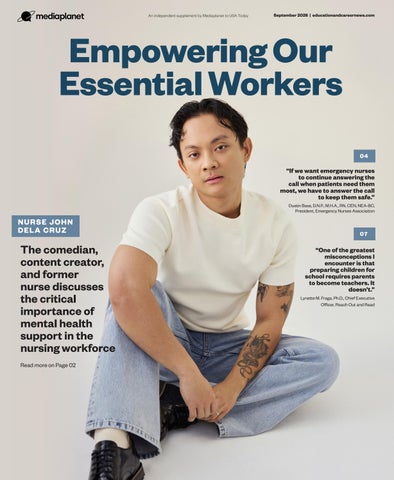
NURSE JOHN DELA CRUZ
The comedian, content creator, and former nurse discusses the critical importance of mental health support in the nursing workforce Read more on Page 02
07
“One of the greatest misconceptions I encounter is that preparing children for school requires parents to become teachers. It doesn’t.” Lynette M. Fraga, Ph.D., Chief Executive Officer, Reach Out and Read
Building the Nursing Workforce of Tomorrow Our panel of experts shares their advice for aspiring nurses, and their vision for expanding access to nursing education and supporting careers that last. INTERVIEW WITH
INTERVIEW WITH
Beverly Malone, Ph.D., RN, FAAN Chief Executive Officer, National League for Nursing
What advice would you give to aspiring nurses entering the profession today? Sarah Rhoads: I would encourage aspiring nurses to remain curious, adaptable, compassionate, and committed to lifelong learning. Nursing is a wonderful profession that requires strong communication, resilience, and caring as well as clinical expertise. Beverly Malone: Be kind and caring to yourself. Practice selfcare by taking a deep breath when you feel overwhelmed, or give
INTERVIEW WITH
Imelda Reyes, Ph.D., RN Dean and Professor, College of Nursing, University of West Georgia
yourself that long-delayed day off to recharge and avoid burning out.
How can nursing programs make sure students are prepared not just to enter the profession, but to build long, successful careers? SR: Nursing programs must provide students with a strong clinical foundation while also developing leadership, critical thinking, communication, and professional resilience. Students should have the opportunity
Sarah Rhoads, DNP, Ph.D., APRN, FAAN Dean, College of Nursing, University of Arkansas for Medical Sciences
to work with interprofessional teams and learn using emerging technologies.
together to offer more seats for nursing students and to retain nurses in the workforce.
Where do you see the greatest opportunities to expand access to nursing education and bring more qualified nurses into the workforce? Imelda Reyes: We are all
How can educators, healthcare organizations, and industry work together to strengthen the nursing pipeline? IR: Working with clinical partners
working within education to expand opportunities. Shortages in nursing faculty and clinical placements are really the limiting factor. We all need to work
is essential to learn what gaps may exist in our educational programs. Encouraging practicing nurses to take on students and mentor them is also an important step in the entire process.
Nurse John on Burnout and Why Nurses Are Speaking Up John Dela Cruz, comedian, content creator, and former nurse, explains why he burned out and what nurses need now. What moment shaped the nurse you are today? COVID-19 shaped me because I graduated at the very beginning of it. Graduating without a professor watching you, being responsible for other people’s lives, plus COVID-19, was frightening. The pandemic was ever-changing every single day. There were new rules, new ways of washing hands, new ways of putting masks on. All of that together was traumatizing, and it shaped the nurse I am today.
What helps you feel valued and supported as a nurse? What helped me feel valued was realizing that my only support is me, and that you cannot rely on big hospitals to give you the help you need. You can scream “help,” and they might hear it three months later, once you have already helped yourself. @educationandcareernews
What really helped, and this was hard for me to realize at the time, was that I needed to go to therapy and have a psychiatrist evaluate me. That therapist helped me see how important it is to set boundaries, because nurses are naturally givers. We give, and we take less than what we give. We give so much that we forget we also deserve the same care we give to strangers.
What innovations excite you most about the future of nursing? There are a lot of developments right now around nurses’ mental health. They are building things like hotlines we can call if we’re depressed or anxious. That is what needs to be addressed if we want the future of nursing to be easier for the new generation.
@MediaplanetUSA
Contact information: US.editorial@mediaplanet.com
Nurse John Dela Cruz | Photo by Vito Pulverenti
Please recycle
Publisher Alessandra Ietta, Sarah O’Brien Business Developer Katie Labriola Managing Director Samantha Taylor Production Manager Dustin Brennan Creative Director Kylie Armishaw Product Strategy & Growth Director Joelle Hernandez Copy Editor Taylor Rice Cover Photo by Sarah Krick All photos are credited to Getty Images unless otherwise specified. This section was created by Mediaplanet and did not involve USA Today. 02
MEDIAPLANET
READ MORE AT EDUCATIONANDCAREERNEWS.COM
Help Wanted: More Nurse Educators to Prepare Future Nurses Without enough nurses joining the ranks of nurse faculty, the nation’s nursing shortage is destined to persist well into the coming decades.
F
aculty shortages in nursing education have long been acknowledged as a primary barrier to overcoming the persistent shortage of nurses in America’s healthcare system. What’s flown under the radar, however, are the realities that created and sustain this stubborn problem in graduating enough qualified nurses. Chief among these is a decade spent underfunding programs and initiatives that facilitate the completion of the advanced degrees required for nurses who aspire to teach. A second obstacle to faculty growth that has gone largely unaddressed is the significant wage difference between
academic nursing education and clinical salaries for advanced practice nurses, with both roles requiring advanced degrees. These twin stumbling blocks are not an inevitable consequence of natural attrition in nursing education, although faculty retention can be another challenge. Rather, today’s widespread faculty shortages are a result of funding choices and policies that demonstrate a lack of vision about what must be done to secure the future of a sufficient nursing workforce that ensures healthcare delivery.
A bipartisan opening in Congress
attention of a rare bipartisan coalition in both the U.S. Senate and House of Representatives that has crafted new legislation to work in tandem with the established tuition and loan programs. If money is power, as the saying goes, and there is strength in numbers, then nurses and nurse educators must raise their almost 5 million voices in the halls of power through elected officials, as well as through our own advocacy organizations and professional associations, to lobby for the passage of federal legislation that enshrines the vital principle of fair pay for nursing education.
WRITTEN BY
Beverly Malone, Ph.D., RN, FAAN Chief Executive Officer, National League for Nursing
Fortunately, the issue has caught the
Sponsored
Closing Gaps in Women’s Healthcare: Increasing Access to Nurse-Midwives From maternal health to menopause, women face gaps in care. The University of Arkansas for Medical Sciences is addressing this through its new Nurse-Midwifery Program.
R
ecent advances have furthered our understanding of women’s healthcare in the United States, but access remains an urgent concern. According to the Centers for Disease Control and Prevention, the U.S. maternal mortality rate remains high compared to other developed countries, a crisis compounded by a shrinking obstetric workforce. Roughly 1.3 million women enter menopause each year, yet many struggle to find appropriate care. Add to this the disproportionate burdens of anxiety, depression, and chronic conditions like cardiovascular
disease that women face — coupled with a shortage of primary care providers — and the need for comprehensive, accessible care becomes clear. Certified nurse-midwives (CNMs) are part of the solution. CNMs are nurses who return to graduate school to gain skills for providing care across the lifespan, from adolescence through menopause and beyond. Their holistic approach centers the woman as a partner in her care. CNMs practice in a variety of public and private settings, including hospitals, clinics, and birth centers. Their flexibility in practice-setting allows them
READ MORE AT EDUCATIONANDCAREERNEWS.COM
to meet patients where they are, easing the burden of an overextended system. In Arkansas, the maternal mortality rate underscores the need for new solutions. The University of Arkansas for Medical Sciences (UAMS) is striving to address that need by launching a nurse-midwifery program for training future providers. The 2.5-year program, which prepares students to sit for their national boards upon graduation, welcomed its inaugural cohort this fall. UAMS sees this as a pivotal step toward reshaping women’s health across the state of Arkansas and beyond,
adding to the growing ranks of CNMs who are meeting a rapidly expanding need. WRITTEN BY
Dominique Gómez DuBois, Ph.D., APRN, CNM Assistant Director, Nurse-Midwifery Program, University of Arkansas for Medical Sciences (UAMS) College of Nursing
To learn more about the UAMS Nurse-Midwifery Program, and its application and admissions process, visit nursing.uams.edu
MEDIAPLANET
03
Violence Is Not Just Part of the Job for Nurses In emergency departments across the country, nurses are the victims of workplace violence, and it’s taking a toll on their ability to deliver care.
N
urses know they see people on their darkest days. They understand patients may be scared, in pain, or frustrated with how long it takes to be treated. However, far too often, encounters turn into assaults against the healthcare worker. A 2024 Emergency Nurses Association study found nearly 20% of emergency nurses surveyed had experienced physical violence, and more than half experienced verbal abuse and threats of violence. Nurses reported being punched, spit on, and having items thrown at them, suffering injuries ranging from cuts and bruises to internal organ damage.
Solutions to this pervasive problem must come from hospitals, legislatures, the patients themselves, and their visitors.
When leaders invest in prevention, education, de-escalation training, strong reporting processes, and meaningful support, it sends a message: Our people matter.
Support that outlasts the report I’ve seen organizations transform their culture by refusing to accept violence as inevitable. When leaders invest in prevention, education, de-escalation training, strong reporting processes, and meaningful support, it sends a message: Our people matter. When an assault does occur, the responsibilities of hospital or nurse leaders don’t end with a completed incident report. They must check in on their staff who were assaulted to make sure they get the support they
need — not just the next day, but sometimes weeks and months later. They help by ensuring everyone knows how to access their employee assistance program, helping navigate the reporting process, or even standing beside someone in court who pursues criminal charges. Workplace violence prevention means caring about those who care for everyone else. If we want emergency nurses to continue answering the call, we have to answer the call to keep them safe.
WRITTEN BY
Dustin Bass, D.N.P., M.H.A., RN, CEN, NEA-BC President, Emergency Nurses Association
Sponsored
The Hidden Gap in Healthcare Workplace Violence Prevention Programs Hospitals have invested in cameras, panic buttons, and weapons detection. But many health care workers still don’t feel prepared to handle a crisis.
A
sk healthcare workers if they’ve completed workplace violence prevention training, and many will say “yes.” Ask if they feel ready to recognize a patient escalating in real time, and the answers get shakier. The term for this gap is “felt safety,” or the experience of feeling genuinely prepared, supported, and capable of responding to a crisis. Felt safety isn’t the same as compliance. Completing a training doesn’t guarantee staff feel equipped to use it. Confidence and capability are separate outcomes from checking a box. 04
MEDIAPLANET
Crisis Prevention Institute’s 2026 Annual Workplace Violence Report puts a number on it. Nearly one in five healthcare leaders say their own staff feel unsafe at work (CPI, 2026). Independent research confirms why it matters — training measurably improves how prepared staff feel, not just whether they’ve completed it (Chung et al., 2025). Without that shift, even a physically wellequipped building can feel unsafe to the people working inside it. Organizations that pair frequent training with clear policy see the difference firsthand. At one treatment center, staff trained
in de-escalation techniques saw client assaults drop 28% and restraint use fall 66% within two years. Leadership credited the results to staff having practical, repeatable skills and stronger rapport with people in their care. Felt safety isn’t something staff members generate through grit alone. It’s built through consistent, role-specific training; visible leadership engagement; and shared safety language used from the front desk to the emergency department. Cameras and panic buttons signal help is coming. Training tells them what to do until it arrives.
Written by Crisis Prevention Institute (CPI)
To learn more, visit crisisprevention.com/ feltworkplacesafety
READ MORE AT EDUCATIONANDCAREERNEWS.COM
More Than Teaching ABCs: What Early Educators Really Do Studies have found that children’s development is shaped not simply by being in a classroom, but by the quality of the interactions they have with their teachers.
L
ong before children become fluent readers, they are developing the language skills that make reading possible. Early childhood educators introduce rich vocabulary through books, play, songs, and conversations. They encourage children to ask questions, express ideas, and make connections, helping them develop the communication skills that support future literacy, writing, and critical thinking. At the same time, they are nurturing children’s social and emotional development. Learning how to take turns, solve problems with classmates, manage frustration, and build confidence are not separate from academic learning; they are essential to it. Early childhood educators also build partnerships with families. By listening to families, honoring their experiences, and sharing strategies that can be used
at home, educators create consistency between home and school that strengthens children’s development. Perhaps most importantly, early childhood educators create environments where children experience the joy of learning. They design classrooms that spark curiosity, encourage exploration, and celebrate discovery. Teaching young children has never been simply about helping them master their ABCs. It is about helping them discover their voice, their curiosity, and their potential.
WRITTEN BY
Diana Greene Chief Executive Officer, Children’s Literacy Initiative
Laying the Foundation: What Early Childhood Education Gets Right (and What It Still Needs) Our panel of experts shares what they believe matters most in the earliest years of learning. What are the most important things educators and parents should prioritize to build a strong foundation for lifelong learning? Lisa Elaine Peters: The biggest thing to remember is that relationships come first. Children learn best when they feel safe, loved, and capable. Sara Schmitt: Children who can sustain attention, adapt to changing rules, follow multi-step instructions, and collaborate with peers are better equipped to benefit from adult instruction.
What changes in early childhood education do you
believe have the greatest potential to positively shape the next generation of learners? LEP: One of the most exciting shifts is the growing emphasis on the science of reading and evidence-based instruction. We’re learning more than ever about how children become successful readers. SS: The single most impactful change we could make for our youngest learners is to invest in the early childhood education workforce — early childhood educators remain chronically underpaid and undervalued.
READ MORE AT EDUCATIONANDCAREERNEWS.COM
Sponsored
Preparing an Essential Workforce: UW Graduates in Action Graduates of the University of Washington College of Education early learning programs are putting their preparation into practice — from community organizations to healthcare and early learning systems. JENNIFER THAO NGUYEN B.A. in Early Childhood and Family Studies, Class of 2012
Current Role: As a certified child life specialist at Seattle Children’s Hospital, Nguyen promotes the psychosocial needs of children and families navigating stressful healthcare experiences. She helps children understand their medical experiences and develop coping strategies to mitigate the long-term effects of hospitalization.
NICOLE TRAORE
B.A. in Early Childhood & Family Studies (online program), Class of 2016 Current Role: Traore leads the planning, coordination and continuous improvement of professional learning systems for the Puget Sound Education School District, supporting high-quality and equitable training, implementation, and educator development.
CARRIE-ANN DEGUZMAN B.A. in Early Care & Education (online program), Class of 2024
Current Role: As an early learning and care program specialist, Deguzman supports Whatcom County’s Healthy Children’s Fund investment in early learning and care. She works with community partners to expand access to and support sustainable, high-quality programs for families. Lisa Elaine Peters Kindergarten Teacher and Content Creator, Mrs. Peters’ Class
ANGEL NICOLE ESTRELLA B.A. in Early Care & Education (online program), Class of 2025
Current Role: Estrella supports students in the Bellevue School District with diverse learning needs to foster inclusive classrooms. She implements individualized strategies and collaborates with educators to support student growth. Sara A. Schmitt, Ph.D. Bricker-Squires Faculty Chair in Early Intervention, University of Oregon MEDIAPLANET
05
Sponsored
How Quality Special Education Degree Programs Deliver Better Outcomes for Young Learners For current and aspiring special education teachers, extra training can pave the way to more impactful careers.
M
ore than a decade ago, Alexis Bacon-Yates came to a realization that put her on a different path, and she’s never looked back. “I became interested in working with children in need of additional support, after learners within my classroom showed signs of autism or other intellectual and/or developmental disabilities,” she said. “I felt there was a gap in our ability to comprehensively meet their needs, so I wanted to better equip myself.”
assistants in Oregon who may be ready to advance in their careers and get their teaching license. “Our students can participate in the program from any location, while still building community with their peers and program faculty,” Dr. Marshall said.
Leading the way
Photo courtesy of University of Oregon
Gaining experience Bacon-Yates decided to earn a Master’s in Applied Behavior Analysis (ABA) from the University of Oregon College of Education. “My ABA degree provided relevant experience and a deep understanding of what I can do to understand the function of student behavior,” Bacon-Yates explained, “and what I need to do to shape those behaviors for an improved learning experience.” The College also offers a Master’s in Early Intervention/ Early Childhood Special Education (EI/ECSE), which helps professionals work with infants and children ages 5 and under. Both the ABA and EI/ ECSE programs train students in current evidence-based practices for supporting young learners.
Finding her focus Currently the director at an inclusive preschool, BaconYates is preparing to transition into an early childhood special education teaching position. 06
MEDIAPLANET
She underscores the need for educators to seek evidence-based approaches that support diversity. “This is a vulnerable population,” she said. “I find it deeply rewarding to play a role in advocating for students and their families. I’ve learned I’m most fulfilled in work that’s service-oriented, and focused on improving the lives of others.”
Shaping tomorrow’s educators According to Kimberly Marshall, Ph.D., BCBA-D, program director for the University of Oregon’s master’s program in ABA, early behavioral intervention has been shown to be critical in helping support young children with developmental disabilities. “Within the ABA and EI/ECSE programs, we prepare students to provide these essential educational opportunities to improve lifelong success and quality of life for their learners,” she said. Dr. Marshall noted the
majority of students who complete the master’s program in ABA are focused on becoming board-certified behavior analysts, who conduct functional behavior assessments and develop function-based behavior intervention plans for students with complex learning profiles. They also consult and train special education teachers and paraeducators who are working with these learners to ensure the students are consistently receiving needed support.
The University of Oregon’s Special Education graduate program has consistently been ranked No. 3 in the nation by U.S. News & World Report. Dr. Marshall is proud to contribute to this tradition of excellence. “I’m fortunate to have been here from the start of the ABA program, allowing me to be a part of building our program from the ground up,” she said. “It’s exciting to support future special education teachers with developing strategies for setting up their students for success, and learning how to respond in evidence-based ways when challenges arise.” Written by Cindy Riley INTERVIEW WITH
Kimberly Marshall, Ph.D., BCBA-D Program Director, Applied Behavior Analysis (ABA) Master’s Program, University of Oregon
Distance learning All courses in the ABA Master’s program are fully online, leveraging both synchronous and asynchronous activities, which opens the door for more educators to take advantage of what the program has to offer. The College’s EI/ECSE Master’s/ Licensure program is also available online, making it convenient for early childhood paraprofessionals, educators, or educational
Scan here to learn more:
READ MORE AT EDUCATIONANDCAREERNEWS.COM
Building Confident Readers Before Kindergarten Starts With Play The activities that best prepare children for kindergarten look less like worksheets and more like everyday play.
W
hen parents think about preparing their children for kindergarten, it’s easy to picture alphabet flashcards or counting worksheets. While those methods certainly have their place, one of the most important things families can do looks a lot more like play.
to sequence events and organize their thinking.
Dramatic play builds vocabulary
Nothing replaces sharing books together
Whether children are pretending to run a grocery store, care for stuffed animals, or serve dinner in an imaginary restaurant, they are learning new vocabulary, practicing conversations, and developing the ability to tell stories.
Music strengthens sound awareness Singing songs, clapping rhythms, and reciting nursery rhymes help children hear the sounds within words, an essential building block for learning to read.
Reading aloud introduces children to new vocabulary, expands their understanding of the world, and creates opportunities to wonder, predict, and ask questions. WRITTEN BY
Erica Holmes-Ware, Ed.D. Chief Program Officer, Children’s Literacy Initiative
Blocks teach children to sequence As children plan what to build, explain their ideas, and describe what happens when their tower tumbles, they learn
School Readiness Starts Long Before the First Bell School readiness is built during the first five years through everyday relationships and routines, long before a child enters a classroom.
B
efore children enter a classroom, the foundation for how they learn, communicate, build relationships, and approach new experiences has already been laid. During the first five years of life, the brain develops more rapidly than at any other time, making daily interactions with caring adults especially powerful in shaping language, learning, and emotional development. Those lessons aren’t taught through worksheets or flashcards. They’re learned through ordinary moments: conversations during dinner, books before bedtime, songs in the car, comforting hugs after a scraped knee, and caregivers who respond when a child points, babbles, or asks “why?”
One of the greatest misconceptions I encounter is that preparing children for school requires parents to become teachers. It doesn’t. Children don’t need every moment to be instructional or every activity to have an educational objective. What they need are caring adults who comfort them, and create the kind of consistent routines that help them feel safe enough to explore, ask questions, and learn.
READ MORE AT EDUCATIONANDCAREERNEWS.COM
Sponsored
A New Path Into Early Childhood Education Is Taking Root in Alaska For Alaskans who love working with children but aren’t sure college — or a career in education — is for them, the University of Alaska Anchorage (UAA) is offering a different way in.
S
ince 2022, UAA’s Early Childhood Education (ECE) program has more than tripled enrollment, thanks in part to a flexible model built around stackable credentials. Under the leadership of Dr. Tonia Dousay, dean of UAA’s School of Education, students can begin with an occupational certificate, continue to an associate degree, or pursue a bachelor’s degree and teaching licensure. Through registered apprenticeships, working educators can earn credentials without leaving the communities where they already live and work. Dousay’s philosophy is simple: “Come as you are, where you are, leave when you’re ready — and make sure you leave with something.” The approach is reaching communities across Alaska. About 60% of UAA’s ECE apprentices are Alaska Native, helping build a workforce that reflects the children it serves. And ECE can lead far beyond a preschool classroom — from counseling and social work to museum education and community outreach. For students like UAA ambassador Tanner, the payoff is simple: he gets to stay home, become an educator, and give back to his community. Written by Emily Rose
INTERVIEW WITH
Dr. Tonia Dousay Dean, University of Alaska Anchorage School of Education
To learn more, visit uaa.alaska.edu WRITTEN BY
Lynette M. Fraga, Ph.D. Chief Executive Officer, Reach Out and Read
MEDIAPLANET
07
08
MEDIAPLANET
READ MORE AT FUTUREOFBUSINESSANDTECH.COM