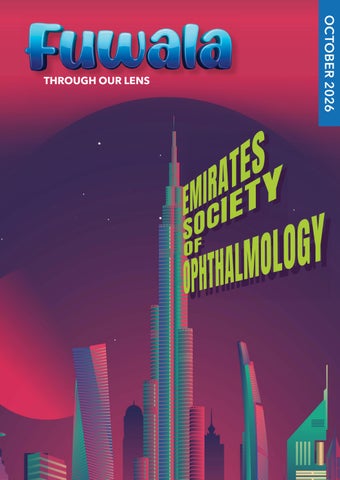
OCTOBER 2026
THROUGH OUR LENS
VISION, REIMAGINED
ESO PRESIDENT’S MESSAGE
Dear Friends and Colleagues, Welcome to Fuwala! It truly makes us happy to share this special magazine with you, a space made to bring us closer, not just as professionals, but as people who share a passion, a journey, and a community. The name Fuwala comes from our beautiful Emirati tradition. “Fuwala” is what we lovingly offer our guests first; selection of fruits, refreshments, sweets, presented and catered to guests before anything else. It means hospitality, kindness and sitting together for a good conversation. And that is exactly what this magazine is meant to be: a welcoming space where we gather, share news and celebrate one another. Fuwala is your social corner. Here you will find happy social moments, achievements, ESO news, memories and stories from our lives as ophthalmologists in the UAE. It is not about titles, it is about people, and the bonds that connect us. My heartfelt thanks to everyone who invested their time and effort to make the first edition of Fuwala possible. At the Emirates Society of Ophthalmology, we believe that strong communities grow through connection, care and shared moments. This magazine is our way of keeping that spirit alive between busy days, clinics and conferences. I hope you enjoy reading Fuwala as much as we enjoyed creating it. With warm wishes,
Sheikha Dr. Noura AL Qassimi President, ESO
2
FUWALA | Issue | October 2026 FUWALA | Issue 1 | 1October 2026
CONTENTS
COVER STORY Emirates Society of Ophthalmology Three decades of vision, leadership and professional unity
09
MILESTONE MOMENT
11
DOCTOR’S DIALOGUE
From Slit Lamps to Storylines A Voice That Educates Beyond Medicine
ANTERIOR INSIGHTS
Evidence, Innovation and Community
Aged Eyes, Modern Solutions
A conversation with Prof. Burkhard Dick
Anterior segment strategies for life after 40
12
MARK YOUR CALENDAR
13
SEE IT SOLVED
16
17
Conferences Calendar 2026-2028
BEHIND THE LENS
We hear your dilemma... and we offer solutions.
KNOWLEDGE IN FOCUS
Summary of Thyroid Eye Disease Research from the United Arab Emirates
BRAIN & EYE BOOST OPHTHO-TOONS
Restoring Vision Beyond the Macula: An Inward Perspective
22
WHERE EXPERTS ALIGN
ESO Consensus, From Discussion to Direction How ESO consensus is shaping eye care in the UAE
24
RISING STARS
UAE’s Future Ophthalmologists
FUWALA | Issue 1 | October 2026
3
EDITORIAL BOARD
Dr. Ghaleb F. Seif Chief Editor
Dr. Areej Abdallah Hasan
Prof. Dr. Omnia Hamam
Dr. Khaled Abuhaleeqa
Sheikha Dr. Noura Al Qassimi Dr. Fatima Habroosh
THROUGH OUR LENS
Published by
Emirates Society of Ophthalmology (ESO) Mamzar Area, Al Wahaida Road, Street 46, Dubai, UAE, P.O.Box: 6600
HQ Office: 6001 Beach Road, #09-09 Golden Mile Tower, Singapore 199589
Satellite Office: 2 Nuoc Man 2 Street, Da Nang City, Vietnam 50506
Phone: +65 8186 7677
Phone: +84 868 063 773
E-mail: enquiry@mediamice.com
Web: www.mediamice.com
Editors Gloria D. Gamat Diana Truong
Art Director Andres Pacheco
Writers Hazlin Hassan Kendra Bruning Marhiel Garrote
4
Graphic Designer Nhat Vo Project Managers Lea Pham Ruchi Ranga
FUWALA | Issue 1 | October 2026 FUWALA | Issue 1 | October 2026
FUWALA | Issue 1 | October 2026
5
COVER STORY
THREE DECADES OF VISION, LEADERSHIP AND PROFESSIONAL UNITY By Hazlin Hassan For more than three decades, the Emirates Society of Ophthalmology (ESO) has stood at the center of ophthalmic advancement in the United Arab Emirates (UAE). What began as a small professional gathering has grown into the country’s leading national ophthalmology society, one that unites ophthalmologists, residents and allied healthcare professionals under a shared commitment to excellence, education and collaboration.
6
FUWALA | Issue 1 | October 2026
WHERE IT ALL BEGAN The ESO was founded in 1992, at a time when ophthalmology in the UAE was still in its formative stages. According to Sheikha Dr. Noura Al Qassimi, president of the society: “In 1992, ESO was established by a group of pioneering ophthalmologists in the UAE under the umbrella of the Emirates Medical Association (EMA), which is governed by the Ministry of Community Empowerment.” From the outset, the society defined its mission clearly. “From its inception, ESO has been committed to promoting high standards of clinical care, encouraging scientific research and fostering collaboration among ophthalmologists nationwide,” said Dr. Al Qassimi. At the time of its founding, the UAE had a relatively small ophthalmology workforce. Over the years, this number has grown significantly alongside the country’s healthcare expansion. Today, ESO represents more than 400 members, including ophthalmologists, residents and allied health professionals, reflecting both national growth and increasing subspecialization. “Over the years, ESO evolved from a small group of specialists into the leading ophthalmology society in the UAE. ESO became the official professional body exclusively devoted to the advancement of ophthalmology in the UAE,” she said.
LEADERSHIP AND GOVERNANCE ESO’s strength lies in structured governance a n d m u l t i d i s c i p l i n a r y l e a d e r s h i p. T h e current Board reflects local exper tise and international collaboration:
Sheikha Dr. Noura Al Qassimi – President
Dr. Khaled Abuhaleeqa – Vice President
Dr. Huda Al Dhaheri – General Secretary
Prof. Piergiorgio Neri – Scientific Committee Chairperson
Dr. Fatima Habroosh – Cultural Committee Chairperson
Dr. Ghaleb Seif – Strategy and Organisational Committee Chairperson
MISSION, OBJECTIVES AND CORE VALUES The professional mandate of the Emirates Society of Ophthalmology (ESO) extends well beyond conferences and meetings. As articulated by Dr. Al Qassimi: “ESO has played a foundational role in shaping professional identity, educational standards and clinical excellence within the national ophthalmology community.” A central focus of the Society is the empowerment of its members and the advancement of professional development, achieved through the following objectives: •
Continuously advancing the standard of ophthalmology practice in the UAE.
•
Promoting Continuing Medical Education (CME) through conducting scientific educational meetings and workshops along the year.
•
Facilitating the professional exchange of knowledge and experience among members.
•
Improving eye and visual health in the community through educational and public health initiatives.
•
Enhancing social interaction and fostering goodwill among practitioners of the specialty, including members in training.
•
Promoting and upholding the interests of the ophthalmology profession in all its aspects.
MILESTONES AND GLOBAL ENGAGEMENT Over the years, ESO has established a strong presence on the international stage, with representation at major congresses, including: •
European Society of Cataract and Refractive Surgeons (ESCRS)
•
American Academy of Ophthalmology (AAO)
•
World Ophthalmology Congress (WOC)
•
Middle East Africa Council of Ophthalmology (MEACO)
The society has also driven impactful research and public-health initiatives such as RAFEK and ESTBEC (Epidemiology Study Before Eye Complications), while fostering collaborations with globally recognized institutions including Bascom Palmer Eye Institute– Abu Dhabi.
GROWING INFLUENCE AND SCIENTIFIC IMPACT ESO’s scope has expanded steadily, evolving into a comprehensive scientific and professional platform with tangible clinical influence.
Dr. Reem Al Hebsi – International Collaboration Committee Chairperson
“Over the years, ESO has expanded its scope by introducing working groups such as the Glaucoma
FUWALA | Issue 1 | October 2026
7
COVER STORY Chapter, Young Ophthalmologists Chapter, Optometrists Chapter and Orthoptists Chapter,” noted Dr. Al Qassimi. The society has also contributed to guideline development and expert consensus documents, including publications on diabetic macular edema, reinforcing its role in shaping national clinical standards. Most recently, ESO collaborated with regional partners to publish the Consensus Guidelines for the Screening and Management of Diabetic Retinopathy in the Gulf Region in the Journal of Diabetes and Endocrine Practice.
GULF OPHTHALMOLOGY (GO): A REGIONAL MILESTONE
VISUAL IDENTITY: THE ESO LOGO ESO’s current logo, introduced in 2022, reflects both symbolism and national identity: •
The colors reflect the flag of the UAE
•
The eye represents ophthalmic specialization and the innovative approach of ESO that gazes into the future of ophthalmology
•
The embrace is inspired by the ESO’s support for patients and empowerment. It acts as a visual element that holds the pillars of the ESO that gazes into the future through innovation and support
DIGITAL PRESENCE AND MEMBER ENGAGEMENT The formation of Gulf Ophthalmology (GO) marked a significant regional achievement. GO unites ophthalmology societies across the GCC (Gulf Cooperation Council) under a single collaborative platform. “The idea of GO began a few years ago when the Gulf Ophthalmology Societies started working collaboratively as one unified platform,” said Dr. Al Qassimi. The first edition of GO was launched in November 2025 in Riyadh, the Kingdom of Saudi Arabia, with the second edition slated to take place from 30th April to 2nd May 2027 in Abu Dhabi, UAE, alongside the 24th ESO Conference.
ESO maintains an active digital footprint to keep members informed and connected: •
•
Website: www.esouae.ae
Email: esoadmin@esouae.ae
•
Conferences Website: eso-conferences.com
•
Conference Email: info@eso-conferences.com
•
Instagram: @eso.uae
•
Facebook: facebook.com/ophthalmology.uae
•
LinkedIn: Emirates Society of Ophthalmology
•
YouTube: @esouae
•
X (Twitter): @ESO_UAE
MEMBERSHIP AND RENEWAL BENEFITS Being an active ESO member through the Emirates Medical Association provides benefits such as: •
Free registration for ESO conferences
•
Discounted rates for workshops and wet lab
•
Regional and international representation
•
Participation in scientific committees, guidelines, and research
•
Regular updates on programs and conferences
CONTRIBUTOR Sheikha Dr. Noura Al Qassimi
8
FUWALA | Issue 1 | October 2026
MILESTONE MOMENT
FROM
Slit Lamps Storylines TO
Meet the ophthalmologist who turned lockdown quiet into a fivebook writing streak—and discover that storytelling may be just as powerful a lens as the slit lamp. Some doctors write prescriptions. Dr. Anwar Sajwani writes books. In this candid chat, we explore his second life as a writer and how storytelling became part of his medical journey. “I see myself as a doctor most of the time… a writer when I’m free to write. Ophthalmology is my mind, writing is my heart,” he shared, offering a neatly balanced diagnosis. This dual identity has shaped a professional path that stretches beyond the clinic into storytelling, reflection and cultural exploration— an uncommon and intriguing route within the Emirates Society of Ophthalmology community.
WHERE THE PEN FOUND ITS MOMENT For Dr. Sajwani, writing took hold during the global lockdown of 2020. In a time marked by stillness and uncertainty, he found clarity on the page. “During the lockdown, it was very calm,” he recalled. “I was sitting on the balcony of my house. Suddenly, this idea came to my mind. I took a ballpoint pen and an A4 sheet and started transferring my thoughts onto paper.” What began as a quiet, personal exercise soon revealed itself as something more enduring — a creative commitment that would extend well beyond that moment of isolation.
A DISCIPLINED LITERARY RHYTHM Since then, Dr. Sajwani has authored five books, four in English and one in Arabic, maintaining an impressively steady pace. “One book per year from 2020,” he noted. His debut novel remains particularly close to him. “My first book, Love in the Season of Hate, is a story of an Emirati doctor who is training to become a heart specialist. He travels to different parts of Arab countries to help the needy in refugee camps,” Dr. Sajwani shared.
NOT A DIVIDED CAREER, BUT A BROADER LENS Writing was never intended to compete with ophthalmology. Instead, it became a complementary practice—one that created space for reflection alongside the pace of clinical life. As Dr. Sajwani explained, “It helped me to relax, avoid tension and understand life
FUWALA FUWALA| |Issue Issue11| |October October2026 2026
By Marhiel Garrote
better than before. I learned a lot of history, culture, humanity and language. Overall, it changed my perception of life.” Moreover, he found encouragement from those around him, despite the demands of clinical practice. “No one told me that it’s risky or a waste of time. In fact everyone was supportive and encouraged me.” That shift has subtly shaped how he approaches patient care. “Writing teaches one to think how characters in the book feel before you write about them,” he said. “Similarly, during treatment, I put myself in my patients’ shoes to understand their problems better.” Themes of service, empathy and cross-cultural experience run consistently through his work, echoing values familiar to many in medicine.
TURNING THE PAGE FORWARD His most recent novel signals growing international recognition. Titled, Visit to the Stolen Land, it has been accepted for publication by Austen Macauley in the UK. The story follows “two American journalists, an American Jewish lady and an American-born Palestinian ma n,” w h o s e “p r of e s s i o nal commitment forced them to work together in the Middle East.” Asked to sum up his writing journey in a single word, Dr. Sajwani chose one that feels both measured and earned: “Proud.” CONTRIBUTOR Dr. Anwar Sajwani
9
MILESTONE MOMENT
Voice Beyond Medicine A
THAT EDUCATES
By Marhiel Garrote
An unexpected creative path where medicine, voice and education intersect. Some doctors extend their impact beyond the clinic in unexpected ways. For Dr. Sara Aldhaheri, that extension came through voice, storytelling and education. While she is known for her work as an ophthalmologist, she also became the voice behind Mansour, the lead character of Mansour, an educational animated project designed to inspire curiosity and confidence in young audiences in Abu Dhabi. Mansour is not just a character she voices, but one she relates to deeply. Asked to describe him, Dr. Aldhaheri identified three defining trait s: “Mansour is curious, kind and brave.” Among these, curiosity stands out as the quality she shares the most closely with him. As she explained, “That constant desire to learn, explore and understand the world is something we both share.” This connection became the foundation of how she approached the role—not just a performance, but also an extension of herself.
THE MOMENT THAT SPARKED THE JOURNEY Voicing a cartoon character was never part of Dr. Aldhaheri’s original career plan. When she first heard about Mansour, her reaction was a mix of excitement and surprise. “I never imagined myself voicing a cartoon character, especially while being a doctor,” she said, describing the opportunity as “a beautiful and unexpected opportunity.” The role came not through a formal audition but through what she described as a natural alignment. “It was very much a right place, right voice moment,” she recalled. “Once we tried the voice, it just clicked.” Rather than dramatically altering her voice, Dr. Aldhaheri focused on authenticity. She believed that Mansour needed to sound real, warm and relatable. “I didn’t try to act too much,” she explained. “I just spoke naturally with minimal changes in my tone depending on Mansour’s age that I am recording.” While the script provided structure, she allowed emotion and instinct to guide her delivery.
DISCIPLINE BEHIND THE MICROPHONE Although being a doctor remains more demanding, voice ac ting brought its own challenges. Recording sessions required focus, repetition and emotional control. “Voice acting surprised me,” Dr. Aldhaheri shared. “It requires focus, emotional control, and repetition.” What stood out most was the physical toll according to Aldhaheri. What also surprised her was how tiring voice work can be, even though you are just using your voice.
in one word, she answered simply: “Magical.” She explained why: “Because the moment I heard Mansour come alive through my voice, I realized this was something truly special.” There were lighter moments too—retakes interrupted by laughter, or lines that suddenly felt too serious for a young character, she recalled.
PERSPECTIVE GAINED, NOT A ROLE DIVIDED Dr. Aldhaheri does not see creativity as separate from being a doctor. Instead, she believes it strengthens her ability to connect with patients. “Creativity improves communication, empathy and emotional intelligence, all of which are essential in medicine,” she said. “Both worlds entail connecting with people.” If Mansour were to walk into an ophthalmology clinic, she imagines him as “ the curious patient asking lots of questions, a little nervous at first, but very brave once you explain things to him—an image that reflects her own approach to care: guiding fear into understanding. Lastly, when asked what superpower she would like to give Mansour, her answer revealed the heart of her achievement, “The power to inspire confidence in others.” Through Mansour and Dr. Sara Aldhaheri, impact is measured not by titles but by the ability to educate, reassure and inspire—both inside and beyond the clinic.
Her first recording sessions remain unforgettable. Asked to describe it
10
FUWALA FUWALA| Issue | Issue11| October | October2026 2026
CONTRIBUTOR Sara Aldhaheri
DOCTOR’S DIALOGUE
EVIDENCE, INNOVATION AND COMMUNITY A conversation with Prof. Burkhard Dick By Diana Truong From evidence over ego to innovation with intent, Prof. Burkhard Dick shares why the future of cataract and refractive surgery hinges on data, mentorship and a community that puts patients before shiny new tech. In this edition of Doctor’s Dialogue, Fuwala sits down with Prof. Burkhard Dick to discuss his vision for the specialty and where cataract and refractive surger y are heading. It’s a conversation that balances big-picture thinking with practical realities—very much in keeping with his leadership style. As president of the European Society of Cataract and Refractive Surgeons (ESCRS), Prof. Dick brings both depth and perspective to the role. When asked what sets ESCRS apart from other global societies, he points first to its character rather than its size or influence. “It is the unique fusion of science, openness and collegiality that distinguishes ESCRS,” he explains. “We are a society of evidence-led professionals who remain close to the realities of practice.” Beyond scientific rigor, he places strong emphasis on the society’s culture. “ESCRS has never been an elite clique. It has always been a community that welcomes young surgeons seeking information, d e bating id eas and s har ing their knowledge.”
FROM DATA TO DAILY PRACTICE Reflecting on ESCRS’s achievements, Prof. Dick highlights the society’s tangible impact on clinical care. “Large studies and outcome registries haven’t just moved the field forward; they’ve truly influenced how surgeons operate on a day-to-day basis,” he notes.
He is equally proud of ESCRS’s evolution into what he describes as “a caring community,” with a clear commitment to mentoring and inclusion.
INNOVATION WITH PURPOSE Cataract and refractive surgery continue to move at pace, and Prof. Dick is particularly energized by developments in intraocular lenses. “Today, we are looking not just at restoring vision but at optimizing it for our patients,” he says. He also sees significant promise in digital technology and artificial intelligence, while remaining cleareyed about their role. “None of this technology is intended to replace surgeons but to enhance precision and safety.” When it comes to adopting new technologies in his own practice, Prof. Dick takes a measured approach. “Evidence comes first: solid data, replicability and transparency,” he states. His central ques tion remains constant: “Does this technology indeed advance patient outcomes or patient safety? The goal of innovation must be to serve patients, not to wow surgeons.”
THE HUMAN SIDE OF SURGERY Mentorship, for Prof. Dick, is essential to shaping well-rounded ophthalmic surgeons. “While skills may be acquired, judgement, resilience and professionalism are learned, often through mentorship,” he reflects. He values the fact that ESCRS treats mentorship “not as an ancillary activity but as a responsibility of a mature scientific organization.”
Away from the operating theater, he finds balance in pursuits that might surprise some colleagues. “Music and sport are essential to me because they bring me down to earth, heighten my awareness, and remind me that precision and creativity go hand in hand,” he shares. His advice to early- career ophthalmologists is refreshingly concise. “Curiosity and humility. Know the basics before reaching for something new. Never be afraid to seek guidance.”
LOOKING AHEAD, TOGETHER Tur ning to ESO 2026, Prof. Dick frames the meeting as an opportunity for collective progress. “Ophthalmology thrives when we join forces, share with each other and challenge each other constructively,” he says. “I see ESO 2026 as a way for ESCRS to build on our international connections, share our ideas, and shape the future of cataract and refractive surgery.” It’s a fitting note to end on: forwardlooking, collaborative, and firmly grounded in the realities of modern ophthalmic practice.
FUWALA | Issue 1 | October 2026
11
MARK YOUR CALENDAR
CONFERENCE C A L E N DA R Q4 CONGRESS OF THE ROYAL AUSTRALIAN AND NEW ZEALAND COLLEGE OF OPHTHALMOLOGISTS (RANZCO)
NOV 6-9
AUCKLAND, NEW ZEALAND
SAUDI OPHTHALMOLOGY SOCIETY CONFERENCE (SOS 2026)
NOV 5-9
DHAHRAN, SAUDI ARABIA
MEETING OF THE EUROPEAN VITREORETINAL SOCIETY (EVRS 2026)
NOV 6-8
ATHENS, GREECE
WCO6 (WORLD CONGRESS OF OPTOMETRY)-SSO (SAUDI SOCIETY OF OPTOMETRY) 2026
NOV 27-29
MUSCAT INTERNATIONAL OPHTHALMOLOGY CONFERENCE (MIOC 2026)
DEC 3-5
2027
Q1 HAWAIIAN EYE AND RETINA 2027 MEETING
RIYADH, SAUDI ARABIA MUSCAT, OMAN
JAN 16-22
HAWAII, USA
ASIA-PACIFIC ACADEMY OF OPHTHALMOLOGY CONGRESS (APAO 2027)
MAR 18-21
SINGAPORE
AMERICAN GLAUCOMA SOCIETY ANNUAL MEETING (AGS 2027)
MAR 4-7
TUCSON, USA
26TH KUWAIT CONFERENCE OF OPHTHALMOLOGY (KCO 2027)
MAR 26-28
KUWAIT CITY, KUWAIT
Q2 AMERICAN SOCIETY OF CATARACT AND REFRACTIVE SURGERY (ASCRS 2027)
APR 2-5
SAN DIEGO, USA
THE 24TH EMIRATES SOCIETY OF OPHTHALMOLOGY CONFERENCE - ESO2027
APR 9-11
ABU DHABI, UAE
THE 2ND GULF OPHTHALMOLOGY SOCIETIES CONGRESS - GO2027
APR 9-11
ABU DHABI, UAE
THE ASSOCIATION FOR RESEARCH IN VISION AND OPHTHALMOLOGY (ARVO 2027)
MAY 2-6
SAN DIEGO, USA
ASIA-PACIFIC ASSOCIATION OF CATARACT AND REFRACTIVE SURGEONS (APACRS 2027)
JUN 3-5
BALI, INDONESIA
Q3 THE AMERICAN SOCIETY OF RETINA SPECIALISTS (ASRS 2027)
JUL 28-AUG 3
SAN FRANCISCO, USA
CONGRESS OF THE EUROPEAN SOCIETY OF RETINA SPECIALISTS (EURETINA 2027)
SEP 16 -19
TBD
Q4 CONGRESS OF THE EUROPEAN SOCIETY OF CATARACT AND REFRACTIVE SURGEONS (ESCRS)
OCT 15-19
MADRID, SPAIN
8TH RED SEA INTERNATIONAL CONFERENCE OF THE SAUDI OPHTHALMOLOGY SOCIETY (SOS)
NOV 4-6
AMERICAN ACADEMY OF OPHTHALMOLOGY (AAO 2027)
NOV 13-15
LAS VEGAS, USA
AMERICAN ACADEMY OF OPTOMETRY (AAOPTOM 2027)
NOV 10-13
SAN ANTONIO, USA
JAN 15-21
HAWAI’I, USA
FEB 24-27
NASHVILLE, USA
APR 21-24
BOSTON, USA
2028
Q1 HAWAIIAN EYE AND RETINA 2028 MEETING AMERICAN GLAUCOMA SOCIETY ANNUAL MEETING (AGS 2028)
Q2 AMERICAN SOCIETY OF CATARACT AND REFRACTIVE SURGERY (ASCRS 2028) THE ASSOCIATION FOR RESEARCH IN VISION AND OPHTHALMOLOGY (ARVO 2028)
Q4 CONGRESS OF THE EUROPEAN SOCIETY OF CATARACT AND REFRACTIVE SURGEONS (ESCRS)
APR 30-MAY 4
JEDDAH, SAUDI ARABIA
TORONTO, CANADA
OCT 6-10
TBD
AMERICAN ACADEMY OF OPHTHALMOLOGY (AAO 2028)
OCT 14-16
CHICAGO, USA
AMERICAN ACADEMY OF OPTOMETRY (AAOPTOM 2028)
NOV 8-11
NASHVILLE, USA
12
FUWALA | Issue | October 2026 FUWALA | Issue 1 | 1October 2026
SEE IT SOLVED
We hear your dilemma…and we offer solutions. Q1: How to prevent burnout? Prevent burnout by protecting rest, fair scheduling and supportive mentorship. Q2: I’m O.H. I love my patients, but I keep talking to them too much…and I can’t stop them while they talk…which leads me to lose control of my consultation times. How can I take back control on my CS time while still giving enough time to my patients? Set the agenda early, listen fully for the first minute, then gently guide the conversation back to the eye. Q3: How do I stop talking without sounding rude? Summarize out loud. Patients feel heard—and you regain control.
Q4: I study a lot, but nothing sticks. Is something wrong with me? Unstructured learning fades fast—clear goals and short assessments make knowledge stay. Q5: Why does surgery feel harder than it looks in lectures? Because surgery is learned by hands, not slides. Wet labs matter. Q6: I’m afraid to interrupt patients— how do seniors do it so smoothly? They don’t interrupt; they redirect. Q7: What’s the secret to surviving residency? Sleep when you can, ask for help early and remember—you’re learning, not failing. Q8: Sometimes I feel that I spend more time on documentation than on the actual clinical examination of the patient. Any thoughts on this? Institutions should support clinicians with standardized documentation systems to reduce administrative burden and enhance clinical productivity.
FUWALA| Issue | Issue1 1| October | November 2026 FUWALA 2026
13
14
FUWALA | Issue 1 | October 2026
FUWALA | Issue 1 | October 2026
15
KNOWLEDGE IN FOCUS
SUMMARY OF THYROID EYE DISEASE RESEARCH FROM THE UNITED ARAB EMIRATES By Dr. Fatima Habroosh
Thyroid eye disease (TED), also known as Graves’ ophthalmopathy, has historically been under-represented in regional literature from the Middle East. Over the past several years, investigators from the United Arab Emirates (UAE) have made notable contributions to the global TED literature, particularly in the areas of biologic therapies, severe and refractory disease, and healtheconomic impact.
proptosis and disease activity.5 This was followed by the first retrospective comparative study from the UAE and Gulf region comparing teprotumumab and tocilizumab, which suggested superior proptosis reduction with teprotumumab while confirming tocilizumab as an effective alternative in selected cases.6 Together, these studies positioned UAE institutions among the early adopters of TED-specific biologic therapy outside Western settings.
Initial UAE publications focused on severe and atypical presentations of TED, primarily through case reports. These included descriptions of euthyroid Graves’ ophthalmopathy with negative thyroid antibodies and cor ticosteroid-refrac tor y disease, highlighting diagnostic complexity and limitations of conventional therapy.1,2 A landmar k pediatr ic c ase repor t documented the first reported use of tocilizumab in pediatric TED, expanding therapeutic considerations for younger patients with aggressive disease.3
Beyond clinical outcomes, UAE investigators also evaluated the economic burden of TED, publishing a cost-of-illness analysis presented at an international health-economics forum. This work highlighted substantial direct medical costs related to immunomodulator y therapy and hospital care, as well as indirect productivity losses, emphasizing the broader societal impact of TED in the UAE.7
Subsequent studies from the UAE shifted toward systematic evaluation of biologic agents, reflecting evolving international treatment paradigms. A prospective longitudinal cohort study assessed tocilizumab in patients with sight-threatening TED and dysthyroid optic neuropathy, demonstrating improvements in visual acuity, inflammatory activity, and orbital congestion in patients unresponsive to corticosteroids.4 This study provided early realworld prospective evidence supporting IL-6 inhibition in severe TED. More recently, UAE centers published the first regional case series evaluating teprotumumab for moderateto-severe TED, documenting meaningful reductions in
In addition, retrospective surgical data from Abu Dhabi, presented in conference for m, des cr ib e d outcomes of or bit al decompression surgery prior to widespread biologic use, providing historical context for evolving management strategies.8 In summary, UAE-based TED research has evolved from isolated case repor ts to prospective cohor ts, comparative biologic studies and health-economic analyses. These contributions have strengthened regional and global understanding of TED management, particularly in refractory disease, biologic therapy outcomes and real-world healthcare impact, thus establishing the UAE as an emerging center for advanced TED research and care.
REFERENCES
16
1.
Abu Helwa RS, Subeh HH, Katreddy V, Ahmed AI. A Case of Euthyroid Graves’ Ophthalmopathy With Negative Thyroid Antibodies. Cureus. 2024;16(11):e73527.
2.
Almazrouei O, Alalawi F, Albrashdi S, et al. A 46-Year-Old Woman with a 4-Year History of Graves Disease, with Severe Corticosteroid-Unresponsive Thyroid Eye Disease, Successfully Treated with Tocilizumab. Am J Case Rep. 2023;24:e938487.
3.
Albrashdi S, Alsharqi H, Habroosh F, Eatamadi H. Tocilizumab use in pediatric thyroid eye disease: First documented case. Am J Ophthalmol Case Rep. 2022;25:101387.
4.
Habroosh FA, Albrashdi SS, Alsaadi AH, Eatamadi H. Tocilizumab use for optic nerve compression in thyroid eye disease: a prospective longitudinal cohort. Int Ophthalmol. 2024;44(1):222
5.
Eatamadi H, Almazrouie O, Al Qatan N, Ibrahim H, Eatamadi S. Teprotumumab Use in Thyroid Eye Disease: Clinical Outcomes in the United Arab Emirates- a First Regional Case Series. Semin Ophthalmol. 2025 May 21:1-8. [Epub ahead of print].
6.
Eatamadi H. Comparative Outcomes of Teprotumumab and Tocilizumab in Thyroid Eye Disease: The First Retrospective Study from the United Arab Emirates and Gulf Region of the Middle East. Semin Ophthalmol. 2025 Dec 24:1-10. [Epub ahead of print].
7.
Al-Mazrouei N, Al-Zaabi M, Al-Shamsi H. Economic burden of thyroid eye disease in the United Arab Emirates. Value Health. 2024;27(S1):S142–S143.
8.
Al-Ketbi L, Al-Mansoori S, Al-Shehhi A. Outcomes of orbital decompression surgery in Abu Dhabi, United Arab Emirates [Conference presentation]. 2014. Regional Ophthalmology Meeting.
CONTRIBUTOR
Dr. Fatima Habroosh
1611|1|April FUWALA |Issue Issue |October October 2026 FUWALA FUWALA | |Issue 20262026
16
BRAIN & EYE BOOST 1
2
3
ACROSS
4
1. A core value that strengthens ESO’s professional community 5
4. Measurement of optical imperfections 5. Relating to the primary aqueous outflow pathway
6 7
7. Examination of the anterior chamber angle
8 15 9
10
8. Bird revered in Emirati culture for its extraordinary eyesight 9. Presence of an intraocular lens
11
12. Current president of the ESO 13. Traditional place for discussion and exchange of ideas 14. Progressive corneal thinning disorder
13
12
16. Primary contributor to the eye’s refractive power 16
14
DOWN 2. Disease of the orbital tissues 3. Describing abnormal new blood vessel growth 6. Involuntary rhythmic eye movement 10. One of the most attractive tourism destinations in the world. 11. Emirati gesture of welcome
OPHTHO-TOONS
15. Most common cause of irreversible blindness worldwide
C O L L A B O R A T I O N R E A B E R R O M E T R Y O I V T R A B E C U L A R A O S G O N I O S C O P F A L C O N U T L P S E U D O P H A K H Y R F U U B W A M A J L A L Q A S S I M I L K E R A T O C O N U S C O
N P Y S T G L I A A G M U C U I S O M R N E A
ANSWER KEY
FUWALA | Issue 1 | October 2026
17 17
ANTERIOR INSIGHTS
Aged Eyes, Modern Solutions ANTERIOR SEGMENT STRATEGIES FOR LIFE AFTER 40 By Kendra Bruning
Patients over 40 across the UAE and GCC are showing up with a modern request for fewer glasses, more freedom and a vision plan that fits screen-heavy work and frequent driving. Presbyopia did not get the memo. The toolkit has expanded, from conservative optics to corneal options to lens-based refractive surgery and premium intraocular lenses (IOLs). Insights from four ophthalmologists— Dr. Abdulla Naqi, Dr. Saleh Almessabi, Dr. Mazen Sinjab and Dr. Ghaleb Seif— point to the same destination: reduced spectacle dependence, but different routes, depending on the patient and the eye.
18
BEYOND 55: WHEN THE LENS TAKES OVER After 55, accommodation is gone and functional cataracts can show up early. The conversation shifts toward lens-based refractive surgery, though thresholds and preferred strategies vary. For Dr. Naqi, spectacle reduction often means clear lens extraction with a presbyopiacorrecting IOL. Dr. Almessabi is similar. When the eye is suitable, premium IOL strategies become the main route to independence. Dr. Sinjab lets the decision hinge on what the crystalline lens is doing. If it’s still transparent, he manages patients much like the 40 to 55 group. Once lens changes are present, cataract surgery with premium IOLs is considered, but only when corneal tomography and wavefront support the optics. In premium cases, the work-up often matters more than the label. Dr. Seif also treats the lens as the main driver beyond 55. He considers EDOF or trifocal IOLs based on eligibility and tolerance for optical side effects and still advises that occasional glasses may be needed.
FUWALA | Issue 1 | October 2026
CATARACT, NOW REFRACTIVE
MIX AND MATCH
Once cataract is present, the premium part of surgery is the pre-op thinking. Small selection errors get loud when patients expect freedom from spectacles.
Once premium IOLs enter the plan, a second decision appears. Keep both eyes on the same optical language or blend designs.
Dr. Naqi and Dr. Almessabi both use presbyopia-correcting IOLs to reduce spectacle dependence, with the same reminder that selection and counseling matter as much as the implant. Dr. Sinjab starts with diagnostics. Corneal tomography and wavefront analysis can flag irregularity or higher-order aberrations that make some designs a poor fit. Tear film, pupil behavior, and macular and optic nerve health help decide whether premium optics will pay off.
Dr. Naqi is firmly in the mix-and-match camp and uses different platforms between eyes to broaden functional vision. Dr. Almessabi prefers a cleaner setup and favors EDOF with minimal monovision rather than mixing IOL types. Dr. Sinjab takes the middle path and treats mix-andmatch as an option for selected cases, not a default strategy.
Dr. Seif lets lifestyle lead. For active patients with normal corneal aberrations, he often favors an EDOF IOL with mini-monovision to extend range while protecting contrast and keeping dysphotopsia manageable. He reserves trifocals for carefully selected patients who accept more halos and glare for stronger near vision, especially if night driving is not a priority. The goal is fewer glasses, with trade-offs clearly explained.
RLE WITH GUARDRAILS Refractive lens exchange (RLE) is elective lens-based surgery. It can be precise and predictable, but none of the surgeons see it as a universal fix. Dr. Naqi describes RLE as offering high safety, precision and predictability. Dr. Almessabi also finds it acceptable when risks and benefits are clearly explained and the patient is a good candidate. Dr. Sinjab draws a tighter circle and reserves RLE mainly for patients with high hyperopia, where corneal options may be less suitable or less stable long term. Dr. Seif is similarly selective. He preferentially considers RLE in patients over 55 with significant hyperopia or high myopia and does not routinely recommend it for emmetropic patients. In highly myopic eyes, he stresses clear counselling about retinal risk.
Dr. Seif’s preferred pairing is specific. He favors EDOF in the dominant eye and a trifocal in the fellow eye, aiming to bridge range while reducing the overall dysphotopsia burden compared with bilateral trifocals. Mix-and-match can work well, but they demand precise biometry, dominance planning and counseling about an adjustment period.
CONTRIBUTORS
Dr. Abdulla Naqi
Dr. Saleh Almessabi
Dr. Mazen Sinjab
GLASSES-FREE VISION AFTER 40? Glasses-free is not a single finish line but a spectrum. It depends on the eye and what the patient is willing to trade.
Dr. Ghaleb Seif
Dr. Naqi is optimistic for selected candidates, where careful selection matters as much as the procedure. Dr. Almessabi is comfortable saying yes when the patient is suitable and expectations are realistic. Dr. Sinjab pushes back and says not yet, because today’s technologies still come with compromises some patients will not tolerate. Dr. Seif lands closer to the cautious yes and sees it as realistic only when the patient is carefully selected, thoroughly evaluated and truly eligible. Across all four, the theme is judgement. Careful diagnostics, plain-language counseling and a plan that fits the patient’s work, habits and tolerance for trade-offs decide satisfaction.
RLE works best when it’s chosen because the eye fits the indication, not because someone is tired of reading glasses.
FUWALA | Issue 1 | October 2026
19
BEHIND THE LENS
Restoring Vision Beyond the Macula: An Inward Perspective By Dr. Mohammed Alkaabi
As vitreoretinal surgeons, we are repeatedly confronted with one of the most frustrating clinical realities in ophthalmology: a patient with a dense submacular scar from agerelated macular degeneration, or profound foveal atrophy from an inherited retinal dystrophy, in whom conventional surgical repair offers no meaningful visual recovery. In these eyes, photoreceptors—the fundamental biological transducers of vision—are irreversibly lost. The central question has therefore persisted for decades: if the macula is no longer functional, how can visual information still reach the visual cortex?
EARLY BIOLOGICAL AND SURGICAL ATTEMPTS: REPAIRING THE IRREPARABLE The earliest strategies aimed to restore or replace damaged retinal tissue itself. Surgeons and researchers explored macular translocation procedures, attempting to move healthy peripheral retina beneath the fovea. While anatomically elegant, these procedures were limited by unpredictable functional outcomes, high complication rates and the inability of relocated photoreceptors to fully integrate into a diseased retinal environment.
failed. Transplanted cells rarely f o r m e d m e a ni n g f u l s y n a p t i c connections with the host inner retina, immune responses, poor alignment and hostile microenvironments further limited success. These experiences collectively reinforced a sobering conclusion: once the macular photoreceptor layer is destroyed, simply replacing tissue is not enough to restore vision.
Other efforts focused on retinal or photoreceptor transplantation. Experimental approaches attempted to gr af t fet al retinal tis s ue, photoreceptor precursors or retinal pigment epithelium into areas of submacular scarring. Although some degree of cellular survival could be demonstrated histologically, functional integration consistently
Pharmacologic and regenerative strategies—including growth factors, stem cell–derived cells and genebased approaches—also offered promise but remained constrained by the same fundamental problem: without a receptive neural network capable of translating light into signal, vision cannot be rebuilt at the level of the outer retina alone.
20
SHIFTING THE TARGET: BYPASSING PHOTORECEPTORS These limitations prompted a conceptual shift. Rather than at tempting to regenerate lost photoreceptors, investigators began asking whether visual information could be delivered downstream of the damage. Importantly, in many patients with advanced macular disease, the inner retinal layers—bipolar cells, amacrine cells and ganglion cells— remain relatively preserved, as do the optic nerve and visual cortex. Initial attempts focused on stimulating retinal ganglion cells directly. These approaches demonstrated that electrically evoked signals could indeed be perceived as light, proving
FUWALA | Issue 1 | October 2026
that the visual cortex retained the ability to interpret artificial input. However, because this strategy bypassed nearly all intrinsic retinal processing, the resulting percepts were crude and spatially limited. Vision was reduced to patterns of light useful for orientation but insuf ficient for detailed form perception.
SUBRETINAL STIMULATION: WORKING WITH RETINAL PHYSIOLOGY A more physiologically aligned strategy emerged when stimulation was moved beneath the retina, into the subretinal space. By targeting bipolar cells rather than ganglion cells, this approach sought to preserve the retina’s internal signal processing architecture. Instead of replacing retinal computation, it attempted to collaborate with it. Submacular placement represented a particularly bold evolution of this concept. Implanting a device beneath the macula—traditionally considered untouchable in advanced degeneration— challenged long-held surgical dogma. Yet clinical experience revealed that, in selected patients with preserved inner retinal layers, meaningful central vision could be achieved. Patients demonstrated improved form perception, letter recognition and even limited reading ability. These outcomes validated a principle well known to vitreoretinal surgeons: the closer an intervention follows natural retinal signal flow, the better the functional outcome. From a surgical perspec tive, however, submacular implantation is not without cost. It is invasive, te c h nic all y d e ma n d i ng a n d per for med in tissue already compromised by degeneration. Long-term biocompatibility, retinal stability and scalability remain open questions. As such, subretinal prostheses may be best understood not as a final destination, but as a transitional solution—bridging biological repair and neural bypass.
THE ROLE OF ARTIFICIAL INTELLIGENCE: REDEFINING ARTIFICIAL VISION As prosthetic strategies evolved, it became clear that hardware alone would never be sufficient. Modern systems rely on external image capture, digital signal processing and patterned stimulation. This is where artificial intelligence has begun to fundamentally reshape the field. AI-driven image processing allows visual information to be optimized before it ever reaches the retina or brain. Complex scenes can be simplified, edges enhanced, contrast amplified and irrelevant information s u p p r e s s e d . I m p o r t a n t l y, s timulation pat ter ns can be customized to the patient’s residual retinal function, compensating for regional degeneration and reducing cognitive load. Vision becomes adaptive—capable of improving through software refinement rather than repeated surgical intervention. In this paradigm, artificial vision is no longer static. It learns, evolves and personalizes itself to the patient’s neural capacity.
LOOKING BEYOND THE EYE: DIRECT CORTICAL INTERFACES The logical extension of this evolution is the question many surgeons now quietly ask: if visual information can be captured externally and interpreted digitally, do we still need the eye at all? Experimental approaches exploring direct stimulation of central visual pathways—whether at the optic nerve, lateral geniculate nucleus or visual cortex—suggest that future systems may bypass the retina entirely. In such models, wearable devices such as glasses become the visual sensor, while the brain becomes the final destination for encoded information. Although these approaches remain investigational, they directly address the original clinical dilemma: delivering vision to the cortex when
FUWALA | Issue 1 | October 2026
the macula is no longer a viable entry point. In this future, vision restoration becomes increasingly software-defined, with hardware serving primarily as an interface rather than a limitation.
THE FUTURE ROLE OF THE VITREORETINAL SURGEON Far from rendering vitreoretinal surgeons obsolete, this evolution expands their role. Surgeons will remain essential for patient selection, preservation of retinal and optic nerve integrity, management of degenerative disease and implantation or maintenance of neural interfaces. Perhaps more importantly, the retinal specialist will increasingly operate at the intersection of surgery, neuroscience and data-driven personalization.
Conclusion The history of attempts to treat submacular sc ar ring ref lec t s a broader truth in medicine: biology cannot be forced, only respected and integrated. Early failures in tissue replacement taught us the limits of regeneration. Subretinal stimulation demonstrated the power of working with preserved neural circuits. Artificial intelligence now offers the means to adapt vision restoration to each patient’s remaining biology. Whether the future lies beneath the macula or beyond the eye itself, the guiding principle remains clear: meaningful vision is restored not by bypassing biology indiscriminately, but by intelligently partnering with it—until the visual cortex itself becomes the ultimate interface.
CONTRIBUTORS
Dr. Mohammed Alkaabi
Dr. Karim Hammamji
21
WHERE EXPERTS ALIGN
ESO Consensus, From Discussion to Direction
HOW ESO CONSENSUS IS SHAPING EYE CARE IN THE UAE* In ophthalmology, agreement isn’t easy—and that’s exactly why it matters. Through its consensus initiatives, the Emirates Society of Ophthalmology (ESO) has transformed expert dialogue into structured, practical guidance that supports clinicians, standardizes care and ultimately protects patients’ vision across the UAE and the region. Consensus statements are not textbooks—they are real-world clinical compasses, created by experts, for everyday practice.
WHY CONSENSUS MATTERS
SPOTLIGHT: DRY EYE AND DIABETES MACULAR EDEMA GUIDELINES
Consensus documents are more than academic publications— they are living guides that help clinicians make informed decisions in complex real-world scenarios. In a world where new therapies, technologies and clinical data emerge rapidly, consensus ensures that practitioners have a clear, re gio n - relevant road map grounded in both evidence and shared clinical experience. W het her it ’s diag nosing subtle ocular surface disease or optimizing retinal care, consensus recommendations help reduce variabilit y in practice and improve outcomes for patients.
One of the Society’s most impactful contributions has been in ocular surface and retinal diseases. Under the Consensus section of the Emirates Society of Ophthalmology, two major documents stand out on the public website: •
Middle East Preferred Practice Patterns for Dry Eye Disease— a regional consensus that outlines best practices for diagnosing and managing dry eye, a condition that affects quality of life and daily functioning for millions. This consensus, developed through expert Delphi panels, covers key aspects from clinical assessment to tailored treatment strategies, providing a structured framework for ophthalmologists across the Middle East.
•
Management of Diabetic Macular Edema Guidelines—published based on evidence and expert opinion from retinal specialists within the Emirates Society of Ophthalmology, this guideline provides clear clinical pathways for managing DME, one of the leading causes of vision loss in people with diabetes—a significant public health issue in the UAE.
Together, these consensus publications reflect the Society’s commitment to patient-centered care and clinical excellence, drawing on global research while tailored to local clinical realities.
22
FUWALA | Issue 1 | October 2026
DRY EYE DISEASE CONSENSUS—IN BRIEF Dry eye disease is one of the most common— yet mos t underes timated — conditions in ophthalmology. ESO’s dry eye consensus addressed this gap by emphasizing structured diagnosis and individualized management.
•
Stepwise management is essential—from lifestyle and environmental modification to topical therapy and advanced interventions
•
Meibomian gland dysfunction—a cornerstone of dry eye and must be actively identified and treated
•
Long-term disease control requires patient education and follow-up, not just short-term symptom relief
Key messages from the Dry Eye Consensus: •
Dry eye is a multifactorial disease— not all symptoms are equal and not all patients need the same treatment
•
Clinical evaluation matters: symptom assessment must be paired with objective signs (tear film stability, ocular surface staining, lid margin disease)
The consensus reinforced that dry eye is a chronic condition, requiring a strategic, personalized approach rather than a one-size-fits-all prescription.
DIABETIC MACULAR EDEMA (DME) CONSENSUS—IN BRIEF With diabetes prevalence rising across the UAE, ESO’s DME consensus provided much-needed clarity for one of the leading causes of vision loss in working-age adults. Key messages from the DME Consensus: •
Early detection is critical—timely diagnosis prevents irreversible vision loss
•
Management decisions should be guided by visual acuity, OCT findings and disease activity
•
Anti-VEGF therapy remains the cornerstone of treatment, with individualized retreatment strategies
•
Steroid therapy has a defined role in selected patients and clinical scenarios
•
Multidisciplinary coordination with physicians and endocrinologists is vital for optimal outcomes
The consensus unified retinal specialists around evidence-based, patient-centered pathways, tailored to regional healthcare realities.
WHAT’S NEXT: ALREADY IN THE PIPELINE The consensus journey continues. Two highly anticipated guidelines are currently under development: •
Retinopathy of Prematurity (ROP) Consensus— aiming to standardize screening and management for the most vulnerable patients: premature infants
•
MIGS Consensus in Glaucoma—addressing the rapidly expanding role of minimally invasive glaucoma surgery in modern practice
These upcoming documents will further strengthen ESO’s mission to support clinicians across every stage of life and every level of care.
FUWALA | Issue | October 2026 FUWALA | Issue 1 | 1October 2026
ONE VISION, ONE STANDARD From dr y eye to diabetic macular edema—and soon ROP and MIGS—ESO consensus initiatives reflect a simple but powerful idea: when experts align, patients benefit.
*Read the published consensus documents at: www.esouae.ae/consensus
23
RISING STARS
UAE’s Future Ophthalmologists
24
FUWALA | Issue 1 | October 2026
ABU DHABI OPHTHALMOLOGY RESIDENCY PROGRAM PGY1 PGY2
Dr. Maitha Alfazari Dr. Latifa Alalawi Dr. Noora Abdullateef AlQattan
RESIDENT PROGRAMS
Dr. Meera Altamimi
PGY3
Dr. Fakhera Alneyadi Dr. Reem Anouassi
PGY4
Dr. Sara Salem Aldhaheri Dr. Omaima Al Shkeili
PGY5
Dr. Aaesha Easa Alnuaimi Dr. Fatima Alalaw
CLEAVELAND CLINIC ABU DHABI OPHTHALMOLOGY RESIDENCY PROGRAM PGY1
Dr. Moawiya Alshunnar Dr. Fatima Alhashmi
PGY2
Dr. Mariam Juma Alkaabi Dr. Mahra Alshehhi
PGY3 PGY4 PGY5
Dr. Maryam Essa Dr. Rauda Shehab Dr. Ola Ahmad Azzam
MBRU (DUBAI) OPHTHALMOLOGY RESIDENCY PROGRAM PGY1 PGY2
Dr. Fatima Abdulla Alsaadi Dr. Reem Esam Alblooshi Dr. Hind Abdulla Alhashimi Dr. Nadia Ali Aldashti
PGY3
Dr. Mariam Darwish Mohamed Dr. Sarah Samer Kabbani Dr. Azza Abdulhameed Altandi Dr. Fatma Mohammad Almoosawi
PGY4 PGY5
Dr. Shamma juma Almansoori Dr. Moustafa Heider Hamoodi Dr. Ghaya Ali Alketbi Dr. Mohamed Mohsen Elmekresh
FUWALA | Issue 1 | October 2026
25
c
c
AN INNOVATIVE LATANOPROST CATIONIC EMULSION FORMULATION, FOR A SUSTAINED IOP-LOWERING EFFICACY AND LONG-TERM IMPROVEMENTS IN OCULAR SURFACE SIGNS AND SYMPTOMS*1,2
COMING SOON
*Vs preserved latanoprost at Week 12 and in the open-label period with continued Catiolanze® emulsion treatment or switching from preserved latanoprost to Catiolanze® emulsion. 1,2 CSF score and OSD symptoms were secondary outcomes from a non-inferiority Phase III randomized controlled trial. CSF, corneal fluorescein staining; IOP, intraocular pressure; OSD, ocular surface disease. 1. Baudouin C, et al. Eye (2025);39(8):1599–1607; 2. Stalmans I, et al. Clin Ophthalmol (2025);19:4635–4650 Date of preparation: March 2026, CATIOL-ME-260001
Website: www.esouae.ae
Email: esoadmin@esouae.ae
A PUBLICATION OF ESO
Facebook: ophthalmology.uae
Instagram: @eso.uae
28
LinkedIn: Emirates Society of Ophthalmology YouTube: @esouae
X (Twitter): @ESO_UAE
FUWALA | Issue 1 | October 2026
Conferences Info info@eso-conferences.com