FUTURE
STRATEGY
Research-based foresight
Future- based strategy
ACTION
Strategy enforcement
Kairos Future International research and consulting agency
New and Evolving Business Models for News Media in the U.S. Dr. Mats Lindgren, CEO and founder, Kairos Future 14 March, 2017
Foresight-driven strategy and innovation Founded 1993 Stockholm, Barcelona, Shanghai Kairos=the opportune moment
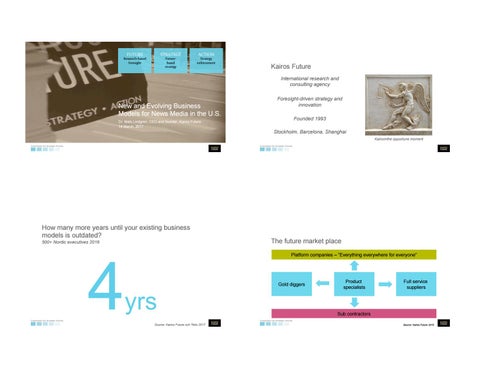
How many more years until your existing business models is outdated? 500+ Nordic executives 2016
4
The future market place Platform companies – ”Everything everywhere for everyone”
Gold diggers
yrs Source: Kairos Future och Tieto 2017
Product specialists
Full service suppliers
Sub contractors Source: Kairos Future 2015
Research model Understanding new and evolving business models in the news industry in the U.S., trends in the contextual environment, changes in subscribership and partnership
Observed mechanisms Among approx 100 observations Systematic experimentation and iteration
Lowering of Experts
the conversion
e
Finding the right pric
≈100 observations
7 Observed mechanisms
Data mining
Work in progress
7 Business model elements
In-depth case studies
Final report
To be completed – June
threshold
Full marketin
Target group specificity ising advert g solutions riven Data-d +1 advertising
Leveraging brand for additional revenue Leveraging skills for
additional revenue
Leveraging data for luencers additional revenue Incubating inf Formats for mobile-n ative audience AR and VR Cross-targeting of non -overlapping audienc es Personalization & customized curation Resource sharing ers-readers ertis adv , tion From mobile-fir idiza Cross-subs st to mobile-on ly Cross-subsidizatio Outsourcing n, readers-readers Automated jou rnalism ng Value-added content Crowdsourci Events Early access
Reorganizing content into new formats
Clusters of mechanisms: Business model elements Overall purpose: Managing the long-tail demand curve 1. Systematic experimentation to increase conversion 2. Synergistic approaches to reach new audiences and convert and retain readers 3. New formats for increased relevance 4. Generation and packaging of value-added content to better fit the demand curve 5. Taking an expanded and redefined role in value-creation for advertisers 6. Leveraging all assets to generate additional revenue 7. Cost reduction and more efficient production
1. Systematic experimentation to increase conversion
Willingness to pay
Readers
Willingness to pay
Lowering of the conversion threshold The FT in 2016 replaced the popular metered pay wall model that it pioneered with a trialing model, giving readers 4 weeks full access for $1 dollar with the aim of building habit and reducing entry barriers.
Systematic experimentation to increase revenues from existing subscribers Finding the right price $1 Old price
The Boston Globe steeply raised the price of their digital subscriptions to $1/day, with above 90% retention of subscribers.
Readers
Willingness to pay
Willingness to pay
Systematic experimentation to lower conversion threshold – trial price or simplified payment
A slight value decrease for advertisers
Brand owners
Brand owners
Before
Before
After
After
Willingness to pay
Subsidization of cost sensitive target group by less cost sensitive subscriber group Generous readers pay for students
2. Synergistic approaches to reach new audiences and convert and retain readers
Willingness to pay
Readers
Increased value for advertisers
Brand owners
Before After
The NYT lets readers sponsor digital subscriptions for students – leveraging generosity among readers with a low costsensitivity with the added benefit of building loyalty among students.
Willingness to pay
Readers
Brand owners
Before
Likes NYT, but unwilling to pay
Lincoln’s target customers
After
Willingness to pay
Willingness to pay
§ NYT identified a group of regular non-paying readers, matching the target profile of Lincoln Motor. § Lincoln was offered to sponsor subscriptions for these readers, as a targeted marketing campaign. § NYT got revenue in two steps: from the sponsor, and from retention of the new subscribers.
Cross-targeting of non-overlapping audiences to reach new audiences through bundled offerings Normal subscription price Revenue from joint subscriptions
The NYT identified Spotify as a potential partner with a largely non-overlapping audience. Through offering a joint subscription, both partners were able to attract new customers.
Readers
Willingness to pay
Subsidization by advertiser of high-value reader group with low willingness to pay
Brand owners
Before After
Willingness to pay
Cross-promotion and sharing of resources to split costs, add value and reach new audiences
Increased value for readers
Attracting new readers
Willingness to pay
Readers
§ The Providence Journal partnered with Gimlet Media’s podcast Crimetown to attract the podcast’s largely non-overlapping audience while at the same time sharing resources for content production. § Crimetown can access the archives for its research and frequently mentions the Journal. § The Journal publishes a weekly column with the stories covered in the podcast.
Cost of content creation Brand owners
Before After
3. New formats for increased relevance
Readers
Willingness to pay
Willingness to pay
Readers
The Street offers readers the possibility to follow individual journalists (one of which is part of the premium content offering). This replicates the person-centered mechanism of social media, fostering loyalty, increasing relevance, and providing advertisers with better targeting.
Presenting news in formats that speak to a mobile-native audience Willingness to pay
Willingness to pay
Becoming an incubator for influencers to drive personcentered revenue
Brand owners
Brand owners
Before
Before
After
After
Experimentation with virtual and augmented reality NYT sent more than 1 million virtual reality headsets to subscribers in late 2015 to reach mainstream consumers; other news organizations followed suit in 2016.
More analytics enabled personalization and greater variation of curated content to target finer segments Lumi, a Tinder-style app that learns what the reader likes.
”Through virtual reality, The New York Times put you at the center of
the stories that only we can tell. From embedding with Iraqi forces as they fight to retake Falluja from ISIS, to climbing the spire of the World Trade Center with professional mountaineer Jimmy Chin or setting foot the alien world of Pluto”
Messagingstyle apps Quartz’ business news app resembles apps for instant messaging, presenting each story as a "message bubble”. Each edition shows one single ad.
WP and NYT use data analytics and dedicated staff to create niched newsletters and notifications targeting 50-70 segments.
Willingness to pay
Charging a premium for early access to content Premium price, Slate Plus
Normal price, outside US
Slate, one of the oldest digital-only news sites, has partnered with the podcast network Panoply to offer early access to Panoply’s free podcasts as parts of its premium offering.
4. Generation and packaging of value-added content to better fit the demand curve
Willingness to pay
Readers
Brand owners
Willingness to pay
Utilizing content and resources for concepts that buyers and advertisers are willing to pay a premium for
Willingness to pay
Readers
Brand owners
Regional publishers find new revenue in organizing events § GateHouse, the largest newspaper publisher in the U.S., has started the division GateHouse Live for producing (mainly lifestyle-oriented) events. § All events are sponsored, some with bundled advertising, and some also charge entry fees.
Leveraging data and internal resources for value-added, members-only content The Street is offering a ‘members-only investing club’ with action alerts and investment advice by Wall Street investors and columnists.
Techcrunch has started offering a premium version of the startup database Crunchbase, by adding new services on top of the data.
More value for advertisers: brand building, bundled offerings, machine learning and millennial voice
5. Taking an expanded and redefined role in value-creation for advertisers
From advertising to brand building
+1 advertising: bundled offerings
With marketing expenditure on the rise but display advertising in relative decline, news organizations expand across the value-chain by assisting in brand building, not just advertising. NYT has acquired Hello Society, an influencer agency. Gatehouse provides full marketing solutions for SMEs.
News organizations and finding that advertising is easier to sell when it is bundled with additional valueadded components such as branded content or event sponsorship. Atlantic Media is selling display advertisements based on leads from events it has produced.
Improving advertising effectiveness by leveraging user data and new formats
Offering advertisers specific target groups and more effective formats
With advances in machine learning and easier-touse tools, growing numbers of news organizations are taking a data-driven approach to generate content that attracts the right audience and match ads with the right readers.
New local news platforms such as Billy Penn target a young audience by using �a millennial voice�. Experimentation with AR ads has been going on for years, but this year the number is surging.
Leveraging brand in e-commerce
6. Leveraging all assets to generate additional revenue
Crowdsourced and crowd co-created content Fresco, a NYT-affiliated start-up, has launched an app that connects editors with amateur photographers.
7. Cost reduction and more efficient production
This way of crowdsourcing photo and video material leads to increased speed and lower production costs.
A few take-aways from the research so far
Thank you!
1. There are no silver bullets – systematic testing, continuous adjustments, and many small revenue streams are needed 2. Seek synergies and overlapping interests in the ecosystem you are part – crosssubsidies, cross-targeting, resource sharing, and ecosystem effects 3. Take a larger role:
Mats Lindgren CEO and Founder mats.lindgren@kairosfuture.com +46 (0) 8 545 225 00
1. 2.
Providing solutions to strengthen brands – not just for advertising Fulfilling large and small unmet needs among content consumers – not just news production
4. With this larger role, non-media digital business models are available to news organizations 5. Monitor best practice in emerging areas such as automation, crowdsourcing, AR, and VR 6. Innovation is great, but don’t forget the core!