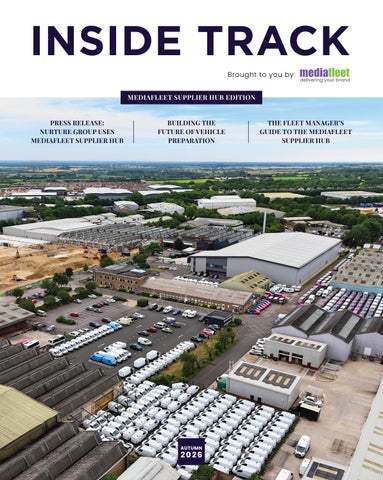
MEDIAFLEET SUPPLIER HUB EDITION
PRESS RELEASE: NURTURE GROUP USES MEDIAFLEET SUPPLIER HUB
BUILDING THE FUTURE OF VEHICLE PREPARATION
AUTUMN
2026
THE FLEET MANAGER’S GUIDE TO THE MEDIAFLEET SUPPLIER HUB
Branding Britain’s Fleets Please call our award winning team to discuss your fleet branding requirements.
www.mediafleet.co.uk 01993 772 525
Welcome ... A New Chapter for Mediafleet There is a particular moment in any ambitious business project when the planning, the conversations and the spreadsheets give way to something rather more real. The money has been committed, the facilities are taking shape, people are asking when they can get started, and you find yourself thinking, “I do hope this works!” I suspect most business owners will recognise that feeling. It is a mixture of excitement, pride and just enough trepidation to keep you awake at night. The Mediafleet Supplier Hub has certainly given some of us a few of those moments. Over the past year, we have made a significant investment in our Witney operation, expanding our facilities, increasing capacity and developing the infrastructure needed to bring independent specialist suppliers together in a single, managed production environment. It represents a considerable commitment, not just financially, but in the time, effort and belief of the people who have helped bring the idea to life. We are proud of what we have built. But we are equally conscious that building a facility is one thing…proving that a new approach can make a genuine difference to customers and the wider industry is quite another. But standing still is rarely a recipe for progress. We felt there was a genuine opportunity to improve the way vehicle conversion is delivered, and we were prepared to invest in making that opportunity a reality. Encouragingly, the early results have been very positive. The projects featured in this
issue, particularly our work with the Nurture Group, demonstrate what can be achieved when specialist expertise, careful planning and effective coordination come together. We are seeing the benefits of keeping vehicles in one location, improving visibility of the process and giving customers greater control over the suppliers involved. We are also learning a great deal. No new operation is ever finished, and we have plenty more to do as we develop the Hub, refine our processes and build relationships with more customers and supply chain partners. I would like to thank the Mediafleet team, the independent suppliers, and the customers choosing to use the Hub, who have embraced the concept and helped turn an idea into a working operation. Their commitment, flexibility and willingness to work together have been fundamental to our progress so far. The Hub represents a major investment in Mediafleet’s future, and I’ll admit that committing to such an ambitious project brought its share of trepidation. There is always uncertainty when you move beyond the familiar and put a new idea into practice. But seeing the Hub become a working operation, and the positive results we are already achieving, has made that leap of faith worthwhile. I hope you enjoy this issue of Inside Track and find the stories that follow as encouraging as we do. They offer a glimpse of what we believe is possible when an established industry is prepared to challenge some of its traditional ways of working. And, for the record, I am sleeping rather better now than I was when we first started putting all this together!
Barnaby Smith Managing Director
Inside Track - Autumn 2026 |
3
In this issue 6-13
Press Release - Nurture Group
Centralised conversion gives Nurture Group greater control, supplier choice and improved visibility while reducing vehicle movements according to Mediafleet and the Nurture Group.
14-37
Stop Moving the Product. Move the Supply Chain
38-53
Building the future of vehicle preparation
54-63
In this article Barnaby Smith, managing director of Mediafleet and Rob Rudd, head of development, discuss the benefits to customers of the Mediafleet Supplier Hub.
Luke Macdivitt, Mediafleet’s manufacturing manager, on the thinking behind the Supplier Hub and how a new approach to vehicle conversion and supply chain integration is changing the way fleet vehicles are prepared and converted.
The Fleet Manager’s Guide to the Mediafleet Supplier Hub
How to simplify vehicle conversion using multiple specialist suppliers without giving up supplier choice.
4
| Inside Track - Autumn 2026
6-13
14-37
54-63
38-53
Inside Track - Autumn 2026 |
5
Press Release - Nurture
6
| Inside Track - Autumn 2026
Press Release
Nurture Group uses Mediafleet Supplier Hub to create a smarter route to work-ready vehicles
Centralised conversion gives Nurture Group greater control, supplier choice and improved visibility while reducing vehicle movements according to Mediafleet and the Nurture Group. Nurture Group is using the new Mediafleet Supplier Hub in Witney to prepare vehicles for operational deployment, adopting a unique centralised approach that brings multiple specialist suppliers to the vehicle rather than moving the vehicle between different conversion facilities.
Inside Track - Autumn 2026 |
7
Press Release - Nurture
Nurture Group is one of the UK’s leading providers of grounds maintenance, green solutions, pest control, winter gritting and landscape construction services. Operating nationally across a diverse customer base, the Group employs over 4,000 colleagues and manages a significant and complex vehicle fleet of more than 2,000 vehicles, including commercial vehicles and company cars. Ensuring those vehicles are efficiently prepared and work-ready is therefore critical to the performance of its national operation and the job of Mo Iqbal, Group Fleet Project Manager, Nurture Group. Mo said, “The difference is significant. “The fact that all the vehicles remain in one location for the duration of the conversion, with my choice of individual suppliers coming to the Supplier Hub to carry out their work, is unique.” said Mo. “It gives us much better visibility of progress, creates a much smoother work-flow, and makes it considerably easier to manage the whole programme. It is this type of service
8
| Inside Track - Autumn 2026
innovation that will drive the conversion market forward and something I look for in a supplier.” The model also gives Nurture Group the freedom to use the specialist suppliers it considers right for each element of a vehicle’s preparation, rather than being restricted to the capabilities or preferred supply chain of a single converter. That combination of specialist choice and centralised management is at the heart of Mediafleet’s Supplier Hub.
Mo stated, “The Nurture Group vehicles receive racking, telematics, tow bars, security plates, locks, floormats and seat covers, to name a few, with the branding always provided by Mediafleet. Depending on the specification, a vehicle can pass through the hands of as many as five different conversion specialists during its preparation — all working from the same location.”
Barnaby Smith, Managing Director of Mediafleet said, “Customers shouldn’t have to choose between specialist expertise and a simple conversion process. The Mediafleet Supplier Hub allows them to choose the suppliers and technologies they want, while Mediafleet brings those specialists together, coordinating the suppliers and managing the vehicle programme on behalf of the end user.”
Inside Track - Autumn 2026 |
9
Press Release - Nurture
Greater visibility, better work-flow, greater throughput. The Hub provides a single location from which to monitor progress. Work completed, outstanding activities, technical issues and planned completion dates can all be tracked as the vehicle moves through its conversion programme. “The Mediafleet Supplier Park is a great place to conduct our work,” said Adrian Marsh, Pioneer Vehicle Solutions. “It is purpose-built, well organised and gives us a controlled environment even with other suppliers working alongside us. Vehicles are always available and move freely through the hub, so we can get on with our work without unnecessary delays. The project management also makes a big difference — everyone knows what needs to happen and when.”
10 | Inside Track - Autumn 2026
For Mo Iqbal, visibility is one of the key benefits. “We can see where every vehicle is in the process and what needs to happen next. Mediafleet’s specialist project team manages the programme, with its proprietary CRM providing realtime visibility of progress across every vehicle. If something isn’t progressing as planned, it can be identified and addressed early, rather than becoming a problem when the vehicle is due to be delivered.” Bringing the specialists together also increases efficiency. With conversion activities coordinated around the vehicle, there is less waiting between stages and faster turnaround — enabling more vehicles to be completed, and with faster service deployment in the same period.
Less movement, less disruption, greater output. Keeping the vehicles at Witney throughout the process also removes many of the unnecessary movements associated with conventional multi-supplier conversion. There are less collections and delivery, less loading, and unloading and less handling of vehicles between different locations. For Nurture, that means a simpler process and fewer opportunities for delays or transport-related damage.
The Supplier Hub provides environmental benefits. “From a sustainability point of view, it makes obvious sense,” said Mo. “With businesses under increasing pressure to reduce their environmental impact, there is a real opportunity to avoid unnecessary vehicle movements during the conversion process. Bringing suppliers to the vehicles means fewer journeys and lower transport emissions — removing avoidable carbon from the process.”
Barnaby Smith believes this is an important distinction in how vehicle conversion can be approached.
“The industry has developed an impressive network of highly capable specialists,” he said. “The challenge is not a lack of capability - it is how you bring that capability together efficiently for the customer”.
Inside Track - Autumn 2026 |
11
Press Release - Nurture
For Nurture Group, the centralised approach brings every stage of the conversion together in one location. Mediafleet provides the production environment, programme management, supplier coordination and overall work-flow, while the individual specialists retain responsibility for their own areas of expertise. The result is a finished, work-ready vehicle delivered as one integrated outcome without the complexity of managing multiple suppliers, locations and vehicle movements.
12
| Inside Track - Autumn 2026
Mo commented, “Delivering a complex fleet replacement programme requires effective supplier collaboration, clear visibility, strong controls and fleet governance . The Supplier Hub model has helped simplify what is traditionally a fragmented process, providing greater oversight across the vehicle build journey and supporting the efficient deployment of vehicles into service. As Nurture Group continues to invest in its fleet, this approach helps drive consistency, efficiency and value across the business.”
The Nurture Group programme demonstrates the purpose of the Supplier Hub: bringing independent specialist capability together around the vehicle to create a more efficient, visible and sustainable route from base vehicle to work-ready vehicle.
Inside Track - Autumn 2026 | 13
The Supplier Hub
Stop Moving the Product.
14
| Inside Track - Autumn 2026
Move the Supply Chain.
Authors: Barnaby Smith and Rob Rudd
Inside Track - Autumn 2026 |
15
The Supplier Hub
Rob says…
“The UK vehicle conversion market is a successful and highly capable industry. It has built an extensive network of specialist converters, manufacturers, financiers and suppliers capable of delivering increasingly complex vehicles. But there is an opportunity to bring that capability together in a way that gives the end user both the efficiency of one central location and the ability to choose the specialists best suited to the job.“
16 | Inside Track - Autumn 2026
The result can be a better vehicle… delivered faster and at a more competitive cost… because the customer is choosing the right supplier for each requirement, rather than accepting a single supplier’s complete offering.
Inside Track - Autumn 2026 |
17
The Supplier Hub
Bringing the vehicle, people and processes together under one roof has clear advantages. It can reduce transport, handling, delays and the number of physical movements involved in a conversion. But…the question is…how can the industry deliver those benefits without limiting the end user to the capabilities, products or preferred suppliers of a single converter? What if the vehicle could stay in one place, with the specialist suppliers coming to it…but the end user remains free to decide which suppliers they want working on their vehicles? Any supplier is welcome…this is an all-inclusive proposition... all except vehicle branding, of course! That combination is the important ‘point of difference’.
18 | Inside Track - Autumn 2026
4 One location provides the operational efficiency. 4 Customer choice provides the commercial advantages. 4 Together, they create a different model for vehicle conversion. 4 This is the thinking behind the Mediafleet Supplier Hub. It is taking Supply Chain Integration to the next level.
Inside Track - Autumn 2026 | 19
Editorial The Supplier Hub
In more detail… Rather than moving the vehicle from supplier to supplier, specialist suppliers work on the vehicle in one central production and assembly facility. Each supplier carries out its own part of the conversion, while the programme is centrally coordinated and managed. The Mediafleet Supplier Hub works with all industry participants, regardless of size, status or capability. End users can choose their existing converter, individual specialist suppliers, or a combination of both. The Supplier Hub provides the facilities, planning and coordination to bring those choices together in one managed production environment. The vehicle stays in one place. The specialists come to it. And the customer chooses the specialists.
It’s ultra efficient, and retains best in-class technical expertise in all aspects of the build.
20 | Inside Track - Autumn 2026
Inside Track - Autumn 2026 |
21
The Supplier Hub
A different approach is emerging…
The ‘Supplier Hub’ provides the space, equipment and production environment needed to bring those suppliers together. The Integrator manages the programme, coordinates the suppliers and takes responsibility for making sure the different activities work together. The end user therefore does not need to source everything from one converter. It can select the specialist suppliers, products and technologies it considers best for the vehicle. The suppliers remain independent. The vehicle remains in one location. The Integrator makes the whole process work as one. It is the combination of independent specialist capability, centralised production and customer choice that creates the difference.
22 | Inside Track - Autumn 2026
It is not about creating another converter. The opportunity is sometimes described as creating a “one-stop shop”. But that phrase can be misleading. A traditional one-stop shop usually means one supplier offering multiple capabilities. The model being proposed here is different.
The Mediafleet Supplier Hub… It is a central hub for independent specialist suppliers.
The customer is not buying everything from one converter. The customer is buying an integrated outcome from an organisation that brings together the specialist capability required to deliver it. That means the end user can say… “These are the suppliers and technologies we want.
“Bring them together, manage the programme, and deliver the finished vehicles to me when they are ‘work ready’.” That is fundamentally different from being offered the capabilities that happen to sit within a single converter’s organisation or supplier network.
Inside Track - Autumn 2026 | 23
The Supplier Hub
The principle is already proven… This is nothing new as a commercial model. Similar approaches have operated for many years in other industries. But, closer to home, the automotive industry provides some useful examples of suppliers being brought together around vehicle production.
Audi - Ingolstadt The Audi supplier Hub or ‘hub’ at Ingolstadt is a good example. A number of suppliers have operated on or around the Audi production site, allowing specialist activities and logistics to be brought closer to final vehicle production. The principle is straightforward: suppliers can remain specialist businesses while operating within a coordinated environment designed around the needs of the vehicle production process. The important point for this proposition is not that every automotive supplier Hub operates in exactly the same way. It is that the automotive industry has long recognised the value of bringing specialist suppliers together rather than repeatedly moving products between disconnected locations.
24 | Inside Track - Autumn 2026
The difference is simple… Traditional model
Supplier A
Transport
Supplier B
Transport
Supplier C
Transport
Inspection
Transport
Final Assembly
Versus the Centralised Supply Chain Integration Facility (Supplier Hub) Integrated model
Inside Track - Autumn 2026 | 25
The Supplier Hub
So, what are the benefits? • Customer choice – the end user can select the specialist suppliers and technologies best suited to the requirement. •
Less transportation – fewer movements between suppliers.
• Shorter lead times – activities can be coordinated to make the best use of time. •
Better control – one location provides visibility of the whole programme.
• Reduced damage risk – the product isn’t repeatedly loaded, unloaded and transported. • Better quality control – problems can be identified while the product is still on site. •
Improved scheduling – suppliers work to an integrated production plan.
• Greater accountability – one location and one programme give the customer clearer ownership. •
Scalability – multiple products can be processed simultaneously.
• Better supplier collaboration – specialists can physically work alongside one another. •
26 | Inside Track - Autumn 2026
Reduced customer disruption – the customer receives a completed, work-ready product rather than coordinating multiple suppliers themselves.
Inside Track - Autumn 2026 | 27
The Supplier Hub
A stronger strategic proposition The proposition is not simply about having a larger facility or more capabilities in one place. It is about creating an environment in which independent specialist suppliers can work together around the vehicle, while the customer retains the ability to choose those suppliers. That provides an interesting and beneficial point of difference. It provides…
SPACE + EQUIPME PLANNING + LOGI COORDINATION + CONTROL + TESTIN ASSEMBLY + DELIV
28 | Inside Track - Autumn 2026
ENT + WORK ISTICS + SUPPLIER + QUALITY NG + FINAL VERY. The suppliers remain specialists, but the facility operator becomes “The Integrator”.
manufacturing environment rather than treating each as an isolated supply-chain transaction.
There are also other markets such as Aerospace, where companies have increasingly brought machining, surface treatment, assembly and other specialist processes into a coordinated
ASG Aerospace describes its UK capability as, “combining machining, complex assembly and surface treatment into an end-to-end integrated manufacturing process.”
That’s not quite the proposed
shared facility I am talking about
here, but it demonstrates the same underlying economic argument… more of the manufacturing process takes place
in one location, reducing
unnecessary transport, handling and delays.
Inside Track - Autumn 2026 | 29
The Supplier Hub
If I were the end user, “What does this actually change for me?” If I am the ‘end user’…
1. I can choose the specialists I want…
This is perhaps the most important difference. I am not limited to the capabilities, products or preferred suppliers of a single converter…and perhaps more importantly, the pricing. I can negotiate with whom I please. If I have a particular requirement for racking, electrical systems, telematics, specialist equipment or another conversion activity, I can select the supplier that I believe is best suited to that requirement. The Integrator provides the facility and coordinates the programme. End-user benefit: I get the specialist capability at the price I choose, without having to manage multiple locations, collections, deliveries and supplier interfaces myself.
2. I have one location and point of contact for the complete conversion.
Instead of managing several suppliers who each perform a different part of the work, there is one location and one organisation coordinating the whole process. End-user benefit: Less supplier management and fewer things for me to coordinate, while retaining the ability to choose the suppliers involved.
3. My product doesn’t keep travelling around
The product stays in one controlled location while the specialists come to it. End-user benefit: Less transport, less handling, less risk of damage and fewer delays. The vehicle can potentially be on the road faster and at lower overall cost.
4. The suppliers work as a team
If one supplier identifies an issue with another supplier’s work, they can resolve it on site rather than sending the product back and forth. End-user benefit: Problems are resolved between suppliers rather than becoming the customer’s problem.
30 | Inside Track - Autumn 2026
5. I get a finished, work-ready product
I am not buying a collection of disconnected supplier activities. I am buying a finished outcome. For example: “As the Integrator…give us the vehicle. We will coordinate everything required to turn it into a work-ready vehicle.” End-user benefit: One completed outcome and one handover, without sacrificing supplier choice.
6. I have complete visibility of the conversion
programme
With the vehicle remaining in one location and all suppliers working within the same programme, the entire conversion can be monitored from a single point. I can see… • where each vehicle is in the conversion process
7. It should reduce my overall lead time
I am not just eliminating transport… I’m potentially allowing different conversion activities to overlap. While Supplier A is completing one part of the work, Supplier B can be preparing its components, and Supplier C can be preparing for the next stage. End-user benefit: Faster turnaround and potentially greater production capacity.
• which work has been completed • what work remains outstanding • whether any supplier activity is affecting the programme • quality or technical issues requiring attention • planned and actual completion dates • when the vehicle is ready for delivery End-user benefit: I have a clear, accurate view of every vehicle throughout the conversion process, allowing me to identify problems early, manage delivery expectations and plan the vehicle’s return to operational service with confidence.
8. One organisation takes responsibility for the whole process The individual suppliers remain responsible for their specialist work, but the Integrator is responsible for making sure all of those activities come together to deliver the finished vehicle. I don’t have to coordinate multiple suppliers, resolve issues between them or work out who is responsible when one stage affects another. End-user benefit: I have one organisation accountable for delivering the complete conversion — while retaining the right to choose the specialists doing the work. Inside Track - Autumn 2026 | 31
The Supplier Hub
If I were the supplier, “What does this actually change for me?” From a supplier perspective
1. I don’t need to provide the facility
I don’t need to supply a workshop, storage, specialist equipment, loading facilities and potentially additional premises…the Integrator provides the production environment. I just bring my people, expertise and equipment required for the particular operation. Supplier benefit: Lower infrastructure costs, less capital investment and the ability to take on larger programmes without having to expand my own facilities.
2. Potentially, I get access to new customers
The Integrator brings together projects that require multiple specialist capabilities. As a supplier, I might traditionally win a contract for your particular service, but in this model, it becomes part of a larger integrated proposition. For example: Customer needs 500 vehicles converted and asks the Integrator for help procuring specialist services. The Integrator could recommend your services and/or products. Supplier benefit: Access to larger contracts, higher volumes and new customers without having to develop the complete range of capabilities required to win the overall programme.
32 | Inside Track - Autumn 2026
3. I spend more time doing
4. I can potentially increase productivity
what I’m good at I don’t necessarily want to become a logistics company.
This is a subtle but important commercial benefit. I might have say…
I don’t want to:
But if the Integrator provides the facility and brings the work to them, I may be able to deploy my people more efficiently. There is less…
• collect the vehicle • transport it • unload it
10 technicians → 10 jobs → 10 jobs worth of capacity.
travel → collection → delivery → waiting → loading → unloading
• store it
and more…
• arrange access
arrive → work → complete → move to next job.
• coordinate other suppliers • chase delivery dates • organise final inspection • arrange onward transport
Supplier benefit: Greater utilisation of technicians, equipment and working time, potentially allowing the supplier to increase output without a corresponding increase in overhead.
I just want to do my job. The Integrator takes much of that complexity away. Supplier benefit: More productive time spent delivering your specialist service and less time dealing with the logistics and administration surrounding it.
5. I get a more predictable work-flow
If the Integrator is responsible for bringing the work, vehicles and other suppliers together, I can work to a planned production programme rather than constantly managing individual collections, deliveries and customer requirements. I know… • when the vehicle is due • what work is required • where the vehicle will be • when its work needs to be completed • what happens next Supplier benefit: More predictable workload, better resource planning and less time lost waiting for vehicles, information or other suppliers.
Inside Track - Autumn 2026 | 33
The Supplier Hub
In conclusion, Barnaby, managing director of Mediafleet says… “The opportunity is bigger than a larger and better workshop. The vehicle conversion market has become very good at meeting the technical demands of the end user. Specialist suppliers have developed deep expertise, built strong businesses and created a supply chain capable of delivering increasingly complex vehicles. But there is a commercial paradox… specialisation is a good thing… you get better expertise and capability… but having more specialists can also create more complexity for the customer. The more specialist the supply chain becomes, the more complicated it can become for the customer and the conversion parties to manage. Every additional specialist brings capability, but also another supplier relationship, another movement, another schedule and another point at which the programme can be delayed.”
34 | Inside Track - Autumn 2026
“The answer isn’t to remove the specialists. It’s to change the way they are brought together.” The Supplier Hub 2
6 3
1
5
7 8
4
1
New Compound #3
2
Internal Racking & Assembly
3
Telematics & PDI
4
Project Management
5
Branding Installation
6
Compound #1
7
Branding: Print & Production
8
Compound #2 Inside Track - Autumn 2026 | 35
The Supplier Hub
“A modern conversion model should allow the customer to buy the finished outcome, while the specialists continue to do what they do best.
That creates a different role for Mediafleet - The Integrator: Not another converter competing with the supply chain, but the organisation that connects the capability, provides the production environment and takes responsibility for bringing it together. And commercially, that changes the proposition for everyone. A modern conversion model should allow the customer to buy the finished outcome, while the specialists continue to do what they do best. The customer gets a simpler route to a completed vehicle. Specialists gain access to larger programmes without having to build the infrastructure to deliver them. The Integrator creates value by connecting the two. But there is one further distinction. The customer is not simply buying convenience. The customer retains the freedom to choose the specialist suppliers that make up the solution. That isn’t just a more efficient way to convert vehicles. It is a different way of organising the market.”
36 | Inside Track - Autumn 2026
“The future of conversion will not belong to the company that can offer the most conversion activities… it will belong to the company that can bring the right specialist capability together… chosen by the customer…”
Inside Track - Autumn 2026 | 37
Building the future
BUILDING Luke Macdivitt, Mediafleet’s manufacturing manager, on the thinking behind the Supplier Hub and how a new approach to vehicle conversion and supply chain integration is changing the way fleet vehicles are prepared and converted.
THE FUTURE OF VEHICLE Luke is talking to Rob Rudd, Mediafleet’s head of development.
PREPARATION
38 | Inside Track - Autumn 2026
Inside Track - Autumn 2026 | 39
Building the future
Steven Hogg Logistics Manager LUKE: My title is Manufacturing Manager, and my primary objectives within the Supplier Hub are to develop the hub and its capabilities to a standard that enables quality conversion of OEM vehicles, and then to prepare those vehicles to be ready to work. So, we bring the OEM vehicles into the hub, to undergo conversion. Each product needs to be transformed to OEM standards, so it has to be of excellent quality. ROB: So, your remit is project management, manufacturing, and quality control? And what about the logistics element? Do you get involved in that as well?
40 | Inside Track - Autumn 2026
LUKE: The logistics element is really plugged into the forecast, and I am involved in vehicle movements. But I think as the site develops the logistics team will take care of that in line with the day’s schedule. ROB: Is that Steve Hogg? LUKE: Yes, Steven Hogg, Logistics Manager for the whole site. ROB: He will control the flow of vehicles into the hub, making sure that the work-flow takes place correctly. LUKE: Yeah, there are many elements to that. You’ve got a
vehicle, the product management, the manning management side of it, training, installation, method of installing. You’ve also got the quality sign off (PDI) at the end of the process, so you’ve got the predelivery inspection of the vehicle which is carried out by logistics when they receive the vehicles. They’re then moved into the shop floor, into the designated bays, wherever it’s been assigned to for its work to be carried out, and then the manufacturing takes place.
“The racking is installed, all the elements of the vehicles are installed, and then at the end of it we’ll carry out a PDI inspection where we do a 360 of the vehicle imagery, sign off documentation, and then that gets prepared for customer inspection.” Inside Track - Autumn 2026 |
41
Building the future
ROB: And has this been your background? Is this where you come from? LUKE: I come from high volume automotive interior installation, so injection moulding, micro assembly. ROB: Tell me a bit about your history. LUKE: When I was 20 years old, I moved to China. I was given the title of production manager, so I worked as a production manager, champion for design and serial manufacturing launch of the Fiat 500 interior, Peugeot 508, and an additional vehicle for the Citroën, the DS3 project. All of the interiors are made in China, and then we shipped from China in cardboard packaging into a DC in Europe, and then we would decant at the distribution centre, and re-pack into returnable packaging, carrying out quality inspection (Quality wall) prior to delivery into the OEM.
42 | Inside Track - Autumn 2026
ROB: So, your job in China was quality control. LUKE: In that role, I was responsible for project development and the design, the implementation into the production line and the processes, signing off the injection moulding tooling, so being involved in all the initial trials and signing off the projects, PSW and PPAP sign-off, which is OEM level standard quality signatures and approvals. ROB: What does that stand for? LUKE: PPAP – Production Part Approval Process PSW – Part Submission Warrant. ROB: So how long were you out there? LUKE: My first stint out in China was three years as a production manager. At the age of twenty-three, I was promoted to general manager, where I was handed almost £50 million to move inland to start my own facility, reporting directly into group.
I was given my budgets, and then I had to go away and create my own development & introduction roadmap. The first six months was the first site housing just shy of 100 moulding machines and 20 production lines with a powder coating facility. The next six months saw the second facility, where we installed a UV curing facility, an additional 50 moulding machines, and an additional 20 production lines. I was then given an additional budget to replicate the first two sites into a standalone site in the same industrial park. Over the period of 18 months, I went from being a production manager to being a fully pledged general manager with just shy of a thousand members of staff, and just shy of...
VEHICLE CAPACITY WORKSHOP BAYS Inside Track - Autumn 2026 | 43
Building the future
ROB: How long did you do that? I was general manager for 5 years. I hit a roadblock at the end of my five years. I realised that it wasn’t where I wanted to stay long-term. Plus, I got married and we had a baby. The length of time I was out in China was just under 8 years. I moved back to the UK, and I worked for a company called Norbrems, manufacturing pneumatic air valves for a company called IMI Precision in Bristol. I did around one year there and then I returned back to the same company in China but based in the Portsmouth office doing operational accounts management. I was responsible for launching four distribution centres in Europe. I had a team of seven engineers and just shy of 15 logistical members of staff across the
44 | Inside Track - Autumn 2026
four distribution centres. I had centres in Spain, Germany, Czech Republic, and one in France – which meant a great deal of European travel.
ROB: Then where did you go?
I had key accounts for Nissan, Bentley, Lamborghini, Peugeot, and also Ford. I did that role for just under five years. I was responsible for the whole of the European operation, including the customerfacing management of the decanting process and overall responsibility for quality.
I worked for TGS for three years working in three different roles in the business. Because of my background I did six months in Production Management & continuous improvements, focussing on the development side of the business, the processing, and material flows.
I was essentially the direct link into the China group and the main point of contact for all quality and associated costs across the business, eventually extending beyond Europe to cover the whole operation. So, I was the man on the ground that would assess the values, the costs, the handling, the third parties, the processing, and the cost down element.
LUKE: I left China Tool in 2022, and I joined a company called TGS in Bristol.
Within those six months I also focused on documentation creation. I rolled out and horizontally deployed standard operating procedures across the whole business. I essentially reviewed a process of installing a vehicle and then broke that process down into the relevant manufacturing elements through the production line. (4M approach – Man / Machine / Material / Method).
“I created all of the document packs that covered the manufacturing process as a whole and then rolled out the PDI process, which bolted onto the manufacturing element. Then I went from a continuous improvement role into a stores management role.”
Inside Track - Autumn 2026 | 45
Building the future
One of the biggest issues we identified within TGS was their material handling and their material stock management. So, I was requested to go into that role. We had just installed a new warehouse facility. I was responsible for the development, the installation and the rollout of all the SAGE systems, and the planning for the implementation of all the scanning systems. I was also responsible for the picking element of the business. We would get the job card or the works order, the bill of materials, and then my team was responsible for picking that material into a cage and we would then feed that to the vehicle line so the operator didn’t have to run off and chase their own material. Everything was fed in cages to their vehicle essentially.
ROB: How do you view the role of the Mediafleet Supplier Hub in the conversion sector? LUKE: It is a supply chain solution for a given opportunity where you can utilise various supply chain options, for example telematics, racking, all elements of installation where specialists need to be in one area to install their relevant equipment. What the Hub offers is reduced logistical movement through the efficient use of space and vehicle utilisation, allowing vehicles to be moved as little as possible. Materials come into the Hub, the vehicle comes in, and the different suppliers can work 46 | Inside Track - Autumn 2026
alongside each other without creating any disruption. In the last 10 months, I have seen no negative impact from having multiple parties involved in the installation process. We have been able to bring together a blend of specialist companies to work together, whereas other supply chain solutions, particularly larger converters, would not typically allow this to happen. What we bring to the broader market is a solution that allows customers to tailor the vehicle and conversion to their specific requirements, rather than being restricted to the limited range of solutions offered by the larger supply chains.
SO, IF YOU WANT A BLEND OF BRANDED EQUIPMENT, WE CAN OFFER THAT. ROB: From an end-user perspective, in terms of tracking where your tranche of vehicles is in that supply process, as you’re the project manager here, you’re overseeing everything that goes on in the hub, do you have any objection to you being the point of contact for any end-user to see where their vehicles are in the supply chain process? LUKE: We already offer that communication flow with Nurture and Octopus Energy for example. We build that into our process. So, if the vehicle comes into the workshop, I can implement a system where they have visibility of what that status is of that vehicle at the end of any given day. Inside Track - Autumn 2026 | 47
Building the future
ROB: How is that visible? LUKE: I’ve utilised a system using Smartsheet. An order gets loaded into Smartsheet, you have a status through the builds and then as the status or each element is installed into the vehicle, you essentially just green it off with any support and data that you need. ROB: And if the end-user had a question they wanted to ask you directly, you wouldn’t have any objection to them phoning you and saying, “what’s happening to this particular vehicle”, or whatever the issue is? LUKE: Yeah, not a problem. Perfect. Happy to fault-find, happy to support the customer in any way they need. So that is a major advantage as far as the end-user is concerned. First of all, they’ve got no blockages on stock, so there’s an easy flow of material of vehicles through the process. ROB: They’ve got a single point of contact so they can track it any one time. What else? What other advantages are there?
48 | Inside Track - Autumn 2026
LUKE: A key advantage of combining the delivery and installation functions is the flexibility it gives the customer. Historically, if a vehicle was coming in for livery application, there might also be a requirement for a simple installation, such as a roof vent or lining kit. The Hub does not have to offer a full conversion; it can provide any tailored installation the customer requires. This also means that if the livery is complete and an additional requirement is identified at the point of collection, the Hub can accommodate it with a short lead time. As part of the sign-off and PDI process, every vehicle undergoes a 360-degree inspection covering both the interior and exterior. Images and the completed documentation are uploaded to a central tracker, with the accountable individual signing off the vehicle. This provides the customer with full quality traceability, including what work was carried out, who carried it out and when, providing a clear audit trail should any warranty or quality issue arise.
ROB: What are the benefits as you said for the supply chain partners? LUKE: The benefits for the supply chain partners are the capacities within the workshop. So that includes the material storage, the vehicle flow and also the vehicle storage within the logistics department. I’m going to use Modul Systems as an example. They’ve just installed 110 full, ready-to-work vehicles for a large energy customer. To give you an idea of how that workflow went ahead - they arranged their logistics of their materials over from Sweden. We then received their materials, booked their materials into their system and then provided them the workspace for their team to come across, sign off the prototype and then present to the customer.
SO NOT ONLY ARE WE OFFERING THE SOLUTION OF MATERIAL MANUFACTURING WE’RE ALSO OFFERING THE SOLUTION TO CUSTOMERS COMING ON SITE TO AGREE THEIR FINAL PRODUCT. WE ALSO WORKED WITH MODUL ON THE VEHICLE PLANNING. SO, WE SUPPORTED THEIR PLANNING FOR RECEIVING THE MATERIALS AND HOW THEIR MATERIALS WILL BE FED INTO THE SHOP FLOOR AND WHEN.
Inside Track - Autumn 2026 | 49
Building the future
They had an allocated workforce capacity, so both the materials and vehicles were fed into the workshop in line with their daily installation capacity of five vehicles per day. Alongside the module installation, we also had a third-party company, TVL, carrying out deadlock installations. Both companies worked alongside each other but operated at different installation rates. I therefore produced separate forecasts for TVL and Modul, ensuring that their workloads did not overlap and that each team could work independently within its own installation capacity.
50 | Inside Track - Autumn 2026
TVL was the first stage of the process, with vehicles coming into the Hub for the deadlock installation before moving through to Module for its installation. This created a controlled daily rotation, with five vehicles moving through the TVL process and then into Modul each day, ensuring a consistent flow of vehicles through both installation stages.
“This created a controlled daily rotation, with five vehicles moving through the TVL process and then into Modul each day, ensuring a consistent flow of vehicles through both installation stages.”
ROB: When did the branding take place? LUKE: The branding took place prior to the vehicle installation, so prior to TVL. Josie and her team had the 55 installs around two weeks prior to the racking and TVL installation. Essentially, it would then give us free reign to do the conversion installations. When Modul finished, we PDI the vehicles and then sent to the customers designated destinations. ROB: Were they collected or sent immediately, or did they go into storage? LUKE: The vehicles went into storage, and we offered the customer a vehicle rotation system. As the vehicles came into the Hub for decommissioning, we coordinated with their engineers to first decommission the existing equipment. Once that process was complete, the vehicles moved through to the installation stage, where the new equipment was fitted.
“We essentially had the shop floor slice and dice into three sections. You have decommissioning at one end, you then had installation of locks, prior to the installation of the racking and the final conversion element of the build.” ROB: You have the decommissioning of the old vehicle LUKE: Yes, the branding was removed etc., the racking was removed everything was taken out. ROB: Where did that go then? LUKE: Elements of it were recycled back through the supply chain and then other elements were recycled that couldn’t be used.
Inside Track - Autumn 2026 |
51
Building the future
ROB: And where did the vehicle go? LUKE: The vehicle then went back to the lease company. ROB: Did it go into storage here first? LUKE: It did for a short period of time. ROB: And that was a seamless process as far as the customer was concerned? LUKE: Yes. The only time I would communicate with the customer would be at the start of installation and then collection of the old vehicle.
52 | Inside Track - Autumn 2026
ROB: So, talk to me about the future. What could we do going forward to develop this further and make it even better? LUKE: Ultimately, I think the future is about taking what the Hub already does and developing it further. The model is already there: a customer can bring a vehicle into the Hub and have its preparation, conversion, installation, livery, PDI and final handover managed within one controlled environment.
The opportunity now is to make that process even more efficient, more visible and more scalable. We can improve the way we forecast and sequence vehicles, develop greater digital tracking and traceability, increase the range of specialist services available and give customers even greater flexibility to make changes or add requirements during the process. So, the future isn’t about changing the model; it’s about taking the model we have already created and making it work at a greater scale, with greater control, visibility and efficiency. On a personal note… I’m genuinely very pleased to be involved in something as unique and innovative as the Supplier Hub. There aren’t many companies, if any, doing what Mediafleet is doing, and it’s exciting to be part of developing something that I believe has a real future in the market.
HAVING BARNEY LEADING THE BUSINESS IS ALSO A BIG PART OF THAT. HE HAS THE VISION AND DRIVE TO CHALLENGE THE TRADITIONAL WAY OF DOING THINGS AND TO KEEP PUSHING THE BUSINESS FORWARD. What makes it work, though, are the people around it. There is a really good mix of people and experience within the business, from those who bring years and years of industry and commercial knowledge, new ideas, and different ways of working…like yourself. To the stalwarts within the business, bringing stability and reliability, some of which have been with Mediafleet for 20 years or more. That combination gives Mediafleet a strong foundation to build on. I think that combination of leadership, innovation, commercial excellence and experience is what gives Mediafleet such a strong opportunity to take the Hub forward. ROB: I couldn’t agree more…
Inside Track - Autumn 2026 | 53
The Fleet Manager’s Guide
54 | Inside Track - Autumn 2026
THE FLEET MANAGER’S
TO THE MEDIAFLEET SUPPLIER HUB
How to simplify vehicle conversion using multiple specialist suppliers without giving up supplier choice.
Inside Track - Autumn 2026 | 55
The Fleet Manager’s Guide
Preparing a fleet vehicle for work can involve much more than the vehicle itself. Depending on the operation, a vehicle may need racking, electrical systems, telematics, specialist equipment, security products, vehicle branding and other conversion work before it can be deployed as a ‘work ready vehicle’.
Each requirement may be best handled by a different specialist. That creates a familiar challenge for fleet managers…how do you bring the right specialists together without creating a complicated process of moving vehicles between them? The Mediafleet Supplier Hub solves this problem
Stop moving the product. Move the supply chain. The vehicle stays in one controlled location while the specialist suppliers come to it. The customer retains the freedom to choose the suppliers and technologies it wants, while Mediafleet manages the environment, programme, logistics and coordination needed to bring everything together. The result is a simpler route from vehicle arrival to ‘work-ready vehicle’.
56 | Inside Track - Autumn 2026
1. Can I still choose my own suppliers? Yes. The Supplier Hub is not a traditional onestop shop where the customer has to accept one company’s complete range of products and services. Fleet operators can specify the specialist suppliers, products and technologies they want to use. That could include a preferred racking supplier, an electrical specialist, a telematics provider or another specialist converter. The suppliers remain independent specialists.
2. So, what does Mediafleet actually do? Mediafleet acts as the ‘Integrator’. The role is to provide the controlled production environment and bring the different activities together into one coordinated programme.
The difference is that they do not each need to have their own location on the vehicle’s journey.
That includes:
The vehicle comes to the Hub. The specialists come to the vehicle.
• Work planning
• Production space and equipment • Vehicle logistics • Supplier coordination • Programme management • Quality control • Testing • Final assembly • PDI • Delivery
The specialist suppliers remain responsible for their own areas of expertise.
Mediafleet is responsible for making sure those individual activities work together as one programme. For the fleet operator, that means retaining specialist choice without having to manage every individual interface.
Inside Track - Autumn 2026 | 57
The Fleet Manager’s Guide
3. Why does keeping the vehicle in one place matter? Every time a vehicle is moved between locations, another stage is introduced into the process. There may be collection and delivery arrangements, loading and unloading, additional handling, scheduling dependencies and waiting time. There is also another opportunity for something to disrupt the programme. At the Supplier Hub, the vehicle remains in one controlled environment. Instead of: Vehicle → Supplier A → Vehicle movement → Supplier B → Vehicle movement → Supplier C …the model becomes: Vehicle → Mediafleet Supplier Hub → Specialists come to the vehicle
Fewer movements mean less transport and handling, while the vehicle remains visible within one location. And fewer movements means a more sustainable approach to conversion.
of specialist suppliers while gaining the operational simplicity of a single coordinated programme.
4. Does this mean using one supplier for everything?
5. Who coordinates everything?
No. That is the important distinction. A traditional one-stop shop typically means one supplier provides multiple capabilities. The Supplier Hub works differently. The customer can select the specialist businesses it believes are right for each requirement. Mediafleet then provides the environment in which those specialists can work together. This means a fleet operator can retain the commercial and technical advantages
Customer choice and operational efficiency are not mutually exclusive.
Mediafleet. For the fleet operator, the objective is to remove the need to coordinate multiple locations, collections, deliveries and supplier interfaces. Mediafleet manages the programme around the vehicle. If one supplier needs to complete its work before another can start, that dependency can be managed within the production programme. If an issue is identified, the relevant specialists are working in the same environment..
Instead of the customer becoming the coordinator between separate businesses, Mediafleet takes responsibility for bringing the programme together.
58 | Inside Track - Autumn 2026
Problems should be resolved between the suppliers rather than becoming the customer’s problem. 7. Will I be able to see what is happening to my vehicles? Yes. A centralised programme provides a much clearer view of vehicle progress. The fleet operator can have visibility of: • Where each vehicle is • Work completed • Work outstanding • Supplier activities • T echnical or quality issues • P lanned completion dates • A ctual completion dates • Readiness for delivery
6. What happens if one supplier identifies a problem with another supplier’s work? This is one of the practical advantages of having specialists working around the same vehicle.
In a conventional multi-location process, an issue can mean communication between businesses, additional transport or potentially sending a vehicle back to a previous supplier.
At the Hub, the relevant specialists are already working in the same
controlled environment. Issues can be identified
and addressed while the vehicle is still onsite. The aim is simple:
That visibility allows potential problems to be identified earlier and makes it easier to manage deployment planning and return-toservice expectations. For a fleet manager, knowing ‘where a vehicle is and what still needs to happen to it’ is as important as knowing who is carrying out the work.
Inside Track - Autumn 2026 | 59
The Fleet Manager’s Guide
8. Can the Hub actually reduce lead times? Yes.
10. Does the Hub restrict my existing supplier relationships? No. The benefit is not simply eliminating vehicle movements because activities are coordinated around the same vehicle, different parts of the programme can be prepared and managed at the same time. One specialist can be working on the vehicle while another prepares the next stage of work. Components can be prepared while another activity is underway. The overall programme therefore becomes less dependent on a vehicle travelling from one supplier to the next before the following stage can begin.
60 | Inside Track - Autumn 2026
The objective is a more continuous production process and a faster route to a completed, work-ready vehicle. 9. What does the fleet operator actually receive? The objective is not to sell the customer a collection of individual conversion activities. It is to deliver the finished outcome. The fleet operator specifies what the vehicle needs and, where required, which specialist suppliers and technologies should be used. Mediafleet brings those requirements together into one managed programme.
The model is designed around customer choice.
The customer receives a vehicle that has completed the required conversion and preparation work and is ready for its intended operation. The customer buys the outcome, not the coordination exercise.
Existing supplier relationships can remain part of the programme where appropriate. The Hub is open to specialist suppliers regardless of their size, status or particular capability. That means the Hub does not require a fleet operator to abandon the specialist businesses it already trusts simply to gain the benefits of centralised conversion. Instead, those businesses can become part of a more integrated way of working.
arrangements and onward delivery. The result is a model designed to make better use of specialist capability rather than replace it. 12. Is this simply a bigger conversion facility? No.
11. What does the model mean for suppliers? The same principle that simplifies the customer’s experience can also simplify the supplier’s role. A specialist supplier does not necessarily need to provide its own additional workshop, storage, loading facilities or other infrastructure to participate in a larger programme at the Hub.
The opportunity is bigger than a larger and better workshop. The UK vehicle conversion sector already has highly capable specialist businesses. The challenge is that specialisation can create complexity for the customer. Every additional specialist can bring valuable capability, but also another
relationship, location, schedule and potential movement.
coordinating multiple supplier locations.
The answer is not to remove the specialists - it is to change the way they are brought together.
Have a clearer view of vehicle status, outstanding work, issues and completion dates.
The Supplier Hub provides the environment and the integration required to do that. What does this mean for a fleet manager? The proposition can be reduced to five practical benefits: 1. Choice Select the specialist suppliers and technologies that best meet the fleet’s requirements. 2. Simplicity Manage one integrated programme rather than
3. Visibility
4. Control Keep the vehicle in one controlled location while specialist suppliers work around it. 5. Work-ready vehicles Receive a completed vehicle rather than managing a series of disconnected conversion activities. The principle is simple…the vehicle does not need to travel to every specialist. The specialists can travel to the vehicle. The customer retains the freedom to choose who carries out the specialist work.
The supplier brings its people, expertise and specialist equipment. Mediafleet provides the production environment and coordinates the programme. That can allow specialists to spend more time doing what they are good at and less time dealing with vehicle collection, transport, unloading, storage, access Inside Track - Autumn 2026 | 61
The Fleet Manager’s Guide
Mediafleet provides the environment, planning, logistics and integration that bring those choices together. That creates a different way to organise vehicle conversion: • One location.
• Customer-selected specialists. • One coordinated programme.
• One finished outcome. 13. What’s in it for Mediafleet? The Supplier Hub is designed to create value for the customer and for the specialist suppliers operating within it. But there is also a clear commercial rationale for Mediafleet.
62 | Inside Track - Autumn 2026
Mediafleet is the Hub’s dedicated vehicle branding provider. For customers that already use Mediafleet for vehicle branding, the Hub provides a more integrated way of managing their complete vehicle preparation programme. For customers that currently use another livery provider, the Hub creates an opportunity to reconsider that arrangement. Rather than asking a fleet operator to change supplier simply to use Mediafleet’s branding services, the proposition is broader:
If bringing the vehicle, its specialist suppliers and its branding together in one location delivers a better overall outcome, changing the branding provider can become part of that decision. This gives Mediafleet a commercial reason to develop and operate the Hub, while the customer retains the freedom to choose the specialist suppliers it needs for other elements of the conversion. Mediafleet provides the environment and integration; specialist suppliers provide their individual expertise; and Mediafleet’s own specialist capability is vehicle branding. The commercial opportunity for Mediafleet is therefore to win more complete vehicle programmes by making the overall process more attractive to fleet operators — not by restricting their choice.
STOP MOVING THE PRODUCT. MOVE THE SUPPLY CHAIN. Inside Track - Autumn 2026 | 63
Branding Britain’s Fleets
Please call our award winning team to discuss your fleet branding requirements.
www.mediafleet.co.uk 01993 772 525