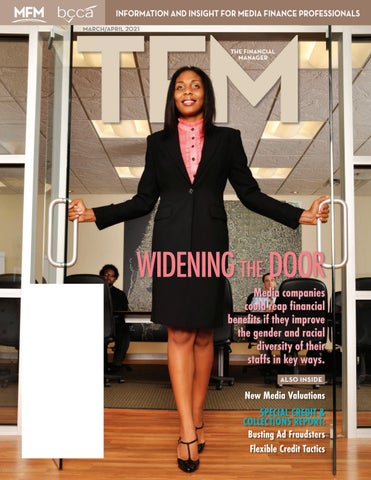
INFORMATION AND INSIGHT FOR MEDIA FINANCE PROFESSIONALS MARCH/APRIL 2021 THE FINANCIAL MANAGER
WIDENING THE DOOR Media companies could reap financial benefits if they improve the gender and racial diversity of their staffs in key ways. ALSO INSIDE
New Media Valuations SPECIAL CREDIT & COLLECTIONS REPORT: Busting Ad Fraudsters Flexible Credit Tactics
Advertising Pays!
***
***especially when you are:
Why Choose CCR for your ad-sales Collections? • • • • •
Experienced team skilled in solving your ad sales payment impasses Competitive rates Educational seminars Extensive, ever-growing client list covering all areas of the media (Radio, TV, Outdoor, Cable, Internet and Print) Receivable Outsourcing (when a sale, acquisition or staff reduction creates a need for prompt attention, call us to discuss.
20 Broad Hollow Rd., Suite 1002 Melville, NY 11747 631-923-2200 • 631-923-2784 (fax)
Proud member of:
Media Financial Management Association
CCR – The MEDIAtion Collection Professionals •
Free Demand Service
•
Years of successful mediation collection experience
•
Commercial attorney network
•
Management reports and analysis
•
Contingent fees based upon size and timeliness of placement (take advantage of our early placement rate!)
www.ccrcollect.com
TFM
INSIDE THIS ISSUE
The Financial Manager
FEATURES
The Official Publication of the Media Financial Management Association is published six times annually under the supervision of:
SPECIAL REPORT: CREDIT & COLLECTIONS
MARY M. COLLINS, President & CEO Mary.Collins@MediaFinance.org JANET STILSON, Editor TFMeditor@MediaFinance.org
10 A Steal of a Deal A series of careful steps can uncover swindlers who want to take your company, and consumers, for a ride.
BILL KNIGHT, Art Director wknight5@nyc.rr.com
Limited commercial messages of interest to our membership and readers will be accepted. Rates and specifications on request to:
BY GEORGE LYNCH
14 A Period of Adjustment
MEDIA FINANCIAL MANAGEMENT ASSOCIATION
In these extraordinary times, the best way to work with financially strapped clients involves careful research and some flexibility.
550 W. Frontage Road, Ste. 3600 Northfield, IL 60093 telephone (847) 716-7000 facsimile (847) 716-7004 and at www.mediafinance.org.
BY C. ROBIN SZABO
Subscription $69.00 per year.
18 Catching the New Wave
Copyright, 2021. All rights reserved.
Traditional media companies are fighting to compete with digital heavy hitters. But rules governing the playing field could change all that.
What is MFM?
The Media Financial Management Association is a not-for-profit corporation organized in 1961. The MFM membership includes more than 1,200 of media’s top financial, IT and human resource personnel, station general managers and other media management personnel as well as associate members in the allied fields of auditing, tax, software, sales and the law. MFM sponsors telephone seminars and conferences, publishes special studies and surveys, files position papers with federal agencies on behalf of its members and its industry, cooperates with other media industry groups and helps its members grow and learn both personally and professionally. MFM also is involved in media industry credit matters through its wholly-owned subsidiary, BCCA, which provides members with a Credit Inquiry Service, an annual Conference, directory of Credit Personnel, credit reports accessed via bccacredit.com online credit search, Commercial Credit Reports and a credit and collections handbook. The information and recommendations contained in this publication have been compiled from sources believed reliable. However, no warranty, guarantee or representation is made by the Association as to the absolute correctness or sufficiency of any representation contained in this publication, and statements contained in advertising and articles submitted to the Association are the responsibility of the authors, not the Association or its officers, directors, staff or members. Moreover, this publication is provided with the understanding that the Association is not engaged in rendering professional services through its distribution. The views and opinions expressed are those of the author, and not necessarily the Association.
BY JOHN SANDERS & JACOB LOURIM
22 How Awake Are We? While progress has been made, research shows that media companies can improve the diversity of their workforce in key areas. BY JANET STILSON
DEPARTMENTS 4 From the President COVID-19 Curveballs 6 Dear Expert Conference Preview 7 Human Factor Remote Hiring
8 Credit Where Due The Waiting Game 9 Board of Directors With Association News 30 Last Word Drone Regulations The Financial Manager • March/April 2021 3
FROM THE PRESIDENT
Catching the Curveballs
COVID-19 requires us to employ a variety of new business tactics, and the stories in this issue reveal many of them.
I
t’s been about a year since stay-at-home orders upended our lives. Some members thought they were in for six weeks of telecommuting; they’re still attending meetings from their kitchen table. Others go into a very different office environment. They face a skeleton staff and one-way hallways along with locked breakroom doors and shuttered drinking fountains. The COVID-19 pandemic is accelerating change, while affecting communication and creativity. And several stories in this magazine tackle various issues related to that. Take, for example, our credit and collections special report. In it, Robin Szabo of Szabo Associates offers a thoughtful piece related to the rising economic woes of media clients. He offers some tips on how to increase collections and reduce bad debt write-offs. Communication and research – a complete understanding of the client’s situation – are key. Szabo outlines several situations credit teams are facing now and recommends approaches to maximize return on their collection efforts. In a separate article, Nexstar Media Group’s George Lynch shares his experience in uncovering advertising fraud schemes, including an anecdote about how he prevented his company from unwittingly advertising a scam and being stuck with a large unpaid invoice. Again, communication and research are important. You don’t want to have to spend time defending Charlie Warner provides your company in court – or face the shame of a sneak peek into knowing you were conned. Media Finance Focus 2021, Our “Credit Where Due” column looks at collection delays resulting from the pandemic. beginning May 11th. FastPay’s Rick Weir recommends a focus on communication between the sales and credit teams. He also suggests that companies consider some changes – such as technological options that can speed payments. This issue includes two additional feature stories. Former MFM Board member John Sanders, of valuation firm Bond & Pecaro, examines so-called “traditional” media companies’ move into digital distribution. As he points out, companies that were digital pioneers – e.g. Google, Amazon, Netflix – have significant financial advantages over those that came later to the game. Here too, the solution seems to be in embracing change – and possible new regulations could increase legacy media’s competitive strength. In our cover story, TFM editor Janet Stilson takes an in-depth look at diversity in media. Having interviewed several industry experts, she finds mixed results. Entertainment Studio’s Byron Allen points to his status as the “only African American who owns Big 4 network affiliates.” Graham Media Group’s Emily Barr says she’s often the “only woman at the table, or one of two.” Third party research shows that diverse voices (communication) increase creativity and company value. Unfortunately, the industry seems to struggle with attracting and retaining such talent. And the pandemic is exacerbating the problem; women are dropping out of the workforce in record numbers. Also included in this issue are two additional regularly scheduled columns. In “Dear Expert,” MFM’s Charlie Warner provides a sneak peek into Media Finance Focus 2021, beginning May 11th. As we offered last year, registered attendees may attend as many of the sessions and roundtables as make sense for them. Finally, our “Last Word” article, supplied by Wilkinson Barker Knauer lawyer Anne Swanson, is an update on drone regulations, particularly the “digital license plate.” The media industry should find much of the new rules to its liking. The pandemic has accelerated so many changes. What hasn’t changed is MFM and BCCA’s commitment to providing members with relevant information and connections. As our 2021 conference theme promises, we are moving “Together Mary Collins is president and CEO of MFM and BCCA; Mary.Collins@MediaFinance.org. Toward Tomorrow.”
4 The Financial Manager • March/April 2021
EDITORIAL ADVISORY BOARD SALLY BUCKMAN Member Lerman Senter PLLC DENISE DWYER Accounting Manager/Assistant Controller Morgan Murphy Media — West GREG LECHOWSKI Market Controller, Phoenix Bonneville International CAL MOSTELLA Vice President, Treasurer WarnerMedia JOHN SANDERS Principal Bond & Pecaro MEREDITH SENTER Member Lerman Senter PLLC C. ROBIN SZABO President Szabo Associates JAMIE GRANDE MFM/BCCA Staff Liaison
CONTRIBUTORS LAURIE KAHN Media Staffing Network JAKE LOURIM Bond & Pecaro Inc. GEORGE LYNCH NewsNation – Nexstar Networks JOHN SANDERS Bond & Pecaro Inc. M. ANNE SWANSON Wilkinson Barker Knauer C. ROBIN SZABO Szabo Associates Inc. W. CHARLES WARNER MFM & Broadcast Finance Inc. RICK WEIR FastPay
Sharing our experience experience Deloitte’s Deloitte’s Audit Audit&&Assurance AssuranceTechnology, Technology,Media Media&& Telecommunications Telecommunications(TMT) (TMT)industry industrypractice practiceisisfocused focused on onquality qualityand andinnovation, innovation,delivered deliveredby byAudit Audit&&Assurance Assurance professionals professionalswho whocan canprovide providedeep deepindustry industryknowledge knowledge and andinsightful insightfulaudits. audits.We’re We’reservice serviceproviders providersto tomany manyofofthe the world’s world’s most most recognizable recognizableTMT TMTbrands brandsininthe themarket markettoday. today. deloitte.com/us/tmtauditservices deloitte.com/us/tmtauditservices Copyright © 2020 LLC. AllAll rights reserved. Copyright 2021Deloitte DeloitteDevelopment Development LLC. rights reserved.
DEAR EXPERT
Looking Toward Tomorrow
MFM conference mastermind Charles Warner spills the beans on what’s in store for attendees of Media Finance Focus 2021. Dear Expert, I’m thinking about attending MFM’s Media Finance Focus 2021 online conference this year, but I don’t know what to expect. Can you please give me an idea of what’s planned? Curious in Cleveland
track will also examine how the programmatic world is impacting the newspaper industry. The Games Committee will be back with a powerful track. One session will look at online roadblocks facing the industry. AnDear Curious, both the public and private sectors. It plans other will offer insight into the latest in I’d be happy to! The many MFM com- to take a look at how the pandemic has im- games valuation. Mobile content and eports mittees that are developing sessions for the pacted lease accounting. It will also focus are the topics of two other discussions as conference are interested in tackling pretty on robotic process automation, along with well. big questions, and some of the issues they other forms of automation. Environmental Media Finance Focus has three general raise are intertwined. social and governance issues are the topic of sessions planned. The first will feature two Ways of reducing expenses is one of them. another session. speakers. Joe Batista, chief creatologist from And human resource concerns are signifiThe Interactive and Digital Media Com- Dell Computer, is first in line. He will adcant. For example, what does working re- mittee will give insights into streaming – dress how many professionals are looking motely do to employee morale, staff mon- consumption data as well as revenue issues for a new playbook moving forward and itoring along with hiring and firing how to develop a formula for change. decisions? Some employees love not The Games Committee will be Next up is Tina Harris, the chair of commuting and feel more productive race, media and cultural literacy in the at home, while others find they are back with a powerful track. One session Manship School of Mass Communiless creative and miss casual conversa- will look at online roadblocks facing cation at Louisiana State University. tions with coworkers in the office that the industry. She will present her research on critical spark their creativity. And what are communication pedagogy, race and employees doing about career advancement and opportunities. It will also examine how identity communication as well as diversity. when there is so much less face time? COVID-19 is pushing some companies to A second general session will feature Tax issues are lurking as states and coun- the technology tipping point and shed light a panel of experts who will focus on the ties try to drum up fees from those working on third-party cookie issues. The conference work-from-home trend. Don Thompson, in new locations. Internal auditors face new will also have a dedicated session on effec- executive vice president of human resources challenges as employees and documents tive ways of selling digital opportunities. at Sinclair Broadcast Group, will join that are now in multiple places. And as cyber The Television Committee will dive into conversation. The third general session will terrorists become ever more sophisticated, the future of television as we know it. One showcase Deloitte’s state of the entertainIT controls over remote computers must be session will focus on the latest rule and pol- ment industry research report. enhanced. icy changes coming from Washington. A Tracks are also in the works for credit, That’s just a taste of the many vital issues related session will discuss how the political radio, internal audit, tax, network programthat will be discussed during Media Finance changes in the U.S. may affect labor rela- ming and streaming. Focus 2021, which is themed “Together To- tions and unionizing efforts. This track will BMI will be providing ward Tomorrow.” Once again, it’s a virtual also look at the latest in the world of music a musical afternoon as event, and runs from May 11 to July 29. All licensing. well. told, 42 sessions along with a dozen roundThe newspaper industry continues to face So don’t wait – sign tables are on the drawing board. an uphill battle, as circulations shrink and up now. We look forThe Accounting Committee will look preprint advertisers fall. The newspaper ward to seeing you in at the latest changes and best practices in track will look at how to expand revenue May! sources. Issues related to expenses will also W. Charles Warner, Jr. is the president of Do you have a professional puzzle that go under the microscope – what to save or Broadcast Finance, Inc., a media management MFM and BCCA experts might be able to cut. Another session will look at systems and answer? We’ll mine the contact base and find consulting firm. He serves as MFM’s conference processes that can make a remote workforce the right person to answer your question. program director and CFO. Warner can be Just contact TFM editor Janet Stilson at reached at charlie.warner@mediafinance.org. safer from a cybersecurity standpoint. This TFMeditor@mediafinance.org.
6 The Financial Manager • March/April 2021
HUMAN FACTOR
Remote Hiring
There’s a host of ways to attract a wide variety of sharp job candidates when in-person hiring has been put on hold. BY LAURIE KAHN
W
hile it might seem daunting at first, recruiting staff members during remote working conditions can help with retention and open up the candidate base. How can you recruit virtually? First and foremost, you need to have a strong, informative website that sells your opportunity. Your “about” page is a great place to include the company history, mission statement and strengths in reaching the community. Use your “career” page to highlight different positions, culture, offices, fun aspects of the job and how to attain more information. Consider shooting a video that shows your offices, your employees and different staff activities. If your company turned to virtual events during the past year, include those so that potential candidates can see the creative ways that you handled the pandemic. Share clips that illustrate how you have shown compassion and caring with your staff. Always include a variety of employees in these videos. By showing that you have a diverse staff, and one that includes members of the younger generation, you’ll attract a larger number of people. Federated Media provides an excellent example of this on its site, federatedmedia.com (under “our culture”). It’s also helpful to use testimonials. Find happy employees who will share why they joined the company and what they like about working there. Video is the most effective means of conveying this, but a still picture with a short, written quote will work as well. Just be sure to monitor your site so that if someone you featured leaves you can replace their video with something else. The “careers” section of Entercomradio.com does a great job of showing employees from a several different departments. If you are in the interviewing process, take or record a virtual tour of the station so that prospects can get an idea of where they would be working when offices are reopened. Include workspaces, meeting rooms, studios, break rooms and any
title, include descriptive words about their management style. If they have promoted several past employees, share that information. Sell the reader on the idea that a manager can help them to succeed. Ask for recommendations from the manager’s direct reports. If the position you’re filling involves entertaining and you want to see how a prospect interacts in a social setObserve how well a job candidate does on a ting, do a virtual lunch remote call. If a job involves presentations, ask or coffee appointment. Have a meal delivered them to share their screen and provide one. and meet online while outdoor areas open to staff members. you enjoy the food. This can be awkward, You could also share your sales and mar- so it may work best with more than just two keting materials. If this makes you uncom- people. fortable, delete the pricing pages, but give Along the way, observe how well a job them an idea of how you position your sale. candidate does on a remote call. If a job inAlways make clear what you do to help volves presentations, ask them to share their a new hire succeed. Cover the training and screen and provide one. support with realistic expectations for perIf a candidate you’d like to hire is interformance. Be sure to explain what services ested in joining your team, send a package or tools you subscribe to and any consultants of station items to help them feel welcome. that work with you. Host a happy hour for all to meet the new If you are moving the person forward, person. Set them up with a buddy or mentor introduce them to a few team members so to help them acclimate. When a new hire they can have phone or video chats about feels welcome, you’ll increase the likeliwhat it’s like to work for you. Invite them to hood of loyalty and join a virtual department meeting so they retention. can see how people interact. Most importantly: Successful remote hiring also needs to be on time, have mainclude updated social media. Check your terials ready to share, Glassdoor profile to confirm there are not know how to conduct negative comments posted. If there are, en- an online meeting and courage happy employees to go on and share be professional. positive remarks. If there are several negative Laurie Kahn is president of Media Staffing comments, you may need to find out what is Network, which helps media companies with all of going on and address the issues immediately. their talent acquisition needs, including diversity Hiring managers should have updated planning. She can be reached at (480) 306-8930 or laurie@mediastaffingnetwork.com. LinkedIn profiles. Instead of just posting a The Financial Manager • March/April 2021 7
CREDIT WHERE DUE
The Waiting Game
Delayed payments have escalated since COVID-19 first struck. But there are ways to counteract this unfortunate trend. BY RICK WEIR
W
hen considering the best terms, late payments tripled from an average digital media suppliers saw much needed reveways to stem the growing of three days to nine days late in 2020. nue from election-year spending. tide of late payments owed, FastPay data for full-year 2020 shows a it pays to first understand the 38% average increase in delays across all ACTIONS TO TAKE mindset and difficulties that agency clients media, compared with the prior year. Even So how do media companies reverse the are facing and overarching payment trends as ad spending began to rebound in the downward spirals? The first thing they should that occurred over the last year. third and fourth quarters, most of the gains focus on are their current payments terms Consider that 97% of all media plans went to digital channels to reach consumers with agencies and in some cases the brands themselves. An assessment of all your current were halted in the second quarter of 2020, on mobile devices and streaming services. according to the Interactive Advertising BuAccording to a report issued last Novem- policies and existing contracts will provide reau. While most industry projections esti- ber from the global marketing research firm visibility into areas where terms should be mated a 10-15% drop in overall ad spend for WARC, several traditional media channels re-evaluated. Alignment between the business development and finance teams is critical last year, the impact on traditionwhen working with the agency teams. al media suppliers has been even Another option is to look at the politgreater. ical model and evaluate additional areas Even before the pandemic, paywhere pre or partial payment should ment delays were a major problem, become policy. There are also accounts causing friction across the media receivable and accounts payable visibility supply chain. Back in January solutions available to suppliers that can au2020, before the pandemic tighttomate and digitize payment data. They ened its grip, a survey commiscan help media vendors get paid faster and sioned by FastPay and conducted provide meaningful reconciliation data. by Prodege showed troubling reExpanding options such as credit sults. Among 155 media suppliers card and ACH (automated clearing that responded, 71% stated that house) payments is an additional way they are negatively impacted by for suppliers to get paid faster. discrepancies and their ability to Alignment between the business development and finance teams is critical Finally, suppliers can leverage their receive payment. membership with MFM and BCCA There’s a major reason why: when working with the agency teams. to spotlight broader industry issues remedia agencies are still using checks for nearly a third of all media pay- – including outdoor, radio and linear TV – lated to delayed payments and work jointly ments, and 66% of suppliers experience are not expected to fully recover until 2022. to create alternative arrangements with the late payments when processing checks from During 2020, the brands themselves were agencies and brands. As vaccinations become more prevalent agencies. responsible for the majority of the delays, According to data from the January 2020 leaving the agencies and suppliers to fight and the economy improves, the media inFastPay survey, 76% of media suppliers said for every ad dollar available. Because of se- dustry will rebound. But we should take this they were willing to improve efficiency and quential liability terms, most agencies can time to focus on how visibility in the invoicing process within the be exposed and will not pay for ads until and where we can adapt next 12 months. In fact, 83% were even dollars are received from their brand clients. and evolve together. It’s willing to pay a fee to receive payment ear- So even though ad spending started to re- up to the industry as a lier if it was lower than the cost of credit bound in the second half of 2020, payment whole to find common solutions that can ease cards. delays continued as well. Payment delays grew even further as the Of course, one area that bucked the trend in the friction points across pandemic spread. The average media invoice 2020 was political advertising; media compa- the media supply chain. payment terms increased from 49 days in nies garnered a record $10 billion in revenue in Rick Weir is chief marketing officer of 2019 to 59 days in 2020 according to data that ad category, according to some estimates. FastPay, which provides media payment and from Oarex published in a Digiday article Because political media requires pre-payment automation solutions for agencies and suppliers. He can be reached at rick@gofastpay.com. last June. In addition to longer payment prior to running an ad, both traditional and
8 The Financial Manager • March/April 2021
ASSOCIATION NEWS
MFM
BOARD OF DIRECTORS As of July 2020 CHAIRMAN MELISSA MITCHELL Bonneville International PRESIDENT & CEO MARY M. COLLINS MFM/BCCA VICE CHAIRMAN/CONFERENCE CHAIR DAVID BOCHENEK Sinclair Broadcast Group
OPPORTUNITY IS KNOCKING
Take the MFM Growth Ambassador Pledge. A few small actions on your part each week will help the organization thrive. Contact Mandy Aoieong (Mandy.Aoieong@mediafinance.org) for details. march 17th at 5:00 et march 23rd at 2:00 et april 16, 2021 2021: How to Pivot from Advance Registration Wearing of the Green Happy Hour, organized Survive-Mode to ThriveDeadline, Media Finance by the MFM Membership Mode, MFM’s TransforFocus 2021. Prices increase Committee. Share a mation Roundtable No. 2. $300 after this date. limerick; the one that’s most Registration is free. Please may 2021 original and pulls in the invite a prospective memAnnual Membership chuckles may win a prize. ber and share news of this Meeting, held via Zoom. event on social media. Upcoming emails from MFM will provide more details on each of the events listed.
SECRETARY/CONFERENCE CO-CHAIR MIKE LAVEY Tribune Publications TREASURER DAVE BESTLER Hubbard Radio IMMEDIATE PAST CHAIRMAN RALPH BENDER Manship Media
MFM/BCCA DIRECTORS MARCUS ANJEWIERDEN Deseret Management Corp. TRACY CLARK Hearst Television
PAUL RAHMLOW Midwest Communications
DEE STEVENSON Gray Media Group
STANLEY HERRIOTT Hearst Television
ELIZABETH BRAMOWSKI Entercom
LORI LOCKE Discovery
CLIFFORD EJIKEME A+E Networks
ANTONELLA RICCIARDI NBCUniversal/ Telemundo
SEAN HETZLER TEGNA
PAUL KELLY KTRK-TV/ABC/Disney
JENNA HARDY Gearbox Software
DAN MCGUIRE KPMG
CAL MOSTELLA WarnerMedia
BCCA Board Member Rep
KIM PARKER Graham Media Group
The Basis for Your Decisions
ApprAisAls FeAsibility studies expert testimony And relAted FinAnciAl services For the communicAtions industry
JENNIFER HURLEY The Washington Post
MARIE TEDESCO Beasley Broadcast Group
CHRISTINE OLIVER Deloitte & Touche
BOND & PECARO
ED IENNER Meredith Corporation.
1990 M STREET, NW SUITE 400 WASHINGTON, DC 20036 (202) 775-8870 E-mail: BP@BondPecaro.com www.BondPecaro.com
The Financial Manager • March/April 2021 9
SPECIAL REPORT: CREDIT & COLLECTIONS
AS TE AL OF
10 The Financial Manager • March/April 2021
A series of careful steps can uncover swindlers who want to take your company, and consumers, for a ride.
AD EA L
BY GEORGE LYNCH
T
HERE ARE TWO TALES OF AD-
vertising fraud that really stick in my mind. They occurred about 15 years ago, back when I was senior credit analyst with Tribune Newspapers. In the first case, an advertiser approached our account executive (AE) a little past noon on a Friday. They wanted to run a $50,000 full-page ad in the Sunday newspaper, up against a hard deadline. The advertiser was selling a five-piece set of luggage for just $50. After they submitted a credit application, we were able to gather three credit references very quickly. How could they possibly be selling a suite of luggage for just $50? You guessed it; there was no luggage. The second case involved mail orders of tobacco products. The prices were unbelievably low. The would-be client asked for a $200,000 credit line. Again, we were able to gather credit references in a very short time. I was preparing to grant credit when I got lucky. There was a very minor question about their campaign. I called the credit applicant. As soon as I told the person who answered the phone who I was, the tone of his voice became excited and eager. He answered my question. Then, half an hour later, he called me back, still excited and eager, and asked if their application had checked out, and did I have any other questions. I got off the phone, grabbed back the file and went through the information
The Financial Manager • March/April 2021 11
SPECIAL REPORT: CREDIT & COLLECTIONS point by point. We did not run the advertising. Months later, it was reported that a number of newspapers throughout the U.S. had run the campaign and collectively lost over $2 million in revenue. For the unscrupulous, fraud is big business. Obviously, credit managers want to avoid being taken in. You’re not only protecting your company; you’re protecting consumers from losing money to people who have no intention of delivering the advertised product or service.
exactly make sense, but the AE put it out of their mind. You’re trying to get the AE to leap over their logic gap. Sometimes, the AE will tell you they thought the same thing was odd as well, but the advertiser had a reasonable explanation. But if it is a scam company, the AE’s response is likely to be “Yes! How did you know?” As a result, now your AE is as suspicious as you are and may have additional suspect information to pass to you. The credit application is usually your best starting point
A fraud company typically sets up references so that when you reach out to them, you are actually contacting the con artist or one of their confederates. While you may be able to raise solid defenses in court, your company definitely does not want to incur the costs of defense if it is named in a lawsuit. Also, on the human level, you want to avoid the shame-faced feeling when you realize that you overlooked clues indicating that you were dealing with a fraudulent company.
HEED THE TRIGGERS
W
HEN DOING A CREDIT
review, certain anomalies should always cause you to slow down and check out the applicant. For example: ■ Does the product or service advertised seem too good to be true? ■ Is the applicant over-excited and rushing you to make a credit decision? ■ Has the applicant flooded you with information you didn’t ask for? ■ If they slip past you and you do grant credit, are you suddenly flooded with credit references, even though their first campaign hasn’t even started? These aren’t the only triggers. But when you encounter them, it’s time to pull back on the credit decision and look more deeply into the applicant.
MIND THE LOGIC GAP As someone who has a reputation as a “fraud-buster”, I’ll give my No. 1 secret: I work very hard to avoid the human tendency to “fill in the blanks.” It’s natural to be in a hurry, especially when your credit decision is on deadline. But if there is something that represents a gap in logic, as you review the available data – something that seems a little odd or doesn’t quite make sense – don’t fill in the blanks in your mind and make excuses for why this odd detail really has a benign explanation. When you see one of these logic gaps, it’s time to slow down and do a meticulous review. For every advertiser that comes your way, follow the “know your customer” principle. Can you find their website? Can you find an actual street address? If not, that’s a red flag. If the buy is coming to you through an ad agency, have the AE give you more information on the company in question. See the sidebar, at left, for some of the questions you should be asking. FIRST STOP: THE AE What should you do when your logic-gap detector goes off? Start by talking to your AE. Ask if the advertiser at some point said or did anything that seemed odd or didn’t
12 The Financial Manager • March/April 2021
for confirming your suspicions of fraud. It asks for some information that you can confirm independently, but also, it’s likely that you’ll have to trust your applicant regarding other information that can’t be verified. Regardless, if you’re dealing with a legitimate company, all the information on the application should add up and hang together. Not so with credit applications that represent fraud. For instance, an agency may say it has 25 employees, but they’ve been in business for only a year. That sort of explosive growth is highly unlikely. The exception would be a new company affiliated with a better-established agency or a new company formed by experienced ad industry executives. It’s almost always possible to verify online whether corporations are chartered in a particular state. If an applicant says their company is incorporated in a certain state but there is no record, that’s more reason to be suspicious. If the applicant sent you a lot of documentation you didn’t request, look through it carefully. I once received a financial statement, but the accompanying accountant’s statement pertained to a different year. And I also saw a faked Dun & Bradstreet report where the “date printed” on the report was previous in time to the date of the “management interview.” If you subscribe to Dun & Bradstreet, pull the report on your own and compare. ONLINE DUE DILIGENCE Look at the company’s website. Does the application indicate it is a well-established company, in business for years, yet you can’t find their website? If the site does exist, does it seem sloppy? Does it have nothing but stock photos? To properly research online information, use your internet browser to find a Who Is website. (There are many of them.) Who Is websites allow you to look up the domain of any registered website and get some basic information. It’s especially important to look at the “created on” and “expires on” website dates. Fraudulent companies Continued on page 28
Insure dreams come to life. Chubb has helped filmmakers and media companies make dreams come to life for more than 50 years. We provide a level of protection and service that comes from knowing your industry and understanding your needs. Visit us online at chubb.com. Chubb is the only commercial insurer endorsed by MFM. ©2021 Chubb. Coverages underwritten by one or more subsidiary companies. Not all coverages available in all jurisdictions. Chubb®, its logo, and Chubb. Insured.SM are protected trademarks of Chubb.
The Financial Manager • March/April 2021 13
SPECIAL REPORT: CREDIT & COLLECTIONS
A PERIOD OF ADJUSTMENT
14 The Financial Manager • March/April 2021
In these extraordinary times, the best way to work with financially strapped clients involves careful research and some flexibility. BY C. ROBIN SZABO
W
HEN WE FINALLY SAID
good riddance to 2020, there was the hope that this year would usher in a period of nonstop recovery for individuals, businesses and the economy. With promising vaccines now available to the public, we remain optimistic that indicators of better health will begin to emerge. However, we also realize that true economic revival takes time. Small businesses have been hit particularly hard, and many temporary closures have turned into permanent ones. Those that remain have limited, if any, money to spend on advertising. Budget cuts have crippled advertising agencies. Media companies have suffered significant drops in revenue. So what are credit and collection managers to do in this rare and troubling environment? With advertising revenue down, it has become more critical than ever to bring in the money that is owed. While it’s essential to manage accounts receivable, who wants to increase the pain of businesses struggling to keep their doors open and their employees employed? In times such as these, we simply cannot collect exactly the same way that we
The Financial Manager • March/April 2021 15
SPECIAL REPORT: CREDIT & COLLECTIONS did when the economy was booming. While the principles and objectives remain the same, we need to recognize the unique nature and size of the challenges each customer is facing as a result of the pandemic and refine our approach accordingly. Once those challenges are understood and a fair solution is reached, persistence must follow in order to collect successfully. TEAM ENVIRONMENT Now more than ever, strong teamwork among your collectors is essential. It’s likely that you and your team have been working remotely. Thankfully, technology affords us an array of communication options. Unfortunately, it does not take the place of human contact between team members. Maintaining a high level of performance should be foremost, and the best way to do this is to establish a “team” environment. First, your staff must be adequately trained and technologically equipped at home to meet your organization’s standards. Second, team members must be given ample opportunities to interact with each other and with you. Scheduling regular virtual staff meetings can give
everyone the opportunity to share ideas and concerns. And it can give you the opportunity to make sure procedures are followed and work standards are met. Additionally, team-message platforms and document sharing can contribute to a feeling of camaraderie and provide help to teammates with questions or problems. Sales representatives are under increased pressure right now. Digital and print publishers are rethinking the structure of their sales organizations to make sure they can respond more nimbly to advertiser demands. The post-sales staff may be growing in areas such as ad operations, optimization and production. That trend began even prior to the pandemic. While this expansion has its advantages, it can also create crowded lines of communication between customers and media, and also between departments in your organization. Talk to sales regularly about prospective and current customers. The sales rep is also more likely to discover problems that the customer may be having, which you need to be aware of. Both sales and credit should also carefully monitor the industries of customers and share this information with each other. Perhaps the representative is talking to the customer about additional marketing strategies to create new revenue streams, such as virtual events and drive-by or pickup services. Chances are good that the customer has had to explore ways to do business differently in order to stay afloat. You need to know of any changes to the customer’s business model and organization and keep tabs on the success of these new endeavors.
Know if your customer has applied and/or received funds from government relief programs.
OPTIMIZING YOUR PERFORMANCE There are four key actions that will help you achieve the best possible outcomes with customers: FOCUS – Remember the 80/20 rule: 80% of your business comes from 20% of your customers. Stay close to your biggest customers with consistent and frequent communications. Also focus on new customers and do the same. As time and resources permit, move on to those less critical to your bottom line. FLEXIBILITY — The more you know about what the customer is doing to make ends meet, the more flexible you can be in negotiating the debt. This is no time to be rigid, because you truly need each other. The key is to come up with a plan that both of you can live with while making it clear that it is a temporary fix for a temporary situation. Explain to the client that extending terms or creating a payment plan does not represent an alteration of your organization’s policy. Set clear expectations and document them. EMPATHY — No one is having much fun right now. Find subjects on which you can commiserate with your customer in a hopeful or lighthearted way. For example, you might talk about your preschoolers who started screaming at each other just as you entered a Zoom conference with the boss. Or perhaps the drawstring on your favorite pair of sweatpants isn’t long enough anymore. Anything that you might have in common suggests, truthfully, that we are all in this together. COMPARE — Analyze the credit lines of existing customers with their actual purchases. If the credit line far exceeds their purchasing history, you might consider dialing it back. Doing so will allow the customer to buy what it needs while reducing your risk. Chances are also good that the customer will prioritize payments to maintain its reasonable credit line.
16 The Financial Manager • March/April 2021
GOVERNMENT RELIEF Know if your customer has applied and/or received funds from government relief programs. In late December, leadership in the U.S. House and Senate came to an agreement on the details of a $900 billion coronavirus relief bill, signed into law by President Trump. The bill extends and modifies several provisions first enacted in the CARES Act, the $2.2 trillion relief law passed in March 2020. The package extends relief for individuals and businesses through mid-March of 2021. The business provisions of the new law vary somewhat from the original legislation. For example, businesses receiving a new Paycheck Protection Program (PPP) loan will now be able to take the increased Employee Retention Tax Credit. Previously they were allowed to opt into one or the other, but not both. Qualifying expenses have also been expanded. They now include covered property damage, supplier costs and worker protection expenditures in addition to employee wages or operating expenses (such as rent and utilities). The employer-side Social Security payroll tax credits – created in the Families First Coronavirus Response Act to offset paid sick and family leave related to the coronavirus Continued on page 29
FIND GAME CHANGING MEDIA TALENT STREAMLINE YOUR NEXT JOB SEARCH FOR EXPERIENCED AND TECH-SAVVY MEDIA PROFESSIONALS WITH A HIGHLY VISIBLE JOB POST ON TVNEWSCHECK.
Visit MediaJobCenter.com From NewsCheckMedia
The Financial Manager • March/April 2021 17
e
Catching the
a
N W W VE Traditional media companies are fighting to compete with digital heavyweights. But rules governing the playing field could change all that. This is the fourth in a series of stories on the financial performance of media. BY JOHN SANDERS & JACOB LOURIM
T
HE VALUATION SPECIAL REPORT SERIES IN TFM HAS
generally focused on specific media sectors, like cable, television and radio. Within their own particular categories, companies with legacy media assets—affiliated TV stations, metro newspapers, broadcast radio stations and the like—occupy a sizable share of the market. But few organizations still operate within one single sector and, as such, evaluating each on its own merits masks opportunities and challenges. It takes another type of analysis to show the massive sea changes in the business environment, as well as structural changes within the companies themselves. All traditional media segments now fall on a second rung of a hierarchy. Above them is an overarching, ever-changing realm occupied by more digitally focused companies. Suddenly, legacy media assets occupy a relatively small portion of the vast media environment. But at the same time, the companies that control them are developing and relying upon new media opportunities to stabilize their own economic futures. In a way, they are becoming new media companies themselves.
Those developments beg two questions. What is the continuing impact of new media companies on the traditional sectors? And how are legacy companies repurposing the very forces that threaten them in order to optimize their own fortunes? Before getting into that, let’s define the term “new media.”
According to the New Media Institute, it is “all that is related to the internet and the interplay between technology, images and sound.” Thus, it encompasses social media sites like Twitter and Instagram; streaming services like Amazon Prime Video, Netflix and Spotify; online search engines like Google; and then the
18 The Financial Manager • March/April 2021
forays of traditional media into the digital space. PALE BY COMPARISON The internet leveled the playing field between longstanding corporate giants in the media ecosystem and new-wave companies distributing content online. That is its greatest power. In decades past, legacy broadcasters had much more reach into audiences’ homes than any ordinary startup, thanks to their licenses from the Federal Communications Commission (FCC). On the internet, both startups and established players distribute content the same way. The challenge for companies new and old is to leverage that opportunity. Thus far, certain sectors have proven more lucrative than others. In fact, the statistics are staggering. As of the third quarter of 2020, Netflix’s reported net revenue reached $23.8 billion over the previous 12 months. That overshadows the combined broadcast television revenue for the major T V station group
owners – E.W. Scripps, Graham Media Holdings, Gray Television, Meredith Corp., Nexstar Media Group, Sinclair Broadcast Group and TEGNA Inc. They collectively reported $20.2 billion in the same 12 months. And in terms of the future outlook for those companies, Netflix’s enterprise value was $231.0 billion as of Jan. 12, 2021, while the aforementioned seven media companies totaled $98.2 billion in capitalization. In fact, Netflix’s enterprise value dwarfs that of ViacomCBS ($47.7 billion) and FOX Corp. ($22.1 billion), which have more diversified revenue streams. What’s more, Netflix’s enterprise value is inching closer to that of Comcast ($325.4 billion). Me a nw h i le , over t he 12 months ending Sept. 30, 2020, Spotify reported $7.6 billion in revenue, while radio station owners Beasley Media Group, Entercom Communications, Entravision Communications, Saga Communications, Salem Radio Network, Townsquare Media, iHeart Media, Urban One and
SPECIAL REPORT: MEDIA VALUATIONS
Cumulus Media reported $6.6 billion combined. Spotify’s enterprise value sits at $63.6 billion, compared to $14.7 billion for the nine radio companies. In previous decades, it would have seemed incongruent to make those comparisons. But today Netflix and TV broadcasters, or Spotify and radio broadcasters, occupy the same spaces in the media world. It’s become clear that subscription revenue is as robust as advertising revenue. And the most profitable media companies essentially operate in the space between media and e-commerce, such that they can capitalize not just from advertisers but also directly from consumers with subscription services. Media companies face huge challenges for all of their revenue streams. Where Netflix and Amazon have come to dominate the subscription entertainment market, Google and Facebook have a firm grasp on the digital advertising market. S&P Global Market Intelligence (S&P) projected in September 2020 that Google would soak up 41.9% of all U.S. digital advertising revenue for the year, while Facebook would bring in another 25.0%. Amazon came in third, followed by Microsoft. Meanwhile, decades-old media companies are not significant players in the ever-growing digital portion of the advertising industry. Facebook, Twitter, Snap and Pinterest together made a projected $34.1 billion in digital advertising in 2020. In comparison all U.S. newspapers were projected at $4.2 billion total digital advertising revenue; U.S. TV stations generated $2.7 billion; and radio The Financial Manager • March/April 2021 19
SPECIAL REPORT: MEDIA VALUATIONS stations brought in $1.4 billion. Longstanding media owners are improving their approaches to the digital advertising market, but at a pace that pales in comparison to that of the social-media giants. By 2025, online advertising will be 41.8% of all newspaper advertising revenue (up from 33.0% in 2020). It will make up 9.3% of all radio advertising revenue (almost stagnant from 9.2% in 2020) and 16.9% of all TV station advertising (up from 13.8% in 2020), according to projections from S&P. Subscription revenues are projected to provide more significant growth than advertising revenues. REGULATORY RELIEF? Looking ahead, there are indications that the traditional media companies may not be buried by the avalanche of growth that has characterized new media. The regulatory momentum in Washington seems to be leaning toward evening the playing field. Large digital companies like Google and Facebook are facing regulatory challenges ranging from antitrust investigations to more stringent privacy standards, which may hamper those companies’ ability to utilize data harvested from user activities. By contrast, traditional companies appear to be facing a deregulatory environment. Specifically, in 2021 the U.S Supreme Court will decide a case (FCC v. Prometheus Radio) that may remove the Third Circuit’s remand of the FCC’s revision of ownership limits.
This may allow broadcasters to increase their holdings beyond currently established limits and remove cross-ownership restrictions (allowing ownership of a television station and a newspaper in the same market, for example). Additionally, in November 2020, the FCC approved provisions that will allow television broadcasters to use their new ATSC 3.0 technical standard to offer new services such as datacasting and smartphone reception of overthe-air signals without incurring additional FCC fees. These initiatives will, to a degree,
The regulatory momentum in Washington seems to be leaning toward evening the playing field. permit traditional media companies to compete more effectively. While regulations may start to sap some tech giants of their monopoly power, many traditional media companies are building on the success of these competitors and entering some of the same markets. For instance, HBO and Netflix are known as two trend-setters in the market for subscription entertainment, albeit in different ways. And in recent years, Disney|ABC (Disney+), NBC Universal (Peacock), ViacomCBS (Paramount+), ESPN (ESPN+) and Discovery (Discovery+) have each launched their own direct-to-consumer
Netflix Enterprise Value Compared to Publicly Traded Television Companies 250,000
$ MILLIONS
200,000
NETFLIX
150,000
TELEVISION BROADCASTERS
100,000
50,000
0
Netflix $231,022.2
E. W. Scripps $3,055.5
Gray Television $5,570.0
Sinclair $14,827.3
Meredith $4,282.9 TEGNA $7,106.1
Graham Holdings $3,103.3 Nexstar Media Group $12,605.0 ViacomCBS $47,693.8
SOURCE: S&P Global Market Intelligence and company SEC filings
20 The Financial Manager • March/April 2021
pay streaming verticals to capture some of the subscription market dominated by Netflix and Amazon Prime Video. NEW, FERTILE TERRAIN Perhaps the quintessential new media venture is podcasting – a medium that was almost nonexistent until Apple added podcasts to iTunes in 2005. An estimated 37% of Americans now listen to podcasts at least once per month, according to Edison Research, more than triple the 12% from 10 years ago. Such growth is only possible in somewhat fledgling industries, but podcasting accounted for an estimated $782 million in revenue in 2020, up 10% from 2019 in spite of the coronavirus pandemic, which caused depressed ad spending nearly across the board. (Radio station advertising decreased by a projected 17.3% in 2020, according to S&P.) As the economy recovers, the podcasting space is expected to keep expanding, to $1.13 billion in 2021 (a 45% growth rate year-overyear) and $1.33 billion in 2022, according to eMarketer. U.S. radio stations brought in $11.6 billion in advertising in 2020. However, podcasts mostly compete with only the national portion of that advertising ($2.0 billion), so the gap was far smaller than it might seem and could disappear within five years. Media competitors have taken note of podcasts’ success and begun to integrate it into their business models, either by expanded podcast offerings or by acquisition of podcasting companies. Entercom, for example, acquired both a podcast producer, Pineapple Street Media, and a podcast distribution company, Cadence13, in 2019. In October 2020, iHeartMedia acquired Voxnest, a podcast marketplace, and last July Sirius XM completed a $325 million purchase of Stitcher, a podcast distributor and creator. All of these recent acquisitions speak to media companies’ way of adapting to a changing landscape. The most successful competitors have responded to an environment that offers more options than ever by diversifying their platforms and distribution as much as possible. Within the past three years, for instance, The Walt Disney Co. has acquired a controlling stake in Hulu, launched ESPN+ as a sports streaming platform and created Disney+ to monetize the distribution of its original and library content. As of December 2020, Disney reported 86.8 million subscribers on Disney+, 11.5million on ESPN+ and 38.8 million on Hulu. (The
40
Trailing 12-Month Revenues
35
$ MILLIONS
30
SUBSCRIPTION CONTENT
25
ADVERTISING REVENUE (Reported)
20 15
SOURCE: S&P Global Market Intelligence and company SEC filings
10 5 0
Netflix
The Walt Twenty-First Disney Century Fox Company
CBS
News Sinclair Corporation
latter number is a two-pronged transformation, including both streaming subscribers and those who pay for live TV on Hulu, a way of capitalizing on the cord-cutting trend.) As a result, Disney has made a splash in the new media world and reported more revenue in the 2020 fiscal year from its media networks than its theme parks division did in 2019, before pandemic-related shutdowns. Indeed, the results have been promising when legacy content providers have entered into the digital space, such as Disney with Disney+ and cable networks like ESPN, Discovery, AMC, HBO and ViacomCBS with
Nexstar Media Group
Gannett
Meredith
TEGNA
Gray Television
their own streaming services for original programming. This reflects the evolution from scheduled distribution over cable and satellite to digital distribution through which the viewer has some on-demand controls. After all, these companies have some clear advantages. Establishment can be an asset – for news organizations with their credible reputations, TV stations and networks with their fully built news operations and programmers with their vast production infrastructures. The established Big 4 and cable networks also have vast libraries of popular programs and feature films. Programs such as Friends,
Tribune
New Media The New The E. W. Investment York Scripps Co. Group Times Co.
The Office, Seinfeld and Big Bang Theory – which were once syndicated or licensed to streamers – are moving back to the original producers as anchors for their new streaming services. Monetizing these assets for the longterm is the ultimate challenge, but in many ways, the companies involved have proven themselves up to the task. John Sanders is a principal and Jake Lourim is an associate of the valuation consultancy Bond & Pecaro Inc. They can be reached at johnsanders@bondpecaro.com and jakelourim@bondpecaro.com, respectively.
Corporate Licenses
Cablefax Daily WHAT THE INDUSTRY READS FIRST. Get reduced subscription rates for multiple readers in your organization. Find out more! Contact Roger Low at rlow@accessintel.com
www.cablefax.com
36453
The Financial Manager • March/April 2021 21
22 The Financial Manager • March/April 2021
HUMAN RESOURCES
HOW AWAKE ARE WE? BY JA N ET ST IL SON
B While progress has been made, research shows that media companies can improve the diversity of their workforce in key areas.
YRON ALLEN WAS GETTING PAS-
sionate. Toward the end of a panel session featuring some top executives in the TV broadcasting industry last October, the conversation turned to minority ownership of stations. The chairman and CEO of Entertainment Studios referred to himself as a “black unicorn” by way of explaining why he felt it was so important to provide minority tax incentives, which would open the gateway for more people of color to own stations. “To the best of my knowledge, I’m the only African American who owns Big 4 TV network affiliates,” he said during the TVNewsCheck’s TV 2025: Monetizing the Future event. There are people of color with the intellect and desire to own affiliates, but they don’t have access to capital and run up against advertising roadblocks set up by Madison Avenue companies, he said. Indeed, the Federal Communications Commission has reported that only 239 commercial TV stations were majority owned by African Americans. It based its finding on station filings in 2017, the most recent year analyzed. For men, the number was 8,736. Allen’s fellow panelist, Emily Barr, could relate to what he was saying. “I’ve often been the only woman at the table, or one of two,” said the president and CEO of Graham Media Group. “It’s hard. I can’t imagine what it’s like for Byron.” If diversity conditions are like that at the top, what are they really like among the rank and file? And have things changed much?
During a period when the racial justice and MeToo movements are supercharged, the time seems ripe to take stock of where various media sectors stand in diversifying their staffs. As the sidebars to this article makes clear, there is no one concise answer to how well media is doing. But there are some numbers that help explain why diversity is vital. “We’re starting to learn that innovation goes up exponentially when you have gender diversity on your team,” said Maria Brennan, president and CEO of Women in Cable Telecommunications (WICT). Indeed, “companies with higher diversity in management earned 38% more of their revenues, on average, from innovative products and services than those companies with lower diversity.” That’s according to a Catalyst research report titled “Why Diversity and Inclusion Matter,” citing a Boston Consulting Group study conducted in 2017. The same Catalyst report notes two Harvard Business Review articles, which concluded that teams that include “different viewpoints or thinking styles (cognitive diversity) solve problems faster and produce more and higher-quality intellectual property, such as patents.” WICT also points to a 2019 Bloomberg report stating that within the first 24 months of appointing female CFOs, companies saw a 6% increase in profits and an 8% better stock return, on average. What’s more, WICT sources refer to a 2018 McKinsey & Co. report, which found that “companies in the top-quartile for gender diversity on executive teams are 21% more The Financial Manager • March/April 2021 23
HUMAN RESOURCES likely to outperform on profitability and 27% more likely to have superior value creation.” Despite the clear rationale behind those stats, the challenges continue, and are very real. The pandemic has certainly exacerbated the situation, noted Ann Carlsen, founder and
equity for years to come if companies do not make this a priority,” Carlsen said. “Beyond pay equity, the number of women who earn senior roles may also decrease, hurting both women and companies, and unraveling years’ worth of advancements in cre-
“We’re starting to learn that innovation goes up exponentially when you have gender diversity on your team.” —Maria Brennan, WICT
CEO of the executive search firm Carlsen Resources. “Almost 900,000 women dropped out of the labor force between August and September [2020] alone. That kind of shift is going to have tremendous effects on pay
ating more equal and diverse workplaces.” More recently, data emerged from the U.S. Labor Department that gives a wider perspective: 2.5 million women dropped out of the labor force during the COVID-19 crisis to Continued on page 26
BROADCAST RADIO & TV: A WAYS TO GO
W
HILE IT DOESN’T CUT ACROSS ALL DEPARTMENTS, A SURVEY CONDUCTED
by the Radio Television Digital News Association (RTDNA) and the Newhouse School at Syracuse University provides a view into the TV and radio broadcasting industry. Last year, the survey received “valid” responses from news directors and general managers representing more than 1,300 TV and nearly 2,000 radio broadcast outlets.
THE REPORT’S TV STATION ANALYSIS SHOWED: ■
■
■
■ ■
There was a steady climb in the percentage of people of color (POC) within newsrooms — from 17.8% in 1990 to 26.6% last year. In comparison, a projection of Bureau of Labor Statistics for 2020 put POC in the U.S. at 39.3%. The percentage of local TV news directors of color edged up slightly in 2020 after a dip in 2019. Last year’s percentage tied 2018 at 17.4%, a record high. However, only Asian American news directors accounted for the uptick. The percentage of TV station general managers who were POC was estimated at 7.1% in 2020. When Spanish-language stations are excluded, the number dips to 3.9% Among general managers, 19% were women, down 4.4 percentage points from 2019. Among news directors, 36.8% were women, the fourth new record high in as many years.
ON THE RADIO FRONT: The POC population within the entire workforce last year was 15.4% — far behind the projected 2020 figure of POC within the U.S. population: 39.3%. ■ The percentage of radio news directors who are POC was, far slimmer: 7.1% in 2020 vs. 8.2% in 2019. ■ Only 6.3% of radio outlet general managers were POC last year. ■ 23.6% of general managers were women, and 28.8% of news directors were women last year. The RTDNA/Syracuse U. report goes into much more detail and can be found within the research section of the organization’s site, rtdna.org. But what about gender and ethnicity breakouts for other broadcast departments — including finance? Apparently, no organization provides that data. ■
24 The Financial Manager • March/April 2021
PRINT’S FUZZY RECORD
J
UST HOW DIVERSE VARIOUS
media sectors are varies, and in most cases, it’s not entirely known. Among the most difficult to ascertain are newspapers and magazines. An annual diversity census of print and digital newsrooms was temporarily halted last year. It had been conducted by the News Leaders Association, formerly known as the American Society of News Editors. The decision to pause the survey involved a variety of reasons, according to the organization’s site, “including the fact that news outlets across the country in recent years have declined to participate.” “We paused for one year to do research into what the industry needed. We will continue to be the baseline for the industry,” said Fran Reilly, NLA’s executive director. A pilot program was scheduled to begin in February. Vocal criticism related to diversity has surfaced at news operations like The New York Times and Bon Appetit — along with digitally-focused Refinery29. But to its credit, the Times is among the few print/digital companies to publish staffing numbers related to diversity. Last May it reported that 32% of its entire staff was composed of people of color (POC), a 5% jump since 2015. And in the same time period, 21% of its leadership team was comprised of POC, a 4% rise. In another positive sign, last June The Washington Post added more than a dozen newsroom positions that were focused on covering racial issues, along with a managing editor for diversity and inclusion.
TOGETHER
d r a t ow a media education & networking event
Virtual Program : May 11 - July 29, 2021 WE HEARD YOU! Media Finance Focus 2021 is coming to you again in 2021. Join us May 11 through July 29 as MFM & BCCA deliver dozens of cutting edge sessions, distinguished keynote speakers, interactive industry roundtables, networking events, and more – to wherever you call your office. Learn everything you need to know to stay ahead in the rapidly changing world of media finance, connect with industry peers, and set yourself up for success. Together, we will build the road to tomorrow.
LEARN MORE: www.mediafinancefocus.org
REGISTRATION NOTES: • If you attended Media Finance Focus 2020, you have a non-refundable credit and a guaranteed registration rate for 2021; we will send you an invoice. • If you did not attend in 2020, Advance Registration (lowest rates) ends January 22, 2021
Register Today! WWW.MEDIAFINANCEFOCUS.ORG/REGISTRATION-DETAILS
HUMAN RESOURCES DIVERSITY—Continued from page 24 our industry as a welcoming home for a wide date. That compares with 1.8 million men. spectrum of diverse talent.” Another big-picture view comes from What about media company finance deJack Myers, chairman and founder of My- partments? When asked to rate their diverersBizNet and MediaVillage: “The media sity, on a scale of 1 to 5, with 5 being the industr y as a whole underperforms compared to most “It’s one thing to get other industries on providing people in the door, but both stakeholder and team education, and it also underhave you created an performs on outreach to unenvironment where der-served communities, like people feel included?” HBCUs [historically black —A. Shaunise Washington, colleges and universities],” he NAMIC said. “Our industry’s diversity retention rate for the first five years of employment is under 25% vs. an all-industry standard of 40%,” added Myers. He refers to most favorable, Carlsen puts them at 2 to The Myers Report’s 1stFive research study 2.5. “Finance, for a long time, was one of and U.S. Department of Labor statistics. the segments that was slow to hire outside of Myers has spent the last 10 years building white males. [However], things are actually a branch of his business called Advancing Di- shifting here rather quickly. The younger versity to tackle the problem. As part of that, generations have been changing that from he’s created the Advancing Diversity Counsel, the ground up – the top has not yet underincluding 40 diversity and inclusion execu- gone those same shifts.” tives. It plans to launch an outreach campaign “I’ve definitely seen more females in leadinvolving more than $1 million to “promote ership over the last five years, but I think
CABLE’S NEXT GOALS
A
RGUABLY, THE MOST COMPREHENSIVE ANALYSIS OF A MEDIA SECTOR, FROM
the standpoints of gender and ethnic diversity, is cable. That’s thanks to the joint survey efforts of WICT and NAMIC, with underwriting support from Kaitz. Their survey, focusing on both cable operators and programmers, is conducted every two years, and 2019 data is the latest gauge of how well the sector is doing. Both NAMIC and WICT separately analyze the numbers from the survey’s results to come to their own conclusions, based on their specific interests. NAMICS’s initiative is called AIM (Advancement Investment Measurement), while WICT’s is known as PAR (Pay Equity, Advancement Opportunities, and Resources for Work/Life Integration). The 2019 AIM report determined that representation of people of color across the overall cable workforce exceeds the national average for all industries: 44% vs. 40%. And it also tops the national averages in three out of four different career levels that were tracked (professionals; entry and mid-level managers; and executives and senior-level managers). In the fourth career level examined, board of director positions, cable came out dead even with industries in general. Analyzing the survey data through a female lens, WICT’s PAR report showed that the percentage of females was slightly down in 2019 vs. 2017 for three out of the four career levels, as well as in the general cable workforce. The only category where women showed improvement was in the professional category (36% in 2017 vs. 37% in 2019). However, there were better results for programmers than operators. Both the NAMIC and WICT analyses are far deeper and can be accessed within both organization’s websites: namic.com and wict.org.
26 The Financial Manager • March/April 2021
there’s more work to be done in terms of diversity and people of color,” said Carrie Heffernan, when speaking broadly about the media industry. She’s both the co-chair of MFM’s Young Professional committee and a regional assistant controller at radio-focused Bonneville International. Hiring practices are fairly good right now, said Michele Ray, executive director of the Walter Kaitz Foundation. “But we need to think more about how we’re promoting and how we’re retaining talent, in terms of women and people of color from the C-Suite all the way through organizations.” A. Shaunise Washington, president and CEO of the National Association for Multi-Ethnicity in Communications (NAMIC), echoes that view. “It’s one thing to get people in the door, but have you created an environment where people feel included?” “When diversity, equity and inclusion are built into the DNA of a company, they’re going to have a better report card – for lack of a better word – than companies that hope it will happen naturally or organically,” added WICT’s Brennan. “It takes a top-down approach from the CEO and has to permeate the entire organization.” Resource groups for employees with different multicultural backgrounds, or different sexual orientations, are ways of speaking to individual needs. Attractive rules for maternity and paternity leave and written pay-equity policies are also key to creating an environment where people stay, and which attracts new employees. Those kinds of initiatives show that an organization “cares about itself and its people – that you may have needs that don’t match the person sitting in the cubicle next to you,” Brennan added. It also shows that an organization cares about itself. “The best thing we can do is to have a very, very wide variety of voices at the table,” said Barr, during her panel discussion with Allen. “We will have an explosion of ideas and creativity if we bring more people into the mix.” Janet Stilson is editor of The Financial Manager. She can be reached at (212) 694-0126 or TFMEditor@mediafinance.org.
Acceptance to help your buyers make payments. • Leverage extended capital by reducing days sales outstanding (DSO). • Integrated business model allows us to connect suppliers with advertising vendors for scaled efficiency and access to our innovative payment solutions. • Help reduce costs of credit losses and processing paper payments.
To learn more about how American Express can grow your business, use the camera app on your phone to scan the QR code and be directed to the Business Solutions Page or visit americanexpress.com/business-solutions. Griff Dudley Director, American Express Global Merchant & Network Services Email: Griffith.k.Dudley@aexp.com
Leila Garcia Senior Manager, American Express Global Merchant & Network Services Email: Leila.Garcia@aexp.com
The Financial Manager • March/April 2021 27
SPECIAL REPORT: CREDIT & COLLECTIONS FRAUD— Continued from page 12
Bruce Nathan, a Lowenstein Sandler partner, notes that you have to be very careful about what you share with a credit group.
often have been created around two months before they approach media companies for an advertising deal. Also, are the “created on” and “expires on” dates just for just one year? It’s not expensive to register your domain for multiple years, and legitimate companies that are planning to be successful will do so. Fraudulent companies will be gone in a few weeks, so a year’s registration is all they need. You can also check where their IP address is located. If you received an email from them in Microsoft Outlook, you can check the IP address by opening an email from the advertiser. Click on “file,” then on the “properties” buttons. When the “internet headers” window opens, there will be lines of code. Several lines down you will find the sender’s IP address. Copy and paste it into one of the many IP Lookup sites on the internet. Typically, the sender is in the U.S; even suspicious companies may show that. Or they may be using a virtual private network (VPN), which will hide their IP address. But if the IP lookup reflects a foreign country, watch out. Look at email addresses too. There may be an innocent explanation for why they are emailing from a Gmail or Yahoo account, but this is a sign for caution. If you don’t recognize the extension after the dot (something beyond .com or .net) do a search to find what sort of organization the extension is associated with. Sometimes that can indicate an email service in a foreign country. Do an internet search of the advertiser’s domain itself. I like using DuckDuckGo for this, because you can do a Boolean search, which allows you limit the search to exact characters. (There are other search engines that accommodate Boolean searches.) For instance, if the advertiser’s email address is joe@ xyzcompany.com, type +“@xyzcompany.com” in the search window. The quotation marks assure that the characters in between must all be present in that order, and the plus sign tells the search engine: “Don’t show me anything that doesn’t have this.” A fraud company will not produce many hits. And look very, very closely at the domain name itself. They may present themselves as being from Famous Media Co., but the domain is famousnediaco.com. Go to the actual website of Famous Media Co. and check what is the real domain. Using the Boolean search I described above, search for the officers’ names on the internet. If there’s no LinkedIn profile on any of them – no mention of them ever speaking at a conference or any other trace – they are probably fictitious people. Now look at the credit references. A fraud company typically sets up references so that when you reach out to them, you are actually contacting the con artist or one of their confederates who will feed you glowing credit information. Do an internet search of the companies that are used as references. If the references are real companies, don’t call
28 The Financial Manager • March/April 2021
the telephone numbers given. Find the actual telephone number for the company; call that number; and ask to get a reference from the credit department. Andrew Behlmann, a partner in the bankruptcy and restructuring department of law firm Lowenstein Sandler, advises credit managers to ask trade association colleagues if they have any experience with the applicant, but to always be mindful of antitrust concerns and ask only about factual experiences, not future actions or plans. Find out if anyone else has received a credit application from them. Context clues are valuable: if no one knows who they are, and especially if numerous members have received an application, that may be a telling clue. Behlmann also notes that some fraudulent companies may seem to be operating legitimately – placing orders and paying their bills for a couple of months or longer to establish some preliminary credit before they make their fraudulent move. In these cases, after you grant credit there may be a flood of credit references, a sudden change in ordering patterns, or both. At this point you may be tempted to broadcast your suspicions to your colleagues, such as members of NACM or BCCA, that you have detected a fraud. However, attorney Bruce Nathan, also a Lowenstein Sandler partner, notes that you have to be extremely careful about what you share with a credit group. As mentioned earlier, sometimes there are innocent explanations for the inconsistencies you have found. And sharing an incorrect surmise of fraud with other parties may expose your company (and perhaps you!) to allegations of defamation. Until you have solid confirmation that fraud has occurred, it’s safest to keep your suspicions to yourself. As more and more of these inconsistencies come to light, you will eventually conclude that you should not run the advertising. Tell your AE not to answer any questions from the applicant about credit and refer them to you. Many scammers will realize you figured them out, and you will not hear from them again. But sometimes they will boldly call you to find out why credit was not granted. It’s best to cite a reason in your corporate credit policy. If you can’t cite your policy, then simply tell them that you were unable to verify much of the information on the credit application. Your credit application’s fine print should state that you are not obliged to grant credit and that credit may be revoked for any reason. You are not obliged to give them details on what inconsistencies you found. Be sure to tell your management about your concerns. Looping in your corporate legal team is also recommended. George Lynch is a credit and collections manager at NewsNation — Nexstar Networks. He can be reached at (773) 883-6279 or GeLynch@nexstar.tv.
Note: Before making any legal decision or taking any legal action that relates to the suggestions in this article, you should consult a qualified professional advisor
SPECIAL REPORT: CREDIT & COLLECTIONS ADJUSTMENT— Continued from page 16 – has been extended through March 2021. The new bill also clarifies that businesses can deduct expenses paid with forgiven PPP loans. The U.S. Small Business Administration (SBA) has provided additional funds for new Economic Injury Disaster Loan grants for small businesses in low-income areas, with the loan application period extended until the end of the year. The legislation also provides the SBA with additional money for continued debt relief payments, including enhancements to SBA lending and dedicated funding for live venues, independent movie theaters and cultural institutions. Also pay attention to the Small Business Reorganization Act’s (SRBA’s) ramifications. Specifically intended to make Chapter 11 bankruptcy more accessible to small businesses, SBRA created a new Subchapter V within Chapter 11 of the U.S. Bankruptcy Code. Media companies should understand the rules regarding Subchapter V and the remedies provided for maximizing debt collection during these challenging times. The law, which went into effect on Feb.19, 2020, enables small businesses to survive bankruptcy and retain control of their operations while also benefitting creditors and the economy. Much like Chapter 13 cases for individuals with regular monthly income, Subchapter V allows debtors to spread their debt over three to five years, during which time they must devote their projected disposable income to paying creditors. Administrative fees and post-petition debt may be stretched out over the life of the plan, and debts are not discharged until the debtor completes all of its plan payments. In light of the COVID-19 battered economy, we can expect a barrage of bankruptcy filings and, in their wake, demands for return of preferential payments. The two primary defenses are either that the payments were made in the ordinary course of business (OC) or for new value (NV), usually in the form of additional goods or services on credit. Create a preferential analysis – a spreadsheet showing a chronological listing of the dates when you received payment and the number of days that elapsed between invoice and payment. That can help determine whether the payment was consistent with an established payment pattern. The spreadsheet analysis will also show subsequent new value of services rendered on credit, providing the start of the NV defense. The longer the “look back” period, the better your defense will be. Struggling companies have also found relief with a “boilerplate” provision called the “force majeure” clause. It is present in most commercial contracts and excuses a party’s performance of its obligation under the contract
when certain circumstances arise beyond the party’s control. Although they vary in language and length, many of these clauses include events such as epidemics or pandemics among these circumstances. Many force majeure clauses include a “carve-out” for obligations, which means the clause cannot be used to excuse a party’s breach of its payment obligation under the contract. It is important to know that force majeure is temporary and applies only for the period of time the event restrains a party’s performance under the contract. COMMUNICATION IS KEY We are painfully aware now that this crisis will continue to hurt businesses for a while longer. If you and a customer come up with an agreed-upon payment plan, communicate with them as often as is feasible. Use whatever method is most comfortable and make sure your demeanor is upbeat, encouraging and respectful. Once the crisis has passed, evaluate each customer’s situation individually as you consider payment arrangements going forward. Recovery times will vary as businesses work to rehire employees and rebuild their customer bases. Advertising agencies are also in a world of hurt. As advertisers have cut budgets, agencies are having to do more with less. Furloughs and staff reductions have become commonplace at agencies and large holding companies. Agencies that have not been paid will likely fall back on their sequential liability positions and refuse to pay. At the same time, they may not want you to call their financially distressed clients either. Try to get as much information about an advertiser’s financial condition as possible. Discuss with the agency how, together, you might come up with a workable arrangement with the advertiser so that you both can get paid. While all the challenges that credit and collections departments face are complex, we have already managed through extremely difficult times. Last year was a testament to what individuals, businesses and government bodies can accomplish when faced with the unimaginable. Media properties that have remained nimble in a fast-changing environment; retained tight intra- and inter-departmental relationships; and stayed on top of their customers’ industries and businesses have always been rewarded with a higher rate of collections and lower days sales outstanding. By continuing those efforts – and staying abreast of any government relief measures in the new administration – you are more likely to do well in these challenging times.
If you and a customer come up with an agreed-upon payment plan, communicate with them as often as is feasible.
C. Robin Szabo is president of Szabo Associates Inc., media collection professionals, in Atlanta, GA. He can be contacted at robin@szabo.com or (404) 266-2464.
The Financial Manager • March/April 2021 29
LAST WORD
Flying High
The FAA has made drone operations easier by issuing regulations that enhance security and eliminate the need for some waivers. BY M. ANNE SWANSON
T
he Federal Aviation Administration (FAA) has cleared the way for a “digital license plate” for drones that will greatly enhance security and eliminate the need for certain waivers. Two long-anticipated FAA decisions, issued in December, represent the first major changes since 2016 to regulations for unmanned aircraft systems (UAS) or drones. The FAA also modified its rules for small UAS (sUAS), those weighing less than 55 pounds, to permit flights over people and moving vehicles without waivers, provided certain conditions are met. All changes are effective March 16. Under the new “license plate” rules, or remote identification, drones must transmit certain identification, location and performance information that can be received by people on the ground and other airspace users. Either the UAS must broadcast the identification message itself, or a retrofitted broadcast module can be attached to it. Both will utilize unlicensed spectrum. The new rules apply to drones that must be registered with the FAA, which includes all drones weighing 0.55 pounds or more. UAS with retrofitted remote ID modules will not be allowed to fly beyond visual line of sight since the modules do not report the location of the ground control station. Because the modules transmit only the initial takeoff location, security officials would have difficulty locating an operator during flight. Drones that do not comply with either of the two identification options will only be allowed to fly in “FAA-recognized identification areas,” established by community-based organizations or educational institutions. To the surprise of many parties, the FAA rejected a proposed two-tiered regime that would have mandated transmission of the remote ID message over an internet connection to a third-party UAS service supplier (termed “network remote ID”),
30 The Financial Manager • March/April 2021
The media industry’s ability to take full advantage of the new changes will be delayed by nine to 12 months due to various pre-conditions. while also permitting the additional option of broadcasting the information over radiofrequency spectrum (termed “broadcast remote ID”). The agency noted political opposition and unforeseen technical challenges. Network remote ID is a key prerequisite for development of a UAS traffic management system, but the FAA indicated that is years away. In the interim, broadcast remote ID will be sufficient to enable police and other authorities to differentiate compliant operators from those posing security risks. The FAA’s second decision adopted a rule specifying four categories of eligible sUAS that may fly over people with different operational parameters for each category. The first three vary depending on the weight of the sUAS or the severity of injury that would result from a collision. The fourth category applies to sUAS that operate under an FAA airworthiness certificate setting forth user-focused specifications. For all categories, the FAA declined to specify a mandatory minimum standoff distance for drone operations over people. The first category includes sUAS weighing less than 0.55 pounds, which media parties had commented is much too low for their use. Categories 2 and 3 are defined by the severity of injury that would be caused by a collision, a transfer of 11 or 25
foot-pounds of kinetic energy, respectively, upon impact from a rigid object. Neither category 2 nor 3 may have exposed rotary parts or safety defects. Both categories must be produced according to FAA-accepted means and declarations of compliance. In terms of operations, category 2 drones may be used for routine flights over people but only if the operation complies with the new remote ID rules. Category 3 may never be flown over assemblies of people. And they may only operate over people in three specific cases, which are outlined at FAA.gov/UAS/. Contrary to what the FAA had proposed, the final rule permits operation over moving vehicles but with limitations, something the media industry had advocated. The FAA’s decision also permits sUAS operations at night, provided the aircraft is equipped with anti-collision lights visible for three statute miles that have a flash rate sufficient to avoid a collision. Before conducting night flights, remote pilots must complete an updated test or updated online training on night flight subjects. Manufacturers must cease producing drones that are not remote ID compliant within 18 months of March 16, the date the rules became effective. Operators may no longer fly non-compliant drones within 30 months. Media companies’ ability to take full advantage of the new changes will be delayed by nine to 12 months due to various pre-conditions, such as the need for category 2 and 3 drones to receive declarations and means of compliance for remote ID. M. Anne Swanson is a partner at Wilkinson Barker Knauer. She can be reached at aswanson@wbklaw.com or (202) 383-3342.
MEDIA WHYS HAS MEDIA-SPECIFIC CREDIT INFORMATION FROM ADVERTISERS IN THE TOP 100 DMAS. WHAT CREDIT REPORTS ARE YOU RELYING ON?
is the ONLY credit report that provides exclusive payment information FROM Media Companies FOR Media Companies. Our reports include complete credit data from twelve media companies, representing 97% of the top 100 DMAs, and our media partners continue to increase! Analyze how advertisers actually paid other media companies and you’ll have the best information to assess credit worthiness and keep your bad debt low. Plus, our reports include collection filings, tax liens, judgements, corporate linkage, payment trends, and trade data from D&B® or Experian®. Start making better credit decisions with local, media-specific data from your industry association – BCCA.
Collecting MORE for you requires a blend of strength and delicacy.
There is an art to collecting media receivables. Not everyone can do it or do it well. Some accounts need a firm approach during the collection process. A show of strength. Other accounts react better to gentle persuasion. A softer MORE delicate touch. The trick is not to be so firm or so strong to lose future business opportunities or too soft as you may never collect the debt. The true art of debt collection lies in knowing when and how much of each technique to use, blending the approach to the account. At Szabo Associates, we’re masters at being hard as steel or soft as a feather. We know what to say and when and how to say it.
It’s because we have MORE experience and MORE training than anyone in the industry. Not to mention a proprietary database that has chapter and verse on thousands of media clients and their payment histories. Szabo has been successfully collecting media receivables longer and better than anyone else. Is it any wonder we collect MORE for our clients?
Szabo Associates, Inc. 404-266-2464 www.szabo.com info@szabo.com
MORE is better than less.