INFORMATION AND INSIGHT FOR MEDIA FINANCE PROFESSIONALS JANUARY/FEBRUARY 2019 THE FINANCIAL MANAGER
Advertising Pays!
***
***especially when you are:
Why Choose CCR for your ad-sales Collections? • • • • •
Experienced team skilled in solving your ad sales payment impasses Competitive rates Educational seminars Extensive, ever-growing client list covering all areas of the media (Radio, TV, Outdoor, Cable, Internet and Print) Receivable Outsourcing (when a sale, acquisition or staff reduction creates a need for prompt attention, call us to discuss.
20 Broad Hollow Rd., Suite 1002 Melville, NY 11747 631-923-2200 • 631-923-2784 (fax)
Proud member of:
Media Financial Management Association
CCR – The MEDIAtion Collection Professionals •
Free Demand Service
•
Years of successful mediation collection experience
•
Commercial attorney network
•
Management reports and analysis
•
Contingent fees based upon size and timeliness of placement (take advantage of our early placement rate!)
www.ccrcollect.com
TFM
INSIDE THIS ISSUE
The Financial Manager
FEATURES
The Official Publication of the Media Financial Management Association is published six times annually under the supervision of:
10 More Bang With Blockchain
MARY M. COLLINS, President & CEO Mary.Collins@MediaFinance.org
Recurring pitfalls in the revenue transaction process could be removed if this new technology is used effectively.
JANET STILSON, Editor TFMeditor@MediaFinance.org
14 Great Expectations
BILL KNIGHT, Art Director wknight5@nyc.rr.com
Political ad revenue exceeded estimates in the record-breaking midterm, paving the way for more outstanding results in 2020.
Limited commercial messages of interest to our membership and readers will be accepted. Rates and specifications on request to:
MEDIA FINANCIAL MANAGEMENT ASSOCIATION
18 Honor and Protect
550 W. Frontage Road, Ste. 3600 Northfield, IL 60093 telephone (847) 716-7000 facsimile (847) 716-7004 and at www.mediafinance.org.
The #MeToo movement has triggered a rise in harassment claims. Make sure your company is carefully prepared for potential problems.
Subscription $69.00 per year. Copyright, 2019. All rights reserved.
SPECIAL REPORT:
people to watch 2019
What is MFM?
25 Blazing Ahead
The Media Financial Management Association is a not-for-profit corporation organized in 1961. The MFM membership includes more than 1,200 of media’s top financial, IT and human resource personnel, station general managers and other media management personnel as well as associate members in the allied fields of auditing, tax, software, sales and the law. MFM sponsors telephone seminars and conferences, publishes special studies and surveys, files position papers with federal agencies on behalf of its members and its industry, cooperates with other media industry groups and helps its members grow and learn both personally and professionally. MFM also is involved in media industry credit matters through its wholly-owned subsidiary, BCCA, which provides members with a Credit Inquiry Service, an annual Conference, directory of Credit Personnel, credit reports accessed via bccacredit.com online credit search, Commercial Credit Reports and a credit and collections handbook. The information and recommendations contained in this publication have been compiled from sources believed reliable. However, no warranty, guarantee or representation is made by the Association as to the absolute correctness or sufficiency of any representation contained in this publication, and statements contained in advertising and articles submitted to the Association are the responsibility of the authors, not the Association or its officers, directors, staff or members. Moreover, this publication is provided with the understanding that the Association is not engaged in rendering professional services through its distribution. The views and opinions expressed are those of the author, and not necessarily the Association.
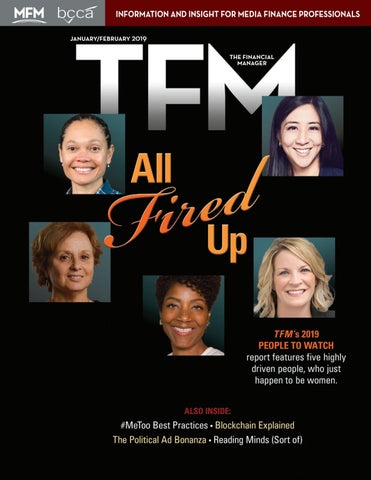
Five women shine in TFM ’s annual look at financial managers moving the needle for their companies and the industry. Intro.......................................25 Ilene Cook.............................26 Veronica Landers................. 27 Rebecca Riegelsberger........28 Jessica Westby.....................29 Shereta Williams................. 30
DEPARTMENTS 4 From the President The 25% Solution 6 Human Factor Recruiting Gen Z 7 Credit Where Due Resolving Discrepancies
8 MFM Board of Directors Leaders of the Pack 8 Association News CFO Summit Update 34 Last Word Reading Minds The Financial Manager • January/February 2019 3
FROM THE PRESIDENT
The 25% Solution
The people we’re watching in 2019 changed up their careers in ways that make them uniquely qualified to lead media companies forward.
A
s I read the “People to Watch” profiles in this issue, I was reminded of a session recently organized by our Young Professionals (YP) group. The speaker, Jane Moyer, had some very striking words of advice. And uncannily, the five people we’re watching in 2019 are going down the patch she’s suggesting, each in her own way. Moyer is founder of New Century Leadership, which works with individuals and teams to develop the skills necessary for success. She spoke about “the new 25% rule” – 25 years of experience is no better than a few years if you keep doing the same thing. Instead, she recommends making 25% of one’s focus new each year. Our Person to Watch, Ilene Cook, seems to be doing that in her role as controller and director of financial accounting at The Washington Post. She’s playing a part in how The Post is reinventing news media by constantly testing new ideas. Right now, she’s focused on robotics processing. Would you join the military if you wanted a career in law? How about following that with a few years spent working in the funeral industry? That was the path that Veronica Landers took before going to business school. Landers, who is now a director of credit and collections at Meredith, says that diverse background has given her the flexibility she needs to Twenty-five years of handle today’s challenges. experience is no better E.W. Scripps’ Rebecca Riegelsberger also takes the 25% rule to heart. Her supervisors note her than a few years if you keep doing the same thing, “get it done” approach. Early on that involved getting her CPA credential; then she helped save the according to Jane Moyer. company about $300 million in taxes. And now she’s taking on new responsibilities while volunteering with three nonprofits that have opened her eyes to new ways of thinking. Shereta Williams, president of Cox’s Videa venture, is described as “calm and steady.” At the same time, she seems to be constantly reaching for the new. Armed with a degree in electrical engineering from MIT, she worked at Lazard, then an analytical training start-up before moving to Cox, where she’s reinventing outdated ad sales processes. Our fifth honoree, Jessica Westby, has seen lots of change in her career. With a background in auditing from EY, as well as experience in restructuring and turnaround, she’s now helping Turner centralize its international accounting functions. One of her supervisors noted that she reinvents herself and her skillsets every five years. Three other features are also included in this issue: a straight-forward explanation of blockchain and its applications for media businesses; a first look at potential 2020 political advertising dollars, and an update on harassment legislation and policies in the wake of the #MeToo movement. Regularly scheduled columns round out our New Year’s offering. “Human Factor” focuses on how to lure Generation Z, which is just starting to enter the workforce. “Credit Where Due” offers six steps to untangling discrepancies. Finally, our “Last Word” column from Linda Smith is intended to inspire all readers to think about developing empathy to become better managers. It’s something to think about when setting 2019 goals. At MFM and BCCA, our unwavering resolution for 2019 is to work with our members to make them more valuable both now and in the future. Finding different ways to do that is part of our new 25% for 2019. Mary Collins is president Happy New Year!
4 The Financial Manager • January/February 2019
and CEO of MFM and BCCA; Mary.Collins@MediaFinance.org.
EDITORIAL ADVISORY BOARD MICHAEL DENSON Director, Credit Services NMCP Inc. JOHN SANDERS Principal Bond & Pecaro Inc. DAWN SCIARRINO Managing Member Sciarrino & Shubert PLLC MEREDITH SENTER Member Lerman Senter PLLC C. ROBIN SZABO President Szabo Associates Inc. THOMAS TWEDT Attorney-at-Law
CONTRIBUTORS NAGENDRA BANGALORE Fintech Global Consulting LLC DWIGHT DELAPENHA Fintech Global Consulting LLC LAURIE KAHN Media Staffing Network PETER LEITZINGER Kagan JOHN SLOAN LINDA SMITH Author of Smashing Glass & Kicking Ass DAVID WISSERT Lowenstein Sandler LLP AMY WIWI Lowenstein Sandler LLP
2019
HUMAN FACTOR
Planting the Gen Z Seeds
There are very specific ways to grow a top-flight younger workforce. The process is most successful when it starts early on. BY LAURIE KAHN
M
ost companies are still grappling with how to attract and manage Millennials and now we are starting to learn more about Generation Z – people born after 1995 who are now joining the workforce. With 75 million Americans expected to retire in the next few years, it is essential to start getting Gen Z interested in your company. One way to get their attention is to start speaking to them early on, before they have settled on their ideal career choice. Don’t wait until they are in their senior year of college to approach them as it could be too late. Get involved with your local and regional high schools. Offer to speak to a class and create internships or other work programs. Host a day where students can come visit your company to see how many different careers there are beyond the flashier positions, like on-air talent, which is what many of them want. Hold contests where they can win a guest stint hosting a show or participate in a major event. Perhaps there’s a charitable initiative where you need volunteers. Just get them involved. If you have colleges near you, contact professors who teach sales, marketing, finance or communications and ask if someone on your team can come teach a class. But be aware: if you go in and make a play to hire students without offering solid educational facts, you won’t be asked back. A given presentation might focus on the new technologies that are changing how you do your job or how your media company is helping local businesses expand by creating entire marketing campaigns for them. Let them know you are happy to share your expertise and information about your company.
Younger generations of workers are looking for an employer they can trust, that can help them grow in their career. They want to work for a company that doesn’t hide challenging aspects of the business and whose management is open in its communication. After they’re hired, they want to feel confident that what they present to clients can actually be delivered. Giving back and helping the community is also key to many of them. Share whatever information you can
that will show how your company can meet their desires and goals on your website and in social media. Because this age group is very research oriented, potential employees are likely to do some homework on you, your company and your products before you ever speak with them. Nothing will turn them off more than seeing out-of-date information. So make sure whatever is posted on the company site and social pages is current. In addition to updating your company’s online information, update your own personal social media profiles. Millennials and members of Gen Z who are scouting for a job will look for someone they can relate to, so use a friendly but professional picture.
6 The Financial Manager • January/February 2019
Share stories about your work as a manager and information about why people succeed under your leadership. Post updates about jobs well done at your company. Include testimonials from past employees or clients that describe your successes. Host a fun event for potential hires that includes younger staff members who can help with the networking and talk about your company. Peer-to-peer conversations can make the information that’s conveyed more believable. Maybe the event is a special meet-and-greet at your company’s offices. Or perhaps you can invite some guests to a concert, allowing them to see what your company does beyond what they’re aware of. Last by not least, if they reach out to you, don’t delay in getting back to them. And don’t give up if they don’t respond right away. Chances are, one or more of their parents and grandparents have been laid off, so they don’t necessarily feel a need for loyalty or perseverance in seeking out one particular position. You need to be prepared to move them through the interview process quickly and to sell them on your opportunity. If you don’t reply for a week, more than likely they will be gone. While that may make them sound like a fickle group of people, Gen Z can be won over. It just requires a special effort to make them anticipate the rewards of working on your team. Laurie Kahn is president of Media Staffing Network, a search and consulting firm that is focused on media jobs. She can be reached at (480) 306-8930 or laurie@mediastaffingnetwork.com.
CREDIT WHERE DUE
Untangling Discrepancies
When billing disputes arise, there are six steps that can make the snarls disappear in an efficient manner. BY JOHN SLOAN
“When solving problems, dig at the roots instead of just hacking at the leaves.” – Anthony J. D’Angelo, The Collegiate EmPowerment Co.
T
he impact of billing discrepancies on collections departments can be significant. Not only can resolving disputes eat up a great deal of time, but the way they are handled can reflect on the reputations of those involved. So coming up with a plan to tackle them is crucial. There are several factors that contribute to any one discrepancy problem. The individuals involved may or may not know how their actions can impact the overall process. The delivery of an ad flight’s schedule can be affected by factors beyond anyone’s control. For stations, this might include technical problems, breaking news, sporting event delays or programming overruns. For buyers, any deviation from the original schedule requires a human to approve and make changes. Generally, ad agencies or advertisers are notified of alterations as they occur, but buyers do not always adjust the schedules in their systems. That creates mismatches that must be resolved after billing. With the overall concentration of ad buying at just a few large ad agencies, unresolved billing issues can negatively impact days sales outstanding (DSO). Making matters worse, discrepancy resolution can be a low-priority function delegated to overworked assistant buyers. The longer a discrepant invoice remains outstanding the more difficult it is to resolve, and the potential for a revenue adjustment increases. Salespeople and ad buyers may move to different accounts or take on different positions. Memories fade, and paperwork is lost or misplaced. Credit personnel may have little control over the resolution process. But they need to provide prompt and effective problem resolution in the best ways possible. Here
are some steps to consider: First, make sure that you understand the entire order-to-cash process. It may be helpful to create a simple diagram or flowchart of all the steps. Determine how many people are involved and whether they know how their actions impact others in the process. Learn where the handoffs between departments occur, and whether the information provided is sufficient for the receiver. Second, identify where the problems have taken place. Given the complexity of the sales process, some discrepancies are
The longer a discrepant invoice remains outstanding the more difficult it is to resolve, and the potential for a revenue adjustment increases. normal. But you may pinpoint one area in the process where most of the difficulties arise. For example, they may be the result of human error. Or there might be billing or trafficking system deficiencies that are contributing to the problem. Third, once discrepancies are identified, determine the person or people who have responsibility for resolving them. Are there priorities that have been established based on the amount of the discrepancy? Figure out if sales and operational management are aware of the amounts involved. If an invoice adjustment is necessary, determine what approvals are required. Make sure the process is sufficiently transparent so that anyone can determine how far along the issue is toward resolution. Fourth, determine whether customers are creatively using discrepancies to delay payment. If schedule changes are being communicated to the agency as they occur, but the agency is not making changes within their buying system, identify who
is responsible for resolving them. There may have been delays in receiving copy or last-minute requests for copy alterations that can’t be accommodated. Media standards for the receipt of copy and other scheduling issues must be clearly communicated to agencies and should not be relaxed when agency personnel apply pressure. Fifth, depending on the size of the collection department, it may make sense to delegate the discrepancy resolution function to one or two people. The characteristics required to successfully solve billing discrepancies are different than those used for routine collection follow up. Finally, make sure both sales and operational management are fully aware of the number, amount and (if possible) origin of all outstanding billing disputes. Prioritize the layout of the report by disputed amounts, with the largest amounts at the top. Distribute the report monthly and follow up with a meeting with the appropriate sales manager to discuss how the problem resolution is progressing. If billing adjustments occur, create a separate report showing all adjustments, the reasons and the customers involved. Additionally, show the impact of all adjustments on sales. That is, what percentage of total sales are lost to billing adjustments? Billing discrepancies are part of the media sales process and can be a frustrating obstacle for collectors. However, with a well-defined procedure, one can reduce the time and effort necessary to fix them. John Sloan is a former executive director of credit services for Turner Broadcasting System. He can be reached at john_sloan23@yahoo.com.
The Financial Manager • January/February 2019 7
ASSOCIATION NEWS
CFO Summit Update
More details are starting to emerge about MFM’s annual CFO Summit, which takes place in Ft. Lauderdale March 7-8, 2019. One session will focus on security — cyber and employee. There will also be sessions on 21st century employment law challenges, the outlook for the economy, the current state of big data, robotics and the workforce of the future. As always, there will be a CFO roundtable, where attendees can exchange views and information about the topics that concern them the most.
This year’s summit is spearheaded by co-chairs Paul Rahmlow, CFO of Midwest Communications, and Joe Waring, CFO of Evening Post Industries. John Drain, CFO of Hearst Television, is serving as an advisor. The event will be located at Ft. Lauderdale’s Pelican Grand Beach Resort, right on the waterfront. Registration is limited to the most senior financial executives in media companies. MFM reserves the right to refuse registration requests that do not meet that criteria. For registration information, please visit mediafinance.org.
MFM
BOARD OF DIRECTORS January 2018 CHAIRPERSON CINDY PEKRUL Turner VICE CHAIRMAN/CONFERENCE CHAIR RALPH BENDER Manship Media SECRETARY/CONFERENCE CO-CHAIR MELISSA MITCHELL Bonneville International TREASURER DAVID BOCHENEK Sinclair Broadcast Group
BOND & PECARO The Basis for Your Decisions
ApprAisAls FeAsibility studies expert testimony And relAted FinAnciAl services For the communicAtions industry
IMMEDIATE PAST CHAIRMAN ROBERT DAMON Damon Strategic Consulting PRESIDENT & CEO MARY M. COLLINS MFM/BCCA
MFM/BCCA DIRECTORS MARCUS ANJEWIERDEN Deseret Management Corp. MATT ASKINS EY STUART BENSON Helios and Matheson DAVE BESTLER Hubbard Radio LORI BROCK Meredith Corp. TRACY CLARK Hearst Television
1990 M STREET, NW SUITE 400 WASHINGTON, DC 20036 (202) 775-8870 E-mail: BP@BondPecaro.com www.BondPecaro.com
8 The Financial Manager • January/February 2019
BRIAN IGNATOWSKI Disney Financial Services GLENN KRIEG Morgan Murphy Media LORI LOCKE Gannett Co. PAUL NESTEROVSKY Sinclair Broadcast Group ANTONELLA RICCIARDI AMC Networks JOHN SANDERS Bond & Pecaro
GREG FREIBERG New Media Investment Group
JEANA STANLEY Hearst Television
JOHN GIRALDO NBCUniversal Media
MARIE TEDESCO Beasley Broadcast Group
LAURA GRAVES WLS-TV/ABC/Disney STEVE HALL Las Vegas Review-Journal
BCCA Board Member Rep EDWARD MOCKUS Discovery
ue n e v e r e h t in s ll a f it Recurring p his t if d e v o m e r e b ld s cou s e c o r p n io t c a s n a r t ely. iv t c e f f e d e s u is y g new technolo 10 The Financial Manager • January/February 2019
TECTONIC TECHNOLOGY
By DWIGHT DELAPENHA & NAGENDRA BANGALORE MUCH HAS BEEN WRITTEN AND DISCUSSED
about what blockchain is and what it can do. We read a recent article that described it is an emerging technology that has the potential to disrupt transaction processing, settlements, accounting, reporting and auditing in the media industry. But a
lot more information is needed in order to understand the technology and its potential for media companies. For starters, it is useful to appreciate why blockchain can add value to industry sectors universally. Its potential and related adoption strategies should be looked at in two distinct pools. The first is that blockchainbased networks offer the opportunity to develop new business and trust models, most of which haven’t been invented yet. Adoption will require the creativity of entrepreneurs and practitioners to use the technology as a means of rethinking the way in which individuals, public authorities and business interact without compromising data privacy and commercial confidentiality, while also minimizing fraud risk. That’s discussed in an IBM-supported Forrester report called The Total Economic Impact of IBM Blockchain.
The second path, and the focus of this article, is on improving the efficiencies of existing process flows. In this pool, an effectively installed blockchain network will improve those situations that involve multiple parties wasting time and resources reconciling data when all should be reviewing and using the same data. It can also help companies avoid situations where fraud arises from a lack of timely information. And blockchain is also a valuable tool for processes where efficiency gains and other benefits can be achieved if all participants have visibility across an entire supply or value chain. This last-named pool is where improvement of advertising revenue transaction processing squarely fits. Programmatic advertising transactions involve several steps starting with the advertiser placing the buy. The intended transaction typically involves ad servers, trading desks, ad exchanges as well as both sell-side and demand-side platforms. Finally the order reaches a publisher and then is seen by consumers. (See top diagram page 12.) This linear relationship is certainly open to the challenges of errors, fraud, customer credit risk, delays in settlement and accounting for revenue recognition under the new accounting rules. Those rules are tilted heavily under accounting principles to significant judgement interpretation and not a rules-based application as in previous U.S. Generally Accepted Accounting Principles, better known as GAAP. HOW IT WORKS
Our view is that these challenges can be proactively addressed by deploying blockchain technology. (The bottom diagram on page 12 illustrates this.) This blockchain network operates under the foundational principles of: ■ Permissioned Network – Each participant has a unique identity, which enables
The Financial Manager • January/February 2019 11
■
■
■
the use of policies to constrain network participation and access to transaction details. Consensus – For a transaction to be valid and recorded on the platform, all participants must agree on its validity. Provenance – Participants know where the underlying asset came from and how its ownership has changed over time. Immutability – No participant can tamper with a transaction after it has been recorded in the ledger.
Finality – A single, shared ledger provides one place that participants can visit in order to determine the ownership of an asset or the completion of a transaction. Operationally, the advertiser, intermediaries and publishers form a blockchain consortium network. Each member of the consortium has at least one node in the blockchain network. Each transaction connected to the advertiser’s digital asset is verified at each of the nodes through smart contracts.
■
The relevant transaction is stored on the blockchain and replicated on all the nodes – but only if members form a consensus on the validity of the transaction across all the nodes. The approved blockchain of transactions are then added to the blockchain in a direct, sequential manner, and it is written as a cryptographically ensured block. New blocks of approved transactions/ information are associated with more established blocks, making a chain of blocks that
HOW PROGRAMMATIC ADVERTISING WORKS
Advertiser
Publisher Ad Network
[ ] Advertiser
Ad Server
Trading Desk
Demand Side Platform
Ad Exchange
Supply Side Platform
Ad Server
Publisher/Audience
Ad Network
Advertiser
Publisher
PROGRAMMATIC ADVERTISING TRANSACTION PROCESS UNDER A BLOCKCHAIN NETWORK Brand/Advertiser D AN BR
Website Hosts
Ad Agency
Demand Side Platform
Publishers Smart Contract
12 The Financial Manager • January/February 2019
Ad Exchange
Blockchain Nodes
TECTONIC TECHNOLOGY demonstrate validity of each transaction in that blockchain’s history. The entire chain is continuously synchronized so every ledger in the network is the same and gives every member the ability to prove at any time who owns what type of transaction. Each digital asset can then be allocated a unique tag, which helps in the audit process. And members on the blockchain can proactively search each transaction to avoid fraud. The flow from asset creation to bid price, display (location, context and click through) can be tracked. And everyone in the ecosystem will be aware of impact of the ad display. With additional use of artificial intelligence and machine learning algorithms built in to mitigate fraud, the network host can proactively practice detection by observing signature patterns, track DNS (domain name system) traffic monitoring and perform behavioral analysis reviews. A rigorous application of these techniques is a robust defense in combatting fraudulent transactions. MEETING MEDIA’S NEEDS
In terms of collections of advertising revenue receivables, the industry has a unique issue: once the ad has run, there is no going back to repossess the asset due to an inability to collect cash. Credit and collections policies are vitally important to the industry and invariably time-consuming and subject to repetitive tasks. Our view is that this can be improved immeasurably with a blockchain solution. When a customer is established on the network, the credit-worthiness and ability to pay can be vetted (not dissimilar to current practices) and the ability to pay and banking details coded into the smart contract that governs the interaction of parties as the contract is executed. When an ad airs, it will trigger performance obligations embedded in the contract and payments flowing through the banking system can be executed. This, properly configured, can be an effective tool in reducing the length of days outstanding in ad revenue receivables and the incidence of uncollected debts. For revenue recognition, we note that ASC 606 Revenue From Contracts With Customers is weighted towards principlesbased accounting (and usually requires the application of significant judgement) as
opposed to rules-based accounting that has long been applied to revenue recognition rules. The implementation of a blockchain network can improve on this application as follows: Step 1 – Identify the contract with the customer. This should be transparent with the nodes and smart contracts specifically identifiable to each customer. Step 2 – Identify the separate performance obligations in the contract. This will be a bit tricky and will involve judgement calls, especially with the need to identify distinct deliverables. With the aid of artificial intelligence tools and big data analytics built into the platform, verifiable evidentiary support can be mined from the transaction processing data. Step 3 – Determine the transaction price. This may involve the accounting for variable consideration and as performance obligations are satisfied. The trove of verifiable transaction data and the use of artificial intelligence and big data analytical tools should assist here. Step 4 – Allocate the transaction price. Having verifiable data and transaction
history from the proceding steps 1-3 will render this step easier to perform. Step 5 – Recognize revenue when (or as) a performance obligation is satisfied. With transparency and verifiable data from the network, the revenue recognition and financial reporting for this step can be better facilitated. Adoption of blockchain technology will take some bold actions by stakeholders. A clear vision of the end stage is needed early on. And its success depends on the involvement and buy-in of internal and external stakeholders. Transaction processing volumes will continue to dramatically increase in the coming years. There will be a need for a better system for recording, using and safeguarding sensitive data. When it’s used effectively, blockchain technology can accomplish these goals. Dwight Delapenha is the president and CEO and Nagendra Bangalore is the chief technology officer of Fintech Global Consulting LLC, a blockchain technology consultancy. They can be reached at (212) 653.0341 or info@fintechglobalconsulting.com or, by visiting www.fintechglobalconsulting.com
The Financial Manager • January/February 2019 13
GREAT EXPECTATIONS By PETER LEITZINGER
Political ad revenue exceeded estimates in the record-breaking midterm, paving the way for more outstanding results in 2020.
I
NCREASED SPENDING DURING THE PAST POLITICAL
year is a positive sign for presidential election year 2020. There is likely to be a reversal from the 2016 election trend, when spending came in below expectations due to the Donald Trump campaign’s reliance on earned media. This outlook bodes particularly well for broadcast station groups, which pick up the majority of political revenue. Cash flow generated from election-year political advertising significantly drives broadcast TV groups’ station investments along with mergers and acquisitions. And it also contributes to improved investor sentiment. The amount of campaign fundraising helped make the 2018 election the most expensive midterm on record, and a
14 The Financial Manager • January/February 2019
boon to other media sectors beyond TV. According to the Center for Responsive Politics (CRP), the final ad spend cost of the 2018 election was $5.2 billion, 35% more than in 2014. The increase was attributed to higher outside spending from special interest groups, at $1.31 billion, up 61% over 2014. The campaigns were particularly fierce not only due to a deeply divided country, but the knowledge that newly elected members of Congress will be tasked with redrawing congressional maps, setting the stage for 2020 and beyond. Each of the seven broadcast groups that Kagan analyzes reported political ad revenue above expectations through the third quarter, as spending grew on average 129.0% from a total $147.3 million in the third quarter
ADVERTISING ADVANCES
“As a reminder, Donald Trump did not raise or spend much money in 2016 … He already has $100 million raised for 2020 with two years to go.” — David Lougee, Tegna
of midterm election year 2014 to $337.3 million in third quarter 2018. Kagan had projected TV to bring in nearly $2.53 billion in political ad revenue in 2018, an increase from the 2014 midterms. However, with political exceeding all the publicly traded broadcasters’ estimates, we expect to revise the total political ad revenue figure upwards. At press time, the fourth-quarter results had not yet been reported. The TVB trade group estimates that 2018 set a midterm election cycle record, with more than $3.0 billion spent on local broadcast TV in the political ad category. Based on Kagan’s historical estimates, that would mean political ad revenue for broadcast TV increased 14.9% from 2016 and 26.0% from midterm election year 2014.
STATION GROUP TRENDS
Results from publicly traded TV station groups bore out those overall trends. As of Nov. 8, Tegna reported booking $238 million of political revenue for the year, up 51.0% from the 2014 midterm year and significantly above prior guidance of $180 million to $200 million. In the third quarter alone, Tegna reported political ad revenue of $60.4 million, up 51.0% from the previous midterm. The company garnered $144.0 million in political ad revenue for the fourth quarter, a 56.0% gain from fourth quarter 2014. On the third-quarter earnings call, Tegna president and CEO David Lougee said the company’s revenue from House race spending more than doubled from 2014. He The Financial Manager • January/February 2019 15
expects that Tegna will have the same numAnother major TV station group, Nexstar in Nexstar markets like West Virginia, Indiber of contested races every two years mov- Media Group, grew midterm-year political ana, Florida, Missouri, Nevada, Tennessee, ing ahead. ad revenue by 285.9% in the third quarter, North Dakota and Arizona. “Looking forward to 2020, adding a from $18.2 million in 2014 to $70.1 milNexstar also benefited from gubernatopresidential race on top of the same num- lion. The company forecasts a political rev- rial races in toss-up states like Connecticut, ber of congressional and state races only enue range of $280.0 million to $290.0 mil- Florida, Iowa, Michigan, Ohio and Nevada. means more revenue. As a reminder, Don- lion for full-year 2018, a company record More great news came from E.W. Scripps, ald Trump did not raise or spend much for the segment. whose executives reported record thirdmoney in 2016. And that has turned out, In political years, broadcasters allocate a quarter political revenue of more than obviously, to be an anomaly. He already has heavy share of inventory to political adver- $40.0 million. That’s an increase of 130.0% $100 million raised for 2020 with two years tisers, and Nexstar has capitalized on the from $17.4 million in 2014. to go,” said Lougee. For full-year 2018, E.W. Scripps Premion, Tegna’s ad service for had booked $140.0 million in politiSinclair Broadcast Group is over-the-top channels and platcal ad revenue, up 86% from 2014. expected to bring in an estimated forms, has begun to attract political Scripps is in the process of acquradvertisers and is a bright spot for ing 15 TV stations from Cordil$250 million to $253 million in the segment moving forward, aclera Communications and two from political revenue this year. cording to Lougee. “We have great Raycom Media. If and when the optimism about what that will do deals close, the new stations will in 2020 ... given its targeting capabilities. opportunity with spot inventory strategies give Scripps greater revenue potential in the Once political advertisers use it, they love that open ad spots to maximize political ad politically important states of Colorado, it,” he said. opportunity – a common practice among Florida, Kentucky, Louisiana, Montana Meanwhile, Sinclair Broadcast Group is broadcast stations in election years. On the and Texas. expected to bring in an estimated $250.0 third-quarter earnings call, president and On the third quarter-earnings call, E.W. million to $253.0 million in political rev- CEO Perry Sook said Nexstar booked about Scripps president of local media Brian Lawenue this year, giving the company its 49% of third-quarter political revenue from lor highlighted that the Cordillera stations biggest-ever midterm political year. That candidate spending, with political action brought in more than $45 million in powould surpass its performance in the cat- committee and issue spending making up litical ad revenue. Lawlor attributed Scripps’ egory in every presidential election year the balance. third-quarter and full-year political ad revother than 2012. Sook attributed the political ad revenue enue success to 12 fiercely fought Senate Sinclair reported political ad revenue of success to investments in local news re- races, 10 U.S. House races and three big $70.0 million in the third quarter, $20.0 sources and reporting capabilities in both ballot initiatives across the country. million higher than the top end of com- Washington, D.C., and state capital bupany guidance. On the third-quarter earn- reaus. Nexstar stations also hosted and HOT HOUSES ings call, Sinclair president and CEO Chris produced debates for Senate and guberna- While there were many record-breaking Ripley said he expects 2018 to be a strong torial races. Sook pointed to multiple battle- House races in 2018, none saw more spendindicator for presidential election year 2020. ground districts and heavy-spending races ing than California’s 39th Congressional
TV Station Group Political Analysis ($000) % Chg. Q3 ’14 –’18
YTD’14
40.3%
285.9%
70,000
33.1%
38,060
60,410
22,029
22,272
E. W. Scripps
17,396
Meredith
% Chg. YTD’14 –YTD’18
$111,049
67.7%
283.9%
63,300
105,000
22.9%
103.9%
66,539
64,050
93,725
-3.7%
40.9%
118.0%
33,437
41,576
71,863
24.3%
114.9%
54.6%
130.0%
25,339
44,601
57,484
76.0%
126.9%
36,100
26.2%
178.5%
16,619
26,482
49,147
59.3%
195.7%
10,500
12,600
262.1%
334.5%
6,800
8,700
31,200
27.9%
358.8%
$184,577
$337,293
25.3%
129.0%
$229,162
$297,220
$519,468
29.7%
126.7%
Q3’16
Q3’18
Nexstar
$18,179
$25,500
$70,147
Sinclair
33,800
45,000
Tegna (formerly Gannett)
39,995
Gray TV 1
Univision Total/Averge
% Chg. Q3 ’14 –’16
% Chg. YTD ’14 –’16
Q3’14
YTD’16
YTD’18
$28,928
$48,511
107.1%
51,500
-4.8%
51.0%
48,018
1.1%
26,892
40,018
12,963
16,353
2,900 $147,262
* Companies ranked by YTD ‘18 political revenue. YTD includes the first three quarters of each year noted. 1 Meredith fiscal year ends June 30. Last three quarters used for consistency SOURCE: Kagan, within the TMT offering of S&P Global Market Intelligence. © 2018 S&P Global Market Intelligence. All rights reserved.
16 The Financial Manager • January/February 2019
ADVERTISING ADVANCES District. The open-seat vacated by Republican Ed Royce yielded the most expensive non-special House election ever in terms of combined spending by candidates and outside groups that supported them. California’s 48th District, with incumbent Republican Dana Rohrabacher facing Democrat Harley Rouda, is the top non-special House election in terms of outside spending alone. Following a mail-in-ballot count, Rouda narrowly defeated Rohrabacher, a nearly 30-year congressional veteran. According to Kantar Media/CMAG, there was strong spending in a number of key U.S. Senate races. Among them: ■ $115.5 million was spent in Florida; ■ $63.5 million in Missouri; ■ $55.1 million in Nevada; ■ $47.9 million in Arizona; ■ $37.5 million in Tennessee. The Texas Senate race between incumbent Republican Ted Cruz and Democrat Beto O’Rourke is the most expensive ever in terms of congressional candidate spending, according to the CRP. O’Rourke set a record for congressional candidate fundraising, at $69.1 million. CRP reported that the Florida Senate
race ranked as the most expensive election ever in terms of combined candidate and outside spending from special interest groups, at $181.2 million, with Florida victor Rick Scott only a few hundred thousand dollars behind O’Rourke in money raised. CHANGING FORTUNES
The midterm elections showed vulnerability for the Republican Party as the Democrats seized control of the House and made inroads in the nation’s governorships. Senate candidates backed by the President lost in Michigan, Pennsylvania and Wisconsin – all states Trump won in 2016 following years of Democratic dominance in presidential elections. Republicans fell short in Minnesota and Nevada, Democratic-leaning states that once appeared to represent flipping opportunities for the 2020 presidential election. Trump narrowly lost in Minnesota in 2016, and Democrats won the state’s governorship and two Senate races. The party picked up two House seats and flipped the state House. Colorado and Nevada, two states where Trump is expected to compete well in 2020, elected full slates of Democrats in 2018. In
Nevada, Democratic House representative Jacky Rosen unseated Republican senator Dean Heller despite Trump campaigning for the incumbent. Looking forward, key states for 2020 presidential candidates include Virginia, Florida, Michigan, Pennsylvania, Wisconsin, Colorado and Nevada. Two other states – Georgia and Arizona – also could come into play, but they remain predominantly Republican-leaning. Broadcasters stand to benefit even more from the over-the-top platforms that carry their signals in the next election battles. During this past year, the platforms brought more data into the TV realm, helping political advertisers to plan ad buys on broadcast TV. The influx of data from digital measurement overall is leading to more informed political ad buys across the board, which bodes well for the 2020 elections. Peter Leitzinger is a research analyst with Kagan, a group within S&P Global Market Intelligence’s TMT offering, providing exclusive research and commentary. He provides analysis on emerging media trends. For more information contact market.intelligence@spglobal.com or (877) 863-1306.
Congratulations Ilene Cook The Washington Post’s Controller and Director of Financial Accounting
Named one of
The Financial Manager magazine’s People to Watch in 2019
KLMNO The Financial Manager • January/February 2019 17
LEADERSHIP POLICIES
HONOR AND PROTECT The #MeToo movement has triggered a rise in harassment claims. Make sure your company is carefully prepared for potential problems. By DAVID WISSERT & AMY WIWI
S
O MUCH CAN HAPPEN IN 15 MONTHS.
It was that short time ago when The New Yorker expose of entertainment titan Harvey Weinstein’s outrageous behavior gave birth to the #MeToo movement. Women who had been previously silent came forward in droves, offering personal tales of sexual abuse and harassment in the workplace spanning decades. Increased public awareness of the issue has led to more complaints. According to the Equal Employment Opportunity Commission (EEOC), allegations of sexual harassment claims increased by more than 12% in the fiscal year ending Sept. 30, 2018. In addition, the EEOC has reported that it filed 50% more lawsuits charging sexual harassment than it did in the year prior. The #MeToo movement has inspired new anti-harassment legislation as well. In 2018, New York State enacted laws that impose extensive training, policy and posting requirements. The state now also prohibits the use of nondisclosure provisions in settlement agreements involving sexual harassment claims unless confidentiality is the employee’s preference. Further, New York has declared null and void any clause or provision in any contract entered into after July 11, 2018, The Financial Manager • January/February 2019 19
LEADERSHIP POLICIES that requires the parties to submit to mandatory arbitration to resolve any allegation or claim of sexual harassment. New California laws also lower a plaintiff’s burden and standard of proof in sexual harassment lawsuits. In addition, they increase sexual harassment training requirements for employers and limit the use of nondisclosure agreements to settle sexual harassment claims. These laws are part of a nationwide trend. According to the National Conference of State Legislatures, more than 32 states have introduced over 125 pieces of legislation related to sexual harassment and workplace misconduct in 2018. In light of this, employers should expect to face a more educated and demanding workforce, with a clearer understanding of what is prohibited, employees’ legal rights and where to seek redress. As Ruth Bader Ginsburg recently noted in a speech at Georgetown University Law Center, gone are the days when bad behavior will be excused under the premise that “boys will be boys.” There are several actions that employers can take to prevent and address sexual harassment. Let’s look at each one in turn.
EXAMINE THE CULTURE
Take a hard look at your company’s culture to determine whether it supports and reinforces a respectful workplace free of sexual harassment. You may find that leaders in the organization engage in, ignore or perpetuate sexual harassment or other gender discrimination. There may be employees who believe that complaints will not be treated seriously or that alleged perpetrators will merely be given a slap on the wrist. Find out if women have been penalized for assertive behavior – if they are silenced or spoken over at meetings. And there may be pay disparities between men and women who hold similar jobs. Whether explicit, implicit or passive, all of these issues must immediately be addressed. A good way to improve culture is to formally evaluate supervisors on how they handle harassment and discrimination issues and promote diversity. Then tie that evaluation to career advancement opportunity and increased compensation. Management should further determine whether a gender imbalance exists in the workplace – in the rank and file, in
THE INVESTIGATION PROCEDURE There are critical questions to answer in any harassment investigation. Among them are: ■■ Who will investigate? ■■ What evidence needs to be collected (i.e., emails, photos, text messages, social media posts)? ■■ Who should be interviewed? ■■ How should the process be documented? The person selected to investigate should be well trained, unbiased, able to communicate well and defuse emotional responses. They also need to be capable of clearly documenting investigative procedures and analysis, and ultimately be a good witness in the event of litigation. The chosen investigator must be sensitive to the occasional need to use an outside investigator or to consult with outside counsel. This is especially true when the accused is a highlevel executive or a person with real or perceived control over a human resources department. Documentation is the key to any defense at trial. This makes it imperative that investigators review their notes — often made quickly or using shorthand — for errors and omissions. Make sure they are in a form easily understood by others in case they become trial exhibits. The form of the investigator’s report is another important consideration. The investigator must decide whether to make recommendations regarding corrective action or only issue factual findings and have human resources personnel take the next steps. If written recommendations are not followed, employers must be prepared to explain why.
20 The Financial Manager • January/February 2019
management, in the board room. Women remain vastly underrepresented at every level in corporate America according to the Women in the Workplace 2018 report. It’s based on a survey by LeanIn.Org and McKinsey & Co., which compiled four years of data from 462 companies employing 20 million people. The #MeToo movement has led to heightened public scrutiny of that imbalance. Employers should consider providing women with leadership training, promoting them into the executive ranks or forming committees that focus on women’s issues and concerns. These efforts will certainly bolster an employer’s message that its female employees are valued and respected. DEVELOP A STRONG POLICY
Employers are well advised – and required in many states – to adopt a sexual harassment policy. What’s more, it should contain a prominent statement that the employer is committed to maintaining a workplace free from sexual harassment. It should clearly define sexual harassment, emphasize that it is against the law and state that all employees have a legal right to a workplace free from sexual harassment. The policy should specify that it applies to all employees, applicants for employment, interns as well as contractors and other third-parties who conduct business with the employer, as may be required by state law. The policy should advise that sexual harassment is not limited to the physical workplace and can occur while employees are traveling for business or at employersponsored events or parties. There should be a clear mechanism for reporting and handling complaints, specifying the people to whom the employee can complain. The options should include someone who will seem safe to a given employee, if he or she needs to lodge a complaint. To that end, someone in addition to the supervisor must be listed, and preferably the list should include at least one male and one female. The employer should confirm that complaints will be treated confidentially, to the extent possible, promptly investigated and that the employer will take prompt corrective action to stop any inappropriate conduct. Some states, including California and New York, now require employers to specify how an employee can file a complaint with the EEOC or state agency that enforces the Continued on page 22
Revenue Management Services PROVEN. ADAPTABLE. ECONOMICAL.
MAI’s RMS is a software-based service that manages license fee data for Content Providers. Founded in 2005, MAI manages over $5B of license fees annually.
MAI is an Extension of Your Business • Mitigates Revenue Leakage • Multi-level Team Support with Account Redundancy • Personalized Account Management & Single Point of Contact • Cost Effective & Scalable • Allows Our Clients to Concentrate on Their Core Business • Help Manage Costs Due to Margin Compression
• Eliminates the Burden of SMS Software License Fees • Newly Developed, State of the Art & Secure, End-to-End Solution • All System Support, Hosting & Software Upgrades Absorbed by MAI • 24/7 Secure Web Access to Data
For more information and to schedule a demonstration of our RMS, please contact: Michael Trujillo SVP, Business Development mtrujillo@mai-global.com +1.720.407.7893 Direct +1.303.807.8756 Mobile
Tim Waddingham Director, Client Development twaddingham@mai-global.com +1.720.407.7569 Direct +1.720.339.3637 Mobile
®
DENVER • NEW YORK • LONDON mai-global.com
The Financial Manager • January/February 2019 21
LEADERSHIP POLICIES #METOO—Continued from page 20
laws prohibiting discrimination. Employers are strongly encouraged to outline and prohibit other forms of unlawful harassment and discrimination within their policy, beyond sexual abuse. For example, employers should affirm they provide equal employment opportunities to all staff members and job applicants without regard to race, color, religion, gender, national origin or any other characteristics protected by state and local law. The same complaint mechanism can be used to report claims of other unlawful discrimination and harassment. The policy should emphasize that retaliation is prohibited. However, the employer should make clear the provision does not protect employees from making intentionally false charges of harassment. New York employers are now required to include a sample complaint form within their policy. Employers from other states may wish to do the same. COMMUNICATE THE POLICY
Employers should disseminate a written copy of their policy to employees either
as a hard copy or via email. Alternatively, they should post the current version of their policy on a company intranet with a tracking system. Intranet tracking is a compliance tool that allows employers to track and confirm that handbooks and policy updates have been received and reviewed by employees. In all events, the employer should secure an acknowledgment form
training in the workplace either every year or every other year and further require that employers track compliance. But employers in every state should provide antiharassment training to their employees not only because it helps when defending a lawsuit, but also because it is good for the employer’s culture. The New York and California training
Employers should consider reminding employees of its harassment policies before holiday parties and at town halls or other large group meetings. from the employee. Policies should be redistributed at least annually and provided to each new hire. But that’s not all. The employer should consider reminding employees of its harassment policies before holiday parties and at town halls or other large group meetings. By doing so, the employer can emphasize its commitment to the policy. TRAIN, TRAIN AND RETRAIN
New York and California have enacted legislation that requires anti-harassment
22 The Financial Manager • January/February 2019
requirements serve as a model for employers in all states. Educational sessions should be interactive, which means they should allow employees to ask questions and require them to provide feedback about the information and materials presented. Include an explanation of sexual harassment consistent with the law of the state in which the employee works and provide examples of conduct that would constitute unlawful sexual harassment. Also provide information about the federal and state Continued on page 32
Thank you for making fans out of us. Turner is proud to congratulate Jessica Westby on being named a “Person to Watch” by MFM.
TM
Congratulations to the
2018 TFM “People To Watch” Rebecca Riegelsberger Vice President Tax & Treasury The E.W. Scripps Company
Jessica Westby Assistant Controller, Operation, G&A and Investments Turner
Ilene Cook Director of Financial Accounting, Controller The Washington Post
Veronica Landers Director of Credit & Collections Meredith Local Media Group
Shereta Williams President Videa
Szabo Associates, Inc. • 404-266-2464 • www.szabo.com • info@szabo.com
g n i z a l B
SPECIAL REPORT: PEOPLE TO WATCH in 2019
Trails
By JANET STILSON
It wasn’t part of the plan.
When TFM ’s editorial board cast a wide net to discover what people we should be keeping an eye on in the coming year, there was no feminist agenda. But we couldn’t be more pleased to feature five outstanding people, who just happen to be women.
Five women shine in TFM ’s annual look at financial managers moving the needle for their companies and the industry.
The profiles that follow reveal the personal qualities that helped propel our People to Watch into roles that are critical to the future health of their companies, if not the media industry overall.
Take, for example, the unusual career path of Veronica Landers. Past work in the military and the field of mortuary sciences has impacted her leadership style at Meredith. Wise words were also dropped along the way. The Washington Post’s Ilene Cook stressed how critical it is for people to advocate for themselves, rather than waiting for others to recognize their accomplishments. And Shereta Williams of Videa relayed some advice from her parents: “hard work can overcome almost any disadvantage.” You’ll find a lot more information about what makes these high achievers tick in the stories that follow.
Janet Stilson is editor of The Financial Manager. She can be reached at (212) 694-0126 or TFMEditor@mediafinance.org.
The Financial Manager • January/February 2019 25
SPECIAL REPORT: PEOPLE TO WATCH in 2019
ILENE COOK
WaPo’s Reinvention Dynamo
26 The Financial Manager • January/February 2019
JASON WONG/THE WASHINGTON POST
W
hen Ilene Cook joined The Washington Post in the economic downturn, all ideas that would reinvent certain 2005, the company was in for a bumpy ride, but in processes were welcome at The Post. many respects, it’s turned into a joy ride for Cook. Anticipating the need to change things up is one big reason Early on, Craigslist was decimating classified why The Post’s vice president and CFO, Steve Gibson, nomiadvertising, and the recession provided nated Cook to be a Person to Watch. further disruptions. Later the paper’s “Ilene plays a vital role in pushing hercontrolling owner, the Graham family, self and her team to make sure we’re resold off its interest to a Jeff Bezos holdally plugged into everything that’s taking ing company. And The Post increasingly place, and that we have an opportunity became an international digital product. to help design how the systems and proToday Cook considers her current role cesses around these new activities will as the company’s controller and director work,” Gibson says. of financial accounting to be the most imCook says that one of her greatest portant of her career. “While the finance accomplishments has been building function is critical in every business, at an extremely effective team. Gibson The Post I feel like I’m contributing not describes her staff as “very strong,” just to a company but to an entire indusadding: “She’s got a very unique style. try,” she says. “Since our acquisition, It’s unlike that of anyone I’ve ever worked we’re dedicated to finding a successful with. She’s very dynamic, really engagbusiness model for media companies. ‘Ilene plays a vital role in pushing herself and ing and really works with her staff a lot.” And to quote our owner, ‘Media is an esOne of the projects that most excites her team to make sure we’re really plugged sential component to democracy.’” Cook right now involves robotics prointo everything that’s taking place.’ Cook has a particular skillset that cessing automation. “The best descrip— Steve Gibson, The Washington Post couldn’t be more apt for the wild world tion I have for it came from one of the of WaPo: anticipating how changes members of my staff, who said, ‘Oh! So within the company will impact the finance department and it eliminates the worst part of our jobs,’” Cook says. surfacing new ideas about how to handle them. “It’s not going to replace my people, but it’s going to free them “It’s kind of like a dream job for me. I’m always coming up up to do more analytics. It will enable us to expand our business with a dozen new ideas. Now, bright people will tell me why without hopefully having to expand our finance department.” 10 of them are no good, but the other two usually work out Cook learned how fascinating business can be at the dinner fine,” says Cook. She notes that even during the dog days of table when she was growing up on the south shore of Long Island. Both of her parents had business careers, and their Ilene Cook (seated, center) is extremely proud of building a strong team. discussions were “illuminating,” Cook says. It includes (L-R) Nadeem Awan, Bhumi Patel, Christine Mullings, Bobby Whitehouse, Now she’s using her insights to help others succeed. “Ilene Shahid Khan, Eileen Hogan, Mandy Wu. is a great mentor to me. She’s given me both career and life advice. She really puts things into perspective,” says Veronika Takacs, senior director of external reporting and policy at comScore. When Takacs worked for PricewaterhouseCoopers, she was an auditor on The Post account, and her working relationship with Cook evolved into friendship. One of the key pieces of advice Cook tends to share is that it’s important to pay attention to the little things one does, like proofing an email before hitting the send button. In the end that can matter a great deal. “People need to be an advocate on their own behalf, not just wait for someone to recognize their skills and what they have to offer,” she adds. That involves preparation. “You need to do research. You need to practice your pitch in front of a mirror or a friendly person. And then you’ll feel more comfortable in saying ‘I’ve got something I think you’ll be really interested in,’” Cook says.
VERONICA LANDERS
Finding Flexibility at Meredith
N
early 10 years ago, Meredith Corp. had a confluence of circumstances on its hands that could have caused unfortunate problems. There was a big snowstorm in Washington, D.C. just before the general election. People working for an ad agency placing political spots across Meredith’s stations couldn’t get into the office to cut a check. As is the general rule for broadcasters, Meredith needed cash in advance from the political client before it could run its spots, and it looked like that wasn’t going to be possible. One of the key people who helped find a workaround was Veronica Landers, who’s currently director of credit collections for Meredith’s local media group. “A less business-friendly approach would have been, ‘Tough break,’” says Kevin James, director of sales for Meredith’s KPHO and KTVK Phoenix, who also helped troubleshoot the snowstorm blowback. “I don’t want to say we bent the rules, because that wasn’t it. But we took a very understanding approach.” Certain documentation was secured to make sure the payment was coming. And the spots ran. “It made a very chaotic time much better. We didn’t miss any money; everybody lived up to what they were so supposed to do,” James recalls. He relates the story as a way of explaining Landers’ genuine interest in finding flexible ways to work with sales in order to increase revenue. “She’s got a unique perspective on how she approaches her job. She’s very structured, very process driven. She’s always looking for ways that we might change the way we do collections and still work within the industry guidelines,” says Chuck Poduska, one of Landers’ former bosses, who’s currently vice president and general manager of Meredith’s KCTV and KSMO in Kansas City. Landers developed some of her leadership qualities while serving as a sergeant in the U.S. Marine Corps. “From a military perspective, you’ve got to have really good organizational skills and tend to be pretty strategic in your thinking. You follow a sense of chain environment,” Landers says. One of the accomplishments she’s most proud of took place shortly after joining Meredith in 2009, when she was instrumental in designing the company’s credit and collections hub. “My manager at the time asked me to prepare a presentation on how I would design it. He allowed me the latitude to
Veronica Landers (center) works with a team that includes (L-R) Tommy Luong, Adam Stanger, Sheydell Finley, Justin Murray, Cheryl Elliott, Ronald Williams, Angela Wright, Charishma Smith-Francis and Roxane Nickeo
redesign his plan to the plan that we have today.” There are plenty of new challenges ahead. One involves the ongoing struggle to get agencies, especially those that have expanded in size, to agree to Meredith’s payment terms. “Trying to magically get to the proper person and get the pay‘She’s always ment on time when you’re working looking for ways through agency systems that are more mechanized – that’s her single that we might biggest challenge,” says Poduska. change the way Then there’s the possibility that we do collections Meredith will follow the growing and still work within the industry industry trend of acquiring more stations. Right now, the company guidelines.’ has 17 stations in 14 markets. — Chuck Poduska, “That hasn’t hit her desk yet but KCTV and KSMO being able to navigate through that Kansas City without missing a beat [is crucial],” says James. Landers’ career path has certainly been unusual. Early on, she had a “difference of opinion” with her father, who was an engineer at PacTel, and eventually AT&T. She wanted to be a corporate lawyer, and he wanted her to go into business. As a means to her desired end, Landers went into the military with the understanding that she would eventually become a judge advocate assistant. “By the time I finished boot camp, that position, although guaranteed, was not available,” she says. After the military, Landers studied mortuary science. “I worked as an embalmer/funeral director for approximately five years, and from there I went back to school to get my business degree,” Landers explains. As much as she feels her current role is very important,
the mortuary business affected her deeply. “It keeps you grounded. In a business environment, sometimes you can let things overwhelm you, because you lose sight of those things that are important,” Landers says.
The Financial Manager • January/February 2019 27
SPECIAL REPORT: PEOPLE TO WATCH in 2019
REBECCA RIEGELSBERGER
Powering Ahead at Scripps
W
hen Rebecca Riegelsberger first joined Scripps According to Doug Lyons, E.W. Scripps’ senior vice presiInteractive about 10 years ago as a tax mandent, controller and treasurer, the goal is to have Riegelsberger ager, she didn’t have one of the “nice to have’s” replace him when he moves off into retirement in a few years. listed in the job description: a certified public “She has a lot of aptitude, drive and a unique ability to put accountant certificate. About two years the technical expertise and training that later, without any prior discussion, she she’s had to a practical business use,” dropped word with her boss, John Lyons says. Viterisi, that she’d taken it upon herself “That is not something that I always to get one. see in people that have accounting and “It’s indicative of her initiative. No finance backgrounds,” Lyons adds. one told her to do it; she just went out “She has the ability to grasp [various and did it,” says Viterisi, who was the issues] in human terms and operational company’s vice president of tax at the terms. She can handle things that need time, and now is a consultant for Eli Lily. to be dealt with, but with a great deal of At one point, Riegelsberger managed empathy.” the details of a project he oversaw that “She’s been very proactive about resulted in a tax savings to Scripps managing her career and her personal Interactive of some $300 million. life,” adds Viterisi. “It’s been interestThat “get it done” nature led Riegelsing to watch her develop personally and ‘She’s been very proactive about managing berger to become vice president of professionally.” her career and her personal life. It’s been tax at the other Scripps company, E.W. There’s certainly a lot to balance beinteresting to watch her develop personally Scripps, at the ripe old age of 36. And tween work and home. Riegelsberger and professionally.’ more recently she’s become vice presiand her husband are raising twin sixdent of both tax and treasury at the comyear-old girls. Riegelsberger is, herself, a — John Viterisi pany, which will include 51 TV stations if twin. In fact, her twin sister gave birth to its recent acquisitions close. a girl the day after Riegelsberger’s twins Riegelsberger says that it’s a pivotal time for both herself were born. “They’re like triplets,” she says. and Scripps. “Being in the broadcast industry, there’s a lot Riegelsberger was raised in the greater Cincinnati area, News reporting going on from a consolidation standpoint. And here at our where E.W. Scripps is based, and she’s deeply involved in three is at the heart of company, we have a new CFO and a new CEO, and they’re very nonprofits there: March of Dimes; UpSpring, which focuses on E.W. Scripps’ energized about the future of the company,” she says, referring homeless children, and the social enterprise hub Flywheel. She stations, and something to Lisa Knutson and Adam Symson, respectively. was recently named by Cincinnati Business Courier as one of that Rebecca “They’re relying on their staff to do even more. So with the the 40 Under 40 who have advanced in their career and given Riegelsberger additional responsibility [as treasurer], it’s a huge opportunity back to their community. watches over from afar. to go into the next phase of my career,” Riegelsberger adds. Her nonprofit work led to a revelation. “At the beginning of my career, I was involved with other accountants, and people who were like-minded. When I started to get involved with nonprofits, I was with people that had different backgrounds – you know, left brain/right brain, Type A/Type B. “Appreciating people’s differences has been very impactful for me. You get to realize that a lot of different things can happen. There can be a lot of productivity and outcomes,” Riegelsberger says. She advises up-and-comers in finance departments to be on the lookout for new opportunities, “filling in the cracks,” as her mentor, Knutson, puts it. “When you graduate and are in accounting and finance, you might think ‘I’m a numbers person, and that’s my job.’ So as opportunities come up, you might not think to take them on if they’re outside your realm,” Riegelsberger says. “You need to be your own advocate.”
28 The Financial Manager • January/February 2019
JESSICA WESTBY
Turner’s Global Go-Getter
C
apturing knowledge from people who are about to lose their jobs can be a very tricky business. But Jessica Westby has excelled in doing that over the last year, as Turner centralized its international accounting functions in Atlanta. She built up the air miles traveling to Buenos Aires, London and Hong Kong to glean all the necessary information from staff members in those locations, most of whom were not retained. Westby is assistant controller over technology operations, G&A (general and administrative expenses), joint ventures and investments at Turner. And her work in the three international hubs was “very challenging,” according to her boss, David Yates, Turner’s controller, accounting business services. “Jessica is a very effective communicator. She was able to quickly build relationships with our partners in those locations and build trust. That was very critical in her ability to get the information that she needed, then translate and provide that information to the teams back here locally in Atlanta,” Yates explains. Little wonder that he nominated Westby to become a Person to Watch this year. Westby’s calm demeanor has been a key asset in her work at Turner. “Oftentimes we’re asked to do things that would make people jump up and down in excitement or exasperation, but Jessica’s got a very level-headed disposition,” explains Shane Johnson, vice president and group controller, global revenue and Latin American accounting at Turner. “She’s very much able to take on new challenges, process them in her head and rationalize their feasibility.” Westby says that her current role is the most important of her career. “It’s been a huge learning experience. I’m proud of my team, and the fact that we were able to take on completely new responsibilities. We used to just look at things domestically. Now we’re working with different currencies and looking at issues that impact different areas around the world.” Right now, Westby and her team are working to stabilize and standardize the processes put in place as a result of the newly centralized global accounting operations. But that’s hardly the end to her challenges. “With the AT&T Time Warner merger closing earlier this year, there’s going to be a lot of changes. That’s another area that we’re going to turn toward in 2019.” A person of a different mold might take it a bit easy at the day job. After all, Westby and her husband are raising two girls, aged six and three, and she also just completed her MBA at Georgia Tech. In her spare time, Westby loves to dance; ballet is a particular passion.
“I don’t know how she does it,” says Yates. “She has a tireless work ethic. She’s never said ‘no’ to a project. She’s always ready to step up to the next challenge.” Westby says the biggest lesson she’s ever learned is that “change is constant. You just have to embrace it. Don’t ever be complacent.” And she has some advice for younger members of finance departments: “Take ‘She has a tireless every opportunity to learn. work ethic. She’s never The more you build up your said ‘no’ to a project. network and understanding She’s always ready of the business the more to step up to the next you’re going to be able to challenge.’ contribute and have an — David Yates, Turner impact.” The daughter of a chemical engineer and a nurse, Westby grew up in Kingsport, TN, a community of about 50,000 people. After undergraduate studies at Emory University, she spent two years in accounting at Ernst & Young, auditing a number of clients including The Coca-Cola Co. and International Hotels Group. She also worked in the restructuring and turnaround group at Alvarez and Marsal, which provides global leadership, problem solving and value creation for companies. There’s no telling where life will lead her moving forward.
Jessica Westby surrounded by colleagues in Hong Kong. (From far left, clockwise) Tricia Harton, Westby, Shane Johnson, Janice Yip, Amanda Headlee, Josh Schopf, David Stormo and Wingyan Chan (closest to the camera)
“She’s shown that she has the skillsets to take on new roles,” says Johnson. “They say people should reinvent themselves and their skillsets every five years, and she’s done that through the evolution of our business. I don’t think there’s a change or new responsibility that she couldn’t handle,” Johnson adds.
The Financial Manager • January/February 2019 29
SPECIAL REPORT: PEOPLE TO WATCH in 2019
SHERETA WILLIAMS
Cox’s Start-Up Mastermind
I
t could be said that a slightly different ver“In a start-up, there’s a lot of frenzy. sion of Aesop’s lesson in “The Tortoise Shereta is very chill,” says Mary Barnas, and the Hare” fable applies to Shereta vice president of platform development Williams, president of Videa. Rather than at Videa. “She has the ability to focus and “slow and steady,” Williams seems to live analyze and hear what everyone is saying.” by the maxim: “calm and steady wins the “When you think about what they’re race” as she grows an automated ad sales doing at Videa and how they’re building platform for TV stations. this platform from nothing, there’s a very The race at hand involves winning over complex set of hoops they have to jump a critical mass of ad agency and TV station through,” adds Barr. “Shereta is very groups to Videa, which she was instrumenthoughtful, methodical and strategic.” tal in creating from the ground up for Cox Barnas notes that Williams is able to arMedia Group. The success of Videa, and ticulate the importance of Videa, and what some of its rivals, could result in a more it does, to everyone from CEOs down to vibrant revenue scenario for broadcast stathe lowest person on the corporate totem tions across the country. pole. It seems to be working. Videa cur“We have, in the broadcast industry, rently does business with over 570 stations essentially been handling the buying proin 154 markets, and most of the major ad cess the same way for decades, There’s a agencies. ‘In a start-up, there’s a lot of frenzy. lot of paper and faxes and phone calls. It’s Williams says that the biggest lesson Shereta is very chill. She has the ability incredibly inefficient,” explains Emily Barr, she’s learned is that “solving real problems to focus and analyze and hear what president and CEO of Graham Media Group. more effectively than anyone else is really everyone is saying.’ “We’ve seen a lot of money go to digital the key to success. I always focus on being — Mary Barnas, Videa advertising, and some would say that digital as clear as possible about what problem is taking a little more than its fair share in we’re solving and let that be our North Star.” part because it’s much easier to buy,” Barr adds. She grew up on a farm in Georgia, but then catapulted into Williams is developing the Videa platform at a time when a vastly different world when she attended the Massachusetts Cox is in a state of change. It’s looking for a strategic partner or Institute of Technology, where she earned a degree in electrical merger opportunity for its station group, a key building block engineering. client for the platform. Williams followed that with work in the mergers and acquisitions department at Lazard and served as managing director of a start-up focused on algorithmic training. Then about 10 years ago, she joined Cox. Shereta Williams’ team isn’t just While Williams says she’s had many mentors along the way, focused on growing the two that influenced her the most are her parents. “They Videa’s business. taught me that hard work can overcome almost any disadvanSome planted trees in an Atlanta tage. And your strength really lies in being true to yourself,” neighborhood as she says. “My Dad was a builder and kind of a cowboy at heart. part of a project And my mother was a teacher and, later in her career, a nurse.” for the nonprofit Trees Atlanta. Her best advice for up-and-comers? “Put your feet in the Pictured here (L-R) shoes of people on the executive team and help them solve are Michael Staed, some problem that’s on their plate. Being able to have those Jackie Burke and Jay Parten. perspectives and think beyond the numbers is what really differentiates the folks that move up.” Williams says that she hopes to do much bigger things than she already has as time goes by. But she finds pleasure in what she’s up to right now. “The thing I’ve enjoyed the most was the opportunity to build a team,” she says. “I know that companies are not families, but when you get to build one from scratch it certainly feels like an extended family, and we’ve managed to capture some of that with our culture.”
30 The Financial Manager • January/February 2019
in the Big Easy MEET US IN NEW ORLEANS May 20-22, 2019!
Register early & save BIG... more than $400 off standard rates!
Don’t miss THE premier annual conference for successful media finance professionals, Media Finance Focus 2019.
MFM & BCCA’s 59th Annual Conference will tackle Big Ideas in the Big Easy. With highlights including expert speakers,
networking opportunities and cutting-edge content, be sure to
register NOW to take advantage of discounted Early Bird rates!
EARLY BIRD Registration* (1/22-4/8/19)
MEMBER:
$1,335/attendee
CORPORATE MEMBER: $1,230/attendee
* Groups of 5 or more, contact MFM before registering!
HOST a team meeting! ACCOMMODATIONS:
Hilton New Orleans Riverside | New Orleans, LA Rate: $229/night + tax
FOR RESERVATIONS:
www.mediafinancefocus.org/hotel-information Call 1-504-561-0500 or 1-855-760-0870 Reference Media Finance Focus or MFM/BCCA Conference for our negotiated rate. Book by 4/25/19** ** Beware housing pirate scams – book directly with hotel.
Contact us about a free meeting room and a food and beverage credit for groups of 10+
LEADERSHIP POLICIES #METOO—Continued from page 22
statutory provisions prohibiting sexual harassment and identify the internal and external complaint forums available to employees. The subject of supervisor responsibility is an area of special concern, and employers should provide separate training for supervisors so they know exactly what to do
retaliation against any employee because that individual complained of harassment, or helped another employee who did, is strictly prohibited. Retaliation includes any action taken to alter an employee’s terms and conditions of employment, such as a demotion, reduction in pay or location change. Year after year, the EEOC has reported that retaliation for harassment claims is the
Year after year, the EEOC has reported that retaliation for harassment claims is the most common issue in the federal cases they handle. when someone complains, or if they observe or know of sexual harassment even if no one is objecting to it. Many states hold supervisors to a higher standard of behavior. Training should advise supervisors that they are required to report all complaints or instances of suspected harassment to a designated company representative (as provided in the employer’s anti-harassment policy) and that they will be subject to discipline for failing to make that report. Supervisors must also be advised that
most common issue in the federal cases they handle. CONDUCT INVESTIGATIONS
A prompt and thorough response to reports of sexual harassment is critical to a successful legal defense. Because there are more legislative efforts to combat workplace harassment, it’s likely that workplace investigations will face more scrutiny moving forward. Not only are victims likely to complain about investigation procedures, but accused
harassers, facing stricter policies and penalties, may also complain that an investigation or the ensuing response is unfair. Recent legislation limiting the use of confidentiality clauses in agreements that settle harassment claims will probably result in more claims going to trial. There, employers should expect their entire investigation process will be put under a microscope. (For tips on how to launch an investigation, see sidebar page 20.) ACT & COMMUNICATE PROMPTLY
Many employees expect that an alleged harasser will be immediately fired once allegations are made. While that expectation may be unrealistic, employees expect follow-up information from an employer once an investigation is concluded. Ordinarily, employers should notify complainants in general terms either that the allegations were substantiated and corrective action was taken, or that the allegations were not substantiated. To emphasize the employer’s strong response to sexual harassment claims and the thoroughness of its investigation, some employers may choose to provide additional information regarding the scope of the investigation, the number of witnesses interviewed and the nature of the corrective action. CONSIDER INSURANCE
Employment practices liability (EPL) insurance policies allow companies to mitigate risk and reduce the costs associated with certain employment-related claims and litigation. The policies generally cover companies, executives and employees for claims arising from wrongful discharge, harassment, discrimination and retaliation. Coverage exclusions do exist and should be reviewed carefully. Dealing with harassment, and guarding against it, is not a simple process. It requires ongoing efforts by employers to set and communicate policy, train, respond and promote a culture of respect. David Wissert is a partner and chair of the employment group at Lowenstein Sandler LLP and can be reached at dwissert@lowenstein.com. Amy Wiwi is a partner in the group and can be reached at awiwi@lowenstein.com. The authors thank Lauren Hollender, counsel in the group, for her invaluable contributions to this article.
32 The Financial Manager • January/February 2019
FIND GAME CHANGING MEDIA TALENT STREAMLINE YOUR NEXT JOB SEARCH FOR EXPERIENCED AND TECH-SAVVY MEDIA PROFESSIONALS WITH A HIGHLY VISIBLE JOB POST ON TVNEWSCHECK.
Visit MediaJobCenter.com From NewsCheckMedia
The Financial Manager • January/February 2019 33
LAST WORD
Reading People’s Minds
Women have unique abilities to decode how others think and can harness the skill to succeed in male-dominated environments. BY LINDA SMITH
I
can read people’s minds. No, not literally how to deal with a woman as a profeswe junior attorneys would submit to him – but like all women, I have the inhersional. I had to read their minds, because never matched up with his expectations. I ent ability to decode what’s called the they certainly weren’t going to try to decided I was no longer going to fall into perceptual screen of those around me. figure out what I was thinking. the trap of wasting my time or his. The A perceptual screen isn’t just one belief or On my first big case, Transamerica’s next time he gave me an assignment and attitude, like political affiliation or religious antitrust lawsuit against our client, IBM, had already turned to something else, I orientation. It refers to someone’s subjective I was assigned to help prepare and present simply stayed in his office until he looked consciousness, a summation of their expeseveral witnesses at trial with a senior up at me, clearly wondering why I was still riences, beliefs, opinions and personality partner named Patrick Lynch. Working standing there. traits. How they view the world I said, “I understand you are is inherently influenced by these looking for this and this.” factors. “No, that’s not right,” he would When I’m interacting with say. a man, I’m evaluating how he Then I would begin the process thinks and what he cares about. again, always in a non-combative Does he value impeccable way. “Did you mean that you “Can Laugh at integrity, or feel like the end wanted this and this instead?” Himself” “Focuses on "Values Integrity" sometimes justifies the means? “No. That’s not right.” Social Status” Would he rather talk it out, or After several rounds, we’d evensee it written down in black and tually reach an understanding of white? Can he laugh at himself, what he actually wanted. The key or is he humorless and arrogant? was to get inside that brilliant but Is this someone who categorizes idiosyncratic legal mind to underpeople by their status in the social stand the very particular way it "Humorless and “Ends Justify the hierarchy? Does he believe that he worked. Once I started asking Pat Arrogant" Means” has no equals? questions, he was willing to keep Once you figure out someone’s screen, clarifying his request until I managed to In recent years, empathy has you can adjust your approach to complehit upon the exact approach he wanted. ment it. I don’t mean that you compromise at long last begun to be recogThe kind of mindreading I’m outlining your personality or values to act in accornized as a crucial management flows directly from empathy, or one’s dance with their beliefs or thinking. It’s a ability to understand and share the skill, one sought after by top question of modulating your approach so feelings of another. In recent years, companies worldwide. you avoid triggering a negative reaction or empathy has at long last begun to be misunderstanding. recognized as a crucial management skill, BusinessInsider.com summarized Wall with Pat was challenging. To his credit, one sought after Street executive Cara Fleisher’s view on he’s a brilliant trial attorney, and I soaked by top companies this: “Successful women often learn to up invaluable knowledge working with worldwide. The new be ‘multilingual’ within their language, him. But he did have his quirks. gold standard of meaning being observant and learning Pat was famous for one particular effective leadership to communicate with different people in behavior whenever he asked an associate skills – emotional ways that make them feel comfortable.” to prepare a draft of a brief. The associate intelligence – has By the time I joined my firm, would labor over that draft for days, empathy at its core. O’Melveny & Meyers, I’d honed my own working long, stressful nights, only to This column is an edited excerpt from multilingual skills to a much finer edge. have Pat look at the draft and then dismiss Smashing Glass & Kicking Ass, by Linda Smith, This was fortunate, because I needed to it, saying, “That’s not what I asked for!” one of the top litigators in the U.S. In the book, put them to use right away. He’d then use the draft as scratch paper Smith seeks to empower ambitious women with The men I worked with cut me very on which to prepare his own brief. sound advice. It can be purchased on Amazon or wherever fine books are sold. little slack, and a lot of them had no idea I saw this happen repeatedly. Whatever
34 The Financial Manager • January/February 2019
As a BCCA member, you’ll connect with knowledgeable credit professionals from 600+ media organizations. You’ll learn through our industry publications, networking events, conferences and seminars. Join our Industry Committees and be part of the group that influences and educates media credit professionals across the U.S. and Canada!
Join BCCA now.
Contact Arcelia Pimentel for information and to become a BCCA member: 847.999.2104 or 847.881.8757 | apimentel@bccacredit.com
Collecting MORE for you requires a blend of strength and delicacy.
There is an art to collecting media receivables. Not everyone can do it or do it well. Some accounts need a firm approach during the collection process. A show of strength. Other accounts react better to gentle persuasion. A softer MORE delicate touch. The trick is not to be so firm or so strong to lose future business opportunities or too soft as you may never collect the debt. The true art of debt collection lies in knowing when and how much of each technique to use, blending the approach to the account. At Szabo Associates, we’re masters at being hard as steel or soft as a feather. We know what to say and when and how to say it.
It’s because we have MORE experience and MORE training than anyone in the industry. Not to mention a proprietary database that has chapter and verse on thousands of media clients and their payment histories. Szabo has been successfully collecting media receivables longer and better than anyone else. Is it any wonder we collect MORE for our clients?
Szabo Associates, Inc. 404-266-2464 www.szabo.com info@szabo.com
MORE is better than less.