MODULAR homes
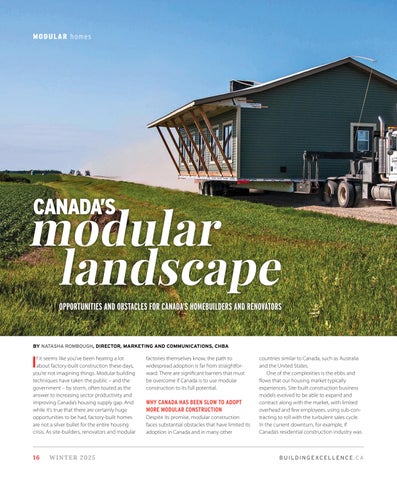
modular landscape CANADA’S
OPPORTUNITIES AND OBSTACLES FOR CANADA’S HOMEBUILDERS AND RENOVATORS
BY NATASHA ROMBOUGH, DIRECTOR, MARKETING AND COMMUNICATIONS, CHBA
I
f it seems like you’ve been hearing a lot about factory-built construction these days, you’re not imagining things. Modular building techniques have taken the public – and the government – by storm, often touted as the answer to increasing sector productivity and improving Canada’s housing supply gap. And while it’s true that there are certainly huge opportunities to be had, factory-built homes are not a silver bullet for the entire housing crisis. As site-builders, renovators and modular
16
WINTER 2025
factories themselves know, the path to widespread adoption is far from straightforward. There are significant barriers that must be overcome if Canada is to use modular construction to its full potential.
WHY CANADA HAS BEEN SLOW TO ADOPT MORE MODULAR CONSTRUCTION Despite its promise, modular construction faces substantial obstacles that have limited its adoption in Canada and in many other
countries similar to Canada, such as Australia and the United States. One of the complexities is the ebbs and flows that our housing market typically experiences. Site-built construction business models evolved to be able to expand and contract along with the market, with limited overhead and few employees, using sub-contracting to roll with the turbulent sales cycle. In the current downturn, for example, if Canada’s residential construction industry was
BUILDINGEXCELLENCE.CA