Implementation Progress Update
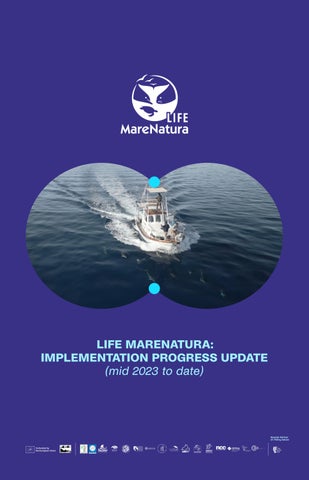
LIFE MARENATURA: IMPLEMENTATION PROGRESS UPDATE (mid 2023 to date)
Special Advisor on Policy Issues
1
LIFE MareNatura
Implementation Progress Update
LIFE MARENATURA: IMPLEMENTATION PROGRESS UPDATE (mid 2023 to date) The LIFE MareNatura project generates new scientific knowledge with the aim of transforming it into practical tools that support conservation planning, protected area management and biodiversity policy implementation. Its overall goal is to mitigate threats to nine target species of marine megafauna of EU interest in Greece and Italy: the Mediterranean monk seal (Monachus monachus), loggerhead turtle (Caretta caretta), green turtle (Chelonia mydas), sperm whale (Physeter macrocephalus), harbour porpoise (Phocoena phocoena), Cuvier’s beaked whale (Ziphius cavirostris), common dolphin (Delphinus delphis), Yelkouan shearwater (Puffinus yelkouan) and Audouin’s gull (Larus audouinii). To achieve this, the project brings together a broad consortium of partners to address key knowledge gaps, identify Mediterranean Offshore Biodiversity hotspots, support the proposal of suitable areas for inclusion in the Natura 2000 network, and strengthen monitoring, management capacity and stakeholder engagement. Three years into its implementation, LIFE MareNatura has made significant progress in advancing marine biodiversity knowledge, applying innovative monitoring tools, assessing climate change impacts, strengthening conservation capacity building and supporting evidence-based marine policy across the Aegean, Ionian and Adriatic Seas.
2
3
LIFE MareNatura
Implementation Progress Update
ADVANCING KNOWLEDGE ON MARINE BIODIVERSITY
LIFE MareNatura has undertaken extensive monitoring efforts to build knowledge for key marine species: sea turtles, seabirds, monk seals and cetaceans, across the Aegean, Ionian and Adriatic Seas. Field activities have combined complementary methodologies, including: •
telemetry studies,
• boat and aerial surveys (see indicative map) • underwater acoustic monitoring (see indicative map) •
innovative technologies and advanced monitoring tools
LIFE MareNatura is piloting the use of a range of advanced scientific tools to improve biodiversity monitoring and conservation planning. These include: •
Environmental DNA (eDNA) monitoring
•
Population genetics analyses
•
Dietary analyses through DNA metabarcoding
•
Bioacoustic monitoring and soundscape assessment
•
Machine-learning approaches for acoustic data analysis
These methods complement traditional monitoring methods and can improve species detection, identify ecological interactions and support evidence-based conservation decisions. The project is also contributing to the development of standardised data and metadata protocols that will facilitate long-term data sharing, interoperability and integration across monitoring programmes and institutions.
The project has applied innovative species monitoring technologies, including GPS devices, automated camera systems, bioacoustic sensors and underwater acoustic monitoring equipment, to generate high-resolution data that improve understanding of species ecology and threats. 4
Through the LIFE MareNatura project, valuable new information is collected on species movements, habitat use, breeding behaviour and critical conservation areas. As such, the project provides a strong scientific basis for conservation measures, protected area management and marine spatial planning. 5
LIFE MareNatura
Implementation Progress Update
SPATIAL DISTRIBUTION OF SURVEY EFFORTS BY MARINE & AERIAL MEANS
LOCATIONS OF FIXED PASSIVE HYDROPHONES FOR MARINE MAMMAL & UNDERWATER NOISE MONITORING
Intensity of research effort
Intensive
Non Intensive
6
7
LIFE MareNatura
Implementation Progress Update
DEVELOPING AN INTEGRATED MONITORING PLAN & EARLY WARNING SYSTEM
One of the LIFE MareNatura project’s main strategic achievements is the development of the Integrated Monitoring Plan (IMP) to support long-term monitoring of marine biodiversity.
One of the LIFE MareNatura project’s main strategic achievements is the development of the Integrated Monitoring Plan (IMP) to support long-term monitoring of marine biodiversity. The IMP adopts a holistic approach integrating physical, chemical, biological and socioeconomic information into a common monitoring framework. The IMP is being developed in alignment with existing European and national monitoring and reporting obligations, including requirements under:
ASSESSING CLIMATE CHANGE IMPACTS ON MARINE BIODIVERSITY Climate change constitutes one of the most significant long-term pressures on Mediterranean marine ecosystems.
LIFE MareNatura has completed a major milestone through the development of climate projections for the entire study area using multiple CMIP6 climate models under different greenhouse gas emission (SSP) scenarios and future periods. The analyses include projections of: •
Sea Surface Temperature
•
Sea Surface Salinity
•
Sea Level Rise
•
Air Temperature
•
the Marine Strategy Framework Directive
•
Precipitation
•
the Birds and Habitats Directives
•
Wind Conditions
•
Natura 2000
•
the EU Biodiversity Strategy for 2030.
An important component of the IMP is the development of an Early Warning System, designed to detect emerging pressures and environmental changes affecting marine biodiversity. By establishing common methodologies, indicators and monitoring priorities as well as the Early Warning System, the IMP is expected to provide a practical framework for adaptive marine conservation management beyond the lifetime of the project and to serve as a transferable tool for marine scientists, managers and practitioners across the Mediterranean.
8
Preliminary results indicate substantial future environmental changes under different greenhouse gas emission scenarios, including significant increases in sea surface temperature and ongoing sea level rise. The next phase of the project will identify climate thresholds and indicators relevant to marine biodiversity, focusing on impacts on species distribution, migration, breeding success, feeding habitats and ecosystem functioning. The project will also assess how climate-driven changes may interact with human activities affecting biodiversity, such as tourism development, coastal infrastructure and offshore energy developments..
9
LIFE MareNatura
Implementation Progress Update
CAPACITY BUILDING & TRAINING
ENGAGING STAKEHOLDERS & RAISING AWARENESS LIFE MareNatura is implementing a structured stakeholder engagement process involving key sectoral stakeholders identified through a systematic mapping process
The LIFE MareNatura project has invested significantly in capacity building through the Marine Conservation School and the development of a Marine Conservation Task Force.
The Marine Conservation School provides training opportunities that have focused on strengthening the skills of staff from the Natural Environment and Climate Change Agency (NECCA), as well as local and regional authorities, conservation practitioners and other stakeholders. Training topics have included species monitoring, conservation management and practical field application techniques. The project will produce educational material and Good Practice Guides for the project’s target species, supporting the transfer of knowledge and the adoption of standardised monitoring approaches. A dedicated Marine Conservation Task Force (MCTF) has been established within NECCA, to support the Agency’s work on marine biodiversity conservation.The MCTF is composed of NECCA personnel and external partners based in Protected Area Management Units across Greece that manage Marine Protected Areas under their authority. In this way, the MCTF acts as a mechanism to strengthen coordination, field response capacity and cooperation among organisations involved in marine biodiversity conservation.
10
Through targeted outreach and dialogue, the project is increasing awareness of its scientific activities and objectives, while promoting the uptake of project knowledge in decision-making processes. This engagement supports the project’s broader goal of contributing to the designation, management and effective conservation of Greece’s marine Natura 2000 sites and protected areas. The project has also supported dialogue with stakeholders from different sectors that relate to marine biodiversity, aiming to keep relevant actors informed about the development of proposals produced through the project’s systematic conservation planning tools. The foreseen establishment of MARBIONET, as a platform designed to strengthen collaboration, knowledge exchange and cooperation among scientists, conservation organisations, public authorities and other stakeholders aims to promote regional and cross-sectoral cooperation around shared marine conservation priorities. The project also aims at increasing public awareness on marine biodiversity through high-visibility outreach and communication activities, including the production of a LIFE MareNatura documentary that premiered at the Institut Français de Grèce in 2025. At the same time, it promotes an improved understanding of marine conservation challenges to non-technical audiences through storytelling and multimedia communication tools, and educational activities. Dissemination of scientific results in relevant conferences, and increased project visibility at national and international level, strengthen support for marine conservation actions and contribute to the uptake of the project’s results evidence-based decision-making.
11
LIFE MareNatura
Implementation Progress Update
SUPPORTING MARINE BIODIVERSITY POLICY IMPLEMENTATION LIFE MareNatura is actively working to bridge the gap between scientific knowledge and policy implementation by translating project findings into practical tools and recommendations for marine conservation and management. Policy-related activities undertaken during the period include informing relevant policy and decision-makers at the national, EU and Mediterranean level on the project’s objectives and presenting at global policy fora.
The project is further exploring opportunities to support the designation, management and ecological connectivity of Natura 2000 sites and other marine protected areas, while coordinating with emerging national and regional marine conservation initiatives. Partners have also shared valuable findings and approaches of the project with their contributions in relevant public consultations. In parallel, LIFE MareNatura is developing policy-support materials and strategic recommendations to facilitate the uptake of project results by decision-makers and practitioners. In the next stages of the project, key outputs such as proposals for new Natura 2000 sites, site-specific conservation objectives and management guidelines will provide practical tools to support competent authorities in the management and conservation of marine biodiversity, while also contributing to the implementation of national and EU biodiversity policy. Through these activities, the LIFE MareNatura project is contributing to the implementation of national and European biodiversity policies, including the EU Biodiversity Strategy for 2030, while supporting broader marine conservation efforts across the Mediterranean.
Through its activities and by securing direct engagement in highlevel international fora, including the 9th Our Ocean Conference (Athens 2024), the COP24 of the Barcelona Convention (Cairo, 2025), and the OCEANOISE2026 Conference (Vilanova i la Geltrú, 2026), the project highlights the policy relevance of its outcomes and promotes the science-to-policy interface in marine governance. In particular, it reinforces the role of the LIFE MareNatura new knowledge generated in supporting Marine Protected Areas (MPAs) and the 30×30 biodiversity target in the Mediterranean region.
12
13
LIFE MareNatura
Implementation Progress Update
LIFE MARENATURA IN AN EVOLVING MARINE BIODIVERSITY POLICY LANDSCAPE LIFE MareNatura is being implemented during a period of significant policy and governance developments for marine biodiversity at global, European, Mediterranean and national levels. The project’s outputs are well positioned to support the implementation of the evolving marine biodiversity policy landscape.
EU Nature Restoration Regulation
The Regulation implementation increases the need for robust biodiversity data, monitoring systems and indicators to support restoration planning and assessment of ecological recovery, to which the project can contribute.
High Seas Treaty - Agreement on Biodiversity Beyond National Jurisdiction (BBNJ)
EU 2030 Biodiversity Strategy
The emerging international framework for biodiversity conservation in areas beyond national jurisdiction, which has already been ratified by Greece, highlights the growing importance of marine biodiversity monitoring and conservation planning, especially in offshore areas.
LIFE MareNatura is generating knowledge and monitoring tools that can support progress towards EU targets on the designation of new protected areas and Natura 2000 sites, ecosystem restoration and biodiversity conservation.
Kunming–Montreal Global Biodiversity Framework
Review of the Marine Strategy Framework Directive (MSFD)
Project results contribute to national implementation and reporting against the 2030 global biodiversity targets and can support the upcoming (COP17) and future assessments of progress towards the GBFs goals and targets.
Ongoing discussions on the future of the EU’s main marine environmental legislation underline the importance of harmonised monitoring methodologies and high-quality marine biodiversity data, which the LIFE MareNatura project is providing.
14
15
LIFE MareNatura
Implementation Progress Update
Evaluation («stress test») of the Birds and Habitats Directives
UNEP/MAP COP24 Cairo Declaration (December 2025) and relevant decisions
Current assessments of the effectiveness of EU nature directives reinforce the need for improved knowledge on species distribution, conservation status and management effectiveness. LIFE MareNatura also demonstrates the continuing value of the Natura 2000 framework and evidence-based conservation planning.
The Cairo Declaration reaffirmed commitments to expand marine protection towards the 30x30 target, strengthen marine biodiversity monitoring, accelerate climate adaptation, improve ecosystem restoration and enhance regional cooperation, creating important opportunities for the uptake of LIFE MareNatura results.
EU Ocean Pact
ACCOBAMS
The new EU framework for ocean governance places greater emphasis on marine protection, resilience, knowledge generation and coordinated action across marine sectors, creating opportunities for the uptake of project results.
The LIFE MareNatura project with its field activities and aerial and boat surveys during the summer 2026 is contributing to the 2nd ACCOBAMS Survey Initiative (ASI II), which aims to update and expand this scientific baseline to track population trends, evaluate Good Environmental Status (GES), and support marine spatial planning and conservation strategies.
OceanEye – EU Ocean Observation Initiative
National Biodiversity Strategy
OceanEye aims to strengthen European ocean observation, monitoring and data integration capacities, highlighting the strategic importance of biodiversity data, monitoring networks and interoperable information systems. LIFE MareNatura can contribute valuable knowledge and experience to these efforts.
The project contributes to the implementation of Greece’s revised National Biodiversity Strategy and the achievement of its biodiversity conservation and monitoring targets for the coming decade.
16
17
LIFE MareNatura
Implementation Progress Update
FUTURE OUTLOOK: As LIFE MareNatura continues its implementation over the next few years (2029), the project will focus on transforming the knowledge and data collected to date into practical tools, policy recommendations and conservation actions.
Key priorities for the period 2026–2029 include: •
Expanding species monitoring to further improve understanding of species distribution, movements and ecological requirements
•
Completing climate impact assessments for marine biodiversity
•
Finalizing and operationalising the Integrated Monitoring Plan and Early Warning System
•
Analysing and integrating biodiversity, climate and socio-economic data to identify conservation priorities and biodiversity hotspots.
•
Further developing data-sharing mechanisms, monitoring standards and interoperability frameworks.
• Strengthening stakeholder engagement and knowledge exchange to support the uptake of project results and conservation actions. • Enhancing cooperation, capacity building and knowledge exchange among national and regional conservation practitioners. • Strengthening the uptake of scientific results in national, European and Mediterranean marine biodiversity policy processes. •
Supporting marine conservation planning, including the designation, management and effective monitoring of marine protected areas.
Learn more about our project here. We will keep you informed throughout the project regarding its progress and findings. For more information you may contact Ms. Nadia Andreanidou, Programmes and Policy Officer at MEDASSET e-mail: k.andreanidou@medasset.org, tel. +30 210-3613572 or Dr. Panagiotis Kasapidis, Senior Researcher at HCMR e-mail: kasapidi@hcmr.gr, tel. +30 2810-337718
18
19
Co-funding
The program LIFE22-NAT-EL-101113792 “Conservation of priority species of marine megafauna in Greece and Italy” – LIFE MareNatura is implemented with the contribution of 75% of the LIFE financial instrument of the European Commission and the co-financing of the Green Fund and the Foundation A.G. Leventis.
Partnership Special Advisor on Policy Issues