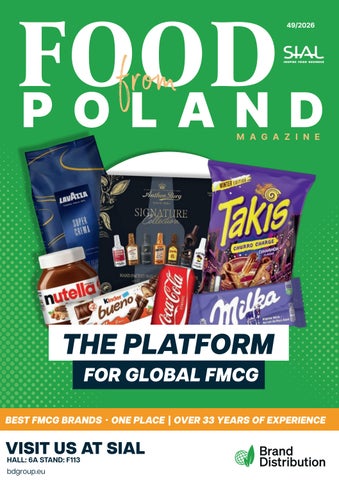
49/2026
THE PLATFORM FOR GLOBAL FMCG
BEST FMCG BRANDS · ONE PLACE | O?ER == ;EARS OF EAPER3ENCE
VISIT US AT SIAL HALL: 6A STAND: F113 bdgroup.eu
Brand Distribution
BORN IN EUROPE, CRAFTED BY EXPERTS, LOVED SINCE 1851
Our factory has always been in Warsaw, and this is where we ship our products from.
Chocolate Cafes, +30 cafes serving delicious treats made with our chocolate.
Chocolate Factory Museum +700,000 visitors in its first days after opening.
Quality confirmed by recognised certifications
Editorial
The potential of the Polish food sector Polish food has been steadily strengthening its position on international markets for many years. Today, products labelled “Made in Poland” reach consumers across Europe and far beyond, while Polish producers increasingly compete not only on price, but above all on quality, innovation, food safety and their ability to respond to changing market needs. The success of Poland’s food industry is no coincidence. It is the result of combining long-standing production traditions with modern technologies, high quality standards and the remarkable flexibility of Polish entrepreneurs. Polish meat and dairy products, confectionery, fruit and vegetable preserves, beverages, snacks and functional foods are gaining recognition among a growing number of international buyers and consumers. At the same time, more and more companies are developing premium, organic and convenience ranges, as well as products that reflect the latest food and lifestyle trends. SIAL Paris is one of the world’s most important meeting points for the food industry, which makes the presence of Polish producers here particularly significant. It is an excellent opportunity to showcase the scale, diversity and potential of the Polish food sector, establish new business relationships and open doors to new markets. In this edition of “Food from Poland”, we would like to present Poland as a mod-
Spring 2026
CONTENTS
Tomasz Pańczyk, Editor-in-Chief Food from Poland Magazine
Editor-In-Chief Tomasz Pańczyk t.panczyk@foodfrompoland.pl Managing Editor Monika Górka m.gorka@hurtidetal.pl
ern, reliable and ambitious partner for the international food trade. We invite you to discover our products, brands and manufacturers – because Polish food today has a great deal to offer the world. Enjoy the read!
INTERVIEWS
FOOD SECTOR
12 M ichał Sawosz, Chief Commercial Officer, Brand Distribution Group 14 M agdalena Szabłowska, Director of the Foreign Trade Department, Mlekovita 18 M xx, Mokate 22 Dariusz Goszczyński, President; National Poultry Council – Chamber of Commerce 24 M arek Osuchowski, Director of Sales and Marketing, Wielkopolski Indyk 26 M arek Marzec, Founder; Paweł Napiórkowski Co-owner, Management Board Member and Commercial Director; EWA-BIS 28 J arosław Stawicki, Sales Manager, Piekarnia Oskroba 32 Andrzej Krzysztof Miranowicz, PhD, Eng.; President of the Management Board; Stovit Group Sp. z o.o. and Mühlhäuser GmbH 36 Katarzyna Kabulska, Project Manager, PPH Maxpol
44 Polish Food Meets the Expectations of Global Consumers
STATISTICS
90 Top export products from the FMCG market
MARKET INSIGHT 52 AKSAM – We Bring the Joy of Crunching 56 Polish Food: Quality, Scale and Reliability 58 The green innovation curve 60 Polish food with confidence: How to turn quality and origin into a competitive advantage in foreign markets 64 A Record Is Not the Finish Line – Polish Food Exports Enter a More Challenging Phase of Growth 72 Polish Food on Global Markets: A Manufacturer’s Perspective
POLISH COMPANIES 80 Information about the manufacturer and contact details
DISCOVER POLISH PRODUCTS
40 Foreign trade in agri-food products in Polish statistics
Advertisement Office +48 22 847 93 67 Sales & Marketing Department Agnieszka Niewiadomska-Majchrzak a.niewiadomska@hurtidetal.pl
Graphics studio Maja Bulwarska m.bulwarska@hurtidetal.pl Printing house ArtDruk Kobyłka www.artdruk.com
Editorial Office Bagno Street 2/218 00-112 Warsaw, Poland +48 22 828 93 66 redakcja@foodfrompoland.pl www.foodfrompoland.pl
Fischer Trading Group Ltd. CEO: Tomasz Pańczyk t.panczyk@ftgroup.pl
Interview
Michał Sawosz Chief Commercial Officer Brand Distribution Group
The Platform for Global FMCG Brand Distribution Group is evolving beyond traditional trading, bringing together global trade, distribution in Poland, e-commerce and logistics, while drawing on Vollmart’s retail experience. Michał Sawosz, Chief Commercial Officer at Brand Distribution Group, explains how The Platform for Global FMCG works in practice, what manufacturers and buyers expect from their partners today, and what it takes to successfully develop a brand in a new market.
What should an international buyer or manufacturer understand about Brand Distribution Group today? We connect brands with customers and markets through global trade, distribution in Poland, e-commerce and logistics. We also draw on Vollmart’s retail experience. That is what we mean by The Platform for Global FMCG: the commercial work and the delivery of the product belong in the same conversation. A manufacturer wants to know where a product can succeed and who will take responsibility for developing it. A buyer wants a relevant offer, dependable availability and a partner who understands the business behind the order. We bring those needs together. Sometimes the right starting point is an export opportunity; sometimes it is Polish distribution or e-commerce through BD24. The route should fit the opportunity. Our new branding expresses that business more clearly. The useful question for
12
someone meeting us at SIAL is: what do you want to achieve next, and which parts of our platform can help you get there? What changed as you developed from a trading business into this broader model? We had to take responsibility for the brand, the channel and the result. Buying and selling well remain essential, but developing a brand requires decisions long before the first order and work long after it. The strategic choice was to develop a Full Service Distributor model. That connects market assessment, the offer, channel planning, logistics and sales execution. It changes the conversation with a manufacturer. We need to understand the consumer, the role of the product in the category and the work required to support it. Then we can agree on a realistic plan. It also changes how we judge our own decisions. A promising product can struggle because the price, presentation or channel is
wrong. Expanding the offer will not fix that. We have to understand the problem and act on it. I want our team to challenge a weak plan early, while there is still time to improve it. What does being a family business bring to those relationships? Continuity matters. You build a name over years, and every commitment carries that name. For me, the difficult part is keeping that sense of personal responsibility as the organisation grows. People need clear roles and the confidence to make decisions. Partners need to know who owns the problem when something goes wrong. We have held stock, taken responsibility for problems and completed projects as promised even when the easier short-term choice would have been different. Those decisions say more about a company than its presentation. I also believe a family business has to question its own habits. Experience is valu-
Interview
able when it helps us make a better decision today. It should never be a reason to avoid change. Trust comes from being consistent in our commitments and willing to improve how we deliver them. How do you decide whether a product is right for a market? We start with the consumer and the buying occasion. Why would someone choose this product? Where would they expect to find it? What price point and pack size make sense? A recognised brand is a strong starting point, but the local offer still has to work. Buyers need an assortment that makes commercial sense and supply they can plan around. Consumers want quality, value and convenience. The balance changes between countries and between channels within the same country. A product can be attractive without being right for every route to market. Takis and Anthon Berg illustrate that well. Takis gives us a distinctive product with a strong appeal to younger consumers. Anthon Berg takes us into premium chocolate and different purchasing occasions. They need different approaches to presentation, assortment and communication. The job is to understand what makes each brand relevant and build around it. How does your approach change between e-commerce, distribution, export and retail? Each channel answers different questions. In e-commerce, the product has to be found and understood on a screen. Content, presentation and fulfilment matter. In distribution, the offer has to work in the retailer’s assortment and be supported by reliable supply. Export adds the realities of a different market and the practical work of moving goods across borders. Retail gives us a direct view of the shopper and the point of purchase. A brand should not be pushed through every channel simply to collect listings. The important question is what the next channel will add. Will it reach a different customer, support another buying occasion or give us a better understanding of demand? That is why we connect what we learn from these activities. A response seen through BD24 can inform a wider commercial discussion. Experience from distribution
or Vollmart can sharpen our understanding of the offer. We still have to judge each opportunity on its own merits; success in one channel is not an automatic instruction to expand everywhere. Can you give a practical example of how the platform works, without naming a particular customer? Take a manufacturer considering a new market. The first conversation should establish the objective, the product’s role and what support is available. We can then select an appropriate entry channel and agree on the offer, availability and responsibilities. Once the product is in the market, we look at the response. If something is not working, we need to distinguish between the product itself and the way it is being sold. The answer might be a different assortment, clearer communication, a price adjustment or a change in availability. It might also be to stop and rethink the proposition. The benefit of the platform is that those decisions can draw on several connected parts of the business. We can bring the commercial plan, purchasing, inventory and logistics together. The manufacturer has fewer separate conversations to manage, and the buyer has a partner who can discuss the offer and its delivery together. The platform provides a 360° service for anyone looking to take an FMCG product to market, both in Poland and beyond. What makes a partnership work after the first shipment? Trust and execution. Both sides should understand the objective, the commitments and the next decision. If those are vague, even a promising start becomes difficult to manage. Product availability and reliable delivery are fundamental. So is the response when conditions change. I would rather have an early, direct conversation about a problem than a reassuring update that leaves the partner no time to act. The relationship becomes stronger when people can work through a difficult situation together.
For a manufacturer, we stay involved in developing the brand beyond launch. For a buyer, the first order should be the start of a dependable supply relationship. In both cases, trust grows when the next commitment is met. That is how a successful transaction becomes repeat business. Where do you see the strongest opportunities for BDG and its partners? We are developing our food business and connecting it more closely with export, Polish distribution and e-commerce. There is room for very different propositions: distinctive products that bring something fresh to a category, established brands with broader market potential, and premium products built around a particular occasion. I want us to be ambitious about those opportunities and precise about how we pursue them. Adding countries or products is easy to announce. Building a relevant offer, securing availability and supporting it properly takes sustained work and experience. That is where we can be useful to our partners. We will continue to look for new distribution partners that offer something unique to the consumer and have real expansion plans beyond a quick sale. The commercial case has to be clear: why this product, why this market and why now? When those answers are convincing, we can bring the relevant capabilities together and work on the next stage of growth. What conversations would you like to have at SIAL? With manufacturers, I want to discuss where they see potential and what is preventing them from reaching it. They may be looking at Poland, another export market or a different channel. A useful conversation starts with the ambition and the practical challenge behind it. With buyers, I want to understand what is missing from their offer and what they need from a supply partner. That gives us a much better starting point than simply exchanging catalogues. SIAL brings those two sides of the business together. We are there to turn an interesting product and a good conversation into a clear next step. Bring us the market you want to reach or the category you want to develop. That is where the platform becomes useful!
13
Interview
Magdalena Szabłowska Director of the Foreign Trade Department Mlekovita
Ambassador of the Polish Dairy Industry on International Markets Mlekovita combines nearly 100 years of dairy tradition with innovation and today exports its products to more than 120 countries. We spoke with Magdalena Szabłowska, Director of the Foreign Trade Department at Mlekovita, about the company’s international growth, export portfolio and key trends in the global dairy market. How do you assess Mlekovita’s current position in the domestic and international dairy markets? Mlekovita is the largest dairy group in Poland in terms of the scale of its operations. The foundation of this success is a stable and steadily growing raw material base. The company procures a record 2.46 billion liters of milk, an increase of 5.4% year over year, from a stable group of 15,000 Polish farmers. Mlekovita is a company with a long tradition and a well-established brand both in Poland and internationally. It is the largest dairy group in Central and Eastern Europe. Every day, we process the highest-quality milk at 25 production facilities. More than 5,300 qualified employees ensure the highest standards across more than 200 production lines. Our portfolio includes more than 2,000 dairy products enjoyed not only by Polish consumers but also by customers in more than 120 countries worldwide.
14
Distribution is supported by 34 company-owned distribution centers, including the industry’s first Cash & Carry warehouses, as well as 150 Mlekovitka company stores and the mlekovitka.pl online store. Mlekovita has a very broad product portfolio, ranging from UHT milk, cheese and butter to specialized products such as WPC, MPC, milk powders and ingredients for the food industry. The company has well-recognized consumer brands and a strong position in both retail and HoReCa. Internationally, Mlekovita is Poland’s largest exporter of dairy products. Which Mlekovita products are most popular in international markets? In recent years, we have seen particularly strong growth in demand for high-protein products such as WPC and milk protein concentrates, ingredients for food manufacturers, products with an extended shelf life and prod-
ucts adapted to local market requirements, including Halal – and Kosher-certified products. Products that combine high quality, a long shelf life and ease of transportation are especially popular. One of Mlekovita’s most important export categories is UHT milk, which is the company’s leading export product. Powdered dairy products are another key category. These include whole and skim milk powder, whey powder, WPC 80 and Fat-Filled Milk Powder. This product group plays an important role in the global food industry. Ripened cheeses are also significant, particularly Cheddar and cheeses with specific technological or nutritional properties. Butter and anhydrous milk fat, or AMF, are highly valued by the food processing, bakery and confectionery industries. Fresh dairy products such as yogurt, kefir, buttermilk, cottage cheese, sour cream and cream cheese are particularly popular in Euro-
Interview
pean markets and in countries with well-developed cold-chain logistics. How important are investments in modern technology, production capacity and product quality for Mlekovita’s future growth? Investment, production capacity and product quality are three key pillars of Mlekovita’s success in international markets. Investment allows the company to introduce modern technologies, automate production, increase efficiency and develop new products that meet customer expectations. Mlekovita also carries out industrial projects designed to increase productivity while reducing energy and raw material consumption. Large production capacity allows us to handle very large orders and ensure on-time deliveries. This is especially important for international retail chains and industrial customers that require stable supplies throughout the year. Thanks to its scale, Mlekovita can also respond flexibly to changes in demand across different markets. The highest product quality is essential for building customer trust. Compliance with international food quality and safety standards, supported by numerous certifications, ensures that Mlekovita competes not only on price but above all on quality, taste and reliability. The combination of modern investment, large-scale production and consistently high quality allows Mlekovita to maintain its position as the largest exporter of dairy products in Central and Eastern Europe while continuing to expand sales in more than 120 markets worldwide. Which trends in the global dairy market are having the greatest impact on the development of Mlekovita’s product portfolio? Is the importance of functional, high-protein or products tailored to specific consumer groups increasing? The importance of functional and high-protein products is definitely growing. Protein-rich products designed for physically active consumers are becoming increasingly popular. The same applies to lactose-free products, products with simple ingredient lists and foods enriched with vitamins and nutrients. Mlekovita is developing these segments through initiatives such as the Super Body Active line, lactose-free products and beverages and foods designed for health-conscious consumers. We are also seeing significant growth in interest in functional foods.
Another important trend is greater personalization of the product portfolio. Consumers increasingly expect products tailored to their lifestyles and specific needs, including products for athletes, seniors, children and people with lactose intolerance. Convenient on-the-go packaging, natural ingredients and clean-label products are also becoming increasingly important. What are Mlekovita’s most important goals and growth priorities for the coming years, particularly when it comes to strengthening the company’s position in international markets? In the coming years, Mlekovita plans to continue strengthening its position as the largest exporter of dairy products in Central and Eastern Europe. The company’s strategy focuses on several key areas. One of the main priorities is further export expansion. This includes strengthening our presence in existing markets and entering new ones, particularly in Asia, Africa, the Middle East and the Americas. Mlekovita products are currently sold in more than 120 countries and exports remain one of the company’s main growth drivers. Another priority is investment in modern technology, including the development of production lines, automation, digitalization and improvements in plant efficiency. The company reinvests its profits in further modernization and technological development. Mlekovita also plans to expand its portfolio of higher-value products. Particular attention is being given to functional, high-protein and lactose-free products as well as ingredients for the food industry. These categories are closely aligned with global nutrition trends. Flexibility is another important element of our strategy. We continue to adapt the product portfolio to local consumer preferences, quality requirements and certification standards so that we can compete effectively with the world’s largest dairy producers. Sustainability and food safety will also remain key priorities. Mlekovita will continue to invest in solutions that reduce environmental
impact while maintaining the highest standards of product quality and safety. Overall, Mlekovita’s goal is not simply to increase international sales. We want to build a sustainable competitive advantage based on innovation, high quality, flexibility and longterm business partnerships. This will allow the company to maintain its position as one of the world’s leading dairy exporters and continue serving as an ambassador for the Polish dairy industry in international markets. What role does SIAL Paris play for Mlekovita and what goals has the company set for this year’s edition? SIAL Paris is one of the most important events in the global food industry. Every two years, it brings together thousands of exhibitors as well as trade professionals, distributors, importers and manufacturers from around the world. For companies such as Mlekovita, the event is not only an opportunity to present products. More importantly, it is a platform for building new business relationships and developing international sales. Participation in this year’s edition is particularly important for Mlekovita. It gives the company an opportunity to strengthen its position as one of the leading dairy exporters from Central and Eastern Europe. It also allows us to present innovative products and our broad portfolio of dairy products and ingredients for the food industry. SIAL is also an important opportunity to meet with existing partners, establish relationships with potential customers from different continents and observe global food trends and changing consumer expectations. During this year’s event, Mlekovita will focus on expanding exports and entering new markets. Another important goal will be strengthening cooperation with existing business partners. We will also promote higher-value products such as cheeses, high-protein products, UHT milk and powdered dairy products. At the same time, we want to emphasize quality, food safety, innovation and sustainability. These areas are becoming increasingly important to international customers. For Mlekovita, SIAL Paris is more than a trade show. It is a strategic platform for strengthening the brand’s global position. It is also an opportunity to demonstrate that the Polish dairy industry can successfully compete with the world’s largest producers and turn business meetings into long-term export partnerships.
15
Global Scale, Local Taste How MOKATE builds a competitive advantage in more than 75 markets Four out of five products made by the MOKATE Group are sold abroad, reaching more than seventy-five countries around the world. This is no coincidence, but the result of consistency: an offer tailored to local consumers, a rapid pace of innovation, and investments that anticipate market needs. We speak with Adam Mokrysz, PhD, CEO of the MOKATE Group, and Katarzyna Mokrysz, PhD, General Director, about what the family character of the company brings to relationships with business partners, where MOKATE is looking for new sources of growth, and why successful exports begin with understanding the consumer. Around 80% of MOKATE products are currently sold outside Poland. What has enabled you to achieve such a large scale of exports? Adam Mokrysz: Consistency and courage in strategic decision-making. Thanks to these qualities, today we are an international company with Polish roots, rather than a domestic company that happens to export. That difference is fundamental. It concerns the way we think, plan, and take risks. However, we do not measure success by the number of flags on a map. Many companies can enter a market; the real skill lies in staying there. Exporting is not a sprint to collect more flags, but a marathon of loyalty. A lasting presence is built by understanding customers and delivering genuine value to them. Efficient logistics, consistent quality, and relationships that we build not for a season, but for years, enable us to do so. Katarzyna Mokrysz: The foundation of this scale is a solid manufacturing base and advanced technology. MOKATE’s three main manufacturing centres, located in Ustroń, Żory, and Votice in the Czech Republic, provide our customers around the world with the necessary capacity and consistently high quality. Modern plants, strategic investments, and an uncompromising focus on the customer are the true driving forces behind our exports. Which MOKATE products best meet the needs of international customers? A.M.: We are developing several pillars of our business. Alongside the MOKATE and LOYD brands, we are building a strong position in B2B, vending, and HoReCa, while also creating
Adam Mokrysz, PhD, CEO of the MOKATE Group, and Katarzyna Mokrysz, PhD, General Director products for our partners’ private-label brands. Coffee, instant beverages, and tea remain the foundation. Over the years, we have developed strong technological expertise in these categories and brands that are recognized across many continents. LOYD has a strong position, while cappuccino continues to be the product most strongly associated with MOKATE. K.M.: Our role as a trusted manufacturing partner for companies in the FMCG sector is equally important. Among other things, we manufacture creamers, cappuccino foaming bases, fat-and-milk concentrates, topping bases, and products for vending machines. Customers expect stable parameters, timeliness, and a manufacturing base they can rely on for their own operations – and that is exactly what we provide.
Can the same product be successfully sold in exactly the same form across dozens of markets? K.M.: Rarely. The market is globalizing faster than people’s tastes. Distribution and communication are becoming increasingly similar, but taste remains local. And that is precisely where the opportunity lies for those who know how to listen. A.M.: That is why, when entering a new country, we do not ask, “What do we want to sell?” but rather, “What does this market need?” We base the answer on in-depth analysis rather than intuition. Our own recipe-development teams give us a great deal of flexibility. Humility toward the local consumer is the most effective strategy for expansion.
What role do innovation and investment in manufacturing play in this strategy?
How has the perception of the company’s Polish origins changed?
A.M.: Infrastructure must keep pace with ambition, which is why we are constantly modernizing it. The newly expanded sections of our plants in Żory and Ustroń have been equipped, among other things, with automated manufacturing lines and real-time quality control. This enables us to manufacture modern coffee and tea formats, increase manufacturing capacity, improve consistency, and shorten order lead times. We do not invest in what the market needs today, but in what it will expect tomorrow. K.M.: At the same time, we understand efficiency more broadly than simply the number of packages coming off the manufacturing line. Our plants use renewable energy, including photovoltaic installations, and when designing processes and products, we look for ways to reduce energy consumption. Responsibility is not merely a declaration for us; it is part of our business model.
A.M.: Today, it is an advantage for us. When we began building the company’s international position, I sometimes had to explain where Poland was located. Today, our partners know the quality of Polish food and the standards of our manufacturing facilities. In the past, we showed Poland on a map; today, we show it on the label. An entire generation of Polish entrepreneurs has worked to bring about this change. K.M.: Today, even on other continents, no one is surprised that a Polish brand combines quality, modern technology, and competitiveness. We have nothing to be ashamed of. On the contrary, we can set standards instead of chasing them.
MOKATE consistently emphasizes its family-owned character. Does this have measurable value in discussions with global partners? A.M.: Absolutely. A family business thinks in terms of generations, not quarters. We invest in directions we believe in, even if the full results will not be visible for years. We build value for decades. It is also important that the people sitting at the negotiating table take full responsibility for the decisions they make. A partner knows who they are signing a contract with and who stands behind it. A corporation signs an agreement. A family gives its word – and has a family name that stands behind that word. K.M.: In many markets, including the Middle East, having a relationship with the owner or the person responsible for the company is extremely important. A partner wants to know that in five or ten years’ time, they will still be dealing with the people they have come to trust. That will be the case with us. Keeping one’s word and maintaining continuity in relationships is a form of capital that cannot be bought. It can only be built.
MOKATE manufacturing plant in Żory.
What is currently the biggest challenge in running an export business? K.M.: Volatility – and across multiple areas at the same time. Prices of coffee and other raw materials fluctuate significantly, as do the costs of energy, packaging, and transport. On top of that, there are currency exchange rates. Contracts and purchasing have to be managed in such a way that the partner receives predictable terms while the manufacturer maintains profitability and continuity of supply. We cannot predict the weather in Brazil, but we can build a company that is not afraid of rain. Uncertainty cannot be eliminated, but we can learn how to navigate it effectively. A.M.: In such conditions, those with diversified markets, their own manufacturing capacity, and access to reliable information have an advantage. Crises affect everyone, but those who are prepared emerge from them stronger. Which changes in the global coffee, tea, and instant-products markets will have the greatest impact on the FMCG industry in the coming years? K.M.: Today, consumers expect more from a cup of coffee or tea than simply good taste. They read labels, check nutritional values, ask about the origin of raw materials, and look for products suited to their lifestyles. That is why func-
tional and plant-based beverages are becoming increasingly important, along with smaller portions and formats that are easy to prepare away from home. At the same time, familiar classics are by no means disappearing. Another direction is inspiration from Asia. Matcha is the best example of a product that has moved dramatically from a niche into the mainstream. We have had it in our portfolio for several seasons, and it has proven to be an excellent decision. Specialty teas and cold beverages are following a similar path. Identifying a trend, however, is only the beginning. The real skill lies in adapting the format, taste, and price to a specific target group. A.M.: I would also draw attention to the speed at which new preferences emerge. Thanks to social media, a trend can reach millions of consumers within a few weeks. A fad shouts, while a trend whispers – and the real skill is hearing that whisper through the noise. A company must quickly determine whether it is dealing with a short-lived fad or a lasting change, and then translate that knowledge into recipes, technology, and distribution. This requires the courage to take carefully calculated risks. For us, that is nothing new. When my mother, Teresa Mokrysz, introduced instant cappuccino to Poland in the early 1990s, it was a completely new concept. No one could guarantee that the idea would catch on. Her determination and courage paid off and permanently changed the coffee-drinking habits of Polish consumers. K.M.: That attitude continues to inspire us today because it teaches us that the market rewards those who have the courage to be first and the determination to persevere. What will MOKATE’s next move be? A.M.: A good chess player does not announce a move before making it. (laughs) I will only say this: in both chess and business, the ability to anticipate several moves ahead is important, but so is the willingness to change the plan when the situation on the board turns out differently than expected. K.M.: We have a clearly defined direction, and there are still plenty of pieces left on the chessboard. Thank you for taking the time to speak with us.
MOKATE manufacturing plant in Ustroń.
Interview
Dariusz Goszczyński President National Poultry Council – Chamber of Commerce
Exports Drive Growth in the Poultry Industry Poland is the largest producer of poultry meat in the European Union. Exports allow the sector to fully leverage its production potential and strengthen its position as a European leader. We spoke with Dariusz Goszczyński, President of the National Poultry Council – Chamber of Commerce, about key export markets, innovation in the poultry industry and the expectations of international customers. Poland is one of Europe’s leading poultry producers and exporters. What is the greatest competitive advantage of Polish poultry in international markets today? The strength of the Polish poultry sector comes from a combination of modern technologies, high food safety standards and many years of experience. Consistent investment in plant modernization, technological development and increased production efficiency has made the Polish poultry industry one of the most advanced sectors of the European agrifood industry. Over the past two decades, the Polish poultry sector has tripled its production capacity while exports have increased tenfold. Today, one of the key challenges is to further strengthen the recognition of Polish poultry as a reliable and competitive product in international markets. The sector’s key strengths remain its production scale, efficiency, competitiveness and
22
supply stability. Another important advantage is high product quality combined with a competitive price-to-quality ratio. These are the factors that build consumer trust in many markets around the world. International consumers are increasingly looking for products that combine tradition, high quality and innovation. What does the Polish poultry industry offer them? Both in Poland and internationally, we are seeing growing interest in poultry products produced according to high sustainability standards. Verified product origin is also becoming increasingly important. Consumers pay attention to certifications confirming high production standards as well as animal husbandry practices, animal welfare and the environmental impact of production. The Polish Oat-Fed Goose, derived from the White Kołuda goose and fed exclusively
on oats during the final fattening period, is an excellent example of how tradition and quality can come together. It is a product deeply rooted in Polish culinary and agricultural traditions that has also built a strong reputation in demanding international markets. The poultry industry, together with the Ministry of Agriculture and Rural Development, is seeking to have the name ‘Polish Oat-Fed Goose’ entered into the EU register of Protected Geographical Indications. The application has been published at the EU level, but the procedure has been complicated by an objection filed by Germany. The matter is currently being discussed between Poland and Germany. Obtaining the designation would protect the name throughout the European Union against unauthorized use. It would also further strengthen the product’s recognition and prestige in international markets.
Interview
The Polish poultry sector also responds to the diverse needs of consumers in individual markets. In Asia, different parts of the chicken are in high demand because they are an important part of local cuisines. In the European Union, where chicken breast is particularly popular, demand is growing for convenient products as well as processed and semi-prepared foods that meet consumers’ need for quick and easy meal preparation. Thanks to a broad product portfolio and the ability to adapt products to the specific characteristics of individual markets, Polish producers can effectively meet the expectations of demanding customers around the world. Which export markets currently offer the greatest opportunities for Polish poultry and where do you see the strongest growth potential? In 2025, exports of poultry meat and processed poultry products were valued at approximately EUR 6.6 billion. Poland produced more than 3.7 million metric tons of poultry meat. More than 55% of production is exported, with around 30% going to non-EU markets. The European Union remains the most important market, but the industry is steadily expanding sales in markets outside the EU, including Asia and Africa. This allows the sector to respond to growing demand for poultry meat, make better use of production capacity and further diversify its export destinations. Promising markets include South Korea, which has once again authorized imports of Polish poultry after a break of several years, and the Philippines, where sales are growing rapidly. The industry is also working with government agencies to open new markets. This is a long-term process that requires more than formal market access. It also involves building relationships with importers, strengthening brand recognition and developing trust. Diversifying export markets is important not only for sales growth. It also allows producers to make better use of different parts of the carcass, reduce dependence on individual markets and increase the sector’s resilience to fluctuations in demand. Given the scale of production, exports are not simply a supplement to the domestic market. They are a key pillar of the industry’s growth. International sales allow the Polish poultry sector to fully leverage its production potential and maintain its position as a European leader.
NATIONAL POULTRY COUNCIL – CHAMBER OF COMMERCE THE LEADING ORGANIZATION REPRESENTING THE POULTRY SECTOR IN POLAND ▪ The organization has been operating continuously for more than 30 years and represents over 115 members active across the poultry value chain. ▪ Its members operate in breeding, reproduction and hatching, commercial poultry and egg production, the production and sale of poultry meat and poultry products, table egg production and sales, poultry feed production and related supporting activities.
How is the Polish poultry industry responding to growing requirements related to quality, food safety, animal welfare and sustainable production? The Polish poultry industry is investing in solutions that support more sustainable production. These include technologies that reduce energy and water consumption and allow resources to be used more efficiently. Examples include investments in renewable energy sources such as photovoltaic systems used to power production facilities. These solutions help reduce electricity consumption from the grid and lower CO2 emissions. Producers are also implementing water recycling systems and smart energy management tools to improve process efficiency. The sector also maintains high biosecurity standards to reduce the risk of disease occurrence and transmission. In terms of animal welfare, producers comply with strict national and EU requirements. These include appropriate housing conditions, proper nutrition and veterinary care. Sustainable development is based on three pillars: environmental, social and economic. Only this approach makes it possible to combine environmental responsibility and animal welfare with production efficiency and the competitiveness of the sector. What are the biggest challenges and opportunities for the Polish poultry industry today? Can exports continue to grow at a rapid pace? The biggest challenges facing the Polish poultry industry include regulatory pressure, competition from producers outside the European Union and the threat of infectious diseases. Increasing requirements related to food safety, animal welfare and environmental pro-
tection have an impact on production costs and the competitiveness of the sector. At the same time, the Polish poultry industry has strong foundations for continued growth. Poland remains the largest producer of poultry meat in the European Union. Its strong position in international markets is built on the sector’s experience, scale and ability to respond quickly to changing consumer needs. Further export growth will depend primarily on opening new markets, diversifying sales destinations and maintaining competitiveness in an increasingly demanding regulatory environment. The flexibility of Polish producers and their ability to adapt their products to the needs of individual markets remain key competitive advantages. This strengthens the sector’s resilience to fluctuations in demand and creates further opportunities for international sales growth. What were the Polish poultry industry’s expectations for this year’s SIAL trade show and what are buyers looking for today? The main goal of participating in SIAL is to further strengthen the recognition of Polish poultry as a strong and reliable export brand under the ‘Polish Poultry’ name and to showcase the potential of the Polish poultry sector. International customers are increasingly looking for products with verified origin, high quality and responsible production standards. The Polish poultry industry responds to these expectations by offering products manufactured according to demanding standards and adapted to the specific needs of individual markets. The trade show is also an opportunity to develop long-term business relationships and strengthen trust between Polish producers and international partners.
23
Interview
From Quality to Resilience: How the Turkey Meat Market Is Changing Marek Osuchowski Director of Sales and Marketing Wielkopolski Indyk
Environmental responsibility, sustainability and control over the entire production process from farm to table are key competitive advantages today. What else does today’s informed consumer expect? Above all, credibility. Consumers want to know where a product comes from, what it is made of and how it was produced. That is why quality must not only be high but also consistent and verifiable. At Wielkopolski Indyk, we address this through our farm-to-table model. We monitor every stage, from grain cultivation and feed production to turkey farming, processing, cutting and packaging. Integration is not only about quality control. It is also a way to reduce risk and ensure a stable supply. Poland is one of the most important players in the European turkey meat market. Why do international customers value Polish meat and poultry products? Because they combine quality, safety and competitiveness. Poland operates within a demanding European regulatory framework while also having significant production capacity. For retailers, this means consistency and scale. Turkey production also requires a high level of specialization. It is a category that demands technological expertise and effective raw material management. At Wielkopolski Indyk, we have been building our expertise in this area since 1967. International customers are not simply buying meat. They are buying predictability. This means consistent product specifications, continuity of supply, traceability and the ability to adapt products to the needs of a specific market. Which international markets offer the greatest growth potential for Wielkopolski Indyk? Europe remains our strategic focus. We also see significant potential in the Middle East and in markets where demand for Halal products is growing. Customers there expect religious compliance, food safety, consistent quality and professional service. Our specialization gives us an advantage. The entire facility operates without any contact with pork and Halal requirements are fully integrated into our production processes.
24
Quality, resilience and partnership are shaping the poultry industry. Marek Osuchowski, Director of Sales and Marketing at Wielkopolski Indyk, discusses the strengths of Polish poultry, customer expectations and opportunities in international markets. We do not want to be everywhere. We want to be in markets where we can build long-term relationships and deliver value beyond the product itself. What are your leading export products today? Fresh turkey meat remains the foundation of our business, but higher-value products are becoming increasingly important. These include cured meats, sous vide products, IQF frozen products and convenience foods, including breaded products. The private label segment is particularly promising. Private labels are no longer only about price and volume. Increasingly, they are about quality, innovation and trust. A supplier needs to understand the DNA of each retail chain, including its consumers, positioning and sales channels. What are the biggest challenges Polish producers face in international markets? The biggest challenge is maintaining competitiveness as the number of factors affecting the business continues to grow. We compete not only on price and quality but also on access to raw materials, energy costs, logistics, environmental requirements and response time. We also face competition from producers outside the European Union, who often operate under different cost structures and regulatory frameworks. This is why we need to continue investing in technology and automation. The future of the Polish poultry industry can be described in three words: quality, resilience and partnership. Quality, because without it we cannot maintain our position in export markets. Resilience, because security of supply is becoming part of our competitive advantage. Partnership, because today’s major retailers need more than just a producer. They need an expert who understands the category and can work with them to develop the right product offering. Producing a good product is no longer enough. You need to understand the market, anticipate change and take responsibility for the entire business value chain.
Interview
Paweł Napiórkowski Co-owner, Management Board Member and Commercial Director EWA-BIS
Marek Marzec Founder EWA-BIS
Guiding Polish Fresh Produce to the World As EWA-BIS approaches its 40th anniversary, founder Marek Marzec talks about the company’s roots, its name and the future of Polish apples. Paweł Napiórkowski, Co-owner, Management Board Member and Commercial Director, explains what that experience means for customers today. Where did your connection with fruit growing begin? Marek Marzec: I grew up in an orchard near Sandomierz. My father worked in construction, but fruit growing was his passion. He would get up before dawn to tend the trees before work. As a boy, I once asked a neighbour if I could collect apples left under his trees. I gathered my friends, loaded the fruit onto a small cart and took it to a nearby buying station. I cannot remember whether I was seven or nine, but I remember the satisfaction of earning my own money. How did that experience lead to EWA-BIS? M.M.: I studied food technology and worked in fruit and vegetable processing before founding EWA-BIS in 1987. We began with industrial apples and produce trading. Over the years, my business activity also expanded into packaging, industrial technologies and international ventures. Although these fields may seem very different, they have always been connected by the same approach: recognising opportunities early, bringing together the right people and technologies, and turning pioneering ideas into lasting businesses
26
Where did the name EWA-BIS come from? M.M.: Ewa is my wife’s name. The second part was inspired by a French cosmetics company where her sister worked. We did not choose it because of the biblical story of Eve and the apple. That association came later and proved remarkably fitting for a company built around fruit. What does EWA-BIS offer beyond the product itself? M.M.: A buyer needs more than a list of varieties. Someone must understand the destination market and bring together growers, quality standards, sorting, packaging, documents and logistics. Our job is to organise that journey. We speak both the language of production and the language of international trade. What must Polish apples offer besides volume? M.M.: Quality. It starts in the orchard and continues through harvesting, storage, sorting, packaging and transport. Polish apples cannot compete indefinitely on price alone. We need consistent preparation, stronger brands and cooperation between growers and exporters. Customers should know what stands behind a
box of fruit and be able to count on the same standards next season. Paweł, how does that thinking shape the offer today? Paweł Napiórkowski: I come from a fruit-growing family in the Grójec region. Over 15 years working in export at EWA-BIS, I have seen how much it matters to understand both the orchard and the destination market. We work with growers and supply partners on varieties, preparation, standards and logistics. As we approach the anniversary, we want to present our offer more clearly and develop product brands while keeping the EWA-BIS name visible to customers who already know us. Marek, what does the anniversary mean to you? M.M.: It is a chance to tell our story, but also a starting point. The ways people buy food are changing. We want to continue connecting Polish production with international demand and help growers build lasting value. Nearly 40 years have taught us that this takes more than moving fruit. It takes people who know where they are going and how to get there together.
Interview
Piekarnia Oskroba: Tradition remains the foundation, technology drives growth
Jarosław Stawicki Sales Manager Piekarnia Oskroba
A family-owned business, a long baking tradition, proprietary recipes and high-quality, simple ingredients are the foundations of Piekarnia Oskroba, whose history dates back to the 1930s. What has changed over the years? Over nearly a century, almost everything has changed except what matters most to us. Piekarnia Oskroba remains a family-owned business, while the baking traditions and experience passed down through generations continue to form the foundation of our operations. The biggest changes have been in production scale and technology. We have evolved from a traditional bakery into a modern company equipped with advanced machinery, state-of-the-art production lines and modern technological infrastructure. This allows us to produce on a large scale while maintaining consistently high quality. Technology has not replaced tradition. Its role is to support it. Great taste, high quality and simple, clean ingredients remain our top priorities. Is it possible to freeze baked goods on a large scale without compromising their quality or the use of natural ingredients? Absolutely. Freezing is one of the most natural ways to extend the shelf life of baked goods. When done properly, it preserves their quality, taste and key characteristics without the need for preservatives. The key is using the right recipe, high-quality raw materials and carefully controlled production and freezing parameters. At Piekarnia Oskroba, experienced food technologists oversee every stage of the process. Can you tell us more about Clean Room technology? Clean Room technology gives us greater control over the conditions in which baked goods are produced and packaged. Its main purpose is to minimize the risk of contamination and maintain a high level of hygiene and production safety. By controlling air quality and airflow, temperature and conditions in production and packaging areas, we can maintain consistently high product quality. How do you assess the baking industry today in Poland and globally? We see the industry as stable but also challenging and rapidly evolving. Bread remains a staple in consumers’ daily diets, but expectations
28
Tradition and modern technology increasingly go hand in hand in the baking industry. We spoke with Jarosław Stawicki, Sales Manager at Piekarnia Oskroba, about innovation, exports, changing consumer expectations and the future of the baking industry. regarding quality, ingredients, freshness, convenience and variety continue to grow. Polish producers are facing rising costs of raw materials, energy, labor and logistics. At the same time, they are investing in automation and modern technologies. These investments will play a major role in determining competitiveness in the years ahead. Similar trends can be seen globally, with growing demand for convenient products, natural ingredients and nutritional value. What do international consumers value about Polish baked goods? First and foremost, they appreciate the high quality, great taste and variety. Poland has a strong baking tradition, which is an important advantage in international markets. A competitive price-to-quality ratio also plays a significant role. Simple and natural ingredients are also becoming increasingly important. International consumers are looking for authentic products with distinctive flavors and consistently high quality. What baked goods does Piekarnia Oskroba offer to international customers? Our export portfolio is extensive. It includes burger and hot dog buns made from wheat and graham flour, which are particularly well suited to the needs of the foodservice sector. Another important category is our range of wheat-rye and rye breads. We also offer high-protein breads and products designed for consumers with specific dietary needs. Traditional bake-off bread for retail stores is also very popular. It allows our international partners to offer customers bread baked fresh on-site, with the aroma, flavor and crispy crust of a freshly baked loaf. One of our most interesting products is preservative-free toast bread with a shelf life of up to 60 days. This solution was developed by our food technologists following extensive research. A long shelf life is particularly important in export markets because it makes transportation and distribution easier to manage. Our strength lies in our ability to adapt our offering to different customer needs and develop partnerships across a wide range of international markets.
Interview
Innovations from Poland on International Markets:
Stovit Group at SIAL Andrzej Krzysztof Miranowicz, PhD, Eng. President of the Management Board Stovit Group Sp. z o.o. and Mühlhäuser GmbH
SIAL is one of the most important events in the global food industry. What does participation in the trade show mean for Stovit Group? For us, SIAL is first and foremost an opportunity to showcase the Stovit Group’s potential on the international stage and to meet directly with current and potential business partners. It’s a place where producers, retail chains, and distributors from around the world come together. We want to show that a Polish company can be not only a producer of high-quality fruit preserves but also a flexible partner for international clients. What innovations and products do you particularly want to showcase at SIAL? One of our key areas of focus is the development of premium jams containing 100% fruit, prepared in unique and intriguing flavor combinations. An example is our mango jam with fruit chunks, which responds to growing consumer interest in exotic flavors and products with a distinctive texture. We are also developing a line of jams sweetened with xylitol, featuring unexpected flavor combinations, such as kiwi with pear. These products are aimed at consumers seeking alternatives to traditionally sweetened preserves. We are the only manufacturer of this line of jams recommended by the Polish Diabetes Association. For us, this is an important confirmation of quality and a response to the
32
An interview with Andrzej Krzysztof Miranowicz, PhD, Eng., President of the Management Board of Stovit Group Sp. z o.o. and Mühlhäuser GmbH, which together form the international structure of the Helios Group.
needs of consumers who pay particular attention to how they compose their diets. What trends are particularly noticeable in European markets right now? There is growing interest in natural ingredients, simple ingredient lists, high fruit content, and products that address specific consumer needs. At the same time, consumers are increasingly seeking new taste experiences. That is why we are expanding our portfolio in two directions: on the one hand, we offer premium products with a very high fruit content; on the other, we provide solutions tailored to the needs of those seeking products sweetened with alternative sweeteners. This combination of tradition and innovation is one of the themes we want to highlight at SIAL. Stovit has nearly 50 years of experience, and thanks to our collaboration within the Helios Group, we also benefit from Mühlhäuser’s tradition spanning over 120 years. How important is collaboration with international chains and partners for the Stovit Group? The European market is highly diverse, which is why flexibility is key. Individual countries differ in taste preferences, product formats, and packaging expectations. The Stovit Group provides an important production and logistics base, while our collaboration with Mühlhäuser and Glück allows us to draw on experience from various markets and
develop both mass-market products and premium-segment offerings. An example of synergy within the group is Mühlhäuser’s fruit preserves, which are now also available in Poland at major retail chains. Is sustainability also an important element of the group’s strategy? Yes. We focus on reducing energy and water consumption, minimizing waste, and seeking more efficient production and packaging solutions. The exchange of experiences among Helios Group companies allows us to benefit from solutions implemented in various European markets. One example is Iberfruta, where photovoltaic systems are used, and production relies on energy derived almost 100% from renewable sources. What are the Stovit Group’s main objectives regarding its presence at SIAL? First and foremost, we want to develop business relationships and expand our export activities. SIAL gives us the opportunity to showcase not only specific products but also our capabilities as a partner – from production and technology, through recipe development, to the preparation of products tailored to the specific characteristics of individual markets. We want to demonstrate that the Polish fruit processing industry can effectively combine experience and tradition with innovative recipes and respond to the changing needs of consumers in international markets.
Interview
Katarzyna Kabulska Project Manager PPH Maxpol
From Design to International Success Trade shows are becoming an increasingly important tool for building brands and expanding exports. Katarzyna Kabulska, Project Manager at PPH Maxpol, discusses preparations for SIAL Paris 2026, changing exhibitor expectations and the growing importance of design and comprehensive project management. SIAL Paris is one of the most important events in the food industry. How significant is Maxpol’s presence in Paris this year, and what projects have you prepared for Polish exhibitors? For us, SIAL Paris is one of the most important events on the trade show calendar. At this year’s edition, Maxpol will be present alongside 30 Polish companies, for whom we are preparing a total of approximately 650 m² of exhibition space. The trade show will take place October 17–21, 2026, in Paris. Each of our clients has different needs, which is why we don’t treat this space as a single large project, but rather as a collection of individual projects. We design booths tailored to the character of each brand, their products, their approach to business meetings, and the expected functionality. Our role doesn’t end with the construction itself. We’re responsible for the entire process – from the design and production of the booths, through logistics and transportation, all the way to on-site assembly, supervision, and dismantling. This is particularly important for an event of this scale, where dozens of independent projects must be completed within a single, very short timeframe.
36
Maxpol has been active in the trade show market since 1990, and during that time we have helped thousands of businesses showcase their products at international events. This year’s SIAL is expected to attract approximately 8,000 exhibitors and nearly 300,000 industry representatives from around the world. From Maxpol’s perspective, what determines whether a booth and the brand presented there will actually get noticed? Given the scale of the event, simply being present at the trade show is no longer enough. The booth must attract attention while simultaneously conveying, in a very short amount of time, what the brand is and what it has to offer. From our perspective, the key is a combination of good design, clear communication, and appropriately selected technical solutions. In our projects, we use, among other things, LED screens, suspended installations, 3D structures, and various types of lighting solutions. These elements help the booth stand out from the rest of the exhibition space and give it the visibility it needs, especially in large venues. At the same time, we take great care to ensure that an eye-catching design does not overshad-
ow the product. Technology and construction are meant to be tools, not ends in themselves. That is why, as early as the design phase, we consider what should be the first thing a visitor sees, how to guide their attention, and how to create a space that encourages them to enter and engage in conversation. The coherence of all elements – architecture, graphics, lighting, multimedia, and the way products are presented – is also crucial. Only when these elements are properly combined does the booth become not only visible but, above all, memorable and truly effective in promoting the brand. SIAL is not just about conversations with potential partners, but also an opportunity to take a closer look at what global competitors have to offer. Are Polish companies making better use of trade shows to monitor trends, competitors, and market development directions? Definitely yes. Our experience shows that trade shows are increasingly less often treated solely as a place to present one’s own offerings. For many companies, they are also a tool for observing the market and making business decisions.
Interview
SIAL is unique in this regard because it brings together manufacturers, importers, distributors, retail chains, and representatives of many different markets in one place. So you can not only talk to potential business partners but also see how product presentation is changing, which categories are growing, what packaging and formats are attracting attention, and in what direction individual brands are developing. Polish companies are now far more informed participants in international trade shows. Increasingly, they attend events not only with the goal of “finding a customer,” but also with a specific plan: to assess the competition, understand the market, identify new export opportunities, and evaluate how their offerings compare to those of global manufacturers. This, in fact, aligns well with Maxpol’s role. For years, we’ve been helping companies select events that align with their export goals and enable them to enter new markets. Behind every finished booth at SIAL lies many months of work. Maxpol is responsible for the entire process – from concept and design, through transportation and logistics, to on-site execution. Which stage of preparation is the most demanding? Paradoxically, I’d say that the most demanding part isn’t the actual production of the booth, but coordinating all the elements simultaneously. When handling multiple projects, you have to keep track of the designs, production, materials, graphics, deadlines, transportation, the organizer’s requirements, and local regulations – all at the same time. Each element depends on the next, so even a minor delay at one stage can affect the entire project. The setup phase is, of course, particularly demanding. That’s when all those months of preparation must translate into a finished booth in a very short time. On top of that, there are situations that cannot be predicted in advance – logistical or technical problems, or the need to quickly change a solution on-site. That is why experience and good organization are so important. At large events, you cannot rely solely on a plan; you must also be able to react efficiently when reality deviates from the plan. It is precisely this comprehensive service – from space reservation, through stand design and construction, to transportation, technical support, and event coordination – that is one of the pillars of Maxpol’s business.
The Mokate booth, designed and built by Maxpol, won this year’s award for Best Trade Show Booth at WOFEX in Manila. What made this particular design stand out? I think, first and foremost, it was the design’s alignment with the Mokate brand and the way we managed to showcase the product. We wanted the booth to be light, transparent, and very clean in form. We didn’t want the structure itself to overshadow what matters most – the product and the brand. Every element had a purpose and supported the way Mokate wanted to present itself in this market. This project is also the result of hard work and successful collaboration with the client. We’ve been working with Mokate for over 15 years, so we know the brand, its character, and its communication style very well. At the same time, Mokate places great trust in us and gives us the freedom to translate the brand’s vision and ideas into a concrete concept. Our role is precisely to first translate this idea into a design and then, with great attention to detail, into a finished product. I think this long-standing partnership is of immense value here. We know each other, understand each other’s needs, and know what the brand expects from us, which allows us to focus not only on making the booth eye-catching, but above all on ensuring it serves as the right tool for presenting Mokate. This award is a great honor for us, but above all, it confirms that the combination of simplicity, quality craftsmanship, a sleek design, and consistent adherence to the brand’s vision can yield excellent results. This is a particularly important recognition for us because the Mokate project demonstrates that a good booth should combine design, functionality, and consistent brand communication. Maxpol’s portfolio is constantly expanding. What types of projects dominate your business today, and how is the profile of the clients you work with changing? Historically, we’ve had very strong ties to the food industry, and it remains one of the most important areas of our business. We work with food
and beverage manufacturers as well as companies expanding their exports to foreign markets. At the same time, Maxpol’s portfolio has definitely expanded in recent years. Today, we also carry out projects for the automotive, cosmetics, gaming, and medical industries. This is also evident in our current trade show calendar – it includes both food industry events, such as SIAL Paris or IFE London (for which we are the exclusive agent in Poland), as well as major automotive events, such as Automechanika Frankfurt. The nature of our clients’ expectations is also changing. Increasingly, it’s no longer just about “building a booth,” but about providing comprehensive project management. Clients want a single partner to handle the design, production, logistics, transportation, assembly, and on-site coordination. This is precisely the direction in which we are developing Maxpol – as a partner that takes responsibility for the entire process, not just the physical construction of the booth. How do you think the trade show market will change in the coming years, and in what direction will Maxpol develop alongside it? I think trade shows will continue to be a very important business tool, especially for companies looking to expand their exports. Direct contact, the opportunity to see a product, face-to-face conversations, and meetings with many potential partners in one place are difficult to replace with online communication alone. At the same time, trade shows themselves will change. Customers today expect far more than they did ten or fifteen years ago. A booth must not only be aesthetically pleasing but also functional, engaging, and tailored to the way a brand wants to communicate. I also think that flexibility and comprehensive service will play an increasingly important role. Companies want to focus on their core business, and they are increasingly entrusting technical, logistical, and organizational matters to specialized partners. For Maxpol, the direction is clear to me – we want to continue developing our design and implementation capabilities, enter new markets, and at the same time leverage our many years of experience. We’ve been in business since 1990, and over these 36 years, technologies, markets, and the way business is conducted have changed, but one thing has remained constant: companies still need a good, reliable partner to help them establish a presence in foreign markets.
37
Statistics
Foreign trade in agri-food products in Polish statistics Observing the turnover of goods in Polish foreign trade over the years, it can be noticed that Polish exports of agri-food products are holding strong, constituting about 15% of the share in exports (over 9% in imports). In 2025, according to final data, exports of these goods amounted to PLN 249.2 billion, and imports to PLN 165.7 billion. The positive balance was PLN 83.6 billion. Compared to 2024, exports increased by 7.3% and imports by 7.8%, while compared to 2020 data, both exports and imports increased by approximately 64 pp. Ukraine (14th), the United States (17th), and Türkiye (19th) among the main trading partners for agri-food products. In 2025, the largest value of Polish exports were prepared foodstuffs; beverages, spirits and vinegar; tobacco and manufactured tobacco substitutes (PLN 135.1 billion), live animals; animal products (PLN 73.8 billion), vegetable products (PLN
developing countries (approx. 9%) and Central and Eastern Europe (3.8%). In 2025, Poland exported agri-food products to 199 countries, above all European Union countries such as Germany, France, the Netherlands, Czechia, Italy, Spain, Hungary, Romania, and Belgium. The United Kingdom was the first nonEU country in second place, followed by
Aldona B. Matejak
Head of the Foreign Trade Unit in the Prices and Services Department at the Statistics Poland
Poland exported most agri-food products to developed countries (approx. 85%), including the European Union (over 70%),
Share of agri-food products for 2020-2025 by country groups EXPORTS
SPECIFICATION
2020
2021
2022
2023
2024
2025
Agri-food products
100,0
100,0
100,0
100,0
100,0
100,0
Developed countries
85,1
85,5
86,8
86,4
86,6
87,1
of which: European Union
71,1
72,7
74,2
73,6
73,9
75,3
Developing countries
10,1
9,7
9,2
9,8
9,7
9,1
Countries of Central and Eastern Europe
4,8
4,8
4,0
3,8
3,7
3,8
Exports of agri-food goods by share of main trading partners in 2020-2022 2020
2021
2022
25 20 15 10 5 0
40
DE
GB
FR
NL
IT
CZ
ES
HU
RO
BE
SK
DK
LT
UA
SE
Statistics
Exports of agri-food goods by share of main trading partners in 2023-2025 2023
2024
2025
30 25 20 15 10 5 0
DE
GB
FR
NL
IT
34.8 billion) oraz fats and oils (PLN 5.5 billion). Tobacco and industrial tobacco substitutes; processed cereals, flour, starch or milk; pastry and various processed foods accounted for almost fifty percent of the export of prepared foodstuffs, which Poland supplied mainly to Germany, Spain, Italy, the United Kingdom and France. Meanwhile, exports of live animals and animal products accounted for almost 30% of the agri-food market. The largest exports from Poland included meat and edible offal, domestic poultry of the Gallus Domesticus
CZ
ES
HU
RO
BE
SK
DK
LT
UA
SE
United Kingdom, Spain, France, Ukraine, and Czechia. The smallest share of the agri-food market, just over 2%, was held by fats and oils. Besides Germany, they were exported to the United Kingdom, the Netherlands, Hungary, and Czechia. In this case, margarine was the dominant product.
species, ducks, geese, turkeys, and guinea fowl, fresh, chilled, or frozen, totaling PLN 22.8 billion. Compared to 2020, a dynamic increase of 118.1 pp was observed in the above-mentioned goods, with the main recipients being countries such as Germany, France, the United Kingdom, the Democratic Republic of the Congo, and Ghana. The share of vegetable products in 2025 was 14.0%, dominated by edible fruits and nuts, cereals, coffee, tea, mate (paraguayan tea), and spices, which accounted for over 20%, and vegetables (13%). We delivered goods to Germany, the Netherlands, the
Dynamics of agri-food products in foreign trade statistics SPECIFICATION
2025 2024 = 100
2023 = 100
2022 = 100
2021 = 100
2020 = 100
Live animals; animal products
113,7
115,1
110,9
155,1
174,2
Vegetable products
99,8
82,5
87,5
118,1
135,8
Fats and oils
94,7
82,5
74,3
145,8
213,7
Prepared foodstuffs; beverages, spirits and vinegar; tobacco and manufactured tobacco substitutes
106,7
108,1
122,6
148,6
166,0
41
MEET YOUR NEW
CHOCOLATE CRUSH! EXTRAORDINARY CHOCOLATE BARS
VELVETY CHOCOLATE
WITH AN INTENSE CHOCOLATE FILLING
Food Sector
Polish Food Meets the Expectations of Global Consumers Polish food is competitively priced thanks to efficient production and an excellent supply of raw materials, but its main strength has become its uncompromising quality.
Monika Górka Editor
The high quality of Polish products stems from a combination of modern production technologies, rigorous safety standards, and access to proven raw materials. Often, the long-standing tradition of Polish companies – which is valued both at home and abroad – along with unique flavors and time-tested recipes, sets domestic producers apart. These producers consistently invest in technological development, process automation, and quality control, which translates into consistent quality and high product performance. After all, it is consistent quality that determines a product’s value, as well as consumer trust and brand loyalty. PURE INGREDIENTS, A LONG-STANDING TRADITION, NATURAL RAW MATERIALS Attention to ingredients – increasing transparency in recipes, limiting unnec-
essary additives, and sourcing raw materials from trusted suppliers – also plays a significant role. Polish companies are increasingly combining tradition with innovation, thereby creating a product lineup that aligns with contemporary trends while maintaining high standards of quality and safety. Equally important is the ability to combine long-standing tradition, respect for natural ingredients, and modern technologies. Polish companies prioritize reliable recipes, process transparency, and control at every stage of production – “from farm to table” – which builds trust among global consumers. On the international stage, operational flexibility and tailoring the product range to local markets are also key. Polish production facilities are among the most modern in Europe; they are automated, meet strict EU standards, and allow for reasonable production costs. Thanks to this, we are a major player in the production of poultry, fruit, dairy products, and confectionery. Today, it’s not just price that matters, but above all, the highest quality and food safety – customers demand full product traceability, rigorous testing, and inter-
national certifications. Customers are increasingly asking about carbon footprints, environmental protection, animal welfare, and responsible supply chains, and they expect a flexible product range tailored to local preferences, including various weights, packaging options, and recipes. Timely delivery, consistent quality, and the ability to fulfill large orders are key. POLISH CONSUMERS ARE BECOMING MORE ASSERTIVE AND CONSCIOUS OF THEIR CHOICES The purchasing choices of Polish consumers are the direct driving force behind the transformation of the domestic food market. What is the Polish consumer like? According to the latest report by the PRCN agency, “Poles and Megatrends in the Food Market,”1 the Polish market is undergoing massive changes following a period of strong inflationary pressure. Shopping baskets today are shaped by a decisive rebellion against processed foods, as as many as 71% of us rigorously analyze product ingredients. At the same time, 31% of consumers are eager to bring Artificial Intelligence into their kitchens, and 14% consciously choose not to re-
source: This report is based on a survey conducted in April 2026 using the computer-assisted web interview (CAWI) method on the SW Panel online panel. The survey was conducted on a representative group of adult Poles (N=1,031) by the research agency SW Research on behalf of the consulting agency PRCN.
1
44
Food Sector
turn bottles, viewing the deposit as the cost of their own convenience. Price continues to play a significant role, but as a society, Poles are increasingly less willing to compromise. Poles are increasingly turning away from socalled ultra-processed foods (UPFs). These are products that have undergone multiple stages of industrial processing and contain ingredients such as emulsifiers, artificial colors, flavor enhancers, and hydrogenated fats. Such foods have a long shelf life but lack nutritional value. As many as 71% of respondents say they always or often check whether a product is highly processed. Women pay the most attention to this – nearly half of them always analyze labels, compared to 38% of men. The report also shows that scrutiny of ingredients increases with educational attainment, as consumers with higher education are most likely to avoid products with a long list of chemical additives. Generation Z (ages 24 and under) stands out in this context, as it is divided into two distinct groups. On the one hand, this group has the highest proportion of people who strictly avoid artificial ingredients (30.5%); on the other hand, it also has the highest percentage of consumers who simply prioritize convenience and rarely read labels (23.2%). Overall, however, the market is clearly dominated by a desire for simplicity. A short, fully understandable list of ingredients – referred to as a “clean label” – is currently the most important selection criterion for 43% of respondents. ARTIFICIAL INTELLIGENCE AS A NEW KITCHEN ASSISTANT
Since we care about good food and managing our budget wisely, we’re increasingly turning to modern conveniences. Artificial Intelligence is beginning to serve as our personal assistant in the kitchen. According to a report by the PRCN agency, 31% of us would most likely ask an algorithm for dinner ideas using the ingredients we currently have in the fridge. This reflects a need for smart saving and reducing food waste in the spirit of zero waste. Furthermore, 28% of respondents trust AI enough to entrust it with verifying ingredient lists for their impact on their own health. Moreover, while college-educated consumers view algorithms as a support in daily life, those with only a primary school education demonstrate a completely different – even medical-kind of trust in them. In this group, as many as one in three people (34.2%) would be willing to entrust artificial intelligence with planning their diet in specific situations such as illness or pregnancy. This figure is nearly three times higher than among respondents with a college education (12.3%). Poles perceive locally produced food primarily as safer and fresher, as stated by nearly half of those surveyed. However, the study2 highlights a clear generational shift. The argument of “traditional Polish flavor” and old recipes still resonates with people over 50-51% of them are guided by it. In contrast, for the youngest Generation Z (up to age 24), these same messages are no longer key, convincing only 33% of them. Young consumers approach shopping much more rationally, focusing on value for mon-
ey and quality, regardless of any sentiment tied to the country of origin. FLAVORS THAT EVOKE MEMORIES3 Fresh baked goods most strongly evoke the flavors of childhood, while we would most likely choose traditional cold cuts when showcasing Polish cuisine to foreign guests. A survey by commissioned by the Kaufland chain3 shows that although our surroundings are changing – our family home, lifestyle, and store shelves – when asked about the flavors that are typical for them, Poles point to similar products, regardless of their generation. In the survey, when asked about the products that most remind them of the flavors of their childhood, as many as 62.5 percent of respondents cited fresh bread. Interestingly, the importance of this product clearly increases with the respondents’ age: among those aged 18–24, 49.5% of respondents gave this answer, while in the group of people over 65, the figure was as high as 72.3%. For older generations, the smell and taste of freshly baked bread from a local bakery were undoubtedly an integral part of everyday life. Younger Poles, on the other hand, have a wide selection of products today. In the respondents’ memories, the next most frequently mentioned items were, in order: butter (41%), cottage cheese (37.3%), and traditional cold cuts (31.6%). This paints a picture of simple, everyday products that have been present on Polish tables for generations and that, even after all these years, still remain in our memories. Interestingly, specific flavors have left varying impressions on the memories of different age groups.
source: This report is based on a survey conducted in April 2026 using the computer-assisted web interview (CAWI) method on the SW Panel online panel. The survey was conducted on a representative group of adult Poles (N=1,031) by the research agency SW Research on behalf of the consulting agency PRCN.
2
source: Kaufland Press Office, survey commissioned by the Kaufland chain, July 2026.
3
45
Food Sector
This is particularly evident in the case of cottage cheese. This product was most frequently cited by people aged 35-44 (41.5 percent), 45-54 (41.3 percent), and 25-34 (40.4 percent). Cottage cheese can therefore be considered one of the products particularly deeply rooted in the memories of today’s thirty – to fifty-somethings. On the other hand, the product associated with home to an equal degree across generations turned out to be butter – as many as 41.01 percent of respondents named it. Regardless of age, we associate it with home cooking and everyday meals. The top items on our list of associations show that what we find most delicious doesn’t always have to be sophisticated delicacies. Often, they are actually the simplest products: a slice of fresh bread with butter, cottage cheese, or a sandwich with traditional cold cuts for breakfast. This is no coincidence. Tastes and smells can be powerful triggers of memories. For this reason, the “taste of childhood” is much more than a specific product. It’s Sunday breakfast, sandwiches made by our parents, or meals shared with the family. WHAT DO WE SERVE TO FOREIGN GUESTS?4 For Poles, however, traditional cuisine is not just a matter of personal memories, but also something we’d proudly showcase to others. When asked what they would serve a foreign guest to showcase distinctive Polish flavors, Poles most often cited traditional cured meats (63% of respondents). Fresh bread (51.7%) and pickled vegetables (41.4%) followed. Bread and cold cuts thus reappear in two different contexts: as part of personal memories and as products we’re proud of. However, differences between specific groups of respondents are also evident here. Traditional cold cuts would be chosen by 51.4% of people aged 18-24 and as many as 81.2% of respondents over 65. And what do we look for when buying fresh food? First and foremost, it’s freshness (76.5%), taste (54.2%), and price (52.8%). The country of origin was cited by 22% of respondents, and whether the product comes from a local producer – 21.7%. As the survey shows, although successive generations can enjoy an increasingly diverse
WHAT DO WE TREAT FOREIGN GUESTS TO? For Poles, however, traditional cuisine is not just a matter of personal memories, but also something we’d proudly showcase to others. When asked what they would serve a foreign guest to showcase distinctive Polish flavors, Poles most often cited tradi tional cured meats (63% of respondents). Fresh bread (51.7%) and pickled vegetables (41.4%) followed.
Source: Kaufland Press Office, survey commissioned by the Kaufland chain, July 2026.
selection in stores and explore cuisines from around the world, we still love our traditional Polish flavors and take pride in them. AND WHAT DOES THE MODERN EUROPEAN CONSUMER EXPECT? -FOOD IN A GLOBAL CONTEXT Over the years, the modern European consumer has shifted their priorities regarding food products. Beyond the basic need to satisfy hunger, food in a global context is meant to signify something more – protecting the planet, supporting mental and physical health, and offering unique sensory experiences. The key trends dominating the market are, above all, dietary personalization, supply chain transparency, and a shift toward “clean label” products and functional foods. Western consumers are seeking foods with a reduced carbon footprint, packaged in biodegradable materials, and rich in natural nutrients. Polish producers offer a product range that not only keeps pace with global trends but actually helps shape them. Additional strengths of our domestic products include a rich tradition and authenticity – regional products, preserves, Polish cheeses, baked goods, and traditional cured meats are associated with a clean environment and time-tested recipes. Another key factor is the high standard of quality – rigorous EU production standards combined with a focus on flavor ensure that Polish food enjoys tremendous consumer trust. We must not forget the aspect of modernization and innovation – Polish processing plants are among the most modern in Europe, which allows them to respond quickly to global trends.
TRENDS: CONVENIENCE, HEALTH, FUNCTIONALITY A revolution in the food market has been underway for many years. Consumers are prioritizing health, convenience, and sustainability. The most important trends dominating this year are undoubtedly: superfoods, high-fiber products, plant-based alternatives, innovative packaging, and functional foods that support mental and physical health. At the same time, there is a growing consumer interest in convenience offerings, which is driving the development of products with higher added value – such as ready-to-eat meals, high-protein products, and functional foods. Changing consumer awareness regarding health and dietary quality is creating opportunities for the development of new product categories. This applies primarily to products with simple ingredient lists (clean label), functional foods, high-protein products, and solutions that address specific nutritional needs. Combined with the convenience trend, this offers growth potential in higher-value-added segments. It is the informed consumer who has the most significant influence on the future of the food market; it is the consumer who, in fact, creates and sets the direction of trends. Not the other way around. Of course, purchasing decisions are driven by many factors – often complex in nature – with psychological, social, or economic roots. They are also influenced by cultural trends, income levels, and product availability. The process of making purchasing
source: Kaufland Press Office, survey commissioned by the Kaufland chain, July 2026.
4
46
Food Sector
decisions often proceeds in stages: from recognizing a need, through seeking information, to selecting a product and evaluating satisfaction after the purchase. The factors that have the greatest influence on contemporary trends are, above all – and this has remained unchanged for years – health benefits. The pleasure derived from eating, environmental impact, and affordability also matter. THE POTENTIAL OF FOREIGN MARKETS – FULLY TAPPED Polish food is now found on the tables of consumers around the world. Promoting Polish food is not only about excellent products – which are, of course, the foundation of foreign consumers’ trust – but also about building trade relationships and seeking new customers. And it all really begins with the Polish farmer. Poland has excellent geographical and natural conditions for producing healthy, organic food. The domestic agricultural sector is increasingly focusing on natural farming methods, which, combined
with the unique characteristics of our environment, gives Polish farmers a significant advantage in the healthy food market. The most important export categories remain meat and meat products – with poultry, beef, and traditional cured meats dominating – as well as grain and bakery products, dairy products, confectionery, and sweets. Fruits and vegetables are also becoming increasingly important in the export mix. For years, Poland has been a leader in apple production, with apples exported to both European Union countries and distant markets in Asia and Africa. Sales of berries – especially blueberries, raspberries, and strawberries – are growing rapidly, winning over consumers in Western Europe and North America. Fresh and processed vegetables also maintain a strong position, including mushrooms, of which Poland is the EU’s largest exporter5. Our country is the EU leader in the production of poultry, apples, and mushrooms. It also ranks among the top producers in the dairy, confectionery, pork and beef, and berry (blueberries, raspberries, and strawber-
ries) segments, with these products rapidly gaining ground in Western markets. Poland’s agri-food offering has traditionally been diverse. Meat and meat products, grains and grain products, tobacco and tobacco products, sugar and confectionery, dairy products, and fish products play a significant role in the export structure. Fruits and vegetables also constitute an important group. At the same time, products with a higher degree of processing are gaining in importance. Several factors contributed to the increase in export value in the first half of 2026. Of particular importance was Poland’s continued strong position in international supply chains and faster growth in sales to non-EU markets. Export performance was also bolstered by higher transaction prices for food in international trade and a more favorable EUR/PLN exchange rate for exporters. Promotional activities carried out by the National Center for Agricultural Support (KOWR) and the Ministry of Agriculture and
Advertising material commissioned by source: Analysis and Strategy Office of the National Center for Agricultural Support (KOWR), August 2026; trade.gov.pl
5
47
Food Sector
Rural Development also serve to strengthen the presence of Polish food abroad. Their goals include supporting entrepreneurs in reaching new customers and building the recognition of Polish food in global markets. – Meat: Poultry, Beef, Pork Polish meat is highly regarded, among other things, for its high quality and flavor, which stem from traditional methods of raising and processing livestock. Producers are expanding and continuously investing in technological innovations that increase efficiency while maintaining high standards and, consequently, consistent product quality. Poland has a rich tradition in the production of poultry, beef, and pork. Since 2014, we have been the largest producer of poultry meat in the EU. Polish meat is distinguished by its high quality and excellent culinary qualities. To ensure the highest product quality, a significant portion of meat production in Poland is carried out under national food quality systems such as the Pork Quality System (PQS), Quality Assurance for Food Products (QAFP), and the Quality Meat Program (QMP). Poland also has a long tradition of producing cured meats – sausages (including the world-renowned kabanos), hams, pork loins, bacon, and pâtés. – Milk and dairy products6 Polish cheeses, UHT milk, butter, and milk powders are in high demand both within the European Union and beyond. Consumers appreciate their taste, quality, and favorable price-to-value ratio. Dairy exports are thus becoming one of the most important pillars of the Polish food economy. The Polish dairy industry employs world-class technologies. Poland’s tradition of dairy production is an asset that cannot be overestimated. For generations, local methods of producing cheese, butter, and fermented dairy products – based on natural ingredients and expertise passed down from farmer to farmer – have developed in many regions of the country. This rich tradition, combining craftsmanship with modernity, is today one of the pillars of consumer trust. – Fruits and Vegetables Apples are a Polish export hit. Polish fruit and vegetable production forms the founda-
tion of the domestic processing industry. Among the most important products manufactured by this industry are apple juice concentrate and high-quality fruit and vegetable juices. Poland is also ranked among the leading EU producers of frozen fruits and vegetables. Our country is characterized above all by favorable climatic and soil conditions, as well as a tradition of growing a wide variety of fruit species, which allows us to meet the needs of both the domestic and foreign markets. Exports of Polish fruit consist mainly of apples, strawberries, cherries, raspberries, black currants, and blueberries. Each of these fruits finds buyers in various foreign markets, both within the European Union and around the world. It is also worth mentioning processed fruits and vegetables, such as juices, jams, and frozen foods, which are popular in part because of their clean labels free of “unnecessary” additives or enhancers. – Grain-processing products In addition to traditional products, the baking industry offers, among other things, long-shelf-life bread, toast or crispbread, hamburger and hot-dog buns, as well as specially packaged semi-finished products for home baking and deep-frozen bread intended for the foodservice sector. Polish pasta also finds buyers all over the world. – Honey Poland is the fifth-largest producer of honey in the European Union. Honey from Poland is among nature’s most precious gifts. It is characterized by a wide variety of types and exceptional sensory and health properties. Thanks to its unique qualities, it is becoming increasingly popular in foreign markets.
– Chocolate and Confectionery Poland is one of the leaders in the production of chocolate products in Europe. Domestically produced sweets delight consumers with a wide range of products and flavors. Poland exports confectionery products to over 130 countries worldwide. Classic recipes and innovation are not mutually exclusive. This is evidenced by Polish sweets that are both delicious and made with simple ingredients. Our domestic sweets have a loyal following around the world. Consumers appreciate them for their taste, tradition, sustainability, and the wide selection available in each category. Both classic products and the ability to follow trends – and respond to them with a diverse range of flavors – are highly valued7. TRADITION, INNOVATION, AND SAFETY Foreign consumers are increasingly choosing Polish brands because they associate them with authenticity and distinctive flavor. This combination of tradition, innovation, and a responsible approach allows Polish products to successfully compete in the most demanding markets. Over the past two decades, the Polish agri-food sector has undergone a transformation, becoming one of the main pillars of the domestic economy and a powerhouse on the international stage. Domestic food products are no longer associated solely with price competitiveness. Today, Polish food is synonymous in Europe and around the world with the highest quality, unique flavor, and uncompromising production safety. Above all, however, Polish food stands out on the plate. The combination of modern technologies with traditional recipes gives Polish products exceptional sensory qualities. source: https://www.polandtastesgood.pl/pl/o-projekcie/produkty/
6
48
TASTE. PROTEIN. DOTS!
Visit us at SIAL PARIS HALL 6A | BOOTH G130
17-21 OCT. 2026
AI Visual created with AI
Explore DOTS
Market Insight
AKSAM – We Bring the Joy of Crunching Today, in the global savory snack market, success is no longer determined by taste alone. International buyers expect reliable production, consistent quality, flexibility, and the ability to tailor products to diverse consumer preferences. AKSAM, a Polish manufacturer specializing in baked savory snacks, combines these strengths with extensive product experience and a clear ambition for further growth in international markets. AKSAM exports its products to 40 coun-
sive expertise in the production of pretzel
weights, and formats that can be tailored to
tries around the world and consistently in-
sticks, pretzels, crackers, and other crunchy
specific markets. Smaller packages cater to
vests in the development of production,
snacks. Combining proven recipes with a
on-the-go consumption, while larger formats
technology, and operational capabilities,
constant search for new product ideas has
work well as family-sized snacks, for sharing
building a solid foundation for further co-
become one of AKSAM’s most important
with friends, and in sales channels requiring
operation with international retail chains,
competitive advantages.
larger packages.
importers, distributors, and private-label clients.
The product range includes both classic
AKSAM is also working on new shapes,
salted products and a wide variety of flavors,
flavors, recipes, and packaging concepts.
At the heart of AKSAM’s international business is the export brand SOLEO, whose mission is to provide consumers with high-quality Polish baked snacks. At the same time, AKSAM has extensive experience in developing and producing private-label brands for clients and international retail chains. This combination allows the company to both develop its own export brand and support partners seeking products created under their own brands.
Specialization in baked snacks AKSAM’s core competence lies in baked savory snacks. The company has built exten-
52
AKSAM – baked in Poland, developed for the world: ▪ International buyers expect reliable production, consistent quality, flexibility, and the ability to tailor products to different consumer preferences.. ▪ The company focuses on categories in which it has achieved high levels of technological expertise, production efficiency, and a deep understanding of consumer expectations. ▪ Aksam – Quality Recognized in International Markets. ▪ By the end of 2026, AKSAM’s production capacity is expected to reach 26,000 metric tons.
Market Insight
Product development is driven not only by global trends but also by direct collaboration with customers. This makes it possible to create solutions tailored to local taste preferences, price points, retail formats, and the specific characteristics of a given category.
SOLEO – AKSAM’s export brand SOLEO plays a central role in AKSAM’s international expansion. The brand was created with foreign markets in mind and allows the company to present a cohesive portfolio of baked snacks. Its strength lies in combining well-known snack formats with the flexibility required in international markets. In one country, consumers may prefer classic salted varieties, while in another they may favor more distinctive flavors or specific weights tailored to
40 Countries – and the Ambition for Further Growth
the specifics of the local retail market.
company to meet high-volume demands, while its specialization and flexibility enable it to create solutions tailored to specific
AKSAM currently exports to 40 countries,
Private Label and Experience in Collaborating with International Retailers
jects. The scale of its operations allows the
customers.
but the company views this achievement as a starting point for further growth rather than an end in itself. The strategy for the coming years calls for both expansion in ex-
More Than Just Snacks – The Joy of Munching
isting markets and entry into new ones. Alongside SOLEO, private-label production
Of particular importance are Asia, Africa,
Behind AKSAM’s international ambitions
is a key element of AKSAM’s business model.
South America, and North America. Each of
lies a simple idea: snacks should bring joy.
The company collaborates with clients and
these regions is characterized by different
Whether it’s a pretzel stick, a classic pretzel,
international retail chains, leveraging its pro-
opportunities, consumer habits, and trade
a cracker, or a new product created specifi-
duction expertise and category knowledge.
structures; therefore, AKSAM aims to grow
cally for a particular market, the moment of
Private-label collaboration is based on ex-
in accordance with a principle that has prov-
munching should be enjoyable and easy to
isting formats as well as custom-developed
en effective in its export activities to date:
share with others.
concepts regarding flavor, recipe, weight,
first understand the market, then build the
With a presence in 40 export markets,
packaging, and product positioning.
right product and business model around it.
growing production capacity, recognized in-
AKSAM’s experience in collaborating with international retail partners also translates to a deep understanding of the operational requirements that underpin a successful
ternational certifications, and a clearly de-
We are looking for reliable partners around the world
business. Quality standards, consistency, ef-
fined strategy for further expansion, AKSAM is ready for the next stage of its global growth. The company’s message to potential partners is simple: if you know your market
ficient logistics, documentation, compliance
AKSAM is actively seeking reliable im-
well and are looking for an experienced, flex-
of packaging with market requirements, and
porters, distributors, and business partners.
ible, and ambitious European snack manu-
The ideal partner should combine a
facturer, AKSAM is ready to partner with you
responsiveness are just as important as the product itself.
strong knowledge of the local market,
For international buyers, food safety,
well-developed distribution capabilities, and
quality control, and responsible business
a long-term approach to the growth of the
practices are of fundamental importance.
SOLEO brand and the baked snacks category.
AKSAM supports its global expansion with a
With production capacity expected to
broad portfolio of recognized certifications:
reach 26,000 metric tons per year by the
IFS, BRC, SEDEX, HALAL, KOSHER, and V-LA-
end of 2026, a workforce exceeding 630
BEL. These certifications help the company
employees, and experience collaborating
meet the requirements of customers oper-
with international retail chains, AKSAM is
ating in various regions and sales channels.
well-prepared to carry out ambitious pro-
in your growth.
53
CONTACT US VIA EXPORT DEPARTMENT e-mail: Export@eurowafel.pl Phone: +48 510 989 405 contains 50% less fat than standard potato chips
eurowafel sp. z o.o. sp. k. 23 Władysława Grabskiego street, 32-640 Zator
www.moonsy.pl
Our booth 5B N061
Moonsy High Protein lentil cakes with chocolate No Added Sugar PARIS —17 — 21 October 2026
Market Insight
Polish Food: Quality, Scale and Reliability Polish food is steadily strengthening its position in global markets. In 2025, the value of Poland’s agrifood exports reached a record EUR 58.4 billion, while the country’s trade surplus in this sector amounted to nearly EUR 20 billion. This upward trend has continued into 2026, confirming that the Polish food industry has become one of the key pillars of the national economy and has a solid foundation for further international expansion. One example of a large-scale nationwide
well as a growing number of environmental
initiative combining the promotion of Pol-
and reporting obligations. The transition to-
ish food with consumer education is the
wards a more sustainable economy is nec-
campaign “Good Taste Begins in Poland. I
essary, but it should be implemented in a
Don’t Waste Food. I Choose Responsibly”
predictable and proportionate manner that
(Dobry smak zaczyna się w Polsce. Nie mar-
takes account of companies’ investment ca-
The success of products made in Poland
nuję. Wybieram odpowiedzialnie) for which
pacity. Excessive burdens may reduce the
is no longer determined by competitive
POHiD serves as Strategic Partner. The initi-
resources available for development, inno-
pricing alone. Increasingly important fac-
ative demonstrates that choosing local and
vation and international expansion.
tors include consistently high quality, food
regional products supports Polish farmers
Polish food possesses all the strengths
safety, supplier reliability, sufficient produc-
and food producers and, by shortening sup-
required to continue expanding its presence
tion capacity and the ability to adapt prod-
ply chains, can also help reduce food loss
worldwide. However, this position should
ucts quickly to the expectations of individ-
and waste. The campaign is addressed to
not be built solely on price competition.
ual markets. Today, Polish producers must
teachers, pupils and their parents, meaning
The greatest opportunity lies in combin-
not only comply with formal and quality
both current and future consumers.
ing excellent products, modern production
Renata Juszkiewicz President of the Management Board POHiD
requirements, but also respond to changing
Retail chains naturally play an important
methods, efficient distribution and a strong,
consumer preferences concerning product
role in promoting Polish food. Cooperation
consistent “made in Poland” brand. Quality,
composition, the origin of raw materials,
with modern retail allows Polish produc-
reliability and the ability to respond to the
packaging solutions and the environmental
ers to gain experience, expand the scale of
needs of international customers should
impact of production.
their operations and adapt their processes
become the main sources of competitive
Recognition of Polish food should be
to international standards. Retailers pro-
advantage for Polish producers.
built through a consistent, long-term pres-
vide access to consumer insights, advanced
ence in international markets. Participation
logistics systems and sales channels span-
in major trade fairs such as SIAL Paris is
ning multiple countries. For some suppliers,
extremely important, but individual pro-
establishing a presence in Polish stores is
motional activities cannot replace lasting
the first stage of international expansion
business relationships, reliable supplies and
and may subsequently open the door to
the continued presence of products on re-
selling their products through the foreign
tail shelves. The key challenge is to move
outlets of the same retail group.
beyond promoting individual product cat-
The competitiveness of Polish business-
egories and build a coherent image of Po-
es also depends on the regulatory environ-
land as a country that offers modern, safe
ment. Producers and retailers are currently
and high-quality food while also investing in
operating under pressure from rising labour,
consumer education.
energy, transport and packaging costs, as
56
Market Insight
The green innovation curve Sustainability has moved from nice to have to an expectation across the global food and drink industry, with consumers becoming increasingly conscious of planetary health and climate change implications. Based on Mintel’s Global New Product Database (GNPD), in the three years ending August 2026, ethical and environmental claims featured on 35% of global food and drink launches.
Honorata Jarocka Associate Director Mintel
This has been led by environmentally
make a positive difference to the environ-
Beyond affordability, offering greater
ment. Sustainability-related claims that have
transparency and tangibility will be crucial
been found most appealing by Polish consum-
for further adoption of ethical and environ-
ers when choosing food and drink products
mentally friendly innovation, with eco-scores
include domestic sourcing/production and
representing one promising route to make
food waste reduction as well as plastic-free
sustainable choices easier.
and
recyclable/compostable
packaging.
friendly package, recycling and sustainable
Nonetheless, the cost-of-living crisis has been
habitats/resources claims. The UK, the US
deeply affecting consumer decision-making,
and Germany were the key markets leading
with 69% of Polish consumers saying that
ethical and environmental innovation within
price is the key factor when choosing which
this time frame.
food and drink products to buy.
In Poland, the share of food and drink launches with ethical and environmental claims reached 24% between September 2023 and August 2026, with chocolate confectionery, processed fish, meat and egg products, and bakery being the top categories featuring such credentials. Environmentally friendly packaging, sustainable habitats/ resources and recyclability were among the top claim types used. Sustainability is becoming increasingly ingrained in consumer behaviour, with as many as 71% of Poles agreeing that even small sustainable steps in food and drink choices can
58
About Mintel: Mintel is the expert in what consumers want and why. As the world’s leading market intelligence agency, our analysis of consumers, markets, new products and competitive landscapes provides a unique perspective on global and local economies. Since 1972, our predictive analytics and expert recommendations have enabled our clients to make better business decisions faster. Our purpose is to help businesses and people grow. To find out how we do that, visit mintel.com.
Market Insight
Polish food with confidence: How to turn quality and origin into a competitive advantage in foreign markets Polish food no longer needs to prove that it can meet the highest standards. Today, the challenge lies elsewhere: how to ensure that the high quality of Polish products is recognized, understood, and properly valued beyond our borders. Michał Lipiński
Director of the “Teraz Polska” Competition Vice President of the Polish Promotional Emblem Foundation
In the domestic market, factors such as
refer to a recipe, a local raw material, a compa-
familiarity with the manufacturer, previous ex-
ny’s history, a particular production method, or
perience, recommendations, and recognizable
simply a credible promise of quality.
quality marks help build that trust. In interna-
It is precisely at the intersection of quality,
tional markets, however, the challenge is great-
origin, and brand storytelling that Polish pro-
er. A company with a long history, a strong rep-
ducers have an opportunity to build greater
In a competitive market, quality is a pre-
utation, and loyal customers in Poland often
value around their products.
requisite for entering the game, but increas-
has to start almost from scratch when entering
ingly, it is not enough to win. When products
another country. That is why one of the biggest
that meet similar standards sit side by side,
challenges facing Polish companies today is no
For more than three decades, this philos-
the choice often comes down to brand, rep-
longer simply improving production quality,
ophy has been at the heart of the “Teraz Pols-
utation, trust, history, and origin. Therefore,
but turning product quality into brand value.
ka” Competition – the flagship initiative of the
it is no longer enough simply to make a good product; manufacturers must also be able to convincingly explain why their particular product is worth choosing.
From product quality to brand value
Origin should mean something Another important asset is a product’s origin. Mature economies have long capitalized
A competition that validates quality
Polish Promotional Emblem Foundation. The competition recognizes products, services, and innovations whose reputation is built on quality, credibility, and high standards.
on the reputation of their country of origin,
The “Teraz Polska” emblem is not merely
building distinctive associations around it –
a graphic symbol that a company can place
In consumer surveys conducted by the Pol-
such as quality, style, technology, or tradition.
on its packaging or promotional materials. Its
ish Promotional Emblem Foundation, quality
Poland, too, has an increasing number
value stems primarily from the fact that it is
has remained the most important purchasing
of reasons to build its own recognizable set
backed by an independent expert evaluation
criterion for years. In a 2025 survey, 78.6 per-
of associations: with high-quality food, safe
process. A company is therefore not simply
cent of respondents cited it as the most im-
production, modern manufacturing facilities,
making its own claim that “we offer high qual-
portant factor. At the same time, more than
natural raw materials, a strong tradition of
ity.” It receives external confirmation that its
73 percent declared that they would be will-
food processing, as well as entrepreneurship
product has been assessed and recognized.
ing to pay more for a higher-quality product.
and the ability to respond quickly to changing
This is good news for manufacturers, but
market needs.
Over successive editions, a community of nearly a thousand winners has formed around
it also offers an important insight. Consumers
This does not mean that the “Made in
the competition. They include large, well-known
are willing to pay for quality, provided they
Poland” label alone is enough to win over a
enterprises as well as family-owned businesses,
can recognize it and have a reason to trust the
foreign customer. Origin becomes meaningful
specialized manufacturers, and brands with
claims being made.
when it is backed by something tangible. It may
strong regional roots. What unites them is the
60
Market Insight
It’s time to sell more than just a product
conviction that sustainable competitive advan-
emblem serves as a shorthand for information
tage cannot be built on price alone.
– helping consumers quickly understand why a
The Polish food sector has made tremen-
particular product deserves their attention.
dous progress in recent decades. We have
The food industry has been an important part of this community for many years. This
This can also be valuable in export mar-
learned to manufacture products to high
was also evident in the 36th edition of the
kets. We should not assume that a consumer
standards, invest in technology, scale up oper-
competition, which concluded in June. Among
in Paris, Berlin, or New York will be as familiar
ations, and compete effectively on price. The
this year’s 25 winners were six entries in the
with the Polish promotional emblem as a cus-
next step should be to compete more strongly
food products and dietary supplements cat-
tomer in Warsaw. However, the “Teraz Polska”
on brand.
egory, ranging from mead, cured meats, and
emblem can become part of a broader brand
We cannot remain primarily a reliable
fruit preserves to products developed with the
narrative: proof that the product has under-
manufacturer for other brands or a supplier
needs of the modern food industry in mind.
gone expert evaluation and has been recog-
chosen simply because we offer good value
nized for its quality in its country of origin.
for money. This model has its advantages, but
This diversity clearly demonstrates that
it limits our ability to capture a greater share
Polish food cannot be reduced to a single cat-
When dealing with distributors, business
egory or image. Its strength lies not only in
partners, or potential customers at inter-
tradition and local heritage, but also in tech-
national trade fairs, such an argument can
The greatest opportunity will come when
nology, innovation, and the ability to respond
strengthen a manufacturer’s credibility. This
foreign customers begin to choose a product
to evolving consumer expectations.
is particularly important when a company is
precisely because it comes from Poland.
The emblem as a shorthand for brand information
of the value created around the product.
only beginning to build brand recognition in
Achieving this requires quality, sufficient
a new market and needs tangible evidence to
production scale, effective distribution, and
support its quality claims.
consistent marketing. But it also requires con-
In the Polish market, the strength of the
This is exactly how we should think about
fidence and the ability to communicate our
“Teraz Polska” emblem stems from its high
building the “Made in Poland” brand – not as
strengths credibly. Polish food has many qual-
recognition and well-established associations.
a single slogan or symbol, but as the systematic
ities that can be turned into an international
Consumers surveyed associate it, among oth-
accumulation of evidence supporting the prom-
competitive advantage. We simply need to
er things, with consistent quality, product dis-
ise made to the customer. The “Teraz Polska”
learn to communicate their value as profes-
tinction, and Polish origin. In this sense, the
emblem can be one such piece of evidence.
sionally as we have learned to produce them.
Explore DOTS
TASTE. PROTEIN. DOTS!
AI Visual created with AI
Visit us at SIAL PARIS HALL 6A | BOOTH G130
17-21 OCT. 2026
61
Market Insight
A Record Is Not the Finish Line – Polish Food Exports Enter a More Challenging Phase of Growth Poland’s agri-food industry ended 2025 with yet another export record. Goods worth 58.4 billion euros were sold abroad, and the trade surplus reached 19.8 billion euros. However, the record alone does not tell the whole story. In the first five months of 2026, exports continued to grow, but by only 1.6% year-over-year.
Jacek Białas
Growth & Brand Visibility Specialist Listonic
The Central Statistical Office (GUS) reports
2025. However, it can be viewed as a clear signal
exports of 247.9 billion PLN, imports of 163.7
that Polish exports have not entered a decline,
billion PLN, and a surplus of 84.2 billion PLN for
but their growth rate has clearly normalized. In
the same period; these figures are also prelim-
this situation, the structure of sales, profitabil-
inary. It is worth noting that the Central Sta-
ity, and the ability to expand beyond the most
tistical Office (GUS) reports a 6.7% increase in
saturated markets take on greater significance.
Comparing these two results leads to a
exports, while the National Center for Agricul-
more significant conclusion than a simple
tural and Rural Development (KOWR) reports
narrative of uninterrupted success: the Polish
an 8.6% increase. This is not a contradiction,
The European Union remains the most
sector has achieved significant scale and a sol-
as the first figure was calculated in zlotys and
important market for Polish food products. In
id position in European supply chains, but fur-
the second in euros. This may seem like a tech-
2025, agri-food goods worth 43.9 billion eu-
ther growth will be more challenging, more
nical detail, but it is significant for assessing
ros were exported to EU countries, account-
selective, and dependent on cost, regulatory,
exporters’ performance in a year of fluctuating
ing for 75% of the sector’s total exports. Sales
and logistical resilience.
exchange rates. Agri-food products accounted for 16% of Poland’s total merchandise exports2.
to the EU market increased by 10% year-over-
The full results for 2025 demonstrate the
maining 14.5 billion euros and 25% of exports, with sales growth there at 3%4.
A Record Year, a Slower Start to the Next
Europe Remains the Cornerstone
year. Non-EU countries accounted for the re-
According to data from the National Center
sector’s strength, while data for January–May
for Agricultural Support, compiled based on
2026 signal a change in pace. During this
The EU market’s position is even more ev-
preliminary data from the Ministry of Finance,
period, exports reached 24.1 billion euros,
ident at the country level. Germany imported
the value of agri-food exports from Poland in
or 102 billion zlotys, and increased by 1.6%
goods worth 14.8 billion euros, or one-quar-
2025 amounted to 58.4 billion euros, or ap-
year-over-year. Imports decreased by 1%, to
ter of all Polish agri-food exports. The next
proximately 248 billion zlotys. By comparison,
16.3 billion euros, resulting in a 7.5% increase
largest markets in the EU were France with
in 2004, the value of exports was 5.2 billion
in the trade balance, to 7.8 billion euros. By
€4.0 billion, the Netherlands with €3.4 billion,
euros. The 2025 figure was 8.6% higher than
comparison, in the corresponding period of 2025, export revenues increased by 9.4%3.
and the Czech Republic with €2.9 billion. The
Five-month data should not be annualized
Kingdom, with exports totaling 4.4 billion eu-
or directly compared with the entire year of
ros, followed by Ukraine with 1.2 billion euros
the previous year. Imports rose to 38.6 billion euros, and the trade surplus increased to 19.8 billion euros1.
64
largest market outside the EU was the United
Market Insight
and the United States with 838 million euros.
do not automatically protect profit margins,
The five largest markets – Germany, France,
as margins depend on the costs of energy, la-
the Netherlands, the Czech Republic, and the
bor, raw materials, financing, and transporta-
United Kingdom – together accounted for about half of the value of sales5.
tion, as well as on bargaining power in trade. The third element is the ability to combine
Such a large share of the EU market is often
In common parlance, this entire basket is
price with quality, safety, and convenience. A
portrayed primarily as a concentration risk. This
often referred to as food exports, although of-
2026 European Commission study conduct-
is only part of the picture. The single market
ficial agri-food statistics also include tobacco.
ed in eleven non-EU markets showed that
reduces some transaction barriers, facilitates
This distinction is important, especially when
quality was the most important factor in the
logistics, shortens supply chains, and enables
comparing data across reports or assessing
large-scale sales growth. Geographical proximi-
the share of individual segments.
purchase of food and beverages from the EU in each of the markets surveyed12. This result
ty and the integration of Polish companies into
A key strength is the share of processed
cannot be attributed solely to Polish products.
European retail networks are a real source of
products. In the cereals group, as much as
However, a practical conclusion can be drawn:
competitive advantage. The risk arises when de-
71% of the export value came from cereal and
in third-country markets, a cost advantage
pendence on a few customers makes it difficult
flour products, while in the sugar and confec-
alone is not enough. Consistent quality, reli-
to offset weaker demand in key markets.
tionery group, 88% consisted of confectionery
able origin, appropriate packaging, and com-
This situation is partly evident in 2026. In
products. This means that Poland’s export of-
munication tailored to local consumers are
the first five months, sales to the EU totaled
fering is not limited to the sale of raw materi-
becoming increasingly important.
17.8 billion euros and increased by only 0.4%.
als. A large portion of the value is generated
“A Polish product can win on quality, but only
Exports to Germany fell by 3%, as did those to
through processing, recipes, packaging, and
once it becomes part of the consumer’s daily
the Netherlands. At the same time, sales out-
the ability to supply finished products to the retail sector and the foodservice industry8.
habits. The true test of export success is not
side the EU rose by 5% to 6.3 billion euros, and their share increased to 26%6. This does not yet
simply the product’s presence on a foreign store
This is not a feature unique to the Polish
shelf, but whether the customer adds it back to
signal a permanent reversal of the balance, but
market. In 2025, foodstuffs accounted for 57%
their shopping list after the first purchase,” says
it shows that third countries can serve as an
of the value of EU agricultural exports to countries outside the Union9. However, the growth
Kamil Janiszewski, co-founder of Listonic.
important second engine of growth.
Value is not the same as volume
However, this diversification should be
was not uniform. In 2025, the value of exports of
interpreted with caution. High growth rates
meat, meat products, and live animals increased
To assess export performance, it is nec-
in a smaller market may result from individ-
by 18%, fruit by 16%, and juices also by 16%.
essary to distinguish between prices and the
ual contracts, a low base, or short-term price
Sales of grains and grain products decreased by
volume of products sold. The average FAO
changes. For example, between January and
1%. In the first five months of 2026, the value
food price index in 2025 was 4.3% higher than
May 2026, exports to Turkey rose by 61%,
the previous year. Prices for dairy products
mainly due to a sharp increase in beef sales.
of dairy product exports to the EU fell by 16%, while poultry sales continued to rise10. The sec-
This is an interesting trend, but it is not proof
tor is thus broad, but individual categories are in
and vegetable oils by 17.1%. At the same
that the entire geographic structure has al-
different phases of the price and demand cycle.
time, the cereal price index fell by 4.9%, and the sugar price index by 17%13. Global price
ready changed permanently. More sustainable diversification means repeat sales across several categories, a stable distribution network, and the ability to meet local requirements over multiple seasons.
Meat Leads the Way, but the Strength Lies in the Breadth of the Offering
Where Does Competitiveness Come From? The first source of competitive advantage is the scale of the agricultural base. Eurostat
rose by an average of 13.2%, meat by 5.1%,
conditions may therefore have accounted for part of the increase in the value of Polish exports, although their significance varied across categories.
estimated the value of Poland’s agricultural
The exchange rate has a similar effect.
production in 2025 at 45.5 billion euros, ranking fifth in the European Union11. While this
KOWR notes that in 2025, the strengthening of the zloty against the dollar limited the
The structure of Polish exports is not
is not a measure of the value of the food in-
growth of sales to third countries. In the first
based on a single product. In 2025, the largest
dustry or exports, it illustrates the size of the
months of 2026, a more favorable euro-to-zlo-
group consisted of meat, meat products, and
country’s raw material base. Combined with a
live animals: 12.8 billion euros, or 22% of total
well-developed processing sector, this allows
ty exchange rate for exporters, in turn, supported the performance of the entire sector14.
agri-food sales. Grain and grain products ac-
for the development of a broad product port-
In practice, this means that a nominal record
counted for 6.4 billion euros and 11%, tobac-
folio and the fulfillment of large orders.
does not necessarily translate directly into improved profitability for every exporter.
co and tobacco products for 5.8 billion euros
The second factor is the country’s location
and 10%, and sugar and confectionery prod-
within the single market. Access to EU cus-
ucts for 4.9 billion euros and 8%. Next were
tomers, relatively short transport routes, and
dairy products at 3.9 billion euros and fish and fish products at 3.4 billion euros7.
a presence in European supply chains facili-
In its short-term forecast for agricultural
tate scaling up sales. However, these factors
markets, the European Commission high-
66
A New Landscape of Challenges
Food Sector
lights high input and energy costs, trade
and reduce vulnerability to the weakening of
tensions, weather volatility, and animal dis-
individual markets.
eases. Demand remains relatively resilient,
In practice, this means selecting markets
but pressure on margins is high15. Although
where Polish products have a genuine com-
the forecast applies to the EU market as a
petitive advantage in terms of product quality,
whole, it has dual significance for Polish ex-
logistics, or price. Refrigerated products with
porters. First, it affects costs and the continu-
a short shelf life require a different approach
ity of supply. Second, even a brief disruption
than sweets, grain products, juices, or dairy
caused by disease or weather can alter the
products. High sales growth should not be
availability of raw materials, prices, and the
the sole criterion. Other factors that matter
ability to fulfill contracts.
include order repeatability, sanitary barriers,
In markets outside the EU, there are additional barriers to entry. Sanitary and phytosanitary
requirements,
promotional costs, the ability to protect margins, and the resilience of local demand.
certification,
In the European Commission’s baseline sce-
testing, labeling, product composition, and
nario, high agricultural productivity in the EU is
documentation vary from country to country.
expected to continue supporting positive trade
In its Access2Markets guide, the European
results. The outlook through 2035 also points to
Commission emphasizes that exporters must
pressures from climate change, the availability and prices of inputs, and global competition19.
verify the rules for a specific product and
In their baseline scenario, the OECD and
market, and sometimes adapt packaging or conduct additional testing16. Geographic di-
FAO project a 13.3% increase in the value of
versification thus increases sales potential,
global agricultural production for the group of
but at the same time raises compliance costs
products covered by the projection through
and operational complexity.
2035. International trade is expected to re-
Environmental regulations are playing an
main crucial for balancing regional supply and
increasingly important role. The EU Packag-
demand. Real international prices for agricul-
ing and Packaging Waste Regulation (PPWR)
tural products are expected to remain largely
will generally apply starting August 12, 2026,
stable, though the report notes that volatility will persist20. This is not a forecast for Poland.
although some obligations will take effect later17. For food producers, this means they
However, it illustrates an environment in which
must review their packaging and compliance
exporters’ competitive advantage will depend
schedules, as individual obligations have dif-
less and less on simply increasing volume, and
ferent implementation deadlines.
increasingly on productivity, risk management,
In turn, the EUDR introduces due diligence obligations for selected supply chains related to, among other things, cattle, cocoa, coffee,
A Record as a Test of Maturity The figure of 58.4 billion euros in 2025 con-
products. The regulation is set to apply to
firms that agri-food exports have become one
large and medium-sized operators as of De-
of the pillars of Polish foreign trade. Its strengths
cember 30, 2026, and to most micro and small entities as of June 30, 202718. It does
lie in a large supply base, a well-developed pro-
not apply to the entire food sector, but within
roots in the EU market. However, the start of
the covered categories, it increases the im-
2026 shows that a strong market position does
portance of traceability and data on the origin
not automatically guarantee the continuation of
of raw materials.
double-digit growth.
“Record Exports of Agri-Food Products from Poland in 2025.” 2
Central Statistical Office, “The Country’s Socioeconomic Situation— Foreign Trade, Data for 2025.”
3,6
also by margin resilience, the ability to meet in-
volve replacing the EU market with third
creasingly complex requirements, the quality of
countries. Europe will remain the founda-
data in the supply chain, and selective diversifica-
tion of Polish exports due to the scale of
tion. A record is therefore not the finish line. It is a
demand, proximity, and the integration of
test of maturity for the sector, which must trans-
supply chains. Expansion outside the EU
form its current scale into a sustainable and more
should rather complement this foundation
resilient position in the international market.
National Center for Agricultural Support, “Polish Food Conquers the World. Exports Have Already Exceeded 24 Billion Euros,” data for January–May 2026.
9
Eurostat, “Extra-EU Trade in Agricultural Goods,” section “Agricultural Products: Four Groups.”
11
Eurostat, “Performance of the agricultural sector”: section “Value of agricultural output.”
12
European Commission, “EU food and drinks enjoy a strong, growing reputation internationally, new flash Eurobarometer reveals.”
13
FAO, “FAO Food Price Index Dips in December Despite Higher World Cereal Prices.”
15
European Commission, “EU agricultural markets short-term outlook – summer 2026.”
16
European Commission, Access2Markets, “Guide for the export of goods.”
17
Regulation (EU) 2025/40 of the European Parliament and of the Council on packaging and packaging waste (PPWR).
18
European Commission, “Regulation on Deforestation-Free Products.”
In the next phase, competitive advantage will be determined not only by scale and price, but
National Center for Agricultural Support,
cessing sector, a broad product mix, and deep
The most realistic scenario does not in-
68
1,4,5,7,8,10,14
and the ability to tailor their offerings.
soy, and palm oil, as well as their derivative
Where to Look for Further Growth
Bibliography
19
European Commission, “EU Agricultural Outlook 2025–35: EU agriculture navigates challenges while embracing opportunities.”
20
OECD–FAO, “Agricultural Outlook 2026–2035.”
BIG TASTE. PROTEIN.
Sweet or savoury? Discover bold protein snacks.
÷ Ŕ ƚ ƥ Ǝ čĴƂÜƭ Ʒ Ŕƒɥ ŔƇ
ƫŵ Ʈ Ǝ ƕ Ü Ŏ đƂƤ ĆƎƑ ƍ÷ƱŔɥ Ģ ůƇÜƭʀŎ
Visit us at SIAL PARIS HALL 6A | BOOTH G130
17-21 OCT. 2026 AI Visual created with AI
Market Insight
Polish Food on Global Markets: A Manufacturer’s Perspective Poland’s food offerings are increasingly meeting the expectations of European Consumers. Today, it is no longer just price that matters, but above all the highest quality and food safety – consumers demand full product traceability, rigorous testing, and international certifications. Polish products combine scale with advanced technology and a high degree of operational flexibility. Foreign partners value us for the quality of our raw materials and our ability to quickly adapt to their requirements.
Piotr Kubiczek
Commercial Director Fanex
72
Polish food products are gaining recognition worldwide because they combine high quality, reliability and the flexibility that international buyers increasingly expect. Today’s consumers are looking not only for trusted products, but also for exciting flavours, authenticity and innovation. In our view, this is one of the greatest strengths of Polish food manufacturers. At Fanex, we have been developing sauces and foodservice solutions for nearly 40 years, supporting professional kitchens across Europe and beyond. Our portfolio combines well-established products, including premium ketchups and mayonnaise-based sauces, with globally inspired flavours such as Asian and sweet-spicy concepts. This approach allows us to respond to changing consumer preferences while maintaining the consistency and quality that our partners value most. International markets reward companies that can combine culinary expertise with agility. Thanks to our in-house R&D capabilities and close cooperation with customers, we are able to develop solutions tailored to local tastes and different foodservice concepts. We believe that the future of Polish food exports lies in turning global trends into products that deliver both great taste and long-term business value.
Advertising material commissioned by
Paweł Majchrzak
Chief Operating Officer Member of the Board Gibar
Poland has a strong and varied confectionery market, with many products that can successfully reach consumers in international markets. Polish sweets combine good quality, traditional flavours and attractive product ideas, making them an interesting choice for foreign buyers. At Gibar, we focus on sweets produced in Poland, including popular Polish specialities such as chocolate-covered plums, delicate chocolate-coated foam sweets with a light, fluffy filling, as well as nuts and dried fruits covered in chocolate. These products combine familiar, traditional flavours with the quality and convenience expected by today’s consumers. We believe that Polish confectionery has great potential abroad. Consumers around the world are increasingly looking for new flavours and products with an authentic story, while still expecting high quality and attractive packing. Polish sweets can meet these expectations by combining local traditions with modern production and product development.
Market Insight
The Polish chocolate confectionery sector has significant export potential, offering international customers a combination of rich tradition, quality, and flexibility in responding to global market trends. The E.Wedel brand’s product range, comprising over 200 diverse products, perfectly meets these growing expectations. The company is building its international position based on unique recipes, innovation, and long-standing business partnerships with distributors and retail chains. The effectiveness of this strategy is evidenced by dynamic expansion and steady sales growth in over 50 countries worldwide, as well as a 20 percent year-over-year increase in exports in the first half of 2026. In foreign markets, the brand offers both its flagship products – led by the unique Ptasie Mleczko® marshmallows – as well as chocolate bars, candy bars, pralines, halva, sesame cookies, and the Torcik Wedlowski cake. This product portfolio allows the company to effectively respond to the challenges and demands of the international market.
Poland’s food offerings are increasingly meeting the expectations of European consumers – combining quality, taste, authenticity, and growing nutritional awareness. This is particularly evident in the meat category, where high-protein, lower-fat products that are convenient and suited to modern lifestyles are gaining importance. At Wielkopolski Indyk, we have specialized in turkey meat for decades, and our products meet all these criteria. Furthermore, nearly the entire process remains under our control – from crop cultivation and feed production, through rearing and slaughter, to processing. This is not an end in itself, but a means of consistently managing quality, taste, and safety, as well as creating products that meet the needs of specific markets. Another factor that sets us apart is our many years of experience in the Halal segment. This is an important part of our offering, particularly in the French market, where it allows us to meet the needs of a specific and growing group of consumers by combining Halal requirements with the high quality and nutritional benefits of turkey meat.
Poland offers an unprecedented opportunity to grow in one of Europe’s fastest growing economies. It is not an easy task, as the Polish consumer is very much different from other developed EU economies, but get it right and the rewards will come! At Brand Distribution, we connect global trade, Full Service Distribution in Poland, e-commerce and logistics, all in one place. Consumers want quality, clear value and convenience, but the right product, pack and buying occasion differ between markets. We leverage our experience and market intelligence from over 90 countries to deeply understand those trends and act upon them with confidence. Our role is to connect a manufacturer’s ambition with a buyer’s commercial needs and turn that into a practical, executable plan. A promising product gets the conversation started. Reliable supply and a relevant offer keep the relationship going and customers coming back.
Luis Andino Velez
Director of International Sales Wedel
Marek Osuchowski Director of Trade and Marketing Wielkopolski Indyk
Michał Sawosz
Chief Commercial Officer Brand Distribution Group
73
Market Insight
Łukasz Knapowski Sales Director Aksam
Małgorzata Cebelińska
Vice President of the Management Board Mlekpol Dairy Cooperative
Tetiana Cwynar
International Sales Director Wawel
74
Polish food exports are breaking records, but today we’re succeeding on the global stage with something different than we did just a few or a dozen or so years ago. Polish products combine scale with advanced technology and a high degree of operational flexibility. Our facilities are among the most modern in Europe; they are automated, meet strict EU standards, and allow us to maintain reasonable production costs. Thanks to this, we are a major player in the production of poultry, fruit, dairy products, and confectionery. This is also clearly evident in the snack industry, as illustrated by Aksam’s breadsticks and pretzels. Today’s market is not limited to traditional flavors but also features innovations in flavors, formats, baking processes, and clean ingredients. Foreign partners value us for the quality of our raw materials and our ability to quickly adapt to their requirements. The challenge remains that a significant portion of our sales still goes to markets under the private labels of foreign retail chains. The quest for higher margins requires us to move beyond the role of a subcontractor and consistently build Polish brands on the global stage.
The Mlekpol Dairy Cooperative offers products for individual customers, the HoReCa sector, and B2B clients. We currently export to over 100 countries worldwide, supplying even the most distant markets, such as the Philippines and Indonesia. Our products include: UHT milk, powdered milk and whey, aged cheeses, mozzarella, cottage cheese, cream, butter, and fermented products; our main export brands are: Łaciate, Mlekpol, Happy Barn, and Milcasa. The strength of Mlekpol’s product portfolio lies not only in its diversity but, above all, in the scale of production and modern technological infrastructure. The company purchases 2 billion liters of milk annually, which it processes in 12 highly specialized plants throughout Poland. This allows us to ensure continuous supply, as well as the high quality and safety of products that meet specific dietary trends. With the right scale of production and expertise, we meet the expectations of our business partners and retail chains, while flexibly adapting to the needs of the market and our consumers.
For Wawel, success rests on uncompromising product quality and exceptional client service for the distributors representing our brand globally. We take a tailored approach to each market and pride ourselves on delivering outstanding quality at a competitive price point. Notably, our premium chocolate line enjoys strong international consumer acclaim. In today’s market, business partnerships are driven by far more than just the lowest price. Clients demand end to end service and a guarantee of reliable, on-time delivery to drive store-level sell-through. A collaborative mindset and a deep understanding of genuine client needs are paramount. The confectionery industry has experienced significant volatility in recent years, requiring manufacturers to continuously monitor market developments and prepare multiple contingency plans. Rapid trend responsiveness and agility are critical in this dynamic landscape. At Wawel, we continuously innovate across categories to serve a broad consumer base both domestically and internationally. We offer unique Polish specialties – such as our globally cherished Cream Fudge, premium chocolate – Plums in Chocolate, and Chocolate souffle – Your Delicacy – all of which serve as flagship „Made in Poland” products.
Market Insight
Poland today offers international buyers far more than competitive pricing. Increasingly, it is bringing to market modern, well-designed products that respond to evolving global consumer preferences. GROOVE Mocktails is a strong example. The range includes four ready-to-drink 0.0% mocktails in a convenient 250 ml format, developed in response to the growing NoLo trend. Consumers increasingly want to reduce their alcohol intake without giving up the taste, experience and enjoyment associated with a well-crafted drink. GROOVE offers exactly that alternative. It combines great taste, distinctive design and an accessible product format with strong branding and communication that helps build the category and create new consumption occasions. For international partners, GROOVE is a ready-made proposition for the growing NoLo segment – an attractive product with the potential to drive both consumer demand and sell-through.
From an export perspective, one of the biggest challenges today is not simply entering a new market, but maintaining a competitive offer while raw material, production and transport costs continue to fluctuate. Consumer expectations are also changing very quickly. New trends can emerge almost overnight and have a direct impact on sales, as we saw with the popularity of Dubai chocolate. There is no single formula that works across all markets. Consumer preferences in Europe differ from those in the Middle East, where our traditional Polish fudge has been performing particularly well. This is why understanding local markets and reacting quickly to changes in consumer behaviour are so important. The broader economic and geopolitical situation is another major challenge. Growing international tensions create additional uncertainty, make long-term planning more difficult and do not favour stable export growth.
The expectations of foreign consumers of dairy products have changed significantly in recent years. Today, it is no longer just price that matters, but above all the highest quality and food safety – consumers demand full product traceability, rigorous testing, and international certifications. Customers are increasingly asking about carbon footprints, environmental protection, animal welfare, and responsible supply chains, and they expect a flexible product range tailored to local preferences, including various weights, packaging options, and recipes. Timely delivery, consistent quality, and the ability to fulfill large orders are key. Interest is growing in high-protein, functional, lactose-free, and organic products, as well as ingredients for the food industry. Mlekovita addresses these needs through: continuous investment in modern technologies and research laboratories; maintaining international quality and food safety management systems, such as FSSC 22000 and ISO 14001; and obtaining numerous certifications required in global markets, including Halal and Kosher; developing a broad product portfolio – ranging from consumer products to specialized ingredients for the food industry – and pursuing sustainable development initiatives, including reducing environmental impact, collaborating with suppliers, and modernizing its facilities. It is precisely this ability to combine high quality, innovation, and flexibility that allows Mlekovita to maintain its position as one of the leading exporters of dairy products from Central and Eastern Europe and to effectively meet the growing demands of customers in international markets.
Anna Miksztal
Groove Mocktails Brand Manager XL Energy Marketing
Karol Pilaciński Export Director Bogutti
Magdalena Szabłowska Director of the Foreign Trade Department Mlekovita
75
Market Insight
Jarosław Stawicki Sales Manager Piekarnia Oskroba
Ksenia Siakas
Industry Director Greek Trade
Krzysztof Jędrzejewski Commercial Director SmakMAK
76
The global bakery market is increasingly driven by quality, authenticity, and consumer trust. Today’s consumers are looking for products that combine traditional recipes with modern production standards, placing greater emphasis on natural ingredients, premium raw materials, and consistent quality. At the same time, the premium bakery segment continues to grow, with consumers valuing not only taste, but also craftsmanship, heritage, and transparency. Demand for sourdough breads and products inspired by traditional baking methods is rising across many markets, while convenience and high-quality snacking solutions are becoming increasingly important purchasing drivers. The offer of Piekarnia Oskroba aligns closely with these evolving expectations. The company’s foundations are built on traditional baking expertise, natural sourdough fermentation, and decades of experience, combined with modern technologies that ensure the highest product quality and consistency. Its portfolio includes highly regarded sourdough breads, premium-quality pan breads, and high-quality burger buns and hot dog rolls, developed for both retail and foodservice customers. In addition, Oskroba offers an excellent snack-sized pizza, a convenient and flavorful product that responds to the growing demand for on-the-go consumption and premium snack solutions. By combining tradition, quality, innovation, and a diversified product portfolio, Piekarnia Oskroba successfully meets the changing needs of modern consumers and business partners alike.
It is evident that private-label brands are competing more effectively with branded products – not only in terms of price but also in terms of quality. Faced with rising living costs, consumers are more likely to choose cheaper yet proven alternatives. This presents a huge opportunity for the private label segment, but also a challenge – as expectations regarding quality, ingredient transparency, and sustainable production are on the rise. We are also seeing dynamic growth in interest in functional, organic, and nutritionally tailored products. At Greek Trade, we actively support retail chains and distributors in building strong private label brands by offering products that meet these needs. The sector’s potential – on the Polish, European, and global markets alike – is significant, but fully realizing it requires flexibility, innovation, and the ability to respond quickly to changing trends. With nearly 35 years of experience, state-of-the-art production facilities, and comprehensive services – from recipe development to logistics – we effectively support our partners in building modern, competitive private label brands.
Convenience is no longer a competitive advantage. It’s a starting point! Today’s European consumer expects not only a product that’s easy and quick to prepare, but also one that’s tailored to their lifestyle, shopping habits, and consumption patterns are changing. That’s why it’s becoming increasingly important not only what we offer, but also how, where, and when the consumer will want to reach for the product. At SmakMAK, we’re observing these changes by developing both grab-and-go formats and PanQ, as well as snacks that cater to new ways of preparing meals – such as our Crispy Rollsy for air fryers. However, it’s not about chasing every trend. The challenge lies in identifying the changes that are permanently altering consumer behavior and quickly translating them into products with international potential. I see this as one of the greatest opportunities for Polish manufacturers today.
Bogutti Sp. z o.o. ul. Gromadzka 48, 05-504 Henryków-Urocze, Poland Export Department, e-mail: export@bogutti.com tel. +48 603 956 466, +48 601 704 404, +48 783 956 466, +48 667 918 000 Internal Sales Department, e-mail: zamowienia@bogutti.com
Polish Companies Polish Companies
AKSAM SP. Z O.O. SP. K.
BOGUTTI SP. Z O.O.
BRAND DISTRIBUTION GROUP
Aksam is a Polish, family-owned company
Bogutti is a family-owned Polish confec-
Brand Distribution Group is a leading inter-
with 33 years of experience in the production of
tionery manufacturer specializing in high-qual-
national full-service distributor of FMCG with
snacks. The Business started with the produc-
ity cookies, fudges, wafer rolls, and biscuits.
33+ years of experience. We deliver top global
tion of “Beskidzkie Paluszki” – salty baked sticks.
We combine tradition with modern production
brands across Europe, Asia, Africa, and the USA,
Over the years, Aksam has expanded its portfo-
standards and continue to expand across in-
providing distribution services to 90+ countries
lio to include other products, such as pretzels,
ternational markets. Export is a key driver of
worldwide. With headquarters in Warsaw and
and has been strengthening its position on the
our business, representing more than 60% of
core operations in Białystok, we combine global
Polish salty snacks market year after year.
total sales. Our portfolio includes well-recog-
sourcing, strong commercial execution, and an
Quality and safety are core values, which is
nized brands such as La Gustosa, Tweetty,
efficient supply chain to support both brands
why Aksam put them first. The products are of
ChocoGutti, ChocoFit, Cookies in American
and buyers. BDG operates a multi-channel
high quality, tasty, and contain the right ingre-
Style, Next, Free, Let’s Rolls, and our newest
structure with four synchronized business mod-
dients. Aksam continuously improve production
brand – VIBSY. In addition to our branded port-
els: Export-Import, National Distribution, E-com-
and quality processes, train the Staff, and mod-
folio, Bogutti offers private label cooperation,
merce, and Retail – allowing us to scale and
ernise machinery. The company holds certifi-
including products from our existing range as
adapt to diverse client needs. We also provide
cations in food safety and quality: BRCGS, IFS,
well as new solutions developed with retail
integrated logistics support (transport, ware-
Halal, V-label and SEDEX.
partners. We supply retail chains in Poland and
housing, and repackaging/labeling solutions) to
abroad, including products with kosher and ha-
ensure smooth delivery from sourcing to final
lal certifications.
destination.
As of now, Aksam exports its products to 40 countries on every continent and continues to seek new destinations.
contact us: contact us:
8 Gromadzka Street 4 05-504 Henryków-Urocze, Poland
0 Karolina Street 7 32-608 Osiek, Poland
48 603 956 466, +48 601 704 404, + +48 783 956 466, +48 667 918 000
export@aksam.pl, aksam.pl
export@bogutti.com, bogutti.com
80
contact us: 1 8 Niepodleglosci Avenue 02-653 Warsaw, Poland +48 500 100 130 contact@bdgroup.eu, www.bdgroup.eu
Polish Polish Companies Companies
CEDROB S.A.
CUKIERNICZA SPÓŁDZIELNIA INWALIDÓW “JEDNOŚĆ”
EUROWAFEL SP. Z O.O. SP.K.
For over 30 years, we have specialized in
Cukiernicza Spółdzielnia Inwalidów “Jed-
Eurowafel is a leading Polish manufacturer
producing iconic Polish cold cuts. We manufac-
ność” is a Polish company with traditions, op-
of wafers and crisp snacks, having consistently
ture high-quality products, including those from
erating on the market since 1949. Our top prior-
built up its leading position in the private label
the renowned Duda brand, in five production
ity is our consumers and their satisfaction. For
sector over the years. The company combines
plants with a monthly production capacity of
years, we have been specialising in the produc-
a long tradition of baking with modern pro-
10,000,000 kg.
tion of sweets such as milk toffee, powdered
duction technologies, delivering products that
We are a leader in the meat industry and
candies, caramels, dragées and chewy candies.
respond to rapidly changing consumer trends.
the fastest-growing company in the fresh food
We are specialists in building our clients’
• Product Portfolio: From classic dry and cake
sector in Poland. Our product range is available
own brands. Our products can be found in many
wafers to puffed wafers.
in 40 countries worldwide, and each year, over
corners of the world.
• Highest Quality and FMCG Standards: Pro-
10,000,000 Poles purchase our products.
By using top-quality raw ingredients, we
duction based on rigorous quality certifica-
What sets us apart is our multi-billion scale
are strengthening our position on the domestic
tions (IFS, BRC), guaranteeing consistency,
operations and a fully integrated, modern,
and international market. We work with an in-
food safety and a ‘clean label’.
and unique farm-to-table production chain at
tegrated ISO 22000:2018 quality management
• Flexibility and Operational Scale: A strong
the European level. The production of Cedrob
system.
position in both traditional and modern retail
Group, of which we are a part, encompasses
We hold the FSSC 22000 Food Safety Cer-
channels (retail chains) and highly devel-
feed preparation, integrated farming, and the
tificate. We are always striving to improve and
oped expertise in private label production
production of meat, cold cuts, and ready-made
develop our facilities, as our customers are our
for key market players in Poland and abroad.
meals.
main priority.
contact us: contact us: 2 Opolska Street 2 40-084 Katowice, Poland
contact us:
+48 32 731 10 00
32 J. Piłsudskiego Street 05-600 Grójec, Poland
marketing@duda.pl, www.cedrob.com.pl
jednosc-grojec.pl
Władysława Grabskiego Street 23 32-640 Zator, Poland xport Department: E +48 510 989 405 xport@eurowafel.pl, eurowafel.pl, e www.moonsy.pl
81
Polish Companies Polish Companies
PPH EWA-BIS SP. Z O.O.
FANEX SP. Z O.O.
GOOD FOOD PRODUCTS S.A.
EWA-BIS connects Polish growers with cus-
Fanex is a family-owned Polish company
Good Food Products is a Polish manufactur-
tomers around the world. We source, select and
with nearly 40 years of experience in the HoRe-
er of private label and branded snacks, special-
deliver fresh produce tailored to the needs of
Ca market. Combining culinary expertise with
ising in rice & corn cakes and high-protein func-
each market, combining close cooperation with
modern technology, the company has become
tional snacks. With over 35 years of experience,
growers, quality control and experience in inter-
a trusted partner for gastronomy operators in
we combine carefully selected ingredients with
national logistics.
Poland and abroad. Fanex offers around 600
modern air-popping technology to create glu-
Our business is built on long-term relation-
products, from classic sauces to trend-inspired
ten-free products that respond to today’s con-
ships and a practical understanding of what
recipes, and develops private labels such as Tres
sumer needs. Our portfolio includes savoury,
buyers need: reliable supply, consistent quali-
Amigos. The company also distributes premium
sweet and simple everyday snacks, as well as
ty and clear communication. EWA-BIS exports
Italian Greci specialties and Japanese Yamasa
functional options with benefits such as high
to more than 40 countries, with apples at the
sauces. Continuous investment in infrastructure,
protein or high fibre. Available in a wide range
heart of its offer and a growing range of other
including a logistics network of over 11,500 pallet
of flavours and formats, our products fit differ-
fresh produce.More than supply. A partner who
spaces, supports Fanex’s dynamic growth and
ent snacking occasions throughout the day. We
knows the way.
international expansion, with products reaching
work closely with leading retailers and partners
markets across Europe, Scandinavia, the UK, the
across Europe, supporting B2B projects from
USA and beyond. The company remains commit-
product concept and development to packaging
ted to quality, reliability, and building long-term
and market launch.
partnerships with its customers.
contact us: 25 Serwituty Street 02-233 Warsaw, Poland
STAND: Hall 6A | Booth G130
contact us: adonice 5a R 05-870 Błonie, Poland
contact us:
+48 22 343 98 70
48 22 47 10 444 + fax: +48 22 72 53 094
15 Szumin Street 62-080 Tarnowo Podgórne, Poland
sales@ewabis.com.pl, ewabis.com.pl
biuro@fanex.pl, fanex.pl
goodfood.pl/en/
82
Polish Polish Companies Companies
GREEK TRADE SP. Z O.O.
LACTIMA SP. Z O.O.
SM MLEKOVITA
We have been producing and importing food
LACTIMA is a Polish producer of pro-
products for over 30 years. We have been on the
cessed and cream cheese products, locat-
market since 1992.
ed in Morąg, in the Warmia-Masuria region.
exporter of dairy products in Poland;
• We have our own production plant and logistics
As the first company in Poland to introduce
• offers over 2000 the highest quality dairy
individually wrapped processed cheese slic-
products: milk and whey powders, UHT milk,
es, we have been delivering dairy solutions
UHT cream, cheeses, processed cheeses, but-
to retail and foodservice customers for over
ter, yoghurts, ice cream, lactose free and BIO
35 years. Our portfolio includes cheese slic-
products;
es, portions, spreads, cream cheese, butter,
• owns 25 modern manufacturing plants and 34
center in the central part of Poland. • We offer products under our own brands and under the private labels of our clients. We supply: – shopping chains,
– wholesalers,
– patisseries, bakeries,
– ice-cream parlours,
– confectionery plants, – fruit and vegetable processing plants. • In production we use both our own recipes and the recipes of our clients. • We cooperate with the best raw material suppliers, and thus our products meet the highest standards. • We have BRC and AEO certificates. • We import products from all over the world, to be marked with our own labels and the labels of our clients.
contact us: 1 4 T. Śliwiaka Street 30-797 Kraków, Poland +48 12 345 26 55 xport@greektrade.com.pl e www.greektrade.com.pl/en/
Dairy Cooperative MLEKOVITA: • is the largest Polish producer and the biggest
margarine, and specialty cheese products.
distribution centers in Poland;
For the foodservice sector, LACTIMA offers SOS
• collects more than 8 million litres of milk from
(slice-on-slice) sliced cheeses with superior
15 thousand milk suppliers per day;
melting stability. Available in 1050 g and 350 g
• has export permits to more than 120 countries;
formats, they are ideal for burgers, sandwich-
• has integrated management system: FSSC 22000
es, toasties, pizzas, and other hot applications.
(equivalent to BRC and IFS), ISO 9001, ISO 14001
Our production is certified according to PN-
and certificates of KOSHER and HALAL;
EN ISO 22000:2018, BRC Global Standard for
• growing systematically each year.
Food Safety, and Halal requirements. Today, LACTIMA products are exported across Europe,
STAND: 7C 099; 7G290
the Middle East, Africa, Asia, and the Americas.
contact us: Kaszubska Street 6 14-300 Morąg, Poland +48 89 757 55 57 export@lactima.pl, lactima.pl
contact us: 122 Ludowa Street 18-200 Wysokie Mazowieckie, Poland +48 86 27 58 211 xport@mlekovita.com.pl, e mlekovita.com.pl
83
Polish Companies
MOKATE SP. Z O.O. MOKATE Group is one of Poland’s few
PIEKARNIA OSKROBA S.A. Bakery “Piekarnia Oskroba”:
PRYMAT GROUP The Prymat Group is a leading European pro-
multi-generational family businesses, found-
• A Polish family business, founded in 1931.
ducer of spices, universal seasonings, bouillon
ed in 1900 by the Mokrysz family. Today it
• Currently managed by the fourth genera-
cubes, powdered and instant soups as well as
comprises production plants in Żory, Ustroń,
tion of the Oskroba family.
Częstochowa (Poland) and Votice (Czech Re-
• One of the largest bakeries in Poland.
public), exporting to over 80 countries across
• 4 production plants located in the Mazovia
6 continents. With 1,500+ employees and annual turnover of PLN 1.4 billion, MOKATE is a
Province. • Products made from natural ingredients,
mustards, sauces and preserved vegetables. With a tradition dating back to 1983, we have built a strong presence and deep expertise in the seasoning and food products category. We supply our products to all key distribution networks
leading manufacturer of instant coffee, cap-
without preservatives, clean label.
in Poland and internationally. Prymat brands
puccino, coffee whiteners, cocoa, matcha and
• A wide range of packaged products.
are present in numerous countries around the
tea, sold under its own brands (Mokate, Loyd,
• A rich selection of bake-off products:
world, including the United Kingdom, Germany,
Marilla, NYCoffee, Minutka, Alpino) and private
breads, rolls, savory/sweet snacks, yeast
Italy, Belgium, the Netherlands, as well as Cana-
label. Still family-run today, MOKATE combines
buns.
da and the United States. Our portfolio includes
tradition, innovation and quality to serve retail
well-known brands such as Prymat, Kucharek
and foodservice customers worldwide.
and Smak.
STAND: 5B, L295
duction meets ISO and HACCP requirements.
We are IFS and Halal certified, and our pro-
STAND: Hall 1 Stand D077
contact us:
contact us:
contact us:
Strażacka Street 48 44-240 Żory Poland
90 Człekówka Street 05-340 Kołbiel, Poland
14 Chlebowa Street 44-337 Jastrzębie-Zdrój, Poland
+48 32 434 97 00
+48 (25) 756 29 00
+48 (12) 252 88 21
export@mokate.com.pl, mokate.com
biuro@oskroba.pl, oskroba.pl
export@prymat.pl, prymatgroup.pl/en/
84
Polish Companies
SERTOP XX SP. Z O.O.
SPÓŁDZIELNIA XX MLECZARSKA RYKI
STOVIT XX GROUP SP. Z O.O.
SERTOP is a Polish processed cheese man-
Based in Ryki, in Poland’s Lublin region, SM
Stovit is a Polish food manufacturer special-
ufacturer with over 60 years of experience and
Ryki celebrates 100 years of cheesemaking in
izing in high-quality fruit preserves, jams, fruit
one of the leading producers in its category in
2026. Today, it is a respected regional producer
in gel, marmalades and fruit-based products.
Poland. The company combines proven pro-
with a nationwide reputation, specialising in ma-
The company combines traditional recipes with
duction technologies, expertise and high food
tured cheeses and producing approximately 45
modern production technologies and carefully
safety standards with a broad portfolio for retail
tonnes every day.
selected ingredients to deliver products that
and foodservice. SERTOP products are availa-
Its best-known product, Rycki Edam, has
meet the needs of today’s consumers. Stovit is
ble through most major retail chains in Poland
become a recognised symbol of Polish cheese-
the only producer of jams sweetened with xy-
and are exported to more than 21 countries, in-
making quality. Yet tradition at SM Ryki has never
litol, recommended by the Polish Diabetes As-
cluding the USA, Israel, Germany and the Czech
meant standing still. Working with milk from local
sociation. This unique product range provides
Republic. The company is BRCGS certified and
farmers, the dairy continually develops products
an alternative to traditional sugar-sweetened
holds the international TRUSTED HALAL QUAL-
that respond to changing consumer needs.
preserves and reflects the company’s commit-
ITY certificate for processed cheese products containing Cheddar, Gouda and Emmental.
These include Active Protein Plus, a matured
ment to developing innovative products tailored
cheese enriched with whey protein, and KremS-
to specific dietary needs. With extensive ex-
er, an original spreadable cheese made without
perience, reliable production capabilities and a
artificial emulsifying salts.
strong focus on quality, Stovit serves both the
SM Ryki was also the first dairy in Poland to
domestic and international markets, cooperat-
introduce an innovative brine purification system.
ing with retail chains, distributors and business
The technology supports consistently high pro-
partners.
duction standards while reducing the use of water and chemicals, bringing together quality, efficiency and greater environmental responsibility.
contact us: 8 Przemysłowa Street 5 43-100 Tychy, Poland
contact us:
+48 32 217 08 38, +48 32 326 46 41
3 Żytnia Street 08-500 Ryki, Poland
export@sertop.com.pl, sertop.pl/en/
+48 81 865 15 07
contact us: Transportowa Street 4 85-790 Bydgoszcz, Poland +48 52 347 11 25, press 47 or 52 xport@stovit.com.pl, e https://stovit.com.pl/
85
Polish Companies
WIELKOPOLSKI INDYK SP. Z O.O.
LOTTE WEDEL SP. Z O.O.
FISCHER TRADING GROUP SP. Z O.O.
We are unique experts in the market of turkey
E.Wedel is one of Poland’s most iconic confec-
Fischer Trading Group is a trade press pub-
meat. High quality meat means high quality prod-
tionery brands, known for its rich history, quality,
lisher located in Poland. It publishes Hurt & Detal
ucts. Since 1967, we have been benefiting from
and dedication to creating unforgettable choc-
Magazine (Wholesale & Retail) and Food from
the tradition, while maintaining the craft nature of
olate experiences. Established in 1851, the com-
Poland Magazine. Hurt & Detal is aimed at Pol-
our products and also using the modern technol-
pany has become synonymous with Polish choc-
ish retailers, shop owners, FMCG profession-
ogy of meat manufacturing and packing. Today
olate and a symbol of tradition and innovation.
als and industry leaders. It covers Polish FMCG
we are thoroughly modern company with an inter-
E.Wedel is celebrated for products like Pta-
sector with a circulation of 51 000 copies per
national activity. We cooperate with the biggest
sie Mleczko®, a fluffy marshmallow in choc-
month. Food from Poland Magazine is available
retail and distribution chains in Poland and abroad.
olate,
decorated
during the biggest trade fairs around the world.
Our products, in the brand of our clients we export
wafer cake. These classics, along with an evolv-
It emphasises the high quality of finest Polish
to a large part of Europe and Middle East coun-
ing range of seasonal and premium choco-
products and promotes Polish food producers.
tries. Wielkopolski Indyk is a company integrated
lates, have become cultural staples in Poland.
Fischer Trading Group is also an organizer of nu-
in a chain from farm to fork. We grow high quality
Next to this, a wide range of dark and milk choc-
merous, cyclical industry events in Poland.
plants, we own feed-mill, turkey farms, slaughter-
olates manufactured with single-sourced cocas
house and modern processing plant specialising in
beans from Ghana become the beloved choco-
products such as: sliced cold cuts, convenience,
lates all around the world. Solid, with ingredients
sausages, long-ripening (e.g. salami), sous-vide.
and with traditional fruity and innovative, like pan-
In addition, the quality of our products has been
na cota fillings… there is more to be discovered in
appreciated by the best and most restrictive or-
E.Wedel chcolates offer.
and
Torcik
Wedlowski,
a
ganisations dealing with the safety of the food: HACCP, BRC, IFS as well as HALAL certificate.
contact us:
contact us:
Bolesławiec 12A 62-050 Mosina, Poland
8/30 Zamoyskiego Street 2 03-801 Warsaw, Poland
+48 61 893 03 04
+48 886 781 237
/218 Bagno Street 2 00-112 Warsaw, Poland
iryna.fuksman@wedel.com, www.wedel.com
r edakcja@ftpgroup.pl, www.hurtidetal.pl, www.foodfrompoland.pl
sekretariat@wielkopolski-indyk.pl www.wielkopolski-indyk.pl
86
contact us:
Discover Polish Products
Fingers Biscuits with crunchy bite
Let’s Rolls
& dark chocolate:
flavoured cream filling:
Vanilla
• High-quality ingredients
Wafer rolls with matcha latte • Crunchy wafer • Soft cream
(3.53 oz)
• High-quality cream • Net weight: 150 g
Milk choco:
Wafer rolls with mango lassi
• High-quality ingre-
flavoured cream filling:
dients
• Crunchy wafer • Soft cream
• Net weight: 100 g
• Net weight: 100 g (3.53 oz) www.BOGUTTI.com
• High-quality cream • Net weight: 150 g www.BOGUTTI.com
Aksam with Minions and PAW Patrol Aksam is expanding its portfolio with products featuring characters from globally popular children’s films and TV series – Minions and PAW Patrol. The new range combines licences that appeal to children with recipes featuring reduced sugar and salt content. Another distinctive feature is the snack shapes inspired by wellknown screen characters, adding a fun element to the snacking experience. The range includes pretzel sticks, pretzels and crackers, combining popular licences with products tailored to the needs of children and their parents. www.AK-
E.Wedel Classic Dark Chocolate 64%
A delicious combination of premium cocoa, rich flavour, and intense aroma. With 64% cocoa content, it delivers a perfectly balanced dark chocolate taste, ideal for everyday indulgence, baking, desserts, and hot chocolate drinks. A timeless classic for those who appreciate authentic chocolate pleasure. www.WEDEL.pl
SAM.pl/en/
Moonsy lentil chips High Protein Moonsy High Protein A unique lentil product that will delight you. Our gluten-free snacks contain 50% less fat than traditional crisps, making them the perfect choice for active and caring people. What’s more, they are suitable for vegetarians and come in two NEW flavours Green Onion and Fried Chicken. www.EUROWAFEL.pl
90
Moonsy Rice cakes with milk and dark chocolate An ideal snack for anyone who values great taste and lightness. This gluten-free product, suitable for vegetarians, is a perfect alternative to traditional sweets. The combination of crunchy rice cakes and smooth chocolate delivers enjoyment without guilt. Great for work, school, and travel. A light, tasty, and convenient snack for any occasion. www.EUROWAFEL.pl
Discover Polish Products
DOTS! High Protein – new branded snack launch in Poland In 2026, Good Food Products expanded its branded portfolio with DOTS! High Protein – a new generation of snacks combining bold flavour and a satisfying crunch with strong nutritional benefits. Produced in Poland by Good Food Products, DOTS! deliver 29 g of protein per 100 g, are gluten-free and contain 62% less fat than traditional potato chips, thanks to our air-popped, not fried technology. The range debuted in two distinctive flavours – Smoky Bacon and Hot Sour Cream – in a convenient single-serve format designed for modern,
Sweetness with a punch! – Protein cakes with milk chocolate Cakes enriched with pea protein and coated in smooth milk chocolate – a light yet satisfying snack that perfectly balances indulgent taste with functional benefits. Great for a work break, a moment to unwind after school, or a sweet energy boost during the day. Product features: – Gluten-free – Source of protein 23 g / 100 g – Air-popped baking method. www.GOODFOOD.pl/en/
on-the-go consumers. www.GOODFOOD.pl/en/
Sweetness with a hint of caffeine! Allow yourself a moment of pleasure with our coffee caramels – small, tempting sweets that combine the creamy sweetness of caramel with the distinctive aroma of freshly brewed coffee. Perfect for an afternoon break, a sweet afternoon tea or as a small companion to your morning coffee. Each candy is a small explosion of flavour – intense, smooth and pleasantly melting in your mouth. Regardless of whether you are a fan of espresso, latte or classic black –coffee caramels will delight your taste buds. www.JEDNOSC-GROJEC.pl
A tradition that you can savor! Discover the taste of childhood hidden in a small, milky piece of happiness. Our Milk Polish fudge is a classic that has been winning hearts and palates for generations. Created according to a long-standing recipe using the highest quality Polish milk and natural ingredients, it delights with its delicately chewy consistency and caramel sweetness. www.JEDNOSC-GROJEC.pl
SERTOP Gouda 130 g – Mild Taste, Versatile Use
SERTOP Cheddar 130 g – Full Flavour, Versatile Use
Creamy processed cheese with a mild Gouda flavour, available
Creamy processed cheese with a distinctive Cheddar flavour,
in 8 individually wrapped slices. Ideal for sandwiches, toasties,
available in 8 individually wrapped slices. Ideal for burgers, toast-
burgers, casseroles and hot dishes. The convenient format
ies, sandwiches, casseroles and hot dishes – wherever conveni-
meets the needs of both retail and foodservice. Free from
ence and consistent quality matter. Free from preservatives and
preservatives and gluten, and a source of calcium. Produced in Tychy, Poland, by SERTOP, a
gluten, and a source of calcium. Produced in Tychy, Poland, by
Polish cheese manufacturer with
ufacturer with over 60 years of
over 60 years of experience and
experience and exports to more
exports to more than 21 coun-
than 21 countries. The product
tries. The product is certified by TRUSTED HALAL QUALITY. www.SERTOP.pl/en
is certified by TRUSTED HALAL
SERTOP, a Polish cheese man-
QUALITY. www.SERTOP.pl/en
91
Discover Polish Products
Super Body Active – Taste Meets Function The new Super Body Active yogurt range combines innovation, great taste and functional benefits, created for people who want to support their everyday wellbeing in a simple and delicious way. Immunity – Peach & Mint: a juicy peach meets a refreshing touch of mint in a delicious combination designed to brighten your everyday routine. Vitality – Coffee & Cinnamon: a delicious way to fuel your everyday activity. Beauty – Lychee & Lime: because true radiance starts from within. Exotic lychee and refreshing lime come together in a delicate, vibrant combination that delights with its fresh and subtly exotic taste. www.MLEKOVITA.com.pl
KremSer KremSer is SM Ryki’s original take on spreadable cheese, designed to reinvent the category. A unique production process blends fresh cream and matured Rycki Edam, creating an exceptionally smooth texture with the rich, satisfying flavour of real cheese. KremSer is naturally lactose-free and made without artificial emulsifying salts, preservatives or thickeners. By combining traditional cheesemaking expertise with modern technology, KremSer introduces a new kind of natural spreadable cheese: creamy, versatile and unmistakably full of character. www.SMRYKI.pl
Antipasti – Cherry Peppers Stuffed with Cheese Helcom 327 ml Sweet and mildly spicy cherry peppers stuffed with Greek cheese are an excellent antipasti – a perfect appetizer before a main meal or a tasty snack served with a crispy baguette. www.GREEKTRADE.com.pl
92
Super Body Active 265 g – High-Protein Milk Shake Keep moving, stay active and enjoy great taste along the way. Super Body Active is a high-protein milk shake created for people who embrace an active lifestyle and are always ready for their next challenge – whether it’s a workout at the gym, a fitness session or an adventure outdoors. With a delicious balance of protein and carbohydrates, it’s a convenient choice for those looking to complement their active daily routine. And with no added sugar, you can enjoy its rich, indulgent taste with confidence. Contains naturally occurring sugars. Choose your favourite flavour: Cookie, Mocha Tiramisu, Vanilla. www.MLEKOVITA.com.pl
Rycki Edam Rycki Edam is the signature cheese of SM Ryki, a Polish dairy with a century of cheesemaking expertise and a reputation that extends far beyond its home region. Made with high-quality milk from local farmers, it blends a time-honoured recipe and modern production technology. Its mild, creamy character is complemented by a delicate nutty note, creating a distinctive flavour that generations of consumers have come to know and trust. Made without preservatives or added calcium chloride, Rycki Edam is a proud expression of Polish cheesemaking quality, recognised by the “Quality Tradition Lubelskie” certifications. www.SMRYKI.pl
Sun-Dried Tomato Halves Helcom 327 ml An excellent choice for lovers of intense flavors. These juicy, aromatic sun-dried tomatoes are preserved in oil, which helps retain their natural sweetness and rich, concentrated taste. Perfect for salads, spreads, pizzas, pasta dishes, and as an addition to meat-based meals. The tomatoes delight with their exceptional softness and deep, intense flavor that enhances any dish. www.GREEKTRADE.com.pl
Discover Polish Products
Discover our unique Caramel-flavoured Ube Matcha Latte A creamy combination of delicate matcha, exotic ube and a sweet caramel note. Its naturally purple colour, velvety texture and harmonious taste create a drink inspired by the latest trends from Asian cafés. The subtle bitterness of matcha blends perfectly with the creamy sweetness of caramel for an exceptionally pleasant, enveloping flavour. Perfect served hot or cold – for a moment of relaxation, energy and everyday pleasure. www.MOKATE.com
Discover Golden Matcha Latte A unique blend of delicate matcha, velvety vanilla and aromatic turmeric. Its creamy texture and harmonious mix of sweet and spicy notes create a drink inspired by wellness rituals and oriental flavours. Subtle vanilla lends the blend gentleness, while turmeric adds warmth, aroma and a golden colour. Perfect for a moment of relaxation, a morning ritual or a warming break during the day. Quick and easy to prepare – just add hot water and stir. www.MOKATE.com
Small in size, big on authentic Italian flavour
Tin bread
Pizza from Piekarnia Oskroba is made with aromatic, real pizza
enabled Piekarnia Oskroba to perfect its baking technology,
dough and baked in a special stone oven using Serpentino Verde
Extensive testing across different pan bread varieties has creating bread with long-lasting freshness, optimal mois-
Vittoria, creating a deliciously crisp texture and an authentic
ture, exceptional softness, and a rich aroma. The loaves fea-
pizza experience. • Long fermentation: 12 hours + 2 hours • Passata made from Italian tomatoes • Stone-baked for a deliciously crisp finish
A high proportion of rye sourdough provides key benefits: • Natural leavening with wild yeasts and lactic acid bacteria; • Rich flavour and aroma with a mild sour-
• Large quantities available – ideal for retail, catering and food-service. Flavor compositions: margherita, vegetarian / veggie, high-protein pizza with high-protein chicken, seasonal flavors, pepperoni, custom compositions created with the client. www.OSKROBA.pl/en/
PRYMAT Air Fryer Seasonings & Coatings Versatile sachets of seasonings and coatings specially designed for air fryer cooking, also suitable for oven use. Made with natural ingredients, free from MSG and artificial additives. Seasonings: Golden Chicken, Salmon, Fries & Potatoes; Coatings: Classic Nuggets, Nuggets with Chili. Recipe on the back. www.PRYMATGROUP.pl/en/
ture an open, even crumb structure and excellent texture.
dough note; • Extended freshness and shelf life; • Support for gut health through natural fermentation. Types: With yeast and yeast-free, wheat, wheat-rye, 100% rye, wholegrain graham. www.OSKROBA.pl/en/
KUCHAREK Chicken Flavoured Bouillon (Instant) Discover our Chicken Flavoured Instant Soup in powder form – a convenient, halal-certified product with a rich chicken flavour, made without meat ingredients. Simply add hot water to prepare a quick, satisfying soup. One tube yields up to 67 portions, making it an efficient choice for foodservice professionals seeking consistency, quality and ease of use. www.PRYMATGROUP.pl/en/
93
Discover Polish Products
Stovit Fruit in Gel Mango & Passion Fruit
Stovit Strawberry Jam
Stovit Fruit in Gel Mango & Passion Fruit combines the tropical
Stovit Strawberry Jam is a delicious fruit spread made with
sweetness of ripe mango with the distinctive, refreshing character of passion fruit. Its fruit flavour, attractive golden colour and gel texture make it an excellent ingredient for desserts, pastries and confectionery. It can be used as a filling, topping or decorative fruit layer, adding an exotic touch to cakes, cheesecakes, tarts,
and smooth, easy-to-spread texture. Perfect for breakfast, desserts and baking, it pairs beautifully with bread, toast, pancakes, waffles and pastries. Its vibrant red colour and fruity taste make it a versatile choice for everyday enjoyment. Packed in a practical glass
pancakes and other sweet creations.
jar, Stovit Strawberry Jam is a convenient
A versatile product for both home and professional kitchens.
vice applications.
addition to home kitchens and foodser-
www.STOVIT.com.pl/en
www.STOVIT.com.pl/en
Re-pasteurized wieners
Convenience product group (nuggets, cordon bleu, strips)
At the customer’s request, we re-pasteurize already packaged VAC products. This technology gives us a longer shelf life. www.WIELKOPOLSKI-INDYK.pl
Cheddar for Professionals LACTIMA Cheddar slices have been developed for professional foodservice and retail. Packaged using a specially developed SLICEON-SLICE method, the slices are arranged in an overlapping zigzag pattern, making them quick and easy to separate and handle. The slices melt evenly under heat while retaining their distinctive flavour and texture, making LACTIMA Cheddar ideal for hot applications across the QSR, casual dining and foodservice sectors. Perfect for burgers, pizzas, toasties, sandwiches and other hot dishes, LACTIMA Cheddar combines ease of use with reliable performance in professional kitchens. The range is available in two pack sizes: 1,050 g (84 x 12.5 g slices) and 350 g. www.LACTIMA.com
94
ripe strawberries. It offers a rich strawberry flavour, aroma
Chicken and turkey meat products. www.WIELKOPOLSKI-INDYK.pl
Fresh produce tailored to your market Apples are the core of the EWA-BIS offer. We supply Royal Gala, Gala, Golden Delicious, Red Jonaprince, Idared, Jonagold, Red Delicious and Mutsu for retail and processing. Conventional and organic apples are available in cartons, wooden boxes, bushels, bags, trays or bulk bins. Our offer also includes pears, plums, blueberries, strawberries and raspberries, as well as peppers, tomatoes, cucumbers, cabbage, carrots and onions. Packaging is tailored to the product and order, with berries available in punnets and tomatoes in cartons, buckets or shakers. We agree the variety, quality specification, packing format and delivery plan with each customer. www.EWABIS.com.pl