IN SECURITY THE MAGAZINE WITH THE INSIDE STORY ON SECURITY ISSUE 82 - OCTOBER 2026
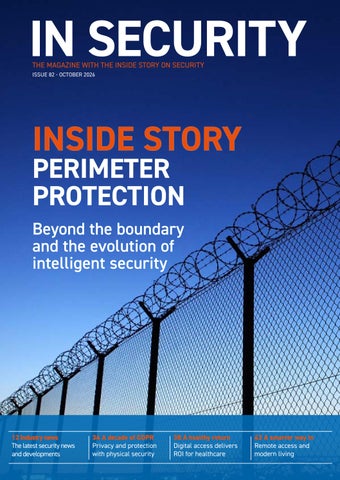
INSIDE STORY PERIMETER PROTECTION Beyond the boundary and the evolution of intelligent security
12 Industry news The latest security news and developments
34 A decade of GDPR Privacy and protection with physical security
38 A healthy return Digital access delivers ROI for healthcare
42 A smarter way in Remote access and modern living
IN SECURITY | OCTOBER 2026 | 1
CLIQ® The smart way to digitalize access Take your access management into the digital era – smoothly, securely, and without overhauling existing infrastructure. With CLIQ, you upgrade from mechanical to digital access at your own pace to gain greater control today and adaptability for tomorrow.
Download our whitepaper to learn more about making the switch to digital access
30
Editor Chris Hewett editorial@mebmedia.co.uk Accounts Jay Kempisty accounts@mebmedia.co.uk
34
Publisher Wayne Banks +44 (0)1622 201207 wayne.banks@mebmedia.co.uk Website and Circulation Manager Kevin Villa website@mebmedia.co.uk Design and Production Charles David production@mebmedia.co.uk In Security Magazine is published 6 times a year by MEB Media Publishing Ltd 13 Princes Street Maidstone Kent ME14 1UR United Kingdom Tel: +44 (0)1622 201207, info@mebmedia.co.uk www.mebmedia.co.uk Articles and art may not be reproduced or reprinted without the express written permission of the publisher. Exclusion of Liability Although every effort will be made to ensure the accuracy of all materials published, the publisher takes no responsibility for errors or omissions. Stock images supplied by iStock Copyright © MEB Media Publishing Ltd 2010 - 2026, all rights reserved.
Contents 4 Perimeter protection Beyond the boundary and the evolution of intelligent security 12 Product & Industry News The latest security news and developments 26 Protection post-PSTN Is security prepared for the PSTN shutdown? 30 Too many alerts, too little time How AI is tackling control room fatigue
42
34 A decade of GDPR Balancing privacy and protection with physical security technology innovation 38 A healthy return Three ways digital access delivers a tangible ROI for healthcare 42 A smarter way in Remote access makes modern living more convenient
IN SECURITY | OCTOBER 2026 | 3
INSIDE STORY
Perimeter protection
I
Beyond the boundary and the evolution of intelligent security Jeremy Malies, Content Editor, In Security
n Security considers what constitutes a perimeter (our ideas are changing) and discusses techniques and products being used. Jeremy covers interoperability, resilience, sensor types, and the cyber perspective. As usual in these features, the article looks at vertical sectors that make unusual demands on vendors and installers. These verticals include maritime, critical national infrastructure (CNI), construction, and data centres. Inevitably, there is consideration of AI which is now the not so dumb elephant in the room. What is AI achieving in perimeter
4 | OCTOBER 2026 | IN SECURITY
protection? Are there limitations and what might be the dangers of over-hyped marketing? Even a moment’s analysis tells observers that this sector is in flux and a shift in perspective is occurring. Facilities managers no longer merely define and seek to protect a boundary. The frameworks have become overarching; optimal perimeter protection should be a way of thinking and the in- vogue term is fusion. It has taken over from “layered protection” and “defence in depth”. The best system designers are concerned with the potential for
perimeter protection devices to combine with each other. The focus is less on spec lists and more on the intelligence (both AI and human) with which individual solutions combine. These products might be fencing, fence sensors, buried sensors, video surveillance, thermal imaging, radar, and 3D LiDAR. Optimal solutions create successive boundaries and delaying factors that an intruder must overcome so increasing the chance of detection. Facilities managers expect the individual technologies to be greater than the sum of their parts. A candid site supervisor might concede
that a determined intruder will be able to scale a fence but will often be detected in the sterile zone between this and the next fence or obstacle. RAF Brize Norton Nowhere in my survey is there anything more extraordinary than events in June of last year when two activists from the group Palestine Action breached the perimeter of RAF Brize Norton in Oxfordshire. They were on scooters and sprayed two aircraft with red paint to symbolize blood. Industry observers were amazed not only at the breach but the fact that the activists were able to leave the site undetected. The group even released a video of their members riding electric scooters across the base. The political dimension should not concern us since it’s not this magazine’s remit. I focus instead only on the content of a statement to the House of Commons in the following September by Parliamentary UnderSecretary of State for Defence, Louise Sandher-Jones. A Sandhurst graduate and former second lieutenant in the British Army, Sandher-Jones has an impressive résumé. But the parliamentary
record, Hansard, tells us that she was sent out to bat with a description of the airbase as merely “needing further investment”. There was also a reference to “years of underinvestment and hollowing-out under the previous administration”. Brize Norton is now reported to be operating an improved system for detecting and tracking attempted breaches with links to a control room that has been overhauled. There has also been investment in drones, fencing, and increased manned patrols. Palestine Action is a wellresourced group with determined activists but it’s salutary to reflect on what jihadists might do at a military base. This incident is unprecedented. It warranted the headlines but does not truly help technical observers identify trends. If we want to learn about the sector through repeated behaviours, it’s best to assess what end-users are saying about their expectations and recent experiences. And we should drill down into specific verticals within perimeter protection. Hostile vehicle mitigation As a technical publication, In Security should focus on perimeter protection
incidents when they have been part of an attack by a named organization on a defined site with a physical boundary. Saying this, I don’t want to undermine the gravity of attacks on pedestrians in public places during markets, festivals, feast days, and historical commemoration days. But the cases particularly relevant to my survey involve vehicle attacks against permanent perimeters protected by gates, turnstiles, barriers, and bollards. The facilities are likely to be a military installation, critical national infrastructure (CNI) or government building. A relevant case study for this survey – and one that might hold potential for hardening the sector – is an incident from March 2025. At Bannu in Pakistan (it’s close to the border with Afghanistan) a pair of suicide bombers drove explosiveladen vehicles into the outer wall of the Bannu Cantt military compound. The pair were affiliated to the Pakistani Taliban. The explosions breached the wall after which six attackers entered the compound. They were killed by commandos. It’s important to note here that the successful perimeter breach (the collapse of part of the
Barcelona build-to-rent provider Becorp IN SECURITY | OCTOBER 2026 | 5
wall) was a planned component of a larger assault. Six patrol staff and six attackers died and there were numerous injuries including to civilians. The lesson here is the need for successive lines of fencing and sterile zones rather than a wall that is an integral part of the facility.
Mdradas is cyber-aware, as all physical security executives must be, and on record as insisting that system design should ensure that physical access points never become backdoors for cyber intrusion. These are demanding but inspiring industry goals.
Industry soundbites
Avoiding passive boundaries There is now a consensus that perimeter protection should not be a passive boundary. It’s healthy that end-users insist that perimeters ought to be the scene of confrontation (digital, usually through voice address) rather than retrospective analysis after a breach has occurred. Responses should come while a situation is gathering momentum. And perimeter protection can be aimed at legitimate site users as well as intruders. Thus, it requires only basic video analytics and voice messaging for a site operative to be told that he has entered an area that requires a hardhat, hazmat suit or similar but is not using them.
Bottlenecks and vulnerabilities Nemer Mdradas, a regional director with Gallagher Security, is clear on his expectations of perimeter protection. “Zero intrusions is not a goal – it’s a must!” Mdradas’s press statements identify high rates of false/nuisance alarms as a pain point for perimeter security. He believes that unwanted alarms dilute situational awareness. Mdradas consistently uses evocative turns of phrase and points to “AI video analytics that is added as an afterthought” as having much to answer for in terms of system failures. He is optimistic about intelligently monitored pulse fencing systems meeting operational needs. The subtle challenges come when legitimate activity is being carried out close to the areas that are likely to be breached by intruders. 6 | OCTOBER 2026 | IN SECURITY
Northern Irish accent! Mobile-deployable perimeter protection video surveillance units that are more or less independent and can be placed around the edges
of estates often end up looking like Daleks. This is a matter of contextsensitive design and can be seen across several manufacturers. These units are invaluable for construction sites, railway lines, and temporary event locations that may have limited power and Internet connectivity. Much is being achieved with solar battery power and 4/5G cellular connections. A proactive aspect of these units is their automated talkdown messages to intruders with warnings that their presence has been detected, reported, and acted on. I’ve been amused at trade fairs to note that the most intimidating accent for a talkdown message is the upward gliding vowel sounds used in Belfast! And these talkdowns are increasingly customized to precise site location and context. Intervening sufficiently early to stem escalation is the obvious goal. An area where perimeter protection has seen improvements is the ability of automated systems to assess the threat or otherwise from an intruder. Certain intruders such as a wayward (perhaps bored) but not seriously ill-intentioned youngster or a disorientated country walker should be identified, alarmed upon, and
The NEW re-engineered PaxLock Pro2
Built to last. Trusted to protect. Certified. Trusted. Secure. The latest wireless, access-controlled door handle from Paxton.
New anti-rotation pin
Solid through-door bolts & pre-terminated cable for easy installation Engineered for lasting reliability, our most durable handle yet
Backed by our 5 year warranty
FD30, FD60 and EN179 rated
More durable
Extensively tested
Fully certified
Long battery life
IK10 impact rated
Tested for exceptional long-term reliability
Fire and emergency egress (FD30, FD60 and EN179 )
Capacitive wake-up up to 55,000 operations or 2 years
Discover PaxLock Pro2 at our exclusive webinars Sign up now
interacted with if only for their own safety. But the perception of threat level must be proportionate, and discrimination must be intelligent. Optimum perimeter protection is a combination of mechanized products and focused reaction from manned patrols. Digital twins A consolation of spending 30 years in this industry is the opportunity to observe true evolution. Writing rail case studies over decades has seen me assess integrated software management platforms for transport hubs that represent the facility and its technology assets as a 3D model. The best vendors optimize site awareness for operators and reduce training time for new recruits. Managers have given feedback to the effect that they have been able to make the best possible decisions with the best possible information. But there is now a wholly different methodology for this – digital twins. This is a dynamic, digital representation of facilities and their security systems. The approach allows combination of the site’s layout with live updates from fence sensors, video surveillance, radar, 8 | OCTOBER 2026 | IN SECURITY
thermal imaging, access control, and SCADA. It should be noted that this is not 3D modelling of a building and its perimeter. There is true connection between the actual site and its digital twin so helping operators understand the events and movements they are monitoring remotely. The result is improved analysis of developing threats allowing the most appropriate response. The verticals Maritime perimeter protection Having grown up around the port of Newhaven and spent time at the nearby port of Shoreham, I follow maritime case studies closely. Consultant friends tell me that at major ports they must design for a variety of activities going on across what is usually a diverse estate. As a result, fence-mounted cable sensors are often calibrated zone by zone to factor out nuisance alarms. In this way, an area that is seeing crane usage would be adjusted in a different way to an area that is receiving only foot passengers. And within the perspective of illegal migration, often from the Schengen
Area to the UK, a passenger terminal might have sensors adjusted to maximum sensitivity with managers willing to tolerate a higher level of false alerts than is the norm. Ports handling everything from bulk cargo to cruise liners not to mention ferries and leisure craft put a myriad of demands on security managers. A complication is that it’s common for a port’s terrain to vary between open coastline, industrial areas, and passenger areas. Zonal adjustments at ports On fences with detection systems, the manufacturers’ algorithms focus on the kind of sharp or abrupt frequency that might be consistent with attempts at breaching a perimeter on foot or in a vehicle. Lower frequencies caused by expected ambient movement around the port and extreme weather are rejected as alarm sources. Fibre optic sensors transmit laser light across optical fibre with the alarms being generated by vibrations that are deemed meaningful according to setting. A different approach is vibration sensors that react to physical changes caused by alarm-worthy activity such as
climbing, lifting, and cutting the port’s perimeter barriers. A taut-wire system will observe the tension in a wire, detecting and reporting on changes that could be consistent with an act of intrusion. An airport and its “corridor” mode Look at how end-users prioritize the benefits they have gained from successful installations when talking to trade media. Number one is often the convenience and the economies of being able to oversee their facility and drill down into different disciplines from a single platform. This was a key takeaway when facilities managers from British Airways Engineering at Heathrow Airport worked with Johnson Controls. The trendy phrase is “ecosystem” and it is descriptive in that it suggests an interconnectedness that was relevant in this case study which encompassed an area equivalent to 109 football pitches. The site involved 10 hangars and 35 aircraft stands supporting an airline fleet. Perimeter protection was relying significantly on foot patrols. The case study shows that video surveillance exploiting intelligent algorithms is now a credible perimeter protection mechanism and should be regarded as such alongside fencing and radar. Two hundred Johnson Controls Illustra cameras were used at
Heathrow, the model being one that can operate in corridor mode. Naturally, this can be a mode in which the camera’s sensor resources are used economically by showing a tall narrow image such as a fence and the strip of ground alongside it. But that can be a simplistic interpretation. Video surveillance of perimeters often has the camera in a regular landscape mode, particularly as there is a need to distinguish between human intruders and large wildlife and perhaps alert on miscreants who have scaled one fence and are proceeding through a sterile zone to the next fence. Radar has also been used on this project and it should be noted that radar detection can prompt a PTZ camera to align with the threat. The Heathrow project has impressed as part of a drive towards unified operational intelligence. Perimeter security at a federal data centre in the US You would be delusional to expect vendors to reveal locations and names of data centres they serve with perimeter protection solutions. It’s enough that the case studies are informative and give insight into the challenges and equipment used. The project I now describe is useful for my overall intentions here because it involves both a fibre optic solution and LiDAR. RBtec Perimeter Security
Systems have recently supplied their RaySense Distributed Acoustic Sensing (DAS) solution across a 2.5 km perimeter at a data centre run by a US federal agency. And there is a familiar aspect to this story that runs through more modest installations. It was an absolute requirement that the perimeter boundary should function throughout the installation process and not even be weakened during fit-out. A coverage gap was unacceptable. How many times have we heard that? And quite rightly at any mission-critical facility. RaySense is a fibre optic intrusion detection system that is mounted onto existing fencing infrastructure. The cable itself is the sensor; there are no power or electronics requirements along the fence. The documented performance of threat discrimination and the rejection of nuisance alarms is impressive. The federal data centre has a continuous fenced boundary with vehicle and personnel gates. This case study saw replacement of a legacy copper-based sensor system that was unfit for purpose. The site is prone to electrical storms and copper was behaving like an antenna. Five kilometres of sensor cable were installed and the perimeter was configured into 11 zones of operation. (These reflected how the site is patrolled by staff and how alerts are responded to.) The company also supplied their
IN SECURITY | OCTOBER 2026 | 9
PulseVI LiDAR units which are giving three-dimensional tracking of movement in the areas that are open for vehicles and people. RaySense contains no copper and this was a clincher in terms of product specification. The RBtec literature for the project includes a pull-quote from its team who note (with wry humour) that copper on a fence in an area that is prone to storms is a no-no. “The weather will find it every time.” Aviation perimeter protection case study Sydney Airport began as a paddock and dates from 1919. It now has three runways and deals with 44 million passengers a year. The facility’s 24km perimeter has been secured by Gallagher Security (an executive of this company has been quoted above) with its Pulse Fence solution. The airport’s 24-km perimeter is unusual in that it includes a sea wall and the Pacific shore. It had been relying on a standard chain-wire fence topped with razor wire (a height of 2.44 metres which has been an aviation standard) until this was deemed unfit for purpose. Alerts on perimeter breaches were coming only through manned guarding patrols and video surveillance. An active fencing solution was needed, one that could work from within a physical barrier and detect proactively. A Gallagher system was 10 | OCTOBER 2026 | IN SECURITY
specified by integrator HRC Security. The Gallagher monitored Pulse Fence system is based on a grid of energized, high tensile wires with multi-zone management capability. The grid can be constructed inside a new or existing perimeter fence. It integrates with video surveillance and other disciplines through simple IP networking. The fencing delivers a short and safe shock to the intruder. This is an energized pulse sent around the perimeter fence line. It meets stringent safety criteria and zoned fences allow adjustments according to need. Conclusions A variety of stakeholders (going right up the chain to architects) are involved in securing perimeters. There is now an evolutionary process from “detect everything” to “be discriminating as to what matters”. This article has assessed actual case studies and quoted engineering executives describing real-life challenges. In other words, I’ve sought to avoid hyperbole. A distinction that needs to be drawn is that headline-grabbing innovative technology should not distract us from basic issues such as poor site design from the get-go, inadequate detection coverage, nuisance alarms through imprecise settings, and slow responses by patrol staff who may lack motivation. There are however, as Ian Dury taught us in a song, “reasons
to be cheerful”. Hostile vehicle mitigation continues to develop from crude individual barriers into sophisticated, integrated designs. Increasingly, ONVIF compliance means that intelligent fencing can work alongside perimeter-protectionspecific surveillance cameras. Perspectives are broader now; the industry has moved on from merely protecting a boundary understanding threats across a whole facility. The best attention of the brightest people and best-of-breed products should be focused on generating reliable alarm responses from both sensors and humans. Walk round an industry trade fair and a conscientious sales executive is less likely now to be fixated on selling you a stronger bollard. The focus from premium manufacturers is creation of a generally protective environment. Vehicle approach points are managed, vulnerable routes receive special attention, access is supervised, and there are ways to counteract the consequences of a penetration. Most importantly perhaps, my survey here tells me that the perimeter is no longer seen as a simple boundary. It’s the area where incidents are assessed by human intelligence and increasingly discriminating AI models. The situation is then deemed nonthreatening or escalated to involve the full resources of the site and if necessary outside agencies.
PRODUCT & INDUSTRY NEWS
Paxton officially launches PaxLock Pro2 Paxton the security technology manufacturer has launched a brand-new re-engineered PaxLock which is built to protect straight out of the box. It is the latest evolution of Paxton’s wireless access-controlled door handle and has been engineered to withstand the most demanding environment, while maintaining a sleek and contemporary design. The PaxLock Pro2 is designed to work on all standard doors and is compatible with all new DIN mortice locks, making it a flexible option for security installers on any site. Adam Stroud, Paxton’s CEO, said: “Our new PaxLock may look similar, but appearances can be deceiving. The new product has been re-engineered from the ground up, with virtually all parts updated from the previous design. Using high-quality materials and components, we have achieved a design that is extremely durable, offering hassle and maintenance-free operation in a wide range of conditions. “We have never tested a product more than PaxLock Pro2. The re-engineered mechanism has been tested well beyond a million cycles. With the new privacy button, we have also added a much-requested feature to the product.” Built to Last. Trusted to Protect. Durability is at the core of the PaxLock Pro 2. The handle has been extensively tested for exceptional long-term reliability. It is the strongest handle Paxton has ever produced, the rotational torque strength is now stronger than a standard manual door handle. Safety is also not compromised for strength, the PaxLock Pro 2 meets FD30 and FD60 fire regulations, and EN179 certifications for safe egress. This ensures compliance across a wide range of commercial and public sector applications.
12 | OCTOBER 2026 | IN SECURITY
More Features. Even Simpler. Following direct feedback from installers, Paxton has introduced a range of new features to improve both security and ease of use. The new Privacy Button allows users to instantly secure a room with one touch, preventing access from the outside until the button is released. The new PaxLock remains incredibly energy efficient, offering up to 55,000 operations (or 2 years) on a single set of batteries, with a capacitive wake-up feature to ensure instant response every time a token is presented. Adam Stroud said: “Because PaxLock contains the power supply (batteries), electric lock, reader and control unit all inside a door handle, there has never been an easier way to add networked access control to a door. With the PaxLock Pro2, we have simplified and refined the installation process, making it easier to install and more forgiving. The product is compatible with Net2 and Paxton10, as well as in stand-alone mode, and the single variant is suitable for both internal and external doors.” Total System Flexibility The latest wireless handles can be used as a standalone offline device for smaller sites. For full online access control, they work seamlessly with larger scale Net2 and Paxton10 systems. For Paxton10 users, the handle features a dualfrequency RFID reader with built-in support for Bluetooth® Low Energy (BLE) mobile credentials, allowing users to unlock doors with their smartphones using free smart credentials. Find out more Paxton is hosting a series of interactive online webinars to introduce the new PaxLock Pro2.
DoorBird launches the new D22x series for modern building requirements
More than just a door intercom Modern buildings are placing ever-increasing demands on door communication systems. Property owners, operators, and residents require intelligent solutions that accommodate different user groups, support flexible access methods, and meet high standards for security, connectivity, and integration. With the new D22x series, DoorBird introduces a new generation of IP video door intercoms. Developed based on specific customer requirements, the series combines cutting-edge technology, exceptional flexibility, premium design, and Made in Germany quality. As part of the ASSA ABLOY Group, the global leader in access solutions, DoorBird combines innovative IP-based door communication with extensive expertise in modern building security. Security and Control at a New Level The D22x series comprises more than 30 models and is the direct successor to the globally successful D21x Series. New additions to the portfolio include versions with digital nameplates, which can be managed centrally and remotely, offering significant advantages for property managers, housing associations, and operators of larger buildings. All models feature a 5 MP HDR camera with a Sony image sensor and a 180° ultra-wide-angle lens, providing excellent visibility of the entrance area even under challenging lighting conditions. Video transmission is available in HD quality via the local network or through DoorBird Cloud Pro. Outstanding audio performance ensures clear and intelligible communication between visitors and residents, even in demanding environments. Depending on the model, a variety of authentication methods are available, including the app, dualfrequency RFID, Bluetooth, PIN code, QR code, and fingerprint recognition. The security concept is further
enhanced by a radar-based 4D motion sensor and an integrated tamper sensor. Simplified Installation and Maximum Integration With the D22x series, DoorBird also simplifies installation. Thanks to the integrated power output for electric door openers, many installations no longer require a separate power supply for the door release mechanism. This reduces cabling complexity, saves installation time, and lowers overall system costs. Open interfaces such as SIP, OSDP, RS485, and Wiegand, along with a comprehensively documented LAN and Cloud API, enable integration with more than 100 smart homes, access control, video surveillance, and building management systems. The door station supports installations with up to 3,000 residential or office units. In addition to traditional call buttons, digital nameplates and displays with resident directories are available. Accessibility features can be added to every model, including an integrated hearing loop, pictograms, and acoustic door-opening confirmation signals. As an ISO/IEC 27001-certified company, DoorBird incorporates privacy and information security throughout the development process in accordance with the Security by Design principle. Sustainable Modernization of Existing Installations The D22x series offers a particularly cost-effective way to modernize existing DoorBird D21x installations. When upgrading, only the main electronic unit needs to be replaced. Existing housings, front panels, and other components can continue to be used, while all existing settings can be retained. This significantly reduces installation effort and contributes to environmental sustainability. The D22x series is available now. IN SECURITY | OCTOBER 2026 | 13
New container data centers experience holistic security and environmental monitoring with KentixONE Prior1, a leading provider of modular IT infrastructure solutions, develops container data centers to meet the highest security and energy efficiency standards. Their containers require optimum protection against both physical threats and environmental risks. To provide this, Prior1 sought a security solution for their new “IT Container FIX” products which offers seamless monitoring and is flexible, scalable, and meets the requirements of EN 50600 certification. By choosing KentixONE as their central platform, Prior1 identified the comprehensive security solution they need. KentixONE enables the central control and monitoring of all security-relevant devices and sensors in real time. Its central dashboard provides data center managers with an overview and full control of every vital parameter. They can also stay in control while on the move via the KentixONE app, a powerful mobile control center. Powerful access oversight and monitoring The KentixONE solution protects Prior1 customers against a vast scope of physical and environmental threats. Its seamless networking and intuitive, unified platform enable continuous monitoring and rapid response to incidents – critical to maintaining data integrity and security. With SmartAccess functionality, Kentix IP wall readers ensure strict access control with two-factor authentication. Every access event is logged; unauthorized attempts immediately trigger an alarm. All data is stored in KentixONE and can be retrieved at any time. In addition, all accesses may be tagged with 14 | OCTOBER 2026 | IN SECURITY
a short video sequence. Access control and sensor technology combines to create alarm zones which protect against unauthorized intrusion. These zones may be armed and disarmed both manually via access control and automatically. Smart video surveillance integrated within KentixONE detects security-relevant events in real time. Recordings can be called up and live images support the assessment of the situation in any emergency. Powerful integrated SmartMonitoring is enabled via Kentix multisensors which continuously track environmental factors like temperature, humidity, and air quality. An integrated 4-factor early fire detection system detects anomalies which may indicate critical conditions at an early stage. This enables timely action to prevent damage. All external units such as air conditioning and UPS systems are seamlessly integrated and continuously communicate their operating status. Kentix SmartPDUs also monitor current and energy parameters, as well as ambient conditions within the server racks. The integrated residual current measurement (RCM) ensures electrical safety and fire protection, and detects creeping device failures. Anomalies are transmitted to KentixONE in real time so prompt action may be taken. KentixONE provides efficiency indicators such as PUE (Power Usage Effectiveness) and generates an energy report at the end of the month. To learn more about implementing innovative physical security for your data center, visit kentix.com.
HIGH-END CAMERA
X
TOP PERFORMANCE LENS
THE NEW FUJINON SX800. THE BEST OF BOTH. With the new SX800, Fujinon combines both in one for the first time: camera and lens. For long range surveillance at the highest level with 40x optical magnification and constantly sharp images. www.fujifilm.eu/fujinon. Fujinon. To see more is to know more.
Perimeter protection for a 50-acre AI campus Why hyperscale and large colocation sites need radar-led detection, thermal confirmation, and visible identification—not simply more cameras The AI buildout has reshaped the data center perimeter. The five largest US cloud and AI infrastructure providers have committed to between $660 billion and $690 billion in capital expenditure for 2026, up from roughly $380 billion in 2025, and much of that spending arrives as new and expanded sites, according to Futurum Group. A campus that once covered a few acres may now span 50 or more, with fence lines running past service roads, substations, generator yards, and open ground. Much of that boundary is poorly lit and difficult to monitor with just remote staff. Once activity at the fence moves toward power, cooling, or other critical systems, it becomes an uptime concern. That distinction matters financially. More than half of significant data center outages now cost more than $100,000, and roughly one in five exceed $1 million, according to the Uptime Institute’s 2024 Annual Outage Analysis. That scale creates practical problems for the team watching the site. There is more ground to cover, more distance between detection and response, and more routine movement from wildlife, debris, and nearby traffic. Adding cameras and alarms can leave the security operations center with more feeds and alerts, without giving operators a better understanding of what is happening. Coverage is not the same as awareness. Start with movement, not video Flir R-190 and R-290 ground radars can monitor long, open sections of the perimeter day or night, in changing weather conditions. They provide a target’s location, direction of travel, and speed. On a site this large, knowing the direction of travel can be as important as detecting the movement itself. Someone following the 16 | OCTOBER 2026 | IN SECURITY
outside of the fence presents a different situation from someone heading directly toward a substation or utility yard. Thermal imaging keeps the target in view when the visible image falls short, allowing a person or vehicle in full darkness to be seen without any additional site lighting. Fixed multispectral cameras such as the Flir FH-Series provide thermal and visible coverage from the same position. A multispectral PTZ camera such as the Flir PT-Series AI SR can follow a radar track, hold the target in thermal, and pull in a visible view when identification matters. Radar shows where the movement is, thermal helps confirm the target in poor conditions, and visible imaging gives the operator the detail needed to judge what is happening. Make the alarm worth looking at A perimeter of this size generates continuous nuisance activity, with wildlife, moving vegetation, traffic on adjacent roads, and authorized personnel working near restricted areas. When those events reach the SOC as undifferentiated alarms, operators spend a disproportionate share of each shift clearing nonactionable events, and genuine intrusions become harder to distinguish from routine ones. The result is unnecessary dispatch cost, guard fatigue, and declining operator confidence in the alarm queue. Validation at the edge helps reduce that noise. Edge analytics can classify human and vehicle movement before the event reaches the control room. Radar provides location and direction, while thermal and visible imagery help confirm what the sensor is seeing. By the time the alert reaches the operator, it can include the target type, location, direction of travel, and associated video.
New HID Signo Décor reader combines secure access and design aesthetic
The flush-mount reader brings Signo’s trusted security architecture to high-design, high-traffic spaces, giving architects and specifiers a reader that complements the spaces it protects HID, a worldwide leader in trusted identity and physical access control solutions, has launched HID Signo Décor in response to a request that architects, specifiers and integrators have repeatedly raised: a Signo-grade reader built for high-design spaces, without a compromise on the security behind it. The Signo Décor Reader 30 model mounts flush on European- and China-style back boxes and sits behind a robust glass face, rated IK10 for impact resistance and IP65 for indoor and outdoor use, fitting naturally into design-led lobbies, hotels, transport hubs and mixed-use developments while standing up to demanding daily use. “Security should not force a choice between how a space looks and how well it is protected,” said Jos Beernink, Vice President Europe for HID’s Physical Access Control (PACS) business area. “This belief is what drives HID’s product development: to give customers choice without asking them to trade away the trust they have placed in our Signo line.” Décor runs on the same architecture as the rest of the Signo family, so specifiers and integrators can bring
it into a design-led project with the same confidence as any other Signo reader. It uses EAL5+ certified secure element hardware and supports SIO data model for trusted authentication, and it communicates with control panels over Open Supervised Device Protocol for encrypted two-way monitoring. Native Bluetooth and NFC support means end users can present a phone as easily as a card, using HID® Mobile Access® and digital wallet credentials alongside existing access cards. For teams managing readers across a portfolio of buildings, that consistency extends to operations. Signo Décor can be updated and monitored through HID Reader Manager, or remotely using HID Linq, so firmware and configuration stay current without a technician visiting every door. It is also available as a module for integration into intercoms, elevators, turnstiles and other access hardware, giving OEM partners a consistent design language across their product lines. The Signo Décor Reader 30 model, available in black or white in a 90x90 mm form, is available to order now in Europe, China, Hong Kong, Singapore and the UAE. Additional Signo Décor model variants will become available in other regions later this year. For more information, visit the website.
IN SECURITY | OCTOBER 2026 | 17
Milestone Systems helps Columbia Borough strengthen safety with open platform video The Pennsylvania borough has relied on Milestone’s open platform video technology for more than 16 years, building a scalable wireless system that supports faster response, stronger investigations, and community safety. Milestone Systems, a leading provider of open platform video management software (VMS), is helping Columbia Borough, Pennsylvania, strengthen public safety through a community-wide video security system built on Milestone XProtect® VMS. For more than 16 years, Columbia has worked with Lancaster-area security integrator App-Techs to develop and expand a distributed wireless video network serving its downtown, public buildings, parks, and other borough facilities. Today, the system supports roughly 83 camera feeds, including 4K multi-lens and PTZ cameras, primarily from iPro. Located along the Susquehanna River in Lancaster County, Columbia is a historic borough of roughly 10,000 residents. As the community worked to revitalise its downtown and attract new businesses, borough leaders wanted safety and security to support that broader effort. Traditional wired infrastructure was impractical across Columbia’s geographically varied environment, requiring App-Techs to engineer a distributed wireless architecture. XProtect provides the video management foundation, with dedicated servers located in the municipal building and a remote park office. Officers can also access live camera feeds from laptops in patrol vehicles, while mobile access extends video to personnel during community events. Real-time video, real-world impact Columbia’s dispatchers are the primary day-to-day operators of XProtect, monitoring cameras, and supporting officers in the field. In one incident, a dispatcher spotted someone breaking into a vending 18 | OCTOBER 2026 | IN SECURITY
machine outside a laundromat and immediately dispatched officers. “Our staff member observed someone breaking into a vending machine just outside that building and was able to dispatch officers to the scene,” said Jack Brommer, Columbia Borough Police Department Chief. “Officers apprehended the individual, and it turns out this was a serial thief who had been breaking into vending machines across the tri-county area. So that single arrest helped resolve a number of thefts across multiple counties. That’s just the kind of impact this technology can have on a community.” The system also supports holding cells and interview rooms inside the police station, where microphones are integrated with cameras, as well as large community events. During Columbia’s annual “Thunder on the River” antique car show, Emergency Management personnel used the community camera network to support proactive monitoring and rapid response across the event. A long-term investment in public safety Over time, Columbia’s video system has supported faster incident response, stronger evidence for prosecution and greater situational awareness for dispatchers and police officers. Borough leaders also use signage in parks and public areas to make camera coverage visible as a deterrent. “The data that I can point to is that we are trending downward, probably for the last five, six years, as far as call volume and crime trends. Those numbers have been very positive,” added Brommer. Looking ahead, Columbia plans to expand its use of video analytics, including object-search capabilities that can help investigators filter video by vehicle type, color, and other attributes. The borough is also exploring emerging gunshot-detection technologies to further improve situational awareness.
500
DO YOUR BEST WORK One of the most versatile work utility vehicles on the market, the Carryall 500 has the power to replace pickup trucks at a fraction of the cost. With a rustproof, aircraft-grade aluminum frame, and cargo box, along with best-in-class ergonomics, the Carryall 500 is the perfect solution for your industrial and commercial jobs.
www.clubcar.com info@clubcar.com
Skanska and HID bring Poland’s first fully digital-wallet access system to Warsaw The Warsaw deployment shows European commercial buildings can simplify access without sacrificing security Skanska CDE, a leading developer of modern office buildings across Central and Eastern Europe, has implemented a digital wallet access control system at its Studio A office building in Warsaw, as part of a growing shift among commercial buildings toward wallet-based credentials as the default. Aimed at removing the friction of separate access apps for employees, tenants and guests, the deployment is built on the company’s proprietary StudioApp web application and HID Origo Web Provisioning, a cloudbased credential management platform from HID, a global leader in trusted identity solutions. Located in Wola, the burgeoning business district in the Polish capital, Studio A is one of the first large-scale deployments in Europe built entirely on web provisioning rather than a dedicated mobile app. Employees and building staff receive an email invitation and can add their credentials to Apple Wallet or Google Wallet within seconds. Skanska CDE occupies a dual role in the project, as both the developer behind the StudioApp integration and the system’s first end user, having deployed it across its Warsaw office before extending it to tenants and guests. The company is evaluating similar deployments across its other offices around the globe. “Our intention was to create an intuitive, secure solution built to scale that responds to the real needs of tenants. The solution not only simplifies access but also meets high requirements in terms of data protection and operational security,” says Rafał Kot, Technical Quality Expert at Skanska Commercial Development Europe. “Moving away from physical badges toward fully digital and integrated solutions sets a new standard in 20 | OCTOBER 2026 | IN SECURITY
designing and managing the access lifecycle process of a building or office space. In practice, the solution shows that the future of access control lies in systems that are invisible to the user, but highly effective and secure,” adds Mateusz Gluz, Senior Project Leader at Skanska Commercial Development Europe. Technology invisible at first glance The system is powered by HID Origo Web Provisioning for Wallet credentials. To issue a digital credential, an administrator needs only a user’s first name, last name and email address. The credential is delivered directly to the user’s Apple Wallet or Google Wallet through a secure link, with no app to download or install. Users simply tap their phone at the reader to gain access, using NFC technology. At the heart of the solution is the proprietary StudioApp web application, which serves as a central integration point between the access control system, the parking system and the HID Origo cloud back-end via a local server installed on site. “Web provisioning is a modern way to distribute digital Apple Wallet and Google Wallet credentials. It enables users to receive and install access cards directly via a web interface, without needing a mobile application, while maintaining full, real-time integration with the access control system. The Studio A project is one of the first in Europe where web provisioning serves as the default standard for all employees, tenants and guests using the Skanska property. It provides simple and fully automated onboarding,” comments Kamil Targalski, HID Business Development Manager for mobile access. This deployment demonstrates a faster, lowerfriction model for managing access across large office portfolios, without the ongoing cost of maintaining a dedicated mobile app.
Euralarm and CoESS publish updated Cybersecurity Guidelines for the security and fire safety industry
Euralarm and the Confederation of European Security Services (CoESS) have published an updated edition of their Cybersecurity Guidelines for the Security and Fire Safety Industry. The revised publication provides practical guidance for organisations across the sector as cybersecurity becomes an increasingly important operational, technical and regulatory requirement. The growing connectivity of fire safety and security systems brings significant benefits, including remote monitoring and maintenance, faster access to information and greater integration between systems. At the same time, connectivity introduces cybersecurity risks that need to be addressed throughout the complete lifecycle of systems and services. The updated guidelines therefore take a broad approach to cybersecurity. They are intended for organisations involved in product development, system design, installation and maintenance, monitoring and alarm response services. The publication combines organisational recommendations with practical technical measures and guidance for working with customers and other partners in the security chain. Responding to a changing regulatory environment An important reason for updating the publication is the rapidly developing European cybersecurity regulatory framework. The new edition provides an overview of legislation relevant to the fire safety and security sector, including the NIS2 Directive and the Cyber Resilience Act (CRA). The guidelines also address other relevant European legislation, including the EU Cybersecurity Act, GDPR, the Radio Equipment Directive and the AI Act.
Cybersecurity throughout the security chain Rather than treating cybersecurity solely as a product or IT issue, the updated publication considers risks and responsibilities throughout the security and fire safety value chain. A central element is a five-pillar lifecycle approach covering products, project design, installation and maintenance, monitoring, and alarm response. For each stage, the guidelines identify relevant risks and provide practical recommendations for reducing them. Technology alone is not enough The updated guidelines also emphasise the human and organisational dimensions of cybersecurity. Companies are encouraged to establish clear cybersecurity governance, define responsibilities, maintain inventories of connected IT and OT assets, conduct regular risk assessments and put business-continuity and incidentresponse procedures in place. Training and awareness are equally important. Recommendations include cybersecurity training for management, compliance, procurement and technical personnel, as well as ongoing awareness programmes for employees. The guidelines also underline the importance of cooperation between customers, suppliers and service providers so that cybersecurity responsibilities are maintained throughout the lifetime of a system or service. To support organisations in implementing these measures, the publication includes references to relevant cybersecurity standards and work in progress. The updated ‘Cybersecurity Guidelines for the Security and Fire Safety Industry’ can be downloaded here or from the websites of Euralarm and CoESS.
IN SECURITY | OCTOBER 2026 | 21
Act now: Taking a holistic approach to video security for NIS-2 and CER
NIS-2 and CER are raising the requirements for the security and resilience of critical infrastructure and essential and important entities. Recent attacks on critical infrastructure demonstrate why these requirements matter in practice. In this context, the video security technology deployed is also coming under greater scrutiny: Operators must not only manage physical threats but also address cyber risks, supply chain security, and system availability. As part of its current Act Now initiative, Dallmeier supports operators with decades of experience in critical infrastructure protection, cybersecure video security technology “Made in Germany,” and practical expert guidance. Taking a holistic approach to physical, cyber, and geopolitical resilience For Dallmeier, a comprehensive security strategy encompasses three dimensions: physical resilience through state-of-the-art video surveillance, cyber resilience through “Security by Design” and ISO 27001-certified information security management, and geopolitical resilience through “Made in Germany” and a secure supply chain. For operators, the interplay between these dimensions is essential to comprehensively address the various requirements of a resilient video security infrastructure. CER defines specific requirements for video systems The new EU CER guidelines published in July 2026 illustrate how directly video technology is affected by regulatory requirements. Control measure C30 specifies concrete requirements for video systems. These include, for example, real-time monitoring of critical assets, facilities, and access routes, continuous recording of security-relevant areas, reliable time synchronization across surveillance systems, regular verification of recording status, and defined and regularly reviewed
retention periods. Additional requirements address reliable system availability through critical spare components and backup power, regular review and verification of video recordings, and ensuring forensic usability. Expert knowledge for resilient video security Dallmeier has been developing video security technology “Made in Germany” since 1984, combining physical security, cybersecurity, and geopolitical resilience into a holistic approach. The company also draws on this extensive experience to address the current challenges associated with NIS-2 and CER. Comprehensive best practice guides help operators of critical infrastructure and essential and important entities interpret regulatory requirements and better understand their implications for video security. “We are not just selling cameras – we are enabling compliance and holistic resilience for our customers,” says Jürgen Seiler, Head of Business Development at Dallmeier electronic Webinars provide practical insights For security professionals seeking a concise overview of how NIS-2 and CER affect their video security systems, Dallmeier offers dedicated webinars. The Englishlanguage webinar “Securing the Weakest Link: Supply Chain Risk in Video Surveillance under NIS-2 & CER,” featuring Jürgen Seiler, focuses on supply chain risks and explains their significance for critical infrastructure resilience in the context of NIS-2 and CER. It also provides an overview of the European legal framework and the three dimensions of resilience. Further information, comprehensive best practice guides, webinar recordings, and contact options are available on the Dallmeier Act Now initiative website. IN SECURITY | OCTOBER 2026 | 23
Advanced revolutionises fire system testing with AdvancedLive Advanced has launched Smart Walk Test, a new feature of its smart fire system management platform, AdvancedLive, that simplifies routine fire system testing and evidences compliance with BS 5839-1:2025 While FMs and maintenance teams are responsible for testing the same connected fire system, their requirements are very different. Smart Walk Test has therefore been designed around two distinct testing modes: weekly testing for facility teams and annual walk testing for maintenance contractors. For facility teams, Smart Walk Test transforms a routine compliance obligation into a quick, guided process that can be completed by non-technical personnel. Step-by-step prompts guide users through the testing of call points, sounders and outputs, while real-time pass/fail confirmation provides instant assurance that devices have responded correctly. Every activity is automatically logged within AdvancedLive, creating a secure digital record that supports traditional paper logbooks and minimses the risk of missed testing. The system can also track which call points have been tested and prompt users to rotate call point checks in line with best-practice guidance. Meanwhile, dashboard visibility gives facility managers an at-aglance view of testing status across their sites. For maintenance contractors, Smart Walk Test streamlines the annual service visit by replacing a traditional panel-and-pole workflow with a connected, app-driven testing process. Engineers can remotely place zones into test mode, verify device activations in real time and track progress as testing is completed across the building. Every action is automatically recorded to produce a complete, timestamped audit trail and professional service visit report. By removing repeated trips between devices and 24 | OCTOBER 2026 | IN SECURITY
the panel, Smart Walk Test can help reduce time spent on site while simplifying reporting and administration. The platform also supports the testing of outputs and ancillary functions, including sounders, beacons, door releases and smoke control interfaces, during the same visit. A central focus of Smart Walk Test is compliance. The feature has been developed around the requirements of BS 5839-1:2025, with event logging, authorised remote connections and detailed activity records providing documented evidence of testing activity. Every device activation, zone status change and engineer action can be logged, helping organisations demonstrate that testing has been completed and providing the audit trail expected by competent persons, customers and auditors. Michael Dunbar, Digital Product Manager at Advanced, said: “Routine fire system testing remains essential, but it can be time-consuming, administrationheavy and difficult to evidence consistently. Smart Walk Test has been designed to make testing simpler for both facility teams and maintenance contractors while providing a stronger digital record of compliance. Whether you’re completing a routine weekly test or carrying out an annual service visit, Smart Walk Test helps ensure testing is easier to manage, easier to evidence and easier to review.” Smart Walk Test is available now through AdvancedLive for compatible MxPro 5 Gen 2 systems running the latest firmware and forms part of Advanced’s ongoing commitment to making fire system management smarter, simpler and more connected. Find out more about AdvancedLive.
Supercharge Your Cameras with Industry-Beating IDIS AI
Up to 98% accuracy powered by the in-house developed IDIS Deep Learning Engine IDIS is transforming video surveillance with an advanced choice of edge cameras, AI box devices, servers, and software ― innovations that make it easy to supercharge your operations without the burden of ongoing maintenance agreements or device connection costs. Regardless of the size or type of your business, regardless of your operational priorities, IDIS makes it affordable to harness the power of AI video with solutions that give you optimized security and safety plus actionable business intelligence ― all with industry-beating accuracy. And our expanding AI video range upholds the IDIS promise of plug-and-play installation, robust performance, and a low total cost of ownership.
IDIS HQ
IDIS Europe
IDIS Middle East
IDIS Tower, 344 Pangyo-ro Bundang-gu, Seongnam-si Gyeonggi-do, 13493 Republic of Korea
1000 Great West Road Brentford, Middlesex TW8 9HH United Kingdom
P.O. Box 341037 D-308, DSO HQ Bldg Dubai Silicon Oasis Dubai, U.A.E.
T +82 (0)31 723 5438 F +82 (0)31 723 5100 E sales@idisglobal.com
T +44 (0)203 657 5678 F +44 (0)203 697 9360 E uksales@idisglobal.com
T +971 4 501 5434 F +971 4 501 5436 E sales_mena@idisglobal.com
Turkiye Liaison Office T +90 533 696 7780 E sales_mena@idisglobal.com
SECURITY MANAGEMENT
Protection post-PSTN What do security providers need to do to prepare for the PSTN shutdown?
W
ith only a few months left until the Public Switched Telephone Network (PSTN) switch off, security service providers and installers are under increasing pressure to make sure that customers are continuously protected throughout the transition. Despite the network due to shut down in January 2027, many sites have security systems that are still reliant on legacy analogue infrastructure which will cease to work
26 | OCTOBER 2026 | IN SECURITY
when the PSTN is switched off. When the PSTN shutdown was announced, security providers had to find a way to successfully guide their customers through network closures, and update all alarm signalling solutions safely, including global security services provider, G4S. G4S is a renowned and trusted provider of alarm monitoring and CCTV services, and operates a managed Security Operations Centre that is responsible for protecting
a wide range of commercial and residential premises across the UK. The PSTN shutdown presented the challenge of a large-scale migration of alarm signalling equipment, and needed careful consideration on how to provide clients with a smooth transition with zero downtime. What are the risks of the PSTN switch off? If steps to changeover haven’t been taken already, now is certainly the time to prepare and migrate
older systems to all-digital Internet Protocol (IP) networks. Failure to do so will leave sites unmonitored and unsecure, leaving customers vulnerable to security breaches, and invalidate insurance policies as there is no adequate protection in place. Preparation and replacement of older systems are the key to success for navigating the closure of the PSTN. A number of alarm systems are still using the PSTN as the only form of alarm signalling network and, in addition to that, a large amount of dual-path signalling devices rely on the network as its secondary back up path. After the shutdown in 2027, devices still relying on it for signal will go completely offline, or become single-path, which leaves customers at significant risk as their security system is much more vulnerable than before. It also increases the chance of alarm downtime. For many providers of high-net-worth property and estate security, downtime is not an option so migration to a new platform needs to have taken place before the PSTN switch off. On a practical installation level, leaving platform migration closer to the deadline could put installers at risk of supply shortages. Network shutdowns tend to place pressure on
resources such as sourcing newer, futureproofed equipment, and leads to a shortage of installers themselves as there is more demand to fit the new systems ahead of closure. Supporting G4S with its migration G4S needed a provider with a reliable signalling platform to replace any outdated legacy equipment. They also needed to ensure that customers understood why the change was happening, the urgency of getting services upgraded ahead of the switch over to mitigate downtime and allow extra time for any troubleshooting. To migrate
customers over successfully, G4S needed to provide a seamless migration by upgrading customer connections before the older networks were permanently switched off. To ensure that customers had outdated infrastructure replaced with a resilient, IP-based service, G4S turned to AddSecure UK and its tried-and-tested Next Generation Portfolio (NGP) to swap any solutions that relied on the PSTN. A robust NGP solution To deliver an effective network transition, G4S swapped legacy
IN SECURITY | OCTOBER 2026 | 27
equipment over to AddSecure’s Next Generation Platform, implementing both single and dual path devices with Essential, Essential IP, Essential Extra and Advanced to support the migration away from legacy PSTN networks. The product portfolio has a broad range and flexibility, allowing G4S to provide their customers with the right service for their risk profile, as well as the extra resilience of a second path. The platform is compatible with modern IP infrastructure enabling G4S to provide customers with a clear and futureproofed upgrade path. AddSecure’s NGP can easily be integrated with a wide range of alarm systems, so that upgrades can be carried out efficiently whilst minimising disruption for customers. The ability to readily integrate has proven beneficial in PSTN migration as G4S were able to work through the complex process of identifying customers with legacy connections, and then support them with the move to modern IP-based signalling with minimal disruption. Since beginning the programme, AddSecure have migrated 850 services helping G4S’ customers 28 | OCTOBER 2026 | IN SECURITY
remain compliant and operational ahead of the PSTN switch-off deadline. Having a robust solution in place has meant that G4S has been able to navigate customers through one of the biggest technology transitions the UK security industry has faced in decades, keeping customers protected with futureproofed alarm monitoring solutions. The countdown to the switch off With the PSTN switch off fast approaching, there is still time for providers and installers to act and ensure that customers are not left unsecure with outdated alarm systems. The first step is conducting a thorough audit of what equipment you have on site, including fire alarms, intruder systems, and CCTV diallers, and which of these rely on copper wiring and the PSTN, making them redundant once the shutdown takes place in January 2027. Any systems that use the PSTN will need replacing with an IP-based alternative so that sites remain secure and insurance policies are validated.
When choosing an upgraded system, look for options that are fully futureproofed with IP-based or mobile connectivity – or both. For even greater resilience, ensure the equipment is also dual-path, utilising fixed-line internet and 4G radio, as it will reduce the chance of service interruption for customers. The PSTN shutdown will take place in less than six months, so providers who are not fully transitioned need to take proactive steps now. As the switch off date gets closer, the potential for demand to overwhelm supply will surge and run the risk of customer sites being left vulnerable with little warning. Protecting clients and their sites needs to be top of the priority list ahead of the PSTN closure. To achieve this successfully, prepare sitWes by auditing and recognising which equipment needs replacing now so you can transition over to IP-based solutions ahead of the closure deadline. Nicholas Whiting, VP Alarm Signalling, AddSecure UK
Open-platform body worn solutions. Solutions that work with yours.
VIDEO SURVEILLANCE
Too many alerts, too little time How AI is tackling control room fatigue by Barry Norton, Fellow, Milestone Systems
C
ontrol room operators face a tricky and ever-growing list of responsibilities. Every day, they’re expected to monitor dozens, sometimes hundreds, of camera feeds, identify suspicious behaviour, and respond quickly when something goes wrong. Add in a constant stream of alerts, many of which turn out to be false alarms, and it’s easy to see how even the most experienced security professionals can become overwhelmed. Indeed, in the UK alone, there are an estimated six million CCTV cameras, with around one in 70 publicly owned. A human, or team of humans, cannot possibly be expected to keep on top of every single one of those devices without missing something. Recently, the UK’s Centre for the Protection of National Infrastructure (CPNI), now part of the National
30 | OCTOBER 2026 | IN SECURITY
Protective Security Authority (NPSA), uncovered a challenge faced by many security operators known as the vigilance decrement, where concentration can begin to decline after just 20 to 30 minutes of continuous monitoring. A study of 42 professional CCTV operators, published in Applied Ergonomics, found that they detected only around half of the target behaviours during a 90-minute video review task. For security teams working long shifts and monitoring multiple locations, this presents a significant challenge. Missing an incident can have serious consequences, yet expecting operators to maintain the same level of concentration throughout an entire shift simply isn’t realistic. This is where AI-powered video analytics makes a huge difference. By automatically identifying unusual activity, filtering out unnecessary
alerts, and highlighting events that require attention, AI can help operators work more effectively and focus on what matters most. The result is that operators spend less time reviewing routine activity, have faster responses to potential threats, and there are more opportunities for security professionals to apply their experience and judgement where it’s needed. Breaking the cycle of alarm fatigue Traditional video surveillance systems have often relied on motion detection and basic rules to identify potential security incidents. While useful, these technologies can also generate large volumes of unnecessary alerts. A tree branch moving in the wind, an animal crossing a perimeter, or a delivery vehicle stopping near a building can all trigger a false alarm.
Now imagine this happening across hundreds of cameras, throughout an eight- or twelve-hour shift. Operators can quickly find themselves dealing with a seemingly endless queue of notifications, most of which turn out to be harmless. Over time, this can lead to alarm fatigue. When operators are repeatedly presented with false alarms, they may become less responsive to new notifications, increasing the risk of a genuine threat being overlooked. This isn’t a reflection of their professionalism or experience, but a natural response to information overload. The consequences extend beyond missed incidents. Persistent alarm fatigue can contribute to stress and burnout, slow response times, and place additional pressure on security teams that may already be stretched. It can also make it harder for organisations to demonstrate the value of their security investments. Simply adding more cameras, hiring more operators, or increasing training isn’t necessarily the answer. Instead, organisations need to consider how technology can reduce the volume of information operators must process and ensure that the alerts reaching them are genuinely useful. Smarter alerts, faster responses AI-powered video analytics is helping to address this challenge by making surveillance systems more intelligent and proactive. Rather than simply detecting movement, modern analytics can identify objects, recognise patterns and provide greater context around what’s happening within a camera’s field of view. For example, a traditional system might generate an alert every time something moves near a perimeter fence. AI analytics can help distinguish between an animal passing through, an authorised vehicle following its usual route, and someone loitering near a restricted entrance. Operators can then focus on the activity that warrants further investigation, rather than spending valuable time reviewing harmless events. Advances in vision-language models are taking this a step further. These technologies can
interpret and describe activity within video footage, helping operators understand what’s happening without having to manually review every camera feed. This shift is gaining momentum across the industry. The Security Industry Association’s 2026 Security Megatrends report identifies the automation of security operations centres as a leading trend, highlighting opportunities for AI to support activities such as incident reporting and filtering lower-priority alarms. Importantly, the aim isn’t to remove operators from the process. Much of this technology takes an agentive AI approach, where AI assists human decision-making rather than acting independently. The system identifies potential concerns and provides relevant information, while operators remain responsible for assessing situations and deciding how to respond. For security teams, this creates an opportunity to improve situational awareness while reducing the pressure of constant monitoring. Identifying threats before they escalate One of the most valuable capabilities of advanced video analytics is its ability to identify unusual behaviour and patterns over time. Consider a vehicle driving slowly around a business park. On its own, this might not appear suspicious. However, if the same vehicle returns on three consecutive evenings, stopping near a restricted entrance before leaving, it could indicate someone assessing the site’s security arrangements. An operator working a single shift might not notice the connection, particularly if the activity occurs across several days. But AI analytics can help identify recurring patterns and flag them for further investigation. The same principle applies to other scenarios. Someone repeatedly approaching a restricted area, a person remaining in an unusual location for an extended period, or a vehicle travelling against the normal flow of traffic could all trigger an alert based on predefined rules or patterns of behaviour. With the right information available, security
teams can investigate potential threats earlier and respond before an incident escalates. These capabilities also offer benefits beyond immediate security monitoring. Analytics can help organisations identify recurring incidents, understand how spaces are being used and make more informed decisions about patrols, staffing and security resources. For multi-site organisations, this can be particularly valuable, allowing security teams to identify trends across locations rather than treating each incident in isolation. Making investigations faster and more effective AI can also significantly reduce the time required to investigate incidents after they occur. Reviewing hours of recorded CCTV footage has traditionally been a painstaking process. Investigators may need to search through multiple camera feeds to identify a person, vehicle, or sequence of events, often under considerable time pressure. Advanced video search and synopsis technologies can simplify this process by condensing lengthy recordings into a much shorter visual summary. Events and objects captured at different times can be presented together, allowing investigators to identify relevant activity quickly while retaining links to the original footage and timestamps. For example, an investigator looking for a particular vehicle can search footage based on characteristics such as colour, type, or direction of travel, rather than watching hours of recordings manually. For police forces, local authorities and private security teams, these capabilities can make a substantial difference to investigations, reducing the time spent searching through footage and helping important evidence reach the right people sooner. Demonstrating the value of intelligent video Alongside the operational benefits, AI-powered video analytics can also deliver a measurable return on investment. An Omdia survey of 140 end users across North America and IN SECURITY | OCTOBER 2026 | 31
Barry Norton
Europe found that more than 85% of organisations achieved a return on investment from their video analytics deployments within one year. More than half reported seeing returns within the first six months, with banking and manufacturing reporting particularly strong results at 95% and 90%, respectively. Evidently, intelligent video can deliver value far beyond traditional surveillance. Reducing false alarms can help operators use their time more effectively, while faster investigations can lower the resources required to review footage. Improved incident detection and response can also help organisations minimise disruption, protect assets and strengthen their overall security posture. There are benefits for installers and integrators too. By introducing advanced analytics into existing video management systems, they can help customers get more value from their security infrastructure, while offering additional capabilities that can evolve alongside operational needs. Rather than viewing video surveillance solely as a cost centre, organisations can increasingly use the intelligence it provides to improve security performance and inform wider operational decisions. Keeping people at the heart of security As AI becomes more capable, questions around human oversight and decision-making will become 32 | OCTOBER 2026 | IN SECURITY
increasingly important. There is a distinction between AI that supports operators and fully autonomous systems that can independently make decisions and take action. While more agentic AI capabilities are emerging, many of the most practical applications in video security today are designed to assist people, not replace them. For instance, AI might identify a person behaving unusually near a restricted entrance, but an operator can assess the wider context, determine whether there is a genuine threat and decide on the appropriate response. Similarly, analytics can highlight a vehicle that has repeatedly visited a site, but it takes human judgement to establish whether that behaviour is suspicious or entirely legitimate. This combination of machine intelligence and human experience is where the greatest value lies. AI can continuously analyse large volumes of footage, identify patterns across different cameras and shifts, and highlight events that deserve attention. Operators bring the contextual understanding, professional judgement and accountability needed to make informed decisions. An operator reviewing five relevant alerts, each supported by useful information, is in a much better position to respond effectively than someone attempting to process 50 notifications with little context.
The goal is therefore not to automate every aspect of security, but to create a more effective partnership between people and technology. A smarter approach to security operations The demands placed on security teams are unlikely to decrease. Organisations are managing larger sites, more cameras and increasingly complex security environments, often without equivalent increases in staffing or resources. At the same time, the limitations of human attention remain unchanged. No matter how experienced or well-trained an operator may be, maintaining constant concentration across dozens of video feeds is an unrealistic expectation. AI-powered video analytics offers a way forward. By reducing unnecessary alerts, identifying suspicious patterns, and accelerating investigations, these technologies can help security teams become more proactive, efficient, and effective. Most importantly, they allow operators to concentrate on what they do best: understanding situations, making informed decisions and protecting people and places. The future of security isn’t about replacing the people behind the screens. It’s about giving them the intelligence and tools they need to do their jobs better.
Phone-based, cloud-hosted.
Access control. Reinvented.
Simplicity of standalone, power of networked
Built to the highest cyber security standards
Game-changingly affordable
See it first. Join the Paxton Tech Tour and claim your free one-door kit.
Limitless opportunities
DATA PROTECTION
A decade of GDPR
I
Balancing privacy and protection with physical security technology innovation
t has been 10 years since the European Union adopted the General Data Protection Regulation (GDPR), triggering a fundamental overhaul of data protection and privacy law. Today, GDPR is embedded in the day-to-day operations of organisations working with, or within, EU member states. It is also widely recognized worldwide as the gold standard for data protection, serving as the basis for similar regulations. GDPR was introduced in recognition that the world had changed profoundly and that existing data protection laws were no longer adequate in an increasingly digital
34 | OCTOBER 2026 | IN SECURITY
and interconnected environment. The regulation was also designed to be forward-looking, providing a framework capable of governing innovation and emerging technologies. However, the rapid growth of AI-driven applications is prompting national data protection authorities to revise guidance for systems that process personal data. Some of this innovation was already gaining momentum before GDPR, most notably body-worn video, which was being tested and deployed primarily by police forces. In fact, live trials of helmet-mounted cameras were reported by Devon and Cornwall police in England back
in 2005. At the same time, more advanced projects, such as live streaming, were receiving funding, while organisations across the public and private sectors moved quickly to achieve compliance ahead of the regulation’s entry into force in 2018. Today, body-worn video is widely used by police forces in the U.K., France, Germany and Italy, with adoption continuing to grow elsewhere, although live streaming is not yet the norm. Uptake in commercial environments is more uneven. Some member states apply stricter rules than others, particularly around whether and how the technology may be used,
and whether it infringes the rights of workers or members of the public. Organizations may also adopt varying degrees of caution when conducting the required Data Protection Impact Assessments. These concerns of necessity and proportionality are amplified in relation to live facial recognition. In the U.K., no longer an EU member state but still aligned with GDPR, the government is encouraging police use of the technology and concluded a consultation on a new legal framework in February 2026. While reported deployments have been positive, the technology remains controversial and continues to attract opposition from civil liberties groups, with concerns over misuse.
The picture is further complicated by the fact that many facial recognition systems rely on AI. As a result, they may breach the EU AI Act, which entered into force in 2024 and largely prohibits real-time biometric identification in public spaces. Over the past decade, video use across Europe has expanded significantly, encompassing CCTV, body-worn video, drones, automatic number plate recognition (ANPR), smartphone footage and video doorbells. Recent figures suggest that market size for surveillance cameras will reach USD 9.17 billion this year and reach USD 15.09 billion in the next five years. At the same time, major advances in technology
now allow security professionals to manage larger and more complex video environments while remaining compliant with GDPR. Modern video management systems (VMS) are a clear example. Security control room operators, whether on site or working from centralised locations, can now retrieve relevant stored footage (typically retained for around 30 days, in line with compliance requirements) quickly and efficiently. This capability is critical not only for operational needs but also for responding to data subject access requests (DSARs), which require organisations to provide personal data on request, within reasonable limits, or for sharing footage with law
IN SECURITY | OCTOBER 2026 | 35
enforcement during investigations. Masking and blurring technologies have also improved significantly, reducing the time and effort required to redact footage before it is shared, either digitally or physically. Because GDPR applies to both public and private sector organisations, redaction requirements also apply when footage is shared with police. The shift from on‑premises systems to cloud-based and hybrid video environments has introduced new challenges, particularly around data residency and the risk of EU citizens’ personal data being stored outside GDPR jurisdiction. However, the economic and operational benefits of these systems have driven greater transparency and the development of stronger controls, enabling organisations to adopt them with greater confidence. GDPR replaced the EU’s 1995 Data Protection Directive. In the 21 years between that directive and GDPR’s 36 | OCTOBER 2026 | IN SECURITY
adoption, the world moved decisively from analogue to digital. Ten years on, the regulation has proved resilient in delivering meaningful protections for EU citizens’ personal data. Furthermore, the regulation is continuing to evolve, notably the introduction of the Digital Omnibus Package, which the European Commission hopes will reduce complexity and make compliance easier and less costly for businesses. While there have been several high-profile fines related to CCTV use, some exceeding €10 million, the security industry has adapted effectively. Challenges, debate and controversy will undoubtedly continue as AI creates new opportunities to enhance safety and security operations. Taken together, GDPR and the EU AI Act are providing a robust legal framework that allows security professionals to innovate while maintaining strong
safeguards for privacy and data protection. Author: Andreas Beerbaum is vice president of global sales and service, physical security, for Octave
The Sony Solution When it comes to professional AV technology, Sony provides much more than just great products. We create solutions that make visual communications and knowledge sharing even smarter and more efficient. We empower organisations of every industry, sector and size with advanced audio-visual tools that help them go further. From schools to universities, small business to big business, retail to automotive and more, we have the perfect solution. Our comprehensive suite of TEOS solutions intelligently manage all of your connected devices, while our powerful collaboration tools enable real-time knowledge sharing. Discover new levels of detail with our class-leading BRAVIA Professional Displays, and take your presentations further with our bright, captivating range of Projectors. Support is at the heart of everything we do. With our PrimeSupport packages, you’ll always get the best service for your business. With specialist advice and a host of support features included as standard, we’ve got you covered.
For full product features and specifications please visit pro.sony
3
ACCESS CONTROL
A healthy return
I
Three ways digital access delivers a tangible ROI for hospitals and healthcare premises
n a sector where budgets are always a focus of attention, delivering concrete returns to every investment is crucial. By digitalizing access, healthcare premises – whether large hospitals or small clinics – can benefit from day one. They can improve staff and patient safety; quickly implement more efficient, time-saving workflows; and painlessly meet compliance demands. Healthcare sites always present complex access challenges. They must be welcoming, accessible public spaces. They often occupy large, sprawling areas; unfamiliar faces and first-time visitors are around every single day. At the same time, these premises inevitably have valuable and/or sensitive assets, including confidential data and medicines, which must be secured. Patients, doctors, nurses and support staff must feel safe. In labs and treatment suites, restricted materials and valuable equipment need both
38 | OCTOBER 2026 | IN SECURITY
security and a compliant system for logging every access event. This has always been healthcare’s ‘businessas-usual’: it is a complex environment for any security manager. Modern hospitals and clinics, however, now face an extra level of challenges – and opportunities. Their access system may benefit from integration with fire detection, CCTV and other building solutions, for example. With so many temporary and contract workers employed on-site, access is in constant motion. It needs to be tailored to specific and very different needs and, equally, revoked when any time-limited tasks are complete. In case of a security breach, rapid investigation is essential. Tracing and logging access to specific areas may also be a legal requirement, especially with new NIS2 regulations introduced for critical infrastructure, which demand proactive “hybrid” cyber/physical security frameworks for many healthcare premises*.
Relying on manual or siloed systems to complete these tasks could eat up hours or even days for security and even medical staff. Happily, there is a better way to work. Digital access for the healthcare sector The solution is access digitalization. Digital access devices and credentials help to keep every hospital user safe. Unauthorized access is minimized because unapproved key copies rarely circulate and lost credentials are cancelled with a click. Employees and equipment are safer because more access points may be digitally secured. Issuing contractors and temporary staff with digital or even mobile credentials can further simplify the granting, amending and revoking of site access. Security teams waste less time handing out and collecting keys. Intelligent, intuitive software helps facilities managers stay in control even while they are off-site. Logging access to
specific assets or areas becomes quick and simple: a few clicks rather than the laborious process of keeping manual logs up to date. “Access is such an important part of any holistic approach to safety,” says David Moser, SVP and Head of Digital Access Solutions at ASSA ABLOY Opening Solutions EMEIA. “Digitalizing access immediately puts powerful tools in the hands of hospital management, delivering tangible daily benefits to meet security challenges head-on, improving efficiency and regulatory compliance at the same time.” “There’s now a device to extend existing systems with digital control at almost any access point, whatever building solution is in place. Alternatively, we can equip customers with whole solutions
to implement digital access from scratch, without invasive installation. So many efficiency and security benefits are within reach.” Below are three of many real-life examples which illustrate the ways healthcare premises have benefited from digital access beyond the most obvious security and safety aspects. Efficiency #1: Staff convenience, as well as safety By choosing ASSA ABLOY’s Aperio® wireless locks, integrated natively with an ARD access management solution, Centre Hospitalier Métropole Savoie (CHMS) could issue access rights tailored to individual staff and contractors and implement real-time control, helping to boost site safety**. Because Aperio locks are wireless, the hospital introduced
more layers of security without incurring excessive installation or operating costs, including for sensitive offices and drug stores. Access point functionality at CHMS now includes real-time management logs and remote door opening. For convenience, staff now carry one credential programmed with their individual tailored permissions. “Having just a single badge, and not having to carry around heavy keys, has been a major advantage for us,” explains Béatrice Dequidt, Health Executive at CHMS. “We have implemented internal HR management procedures, creating badges that are automatically integrated into ARD’s operating software,” adds Alain Gestin, CHMS’s IT Systems Architect. Aperio and ARD maintain
IN SECURITY | OCTOBER 2026 | 39
compatibility of credentials with the French government’s electronic Health Professional Card (CPS), for added staff and management convenience. Efficiency #2: Time-saving workflows Hospital MAZ, in Zaragoza, also implemented a new ASSA ABLOY digital solution, SMARTair®, with real-time access functionality. Their online wireless access management system saves security managers’ time because they can implement all changes via the central system in real time, without needing to waste time walking through the hospital. Staff convenience is further enhanced: they now carry a smartcard programmed with their personalized access permissions. Custom-made cards double as employee IDs, so 625 staff and approximately 100 contractors only need to carry one. Their ASSA ABLOY system is also mobile access ready, making it easy for the hospital to 40 | OCTOBER 2026 | IN SECURITY
issue and manage mobile keys in the future without hardware changes. “Digitalization presents opportunities for healthcare organizations of every size and type to improve security while they also reduce costs ‘hidden’ in daily workflows,” explains David Moser. Efficiency #3: Medicine control and other compliance challenges Managing physical keys can impact nursing care, as pharmacy managers at Queen Elizabeth Hospital, Birmingham discovered. An older, mechanical system made it difficult for them to keep track of who held the right key. Searching for that person wasted time. They identified a better solution for convenient secure access to controlled medicines: programmable keys. With their CLIQ programmable key access solution, power to digital and electromechanical locks is supplied by a standard battery inside every key, so no wires are required –
making it an ideal retrofit solution for hospital doors, cabinets and mobile drug trolleys***. Audit trails for locks and padlocks are available on demand: nurse managers can quickly see who has accessed cabinets or drug trolleys. “The message from all nursing staff is that patients are getting medicines much easier and in a more timely fashion,” says Inderjit Singh, Chief Pharmacist at QE Birmingham. “For us, the key return on investment is the quality of service we’re providing.” “Our expertise in access, established over decades, enables us to work with customers to get their access ready for what’s ahead,” adds David Moser. “With ASSA ABLOY, they digitalize with confidence.” To learn more about Digital Access Solutions from ASSA ABLOY, visit www.assaabloy.com/group/emeia/ solutions/topics/access-control.
s
TRANSFORM THE EVERYDAY
With the next generation Cerberus Nova fire detectors • Disturbance free testing • Smoke entry and Cover supervision 24/7 • ASAplus technology - no false alarms • Backwards compatible and field updateable That’s what we call fire safe for life. Email: bpsales.gb@siemens.com
ENTRANCE CONTROL
A smarter way in Remote access makes modern living more convenient
C
ouriers, service technicians and visitors do not always arrive when residents are at home. With the My2N App, residents can let them into the building remotely or send them a time-limited PIN or QR code in advance. For developers, this is more than an added convenience. It is a practical feature designed around everyday situations in residential buildings. Residents do not have to hand over a physical key, ask a neighbour
42 | OCTOBER 2026 | IN SECURITY
for help or change their plans because someone is coming. When a visitor calls from the entrance intercom, the call appears on the resident’s phone. They can see and speak to the visitor before deciding whether to unlock the entrance door and, if required, another door further inside the building. Access can also be arranged in advance and limited to exactly when it is needed. Developers are therefore choosing more than an intercom or access unit. They are also shaping how
access to the building will work in practice, from residents returning home each day to those occasions when they are away. A well-designed access solution becomes part of the user experience offered by the development and can help set it apart in the market. Residents remain in control even when they are away The My2N App brings mobile access and intercom communication together on a smartphone. The
phone can replace an access card while also receiving video calls from the intercom. When a visitor rings, the resident can see who is there, speak to them and unlock the door remotely, whether they are at work, travelling or on holiday. Residents can create a timelimited PIN or QR code for visitors, couriers or service technicians and send it to them in advance. The access credential remains valid only for the specified period and can be revoked if necessary. Residents retain control over who can enter the building and when, without having to give anyone their own key or access card. “For us, Reliable Innovation means that advanced technology is not an end in itself. It must deliver an experience that is both reliable and intuitive. Access systems demonstrate this in very practical situations: residents need to be able to verify a visitor easily, let them in remotely or create a time-limited access credential. The true value of innovation becomes clear when
the technology works predictably, securely and without unnecessary complexity,” says Michal Kratochvíl, CEO of 2N. A mobile phone instead of a card. Sometimes a watch is all it takes The convenience extends beyond unlocking doors remotely. As residents move around the building
in their daily lives, they can unlock doors using their phone and, depending on the solution selected, their Apple Watch. This removes the need to carry an additional access card and makes entry a more natural part of their everyday routine. Depending on the requirements of the project, a 2N solution can include an IP intercom at the main
IN SECURITY | OCTOBER 2026 | 43
entrance, access units at other doors, mobile access via the My2N App and integration with a supported lift system for access to designated floors. The scope of the solution always reflects the layout and operation of the individual building. Home automation is a separate third-party system. Selected 2N products can be integrated with it where the particular system supports the integration. For developers, this offers a further advantage: connections to other technologies within the development can be considered from the outset when planning access and movement through the building. The benefits are clearest when residents are on holiday A holiday is a particularly good example of the value of remote access. A courier may arrive with 44 | OCTOBER 2026 | IN SECURITY
an important delivery, a service technician may need to enter the building or someone may be coming to water the plants. The resident does not need to be there. They can verify the visitor over a video call and unlock the door, or send them a time-limited PIN or QR code in advance. The same convenience is useful throughout the rest of the year. Remote access is therefore not simply a “holiday feature”, but a clear example of how a modern access solution can make everyday life easier. For developers, it is also a straightforward point of differentiation: the benefit is easy to demonstrate through a real-life situation and something customers will experience in their daily lives. Planning a residential development? Find out how 2N solutions can bring mobile access,
video communication and temporary visitor access together in a single user environment. 2N develops and manufactures IP access systems for residential and commercial buildings, hotels, schools and other types of properties around the world. Its solutions combine security, user convenience and modern technologies, including keyless access via mobile phone. Since introducing the world’s first IP intercom in 2008, 2N has continued to develop access and communication solutions with a focus on quality, design, integration and cybersecurity. The company is part of the Axis Group, which provides it with additional resources and global reach. Explore 2N solutions for residential developments at www.2N.com.
More Than Access Control Flexible security for a changing world Maxxess eFusion software opens up limitless possibilities, taking you beyond feature-rich, enterprise-level access control to give you all the benefits of a total security and safety management platform – without the cost or complexity. Ready-made to integrate more than 60 leading technologies, off-the-shelf, Maxxess eFusion now lets you combine access, video, fire, intruder, visitor management, building systems, widely used databases and site-specific applications.
www.maxxess-efusion.com Europe Maxxess Systems Europe Ltd United Kingdom +44 (0) 1344 440083 sales@maxxess-systems.com
Middle East Maxxess Systems Middle East United Arab Emirates +971 (0) 509467717
North America Maxxess Systems, Inc. United States +1 (714) 772 1000
IN SECURITY | OCTOBER 2026 | 45
DIRECTORY
The ASSA ABLOY Group is the global leader in access solutions. Our offering covers products and services related to openings, such as locks, doors, gates and entrance automation solutions. This also includes expertise in controlling identities with keys, cards, tags, mobile and biometric identity verification systems.
Innovating for a smarter, safer world by combining intelligent technology and human imagination, at Axis Communications we offer solutions based on sight, sound and analytics to improve security and optimize business performance. www.axis.com
www.assaabloy.com
azena accelerates the next generation of smart security and safety solutions through joint innovation with customers and partners. Our goal is to be the leading open platform and marketplace for smart security and safety solutions. The platform we offer is based on a camera operating system that powers cameras from various manufacturers on the market.
Buildings today don’t only provide a safe, functional place for people to live and work. They can also cater for – and even respond to – their needs, while helping them work more efficiently and sustainably. At Bosch Building Technologies, we are at the forefront of these new developments. www.boschbuildingtechnologies.com
www.azena.com
Club Car boasts nearly 60 years of industry-leading innovation and design, initially focused on golf cars and then expanding to commercial utility vehicles and personal-use transportation. www.clubcar.com
With a full HD camera and an optically stabilized, 40x zoom lens from FUJINON, two high-performance components are integrated into one system. This innovation is the result of years of experience in digital cameras and a dedication to the highest optical quality. www.fujifilm.eu/fujinon
Hanwha Techwin Europe, formerly Samsung Techwin Europe, offers robust and reliable video surveillance products designed to meet the current and future needs of security professionals. Our cameras, video recorders and other devices are built to exacting standards which reflect the heritage of precision engineering associated with the Samsung brand.
HID powers the trusted identities of the world’s people, places and things. We make it possible for people to transact safely, work productively, and travel freely. We are passionate about helping people use a verified, trusted identity to make it more convenient and safer for them to get to where they need to go and achieve what they want to do in everyday life.
www.hanwha-security.eu
www.hidglobal.com
46 | OCTOBER 2026 | IN SECURITY
Maxxess Systems delivers innovative SaaS and security management software solutions that combine otherwise disparate physical security, communications, business intelligence and data integration capabilities onto one unified management platform. https://maxxess-systems.com
At Mayflex we lead the way in the distribution of Converged IP Solutions. Bringing together ‘best-in-class’ Infrastructure, Networking and Electronic solutions. We’re a growing international force, enriched by the skills, expertise and unique personalities of our people. Globally owned but with a family and local feel. www.mayflex.com
Panasonic i-PRO Sensing Solutions Corporation of America a global leader in professional security solutions for surveillance and public safety, is launching their new name, i-PRO Americas Inc., and taking a unique approach to best navigate the evolving business environment and technology demands of the professional security industry.
With over 30 years of experience, we design and manufacture marketleading security solutions for a range of buildings. Around 25,000 buildings each year are secured globally with Paxton products. Our global Head Office is based in Brighton, we have colleagues in 12 countries and we export to over 60 countries worldwide. www.paxton-access.com
https://i-pro.com/eu/en
As a trusted advisor and reliable partner, as a system integrator, service provider and a product vendor, Siemens offers energy-efficient, safe and secure buildings and infrastructure. With our people, our global footprint and our technical expertise, it's our passion helping you to create the perfect place – your perfect place.
From its inception in 2001, SALTO was created with one objective: to devise a world-class access control system that was simple to use and extremely efficient, giving users the ability to control all their access needs and secure all their doors without complex and expensive wiring. www.saltosystems.com
www.siemens.com
Transforming teaching and learning with creative solutions to engage and inspire every student. Learning’s becoming more interactive. More immersive. More collaborative. At Sony we’re working with universities, colleges and schools to create richer, more rewarding educational experiences for today’s students and teaching staff.
Videx Security is a leading manufacturer and supplier of access control systems across the UK. We are experts in the door entry market. Videx and our team of estimators, technical support and designers are focused on making and providing high quality products and support to customers. www.videxuk.com
https://pro.sony.com
IN SECURITY | OCTOBER 2026 | 47
Desigo – the state-of-the-art building automation system One system for all requirements of an intelligent building
siemens.com/desigo