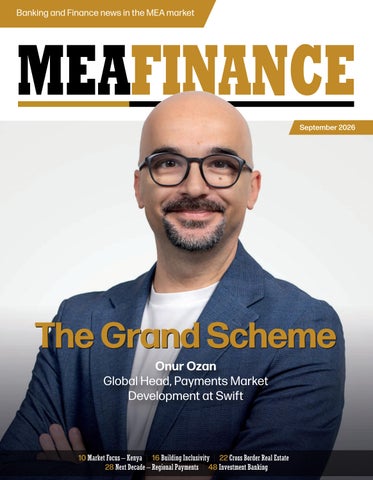
September 2026
The Grand Scheme Onur Ozan, Global Head, Payments Market Development at Swift
September 2026
The Grand Scheme Onur Ozan Global Head, Payments Market Development at Swift A MEA Finance Publication
10 Market Focus – Kenya | 16 Building Inclusivity | 22 Cross Border Real Estate 28 Next Decade – Regional Payments | 48 Investment Banking
Remit to Remit
W
elcome to the September 2026 edition of MEA Finance Magazine. In this issue, much content, as is fitting at the time of our annual Leaders in Payments Summit and Awards, focuses on payments. It is fair to say that payments are the operational backbone of banking, finance and the modern economy; a metaphor that needs no explaining. Payments are part of our daily personal and business lives, and pretty much always have been. However, where in the not too distant past, making and receiving payments were a conscious activity, often requiring a physical presence, they are now dematerialising from our to do lists and taking place in a dimension created by technology, with an ecosystem increasingly managed by AI, itself instructed with a remit to remit. Spurring the introduction you have just read, starting at page 28, is our article looking at the coming decade for payments across our region. Among the projections and predictions in this piece, it argues that banks may compete according to how effectively technology chooses between networks on behalf of the customer. Following our look into the payments future, our cover interview this month features Onur Ozan, Global Head, Payments Market Development at Swift. Ozan says, “The reference point for customers has fundamentally changed. People do not compare an international payment with what an international payment looked like five or ten years ago”. Also inside, we cover the growing place of technology and AI in wealth management and HNW advisory; what it does well and what it currently has no hope of achieving, and how these differences are blending into a hybrid service. And in our look at cross-border real estate, we note that investment is entering a more selective but increasingly global phase, and investors now
balance a range of considerations including demographic growth and geopolitical risk. This issue includes a diverse mix of contributors including Dan Robinson, Partner at AcuityX pointing to essential considerations and understandings when committing to the adoption of AI, stating, “AI transformations are an operating-model shift, not a systems upgrade”. In his opinion on the future of Open Banking in Riyadh and Manama, Hesham Mohamed J., Chief Executive Officer, Graystone Capital says, “ The Gulf does not need to relive the paymentsera decade of open banking”, and Akash Anand, Managing Director, Middle East and Africa at Avaloq highlights that in wealth management, “AI is moving rapidly from experimentation to practical implementation”. Returning to our lead features, our examination of the advantages of inclusivity highlights how the ability to serve broader and more diverse markets can create advantages that are both measurable and less easily quantified. Then we cover our region’s burgeoning Investment banking sector, it having now entered a more consequential phase of development. Our selection of contributors also include Saeed A. Assiri, Chief Innovation Banking Officer at Saudi Awwal Bank describing innovation as the essence of their culture, “Innovation is not a department at SAB; it is a mindset and behaviour embedded into our organisational rhythm”. Also Tim Haywood, Managing Director, Middle East at GRT Capital Management Limited, in his piece on private assets, discusses the changing priorities of Middle Eastern investors and opportunities across private markets. For our market focus this month, we head south to one of Africa’s most exciting and innovative banking and financial locations Kenya, itself not new to pioneering payments and where the financial system has repeatedly demonstrated resilience and adaptability. So, please remit us your attention, deposit yourself in a comfortable seat, start turning the pages and receive a rewarding narrative settlement.
mea-finance.com
3
CONTENTS
CONTENTS 34
MARKET NEWS
6
NEOPAY and Commercial Bank of Dubai (CBD) partner to strengthen access to working capital and banking services for SMEs
8
Standard Chartered and LMAX Group expand partnership to include digital asset custody in Luxembourg and DIFC
MARKET FOCUS - KENYA
10 Resilience, Adaptability and Potential BUILDING INCLUSIVITY
16 Win-Win Scenario CROSS BORDER REAL ESTATE
22 Multiple Choice BANKING INNOVATION
26 Pioneering Spirit NEXT DECADE - REGIONAL PAYMENTS
28 Paying it Forward COVER STORY
34 The Grand Scheme
MEA Finance WEB: www.mea-finance.com EMAIL: info@mea-finance.com PUBLISHED BY: Creative Middle East Media FZ LLC, M1 Floor, Twin Towers, PO Box 4422, Fujairah, UAE
4
Banking and Finance news in the MEA market
DIGITAL WEALTH PLATFORMS AND AI-ENABLED ADVISORY
38 Acquiring Insight 44 Special Blend PARTNER CONTENT
46 The Best of Both Worlds INVESTMENT BANKING IN THE MIDDLE EAST
06
10
26
46
54
58
48 Emerged Market PRIVATE ASSETS Traditional Markets: Why 54 Beyond Private Assets are Gaining Ground with Middle Eastern Investors
OPINION PIECE Is the Human You Want Your 56 Who Customers to See When Delivering an AI Transformation?
Gulf’s SME Lending Leapfrog: 58 The Why Open Banking in Riyadh and
Manama Will Be Built on Playbooks Written in Mumbai and Jakarta
debt capital markets: Beyond 62 MENA resilience
PARTNER CONTENT Wealth Platforms and AI60 Digital Enabled Advisory: Why the Future Is Augmented, Not Automated
EXECUTIVE DIRECTOR AND PUBLISHER Kenneth Mitchen ken.mitchen@mea-finance.com GROUP COMMERCIAL DIRECTOR Nap Estampador nap.estampador@mea-finance.com Tel : +971 50 100 5488 DIRECTOR Andrew Cover andrew.cover@mea-finance.com Tel: +971 50 931 3236
BUSINESS DEVELOPMENT OFFICER Geri Teniozo geri.teniozo@mea-finance.com Tel: +971 50 3036879
EVENT AND CONTENT DIRECTOR Natasha Cristi natasha@mea-finance.com Tel: +971 50 303 4235
EVENTS AND MARKETING MANAGER Cris Balatbat crissyb@mea-finance.com Tel: +971 58 594 4818
SENIOR DESIGNER Florante Magsakay Tel: +971 52 570 1811 design@mea-finance.com
EVENTS & MARKETING MANAGER Joy Baldenero joy@mea-finance.com Tel: +971 56 174 7426
ADMIN AND FINANCE MANAGER Marilyn Nainque marilyn@mea-finance.com Tel: +971 58 5025836
WEB ASSISTANT Marie Orayan web@mea-finance.com EDITORIAL editorial@mea-finance.com EDITOR-AT-LARGE Oscar Wendel oscar.wendel@mea-finance.com
Dubai office: Al Saaha Offices, Old Town Island Burj Khalifa District PO Box 487177, Dubai, UAE Email: info@mea-finance.com
mea-finance.com
5
MARKET NEWS
NEOPAY and Commercial Bank of Dubai (CBD) partner to strengthen access to working capital and banking services for SMEs Partnership will help eligible SMEs explore financing and banking services from CBD, using their transaction activity to support easier access to working capital
Vibhor Mundhada, CEO of NEOPAY, and Dhiraj Kunwar, General Manager, Retail & Business Banking at Commercial Bank of Dubai (CBD)
N
EOPAY, a payments solutions provider in the UAE, has partnered with CBD to help small and medium-sized enterprises (SMEs) gain easier access to financing for their working capital requirements and banking services, supporting their growth and day-to-day business needs. Through the partnership, eligible NEOPAY merchants will be able to explore financing options from CBD to support their growth, expansion and
6
working capital requirements. By bringing payment data and banking capabilities together, NEOPAY and CBD aim to make the process of accessing working capital simpler and more convenient for SMEs. Working capital plays a critical role in the day-to-day operations of businesses, helping them manage expenses, meet commitments and invest in opportunities as they arise. However, accessing timely financing can often be a challenge for SMEs. Together, NEOPAY and CBD are
Banking and Finance news in the MEA market
working to create a more accessible route to financing by using transaction activity to provide greater visibility into a business’s performance. The partnership combines NEOPAY’s payment infrastructure and merchant ecosystem with CBD’s banking expertise and financing capabilities. Together, the two organisations will help eligible businesses explore financing solutions that can support their operational requirements and business ambitions. The partnership agreement was signed by Vibhor Mundhada, CEO of NEOPAY, and Dhiraj Kunwar, General Manager, Retail & Business Banking at Commercial Bank of Dubai (CBD). Vibhor Mundhada, CEO of NEOPAY, said: “SMEs want banking and payment solutions that work seamlessly together. By bringing these capabilities together, we are making it easier for merchants to access financing and support their growth ambitions. Every day, businesses generate valuable transaction data that reflects the rhythm and scale of their operations. When used correctly, these insights can help create a more informed approach to financing. Our partnership with CBD brings together NEOPAY’s payments ecosystem and the Bank’s financial expertise to make that connection possible, giving eligible merchants a clearer and more seamless path to accessing the capital they need to keep their businesses moving.” The partnership reflects the shared commitment of NEOPAY and CBD to support SMEs with solutions that address their broader business needs.
MARKET NEWS
Standard Chartered and LMAX Group expand partnership to include digital asset custody in Luxembourg and DIFC LMAX Group becomes first client to onboard in Luxembourg following Standard Chartered’s authorisation under MiCA
S
tandard Chartered announced its appointment as LMAX Group’s digital asset custodian through its DFSA-regulated Dubai International Financial Centre (DIFC) Branch and Standard Chartered Luxembourg S.A. LMAX Group is the first client to join Standard Chartered Luxembourg’s digital asset custody platform following the Bank’s Markets in Crypto-Assets (MiCA) authorisation in June 2026. The appointment builds on the firms’ successful collaboration announced in July 2026, when they executed the industry’s first live digital asset prime brokerage trades by combining Standard Chartered’s banking, credit and custody capabilities with LMAX Group’s regulated, institutional-grade digital asset market infrastructure. Under the expanded partnership across custody and settlement , Standard Char tered will provide secure digital asset custody services to support LMAX Group’s growing institutional digital asset business. The dual appointments through DIFC and Luxembourg provides LMAX Group with access to regulated custody solutions across key international financial centres, supporting the firm’s expanding institutional client base across the Middle East and Europe.
8
Ole Matthiessen, Global Head, Transaction Ser vices & Digital Assets Standard Chartered said: “As institutional clients continue to scale their digital asset businesses, they need trusted infrastructure that can operate seamlessly across markets and regulatory regimes. By combining bank-grade custody in DIFC and Luxembourg with our broader trading and prime brokerage capabilities, Standard Chartered is helping to shape a connected, institutionalised digital asset ecosystem. We are pleased to partner with clients such as LMAX Group as they expand their digital asset proposition across markets.”
we continue to build the foundations for the next generation of institutional digital asset markets.” David Mercer, CEO, LMAX Group, said: “Standard Chartered is establishing itself as one of the leading banking partners for the institutional digital asset market. Following our successful collaboration in digital asset prime brokerage, this expanded custody partnership represents a natural next step. The combination of their regulated custody capabilities in both the DIFC and Luxembourg provides us, and the industry more broadly, with robust, institutional-grade infrastructure to support the continued growth of our digital asset business and the evolving needs of our clients.”
Building the future of institutional digital asset infrastructure
Ole Matthiessen, Global Head, Transaction Services & Digital Assets Standard Chartered
Margaret Harwood-Jones, Chair of the Board, Standard Chartered Luxembourg S.A., said: “Our MiCA authorisation marked an important step in Standard Chartered’s digital asset strategy in Europe, and we are proud to welcome LMAX Group as the first client to join our Luxembourg platform. This milestone demonstrates the growing demand for trusted, bank-grade digital asset infrastructure operating within a clear regulatory framework. We look forward to working with LMAX Group as
Banking and Finance news in the MEA market
As part of their shared vision for the future of institutional digital asset markets, Standard Chartered and LMAX Group are exploring the development of off-exchange custody solutions designed to combine the safety of bank-grade custody with seamless access to institutional digital asset liquidity. The initiative aims to address one of the industry’s most important requirements: enabling market participants to access trading opportunities whilst maintaining custody of their assets with a trusted and regulated financial institution, supporting the next phase of institutional adoption through enhanced security, operational efficiency and risk management. Standard Chartered and LMAX Group are committed to delivering secure, transparent and scalable market infrastructure that meets the standards and governance expectations of institutional investors globally.
Hosted by:
24 Nov
2026
Event Partner:
MENA INVESTMENT CONGRESS 2026 UAE 8TH EDITION
Ritz Carlton, JBR Dubai, UAE
REGISTER NOW
MARKET FOCUS - KENYA
Resilience, Adaptability and Potential Kenya is a market in which the financial system has repeatedly demonstrated resilience and adaptability while the broader economy continues to confront structural questions around productivity, fiscal capacity, investment, employment and, ultimately, the ability to convert remarkable financial access into deeper financial health
K
enya occupies an unusually important position within African finance because the country’s influence extends beyond the size of its economy. Nairobi has developed over several decades as a centre for regional banking, insurance, capital markets, technology, development finance and professional services, while Kenyan banks and financial institutions have expanded into neighbouring markets and helped establish the country as an important source of financial capability within East Africa. At consumer level, Kenya became internationally associated with mobile money long before digital finance became a central strategic issue for banks elsewhere. At corporate level, large domestic banks have developed regional franchises spanning several
10
East and Central African economies. At regulatory level, the Central Bank of Kenya (CBK) has had to balance innovation and financial inclusion with credit quality, cybersecurity, consumer protection and the risks created by a rapidly expanding digital-finance ecosystem. This combination of institutional depth, technological adoption and regional connectivity explains much of Kenya’s financial significance, but it also raises the standard against which the sector must now be judged: not simply by how efficiently money can move, but by how effectively finance supports productive economic activity.
Growing Pains These strengths matter because Kenya’s macroeconomic environment has
Banking and Finance news in the MEA market
become more demanding. The World Bank expects real GDP to grow by around 4.7% in 2026 and projects growth broadly within a 4.7–5.0% range over the short to medium term, supported principally by private consumption and a gradual recovery in private investment. That remains a respectable rate by global standards and reflects an economy with diversified sources of activity across services, agriculture, manufacturing, construction, tourism, transport, telecommunications and financial services. Yet the headline growth rate needs to be interpreted against equally important structural c h a l l e n g e s . E m p l oy m e nt g row t h weakened from 4.4% in 2023 to 3.9% in 2024, according to the World Bank, while formal employment represented only around 15 to 16% of jobs. The implication is central to understanding Kenya: economic expansion continues, but the quality, productivity and formality of employment created by that growth remain critical questions. This distinction between growth and its distribution has direct consequences for banking. An economy can produce respectable aggregate GDP growth while households and smaller businesses remain under pressure, particularly where employment is informal, disposable incomes are vulnerable to food and fuel costs and borrowing rates remain high.
Kenya’s banks therefore operate within a market offering significant long-term credit potential while simultaneously confronting borrowers whose cash flows can be unusually sensitive to inflation, weather, interest rates and changes in domestic demand. For senior banking executives, the strategic issue is consequently not simply how fast the economy grows, but where that growth occurs, how consistently it produces income and which sectors generate sufficiently predictable cash flows to support sustainable lending without recreating the asset-quality pressures accumulated during the previous cycle. Inflation provides a clear illustration of how quickly the operating environment can change. Kenya had benefited from an easing inflation cycle, allowing monetary policy to move gradually away from the restrictive conditions that had characterised the earlier period. By August 2026, however, headline inflation stood at 6.6%, while the Central Bank Rate remained at 8.75%. In June, the Monetary Policy Committee had specifically pointed to disruption associated with the Middle East conflict, higher global energy prices and supply-chain pressures after inflation increased to 6.7% in May from 5.6% in April. The CBK nevertheless judged that inflation was likely to remain within the target range in the near term and maintained its policy stance while noting declining average lending rates and improving private-sector credit growth. The picture is therefore materially better than during the period in which inflation, currency pressure and tightening financial conditions all moved against borrowers simultaneously, but Kenya
remains exposed to external price shocks because fuel and imported inputs can transmit global disruption rapidly into domestic costs. The Kenyan shilling forms another important part of this macro-financial equation. Currency stability matters profoundly to a country that imports energy, services external debt and remains extensively connected to international trade and capital flows. The extreme volatility experienced earlier in the cycle highlighted the fiscal and financial consequences of exchangerate weakness because depreciation increases the local-currency cost of foreign-denominated obligations and can feed through rapidly into prices for imported goods. More stable foreignexchange conditions have subsequently improved financial confidence, while the CBK continues to emphasise that its interventions are designed to address excess volatility and maintain adequate reserves rather than defend a predetermined exchange rate. For banks, the improvement reduces some of the immediate pressure surrounding foreign-currency exposures, but it does not remove the need to manage currency risk carefully across corporate clients whose revenues and liabilities may be denominated differently. Exchange-rate stability therefore provides breathing space rather than eliminating the underlying exposure created by Kenya’s integration into international markets. Fiscal conditions present a more persistent challenge. The World Bank continues to assess Kenya as facing a high risk of debt distress and identifies fiscal consolidation as one of the
AT CONSUMER LEVEL, KENYA BECAME INTERNATIONALLY ASSOCIATED WITH MOBILE MONEY LONG BEFORE DIGITAL FINANCE BECAME A CENTRAL STRATEGIC ISSUE FOR BANKS ELSEWHERE
central macroeconomic priorities. This matters to banking through several interconnected channels. Government borrowing competes with the private sector for domestic capital; debt-service requirements limit fiscal resources available for infrastructure and other productive expenditure; tax increases intended to improve revenue mobilisation can weaken disposable income or business cash flow; and uncertainty surrounding fiscal policy affects investor sentiment and the cost at which both the sovereign and private sector can access funding. Fiscal sustainability is therefore not separate from the banking outlook. It influences the price of money, the allocation of savings, the financial condition of borrowers and ultimately the capacity of the private economy to invest.
Monetary Environment For the banking sector, sovereign debt creates an accompanying strategic allocation question. Government securities can provide banks with relatively liquid income and an important component of balance-sheet management, particularly when yields are attractive relative to private-sector lending after adjusting for credit risk. But an economy cannot realise its full growth potential if too much financial capacity circulates between banks and the sovereign while productive enterprises remain underfinanced. The tension between government financing and private-sector credit is therefore one of the most important issues in Kenya’s financial development. Banks need government securities for liquidity, risk management and portfolio purposes, while the economy needs those same institutions to channel capital towards companies, infrastructure and the wider employment and productivity generating economy. The objective is not to eliminate bank exposure to sovereign debt but to achieve a healthier balance in which government financing does not become the default destination for capital that could otherwise support viable private investment. mea-finance.com
11
MARKET FOCUS - KENYA
The environment is becoming somewhat more constructive as monetary conditions ease. The CBK has reported improving private-sector credit growth and declining lending rates through 2026, although borrowing costs remain significant. In July, the average lending rate reported by the Central Bank was approximately 14.39%, materially above the policy rate and still demanding for borrowers whose margins are already affected by input costs and taxation. The gradual transmission of monetary easing therefore matters greatly. Lower policy rates support economic activity only when they ultimately translate into meaningfully lower financing costs for viable households and businesses, and the strength of that transmission will help determine whether the next phase of Kenyan growth becomes more investment-led or remains constrained by expensive credit.
The Banking Sector This is where Kenya’s banking sector becomes central to the economic outlook. It entered 2026 from a position of considerable scale and resilience. According to the Central Bank of Kenya’s fourth-quarter 2025 review, total bankingsector assets reached approximately KSh8.41 trillion by December 2025, increasing 4.4% during the quarter, while deposits rose 5.4% to approximately KSh6.27 trillion. The sector’s capital adequacy ratio stood at 20.0%, comfortably above the 14.5% regulatory minimum cited by the CBK, and banks remained profitable, generating approximately KSh90.4 billion in profit before tax during the fourth quarter compared with KSh79.8 billion in the preceding quarter. These numbers demonstrate why Kenyan banks have been able to withstand repeated economic shocks: the sector possesses meaningful capital, substantial deposit funding and earnings capacity, giving the stronger institutions room to absorb stress while continuing to invest in technology, distribution and regional growth.
12
THE ENVIRONMENT IS BECOMING SOMEWHAT MORE CONSTRUCTIVE AS MONETARY CONDITIONS EASE The balance-sheet strength should not, however, obscure the industry’s most visible weakness. The gross nonperforming-loans ratio remained high at 15.4% at the end of 2025, although this represented an improvement from 16.9% at the end of the third quarter. Credit risk has therefore begun easing but remains substantial. Elevated NPLs are the accumulated consequence of several pressures rather than one isolated shock: higher financing costs, difficult operating conditions for businesses, delayed payments, pressure in sectors such as construction and trade, and the effects of a restrictive monetary cycle upon borrowers whose debt was accumulated in easier conditions. The challenge for banks is now to support renewed credit growth without allowing improving macroeconomic conditions to weaken underwriting discipline. A healthier credit cycle cannot simply mean originating more loans; it needs to mean allocating more capital towards borrowers whose underlying economics can withstand the next period of volatility as well as the present recovery. This balance between growth and asset quality is particularly important because Kenyan banking remains highly competitive. At the end of 2025, the sector comprised 38 commercial banks, one mortgage finance company, one mortgage refinance company and 14 microfinance banks, alongside representative offices, credit reference bureaux, money-remittance providers and a rapidly expanding population of regulated digital-credit providers. The sheer number of institutions creates competition, but market influence is concentrated among a group of larger banks whose scale, technology i nve st m e n t , d e p o s i t f ra n c h i s e s
Banking and Finance news in the MEA market
and regional operations give them important advantages. KCB Group illustrates the scale Kenyan banking has achieved beyond the domestic market. The group reports an asset base of approximately KSh2.3 trillion, net loans and advances of around KSh1.2 trillion, customer deposits of approximately KSh1.7 trillion and a customer base exceeding 40 million across its wider operations. Its banking businesses extend beyond Kenya into markets including Uganda, Tanzania, Rwanda, Burundi, South Sudan and the Democratic Republic of Congo, making KCB not merely a Kenyan institution but a regional banking platform. The group reported KSh68.4 billion in net profit for full-year 2025, illustrating the earnings power available to institutions able to combine domestic scale with regional diversification. Equity Group represents another model of Kenyan financial expansion, using a strategy built originally around financial inclusion and mass-market banking to create a regional franchise spanning several African economies. Co-operative Bank of Kenya adds a different source of competitive strength through its longstanding relationship with the cooperative movement and SACCO (Savings and Credit Cooperative Organisations) ecosystem, while Absa Bank Kenya and Standard Chartered represent the continuing role of internationally connected banking groups. I&M, NCBA, Stanbic and other institutions further deepen a market in which domestic, regional and international banking models coexist. This diversity contributes to competition and product development, but it also raises the strategic threshold for smaller institutions, particularly as technology, compliance, data infrastructure and
cybersecurit y require increasing investment simply to remain competitive. The structure is already producing consolidation pressure. Banking increasingly rewards scale because the same regulatory, cybersecurity, data and technology infrastructure can support much larger customer bases once established. Smaller institutions therefore need to distinguish themselves through specialist markets, partnerships or targeted customer propositions if they cannot match the investment budgets of the country’s largest franchises. Deloitte’s 2026 East Africa Banking Industry Outlook identifies regulatory change, cyber risk, advanced analytics and potential consolidation among the key issues facing banks across the region, with Kenya occupying a central role because it combines one of East Africa’s most developed banking sectors with an unusually advanced digital ecosystem.
Mobile Money Scale, however, cannot be understood purely through branches, deposits and assets because Kenya transformed the economics of financial distribution through mobile money. Formal financial inclusion reached 84.8% in 2024, according to the FinAccess Household Survey, up from 83.7% in 2021, while the proportion of adults excluded from any form of financial service declined to 9.9%. Mobile money remained the principal driver of inclusion and contributed to narrowing the gender gap in formal financial access to just 1.6 percentage points. Few statistics describe Kenya’s financial achievement more clearly: access to financial services is no longer principally constrained by whether a bank can afford to build a branch near the customer. The scale of mobile finance reinforces the point. CBK data show that Kenya had approximately 42.3 million mobilemoney subscribers in 2024, while monthly transaction volumes reached about 309 million and the value of transactions averaged approximately KSh753.5 billion
per month. The country also had more than 381,000 active mobile-money agents, creating a distribution network whose reach dramatically exceeds conventional banking infrastructure. The system has moved far beyond personto-person transfers. Mobile money now connects payments, bank accounts, savings, credit, commerce, remittances and increasingly broader digital financial services, creating an infrastructure upon which much of the country’s wider financial ecosystem now operates. This transformation changed the competitive logic of banking. Kenyan banks did not disappear when mobile money expanded; many learned instead to build on top of it. Banks partnered w i t h m o b i l e - n et wo r k o p e ra to rs , connected accounts to mobile wallets, developed virtual banking products and moved a growing proportion of routine transactions away from branches. The mobile phone became both a payments instrument and a distribution channel through which conventional banks could reach customers much more economically. Kenya consequently demonstrates one of the most important lessons from the evolution of fintech: technology does not necessarily replace banking when financial systems develop mechanisms through which technology companies and regulated institutions can complement one another. Mobile money solved important problems around distribution and transaction cost, while banks continued providing deposit intermediation, larger-scale credit, corporate banking, treasury, trade finance, investment products and other services requiring more complex balance sheets and regulatory infrastructure.
Credit Control Yet financial access and financial health are not the same thing. A household can possess a mobile wallet and bank account while still having insufficient savings, irregular income, expensive debt and limited capacity to withstand a financial shock. The FinAccess findings themselves
identify financial literacy, consumer protection, youth inclusion, disability inclusion and broader financial health as areas requiring improvement. Kenya’s next phase of financial development therefore needs to move beyond counting accounts towards measuring whether financial services actually improve resilience, productivity and the ability of households and enterprises to accumulate assets over time. Digital credit makes this distinction particularly visible. Technology has made small-value borrowing fast and convenient, but convenience can become harmful where customers accumulate debt without understanding pricing or repayment consequences. Regulatory oversight has accordingly increased. By the end of 2025 the CBK reported 195 digital credit providers within the wider financial-sector structure, demonstrating how rapidly the industry has expanded under formal supervision. Regulation can reduce predatory behaviour and improve transparency, but the underlying challenge remains: digital distribution can make good credit more accessible and bad credit easier to obtain with equal efficiency. F o r b a n ks , t h i s c re a te s b ot h competition and opportunity. Fintech companies can acquire customers quickly and design narrow products without the infrastructure of a universal bank, while banks possess advantages around funding cost , regulator y experience, customer deposits and broader financial relationships. The competitive boundary increasingly depends upon data. Institutions capable of understanding transaction behaviour, income patterns and payment histories can potentially assess borrowers previously excluded by conventional collateral-based lending, creating an opportunity to expand productive credit to MSMEs and households. Yet alternative data is not inherently superior data. It requires strong governance, appropriate consent and careful modelling because automated assessment can generate mea-finance.com
13
MARKET FOCUS - KENYA
false confidence or introduce bias when models are poorly designed. Kenya’s strength in digital finance is therefore evolving towards a second phase. The first phase was principally about access—using mobile technology to connect millions of people to payments and basic financial services. The second is about quality: interoperable payments, affordable credit, savings, insurance, investment, consumer protection and financial products sophisticated enough to support businesses as they grow. The National Financial Inclusion Strategy 2025–2028 reflects this transition, bringing together initiatives around agency banking, credit guarantees, mortgage refinancing, mobile money, payment-service-provider interoperability, digital credit and the development of a fast-payment system. Remittances add another dimension to this architecture. Diaspora inflows have become an important source of foreign currency and household income, with the CBK reporting approximately US$5.04 billion in remittances during 2025. Inflows remained resilient into 2026, reaching roughly US$4.96 billion over the twelve months to June, although the six-month figure was somewhat lower than in the corresponding period of 2025. North America remains the largest source region, but flows from Europe, the Gulf and other markets demonstrate the breadth of Kenya’s diaspora relationships. For banks and fintech companies, remittances are important not merely because they generate transfer fees. They connect international payments with savings, housing, education, investment and family finance.
Capital Markets Kenya’s capital markets provide another part of the financial architecture, although
their development has not matched the ubiquity of mobile money or banking. The Nairobi Securities Exchange remains one of Africa’s more established exchanges, with equity, bond, derivatives and ETF infrastructure, while the Capital Markets Authority continues trying to diversify products and deepen participation. In August 2026 the CMA approved the WSA Banking Index ETF, the country’s first locally domiciled ETF, bringing the number of listed ETFs on the NSE to three. The development is incremental rather than transformative on its own, but it illustrates the broader policy effort to expand the instruments available to domestic investors and move household and institutional savings towards capital-market products. D e e p e r c a p i t a l m a r ke t s a re strategically important because banks cannot finance every form of economic d eve l o p m e nt t h ro u g h t h e i r ow n balance sheets. Large infrastructure projects, growing companies, housing, climate-related investment and longduration corporate finance require a broader mixture of bank lending, bonds, equity, private capital and institutional investment. Kenya possesses substantial pension and insurance assets capable of supporting this development, but creating attractive, transparent and investable instruments remains essential if domestic savings are to be channelled more effectively into productive assets. This question of intermediation sits at the centre of Kenya’s economic challenge. The country has demonstrated an exceptional ability to make finance accessible, create digital transactions and build large regional financial institutions. The next challenge is to ensure that the financial system allocates capital towards activities capable of producing sustained increases in productivity, formal employment and
References: World Bank Group — Kenya Country Overview and Economic Outlook, 2026. Central Bank of Kenya — Monetary Policy statistics and key rates, September 2026. Central Bank of Kenya — 2024 FinAccess Household Survey. Central Bank of Kenya — Mobile Payments Statistics. Deloitte East Africa — Banking and Financial Services Outlook 2026.
14
Banking and Finance news in the MEA market
household income. Financial innovation cannot compensate indefinitely for weak business cash flow; digital credit cannot substitute for productive investment; and a highly accessible payments system does not automatically solve the financing gap facing an SME attempting to purchase machinery, expand exports or build a larger workforce. The achievement of inclusion has therefore exposed the next, more difficult challenge: transforming access into capital formation. The private sector consequently occupies a central place in the country’s next growth phase. The World Bank argues that stronger productivity, greater access to skills and capital and improved resilience to climate shocks are necessary if Kenya is to translate macroeconomic growth into higher incomes and faster poverty reduction. This has direct implications for banks. Credit needs to reach sectors capable of creating economic value without weakening asset quality; workingcapital and trade-finance products need to support firms participating in regional and international commerce; agricultural finance needs to recognise both the importance and climate sensitivity of the sector; and financial institutions need to help viable informal businesses develop sufficient records and structure to become bankable. The next stage of Kenya’s banking story will therefore be defined less by whether the sector can continue innovating (it has already demonstrated that capability) and more by whether banks can translate their balance-sheet strength, customer data, technology and regional reach into sustainable credit creation. That question takes the discussion beyond the aggregate resilience of the financial system and into the operating realities confronting individual institutions: how Kenya’s leading banks are competing, where profitability is being generated, which sectors are creating the greatest credit risk, whether consolidation is becoming inevitable and how digital transformation is changing the relationship between scale, inclusion and profitability.
BUILDING INCLUSIVITY
Win-Win Scenario Inclusivity is moving beyond the traditional boundaries of financial inclusion and corporate responsibility to become an increasingly important consideration in how banks design products, deploy technology, develop talent, manage customer relationships and identify future sources of growth. The ability to serve broader and more diverse markets can create advantages that are both measurable and less easily quantified
W
hat value remains uncaptured because an institution does not understand, re a c h o r s e r ve p a r t i c u l a r customers effectively? Few banking markets have transformed as rapidly as those of the Middle East over the past decade. Across the GCC in particular, financial institutions have entered the current period from a position of considerable strength, supported by resilient economies, healthy capital positions, expanding non-oil activity and national transformation programmes
16
that are reshaping the commercial landscape around them. At the same time, the competitive environment has become considerably more demanding. Digital banks and fintech companies are challenging conventional assumptions about distribution and customer acquisition, artificial intelligence is moving deeper into banking operations, instant payments are changing expectations around transactions, Open Banking and Open Finance are creating new possibilities around data and financial services, and customers increasingly expect the convenience, personalisation
Banking and Finance news in the MEA market
and responsiveness they encounter elsewhere in the digital economy. The region’s banks are therefore not confronting inclusivity from a position of weakness; they are considering it while many are profitable, well-capitalised and investing heavily in the future. This makes the timing of the inclusivity debate particularly important.
The Inclusivity Questions Banking has become exceptionally good at discussing how technology can make institutions faster, more efficient and increasingly intelligent, but the next
stage of transformation raises another question: are regional banks also capable of serving more of the economies and societies around them? The answer requires a broader examination of who can obtain finance, who can use increasingly digital banking services effectively, which businesses are adequately served by existing credit models, whether products reflect the circumstances of increasingly diverse populations and whether the technologies now being embedded into banking expand opportunity or inadvertently create new barriers. Inclusivit y in regional banking should consequently be understood as something considerably broader than the conventional definition of financial inclusion. Financial inclusion remains a fundamental component, particularly across the wider Middle East and Africa, where access to formal financial services remains uneven. Across low and middleincome Arab economies in Africa and Asia, around 90% of adults own a mobile phone, yet that high level of connectivity has not translated automatically into equally high financial inclusion. The implication for banking is significant. Much of the physical infrastructure required to reach customers increasingly exists; the challenge is converting connectivity into meaningful and sustainable participation in formal finance. For senior banking executives, however, the strategic relevance goes much further than bringing the unbanked into the system. Inclusivity concerns whether a bank can understand and commercially serve customers whose needs do not conform neatly to the assumptions around which traditional banking models were constructed. It includes, for example SMEs that may be commercially viable but lack long credit histories, younger customers whose first meaningful relationship with finance may begin through a mobile device rather than a branch, lower-income workers for whom transaction costs and remittance functionality have particular importance and customers who may technically
have access to digital banking but lack the confidence or financial literacy to participate fully in an increasingly complex financial system. It also extends internally to the ability of banks to recruit, retain and advance people with different backgrounds and experiences, because the institution attempting to understand a diverse marketplace is ultimately dependent upon the people making decisions inside it.
Diversity vs Inclusion This broader interpretation matters particularly in the Middle East because diversity is not an abstract characteristic of the regional marketplace; it is one of its defining commercial realities. GCC banks operate in economies containing citizens and large expatriate populations, with a customer range from HNWIs through to lower income workers. The economic
institution effectively, obtain products appropriate to their circumstances, progress into a deeper financial relationship and participate in the opportunities created by the financial system. A customer with an account but no realistic pathway towards savings, investment or responsible credit may be banked without being fully financially included. An SME repeatedly rejected because conventional underwriting cannot interpret its business model may possess a corporate account while remaining inadequately served. A diverse workforce may satisfy representation targets while contributing little additional perspective if decision-making remains concentrated among a narrow leadership group. Inclusion is therefore less about simply opening doors than examining what happens after customers and employees pass through them.
THIS IS WHERE THE DISTINCTION BETWEEN ACCESS AND INCLUSION BECOMES COMMERCIALLY IMPORTANT transformation occurring across the GCC is broadening this marketplace as governments seek greater privatesector participation, entrepreneurship, investment, innovation and workforce development. An institution capable of understanding these changing constituencies has access to a progressively larger opportunity set, while an institution that continues to design around a narrower historical definition of the banking customer risks overlooking precisely the segments from which future growth may emerge. This is where the distinction between access and inclusion becomes commercially important. Access asks whether a customer can obtain a bank account, enter a branch, download an application or apply for credit. Inclusion asks whether that customer can use the
Regional regulators are increasingly making this distinction explicit. The Central Bank of the UAE’s Consumer Protection Standards provide one of the clearest examples. The framework defines vulnerable consumers broadly, including low-income groups and People of Determination, and requires licensed financial institutions to ensure access, incorporate anti-discrimination principles, make information suitable for vulnerable customers and consider accessibility throughout product design, business operations, premises and processes. Importantly for bank leadership, responsibility is not confined to frontline customer service: the standards explicitly place responsibility upon boards and senior management to ensure that products, operations and processes are suitable and accessible. The framework mea-finance.com
17
BUILDING INCLUSIVITY
also requires institutions to review retail operations to identify unreasonable barriers faced by People of Determination and to train relevant employees to assist vulnerable groups. The UAE’s updated central-bank legislation, effective from September 2025, reinforces this direction by establishing access to suitable banking and financial products as a principle of financial inclusion and providing for nationwide financial-literacy programmes developed collaboratively by the Central Bank and licensed financial institutions. Inclusivity, in other words, is moving closer to governance, product management and conduct rather than remaining solely within CSR or sustainability departments. This is particularly important because representation and inclusion are not interchangeable. Diversity measures who is present; inclusion determines whether those people participate meaningfully in the organisation. A bank may recruit employees from many nationalities, achieve stronger gender representation or meet nationalisation targets without necessarily changing how strategic decisions are made. The potential commercial value appears when a broader range of experiences contributes to product development, risk discussions, technology design, customer service and leadership. A bank serving customers across different income groups, nationalities, generations and business segments has an obvious reason to understand those constituencies deeply, and some of that understanding can come from the composition and experience of its own workforce. For boards and executive committees, this raises a more substantive issue than headline diversity statistics. The question is whether organisational inclusivity improves the quality of challenge and decision-making. Financial institutions are increasingly making choices about technologies and customer behaviours that are difficult to understand through historical experience alone. AI models are influencing fraud detection, customer service, marketing, credit assessment
18
and compliance; digital channels are replacing interactions once handled by branch employees; and new forms of customer data are being used to personalise services at increasingly granular levels. As these systems become more influential, the range of customers affected by decisions made through technology becomes enormous.
Technology Inclusivity therefore acquires a new technological dimension. The issue is no longer simply whether a bank’s application is available to everyone, but whether digital journeys work effectively for different customers; whether authentication methods are accessible; whether algorithms trained on historical data unintentionally perpetuate historical patterns; and whether the pursuit of frictionless banking for the majority creates friction for customers whose circumstances fall outside standardised digital journeys. An institution can possess an outstanding digital platform and still leave particular groups underserved if accessibility and customer variation were not considered during its design. This is not a theoretical concern when customer experience has become one of the principal battlegrounds in GCC banking. PwC Middle East’s 2025 GCC Banking Sentiment Index, produced with DataEQ, analysed approximately 2.8 million public digital conversations across all six GCC markets between September 2024 and February 2025. Service quality accounted for more than 35% of negative mentions, while digital experiences generated almost one in four negative posts, with mobile application crashes, login failures and payment errors among the recurring frustrations. Fraud concerns were another major source of anxiety. PwC concluded that institutions capable of responding effectively to these issues have an opportunity to transform trust into competitive advantage. Although the study is not specifically an inclusivity survey, its findings are highly relevant to the discussion because they demonstrate how
Banking and Finance news in the MEA market
easily the promise of digital convenience can break down when customer journeys fail. A digital channel that works brilliantly for most customers but repeatedly fails particular types of interaction is not delivering universal convenience. This becomes particularly significant when considering younger and lowerincome customers. Strategy&, part of the PwC network, has previously identified the GCC as fertile ground for digital banking partly because of its large, young and digitally native population, while also highlighting an underbanked segment that can struggle to access conventional services because of factors including self-employment and lower incomes. Digital banks can address some of these barriers by operating with different cost structures and onboarding models, but they also introduce a competitive challenge for incumbents. If established institutions do not design effectively around customer groups historically considered less attractive or more difficult to serve, technology-enabled competitors have an incentive to do so.
The Business Case This is one of the reasons the business case for inclusivity deserves greater attention. The discussion is often framed as though serving underserved groups necessarily involves sacrificing profitability in exchange for social impact. In practice, the commercial question is more nuanced. Some segments may indeed be uneconomic for particular products or risk appetites, and responsible inclusion cannot mean lending indiscriminately or ignoring the economics of customer service. But technology, alternative data, automation and more precise segmentation can change the cost and risk calculations that previously made some customers difficult to serve. A segment that was uneconomic through a branch-heavy model may become viable through digital distribution; a small business difficult to assess through collateralbased underwriting may become more
understandable when transaction and cash-flow data are available; and a customer who initially generates modest revenue may develop substantial lifetime value as income, wealth or business activity grows. SME banking is perhaps the clearest regional illustration. Small and mediumsized enterprises are central to economic diversification throughout the Middle East because they contribute to employment, entrepreneurship and private-sector development, yet financing constraints have historically limited their growth. Saudi Arabia’s regulatory direction illustrates the strategic importance attached to the sector: the Saudi Central Bank has instructed finance entities to develop periodic financial-awareness programmes tailored to SMEs, explicitly connecting this with the Financial Sector Development Program’s objectives of enabling financial institutions to support private-sector growth and improving financial literacy. The message is significant because it recognises that access to capital is only part of the relationship; customers also need sufficient understanding to use financial products effectively. The commercial opportunity for banks extends far beyond the initial SME loan. A small company that survives and expands can become a substantial user of increasingly sophisticated products and services, while its owners and employees may generate additional retail and wealth-management relationships. The value of inclusion should therefore be measured across the lifecycle of a customer rather than at the point of entry. A bank that identifies viable emerging businesses earlier than competitors can potentially grow alongside them, while one whose processes systematically exclude businesses lacking conventional histories may surrender future corporate relationships before they have had the opportunity to mature. Eg y pt p rov i d es a p a r t i c u l a r l y useful example of how an institution c a n a p p ro a c h a n u n d e rs e r ve d business segment more deliberately.
THE VALUE OF INCLUSION SHOULD THEREFORE BE MEASURED ACROSS THE LIFECYCLE OF A CUSTOMER RATHER THAN AT THE POINT OF ENTRY Banque Misr ’s ZA AT programme, developed with IFC support, was designed around entrepreneurs and particularly women entrepreneurs, combining financing with advisor y support, mentoring and training. IFC’s work with the bank included research into the needs of women in business and the development of a sustainable banking model around those findings. A subsequent IFC financing partnership with Banque Misr included $234 million intended to expand access to finance for privately owned micro and small enterprises, with half earmarked specifically for women-owned MSMEs. The importance of the example is not simply that money was allocated to a particular demographic. It is that the proposition began with an attempt to understand why an economically active customer group remained underserved and then designed financial and nonfinancial support around those barriers. Fo r re g i o n a l b a n ks , t h i s i s a fundamentally different proposition from corporate philanthropy. Philanthropy can generate social value without necessarily creating a direct commercial return. Inclusive banking, when properly designed, seeks areas where customer need and commercial opportunity overlap. A woman-owned SME requiring finance is not valuable to a bank because the owner is a woman; it is valuable if the business is viable and capable of developing into a deeper financial relationship. Inclusivity matters because conventional structures may have prevented the institution from recognising or capturing that opportunity. The objective is therefore not to suspend commercial judgement but to improve it. The same reasoning applies to People of Determination. Making branches,
ATMs and digital channels accessible undoubtedly fulfils an important social objective, but accessibility also means enabling customers to interact independently with the bank, reducing avoidable service barriers and enlarging the population capable of using products effectively. Emirates NBD’s experience shows how this can be embedded across infrastructure and employee training rather than treated as a standalone initiative. The UAE regulator’s approach goes further by making the identification and removal of unreasonable barriers an explicit responsibility for licensed financial institutions. Accessibility consequently sits at the intersection of customer experience, regulation, technology and market reach.
Beyond ESG This intersection is important because it begins to explain why inclusivity cannot be contained neatly within the social component of ESG. There is undoubtedly a strong ESG dimension: fair access, workforce representation, financial literacy and support for vulnerable customers clearly relate to social impact, while governance determines whether commitments translate into accountable institutional practice. Yet inclusivity increasingly reaches beyond ESG reporting into the mechanics of banking itself. SME inclusion is part of commercial banking strategy; digital accessibility is part of technology and customer-experience strategy; responsible lending is part of risk; financial literacy intersects with conduct; workforce inclusion affects talent and succession; and the treatment of data in automated decision-making belongs mea-finance.com
19
BUILDING INCLUSIVITY
increasingly within AI and model governance. The ESG relationship is therefore real, but defining inclusivity exclusively through ESG may ultimately make the concept narrower than the business reality. Deloitte’s regional work on financial inclusion captures this commercial convergence directly, describing the opportunity to combine profit and purpose by identifying populations whose access to financial products remains constrained. Its Middle East consumer-protection work similarly argues that increasingly complex products and technological change, combined with low financial literacy and limited access in some jurisdictions, increase the importance of consumer protection, financial education and financial inclusion. The broader implication is that inclusivity is becoming part of the architecture through which trust is maintained as financial services become more sophisticated. Trust may ultimately prove to be one of the most valuable elements of the entire argument. Banking is unusual among industries because the relationship between institution and customer depends upon confidence at virtually every stage. Customers entrust banks with salaries, savings, investments, personal information and increasingly detailed behavioural data. Businesses depend upon banks for liquidity, payments and access to capital. As artificial intelligence and automation make financial services less visibly human, institutions must preserve trust while decisions become faster and more technologically mediated. An inclusive bank is not automatically a trusted bank,
but an institution that understands different customer circumstances, communicates clearly, designs accessible services and demonstrates fair treatment has more opportunities to build that trust than one whose systems repeatedly leave customers feeling unseen or misunderstood.
Missed Opportunities The competitive implications become clearer when these elements are considered together. Regional banks are investing billions across technology, data, cybersecurity, digital channels and new business models because they recognise that future growth will not be secured by balance-sheet strength alone. PwC’s work on intelligent automation describes GCC banks as facing rising customer demands alongside operational pressures, with automation increasingly positioned not simply as an efficiency tool but as a route towards better customer experience and long-term resilience. The same logic should apply to inclusivity. If technology enables a bank to process more customers at lower cost but the institution does not understand which customers remain excluded by its processes, part of the potential value of that technology is lost. For boards and senior executives, the central question is consequently becoming less philosophical and considerably more strategic. What value remains uncaptured because an institution does not understand, reach or serve particular customers effectively? The answer may appear in abandoned digital journeys, viable SMEs financed elsewhere, customers using only a
References: • PwC Middle East, GCC Banking Sentiment Index 2025, analysis of customer conversations and sentiment across the six GCC banking markets. • Strategy& Middle East, part of the PwC network, Banks’ ESG Opportunities and analysis of ESG integration within GCC bank business strategies. • International Finance Corporation and Banque Misr, ZAAT programme and financing initiatives supporting Egyptian entrepreneurs and women-owned MSMEs. • Emirates NBD Group, ESG Report 2025, including accessibility, People of Determination and financial-inclusion initiatives. • Deloitte Middle East, Beyond Balance Sheets: The ESG Imperative for GCC Banks’ Future, benchmarking ESG maturity among GCC and international banks.
20
Banking and Finance news in the MEA market
fraction of the products appropriate to them, employees whose capabilities never reach senior decision-making positions, or new entrants building propositions around segments incumbents considered too small or complicated. These are not necessarily visible losses because they rarely appear as a specific line item in an income statement. They represent revenue, relationships and institutional capability that never materialise. This is where inclusivity begins to move decisively from obligation towards opportunity. The strongest regional institutions will still need disciplined credit standards, rigorous risk management and clear commercial objectives; inclusivity does not diminish any of those requirements. What it can do is challenge banks to examine whether historical assumptions are preventing them from seeing economically viable customers and talent more clearly. In a region where economies are diversifying, populations are highly varied, women’s economic participation is expanding, entrepreneurship is being actively encouraged and technology is reducing the cost of serving increasingly specialised segments, that ability can become materially important. The future competitive question may therefore not be which regional bank can serve everyone indiscriminately, because no institution can or should attempt to do so. It will be which institutions can understand more of the market, identify viable opportunities earlier and remove unnecessary barriers without compromising risk discipline. That is a much more commercially demanding definition of inclusivity, but it is also one far more relevant to the executives determining the future of regional banking. Inclusivity, viewed through this lens, is not simply about who enters the financial system. It is about how much economic value banks can create when more customers, businesses and employees are able to participate in it effectively—and how much potential value institutions leave behind when they cannot.
CROSS BORDER REAL ESTATE
Multiple Choice Cross-border real estate investment is entering a more selective but increasingly global phase, and though money continues to move towards the world’s deepest property markets, investors are now balancing a wide range of important considerations, including demographic growth and geopolitical risk, against the traditional gateway cities. While at the same time, Gulf sovereign investors, family offices, institutions and private purchasers are becoming more important exporters of capital
T
he globalisation of real estate is changing character. For much of the modern investment cycle, cross-border property investment could be understood through a relatively familiar set of movements: Asian and Middle Eastern capital into London and other European gateway cities, global institutions into the United States, international private wealth into a limited number of residential centres and developed-market pension or insurance capital seeking incomeproducing commercial assets abroad.
22
Those patterns have not disappeared, but they now sit alongside a considerably more diverse network of capital flows in which Gulf sovereign institutions acquire platforms internationally, global private-equity managers move between regions according to repricing opportunities, family offices diversify across cities and currencies, wealthy individuals increasingly treat residential property as part investment and part mobility strategy, and developers seek international partnerships capable of providing both capital and expertise.
Banking and Finance news in the MEA market
The scale of that market remains substantial despite the disruption that has defined 2026. JLL recorded US$216 billion of global direct commercial realestate transaction volume in the first quarter, an increase of 18% year on year, while cross-border investment rose even faster, increasing 37% to US$55 billion. EMEA attracted 40% of that cross-border capital, with the Americas and Asia-Pacific each receiving 30%, producing what JLL described as the most evenly distributed geographic pattern of cross-border investment on record. Asia-Pacific direct investment increased 31%, the Americas 25%, while EMEA declined modestly by 2% against a particularly strong comparative quarter. This is an important starting point because the geopolitical shock of 2026 has not caused investors to retreat uniformly towards domestic markets. Capital is still crossing borders, but it is doing so more selectively and increasingly towards locations in which pricing, liquidity, occupier fundamentals and future exit routes can be understood with confidence. That distinction matters enormously to banks, wealth managers and other financial institutions across the Middle East because real estate is both an asset class and a gateway into much broader financial relationships. A wealthy family purchasing residential property in London or Dubai may require mortgage
financing, tax planning, trust and estate structures, private banking and eventually wealth-management services around the rest of the portfolio. An institutional investor acquiring a European logistics platform can require acquisition finance, hedging, fund structures, custody, capital-call facilities and eventual refinancing. A sovereign investor entering a foreign market may combine direct property investment with infrastructure, operating businesses and development partnerships, while a developer acquiring land abroad may require financing in one currency while receiving revenues in another. Cross-border real estate therefore creates banking opportunities extending far beyond the property transaction itself. The attractions of individual markets must consequently be understood according to the capital pursuing them. The world’s largest institutional investors generally prioritise liquidity, market transparency, income durability, tenant depth, financing availability and an eventual route to exit. Private purchasers can assign considerably greater weight to lifestyle, education, residency, family mobility and capital preservation. Sovereign investors can tolerate longer holding periods where an asset or platform serves a strategic objective, while opportunistic funds deliberately seek markets in which distress, repricing or operational complexity create the possibility of higher returns. A city can therefore become highly attractive to one category of cross-border investor while remaining relatively unattractive to another, and the strongest international markets are increasingly those capable of serving several pools of capital simultaneously.
Global Markets For global commercial property, the United Kingdom has re-emerged prominently as investors look for markets where pricing has adjusted sufficiently to restore the relationship between asset values, borrowing costs and prospective returns. Knight Frank’s 2026 Active Capital Survey, covering 119 major investors representing
CROSS-BORDER REAL ESTATE THEREFORE CREATES BANKING OPPORTUNITIES EXTENDING FAR BEYOND THE PROPERTY TRANSACTION ITSELF more than US$1.4 trillion of assets under management and tracking approximately US$144 billion of intended deployment, placed the UK as the leading destination for global investment intentions, with 60% of respondents planning to target the market during the year. London retains an especially important role in cross-border investment because few cities combine comparable pools of occupiers, lenders, advisers, international investors and tradable institutional assets. CBRE’s 2026 European Investor Intentions Survey, based on responses from nearly 700 investors, again ranked London as Europe’s leading city for crossborder investment, ahead of Madrid, Warsaw, Barcelona and Milan, while Spain ranked first at country level. Southern Europe is benefiting from another set of dynamics. Spain’s rise to the top of CBRE’s European country preferences reflects resilient macroeconomic fundamentals and strong demand across key property sectors, while Madrid and Barcelona remain prominent institutional destinations. Italy and selected Central and Eastern European cities are also drawing crossborder attention as investors widen their search for income and growth beyond the traditional London–Paris–Frankfurt axis. Asia-Pacific presents a different investment map. CBRE’s 2026 investor research ranks Tokyo as the preferred cross-border destination in the region for a seventh consecutive year, supported by attractive debt economics and stableto-growing cash flows. Sydney follows, reflecting investor interest in historically attractive pricing, demographic strength and high-quality CBD offices, while Singapore and Seoul share third place and Hong Kong has returned to the top five.
Japan’s position is especially instructive because it demonstrates that crossborder investors increasingly analyse the relationship between property yield, borrowing cost and income growth rather than chasing nominal economic growth alone. Tokyo has remained attractive partly because financing economics can support attractive spreads while a deep occupier market and growing international interest provide liquidity. Singapore fulfils another role as both an investment destination and a regional capital hub. Its political stability, legal infrastructure and position within Asian finance make it attractive to investors seeking a relatively transparent base from which to gain regional exposure, while lower debt costs have strengthened the appeal of core and core-plus investments. Seoul has similarly strengthened as its investable universe broadens beyond traditional offices into logistics, hotels, multifamily and data centres, demonstrating how the growth of new property sectors can change the international relevance of a market. Hong Kong’s return to the regional top five reflects renewed investor interest, particularly from mainland Chinese capital, alongside opportunities in living and hospitality assets. The United States remains too large and diverse to be treated as a single investment market. Its attraction to international capital rests upon enormous market depth, a broad range of investable sectors, sophisticated financing markets and the ability to deploy capital at a scale few jurisdictions can match. Yet those same characteristics make the US operationally demanding. Regulation varies by state and municipality, taxation can be complex, foreign investors must understand both federal and local mea-finance.com
23
CROSS BORDER REAL ESTATE
considerations, and market conditions can differ dramatically between cities that are grouped casually under a single national allocation.
Regional Markets For Middle Eastern investors, however, the most significant change in the global cross-border map may be occurring closer to home. Dubai has become both a destination for global wealth and an increasingly important base from which that wealth invests internationally. Its property market sits at the intersection of residency, entrepreneurship, private wealth, tourism and financial services in a way that makes conventional measures of institutional real-estate investment only part of the story. International residential purchasing has become particularly important because property frequently accompanies the relocation of people, companies and family capital into the UAE, transforming the property transaction from a simple asset purchase into one component of a much wider movement of wealth. Knight Frank’s 2026 Wealth Report found that prime residential values across the Middle East rose by an average of 9.4% during 2025, the strongest regional performance globally, compared with global average growth of 3.2%. Dubai recorded a 25.1% increase in prime residential values, second among the markets highlighted only to Tokyo’s 58.5%. Dubai also recorded 500 home sales above US$10 million during 2025, illustrating the depth that has developed at the upper end of the market. These figures should not be interpreted as evidence that price growth can continue indefinitely, but they do demonstrate the extent to which Dubai has entered the competitive landscape for internationally mobile private wealth. The first half of 2026 provides an even more useful test of whether that demand can withstand geopolitical disruption. Knight Frank recorded 296 Dubai homes changing hands for more than US$10 million during H1, including
24
26 transactions above US$25 million, with the total value of US$10 million-plus sales reaching US$5.1 billion. The value was 14% higher than in H1 2025, while the number of transactions increased 16%. This does not mean geopolitical risk is irrelevant to Dubai, nor does the performance of the ultra-prime segment necessarily represent the direction of the entire residential market. CBRE reported moderation in the wider Dubai residential sector during the second quarter as demand softened, transaction activity declined and new supply began easing pricing pressures. The contrast is itself important: internationally mobile wealth at the very top of the market can remain highly active even as broader residential conditions become more balanced. The buyer base demonstrates how genuinely cross-border the market has become. International purchasers are attracted not simply by expected property appreciation but by Dubai’s position as a business centre, transport hub, financial-services market and base for internationally mobile wealth. For financial institutions, the distinction is important because a purchaser relocating a business, establishing a family office, obtaining residency, educating children in the region or transferring a larger portion of personal and corporate wealth into the UAE creates a relationship extending far beyond the property itself. Deposits, investment management, lending, payments, foreign exchange, corporate banking and succession planning can all follow the original real-estate decision. Abu Dhabi occupies a different position but is becoming increasingly relevant to international property capital through the combination of sovereign wealth, financial-services expansion, high-end residential development and constrained prime commercial supply. Its appeal is less dependent upon replicating Dubai’s transaction volumes than upon developing a deeper institutional ecosystem around investment management, business relocation and high-quality residential
Banking and Finance news in the MEA market
and commercial property. CBRE’s Q2 2026 research recorded Abu Dhabi office occupancy at approximately 96%, alongside annual rental growth of nearly 16%, demonstrating the continuing tightness of the office market even as the wider regional environment became more difficult. The emirate’s residential sector also continued to outperform during the quarter, supported by domestic demand, investor confidence and off-plan activity. These conditions make the UAE one of the clearest examples of how inbound and outbound real-estate capital can reinforce one another. International investors and wealthy families bring capital into the country, while the accumulation of wealth, expansion of family offices and presence of major sovereign institutions create a larger base from which capital can subsequently be deployed abroad. Dubai and Abu Dhabi therefore operate not simply as endpoints for international property investment but increasingly as nodes within a global capital network, connecting capital originating in the Middle East, Asia, Europe and Africa with investment opportunities across multiple jurisdictions. Saudi Arabia could become the most consequential new addition to that network. The Kingdom’s property market has historically been far less accessible to international purchasers than Dubai or established Western markets, but reforms are changing the investable landscape. The new framework governing non-Saudi real-estate ownership took effect on 22 January 2026, opening designated areas of the market to non-resident international property investors and potentially creating a significantly larger international buyer base. Knight Frank’s Destination Saudi 2026 research, based on a survey of 1,550 respondents across several international markets and expatriate communities in Saudi Arabia and the UAE, identified approximately US$6.3 billion of potential private global capital that could target Saudi property as geopolitical conditions normalise. The firm’s subsequent analysis identified approximately US$1.5 billion of potential capital targeting residential
purchases and US$3.4 billion interested in branded residences. These numbers require careful interpretation because they represent potential investment intentions rather than completed capital flows, and the international demand research provides an indication of prospective appetite rather than evidence that US$6.3 billion will necessarily enter the market. The distinction is particularly important in 2026 because geopolitical disruption can affect travel, capital mobility, business relocation and investor confidence between the point at which interest is expressed and the point at which a transaction completes. Nevertheless, the underlying structural change is significant. Saudi Arabia should not yet be described as an established international property market comparable with London, Dubai or Tokyo, but it is deliberately constructing the legal and commercial architecture through which it could become a considerably more important cross-border destination.
Foreign Ownership Opening a property market to foreign ownership can generate capital, increase liquidity and connect domestic d eve l o p m e nt m o re c l o s e l y w i t h international wealth, but international demand is never automatic. Among many other considerations, buyers need confidence in title, registration, dispute resolution, taxation and the long-term clarity of ownership rules. Developers need to understand international expectations around completion risk and property management, banks need financing structures appropriate to nonresident purchasers, and brokers and advisers need sufficiently transparent market data to support credible valuation. Regulatory liberalisation is therefore the beginning of the process rather than its conclusion. The experience of Dubai demonstrates how powerful the combination of clear ownership structures, international connectivity, lifestyle, business migration
and financial infrastructure can become, but Saudi Arabia will develop according to its own market characteristics rather than reproducing the Dubai model. Riyadh’s appeal is closely connected to business expansion, inward corporate migration, population growth and demand for high-quality commercial and residential property. Jeddah combines commercial importance with lifestyle appeal, while Makkah and Madinah possess religious and cultural attractions fundamentally different from conventional global property investment. Knight Frank’s re s e a rc h s u g g e s t s s u b s ta n t i a l international interest in the Holy Cities among surveyed high-net-worth individuals, illustrating how cross-border purchasing motivations can include cultural and personal considerations alongside financial return. T h i s d i ve rs i t y of m ot i va t i o n s is becoming one of the defining characteristics of international real estate. An institutional investor buying a Tokyo office building, an Emirati family purchasing a London home, an overseas investor considering a Saudi branded residence and a sovereign wealth fund acquiring a logistics portfolio in the United States may all appear within the same broad category of cross-border property investment, yet the economic drivers, financing structures, risk tolerances and expected holding periods can be entirely different. For banks, wealth managers and advisers, the commercial opportunity increasingly lies in identifying those differences before competitors do, because property ownership can reveal broader requirements around financing, liquidity, foreign exchange, wealth structuring, corporate expansion and succession. Private banks in particular need to treat overseas property as part of total wealth rather than as an isolated asset. A client with properties across Dubai, London, Paris and New York has currency exposure, tax obligations, succession questions, financing requirements and concentration risk
that should be considered at portfolio level. Commercial and investment banks serving institutional investors require capabilities spanning acquisition finance, refinancing, hedging, fund finance and potentially asset-level capital-market structures, while developers operating internationally require construction and project finance alongside advice on local partnerships and capital structures. Realestate funds require custody, treasury, subscriptions, capital-call facilities and foreign-exchange management. Crossborder property can consequently deepen banking relationships precisely because it creates complexity. Cross-border real estate is ultimately about capital seeking a productive home outside its country of origin, and while the leading destinations will continue changing as economic cycles, regulation and investor priorities evolve, the fundamental attraction of international property remains intact because investors rarely seek return alone; they also seek diversification, security, access and optionality. AI will improve the tools through which those choices are made without making the choices themselves less consequential. In a world where capital can compare more markets, assets and risks more quickly than at any previous stage in the development of institutional property investment, the advantage will increasingly belong to the locations, institutions and investors capable of converting information into informed conviction because, regardless of how sophisticated the technology becomes, confidence remains the currency without which cross-border real estate cannot move. References: • JLL — Global Real Estate Perspectives / Global Capital Markets, 2026. • Knight Frank — Active Capital Survey 2026. • CBRE — European Investor Intentions Survey 2026. • CBRE — Asia Pacific Investor Intentions Survey 2026. • CBRE — UAE Real Estate Market Review Q2 2026. • Knight Frank — The Wealth Report 2026. • Knight Frank — Destination Saudi 2026
mea-finance.com
25
BANKING INNOVATION
Pioneering Spirit Saeed A. Assiri Chief Innovation Banking Officer, Saudi Awwal Bank describes innovation as the essence of their culture and how with initiatives such as their Innovation Centre, they emphatically underline their place as a futureready, sustainable growth engine, contributing significantly to Vision 2030’s aims
S
AB launched its Innovation Centre earlier this year — a significant milestone for the Bank. What inspired this initiative, and what does it represent?
The Innovation Centre was born from a clear conviction: that the future of banking will be defined by agility, experimentation and purposeful collaboration. For SAB, this is not an adjunct activity but a structural investment in the Kingdom’s Future-Ready, Sustainable Growth agenda. When we conceived the Centre, our intent was to create a dedicated space where new ideas could move from insight to impact within a controlled, measurable environment — bringing together our people, partners and clients to co-create s o l u t i o n s a d d res s i n g re a l -wo r l d challenges facing the financial sector and the Kingdom’s evolving digital economy. T h e C e n t re e m b o d i e s S A B ’s confidence in Saudi Arabia’s innovation journey — a journey aligned with Vision 2030 and the ambition to position the Kingdom as a leading regional hub for fintech, data and digital infrastructure. It represents our belief that innovation
26
must be institutionalised: governed, measurable and driven by purpose.
How is SAB embedding this “innovation DNA” across the organisation? Innovation is not a department at SAB; it is a mindset and behaviour embedded into our organisational rhythm. Through our flagship programmes — Innovation Champions, SAB Talks, Innovation Spark, 10X and Moonshot — we are nurturing a culture of curiosity, experimentation and problem-solving. More than 5,000 colleagues have engaged with these programmes, translating ideas into measurable business outcomes. Our Innovation Maturity Index has risen by over 20% year-on-year, reflecting tangible cultural progress. We are also the first Saudi bank to be awarded. Innovative Institute a c c re d i ta t i o n , u n d e rs c o r i n g o u r disciplined approach to performancedriven innovation. Our Innovation Champions network, now 100+ strong, acts as catalysts across every business line — connecting teams, nurturing ideas and ensuring innovation becomes part of SAB’s daily rhythm. Together, these initiatives are embedding innovation within the fabric of the organisation — ensuring it is both sustainable and scalable.
V i r t u a l As s et s h a ve b e e n a recurring theme for SAB Innovation Banking. Could you elaborate on the Bank’s progress in this space? Saeed A. Assiri, Chief Innovation Banking Officer, Saudi Awwal Bank.
Banking and Finance news in the MEA market
V ir tual Assets and Tokenisation represent one of the most significant frontiers for financial innovation globally. SAB’s approach has been measured,
c o m p l i a n t a n d fo r wa rd - l o o k i n g , aligning with regulatory frameworks while ensuring readiness for future digital-asset ecosystems. This year, SAB became the first Saudi bank to execute a cross-border pilot transaction using a digital version of the Saudi Riyal through a multi-currency distributed ledger platform — marking a regional milestone in interoperability and settlement efficiency. The experiment delivered measurable results in efficiency, security and risk control within a regulated environment. Building on this, we have piloted to ke n i s e d d e p os i ts a n d I s l a m i c Repo smart-contract settlements in collaboration with international partners,
partners under a common purpose — to accelerate responsible innovation at scale. We operate through an openarchitecture model, enabling fintechs and ecosystem enablers to co-create and test propositions in a secure, compliant environment. Through structured engagement frameworks, we have co-developed use cases across Open Banking, Embedded Finance, Compliance Automation and AI-driven analytics. We also play an active role in policy dialogue and national working groups, shaping the Kingdom’s innovation landscape and helping define standards for digital banking and emerging technologies.
INNOVATION IS NOT A DEPARTMENT AT SAB; IT IS A MINDSET AND BEHAVIOUR EMBEDDED INTO OUR ORGANISATIONAL RHYTHM advancing our readiness for future-state liquidity management and deepening the Kingdom’s participation in the global digital economy. Our focus remains on utility over speculation — enabling secure, transparent and value-accretive applications of blockchain and tokenisation for our clients, corporates and regulators. We are now commercialising these learnings in partnership with both SAB IT and HSBC’s proprietary platform to deliver nextgeneration infrastructure capabilities.
How is SAB fostering collaboration between corporate clients, fintechs and regulators? Collaboration is the cornerstone of our innovation model. SAB has built one of the Kingdom’s most connected innovation ecosystems, bringing together startups, corporates, regulators and venture
Beyond technology, we continue to invest in thought leadership and talent acceleration, nurturing Saudi founders and fintech entrepreneurs — ensuring the innovation economy remains inclusive, sustainable and future-ready.
The Innovation Centre also features a “Sandbox” capability. Can you tell us more about its purpose? Our Sandbox capability is designed to compress the time from concept to decision — providing a safe, real-world testing environment for prototypes under real governance but without real risk. It allows our teams and partners to validate ideas faster, assess regulatory implications earlier, and measure commercial potential before scale. The Sandbox bridges experimentation and execution, determining not only whether
something can work — but whether it should work — in line with SAB’s risk appetite and compliance framework. Th ro u g h t h i s m o d e l , we h a ve successfully piloted innovations in AI-driven risk assessment, SME credit scoring and digital onboarding journeys. Several have now progressed into live use cases and revenue-generating propositions, illustrating our commitment to “safe innovation” — combining agility with accountability.
What are SAB’s priorities for the coming year in Innovation Banking? Our focus for 2026 is scale — translating innovation into measurable commercial value and customer impact. We will further build upon the years growth themes: 1. Embedded Finance – deepening p a r t n e rs h i ps t h a t i nte g ra te financial services seamlessly into digital ecosystems. 2. Open Banking & Data – enabling secure data exchange to power next-generation services. 3. V irtual Assets & Tokenisation – extending proof-of-concept initiatives into production-ready models. 4. AI & Automation – embedding intelligence across risk, finance and operations for measurable efficiency gains. To accelerate this journey, we are leveraging strategic venture investments through SAB Invest’s X-Tech Fund and a regional FinTech Fund II, while deploying capital into high-potential startups that align with the Bank’s priorities in AI, Compliance and Infrastructure Our recent investment in a specialised AI Fund provides early access to nextgeneration technologies that will redefine financial services. This next phase will cement SAB’s position as a Future-Ready, Sustainable Growth Engine — accelerating the pace of innovation, commercialisation and value creation for the Kingdom’s financial future mea-finance.com
27
DATA SECURITY NEXT DECADE - REGIONAL PAYMENTS
Paying it Forward Money moving around the Gulf is likely to encounter increasingly fewer of the delays historically associated with international payments, even though the infrastructure operating underneath may become considerably more complex. By the 2030s, banks may no longer compete primarily according to which network they use; they may compete according to how effectively technology chooses between networks on behalf of the customer
F
or much of modern banking history, international payments have been structurally different from the domestic one. A customer moving money within one country typically interacted with one banking system, one currency, one regulatory framework and a clearly defined settlement infrastructure. Moving the same money across a border could require several institutions, correspondent accounts, foreign-exchange conversions, different operating hours and repeated compliance checks before the beneficiary ultimately received funds. A payment could move between banks that never had a commercial relationship with the original
28
customer, each institution could perform its own screening and reconciliation, and the sender might have limited visibility over the final cost or timing until the transaction was completed. The fundamental pressure on this model comes from the experience customers already have domestically. Across the GCC, central banks have invested heavily in instant-payment infrastructure, digital identity, open banking, mobile banking and new settlement systems. Consumers accustomed to transferring money within seconds at home increasingly find it difficult to understand why sending money a few hundred kilometres across a national border should require a materially
Banking and Finance news in the MEA market
slower or less transparent experience. Corporates feel the same tension at much larger scale. Treasury teams operating across the Gulf can move information globally in real time while the underlying liquidity supporting trade, payroll, supplier relationships and investment remains fragmented among national systems and currencies. Payments technology is consequently being asked to make the financial geography of the GCC behave more like its increasingly integrated commercial geography.
Integrate to Operate This is precisely the problem regional payment infrastructures are solving.
AFAQ, operated through the Gulf Payments Company and supported by GCC central banks, connects the real-time gross settlement systems of participating GCC member states, allowing intra-GCC financial transfers to be processed through a regional architecture rather than relying exclusively upon conventional bilateral correspondent relationships. IMF analysis describes AFAQ as facilitating instant processing alongside same-day settlement finality and irrevocability, while enabling companies to execute many cross-border payments through a single domestic account and thereby streamline payment processes and liquidity management. Saudi Arabia and Bahrain were the first countries connected when the service went live in 2021; Kuwait followed in 2022, the UAE in 2023 and Oman in 2024. The IMF reports that the values of transfers and financial settlements through AFAQ rose by around 300% and 270% respectively in 2023 and 2024, demonstrating that regional payment integration is already moving from institutional design towards actual use. The longer-term significance of AFAQ lies less in its present scale than in the architecture it creates. By the mid2030s, that architecture could become considerably more sophisticated. A corporate treasurer in Saudi Arabia paying a UAE supplier may no longer need to decide whether the transaction should travel through AFAQ, a correspondent bank, Buna or another network. The paymentmanagement system could determine this automatically. A large treasury platform could route one transaction over AFAQ because the currency and destination make it the most efficient option, another through the global correspondent-banking environment because the beneficiary sits outside a regional network, and a third through Buna because that route provides a more appropriate regional settlement path. The concept of a “rail” remains essential for infrastructure operators but becomes progressively less visible to end users.
This is where the future of cross-border payments differs fundamentally from the idea that one network simply replaces another. The coming decade is more likely to produce interoperability between increasingly specialised networks. The Bank for International Settlements has repeatedly identified interoperability as fundamental to improving crossborder payments because payment systems need technical, semantic and business compatibility if users are to transact seamlessly across them. More recent BIS work has pushed the concept further into a “network of networks”, demonstrating how existing domestic financial infrastructures can potentially be connected through neutral interoperability layers without requiring each system to abandon its
the 2030s can therefore become highly integrated without requiring national financial infrastructures to disappear. ISO 20022 will be one of the most i m p o r ta n t fo u n d a t i o n s of t h a t coordination. The standard provides richer, more structured payment data capable of travelling consistently across financial institutions and market infrastructures. Its significance is easily underestimated because standards are less visible than instant-payment applications, but common structured data can allow payment systems to communicate more effectively, reduce manual intervention and improve screening, reconciliation and analytics. For the GCC, ISO 20022 can become part of the connective tissue joining regional infrastructures. If AFAQ,
THE COMING DECADE IS MORE LIKELY TO PRODUCE INTEROPERABILITY BETWEEN INCREASINGLY SPECIALISED NETWORKS underlying architecture. Technology alone, however, cannot remove every obstacle: differences in legal frameworks, regulation, compliance requirements, data standards and institutional arrangements remain central to the difficulty of moving money across jurisdictions. This point is particularly relevant to the GCC because the region is unusually well positioned for payment-system interoperability. The six economies possess sophisticated banking sectors, substantial digital infrastructure, strong central banks and extensive economic relationships with one another, while commercial, investment and labour flows create clear use cases for faster regional payments. At the same time, the GCC does not operate one currency or one unified banking regulator, meaning interoperability is structurally more practical than complete system consolidation. The payment system of
Buna, domestic payment platforms, correspondent banks and international networks can exchange sufficiently consistent information, routing a crossborder transaction between them becomes considerably easier. The future therefore depends not simply upon whether the GCC develops new rails but whether existing and emerging rails become intelligible to one another.
Alternatives This changes the debate around Swift. Asking whether an alternative to Swift will exist by the middle of the 2030s assumes that the principal competition is between one global network and another. In practice, alternatives to some functions historically associated with correspondent banking already exist. Buna provides regional cross-border clearing and settlement capabilities. AFAQ connects GCC RTGS infrastructures. mea-finance.com mea-finance.com
29
DATA SECURITY NEXT DECADE - REGIONAL PAYMENTS
Domestic instant-payment networks can increasingly be linked across borders. Multi-CBDC experiments have examined alternative forms of cross-border central-bank-money settlement, while tokenised deposits and regulated digitalmoney models are being explored for international value transfer. None of these developments means Swift automatically disappears, because Swift’s principal role is financial messaging and connectivity rather than acting as the settlement asset itself, and its strategic strength remains the breadth of its global institutional network. The more credible scenario is therefore that Swift changes alongside the market. ISO 20022 has already transformed the information travelling across its network, while the organisation continues working on instant crossborder payments, transaction tracking, compliance and interoperability with emerging digital-asset infrastructure. Its network can remain highly relevant even where settlement increasingly occurs through different mechanisms because messaging, orchestration, identity, data and connectivity retain value regardless of which infrastructure ultimately completes settlement. This distinction between messaging and settlement will become increasingly important for senior executives considering the future payments landscape. A payment can be instructed through one network and settled through another. A digital wallet can initiate a transaction while a bank account provides the underlying funds. A tokenised deposit can move through distributed infrastructure while central-bank money ultimately supports settlement between institutions. The customer may interact with an AI agent while the actual transaction passes through a conventional banking or card network. Infrastructure that appears to compete at one layer can complement each other at another. The same applies to central-bank digital currencies. The Gulf has played
30
a prominent role in wholesale CBDC experimentation, most visibly through the UAE’s involvement in Project mBridge and Saudi Arabia’s subsequent participation. These initiatives have demonstrated the technical possibility of using shared digital infrastructure to support cross-border transactions involving central-bank money without simply reproducing every stage of the traditional correspondent chain. They should not, however, be interpreted as proof that wholesale CBDCs will become the dominant mechanism for
more technically diverse even where the underlying economic claims remain familiar. Stablecoins add a further possibility, particularly for international settlement and machine-to-machine commerce, although their role within heavily regulated GCC banking systems will depend upon regulation, reserves, issuer credibility and integration with existing financial infrastructure. Rather than assuming that stablecoins, real-time payments, tokenised deposits, CBDCs or
INFRASTRUCTURE THAT APPEARS TO COMPETE AT ONE LAYER CAN COMPLEMENT EACH OTHER AT ANOTHER GCC payments by 2035. The more realistic question is which types of payments benefit sufficiently from tokenised central-bank money to justify a new settlement architecture. Large wholesale foreign-exchange transactions, crossborder securities settlement and certain treasury activities may ultimately provide stronger use cases than ordinary retail transactions already handled efficiently through established banking and card infrastructure. Tokenised commercial-bank money may develop alongside CBDCs. Banks already create deposit money digitally; tokenisation changes how that claim on the bank can move and interact with programmable infrastructure. By the 2030s, corporate treasurers may potentially manage conventional deposits, tokenised deposits and other regulated forms of digital value within the same liquidity architecture, with systems selecting the appropriate instrument according to the transaction. This is another reason predicting one dominant “future payment network” is increasingly difficult. The infrastructure through which money moves is becoming
Banking and Finance news in the MEA market
conventional bank money must ultimately defeat one another, it is more useful to view them as potentially different components within an increasingly interoperable payments stack. The resulting GCC cross-border payment experience could therefore become almost invisible. A user in Dubai sending money to Riyadh may select the recipient and amount while the system identifies the beneficiary, calculates the exchange rate, screens the parties, verifies transaction legitimacy, chooses an appropriate route, secures the necessary liquidity, completes settlement a n d p rov i d es c o n f i r m a t i o n w i t h progressively less manual intervention. A corporate transaction could involve far more complicated liquidity, compliance and reconciliation processes underneath but produce a similarly predictable frontend experience. For banks, however, making payments invisible to customers does not make the payment business strategically unimportant. It does the opposite. Once speed becomes increasingly commoditised, value migrates towards orchestration, liquidity, foreign exchange,
data and the services surrounding the transaction. The global scale of crossborder payments remains enormous: IMF research based on traditional and crypto payment data estimated that the global cross-border market approached US$1 quadrillion in value in 2024. The competitive question is consequently moving beyond who can simply transport the payment towards who can use the transaction to provide the most valuable surrounding services. This shift could be particularly pronounced in the GCC because corporate clients already expect banks to support multiple financial needs around cross-border activity. AI will intensify this shift by allowing the routing and interpretation of payments to become increasingly autonomous. Instead of a treasury employee manually deciding which account should fund every transaction or a consumer repeatedly selecting which credential provides the best economics, intelligent software can increasingly make those choices according to rules established by the customer or institution. The strategic implication is significant because payment initiation can migrate towards machines before settlement infrastructure itself changes fundamentally. A consumer does not need to understand AFAQ, Buna, Swift, a card network or an instant-payment system if an authorised application chooses the appropriate mechanism in the background. A corporate procurement agent could eventually identify a supplier, compare terms, initiate an approved purchase and trigger payment according to pre-established parameters. The “payments world run by AI” therefore does not necessarily mean AI controls central banks or payment infrastructures; it can mean that a growing proportion of the decisions surrounding how, when and through which mechanism payments occur becomes machine-mediated.
Trust Issues The same development creates profound security implications. Fraud has historically
attempted to compromise cards, credentials, accounts or payment systems directly, but stronger network-level security is increasingly pushing criminals towards the individual and towards manipulation of legitimate payment authority. Generative AI lowers the cost of creating personalised phishing messages, impersonating companies and individuals, reproducing voices and constructing convincing digital interactions, allowing criminals to attack trust rather than simply technology. The GCC is particularly exposed to this evolution because it combines affluent consumers, extensive smartphone use, multilingual populations, rapid ecommerce adoption and widespread digital banking. AI can produce communications in Arabic and English, imitate a corporate executive or family member, construct convincing digital advertisements and interact dynamically with victims rather than relying upon static phishing templates. The scam of the 2030s may consequently become harder to recognise precisely because the attacker can increasingly understand context and adapt the deception in real time. Counter-fraud architecture will need to evolve correspondingly. AI is already helping financial institutions analyse behavioural and transaction data in real time; by the 2030s, fraud prevention is likely to become increasingly ecosystembased rather than transaction-based. Systems will examine whether the device, merchant, beneficiary, communication channel, identity, transaction history and behavioural context collectively make sense before money moves. This matters especially in instant payments because speed eliminates much of the time historically available to investigate suspicious transfers after initiation. A transaction that settles irrevocably in seconds requires fraud decisions to occur before settlement or at machine speed during the transaction. The future is therefore likely to involve greater sharing of risk intelligence between institutions because no single bank possesses enough information to
understand every fraudulent network operating across several countries.
Payments Maestro The regional payments system of the 2030s consequently begins to resemble an intelligent network of networks. Domestic instant-payment rails provide national reach; AFAQ connects GCC settlement infrastructure; Buna creates wider Arab cross-border connectivity; Swift provides global financial messaging and connectivit y ; card networks support merchant acceptance and tokenisation; CBDC and tokenised-money infrastructures may provide additional forms of settlement; and AI increasingly determines how customers, businesses and institutions interact with these layers. The commercial contest will not necessarily be over which network survives. It will increasingly be over who owns the orchestration layer. A bank that can intelligently route payments, optimise liquidity, manage foreign exchange, identify fraud and integrate transaction data into a wider corporate or consumer relationship can remain central even if customers rarely think about the bank’s underlying payment infrastructure. A fintech can occupy part of the same layer if it provides a more intuitive interface. Card networks can extend their relevance through tokenisation and support for machine-mediated commerce. Regional systems can reduce dependence upon unnecessarily long correspondent chains. Swift can remain valuable as a global connectivity and data layer even while more settlement occurs through alternative infrastructures. This is why the mid-2030s payment environment is unlikely to resemble a clean technological replacement cycle in which one old network disappears and one new network takes its place. It is more likely to resemble the internet: multiple infrastructures operating underneath increasingly standardised interfaces, with customers largely unaware of which path their data, or in this case their money, takes. mea-finance.com mea-finance.com
31
DATA SECURITY NEXT DECADE - REGIONAL PAYMENTS
Checkout Checking Out And once the cross-border rail itself begins to disappear from the customer’s experience, the next question becomes even more consequential: what does commerce look like when the person initiating the payment begins to disappear as well? By the 2030s, checkout may no longer be a page, card details may no longer be credentials customers routinely enter and many purchases may begin before the consumer consciously reaches a payment screen. The evolution from regional payment infrastructure into agentic commerce is therefore where the coming decade becomes significantly more disruptive. If the defining achievement of crossborder infrastructure over the next decade is to make the payment rail increasingly invisible, the defining achievement of retail payments may be to make checkout itself disappear. The familiar sequence of selecting a product, moving to a checkout page, entering or retrieving payment details, authenticating the transaction and waiting for confirmation is already being compressed by digital wallets, stored credentials, tokenisation and biometric authentication. By the middle of the 2030s, that sequence could become so abbreviated that for many transactions there is no recognisable payment moment at all. A consumer will still authorise the use of money and merchants will still need certainty that they will be paid, but the technical process connecting those two decisions will increasingly take place in the background. This is where the infrastructure described earlier in this article becomes commercially tangible: regional integration matters ultimately because customers and businesses should have to think less about the mechanisms through which money moves. The GCC is particularly well positioned for this transition because the region is not
beginning from a cash-heavy or digitally reluctant base. Saudi Arabia provides one of the clearest examples. The Saudi Central Bank reported that electronic payments accounted for 85% of retail transactions in 2025, up from 79% a year earlier, with the number of electronic retail transactions reaching approximately 14.6 billion. This is not merely evidence that consumers have adopted cards and wallets; it demonstrates that digital payment behaviour has become normal across the Kingdom. The infrastructure supporting that behaviour is also evolving. SAMA has continued developing the national payments environment around mada, ecommerce and tokenised payment capabilities, while seeking to simplify integration between domestic and international payment networks. The direction is towards an environment where customers have more ways to pay while merchants require fewer separate technical relationships to accept them. The same transition is visible in consumer behaviour across the wider Middle East. Half were willing to store card information to reduce friction and 63% expected to shop online more frequently over the following twelve months. In Saudi Arabia specifically, 65% of surveyed adults used digital wallets at least monthly and 36% identified availability of their preferred payment method as a leading priority when buying online. These are survey findings rather than forecasts of where the market will necessarily stand in 2035, but they establish the behavioural foundation from which the next decade begins: consumers increasingly expect payment to be embedded within commerce rather than experienced as a separate administrative task. This matters because payment innovation is entering a different phase. For much of the previous two decades,
References — Regional Payments in the Coming Decade 1. Bank for International Settlements — AI Agents for Cash Management in Payment Systems, BIS Working Paper 1310, November 2025. 2. International Monetary Fund — GCC cross-border payment integration analysis, 2026.
32
Banking and Finance news in the MEA market
the principal objective was digitising the payment instrument. Cash became a card transaction; the physical card became contactless; the card entered the smartphone wallet; and the ecommerce card number became a stored credential. The next stage is less about digitising the instrument and more about abstracting it. The customer does not necessarily need to know which underlying credential, account or payment network completes a transaction if the system understands the customer’s preferences, possesses the necessary authority and can authenticate the purchase securely. For the GCC, the foundations of that future are already visible. AFAQ is connecting national settlement systems; Buna is building a wider multi-currency regional network; ISO 20022 is creating a richer common language for payments; domestic instant-payment systems are redefining expectations around speed; central banks have experimented with tokenised settlement; card networks are moving towards tokenised credentials and agentic commerce; and AI is becoming both a payment-enabling and fraud-control technology. The next decade will determine whether these developments remain parallel innovations or become an integrated regional architecture. If interoperability, regulation and data standards develop successfully, a GCC cross-border payment in the mid2030s could feel increasingly similar to a domestic transfer. The customer will see the beneficiary, amount, exchange rate and confirmation. Everything else— route selection, liquidity, compliance, s e t t l e m e n t , i d e n t i t y a n d f ra u d assessment, will happen progressively in the background. That outcome would represent a much deeper transformation than simply making international payments faster. It would mean that borders remain important legally, economically and monetarily while becoming progressively less visible operationally to the person or business moving money.
SCAN FOR MORE DETAILS AND REGISTER
SCAN FOR MORE DETAILS AND REGISTER
SCAN FOR MORE DETAILS
CONTACT US: Nap Estampador
nap.estampador@mea-finance.com +971 50 100 5488
COVER INTERVIEW
The Grand Scheme Collaboration across regions, markets, central banks, regulators and technology has made cross border payments faster, more direct and agile than at any time. Onur Ozan Global Head, Payments Market Development at Swift points out that despite this, in-country hold-ups still remain, however Swift is working to keep improving customer experiences
T
he Middle East and Africa share attributes key to regional and global economies, so what role do they play in payments innovation?
Onur Ozan, Global Head, Payments Market Development at Swift
34
The Middle East and Africa are extremely diverse markets, and that is part of what makes the region so important from a payments perspective. You have some of the world’s most advanced financial centres and digital infrastructures alongside markets where financial inclusion, remittances and access remain important priorities. You also have major trade, investment and migration corridors connecting Africa, the Gulf, Asia and Europe. That combination creates a strong environment for innovation. Across the region, central banks, financial institutions and payment infrastructures are modernising domestic payment systems, expanding instant payments, adopting international standards and exploring new forms of digital value. What is particularly interesting is that the conversation is increasingly moving beyond individual technologies. The bigger question is how different systems can work together. Crossborder payments inevitably interact with domestic payment infrastructures, different currencies, regulatory regimes
and institutions. The real opportunity for the Middle East and Africa is therefore not simply to adopt new technology quickly, but to help demonstrate how innovation can be delivered at scale while preserving trust, resilience and interoperability. That matters well beyond the region. Payments innovation becomes truly meaningful when it can connect into the wider financial system and deliver a consistent experience across borders.
In what ways have customer expectations changed in recent years? The reference point for customers has fundamentally changed. People do not compare an international payment with what an international payment looked like five or ten years ago. They compare it with the digital experiences they have every day - and increasingly with their domestic payment experience. They expect to know how much something will cost before they commit, when it will arrive, where it is along the way and what the recipient will receive. Speed matters, but predictability matters just as much. This is an important distinction because tremendous progress has already been made in the underlying cross-border infrastructure. Today, 75% of payments travelling across the Swift network reach the beneficiary financial institution within ten minutes, many in seconds. Yet the customer may not always experience that progress. On average, the final domestic stage of a cross-border payment – after the payment has arrived at the beneficiary bank - accounts for around 80% of the total processing time is in. Customers can also still encounter uncertainty around fees, foreign exchange rates, delivery times or the amount ultimately received. In other words, a fastunderlying payment does not automatically translate into a great customer experience. That is the gap we are now addressing with the Swift payments scheme.
The ambition is straightforward: make an international payment feel as predictable and transparent as a good domestic payment. Participating institutions commit to outcomes including upfront transparency on fees and FX, full-value delivery, efficient last-mile processing and end-to-end visibility.
has become extremely fast. Much of the remaining friction sits at the destination in local clearing arrangements, operating models, regulatory processes or the way payments are credited and confirmed. Scaling therefore means working not only with banks, but also with payment market infrastructures, central banks
THE REFERENCE POINT FOR CUSTOMERS HAS FUNDAMENTALLY CHANGED. PEOPLE DO NOT COMPARE AN INTERNATIONAL PAYMENT WITH WHAT AN INTERNATIONAL PAYMENT LOOKED LIKE FIVE OR TEN YEARS AGO Ultimately, customers should not have to understand what happens behind the scenes. They should simply know what the payment will cost, when it will arrive and that the intended value will reach the recipient. That is the standard the industry increasingly has to meet.
How can Swift ensure that its payments scheme is scaling to meet its full-value delivery objectives? Scale is critical, because a payments scheme only creates real value when the experience is consistent across institutions, markets and corridors. The starting point has therefore been to develop the scheme with the industry rather than for the industry. Banks from diverse regions, with different business models and customer bases, have come together around a common objective: improving the cross-border payment experience for consumers and SMEs at scale. That shared commitment is important. This is not simply a new technical capability; it is about establishing a common standard for the experience customers should receive. The second part is connecting the cross-border and domestic legs of the journey. We know the international leg
and regulators to address those frictions. Where instant-payment systems are available, there is an important opportunity to use them for the last mile of an international transaction. We are already seeing markets around the world explore models that allow domestic instant-payment systems to receive cross-border transactions. And finally, scale has to come with measurement and accountability. The scheme is built around outcomes rather than simply participation: Did the customer see the charges upfront? Was the full value delivered? How quickly was the beneficiary credited? Was the transaction visible throughout its journey? That is ultimately how we should judge success. The objective is not simply to have banks adopt the scheme. It is for their customers to recognise and actively choose an international payment experience because they know what they are going to get.
What are Swift’s perspectives on the future of money as digital assets,currencies and tokenisation become more established in the execution of transactions? We believe the future will offer more forms of value, not fewer. mea-finance.com
35
COVER INTERVIEW
Tokenised deposits, stablecoins, central bank digital currencies, tokenised assets and conventional commercial bank money are likely to coexist. The question is therefore less about which technology ultimately “wins” and much more about how institutions can transact seamlessly across those different forms of value without creating new islands of liquidity and infrastructure. This is where interoperability becomes so important. The benefits of digital assets will only be realised at global scale if financial institutions can move between existing and emerging systems securely, predictably and efficiently. The industry should avoid replacing today’s fragmentation with a new generation of digital fragmentation. Swift has been exploring this space for nearly a decade, from early blockchain experiments to work on CBDCs and tokenised assets. We are now adding a blockchain-based shared ledger to our technology infrastructure, initially focused on enabling real-time, 24/7 cross-border payments using regulated tokenised value. But technology is only part of this. For any new form of money to operate at scale, you need trust, resilience, regulatory clarity, standards and reach.
How is our increasingly interconnected payments world influencing the role of central banks and regulators? It makes their role even more important, but also increasingly collaborative. Historically, a regulator could focus largely on the institutions and infrastructure operating within its own jurisdiction. Today, a payment can interact with several financial institutions,
THE INDUSTRY SHOULD AVOID REPLACING TODAY’S FRAGMENTATION WITH A NEW GENERATION OF DIGITAL FRAGMENTATION Swift has spent more than 50 years connecting the global financial community. Our long-term vision is to allow institutions to access and transact across multiple forms of regulated value through trusted infrastructure - giving them choice without requiring the financial system to fragment around that choice.
36
domestic payment infrastructures, currencies, technologies and regulatory frameworks before reaching its destination. No single authority can see or control every element of that journey. At the same time, developments such as instant payments, digital assets and tokenisation increasingly blur the lines
between what is domestic and what is cross-border. A domestic instant-payment system, for example, can become the final leg of a cross-border transaction. Decisions made about access to that infrastructure can therefore have a material impact on international payment speed and efficiency. That creates a need for much closer collaboration between the public and private sectors. Regulators provide the legal certainty, consumer protection, financial stability and trust on which the system depends. The private sector can bring operational experience, technology and a detailed understanding of how payments actually move across institutions and borders. Importantly, collaboration does not mean every jurisdiction needs identical regulation. Different markets will rightly make different policy choices. A more realistic objective is greater alignment around outcomes - ensuring equivalent risks receive equivalent treatment and reducing unnecessary differences that create friction without improving financial integrity. In an interconnected system, strong national regulation remains essential. But increasingly, its effectiveness also
depends on how well it connects with regulation elsewhere.
How can the advancement and standardisation of payments policy be led effectively in our more interconnected world? We need to distinguish between standardising objectives and trying to make every market identical. The latter is neither realistic nor necessarily desirable. Payments operate within different legal systems, currencies, economic structures and policy environments. But there is enormous value in agreeing common outcomes and establishing standards that allow those different systems to communicate. ISO 20022 is a very good example. It gives the global financial community a common language for payments, with richer and more structured data. That is not simply a technical improvement. Better structured data supports greater automation, more efficient compliance, improved reconciliation, better analytics and ultimately a better customer experience. The same principle applies to policy. The G20 roadmap has been powerful because it defines clear outcomes around speed, cost, transparency and access while recognising that markets may take different routes to achieve them. The next phase requires even deeper coordination. Policy-makers, central banks, financial institutions and market infrastructures need to look at the payment journey end-to-end rather than optimising individual components in isolation. A cross-border payment can move extremely quickly between countries and still be delayed by local operating hours, regulatory reporting, data- qualit y issues or domestic processing requirements. So effective standardisation has to combine global ambition with local implementation. International bodies can establish common objectives and principles. Industry standards can ensure systems speak the same language.
National authorities and market participants can then identify the specific frictions that prevent those outcomes from being delivered locally. T h e o b j e c t i ve s h o u l d n ot b e uniformity for its own sake. It should be interoperability: different systems, institutions and regulatory regimes working together well enough that the complexity becomes largely invisible to the customer.
You have witnessed and been present during key developments in payments, so how has this sector evolved and where is it heading? The biggest change I have seen is that the conversation has moved from infrastructure to experience. Years ago, much of the industry’s focus was on whether a cross-border payment could reach the right institution
securely and reliably. Then we focused heavily on visibility and speed. Those were necessary steps, and the progress has been significant. Today the question is different: what does the customer actually experience? A payment reaching another bank in seconds is impressive technically, but the customer ultimately cares about something much simpler: How much will I pay? How much will the beneficiary receive? When will it arrive? Can I see what is happening? That is why I think the next chapter has two dimensions. The first is finishing the job on today’s infrastructure - taking the extraordinary reach, security and speed that already exists and translating it into a consistently great end-to-end experience for consumers and businesses everywhere. That is what initiatives such as the Swift payments scheme are designed to achieve. The second is preparing that infrastructure for a world in which value itself becomes more diverse. We will see traditional account-based payments alongside tokenised deposits, digital currencies and other regulated digital assets. Finance will increasingly become multi-network, multi-asset and always-on. I do not believe this means everything we have today disappears. Financial infrastructure evolves through layers. New capabilities become valuable when they can connect to the scale, trust and reach that already exist. That is why I see interoperability as perhaps the defining challenge for the next decade. Not simply connecting one network to another, but enabling value, information and trust to move seamlessly across technologies, institutions and jurisdictions. Swift’s role has always been to support the secure and efficient movement of value around the world. What changes is the technology and the forms that value may take. The responsibility to connect the financial community securely and at global scale remains remarkably consistent. mea-finance.com
37
DIGITAL WEALTH PLATFORMS AND AI-ENABLED ADVISORY
Acquiring Insight Artificial intelligence is entering wealth management just when global private wealth is expanding, capital is becoming more internationally mobile and highnet-worth individuals expect financial institutions to understand increasingly complicated portfolios. However, serious questions remain about AI’s ability to manage client complexity
D
igital wealth platforms that once concentrated principally on reporting, execution and communication are evolving towards systems capable of analysing portfolios continuously, identifying risks, personalising investment ideas, coordinating specialists and anticipating client needs. For private banks across the Middle East, where Dubai and Abu Dhabi have become increasingly important international wealth centres and Saudi Arabia is building a larger domestic wealth-management industry, the opportunity extends far beyond
38
creating a better mobile application. AI could fundamentally alter the economics of advice by allowing institutions to understand more clients in greater depth while giving relationship managers more time for judgement, trust and complex family conversations. Yet a more disruptive possibility also needs to be considered: if AI becomes capable of constructing portfolios, planning wealth, communicating with clients and executing increasingly complex workflows autonomously, the question may eventually move beyond how technology assists the relationship
Banking and Finance news in the MEA market
manager towards which elements of the traditional advisory relationship still require one.
Complexity The transformation is occurring against an unusually powerful expansion of global wealth. Boston Consulting Group estimates that global financial wealth increased 10.7% during 2025 to US$333 trillion, the strongest percentage growth since 2021, while total net wealth, including real assets, reached US$550 trillion. The significance for wealth managers is not simply that more wealth exists,
but that an increasing proportion of it is internationally distributed. BCG estimates that cross-border financial wealth reached approximately US$15.6 trillion in 2025, supported partly by growing demand for geographic diversification, while the world’s principal booking centres continue competing aggressively for internationally mobile capital. Wealth management is therefore being asked to manage a larger pool of assets that is simultaneously becoming more global, more fragmented and more difficult to understand through the traditional model of one adviser reviewing one portfolio held predominantly within one institution. The complexity becomes still greater at the upper end of the market. UBS’ Global Family Office Report 2026 surveyed 307 family offices across more than 30 markets, representing families with average net worth of US$2.7 billion and total family wealth of US$627.4 billion. Sixty per cent planned to change their strategic asset allocation over the following twelve months, the highest proportion UBS had recorded, while geopolitical conflict had become the leading concern across both short- and long-term horizons. These are not investors choosing between a handful of funds inside a conventional portfolio. Family offices can allocate across listed securities, private equity, private credit, direct businesses, real estate, infrastructure, hedge funds and currencies while simultaneously addressing governance, succession and family objectives. Seventy-seven per cent of the families in UBS’ survey still had an active operating business, demonstrating how frequently private wealth remains connected to entrepreneurship rather than existing as an isolated financial portfolio. For advisers serving this market, understanding the client therefore means understanding the interaction between financial assets and the source from which the wealth itself was created. This is precisely where the conventional digital wealth platform begins to reach its limits. The first generation of platforms made wealth management more
accessible by allowing clients to view portfolios, receive research, communicate securely and execute transactions without relying upon printed statements, telephone instructions or physical meetings. Those capabilities improved convenience but did not necessarily improve understanding because the underlying information
lies in what they imply for the operating model. The strategic distinction is increasingly between institutions redesigning workflows around AI and those simply attaching new tools to legacy processes. Firms possessing unified data, modern technology architecture and organisational commitment can potentially
THE STRATEGIC DISTINCTION IS INCREASINGLY BETWEEN INSTITUTIONS REDESIGNING WORKFLOWS AROUND AI AND THOSE SIMPLY ATTACHING NEW TOOLS TO LEGACY PROCESSES frequently remained fragmented between investment systems, lending, product specialists, relationship managers, compliance teams and external holdings. Artificial intelligence introduces a different possibility. Instead of merely presenting information digitally, a wealth platform can increasingly interpret information, connect relationships between assets and liabilities, identify potential actions and place relevant insights in front of either the client or the adviser at the moment they become useful.
AI Insight Management BCG describes the implications in unusually structural terms. Its 2026 Global Wealth Report argues that AI is beginning to change the economics of wealth management itself rather than functioning merely as another productivity technology. AI is already being deployed across activities including financialplan preparation, portfolio analysis, documentation and increasingly complex workflows, while BCG estimates that AI-first wealth managers could ultimately achieve 25–30% capacity gains across key workflows and increase revenue per adviser by 15–20%. These are projected gains rather than observed industrywide outcomes, but their significance
scale AI throughout the advisory process; institutions whose client information remains fragmented may struggle to move beyond isolated applications regardless of how sophisticated the underlying models become. The specific enhancement for HNWI portfolio management therefore begins with something more fundamental than investment recommendation: creating a more complete representation of the client. Traditional private banking has often segmented clients principally according to assets under management because wealth bands determine service tiers, product eligibility and adviser coverage. Yet two clients with US$20 million of investable assets can have radically different financial circumstances. One may be an entrepreneur whose largest economic exposure remains an operating technology company, while another may be a retired family-business owner whose wealth is distributed across investment portfolios, property and structures established for children. One requires substantial liquidity ahead of corporate expansion while the other prioritises income and succession; one can tolerate volatility in a financial portfolio because the investment horizon is long, while the other may appear diversified but remain mea-finance.com
39
DIGITAL WEALTH PLATFORMS AND AI-ENABLED ADVISORY
heavily exposed to one currency or property market. AUM identifies the size of both relationships without adequately describing either. AI can potentially change this by allowing portfolio information to be considered alongside liabilities, cash flows, external assets, stated objectives, previous interactions and significant life or business events. Capgemini’s 2026 research illustrates why that matters. It found that only 17% of HNWIs surveyed considered their advisory experience seamless and personalised, while 97% of wealth-management firms continued to segment clients primarily according to wealth bands. The weakness is therefore not necessarily a shortage of data but the industry’s inability to convert information held across multiple systems into a coherent understanding of the client. The institutions that solve this problem can move from superficial personalisation— addressing clients differently because they belong to different wealth tiers— towards advice reflecting how the individual’s wealth is actually structured. For HNWIs and UHNWIs, that distinction is especially important because the financial portfolio frequently represents only one portion of the balance sheet. A client can consequently appear conservative when the private-bank portfolio is examined in isolation while remaining highly leveraged or economically concentrated when the complete financial position is considered. The most valuable wealth platform is therefore not necessarily the one displaying the largest number of products but the one capable of revealing relationships that individual accounts conceal. Portfolio concentration provides one of the clearest examples. A Gulf entrepreneur may hold shares in international technology companies because they appear geographically and operationally distinct from the regional business that created the family’s wealth, while both exposures remain sensitive to the same interest-rate or technology-investment cycle. A family
40
may own property in London, equities in Europe and euro-denominated funds and believe it is diversified because the holdings are legally different, despite all three being substantially exposed to European economic and currency conditions. Another client may use several external asset managers whose supposedly independent portfolios contain many of the same large global securities. AI-supported aggregation can identify these hidden relationships more efficiently than account-by-account reporting and provide the adviser with a clearer picture of economic concentration before a market shock reveals it. AI makes this type of analysis more practical because machines can evaluate relationships across considerably more holdings and variables than an individual adviser can monitor continuously. A wealth platform can potentially recognise
and determining whether that change requires attention. It is within that gap between knowing more and understanding enough that the limits of AI-enabled wealth management become most visible, and it is there that the future division of labour between technology and the relationship manager will ultimately be decided.
Not So Smart The difficulty for wealth managers is that knowing more about a client does not automatically mean understanding the client better. AI can aggregate holdings, identify correlations, detect patterns in transactions and retrieve years of interaction history in seconds, yet HNWI advice frequently turns on information that is incomplete, subjective or deliberately kept outside the institution. A platform may know that a client owns a
THE DISTINCTION IS FUNDAMENTAL BECAUSE WEALTH MANAGEMENT IS FILLED WITH FINANCIALLY INEFFICIENT DECISIONS THAT ARE PERFECTLY RATIONAL ONCE PERSONAL OBJECTIVES ARE UNDERSTOOD that a client’s cash position has moved beyond an agreed range, one equity holding has become disproportionately large, credit exposure to the same company appears across several funds, or a currency movement has changed the effective geographic allocation of the portfolio. It can identify upcoming bond maturities, private-equity capital calls and loan repayments together, allowing liquidity requirements to be anticipated rather than discovered after the client requests funds. None of these capabilities requires AI to predict markets successfully; much of the value comes from identifying what has changed within the client’s existing financial position
Banking and Finance news in the MEA market
substantial position in a family company without understanding that the founder considers those shares inseparable from the family’s identity; it may identify that an overseas property produces an unattractive financial return without knowing that it is retained because children live there; it may determine that a portfolio contains excessive cash while remaining unaware that the family is preparing to acquire a business that has not yet been disclosed to the bank. The distinction is fundamental because wealth management is filled with financially inefficient decisions that are perfectly rational once personal objectives are understood. AI can improve
the institution’s ability to organise what it knows, but it cannot reliably infer what has never been communicated, and the danger arises when increasingly sophisticated systems make incomplete knowledge appear complete. This exposes one of the most important shortcomings in the current generation of digital wealth platforms: the client view remains only as comprehensive as the data available to construct it. HNWIs commonly maintain several banking and investment relationships, own assets through companies and family structures and hold private investments whose information is not updated continuously. A platform can consolidate accounts that are technically accessible while still missing operating businesses, direct investments, private loans, trusts, overseas property or assets deliberately held outside digital aggregation. Even information inside the same institution can remain fragmented between investment, credit, banking, corporate and compliance systems. This gap between strategic ambition and execution remains one of the industry’s most important technology challenges because an AI system cannot create a reliable holistic client view simply because the interface appears intelligent. If the data beneath it are incomplete, inconsistent or poorly connected, the resulting personalisation can be sophisticated in presentation while remaining shallow in substance. This is particularly problematic in private markets, where the very assets becoming more important to HNWIs are among the hardest to represent accurately inside a real-time digital platform. A listed equity has an observable market price; a private company, venture investment, private-equity fund, direct property holding or privately originated loan may not. Valuations can be periodic, manager-dependent or based upon assumptions that change much more slowly than public-market prices. Capital can also be committed without being invested immediately, distributions can arrive unpredictably and underlying
portfolio exposures may be disclosed with considerable delay. An AI system analysing the client’s total allocation can therefore create an impression of precision that the underlying assets do not support. A family whose dashboard reports a portfolio value of US$100 million may not possess anything approaching US$100 million of immediately realisable wealth, and the distinction becomes critical when the same platform begins recommending new investments, modelling liquidity or supporting borrowing decisions.
Explainability and Interpretability The commercial incentives surrounding digital engagement make this distinction particularly important. Platforms are naturally rewarded when clients use them more frequently, transact more often or purchase additional products, while good wealth advice can require the opposite behaviour. An adviser may create value by persuading a client not to trade, not to pursue a fashionable investment and not to increase risk after markets have risen sharply. AI systems optimised around engagement, product conversion or revenue can consequently produce outcomes inconsistent with suitability and client-interest objectives unless the institution designs explicit safeguards around what the system is attempting to optimise. The issue becomes more significant as systems move from recommending actions towards carrying them out, because an autonomous agent optimising the wrong objective can execute poor decisions more efficiently than a human adviser ever could. Regulatory attention to generative and agentic AI increasingly reflects this broader problem. FINRA has identified hallucination, bias, privacy and cybersecurity among the risks firms need to supervise and has highlighted the limitations that general-purpose AI agents can face when performing complex industry-specific tasks. The concern extends beyond whether an
AI-generated paragraph contains an error. As systems become capable of initiating multistep processes, firms need to understand what objective the agent has been given, what actions it is permitted to take and where human approval becomes mandatory. Generative AI’s tendency to produce plausible but incorrect information is especially problematic in private banking because confidence is part of the interface. A conventional search system can fail visibly by returning no result; a generative model can provide a fluent, detailed answer even when the underlying information is incomplete or wrong. In ordinary consumer applications this can be inconvenient. In wealth management, an incorrect explanation of a structured product, portfolio exposure, regulatory requirement or other consequential financial matter can influence decisions involving substantial capital. The risk becomes greater because the most persuasive AI systems are conversational. Clients can ask follow-up questions naturally, request explanations in different levels of detail and receive responses that appear tailored to their circumstances. This is an enormous improvement over navigating static research libraries, but fluency can be mistaken for expertise. An HNWI asking why a private-credit investment is appropriate may receive a coherent explanation around income, diversification and volatility without the system adequately recognising that the client’s portfolio already contains substantial illiquidity elsewhere. The recommendation can be correct in general and wrong for the individual, which is precisely the type of failure a wealth platform is supposed to prevent. Explainability therefore becomes central to whether AI can move from information support towards genuine advisory. Deloitte’s 2025 EMEA Model Risk Management Survey, covering 87 banks and 49 insurers across Europe, the Middle East and South Africa, found that more than half of participating institutions mea-finance.com
41
DIGITAL WEALTH PLATFORMS AND AI-ENABLED ADVISORY
identified transparency and explainability as a hurdle to AI adoption. The findings are significant because these are institutions already experienced in model governance. As AI systems become more complex and institutions rely increasingly upon external vendors, understanding why a model produced a particular recommendation can become harder precisely as the consequences of the recommendation become more important. Interpretability is consequently becoming a core requirement for AI adoption in regulated financial services because users and supervisors need sufficient understanding of how systems arrive at conclusions. This is particularly relevant to wealth management, where a relationship manager cannot responsibly tell a client that an investment was recommended simply because the model identified it. The adviser needs to explain why the recommendation is appropriate, which client objectives it addresses, what assumptions support it and what risks could make it unsuccessful. If the RM cannot understand the system sufficiently to defend the advice, the apparent sophistication of the technology becomes a liability rather than an advantage.
There is More to Life AI advisory currently falls short not because it lacks computational power but because wealth itself is not entirely computational. The industr y can model returns, correlations, liquidity and probabilities with increasing sophistication, but it cannot reduce every family objective to a variable without losing part of what makes the objective meaningful. A founder deciding
EXPLAINABILITY THEREFORE BECOMES CENTRAL TO WHETHER AI CAN MOVE FROM INFORMATION SUPPORT TOWARDS GENUINE ADVISORY whether children should inherit equal ownership of a company is not solving a portfolio optimisation problem; a family deciding whether to retain a property with emotional significance is not necessarily maximising yield; and a client seeking Sharia-compliant investment is expressing principles as well as financial preferences. Technology can inform each decision, but treating the measurable elements as though they represent the complete decision creates the illusion of precision. That limitation does not weaken the case for AI in wealth management. It defines where the technology can create the most value. AI is extraordinarily well suited to processing the information s u r ro u n d i n g c o m p l ex d e c i s i o n s , identifying inconsistencies, modelling consequences and ensuring that relevant facts are available when human judgement is required. The relationship manager’s role can consequently become smaller in operational terms while becoming more concentrated in strategic ones. Whether that equilibrium survives increasingly capable agentic AI remains unresolved. The evidence today points towards a hybrid model because trust, explainability, data limitations, regulation and client complexity continue to require
References: • Boston Consulting Group, Global Wealth Report 2026 and AI and the Future Economics of Wealth Management, 2026. • Capgemini Research Institute, World Wealth Report 2026: Wealth.AI — Unlocking Personalization through Augmented Intelligence, 2026. • UBS, Global Family Office Report 2026, May 2026. • Deloitte, research on AI adoption, model risk, explainability and governance across financial institutions in Europe, the Middle East and Africa.
42
Banking and Finance news in the MEA market
human oversight. Yet the technology is advancing rapidly enough that wealth managers should be cautious about treating today’s boundary as permanent. Routine advisory decisions that currently require RM approval may eventually become sufficiently reliable for bounded autonomy, particularly among digitally confident clients and standardised portfolios. What remains human will increasingly be defined not only by what machines cannot calculate but by what clients are unwilling to delegate and what institutions and regulators are unwilling to allow them to delegate. That makes generational behaviour one of the most important indicators of where the boundary may eventually settle. Younger HNWIs are already signalling greater willingness to engage with AI, but their expectations around speed, transparency and self-direction coexist with increasingly complicated inherited wealth. Older generations bring stronger established adviser relationships but are also using digital platforms more extensively as service models evolve. Between them sits a wealth industry attempting to build one advisory architecture capable of serving radically different expectations. Understanding those differences is therefore essential before deciding whether the ultimate destination is autonomous advice or a more powerful relationship manager. The question is no longer simply whether HNWIs trust AI. It is which tasks they trust it to perform, which decisions they want to retain themselves, when they expect an RM to intervene and how those preferences change as wealth passes from one generation to another.
THE WORLD'S LARGEST TECH, AI & STARTUP SHOW 200,000+
6,800+
400+
2,200+
1,300+
1,184
TECH EXECUTIVES FROM 180+ COUNTRIES
STARTUPS
EXHIBITING COMPANIES
INVESTORS WITH $1 TN AUM
GOVERNMENT ENTITIES
SPEAKERS
Scan the QR code to
#GITEXGLOBAL | gitex.com
GET INVOLVED
DIGITAL WEALTH PLATFORMS AND AI-ENABLED ADVISORY
Special Blend Roger Rouhana CEO of Alpheya outlining, the enhancements that wealth platforms and AI advisory can bring, also describes how currently, the best approach to applying these technologies is by blending the unique insights that both the relationship manager and the AI can offer
W
hat specific enhancements do wealth platforms and AI advisory bring to HNWI portfolio management?
personalised. Investors understand developments as they occur. Advisers apply their judgement to current, complete information. The value lies
We are seeing a transformational shift in how high-net-worth individuals manage their wealth: from periodic reviews to continuous, informed decision-making. Wealth management platforms give HNWIs a clearer, more current understanding of their overall financial position. Investors no longer need to wait for a quarterly review or a statement to know where they stand. They see the impact of market developments as they happen. AI advisory takes this further. It monitors exposures continuously, flags emerging risks early and shows how portfolios would respond under different market conditions. Clients are exposed to insights that matter most, at the right time and with the appropriate guidance. All that, delivered either by their relationship manager, or an AI assistant. Together, wealth management platforms and AI advisory move portfolio management from static to adaptive, and from generic to
44
Banking and Finance news in the MEA market
in helping HNWIs make decisions with greater clarity and confidence.
Where do wealth platforms and AI advisory currently fall short in the servicing of the HNWIs needs? One of the challenges we hear often is the fact that technology lacks understanding of the full circumstances surrounding a financial decision. Technology understands the portfolio but it rarely understands the person behind it. Most platforms hold detailed data on holdings, trades and performance. What they miss is the context that actually drives a decision: family responsibilities, plans for a private business, future liquidity needs, succession objectives. Any one of these can turn a sound recommendation into the wrong one, and much of it is never formally recorded. Illiquid wealth is the second blind spot. Property, private businesses and art often make up a significant share of an HNWI’s wealth, yet platforms built around listed securities see them least clearly. AI advisory is only as good as the picture it works from. Give it transaction data alone and it will optimise the portfolio while missing the client. Institutions need infrastructure that captures the full client context and keeps it current, secure and properly governed, so that AI analyses the individual, not just the account. This is where the hybrid model earns its place. The relationship manager completes the picture: the assets the platform cannot fully see, the circumstances it
Roger Rouhana, CEO, Alpheya
was never told about, the priorities that shift over time. AI brings the analysis. The adviser brings the judgement. In relationship-led markets like the GCC, that combination matters. HNWIs want guidance from someone they trust, who understands everything riding on the decision.
What are the most noticeable AI engagement variations between different HNWI generations? G e n e ra t i o n a l d i f fe re n c e s i n A I engagement are likely to be reflected less in whether HNWIs are willing to use the technology and more in how they assess its output and prefer advice to be delivered. Some investors may be comfortable engaging with AI directly, while others may want its analysis interpreted through a trusted relationship manager before it informs a decision. Younger, more digitally confident HNWIs may place greater emphasis on understanding how an AI-generated insight has been reached. They may expect greater transparency around the information considered, the reasoning behind a recommendation and the limitations of the analysis, rather than initially accepting the output. Wealth institutions therefore need AI infrastructure that can support different client experiences. The same underlying capabilities should be available through intuitive digital tools or delivered through an adviser, with clients able to choose how they engage and the level of detail they receive. Relationship managers can then tailor how the analysis is explained
AI ADVISORY IS ONLY AS GOOD AS THE PICTURE IT WORKS FROM
FOR NOW, THE CO-PILOT MODEL PROVIDES THE MOST REALISTIC BALANCE, BUT IT SHOULD BE SEEN AS A MOVING BOUNDARY RATHER THAN A FIXED CEILING and applied to each client’s preferences and circumstances with each route leading to a clearer understanding of the client’s financial position and greater confidence in the decisions being made.
Are wealth platforms adapting to specific local needs, including Arabic language processing and Sharia-compliant Islamic finance principles? We are already seeing wealth platforms adapt more closely to regional needs, with some being built around Arabicnative experiences and Shariahembedded frameworks. At Alpheya, we are making sure our wealth management platform specifically addresses the nuances and dynamics of the MENA market, reflecting the needs of local financial institutions and the investors they serve. This regional focus provides the foundation for more relevant services and experiences as local expectations continue to evolve. These requirements will likely become increasingly important as investor expectations evolve, encouraging wealth platforms to look at the ways their interface can more closely reflect clients’ preferences and needs. Lo o k i n g a t c h a n g i n g i nvesto r behaviours more broadly, our most recent UAE Investor Survey shows that investors are already comfortable with technology playing a greater role in wealth management. 73% are comfortable using AI for investment recommendations, while satisfaction with existing digital investment platforms remains below 40%. This gap suggests that investor appetite is ahead of the experience currently available, creating an opportunity for institutions to
develop services that are not only more intuitive and personalised, but also more closely aligned with the needs of investors in this market. Our view is that the platforms that succeed in this region will be those that combine advanced technology with a deep understanding of how local investors communicate, invest and manage their wealth.
Will the most effective that AI advisory will ever become be in a hybrid role as a co-pilot to RMs? For now, the co-pilot model provides the most realistic balance, but it should be seen as a moving boundary rather than a fixed ceiling. Today, AI can strengthen the relationship manager’s ability to serve each client by monitoring portfolios continuously and surfacing relevant developments worth flagging, thereby enabling advisers to leverage that time gained to focus on the conversations and decisions where human judgment brings the greatest value. However, as technology advances, regulation evolves and investors become more familiar with AI’s capabilities, the role it plays is likely to expand. Investors will engage more directly with AI-generated analysis, while relationship managers increasingly focus on judgement, accountability and the decisions requiring deeper context. The balance between the two will continue to evolve, and I suspect the coming 5 years will see a wide range of archetypes when it comes to how AI is used. Some investors will fully rely on their AI adviser, while others will prefer the human-tohuman touch, particularly around big events or decisions. mea-finance.com
45
PARTNER CONTENT
The Best of Both Worlds Akash Anand Managing Director, Middle East and Africa addresses key questions about the growing role of AI in wealth management, arguing that it can deliver greater operational efficiencies while also maintaining the high levels of personalisation expected by affluent clients
W industry?
hat are the biggest t re n d s c u r re nt l y shaping the wealth management
Wealth management is undergoing a fundamental transformation driven by four interconnected trends: the adoption of scalable technology platforms, rising client expectations, the growing role of artificial intelligence, and increasing interest in alternative assets. Our latest Avaloq wealth insights 2 0 26 res e a rc h s h ows t h a t b ot h investors and wealth professionals expect wealth firms to deliver more personalised, responsive and digitally
46
Akash Anand, Managing Director, Middle East and Africa, Avaloq
Banking and Finance news in the MEA market
enabled experiences. At the same time, wealth managers are under pressure to improve operational efficiency while maintaining the trusted relationships that define the industry. These trends are particularly evident in the GCC. The region, and especially Dubai, continues to attract high-networth individuals, entrepreneurs and family offices from across the world. As a result, wealth managers operating in the DIFC are seeing growing demand for sophisticated advisory services, cross-border wealth structuring and seamless digital experiences. This makes technology not just a competitive advantage but a strategic necessity.
How is AI changing wealth management today? AI is moving rapidly from experimentation to practical implementation. According to the Avaloq industry survey 2026, 93% of wealth professionals in the GCC believe AI will become integral to how they perform their work within the next two years, while 90% believe it will help them deliver more personalised client service. The greatest opportunities lie in enhancing adviser productivity through administrative automation, client reporting and data analysis. Rather than replacing advisers, AI is helping them spend more time on higher-value activities such as strategic advice and relationship management. This is particularly relevant in Dubai and the wider GCC, where financial institutions are embracing innovation and digital transformation. As wealth management businesses scale to meet the needs of a growing affluent population, AI can help firms deliver the high level of personalisation expected by clients while maintaining operational efficiency. However, trust, governance and responsible AI practices remain essential to successful adoption.
What do wealthy investors expect from their advisers today? Today’s investors want the best of both worlds. They value digital convenience and fast access to information, but they also continue to rely on trusted advisers for complex financial decisions. Our research shows that investors remain highly focused on personalised service, timely communication and expert guidance during periods of market uncertainty. They increasingly expect wealth managers to anticipate needs, provide tailored recommendations and engage through their preferred channels. In the GCC, these expectations are often amplified by the complexity of family wealth, succession planning and international assets. Advisers therefore need technology that supports a deeper understanding of client needs while enabling more
AI IS MOVING RAPIDLY FROM EXPERIMENTATION TO PRACTICAL IMPLEMENTATION meaningful and proactive conversations. The firms that succeed will be those that combine advanced technology with strong human relationships.
What role will technology play in the future of wealth management? Technology will form the foundation for future growth in wealth management. Firms need scalable platforms that allow them to launch new services quickly, improve efficiency and adapt to changing client expectations. As regulatory requirements increase and business models become more complex, disconnected legacy systems can limit growth and innovation. Modern, integrated platforms help firms streamline operations, improve data quality and support more personalised services at scale. In fast-growing markets such as the GCC, this becomes especially important. Wealth managers in Dubai are serving increasingly diverse client segments, including entrepreneurs, family offices, international investors and next-generation wealth holders. Technology provides the flexibility needed to support these evolving demands while maintaining the highest standards of service and compliance.
What opportunities do you see for wealth managers in the GCC? The GCC is one of the most exciting wealth management markets globally. The region benefits from strong economic fundamentals, an increasingly sophisticated investor base and a supportive regulatory environment. Dubai’s position as an international financial hub, supported by the DIFC, continues to attract global wealth, talent and investment firms. We are also seeing increasing demand for private market
investments, sophisticated portfolio solutions and digital wealth services. For wealth managers, the opportunity lies in combining global expertise with regional understanding. Clients expect personalised advice, seamless digital experiences and access to a broad range of investment opportunities. Firms that can deliver these capabilities efficiently and at scale will be well positioned for long-term growth.
What is your outlook for the future of wealth management? The future of wealth management will be defined by a balance between innovation and trust. AI, automation and digital platforms will become increasingly important, but the human element will remain central to successful client relationships. As our 2026 researchh highlights, investors continue to value professional advice and personalised guidance. Te c h n o l o g y c a n e n h a n c e t h e s e relationships, but it cannot replace the trust that advisers build over time. In the GCC, this balance is particularly important. The continued rise of Dubai as a global wealth centre creates significant opportunities for firms that can combine cutting-edge technology with deep client relationships. Those that successfully integrate both will be best positioned to capture the next phase of growth in the region’s wealth management industry. Download our report:
mea-finance.com
47
INVESTMENT BANKING IN THE MIDDLE EAST
Emerged Market Investment banking in the Middle East has entered a more consequential phase of its development. Economic diversification, sovereign capital, expanding private enterprise, deeper capital markets and the emergence of the GCC as an important global investment hub have created a larger and more sophisticated market for advisory, capital raising and strategic finance
F
or much of the international financial industry’s history, the Middle East occupied an unusual position within investment banking. The region generated enormous pools of capital, hosted some of the world’s largest institutional investors and provided international banks with important relationships across governments, sovereign wealth funds,
48
energy companies and wealthy families, yet much of the sophisticated investmentbanking activity associated with that capital was historically executed through financial centres elsewhere. London, New York and other established global markets frequently provided the advisory infrastructure through which Middle Eastern capital entered international markets, while regional banking systems
Banking and Finance news in the MEA market
remained dominated by commercial lending, corporate relationships and the financing requirements of economies. That model has been changing for years, but the transformation has accelerated sufficiently for the direction of travel to become unmistakable. Our region is no longer simply a source of capital for the global investment-banking industry, but is becoming a market in which capital is raised, businesses are listed, sophisticated financing structures are created and regional institutions themselves compete for advisory mandates that would once have been expected to flow towards the largest international houses. The numbers prec edin g 2 0 26 demonstrate how far that market had travelled. EY reported that MENA recorded 884 M&A transactions worth US$106.1 billion during 2025, representing a 26% increase in deal volume and a 15% increase in value compared with 2024. The GCC accounted for 685 of those transactions and US$102.1 billion of value, making it overwhelmingly the centre of
regional dealmaking, while cross-border transactions represented 54% of overall MENA deal volume. Middle Eastern dealmaking therefore entered 2026 with considerably greater depth and regional participation than it possessed only a few years earlier.
A New Era That expansion is not being driven by a single cyclical factor. It is the financial consequence of a much larger transformation taking place across the GCC and parts of the wider Middle East. Saudi Arabia’s Vision 2030, the UAE’s continuing development as a global commercial and financial centre, Qatar’s diversification ambitions, Oman’s Vision 2040, Bahrain’s established financialservices ecosystem and the wider movement towards greater private-sector participation are collectively changing the type and volume of transactions generated by regional economies. Governments are creating and expanding industries and sovereign investors are deploying capital strategically at home and internationally. Also underscoring meaningful change, state owned assets are being commercialised, family businesses are considering institutional capital and succession, private-equity activity is developing. Companies operating in technology, healthcare, logistics, renewable energy, consumer markets and advanced industries increasingly require financing structures more sophisticated than conventional bank lending alone. Investment banking grows when economies generate t ran s act io n s, a nd o ur regi o n i s generating more reasons for companies, governments and investors to transact. However, describing this development simply through the number of IPOs or M&A transactions consequently u n d e rsta te s w h a t i s o c c u r r i n g . Investment banking sits between capital and strategic change. Whenever a government monetises an asset, a family business introduces an external investor, a corporation acquires a competitor or
THIS IS ALSO WHY THE PRESENT CYCLE IS QUALITATIVELY DIFFERENT FROM EARLIER PERIODS OF ABUNDANT LIQUIDITY an institution restructures its balance sheet, there is potential demand for advisory, underwriting, financing, valuation, structuring, syndication and risk-management expertise. As regional economies become larger, more diversified and structurally more complicated, the investment-banking market expands with them. This is also why the present cycle is qualitatively different from earlier periods of abundant liquidity. Capital remains important, but transactions are increasingly being used to build capabilities and economic ecosystems rather than merely to increase corporate scale. PwC’s 2026 TransAct Middle East research identifies domestic and intra-regional consolidation, energy and industrial resilience, AI and digital infrastructure and sovereign capital as defining themes. Their CEO research points towards unusually strong acquisition appetite. Nearly threequarters of surveyed Middle Eastern CEOs and close to 80% of GCC CEOs expected to undertake one or more significant acquisitions worth more than 10% of their company’s assets within the following three years, substantially above their global peers. This is not simply an M&A statistic. It indicates a corporate environment in which inorganic growth is increasingly regarded as a mainstream strategic instrument, creating demand for investment banks capable of originating opportunities, valuing assets, arranging finance and executing transactions across jurisdictions.
Sovereign Capital The role of sovereign capital makes the Middle Eastern investment-banking opportunity particularly distinctive.
The region contains some of the world’s most significant sovereign wealth funds and government-related investment institutions, including Saudi Arabia’s Public Investment Fund, Abu Dhabi Investment Authority, Mubadala, ADQ, Qatar Investment Authority and Investment Corporation of Dubai, alongside other state-backed vehicles and development institutions across the GCC. These organisations increasingly act as strategic investors capable of creating companies, consolidating sectors, attracting international partners, taking positions in global industries and using investment to accelerate domestic economic development. Their activities consequently generate advisor y opportunities across M&A, financing, capital markets, private placements, joint ventures and portfolio transactions. The sovereign dimension differentiates the current regional cycle from a conventional investmentb a n k i n g b o o m d r i ve n m a i n l y by inexpensive money. Financing conditions and international interest-rate cycles undoubtedly affect activity, but Middle Eastern transaction demand is also supported by something more structural: long-term national economic strategies backed by significant pools of capital. PwC describes state-aligned capital as continuing to operate both as a source of financing and as an ecosystem architect, helping determine where value chains are established and how new industries develop. Its analysis points towards AI infrastructure, digital platforms, energy, logistics and industrial capabilities as examples of areas in which acquisitions and investment are being used to establish strategic positions rather than simply to acquire financial assets. mea-finance.com
49
INVESTMENT BANKING IN THE MIDDLE EAST
For investment banks, this changes the nature of the client conversation. Advising a sovereign investor acquiring an overseas technology capability that may subsequently be localised within the GCC requires considerably more than transaction execution. Banks need sector knowledge, international n e t w o r ks , f i n a n c i n g c a p a b i l i t y, regulatory understanding and the ability to connect strategic objectives across multiple jurisdictions. Similarly, advising an international company entering Saudi Arabia or the UAE may involve acquisitions, joint ventures, capital raising, local partnerships and ultimately access to public markets.
As the number of available capital options grows, the advisory decision itself becomes more sophisticated. Saudi Arabia has been central to this development. The Kingdom’s economic transformation has created a transaction environment extending across privatisation, public markets, tourism, mining, logistics, financial services, technology, infrastructure and real estate. Tadawul and the Nomu parallel market have provided companies with increasingly visible routes towards public capital. The expansion of private enterprise and the development of new industries have created a pipeline of businesses
THE SOVEREIGN DIMENSION DIFFERENTIATES THE CURRENT REGIONAL CYCLE FROM A CONVENTIONAL INVESTMENT-BANKING BOOM DRIVEN MAINLY BY INEXPENSIVE MONEY The bank involved at the earliest stage can potentially participate through several phases of a client’s development rather than being introduced only once a financing requirement has already been defined. This is where investment banking becomes more deeply embedded within economic development.
Embedding The region is not simply creating more deals; it is creating more situations in which businesses and governments must make decisions about ownership, capital structure, financing and strategic partnerships. The value of the investment bank therefore begins before a transaction is announced. It lies in determining whether an acquisition is preferable to organic expansion, whether a minority strategic investor is more appropriate than a sale, whether a business should borrow privately or enter public debt markets, or whether an IPO should proceed at all.
50
requiring corporate-finance advice. Saudi institutions have simultaneously been developing their own investmentbanking capabilities, producing a more competitive market in which local firms possess relationships and domestic knowledge that can be highly valuable alongside the international reach and distribution strength of global houses. SNB Capital provides one illustration of the scale regional investment-banking platforms can now achieve. As the securities and investment-banking arm of Saudi National Bank, its activities span investment banking, asset management, securities and principal investments, positioning the institution across many of the areas being expanded by the Kingdom’s capital-market development. Al Rajhi Capital, Riyad Capital, SAB Invest, Alinma Investment and other Saudi institutions operate within the same increasingly sophisticated domestic environment. Their importance does not
Banking and Finance news in the MEA market
lie simply in the fact that local banking groups have investment-banking subsidiaries; many have possessed such capabilities for years. The more important development is that the market around them is producing a larger number of more complex mandates over which they can compete. This creates an increasingly nuanced competitive dynamic between regional and international institutions. Global investment banks retain formidable advantages in international distribution, cross-border M&A networks, sector expertise and access to global institutional investors. Regional banks, however, can possess deeper corporate relationships, stronger balance-sheet connectivity, local regulatory knowledge and an understanding of family, government and institutional clients developed over decades. As Middle Eastern companies transact internationally and international investors seek access to regional opportunities, mandates increasingly require combinations of both capabilities. Competition therefore does not necessarily produce a simple transfer of business from international banks to regional institutions. It can generate partnerships, syndicates and advisory structures in which banks contribute complementary strengths. The UAE provides another important centre of gravity. Dubai and Abu Dhabi have developed different but complementary investment ecosystems, combining major financial institutions, international banks, sovereign investors, family offices, private capital and increasingly active public markets. The growth of the Dubai Financial Market and Abu Dhabi Securities Exchange, together with Nasdaq Dubai and the financial-centre ecosystems of DIFC and ADGM, has expanded the infrastructure available to companies and investors seeking capital. At the same time, the UAE’s attraction of international wealth, investment managers, hedge funds, private-equity firms and family offices adds another layer to this ecosystem
because investment banking thrives where companies requiring capital and institutions capable of supplying it are concentrated geographically and institutionally. First Abu Dhabi Bank demonstrates how a major regional commercial bank can use its balance sheet and corporate relationships to build a broader wholesale and investment-banking franchise. Its Global Markets and Global Corporate Finance businesses connect financing, debt markets, risk management and advisory capabilities with a corporate and institutional client base extending beyond the UAE. Emirates NBD similarly o p e ra tes a c ros s c o r p o ra te a n d institutional banking, capital markets and advisory through the broader Group and Emirates NBD Capital, while ADCB maintains capabilities spanning corporate finance, capital markets and institutional banking. The strategic logic is compelling: relationships established through lending, transaction banking and treasury can originate investmentbanking opportunities when clients acquire companies, raise capital or reshape their balance sheets, while successful investment-banking mandates can make broader institutional relationships deeper and more difficult for competitors to displace. This connection between commercial and investment banking is likely to become increasingly important across the region. GCC banking groups frequently possess substantial corporate lending franchises alongside markets and advisor y businesses, creating the possibility of relationship-led investment banking in which an institution can provide acquisition finance, bridge financing, d e bt- c a p i ta l - m a r ket s exe c u t i o n , hedging and strategic advice around the same transaction. The advantage can be considerable when clients value certainty of funding alongside execution. A bank involved in a client’s ordinary lending, cash-management and treasury requirements may also have information and relationships
that make it a natural participant when that company considers an acquisition, capital raising or strategic restructuring. Yet the opportunity should not be mistaken for an easy route to higher profitability. Investment banking is talent intensive, relationship dependent and highly sensitive to reputation. Competing successfully requires experienced senior bankers, sector specialists, research, institutional distribution, legal and regulatory expertise, risk systems and the capacity to invest through periods in which transaction revenues can fall abruptly. Relationships and credentials take years to build but can be damaged by one poor transaction.
transactions proved comparatively resilient. EY’s wider MENA dataset recorded 390 transactions worth US$46.7 billion in H1 2026, compared with 434 deals worth US$58.8 billion a year earlier. The figures show a moderation in activity, but not a market ceasing to function. EY’s data also showed transaction value strengthening significantly during the second quarter, supported by domestic and outbound activity and continuing sovereign investment. The geopolitical environment has also changed the sectoral composition of opportunity. Infrastructure, energy security, logistics, utilities, technology and digital infrastructure become
THIS CONNECTION BETWEEN COMMERCIAL AND INVESTMENT BANKING IS LIKELY TO BECOME INCREASINGLY IMPORTANT ACROSS THE REGION A bank cannot become a leading investment bank merely by establishing an advisory department and hiring a handful of senior names; the franchise depends upon whether boards and chief executives are prepared to support the business through market cycles.
Testing Times T h a t re q u i re m e n t h a s b e c o m e particularly relevant in 2026 because the region has provided exactly such a test. The year began with strong underlying momentum following the expansion of 2025, but geopolitical disruption changed many of the assumptions under which companies, shareholders and investors were preparing transactions. PwC’s mid-year assessment estimated approximately 272 Middle Eastern M&A transactions in the first half of 2026, around 8% lower year on year, with inbound cross-border activity declining more sharply even as intra-regional
more strategically important when g ove r n m e n t s a n d c o r p o ra t i o n s reconsider resilience. Capital that might otherwise have flowed towards discretionary expansion can move instead towards assets regarded as critical to economic continuity or national capability. Islamic capital markets add a dimension in which regional institutions possess genuine accumulated expertise and resilience. Sukuk connects issuers with deep pools of Islamic liquidity while also attracting an international investor base that increasingly evaluates the product as part of broader fixed-income allocation. Saudi Arabia, the UAE and other GCC markets have become important centres for issuance and structuring, while the region’s continuing development and refinancing requirements suggest that sukuk and conventional debt will remain central even during periods when equitymarket volatility interrupts public listings. mea-finance.com
51
INVESTMENT BANKING IN THE MIDDLE EAST
Rebound The rise of investment banking in the Middle East is not simply a financialservices trend but part of the region’s transition towards economies in which capital allocation becomes more diversified, institutional and market driven. That transition will produce failures as well as successes: not every IPO will trade above its offer price, not every acquisition will create value and not every infrastructure project will justify its initial assumptions. Deeper capital markets do not eliminate risk; they distribute and price it differently, which means investment banks themselves need to resist becoming cheerleaders for the transformation they are being paid to finance. Their long-term value lies in disciplined intermediation. That quality becomes particularly important as 2027 approaches because there is a plausible path towards a substantial rebound. The underlying M&A pipeline remains alive and global IPO markets have demonstrated that substantial amounts of capital can return quickly towards compelling issuers when conditions improve. Saudi Arabia continues deliberately deepening debt and sukuk markets, private capital is expanding, Abu Dhabi’s institutionalinvestment ecosystem continues to grow and economic transformation programmes remain active. The ingredients for activity are already present; what remains uncertain is the speed with which confidence can reconnect them. If geopolitical conditions stabilise into 2027, the likely result is not simply an increase in transactions but the release of decisions companies and shareholders were unwilling to make during the
uncertain period. IPO candidates can return, strategic acquisitions can be revived, private-equity sponsors can seek exits, international investors can reconsider opportunities they postponed and companies can execute financing that was deferred when pricing or market access became unattractive. At the same time, debt, sukuk and infrastructure financing can continue while private capital provides another route for transactions that remain unsuitable for public markets. This gives 2027 the potential to become stronger than a conventional post-disruption recovery because cyclical reopening would occur on top of structural capitalmarket development. This should encourage healthy competition in which regional banks become more international while international banks become more regional, enlarging the number of credible advisers available to clients and raising the standards required to win major mandates. The activities benefiting from that competition are likely to reflect current structural requirements. M&A should remain powerful as regional companies and sovereign investors consolidate industries, acquire capabilities and expand internationally, while debt capital markets and sukuk may provide the most consistent activity because governments, financial institutions and corporations face continuous funding and refinancing requirements. Project and infrastructure finance should grow alongside diversification, AI infrastructure, utilities, energy and increasingly urgent requirements for resilient transport and trade networks. Private capital could also grow as companies seek financing between conventional bank lending and
References: • EY MENA, MENA M&A Insights 2025, February 2026. • EY-Parthenon / EY MENA, MENA M&A Insights – H1 2026, August 2026. • PwC Middle East, 2026 TransAct Middle East, February 2026. • PwC Middle East, TransAct Middle East – 2026 Mid-Year Update, July 2026. • PwC Middle East, 29th Global CEO Survey – Middle East Findings 2026.
52
Banking and Finance news in the MEA market
public markets and equity capital markets should continue producing high-value mandates, particularly in Saudi Arabia and the UAE. Additionally, restructuring and liability management may become increasingly relevant as the market matures and periods of stress expose weaker capital structures. Together, these activities amount to something considerably larger than a temporary investment-banking boom. They represent the financial machinery required by a region moving from economies in which capital was historically concentrated among governments, commercial banks and a relatively limited group of large enterprises towards economies containing more public companies, institutional investors, private-capital providers, internationally active corporations and investable infrastructure. That is ultimately why investment banking is rising in the Middle East: not because the region has experienced several strong years of transactions, and not because global banks have discovered another source of fees, but because the economic model itself is changing. Capital is being asked to perform more functions, move through more channels and connect a wider range of investors, companies and strategic objectives than before. If 2027 brings greater stability, that transformation should become visible again through stronger transaction volumes; if uncertainty lasts longer, it will continue through debt, private capital, infrastructure, restructuring and selective strategic M&A. Either way, institutions building genuine advisory capability today are positioning themselves for a market whose importance extends far beyond the next deal cycle. The Middle East has spent decades accumulating capital. Its next financial chapter will increasingly be defined by how intelligently that capital is structured, mobilised and deployed, and investment banking will be one of the industries at the centre of that transition.
The New Intelligence Order from Abu Dhabi, the AI Capital of the World THE WORLD'S LARGEST AI-FIRST EXPO & SUMMIT
350+
AI BIG TECH & STARTUPS
REGISTER NOW
180+
INTERNATIONAL EXPERTS ON STAGE
60+
COUNTRIES PARTICIPATING
200+ 20+ GLOBAL INVESTORS
AI UNICORNS
Meet the world’s leading AI enterprises building the infrastructure, frontier new models and full-stack AI solutions that will reshape industries altogether – from breakthrough research to powerful business use-cases aieverythingabudhabi.com sales@aieverythingabudhabi.com
#AiEverythingAbuDhabi
PRIVATE ASSETS
BEYOND TRADITIONAL MARKETS:
Why Private Assets are Gaining Ground with Middle Eastern Investors Tim Haywood Managing Director, Middle East at GRT Capital Management Limited, discusses the changing priorities of Middle Eastern investors, opportunities across private markets and real assets, the growing relevance of Shariahcompliant investing, and why MEASA is central to GRT’s next phase of international growth
G
RT has recently established a presence in DIFC. How would you describe the firm and its investment philosophy?
GRT Capital Management Limited is a Hong Kong-based specialised asset manager, licensed by the Securities and Futures Commission of Hong Kong to conduct Type 4 (Advising on Securities) and Type 9 (Asset Management) regulated activities. Our focus is on private markets, particularly real assets and asset-backed private credit. What differentiates our approach is the combination of family-office investment discipline with institutional assetmanagement capability. That heritage shapes how we think about capital: preservation comes first, and we look for opportunities where value is underpinned by tangible assets, contractual cash flows and disciplined structuring. For us, the question is not simply whether an investment can generate a return. We want to understand where that return comes from, what could go wrong,
54
and how downside risks are managed if conditions change.
Why has ME ASA become st ra te g i c a l l y i m p o r ta nt to GRT, and why establish a DIFC Representative Office now? What has struck us about the Middle East is not simply the scale of capital in the
region, but how sophisticated that capital has become. The conversation has moved beyond whether investors should allocate to private markets. Increasingly, the questions are where within private markets they should allocate, what role those investments should play in a portfolio, and which managers have genuine specialist capabilities. We are also seeing regional allocators become more comfortable evaluating private credit and real assets directly. Dubai is at the centre of that evolution. The DIFC combines an internationally recognised regulatory environment with a concentrated ecosystem of financial institutions, family offices, advisers and investment professionals. For GRT, establishing a Representative O f f i c e wa s t h e refo re a n a t u ra l progression. The timing reflects both the maturity of regional demand for privatemarket strategies and the importance of being physically present as investors become more selective in their manager relationships. Having people on the ground allows us to deepen our engagement with professional investors and strategic partners and demonstrate that our commitment to the region is long term.
How are the investment priorities of Middle Eastern investors changing?
Tim Haywood, Managing Director, Middle East, GRT Capital Management Limited
Banking and Finance news in the MEA market
We see a clear shift towards greater selectivity and specialisation. As allocations to alternatives mature, investors are looking beyond broad assetclass labels. They increasingly want to understand the underlying source of
return, the quality of collateral, duration, alignment with the manager and how an investment may behave under different market conditions. That environment favours specialist managers with genuine origination capabilities, sector expertise, disciplined underwriting and a clear understanding of risk.
Where do you see opportunities within private markets today? We are seeing opportunities where traditional financing have become more difficult, and specialist private capital can address structural needs. More broadly, real assets and assetbacked strategies can offer identifiable investment characteristics, including tangible collateral, defined sources of repayment and clearer investment durations. One market development illustrating this broader trend is the evolution of the U.S. residential land market. The U.S. continues to face a housing supply shortfall, while many homebuilders have increasingly adopted land-light business models. Together, these trends have contributed to greater demand for third-party capital within the land development ecosystem. For investors, the broader lesson is that understanding how you get your capital back can be just as important as the headline return. That is particularly relevant in private markets, where investment structure, collateral and the quality of counterparties can materially influence outcomes.
What role can real assets and asset-backed strategies play within portfolios? Their underlying economic drivers can differ from those of listed equities and bonds.
In certain asset-backed strategies, cash flows are linked to contractual obligations and underlying assets rather than daily public-market pricing. Some structures can also return capital progressively as assets are realised, allowing capital to be redeployed rather than waiting for a single exit. These assets are not isolated from broader economic conditions. Interest rates, liquidit y, asset valuations and counterparty behaviour can all influence outcomes. Private assets are not inherently defensive or low risk. The quality of the counterparty, collateral, structure, underwriting and ongoing asset management all matter. This is why we believe specialist expertise is particularly important in private markets.
Shariah-compliant investing is an important part of the regional landscape. How is GRT approaching it? A meaningful pool of capital in the Middle East requires Shariah-compliant investment options, yet historically the private-markets universe available to Islamic investors has been narrower than the conventional one. Certain real-asset and asset-backed structures can lend themselves to Islamic finance principles because they are grounded in tangible underlying assets and real economic activity. We consider Shariah requirements from the strategy-design stage rather than treating them simply as an overlay. In practice, that means considering the nature of the underlying assets, contractual structure, cash-flow mechanics, documentation and ongoing monitoring from the outset. Independent Shariah expertise and ongoing oversight are also important parts of that process.
Regulatory Information: GRT Capital Management Limited (DIFC Representative Office) is regulated by the Dubai Financial Services Authority (DFSA) as a Representative Office. GRT Capital Management Limited is licensed by the Securities and Futures Commission of Hong Kong (SFC) to conduct Type 4 (Advising on Securities) and Type 9 (Asset Management) regulated activities. The DIFC Representative Office does not provide investment advice, arrange or execute transactions, or provide investment management services in or from the DIFC. Disclaimer: This article is provided for general information purposes only and does not constitute, and should not be construed as, investment advice, an offer, solicitation or recommendation to buy or sell any financial product or to engage in any investment activity. The views expressed are general in nature and should not be relied upon in making any investment decision.
For GRT, this is a long-term capability rather than something developed simply because we have established a presence in the DIFC.
GRT talks about combining familyoffice discipline with institutional asset-management expertise. What does that mean in practice? One lesson from our family-office heritage is patience: capital does not have to be deployed simply because it is available. We would rather wait for an opportunity that meets our underwriting criteria than make the pace of deployment itself the objective. That discipline extends throughout the investment lifecycle— from sourcing opportunities directly and underwriting downside scenarios to monitoring investments after they are made. At the same time, the institutional side is equally important. Investors rightly expect robust governance, independent administration, valuation and reporting. Our aim is to combine that institutional infrastructure with the mindset of a principal investor: understand the asset, understand the downside and remain actively engaged throughout the investment.
What role will the Middle East play in GRT’s next three to five years? MEASA is one of a small number of priority growth markets for GRT. That is a deliberate strategic decision rather than an opportunistic one. The establishment of our DIFC Representative Office is the starting point: our presence and building relationships first, deeper capability over time. We expect private-market allocations across the region to continue developing, alongside greater demand for specialist managers and Shariahcompliant private-market strategies delivered to institutional standards. Our focus now is straightforward: establish our team, invest time in relationships and build credibility over the long term. We see opportunities not only in the UAE but across the wider MEASA region as its private-market ecosystem matures. mea-finance.com
55
OPINION PIECE
Who Is the Human You Want Your Customers to See When Delivering an AI Transformation? Dan Robinson Partner at AcuityX brings us impactful clarity when describing some of the essential considerations and objectives of committing to the adoption of AI in your organisation
Dan Robinson, Partner, AcuityX
56
Banking and Finance news in the MEA market
E
very bank in the region is running, or looking to run an AI transformation right now, with the vast majority planning to increase AI spend in the coming 12 months. The real question, with all this transformation, is who will your customers meet on the other side of it all? The case for AI is strong, with multiple headline examples showing just how impactful it can be: • JPMorgan’s c $2 billion annual AI spend paying for itself “poundfor-pound,” through c150,000 employees using its in-house LLM Suite every week (Fortune, October 2025) • Bank of America’s ‘Erica’ is reported to be handling over 3 billion client interactions, and their CTIO says AI has cut their IT service-desk call volumes by more than half (BofA Newsroom, 2025). • HSBC’s Georges Elhedery pointing to customer resolution times reducing more than 30% since January 2025. Closer to home, GCC institutions have collectively committed to more than $30 billion in AI projects, with Emirates NBD and First Abu Dhabi Bank ranking first and third on the Evident AI Index for Banks – Middle East & Africa. The benefits aren’t just promises anymore. They are showing up in
countless proof points, with institutions setting out ambitious plans and delivering on them. This is only set to accelerate. So, if it is that much of a slam dunk why isn’t everyone finding every dirham, they have to spend on AI deployment? Customers don’t like it. The National published a quote in August, “In banking, trust is the ultimate currency”. Yet roll backs post launch, infrastructure break downs and customers feeling automation is motivated by the company’s own costcutting drive all impact brand value and trust. Customers who are effected don’t always come back. When the benefits for the organisation are clearly this good, but there is still such a gap in customer experience and engagement, the question becomes how can you deliver scale AI transformation whilst still maintaining your customers’ trust and expectations? First, let’s look at how the colleagues inside the organisations feel about the shift. Mercer’s 2026 Global Talent Trends found 40% of employees now fear losing their job to AI, up from 28% just two years ago. How can you expect customers to trust a change that your own teams don’t? Gallup’s data is even more resounding. Their research showed that engagement in the teams they met stayed flat at 31% as AI access was rolled out. But when the roll out was paired with clear user cases, supported through a clear plan and managerial support, that engagement climbed to 53%. It’s clear that technology isn’t the only variable and leaders need to view this as a transformation of their human systems as well. Transformation used to be described, quite deliberately, as changing processes, capabilities, mindsets, behaviours and belief systems all together. It was never just not swapping in a new system and hoping the rest followed. So, has that much really changed in transformation or is it just that our underlying expectations have? If you’re sat in the C-suite, scoping your next phase of AI transformation,
ask yourself who is the human that you want your customers and your colleagues to meet on the other side of the transformation. At AcuityX we believe in five things that are worth considering before the technology roadmap decides them for you: Design the human experience first, then decide what the AI delivers -not the other way round. The fact that AI can do something is not permission to skip the harder question of what your customers or colleagues actually need. Build prototypes around the real opportunities and pain points, road-test the hypothesis
how you structure teams, organise work and drive performance has to move at the same pace as the technology itself. Transformations that touch only the tech layer will only ever bank part of the return and maybe none at all. Tell staff and customers honestly why you’re deploying AI. If you change one piece of the puzzle you should expect the rest of it to notice. This means you need to make sure that colleagues and customers hear the reason from you, in plain language, before they infer their own. Don’t hide the cost case if that is part of it; cost savings are real and
AI TRANSFORMATIONS ARE AN OPERATING-MODEL SHIFT, NOT A SYSTEMS UPGRADE before you build the platform, and go and listen, properly to customers and colleagues before you decide anything. That’s where the guardrails for lasting value get set, not just in the tech spec. Build a visible, easy route to a person into the design from day one, not as damage control after launch. Walk the journey you’re changing, end to end, relentlessly. A 90% resolution rate on a fully automated process sounds like success until you ask the only question that matters: where did the other 10% go, and who’s waiting on the other end of it? Customers expect an opt out and will feel better about the automation if they know they have the option. It’s up to your design to drive the adoption. Redesign roles, training and reward a l o n g s i d e t h e te c h n o l o g y, n ot after the backlash forces you to. AI transformations are an operating-model shift, not a systems upgrade. That means
you’re entitled to talk about them. Just pair them with a clear “why” and evidence of the benefit you’re actually delivering to your customer. Silence gets filled with the worst assumptions, and those assumptions are often very expensive to undo. Measure, measure, measure engagement, complaints and NPS with the same rigour you apply to cost and productivity. You need to know what impact your transformation is having on your staff and customers. What we are seeing is that the institutions pulling ahead on AI transformation aren’t the ones with the flashiest deployment, they are the ones treating the human system as a core component of the transformation, not a by-product of it. Get these five right, and the AI does what it’s actually meant to do: free your people to be more human, not less. That’s the human you want your customers to see. mea-finance.com
57
OPINION PIECE
THE GULF’S SME LENDING LEAPFROG:
Why Open Banking in Riyadh and Manama Will Be Built on Playbooks Written in Mumbai and Jakarta As Saudi Arabia hands out its first open banking licences and Bahrain’s pioneers pivot to AI, the Gulf’s most useful teachers are not in London or Brussels. They are eight flight hours east
Hesham Mohamed J., Chief Executive Officer, Graystone Capital
58
Banking and Finance news in the MEA market
O
n 26 March 2026, the Saudi Central Bank quietly did something that will matter far more to a machineparts trader in Dammam than to any payments executive in Riyadh. It granted the Kingdom’s first open banking licences, moving the activity out of its regulatory sandbox and into fully supervised commercial life. Lean Technologies, one of the first sandbox entrants, collected the inaugural licence having already connected more than a million bank accounts and analysed over a billion transactions under SAMA’s watch. The announcements read like a payments story. They are not. They are a credit story, and specifically an SME credit story, because that is where open banking will earn its keep in the Gulf. The problem it must solve is stark. Small and medium enterprises make up more than nine in ten registered businesses across the GCC, yet capture less than ten percent of bank lending. In Saudi Arabia, SME credit sat at roughly 9.1 percent of total bank credit at last count, against a Vision 2030 ambition of 15 to 20 percent, leaving a funding gap estimated at over SAR 300 billion. The reasons are familiar to anyone who has sat across a credit committee table. Gulf banks have historically asked SMEs for collateral coverage of 200 to 250 percent of the loan, versus around 140 percent for corporates. Guarantee programmes and lenders alike have historically required
extensive documentation, including several years of audited financials that a two-year-old logistics startup simply does not possess. The banking model was built for sovereigns and large corporates. It prices what it cannot see as risk, and it cannot see very much of a small business at all. Which is why Europe is the wrong map. PSD2, the regulation that made “open banking” a global phrase, was conceived as a competition remedy for payments. A decade on, its lending dividend remains modest; account-to-account payments and subscription dashboards were never going to close a corporate credit gap. The experiments that actually moved SME credit happened in markets whose problems look like the Gulf’s: hundreds of millions of thin-file borrowers, dominant banks and governments impatient for diversification. Those experiments happened in Mumbai and Jakarta.
The Mumbai playbook: infrastructure, not compliance India never treated data sharing as a compliance burden on banks. It built the Account Aggregator framework as public infrastructure, a consent layer sitting between the institutions that hold financial data and the lenders who need it, with the aggregator itself blind to the data passing through. Crucially, the design was aimed at lending from day one, and it kept widening the aperture: bank statements first, then GST tax filings, securities, insurance and pensions, giving lenders a living picture of a business’s cash flows rather than a photograph of its collateral. The results have compounded. More than two billion financial accounts are now enabled for consent-based sharing. In the first half of FY26 alone, the framework facilitated an estimated ₹1.47 lakh crore, roughly USD 17 billion, in loans across fifteen million accounts, with monthly disbursals near ₹24,000 crore and climbing. Around one in ten Indian personal loans now runs through this plumbing, a share that was effectively zero four years ago, and cash-flow-
based underwriting has turned invoice discounting and just-in-time working capital into products a lender can approve in minutes. Sahamati, the ecosystem’s alliance, estimates lender transaction costs fall by a fifth or more. That is what a lending-first design produces.
The Jakarta playbook: growth, then the reckoning Indonesia offers the other half of the syllabus. Its market-led fintech lending boom proved that digital underwriting could reach borrowers banks ignored: outstanding P2P loans hit IDR 98.5 trillion in January 2026, growing 25 percent year on year, with platforms steadily pivoting from consumptive credit toward productive SME lending. But Jakarta also teaches what happens when growth outruns discipline. The OJK has spent recent years in cleanup mode, imposing a minimum capital of IDR 12.5 billion that pushed a dozen platforms out of the market, capping borrowing costs on a declining schedule through 2026, and rewriting the rulebook with Regulation 40 of 2024. The lesson for Gulf regulators is
allowing lenders such as FLOOSS to compress loan approvals from weeks to minutes. Tarabut is now licensed across Bahrain, Saudi Arabia and the UAE, and its January 2026 acquisition of AI firm Servable signals where the infrastructure layer goes next: from moving data to making decisions. Saudi Arabia, characteristically, is executing the state-led version at speed. The Open Banking Framework of 2022 begat the Open Banking Lab, the sandbox begat the March licences, and SAMA’s deputy governor for financial innovation convened the newly licensed cohort within weeks to align the next phase. Around the data rails sits an unusually complete supporting cast: Nafath digital identity, SIMAH credit data, Kafalah guarantees, and fintech lenders such as Lendo and Tarmeez already channelling SAR 774 million of Ministry of Industry financing to qualifying SMEs this year. That is the leapfrog. The Gulf does not need to relive the payments-era decade of open banking. It can go straight to consent-based, cash-flow-driven SME credit, wiring ZATCA e-invoicing and tax
THE GULF DOES NOT NEED TO RELIVE THE PAYMENTS-ERA DECADE OF OPEN BANKING not to avoid the market-led energy. It is to sequence the guardrails early, so the correction never has to be that painful.
Riyadh and Manama are already borrowing Look closely and both capitals are assembling recognisably Indian rails with Gulf-grade state capacity. Bahrain moved first, mandating open banking for retail banks in 2018 and codifying a full framework in 2020. Its flagship graduate, Tarabut, integrated with eleven Bahraini banks, then built something Delhi would recognise instantly: centralised, appto-app consent and authentication with BENEFIT, the national payments network,
data into the consent layer the way India wired in GST, using guarantee schemes to share early risk, and adopting Jakarta’s hard-won prudential discipline before the boom rather than after it. The pace will be set by the same choices that determined how quickly Mumbai’s rails translated into lending at scale: broad bank participation, standardised APIs and generously scoped data sharing. The direction, however, is unmistakable. As Riyadh and Manama sustain this momentum, the interesting question in 2030 will not be whether a Gulf SME can raise working capital against its cash flows. It will be why anyone ever demanded collateral worth twice the loan. mea-finance.com
59
PARTNER CONTENT
Why the Future Is Augmented, Not Automated Niraj Naetsawan General Manager Middle East at additiv asks that for all the progress wealth management has made in digitisation, one fundamental challenge remains: how do you make a high-net-worth client feel genuinely understood at scale
T
he industry has become very good at putting portfolios online. Clients can track performance, complete onboarding digitally and increasingly interact with automated investment journeys. But managing wealth is not the same as managing a portfolio. For an HNWI, the financial picture can encompass investments, property, business interests, pensions, insurance, lending, family structures and succession planning. The value of advice comes from understanding how these elements interact — and what they mean for the client’s objectives. This is where the next generation of digital wealth platforms and AI-enabled advisory can move beyond automation and towards intelligence. Capgemini’s 2026 World Wealth Report found that only 17% of HNWIs feel their wealth advisory experience is seamless and personalised. At the same time, 97% of wealth management firms continue to segment clients primarily by wealth bands. There is therefore a clear gap between what clients expect from a modern wealth relationship and what many firms are structurally able to deliver.
60
Niraj Naetsawan, General Manager Middle East, additiv
F ro m d i g i ta l p o r t fo l i os to intelligent advice Digital wealth platforms have transformed t h e o p e ra t i o n a l s i d e of we a l t h management. The next step is to make the underlying infrastructure more intelligent. The real opportunity comes when AI is embedded into that infrastructure. Rather than simply automating an existing process, AI can identify patterns, surface relevant information and determine what deserves attention.
Banking and Finance news in the MEA market
A portfolio manager could move from reviewing hundreds of portfolios on a scheduled basis to being alerted to the clients whose circumstances, portfolio positioning or objectives warrant intervention.
That distinction matters. Automation executes. Intelligence prioritises. Advice interprets. At additiv, we increasingly see this as an orchestration challenge: connecting specialised AI capabilities with trusted data, financial logic, existing systems and appropriate human oversight. Our AI Studio is built around this concept, using specialised AI agents through an orchestration layer, with financial logic, compliance and human supervision embedded into the process. The objective is not to replace the systems financial institutions already rely on, but to make those systems considerably more intelligent. The relationship manager becomes the co-pilot’s beneficiary This leads to one of the more important questions for the industry: will AI ultimately replace the relationship manager? For HNW wealth management, the more interesting question is what happens when the relationship manager has an intelligent co-pilot. Consider a client asking: “Am I on track to meet my financial objectives?”Answering that properly may require much more than looking at portfolio performance. It could involve pensions, liabilities, insurance coverage, cash flows, property, business interests and future spending requirements. Today, assembling that picture can involve multiple systems, spreadsheets and specialist teams. AI can help bring
relevant information together, model scenarios and identify potential gaps before the advisor sits down with the client. That changes the role of the RM. Less time can be spent gathering information and performing repetitive analysis. More time can be spent discussing trade-offs, challenging assumptions, understanding family circumstances and helping the client make decisions. Capgemini’s 2026 research reinforces this direction. Its proposed operating model includes “supercharging” the relationship manager with intelligence-driven technology. The report also found that 41% of advisors’ time is consumed by operational tasks, while 76% want AI-enabled systems to automate routine work. The opportunity, therefore, is not to make wealth management less human. It is to remove some of the work that gets in the way of being human.
But AI has limits That does not mean AI can solve every part of the wealth relationship. Some of the most important decisions an HNWI makes are not purely financial. Succession planning, the sale of a family business, intergenerational wealth transfer or a major change in circumstances can involve competing priorities and complex family dynamics.AI can model scenarios. It cannot replace the trust required to have a difficult conversation. There is also a fundamental data problem. AI cannot provide a genuinely holistic recommendation if the underlying view of the client is fragmented. A powerful model working from incomplete information can simply produce a more sophisticated version of an incomplete answer. For wealth managers, data quality, governance, explainability and human oversight are therefore as important as the AI model itself.
A generational shift — but not simply a digital one The next generation of HNWIs will also change expectations around how that relationship works.
Younger investors are generally more comfortable using digital tools to research investments, explore scenarios and obtain information on demand. EY’s research found strong demand for AI-enabled wealth solutions among younger investors, while 71% of investors in the Middle East expect wealth managers to incorporate AI into their offerings. But this should not be interpreted as a simple preference for machines over people. The more important change may be that clients increasingly expect choice in how and when they engage. A younger HNWI may want to explore a scenario digitally and then discuss its implications
governance processes and investment c o n s i d e ra t i o n s . T h e u n d e r l y i n g technology needs to understand the financial logic, not simply the language. From our perspective in the region, the opportunity is not simply to import digital wealth models, but to build around the characteristics of Middle Eastern wealth and the expectations of its clients.
The next generation of wealth management The most effective form of AI-enabled advisory may ultimately be neither fully autonomous advice nor traditional advice with a chatbot attached. It is more likely to be an augmented model.
THE MORE IMPORTANT CHANGE MAY BE THAT CLIENTS INCREASINGLY EXPECT CHOICE IN HOW AND WHEN THEY ENGAGE with an RM. An older client may prefer to start with the RM but still expect the advisor to arrive with a deeper, data-driven understanding of their financial position. The future is therefore likely to be less about human versus digital and more about human plus digital.
The Middle East adds another layer of complexity This is particularly relevant in the Middle East. The region is not simply adopting a global wealth-management model. Clients have distinctive expectations around family, succession, cross-border wealth, investment access and cultural context. There is also a significant requirement for technology to work within Islamic finance principles and to support Arabic-language engagement. Sharia-compliant wealth management illustrates why localisation cannot be reduced to translating an interface. Islamic finance can require different product structures, screening criteria,
The digital wealth platform provides the infrastructure. AI provides the intelligence — analysing data, identifying patterns, coordinating workflows and surfacing opportunities or risks. The relationship manager provides judgement, context, accountability and trust. For HNWIs, that combination can deliver something the industry has struggled to achieve: greater personalisation without requiring every interaction to be manually intensive. The objective should not be to replace the relationship manager. It should be to give every relationship manager the capabilities of a much larger team — while preserving the human relationship at the centre of wealth management. The competitive advantage in the next phase of wealth management may therefore not come from having the most sophisticated AI model. It may come from how intelligently that AI is connected to the client, the advisor, the data and the wider wealth ecosystem. mea-finance.com
61
OPINION PIECE
MENA DEBT CAPITAL MARKETS:
Beyond resilience Opinion Piece by Salman Ansari, Global Head of Capital Markets, Standard Chartered
T
he current phase of MENA debt capital markets is defined by the presence of geopolitical risk and the market’s ability to function effectively despite it. MENA issuers have raised US$133.9 billion in the international markets so far this year, up almost 9 per cent on the US$123.1 billion recorded over the same period in 2025 — growth delivered despite a challenging backdrop of conflict. Just as revealing as the headline is how quickly fundamentals returned to the forefront of investor decisions, with the market rebuilding around a broader base of borrowers and a more discriminating investor response. The market view was quite different at the start of the conflict. Activity slowed materially in March on the back of regional tensions, with monthly supply falling to roughly US$3 billion — down almost 60 per cent on the same month last year. The subsequent recovery, however, was both swift and significant. By late April and May, activity had resumed across sovereign, financial institution and corporate issuers, and across the second quarter more than 40 issuers returned to the markets pricing some US$66 billion across 85 tranches — demonstrating that neither borrowers nor investors were prepared to remain on the sidelines indefinitely. The resurgence has also been broad-based with each sector across Sovereigns, Corporates and governmentrelated issuers, and Banks driving roughly a third of the issuance total for the first
62
Salman Ansari
half of the year. From a year-on-year growth perspective, Corporate and Bank issuers have seen the strongest growth while Sovereign volumes have largely held steady. This issuance pattern of course is reassuring given that a market supported by several borrower groups shows greater depth and resilience versus one reliant largely on Sovereign issuance alone, giving investors more opportunities to assess relative value and form individual credit views across the region. Investor behaviour through the period of heightened sensitivity provides an equally important signal. The repricing itself was orderly: high-grade GCC sovereign spreads widened by some 20 to 35 basis points at the peak of the disruption in late March, and by mid-May the majority of GCC sovereign paper was trading at or within a few basis points of its pre-conflict levels — a round trip completed in a matter of weeks. Investors increasingly differentiated between short-term geopolitical developments
Banking and Finance news in the MEA market
and the deeper fiscal, institutional and policy foundations supporting the region. That differentiation reflects how the region is now assessed. Sovereign balance sheets, institutional frameworks, economic diversification programmes and issuer-specific fundamentals continued to inform investment decisions, with regional credit no longer treated as a single risk exposure. Sovereigns, banks, corporates and governmentrelated entities are assessed on their own merits, with investors differentiating across countries, sectors and maturities, and taking into account how regional headlines may impact individual credits on their own. Standard Chartered has been proud to lead the lion share of this resurgent market supply, driving over US$80 billion of MENA issuance with a market share rising to among the highest on record, and ranking #1 across the region – reflecting the strength of the Bank’s regional expertise, global reach and continued commitment to its clients. As we enter into the critical post summer period, the outlook remains constructive. Funding pipelines are building, and issuers and international investors alike continue to seek highquality GCC opportunities. The region’s resilience will nevertheless continue to be tested — not only by the possibility of further market volatility, but by broader global themes, not least the world’s technology hyperscalers for example, whose record borrowing programmes are intensifying the competition for global fixed income liquidity. The region enters that contest from a position of demonstrated strength and resilience.
A Always-on Always-on Banking, Banking, e eveneven during during global global id disruptions. disruptions. nertS rebyc sisirc igne
StrengthenStrengthen operationaloperational resilience across resilience across cyber defense, cyber platform defense, continuity, platform and continuity, and crisis preparedness crisis preparedness with a banking withplatform a banking platform engineeredengineered for always-on foroperations. always-on operations.
Cyber resilience Cyber resilience Proactive defense Proactive against defense evolving against threats. evolving threats.
Platform robustness Platform robustness High availability, High scale, availability, and dependable scale, and dependable performance.performance.
Continuity assurance Continuity assurance Prepared for extreme Preparedevents for extreme and events and operational shocks. operational shocks.
RegulatoryRegulatory alignment alignment Support evolving Support resilience evolving expectations. resilience expectations.
liseR ResilienceResilience that goesthat beyond goesjust beyond recovery just to recovery to viled deliver always-on deliver always-on banking! banking!
Breakthroughs rarely happen in the boardroom
We enable meaningful connections for the next chapter of your entrepreneurial journey. Drawing on our global network and expertise in over 50 markets, we connect you with the right partners and solutions to support every aspect of your life’s work. Where your life’s work lives
Learn More