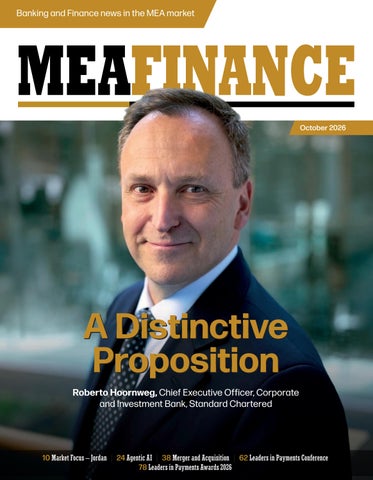
October 2026
A Distinctive Proposition Roberto Hoornweg, Chief Executive Officer, Corporate and Investment Bank, Standard Chartered
October 2026
A Distinctive Proposition Roberto Hoornweg, Chief Executive Officer, Corporate and Investment Bank, Standard Chartered
A MEA Finance Publication
10 Market Focus – Jordan | 24 Agentic AI | 38 Merger and Acquisition | 62 Leaders in Payments Conference 78 Leaders in Payments Awards 2026
Interest Rate Spread
T
he interest rate spread is the difference between the average interest rate a bank earns on loans and other assets, and the average interest rate it pays on deposits and borrowings. However, in relation to this edition of MEA Finance, it refers to the broad variety of different subjects we cover, for which the rate of topical interest is currently pretty high for our region’s banking and financial markets. Adding an additional percentage point to the levels of interest in these subjects is the pervading context of the regional geopolitical challenges that we are currently facing. Our cover interview is with Roberto Hoornweg, Chief Executive Officer, Corporate and Investment Bank at Standard Chartered, who discusses the shifts reshaping global capital flows, the sources of the UAE’s competitive advantage, and how the country is strengthening its position within the global financial system and rewriting the rules of competition for global capital - “Ultimately, a financial centre moves beyond attracting capital when it enables institutions to manage that capital locally and connect it with opportunities across markets”. Inside we focus on Transaction Banking and Cash Management, the importance of which has become clearer as geopolitical disruption reminds companies that knowing where liquidity sits, being able to mobilise it quickly and maintaining access to alternative banking and payment routes can become critical. Underlining this, Najma Salman, Managing Director, Co- Head CEEMEA, Institutional Cash & Trade, Deutsche Bank states, “while efficiency remains important, resilience has become the dominant theme”. Intertest in agentic AI is mushrooming and the question now being asked is, who will control the financial relationship when machines begin acting for both banks and their customers?
Inside we hear from Nadia Stephenson, Managing Associate – Commercial (Payments & FinTech) at Addleshaw Goddard, and Bryan Stirewalt, Board Mamber, Advisor and Former Chief Executive of the DFSA, with their thoughts and insights on this industry changing matter. Covering the development of M&A across our region, we show that how, in the current circumstances, our region’s resilience reflects a deeper change in its financial architecture. We hear from Miguel Azevedo, Managing Director, Vice - Chair Investment Banking Citi and Rohit Maheshwari, Partner for M&A at Deloitte Middle East, on this revealing barometer of the regional capital markets. Our country focus this month falls on Jordan. Read inside how the nation has navigated another year of regional uncertainty with growth intact, inflation contained, foreign reserves at record levels and a resilient banking system. However, they now face the challenge of moving from preserving stability to durably speeding up economic growth. Reading interest rates rise further with opinions that include Wycliffe Muma Director of Service Delivery and Country Manager for Vynrta Global, arguing that East Africa’s banks must act as a network to fight fraud, and John Kerschner, Global Head of Securitised Products, Portfolio Manager at Janus Henderson Investors highlighting the risks posed by AI to technology and software loans. Wealth this month is covered by both HSBC and Mashreq, with Feras Al Jaramani Head of UAE Market – Private Banking at HSBC arguing that the point of AI is not to replace trusted person to person relationships, but to support it with increasing efficacy and Navin Chokhani, SVP Head of Client Value Management - Private Banking telling us about their wealth corridors linking the UAE with Hong Kong and London. With this spread of numerous topics, and coverage of the MEA Finance Leaders in Payments Summit and Awards, we have ensured that your rate of personal interest in the topics inside this issue will be uncapped.
mea-finance.com
3
CONTENTS
CONTENTS 32
LEGAL ADVICE
6
Who Owns Tax? The Leadership Gap Inside UAE Businesses
REAL ESTATE CAPITAL
8
Land of Opportunity
MARKET FOCUS - JORDAN
10 From Durability to Development TRANSACTION BANKING & CASH MANAGEMENT
16 Flexible Friends Complexity, More 22 More Opportunities AGENTIC AI
24 Double Agent Exposed are CLOs to AI 30 How disruption? COVER STORY
32 A Distinctive Proposition BANKING TECHNOLOGY engagement gap: Why AI36 The empowered customers need AIempowered banks
MEA Finance WEB: www.mea-finance.com EMAIL: info@mea-finance.com PUBLISHED BY: Creative Middle East Media FZ LLC, M1 Floor, Twin Towers, PO Box 4422, Fujairah, UAE
4
Banking and Finance news in the MEA market
MERGERS & ACQUISITIONS
38 The Heart of the Deal 44 Busily Unbowed 46 All Coming Together OPINION PIECE East Africa’s banks need to fight 48 Why fraud as a network
6
10
OPEN FINANCE
50 The Omniscient Customer WEALTH MANAGEMENT
52 Power of Corridors DIGITAL WEALTH
54 Enhancing is not Supplanting
36
PARTNER CONTENT your Real Estate Function 56 Making a Dynamic Asset rather than Fixed Overhead
52
54
LEADERS IN PAYMENTS SUMMIT & AWARDS 2026
62 Challenges and Changes
EXECUTIVE DIRECTOR AND PUBLISHER Kenneth Mitchen ken.mitchen@mea-finance.com GROUP COMMERCIAL DIRECTOR Nap Estampador nap.estampador@mea-finance.com Tel : +971 50 100 5488 DIRECTOR Andrew Cover andrew.cover@mea-finance.com Tel: +971 50 931 3236
BUSINESS DEVELOPMENT OFFICER Geri Teniozo geri.teniozo@mea-finance.com Tel: +971 50 3036879
EVENT AND CONTENT DIRECTOR Natasha Cristi natasha@mea-finance.com Tel: +971 50 303 4235
EVENTS AND MARKETING MANAGER Cris Balatbat crissyb@mea-finance.com Tel: +971 58 594 4818
SENIOR DESIGNER Florante Magsakay Tel: +971 52 570 1811 design@mea-finance.com
EVENTS & MARKETING MANAGER Joy Baldenero joy@mea-finance.com Tel: +971 56 174 7426
ADMIN AND FINANCE MANAGER Marilyn Nainque marilyn@mea-finance.com Tel: +971 58 5025836
WEB ASSISTANT Marie Orayan web@mea-finance.com EDITORIAL editorial@mea-finance.com EDITOR-AT-LARGE Oscar Wendel oscar.wendel@mea-finance.com
Dubai office: Al Saaha Offices, Old Town Island Burj Khalifa District PO Box 487177, Dubai, UAE Email: info@mea-finance.com
mea-finance.com
5
LEGAL ADVICE
Who Owns Tax? The Leadership Gap Inside UAE Businesses UAE tax obligations now sit inside business decisions. The challenge is not finding expert advice. It is making sure someone brings it into the room before the decision is made, says Patryk Karczewski Partner and Head of AMERELLER Tax
T
h e ex p a n s i o n h a s b e e n approved. Funding is secured, contracts are advancing, and management is ready to proceed. Then someone asks whether anyone has looked at the tax consequences of the structure, including how the new entity will transact with its parent. The business has a capable finance department, experienced lawyers and external tax advisors. The question still surfaced only after the commercial decisions were made. Before moving into advisory practice, I was Head of Indirect Tax at a large UAEheadquartered family group. When tax input comes only after a structure has been agreed, the options are narrower and changes harder to make.
Tax is no longer a filing exercise Federal corporate tax changed the role of accounting and finance teams. Tax now sits inside questions that used to belong somewhere else: how related parties price dealings with each other, what happens
6
revenue of at least €750 million in two of the four preceding financial years, not businesses across the board, yet the complexities it brings can cause enough headache for the entire market. E-invoicing is about to reach a different part of the business. In-scope companies with annual revenue of AED 50 million or more must implement the system by 1 January 2027, with an accredited service provider appointed by 30 October 2026. It requires coordination between finance, tax, IT and operations. Tax obligations increasingly shape how transactions are built and what boards are told about risk. Others, and I mean every single other business present in the UAE, will have only six months more to follow (i.e. by July 2027 all businesses are expected to have e-invoicing in place).
The accountability gap
Patryk Karczewski, Partner and Head of AMERELLER Tax
when a group opens in a new market, and what it costs to leave one. For qualifying large multinational groups, the UAE›s Domestic Minimum Top-up Tax adds further complexity. It concerns groups with consolidated
Banking and Finance news in the MEA market
In many organisations, responsibility is dispersed. Finance oversees filings, legal manages contracts and transactions, and outside specialists answer technical questions when asked. Each team does its job. The important questions still fall between them. Who identifies tax implications before an acquisition is approved? Who reconciles recommendations from different advisors? Who checks that the agreed actions were carried out? Advice and leadership are not the same thing. A technical opinion answers the question it was given. Leadership works out which question should have been asked, three weeks earlier, by somebody else.
What being in-house taught me is that the gap is rarely a knowledge problem. The expertise is usually available. What is missing is someone with the responsibility and access to bring it into commercial decisions.
When tax issues surface during a sale Consider a privately owned UAE company preparing for investment or a sale. Its filings are up to date. Its advisors are available when needed. Then diligence begins. Investors want explanations of historical tax positions, related-party pricing and the documentation behind both. The answers exist. Assembling them takes weeks, and the search exposes gaps in internal oversight. None of this means there is a liability. It does mean uncertainty, which leads to slower negotiations, additional warranties for the buyer, tax covenants the seller would rather not give, or an adjustment to the purchase price. Tax readiness is built long before the transaction. Ongoing review, clear ownership of follow-up actions and reliable records are the difference between an orderly process and avoidable pressure at the worst moment.
Between the two extremes A group with substantial cross-border complexity needs a permanent Head of Tax. A business with straightforward operations is well served by its finance team and an advisor on call. Size alone is not the test: activity, transaction vo l u m e a n d i n te r n a l c a p a b i l i t y matter more. The difficulty sits between those extremes. Growing regional groups, family offices and investment-backed companies carr y significant tax complexity and cannot yet justify a fulltime appointment. O n e a n swe r i s f ra ct i o n a l ta x leadership. A senior tax professional works with management on a structured, continuing basis rather than question by
question, coordinating internal teams and external advisors and following implementation through. For an expanding group, that means reviewing intercompany arrangements before entering a new jurisdiction. For a family office, consistent tax review across investments. For a business heading toward an exit, better documentation and oversight before buyers arrive.
Who tracks recommendations, deadlines and unresolved exposures? And who has the standing to raise concerns before a commercial commitment becomes difficult to change? In practice that means a tax review before material transactions are approved, an owner and deadline for each agreed action, and unresolved issues reported to management. Sometimes
AS THE UAE’S TAX ENVIRONMENT MATURES, GOOD GOVERNANCE WILL DEPEND LESS ON HOW MANY ADVISORS A BUSINESS RETAINS THAN ON WHETHER THEIR EXPERTISE REACHES THE RIGHT DECISIONS IN TIME Having worked on both sides, the difference I notice most is access. Inside the business, I heard about a transaction while it was still an idea. As an external advisor, I usually hear about it once the terms are agreed. Any arrangement meant to close that gap must give the tax lead access while decisions are still being shaped. It does not replace the finance function, and it does not move statutory responsibility away from directors and management. A designated executive, usually the CFO, stays accountable for tax oversight; day-to-day coordination sits with an internal or fractional tax lead. The arrangement needs clear scope, access to decision-makers and a defined reporting line. Without those, it becomes another advisory retainer.
Start with responsibility, not job titles Before hiring another advisor or creating a new position, boards and CFOs should examine how tax is actually managed. Which decisions trigger a tax review?
better processes are enough; sometimes a permanent hire is needed. The model matters less than ensuring that advice is acted on. As the UAE’s tax environment matures, good governance will depend less on how many advisors a business retains than on whether their expertise reaches the right decisions in time. Before the next investment, expansion or sale, management should be able to answer one question:
Who owns tax in your business?
About the author Patryk Karczewski is Partner and Head of AMERELLER Tax in Dubai. He has more than 15 years of experience in GCC taxation and previously served as Head of Indirect Tax at a major UAE-headquartered multinational family group. His practice covers corporate tax, VAT, transfer pricing, tax strategy and disputes. Patryk can be reached at pk@amereller.com. More on AMERELLER’s Fractional Head of Tax service at amereller.com/fractional-head-of-tax
mea-finance.com
7
REAL ESTATE CAPITAL
Land of Opportunity Zain Qureishi Global Head of Real Estate Finance and Advisory notes that uncertainty has led to some delays in transactions, other sectors are showing continued promise and providing strong investment opportunities
From our perspective, the impact has been more visible in transaction activity and decision-making timelines than in pricing or occupier demand. Investors have become increasingly selective, favouring assets with strong cash flows, quality sponsorship and clear long-term demand drivers. Overall, the GCC continues to be viewed as an attractive destination for real estate capital, supported by strong sovereign b a l a n c e s h e e t s , i n f ra s t r u c t u re spending and ambitious economic transformation agendas.
Of the following regional real estate sectors — residential, commercial, industrial and undeveloped land — which currently show the most promise?
Zain Qureishi, Global Head of Real Estate Finance and Advisory
A
s a whole, how has the regional real estate market responded to the geopolitical tensions that began earlier this year? The market has remained relatively resilient despite heightened tensions. While uncertainty led some investors
8
to delay transactions and adopt a more cautious approach, we did not see a broad deterioration in underlying market fundamentals. In fact, high-quality assets continued to attract capital, supported by strong economic growth, population inflows and ongoing government investment programs.
Banking and Finance news in the MEA market
Industrial and logistics real estate currently offers some of the strongest o p p o r t u n i t i e s a c ro s s t h e G C C, supported by e-commerce growth, supply chain expansion and continued i nvest m e nt i n re g i o n a l l o g i st i c s i n f ra st r u c t u re. Re s i d e n t i a l a l s o remains attractive, particularly in key cities such as Dubai, Abu Dhabi and Riyadh, where population growth and housing demand continue to support market fundamentals. Within the commercial sector, performance has become increasingly selective. Prime Grade A office assets continue to benefit from strong demand and limited supply, while older stock faces greater pressure. Undeveloped land also offers long-term potential, particularly in areas supported by major infrastructure investment and urban expansion plans, although investors today are approaching land opportunities with greater discipline and a stronger focus on underlying development fundamentals.
How and by whom is capital currently being deployed across regional real estate sectors? Capital deployment across GCC real estate is becoming increasingly i n s t i t u t i o n a l . S ove re i g n w e a l t h funds continue to play a central role, particularly across infrastructure, logistics, digital assets and strategic urban developments. At the same time, we are seeing growing participation from international asset managers, private capital providers and family offices, reflecting confidence in the region’s long-term growth prospects. Investor preferences have also shifted toward income-producing assets with resilient cash flows and strong operating fundamentals. On the financing side, banks remain a key source of funding, but private credit, syndicated lending and club
limited REIT penetration compared with markets such as the US and Europe. Looking ahead, the greatest opportunity for REITs may lie in capital recycling, allowing owners of stabilised assets to unlock value and broaden investor participation. Sectors such as logistics, healthcare and education may offer particularly attractive opportunities for future growth.
Which key markers do regional banks look for when weighing real estate opportunities? Real estate lending today is centered a ro u n d s p o n s o r q u a l i t y, a s s e t fundamentals and cash flow sustainability. Banks place significant emphasis on a sponsor’s track record, financial strength and ability to successfully execute projects through different market cycles.
CAPITAL DEPLOYMENT ACROSS GCC REAL ESTATE IS BECOMING INCREASINGLY INSTITUTIONAL structures are becoming increasingly important as transactions grow in size and complexity. This is creating a deeper and more diversified capital ecosystem across the region.
How are regional REITs faring at this time? Regional REITs have continued to evolve and are playing a growing role within GCC real estate capital markets, a l t h o u g h t h ey re m a i n re l a t i ve l y small compared with more mature markets globally. Improvements in governance, transparency and portfolio quality have helped attract greater institutional participation. That said, direct ownership remains the preferred investment route for many investors across the region, which has
Equally important is the quality of the underlying asset, including location, tenant demand, occupancy levels and income resilience. Financial metrics such as loanto-value ratios, debt service coverage and debt yield remain important, but they are assessed alongside the broader investment case rather than in isolation. Finally, lenders want clear visibility on repayment and exit strategy. As a result, sectors supported by strong structural demand, including logistics, residential rental housing and digital infrastructure, c o n t i n u e to a t t ra c t s i g n i f i c a n t financing interest.
How are financing structures adapting to changing investor appetite and market conditions? Real estate financing across the GCC
is becoming increasingly sophisticated as markets mature and transactions become larger and more institutional. One of the most visible trends has been the growing use of syndications and club financings, allowing banks to support larger transactions while managing risk and capital efficiently. We are also seeing a broader financing ecosystem emerge. While senior bank lending remains dominant, private credit, structured capital solutions and fundlevel financing products are becoming increasingly relevant for certain borrowers and investment strategies. Perhaps the most significant shift is the move toward originate-anddistribute models, where banks structure and underwrite transactions before syndicating portions of the exposure to a wider investor base (not just to other banks). This is helping deepen regional real estate capital markets and increase funding flexibility.
Will we soon see tokenisation taking a bigger presence in real estate investment? Tokenisation is one of the more interesting developments emerging within real estate investment, particularly in markets such as the UAE where regulators have embraced innovation and digital asset frameworks through VARA. While adoption remains at an early stage, the concept has the potential to broaden investor access and lower investment thresholds. However, widespread adoption will depend on continued regulatory development, investor confidence, market liquidity and institutional participation. These foundations are still evolving and will take time to mature. In my view, tokenisation is unlikely to replace traditional ownership structures, funds or REITs. Instead, it has the potential to become an additional capital-raising and distribution channel, helping broaden participation and supporting the long-term development of real estate capital markets. mea-finance.com
9
MARKET FOCUS - JORDAN
From Durability J to Development Jordan has navigated another year of regional uncertainty with growth intact, inflation contained, foreign reserves at record levels and a resilient banking system, but the challenge is shifting from preserving stability and a more durable acceleration in economic growth
10
Banking and Finance news in the MEA market
ordan enters the final months of 2026 with an economic story that is more consequential than its headline growth rate might suggest. The Kingdom has continued to expand while maintaining monetary stability, containing inflation and strengthening its external buffers. Real GDP grew by 2.8% in 2025, according to the International Monetary Fund, while official Jordanian data show growth reaching 2.9% year-on-year in the first quarter of 2026, compared with 2.7% in the same period a year earlier. These are not the rates associated with a highgrowth emerging economy, and they remain insufficient to resolve Jordan’s longstanding employment and fiscal challenges quickly. Their significance lies instead in the consistency with which the
confidence and commercial flows, while the Kingdom continues to manage structural pressures associated with energy and water constraints and a large refugee population. Against that background, maintaining growth close to 3% while preserving price and monetary stability represents a degree of economic resilience that should not be understated. The challenge is that resilience is no longer enough. Jordan has demonstrated repeatedly that it can maintain macroeconomic stability under difficult conditions. Its next economic test is whether that stability can generate a stronger cycle of private investment, productivity, employment and household income. The outlook is therefore one of gradual improvement rather than a dramatic breakout.
Strengths and Challenges
economy has absorbed external shocks without losing its underlying stability. That distinction matters when assessing Jordan’s performance over the past 12 months. Geography gives the country considerable strategic importance (Jordan sits between the Gulf, the Levant and the Eastern Mediterranean) but also exposes it unusually directly to regional instability. Conflict across the wider Middle East has affected tourism, transport, investor
There are nevertheless signs that the composition of economic activity is strengthening. Jordan’s national exports rose by 9.9% in 2025 to JOD9.62 billion, while total exports, including re-exports, increased by 10.1% to JOD10.58 billion. Imports also rose, by 7.5% to JOD20.53 billion, leaving a trade deficit of approximately JOD9.95 billion. The figures illustrate both sides of Jordan’s external economy: domestic producers are expanding their reach, but the country remains structurally dependent upon imported goods, energy and inputs, maintaining a substantial merchandise trade deficit. Export momentum continued into 2026. During the first half of the year, national exports increased by 6.2% to JOD4.67 billion, while re-exports rose sharply by 44.6% to JOD1.75 billion. Total exports consequently reached JOD6.41 billion,
JORDAN CANNOT CHANGE ITS GEOGRAPHY, BUT IT CAN MAKE GREATER ECONOMIC USE OF IT
14.5% higher than a year earlier, while the merchandise trade deficit narrowed by 5.5% to JOD3.85 billion. The improvement is significant because stronger exports provide Jordan with a route towards growth that is less dependent upon domestic consumption or government expenditure. Pharmaceuticals, fertilisers, potash, phosphates, jewellery and other industrial products form part of an increasingly important export base, while changing commercial relationships with neighbouring markets can create additional opportunities. This external diversification matters strategically. Jordan cannot change its geography, but it can make greater economic use of it. Its position between the Gulf, Iraq, Syria and the Mediterranean gives it potential as a logistics, services and industrial link between markets whose economic relationships are themselves changing. Greater integration with Gulf economies is particularly important. Investment from Saudi Arabia and the UAE is increasingly relevant across logistics, technology, healthcare and energy, while the UAE–Jordan Comprehensive Economic Partnership Agreement provides another framework through which trade and investment links can deepen. The opportunity extends beyond increasing bilateral trade towards positioning Jordan more effectively within regional value chains. Business confidence provides some evidence that the private sector sees that possibility. PwC’s 2026 Jordan findings from its 29th Global CEO Survey reported that 77% of surveyed chief executives expected economic growth in Jordan to improve over the following 12 months, compared with 45% in the previous survey. More than half—53%—said they were very or extremely confident about their own company’s revenue growth over the next 12 months, but they provide a useful indication that corporate sentiment has strengthened despite geopolitical uncertainty. The reasons for that confidence extend beyond near-term GDP. Jordan mea-finance.com
11
MARKET FOCUS - JORDAN
possesses a comparatively diversified ser vices economy, an educated workforce, established pharmaceutical and industrial capabilities, an important tourism offering and a growing technology sector. What it has historically struggled to achieve is the rate of investment and private-sector job creation necessary to translate those advantages into faster improvements in living standards. Employment remains the clearest expression of that challenge. Jordan’s Department of Statistics reported an overall unemployment rate for Jordanians and non-Jordanians of 16.1% in the second quarter of 2026, down from 16.5% in the corresponding period of 2025. Among Jordanians specifically, unemployment stood at 21.0%, compared with 21.3%
During the first half of 2026, tourism receipts fell, but summer subsequently brought a recovery, with tourism income for the first eight months of the year reaching approximately US$5.56 billion. Re m i t ta n c e s p rov i d e a n ot h e r stabilising external flow. Central Bank data show workers’ remittances rising by 14.3% during the first half of 2026 to approximately US$2.5 billion. These inflows support household consumption and foreign-exchange availability and provide an important counterweight when other external sectors face pressure. Jordan’s strongest macroeconomic buffer, however, is the credibility of its monetary framework. The Jordanian dinar’s peg to the US dollar has long acted as an anchor for monetary
FOR AN ECONOMY THAT HAS REPEATEDLY ABSORBED REGIONAL SHOCKS, FINANCIAL-SECTOR STABILITY HAS BEEN ONE OF THE PRINCIPAL ANCHORS OF THE BROADER MACROECONOMIC FRAMEWORK a year earlier. Unemployment remains structurally high despite continued GDP growth. Youth unemployment and low female labour-force participation add further complexit y, allowing macroeconomic stability to coexist with considerable pressure at household level. This is why Jordan needs more than incremental GDP expansion. The quality and labour intensity of investment therefore matter as much as its headline value. Capital-intensive infrastructure can raise productive capacity, but Jordan also needs expansion in sectors capable of employing its skilled population at scale. Tourism illustrates both the country’s economic potential and its vulnerability to events beyond its control as it is sensitive to perceptions of regional security even when Jordan itself remains stable.
12
stability, requiring the Central Bank of Jordan to maintain adequate reserves and manage interest rates in a manner consistent with protecting confidence in the currency. Price stability has been equally important. Inflation averaged 2.2% during the first eight months of 2026, comparatively contained despite the potential for geopolitical disruption to raise transport, energy and food costs. Stable prices protect household purchasing power and reduce uncertainty for businesses, although the monetary stance required to defend the currency peg can impose its own constraints on borrowing costs and domestic demand. That trade-off became particularly visible in September. The Central Bank’s published rates show the key policy rate at
Banking and Finance news in the MEA market
6.0% from 21 September 2026, compared with 5.75% previously. Fiscal policy presents a more difficult balancing act. Jordan must simultaneously support economic development, infrastructure, social protection and essential public services while reducing a substantial public-debt burden. The IMF estimated government and guaranteed gross debt at 109% of GDP in 2025, or 83.6% when holdings of the Social Security Corporation are excluded. The latter measure is projected to decline to 82.5% in 2026, 81.4% in 2027 and 79.9% in 2028. Whichever measure is used, the underlying point remains that fiscal space is constrained and debt reduction needs to occur without suppressing the productive investment required for stronger growth.
Banking Jordan’s banks enter that challenge from a comparatively strong position. For an economy that has repeatedly absorbed regional shocks, financial-sector stability has been one of the principal anchors of the broader macroeconomic framework. Banks have continued to expand their balance sheets, attract deposits and extend credit while maintaining capital and liquidity buffers comfortably above regulatory requirements. The important question is whether that resilience can increasingly be converted into the financing, innovation and productive risk-taking required to support a fastergrowing private economy. By the end of 2025, total assets of licensed banks in Jordan had increased by 6.1% to approximately JOD74.1 billion, compared with JOD69.9 billion a year earlier. Customer deposits rose by around 7.1% to JOD50 billion, while credit facilities expanded by 3.7% to JOD36.1 billion. The relationship between those figures is revealing. Deposits grew considerably faster than credit, reinforcing liquidity but also highlighting a wider economic challenge: substantial financial resources are available within the banking system,
yet the pace at which they translate i n to a d d i t i o n a l l e n d i n g re m a i n s comparatively measured. There are sound reasons for that caution. Jordanian banks operate in an economy exposed to geopolitical uncertainty, elevated public debt and periods of subdued private investment. Credit decisions must reflect the ability of companies and households to absorb additional borrowing. Expanding lending simply to generate faster balance-sheet growth would not constitute economic progress if it weakened asset quality. The strategic objective is therefore not indiscriminate credit expansion but directing more finance towards viable companies, productive investment, exporters, infrastructure, entrepreneurs and smaller businesses capable of generating employment and economic value. The sector has the financial capacity to do so. That stability has implications beyond individual institutions. Confidence in the banking system suppor ts confidence in deposits, the dinar and the wider monetary framework. It also gives policymakers greater room to manage shocks without simultaneously confronting financial-sector instability. The question for the next stage is how effectively this defensive strength can be converted into productive financial capacity.
Credit Management Monetary conditions complicate that transition. The dinar’s peg to the US dollar remains fundamental to Jordan’s e c o n o m i c f ra m e w o r k , m e a n i n g domestic interest-rate policy cannot be determined solely by the credit requirements of the local economy. The Central Bank must also protect monetary stability and confidence in the exchange-rate regime. For banks, that framework provides an indispensable anchor; for companies financing expansion, however, the resulting cost of capital can influence investment decisions.
JORDAN HAS ALREADY CONVERTED INTERNATIONAL SUPPORT, INSTITUTIONAL CONTINUITY AND PRUDENT POLICYMAKING INTO MACROECONOMIC STABILITY This makes the allocation of credit as important as its price. Large established corporates with strong balance sheets can generally obtain finance on more favourable terms, while smaller enterprises frequently face higher information costs, limited collateral and shorter financial track records. That distinction is particularly important because SMEs and entrepreneurial companies need to contribute more substantially if Jordan’s growth is to become sufficiently employmentintensive. A banking system can be exceptionally stable and still fall short of its economic potential if commercially viable smaller businesses cannot obtain finance on sustainable terms. Jordan’s National Financial Inclusion Strategy for 2023–2028 explicitly recognises that challenge. It aims to increase overall financial inclusion from 43.1% to 65% by the end of 2028, reduce the gender gap in account ownership from 22% to 12%, and raise financial-account ownership among micro, small and medium-sized enterprises from 52.4% to 75%. Its framework extends beyond conventional bank lending to savings, insurance, payments and transfers, supported by fintech, data, consumer protection and regulatory reform. The significance lies in treating access to finance not as a social objective separate from economic growth, but as part of the mechanism through which growth can become broader and more inclusive.
Looking Ahead Jordan cannot rely indefinitely upon labour-force expansion to drive economic growth when unemployment is already elevated. Higher output per
worker, stronger companies and more sophisticated exports are therefore essential. That makes human-capital policy inseparable from economic policy. Education and training need to respond more quickly to employer requirements in technology, healthcare, engineering, finance, manufacturing and other sectors capable of generating skilled employment. The employment challenge should remain the ultimate test of whether the growth model is improving. A stronger GDP figure is valuable, but Jordan’s economic transformation will be incomplete if growth does not create sufficient opportunities for young people and women or raise household incomes. The country needs not only more jobs but more productive jobs capable of retaining skilled workers and reducing the incentive for talent to relocate. This places additional emphasis on companies capable of scaling beyond the domestic market. SMEs dominate Jordan’s business population, but the next phase should focus increasingly on producing more medium-sized and growth-stage companies rather than simply increasing the number of small enterprises. Firms that can professionalise, adopt technology, attract equity, borrow responsibly and expand into Gulf and neighbouring markets can become more meaningful contributors to employment, exports and productivity. Banks will remain central to that process, but the financial system will need to become broader as the investment agenda develops. Infrastructure requires long-duration capital; technology companies may require equity rather than debt; and institutional investors need a wider range mea-finance.com
13
MARKET FOCUS - JORDAN
of investable assets. Corporate bonds, sukuk, investment funds, private equity, venture capital and other instruments can complement bank lending and distribute financing requirements across a deeper financial system. Jordan should therefore approach 2027 with measured confidence rather than complacency. The macroeconomic framework remains credible, reserves are strong, inflation is contained, banks are well-capitalised and international partners continue to provide substantial support. Exports have shown momentum, tourism has demonstrated an ability to recover, digital financial infrastructure is advancing and a significant investment programme is moving into its implementation phase. Business sentiment has also strengthened from a year earlier. At the same time, none of the principal structural constraints has disappeared. Public debt remains high, unemployment is elevated, the domestic market is relatively small and geopolitical exposure is unavoidable. Fiscal consolidation limits the state’s capacity to drive growth directly, while private investors will not commit capital simply because projects appear in a government strategy. Commercial returns, implementation capability and institutional credibility remain decisive. The more constructive scenario is therefore not an economic boom but a gradual improvement in Jordan’s underlying growth model. Investment contributes more meaningfully; privatesector credit accelerates without weakening asset quality; exports continue to expand; tourism normalises; major infrastructure moves from planning into execution; growing companies obtain broader financing options; and stronger commercial links with the Gulf provide both capital and markets.
If those developments reinforce one another, growth around 3% could become a platform from which Jordan gradually moves higher rather than a temporary peak. More importantly, the composition of growth would become increasingly private-sector-led, investment-driven and export-oriented. That would improve employment prospects and, over time, make fiscal consolidation easier by broadening economic activity and the revenue base.
JORDAN SHOULD THEREFORE APPROACH 2027 WITH MEASURED CONFIDENCE RATHER THAN COMPLACENCY The downside is equally clear. Renewed or prolonged regional conflict could weaken tourism and trade, raise energy and freight costs and delay investment. Slow project execution could leave the Economic Modernisation Vision producing more plans than productive assets. Fiscal pressures could constrain capital expenditure, while cautious banks could remain highly liquid without expanding productive credit sufficiently. Under such circumstances, Jordan could preserve stability while remaining close to the modest growth rates that have characterised much of the previous decade. The policy challenge is therefore one of conversion. Jordan has already converted international support, institutional continuity and prudent policymaking into macroeconomic stability. It must now convert stability into investor confidence; investor confidence into capital; capital into productive
References: 1. PwC Middle East — 29th Annual Global CEO Survey: Jordan Findings 2026. 2. Central Bank of Jordan (CBJ) — Statistical Database, Monthly Statistical Bulletin and monetary-policy releases, 2025–2026. 3. International Monetary Fund (IMF) — Jordan: Fourth Review Under the Extended Arrangement Under the Extended Fund Facility and First Review Under the Resilience and Sustainability Facility Arrangement, 2025.
14
businesses and infrastructure; and those investments into jobs, exports and higher household incomes. Banks sit at the centre of that chain but cannot complete it alone. Government must provide credible policy and execution; regulators must preserve stability while enabling innovation; development institutions can absorb specific risks and catalyse private finance; capital markets must provide alternatives to conventional
Banking and Finance news in the MEA market
lending; regional investors can provide capital and commercial connectivity; and Jordanian companies must demonstrate that they can compete beyond the domestic market. T h e s t ro n g e s t a rg u m e n t fo r Jordan entering 2027 is therefore not that its economic constraints have disappeared. They have not. It is that the country possesses stronger buffers, a resilient financial system, a defined investment programme, improving regional commercial relationships and a reform agenda increasingly focused on private-sector activit y. Those foundations create an opportunity that now needs to be converted into measurable economic outcomes. For much of the past decade, Jordan’s economic narrative has centred on its ability to withstand shocks. The next chapter should be judged by a more demanding standard: whether stability can generate investment, whether investment can expand productive capacity, whether that capacity can strengthen exports and private enterprise, and whether growth can ultimately create broader opportunity. Jordan has proved its resilience. The task now is to make that resilience productive.
TRANSACTION BANKING & CASH MANAGEMENT
Flexible Friends The importance of transaction banking in the Middle East has become clearer as geopolitical disruption has reminded companies that knowing where liquidity sits, being able to mobilise it quickly and maintaining access to alternative banking and payment routes can become critical when conditions change abruptly. Banks that can help clients manage this complexity become valuable partners
T
he consequences of recent geopolitical disruptions have extended beyond companies directly exposed to the areas of conflict because our region’s economies are deeply integrated into many key global networks. Disruption affecting one corridor can therefore move rapidly into freight costs, inventory requirements, payment timing, working-capital needs and corporate liquidity. For transaction banks, this has elevated a business sometimes re g a rd e d p r i m a r i l y a s f i n a n c i a l plumbing into something much closer to strategic infrastructure.
16
Geopolitical events affect corporate treasury differently from many other areas of banking. A company can postpone an acquisition, delay capital expenditure or reconsider a financing transaction when uncertainty rises, but salaries still need to be paid, suppliers still require settlement, receivables still need to be collected and liquidity must remain available across the organisation. Transaction banking operates within this continuous movement of the real economy. When trade routes become less predictable, corporates may carry additional inventory, change suppliers or alter payment terms; when settlement
Banking and Finance news in the MEA market
corridors become more complicated, treasur y teams need alternative payment routes and stronger visibility over counterparties; when currencies or funding conditions become volatile, cash forecasting becomes more important; and when sanctions regimes change, banks and their clients must determine whether payments that were routine yesterday remain executable tomorrow. Geopolitical risk therefore does not simply suppress transaction volumes. It can increase the complexity surrounding every transaction and, in doing so, increase the value of banks capable of helping clients navigate that complexity
Resilience The events of this year have clearly demonstrated this dynamic. The IMF’s April regional outlook described a severe and multifaceted shock across the Middle East, with disruption to energy markets, trade routes and business confidence transmitting through economies at different speeds and with different intensity. The effects on Gulf economies were significant because of their role in global energy and trade, while spillovers extended across the broader Middle East, North Africa and neighbouring regions through commodity prices, tourism, remittances, investment and logistics. Yet disruption has not translated into systemic weakness across the GCC banking sector. By the end of June 2026, commercial-bank deposits across GCC states had reached approximately US$2.45 trillion, 6% higher than at the end of 2025, while commercial-bank assets exceeded US$4 trillion after increasing 3.9% over the same period. GCC central banks collectively held approximately US$829 billion in net foreign assets, equivalent to around 11 months of regional import cover. Those figures do not remove the effects of geopolitical risk, nor do they imply that individual institutions, sectors or customers have been unaffected. They demonstrate instead that the region has been confronting disruption with substantial financial buffers and that its transaction banks have generally been operating from a position of comparative strength. This resilience creates an important distinction between liquidity at system level and liquidity at company level. A banking system can remain well capitalised and liquid while individual businesses experience significant cashflow pressure because receivables arrive later, inventory remains in transit for longer, suppliers demand different payment terms or operations in one jurisdiction require additional funding. Corporate liquidity is ultimately distributed across entities, currencies, banks and markets, and the existence of cash somewhere
within a group does not necessarily mean it is immediately available where the organisation needs it. Standard Chartered has described this problem in terms of increasing liquidity fragmentation, with geopolitical shifts reshaping the financial corridors on which corporate treasury depends while regulatory frameworks across markets can diverge. For treasurers, trapped or inaccessible cash becomes considerably more consequential when uncertainty rises because liquidity that cannot be mobilised cannot readily be used to respond to changing operating conditions. The treasury response is therefore moving beyond the traditional objective of maximising yield on surplus balances.
UNDER GEOPOLITICAL STRESS, OPTIONALITY ACQUIRES ADDITIONAL VALUE In periods of relative predictability, a corporate can optimise liquidity predominantly around efficiency: minimise idle cash, centralise balances, reduce borrowing and maximise returns. Under geopolitical stress, optionality acquires additional value. A company may deliberately preserve larger buffers, diversify banking relationships, maintain alternative settlement channels or hold liquidity closer to operating subsidiaries even if doing so appears less efficient under normal circumstances. The treasury question becomes not simply how to minimise the cost of cash, but how to ensure that cash remains available under several plausible scenarios. This changes what corporates expect from their banks. They need visibility across accounts and entities, accurate intraday information, flexible liquidity structures, reliable cross-
border payments, strong trade-finance capabilities, rapid access to working capital and bankers who understand how geopolitical developments can affect particular sectors and corridors.
Opportunity For regional transaction banks, this creates a commercial opportunity precisely because resilience is difficult to deliver through a single product. A corporate facing supply-chain disruption may simultaneously need additional working capital, revised trade-finance arrangements, alternative payment routing, foreign-exchange execution and better visibility over cash across subsidiaries. Transaction banking becomes most valuable when these capabilities operate as an integrated system rather than as separate products. The institution controlling the operating account can see payment flows; the bank providing collections can understand receivables; the trade bank can see movement between buyers and suppliers; and the liquidity provider can understand where cash accumulates or becomes constrained. Used responsibly, that information can give banks an unusually detailed view of how a corporate client actually operates. This explains why transaction banking has become strategically important even though many of its individual services can appear commoditised. A payment can be compared on speed and price, an account can be moved and basic cashmanagement functionality is increasingly expected as standard. Yet the aggregate relationship can be exceptionally difficult to displace once the bank becomes embedded within the company’s treasury infrastructure. Corporate ERP systems, host-to-host connections, APIs, payroll, collections, virtual accounts, liquidity structures, trade workflows and reporting can all connect the client to the bank’s operating environment. The competitive prize is therefore considerably larger than transaction fees. The institution sitting closest to daily cash flows has mea-finance.com
17
TRANSACTION BANKING & CASH MANAGEMENT
an opportunity to become the primary operating bank, attract operational deposits, capture FX and trade activity, understand working-capital requirements and identify financing needs before they become formal requests. Transaction banking can consequently anchor a much broader corporate-banking relationship. That role becomes even more valuable when funding conditions are uncertain. Transaction deposits are strategically attractive because they are connected to operating activity rather than purely investment decisions. Companies require balances to pay employees, suppliers and taxes and to manage everyday working capital, giving banks that capture these flows an opportunity to build funding while generating associated fee income. This does not make operating balances immune from competition—corporate treasurers actively manage surplus cash and can move it when yield differences or risk considerations become material— but it gives banks a powerful economic reason to invest in the technology and service infrastructure surrounding cash management. A transaction-banking relationship can create value simultaneously through deposits, fees, data and access to adjacent financing opportunities and regional banks are increasingly presenting their capabilities accordingly. The significance lies less in the availability of any single feature than in the direction of the proposition: the competitive unit is moving away from an individual payment, account or trade instrument towards an integrated treasury relationship.
Technology Technology has enabled much of that integration, but corporate expectations are now pushing it further. Treasury teams historically operated around endof-day information because banking infrastructure itself was organised around batches and cut-off times. That architecture becomes increasingly difficult to reconcile with economies in which commerce operates continuously.
18
A company can receive an online order at midnight, a marketplace can collect money throughout the weekend and a multinational can operate across time zones without a natural end to its business day. If commercial activity is real time but treasury information is delayed, finance teams are effectively managing yesterday’s cash position. Realtime payment infrastructure, APIs and increasingly sophisticated corporatebanking platforms are narrowing the gap between the movement of money and the visibility of money. The region has already built important foundations. The UAE Funds Transfer System provides real-time gross settlement for participating financial institutions, while the country’s wider payments infrastructure continues to support increasingly digital and immediate transactions. Saudi Arabia’s instantpayment infrastructure similarly allows eligible transfers across participating institutions around the clock, with ISO 20022 messaging supporting richer payment information and greater potential for business cash-flow management. At GCC level, AFAQ connects participating national RTGS systems and supports cross-border transfers with sameday settlement finality, while the Arab Monetary Fund’s Buna platform provides multicurrency cross-border payment capabilities across participating Arab and international institutions. IMF analysis has recorded significant expansion in the use of these regional systems, illustrating how financial infrastructure is beginning to reflect the increasingly interconnected commercial geography of the Middle East. These developments matter because the competitiveness of transaction banking is increasingly determined by what happens between domestic payment systems rather than only within them. Cross-border payments remain more complicated than domestic transactions because they can involve d i f fe re nt c u r re n c i es , re g u l a to r y frameworks, time zones, intermediaries and financial-market infrastructures.
Banking and Finance news in the MEA market
Correspondent-banking networks also face pressure from compliance costs, profitability considerations and financialintegrity risks. For a region positioning itself as a commercial bridge between Asia, Africa and Europe, reducing that friction has economic significance beyond banking. Faster and more predictable cross-border settlement can improve working capital, reduce uncertainty around payment receipt and strengthen the attractiveness of regional trade corridors.
Geopolitics The geopolitical environment reinforces that need because trade itself is becoming more multidirectional. GCC economies have spent years diversifying commercial relationships beyond traditional Western markets, with deeper connections to China, India and wider Asia alongside growing investment and trade relationships with Africa and Central Asia. Heightened global uncertainty, geoeconomic fragmentation and trade tensions have strengthened the rationale for those relationships. IMF work on economic cooperation between the GCC and Caucasus and Central Asia, for example, identifies transport connectivity, trade facilitation and crossborder payments among the mechanisms capable of supporting stronger economic ties at a time of global fragmentation. The opportunity for regional transaction banks is therefore not limited to servicing growth inside individual GCC economies. Banks capable of connecting corporate clients across emerging trade corridors can potentially capture payments, FX, trade finance, liquidity and workingcapital activity generated by the region’s changing commercial geography. This makes network strength important in a way that digitalisation alone cannot solve. A sophisticated corporate portal has limited value if the underlying institution cannot move funds reliably into the markets where the client operates. Global banks retain advantages through extensive correspondent networks and
multinational client relationships, while regional institutions can compete through local depth, decision-making proximity and expanding footprints across the Middle East, Africa and Asia. The strongest propositions increasingly combine elements of both: international connectivity with local knowledge. This is particularly important in transaction banking because regulations, payment conventions, documentation requirements, currencies and market practices remain highly local even when the corporate customer wants a globally consistent treasury experience. Geopolitical fragmentation also makes compliance part of the transactionbanking proposition rather than merely a control applied after a payment is initiated. Sanctions can change rapidly, ownership structures can obscure counterparties and the same trade route may involve several jurisdictions with different regulatory expectations. Banks must therefore process payments efficiently while ensuring that speed does not weaken sanctions screening, a n t i - m o n ey- l a u n d e r i n g c o n t ro l s , fraud prevention or trade-compliance processes. Corporates increasingly need certainty not merely that a payment can be sent, but that it will reach the intended beneficiary without unexpected compliance delays. The quality of a transaction bank can consequently be measured partly by its ability to combine control with predictability: understanding a client’s legitimate business well enough to process routine activity efficiently while identifying transactions requiring additional scrutiny. The events of this year have made that capability more visible because financial relationships can be affected rapidly by developments originating outside the banking system. Sanctions, trade restrictions, disrupted transport corridors and changing counterparty risk can alter the practical viability of established financial routes. Treasury teams consequently need banks capable of translating geopolitical developments into operational consequences: whether
a supplier can still be paid, whether a correspondent institution is likely to process the transaction, whether an alternative currency or route is available and what additional documentation may be required. Transaction banks capable of providing that interpretation move beyond processing instructions towards becoming advisers on financial connectivity. The same shift is visible in trade finance. Traditional documentar y instruments remain important because they allocate payment and performance risk between buyers, sellers and banks, but corporate demand increasingly extends into supply-chain finance, receivables finance, structured trade and broader working-capital solutions. Geopolitical disruption strengthens the connection between trade and cash management because inventory decisions directly affect liquidity. A company carrying additional stock to protect against supply disruption ties up more working capital; a
create disproportionate pressure. Banks capable of combining digital collections, cash-flow visibility and working-capital finance can help smaller businesses manage that volatility more effectively, while transaction data can potentially improve the bank’s understanding of underlying business performance. As regional economies continue encouraging SME development and private-sector expansion, transaction banking can contribute to growth not simply by processing more payments but by helping working capital circulate more efficiently.
Winning Combination The strategic role of transaction banking also needs to be understood against the strength of GCC bank balance sheets. Despite the shocks experienced during this year, the region’s banking system has continued to display substantial capital and liquidity buffers. GCC banking indicators through the middle of the year
IF COMMERCIAL ACTIVITY IS REAL TIME BUT TREASURY INFORMATION IS DELAYED, FINANCE TEAMS ARE EFFECTIVELY MANAGING YESTERDAY’S CASH POSITION supplier required to offer longer payment terms may need receivables finance; a buyer seeking to preserve cash may want to extend terms without damaging strategically important suppliers. The transaction bank sits between these competing objectives and can potentially use financing structures to improve liquidity across the supply chain rather than simply financing one company in isolation. This is particularly important for SMEs, which generally possess smaller liquidity buffers and less sophisticated treasury resources than large corporates. Supply disruption, delayed receivables or higher inventory requirements can therefore
showed continued deposit growth and assets above US$4 trillion, while regional central banks maintained substantial external reserves. This resilience does not eliminate credit deterioration or sector-specific pressure, and banks have had to recognise the effects of disruption on parts of the regional economy, but it provides transaction banks with capacity to support clients precisely when liquidity becomes more valuable. This is an important commercial advantage because a corporate does not evaluate a transaction bank only according to the quality of its software. During periods of stress, clients also discover the value of balance-sheet capacity, credit mea-finance.com
19
TRANSACTION BANKING & CASH MANAGEMENT
appetite, experienced bankers and the ability to maintain services when markets are difficult. A bank that provides excellent cash-management technology but cannot support a company when workingcapital requirements rise offers only part of the proposition; conversely, a lender with substantial balance-sheet capacity but weak digital infrastructure risks losing the daily operating relationship to a more capable transaction bank. Competitive advantage increasingly comes from combining both: the ability to move, see and optimise cash in normal conditions and the financial capacity to support the customer when normal conditions break down. That combination helps explain why transaction banking can create particularly durable institutional relationships. Corporate treasurers may distribute borrowing among several banks to diversify funding sources, but operating flows can become more concentrated because managing multiple systems creates complexity. The institution providing the clearest visibility, strongest connectivity and most reliable execution can become a hub around which the client organises treasury, producing deposits and fee income while giving the bank valuable insight into the customer’s financial behaviour. Competition is therefore intensifying even as many basic payment services become cheaper and faster because the economic value is migrating away from the individual transaction and towards the broader operating relationship.
KPIs Banks should consequently resist evaluating the business principally through the number or value of transactions processed. A more useful scorecard would consider the quality and stability of operating deposits, payment and collection flows, share of corporate wallet, cross-border activity, trade and FX penetration, implementation success, digital adoption, service quality and the extent to which transaction
20
relationships generate broader financing opportunities. Technology investment should similarly be judged by economic outcomes rather than the number of digital features launched. An API that materially reduces implementation time or manual reconciliation may create more value than a highly visible capability with limited customer adoption. For corporate treasurers, the corresponding measure is not maximum automation or minimum cash. It is financial control. A treasury function needs enough visibility to understand its position, enough liquidity to withstand uncertainty, enough connectivity to execute efficiently and enough optionality to respond when
surplus liquidity from cash that may shortly be required elsewhere. The future of regional transaction banking is therefore likely to be defined less by any single technology than by the ability to connect these capabilities coherently. Artificial intelligence, APIs, ISO 20022, real-time payments, digital trade and programmable forms of money will develop at different speeds, and not every innovation will become commercially significant. What matters is whether banks can use them to improve the movement, visibility, allocation and protection of corporate liquidity while maintaining the controls and judgement required in a regulated financial system.
A SOPHISTICATED CORPORATE PORTAL HAS LIMITED VALUE IF THE UNDERLYING INSTITUTION CANNOT MOVE FUNDS RELIABLY INTO THE MARKETS WHERE THE CLIENT OPERATES established assumptions fail. Technology can improve every one of those capabilities, but the objective remains economic rather than technological. The company needs to know that its financial resources will be available when the business requires them. This returns transaction banking to its most fundamental purpose. The industry has spent years making money move faster, information arrive sooner and treasury processes require less manual intervention. Those advances are important, but their greatest value emerges when they allow companies to make better financial decisions. Realtime information can reveal a developing liquidity problem before it becomes urgent; integrated trade and cash data can expose working-capital opportunities; better connectivity can allow companies to operate across markets with greater consistency; and stronger forecasting can help treasury distinguish genuine
Banking and Finance news in the MEA market
That is particularly important in the Middle East because the region is simultaneously becoming more economically diversified, more internationally connected and more exposed to the consequences of global fragmentation. These forces create complexity, but they also create transaction flows. Companies expanding across borders require banking infrastructure capable of following them; changing trade corridors require financing and settlement; new industries generate collections, payments and workingcapital requirements; and geopolitical uncertainty increases the value of liquidity and resilience. The same forces that make treasury more difficult can therefore make high-quality transaction banking more valuable. The future of transaction banking will therefore be determined not simply by how efficiently banks move money, but by how effectively they help their customers maintain control of it.
Discover Distinction
with Mashreq Private Banking
Our cutting-edge technology offers you a one-stop solution for all your wealth management and daily banking needs.
Bonds
Mutual Funds
Wealth Lending Solutions
Thematic Investments
UAE and International Equities
Mashreqbank PSC is regulated by the Central Bank of the United Arab Emirates.
Scan to discover more
TRANSACTION BANKING & CASH MANAGEMENT
More Complexity, More Opportunities Najma Salman Managing Director, Co-Head CEEMEA, Institutional Cash & Trade at Deutsche Bank highlights the development of regional trade finance and cash management, defining the changes and opportunities now emerging in this key sector
What are the key growth drivers of c a s h m a n a g e m e nt a n d transaction banking in our region?
H
ow have regional transaction banking and cash management activities been impacted by both nearby and global geopolitical events this year?
G eopolitical developments have fundamentally reshaped priorities for treasurers across the Middle East and Africa. Clients are increasingly focused on ensuring business continuity through periods of uncertainty, which means reassessing payment routes, banking relationships, liquidity buffers and supply chains. The objective is no longer simply to optimise costs, but to build operational and financial resilience into treasury functions. At the same time, geopolitical fragmentation has reinforced the value of banks with both strong regional expertise and global connectivity. As sanctions regimes, regulatory requirements and geopolitical considerations become more complex, corporates and financial institutions need banking partners that can connect markets while maintaining consistent standards of compliance, risk management and security. We are also seeing significant shifts in global trade flows. Supply chain
22
Overall, the market has shifted from prioritising efficient payments to focusing on resilient payments, liquidity optimisation and robust risk management. Institutions that can provide alternative payment corridors, multi-bank connectivity, strong compliance frameworks and sophisticated liquidity solutions are increasingly differentiating themselves in the market.
Najma Salman, Managing Director, CoHead CEEMEA, Institutional Cash & Trade, Deutsche Bank
diversification, rising South-South trade and changing investment patterns are creating new payment, foreign exchange, liquidity and trade finance requirements. While the US dollar and euro remain central to global commerce, there is growing interest in alternative settlement currencies, including the UAE dirham, Saudi riyal and Chinese yuan. This reflects a broader move towards a more multipolar payments landscape.
Banking and Finance news in the MEA market
One of the most significant growth drivers remains the continued expansion of crossborder trade and investment across the Middle East, Africa and wider emerging markets. As trade volumes increase and new commercial corridors emerge, demand naturally grows for payments, collections, foreign exchange, liquidity management and working-capital solutions. A second major driver is the rapid digital transformation of treasury and transaction banking. The adoption of instant payments, API connectivity, ISO 20022 standards and around-the-clock processing capabilities is changing client expectations. Treasurers increasingly expect real-time information, greater automation and more dynamic liquidity management capabilities. We are also seeing the addressable market broaden considerably. Beyond traditional corporate and financial institution clients, fintechs, payment companies, digital platforms and other non-bank financial institutions are becoming increasingly important users of transaction banking services. Africa presents a particularly compelling growth opportunity. Mobilemoney adoption, digital banking initiatives and the continued formalisation of
economic activity are generating substantial transaction volumes, especially in payments and collections. As these ecosystems mature, they create new opportunities for banks to support both domestic and cross-border activity. Finally, investment in local payment infrastructure is accelerating across the region. The development of instantpayment systems and modern settlement mechanisms is creating new opportunities for banks to intermediate domestic and international flows with greater efficiency.
Are banks in our region actively growing their cash and trade teams at this time? The answer is yes, although the picture is more nuanced than a simple expansion in headcount. Banks continue to invest in transaction banking because it offers attractive, recurring revenues and supports broader client relationships. However, growth in teams is increasingly targeted rather than broad-based.
WHILE EFFICIENCY REMAINS IMPORTANT, RESILIENCE HAS BECOME THE DOMINANT THEME The focus is on building specialist capabilities. Institutions are investing in expertise related to digital payments, liquidity management, technology, compliance, data analytics and complex solution structuring. Rather than focusing solely on traditional sales roles, banks are looking for professionals who can help clients navigate increasingly sophisticated treasury and transactionbanking environments. At the same time, growing cross-border complexity is increasing demand for specialised cash and trade expertise.
As clients manage more intricate payment flows, working-capital requirements and liquidity structures across multiple jurisdictions, banks increasingly value professionals with strong regional knowledge, deep client networks and proven business-development capabilities.
How are Islamic finance frameworks being integrated into modern cash management and transaction banking? The integration of Islamic finance into modern transaction banking is centred on combining Sharia-compliant structures with the advanced capabilities that clients expect from contemporary treasury solutions. Regardless of the financing framework, clients still require efficient payments, liquidity management, digital connectivity and sophisticated reporting. Technology is playing an important role in enabling this integration. Increasingly, Sharia-compliant solutions can operate within the same digital ecosystems that support real-time reporting, API connectivity, automated treasury processes and modern financial infrastructure. This helps ensure that Islamic finance products are not viewed as separate or niche offerings but as an integrated component of broader transaction-banking solutions. The opportunity is particularly significant in markets where Islamic finance and international commerce intersect. In these environments, banks that combine deep local Sharia expertise with global capabilities in payments, liquidity management, foreign exchange and trade finance are particularly well positioned to support clients.
What core trends are shaping the future of regional cash management and transaction banking? Several powerful trends are converging to shape the future of transaction banking. One of the most important is the emergence of a multi-rail payments ecosystem. Traditional correspondent
banking networks will remain critically important, but they will increasingly coexist with instant-payment systems, tokenised deposits, stablecoins and new settlement infrastructures. The future is unlikely to be defined by one winning model; instead, success will come from interoperability and effective orchestration across multiple payment rails. Another major trend is the shift from transactions to intelligence. Data, analytics and artificial intelligence are beginning to transform how clients forecast cash, optimise liquidity, prevent fraud, route payments and make strategic decisions. Transaction banking is evolving beyond execution to become a source of insight and value creation. We are also moving towards a more interconnected ecosystem model. Banks, fintechs, technology companies and market infrastructures each bring different strengths. Future competitive advantage will increasingly come from partnerships that combine the trust, balance-sheet strength, networks and risk-management expertise of banks with the innovation capabilities of technologyled organisations. At the same time, the industry is moving steadily towards an always-on operating model. Clients increasingly expect payments and treasury services to be available beyond traditional banking hours, reflecting the reality of global commerce and digital business models. Deutsche Bank’s EverOn initiative, which extends USD cross-border book-transfer processing across weekends, is one example of how the industry is progressing towards 24/7 transaction banking. Ultimately, the future is not simply about making payments faster. It is about connecting fragmented markets, improving interoperability and making cross-border transactions increasingly seamless. As financial ecosystems become more complex, the ability to connect, coordinate and orchestrate across markets will become one of the most valuable capabilities in transaction banking. mea-finance.com
23
AGENTIC AI
Double Agent As artificial intelligence moves from answering questions to taking action, banks face a transformation potentially more consequential than the arrival of mobile banking itself. But given that the same technology may ultimately give customers their own intelligent agents capable of comparing, selecting and switching between banks, the question now is who will control the financial relationship when machines begin acting for both sides
F
or most of the digital-banking era, technology has changed how customers instruct their banks without fundamentally changing who makes the decision. Mobile banking replaced many branch visits, digital wallets changed the mechanics of payment and generative AI began
24
answering questions and helping employees interpret information, but the customer generally remained the initiating intelligence. A person decided to transfer money, apply for credit, purchase an investment or pay a supplier; technology made the instruction easier to execute. Agentic AI begins to challenge
Banking and Finance news in the MEA market
that sequence. An AI system capable of interpreting an objective, developing a plan, interacting with other systems and executing permitted actions can move from advising a customer what to do towards doing at least part of it on the customer’s behalf. In banking, that distinction is profound because
financial services are built not merely around information but around authority: authority to move money, extend credit, assume risk and enter transactions whose consequences can be immediate and sometimes irreversible. Agentic AI introduces probabilistic decision-making capable of influencing the initiation of financial actions. The issue is therefore larger than whether a chatbot becomes more capable. It concerns what happens when intelligence is inserted before the payment instruction itself— when software begins determining that a transaction should occur rather than merely processing an instruction already made by a human.
authorised payment within a connected journey. Importantly, this was presented as a showcase rather than a mature mass-market service, with a phased rollout and commercial launch expected in early 2027. Taken together, these developments do not demonstrate that autonomous finance has already arrived at scale; they show that the infrastructure required to allow software to participate directly in financial transactions is moving from concept towards controlled real-world implementation. For banks in our region, that development arrives at a particularly important moment. The region has spent more than a decade building many
experiments with agent- enabled services. The Central Bank of the UAE’s 2026 guidance specifically addresses consumer protection, transparency, accountability, explainability, data privacy and responsible adoption, providing an increasingly relevant regulatory foundation as AI moves closer to consequential financial decisions. The readiness of regional financial institutions should nevertheless be described carefully because AI adoption and Agentic AI adoption are not the same thing. PwC’s 2026 survey of Middle Eastern financial-services CEOs found that 71% reported a clearly defined AI roadmap, while approximately 80%
Future in the Present That future is no longer entirely theoretical, although the distinction between controlled demonstrations and scaled commercial deployment is important. In March 2026, Santander and Mastercard announced what they described as Europe’s first live end-toend payment executed by an AI agent and the first agentic payment carried out within a regulated banking framework. The controlled transaction used Mastercard Agent Pay and Santander’s live payments infrastructure, allowing an AI agent to initiate and complete a purchase within predefined customer permissions and limits. In the UAE, the transition had begun earlier. In December 2025, Visa and Aldar announced the first live regional implementation of Visa Intelligent Commerce, with the first transaction involving a customer paying real-estate service charges through Aldar’s AI agent in a consentled flow using an Emirates NBD Darna Visa credit card; further capabilities were scheduled to roll out during 2026. Mastercard has also been developing agentic-commerce capabilities involving regional participants, while its September 2026 collaboration with Trip.com and Network International showcased how consumers could eventually move from AI-led travel discovery through booking to
THE DISTINCTION BETWEEN AUTOMATION AND AGENCY IS ESSENTIAL TO UNDERSTANDING WHERE THE COMMERCIAL OPPORTUNITY LIES of the foundations required for highly automated finance: widespread digital banking, increasingly sophisticated p a y m e n t i n f ra s t r u c t u re , o p e n banking initiatives, cloud adoption and national strategies that place artificial intelligence at the centre of economic transformation. Saudi Arabia moved its Open Banking programme further into regulated commercial deployment in March 2026 when the Saudi Central Bank began licensing fintech companies to provide open-banking services following completion of regulatory-sandbox requirements, creating a more formal framework through which customerauthorised financial information can support new services. The UAE, meanwhile, has been establishing principles for the responsible use of AI and machine learning by licensed financial institutions while its banking, payments and commerce ecosystem
said their technology environments and organisational cultures enabled AI integration. Thirty-two per cent reported extensive AI use across support services, 28% in demand generation, 25% in products, services and customer experience and 22% in strategic direction setting, while nearly 70% reported established Responsible AI and risk processes. These figures indicate that AI is moving into the operating core of financial institutions, but they do not establish that autonomous agents are already making consequential banking decisions at scale. Financial institutions are progressively moving from models that generate content or insights towards systems capable of coordinating workflows and supporting or executing decisions, but most remain in the process of establishing the governance, workforce and technology required before extensive autonomy becomes prudent. mea-finance.com
25
AGENTIC AI
The distinction between automation and agency is essential to understanding where the commercial opportunity lies. Automation takes a process whose objective has already been defined and performs it more efficiently. An agentic system can potentially receive an objective—reduce excess cash while maintaining sufficient liquidity, find an appropriate financing structure, res o l ve a d i s p u te d t ra n s a ct i o n , prepare a client proposal or complete a permitted purchase—and determine which sequence of actions is required to achieve it. It can retrieve information, call other applications, assess alternatives, execute approved actions, evaluate the
p re p a re re c o m m e n d a t i o n s a n d coordinate specialist teams. Traditional automation can improve individual steps; Agentic AI raises the possibility of coordinating the workflow itself.
More than Cost The immediate economic temptation is to view this principally as a cost story. Banking remains operationally intensive, and PwC’s work on GCC intelligent automation, cited in its 2026 financial-services findings, estimates that up to 90% of routine tasks are potentially automatable and that more than 60% of banks are already deploying automation tools. Agentic systems could extend that trajectory beyond repetitive
FOR BANKS, THIS CREATES AN OPPORTUNITY TO INCREASE SHARE OF WALLET BY BECOMING MORE USEFUL RATHER THAN SIMPLY SELLING MORE AGGRESSIVELY result and continue until the objective is satisfied or human intervention becomes necessary. That progression expands the addressable value of AI because banking contains thousands of processes in which the work is not one task but a chain of tasks separated by organisational and technological boundaries. Opening a corporate account can involve identity verification, beneficial-owner checks, sanctions screening, document collection, risk classification, account configuration and follow-up. Lending involves information gathering, credit analysis, pricing, documentation, approval and monitoring. A payment exception can require investigation across transaction records, fraud systems, customer communications and compliance procedures, while relationship management requires bankers to understand client activity, anticipate financing requirements,
26
rules-based activities into processes requiring interpretation and coordination, potentially reducing manual handling, shortening turnaround times and allowing employees to concentrate on exceptions and higher-value work. Yet cost reduction may ultimately prove one of the less transformative consequences. Every major wave of banking technology has compressed the cost of activities that were previously expensive.The institutions able to create the greatest value were not necessarily those that removed the most cost, but those that used lower distribution and servicing costs to reach more customers, increase activity and build better propositions. Agentic AI creates a similar strategic choice. Banks can deploy it principally to make the existing organisation cheaper, or they can use it to increase the amount of economically useful activity each customer relationship can support.
Banking and Finance news in the MEA market
The first route to growth is hyperpersonalised financial management at a scale that human relationship models could never economically provide. Private-banking clients already receive personalised attention because the value of the relationship can support dedicated human expertise; mass-market customers generally receive far less individual attention because assigning a relationship manager to every account would be uneconomic. An agent capable of continuously understanding income, expenditure, liabilities, savings goals and product eligibility could narrow that gap by identifying excess cash, warning that spending is deviating from a goal, highlighting an approaching liquidity shortfall or recognising when refinancing could potentially reduce borrowing costs. The important change is persistence. Most banking recommendations today are episodic: a customer logs into an application, receives a notification or speaks with an adviser. An agent could potentially operate continuously within permissions established by the customer, monitoring circumstances rather than waiting for the customer to recognise a financial need independently. For banks, this creates an opportunity to increase share of wallet by becoming more useful rather than simply selling more aggressively. Traditional cross-selling frequently begins with the product— identify customers likely to purchase a credit card, loan or investment—whereas agentic banking can begin with the objective, understand what the customer is trying to achieve and determine which combination of products or actions could support it. The distinction is commercially important because the technology becomes valuable not through generating more marketing but through increasing the institution’s ability to recognise and solve financial problems when they emerge.
Use Cases The opportunit y becomes larger i n w e a l t h m a n a g e m e n t , w h e re relationship managers and advisers
spend considerable time gathering information, preparing meetings, analysing portfolios and coordinating administrative activity. Agentic systems could continuously monitor portfolios, markets, client preferences, cash positions and agreed risk parameters, then prepare relevant actions for adviser or customer approval. The human adviser remains responsible for judgement and the relationship, but each adviser can potentially serve clients with greater depth because the machine performs more of the monitoring and preparation. This is not simply a productivity argument. If technology allows a bank to deliver elements of sophisticated wealth management economically to customers below traditional private-banking thresholds, the addressable market expands. A mass-affluent customer who previously received a relatively standard investment proposition could receive more contextualised guidance, while the institution can deepen the relationship across products and services. SME banking could experience an even more consequential shift because smaller companies often face financial requirements comparable in complexity to those of larger businesses without possessing dedicated treasury teams. An agent connected, with permission, to banking and business information could help forecast cash flow, identify re c e i va b l e s p re s s u re, s c h e d u l e payments, compare financing options or assemble information required for a credit application. The commercial opportunity arises because SME banking has traditionally faced an economics problem: providing hightouch relationship banking to smaller companies is expensive, while purely digital service can leave complicated needs insufficiently addressed. Agentic AI could create a layer of continuous financial intelligence between conventional self-service and the relationship manager, allowing human bankers to intervene where judgement, negotiation or trust is required while
technology performs monitoring and preparation across a substantially larger portfolio. Corporate banking presents a parallel opportunity at greater scale. Treasury functions manage liquidity, payments, FX exposure, borrowing and investment across multiple accounts, currencies and jurisdictions. Much of this activity is already automated, but the decision layer remains fragmented across treasury systems, bank portals and human approvals. Agentic systems could eventually help coordinate cash positions, identify liquidity requirements, recommend hedging actions, prepare payment batches and interact with
customers, that can reduce the time between financial need and access to capital; for more complex cases, it can provide human credit officers with a richer evidence base. Faster lending is not automatically better lending, and increasing autonomy makes that distinction more important, but reducing administrative friction under strong governance can expand the range of relationships that are economical to serve. SMEs or consumers expensive to assess manually may become more commercially attractive if technology reduces origination cost without weakening underwriting standards. The growth opportunity therefore comes not
AGENTIC AI COULD THEREFORE REINFORCE TRANSACTION BANKING BY MAKING THE BANK’S INFRASTRUCTURE MORE INTELLIGENT RATHER THAN MERELY FASTER banking APIs, subject to explicit mandates and controls. For a regional bank serving companies expanding across the GCC, the strategic value could be considerable. A bank that helps a corporate client manage liquidity intelligently across Saudi Arabia, the UAE and other markets becomes more deeply embedded than one providing an account and payment rail alone. Agentic AI could therefore reinforce transaction banking by making the bank’s infrastructure more intelligent rather than merely faster. Credit offers another route to growth. AI already supports underwriting and fraud detection, but agentic systems could coordinate a larger portion of the lending journey by gathering authorised i n fo r m a t i o n , i d e nt i f y i n g m i s s i n g documentation, analysing cash flows, preparing assessments, routing cases for approval and monitoring obligations after drawdown. For straightforward
merely from processing existing loans more cheaply but from making additional relationships economically viable. Customer service illustrates the same distinction between automation and outcome. Conventional chatbots became frustrating partly because they often placed automation between the customer and resolution: the customer did not particularly want to converse with a machine but wanted the problem fixed. A genuinely agentic service model changes the proposition because the system could potentially investigate an issue, access permitted information, coordinate internal processes and complete a remedy rather than merely explain the next step. Financial relationships are frequently tested when something goes wrong—a card is blocked while travelling, a payment is duplicated, a transfer fails or suspected fraud appears—and an agent capable of understanding the mea-finance.com
27
AGENTIC AI
context, resolving appropriate lowrisk cases immediately and bringing a human specialist into genuinely ambiguous situations with the relevant information already assembled could strengthen rather than depersonalise the relationship. This is why the highestimpact benefits of Agentic AI are likely to extend well beyond operating costs:
Free Agent But agentic AI creates a strategic vulnerability at precisely the moment it creates opportunities, because there is no guarantee that the intelligent agent coordinating those actions will belong to the bank. A customer may use a general-purpose AI agent supplied by a technology company, digital wallet, commerce platform or independent financial service. If that agent can access authorised financial information and interact with competing providers, it could eventually compare deposit rates, lending terms, card rewards, investment fees and foreign-exchange prices without requiring the customer to open several banking applications and perform the comparison manually. Instead of the customer entering a bank’s digital environment and deciding which product to use, an external agent could increasingly influence which bank best satisfies the customer’s objective. Mastercard’s current work with merchants already reflects the emerging importance of making products and information discoverable across external AI experiences while preserving merchant control over how those propositions are represented and acted upon. The strategic competition would then move one level above digital banking. Banks spent the mobile era competing to own the interface on the customer’s
phone; in an agentic era, customers may increasingly interact with an intelligent layer sitting above several applications and providers. That possibility changes the economics of loyalty because a person may remain with a financial institution partly because comparing alternatives and switching providers require time and attention, whereas an AI agent does not experience inconvenience in the same way. It can potentially compare alternatives persistently and reduce the cognitive cost of changing providers. Products that benefit from inertia could therefore become more exposed, while pricing, service quality, reliability and machine-readable accessibility become more important. The same technology that
A CUSTOMER MAY USE A GENERALPURPOSE AI AGENT SUPPLIED BY A TECHNOLOGY COMPANY, DIGITAL WALLET, COMMERCE PLATFORM OR INDEPENDENT FINANCIAL SERVICE allows a bank to understand its customer more deeply can empower that customer to compare the bank more relentlessly. For regional banks, Agentic AI consequently presents two intertwined growth strategies. The first is to build intelligent agents of their own, using trusted data and regulated financial infrastructure to deepen relationships and deliver more valuable outcomes. The second is to ensure that their products and services remain competitive and accessible when customers arrive through agents controlled
References: • PwC Middle East, 29th Global CEO Survey: Financial Services Findings, February 2026 5. • PwC Middle East, 29th Global CEO Survey: Middle East Findings, January 2026.4 • Visa and Aldar, First End-to-End Voice-Enabled Agentic Payment in the Region, 18 December 2025 2. • Mastercard and Santander, Europe’s First Live End-to-End Payment Executed by an AI Agent, 2 March 2026. 1 • Mastercard, Trip.com and Network International, agentic-commerce travel collaboration showcased in September 2026. 3
28
by somebody else. Banks pursuing only the first risk assuming that customers will continue to enter finance through the bank’s own interface; banks pursuing only the second risk surrendering the relationship and becoming increasingly commoditised providers behind external platforms. The strategic challenge is to do both without sacrificing the trust on which banking depends. That brings the argument to the central tension of Agentic AI in financial services. The technology can create value precisely because it is allowed to make more decisions, coordinate more activities and perform more actions without constant human intervention, yet every additional degree of autonomy transfers some
Banking and Finance news in the MEA market
authority from a person or institution to software. Banking cannot capture the full economic benefits of agency while pretending that this transfer carries no risk. The question is therefore not whether Agentic AI can become perfectly trustworthy before banks use it, but how banks determine which decisions can responsibly be delegated, which should remain human, how customers can understand and control that delegation, and who remains accountable when an authorised agent produces an outcome nobody intended. The institutions that answer those questions will possess more than efficient AI. They will have begun constructing the trust architecture required for autonomous finance—and that may become one of the most valuable competitive assets in the next generation of banking.
OPINION PIECE
How exposed are CLOs to AI disruption? Exploring the risks posed by artificial intelligence (AI) to technology and software loans, John Kerschner, Global Head of Securitised Products, Portfolio Manager at Janus Henderson Investors says that while the proliferation of AI solutions is expected to eventually impact most major industries, investor concern is presently hyper focused on the threat posed to software companies
A
u to n o m o u s a g e n t s a re becoming more capable of executing tasks directly within business applications, which could undermine the traditional per-seat subscription model of many software providers. At the same time, AI is lowering barriers to entry by reducing the cost and complexity of software development, making it easier for new competitors – or even corporate customers themselves – to build customised tools.
Where does the risk reside? Software companies have leaned more heavily on leveraged loans and private credit for financing than on corporate markets. Business D evelopment Companies (BDCs) have been drawn to software businesses for leveraged buyouts because their recurring subscription revenues, strong margins and asset-light operating models have been well suited to supporting higher debt loads. Given the higher technology and software exposure of leveraged loans
30
John Kerschner, Global Head of Securitised Products, Portfolio Manager, Janus Henderson Investors
or collateralised loan obligations (CLOs), investors may be tempted to eschew these asset classes altogether. But we think the issue requires a more measured approach and warrants a closer look at loan-level metrics.
Banking and Finance news in the MEA market
As outlined below, our method involves isolating and quantifying the risk, seeking to mitigate risk through active management, and selecting the investment vehicles that we believe may offer structural protections against defaults. 1. Isolate and quantify the risk Technology and technology-adjacent loans represent around 22% of the U.S. CLO loan universe and 17% of the European CLO loan universe. However, in our opinion, sector classification alone overstates the risk because not all issuers are directly exposed to AI disruption. Drawing on our strong corporate credit research capabilities, we assess each loan individually and have determined that only 11% of U.S. CLO loans and 9% of European CLO loans are directly exposed to AI disruption – roughly half the headline technology exposure. We go a step further and separate the loans with direct AI exposure into three risk buckets using real-time pricing data – which we consider to be a highly efficient information aggregator – to determine whether the market perceives the loan to be lower risk, higher risk, or stressed. Low-beta loans in the U.S. and Europe are pricing very close to par (100) at 99.2 and 99.4, respectively, indicating the market sees no credit concern in those loans. The high-beta risk cohort, priced at 94.0 and 96.5, reflects some uncertainty but is still priced well above distressed levels. The stressed portion, at just 3% of the index, is where real credit risk resides. Nonetheless, the stressed cohort is much smaller than headline exposure might suggest.
2. Seek to mitigate risk through active management. Once we have appropriately isolated and quantified the risk, we seek to mitigate the risk through active management. The two salient points here are to a) assess the maturity profile of the stressed loans to quantify imminent refinancing risk, and b) identify variations in direct AI exposure by individual CLO deal. As it relates to a), a potential concern with AI-disrupted borrowers is refinancing risk. If a loan matures too soon for a borrower facing structural revenue uncertainty, it may be forced to refinance at materially wider spreads or fail to refinance altogether. In the U.S., stressed technology loans maturing within three years represent just 1.4% of the loan universe, while in Europe that number is 0.7%. No stressed technology loans mature within one year. This healthy maturity profile provides time for credit situations to develop or resolve before refinancing pressure builds, and therefore no imminent maturity wall exists to force crystallisation of losses. Regarding point b), the figures above describe the universe as a single portfolio, yet individual CLO deals are very different. After analysing over 2,750 CLO transactions across U.S. and European markets, we found that exposure to stressed technology loans varied significantly by deal and by CLO manager. In our analysis, we identified and measured each CLO’s exposure to stressed technology loans and then ranked the deals from lowest to highest exposure and grouped them into quartiles. Exposure to stressed technology loans in the most-exposed quartile was ~300% higher in the U.S. and ~600% higher in Europe compared to the leastexposed quartile. With over 170 CLO managers operating across both markets and individual managers running deals of varying composition and vintage, the exposure is ultimately determined by credit selection at the deal level.
3. Select the investment vehicles we believe may offer structural protection In our view, investors seeking floatingrate exposure should consider CLOs over leveraged loans due to the structural protections and higher credit quality within CLOs, as well as the ability to select one’s desired level of credit risk. Whereas CLOs employ a waterfall structure to provide credit enhancement, leveraged loans participate in defaultrelated losses from the first dollar, as there is no tranche hierarchy inherent in direct loan exposure. This credit enhancement feature
not believe the BB and B tranches are adequately compensating investors for this risk. Therefore, we believe investors should consider moving up in quality to the BBB tranche, or potentially into the A, AA, and AAA tranches.
In summary As technology author and consultant Geoffrey Moore has observed, “the most common misunderstanding of disruptive innovations is to overestimate their impact in the short term and underestimate it in the long term.” In light of the data presented – we believe the
IF A LOAN MATURES TOO SOON FOR A BORROWER FACING STRUCTURAL REVENUE UNCERTAINTY, IT MAY BE FORCED TO REFINANCE AT MATERIALLY WIDER SPREADS OR FAIL TO REFINANCE ALTOGETHER within CLOs has proven resilient over time, particularly for higher-rated tranches. That’s because losses from underlying loans hit the equity tranche first, moving upward through B and BB tiers before touching the BBB, A, AA, and AAA tranches. Due to the heightened level of uncertainty within the technology sector, we prefer exposure to the highest-rated (AAA) tranches of CLOs where structural protections are at their maximum. AA and A rated CLOs remain a compelling option as well, as they exhibit a very high degree of credit enhancement while offering some additional credit spread over the AAA tranche. For investors in BB and B CLO tranches, the risks are more direct. A negative turn in AI-exposed credits could drive tranche rating downgrades and spread repricing further down the capital stack and we do
headline hype around software loans is overblown in the short term, while longerterm impacts remain to be seen. Floating-rate bond exposure remains an essential component of a diversified fixed income allocation, with CLOs being the preferred investment vehicle due to their strong credit ratings, structural protections, and historical resilience. A combination of deep loan-level analysis, active selection, and a bias toward higher-rated CLO tranches remains our preferred approach to navigating the risk of AI disruption within software loans. Selecting deals with disciplined credit exposure and avoiding those with concentrated risk in AI-sensitive sectors is where we see the clearest opportunity to add value for investors. John Kerschner, CFA is Global Head of Securitised Products, Portfolio Manager. mea-finance.com
31
COVER INTERVIEW
A Distinctive Proposition Competition among the world’s leading financial centres is increasingly shaped by where capital is managed, investments are structured, and financial activity is built around them. Roberto Hoornweg Chief Executive Officer, Corporate and Investment Bank, Standard Chartered, discusses the shifts reshaping global capital flows, the sources of the UAE’s competitive advantage, and how the country is strengthening its position within the global financial system and rewriting the rules of competition for global capital
G
l o b a l m a r ket s a re witnessing a shift in how capital moves. How do you read this shift, and what does it mean for global financial centres? Today, we are seeing a shift not simply in where capital is deployed, but in where the financial activity around that capital takes place. Global investors are looking more closely at where assets are managed, where funds are structured, where transactions are executed and booked, and where the services supporting those activities are located. This reflects a broader change in the global environment. Capital is moving across a more diverse set of markets and corridors, while geopolitical fragmentation, changing trade patterns and a greater focus on resilience are influencing how institutions organise their businesses. As a result, decisions about where to locate people, infrastructure and decision making are becoming more strategic. For financial centres, that changes the competitive equation. Attracting capital
32
Roberto Hoornweg, Chief Executive Officer, Corporate and Investment Bank, Standard Chartered
remains important, but it is no longer sufficient. The greater opportunity is to capture more of the activity surrounding that capital, from investment management and structuring to financing, execution, custody, administration and other specialist services. That requires depth across the entire ecosystem. Institutions need strong legal and regulatory frameworks, sophisticated market infrastructure, access to liquidity and investors, specialist talent and the ability to connect activity across markets. The centres that bring those elements together can become places where global institutions do more than raise or deploy capital. They can build substantive platforms from which they manage investments and serve clients across regions. Connectivity is particularly important in a more multipolar environment. As capital flows develop across a wider range of corridors, financial centres that can connect different pools of capital with opportunities across developed and emerging markets have a stronger role to play.
So the shift we are seeing is ultimately about more than the destination of investment. It is about where capital is managed, where the decisions around it are made and where the economic value associated with those activities is created. For global financial centres, that is becoming an increasingly important measure of competitiveness. The UAE has built a distinctive proposition around these strengths. Its strategic location provides institutions access to some of the world’s most important growth markets, while continued investment in financial infrastructure and the development of its regulatory environment have strengthened its ability to attract and support international capital. Together, these factors are reinforcing the UAE’s role not only as a destination for investment, but as a base from which global institutions can manage, structure and deploy capital across regions.
In recent years, the UAE has emerged as a leading destination for global financial institutions. What factors are driving this momentum? Recent announcements from a number of global institutions in asset management, hedge funds, private equity and digital banking regarding the establishment or expansion of their operations in the country affirm growing confidence, not only in the strength of the UAE economy, but also in the country’s ability to serve as a platform for managing capital and providing the associated services on a global scale. Asset managers that announced new establishments in the UAE this year alone collectively represent more than US$4.4 trillion in global assets under management, a scale that reflects decision-making infrastructure being built in the region, not simply a headcount presence. This trend also reflects a reassessment by global institutions of the locations of their investment activities. At present, they are seeking centres capable of combining capital management, providing
associated services, and channeling that capital efficiently into multiple markets. This momentum rests on a combination of complementary factors. Foremost among them is the UAE’s strategic location connecting Europe, Africa, and Asia with direct access to the wider Middle East. This enables institutions to reach major markets and pools of capital from a single base, while retaining an overlap with North America. The UAE also has a regulatory environment that combines credibility with flexibility which provides investors with the confidence needed to keep pace with their evolving needs while operating efficiently within a fast-changing global environment.
In your view, what distinguishes financial centres capable of moving from being mere destinations for attracting capital into hubs for managing it and creating added value around it? The key distinction is how much of the investment value chain a financial centre can support locally. Attracting capital is an important starting point, but a mature financial centre creates value around that capital before, during and after the investment decision. That requires an ecosystem in which institutions can establish and operate
long-term capabilities. From a single base, they can build teams to manage assets, structure products and support clients across jurisdictions. Access to financing, custody and specialist services enables this work, while investor protection, legal certainty, market infrastructure and skilled talent support increasingly sophisticated strategies. These capabilities create value beyond the domestic market. A financial centre can connect different pools of capital with growth opportunities through its banking and capital markets infrastructure, relationships with international investors and ability to operate across currencies, jurisdictions and time zones. As trade and investment flows become more dispersed, this connectivity strengthens the centre’s proposition. The technology supporting this i n f ra st r u ct u re i s a l s o evo l v i n g . Tokenisation is changing how assets are issued, transferred, settled and administered, while artificial intelligence is influencing areas such as data analysis, client service and risk management. The advantage lies in integrating these technologies into trusted financial, legal and regulatory systems. Ultimately, a financial centre moves beyond attracting capital when it enables institutions to manage that capital locally and connect it with opportunities across markets. That is what turns a financial presence into a durable financial ecosystem.
What are the key priorities that should be focused on to strengthen the UAE’s competitiveness as a global hub for investment management and asset servicing? The UAE is already an attractive base for investment management and asset servicing. The next stage is to build on that position and make it even more compelling for global institutions to manage a greater share of their investment activity from the country. A priority is to deepen connectivity across the financial ecosystem. mea-finance.com
33
COVER INTERVIEW
Institutions need to reach clients, investors and opportunities across global markets while managing capital, structuring investments and supporting cross-border activity from the UAE. Stronger links across the ecosystem would make it easier to carry out more of these functions locally. In practical terms, this means helping institutions connect decisions made in the UAE with execution in markets such as London, Hong Kong, Singapore and New York. That connectivity allows firms to draw on the UAE’s local ecosystem while serving clients and investors across markets globally. The UAE’s proposition also reflects the range of fund structures available to international managers. Global managers operate across public and private markets, with strategies designed for different investor bases and operating requirements. A flexible set of structures helps them establish platforms suited to those requirements and expand activity locally. Fund frameworks in DIFC and ADGM have evolved alongside the market’s growing sophistication, giving firms a basis for establishing and expanding those platforms from the UAE.
can carry out more of their platform activity from the UAE. Building scale and expertise across these services allows more of the value associated with global capital to be created in the country. Talent and market infrastructure underpin this ecosystem. The expertise required extends beyond investment management to risk, operations, technology, legal and compliance. Data, execution and post-trade infrastructure
ULTIMATELY, A FINANCIAL CENTRE MOVES BEYOND ATTRACTING CAPITAL WHEN IT ENABLES INSTITUTIONS TO MANAGE THAT CAPITAL LOCALLY AND CONNECT IT WITH OPPORTUNITIES ACROSS MARKETS The depth of the asset-servicing ecosystem is equally impor tant. Managers consider whether the services required to operate their platforms are available locally, including custody and administration, valuation and financing, and legal and governance support. Those capabilities can influence where firms choose to locate and expand investment activity. When these services are available in one market, managers
34
support day-to-day platform operations. Their quality affects how efficiently those platforms can operate. As the market matures, attracting and developing this expertise and infrastructure will help determine how far the UAE can grow as an investment management and assetservicing hub. Capital is drawn to places where it can be managed, serviced and governed efficiently. The UAE’s opportunity is to
become the base from which global institutions carry out more of that activity.
How might the UAE’s success in cementing its financial standing be reflected in the national economy and non-financial sectors? As the UAE strengthens its position as a global financial hub, its economic impact can extend well beyond financial services. Financial centres bring together capital, expertise and decision-making. When these capabilities support businesses across the wider economy, they can help generate investment, skilled employment and specialist knowledge that other sectors can use. Access to capital is one direct channel. A deeper financial ecosystem can connect businesses and projects with international investors and a broader range of financing options. This can support investment and expansion in infrastructure, manufacturing, logistics, technology and energy, while giving companies greater choice as their funding needs evolve. As businesses grow, their demand for financing, advice and investment also increases. Finance and the wider economy therefore reinforce one another. That growth also affects employment and skills. Banks, asset managers and investment firms create high-value roles
across investment, risk, technology and operations. Their presence supports demand for professional and technical services, including legal, accounting, consulting, engineering and data capabilities. As these services develop, they add to the pool of specialist expertise available to businesses in the UAE, extending the benefits beyond direct employment in finance. Technology provides another link with the wider economy. Financial institutions are major users of data infrastructure, artificial intelligence, cybersecurity and digital-market technologies. Developing these capabilities in the UAE can attract specialist talent and deepen the domestic technology ecosystem. The expertise developed can also be applied in other industries, connecting the needs of financial firms with capabilities that benefit the wider market. Over time, the concentration of capital, expertise and decision-making can support a broader clustering effect. As more global financial institutions, investors and advisers operate from the UAE, international businesses may have stronger reasons to locate strategic functions and senior talent here. That can generate demand across sectors such as professional services,
technology, hospitality, real estate and education. The more capital is managed, structured, financed, serviced and deployed in the country, the greater the opportunity for associated advisory, operational and professional activity to take place locally. That is the wider economic significance of a global financial hub. Its financial depth can support business growth, create skilled employment and build capabilities that benefit the economy as a whole.
Given the current economic and geopolitical shifts, how do you see the UAE’s position on the map of global financial centres in the coming years? The UAE enters this next phase from a position of considerable strength. As global capital becomes more selective and investment decisions are increasingly shaped by economic fragmentation, geopolitical uncertainty and the need for resilience, financial centres that combine stability, connectivity and regulatory certainty are becoming more important. The UAE brings those attributes together in a distinctive way. Its geographic position links major markets across Asia, the Middle East, Africa and Europe, with working-day connectivity
to North America. It pairs this reach with sophisticated financial infrastructure, established regulatory frameworks and a growing concentration of global financial institutions and specialist talent. Together, these strengths give institutions a base from which to serve clients and operate across markets. As global capital flows diversify, the UAE’s position at the intersection of corridors linking Asia, the Middle East and other highgrowth markets becomes more significant. The country has developed infrastructure to support institutions operating across these flows. Its ability to connect developed and emerging markets within one financial ecosystem is also relevant as companies reassess supply chains, sources of growth and where to deploy capital. The UAE’s role is broadening. It is increasingly a base from which capital can be managed, structured, serviced and deployed across markets. As global institutions establish substantive operations in the country, more investment decisions and financial activity can take place here. This adds depth to the wider ecosystem and brings more of the capabilities associated with international capital within reach. The continued development of DIFC and ADGM contributes to this progression. Their growth has expanded the range of financial activities, institutions and specialist expertise available in the UAE. This adds depth to the country’s financial ecosystem and strengthens its relevance to institutions operating across international markets. Looking ahead, the UAE’s role in global finance will continue to deepen as more institutions manage, structure and deploy capital from the country. Its geographic reach, financial infrastructure, established regulatory frameworks and specialist talent support that trajectory. As companies and investors adapt to a more fragmented global economy, sustained growth in cross-border activity will further strengthen the UAE’s place in the global financial system. mea-finance.com
35
BANKING TECHNOLOGY
THE ENGAGEMENT GAP
Why AI-empowered customers need AI-empowered banks Rajashekara V. Maiya VP & Global Head of Business Consulting & Alliances at Infosys Finacle contends that consumers have already brought AI into their financial lives, but most banks have not yet brought it to the people and journeys that serve them
S
omething quietly decisive has happened in retail banking across the world: the customer got AI first. EY’s 2026 AI Sentiment Report ranks Saudi Arabia and the UAE among eight global “Pioneer” markets for AI use, where 94% report using AI and nearly one in four have used AI that acts without human intervention. Globally, EY found 49% have used AI to support savings and investment decisions. Yet confidence trails behaviour: Tabby’s survey of more than 20,000 Saudi and UAE shoppers found 43% now use AI for purchase decisions, while only 30% fully trust what it recommends. That is an engagement gap, not an adoption problem. Customers arrive at the bank having already compared, modelled and largely pre-decided; what they meet is a frontline working with fragmented data and manual workflows. Closing that asymmetry is now at the heart of digital engagement.
The frontline is where the gap shows The first casualty of the AI-empowered customer is the under-equipped employee. Someone who has just modelled
36
Rajashekara V. Maiya, Global Head - Business Consulting and Strategic Alliances, Infosys Finacle
refinancing scenarios with an AI assistant will not wait three days and two departments for an answer. Hence the case for bank-side AI that is unglamorous but decisive: pushing customer context, product policy, risk and KYC position, and next-best-action intelligence into the banker’s workflow, with explanations defensible to both the customer and a regulator. The point is not to remove human judgement but to make the human
Banking and Finance news in the MEA market
in the loop the best-informed party in the conversation rather than the slowest. S e l f- s e r v i c e fa c e s t h e s a m e test. Gartner expects at least 70% of customers to begin their service journey in a conversational AI interface by 2028. But deployment was never the constraint; resolution is. Accenture’s 2025 Banking Consumer Study found chatbots record the lowest satisfaction of any service channel, at 29% very satisfied, alongside some of the lowest usage at 21%. The lesson is not fewer bots but resolutionfirst engagement: intent understood, issue resolved, escalation only where a human genuinely adds value. Agentic engagement means AI that can understand, act, explain and escalate with full context, not automation that manufactures a new queue. The branch, meanwhile, is not the casualty everyone predicted. Arthur D. Little’s survey of 24 banks in the UAE and 18 in Saudi Arabia found 72% of UAE respondents primarily use mobile apps, yet around 70% of higher-income UAE customers and 65% in Saudi Arabia still want personal advisory support for complex decisions. The answer many banks reach for is the universal banker. But that is an outcome, not a job title. One banker who can serve, advise, resolve and sell across needs becomes possible only when AI supplies the breadth that specialisation used to provide.
Personalisation is a trust problem before it is a data problem The appetite is not in doubt. Capco’s survey of more than 1,200 UAE banking customers found nine in ten want apps offering personalised insights into their finances, and 73% are comfortable having
AI guide day-to-day financial decisions. What is missing is delivery: Accenture found 72% of customers globally say personalisation influences their choice of bank, while just 3% use the personalisation tools their main bank already offers. No bank can rebuild itself for every segment and life stage. AI lets it make every customer feel it did. That depends less on models than on plumbing: realtime data, resolved customer context, captured consent and journeys that stay connected as someone moves from app to web to branch to relationship manager to contact centre. Relevance without trust is equally corrosive. Accenture found 84% of customers worry about how their data is used, and only 26% want their bank extensively analysing that data with AI to deliver more personalised services. Consumers also trust their primary bank twice as much as technology companies for quality products and advice. Explainability, consent, responsible AI and human override are not compliance overhead, but what converts a recommendation engine into a relationship engine. The payoff is measurable: banks in the top 20% for advocacy have grown revenue 1.7 times faster than the bottom 20%, with advocates holding 17% more products.
E n g a g e m e nt n ow h a p p e n s beyond the bank, and faster than its release cycle Engagement no longer stops at the bank’s own channels; customers increasingly meet their bank inside payroll apps, marketplaces, accounting software and checkout flows. The Gulf arrived here by mandate rather than market drift. The Central Bank of the UAE’s Open Finance Regulation came into force in July 2025, making participation compulsory for licensed institutions and routing the ecosystem through a centralised API hub operated by Nebras under the AlTareq initiative. Saudi Arabia followed on 26 March 2026, when SAMA lifted open banking out of the sandbox into a formal licensing regime. The consequence matters: where compliance is mandatory, it is only the floor, and differentiation comes from what a bank builds on the APIs everyone must expose. API-first is what makes AI-first distributable. Speed is the other benchmark, and banks are no longer benchmarked against banks. KPMG’s Global Customer Experience Excellence study, covering more than 80,000 consumers across 16 markets, finds organisations investing in trust, personalisation and integration are outperforming peers while laggards
Sources: • EY 2026 AI Sentiment Report • EY Global AI Sentiment Survey • Accenture 2025 Banking Consumer Study • CBUAE Open Finance Regulation (in force Jul 2025) • UAE Open Finance portal • https://www.pinsentmasons.com/out-law/guides/uae-open-finance • SAMA open banking licensing framework (Mar 2026) • https://www.thunes.com/insights/trends/saudi-arabia-unlocking-fintech-potential-across-the-middle-east/ • Evident AI Index for Banks, MEA edition (Jun 2026) • Arthur D. Little GCC omnichannel survey • Capco Bank of the Future UAE survey • Tabby Middle East Shopping Survey • Gartner • KPMG Global CEE 2025-2026 • https://kpmg.com/ae/en/media/press-releases/2025/05/humanizing-ai-is-the-new-competitive-edge-for-uaebrands.html • https://assets.kpmg.com/content/dam/kpmgsites/sa/pdf/2025/cee-2025-report.pdf.coredownload.inline.pdf • McKinsey next-best-experience. • https://www.gartner.com/en/newsroom/press-releases/2024-12-11-gartner-predicts-that-30-percent-of-fortune500-companies-will-offer-service-through-only-a-single-ai-enabled-channel-by-2028
fall further behind. Its UAE edition recorded a 1.5% rise in experience scores against flat or declining results in several global markets, with integrity overtaking personalisation as the strongest driver of experience. With digital-only challengers launching full propositions in months, the reference point is fintech-grade: releases in weeks, journeys reconfigured in days, offers responding to behaviour within the session. Multi-month redesignand-launch cycles are now a structural disadvantage. Banks need less a prettier front end than an experience factory, a layer letting business teams compose, personalise, test and deploy journeys across every channel continuously.
Then prove it in outcomes None of this survives a budget cycle as an innovation experiment. McKinsey estimates AI-powered next-bestexperience capabilities can lift customer satisfaction by 15% to 20%, increase revenue by 5% to 8%, and reduce costto-serve by 20% to 30%. The region is already being measured on this. Evident’s 2026 AI Index for Banks, Middle East and Africa edition, assessed 25 institutions and ranked Emirates NBD first, First Abu Dhabi Bank third, Al Rajhi ninth and Mashreq tenth, concluding the region is narrowing the gap with global peers. Evident found the leaders uniformly treat AI as a strategic objective, run AI training, establish governance committees and document use cases producing measurable outcomes. That is the honest test for AI-led engagement: better customer outcomes and better operating outcomes, in the same business case. The engagement gap will not close with another app refresh. It closes when the bank’s AI is at least as capable as the customer’s, when the frontline is the bestinformed voice in the room, and when every channel remembers what the last one learned. Customers have already upgraded; the question is how long banks can afford not to. mea-finance.com
37
MERGERS & ACQUISITIONS
The Heart of the Deal Geopolitical conflict has tested our region’s M&A market in 2026, and while inbound investors have become more cautious, domestic, intra-regional and outbound capital has continued to move, with dealmaking concentrated in the UAE and Saudi Arabia. This resilience reflects a deeper change in the region’s financial architecture
T
he Middle East entered 2026 from an unusually strong position. Deal activity had ex p a n d e d s u b s t a n t i a l l y during 2025 as governments continued deploying capital behind economic diversification, companies sought scale and new capabilities, and international investors increased their exposure to markets offering comparatively strong growth, fiscal capacity and structural investment programmes. Indeed PwC recorded 635 completed Middle Eastern transactions in 2025 within the scope of its dataset, an increase of 33% year on year. Of these, 320 were intra-regional transactions, up 35%, while inbound
38
transactions increased from 182 in 2024 to 238 in 2025. The Middle East therefore began 2026 with considerable deal momentum and a capital ecosystem that had already become substantially more regional.
Then The conflict in the Middle East changed that environment quickly. Beyond the direct security implications, disruption to shipping and trade routes, uncertainty surrounding the Strait of Hormuz, higher energy prices and concerns about the duration and geographic reach of the conflict altered the assumptions used by investors to evaluate transactions.
Banking and Finance news in the MEA market
The IMF’s April 2026 World Economic Outlook described the conflict as a major new test for a global economy already contending with trade barriers and elevated uncertainty, while its regional assessment documented disruption to energy production and exports, air traffic, logistics and financial markets. For dealmakers these circumstances directly influence revenue forecasts, discount rates, insurance costs, financing assumptions, supply-chain resilience, management confidence and ultimately the price a buyer is prepared to pay for an asset. The first consequence was that conviction became more expensive. Buyers needed greater confidence that an asset could withstand disruption, that its earnings remained defensible and that the strategic rationale for the transaction was strong enough to justify taking additional geopolitical risk. PwC characterises the first half of 2026 as a recalibration rather than a retreat: activity moderated, valuations were reassessed and capital became more selective, while transactions continued around businesses offering clearer strategic value. This distinction is important because a market in which investors abandon transactions is fundamentally
different from one in which they continue investing but raise the threshold that a deal must clear. The latter is closer to what occurred across much of the GCC.
A Matured Market The headline M&A statistics illustrate the slowdown, but they also demonstrate why regional deal data needs to be interpreted carefully. EY records 390 completed M&A transactions across MENA worth US$46.7 billion during the first half of 2026, compared with 434 transactions worth US$58.8 billion in the same period of 2025. PwC, using a narrower Middle East universe, estimates approximately 272 transactions for H1 2026, down around 8%. Crucially, PwC states that its H1 2026 figure is an estimate derived from transactions completed or partially completed between January and May, adjusted for reporting lag and extrapolated to a full half year; it excludes outbound cross-border transactions and does not represent a PwC forecast. The two datasets are therefore not contradictory measurements of exactly the same market. They use different geographies, transaction universes and methodologies, but together they point towards the same broad conclusion: dealmaking moderated during the first half of 2026 without producing a wholesale withdrawal of capital. The direction of capital is more revealing than the headline decline. The UAE and Saudi Arabia remained the region’s most active outbound investors. In other words, geopolitical uncertainty made some international investors more cautious about deploying new money into the Middle East, but it did not prevent Middle Eastern capital from investing either at home or overseas. This divergence says something important about how the region’s M&A market has matured. International banks, multinational strategic buyers and overseas institutional investors remain critical to the ecosystem, particularly for international distribution, price discovery, technology transfer and the
global expansion of regional businesses. What has changed is the depth of capital available inside the region. The Gulf now contains sovereign investors managing enormous pools of assets, national champions with increasingly international balance sheets, family offices seeking more institutional forms of investment, regional private-equity managers and banks with deeper corporate-finance and acquisition-financing capabilities. When international capital becomes more cautious, regional capital can occupy more of the space than it could in earlier phases of the market. This does not make the Middle East immune to geopolitics. It changes the transmission mechanism. An overseas investment committee considering its
found that transactions were more commonly delayed than abandoned, while the impact was distinctly sectoral: retail, FMCG, hospitality and tourism experienced more pronounced disruption, whereas defence technology and strategic-buyer activity remained comparatively robust. The pattern reinforces the broader argument that geopolitical uncertainty is not merely reducing M&A appetite; it is repricing different forms of resilience. Businesses whose revenues depend heavily upon discretionary consumption, uninterrupted travel or vulnerable supply chains can be judged differently from utilities, infrastructure, digital platforms or industrial assets that provide essential services or support strategic economic objectives.
WHEN INTERNATIONAL CAPITAL BECOMES MORE CAUTIOUS, REGIONAL CAPITAL CAN OCCUPY MORE OF THE SPACE THAN IT COULD IN EARLIER PHASES OF THE MARKET. first substantial acquisition in the region may respond to conflict by postponing the decision until the outlook becomes clearer. A UAE or Saudi strategic investor with a long-term industrial objective may evaluate the same uncertainty differently because it already operates within the region, understands the local risk environment and is investing against a national or corporate strategy extending beyond one geopolitical cycle. Sovereign investors can have an even longer horizon, with mandates that may combine risk-adjusted financial returns with objectives involving domestic capability, infrastructure, technology and industrial development.
Selective Slowdown This difference in investment horizon helps explain why the slowdown has been selective rather than universal. A&O Shearman’s review of first-half activity
This helps explain why some of the largest pools of capital in 2026 have moved towards assets with comparatively visible cash flows or strategic importance, the attraction of which during periods of uncertainty is not difficult to understand. Utilities and contracted infrastructure can offer greater revenue visibility than businesses whose performance depends upon discretionary demand, while energy and logistics assets can become more strategically important when conflict exposes vulnerabilities in supply chains and transportation routes. Geopolitical risk therefore creates a paradox for M&A: it can suppress overall confidence while simultaneously strengthening the strategic case for assets that improve resilience. A port, pipeline, data centre, power-generation platform or logistics business may become more attractive precisely because disruption has demonstrated the economic mea-finance.com
39
MERGERS & ACQUISITIONS
consequences of essential infrastructure becoming constrained or unavailable. T h e s a m e l o g i c ex t e n d s t o c o r p o ra te st ra te g y. C o m p a n i e s rarely acquire businesses simply because macroeconomic conditions are comfortable; they acquire when ownership of an asset solves a strategic problem more effectively than building the capability internally. Periods of disruption can make those problems more visible. A manufacturer concerned about supplychain reliability may seek greater control over suppliers or distribution. A bank facing competition from digital platforms may invest in or acquire specialist technology. A regional company seeking geographic diversification may use M&A to reduce dependence upon one market. The strategic rationale for a transaction can therefore strengthen at the same time that the financial hurdle for completing it becomes higher.
Outbound This is one reason the region’s outbound activity deserves particular attention. BCG’s assessment through the first seven months of 2026 reinforces the tension between weaker headline activity and continued strategic ambition. It records an 8% decline in Middle Eastern deal volume and a 25% decline in deal value compared with the corresponding period, against a 19% increase in global deal value over the same period. Yet that pullback coexisted with continued outbound investment by Middle Eastern buyers, including transactions designed to secure contracted or fee-based cash flows, international capability and geographic diversification. The implication is not that the region has decoupled from global M&A conditions, but that its strongest buyers retain sufficient capital and strategic purpose to remain active even when the overall market becomes more difficult. Oil remains important to this resilience, although the relationship between energy prices and M&A is more complicated than the conventional assumption that
40
higher oil automatically produces more Gulf transactions. Higher prices can strengthen fiscal and external balances among hydrocarbon exporters, support government-related entities and increase financial capacity, but conflict-driven price increases can simultaneously damage confidence, increase inflationary pressure and raise operating costs. The IMF’s July assessment of the UAE found that higher oil prices, conservative budgeting and strong policy buffers were supporting fiscal and external surpluses even as the conflict affected parts of the economy. Its Saudi assessment similarly found that higher oil prices more than offset lower export volumes, while trade disruption and uncertainty weighed on activity. For M&A, the result is a mixed environment in which some of the region’s largest sources of capital can remain financially strong while the businesses they evaluate face greater uncertainty. That combination can favour buyers with patient capital. Investors dependent upon aggressive leverage or short holding periods are more exposed when risk premiums or earnings assumptions change. Sovereign funds, strategic corporates and well-capitalised family groups can sometimes tolerate longer transaction timelines and evaluate value creation over a longer horizon. This does not imply that they will accept undisciplined valuations; indeed, the evidence from 2026 points towards greater selectivity. It means that their investment horizon can allow them to remain at the negotiating table when financing becomes more complicated or other buyers become less willing to assume regional exposure.
Valuation and Financing Valuation consequently becomes one of the central battlegrounds of the current market. Geopolitical uncertainty increases the risks buyers need to price, but owners of high-quality Middle Eastern assets may be reluctant to accept substantial discounts where their businesses continue growing
Banking and Finance news in the MEA market
and structural regional trends remain favourable. The result can be a valuation gap rather than an immediate collapse in prices: buyers become more conservative while sellers retain expectations anchored to stronger periods of activity. Deals can then take longer, incorporate more contingent consideration or wait until expectations converge. Deloitte’s 2026 Middle East analysis similarly identifies phased transactions, contingent payments and other creative structures as mechanisms for bridging valuation gaps and allocating event risk in an uncertain environment. This is particularly important for private equity. A financial sponsor requires a credible route to exit and normally evaluates an acquisition against a defined return horizon. Greater uncertainty around valuations, financing and future exit multiples can make underwriting more difficult even when the underlying company remains attractive. Strategic and sovereign buyers can sometimes approach the same asset differently because the value of a transaction may include operational synergies, market access, technology or broader strategic objectives that are not captured fully by a conventional sponsor model. The widening diversity of capital in the Middle East means that the same asset can have materially different strategic value to different buyers. Financing conditions are changing the execution environment as well. The period in which exceptionally inexpensive global liquidity made highly leveraged acquisitions comparatively straightforward has passed, and geopolitical risk adds another layer to credit assessment. Yet Gulf banking systems enter this environment from positions of considerable strength. The IMF described the UAE banking system in July as well capitalised and liquid, with capital buffers above required ratios and both credit and deposits continuing to expand despite the conflict. Saudi Arabia’s banking system likewise entered the shock with strong capital
and liquidity buffers, although the IMF has emphasised continued monitoring of credit conditions, foreign-currency funding risks, sovereign-bank linkages and exposure to large projects. Strong regional bank balance sheets matter to M&A because banks provide acquisition finance, bridge facilities, hedging, working-capital support and the broader financing relationships required to convert strategic intent into completed transactions. Regional institutions also hold long-standing relationships with corporate groups, sovereign investors and family businesses and possess detailed knowledge of local regulatory and credit environments. International investment banks remain crucial, particularly for complex global transactions, but the expansion of regional capital means that the advisory and financing market itself is becoming more competitive.
footprint spans several GCC economies. Intra-regional transactions consequently do more than transfer ownership. They can create businesses capable of competing across a market that remains fragmented by national regulation but is becoming increasingly interconnected through trade, investment, tourism, digital commerce and infrastructure. This regionalisation helps explain why the 2% increase in intra-regional dealmaking repor ted by P wC is strategically significant despite appearing modest in isolation. It occurred during a period in which inbound crossborder activity fell approximately 19%. Regional investors did not compensate numerically for every transaction foreign investors postponed, but their continued activity provided an internal source
UAE & KSA The geographic centre of Middle Eastern dealmaking remains heavily concentrated in the UAE and Saudi Arabia. Their strengths are different but increasingly complementary. The UAE combines international connectivity, e s t a b l i s h e d f i n a n c i a l c e n t re s , substantial sovereign capital and a large concentration of regional corporate headquarters. Saudi Arabia offers the scale of the region’s largest economy, extensive investment requirements associated with Vision 2030, substantial sovereign deployment and policies designed to deepen private-sector participation and domestic capability. The interaction between the two markets matters because Middle Eastern M&A is becoming more regional. A company established in the UAE may view Saudi Arabia as the natural market for scale; a Saudi business may use the UAE as a platform for international expansion; private-capital managers increasingly operate across both; and sovereign or state-linked investors can invest alongside international institutions in businesses whose commercial
COMPANIES RARELY ACQUIRE BUSINESSES SIMPLY BECAUSE MACROECONOMIC CONDITIONS ARE COMFORTABLE of transaction liquidity at a time when external capital became more cautious. The same shift can be seen in the role of sovereign wealth funds and governmentrelated entities. PwC reports that state and sovereign-linked entities appeared on at least one side of half of the region’s largest transactions during the first half, while EY identifies continued sovereign investment as one of the forces sustaining activity. Their influence is not limited to direct acquisitions. Large investments in AI, data centres, energy, logistics and industrial capacity can create platforms that subsequently acquire suppliers, competitors, technologies and specialist capabilities. PwC explicitly notes that
much of the region’s largest strategic capital deployment is currently taking place outside conventional M&A through partnerships, minority investments and greenfield development, but that these platforms are likely to generate future consolidation, refinancing and strategicinvestment opportunities. Technology provides an early indication of that process but it is not alone. Energy, utilities and infrastructure remain central; logistics has become more strategically important as disruption exposes supplychain vulnerabilities; financial services continue to face pressures around scale and technological capability; and industrial and healthcare investment remains closely connected to national development and localisation agendas. These sectors are not experiencing identical M&A cycles, but many share one important characteristic: they sit close to the long-term economic transformation programmes of the Gulf states. That makes the 2026 market different from an M&A cycle driven principally by short-term corporate confidence. Much of Gulf dealmaking is connected to objectives governments, sovereign funds and corporations intend to pursue over many years: building digital infrastructure, increasing industrial capacity, securing energy and logistics networks, expanding healthcare capability, localising supply chains and creating internationally competitive companies. Geopolitical shocks can delay execution, increase financing costs and alter valuations, but they do not automatically remove those strategic requirements. This does not guarantee continued growth. Prolonged conflict could weaken business confidence, disrupt trade, increase insurance and logistics costs and force governments and companies to reprioritise capital. The IMF continues to describe the outlook as highly uncertain and dependent upon the duration and intensity of conflict and the normalisation of trade and maritime traffic. Global conditions also matter: renewed trade tensions, weaker mea-finance.com
41
MERGERS & ACQUISITIONS
demand or financial-market repricing would affect Middle Eastern buyers as well as international investors.
Buffers The first half nevertheless provides evidence that the regional M&A market possesses substantial internal buffers. A year defined by geopolitical disruption still produced, late in Q2, a concentration of large strategic transactions. That should not be interpreted as evidence that the geopolitical shock has passed. It demonstrates instead that capital continued to move where buyers possessed sufficient conviction. This may be one of the defining characteristics of the Middle Eastern M&A market through the remainder of 2026 and into 2027. Assets capable of demonstrating resilience, essential infrastructure, defensible market positions or scarce capabilities can continue attracting substantial capital, while businesses lacking those qualities may discover that buyers are considerably less willing to accept optimistic valuations. For sellers, this changes preparation. Financial performance alone may not be sufficient to achieve premium pricing. Investors increasingly need evidence that supply chains are resilient, management can operate through disruption, technology systems are robust, key customer relationships are durable and the company is positioned within sectors that governments and corporates continue prioritising. Cybersecurity, data governance, tax structure, sanctions exposure and geographic concentration can move from peripheral due-diligence considerations towards issues capable of affecting valuation or transaction structure. For buyers, diligence similarly becomes more strategic. Understanding a target’s
exposure to shipping routes, energy supply, cross-border labour, foreign customers, government contracts and regulatory change can matter alongside analysing historic EBITDA. Acquirers need to consider whether a business can continue operating if trade routes are disrupted, whether alternative suppliers exist, whether its technology can scale and whether the transaction genuinely improves resilience rather than simply adding revenue. M&A becomes part of risk management as well as growth. The implication for the region is that geopolitical volatility may accelerate some structural changes already occurring within the deal market. Companies seeking stronger supply chains may consolidate vertically. Groups wanting geographic diversification may acquire internationally. Governments concerned about strategic dependence may encourage localisation. Sovereign investors may prioritise infrastructure and technology considered essential to economic resilience. Private capital may find opportunities in businesses requiring institutional investment to achieve regional scale. Banks may deepen acquisition-finance and advisory capabilities as transactions become more complex.
Regional Overview The Middle East’s M&A story in 2026 is therefore not principally one of resilience in the comforting sense that nothing has changed. A great deal has changed. Inbound capital has become more cautious, overall activity has moderated, geopolitical risk has entered valuation more explicitly and the gap between highconviction strategic assets and more discretionary businesses has widened.
References: • PwC Middle East — TransAct Middle East: 2026 Mid-Year Update, “Holding course in the crosswinds” (23 July 2026 • EY MENA — MENA M&A Insights H1 2026 (12 August 2026). • International Monetary Fund — Saudi Arabia, 2026 Article IV Mission (3 June 2026). • International Monetary Fund — UAE Staff Visit (17 July 2026). • A&O Shearman — “Middle Eastern dealmaking endures despite regional instability” (8 July 2026). • BCG — 2026 M&A regional analysis.
42
Banking and Finance news in the MEA market
What has proved resilient is the region’s capacity to continue producing buyers. That distinction will shape the next phase of the market. The UAE and Saudi Arabia possess companies seeking international scale, sovereign institutions with long investment horizons and governments determined to build industries that did not exist at comparable scale a decade ago. Regional banks have strong capital positions and increasingly sophisticated transaction capabilities. Private capital has become more institutionalised. Family capital is broadening its investment approach. International investors remain interested but more selective. Together, these forces are creating an M&A market in which the identity and purpose of the buyer can matter as much as the macroeconomic cycle. The sector data already reveals where that capital is concentrating. Technology is moving from a specialist investment category towards core economic infrastructure; energy is expanding beyond hydrocarbons into power, utilities and transition assets; logistics and industrial businesses are being reassessed through the lens of resilience and localisation; financial institutions face pressure to acquire scale and digital capability; and healthcare remains connected to both demographic demand and government development priorities. These sectors are not experiencing identical M&A cycles, and treating them as one market would obscure the story. The sectors attracting transactions in 2026 reveal what regional corporates, sovereign investors, private capital and international buyers believe the Middle Eastern economy will need next. They also reveal something deeper about M&A itself: in a market increasingly shaped by economic transformation rather than simple consolidation, acquisitions are becoming one mechanism through which the region can buy capabilities, secure infrastructure and accelerate the creation of industries that would take considerably longer to build organically.
MERGERS & ACQUISITIONS
Busily Unbowed Miguel Azevedo Managing Director, ViceChair Investment Banking Citi, responding to questions about regional M&A market, describes a market that remains active and is comfortably adapting to current conditions
H
ow has the regional M&A market been impacted by both nearby and global geopolitical events this year?
Debt markets have been functioning very well and spreads, until very recently have been at significantly compressed levels. Middle Eastern issuers have not seen any surge in the post conflict period, and most remarkably, African issuers have averaged historic lows on spreads and
44
have had access to the market even during the conflict. So this is to say that financing has been available and that of course helps M&A activity. Equity markets have been on a complete pause in the Middle East, hence the ability to raise public equity has been limited. However I can see it recovering as soon as the global markets gain a new footing(and we have already seen the first launch in the last few days). It is true that in previous years, strong sovereign and
Banking and Finance news in the MEA market
corporate performance have allowed for significant deleveraging, and so balance sheets were strong and were not under constraint. Depressed stock price levels have also increased the gap between the multiples at which owners are willing to sell and the market multiples used by buyers as a reference for the valuations at which they are willing to buy. Uncertainty always has this effect of creating demand for an immediate price drop or a financial concession to close a deal quickly, rather than waiting until later. But it is fair to say that everyone is now settling into a new normal and I believe that this gap will start to reduce and more transactions may start to progress. However, we have seen unabated interest and capacity from the major investors in the region (sovereign or quasi sovereign fund and regional champions) for outside investment outside. In fact, if
from the Middle East is being directed towards African companies.
anything, we are seeing that the interest in geographical diversification is becoming more relevant than in previous times.
What role has sovereign capital had in regional M&A during 2026?
What are currently the most active sectors showing M&A activity in our region? Not a lot is happening right now, however we are frequently seeing growing interest in consolidation plays in the banking system, but more in market than crosscountry. Additionally, I would not be surprised to see some increased activity in the real estate development sector, though probably more at asset and/or project level than at the corporate level. But in general, it is fair to say that things are somewhat on pause at this time and have entered into a wait and see mode. Having said that, banks remain highly liquid and absolutely available to fund M&A, mainly for assets outside the region, as well as buy backs where key shareholders take advantage of the current stock market softness to buy back and consolidate their positions. As we have seen, there was absolutely no flight of capital from the region during the conflict so banks remain very solid, highly capitalised and at present, the asset quality remains strong.
Is private capital playing a bigger role in middle east M&A than in previous years? Private debt capital players have arrived in the region in the last few years and have been very active in deploying capital. We have seen several real estate related companies using those providers, and we have also seen similar situations in other sectors too. From my own experience, these players are currently cautious, but definitely not leaving the region. Having gained large exposure to real estate, it makes them a bit more sensitive because that has been the sector most affected in terms of activity, prospects and levels of confidence (although we have not seen any collapse or any bond market default). Private equity capital players are widely present and some very large
Miguel Azevedo, Managing Director, ViceChair Investment Banking Citi
operators, who have been here in the region for quite a long time, have new large funds ready to deploy. Additionally, others that have arrived in the region recently are ready and willing to become active participants. These moments of uncertainty also provide great opportunities for those that are more
Sovereign capital is always a major player either directly or indirectly, namely by being large investors in some of the main private equity funds. In that sense, 2026 has not been different from any other year. In some countries we are noticing a renewed interest in having their national Sovereign Wealth Funds deploying capital in the home market, whilst in other markets we see a renewed interest in investing outside the region, to build wider diversification and an increased ability to bolster sustainability in the face of geopolitical driven shocks in the future.
What are your predictions for the region’s M&A market for the coming 18 months? I believe every country in the region wants or needs this conflict to come to an end in the near future. With that, stability and predictability will return to the market, allowing for longer term planning. All the plumbing is in place: a strong banking system, access to debt and
PRIVATE EQUITY CAPITAL PLAYERS ARE WIDELY PRESENT AND SOME VERY LARGE OPERATORS, WHO HAVE BEEN HERE IN THE REGION FOR QUITE A LONG TIME, HAVE NEW LARGE FUNDS READY TO DEPLOY confident about the recovery, and some are trying to take advantage of this. There is absolutely no shortage of private equity capital at this time. It is worth devoting some words to the Middle East -Africa corridor, where we have seen more private transactions taking place as investors become more curious about opportunities in Africa, and more equity (both public and private)
equity capital markets, a continued attraction of top talent ( there has been no permanent impact whatsoever from the conflict on this front), hence I believe M&A will recover and reach even higher levels of activity in the near future. One final word for investment outside the region: I believe this is here to say and may well now develop an even greater geographical diversification mea-finance.com
45
MERGERS & ACQUISITIONS
All Coming Together Rohit Maheshwari M&A Partner at Deloitte Middle East describes a regional M&A sector that has adjusted to current circumstances and structured toward continuity, with the core drivers of regional M&A intact and active
core market or strategic comfort zone, especially where the investment rationale is still being debated. By comparison, confidence has been more resilient in domestic and regional transactions, particularly where the deal supports a clear strategic priority, strengthens an existing platform, or addresses an identified capability gap. Overall, the market remains open for high-quality assets, but the threshold for getting deals done has become meaningfully higher.
What are currently the most active sectors showing M&A activity in our region?
Rohit Maheshwari, Partner, M&A at Deloitte Middle East
H
ow has the regional M&A market been impacted by both nearby and global geopolitical events this year?
The regional M&A market has been influenced by a more complex geopolitical backdrop this year. While these developments have clearly impacted
46
deal flow, they have not led to a broadbased withdrawal of activity. Instead, the main impact has been a higher degree of selectivity. Although the headline transaction data has a lag effect, shifts in sentiment are usually visible in buyer behaviour. We are observing the greatest caution in transactions that sit outside a buyer’s
Banking and Finance news in the MEA market
Activity has been most visible in infrastructure, energy, financial services, consumer and industrials. These sectors continue to benefit from a combination of consolidation opportunities, privatisation or divestment activity, and long-term capital deployment themes. Investors are looking more closely at areas tied to resilience, self-sufficiency and longer-term national priorities. In particular, we are seeing increased interest in logistics, driven by the need to strengthen supply chain resilience, as well as sustained focus on infrastructureand security-related themes, including cybersecurity, food security and other nationally significant capabilities. At the same time, traditionally defensive sectors such as healthcare and education continue to attract strong attention from both strategic and financial investors. These sectors offer relatively predictable demand, attractive longterm demographic fundamentals and clear alignment with broader economic development agendas across the region.
How are banks in our region adjusting to, or gearing up for the regional M&A market? Regional banks remain supportive of M&A activity generally, but they are approaching the market with greater prudence. Financing continues to be available for strong credits and wellstructured transactions, particularly where there is credible sponsorship and defensible cash flow generation. However, banks are becoming more selective on sector exposure, leverage levels and transaction complexity. A n i m p o r ta nt d eve l o p m e nt i n parallel has been the emergence of alternative capital providers. Private credit, in particular, is beginning to play
In many cases, family offices are well placed to assess complex opportunities, invest across sectors and remain engaged over a longer holding period where they see clear value creation potential. Their local knowledge, patient capital and flexibility can be especially valuable in periods of market uncertainty. This matters because it broadens the buyer universe and adds depth to the market. Private equity funds also remain active, although understandably disciplined. They continue to assess transactions in line with sector focus, return thresholds and portfolio strategy, and capital remains available for high-quality businesses with strong fundamentals and credible growth plans.
MORE BROADLY, THE CURRENT ENVIRONMENT REWARDS CREATIVE DEALMAKING AND FLEXIBLE STRUCTURING a more active role in supporting regional transactions and is especially relevant in situations where traditional bank appetite may be constrained or where sponsors are seeking more tailored capital solutions. That said, the extent to which private credit can consistently support larger transaction sizes across a broad range of sectors remains to be fully tested as the market continues to mature. For now, banks remain central to the regional M&A ecosystem.
Is private capital playing a bigger role in Middle East M&A than in previous years? Private capital remains an important part of the Middle East M&A landscape, including regional family offices, private equity funds and other long-term investors. In particular, family offices can be highly relevant in this market, given their ability to take a long-term view.
More broadly, the current environment rewards creative dealmaking and flexible structuring. These are all characteristics that can make private capital an important source of support for regional M&A activity.
What role has sovereign capital had in regional M&A during 2026? Sovereign capital has remained central to regional M&A during 2026, not because its role has changed dramatically, but because sovereign wealth funds continue to be one of the region’s most important and dependable sources of capital. Their relevance comes from the fact that they typically operate with a broader mandate than purely financial investors, balancing economic diversification, the generation of reasonable longterm returns and support for domestic economic development. Their importance is also reflected in the fact that they often serve as deep-
pocketed, long-term shareholders in national and regional champion companies. That kind of ownership matters in M&A because it helps provide stability, credibility and the capital base needed to support expansion, partnerships and longterm value creation. So, in 2026, the role of sovereign capital in regional M&A has been both direct and structural: direct through continued participation in transactions and structural through its ongoing role as a long-term provider of scale, confidence and strategic backing across the regional corporate landscape.
What are your predictions for the region’s M&A market over the coming 18 months? Over the next 18 months, we expect regional M&A sentiment will be driven by the direction of regional conflict and the extent to which visibility improves around political and economic dynamics. The more important point, however, is that the core drivers of regional M&A are structural and remain intact. These include the continued growth of national and regional champions, ongoing capability building, economic diversification agendas and the growing role of private capital. We also expect valuation discipline to remain a defining feature of the market. In many situations, bid-ask spreads are likely to remain wide, which means a larger proportion of deals may need to be structured with negotiated risk allocation and valuation bridges to get done. That may lengthen execution timelines in some segments, but it should also support better-quality deal flow. Finally, if capital markets remain relatively subdued, that could provide an additional catalyst for M&A. Companies seeking capital, liquidity, or strategic alternatives may increasingly view M&A as a more viable route than public markets. As a result, we would expect a continued recovery in strategic transactions and selective financial sponsor activity. mea-finance.com
47
OPINION PIECE
Why East Africa’s banks need to fight fraud as a network Wycliffe Muma Director of Service Delivery and Country Manager for Vynrta Global says that collaboration and smart sharing of data between bank is the key to more effectively tackling fraud
A
bank can have strong fraud controls inside its own walls and still lose sight of the wider attack. In East Africa, that gap is becoming harder to ignore. Half of all reported fraud cases in Kenya between February and July 2026 involved mobile money - either as the method criminals used to collect payment or as the destination for stolen funds. As of July this year, Kenya had 94.35 million registered mobile-money accounts, with agent cash-in and cash-out transactions totalled KSh728.7 billion in a single month. This is the scale and speed of the ecosystem banks are trying to protect. A suspicious payment can leave one institution, reach an account elsewhere and move again through another payment channel within minutes. Each participant sees its own part of the journey, while the activity that makes the transaction suspicious may only become clear when those separate parts are viewed together. Ke n ya ’s p u s h fo r g re a te r interoperability between mobile money providers and banking institutions has been an important step for financial inclusion. The same connectivity means fraud teams increasingly have to make
48
Wycliffe Muma, Director of Service Delivery and Country Manager for Vynrta Global
Banking and Finance news in the MEA market
decisions about transactions that extend beyond their own view. Suspicious activity does not remain within one institution long enough for that institution to understand the full pattern.
Fraud in East Africa has outgrown the Individual bank Most fraud detection begins with what one institution knows: its customers, their normal behaviour, their devices, beneficiaries and transaction history. That information remains essential. Behavioural anomalies can reveal when someone suddenly sends an unusual amount, pays a new beneficiary or behaves differently from their established pattern. The problem is when a critical part of the pattern sits outside the bank’s own records. A beneficiary may appear completely new to one bank while already being associated with suspicious activity elsewhere. A mule account can receive funds originating from several institutions before those funds are moved onwards. Viewed in isolation, individual transactions may not provide enough context to establish the wider pattern. A fraudster conducts a SIM swap at a mobile network operator, gaining control of a customer’s phone number and resetting their mobile banking PIN. Within minutes, funds are transferred out of the victim’s bank account via interbank transfer to an account at a second institution, an account that has no prior transaction history with the first bank and therefore raises no immediate flag. From there, the funds move through a mobile money channel to multiple agent cash-out points before any single institution has seen enough of the pattern to intervene. Bank A sees an unusual transfer to an unknown beneficiary. Bank B sees a normal incoming transfer to a new account. The mobile money provider sees cash-outs consistent with agent activity. None of them, acting alone, sees the full picture. During Vyntra’s decade working with banks in East Africa, the threat landscape
we have encountered has shifted from a heavy emphasis on internal fraud - rogue employees exploiting dormant accounts, deceased customer records and settlement accounts, towards customerfacing scams: SMS impersonation, fraudulent investment schemes, SIMswap fraud and organised money mule networks. Today, Vyntra screens more than two billion transactions annually across the region, giving us a close view of how those patterns are evolving. Sharing Fraud Intelligence does not mean sharing everything Sharing intelligence across institutions does not mean sharing everything. Banks do not need unrestricted access to another institution’s customer records to benefit from information about an emerging fraud risk. A bank needs specific intelligence to make a better decision about a transaction it is already assessing. Community-level intelligence allows participating institutions to exchange relevant entities, alerts and risk signals within a controlled framework. If one institution identifies activity associated with a mule account, for example, that signal can help another institution assess a future transaction involving the same beneficiary - without exposing complete customer KYC records. The receiving bank retains full control over the final decision. The external signal adds context; it does not replace judgement.
Prevention only works at the speed of payment In East Africa, interoperability has made it possible for money to move rapidly between different parts of the payment ecosystem. When funds can move quickly from a bank account to a mobile wallet to an agent cash-out point within the space of a few minutes, the window for intervention becomes much shorter. External fraud intelligence has to be available when the transaction is being assessed, much before the case reaches an investigator. A known mule indicator, a suspicious re c e i ve - a n d - fo r wa rd p a t te r n o r
intelligence about a beneficiary can materially change the interpretation of a transaction that otherwise looks legitimate in isolation. Once an alert is raised, the fraud team may then need to understand where the payment originated, which channels or systems were involved, where the funds moved next and whether similar activity has appeared elsewhere. Better transaction visibility helps answer those questions and gives investigators more to work with than a standalone alert from their own system.
The case for collaboration starts with trust For community intelligence to work in practice, participating institutions also need to be confident in the information they are receiving and in the rules around its use. An outdated or incorrectly attributed indicator creates unnecessary
regulators important participants in the discussion, not just observers.
What fraud collaboration looks like when it works East Africa has already shown what an ecosystem approach can achieve i n p a y m e nts . Ke nya ’s p a y m e nts strategy itself places collaboration and interoperability at the centre of its payments infrastructure development. Fraud prevention now has to catch up with the way that payment infrastructure itself has evolved. Fraudsters benefit when each institution has to discover the same threat independently. A mule account identified by one participant should not remain completely unknown to the next simply because the money has crossed an institutional boundary. The answer is to exchange specific, validated risk signals, such as known mule indicators,
A BENEFICIARY MAY APPEAR COMPLETELY NEW TO ONE BANK WHILE ALREADY BEING ASSOCIATED WITH SUSPICIOUS ACTIVITY ELSEWHERE friction for legitimate customers and erodes trust in the model. Banks need to know how a signal was generated, how current it is, and how errors can be corrected. Institutions should share only the information required to identify and assess a risk, not full customer records. And no single bank can set standards on behalf of the wider market. Agreement is needed around what can be shared, how signals are validated, how institutions act on them, and where responsibility ultimately sits when a decision based on shared intelligence leads to an incorrect outcome. That makes banking associations, payment providers and
suspicious beneficiary activity or repeated receive-and-forward patterns, and to make them available quickly enough to inform a transaction while it is still being assessed. Those signals need to be current, traceable and governed by clear operating standards. Combined with each bank’s own customer and, with the institution retaining control over the final decision, community intelligence becomes a meaningful layer of protection that no single bank can build alone. A s p a y m e n t s b e c o m e m o re interconnected, fraud prevention has to become more interconnected too. The infrastructure for collaboration exists. What remains is the will to use it. mea-finance.com
49
OPEN FINANCE
The Omniscient Customer Discussing Open Finance, Vladislavs Mironovs Chief Digital Officer at CBD tells us that it will bring customers greater control over their financial information and allow them to operate banking services beyond the confines of a single bank, ultimately leading to more competitive, accessible and responsive services
W
hat does the approval to operate as a ThirdParty Provider (TPP) under the UAE’s Open Finance Initiative mean for CBD in the near to mid-term? Open Finance extends customers’ horizons, allowing them to operate banking services beyond the boundaries of a single bank. With their explicit consent, customers can now connect securely to eligible accounts they hold with other banks and initiate payments from those accounts directly within the CBD Mobile App. CBD is the first bank in the UAE to bring payments initiation capabilities to customers through its mobile app. This is an important milestone in turning Open Finance from a regulatory framework into an everyday customer experience. In the near to mid-term, our focus is on making these capabilities more comprehensive and intuitive. As more data and services flow
50
Banking and Finance news in the MEA market
through the Open Finance ecosystem, banks are able to design experiences around how customers actually manage their financial lives, rather than around the products each institution happens to offer. Over time, this will change the relationship between banks and their customers from transactional to genuinely connected.
How will the development of Open Finance in the UAE change customers banking experiences in the UAE? The most significant benefit for customers will be greater control over their financial information. At present, customers frequently maintain a current account with one bank, savings with another, and investments with a third, without a consolidated view of their overall position. Open Finance provides the infrastructure to c o n n e ct t h e s e re l a t i o n s h i p s securely and exclusively with the customer’s consent. As a result, banking becomes simpler and more transparent. C u s t o m e r s g a i n a c l e a re r understanding of their overall financial position and are no longer required to track their accounts and transactions across multiple institutions. For banks, access to consented financial data creates the opportunity to offer services that are more closely aligned with each individual’s overall needs and requirements. Vladislavs Mironovs, Chief Digital Officer at Commercial Bank Dubai
This reflects the Central Bank’s vision for Open Finance, which seeks to provide customers with greater clarity and control through more innovative, data-driven and customer-centric financial services. Ultimately, Open Finance in the UAE will lead to less fragmentation, greater choice and a more connected banking experience.
How will all banks and financial institutions engage with regulators and stakeholders to ensure the best possible outcomes from Open Finance? The success of Open Finance depends on collaboration, as no single bank, fintech or technology provider is able to deliver these capabilities independently. The UAE is well positioned in this regard. The Central Bank has established a common Open Finance Regulation framework, which includes the API
never pursued at the expense of trust. Transparency is central to building that trust. Customers must be able to understand what they are consenting to and how their information is being used, with the assurance that they remain in control throughout. The CBUAE framework places explicit consent at the heart of the model, including the customer’s right to withdraw that consent at any time. Achieving the right balance between innovation, interoperability, security and trust will be essential to creating lasting value across the financial sector.
licensed participants are able to develop new services collaboratively, rather than within closed ecosystems. This is aligned with the CBUAE’s vision of using Open Finance to foster more collaborative, secure and customer-centric digital business models. For the UAE, this supports the countries’ ambition to be at the forefront of digital financial services. As Open Finance continues to develop across the region, the experience and infrastructure established in the UAE can contribute to a more connected and innovative regional financial ecosystem.
How do you see Open Finance benefitting the UAE and regional economies?
What is next for CBD as it continues rolling out additional Open Finance capabilities?
Open Finance has the potential to make financial services more competitive, accessible and responsive to the needs of both individuals and businesses.
CBD’s immediate priority is to build on the capabilities already introduced and to continue expanding the practical value that Open Finance delivers to customers. Customers are currently able to initiate payments from eligible accounts held with other banks through the CBD mobile app. The next phase will provide different customers groups greater visibility across their financial relationships, including the ability to view not only balances held with other banks but also obtain a transaction history, with further Open Finance services to be introduced as the ecosystem develops. CBD’s ambition is to evolve its mobile app into a connected platform through which customers can understand and manage a greater part of their financial lives. This requires continued investment in the technology and customer experience that underpin Open Finance, in line with the Central Bank’s framework as new capabilities become available. Open Finance in the UAE remains at an early stage, and the infrastructure now being established provides a strong foundation for future development. CBD will remain focused on translating that infrastructure into simple, useful and increasingly connected services that deliver tangible value to its customers.
THE SUCCESS OF OPEN FINANCE DEPENDS ON COLLABORATION, AS NO SINGLE BANK, FINTECH OR TECHNOLOGY PROVIDER IS ABLE TO DELIVER THESE CAPABILITIES INDEPENDENTLY Hub, the Trust Framework and shared infrastructure. Licensed financial institutions are required to provide secure access through this infrastructure and to cooperate with Open Finance providers on data sharing and transaction initiation, subject to customer consent. As the ecosystem matures, banks will need to continue working closely with the regulator and with one another. This involves upholding common technical and security standards, sharing practical insights from implementation and, most importantly, ensuring that innovation is
For consumers, greater portability of financial data encourages competition and provides more choice in how they access and manage their finances. For SMEs, the opportunity is even more significant, as consented access to financial information can enable more seamless experiences for businesses that maintain relationships across multiple institutions. Open Finance also presents a broader opportunity for innovation. As financial infrastructure becomes more open and interoperable, banks, fintechs and other
mea-finance.com mea-finance.com
51
WEALTH MANAGEMENT
Power of Corridors Navin Chokhani SVP, Head of Client Value Management – Mashreq Private Banking tells us about their wealth corridors linking the UAE with Hong Kong and London, why they were set up, what they mean to their clients and how they might develop moving into the future
52
Banking and Finance news in the MEA market
W
hat was the main impetus behind your we a l t h c o r r i d o r s linking the UAE with London and Hong Kong? We launched the UAE-London and UAE-Hong Kong wealth corridors in response to the growing needs of high net-worth clients for personal, business and investment interests into the UAE. As the UAE continues to attract global wealth, these clients are either making
succession planning and access to stable financial ecosystems. While the specific motivations may vary between markets, the common theme was a desire for greater resilience and flexibility in an increasingly uncertain world. This reinforced the value of having a seamless corridor that connects clients to opportunities, expertise and wealth infrastructure across jurisdictions.
the UAE their second home or diversifying a portion their wealth into the UAE into different asset classes. Our aim is to engage with these clients earlier in their decision-making journey, i.e. at the source, and provide a seamless bridge between their home market and the UAE. These corridors allow us to acquire and serve clients in a more integrated way, helping them navigate cross-border opportunities while benefiting from the UAE’s strong position as a leading global wealth hub and sophisticated regulatory framework.
What more can we expect to see develop as the corridors business continue their operations?
Beyond capital terms, in what ways are the corridors important to your clients and to the bank? Beyond capital, the corridors help clients manage increasingly international lives. They provide seamless access to integrated solutions i.e. banking, investments, family office services, wealth structuring, succession planning and cross-border solutions through a single relationship. For Mashreq Private Banking, the corridors allow us to engage clients earlier, support them wealth transition across jurisdictions, and build deeper long-term relationships by serving as a trusted bridge between global financial centres and the UAE’s wealth ecosystem. UAE does not just offers a booking centre, but clients often cite political stability, safety & security, attractive residency options and global connectivity.
H ow h a s t h e g e o p o l i t i c a l background of this year influenced your Corridors? The geopolitical backdrop has not fundamentally changed the rationale for our wealth corridors. If anything, it has highlighted the value of connectivity between established financial centres. During periods of uncertainty, clients naturally review diversification, succession planning and how their wealth is structured across jurisdictions. Our role is to provide the connectivity and capabilities that allow them to navigate
Navin Chokhani, SVP, Head of Client Value Management – Mashreq Private Banking
those decisions with greater flexibility. Against this backdrop, we continue to see the UAE’s family wealth ecosystem develop. DIFC reported more than 1,400 family-related entities by September
Looking ahead, we expect the corridors to evolve beyond client acquisition into comprehensive wealth ecosystems. Demand will increasingly be driven by family office services, succession planning, wealth structuring and multi-jurisdictional solutions. The next phase of the wealth corridors will be defined by how effectively both markets develop the ecosystem required to manage globally mobile capital. For modern entrepreneurs, investors and affluent families, the future of wealth management will not be centered in
DEMAND WILL INCREASINGLY BE DRIVEN BY FAMILY OFFICE SERVICES, SUCCESSION PLANNING, WEALTH STRUCTURING AND MULTIJURISDICTIONAL SOLUTIONS
2026, compared with over 1,250 at the beginning of the year, illustrating the continued expansion of the ecosystem.
Were the effects of the tensions manifesting in common ways across the differing corridors? Yes. Across both corridors, we saw clients place greater emphasis on diversification, wealth preservation,
a single jurisdiction. Instead, it will be built across trusted corridors that link opportunity with security, and business growth with wealth preservation. The most successful wealth hubs will be those that combine stability, connectivity and the infrastructure to support wealth across generations and we see the corridors playing a central role in delivering that experience. mea-finance.com
53
DIGITAL WEALTH
Enhancing is not Supplanting Feras Al Jaramani Head of UAE Market – Private Banking at HSBC makes clear the roles of both the human element and the AI in wealth management, concluding that the point of AI is not to replace trusted person to person relationships, but to support it with increasing efficacy
W
hat specific enhancements do wealth platforms and AI bring to HNWI client management? The honest answer is that most of the value today sits behind the scenes rather than in front of the client. AI is very good at the work that used to consume a relationship manager’s day — synthesising research, scanning thousands of external sources, drafting a first market summary, screening for products that fit a client›s stated objectives, and cutting the administrative load around meeting preparation. Across HSBC we have invested heavily here: our Wealth Intelligence platform draws on our Chief Investment Office›s research and more than 10,000 external sources so our teams can find the relevant insight in minutes, and our wider partnership with Google Cloud is extending that kind of support across the bank,
54
relationships. What these tools actually do is give a relationship manager more time, and better-organised insight, to spend on the part that matters — understanding a particular family, their objectives, their appetite for risk and the decisions in front of them. For our clients, the enhancement is not that they interact with a cleverer platform. It is that they deal with a relationship manager who knows them, is better prepared, and is backed by the full expertise and network of the bank behind them.
Where do wealth platforms and AI currently fall short in servicing HNWI needs?
Feras Al Jaramani, Head of UAE Market – Private Banking, HSBC
taking meeting preparation from hours to minutes. But I would be cautious about calling this “client management.” The technology manages information; it does not manage
Banking and Finance news in the MEA market
They fall short in exactly the places you would expect a tool to fall short. AI is fast, confident and occasionally wrong, and it carries no accountability for the outcome. Our own 2026 research put numbers on this: nearly threequarters of affluent and high-net-worth investors now use AI in some form, yet only around one in eight said it was the most influential factor in their last investment decision. When it comes to actually making a decision, people turn to a professional — for judgement, for context, and, tellingly, to catch the errors the machine makes. Eighty per cent said the reassurance of a trusted adviser mattered to them. That gap is not a temporary software problem waiting to be patched. A platform cannot sit across the table in a difficult market, cannot weigh a decision against
everything else happening in a family’s life, and cannot be held responsible for what it recommends. Those are human functions, and in wealth they are the whole job. Where the technology genuinely adds value is in support of the people who carry that responsibility — a we l l - res o u rc e d re l a t i o n s h i p manager, drawing on specialists across investments, credit, succession and our international network. The shortfall of the platform, in other words, is the argument for the relationship manager, not against them.
What are the most noticeable AI engagement variations between different HNWI generations? The generational pattern is one of the clearest findings we see. Adoption tracks almost linearly with age: in our research, use of AI for finance ran at around 86% among Gen Z and 82% among millennials, and considerably lower among older cohorts. Younger wealth holders are comfortable using these tools to explore ideas, test scenarios and educate themselves before a conversation, and they tend to arrive noticeably better informed as a result. What is striking, though, is what does not vary. Across every generation, around half told us they want a hybrid — AI to explore, a human to decide. The next generation is not looking to replace their banker with an app; they are looking for a banker who is as fluent in these tools as they are, and who adds the judgement the tools cannot. That has real implications for how we build and develop our teams. That matters because the same pace of change driving AI adoption is also raising the stakes on wealth transfer. In our legacy planning research, nearly six in 10 HNWIs still have no plan in place.
THE NEXT GENERATION IS NOT LOOKING TO REPLACE THEIR BANKER WITH AN APP; THEY ARE LOOKING FOR A BANKER WHO IS AS FLUENT IN THESE TOOLS AS THEY ARE, AND WHO ADDS THE JUDGEMENT THE TOOLS CANNOT With volatility now the top trigger for action, engaging the next generation early turns intention into execution, and helps families keep control as circumstances shift. That is why wealth planning and conversations across our clients’ generations is so important to what we do.
Are wealth platforms adapting to specific local needs, including Arabic language processing and Sharia-compliant Islamic finance? They are beginning to, and this is one area where the region will not simply import a global template. Large language models are now genuinely capable in Arabic, which matters for how research and information can be surfaced for both bankers and clients. But language is the easy part. Local needs here run deeper — Sharia-compliant structures, the expectations of regional family businesses, the way wealth passes between generations, and the crossborder realities of internationally minded Gulf families. Those are matters of cultural fluency and specialist knowledge, not translation. This is where a global bank with genuine local depth has an advantage. Our coverage model across the Middle East is built on Arabic-speaking relationship managers and specialists who understand the market first-hand,
THE MOST USEFUL WAY TO THINK ABOUT IT IS THAT AI HELPS US SCALE EXPERTISE — IT DOES NOT REPLACE THE EXPERTISE ITSELF
connected to HSBC’s international network for clients whose interests span the UAE, the wider Gulf, Asia and beyond. Technology can help those teams work faster and engage clients in their own language; it cannot substitute for understanding a client’s world. The most useful way to think about it is that AI helps us scale expertise — it does not replace the expertise itself.
At its most effective, will AI advisory only ever be a co-pilot to relationship managers? Yes — and I would go further: that is not a limitation, it is the point. It is easy to picture a world of ever-more-capable tools, and that world is worth preparing for. But wealth management, at its core, is a relationship built on trust and accountability, and neither can be delegated to a system. A client wants to know that a named individual, backed by an institution, stands behind the service they receive and will be there when it matters. So the co-pilot framing is the right one, and I expect it to hold. The best outcome is a relationship manager who is dramatically better equipped — faster to insight, freer from administration, supported by specialists and a global network — and who spends the time that frees up on clients rather than screens. AI will make good bankers better and raise what clients can rightly expect from them. What it will not do is replace the trusted human relationship at the centre of it. For us, that relationship is the service; everything else, however sophisticated, is there to support it. mea-finance.com
55
PARTNER CONTENT
Making your Real Estate Function a Dynamic Asset rather than Fixed Overhead Moving from fragmented buildings to an intelligent, connected portfolio is no longer optional; it is a financial necessity. A horizontal integration layer replaces incompatible silos with contextual intelligence across the estate
I
From Digital Patchwork to Centralised Control
Scaling at the Speed of Software Traditionally, reporting energy use across 500 buildings in 30 countries is manual, risky and difficult to replicate. A solution built for London may demand another custom integration in Dubai. A h o r i zo n ta l i n te g ra t i o n a n d orchestration layer creates a single source of truth and enables software-
56
Inaccessible data drives operational missteps, as post-pandemic workplace decisions showed. A unified hub brings building metrics from the basement to the boardroom: • O ccupancy & HR: Usage data improves employee apps and hybridwork models. • Financial Forecasting: Granular metrics sharpen Opex forecasts. • Investor-Grade ESG: Source-level, timestamped energy and water data replaces spreadsheets and supports CSRD and climate disclosures. • Employee Well-Being: Environmental data helps optimise indoor CO2 and humidity.
Middleware-as-a-Service Beats In-House IoT
magine real estate functioning as a dynamic asset rather than fixed overhead—and data revealing that 20% of a global portfolio is “ghost space.” For multinational financial and insurance organisations, savings remain trapped behind siloed systems.
Enterprises juggle different sensors and Building Management System (BMS) standards across locations from Zurich and London to New York and Singapore. This fragmentation obstructs ESG compliance and AI adoption. The answer is not more sensors, but a centralised data hub—an operating system for the global estate. Decoupling hardware from software lets organisations manage buildings and use cases through one standardised data layer.
Data Democratisation: Moving from Basement to Boardroom
Keba A. SOW, VP MEA at akenza.io
speed scaling. Standardised blueprints let teams configure use cases such as smart cleaning once, then deploy them across hundreds of sites.
Our Key Architectural Pillars (KAPs) The architecture rests on three pillars: • Agnostic Connectivity: Harmonises LoRaWAN, NB-IoT, LTE-M, wired sensors, and BMS protocols. • Regional Sovereignty: Supports Azure, AWS, or Google Cloud regional deployment for compliance and low latency. • Contextual Intelligence: Uses Brick Schema to define relationships among rooms, floors and equipment so AI understands physical spaces.
Banking and Finance news in the MEA market
Enterprise IoT projects often stall before delivering value. One global bank spent four years building an internal platform that exceeded budget yet still could not scale or meet its needs. Middleware-as-a-Service breaks this cycle through: Pre-Integrated Hardware: More 1. than 500 integrated devices and lowcode tools accelerate deployments. 2. Simplified Field Operations: A Setup Assistant lets local teams onboard sensors by scanning a QR code. 3. Legacy Integration: Building Edge connects BACnet or Modbus equipment to the cloud for modern analysis.
The Foundation for the AI Revolution As AI enables autonomous climate control and predictive financial modelling, data quality is decisive. Models are only as good as their inputs. We act as a data refinery, converting noisy signals into structured inputs for Digital Twins, predictive analytics, and conversational AI assistants. The result is a scalable, compliant, AI-ready estate that turns buildings from overhead into strategic assets.
AGENTIC AI
Agent of Change Nadia Stephenson, Managing Associate – Commercial (Payments & FinTech) at Addleshaw Goddard explains that Agentic AI could move banks toward actively helping customers achieve enhanced financial outcomes with the relationship building benefits that brings, but that competition may also grow more sophisticated
H
ow will Agentic AI open new routes to growth for regional banks?
Traditional AI models and large language models can generate content, answer questions and provide recommendations. Agentic AI goes a step further: it can work across multiple systems, make decisions within defined parameters, interact with other AI agents and take action on a user’s behalf. The significance is not simply that AI can automate more tasks, but that decisions and actions can increasingly be delegated to AI agents. This has the potential to change how customers interact with banks, how banks operate (and how effectively they can then compete) and, ultimately, what customers expect their bank to do for them. For banks, this creates an opportunity to move beyond being providers of financial products and become active participants in helping customers achieve their financial goals. Rather than simply responding to a request for a loan, for example, a bank could help a customer identify the most suitable financing option for their circumstances. The growth opportunity is not just selling more products; it is becoming more useful to the customer. Banks that use agentic AI purely to reduce costs may capture efficiency gains.
58
Nadia Stephenson, Managing Associate – Commercial (Payments & FinTech) at Addleshaw Goddard
Those that use it to deliver genuinely better customer outcomes could unlock new revenue streams and build deeper customer relationships.
Can Agentic AI in banking achieve unquestionable trust, or will there always need to be an acceptance of r i s k b a l a n c e d a g a i n st its benefits? Rather than treating “unquestionable trust” as the objective, banks should focus on transparency, appropriate controls and accountability. Customers need to understand what an AI agent is authorised to do, the limits of that authority and what happens if something goes wrong.
Banking and Finance news in the MEA market
Agentic AI introduces a different risk profile from systems that simply generate information or recommendations. An AI agent can interpret information, make decisions and execute a sequence of actions, potentially across multiple systems. Banks must therefore build appropriate guardrails into their systems, configure agents carefully, maintain audit trails and continuously monitor performance. Deploying an AI agent does not mean leaving it to operate unchecked. In practice, this means clear p e r m i s s i o n s , t ra n s a ct i o n l i m i ts , authentication requirements, ongoing monitoring, escalation routes and the ability to intervene when necessary. The controls should be proportionate to the nature and potential impact of the actions being delegated. Ultimately, customers will expect banks to use AI agents responsibly and remain accountable for the services they provide. The adoption of agentic AI should not come at the expense of customer trust, or require customers to accept a level of risk in the services that they receive.
How can banks maintain customer relationships as third-party AI agents increasingly become gatekeepers between them and their clients’ banking needs? Traditionally, banks have built customer relationships through their brand, the quality of their products and the value-added services they provide. But as third-party AI agents increasingly mediate everyday financial decisions, banks risk losing direct ownership of the customer relationship. If an AI agent chooses a bank or financial product on a customer’s behalf, the bank may no longer be the first point of contact, or even the brand the customer engages with most. Banks will therefore need to continue to demonstrate consistent value to customers both when dealing direct and through the third-party AI agents or organisations helping them make financial decisions.
Offering genuinely competitive products, making relevant data and services securely accessible, and providing infrastructure that enables authorised agents to interact efficiently will remain key. Banks also have assets many technology platforms lack: trusted brands, financial data, transaction infrastructure, greater resilience and established customer relationships. The opportunity is to turn these into a differentiated banking service layer that AI agents can access and customers can rely on. Banks will need to become “agentready”. That means not only developing or deploying their own AI agents, but also ensuring their products, data and infrastructure can be discovered, evaluated and accessed by authorised third-party agents.
Will competition between banks intensify as customers and clients increasingly rely on their own AI agents? Digitisation and automation are not new to banking. Over the past five to ten years, new market entrants have disrupted the industry and challenged incumbent banks by offering more convenient services, better digital interfaces and improved customer experiences. Incumbents have responded with their own digital transformation programmes. Agentic AI is likely to intensify this existing competition but is not an entirely unprecedented challenge. AI agents could put pressure on prices by making it easier for customers to compare products, identify better deals and move their money between providers. They could also handle tasks that traditionally required significant human input, from comparing financial products to helping customers optimise their financial decisions, with human involvement where judgement is needed. Competition may also become more sophisticated. Price will matter, but so will the quality of information available to an agent, the reliability of APIs, execution speed, transparency of terms, security and the ability to deliver
consistently. Banks will need to ensure that their products and services are not only attractive to customers but also accessible and competitive within an agent-driven environment.
Beyond reducing operational costs, what will be the highestimpact benefits for banks resulting from Agentic AI? While agentic AI may reduce operational costs in the short term, its longer-term value will depend on whether banks have a clear vision of the role they want to play in the future banking ecosystem and where AI can give them a competitive advantage.
DEPLOYING AN AI AGENT DOES NOT MEAN LEAVING IT TO OPERATE UNCHECKED Banks that identify capabilities they can deliver distinctively well will be better positioned to create new opportunities and capture value. The aim should be to use agentic AI as a strategic advantage. This could mean more proactive, personalised services, including tailored financial guidance and investment support. It could also mean more efficient backoffice functions, such as fraud screening, credit risk assessment and customer onboarding to enhance customer trust. Done well, these applications could improve productivity while delivering a better customer experience. A considered approach is also essential to managing the associated risks, including in relation to data security, cyber threats, compliance and reputational issues. We strongly suggest getting the fundamentals right first. Strong governance, appropriate guardrails and effective oversight are essential before banks can move confidently towards
more complex, agent-orchestrated financial services.
How comfortable are consumers and businesses likely to become with Agentic AI making payments or purchasing decisions on their behalf? As with many new technologies, widespread adoption is likely to be gradual and depend on the nature and value of the transaction. Agentic commerce may initially involve AI helping customers compare products, prices and availability, before taking on more of the purchasing process and eventually being authorised to make payments or purchasing decisions independently within agreed parameters. The key will be control and trust. Customers are unlikely to want to give an AI agent a blank cheque from the outset. They are much more likely to delegate authority within clear limits: “Buy this if the price is below X”, “Pay these suppliers up to Y” or “Move funds if my balance falls below Z”. As confidence grows and agentic AI becomes more familiar, customers may be willing to expand those permissions. This must also work within the existing payments ecosystem, including applicable authorisation requirements and the fraud and consumer protection mechanisms that underpin payment transactions. The precise requirements will depend on the payment method, transaction and relevant jurisdiction. The UAE has the potential to play an important role in this development, with payment networks and financial institutions exploring agentic payments and the infrastructure needed to support agentic commerce. Ultimately, customers do not need to believe that agentic AI is infallible; they need to trust the system around it. They will want to know who authorised the agent, what it is permitted to do, how its actions are monitored and verified, and what protections are available if something goes wrong. mea-finance.com
59
OPINION PIECE
The Future of Agentic AI in Financial Services My friends at MEA Finance asked for a contribution discussing the future of agentic artificial intelligence (AI) in financial services. The following is a short compilation of my thoughts in this fast-growing area
W
e are well past the point of no return for AI. In fact, the Financial Stability Board has noted the risks of not adopting AI. Saying that, we are in the initial stages of what will be a bumpy road in the future of financial services. Artificial intelligence is not new. We have been discussing, and using AI for many years. The difference now is that AI theory has finally met with key AI enablers – cloud service providers, high-speed chips and advancements in memory and storage capacity. This has taken us to a new dimension of implementation, marked by the launch of new frontier models over the past several years. The potential impact of AI – both positive and negative – cannot be overstated. Agentic AI goes well beyond basic systems that analyse information or answer questions to systems that plan and conduct multi-step tasks. An AI agent might gather documents, check them against rules, recommend an action and, with proper authority, execute that action. That shift could make services more efficient and more personal.
Where are we now? The Cambridge Center for Alternative Finance and the University of Cambridge Business School recently published
60
the traditional financial services firms in AI adoption by a wide margin. This might be due to their more targeted product offerings and their newer technology platforms versus traditional finance players having universal offerings and layers of outdated technology. Fintechs were also formed more recently with data structuring and protection in mind. On the other hand, fintechs might be more likely to bring their data to an external model versus traditional finance institutions bringing or building a model for their data. This would imply a higher need for third party risk management for fintechs. The Global AI Report shows that the greatest near-term gains may come from improving internal operations rather than handing agents unrestricted authority over customers’ money. Front office use cases center more around customer support where agentic AI tools are becoming more proficient at interpreting a request, retrieving relevant information, using software tools and checking whether a task is complete. Over time, these tools may take on more complex workflows, provided firms can reliably limit what agents are allowed to access and do
Bryan Stirewalt, Board Member, Advisor, Former Chief Executive of the DFSA
Different opportunities across finance
“The 2026 Global AI in Financial Services Report (Global AI Report) 1 highlights many interesting findings on the current state of play noting that over 80% of financial services firms are adopting AI at some level, with half of those saying they have reached a stage of advanced adoption. Fintechs appear to be leading
Financial institutions are already using agents to support a variety of operations. For banks, an agent might assemble a credit application, identify missing information or explain a decision to a customer. In corporate banking, the agent could monitor cash flows or prepare payment instructions for approval. But letting agents move money or make
Banking and Finance news in the MEA market
independent credit decisions raises the stakes, potentially harming customers and causing reputational risks. We are already seeing some pushbacks from banks when customers are using AI agents. Asset managers could deploy agents to review research, monitor portfolios against mandates, test investment scenarios and prepare trade recommendations. Agents might help teams process large volumes of market and company information more quickly. A system of AI agents might also react to the same signals as many competitors which could amplify market swings through a herd mentality of buying and selling. Investment firms will need to distinguish decision support from delegated trading authority and monitor how automated strategies behave under stress. Wealth managers could use agents to keep financial plans up to date as a client’s goals, income or circumstances change. They might explain options in plain language, flag portfolio drift or prepare suitable recommendations. Importantly, the human in the loop function is critical for investment advice. Even with humans in the loops, these advancements make personalised services available to more people. From a compliance perspective, agentic AI tools could certainly improve efficiencies with know-your-customer issues and suitability analysis. The opportunity of agentic AI is not just lower costs of operations. It is more relevant products, faster service and access to customers banks may not be able to serve economically today. Improving efficiency while maintaining trust is the balance that must be the primary goal. Financial institutions need clear customer consent, human review
for consequential decisions, strong data protection and audit trails.
Risks in AI adoption and why regulation is difficult The Global AI Report also shows regulators trailing the financial services industry in adoption of AI, yet the AI advancements could benefit financial regulators as well. Financial services regulators are focused on outcomes of AI adoption, not the choices around specific technologies or models. AI can certainly improve efficiency, but it can also amplify
risks in the AI lifecycle, from inception to retirement. Third party risk management has massively complicated traditional supervision. Financial firms may depend on external models, cloud services, data providers, and specialist agents. Regulators may have limited visibility in these systems, while several firms could rely on the same providers. That concentration creates potential operational and systemic risks. Managing cyber risks and resilience is paramount to maintaining trust in Al adoption.
AGENTIC AI GOES WELL BEYOND BASIC SYSTEMS THAT ANALYSE INFORMATION OR ANSWER QUESTIONS TO SYSTEMS THAT PLAN AND CONDUCT MULTI-STEP TASKS certain risks and bring new risks around financial stability. Regulatory focus remains on topics such as fair treatment, market integrity, risk management, data privacy, and operational resilience. The difficulty is applying established duties to systems that can act autonomously, change through updates, and depend on technology supplied by other firms. The Financial Stability Board 3 has highlighted third-party dependencies, cyber risk, market correlations and model governance, as vulnerabilities requiring attention in its recent report titled “Sound Practices for Responsible Adoption of Artificial Intelligence.” This report identifies 12 practices that are organised into two groups. One group focuses on overall governance of AI and the second focuses on managing
References: 1. The 2026 Global AI in Financial Services Report 2. Guidance Note on the Consumer Protection and Responsible Adoption and Use of Artificial Intelligence and Machine Learning by Licensed Financial Institutions in the U.A.E. | CBUAE Rulebook 3. Sound Practices for Responsible Adoption of Artificial Intelligence (AI): Final report - Financial Stability Board
Importantly, accountability must remain clear. If an agent gives unsuitable advice, mishandles a claim, or executes the wrong transaction, a financial institution cannot simply blame its model or vendor. Firms need clear ownership of each agent, as if the agent was a human employee. The agent also needs limits on its authority, records of its actions and ways to stop or reverse harmful activity.
Conclusion Agentic AI’s promise is not simply lower costs. It is the possibility of financial services that respond more quickly and adapt more closely to people’s needs. Achieving that promise will depend on keeping the benefits of automation while ensuring that authority, accountability and customer protection remain firmly in human hands. Agentic AI can fail, be manipulated or make mistakes, just as people and existing systems can. The goal is justified, bounded trust so that an agent’s actions are monitored, a n d m i sta ke s c a n b e d ete cte d and remediated. mea-finance.com
61
LEADERS IN PAYMENTS AWARDS 2026
Challenges and Changes The MEA Finance Leaders in Payments Conference 2026, held on 22nd of September at the Ritz Carlton Hotel, JBR in Dubai, welcomed more than 600 delegates, and now embedded as the region’s leading annual payments gathering, showcased highly topical debates on the challenges and changes, and emerging opportunities in the regional payments sector
O
pening the conference, Andrea Cianchetti, Chief Products Officer at Al Etihad Payments (AEP), placed the contribution of the wider payments ecosystem at the centre of his remarks, acknowledging what he described as a particularly eventful period and thanking
62
the institutions and individuals that had continued to support the development of the UAE’s payment infrastructure. The acknowledgement reflected the intensity of a transformation that has required sustained participation across the financial industry, particularly following the introduction of Aani and Jaywan and
Banking and Finance news in the MEA market
the broader Financial Infrastructure Transformation programme initiated by the Central Bank of the UAE. Cianchetti noted that AEP and the regulator had kept the industry “just a little bit busy” over the preceding years, but his remarks also made clear that the transformation was far from complete. Instead, the experience of recent years had sharpened the strategic principles around which the next phase of the country’s payments development would be built. Sovereignty and resilience were foremost among them. As payments become embedded in virtually every form of economic activity, Cianchetti argued that payment infrastructure must increasingly be understood as strategic national infrastructure rather than simply another component of financial services. “Sovereignty is now at the heart of every decision that we take,” he said. “The recent events show how important it is to run and operate and own the end-to-end payments infrastructure of the country.” Cianchetti was equally clear, however, that sovereignty should not be confused with isolation or an attempt to displace international payment organisations.
Th e o b j e ct i ve wa s to esta b l i s h an ecosystem in which domestic infrastructure strengthened national resilience while international players continued to contribute scale, connectivity and innovation. He closed by emphasising that continued progress would depend on cooperation between AEP and the institutions operating across the ecosystem. The themes established during his address — sovereignty, resilience, innovation, inclusion and cooperation — provided a natural foundation for the conference’s first panel.
Panel 1 - Digital Defence
Moderated by Bryan Stirewalt, Executive Advisor at Grant Thornton, the Digital Defence panel brought together Somu Roy, Managing Director for Outsourced Payment Services in the UAE at Network International; Diaa Moustafa, Chief Information Officer at National Bank of Fujairah; and Zarina Tariq, BFSI Lead at TrendAI. Stirewalt opened by observing that “dealing with the unexpected is what we’ve been doing all year”. He placed that
were becoming part of infrastructure discussions and risk and compliance were themselves developing into product characteristics capable of differentiating one institution from another. The scale of investment required to respond to these developments was also changing the competitive environment. Stirewalt suggested that the combination of AI adoption and the growing requirement for cyber-resilience investment was
WE CAN’T AFFORD TO BE REACTIVE ANYMORE. IN FACT, WE CAN’T REALLY BE PROACTIVE. WE NEED TO BE PREDICTIVE – Zarina Tariq
challenge within the broader disruption of the payments industry over the past two decades, during which new entrants had challenged established players and large banks while the infrastructure and economics of payments continued to evolve. Artificial intelligence was now entering payment decision-making, real-time payments were becoming increasingly standard, cross-border c a p a b i l i t i e s we re e m e rg i n g a s competitive differentiators, stablecoins
placing renewed emphasis on institutions with the capital to build and maintain sophisticated infrastructure. At the same time, the events of 2026 had expanded the range of scenarios financial institutions needed to consider when assessing business continuity. Asked how the events of 2026 had changed Network International’s operational risk profile, Somu Roy returned to a principle he associated with the Roman philosopher Seneca and later popularised
by General David Petraeus: “Luck is when opportunity meets preparation.” Network International had not been able to predict precisely what would occur, he explained, but preparation meant it had been positioned to absorb turbulence when it arrived. Roy’s description of that preparation began not with infrastructure but with people. “There is technology but behind all technology, there is people. So people come first, who will run the technology and make it work,” he said. Cyber preparedness had also been tested. Roy acknowledged an increase in cyberattacks without going into their nature, but said Network International’s systems had demonstrated resilience. The response extended beyond the technology itself because the company’s banking clients needed visibility into how its infrastructure and their portfolios were performing. Communication therefore became part of continuity management, with Network International maintaining dialogue with its bank clients and producing regular pulse-check reporting. Roy also pointed to the benefits of diversification across people, resources, locations and business lines. Operating across multiple markets meant that weakness in one area of activity could be offset by resilience elsewhere, allowing the organisation to manage the financial mea-finance.com
63
LEADERS IN PAYMENTS AWARDS 2026
as well as technological dimensions of disruption. Roy’s emphasis on people prompted Stirewalt to reflect on the experience of COVID-19, when financial institutions demonstrated how quickly large workforces could transition to remote operations. “We can’t forget about people and certainly, cannot forget about the importance of engagement and communication,” he said, before asking Diaa Moustafa how the events of 2026 had altered the bank’s own approach to operational risk. For Moustafa, the change had been fundamental. “The life before the events of February and after has completely changed, especially
another module or route to assume its function without causing wider operational failure. “Digitalisation means speed and efficiency but it doesn’t mean resiliency,” Moustafa said. “Resiliency has to be achieved in different layers, in different mechanisms.” If “cloud-first” had been one of the defining principles of the previous stage of technology modernisation, he suggested that “resilience-first” was now becoming an equally important consideration in the way institutions planned and made decisions. Artificial intelligence added another dimension to that control environment. Moustafa acknowledged its usefulness while warning that adoption introduced
through them, to the individual customers ultimately relying on those institutions. Cybersecurity had consequently become increasingly central to the delivery of financial services, particularly in a highly regulated industry where customer information had to remain secure regardless of the external environment. “We provide a service to our customers and we need to do that safely and securely while we safeguard their information data which is our biggest asset, more so than the money itself, in my view,” she said. The response to the year’s events had been to move faster, but also more strategically. Tariq described closer engagement with banks to understand
from operational risk,” he said. Where disaster recovery might previously have occupied only a few minutes at the end of an executive meeting, resilience had moved decisively towards the beginning of the conversation. “Operational risk is no longer the boring topic that comes at the end of the meeting and people dismiss it fast,” he added. Moustafa referred to the need to examine connectivity, infrastructure, payment intermediaries and solutions, as well as the end-user’s ability to access the system. Questions that might once have sat outside routine executive discussions had become more relevant as institutions examined where disruption could enter the payment chain. The same thinking applied to software architecture. Application development, component modularity and communication between systems increasingly needed to anticipate the possibility that an individual component could become unavailable, allowing
risks requiring governance and human oversight. This connected directly with Cianchetti’s earlier assessment of AI whose opportunities and risks could not yet be fully understood. Within payments, where decisions can have immediate financial and regulatory consequences, the issue was not whether institutions would use AI, but how governance and accountability would evolve as the technology assumed a larger role in operational processes. That question provided the bridge into Zarina Tariq’s contribution. As BFSI Lead at TrendAI and with a background spanning banking and risk, Tariq approached resilience from both sides of the relationship between financial institutions and the technology providers responsible for protecting increasingly complex digital environments. TrendAI’s responsibility, she explained, extended beyond its own organisation to the enterprises using its solutions and,
the threats emerging across their environments, the requirements of the industry and the expectations of regulators, alongside enhancements to vulnerability intelligence, threat feeds and risk-exposure management. Attackers were themselves making use of AI and increasingly sophisticated technologies, reducing the time available for institutions to identify and close weaknesses. “We can’t afford to be reactive anymore. In fact, we can’t really be proactive. We need to be predictive,” Tariq said, framing cybersecurity as a contest over which side could identify and close the loop first. Some of the most persistent weaknesses, h oweve r, re m a i n e d organisational. Asked what she most frequently found under-prioritised within financial institutions, Tariq identified alignment between boards, senior management, CISOs and cybersecurity teams. Technical teams and business leaders often described the same risks
64
Banking and Finance news in the MEA market
in very different language, creating a gap between understanding a vulnerability technically and recognising its potential effect on the institution. Closing that gap required cybersecurity issues to be translated into their consequences for shareholder value, the balance sheet, reputation, regulatory exposure and customers, while boards and senior executives needed sufficient understanding of technology risk to assess those consequences and support appropriate action. Stirewalt returned to Moustafa and asked whether regulatory issues could complicate institutions’ efforts to strengthen resilience. Moustafa’s assessment was positive, particularly in relation to the speed with which the regulator had responded during the year’s disruption. “I don’t think we have regulatory issues,” he said, recalling instances in which approvals had been obtained on the same day and, when urgent circumstances required it, by telephone. Stirewalt turned to Network International, which he described as systemically important to the financial ecosystem even if it was not always perceived that way by the wider public. Roy agreed that the responsibilities accompanying that position were substantial, noting that Network International was subject to intensive
Central Bank scrutiny comparable in rigour to that applied to banks. The question of where additional resilience infrastructure should be located was more complex. Roy said Network International was considering South Africa for another data centre, with the intention of extending the active-active architecture into an active-active-active model. His reasoning reflected a wider change in how geographic diversification is being considered. Locating additional capacity in a market simply because it appeared distant from a current crisis did not necessarily provide sufficient protection when geopolitical risks themselves were capable of shifting. The objective was to create meaningful diversity rather than geographical separation for its own sake. Investment inevitably sat behind those decisions. Resilience infrastructure is expensive, and Roy acknowledged the tension that can arise when large technology commitments compete with shorter-term financial objectives. For Zarina Tariq, ecosystem-wide responsibility was particularly relevant to cyber resilience because the consequences of a successful attack on a financial institution could extend into the broader economy. Stirewalt noted the persistence of cybersecurity at the top of chief risk officers’ concerns and
the recurring expectation that, several years into the future, the problem would somehow have been solved. In practice, cyber risk continued to return to the top of current priorities as technologies, attackers and institutional dependencies evolved. Tariq expected that pattern to continue. Given banking’s potential to transmit systemic risk across economies and regions, she argued, cyber risk was likely to remain among the industry’s highest concerns. Effective defence required appropriate frameworks and controls, but also a culture in which risk management extended beyond specialist departments. “Everybody in the bank is a risk manager, regardless and irrespective of their role and accountability,” she said, arguing that responsibility for protecting the institution needed to be understood as part of every employee’s role. Stirewalt closed the panel with a characteristically light reference to his own use of AI, explaining that he had asked Claude what would distinguish winning payment service providers in 2026. Its answer combined global reach, local rails, real-time capability, AI-driven risk controls, embedded finance, operational resilience and regulatory credibility. “All easy stuff,” he joked, before thanking Roy, Moustafa and Tariq for the discussion.
Huawei Presentation
Faisal Ameer Malik, Chief Technical Officer at Huawei, took the stage for a standalone presentation on agentic AI, noting that the preceding discussion had made his task easier because many of the issues he intended to address had already emerged during Digital Defence. His central question concerned where trust would ultimately reside as agentic systems assumed greater responsibility for commerce: in the AI model, in the agent making the decision or in the infrastructure underneath it. The commercial attraction was considerable. Malik described a future in which agents could move a consumer from purchasing intent to completed transaction with fewer interactions, automate elements of mea-finance.com
65
LEADERS IN PAYMENTS AWARDS 2026
money management, reduce abandoned purchases and lower operating costs by allowing agents to handle processes such as transactions and reconciliation. He also cited an industry estimate presented during his session that agentic commerce could become at least a $5 trillion sector by 2030, while payment organisations were already testing endto-end agentic transactions. The same autonomy that creates efficiency, however, changes some of t h e a s s u m pt i o n s u p o n w h i c h payments have traditionally operated. Malik identified accountability as an immediate issue: if an autonomous agent executes an action that produces an undesirable outcome, responsibility could potentially sit with the platform, the customer, the agent or another participant in the chain. Consent creates a related problem. In conventional transactions, approval ultimately rests with the person making the payment, whereas an agentic environment may involve multiple transactions being initiated or approved autonomously, potentially including transactions of
The UAE, Malik argued, was particularly well positioned to move towards agentic commerce because of its regulatory ambition, emphasis on data residency and willingness to adopt new financial technologies. He expected the country to be among the first markets to test and implement agentic commerce at
YOU CONSENT YOUR DATA BEING SHARED, YOU CONSENT TO PAYMENTS BEING MADE, THAT YOU CONSENT TO AN AGENT BEING ABLE TO USE THOSE CONSENTS – Jonathan Holman
significant value. Fraud also becomes more difficult to attribute as the number of machine-driven interactions expands, while the longstanding principle that poor-quality input produces poorquality output remains relevant even when decisions are being made by increasingly autonomous systems. “Once we built agentic commerce, where does the trust lie?” Malik asked. “It lies in the agent, it lies in the model, or it lies in the underlying infrastructure?”
66
meaningful scale, citing the Central Bank’s record of supporting new concepts as one reason for that confidence. For organisations preparing to adopt agentic AI, Malik proposed beginning with an audit of the existing payments environment, examining each trust point and transaction stage to understand what would change when an agent rather than a human began making decisions. Institutions would then need to assess the architectural consequences across
Banking and Finance news in the MEA market
physical infrastructure, data centres, AI models, cybersecurity, resilience and applications before selecting partners capable of operating across those layers. Drawing on a description associated with NVIDIA Chief Executive Jensen Huang, Malik referred to AI as a “fivelayer cake”, spanning elements from energy and computing infrastructure through cloud and models to applications, before positioning Huawei’s own capabilities across those layers and acknowledging with some humour the inevitable marketing element of a sponsor presentation.
Panel 2 - Trust Issues
The second panel, Trust Issues, was moderated by Sandeep Singh, Director, Huawei UAE Finance Business at Huawei, and featured Dima Stiran, Head of Payments and Wallet Partnership, Middle East and Africa at Google Pay; Sagar Chandiramani, Chief Financial Officer at Virtuzone; Venkata Indraganti, Thought Leader, Transaction Banking at Commercial Bank of Qatar; Osama Al Rahma, Head of Business Development and Wealth Management at Emirates Investment Bank and Chairman of FERG and Jonathan Holman, Chief Executive Officer at Nebras Open Finance.
Singh framed the change confronting payments in straightforward terms. Historically, the person purchasing something and the person responsible for paying for it were generally the same. Agentic commerce inserts another decision-maker into that relationship: an autonomous system capable of selecting products, choosing where to buy them and potentially initiating transactions on the customer’s behalf. If the agent makes the wrong choice, purchases from the wrong merchant or falls victim to a scam that a person might have recognised, responsibility becomes less obvious. The panel therefore centred on three related questions: how much of agentic payments was already real rather than hype; where liability and accountability should sit, and how fraud and disputes could be managed when transactions occur at machine speed. Stiran began by distinguishing between the different parts of the commerce journey and the various protocols emerging around them. Stiran used the analogy of a shopping centre: the commerce protocol could
experience of the customer rather than as a builder of payment infrastructure. The company’s immediate concern was creating guardrails around an environment in which increasingly sophisticated automated tools could replicate legitimate digital experiences. Websites and payment journeys could be cloned rapidly, exposing customers to fraud that appeared increasingly authentic. “We come on the other side of the table, less on what we are doing to make the agentic payments a reality, but more so to ensure that while the customer is able to avail the benefit of an easy check-out solution, they are protected in every form,” he said. The distinction reflected one of the central tensions around agentic commerce: the same automation capable of removing friction from legitimate transactions can also make fraudulent interactions more convincing and scalable. Indraganti considered the transition from a banking perspective, tracing the progression from humans delegating tasks to other people, through digital assistants such as Alexa, and towards AI systems capable of participating in
those capabilities into institutions built around established controls, customer obligations and regulatory responsibilities. “It’s a journey. We are therein,” Indraganti said, describing a market in which the direction of travel was evident even if the final operating model remained unsettled. Al Rahma took the discussion to a higher level, arguing that the central issue was an organisation’s ability to understand and adapt to the technology rather than treating AI as something fundamentally detached from previous waves of digitisation. Agentic AI represented another stage in the evolution of technology towards more personalised services. Building trust would therefore depend partly on institutions demystifying the technology sufficiently to understand how it fitted within their business models and customer relationships. Holman brought the discussion directly into open finance, where consent already sits at the heart of interactions between customers, third-party providers and financial institutions. If open finance allows a customer to consent to a third party accessing data or initiating
help an agent enter the mall, browse the stores, identify the appropriate product and reach the cashier, while payment protocols handled the movement of funds once the purchase was ready to be completed. Rather than viewing every emerging protocol as attempting to solve precisely the same problem, he argued that they should be understood according to the part of the customer journey each was intended to support. From V ir tuzone’s perspective, Chandiramani approached agentic commerce primarily through the
decisions themselves. Banks were still evaluating how far that delegation should extend and what guardrails were necessary to ensure that customers were not exposed to inappropriate decisions or fraud. The challenge was particularly acute because banks had evolved within a very different regulatory and institutional environment from technology platforms. Newer technology and payments companies could sometimes develop capabilities more quickly because of the ecosystems in which they had grown, while banks had to integrate
payments, the next logical question is whether that consent can also authorise an agent to act within predetermined constraints. Nebras Open Finance had been developing a prototype around what Holman described as agentic consent, extending existing consent models so that customers could authorise agents to use permissions over longer periods and for defined purposes. “You consent your data being shared, you consent to payments being made, that you consent to an agent being able to use those consents,” he explained. The intention was to establish mea-finance.com
67
LEADERS IN PAYMENTS AWARDS 2026
deterministic boundaries within which an autonomous system could operate rather than giving it unrestricted authority. Facing the distinction between genuine deployment and industry hype, Stiran observed that most consumers were not yet fully delegating payment authority to autonomous agents. People were increasingly using large language models and AI tools during product research and discovery, but in most current journeys the human customer still authorised the final transaction. When Singh asked the audience whether anyone had fully delegated commerce payments to an agent, no hands were raised. For Stiran, that illustrated the stage the market had reached. Consumers first needed to develop familiarity and trust in the systems supporting discovery, checkout and payment security before fully autonomous transactions would gain wider traction. Liability was considerably more difficult. Holman explained that open finance already provided useful concepts through a dynamic liability model in which responsibility could move depending on the task being performed. Under Delegated Strong Customer Authentication, for example, authentication traditionally undertaken by the bank could be transferred to a third-party provider, with the liability moving alongside it. That provider could in turn use another secure mechanism, such as biometric authentication within a device. Extending the principle into an agentic environment could allow an agent to perform certain functions, but Holman expected the regulated thirdparty provider sponsoring access to remain responsible. “If you bring your own agent, the TPP is sponsoring you to bring that agent to the ecosystem,” he said, while a provider supplying its own agent would similarly carry responsibility for its operation. Existing liability structures could therefore be adapted rather than discarded completely, although agentic activity would expose any weaknesses or ambiguities already present within them.
68
Chandiramani was more emphatic that the wider framework needed updating, “I strongly believe there is a need for a refresh of all legislations, regulations, and contractual terms and conditions at the very least as far as payments are concerned,” he said. For Indraganti, the reality of banking meant that liability frequently found its way back to the financial institution regardless of how many other parties participated in the transaction. “Being a banker, ultimate liability starts with the banker because the customers always push it back to the bank,” he said. That made disclosure particularly important. If banks introduced new technology without clearly explaining the associated risks, they could reasonably expect responsibility to return to them when something went wrong. Yet consumers increasingly interacted with multiple platforms and service providers, each capable of introducing bias. Responsibility therefore needed to reflect the role played by different participants, otherwise liability would tend to settle with whichever organisation had the deepest pockets rather than with the party that created the risk. Al Rahma viewed regulatory clarity as an evolving process that would require international collaboration. AI systems
Banking and Finance news in the MEA market
were being developed across jurisdictions without a single standardised global protocol. He compared the emerging AI framework with the earlier development of data-protection rules, where legislation such as Europe’s GDPR helped clarify responsibilities across participants. In the AI context, responsibility could begin with the providers and developers designing algorithms, because those systems were created by people and could reproduce human bias, before extending to the banks and other institutions deploying them. The discussion turned to fraud and disputes occurring at machine speed. Holman believed many existing techniques could be adapted, particularly cryptographic evidence capable of binding a customer to the consent under which an agent acted. The nature of early use cases could also help contain risk. Consumers might be less inclined to delegate activities they enjoyed, such as browsing for discretionary purchases, while repetitive, mundane or administrative tasks were much more likely to be handed to agents. Those activities generally followed more predictable patterns and tighter parameters, making them easier to constrain. The more distinctive agentic risks would require extensive event logging, monitoring and pattern detection
alongside the ability for regulators or ecosystem operators to intervene. Chandiramani returned to established control principles rather than assuming that AI required entirely new governance concepts. From a finance and audit perspective, the familiar maker-checker principle remained highly relevant: one party or system initiates an action and another provides verification, creating separation between authority, responsibility and accountability. Autonomous payments could similarly be constrained through thresholds, clearly assigned accountability and regular auditing. The same principle could apply within corporate finance functions as AI moved from relatively simple activities such as journal entries towards executing payments after verifying purchase orders, invoices and other required checks. Stiran compared the development of trust in agentic payments with the experience of entering a self-driving vehicle for the first time. Initial discomfort with surrendering direct control could diminish once users understood the safeguards and observed the system behaving reliably. He argued that a similar progression would occur in commerce. Al Rahma reinforced the point from the perspective of increasingly sophisticated
fraud. Advanced technologies were available to both legitimate institutions and criminal organisations, and the speed at which deepfakes and other AI-enabled techniques were developing made it progressively more difficult even for experienced investigators to distinguish authentic activity from manipulation. For Al Rahma, Al adoption therefore had to proceed in parallel with stronger mechanisms for mitigating the risks that adoption itself created, including cybersecurity capabilities and controls around the use of AI in fraud. Indraganti remained confident that the payments industry would adapt rather than descend into a fundamentally less secure environment. Payment methods had already evolved from cash to cards, online transactions and integrated digital payment journeys, with customer consent changing alongside them. Guardrails had developed throughout that progression and would continue to do so. As the panel closed, Singh asked whether agentic payments would ultimately achieve unquestioned trust or whether consumers would simply trade elements of trust and privacy for convenience. Holman expected autonomous systems to become embedded in both personal and working life, noting that
people had repeatedly demonstrated a willingness to exchange data and privacy for convenience. Al Rahma similarly expected trust to evolve as people became accustomed to the technology, comparing the process with the transition from earlier internet services to the digital environment consumers now accepted as part of everyday life. Chandiramani was more cautious about complete delegation, drawing a distinction between receiving and spending money. “When we receive money, we don’t think. When we pay money, we think ten times,” he said. He doubted that people would ever be universally comfortable surrendering complete authority over outgoing payments. Stiran brought those perspectives together by observing that the payments industry had spent decades attempting to minimise friction and was now moving towards eliminating it, but trust had to precede that final step. Singh concluded that agentic payments were clearly part of the industry’s future even though many questions remained unresolved. The technology and the frameworks governing it were evolving simultaneously, leaving the industry to establish accountability while adoption was already under way.
GBM Presentation
The next standalone session, AI Agents in Fraud Operations, was delivered by Ahmad Jishi, Data and AI Squad Leader at GBM. Jishi focused on a practical area in which AI agents were already capable of producing significant operational efficiencies: fraud investigation. Many of the AI use cases being developed across the region remained internally focused rather than exposed directly to customers, he explained, partly because organisations were conscious of the reputational consequences of allowing AI systems to act externally without sufficient control. Fraud operations offered a useful illustration of how agents could be deployed within a controlled environment while preserving human responsibility. mea-finance.com
69
LEADERS IN PAYMENTS AWARDS 2026
Jishi described the conventional fraud-investigation process as labour intensive. Machine-learning systems could already monitor transactions and generate alerts, but a fraud analyst still needed to triage each case. The process could take days internally even when the customer-facing resolution period was considerably longer. AI agents could compress much of that work from hours into minutes by collecting, integrating and organising the relevant information before presenting it to the analyst. “The idea is the agent is a force multiplier. It does not replace the fraud analyst,” Jishi said. The human remained responsible for the final decision, while the agent removed repetitive investigative work and allowed analysts to process a larger number of cases more efficiently. The productivity gains did not remove the issue of accountability. Whatever an AI system did within a bank remained the
disappear as employees were forced to recheck or repeat the work produced by systems they could not trust. Within a properly controlled fraud e nv i ro n m e nt , J i s h i e nv i s a g e d a transaction being scored by the bank’s enterprise fraud-management system, with suspicious activity triggering a case. The AI agent could then perform the repetitive investigative steps normally undertaken by the analyst. The agent could also recommend a conclusion and explain the reasoning supporting it, but Jishi was explicit that the final judgement should remain with the trained professional. The progression from the Trust I s s u es p a n e l i nto J i s h i ’s f ra u d operations presentation captured the wider challenge facing payments as AI moves from assistance towards agency. Autonomous technology can reduce friction, accelerate investigation and perform repetitive work at a scale
Dasgupta, Chairman of the Middle East Stablecoin Association (MESA); Arif Khan, Regional CEO for MENA at Crown Agents Bank; Kartik Taneja, Executive Vice President, Head of Payments and Consumer Lending at Mashreq; Sagar Chandiramani, Chief Financial Officer at Virtuzone; and Nisreen Al Matarweh, Business Development, Middle East and North Africa at Swift. Zeitlin observed that stablecoins had featured in payments conversations for several years, but 2026 felt different. The debate was no longer primarily theoretical. Financial institutions, corporates and infrastructure providers were beginning to describe actual implementations, allowing the discussion to move beyond whether stablecoins had a role in finance towards the more difficult questions of where they added value, how they should be regulated and how they could coexist with established forms of money.
responsibility of the institution deploying it. Jishi referred to research presented during his session suggesting that organisations using AI in production continued to experience regular errors, some with significant consequences, while CIOs and CTOs could find themselves accountable for models, whose internal reasoning they did not fully control. He also cited survey findings indicating that many organisations lacked sufficiently reliable data to move AI safely into production, while others were uncertain about how to establish governance policies or prevent systems from performing actions they should not undertake. Jishi condensed the challenge into three requirements: data, governance and control. Without them, the speed gained through AI could
that would be impossible for human teams alone, but greater autonomy simultaneously increases the importance of clearly defined consent, liability, permissions, governance and evidential records. The industry is therefore not moving towards an environment in which human accountability disappears.
Taneja offered an immediate example of that transition at Mashreq, where work was progressing across several digital-asset initiatives. Beyond enabling clients to trade and hold crypto assets and stablecoins, the bank was examining their use in treasury and corporate payments, including structures in which stablecoins could reduce the need for conventional pre-funding, support liquidity pooling and potentially underpin new payment products. Several initiatives were sufficiently advanced that Taneja expected some to reach the market within the coming quarters. The significance was not simply that a major bank was experimenting with another technology, but that stablecoins were increasingly being considered alongside conventional
70
Panel 3 - In From the Cold If the earlier discussions on agentic payments had demonstrated how rapidly artificial intelligence was moving from experimentation towards operational deployment, the conference’s third panel, In From the Cold, applied a similar test to stablecoins. Moderated by Anna Zeitlin, Partner at Addleshaw Goddard, the session brought together Dr. Bhaskar
Banking and Finance news in the MEA market
payment rails as instruments capable of addressing specific problems in liquidity, settlement and corporate transactions. Al Matarweh positioned Swift differently. As a neutral financial messaging and connectivity infrastructure, Swift did not intend to become a stablecoin issuer. Its role was instead to ensure that financial institutions could exchange value across an increasingly diverse monetary landscape. That strategy had led to the development of the Swift Ledger, a shared-ledger initiative co-designed with participating banks rather than developed in isolation. According to Al Matarweh, after approximately nine months of development, the initiative had reached the stage of exchanging live transactions. “It’s no longer an experiment,” she said. “It is reality and it is happening with live transactions between the banks.” For Swift, the broader strategic issue was not choosing between traditional money and digital assets but enabling them to coexist. Khan approached stablecoins from the perspective of a bank specialising in emerging and frontier markets, where the limitations of traditional cross-border infrastructure could be particularly visible. Crown Agents Bank’s long history of moving money into difficult jurisdictions meant that it regularly encountered markets where sophisticated payment rails were limited or absent. Stablecoins therefore offered potential as an additional settlement mechanism capable of moving value instantaneously and continuously at lower cost. “We don’t see it replacing the traditional rails but sort of augmenting them to be able to enhance the customer experience,” Khan explained. The distinction was important: the technology did not need to overthrow correspondent banking or conventional settlement to become useful. It could instead fill gaps where existing infrastructure was slow, expensive or difficult to access. That potential became particularly relevant in humanitarian and crisis situations. For Chandiramani, stablecoins were visible from both sides of Virtuzone’s
business. The first was demand from companies seeking to establish themselves in the UAE as virtual-asset or related service providers, a trend he said had increased considerably over the preceding 12 to 18 months as the country developed clearer licensing frameworks. The second was the question of whether businesses such as Virtuzone could themselves accept virtual assets as payment. That remained more complex because of the organisation’s regulatory obligations and the need for clarity around the treatment of customer funds. Nevertheless, the benefits of
case. These are cases that already have been used,” he said. H e i d e n t i f i e d g ove r n m e n t- to government transactions as one layer, alongside tokenised deposits and initiatives such as mBridge, while stateowned enterprises represented another. In markets where Sharia compliance was important, he saw growing interest in structures designed to ensure that not only the underlying financing but also the movement of money could be consistent with Sharia principles. Corporate activity represented another major layer, including import and export payments,
IT’S NOT A USE CASE. THESE ARE CASES THAT ALREADY HAVE BEEN USED – Dr. Bhaskar Dasgupta
faster cross-border settlement were already becoming apparent in corporate operations. Virtuzone’s international ownership and intercompany flows meant that it regularly moved funds across borders, and Chandiramani noted that transactions which had historically required several working days were increasingly settling on the same or following day. Dasgupta pushed the argument further, challenging the premise that the industry should still be searching for stablecoin “use cases”. From his perspective, usage was already occurring across several layers of the economy. MESA had been established partly to bring together the industry’s voice in discussions with regulators and had grown, he said, to include hundreds of members spanning banks, corporates, legal firms and issuers. The association was working on payment corridors, industry education and frameworks intended to make transactions legally compliant and technically executable. But the more important point, Dasgupta argued, was that stablecoins were no longer waiting for hypothetical applications. “It’s not a use
commodity trading and intercompany transactions. The last of these was particularly relevant in Dubai, where large numbers of multinational businesses operated through subsidiaries and regularly transferred money within corporate groups. Stablecoins, he argued, were increasingly being used to facilitate those movements. Retail activity completed the stack, but Dasgupta’s larger message was that the scale of stablecoin activity could not necessarily be understood simply by measuring conversion between fiat currency and digital assets. Zeitlin then shifted the discussion from adoption towards risk. Taneja acknowledged that technology risk was significant, but for a regulated bank it existed alongside an even larger regulatory burden. Mashreq therefore maintained close dialogue with the regulator when developing new products. With rules evolving rapidly, different organisations could interpret the same requirement differently, making direct engagement essential. That might occasionally mean not being first to market, he said, but the bank’s priority was mea-finance.com
71
LEADERS IN PAYMENTS AWARDS 2026
to ensure that innovation remained within the regulator’s expectations. Zeitlin noted that this reflected her own experience of UAE regulators, which were actively seeking to understand new technology rather than simply responding after products had already been deployed. Al Matarweh identified fragmentation as one of the greatest structural risks. Stablecoins, blockchains and other digitalasset networks were multiplying, often with different standards and operating models. If those systems developed independently, the industry could end up with “separate digital islands not talking to each other”. Interoperability therefore had to be treated as foundational. The relevant question was no longer whether digital assets would replace fiat currency, she argued, but “how they should co-exist together at the same time, how we should link them together”. K h a n fo c u s e d o n a n t i - m o n ey laundering, wallet identification and the irreversibility of certain digital-asset transactions. Traditional banking had developed extensive procedures around customer identification, monitoring and remediation. Blockchain offered unusually high transparency over the movement of funds, but transparency did not automatically mean that every wallet owner could be identified with the same confidence as a conventional banking customer. Nor did visibility necessarily provide the ability to reverse a transaction. “While we can see where the funds had gone, the ability to claw back does not exist at the moment,” he said. That made preventative controls particularly important. For Chandiramani, the practical compliance problem was identifying the source of funds. Virtuzone dealt with customers making payments that could be significant in value, and it also acted as an intermediary between those customers and government licensing jurisdictions. Accepting digital assets therefore carried obligations not only to protect the company but also to protect relationships with the government entities
72
ultimately issuing licences. Blockchain analytics had improved considerably, but source-of-funds verification remained an important risk. D a s g u pta of fe re d a d i f fe re nt perspective on the relationship between regulators and technology. Regulators, he argued, should not attempt to regulate individual technologies because technologies change too quickly. Their role was to regulate outcomes: investor protection, transparency, market integrity and the proper functioning of financial systems. From his experience, the more unusual feature of the UAE market was that regulators were often moving faster than industry. “The regulators are running ahead of the market,” he said, suggesting that the challenge was increasingly one of commercial implementation rather than regulatory reluctance. Zeitlin closed by asking each participant for a 12-month prediction. Al Matarweh expected a future defined by multiple rails and multiple networks, with the strongest ecosystems combining innovation with “trust, transparency, and interoperability”. Chandiramani’s assessment was straightforward: “Stablecoins are here to stay,” with greater interoperability likely as digital and conventional payment businesses converged. Khan likewise expected
Banking and Finance news in the MEA market
accelerating institutional adoption accompanied by stronger regulation. Dasgupta suggested following capital rather than forecasts, pointing to his own investments across interoperability, cash management, stablecoin payments, AI and healthcare businesses accepting digital money. “Follow the money,” he advised. “Look at where the money is getting invested and then you will figure out what’s going to happen in 12 months.” What emerged from the panel was therefore not an argument that stablecoins would replace existing money, but that they were becoming another increasingly significant component of a multi-rail financial architecture in which the competitive questions would revolve around usability, regulation, interoperability and trust.
Panel 4 - Payments Technology and AI The conference then returned to artificial intelligence, but this time through the operational architecture of banks themselves. Payments Technology and AI, moderated by Malika Beri, Founder and Principal Advisor at Blaze Meridian, brought together Dr. Joseph George, Chief Technology Officer at Ajman Bank; Dr. Abdulla AlTaee, Chief Operating Officer at United Arab Bank; Vani Rao,
MEA Head for Domestic Payments and Accounts Payable at Citi, and Surya Arora, Head of Platform – Payments at Emirates NBD. Beri drew on more than two decades in transaction banking to frame the transformation: payments had moved from batch processing and restrictive cut-off times towards an environment where settlement was faster, data richer and financial-crime controls increasingly sophisticated. The next questions were how much authority could safely be handed to machines, how banks could modernise payment architecture without repeatedly rebuilding their cores, and what treasury operations would look like when payments settled in seconds and rules rather than people increasingly determined when money moved. AlTaee began with a practical example from United Arab Bank, where agentic capabilities were already being applied to fraud detection. The system could identify potentially fraudulent transactions and communicate with customers through push notifications, but the final decision remained with the customer, who could approve or decline the transaction. The AI therefore generated the warning and informed the decision rather than taking unrestricted control. For AlTaee, this illustrated how agentic AI could simplify payments while simultaneously improving resilience: automation could identify unusual behaviour rapidly, while customer consent preserved the final layer of authority. Rao broadened the discussion to corporate readiness. Drawing on Citi research involving approximately 250 treasurers, she described a market characterised by considerable enthusiasm but much less mature implementation. Most organisations were still exploring or identifying agentic-AI opportunities, while only a small proportion had reached deployments producing measurable financial outcomes. Inside Citi, however, work was taking place across multiple areas, including sales, service, operational automation and technology. AI could make
relationship teams more productive, accelerate the development of client proposals, improve internal processes and increase speed to market. Yet Rao emphasised that people remained central. Arora described Emirates NBD’s approach as deliberately stopping short of allowing agents to control the complete movement of money. Instead, AI was being used to orchestrate and improve different parts of the payment lifecycle. Routing was one example. Banks increasingly had to choose among
it operated within a complex chain of systems and regulatory checkpoints. He traced the progression from workflow automation through robotics and intelligent process automation towards agentic AI, arguing that the next stage should focus on carefully selected points within the end-to-end payment journey. George also described Hamad, an AI capability within Ajman Bank’s retail application. The bank was exploring how the assistant could progress from providing information towards
YOU CAN OUTSOURCE THE TECHNOLOGY BUT YOU NEED TO REMEMBER THE CONTROL AND ACCOUNTABILITY STILL STAYS WITH YOU – Dr. Abdulla AlTaee
instant, domestic and cross-border rails, considering speed, liquidity, cost and customer preference simultaneously. Agentic systems could analyse those variables and recommend or select more appropriate routes. Fraud and c o m p l i a n c e re p res e nte d a t h i rd area, where AI could provide richer transaction histories and relevant data without replacing the bank’s underlying control framework. Arora expected that distinction to remain important over the next several years. “They would not completely get the control of payments,” he said of agents. Even where agent-initiated transactions were being explored, the bank remained cautious about giving machines unrestricted authority. George shared that caution. “We are dealing with customer’s money,” he said, making governance and observability nonnegotiable. Payments were fundamental to banking, so ignoring innovation was not an option, but neither was implementing AI without understanding precisely where
helping customers initiate payments conversationally. A customer might ask Hamad to send AED100 to an existing beneficiary, for example, with the agent identifying the beneficiary and preparing the transaction. Such use cases illustrated how AI could gradually move closer to execution without requiring banks to surrender governance over the entire payment process. The conversation then shifted from intelligence to architecture. AlTaee argued that payments-as-a-service offered a practical route for banks trying to modernise while still carrying legacy cores. Rather than repeatedly changing the core banking system whenever a new rail or service emerged, institutions could build an API or middleware layer above it, allowing the core to concentrate on posting and reporting while payment services were orchestrated externally. United Arab Bank had already developed a payment hub covering domestic and international payments and was using fintech partnerships to access mea-finance.com
73
LEADERS IN PAYMENTS AWARDS 2026
additional cross-border rails. Customers could therefore be offered multiple ways of moving money rather than relying exclusively on a single route. But AlTaee attached an important condition to outsourcing: “You can outsource the technology but you need to remember the control and accountability still stays with you.” Regardless of which technology provider supplied the rail or platform, the bank remained responsible for risk and customer experience. Modernisation could distribute technology, but it could not outsource accountability. Arora described a similar architectural principle at Emirates NBD through an internally built payment hub sitting above the core. The proliferation of payment rails in the UAE made such flexibility increasingly necessary. Integrating
Complete autonomous execution remained some distance away in most cases, she said, with humans still participating in critical decisions. Yet significant automation was already possible. She highlighted Citi’s work with Careem, where increasingly automated treasury operations, virtual cards, API connectivity and rule-based processes had helped transform the company’s payment and receivables environment. Rao said the receivables cycle had been reduced from around three days to one, while greater automation supported account rationalisation, just-in-time funding and more efficient liquidity management. Looking ahead, AlTaee expected agentic AI to expand beyond the payment itself into the routine processes surrounding it:
to arrive almost immediately after a payment was initiated. Banks therefore had to find technologies capable of a c c e l e ra t i n g t ra n s a ct i o n s w h i l e completing regulatory, sanctions and compliance checks within milliseconds. Speed without control was unacceptable, but control that destroyed speed would increasingly fail customer expectations. The competitive challenge would lie in achieving both simultaneously. Arora added a third requirement: resilience. Speed, adaptability and connectivity mattered only if the service remained available when individual rails failed. Future payment architectures should therefore be capable of rerouting transactions automatically, retrying failed processes and shifting between rails where appropriate. His forecast for the next stage
a new rail was not simply a matter of connecting an API. Banks also had to consider initiation channels, fraud, sanctions screening, reconciliation and operational processes. Continually modifying the core to accommodate every new infrastructure would introduce unnecessary instability. A separate orchestration layer allowed the bank to keep its core comparatively stable while integrating new rails and technologies more rapidly. Agentic intelligence could then sit within that layer, helping determine which rail offered the best combination of speed, cost, liquidity and customer outcome rather than depending solely on manually configured rules. Rao then brought the discussion back to corporate treasury and the practical consequences of increasingly programmable payments.
fraud detection, exceptions, reconciliation and recurring customer behaviour. United Arab Bank was already applying agentic capabilities within internationalpayment exception management. When correspondent banks requested missing information or a payment became stuck, an agent could read the relevant Swift messages, identify missing fields, search internal workflow systems for the required information and prepare it for an employee to review. Rather than automating the final release immediately, the bank retained human approval while the system matured. Over time, routine cases could increasingly be handled automatically, freeing employees to focus on exceptions requiring judgement. For George, the customer’s overriding expectation remained much simpler: speed. Customers expected money
of payments came down to three words: instant, intelligent and interconnected. Transactions would increasingly settle immediately; agentic technologies would provide intelligence across routing and investigation; and rails that had historically operated independently would begin to converge into a more seamless ecosystem. Rao described the same direction as multi-rail convergence. Crossborder payments, domestic instant systems, wallets and digital assets were still frequently treated as separate infrastructures, but the future would require them to operate together. The scale of mobile-wallet activity across Africa reinforced why banks in the Middle East and Africa could not think exclusively in terms of traditional bank-account rails. Different markets would continue to favour different forms of value storage
74
Banking and Finance news in the MEA market
and movement, making convergence more valuable than attempting to force every payment through a single network. AlTaee added another description to that future: invisible. Payments would increasingly happen within conversations and customer journeys rather than through a separate, recognisable payment process. A consumer interacting with a conversational banking service could agree to purchase a product and authorise payment within the same exchange, with a linked wallet or account completing the transaction in the background. The payment would remain real and regulated, but the act of “making a payment” could gradually disappear from the customer’s perception. George closed with the three elements that reflected his own priorities: COPP, speed and risk. Banks needed centralised observability across the payment journey, customers demanded rapid execution, and neither could come at the expense of real-time risk intelligence. The relationship between those three elements captured the central message of the panel. The future of payments would not be defined simply by faster rails or more powerful AI. It would depend on whether financial institutions could build architectures capable of observing, controlling and rerouting transactions across increasingly complex ecosystems while still delivering the near-instant experience customers expected.
Panel 5 - Border Crossing The final panel of the conference, Border Crossing, was moderated by Moller Agaiby, Leader – Digital Business
Automation at GBM, and brought together Siddharth Ghaisas, Payments Lead at Accenture; Preetham Prabhu, Product Head for Aani at Al Etihad Payments; Ananth Srivatsa, Executive Vice President, Payment Solutions at Rakbank; and Cem Soydemir, Regional Lead – Payments Market Development, MENAT & India at Swift. Agaiby framed the discussion around a familiar contradiction. Cross-border payments had undergone substantial technological change, yet they could still be unpredictable, expensive and slower than customers expected. The ambition was clear — to make international payments shorter, faster and ultimately closer to instant, but achieving that required more than accelerating the transaction itself.
ISO 20022 HAD IMPROVED THE INFORMATION TRAVELLING WITH PAYMENTS AND SUPPORTED EASIER RECONCILIATION, WHILE SWIFT GPI HAD SUBSTANTIALLY INCREASED TRACKING AND VISIBILITY. – Siddharth Ghaisas
Soydemir began with ISO 20022, describing two fundamental benefits from the industry’s migration towards the standard: richer data and interoperability. If payment infrastructures used the same language, he argued, they could communicate more effectively with one another and remove some of the translation layers and inefficiencies that had historically complicated international payments. For an organisation such as Swift, whose cooperative network encompassed thousands of institutions globally, reaching that point had necessarily been a gradual process. Financial institutions first had to become capable of receiving ISO payment messages and subsequently of sending them, with Soydemir telling the conference that adoption of MX messages had reached more than 97 per cent across the relevant Swift payment environment. Ghaisas argued that the industry sometimes understated how much progress had already been made. ISO 20022 had improved the information travelling with payments and supported easier reconciliation, while Swift GPI had substantially increased tracking and visibility. Correspondent banking itself had also improved over the preceding decade. Yet familiar frustrations remained. mea-finance.com
75
LEADERS IN PAYMENTS AWARDS 2026
Corporate treasurers could still struggle to determine the exact foreign-exchange rate that would apply to a transaction, the number of intermediaries through which a payment would pass or precisely how long settlement would take. Even within the same corridor, payment times could vary considerably. The infrastructure had improved, but predictability had not yet become universal. Prabhu identified another area of unfinished transformation: cross-border ecommerce and person-to-merchant payments. International payments had historically depended heavily on cash and cards in situations where domestic markets were increasingly accustomed to account-to-account digital experiences. Bilateral faster-payment integrations and initiatives connecting domestic instantpayment infrastructures offered the possibility of changing that model. He pointed to developments such as Project Nexus and Aani’s international ambitions
but when it would arrive, what it would cost and where it was at any moment during the journey. “Instant payments no longer are differentiators. Low cost payments are no longer differentiators,” he observed. In a market approaching parity on basic speed, competitive advantage would increasingly depend on certainty, visibility and the quality of the overall payment experience. F o r G h a i s a s , h oweve r, fa ste r infrastructure did not automatically eliminate the commercial and compliance frictions surrounding a payment. Foreignexchange opacity remained a major problem. The data required to provide greater transparency existed, as did analytical tools capable of identifying timing patterns and modelling cash flows, but the incentives for complete transparency were not always aligned. “I think it’s more of a commercial will for transparency,” he said, arguing that opacity could remain profitable for parts
INSTANT PAYMENTS NO LONGER ARE DIFFERENTIATORS. LOW COST PAYMENTS ARE NO LONGER DIFFERENTIATORS – Ananth Srivatsa
as examples of infrastructure capable of making QR codes and proxy identifiers interoperable across borders. From the bank’s perspective, Srivatsa reduced customer expectations to several enduring fundamentals: speed, cost, trust and certainty. Those expectations themselves were not new, but the baseline against which customers measured them had changed dramatically. Person-toperson payments had already moved so far that instant settlement and low cost were increasingly considered standard rather than differentiating features. The same expectation was now extending into business payments. Corporate customers wanted to know not merely that a payment would eventually arrive,
76
of the value chain. Technology might therefore be capable of solving a problem before every participant had a commercial reason to allow it to be solved. Compliance presented another obstacle. Banks and payment providers already collected substantial information about individuals through KYC and about companies through KYB, yet much of that information did not travel seamlessly with a cross-border transaction. Ghaisas proposed the concept of a “compliance passport” — a mechanism through which verified information about the sender could accompany the payment and reduce the need for repeated checks as money crossed jurisdictions. The idea reflected a recurring theme throughout
Banking and Finance news in the MEA market
the conference: financial institutions possessed more data than ever before, but the efficiency of the system depended on whether that information could travel securely between participants and be trusted when it arrived. A third missing component, in Ghaisas’s view, was an intelligent orchestration layer sitting above the different organisations and infrastructures involved in a payment. The rails existed. Data existed. AI and analytics were increasingly available. What remained fragmented was the ability to select the appropriate route, identify the optimal foreign-exchange window, transmit the necessary compliance information and coordinate the journey across different networks. “It’s not an infrastructure issue,” he argued. “I think it’s an intelligence and orchestration issue.” The UAE was particularly well positioned to address that challenge. Ghaisas pointed to an environment in which stablecoin regulation was developing, wholesale digital-currency initiatives such as mBridge were being explored, Aani provided domestic instant payments and work was under way to connect domestic infrastructures internationally. The commercial incentive was equally substantial in corridors such as UAE–India, where large payment flows could justify investment in better orchestration. The ingredients therefore increasingly existed; the challenge was assembling them into a coherent crossborder experience. Srivatsa saw convergence as the likely result. Domestic payment schemes, cross-border infrastructure and instantpayment systems had historically developed through different protocols, but ISO-based standardisation created an opportunity to move towards common interfaces and messaging formats. Richer data could improve compliance, reduce uncertainty and allow payment systems to process different transaction types more consistently. The benefit would extend across retail, corporate and international payments because standardisation would reduce the amount
of information lost or reinterpreted as transactions moved between systems. Prabhu added that interoperability had to go further than messaging. Schemeto-scheme integration — including work connecting Aani with other instantpayment infrastructures such as India’s UPI — represented a deeper form of interoperability because the networks themselves could begin exchanging information and transactions directly. In such an environment, certainty around cost, timing and destination could be established earlier because
served without major interruption. “Every single institution put the resiliency in front of everything else,” he said. For an end user, Agaiby observed, that invisibility was precisely the point. A customer transferring money abroad did not want to know that payment infrastructure had been placed under stress or that institutions were activating contingency plans. The expectation was that the transaction would continue to work. Resilience was successful when the complexity required to maintain it remained largely invisible to the customer.
international transactions, trade, ecommerce and merchant payments. Greater geopolitical uncertainty was consequently reinforcing the case against dependence on any single network or channel. While geopolitical disruption was clearly not desirable, one consequence was accelerated innovation and diversification within payment infrastructure. Srivatsa reached a similar conclusion from the banking perspective. The ability to continue serving customers during difficult conditions had been
the information passed between the different sides of the transaction was more standardised, transparent and predictable. ISO 20022 was therefore an important foundation, but the ultimate ambition was not simply for every institution to speak the same language; it was for the infrastructures speaking that language to connect meaningfully with one another. Agaiby then brought the discussion to an issue that had surfaced repeatedly during the conference: geopolitical disruption and its effect on payments. The question carried particular weight after a year in which institutions across the region had been required to test contingency arrangements in circumstances that were no longer hypothetical. Soydemir acknowledged that there had been effects during the first days of the regional disruption, but from the perspective of cross-border payments, institutions had responded by putting resilience ahead of other considerations. The result was that customers generally continued to be
Ghaisas argued that the wider geopolitical environment should now be treated as a structural reality rather than a temporary interruption. He praised the UAE’s handling of the situation but cautioned against assuming that operating conditions would simply return to an earlier norm. Sanctions, de-risking and more complex compliance conversations were increasingly part of boardroom discussions, particularly for organisations dealing with sovereign or cross-border clients. “This is the new normal,” he said. Institutions that adapted their operating models accordingly would be better positioned than those waiting for the external environment to become simpler. Prabhu viewed the same pressures through the lens of infrastructure diversification. “Movement of money never stops, whether it is geopolitical situation or not,” he said. What changed was the route through which it moved. Bilateral faster-payment integrations, multilateral hub-and-spoke arrangements and alternative rails were giving institutions additional ways to facilitate
strengthened precisely because institutions were not wholly dependent on one rail that could become unavailable. Disruption of one component did not necessarily mean disruption of the payment itself. The lesson was therefore architectural as much as operational. “As providers of payment solutions, it’s our job to make sure that systems are built robust enough and resilient enough to weather these challenges,” he said. Resilience remained the condition underneath all of them. The year’s disruption had reinforced the importance of multiple rails, geographically distributed infrastructure, alternative connectivity, continuity planning and the ability to move between systems without interrupting customers. In that sense, the final discussion returned directly to the principle established at the beginning of the conference. Innovation mattered because payments had to become faster, easier and more intelligent; resilience mattered because they still had to work when circumstances were at their most difficult. mea-finance.com
77
EVENT PARTNERS
LEAD PARTNER
STRATEGIC TECHNOLOGY PARTNER
OFFICIAL CYBERSECURITY PARTNER
GOLD SPONSOR
SILVER SPONSOR
BADGE SPONSOR
SUPPORTING PARTNER
LEADERS IN PAYMENTS AWARDS 2026
THE MEA FINANCE LEADERS IN PAYMENTS AWARDS 2026
Celebrating Our Payments Leaders in Times of Challenges and Change The 2026 MEA Finance Leaders in Payments Awards paid recognition to those companies, innovators and visionaries driving the forward progress of payments across our region, highlighting its resilience and further securing its place on the global stage
T
he MEA Finance Leaders in Pa y m e n t s Aw a rd s 2 0 2 6 returned in style on 22nd of September, gathering the industry’s brightest minds and boldest innovators at the Ritz-Carlton, JBR in Dubai. Against a backdrop of rapid change and unexpected challenges confronting
80
the payments landscape, the evening honoured those leading the charge — from trailblazing fintechs and pioneering banks to standout individuals shaping the future of how money moves. Beyond the awards, this annual celebration recognises the people, companies and ideas propelling the
Banking and Finance news in the MEA market
Middle East and Africa to the forefront of the global payments revolution. As payments technology becomes ever more integral to the way societies and economies function, these awards highlight the talent and innovation ensuring our region remains ahead of the curve. Organised by MEA Finance Magazine, the Leaders in Payments Awards have become the benchmark for excellence and leadership in this dynamic sector. Year after year, they cast a spotlight on groundbreaking achievements, standout performances and transformative technologies that are redefining the way we think about payments. Reflecting the sector’s extraordinary growth and rising importance, this year’s awards attracted a record number of nominations. Each submission was thoughtully reviewed by an independent panel of industry experts, who evaluated their impact and contribution to the regional ecosystem. After a rigorous judging process, forty-one winners were
announced — each one a standard-bearer of innovation, leadership and excellence in the payments space. Here follows the full list of the MEA Finance Banking Leaders in Payments Awards 2026 winners: • Best Payment Gateway - Tap Payments • Best Payment Gateway Implementation - Network International • Best End-to-End Online Payments Processing Systems Provider - Telr • Best Real-Time Payments Provider - TerraPay • Best Payment Interoperability Platform - TerraPay • Best Real-Time Payments Banking Service - First Abu Dhabi Bank • Best Real-Time Payments Implementation - RAKBANK • Best Initiative in Payment Technology Implementation - Nebras Open Finance LLC • B e s t P a y m e n t Te c h n o l o g y Implementation – UAE - Neopay • Best Digital Cards Transformation in Banking - United Arab Bank (UAB) • Best User Experience in Payments – UAE - First Abu Dhabi Bank • Best User Experience in Payments Middle East - Standard Chartered • B e st C ro s s- B o rd e r Pa y m e n t s Technology Provider - Global Payment Services (GPS)
• Landmark Innovation in Cross-Border Payments - Liv by Emirates NBD • Landmark Innovation in CrossBorder Payments - Remittances - Al Ansari Exchange (AAE) Kuwait’s implementation of Visa Direct • Best Payments as a Service Award Aurigga Technology Solutions • Best Payments Cyber Security Provider - TrendAI™ • Best B2B Payments Solution – RAKBANK • Best Payment Orchestration Platform - Network International and GBM • Best Open Banking Payments Project - First Abu Dhabi Bank • Best Digital Payment Transformation Initiative - Emirates NBD • Best Digital Payment Transformation Implementation - Mashreq • Best Mobile Payment App - Emirates NBD • Best Mobile Banking Application - RAKBANK • Best Payments Inclusivity Initiative - Botim • Best Digital Collections Platform for Corporate Banking - Standard Chartered • Best Remittance and Foreign Exchange ServicesProvider-AlAnsariExchangeLLC • Best Payment System Implementation - Global Payment Services (GPS) • B e st C ro s s- B o rd e r Pa y m e n t s Infrastructure in the Middle East - Swift • Best Cross Border Technology Project
- Mashreq and GBM for Swift GPH & Quick Remit • Payments Innovation of the Year – UAE - Liv by Emirates NBD • Most Impactful Payments Innovation - Skiply • Best AI Application in Payments - Mashreq and GBM • B e st I n n ova t i o n i n Pa y m e n t s Technology - Neopay • Payments Technology Executive of the Year in Banking - Santosh Vaidya, Senior Vice President – Head of Payments and Digital Services, Mashreq • Payments Technology Executive of the Year in Financial Services - Rajesh TK - Group Head - IT Infrastructure, Network International • Digital Payments Leader of the Year Abdallah Muhana Jamil, Senior Vice President – Head of Skiply Program & Head of Education Solution • Most Outstanding Leader in Digital Payments - Sujit Unni, Group CTO, Network International • Payments Executive of the Year Erdogan Bayrak, CTO, Neopay • Digital Payments Visionary - Dr. Abdulla Altaee, Chief Operating Officer, United Arab Bank • Payments CEO of the Year - Vibhor Mundhada, Chief Executive Officer, Neopay mea-finance.com
81
LEADERS IN PAYMENTS AWARDS 2026
Celebrating Excellence and Innovation in the New Era of Payments
Nap Estampador Group Director, MEA Finance
A
s the payments landscape continues to evolve amid rapid technological advancement, shifting economic conditions and growing demand for seamless financial services, 2026 has been another defining year for innovation and transformation across the Middle East and Africa. The MEA Finance Leaders in Payments Awards 2026 celebrated the outstanding achievements of the institutions, innovators and industry leaders shaping the future of payments, recognising their vision, resilience and commitment to building a more connected, secure and inclusive f i n a n c i a l e c o syste m . B r i n g i n g together the region’s leading banks, fintechs, payment service providers and technology pioneers, the awards highlighted the remarkable progress being made in an industry that continues to play an increasingly important role in economic development and financial connectivity.
In an environment where real-time transactions, artificial intelligence, digital
82
currencies, open finance and cross-border payment innovations are reshaping the financial services landscape, this year’s winners have demonstrated exceptional leadership in addressing the industry’s most pressing challenges while embracing new opportunities. Their achievements, spanning payment infrastructure modernisation, digital banking innovation, advanced fraud prevention, payment security and enhanced transaction capabilities, reflect the determination of organisations across the region to deliver greater efficiency, accessibility and trust. Through forwardlooking strategies and practical innovation, these industry leaders are establishing new benchmarks for excellence and strengthening the foundations of an increasingly digital economy. The 2026 awardees exemplify how innovation in payments extends far beyond the speed and convenience of financial transactions. They are developing intelligent, resilient and customer-focused ecosystems that respond to evolving market expectations while enabling businesses and individuals to participate more effectively in the digital economy. From AI-driven risk management and biometric authentication to tokenisation, embedded finance and increasingly sophisticated cross-border payment solutions, their contributions are transforming the customer experience, improving operational capabilities and reinforcing the importance of security and reliability in an interconnected financial environment. Beyond technological achievement, this year’s winners have also demonstrated
Banking and Finance news in the MEA market
the importance of collaboration, responsible innovation and financial inclusion in advancing the payments industry,especially during a challenging and uncertain period starting earlier this year. As financial institutions, fintechs, regulators and technology providers work more closely to address emerging challenges, their collective efforts are helping to expand financial accessibility, support underserved communities and strengthen economic participation across the region. Their achievements underline the importance of ensuring that innovation delivers not only commercial success but also meaningful and sustainable benefits for businesses, consumers and society. As we celebrate these accomplishments, we also recognise the broader significance of an industry that has become fundamental to the functioning of modern economies. Payments power commerce, facilitate international trade, connect communities and enable new opportunities for growth. The institutions and individuals honoured at the MEA Finance Leaders in Payments Awards 2026 demonstrate that the true measure of progress extends beyond technological sophistication, transaction volumes and processing speeds. It is equally reflected in the trust they inspire, the challenges they overcome and the lasting value they create for the markets and communities they serve. We extend our warmest congratulations to all the winners of the MEA Finance Leaders in Payments Awards 2026. Their outstanding achievements are a testament to their ingenuity, determination and leadership.
Best Payment Gateway - Tap Payments The award for Best Payment Gateway was presented to Tap Payments who clearly demonstrated their market leading services and comprehensive range of payments options across the GCC. Operating in locations over the Middle East, and with an office in London, they support over 20 payment methods, including global and regional cards, operate in local payment networks, are available in leading digital wallets as well as top BNPL servicer providers. Noted also was their dedicated focus on reliability, security and market integration.
Best Payment Gateway Implementation - Network International Network International won the award for Best Payment Gateway Implementation following their major enterprise-level digital transformation partnership with Gulf Business Machines (GBM) that was designed to modernise IT infrastructure, strengthen cybersecurity and enhance payment gateway reliability across the UAE and the broader Middle East, featuring unified gateway architecture, integration pathways, implementation workflow and a key infrastructure and security layer.
Best End-to-End Online Payments Processing Systems Provider - Telr Telr were the winners of the Best End-to-End Online Payments Processing Systems Provider award. With an ambition to redefine the traditional role of a payment gateway by addressing the fragmentation of the services needed to start, operate, accept payments and grow, they created a one-stop digital commerce ecosystem, built around their proprietary payment technology and integrated business capabilities, allowing merchants to access essential services through a more connected and scalable environment
mea-finance.com
83
MEA FINANCE LEADERS IN PAYMENTS AWARDS 2026
Best Real-Time Payments Provider - Terra Pay Terra Pay won the award for Best Real-Time Payments Provider in recognition of their enabling of global payment interoperability through their dual-network strategy, bringing payment interoperability at scale to life via Xend – the roaming network for wallets and SWIFT connectivity, thus enabling seamless integration with the global banking ecosystem and together forming a unified interoperability layer allowing money to move seamlessly across financial ecosystems and geographies.
Best Payment Interoperability Platform - Terra Pay Terra Pay were also judged winer for the award for Best Payment Interoperability Platform. Again, in recognition of their enabling of global payment interoperability through their dual-network strategy, bringing payment interoperability at scale to life via Xend – the roaming network for wallets and SWIFT connectivity, allowing wallets to send and receive funds across borders without multiple bilateral integrations with real time transaction capability.
Best Real-Time Payments Banking Service - First Abu Dhabi Bank First Abu Dhabi Bank win the award for Best Real-Time Payments Banking Service by demonstrating a forward thinking approach to their instant payments banking services by offering IPP access by default to all new clients, ensuring seamless onboarding into the real-time payments’ ecosystem from day one, and showing a keenness to provide enhanced services and setting benchmarks in real-time payments.
84
Banking and Finance news in the MEA market
Best Real-Time Payments Implementation - RAKBANK RAKBANK were presented with the award for the Best Real-Time Payments Implementation for Skiply, the first bank-built, UAE Central Bank-regulated education payments ecosystem, providing real-time access and instant push notifications to confirm transactions for parents and schools, in partnership with Gulf Business Machines (GBM). Additionally of note, for international payments via Skiply x Flywire, their app supports real-time tracking across over 140 currencies with immediate payments available by using credit or debit cards, Apple Pay, Google Play or American Express.
Best Initiative in Payment Technology Implementation - Nebras Open Finance LLC Nebras Open Finance win Best Initiative in Payment Technology Implementation for implementation of their Open Beneficiary Variable On-Demand Payments (OBVODP) and Delegated Strong Customer Authentication (Delegated SCA), which has introduced groundbreaking capabilities that significantly expand what regulated account-to-account payments can achieve. These innovations establish a new benchmark for secure, frictionless and customer-centric digital payments and contribute to the positioning the UAE at the forefront of global Open Finance innovation.
Best Payment Technology Implementation - Neopay Neopay was the winner of the Best Payment Technology Implementation award based on their implementation architecture focusing on Optimised Authorisation - with an adaptive AI layer to track approval trends, detect structural routing inefficiencies and automatically reroute failed payments; Cross Border and Swift GPI and Quick Remit infrastructure for fast, seamless and transparent corporate payments and advanced real-time reconciliation and automation including anomaly detection and unified commerce workflows.
mea-finance.com
85
MEA FINANCE LEADERS IN PAYMENTS AWARDS 2026
Best Digital Cards Transformation in Banking - United Arab Bank (UAB) UAB were presented with the award for Best Digital Cards Transformation in Banking for successfully transforming their entire cards and payments landscape across Retail and Corporate verticals to the benefit of both individual and non-individual clients, with a diversity of offerings including corporate cards, their 50th anniversary limited edition cards, Jaywan Prepaid Cards and Jaywan Mono badge and co-badge debit cards as some examples of their transformation initiatives in the cards domain.
Best User Experience in Payments, UAE - First Abu Dhabi Bank First Abu Dhabi Bank win the award for Best User Experience in Payments in the UAE in recognition of their FABAccess Platform for Corporate Customers offering Internet Banking, Host to Host and mobile service access, along with a full product suite of cash management solutions. The platform offers intuitive suggestions, notifications, and data analytics to refine user’s decision making, enhancing the overall user experience and empowering corporate clients with valuable insights.
Best User Experience in Payments, Middle East - Standard Chartered Standard Chartered were awarded with the Best User Experience in Payments in the Middle East award for their Straight2Bank Flowbanker, fully digital integrated platform that eases the complexity resulting from cross-border growth such as payments, collections and foreign exchange. Created for corporates, multinationals and their Regional Trade Centres, Straight2Bank Flowbanker brings all these key elements together in a single connected ecosystem that manages these tasks end-to-end with regulatory requirements also covered.
86
Banking and Finance news in the MEA market
Best Cross-Border Payments Technology Provider - Global Payment Services (GPS) GPS took the award for Best Cross-Border Payments Technology Provider. Their combination of over twenty years of payment processing expertise with the technology, integration capability and international partnerships have made increasingly complex cross-border payment services for financial institutions and their customers simpler and more accessible. Of particular note was their technical integration with Visa Currencycloud, establishing the infrastructure required to support a regional financial institution’s multi-currency payment proposition.
Landmark Innovation in Cross-Border Payments - Liv by Emirates NBD Liv by Emirates NBD were presented with the Landmark Innovation in CrossBorder Payments award for their first Visa Flex Credential multicurrency implementation for cross-border payments. This allows customers to hold, spend and transfer across key global currencies including USD, EUR, GBP,AUD and CAD, all linked to their existing Liv debit card, which has transformed this complex activity into a simple, seamless and highly usable proposition for globally connected customers in the GCC
Landmark Innovation in Cross-Border Payments - Remittances - Al Ansari Exchange for Kuwait Al Ansari Exchange for Kuwait won the Landmark Innovation in Cross-Border Payments - Remittances award. Their partnership with Visa to launch Visa Direct is a consequential advance in Kuwait’s cross-border payments landscape, connecting AAE’s branch and digital network directly to VisaNet, the initiative enables customers to send money from Kuwait straight to a beneficiary’s Visa card in over 200 countries, with funds credited in near real time.
mea-finance.com
87
MEA FINANCE LEADERS IN PAYMENTS AWARDS 2026
Best Payments as a Service Award - Aurigga Technology Solutions Aurigga Technology Solutions were the winners of the Best Payments as a Service award for their ongoing initiative to develop a technology framework that enables UAE financial institutions to participate in the Huawei Pay ecosystem through UnionPay, representing a significant innovation in ecosystem design and cross-border payment enablement with the initial stage designed around a partner-bank BIN sponsorship arrangement, allowing institutions to accelerate market entry by leveraging existing licensed infrastructure.
Best Payments Cyber Security Provider - TrendAI TrendAI won the award for Best Payments Cyber Security Provider, successfully and effectively providing dedicated AI-driven cybersecurity solutions tailored specifically for the financial services sector to protect payments, accounts and financial data across digital banking and fintech ecosystems, the core of which runs on its TrendAI Vision One Platform, which focuses on defending financial institutions from automated, AI-driven fraud and advanced cyber risk and securing the flow of money through a range of infrastructures.
Best B2B Payments Solution - Rakbank Rakbank took the award for Best B2B Payments Solution for their Corporate Card Ecosystem Developed for Agthia Group PJSC and its subsidiaries, transforming the way this large, multi-entity organisation manages corporate payments, procurement spend, employee expenses and financial governance. The solution replaced fragmented payment methods, manual petty cash processes and decentralised controls with a digitally governed, enterprisewide payment ecosystem that delivers greater visibility, control, scalability and operational efficiency.
88
Banking and Finance news in the MEA market
Best Payment Orchestration Platform - Network International and GBM Winning the Best Payment Orchestration Platform award are Network International and GBM in recognition for their collaboration on Network International’s technology platforms that provide omnichannel and digital payments ecosystem across the Middle East and Africa, and for bringing leading performance and innovation across all key functions including smart routing, auto-retries and failover protections, while connection to multiple gateways.
Best Open Banking Payments Project - First Abu Dhabi Bank First Abu Dhabi Bank were the winners of the award for Best Open Banking Payments Project for their API-led cash management initiatives which have significantly enhanced how clients interact with the bank by embedding core banking capabilities directly into their operational systems. This has had the effect of transforming the customer journey into a seamless, automated and real-time experience, thus elevating convenience and operational efficiency across industries.
Best Digital Payment Transformation Initiative - Emirates NBD Emirates NBD won the award for Best Digital Payment Transformation Initiative based on realising that most payments transformations begin where something is failing, however this one began while nothing was at fault, making it a harder yet more consequential decision. They looked at a journey that worked, understood that working is not the same as serving, and rebuilt it with the result being a payments experience asking less of the customer and telling them more, faster.
mea-finance.com
89
MEA FINANCE LEADERS IN PAYMENTS AWARDS 2026
Best Digital Payment Transformation Implementation - Mashreq Mashreq were the winner presented with the award for Best Digital Payment Transformation Implementation. This highly successful enterprise modernisation initiative, that was implemented in partnership with GBM, has earned top industry accolades for advancing real-time financial ecosystems in the UAE, and includes milestones such as a Next-Gen Instant Payments System, a Core Operations Upgrade and Financial Planning Integration.
Best Mobile Payment App - Emirates NBD Emirates NBD took the award for Best Mobile Payment App for their ENBD X app. Its’ strength is in the full range of money movement that a person might plausibly need, whether routine, occasional, urgent or international. ENBD X has now resolved all of this inside one application, on one login and through one consistent hub with numerous capabilities including movement between own accounts, local transfers to any UAE bank account and realtime international remittance and scan to pay.
Best Mobile Banking Application - RAKBANK RAKBANK were presented with the award for the Best Mobile Banking Application for their application which offers financial management, multi-currency or local and international transfers, cardless cash withdrawals via MobileCash, investment options including gold, silver, crypto and their AI-powered digital assistant - Rai. Gulf Business Machines served as a strategic digital transformation partner to streamline core operations, eliminate non-critical processes and modernise architecture, bringing definitive results providing customers with optimum mobile banking experiences.
90
Banking and Finance news in the MEA market
Best Payments Inclusivity Initiative - Botim Botim won the Best Payments Inclusivity Initiative award by leveraging the platform already used by millions to communicate with family, friends and employers. Botim positioned payments as a gateway to financial participation, designing a connected ecosystem that brings together payments, remittances, wallets, salary access, cards, savings, credit and investments into one intuitive experience. By reducing complexity and eliminating the need for multiple providers, they made financial services more accessible for communities often overlooked by traditional financial institutions.
Best Digital Collections Platform for Corporate Banking - Standard Chartered Standard Chartered took the award for the Best Digital Collections Platform for Corporate Banking for the completion of a digital collections platform implementation for a Paytech sector client that facilitates the buying, selling and storing of crypto assets, and who needed a banking partner to assist with collections, facilitating outward payments and with settlement processes when dealing with liquidity providers. The solution included Virtual account creation via API allowing the client to instantly create FIAT wallets for the underlying customer.
Best Remittance and Foreign Exchange Services Provider - Al Ansari Exchange Al Ansari Exchange win the award for Best Remittance and Foreign Exchange Services Provider for their continued expansion of value-added services through partnerships across government, financial services, loyalty programmes, insurance solutions and payment ecosystems. These collaborations have enhanced customer convenience, improved access to financial services and made definitive contributions to the UAE’s broader financial infrastructure. Their growth trajectory continues across multiple verticals including 18% growth in corporate business volumes, 45% growth in net commission income from Wage Protection System services.
mea-finance.com
91
MEA FINANCE LEADERS IN PAYMENTS AWARDS 2026
Best Payment System Implementation - Global Payment Services (GPS) GPS took the Best Payment System Implementation based on their belief that a payment system implementation should be measured by how effectively it improves security, operational efficiency, flexibility, scalability and the overall payment experience. The project established a more efficient and scalable operating framework for foreign exchange and multi-currency payment services, while simplifying the complexity behind international card transactions and demonstrates GPS’s ability to take sophisticated international payment technology and translate it into an operationally practical solution within an existing financial institution’s environment.
Best Cross-Border Payments Infrastructure in the Middle East - Swift Swift win the award for Best Cross-Border Payments Infrastructure in the Middle East. Swift are synonymous with cross-border payments and here are once again recognised for their essential role facilitating the working of regional economies and for their continual flow of innovative options, financial messaging standards and products including their latest, The Swift Payments Scheme launched earlier this year with a set of common, enforceable rules and service commitments to fix “last-mile” frictions in cross-border retail and consumer-originated payments.
Best Cross Border Technology Project - Mashreq and GBM Mashreq and GBM take the Best Cross Border Technology Project award for their collaboration in upgrading the bank’s core banking and transaction processing infrastructure using next-generation enterprise hardware and realtime solutions. The upgraded infrastructure supports high-volume, real-time demands, including digital banking, instant domestic and regional payments plus high-speed cross-border transactions. The collaboration builds on IBM and GBM technology foundations, which Mashreq has further expanded by piloting agentic AI platforms to streamline
92
Banking and Finance news in the MEA market
Payments Innovation of the Year - Liv by Emirates NBD Liv by Emirates NBD win Payments Innovation of the Year, recognising their understanding, via Liv Multicurrency, that international financial behaviour is no longer occasional. More people live internationally connected lives as frequent travellers, expatriates and internationally connected professionals who increasingly expect banking to work across borders as easily as it does domestically, yet still face fragmented experiences when they hold, spend, remit or save in foreign currencies. Liv Multicurrency allows customers to hold, spend and transfer across key global currencies
Most Impactful Payments Innovation - Skiply - by RAKBANK Skiply, by RAKBANK won for the most impactful payments innovation. Skiply, the educational payments system developed in 2020, retains its impact having revolutionised the UAE’s educational payments landscape. Now serving over 250,000 parents, its growth continues, however its positive impact is most felt in its easing the burden of lump-sum tuition fees on families with features like 0% easy payments plans. With broad payment acceptance across numerous options and full Enterprise Resource Planning (ERP) integration for institutions, Skiply’s impact in payments continues.
Best AI Application in Payments - Mashreq and GBM Mashreq and GBM took the award for the Best AI Application in Payments. They partnered to modernise the digital integration platform that powers Mashreq’s core banking ecosystem, paving the way for agentic AI applications in payments and digital banking. While the core payment engine processes around 650 transactions per second, including critical functions like cross-border transactions and instant payments, the AI application in this initiative focused on the software engineering, orchestration and integration infrastructure connecting these payment and enterprise systems.
mea-finance.com
93
MEA FINANCE LEADERS IN PAYMENTS AWARDS 2026
Best Innovation in Payments Technology - Neopay Neopay were the winners of the award marking the Best Innovation in Payments Technology. Neopay have a long list of innovation credentials, and standing out amongst them includes being the first acquirer to bring Visa’s Instalment Solution live in the UAE, addressing a clearly documented consumer need but, rather than building a standalone BNPL product, NEOPAY embedded the capability directly into existing Visa card rails, so consumers could access it without a new credit assessment or a separate app.
Payments Technology Executive of the Year in Banking - Santosh Vaidya, Senior Vice President – Head of Payments and Digital Services, Mashreq Santosh Vaidya, Senior Vice President – Head of Payments and Digital Services at Mashreq was presented with the award for Payments Technology Executive of the Year in Banking. Vaidya is an innovative and experienced digital payments executive with expertise spanning payments, digital services, Business Process Management, enterprise architecture and advanced analytics. He is known for his strategic foresight and with his hands-on execution, he consistently delivers measurable business impact such as his successfully leading Mashreq in a transformation journey which included the implementation of modern payment systems, modernisation of legacy infrastructure, scaled automation and enterprise-wide innovation
Payments Technology Executive of the Year in Financial Services - Rajesh TK - Group Head - IT Infrastructure, Network International Rajesh TK - Group head - IT Infrastructure at Network International won the Payments Technology Executive of the Year in Financial Services award. With over 30 years of experience in enterprise technology transformation, service management scale and the key integration of emerging technologies, he manages the resilience, uptime and scalability of the underlying infrastructure, which is what allows products and services to run reliably, and at the volumes a payments processor like Network International handles. Having held prominent technology leadership positions, including serving as managing director and dead of group technology service management for a leading international bank, he oversees the crucial global IT infrastructure, service delivery stability and technology command centre functions for Network International.
94
Banking and Finance news in the MEA market
MEA FINANCE LEADERS IN PAYMENTS AWARDS 2026
Digital Payments Leader of the Year - Abdallah Muhana Jamil, Senior Vice President and Head of Skiply Program & Head of Education Solution Abdallah Muhana Jamil, Senior Vice President and Head of Skiply Program & Head of Education Solution, wins in this category for the successful development and growth of Skiply, the UAE’s first bank-built, UAE Central Bank-regulated education payments ecosystem. His leadership has driven digital adoption across 250,000+ parents and more than 400 institutions, while also introducing industry-leading capabilities such as Direct Debit, Smart Plan instalments, ERP integrations, real-time reconciliation and a seamless multi-payment experience. By solving long-standing inefficiencies in education payments and delivering a secure, scalable and customer-centric platform, this initiative has set a new benchmark for payments innovation, financial inclusion and digital transformation in the UAE banking sector.
Most Outstanding Leader in Digital Payments - Sujit Unni, Group Chief Technology Officer , Network International Sujit Unni, Group CTO, Network International took the Most Outstanding Leader in Digital Payments award for his organisation of technology which has underpinned a period of significant growth and platform advancement at Network International. His impact has been seen through significant growth in Total Processed Volume (TPV), growing faster than the market and reinforcing Network’s position as the leading fintech platform in the MEA region and in the development of next-generation capabilities including digital-assets-as-aservice, a new all-in-one merchant app, biometric payments and early agentic commerce use cases. Behind these and many other achievements, Unni brings a rare combination of depth and breadth to payments technology leadership with over two decades spent at the technology helm of some of the industry’s most recognised names.
Payments Executive of the Year - Erdogan Bayrak, Chief Technology Officer, Neopay Erdogan Bayrak walked away with the award for Payments Executive of the Year in recognition of his key role in driving NEOPAY’s merchant-technology partnerships in the UAE, including Nymbl QX, a QR-based scan-to-order-andpay-at-table solution that was rolled out to food and beverage merchants across the UAE, reducing waiting times and improving table turnaround for restaurants. In addition is his public engagement on converging transport and financial ecosystems, which drew on his BELBİM/Istanbulkart background to bring a transit-payments perspective to NEOPAY’s UAE merchant strategy. Of note is the breadth he brings to his role with over 27 years of experience transforming payments technology landscapes across telecoms, fuel retail, urban transit and digital payments, and now leading NEOPAY’s technology role in advancing digital and merchant-focused innovation across the UAE.
96
Banking and Finance news in the MEA market
Hosted by:
24 Nov
2026
Event Partner:
MENA INVESTMENT CONGRESS 2026 UAE 8TH EDITION
Ritz Carlton, JBR Dubai, UAE
REGISTER NOW
MEA FINANCE LEADERS IN PAYMENTS AWARDS 2026
Digital Payments Visionary Award - Dr. Abdullah AlTaee, Chief Operating Officer, United Arab Bank Dr. Abdullah AlTaee, Chief Operating Officer, United Arab Bank was presented with the Digital Payments Visionary Award for his foresight and resolute leadership in taking through his vision for UAB into reality, transforming the bank’s entire cards and payments landscape across retail and corporate verticals to benefit both individual and non-individual clients. Key transformation initiatives included China-interbank payment systems, payment rails to allow its clients to seamlessly transfer funds to and from India, using India payment rails via Central Bank of the UAE and enabling straight through processing (STP) for all internal outward remittances via its Retail and Corporate channels allowing STP via Swift payment rails. In addition to all this, he also led seven initiatives across the cards domain which included their 50th anniversary limited edition cards from its VIP customers.
Payments CEO of the Year - Vibhor Mundhada, Chief Executive Officer, Neopay Vibhor Mundhada, CEO of Neopay was presented with the award for Payments CEO of the Year, maintaining his place as the winner of this award following another year keeping the business he heads at the forefront of payments in the UAE. Under his continued guidance and direction, the business Neopay has maintained and built its lead in the market, typifying innovation and for a pioneering spirit manifested by examples such as bio-metric checkout solutions and prioritising customer-centricity and security. From a business perspective Mundhada is active in leading the fostering of market growth for Neopay and plays a wider industry role serves as the Chairman of the UAE Banks Federation Acquiring and Payments Committee.
98
Banking and Finance news in the MEA market
An AI Ambition without the right Architecture, Is like a Race car without an Engine. Win the AI-Native Banking Race, with Finacle's fully Composable, Enterprise-wide Intelligence Platform
Compose AI-Native Banking with Finacle Open and interoperable API-first architecture that connects systems, ecosystems, and intelligence. Powered by Microservices Independent capabilities that evolve continuously without large-scale disruption.
Event-driven Real-time responsiveness across customer journeys and operational workflows.
Intelligence enabled Embed AI across products, channels, and processes where it creates value.
Agentic-orchestration Leverage MCP-enabled domain capabilities to power intelligent banking journeys.
Talk to us about how Next-Gen Composability can fuel your bank's AI ambitions.
Inspiring Better Banking www.finacle.com
210mm(w) x 270mm(h)
Breakthroughs rarely happen in the boardroom
We enable meaningful connections for the next chapter of your entrepreneurial journey. Drawing on our global network and expertise in over 50 markets, we connect you with the right partners and solutions to support every aspect of your life’s work. Where your life’s work lives
Learn More