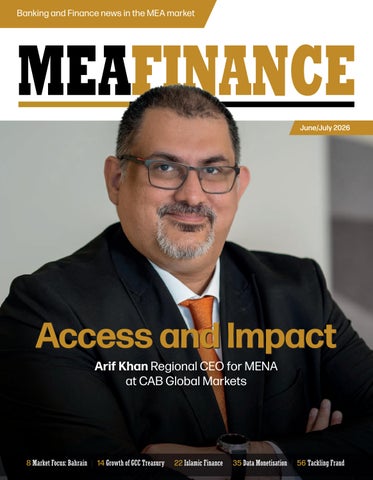

Access and Impact
Access and Impact
Arif Khan Regional CEO for MENA at CAB Global Markets


Double Edged Sword
Everybody understands that actions, products and innovations often have both favourable and unfavorable outcomes. Examples of this are peppered throughout history, from the earliest stone hand axes all the way up to social media and AI. Sadly, there will likely never be a way to prevent ideas and innovations that have arrived with the promise to improve lives from being turned against us for underhand or destructive purposes. However, this does spur creativity in the development of countermeasures, and you might even contend that the momentum of this positive and negative movement powers

In this issue of MEA Finance, a lot of space is given to the technology of banking. Much of it describes how it is advancing in response to our needs, not just as a bringer of convenience and inclusion, but also as a threat from bad actors that needs to be countered and kept in check. As you will learn, the way this is being tackled is a true testament to positive ingenuity. Countering fraud and banking scams are areas of rapid progress in banking technology, with AI that can detect when a scam is occurring in real time. In our section focusing on tackling fraud, we hear from a technology provider at the forefront of developments to protect banks and consumers, and from banks who are managing this unending menace.
Further related matters requiring the application of technology in banking include cyber threats and cloud security, which we also look at in this edition, along with another link in this chain - the role and collection of data, another example of a strategically valuable asset in banking being double-edged. In this section, Addleshaw Goddard's, Sara Greenstreet points out that, "Without contextual framing, even accurate data becomes unreliable as a basis for decision making".
Moving on to different challenges, our cover story this month features Arif Khan, Regional CEO, MENA at Crown Agents Bank (CAB) Global Markets. In his interview, Khan highlights how this long-established financial institution focuses operations on difficult locations and circumstances. "Most banks optimise for scale and efficiency in developed markets. We have deliberately chosen the markets where access is harder, infrastructure is thinner and risk is more complex".
In the latest of our regular looks into Islamic Finance, we explain how this growing sector of banking and finance is undergoing a period of structural transformation shaped by technology, digitalisation, capital market evolution and changing wealth dynamics.
Also inside, we consider the growing role of treasury in our region as corporations expand internationally and liquidity management becomes increasingly important; with key contributions from Citi and JP Morgan.
Additionally we observe the UAE in these challenging times, to show the nations' institutional strength, financial infrastructure and operational preparedness mean that the country’s banking system, financial markets and investment ecosystem continue attracting capital, businesses and entrepreneurs seeking long-term opportunity.
And in our market focus on Bahrain, we explain how the Kingdom continues to exert disproportionate influence across banking, financial regulation, Islamic finance and fintech innovation.
Coming back round to technology, our contribution from Infosys in this edition looks at its role in the SME banking market where digital lenders and embedded finance platforms are demonstrating that SMEs can now be served at scale.
Finally, we introduce a new sectionTechnology Companies You Should Know, which will provide a platform for technology businesses operating in the highly competitive banking and finance technology market, to showcase their special services and innovations.
So, in this issue of MEA Finance, we safely rearrange the sword into words, so that you can learn more about the double edges of technology advancement in our market.









Optimal Data
Sarah Greenstreet Technology, Media and Telecommunications and Data Protection Lawyer at Addleshaw Goddard outlines why the future of data strategy in banking is not about converting data into revenue. It is about converting data into better financial services, and while it is a higher bar, the institutions willing to meet it are the ones worth watching
Is data monetisation now a toptier priority for regional banks and financial institutions?
Yes, though the question is better understood once we are clear about what data monetisation actually means in a banking context. It is not the sale of customer data to the highest bidder. It is the responsible extraction of value from data that banks already hold, through more precise fraud detection, sharper risk scoring, personalised product delivery, open finance partnerships, AI-enabled services and consented data sharing via APIs.
Banks occupy a structurally privileged position: they have visibility across the full arc of a customer’s financial life. Spending habits, salary flows, savings behaviour, borrowing patterns, periods of financial stress. Few institutions see as much, as continuously, as a bank does. The question is whether that data is being used to make the relationship genuinely better, or simply to make the bank’s internal models more efficient. Across the Middle East, the stakes are rising. Open finance, instant payments, digital wallets and embedded finance

Sarah
Greenstreet, Technology, Media and Telecommunications and Data Protection Lawyer at Addleshaw Goddard
are reshaping customer expectations. Customers no longer tolerate irrelevant, poorly timed or generic propositions, and institutions that cannot meet that standard will lose ground to those that can. The real opportunity is not monetisation in the extractive sense.
It is using data as the basis for a more intelligent, more responsive and more trusted financial relationship.
The institutions that will lead are those that understand trust not as a compliance obligation but as a commercial asset.
Do consent-driven data collection services provide better quality information than non-consented data collection?
Generally, yes. When a customer understands what they are sharing, why they are sharing it and what they stand to receive in return, the resulting data tends to be more deliberate, more relevant and more reliable. The intentionality of the exchange matters to data quality, not only to legal compliance.
This is particularly significant as open banking and open finance frameworks develop across the region. Open finance is architecturally premised on the idea that customers should control access to their financial data, sharing it with authorised providers only where they have given clear, informed and revocable consent. That is not merely a design preference. Under regional data protection and
financial services frameworks, consent is increasingly required to be specific, evidenced and capable of withdrawal, and regulators are beginning to scrutinise whether institutions can demonstrate this in practice.
For banks, the technical challenge is non-trivial: consent must not simply be captured at the point of onboarding and then treated as perpetual. It needs to be tracked, scoped, updated and revoked across systems and third-party integrations in a way that reflects what the customer actually agreed to at any given point in time.
That said, consent is not a quality guarantee in itself. A customer may consent to data sharing and the data may still be incomplete, duplicated, outdated or misinterpreted. Strong governance must sit behind the consent architecture. That means clear consent notices, accurate records of agreed scope, defined and limited purposes for use, regular data quality reviews, and meaningful controls against purpose creep.
How can it be ensured that collected data is correctly interpreted and assessed accurately?
Correct interpretation begins with purpose. The same data point can support quite different conclusions depending on the context in which it is read. An uptick in spending may indicate financial stress, a life event, business expansion or entirely ordinary seasonal behaviour. Without contextual framing, even accurate data becomes unreliable as a basis for decision-making.
Banks therefore need governance and technical controls working in concert. On the technical side, that means data quality checks, lineage tracking, validation against trusted sources, deduplication, consistent classification and regular model testing. On the governance side, it means clear dataset ownership, documented analytical assumptions, human review
of consequential decisions and credible challenge processes where outputs appear anomalous or produce outcomes that seem disproportionate.
Over-reliance on single data points is a recurring failure mode. More robust outcomes come from reading patterns across time, anchored in well-constructed business rules and properly validated models. The goal is not to collect more data. It is to understand what the data is actually indicating, and to be equally honest about what it cannot tell you.
In today’s AI-driven world, how can banks distinguish good data from fraudulent data?
This is one of the more consequential questions facing financial institutions deploying AI at scale. AI can be a powerful analytical tool, but its outputs are only as sound as the data underpinning them. Poor, biased or fraudulent data does
to inform. Historical data used in credit scoring models, for example, may embed patterns that no longer reflect customer reality or may encode structural bias from earlier periods.
Third, lawfulness and ethical usability: data collected without adequate transparency or proper authorisation creates legal, regulatory and reputational exposure, regardless of its apparent commercial value.
On the fraud detection side, banks need a layered combination of technology, governance and human oversight: identity verification, device intelligence, behavioural analytics, anomaly detection, transaction monitoring and ongoing fraud typology reviews. They also need to contend with a threat landscape that is evolving rapidly. Synthetic identities, deepfakegenerated documentation, manipulated financial records and account takeover
WITHOUT CONTEXTUAL FRAMING, EVEN ACCURATE DATA BECOMES UNRELIABLE AS A BASIS FOR DECISION-MAKING
not become reliable simply because a sophisticated model has processed it.
Banks should assess data quality across three dimensions. First, accuracy and traceability: the bank should be able to identify the origin of the data, verify whether it has been altered in transit, and audit its provenance. This is particularly important for data sourced from thirdparty providers or ingested via open banking APIs, where lineage is often harder to establish and data integrity cannot be assumed.
Second, relevance: a large dataset is not inherently a useful one. Data must be sufficiently current and appropriately matched to the decision it is intended
techniques are all becoming more sophisticated as generative AI tools become more widely available. Perhaps most importantly, banks should resist treating AI outputs as inherently objective. Models surface patterns, but they can also entrench historical bias or amplify data quality problems at scale. Explainability, audit trails, bias testing, model validation, escalation mechanisms and clearly defined accountability are not optional features. They are prerequisites for responsible AI deployment in any context where the outcomes affect access to credit, pricing, onboarding or fraud determinations.

Bahrain’s Strategic Influence
Bahrain occupies a unique position within the Gulf’s financial architecture. Despite its smaller geographic and economic scale relative to some neighbouring markets, the Kingdom continues to exert disproportionate influence across banking, financial regulation, Islamic finance and fintech innovation. As the GCC enters a new phase shaped by artificial intelligence, digital payments, open banking and economic diversification, Bahrain’s long-standing institutional strengths continue to play an important role in defining the future direction of regional finance.
Bahrain’s position within the regional financial system has historically been shaped by its early recognition of banking and financial services as strategic pillars of economic development. Long before financial diversification became a dominant theme across the GCC, the Kingdom had already established itself as an important regional banking hub serving conventional banking, Islamic finance, investment management and cross-border financial activity throughout the Middle East.
This historical positioning continues to influence Bahrain’s modern financial identity. The Kingdom remains one of the Gulf’s most institutionally mature financial markets, combining established regulatory capability with a comparatively agile approach toward innovation and financial sector modernisation. Bahrain’s financial ecosystem today
encompasses conventional and Islamic banks, investment firms, insurance providers, payment companies and increasingly sophisticated fintech and digital infrastructure environments operating across both regional and international markets.
Regional Influencer
The strategic significance of Bahrain’s financial sector extends beyond its domestic economy. The Kingdom continues to function as an important gateway between Gulf financial markets and broader international banking and investment ecosystems. Bahrain’s regulatory environment, financial infrastructure and operational connectivity have allowed it to maintain influence across areas such as Islamic finance, treasury operations, cross-border banking and increasingly digital financial innovation despite intensifying competition among regional financial centres.
The Central Bank of Bahrain remains central to this positioning. The regulator continues to play a major role in shaping Bahrain’s financial modernisation strategy through frameworks focused on digital banking, fintech innovation, open banking and operational resilience. Bahrain was among the earliest jurisdictions in the Middle East to introduce formal open banking regulation, reinforcing its reputation as a market willing to adapt regulatory structures proactively in response to technological and operational change within financial services.
This regulatory agility has become increasingly important as banking systems across the GCC undergo rapid transformation. Financial institutions throughout the region are modernising payment infrastructure, expanding digital ecosystems and integrating artificial intelligence into operational environments at accelerating speed. Bahrain has sought to position itself at the centre of this transition by developing financial infrastructure capable of supporting innovation while maintaining regulatory oversight and institutional stability.
Digital banking and fintech development have consequently become increasingly prominent within Bahrain’s broader financial strategy. The Kingdom has continued encouraging innovation across payments, digital wallets, cloudenabled banking infrastructure and API-driven financial ecosystems. Open banking frameworks, regulatory sandbox environments and fintech-focused infrastructure initiatives have contributed to Bahrain’s reputation as one of the more innovation-oriented banking jurisdictions within the GCC.
This approach reflects broader structural realities affecting the Kingdom’s economy. Bahrain’s financial sector plays a strategically important role within national economic diversification efforts, making continued modernisation and competitiveness particularly significant. The banking and financial services industry contributes materially to economic activity, employment and investment positioning within the Kingdom, reinforcing the importance of maintaining regulatory relevance and operational sophistication amid rapid regional transformation.
The banking sector itself remains highly diverse relative to the size of the domestic market. Conventional banking, Islamic finance, wholesale banking and investment activity continue to coexist within an ecosystem shaped by both regional connectivity and international engagement. Bahrain’s role within Islamic finance remains particularly important given the Kingdom’s historical contribution to the development of regional Shariacompliant financial infrastructure.
Institutions including Bank ABC, National Bank of Bahrain and Al Baraka Banking Group continue operating across diversified banking and financial environments linked to regional markets and broader international activity. Bahrain also remains home to important Islamic finance institutions and industry bodies that continue influencing governance standards and financial market development across the wider Islamic banking ecosystem.
The Kingdom’s role within Islamic finance extends beyond banking activity alone. Bahrain continues to contribute to governance, standardisation and institutional development across the sector through organisations including the Accounting and Auditing Organization for Islamic Financial Institutions, whose standards and governance frameworks remain influential across Islamic banking markets globally.
This institutional depth has become increasingly valuable as Islamic finance itself enters a more technologically advanced and internationally integrated phase of development. Digital banking, sukuk market expansion, AI-driven compliance systems and ESG-linked Islamic finance structures are reshaping the operational environment across the industry. Bahrain’s long-standing institutional involvement within Islamic finance governance therefore continues to support its strategic relevance despite intensifying competition from larger regional economies.
Payments infrastructure modernisation is also becoming increasingly important within Bahrain’s financial transformation strategy. Real-time payment systems, digital transaction ecosystems and fintech-driven payment environments are expanding rapidly across our region, changing customer expectations and operational banking requirements. Bahrain has continued investing in payment innovation and financial connectivity infrastructure as part of broader digital economy development efforts.
This shift is influencing how financial institutions operate across nearly every layer of banking activity. Transaction processing, customer onboarding, compliance oversight and treasury operations are becoming increasingly dependent on cloud infrastructure, AI-enabled analytics and continuously connected digital ecosystems. Banks operating within Bahrain’s financial sector must therefore balance innovation with cybersecurity resilience, operational governance and regulatory
compliance across increasingly complex digital environments.
Artificial intelligence is emerging as one of the defining technologies shaping the next phase of Bahrain’s financial sector evolution. AI-enabled systems are increasingly influencing fraud monitoring, compliance management, customer engagement and operational analytics across banking environments throughout the GCC. Bahrain’s emphasis on digital financial innovation positions it to participate actively within this broader transformation as regional banking systems become more data-driven and technologically interconnected.
Cybersecurity and operational resilience consequently remain major strategic priorities. Financial institutions across the Kingdom operate within increasingly digital environments characterised by real-time payments, cloud-enabled infrastructure and interconnected operational ecosystems. This increases exposure to cyber risk, vendor dependency and operational disruption if governance and resilience frameworks are insufficiently mature.
The Kingdom’s financial ecosystem therefore faces many of the same structural challenges affecting banking systems throughout the wider GCC. Competition for digital leadership, infrastructure modernisation, skills development and operational scalability continues intensifying as regional financial centres accelerate investment into fintech, artificial intelligence and digital banking capability.
Structural Advantages
The Kingdom’s retains several important structural advantages with a comparatively agile regulatory environment, established financial infrastructure and long-standing institutional experience continue to support its relevance within rapidly changing regional financial markets. Its smaller scale may also provide operational flexibility that allows faster adaptation to emerging financial
technologies and evolving banking models compared with more complex or heavily layered financial ecosystems.
This flexibility is increasingly important as financial systems across the region move toward more interoperable and ecosystem-driven operating models shaped by open banking, embedded finance and AI-enabled financial services.
The role Bahrain plays within the GCC financial system is therefore evolving rather than diminishing. The Kingdom is no longer competing purely on traditional banking scale or regional dominance. Instead, it is increasingly positioning itself as an adaptive financial ecosystem focused on regulatory innovation, operational flexibility and digital financial infrastructure capable of supporting the next phase of regional banking transformation.
And as financial systems across the Middle East continue shifting toward real-time payments, AI integration and interconnected digital economies, Bahrain’s long-established institutional strengths may continue to provide the Kingdom with strategic influence extending well beyond the size of its domestic market.
Bahrain’s continued importance within the GCC financial system is also closely connected to its broader economic positioning and long-standing role as a regional commercial and banking gateway. While the Kingdom’s economy is smaller in scale relative to some neighbouring Gulf markets, Bahrain has historically compensated through financial sophistication, operational connectivity and institutional adaptability. These characteristics continue to influence how the country positions itself within an increasingly competitive regional financial landscape.
Economic diversification remains central to Bahrain’s long-term strategy. Like other regional economies, the Kingdom continues balancing hydrocarbon-related revenues with broader efforts to expand non-oil economic activity, attract investment and strengthen private sector participation.
Financial services remain one of the most strategically important sectors within this diversification framework because of their contribution to GDP, employment and international connectivity.
The Need to Innovate
Banking and financial services continue to represent one of Bahrain’s largest non-oil economic sectors. This creates both opportunity and strategic necessity. The Kingdom’s financial ecosystem must continue evolving in order to maintain competitiveness as neighbouring markets invest heavily in digital infrastructure, fintech development and capital market expansion. Bahrain’s response has increasingly focused on flexibility, regulatory agility and operational modernisation rather than competing directly on market scale alone.
This approach is particularly visible within Bahrain’s capital markets and treasury environment. The Kingdom continues to maintain importance within regional debt markets, sukuk activity and wholesale banking despite intensified competition among Gulf financial centres. Bahrain’s long-established financial infrastructure and institutional experience continue to support treasury operations, liquidity management and cross-border banking activity linked to wider GCC and international markets.
The sovereign debt and sukuk market remains an important component of Bahrain’s broader financial ecosystem. Like many governments globally, Bahrain has increasingly utilised debt capital markets as part of fiscal management and funding strategies over recent years.
At the same time, the Kingdom continues participating actively within regional Islamic capital markets that remain structurally important across the GCC. This is particularly significant given Bahrain’s long-standing association with Islamic finance governance and institutional development. The Kingdom continues to maintain influence across the Islamic financial ecosystem through regulatory institutions, banking activity
and broader market participation. Organisations including the Accounting and Auditing Organization for Islamic Financial Institutions continue contributing to governance frameworks and industry standards that influence Islamic finance markets far beyond Bahrain itself.
Bahrain’s role within wholesale banking and treasury activity also remains important. Historically, the Kingdom developed as a regional banking centre partly due to its openness to international banking activity and its position as a commercially connected Gulf financial jurisdiction. While regional financial competition has intensified significantly, Bahrain continues to retain institutional expertise and infrastructure linked to treasury operations, correspondent banking and international financial connectivity.
Banks operating within the Kingdom continue supporting regional and international financial flows across conventional and Islamic banking environments. Institutions including Bank ABC, National Bank of Bahrain and Al Baraka Banking Group continue operating across diversified financial activities linked to regional markets, trade connectivity and cross-border banking environments.
This cross-border orientation is increasingly important as GCC economies become more interconnected through trade, payments infrastructure and digital financial ecosystems. Bahrain’s comparatively open financial environment and operational flexibility continue supporting its positioning as a connector between regional banking systems and broader international financial markets.
The Kingdom’s financial ecosystem is also benefiting from broader regional expansion in digital commerce, payments infrastructure and fintech development. Bahrain has continued encouraging innovation through regulatory sandbox frameworks, open banking initiatives and fintech-focused operational environments designed to attract technology-driven financial activity.
This strategy reflects recognition that long-term competitiveness increasingly depends on digital capability, ecosystem connectivity and operational agility rather than traditional banking scale alone.
Fintech development has therefore become an increasingly important component of Bahrain’s wider economic strategy. The Kingdom has continued positioning itself as a market supportive of startup ecosystems, innovation environments and digital financial experimentation within regulated frameworks. This has helped strengthen Bahrain’s profile within areas such as payments, open banking and digital financial infrastructure.
The growth of cloud-enabled banking environments, API ecosystems and AI-driven operational systems is further accelerating this transition. Financial institutions across Bahrain increasingly operate within real-time digital environments requiring scalable infrastructure, cybersecurity resilience and advanced data management capability. This is encouraging deeper collaboration between banks, regulators and technology ecosystems as operational complexity increases across financial services environments.
Artificial intelligence is also expected to play an increasingly important role within Bahrain’s financial evolution. AI-driven systems are already influencing fraud monitoring, customer analytics, compliance management and operational optimisation across regional banking systems. Bahrain’s emphasis on innovation and financial technology positions it to participate actively within this broader transformation as AI capability becomes more deeply integrated into banking infrastructure across the GCC.
The Kingdom’s relatively agile regulatory environment remains one of its strongest structural advantages within this context. Bahrain has historically demonstrated an ability to adapt financial regulation and operational frameworks relatively quickly in response to changing
market conditions and technological development. This flexibility may become increasingly valuable as financial services continue evolving toward more interconnected and technology-intensive operating environments.
Talent and workforce capability also remain strategically important. Bahrain continues to maintain an experienced financial services workforce with institutional expertise across banking, Islamic finance, treasury operations and regulatory environments. As banking ecosystems become increasingly technology-driven, the ability to combine financial expertise with digital and operational capability may become one of the most important competitive differentiators shaping the Kingdom’s future financial positioning.
Managing a Competitive Environment
Bahrain also faces many of the same structural pressures affecting other regional financial centres. Competition for investment, digital leadership and financial activity continues intensifying as Gulf economies accelerate diversification and infrastructure investment. Larger neighbouring markets possess greater scale and capital deployment capability, increasing pressure on Bahrain to differentiate through regulatory adaptability, operational efficiency and specialised financial expertise.
This competitive environment is gradually reshaping how Bahrain defines its role within regional finance. The Kingdom is no longer attempting to compete primarily through scale or market dominance alone. Instead, Bahrain is increasingly positioning itself as a highly connected, institutionally mature and operationally agile financial ecosystem capable of adapting rapidly to technological and structural change across banking and finance.
That positioning may ultimately prove increasingly valuable as financial systems across the GCC continue shifting toward AI-driven banking, real-time payments,
open finance and interconnected digital economies.
And as the Middle East enters a new phase of financial modernisation shaped by infrastructure intelligence, operational resilience and ecosystem connectivity, Bahrain’s combination of regulatory flexibility, financial experience and innovation-oriented governance may allow the Kingdom to continue exerting influence well beyond the relative size of its domestic market.
As Bahrain’s financial sector continues evolving, the Kingdom’s banking ecosystem is increasingly shaped by the same structural forces transforming financial systems across the wider GCC: digitalisation, artificial intelligence, realtime payments, operational resilience and intensifying competition for regional financial relevance. Yet Bahrain’s response to these shifts reflects its own distinct institutional characteristics, particularly its emphasis on regulatory flexibility, adaptability and financial connectivity.
The operational environment facing banks across Bahrain today is considerably more complex than during earlier phases of the Kingdom’s financial development. Financial institutions are simultaneously modernising legacy infrastructure, integrating digital ecosystems, strengthening cybersecurity capability and responding to rapidly changing customer expectations surrounding speed, accessibility and personalised financial services.
This transformation is particularly visible within payments and transaction infrastructure. Real-time payments, digital wallets and API-driven banking ecosystems are increasingly reshaping how individuals and businesses interact with financial services across the GCC. Bahrain has sought to position itself actively within this transition through support for open banking, fintech integration and payment innovation environments designed to strengthen financial connectivity and digital commerce capability.
The operational implications for banks are substantial. Institutions increasingly
require infrastructure capable of processing large transaction volumes securely and continuously while simultaneously maintaining regulatory compliance, cybersecurity resilience and operational continuity. This is accelerating investment into cloud-enabled infrastructure, AI-driven operational systems and data-intensive banking environments throughout the Kingdom.
Institutions including Bank ABC, National Bank of Bahrain and Al Baraka Banking Group continue strengthening digital banking capability, payments infrastructure and operational resilience environments linked to broader regional financial transformation.
The future competitiveness of financial centres across the Gulf is increasingly likely to depend on operational flexibility and ecosystem connectivity rather than physical scale alone. Financial institutions require regulatory environments capable of adapting quickly to technological evolution while still maintaining governance standards, cybersecurity resilience and financial stability. Bahrain’s comparatively agile approach toward financial regulation may therefore remain one of its most strategically important advantages.
This flexibility has already become visible through the Kingdom’s approach toward open banking, fintech regulation and digital financial infrastructure. Bahrain was among the earliest markets in the region to implement formal open banking frameworks, reinforcing its reputation as a jurisdiction willing to modernise operational and regulatory structures proactively in response to evolving financial technology environments.
The expansion of open finance and embedded banking ecosystems across the GCC is likely to reinforce the importance of this adaptability further. Financial services are increasingly integrating directly into digital commerce environments, payment ecosystems and customer activity platforms through APIdriven infrastructure and interoperable operational environments. Banks are
therefore operating within ecosystems where continuous connectivity, realtime processing and data integration increasingly determine competitiveness.
Role Redefinition
Talent development will remain critical. Banking ecosystems across the GCC increasingly require expertise spanning digital infrastructure, cybersecurity, AI governance, treasury operations and regulatory technology environments. Bahrain’s long-established financial services expertise provides a strong institutional base, but continued investment into digital capability and technology-oriented financial skills will likely remain essential for sustaining competitiveness.
Major advisory and professional services firms including Deloitte, PwC, EY and KPMG continue supporting financial institutions across Bahrain undertaking operational modernisation, digital transformation and governance enhancement programmes linked to wider regional banking evolution.
What is emerging across Bahrain is not simply the preservation of a traditional Gulf banking centre. The Kingdom is gradually redefining its role within regional finance through adaptability, institutional maturity and increasingly technologyoriented financial infrastructure.
Its future competitiveness may depend less on attempting to replicate the scale of larger neighbouring markets and more on maintaining the flexibility, regulatory responsiveness and operational sophistication that have historically differentiated Bahrain within regional banking and finance.
And as GCC financial systems continue evolving toward AI-driven operations, embedded finance, open banking and interconnected digital economies, Bahrain’s ability to combine institutional experience with innovationoriented governance may allow the Kingdom to continue exerting strategic financial influence far beyond the relative scale of its domestic economy.
Discover Distinction
with Mashreq Private Banking


Our cutting-edge technology offers you a one-stop solution for all your wealth management and daily banking needs.


Treasured Times
Treasury operations across the Gulf Cooperation Council are undergoing a structural transformation. As regional corporations expand internationally, payment infrastructures modernise and liquidity management becomes increasingly strategic, the GCC is emerging as a significant centre for treasury centralisation and financial coordination. What was once viewed primarily as an operational finance function is now becoming a critical component of corporate strategy, capital deployment and crossborder commercial expansion
The evolution of treasury management across the GCC reflects a broader transformation taking place within the region’s corporate and financial landscape. Over the past decade, the GCC has steadily moved beyond an economic model primarily centred on hydrocarbons toward one increasingly shaped by diversification, international investment and cross-border commercial integration. This transition has fundamentally altered how regional corporates manage liquidity, funding and financial control, placing treasury functions at the centre of strategic decision-making.
The need for Centralisation
The emergence of treasury centralisation across our region is also being shaped by the evolution of corporate operating structures themselves. As regional organisations become larger, more internationally connected and operationally diversified, treasury functions are increasingly being
reorganised into formalised financial control centres capable of overseeing liquidity, funding and risk management across entire corporate ecosystems.
Historically, treasury operations across many regional organisations were decentralised, separated across subsidiaries and largely focused on transactional oversight. Cash management, payment execution and funding arrangements were often handled independently within local operating units. As regional businesses expanded geographically and operationally, however, these structures became increasingly difficult to manage efficiently. The complexity associated with multiple banking relationships, fragmented liquidity positions and varying regulatory environments created operational limitations that could no longer be addressed through conventional treasury models.
Treasury centralisation has therefore emerged as one of the most important structural trends within GCC corporate finance. Large regional groups, sovereignlinked entities and multinational organisations operating across the Gulf are increasingly establishing centralised treasury hubs capable of overseeing liquidity, risk management and capital deployment across multiple jurisdictions. These treasury centres are designed not only to improve operational efficiency, but to provide corporates with real-time financial visibility and stronger strategic control over regional and international operations.
Several factors are contributing to this transition. The first is the increasing scale and internationalisation of GCC corporates themselves. For many regional corporates, the shift toward treasury hubs is driven by the practical realities of international expansion, requiring them to manage increasingly complex banking relationships, payment structures and funding arrangements.
Businesses headquartered in the Gulf are now active across Africa, Asia and Europe through investments, acquisitions, logistics corridors and trade expansion.
Sectors such as aviation, energy, telecommunications, infrastructure, industrial manufacturing and retail are managing increasingly sophisticated payment flows and foreign exchange exposure across multiple markets. Decentralised treasury environments make it difficult to maintain visibility over group-wide liquidity positions, often resulting in excess idle cash, duplicated financing costs and fragmented operational oversight.
As companies expand internationally, treasury functions must manage wider currency exposure, more complex funding structures and increasingly dynamic liquidity requirements. Treasury centralisation provides a mechanism through which corporates can consolidate cash visibility, optimise liquidity allocation and strengthen control over cross-border funding activity.
The GCC itself offers an increasingly supportive environment for treasury centralisation. Financial centres such as the
environment compared to many emerging markets. This stability supports crossborder treasury planning and reduces currency volatility risk for corporates operating regionally and internationally.
The region’s geographic positioning also contributes to its attractiveness as a treasury coordination centre. The GCC sits between Asian, European and African markets, allowing treasury teams to oversee operations across multiple time zones within a single working day. This logistical advantage is increasingly important for corporates managing international supply chains, investment activity and real-time liquidity movements across multiple regions.
Tax and regulatory considerations further reinforce the appeal of treasury centralisation. Financial centres such as the Dubai International Financial Centre and Abu Dhabi Global Market continue to attract multinational treasury activity through internationally recognised legal frameworks, financial
THE EMERGENCE OF TREASURY
CENTRALISATION ACROSS THE GCC IS ALSO BEING SHAPED BY THE EVOLUTION OF
CORPORATE OPERATING STRUCTURES THEMSELVES
Dubai International Financial Centre and Abu Dhabi Global Market continue to attract multinational treasury activity through internationally aligned legal frameworks, sophisticated banking infrastructure and strong financial connectivity. These environments allow corporates to coordinate treasury operations across the Middle East, Africa and South Asia from a single regional base.
Our region also enjoys several structural advantages that support this model. Currency stability remains one of the most important. The majority of GCC currencies remain pegged to the US dollar, providing treasury functions with a relatively predictable foreign exchange
infrastructure and corporate-friendly operating environments. Saudi Arabia’s ongoing economic reforms are similarly contributing to the Kingdom’s growing importance within regional treasury operations, particularly as regional headquarters and large-scale investment activity continue to expand.
Another important driver behind treasury transformation is the growing influence of sovereign-linked entities and large family conglomerates within the regional economy. Many of the GCC’s largest corporates operate across multiple sectors and jurisdictions simultaneously, often maintaining extensive international investment and
OF GCC TREASURY
trade relationships. Treasury functions within these organisations must therefore coordinate increasingly large and complex liquidity structures involving multiple currencies, financing arrangements and banking counterparties.
The scale of sovereign investment programmes is also influencing treasury operations indirectly. Large infrastructure projects, industrial development programmes and strategic investment initiatives generate significant funding and liquidity requirements across the corporate sector. Treasury teams involved in these ecosystems must manage payment flows, financing structures and liquidity allocation with increasing sophistication as project pipelines expand.
The Role of Banks
Banks operating across the GCC are adapting to these developments by positioning treasury and transaction banking services as strategic corporate infrastructure. Institutions including First Abu Dhabi Bank, Emirates NBD and Mashreq Bank continue to offer transaction banking, liquidity management and treasury solutions aligned with the increasingly international nature of regional corporate activity.
Saudi Arabia is also becoming increasingly important within the regional treasury landscape as Vision 2030 accelerates corporate expansion and investment activity across the Kingdom. The scale of industrial, infrastructure and investment programmes underway is contributing to greater demand for advanced treasury and liquidity management capabilities. Banks such as Saudi National Bank, Al Rajhi Bank and Riyad Bank provide transaction banking, liquidity and corporate treasury services aligned with these evolving requirements.
The UAE meanwhile continues to strengthen its position as a regional treasury and transaction banking hub. Institutions including First Abu Dhabi Bank, Emirates NBD and Mashreq Bank maintain extensive corporate banking,
TREASURY AND CASH MANAGEMENT SERVICES, ONCE VIEWED PRIMARILY AS OPERATIONAL SUPPORT FUNCTIONS, ARE NOW BECOMING CENTRAL COMPETITIVE DIFFERENTIATORS
FOR BANKS OPERATING ACROSS THE GCC
cash management and treasury service platforms supporting both domestic and internationally active corporates. Their treasury and transaction banking operations increasingly incorporate digital connectivity, liquidity management and cross-border payment capabilities designed to support regional treasury structures.
Across the wider GCC, treasury capabilities are also continuing to evolve. In Qatar, Qatar National Bank and Commercial Bank provide corporate treasury, transaction banking and liquidity management services linked to regional trade and investment activity. In Kuwait, National Bank of Kuwait and Kuwait Finance House maintain treasury and corporate banking operations supporting increasingly international business activity among Kuwaiti corporates and investment groups.
Bahrain also continues to play an important role within the regional treasury environment due to its longestablished financial sector and international banking connectivity. Bank ABC and National Bank of Bahrain remain active within transaction banking, liquidity management and correspondent banking services linked to regional corporate activity. In Oman, Bank Muscat and National Bank of Oman continue to support treasury and corporate banking requirements associated with expanding trade, logistics and infrastructure sectors.
The role of banks within treasury transformation is becoming increasingly strategic. Treasury operations today depend heavily on real-time liquidity
visibility, payment efficiency and integrated financial infrastructure. Corporates are therefore placing greater emphasis on banking relationships capable of supporting centralised liquidity structures, cross-border payments and multi-jurisdiction treasury management.
This shift is also increasing the importance of transaction banking within regional financial institutions. Treasury and cash management services, once viewed primarily as operational support functions, are now becoming central competitive differentiators for banks operating across the GCC. Institutions are investing in digital treasury platforms, liquidity management systems and payment integration capabilities designed to strengthen long-term corporate relationships.
International banks remain deeply embedded within this environment as well. HSBC Middle East and Standard Chartered continue to provide treasury, transaction banking and cross-border liquidity services to multinational corporates operating within the GCC. Their role reflects the increasingly international nature of treasury management across the region and the integration of GCC businesses within global trade and capital flows.
Technology
Technology is simultaneously reshaping treasury operations across the region. The transformation of treasury functions is also changing the governance expectations placed upon treasury teams themselves. Treasury operations
are becoming more centralised, more data-driven and more integrated into executive management structures. Corporate boards and senior finance leadership increasingly expect treasury teams to provide strategic insight around liquidity exposure, capital allocation and financial risk rather than simply operational oversight.
This shift is creating growing demand for treasury professionals with more advanced analytical, technological and strategic capabilities. Additionally, many organisations across the region continue to face challenges related to treasury talent availability and operational standardisation. As treasury environments become more sophisticated, attracting and retaining specialised treasury expertise is becoming increasingly important for corporates undertaking large-scale treasury transformation programmes.
Technology adoption is simultaneously reinforcing this evolution. Treasury Management Systems are becoming foundational infrastructure within large regional corporates as treasury teams seek greater automation, integration and visibility across banking relationships and liquidity structures. Treasury environments that once relied heavily on manual reconciliation and dispersed reporting are increasingly shifting toward integrated digital ecosystems capable of providing real-time liquidity visibility and automated payment processing.
Treasury Management Systems are being adopted more widely as corporates seek greater automation, visibility and operational control. Historically, treasury functions within many organisations relied heavily on manual reporting structures and fragmented banking systems, limiting real-time oversight of liquidity positions. As transaction volumes and international operations expand, these approaches are becoming increasingly difficult to sustain.
Treasury Management Systems allow organisations to consolidate liquidity visibility, automate reconciliation processes, improve forecasting and
strengthen cash management across multiple jurisdictions and banking relationships. Their growing adoption reflects the broader transformation of treasury from an operational finance function into a more strategically integrated component of corporate decision-making.
Great Expectations
The expectations placed on treasury professionals are also evolving. Treasury teams are increasingly involved in discussions surrounding capital allocation, risk management and strategic planning. The ability to manage liquidity efficiently across interconnected regional and international operations is becoming a critical corporate capability, particularly within sectors characterised by large-scale investment and crossborder expansion.
One of the most immediate challenges facing corporate treasurers across the GCC relates to liquidity visibility and cash concentration. Large regional organisations frequently operate through subsidiaries spread across different markets, often maintaining relationships with multiple financial institutions in each jurisdiction. Treasury teams are therefore under increasing pressure to centralise liquidity oversight while maintaining compliance with local banking and regulatory requirements.
This challenge becomes more pronounced as GCC corporates deepen outbound investment and commercial activity. Businesses headquartered in the Gulf are expanding rapidly into Africa, Europe and Asia through acquisitions, joint ventures and trade corridors linked to logistics, infrastructure, energy and industrial investment. These activities generate increasingly complex payment flows and foreign exchange exposures, requiring treasury functions to operate with significantly greater coordination and strategic oversight.
Managing liquidity across multiple jurisdictions and currencies introduces additional operational considerations
around hedging, funding costs and counterparty management. Treasury teams must oversee liquidity movement between subsidiaries while maintaining flexibility over working capital requirements and financing structures. This becomes particularly relevant for organisations with exposure to emerging markets, where currency volatility and differing banking regulations can materially affect treasury planning.
At the same time, treasury environments across the GCC continue to operate within a broader global context shaped by interest rate movements, geopolitical developments and shifting trade flows. Treasury teams must therefore manage increasingly complex operating conditions while maintaining flexibility over liquidity and funding strategies.
Emerging Treasury Landscape
Current geo-political considerations aside, the globalisation of business has contributed to the expanding importance of treasury and payments corridors which now is a major consideration for businesses and their treasurers across our region as economies here diversify and grow.
What is emerging across the GCC is not simply a more advanced treasury environment. It is the development of a more strategically integrated financial operating architecture aligned with the region’s expanding role within global commerce and capital markets.
Treasury centralisation is becoming increasingly connected to corporate agility and expansion, liquidity optimisation, investment efficiency and international competitiveness.
And as our region’s businesses continue to expand their global commercial footprint, treasury operations are evolving into one of the most important financial control structures supporting the region’s long-term economic transformation, with its deeper embedding also reflecting the region’s enthusiasm for growth and success.
TREASURY TRANSFORMATION IN THE GCC
The rise of centralization, digitization and real time
Viplav
Rathore Managing Director, Liquidity Management Services, Middle East and Africa at Citi Treasury and Trade Solutions describes why treasury centralisation across he GCC is now embedded and highlights its main drivers
How is treasury centralisation manifesting in the GCC today?
Treasury centralisation across the GCC is now firmly embedded in how leading corporates operate. What is notable is not just the direction of travel, but the breadth of tools being deployed simultaneously.
At the heart of this transformation is technology. Companies are investing heavily in advanced enterprise resource planning (ERP) systems and Treasury Management Systems (TMS), underpinned by secure bank connectivity through hostto-host integrations and SWIFT networks. These capabilities are enabling real-time visibility, automation, and control at a scale not previously possible.
Alongside technology, structural changes are playing a key role. Many organisations are simplifying legal entity structures to remove operational complexity, creating a cleaner foundation for centralised treasury models. This is being complemented by the establishment of Group Treasury Centres (GTCs) and Regional Treasury Centres (RTCs), supported by standardised policies and governance frameworks.

Operationally, centralisation is also being driven through Shared Service Centres, which are consolidating payments, collections, and record-to-report functions. Companies are also adopting increasingly sophisticated liquidity structures, including multi-country and multi-currency cash pooling arrangements—ranging from zero balancing to notional pooling.
One of the more advanced developments is the rise of in-house banking models. These allow treasury functions to act as internal banks, managing intercompany lending, payments, and liquidity on behalf of subsidiaries.
Finally, centralisation is extending beyond liquidity into enterprise risk management, regulatory engagement, and even trade finance activities, where some firms are establishing trading hubs to support cross-border flows.
Treasury in the GCC is evolving into a highly integrated, strategically positioned capability.
What is driving the growth of corporate treasury hubs in the GCC?
The rise of treasury hubs in the GCC is being driven by a combination of structural advantages and shifting corporate needs.
The region offers world-class infrastructure and increasingly competitive financial ecosystems, including incentive frameworks designed to attract multinational operations. Its geographic positioning also remains a key differentiator—sitting between East and West, the GCC provides an ideal base for organisations managing operations across the Middle East, Africa, and increasingly parts of Asia.
From a regulatory and market perspective, the region benefits from relatively well-developed financial systems and, in many cases, limited capital controls, which facilitate cross-border liquidity management and treasury activity.
Importantly, the growth is not just inbound. GCC-headquartered companies are expanding internationally, creating a natural demand for centralised treasury functions in their home markets to oversee increasingly complex global operations.
Talent availability is another contributing factor. The region’s expatfriendly environment supports access
Viplav Rathore, Managing Director, Liquidity Management Services, Middle East and Africa, Citi Treasury and Trade Solutions
to skilled treasury professionals, while governments are actively investing in digital transformation, fintech ecosystems, and emerging areas such as artificial intelligence and digital assets.
What challenges are treasurers in
the region currently navigating?
Despite this momentum, treasury teams in the GCC are operating in an increasingly complex environment.
Regulatory fragmentation remains a key challenge. While frameworks are evolving positively, differences between jurisdictions—particularly around taxation, reporting, and compliance— add complexity for companies operating across multiple markets.
Geopolitical and economic volatility is another factor. Exposure to global energy markets and regional geopolitical developments can lead to sudden shifts in liquidity, currency dynamics, and risk profiles, requiring treasury teams to remain highly agile.
Digital transformation, integrating modern treasury platforms with legacy systems and ensuring cybersecurity resilience is becoming a critical priority.
Liquidity management is further complicated by variations in banking infrastructure and payment systems across GCC countries. Inconsistent settlement cycles and frameworks can reduce efficiency and make accurate cash forecasting more difficult.
Access to capital markets is uneven across the region, and treasury functions must navigate differing levels of market maturity when raising funding.
How are banks in the region responding to these needs?
Banks operating in the GCC are significantly enhancing their treasury and cash management offerings to keep pace with client demand.
There is a clear focus on delivering global-standard digital platforms, ensuring consistency in user experience and security across markets. Banks are investing in advanced liquidity solutions,
AS GCC-BASED COMPANIES EXPAND INTERNATIONALLY, TREASURY FUNCTIONS ARE BECOMING MORE SOPHISTICATED, CENTRALISED AND STRATEGIC
including real-time and cross-border cash pooling, multi-currency structures, and interest optimisation mechanisms.
Innovation is also accelerating in areas such as digital assets and tokenisation, alongside the development of 24/7 clearing capabilities that reflect the increasing demand for round-the-clock financial operations.
In parallel, banks are improving payment and collection infrastructure, enabling seamless domestic and cross-border flows, and driving greater automation to reduce manual processes.
Importantly, many institutions are adopting a “follow-the-flows” strategy— supporting clients along emerging trade corridors such as those linking the GCC with Asia, reflecting the changing dynamics of global trade.
Is investment in treasury technology increasing?
Absolutely. Investment in treasury technology is accelerating rapidly across the GCC.
This is being driven by a combination of digital transformation agendas, the need to support centralised operating models, and a growing requirement for real-time visibility and control across increasingly complex, multi-market operations.
Treasury Management Systems are playing a central role in this shift, enabling enhanced risk management, improved tracking of exposures, and more efficient regulatory reporting.
How are payment infrastructures and regulation shaping liquidity management?
The region presents a mixed picture.
On one hand, relatively limited capital controls in many GCC markets support the
movement of funds and the implementation of centralised liquidity structures. On the other, fragmentation in payment systems across countries remains a challenge.
Different real-time gross settlement systems, clearing mechanisms, and regulatory requirements can create inefficiencies, often requiring companies to hold higher liquidity buffers across multiple jurisdictions.
However, there is clear progress underway. Initiatives such as the development of a unified regional payment system, alongside the growth of open banking frameworks, are expected to drive greater interoperability and efficiency over time.
How is outbound expansion by GCC corporates reshaping treasury functions?
As GCC-based companies expand internationally, treasury functions are becoming more sophisticated, centralised, and strategic.
Organisations are increasingly adopting complex liquidity structures, leveraging global banking networks, and implementing advanced digital solutions to manage operations across multiple currencies and jurisdictions.
There is also a stronger focus on risk management, particularly around foreign exchange exposures, as well as working capital optimisation through improved payment and collection strategies.
Perhaps most importantly, the role of treasury itself is evolving. No longer confined to operational execution, treasury is becoming a strategic partner within the organisation—playing a critical role in shaping financial strategy, supporting expansion, and enabling growth.
Winning Combination
A winning combination of geographic good fortune, closer collaborations between treasurers and their bankers, established financial centres backed by effective regulatory regimes and established tax structures makes our region a growing focus for treasury hubs says Siddharth Sabherwal, Product Head
for Treasury Services, CEEMEA, J.P. Morgan Payments
How is treasury centralisation manifesting in the GCC?
The Gulf Corporation Council [GCC] has developed a dynamic treasury landscape with many multinational and regional firms establishing regional treasury hubs in the GCC, often with oversight of emerging markets across the broader Middle East, Africa, Southeast Asia, India and Central and Eastern Europe (CEE). Firms are adopting in house banking [IHB] to consolidate fragmented liquidity and manage the diverse regulatory landscape. Treasury centralisation is increasingly reflected in these firms by leveraging established financial centres like Dubai International Financial Centre (DIFC) and Abu Dhabi Global Market (ADGM), which are seen as strategic gateways with established and mature regulatory and legal frameworks.

What specific circumstances are driving the growth of corporate treasury hubs in the GCC?
The growth of corporate treasury hubs in the GCC is being propelled by a unique convergence of regulatory mandates, tax and legal structures, geographical advantage and a significant shift in the regional investment flows. Treasury hubs
Siddharth Sabherwal, Product Head for Treasury Services, CEEMEA,
J.P. Morgan Payments
are growing as firms leverage established financial centres in the GCC, seeing the geographical location as a gateway for regional and international treasury oversight. Both geographically and
strategically connected to the rest of the world – there is ever-growing connectivity between Europe, Sub-Saharan Africa and Asia – the GCC is the natural central point between East and West. Companies here are investing in and acquiring assets all over the world as the region charts its course toward economic and geographic diversification.
What challenges are corporate treasurers operating in our region currently facing?
Corporate treasurers in the middle east are currently navigating a landscape defined by significant geopolitical shifts causing supply chain disruptions and thus a heightened focus on operational resilience and rapid regulatory modernisation. The operating environment is complex across markets, with differences in regulations, legal frameworks and product availability across countries that require treasurers to devise tailored solutions, often in collaboration with banking partners, to manage day-to-day operations in a strategic and scalable manner. Additionally, overcoming operational fragmentation and legacy technology is essential to achieve realtime visibility needed to manage interest rate volatility and FX risk.
How are banks operating in our region enhancing their treasury services?
We collaborate closely with treasurers to develop customised solutions, including advanced cash and liquidity management structures aligned that are with regulatory and legal frameworks including but not limited to physical, virtual and notional solutions. There is a shift towards hyper connectivity i.e., API-led architectures that provide real-time, always available visibility. Our service model is technology-first, enabling treasurers to harness data-driven approaches and AI – such as using models to analyse historical transaction data, predictive cash forecasting, fraud detection and automation of reconciliations, etc. Banks are increasingly utilising financial free zones to offer in-house banking, streamlining the transition to regional centralisation.
(manual spreadsheets and fragmented systems) towards integrated digital ecosystems. Treasurers across the GCC are seeking technologies that accelerate settlement processes to allow liquidity to be managed outside traditional cut-off windows, supporting stronger liquidity positions. API-driven real time connectivity, cloud native and Agentic AI platforms are increasingly being adopted by companies to evolve their treasury functions to support growth and strategic intent.
What affects are regional payments infrastructures and regulation having on liquidity and cash flow management?
Regional payment systems and evolving regulations in the Middle East are fundamentally reshaping liquidity and cash flow management for corporates. Faster domestic payment
FASTER DOMESTIC PAYMENT RAILS, OPEN BANKING FRAMEWORKS AND API
CONNECTIVITY ARE GIVING TREASURERS NEAR REAL-TIME VISIBILITY OVER CASH POSITIONS AND ENABLING MORE PRECISE, JUST-IN-TIME FUNDING, REDUCING THE NEED TO HOLD LARGE
PRECAUTIONARY LIQUIDITY BUFFERS
Is adoption and investment in Treasury Management Systems technology increasing across the GCC?
The adoption and investment in Treasury Management System [TMS] technology is surging across the GCC. The region is currently one of the fastest growing markets globally for these solutions as firms move away from “legacy debt”
rails, open banking frameworks and API connectivity are giving treasurers near real-time visibility over cash positions and enabling more precise, just-in-time funding, reducing the need to hold large precautionary liquidity buffers. Emerging digital settlement initiatives, including blockchain-based infrastructure, are further accelerating settlement speed and lowering transaction friction.
Regulation is also helping drive greater discipline and sophistication in treasury operations. While GCC markets are becoming increasingly sophisticated and integrated, the broader Middle East and Africa remains more fragmented, with capital controls and infrastructure differences continuing to affect cash mobility. Overall, liquidity management in the region is shifting from a model focused on managing settlement delays and operational risk to one centred on realtime visibility, regulatory resilience and strategic cash optimisation.
How are treasurers harnessing bank solutions to achieve their goals?
Treasurers collaborate closely with their banking partners to develop bespoke solutions to implement advanced cash and liquidity management structures in line with regulatory, legal and product requirements. We are also seeing many treasurers seeking APIs and digital banking solutions to automate and streamline their treasury operations.
Tr easurers are also increasingly harnessing data-driven approaches and artificial intelligence (AI) to enhance decision-making and address key challenges in their operations. By leveraging AI models to analyse historical transaction data and market trends, they can improve the accuracy of cash flow forecasting, enabling better anticipation of liquidity needs and optimisation of cash positions. Machine learning algorithms automate the reconciliation process by matching payments and receipts, which reduces errors and minimises manual workload. Additionally , data-driven insights empower treasurers to optimise fund allocation, make informed investment decisions and manage working capital more efficiently, ensuring that funds are deployed where they are most needed. This integration of analytics and AI can lead to greater efficiency and accuracy.

Faith in the Markets
Islamic finance across the GCC and wider Middle East is undergoing a period of structural transformation shaped by technology, digitalisation, capital market evolution and changing wealth dynamics. As the sector expands deeper into wealth management, digital banking and international capital markets, Islamic finance is entering a phase defined less by establishment and more by strategic maturity
The development of Islamic finance across the GCC and wider Middle East during the 2020s reflects a broader evolution taking place within regional banking and capital markets. Today, however, the sector is moving into a more advanced phase characterised by technological transformation, institutional sophistication and deeper integration with global finance.
This transition is occurring against a backdrop of economic diversification, regulatory modernisation and changing customer expectations across the region. Islamic financial institutions are no longer operating solely within a niche segment focused on religious compliance. They are increasingly competing directly with conventional institutions across retail banking, corporate finance, investment management and wealth
advisory services. The result is a sector that is becoming more digitally advanced, operationally integrated and strategically significant within the broader regional economy.
Technology and AI
Technology and digitisation have played a particularly important role in reshaping Islamic finance. The acceleration of digital banking adoption across the GCC during
and after the pandemic significantly altered how customers engage with financial institutions. Islamic banks, many of which had historically relied on relationship-driven physical banking models, were required to accelerate digital transformation strategies in response to changing consumer behaviour and increasing competition from both conventional banks and fintech platforms.
Institutions such as Dubai Islamic Bank, Abu Dhabi Islamic Bank and Al Rajhi Bank have continued to expand digital banking capabilities across retail and corporate banking segments and this shift is not limited to the UAE and Saudi Arabia. Kuwait Finance House continues to expand digital banking and transaction capabilities, Qatar Islamic Bank has continued developing digital banking services and in Bahrain, Al Baraka Banking Group, has similarly continued integrating digital financial services within broader Islamic banking operations.
The increasing adoption of technology across Islamic finance is influencing more than customer interfaces. Operational processes, compliance structures and product delivery mechanisms are all becoming increasingly digitised. Automation within trade finance, digital payment integration and data-driven customer analysis are contributing to more efficient operating environments while also helping Islamic institutions compete more directly with large conventional banks.
The interaction between technology and Sharia governance is also becoming increasingly significant. Islamic finance depends fundamentally on compliance frameworks requiring oversight from Sharia scholars and internal governance structures. As financial products, payment systems and digital platforms become more sophisticated, institutions are increasingly exploring how advanced technologies can support compliance monitoring, operational efficiency and product structuring within Islamic finance environments.
Artificial intelligence is expected to become increasingly influential within this area over the coming years. AI-driven analytics and automation tools have the potential to improve monitoring of Sharia-compliant transactions, automate documentation processes and strengthen operational oversight within Islamic banking systems. While advanced AI is unlikely to replace the role of Sharia scholars or supervisory boards, it is increasingly likely to support operational processes associated with compliance verification, product screening and transaction monitoring.
This is particularly relevant as Islamic financial products become more complex and internationally integrated. Sukuk structures, cross-
This evolving relationship between technology and governance reflects a broader maturation of Islamic finance itself. Institutions are increasingly balancing innovation with the preservation of core compliance principles, creating a sector that is simultaneously modernising and reinforcing its foundational structures.
Capital Markets
The transformation of Islamic capital markets over the past five years illustrates this progression clearly. Sukuk markets across the GCC and wider Middle East have expanded significantly in both scale and sophistication, supported by sovereign issuance programmes, infrastructure financing requirements and increasing
THE INVESTOR BASE WITHIN ISLAMIC CAPITAL MARKETS HAS ALSO BROADENED CONSIDERABLY
border investment products and Islamic wealth management platforms often involve extensive documentation and multilayered compliance processes. AI-enabled systems may therefore help institutions process information more efficiently while improving consistency within governance and reporting frameworks.
The integration of AI into Islamic finance introduces broader questions regarding transparency, accountability and interpretive oversight. Islamic banking structures rely heavily on ethical governance principles and supervisory accountability. The increasing use of automated systems within product management, customer assessment or compliance monitoring will therefore require careful alignment with established Sharia governance frameworks.
international investor participation. Governments across the GCC continue to utilise sukuk markets as part of broader debt management and capital market development strategies, while corporates increasingly access Islamic capital markets for project financing and liquidity management purposes. Within regional sukuk activity, Saudi Arabia, the UAE and Qatar remain the central players. Saudi National Bank and First Abu Dhabi Bank continue to participate actively within regional debt and sukuk markets, while Dubai Islamic Bank and Kuwait Finance House remain important participants within Islamic capital market activity.
The investor base within Islamic capital markets has also broadened considerably. What was once driven largely by regional institutional
and sovereign demand is now attracting increasing participation from international investors seeking diversification and exposure to Sharia-compliant assets. This growing internationalisation is contributing to stronger liquidity, wider issuance activity and deeper integration between Islamic and conventional capital markets.
International investor participation within sukuk markets has also increased materially over recent years. Global institutional investors increasingly view sukuk as viable fixed-income diversification instruments supported by strong sovereign and institutional issuers. This growing internationalisation has contributed to improved liquidity conditions, broader investor participation and deeper integration between Islamic and conventional capital markets.
Sustainability-linked finance and ESG considerations are increasingly intersecting with Islamic finance frameworks. The ethical principles underpinning Islamic finance have created natural alignment with broader sustainability themes linked to responsible investment and socially conscious capital allocation. Green sukuk issuance, sustainability-linked Islamic financing and ESG-oriented Islamic investment strategies are therefore becoming more prominent across the region.
Wealth Management
The expansion of wealth management and premium banking services is similarly reshaping the Islamic finance landscape. Rising levels of private wealth across the GCC, alongside increasing sophistication among high-net-worth clients, are driving demand for Shariacompliant wealth advisory, investment management and succession planning services. Islamic financial institutions are responding by expanding private banking and wealth management offerings tailored to affluent regional and international clients.
Institutions such as Abu Dhabi Islamic Bank, Dubai Islamic Bank
and Al Rajhi Bank continue to provide Islamic wealth management and private banking services linked to investment advisory, portfolio management and family wealth structures. This segment is expected to become increasingly important as intergenerational wealth transfer accelerates across the GCC and demand for Sharia-compliant investment solutions continues to grow.
Demand for more sophisticated Sharia-compliant wealth advisory and investment management services is increasing. High-net-worth and ultrahigh-net-worth individuals increasingly require integrated financial solutions encompassing investment advisory, estate planning, succession structuring and private banking services aligned with Islamic financial principles.
GCC and wider Middle East. And as the sector becomes more integrated with global markets, digital ecosystems and international investment flows, Islamic finance is evolving into one of the most strategically significant components of the regional financial architecture.
The evolution of Islamic finance across the GCC over the past two decades has fundamentally altered its position within the regional financial system. What was once viewed primarily as a specialist segment serving a defined customer base has become an increasingly systemic component of banking, capital markets and investment activity across the Middle East. Islamic finance is now deeply embedded within sovereign funding structures, corporate banking, wealth management and retail financial
ISLAMIC FINANCE IS NO LONGER DEVELOPING PRIMARILY THROUGH
RETAIL BANKING EXPANSION ALONE.
Banks continue to expand Islamic wealth management and private banking capabilities linked to investment management, family office support and long-term capital preservation strategies. This segment is expected to become increasingly significant as regional family businesses and investment groups focus more closely on succession planning and multigenerational wealth transfer structures.
Institutional Transformation
What is becoming increasingly evident is that Islamic finance in the region is entering a phase defined not by expansion alone, but by institutional transformation. Technology, capital market sophistication and changing wealth dynamics are reshaping how Islamic banking and finance operate across the
services, reflecting a level of institutional maturity that differs considerably from earlier phases of its development.
This transformation has been driven in part by the increasing integration of Islamic finance within broader national economic strategies. Governments across the GCC have supported the expansion of Islamic banking and capital markets not only as religiously aligned financial alternatives, but as strategic components of financial sector diversification and capital market development. The result is a regional financial environment in which Islamic and conventional systems increasingly operate alongside each other within integrated banking ecosystems.
The institutionalisation of Islamic finance has been reinforced significantly through the development of regional
regulatory and governance frameworks. Organisations such as the Accounting and Auditing Organization for Islamic Financial Institutions and the Islamic Financial Services Board have played important roles in establishing governance, accounting and supervisory standards for Islamic banking and finance. While implementation differs across jurisdictions, these frameworks have contributed to greater consistency, transparency and international credibility within the sector.
Central banks across the GCC have also continued strengthening regulatory oversight of Islamic finance operations. Regulators in the UAE, Saudi Arabia, Bahrain and Qatar have progressively integrated Islamic banking supervision within broader financial regulatory frameworks while maintaining dedicated governance structures related to Sharia compliance and product approval. This increasingly sophisticated regulatory environment has contributed to stronger institutional confidence and greater participation from international investors within Islamic capital markets.
The development of Islamic capital markets over the past five years illustrates the growing sophistication of the sector. Sukuk issuance across the GCC has expanded considerably, supported by sovereign funding programmes, infrastructure investment and corporate financing activity. Governments throughout the region increasingly utilise sukuk markets as part of broader debt management and liquidity diversification strategies, while corporates continue to access Islamic capital markets for longterm financing requirements.
Saudi Arabia and the UAE remain central to regional sukuk activity, with sovereign and quasi-sovereign issuances continuing to support market depth and liquidity development. Banks such as First Abu Dhabi Bank and Saudi National Bank participate actively within regional debt and sukuk markets, while Islamic institutions including Dubai Islamic Bank and Kuwait Finance House continue
to maintain significant involvement in Islamic capital market activity.
Fintech
Technology-driven financial ecosystems are simultaneously reshaping how Islamic financial services are delivered. Fintech ecosystems across the GCC are beginning to influence the Islamic finance sector more materially. Islamic fintech platforms focused on payments, SME financing, crowdfunding and digital investment solutions are expanding across the region, contributing to a broader diversification of Islamic financial services. Regulators in the UAE, Bahrain and Saudi Arabia have continued to support fintech development through regulatory sandboxes and innovation frameworks, creating environments
becoming increasingly visible across the regional financial ecosystem. The boundaries between conventional fintech innovation and Islamic financial structures are gradually narrowing as institutions integrate digital infrastructure within Sharia-compliant operating models.
A Maturing Sector
As Islamic finance across the GCC continues to mature, the sector is increasingly operating within a more competitive and interconnected financial environment. Islamic institutions are no longer developing primarily within protected or segmented markets. They are competing directly with conventional banks, digital financial platforms and international investment institutions across areas including corporate finance,
THE EXPANSION OF ISLAMIC FINTECH REFLECTS BROADER CHANGES IN CUSTOMER EXPECTATIONS ACROSS THE REGION
where Islamic fintech models can evolve alongside conventional digital finance platforms.
The expansion of Islamic fintech reflects broader changes in customer expectations across the region. Younger demographics, digitally native consumers and increasingly technology-oriented SMEs are seeking faster, more integrated financial experiences that align with both modern banking expectations and Shariacompliant financial structures. Islamic digital banking platforms are therefore becoming increasingly sophisticated as institutions compete across convenience, accessibility and product integration.
This digital evolution is extending into adjacent financial segments as well. Digital takaful platforms, embedded Islamic finance solutions and technologyenabled Islamic investment products are
wealth management, payments, trade finance and capital markets. This shift is changing how Islamic banks structure operations, manage liquidity and position themselves strategically within the wider financial ecosystem.
The increasing sophistication of Islamic wealth management also reflects this maturity. Islamic finance is no longer developing primarily through retail banking expansion alone. It is increasingly evolving through institutional depth, capital market integration, digital ecosystems and premium financial services.
And as the GCC continues to strengthen its position within global finance and investment activity, Islamic finance is becoming one of the most structurally important pillars supporting the region’s broader financial transformation.
Not One and Done
Different SME banking models must serve different SME needs. Rethinking SME Banking Through Segmentation and Embedded Models
Historically, banks have neglected the SME segment, deeming it too risky and too expensive to serve. Today, digital lenders and embedded finance platforms are proving otherwise by demonstrating that SMEs can be served at scale, profitably


Business Consulting and Strategic Alliances,
While there is a $5.7 trillion MSME financing gap, SMEs remain underserved — not just because of risk or cost, but because banks continue to apply models designed for retail or corporate customers. These approaches fail to reflect the realities of small businesses. More importantly, banks often treat SMEs as a homogeneous segment, rather than recognising the diversity of their needs.
To address this, banks must move beyond a one-size-fits-all approach. The article outlines how SMEs can be segmented based on their primary banking dependency and explores how banks can employ three
transformative business models to serve these customers to everyone’s advantage.
Hundreds of millions of businesses, and just one segment?
SMEs span a wide spectrum, from street vendors and seasonal exporters to technology firms scaling globally. Each operates with distinct cash flows, risk profiles and financial needs.
Grouping them together leads to undifferentiated strategies and average solutions that fail to fully meet any one need. Instead, banks must segment SMEs more precisely, much like retail customers, and align offerings accordingly.
One effective way is to assess SMEs based on their primary banking dependency at a given point in time. While most businesses have multiple needs, one typically dominates and the provider that meets this need at the right time captures disproportionate value.
Five-category SME typology based on primary banking dependency
1. The liquidity-anchored SME relies heavily on working capital and cash flow management. Businesses such as distributors, manufacturers and traders often struggle with rigid overdraft facilities and collateral requirements. In 2024, cash flow and working capital shortages hindered the growth of one in four UK SMEs.
2. The cr edit-anchored SME seeks term finance to invest and scale. Many viable businesses face barriers due to limited access to long-term funding and reliance on collateral that does not reflect intangible assets. Examples include healthcare providers, logistics companies, and technology-enabled businesses, whose intangible assets (such as customer relationships or intellectual property) do not sit well with traditional collateral-based lending.
3. The settlement-anchored SME depends on efficient payments infrastructure. Retailers, e-commerce sellers, and exporters require fast settlements, cost-effective transactions, multi-channel reconciliation, and crossborder capability.
4. The risk-anchored SME focuses on mitigating exposure to risks -
Manish Jain, Head - Management Consulting at Infosys Finacle
Rajashekara V. Maiya, Global Head -
Infosys Finacle
FX volatility, delayed payments or regulatory obligations. Yet, risk solutions for SMEs remain underdeveloped. In a 2025 survey, just 13 percent of US small businesses with insurance believed they were fully prepared to face potential risks. 5. The eco system-anchored SME operates within digital platforms. Revenue, creditworthiness and financial interactions are deeply embedded in platform ecosystems, making embedded financial services the most natural delivery model. Many SMEs move across these categories over time, or operate across them simultaneously. This typology is therefore not rigid but helps identify the most pressing need at a given moment, enabling banks to deliver relevant value when it matters most.
Matching typology to model
Different SME archetypes require different banking approaches. While digital-only, embedded and marketplace banking are all relevant, their applicability varies by need.
Each of the three models is characterised by a particular set of capabilities, data access mechanism, distribution economics, partnership infrastructure and product specialisation that align better with some SME categories. Before allocating investment, a bank should clearly understand the affinities between business model and SME archetype.
Type 1: Digital-only and embedded banking support liquidity seeking SMEs
For liquidity-anchored SMEs whose survival hinges on working capital, both the digital-only and embedded banking models are relevant: digital-only banks use live transaction data for cash-flow based underwriting, rather than collateral. Dynamic credit lines flex with trading cycles. Time-tocredit takes minutes rather than weeks. Banks can also use embedded finance as a primary model to assess and serve credit-anchored customers by leveraging data available and embedding offerings in procurement and ERP systems. This makes
credit available as soon as a purchase order is raised. For example, suppliers can access early payment against confirmed orders on buyer platforms. Goldman Sachs supports Amazon’s small business credit line, extending business financing to eligible sellers in a fully digital application process. Small businesses selling on the platform can avail revolving credit lines from Amazon, powered by the Bank.
Marketplace banking serves as a secondary model with sector-specific platforms, for example, wholesale and construction platforms surfacing invoice data that enables working capital products in context.
Type
2:
Digital-only banks
and marketplaces ease long-term financing
Credit-anchored enterprises are primarily dependent on term finance and capex investment for growth. Digital-only banks can fill that need by using alternative credit scoring (based on accounting software data, tax records and payment history) to establish creditworthiness without traditional collateral. At the same time, multilender credit marketplaces offer choice and transparent pricing, enabling SMEs to choose the most competitive capital provider.
Zand Bank UAE, which identifies itself as a fully digital SME bank, embeds financial services directly into the platforms SMEs already use, for example, invoicing tools and payroll systems. The Bank is changing SME banking from a parallel activity to an inworkflow experience.
Type 3: Digital banking and embedded finance models serve up payment infrastructure
Digital-only banking and embedded banking are the best options for settlementanchored SMEs’ need for strong payment infrastructure. The former offers near-zero FX margins, instant settlement, virtual IBANs and unified multi-channel dashboards, making it the first choice. Banks may also embed payment services within POS systems and e-commerce checkout to streamline reconciliation and enable real-time merchant cash advances triggered by settlement flows.
Malaysia’s Maybank embeds realtime banking data into SME accounting platforms, eliminating reconciliation friction and reducing manual reconciliation effort by ~80%.
While payment aggregator marketplaces play a secondary role, those that bundle acquisition, settlement and FX services serve SMEs in this category well at volume.
Industry-specific marketplaces for the risk-anchored small business
For risk-anchored SMEs, embedded finance within trade and procurement platforms can deliver context-driven insurance, hedging and guarantees at the point of transaction. However, this remains one of the least developed areas in SME banking. Industry-specific marketplaces are better established, aggregating SME demand to enable more accurate pricing and scalable risk solutions. Digital platforms complement this by democratising access to FX hedging and simple insurance products.
What banks should do now
Capturing the SME opportunity requires deliberate strategic choices, not incremental change.
First, treat embedded banking as a priority. The most valuable platform partnerships are being formed now, and early movers will gain lasting distribution advantage.
Second, reassess SME portfolios using a sharper segmentation lens. Current portfolios reflect legacy biases— banks must realign toward segments where future value will accrue.
Third, combine business models, not isolate them. Digital, embedded, and marketplace models work best together, reinforcing each other and creating compounding advantage.
Finally, anchor investments in unmet SME needs, such as real-time credit, embedded risk solutions, and cross-border payments, and build capabilities around them.
Banks that act decisively will move from fragmented engagement to scalable, highimpact SME relationships.
Securing the Digital Core

Banking systems across the GCC and wider Middle East are entering a period where cybersecurity, cloud resilience and digital infrastructure protection are becoming central components of financial stability itself. The challenge facing regional financial services now is how to secure increasingly interconnected banking environments against rapidly evolving cyberthreats
The transformation of banking across our region during the 2020s has fundamentally reshaped its cybersecurity environment. Financial institutions have accelerated cloud adoption, digital banking expansion and artificial intelligence integration at pace. Mobile banking ecosystems, open finance frameworks, API-driven services and real-time payment infrastructure
are becoming increasingly central to banking operations.
However, this transformation is expanding the available cyberattack surface. Banking systems that once relied heavily on isolated infrastructure and tightly controlled operational environments are increasingly operating across interconnected digital ecosystems involving cloud providers, fintech integrations, third-party
vendors and AI-enabled operational platforms. The result is a financial environment that is simultaneously more technologically advanced and more operationally exposed.
Cybersecurity within banking is therefore evolving into one of the most strategically important operational disciplines across the GCC financial sector. The ability of banks to secure digital infrastructure is becoming
directly connected to their long-term competitiveness and systemic credibility.
The Cloud Effect Cloud adoption is central to this transformation. Regional banks are increasingly migrating into cloud infrastructure in order to improve scalability, operational flexibility and digital service delivery. Institutions across the GCC continue to invest heavily in cloud-enabled banking ecosystems capable of supporting AI integration, real-time analytics and increasingly sophisticated customer platforms.
The increasing adoption of cloud infrastructure has also intensified discussion surrounding the shared responsibility model that traditionally underpins cloud security environments. Under this framework, cloud providers remain responsible for securing core infrastructure, while banks themselves remain responsible for application security, identity management, access governance and operational oversight within cloud environments.
Yet the rapid expansion of AI-driven systems and increasingly sophisticated cyberthreats is placing growing pressure on this model. Banking environments are becoming more dynamic, automated and interconnected, making the boundaries of operational responsibility more complex than in earlier stages of cloud adoption. AI-enabled banking systems may process enormous volumes of transactional and behavioural data in real time across multiple interconnected environments, increasing the operational consequences of configuration failures, identity compromise or applicationlevel vulnerabilities.
This is prompting many financial institutions to reassess whether traditional cloud governance structures remain sufficient for increasingly intelligent and autonomous digital ecosystems. The question facing banks is no longer simply whether the cloud is secure, but whether governance models designed for earlier generations of cloud computing remain
fully effective within highly automated AI-enabled operational environments.
Cloud security provides benefits extending well beyond direct cyber defence. Cloud-enabled banking environments may improve operational resilience, disaster recovery capability and business continuity in ways that traditional on-premises infrastructure often struggled to achieve at comparable scale. The distributed
sophisticated attacks involving social engineering, AI-generated impersonation and advanced persistent threat activity targeting critical infrastructure and highvalue institutional environments.
Banks operating across the GCC are particularly exposed because they manage large transactional ecosystems, payment infrastructure and sensitive customer data while simultaneously accelerating digital integration across
THE ABILITY OF BANKS
TO SECURE DIGITAL INFRASTRUCTURE IS BECOMING DIRECTLY CONNECTED TO THEIR LONG-TERM COMPETITIVENESS AND SYSTEMIC CREDIBILITY
architecture associated with major cloud environments allows institutions to strengthen redundancy, improve operational flexibility and reduce dependence on single-site exposure.
Cyberthreats
The GCC’s cyberthreat environment also contains characteristics shaped by the region’s broader geopolitical and economic context. Financial institutions across the Middle East operate within an environment characterised by elevated geopolitical sensitivity, strategic infrastructure concentration and rapidly accelerating digitalisation. This combination creates conditions where banking systems may become targets not only for financially motivated cybercrime, but also for politically motivated cyber activity, state-aligned threat actors and strategic disruption campaigns.
Cybersecurity specialists across the region continue to monitor threats linked to ransomware, phishing, credential theft, payment system attacks and supply chain compromise. Financial institutions increasingly face more
banking operations. Real-time payment systems, mobile banking applications and API-connected financial ecosystems all increase operational complexity and create additional points of vulnerability that must be secured continuously.
Identity management is becoming one of the most critical areas within this environment. Many successful cyberattacks now exploit compromised credentials, behavioural manipulation or privileged access weaknesses rather than attempting direct attacks. Financial institutions are therefore investing heavily in zero-trust security models, behavioural authentication systems and AI-enabled monitoring capabilities designed to strengthen identity verification and reduce internal vulnerability exposure.
And as cloud adoption, AI integration and digital banking ecosystems continue expanding across the GCC, cybersecurity may ultimately become one of the most important strategic capabilities determining the future stability and competitiveness of regional financial institutions.
Data Sovereignty
The expansion of cloud infrastructure across the GCC banking sector is occurring alongside a broader reassessment of how financial institutions manage operational resilience, data sovereignty and systemic technology risk. While cloud migration continues to accelerate throughout the region, banks are simultaneously confronting increasingly complex questions regarding jurisdictional oversight, third-party dependency and long-term control over critical digital infrastructure.
This is particularly important because banking systems across the GCC are becoming more interconnected with national digital economy strategies and broader sovereign technology ambitions. Governments throughout the region are investing heavily in artificial intelligence, digital identity systems, smart infrastructure and hyperscale data environments as part of wider economic diversification programmes. Financial institutions are therefore operating within environments where cloud infrastructure is no longer simply a technology platform, but an increasingly strategic component of national economic architecture.
As a result, cloud sovereignty and data localisation have become major priorities across regional financial systems. Regulators and banking authorities throughout the GCC are increasingly focused on where sensitive banking data is stored, how cross-border data flows are managed and which operational controls remain under institutional oversight when workloads migrate into cloud environments.
The UAE, Saudi Arabia and Bahrain have all continued developing regulatory frameworks linked to cloud governance, cybersecurity and digital infrastructure resilience. Financial centres such as the Dubai International Financial Centre and Abu Dhabi Global Market continue to strengthen digital governance and operational resilience frameworks linked to financial services infrastructure, while Saudi Arabia continues to expand
sovereign digital infrastructure and cloud investment under broader Vision 2030 initiatives.
Hybrid and Multi-Cloud
These developments reflect a wider regional recognition that cloud dependency introduces strategic considerations extending beyond traditional cybersecurity concerns alone. Financial institutions increasingly rely on a relatively concentrated group of global cloud providers for critical operational infrastructure. While these providers maintain extensive security capability and operational scale, concentration risk is becoming a growing concern within highly digitised banking ecosystems.
The issue is not simply whether major cloud providers are secure. It is whether excessive dependency on limited infrastructure providers may itself create systemic operational vulnerabilities within regional banking environments. Large-scale outages, jurisdictional disputes or operational failures affecting major cloud environments could potentially impact multiple institutions simultaneously if resilience structures are insufficiently diversified.
This is one reason why hybrid and multi-cloud operating models are becoming increasingly important across regional banking systems. Many institutions are attempting to balance cloud scalability and operational flexibility with greater redundancy and infrastructure diversification. Rather than migrating entire ecosystems into single-provider environments, banks are increasingly distributing workloads across hybrid infrastructure combining private cloud, public cloud and on-premises systems.
Institutions across our region continue to expand these capabilities as cloud adoption accelerates. First Abu Dhabi Bank, Emirates NBD and Mashreq Bank continue investing in digital banking infrastructure and operational resilience environments linked to increasingly cloudenabled financial ecosystems.
Saudi Arabia’s banking sector is similarly strengthening cloud and cybersecurity infrastructure as digital banking ecosystems become more sophisticated and interconnected. Saudi National Bank, Riyad Bank and Al Rajhi Bank continue expanding digital banking and operational resilience capability linked to broader financial sector modernisation efforts.
Across Qatar, Kuwait and Bahrain, institutions including Qatar National Bank, National Bank of Kuwait and Bank ABC continue strengthening digital infrastructure, cloud integration and cybersecurity operations as financial systems across the region become increasingly dependent on interconnected digital environments.
Beyond Defence
Cloud infrastructure also provides benefits extending significantly beyond direct cyber defence. Disaster recovery capability, operational redundancy and business continuity are among the most important advantages cloud environments may offer financial institutions compared with many traditional on-premises systems. Distributed infrastructure architecture can improve recovery capability during operational disruption while also strengthening resilience against physical infrastructure failures, power disruptions or localised operational outages.
This is particularly important in a region where operational continuity has become increasingly significant amid geopolitical uncertainty, accelerating digital dependency and growing economic interconnectedness.
Cloud-enabled scalability also provides strategic operational advantages. Banks operating within rapidly expanding digital ecosystems must manage fluctuating transaction volumes, real-time payment activity and increasingly data-intensive AI environments. Cloud infrastructure allows institutions to scale operational resources dynamically in ways that
many legacy on-premises environments struggle to support efficiently.
The operational flexibility associated with cloud infrastructure is also accelerating innovation across banking systems. AI deployment, advanced analytics integration and digital product development can often be implemented more rapidly within cloud-enabled environments than through heavily fragmented legacy infrastructure. This is contributing to faster development cycles across digital banking, fraud monitoring and customer engagement systems throughout the region. However, the expansion of API-driven banking ecosystems and third-party integrations is increasing operational exposure to supply chain and vendor-related cyber risk.
Third Party Risk
Modern banking systems increasingly depend on extensive networks of fintech providers, payment processors, software vendors and outsourced technology environments connected through digital infrastructure and cloud ecosystems.
This interconnectedness creates additional operational complexity because vulnerabilities affecting thirdparty providers may potentially affect banking systems indirectly. Cybersecurity incidents involving software vendors, managed service providers or integrated fintech environments can therefore create broader systemic exposure across interconnected financial ecosystems.
Banks across the GCC are consequently placing greater emphasis on third-party risk governance, vendor assessment and supply chain security monitoring. Financial institutions increasingly require stronger oversight regarding how vendors manage infrastructure, process data and maintain operational security standards across integrated environments.
Identity and access governance is similarly becoming more critical within cloud-enabled banking ecosystems. The expansion of remote operations, API connectivity and distributed infrastructure has increased the
importance of privileged access management, behavioural authentication and zero-trust operational frameworks.
AI
Artificial intelligence is also reshaping how banks manage cyber defence within these increasingly complex environments. AI-enabled security operations centres are becoming more capable of analysing behavioural anomalies, detecting suspicious activity and automating threat investigation at scale. Machine learning systems may identify operational inconsistencies across payments, infrastructure and user behaviour far more rapidly than traditional monitoring environments alone.
Yet malicious actors are simultaneously adopting many of the same technologies. AI-generated phishing, synthetic identities and
open banking, embedded finance and ecosystem-driven service models across increasingly interconnected digital environments. Every additional API integration, third-party connection and digital service layer potentially expands operational exposure that must be monitored and secured continuously.
Transformation
Major advisory and technology firms including Deloitte, PwC, EY and KPMG continue supporting regional banks undertaking cybersecurity transformation, cloud governance development and operational resilience modernisation programmes linked to increasingly AI-driven financial ecosystems.
What is emerging across the GCC is not simply a more digital banking system. It is the gradual construction of a financial environment where cybersecurity, cloud
IDENTITY MANAGEMENT IS BECOMING ONE OF THE MOST CRITICAL AREAS WITHIN THIS ENVIRONMENT
automated reconnaissance capabilities are becoming more sophisticated, increasing pressure on financial institutions to strengthen both technical and governance-based resilience frameworks continuously.
This escalation is gradually changing how cybersecurity itself is understood within regional banking systems. Cybersecurity is no longer limited to protecting isolated infrastructure environments from external attack. It increasingly involves managing operational resilience across highly interconnected ecosystems shaped by cloud dependency, AI integration, vendor exposure and digital identity complexity.
This is particularly significant as financial institutions continue integrating
governance and operational resilience increasingly form part of the region’s core economic infrastructure.
Financial institutions are evolving into highly interconnected digital ecosystems operating across cloud platforms, AI-enabled environments and real-time transactional networks that require continuous adaptive security architecture.
And as cyberthreats become more sophisticated, AI systems more autonomous and banking ecosystems more interconnected, the institutions most capable of balancing innovation, sovereignty, resilience and trust may ultimately define the future leadership of banking and finance across the Middle East.
Access and Impact
Arif Khan Regional CEO for MENA at Crown Agents Bank (CAB) Global Markets, highlights what makes this almost 200-year-old financial institution uniquely equipped to manage the complex and challenging markets that are very much a part of the modern banking world

Tell us about CAB Global Markets and the key reasons for establishing in our region
Crown Agents Bank has been a market connector, opening access to the markets, currencies and counterparties for nearly two centuries. CAB Global
Markets, with our office in Abu Dhabi, is now a part of that history and network.
The Middle East sits at the intersection of global trade. Gulf capital is moving into Africa. Supply chains are binding Asia and the Middle East ever more tightly; commodity and trade corridors are connecting South America to both.
Financial institutions in the Gulf are actively deploying into Africa, and the Middle East is fast becoming the aggregation point where these flows are priced, intermediated and settled.
We see this in our own book. For instance, we are structuring and intermediating cross-border flows that connect South America to the MENA region.These flows are driven by robust oil and sugar commodity trades from Brazil and Venezuela into the Gulf. Simultaneously, we are facilitating high-volume, critical transactions linking the Middle East to Sub-Saharan Africa, enabling deep-tier supply chains and essential imports. This is exactly the calibre of complex, high-impact transaction that CAB Global Markets exists to make possible.
Abu Dhabi gives us a platform to intermediate four flows at once: Middle Eastern liquidity and institutional capital; African trade and financing demand; Asian manufacturing and payment corridors; and South American commodity and trade-linked flows. As highlighted in our strategic roadmap, the UAE is already a key origin point for over $50 billion in annual trade flows with Sub-Saharan Africa and over $60 billion in outward remittances.
Over the past decade, many global banks have retrenched from complex and higher-risk corridors, leaving a structural gap in trade finance, FX liquidity and
Arif Khan, Regional CEO for MENA at CAB Global Markets
cross-border payments. Where others have stepped back, Crown Agents Bank has spent nearly 200 years stepping in. We are uniquely placed to fill that gap.
We have built CAB Global Markets as a hub-and-spoke model with Abu Dhabi as the hub, with deep connectivity into the Global South. By combining the bank’s heritage and network with the region’s capital base and regulatory environment, we can facilitate flows that would otherwise be difficult, inefficient or simply inaccessible.
Our commitment to the region is underscored by our regulatory standing. We are fully regulated by the FSRA in ADGM, officially launched our platform this year, and have assembled a worldclass team of specialists dedicated to scaling our regional presence.
Which key characteristics or factors would you say particularly distinguish Crown Agents Bank?
We do not try to compete with traditional banks on their own ground. We operate in a different part of the financial system; one defined by access, connectivity and real-economy impact. At its core, the bank exists to deliver prosperity in the markets we serve: to ensure capital can move responsibly, securely and efficiently into parts of the world that mainstream institutions often overlook.
Most banks optimise for scale and efficiency in developed markets. We have deliberately chosen the markets where access is harder, infrastructure is thinner and risk is more complex. That is a recognition that financial exclusion at a market level has real economic consequences. By enabling FX, payments and financing, we help sustain trade and economic activity where alternatives are limited.
A few things genuinely set us apart. Impact is built into the model, not bolted on. We are a certified B Corporation and EcoVadis Platinum rated. Our activity directly supports financial inclusion and development. By financing deeptier supply chains and enabling flows to
SMEs, agricultural producers and local institutions, we help capital reach the parts of the economy that are hardest to serve, driving financial inclusion and development.
Last year, this translated into £13.6 billion in emerging market flows, £8.3 billion in fintech and corporate payments, £2.5 billion in development aid flows, and £623 million in trade finance, supporting the movement of capital into markets and sectors that are typically underserved by global financial institutions.
The result is twofold: commercially viable transactions and measurable impact. This is a combination that aligns increasingly well with institutional capital seeking both yield and purpose.
Rather than avoiding complexity, we are structured to understand, price and manage it, backed by robust governance, strong risk frameworks and ESG considerations integrated into credit, counterparty and country decisions. In short, we are built to manage complexity, not avoid it.
We are regulated across multiple jurisdictions. CAB Global Markets is licensed and regulated by the Financial Services Regulatory Authority (FSRA). In the UK, we are authorised by the Prudential Regulation Authority (PRA) and regulated by the Financial Conduct Authority and PRA; in Europe, under CAB Europe B.V., we are authorised by the Dutch Central Bank; and CAB Americas is
MOST BANKS OPTIMISE FOR SCALE AND EFFICIENCY IN DEVELOPED MARKETS. WE HAVE DELIBERATELY CHOSEN THE MARKETS WHERE ACCESS IS HARDER, INFRASTRUCTURE IS THINNER AND RISK IS MORE COMPLEX
We connect across the whole ecosystem at once. Very few institutions sit across all four layers of the market simultaneously: governments and central banks; commercial financial institutions; development finance institutions and multilaterals; and corporates and nonbank financial institutions.
That breadth allows us to act as a true conduit between capital providers and the real economy, rather than serving a single slice of the market. It is the clearest expression of what it means to be a market connector. Our Originate-toDistribute model is a core advantage; we originate assets on our balance sheet and distribute risk, providing institutional investors access to a proprietary deal flow unavailable through public markets.
Operating in underserved markets demands a different approach to risk.
a representative office of Crown Agents Bank. Inclusion is never pursued at the expense of control.
We hold strict financial crime, conduct and governance standards; our activity supports sustainable outcomes without exposing vulnerable markets to undue risk. In an industry usually defined by scale and efficiency, we are defined instead by access and impact, making sure capital reaches the markets where it can make the greatest difference.
In terms of products, services and heritage, what will Crown Agents Bank bring to our region?
Crown Agents Bank traces its origins back to 1833. It is a business that has been built over generations of connecting governments, institutions and trade across the markets that others found too
difficult. None of our fintech competitors can manufacture that lineage and it is the foundation of the trust we bring to this region.
We offer a fully integrated cross-border capability, built on four pillars: payments and FX liquidity across developed, emerging and frontier currencies; trade finance and structured solutions, particularly for financial institutions and corporates; credit provision tailored to complex markets and counterparties; and investment structuring and connectivity that links capital to opportunity.
Crucially, these are delivered across interconnected corridors rather than single markets. For example, AfricaMiddle East trade and FX flows where correspondent access is limited; Middle East-Asia supply chains around manufacturing and commodities; and South America-Middle East and Asia flows linked to commodities, agriculture and energy.
For example, we are facilitating AfricaMiddle East trade and FX flows where correspondent access is limited; Middle

East and Asia supply chains around manufacturing; and South AmericaMiddle East flows linked to commodities like Brazilian sugar and Venezuelan oil.
These corridors are increasingly interlinked, with the Middle East as the central aggregation point, and CAB Global Markets’ role is to move capital and liquidity across them efficiently and securely. We deliver this through a hybrid model: a local presence in Abu Dhabi for client engagement and origination, connected to a global platform for execution, liquidity and risk management, and a combination of digital infrastructure and specialist teams. Clients reach complex cross-border solutions through a single, integrated platform.
The real promise is this: we are built to be an enduring partner. We are here for the long term, through thick and thin. Our clients can count on us to deliver, even in times of turmoil. That is what over a century of operating in difficult markets teaches us to do.
Tell us about EMpower FX and EMPower Payments and what needs or challenges led to their development?
Our EMPower platform answers one of the most persistent problems in crossborder finance: the inefficiency and fragmentation of accessing liquidity across multiple markets and currencies.
Historically, transacting across emerging markets has meant manual processes, opaque pricing and multiple intermediaries, which means delays, rising costs and a lack of transparency for clients. EMpower is a technologyenabled interface for accessing FX liquidity and executing transactions in real time. It connects users directly to pricing and execution, cutting reliance on manual workflows.
Its benefits are tangible: real-time pricing and execution for genuine transparency; reduced friction across multiple currencies; scalability for higher volumes and flexibility. Today, clients can seamlessly access more than 124 currencies and
800+ currency pairs through a single, intuitive interface, executing high-volume, time-sensitive disbursements with unprecedented efficiency.
Its true value lies in what sits behind it. In complex corridors, such as African currencies, Asian settlement routes and South American flows, technology alone is not enough. The EMpower platform combines digital execution efficiency with access to deep liquidity pools and underlying risk and structuring expertise. Clients can move money with total confidence with the speed of a platform and with the judgement of specialists behind every transaction.
Technology and AI are key to the advancement of cross-border payments, but what issues or difficulties can it not manage without specialist services?
Technology and AI are critical enablers for automating processes, improving data transparency and reducing transaction timelines. But in emerging and interconnected corridors, there are clear limits to what they can do alone.
The first is multi-jurisdictional complexity. Transactions spanning Africa, the Middle East, Asia and South America cross different regulatory regimes, settlement infrastructures and market practices. These cannot be navigated by automation alone. The second is liquidity and market-making: technology can provide an access point, but the underlying liquidity in frontier currencies requires active management, relationships and balancesheet deployment.
The third is structuring and risk: complex trade finance, cross-currency flows and multi-leg settlements need bespoke structuring built on human expertise. And the fourth is execution certainty. In markets with uneven infrastructure, making sure funds actually settle and arrive as expected takes more than code.
Technology should be an accelerator, not a replacement. This is exactly
where being proven experts matters. The corridors where automation breaks down are the ones we have spent decades learning. The most effective model combines digital efficiency, deep market expertise and strong institutional risk frameworks so clients get both speed and reliability. That is the model Crown Agents Bank is built on.
What are CAB Global Markets’ plans or aspirations in the medium to long term for business in and around our region?
Our ambition is to establish Abu Dhabi as a global hub for cross-border flows into emerging markets, with multi-directional connectivity at its heart.
In the medium term, we are focused on building deep institutional relationships across the Middle East, scaling volumes through our key corridors, Africa-facing flows in particular, and expanding connectivity into Asia and the Americas as trade patterns evolve. Our phased growth model is designed to migrate client activity locally, deepen wallet share, and scale transaction volumes, capturing a disproportionate share of growth in emerging market financial flows.
Over time, we intend to grow into a fully scaled regional platform: local booking capability, deeper balance-sheet deployment, an expanded product set in trade finance and structured solutions, and closer integration with global capital providers.
A specific priority is multi-corridor connectivity, the ability to facilitate flows not just between two regions, but across entire trade ecosystems, with the Gulf as the coordinating point. Over the next 12 months, we aim to significantly expand our South-South trade facilitation, specifically targeting the $100bn+ bilateral trade corridor between the Gulf and Africa, while simultaneously launching bespoke structured credit solutions for regional institutions.
Ultimately, the vision is to position CAB Global Markets as a leading institutional platform at the heart of global trade;

enabling the efficient, scalable and secure movement of capital across the regions shaping the next phase of growth. We measure success not only by the volumes we move, but ensuring that capital gets to where it is needed. In the end, this is all in service of one purpose: to deliver prosperity in the markets we serve.
Please allow us some insight into your role at CAB and the path that brought you to the bank.
I am a senior finance executive with over 22 years of international experience spanning private equity, financial advisory, structured finance, financial markets and risk management across the Middle East, Europe and Asia. In my role at CAB I hold full regional P&L responsibility and am responsible for driving CAGM’s strategic expansion across the Gulf, wider MENA region, and Asia, including the Indian subcontinent.
I am also responsible for leading the build-out of an integrated platform offering FX, cross-border payments and capital markets solutions, with an initial focus on scaling operations in the Gulf before expanding more broadly across regional markets. My mandate includes defining market entry strategy, building
institutional client relationships and establishing a robust governance, risk and operational framework aligned with regulatory requirements.
Prior to this, I was Director & Partner at Bateleur Capital in London, where I originated and executed private equity investments across the UK and Europe, focusing on real assets including energy, aviation, shipping and real estate. I played a key role in fundraising and investor relations, while also leading asset-level value creation initiatives, including the restructuring of underperforming investments through active asset management and strategic repositioning.
Earlier in my career, I held senior roles across Gulfstone Capital and Standard Chartered, where I built extensive experience in financial advisory, relationship banking and structured financing across emerging markets in the Middle East, Africa and Asia. During this period, I developed a strong track record in originating proprietary transactions, advising on complex cross-border deals, and working closely with corporates, financial institutions, and sovereign-linked entities. My experience has spanned working with institutional investors, development finance institutions, sovereign entities and corporates.

The Age of Consent
Banks across the GCC and wider Middle East are entering a new phase of digital transformation in which data is becoming one of the most strategically valuable assets within the financial system, but the future of data monetisation in the region may ultimately depend less on how much information banks can collect, and more on how responsibly and intelligently they use it
The transformation of banking across the GCC over the past decade has fundamentally altered the relationship between financial institutions and data. Historically, banks primarily utilised customer information for transactional processing, risk assessment and regulatory reporting. Today, however, data has become a strategic commercial asset influencing everything from customer engagement and product development to risk management, fraud detection and revenue generation.
This shift has accelerated considerably during the 2020s as regional banks expanded digital banking infrastructure, integrated real-time payments and
increased adoption of cloud computing, artificial intelligence and advanced analytics. Every interaction within modern banking environments now generates large volumes of operational, behavioural and transactional information. Mobile banking activity, payment flows, merchant interactions, investment behaviour and digital onboarding processes collectively create extensive data ecosystems capable of producing increasingly granular customer insight.
For banks operating across the GCC, this transformation is occurring alongside broader economic and technological changes reshaping the regional financial sector. Governments throughout the region continue to prioritise
digital economy strategies, smart infrastructure initiatives and financial technology development as part of wider economic diversification programmes. The result is a financial environment where data-driven banking models are becoming increasingly central to institutional competitiveness.
Monetisation Models
Data monetisation is therefore emerging as an increasingly important strategic priority across regional banking systems. While direct monetisation through data sales remains highly restricted within regulated financial environments, banks are increasingly generating value from data through improved customer

targeting, embedded financial services, personalised product offerings, merchant analytics and partnerships. The objective is not simply to accumulate information, but to convert data into commercially actionable intelligence capable of improving customer retention, operational efficiency and revenue generation.
Institutions across the UAE, Saudi Arabia and wider GCC are investing heavily in analytics capabilities designed to support these objectives. Emirates NBD, First Abu Dhabi Bank and Mashreq Bank continue to expand digital banking services and customer analytics capabilities as regional competition around customer experience and digital engagement intensifies.
Saudi Arabia’s banking sector is similarly accelerating investment in data-driven banking infrastructure as Vision 2030 continues to stimulate digital transformation across the Kingdom’s economy. Saudi National Bank, Riyad Bank and Al Rajhi Bank are expanding digital banking capabilities, payment infrastructure and analytics environments linked to increasingly datacentric banking models.
Across Qatar, Kuwait and Bahrain, financial institutions are also deepening investment in analytics and digital customer products. Qatar National Bank, Qatar Islamic Bank, National Bank of Kuwait and Bank ABC continue to strengthen digital banking and transaction
infrastructure linked to customer engagement, payment ecosystems and data-enabled financial services.
The primary sources of monetisable and actionable banking data have also evolved significantly over recent years. Transactional payment data remains one of the most valuable information categories within banking systems because it provides direct visibility into customer behaviour, consumption patterns and financial activity. Card transactions, merchant payments, transfers and digital wallet usage collectively allow institutions to build increasingly sophisticated behavioural models capable of supporting product development, customer segmentation and targeted financial services.
Digital banking interactions themselves also represent a rapidly growing source of actionable intelligence. Customer behaviour within mobile banking platforms, online banking channels and digital onboarding
the GCC is therefore creating increasingly rich data environments linked not only to individual customers, but to wider patterns of regional economic activity.
The growth of open banking and API-driven financial ecosystems is also contributing to broader data expansion across regional financial systems. As customers increasingly connect multiple financial services through digital platforms, banks are gaining access to more integrated financial behaviour patterns. This shift is contributing to the development of more personalised banking models in which financial institutions attempt to position themselves at the centre of broader customer activity rather than operating purely as transactional service providers.
Open banking environments significantly expand the commercial value of financial data because they allow institutions to build more integrated customer profiles across
DATA MONETISATION IS THEREFORE
EMERGING AS AN INCREASINGLY IMPORTANT STRATEGIC PRIORITY ACROSS REGIONAL BANKING SYSTEMS
environments provides insight into financial preferences, service usage patterns and broader behavioural trends. This information allows institutions to personalise product recommendations, improve user experience and strengthen customer retention strategies.
The merchant sector is becoming increasingly important within this environment as well. Banks involved in merchant acquiring, SME finance and payment infrastructure increasingly possess visibility into broader commercial activity across sectors such as retail, hospitality, logistics and e-commerce. The expansion of digital payments across
multiple financial relationships and transactional ecosystems. Instead of relying solely on isolated banking activity, institutions can increasingly analyse broader behavioural patterns linked to payments, savings, investments, lending and digital commerce activity across interconnected platforms.
This creates new opportunities for platform based monetisation models. Banks are increasingly attempting to position themselves not simply as providers of individual financial products, but as integrated digital financial platforms capable of embedding banking services within broader customer
activity. Data becomes central to this strategy because it enables institutions to personalise services, anticipate customer needs and create more contextual financial experiences.
The Quality of Consent
At the same time, consent-driven data collection is becoming increasingly important within the regional banking environment. Financial institutions globally are facing growing scrutiny around privacy, transparency and customer data governance. Within the GCC, regulators are also strengthening data protection frameworks as digital banking ecosystems continue to expand. This is encouraging banks to place greater emphasis on consentbased data collection models where customers explicitly authorise how information may be used within financial services environments.
Consent-driven models may ultimately provide banks with more valuable data than non-consented collection structures. Customers who voluntarily engage with data-sharing are often more likely to provide accurate, complete and behaviourally relevant information. Consent-based environments also strengthen trust between customers and financial institutions, which is becoming increasingly important as banks seek deeper integration into digital lifestyle ecosystems.
This is particularly relevant as financial institutions move toward more personalised and embedded financial services models. Data-driven product recommendations, contextual lending, personalised wealth advisory and ecosystem-based financial offerings
CONSENT-DRIVEN MODELS MAY ULTIMATELY PROVIDE BANKS WITH MORE VALUABLE DATA THAN NON-CONSENTED COLLECTION STRUCTURES
depend heavily on customer willingness to engage with data-sharing structures. Banks therefore increasingly require not only access to information, but sustained customer trust regarding how that information is interpreted and utilised.
Regulatory frameworks across the GCC are reinforcing this shift toward stronger governance and customer transparency. Data protection legislation in the UAE and Saudi Arabia, alongside broader cybersecurity and privacy frameworks across the region, are contributing to more structured approaches toward data collection and monetisation. Financial institutions are increasingly required to demonstrate how customer data is managed, protected and utilised within operational environments.
Interpretation and Context
The challenge for banks, however, extends beyond simply collecting information. The true strategic value of data depends on whether it is interpreted accurately and contextualised intelligently. Financial institutions now operate within environments generating enormous volumes of structured and unstructured information, much of which may be incomplete, duplicated or misleading if analysed incorrectly.
Ensuring data quality and interpretive
THE TRUE STRATEGIC VALUE OF DATA DEPENDS ON WHETHER IT IS INTERPRETED
accuracy is therefore becoming one of the most important operational priorities within modern banking systems. Banks are increasingly investing in governance frameworks, data management systems and AI-enabled analytics environments designed to improve consistency, reliability and contextual understanding within data ecosystems.
Major advisory and technology firms including Deloitte, PwC, EY and KPMG continue to support regional banks undertaking data governance transformation, analytics integration and AI-enabled operational modernisation projects. Their growing involvement reflects the extent to which data management has become central to banking strategy across the region.
Artificial intelligence is increasingly central to this transformation. Banks are using machine learning and predictive analytics systems to identify behavioural patterns, assess customer risk, personalise financial offerings and strengthen fraud detection capabilities. AI systems are increasingly capable of analysing large-scale transactional environments in real time, identifying anomalies and generating predictive insight that would be difficult to achieve through traditional analytical models alone.
Yet the increasing reliance on AI also introduces new operational and governance risks. The distinction between valuable data and fraudulent or manipulated data is becoming increasingly difficult to define within highly digitised financial environments. And as banks continue expanding AI-driven decision-making systems, ensuring data integrity may become one of the defining
operational challenges shaping the next phase of regional banking transformation.
The increasing commercial value of data across regional banking systems is closely connected to the wider evolution of open banking, digital identity infrastructure and platform based financial services throughout the GCC. As financial institutions modernise technology architecture and payment systems become increasingly interconnected, banks are moving away from isolated operating environments toward more integrated financial ecosystems in which customer data flows across multiple services, platforms and applications.
This transition is fundamentally altering how banks view data ownership, customer engagement and monetisation strategy. Historically, customer information was largely retained within closed banking systems where institutions controlled access to financial data internally. Open banking frameworks are gradually reshaping this model by allowing customers to authorise the secure sharing of financial information between institutions and third-party providers through application programming interfaces and digital connectivity infrastructure.
Our region is increasingly becoming an important regional market for this transformation. Bahrain was among the first countries in the Middle East to implement a formal open banking framework through the Central Bank of Bahrain, while the UAE and Saudi Arabia continue to expand broader open finance and digital banking linked to financial sector modernisation strategies. These developments are contributing to a financial environment where data portability, interoperability and consentdriven financial services are becoming progressively more important.
The Merchant Ecosystem
Merchant ecosystems are becoming particularly important within this environment. Banks involved in acquiring,
SME banking and payment infrastructure possess extensive insight into commercial activity across sectors including retail, hospitality, healthcare, logistics and e-commerce. Transactional behaviour within these ecosystems generates highly valuable commercial intelligence capable of supporting lending models, targeted financial services and merchant analytics platforms.
Institutions across the GCC are increasingly investing in these capabilities. Emirates NBD, First Abu Dhabi Bank and Mashreq Bank continue expanding digital services and transaction infrastructure linked to payments, SME banking and merchant services. In Saudi Arabia, Saudi National Bank, Riyad Bank and Al Rajhi Bank continue to strengthen digital banking and payments environments aligned
networks and digital marketplaces. The ability to provide financing, payments or insurance services contextually within customer activity depends heavily on the availability of accurate behavioural and transactional data.
Consent-driven data collection therefore becomes increasingly important not only from a regulatory perspective, but from a commercial standpoint as well. Customers who actively authorise data sharing within trusted ecosystems often provide more accurate and behaviourally relevant information than non-consented or indirectly sourced data environments. Consent-based systems may therefore produce higher-quality analytical insight while simultaneously strengthening trust between financial institutions and customers.
THE MONETISATION OF DATA WITHIN THESE ECOSYSTEMS RARELY INVOLVES THE DIRECT SALE OF CUSTOMER INFORMATION
with the Kingdom’s rapidly expanding digital economy.
The monetisation of data within these ecosystems rarely involves the direct sale of customer information. Instead, value is increasingly generated through improved customer acquisition, contextual product recommendations, embedded lending services and operational efficiency. Banks capable of analysing behavioural patterns accurately can identify customer requirements earlier, improve risk pricing and strengthen engagement across increasingly competitive financial markets.
Embedded finance is becoming increasingly relevant within this environment. Financial services are progressively being integrated into broader digital ecosystems including e-commerce platforms, logistics
Trust is becoming one of the defining competitive variables within datadriven banking environments. Financial institutions seeking to deepen customer engagement through personalised and embedded services must increasingly demonstrate that data is being managed responsibly, transparently and securely. The willingness of customers to participate within data-sharing ecosystems is heavily influenced by confidence in governance standards and institutional credibility.
Maintaining Data Integrity
This is particularly significant as regulators across the GCC continue strengthening data governance and privacy frameworks. The UAE’s Personal Data Protection Law, Saudi Arabia’s Personal Data Protection Law and
broader data governance environments within financial centres such as the Dubai International Financial Centre and Abu Dhabi Global Market are contributing to more structured approaches toward customer data management and consent governance.
The regulatory direction across the region increasingly emphasises transparency, customer control and operational accountability regarding how financial institutions collect and utilise data. This is encouraging banks to invest more heavily in governance infrastructure, cybersecurity capability and consent management systems capable of supporting increasingly sophisticated digital ecosystems.
Simultaneously, the expansion of artificial intelligence across banking environments is increasing the importance of data quality and interpretive accuracy. The effectiveness of AI-driven banking systems depends fundamentally on the reliability of underlying information. Poorquality, duplicated or manipulated data can materially weaken risk assessment, fraud detection and predictive analytics capability.
THE DISTINCTION BETWEEN VALUABLE DATA AND MISLEADING DATA IS BECOMING INCREASINGLY IMPORTANT AS BANKS RELY MORE
HEAVILY ON AUTOMATION AND PREDICTIVE ANALYTICS SYSTEMS
Financial institutions across the GCC are responding by strengthening fraud analytics, behavioural verification and real-time monitoring capabilities. AI-enabled fraud detection systems are increasingly used to analyse transactional behaviour, device patterns and customer interaction activity in order to identify anomalies within payment and banking environments. The objective is not only to detect fraudulent transactions, but to assess the reliability and authenticity of data itself.
The distinction between valuable data and misleading data is becoming increasingly important as banks rely more heavily on automation and predictive analytics systems. Data governance is
THE CUSTOMER BENEFITS ASSOCIATED WITH DATA-DRIVEN BANKING MODELS ARE ALSO BECOMING MORE VISIBLE ACROSS THE REGION
This challenge is becoming more complex as synthetic identities, AI-generated fraud and digitally manipulated information become increasingly sophisticated. Banks operating within highly digitised environments must therefore distinguish between legitimate behavioural data and increasingly advanced fraudulent activity designed to imitate authentic customer behaviour.
therefore evolving from a compliance requirement into a strategic operational discipline central to digital banking resilience and customer trust.
Beneficial Experience
The customer benefits associated with data-driven banking models are also becoming more visible across the region. Personalised product recommendations, faster credit approvals, more accurate
fraud protection and tailored wealth management services all depend heavily on banks’ ability to analyse behavioural and financial information effectively. Data-driven banking environments may therefore improve customer experience significantly when managed transparently and responsibly.
Wealth management is becoming increasingly influenced by these capabilities as well. Banks and private banking institutions are using behavioural analytics and AI-driven insight to personalise portfolio management, investment advisory and financial planning services. High-networth clients increasingly expect digital sophistication and predictive financial insight alongside traditional relationship management models.
Major advisory and technology firms including Deloitte, PwC, EY and KPMG continue to support regional financial institutions undertaking data governance transformation, AI integration and digital banking modernisation projects. Their involvement reflects the extent to which data strategy is becoming central to banking competitiveness across the GCC. What is emerging across the region is not simply a more digital banking system. It is the gradual formation of a banking environment in which data itself is becoming a core financial asset shaping customer relationships, operational strategy and competitive positioning. And as open banking ecosystems, AI infrastructure and consent-driven financial models continue to evolve, the long-term success of regional banks may increasingly depend on how effectively they balance monetisation capability with governance, trust and data integrity.

Banking is Technology
A key question for those leading banks technological developments is more than what technology do we adopt, it is which technology companies should we work with? In this section we outline the essential role of technology across the broad spectrum of regional banking today and go on to showcase some such companies that are keeping banks ahead of the curve, competitive and fit for operations in our very busy market
The transformation of banking across the GCC during the 2020s has fundamentally altered the relationship between financial institutions and technology providers. Historically, banks often viewed technology vendors primarily as infrastructure suppliers responsible for maintaining operational systems, processing environments or software support functions. Today, however, technology ecosystems are increasingly embedded directly into the strategic architecture of financial institutions themselves.
This shift reflects the scale and speed of digital transformation currently reshaping regional banking systems.
Financial institutions across the UAE, Saudi Arabia, Qatar, Bahrain and Kuwait are modernising payment environments, migrating operational systems into cloud infrastructure, integrating artificial intelligence and expanding digital banking ecosystems at unprecedented scale. The operational complexity associated with these transformations has significantly increased demand for specialised technology capability across areas including cybersecurity, data analytics, cloud architecture, fraud prevention, digital identity and embedded finance infrastructure.
Technology providers are therefore becoming increasingly influential participants within the banking
ecosystem rather than external operational support functions alone. Their platforms, infrastructure and specialised services now directly affect customer experience, operational resilience, transaction speed, regulatory compliance and institutional competitiveness. Banks across the region increasingly depend on highly sophisticated technology environments capable of supporting realtime financial activity within increasingly interconnected digital ecosystems.
Symbiosis
This evolution is particularly significant because regional banking systems are simultaneously undergoing broader structural transformation linked to
economic diversification, digital economy development and changing customer behaviour. Governments across the GCC continue to prioritise smart infrastructure, artificial intelligence, financial technology and digital economy expansion as part of wider national transformation agendas. Financial institutions sit at the centre of these initiatives because banking infrastructure increasingly underpins wider digital commerce, payment activity and economic connectivity.
The result is a financial environment where technology capability is becoming inseparable from banking capability itself. Institutions are no longer competing solely on capital strength, branch networks or traditional product offerings. Increasingly, they are competing on operational intelligence, digital integration, customer experience and ecosystem connectivity — all of which depend heavily on underlying technology infrastructure.
This is accelerating demand for highly specialised technology expertise across the financial sector. Banks require increasingly sophisticated capability in areas such as cloud migration, AI integration, cybersecurity architecture, API infrastructure and operational resilience. Real-time payment systems, open banking frameworks and data-driven financial services all require technology environments capable of processing enormous volumes of information securely and continuously across interconnected systems.
Payments
The modernisation of payments infrastructure across the GCC illustrates
this transformation clearly. Real-time payments, digital wallets and mobile banking ecosystems are expanding rapidly across regional markets as customer expectations shift toward instantaneous and integrated financial interaction. Payment environments that historically relied on fragmented legacy infrastructure are increasingly evolving into real-time digital ecosystems supporting both consumer and commercial financial activity.
This transformation creates substantial operational and technological complexity. Financial institutions require infrastructure capable of processing high transaction volumes with minimal latency while simultaneously maintaining cybersecurity resilience, regulatory compliance and operational continuity. The technology ecosystems supporting these environments therefore become critical components of financial system stability itself.
The
Cloud Cloud infrastructure is also becoming increasingly central to banking modernisation across the region. Banks are migrating operational environments into cloud ecosystems in order to improve scalability, resilience and deployment flexibility while supporting increasingly data-intensive AI and analytics capability. The growth of hybrid cloud environments, distributed infrastructure and API-driven banking ecosystems is reshaping how financial institutions manage operational architecture and digital service delivery.
TECHNOLOGY PROVIDERS ARE THEREFORE BECOMING INCREASINGLY INFLUENTIAL PARTICIPANTS WITHIN THE BANKING ECOSYSTEM RATHER THAN EXTERNAL OPERATIONAL SUPPORT FUNCTIONS ALONE
This transition is influencing nearly every operational layer within banking systems. Core banking environments, fraud detection systems, customer engagement platforms and treasury operations are all becoming increasingly dependent on integrated digital infrastructure capable of supporting real-time intelligence and continuous operational availability.
AI
Artificial intelligence is simultaneously emerging as one of the defining technologies shaping the next phase of regional banking transformation. AI-driven systems are increasingly being integrated into fraud monitoring, customer engagement, risk analysis, compliance oversight and operational optimisation environments. Machine learning capability allows financial institutions to analyse behavioural patterns, automate workflows and personalise financial services at a scale difficult to achieve through traditional operational models alone.
The operational implications are considerable. AI environments require large-scale data infrastructure, advanced analytics capability and highly resilient operational architecture in order to function effectively. Financial institutions are therefore becoming increasingly dependent on technology ecosystems capable of supporting sophisticated data management, AI governance and infrastructure resilience simultaneously.
Cybersecurity
Cybersecurity has consequently become one of the most strategically important areas of technology investment within regional banking systems. The expansion of digital ecosystems, cloud infrastructure and API-connected services has significantly increased operational exposure to cyber risk. Financial institutions across the GCC operate within environments characterised by growing digital dependency, increasingly sophisticated threat activity and elevated geopolitical sensitivity.
Banks are therefore investing heavily in cybersecurity operations, identity governance, behavioural analytics and operational resilience capability designed to protect increasingly interconnected banking environments. The technology ecosystems supporting these functions are becoming fundamental to operational continuity and customer trust across regional financial systems.
Data
Data management and analytics capability are similarly evolving into strategic differentiators within modern banking environments. Financial institutions now generate enormous volumes of transactional, behavioural and operational information through digital banking, payments and customer engagement ecosystems. The ability to interpret this information effectively is increasingly shaping customer retention, product development, fraud prevention and revenue optimisation strategies.
Open Banking
The emergence of open banking and embedded finance is expanding this transformation further. Banks are increasingly operating within interconnected ecosystems where financial services integrate directly into digital commerce, logistics platforms and broader customer activity environments. Technology capability therefore increasingly determines how effectively institutions can participate within ecosystem-based financial models.
Operational Resilience
Alongside all of this, operational resilience is becoming one of the defining measures of technology maturity across the financial sector. Banks increasingly recognise that digital transformation introduces not only opportunity, but also systemic dependency on infrastructure, vendors and interconnected operational ecosystems. Financial institutions must therefore balance innovation with
TECHNOLOGY IS NO LONGER FUNCTIONING PRIMARILY AS OPERATIONAL
SUPPORT INFRASTRUCTURE POSITIONED BEHIND FINANCIAL SERVICES
governance, continuity planning and longterm operational stability.
This is particularly relevant as banking systems across the GCC continue expanding AI integration and cloud dependency. Operational environments are becoming more automated, interconnected and dataintensive, increasing the importance of infrastructure visibility, governance oversight and cybersecurity resilience.
The role of technology within banking is therefore undergoing a fundamental redefinition.
Facilitator and Influencer
Technology is no longer functioning primarily as operational support infrastructure positioned behind financial services. It is increasingly becoming the architecture through which financial services themselves are designed, delivered and experienced.
And as regional banking ecosystems continue evolving toward AI-driven, cloud-enabled and real-time operational environments, the technology organisations capable of supporting resilience, scalability and intelligent transformation may increasingly shape the future direction of finance across the Middle East.
The increasing dependence of regional banking systems on advanced technology ecosystems is also reshaping how financial institutions view operational strategy, institutional partnerships and long-term competitiveness. Technology is no longer confined to isolated transformation programmes operating alongside traditional banking models. It is increasingly integrated directly into the operational core of financial institutions, influencing everything from customer
acquisition and compliance management to liquidity operations, cybersecurity resilience and strategic decision-making.
This evolution is particularly visible across the GCC where banks are simultaneously modernising legacy infrastructure, expanding digital ecosystems and responding to rapidly changing customer expectations. Financial institutions are increasingly expected to deliver real-time financial services, seamless digital interaction and highly personalised customer experiences while also maintaining operational resilience, regulatory compliance and cybersecurity integrity across increasingly interconnected environments.
Meeting these requirements requires far more than traditional software deployment alone. Banks increasingly depend on sophisticated ecosystems involving cloud architecture, AI infrastructure, cybersecurity capability, data analytics environments, API management systems and digital identity frameworks operating continuously across large-scale operational networks.
This is accelerating convergence between banking and technology operating models themselves. Financial institutions increasingly resemble largescale digital infrastructure organisations managing complex data environments, real-time operational systems and highly interconnected technology ecosystems rather than conventional transactionprocessing institutions alone.
The modernisation of core banking infrastructure is central to this transition. Many regional banks continue operating legacy operational systems originally designed for earlier generations of financial activity where transaction
volumes, customer expectations and digital integration requirements were significantly lower than today. The growth of mobile banking, instant payments, embedded finance and open banking ecosystems is placing increasing pressure on these environments.
Banks across the GCC have and are still investing heavily in core modernisation programmes designed to improve scalability, operational agility and infrastructure resilience. Institutions including First Abu Dhabi Bank, Emirates NBD and Mashreq Bank continue expanding digital infrastructure and cloudenabled operational ecosystems linked to broader banking transformation initiatives.
Saudi Arabia’s banking sector is similarly accelerating technology modernisation as Vision 2030 initiatives continue expanding the Kingdom’s digital economy infrastructure. Saudi National Bank, Riyad Bank and Al Rajhi Bank continue strengthening digital banking environments, AI integration and cloudenabled infrastructure linked to increasingly sophisticated operational ecosystems.
Across Qatar, Kuwait and Bahrain, institutions including Qatar National Bank, National Bank of Kuwait and Bank ABC continue investing in digital banking capability, operational resilience and data-driven infrastructure linked to wider financial sector modernisation strategies.
Conclusions
By now, everyone knows and understands that artificial intelligence is a defining technology shaping this transformation. AI-driven operational environments are increasingly influencing fraud monitoring, customer engagement, compliance management, treasury operations and predictive analytics capability across banking systems. Machine learning environments allow institutions to automate operational processes, improve decisionmaking speed and analyse customer behaviour at a scale that would be difficult to achieve through traditional systems alone.
Again, the growing appreciation of the importance of data and data infrastructure is directly connected to this evolution. Modern banking ecosystems generate enormous volumes of transactional, behavioural and operational information through digital payments, mobile banking and real-time customer interaction. Financial institutions increasingly depend on advanced analytics environments capable of converting this information into actionable operational and commercial intelligence.
All of this influences how banks approach customer engagement and product development. Technology-driven banking environments increasingly allow institutions to personalise financial services, automate onboarding processes and deliver contextual financial
becoming more deeply integrated into the operational architecture of regional economies themselves. Their platforms and infrastructure increasingly influence payment continuity, cybersecurity resilience, transaction efficiency and broader financial connectivity across rapidly digitising markets.
Consequently, there is and will continue to be a reshaping of talent and leadership priorities across the banking sector. Financial institutions increasingly require expertise not only in traditional banking disciplines, but also in AI operations, cloud governance, cybersecurity management, data science and digital infrastructure architecture. Technology leadership is now strategically important at executive levels as operational ecosystems grow more sophisticated and interconnected.
CONSEQUENTLY, THERE IS AND WILL CONTINUE TO BE A RESHAPING OF TALENT AND LEADERSHIP PRIORITIES
ACROSS THE BANKING SECTOR
solutions integrated directly into broader customer activity. Embedded finance and API-driven banking ecosystems are accelerating this transition by allowing financial services to integrate directly into digital commerce, logistics and consumer ecosystems.
The expansion of open banking across parts of the GCC is contributing further to this shift. Financial institutions are gradually moving toward more interoperable operating environments where customer data, payment services and financial applications interact across multiple platforms through secure digital infrastructure. This is increasing demand for technology ecosystems capable of supporting secure API management, identity verification and real-time operational visibility.
Technology organisations supporting financial institutions are consequently
What is emerging across the GCC is not simply a more digitised financial system. It is the gradual evolution of banking into a technology-intensive infrastructure environment where operational intelligence, cloud scalability, cybersecurity resilience and ecosystem connectivity increasingly define institutional capability.
Financial institutions are becoming deeply integrated digital ecosystems operating across real-time payments, AI-enabled analytics and continuously connected customer environments. And as digital economies across the Middle East continue expanding, the organisations most capable of enabling secure, scalable and intelligent banking transformation may increasingly shape not only the future of finance, but the wider architecture of regional economic development itself.
How Dubai is Positioning Itself for the Next Stage of Growth in Wealth Management
Akash Anand Managing Director, Middle East, Africa and India at Avaloq highlights the growing role of the UAE as a wealth hub, and the rising service expectations of regional investors
From our office in the Dubai International Financial Centre (DIFC), we see first-hand how the UAE continues to strengthen its position as a global wealth hub. In Dubai, a combination of progressive regulation and government investment is shaping a modern wealth management ecosystem. At the same time, regulators and industry partners are working together to build the onshore capabilities required to support a more sophisticated wealth market that meets the needs of UAE investors. Over time, this coordinated approach ensures the continuity and confidence that are essential for wealth markets to thrive.
The shift to onshore
For decades, a significant share of Middle Eastern wealth was managed offshore. Today, this picture is changing rapidly. Regulatory maturity, the growth of specialised wealth offerings and investor preference for proximity are driving a sustained shift towards onshore offerings.
Local firms looking to establish wealth capabilities have to overcome several challenges. They require a specialised platform that can support sophisticated advisory and multi-asset investment services, with built-in compliance across jurisdictions.

They also need front-office tools that enable advisers to deliver highly personalised advice, while leveraging automation and standardisation to do so at scale. In many financial institutions, fragmented legacy systems and manual processes make this difficult to achieve.
What investors are telling us
Avaloq’s wealth insights report shows how competitive the UAE wealth market has become. Nearly two-thirds of investors here say they have either switched their bank or wealth manager in the past or are considering doing so, above the global average of 50%. Value for money, transparency and trust consistently rank among the key factors influencing client loyalty.
Our research also highlights how investor expectations in the UAE are evolving. Interest in a broader investment universe, including digital assets, continues to grow, while many investors still manage these holdings outside their traditional wealth provider. For banks and wealth managers, this creates a clear opportunity to consolidate relationships through broader investment access.
Supporting growth across the region
Avaloq supports firms across the Middle East as they modernise and scale their wealth businesses. This requires a platform that connects frontto-back operations, from core banking and investment management to digital channels and operations. High levels of automation support operational efficiency and straight-through processing, helping to reduce operating costs, minimise errors and enable more efficient service delivery.
A long-term outlook
Founded in Switzerland in 1985, Avaloq today supports more than 170 financial institutions globally, with over USD 5 trillion in client assets managed on the platform. In the Middle East, firms such as InvestGB, Emirates Investment Bank, BTA Finance Limited and Capital Union Bank have partnered with Avaloq to develop and expand their wealth propositions. As Dubai’s role as a wealth hub continues to develop, the next phase of growth will be led by firms that successfully transform their operations, giving them a solid foundation on which to scale their services.
Akash Anand, Managing Director, Middle East, Africa and India, Avaloq
RIYADH EXHIBITION & CONVENTION CENTER, MALHAM
THE FASTEST
Co-organised by:
Hosted by:

Partners in Progress
Eljo J P, CBO & Director Finesse and Sudheer Kurup, Head of BFSI Digital
Transformation, AI & Data- Finesse answer questions about the impact of technology in banking and what they feel distinguishes their business in this competitive sector
What key attributes distinguish your business among others serving regional banks and financial institutions?
Eljo J P - Candidly, most technology vendors sell products. We sell conviction. Over 15 years of serving institutions various banks and other regional banks and Financial Institutions, we’ve built something competitors struggle to replicate - a fully integrated Advise-
Enable-Secure model that meets a bank’s leadership at the board level through 1CXO, engineers and delivers the digital stack through Finesse, and protects it 24x7 through Finesse SOC.
I see firsthand that regional banks don’t want five vendors and a systems integration problem. They want one partner who carries accountability endto-end. With 450+ professionals across 20+ nationalities and 100+ international awards, we’ve earned the right to that role and we’re only getting sharper.
How do you define success as a technology business working with banks and financial institutions in the region?
Eljo J P - Success is when a bank’s CEO stops thinking of us as a vendor and starts thinking of us as an extension of their leadership team. Commercially, it means multiyear strategic relationships, not project transactions. From a practice standpoint, it means our AI Readiness Assessments and Transformation Roadmaps actually
get executed, not shelved. And at the customer level, it means the bank’s retail and corporate clients experience faster onboarding, smarter contact centers and instant payment journeys without ever knowing we were behind it. If the bank wins market share because of what we built together, that’s our definition of success. Everything else such as revenue, awards, references follows naturally from that.
From your products and services perspective, how has technology improved banking and finance?
Sudheer Kurup - The shift we have witnessed across our BFSI client base is profound. RPA and AI-powered contact centers have eliminated weeks of manual processing and dramatically reduced cost-to-serve. Our BI and analytics automation deployments have transformed intuition-based decisions into real-time, data-driven ones. Corporate Treasury and CPM platforms have given CFOs live visibility into liquidity, something unimaginable a decade ago.
But the biggest improvement is invisible to most: the convergence of AI middleware, Gen AI applications and CRM platforms that now allow a relationship manager to walk into a client meeting with a 360-degree view, predictive insights and the authority to act. Technology hasn’t just improved banking; it’s redefined what “good” looks like.
How are you preparing for the deeper embedding of AI in the regional banking sector?
Sudheer Kurup - We’ve been preparing for couple of years already. Through


1CXO, we’re helping bank board’s govern AI responsibly - building AI Guardrails, Gen AI Governance frameworks and Data Privacy policies that satisfy UAE Central Bank, SAMA and other regional Central Bank expectations. Through Finesse’s AI Development Services and our AI accelerator, we’re shipping production-grade Gen AI and Agentic AI use cases: credit copilots, fraud explainability engines, AI-assisted KYC. And through Finesse SOC , we’re deploying LLM Gateways, Red Teaming, Gen AI Brokers, AIML Ops that secure the model layer itself, because every AI capability is also an attack surface. Our message to banking leaders is this: AI without governance is liability.
SUCCESS IS WHEN A BANK’S CEO STOPS THINKING OF US AS A VENDOR AND STARTS THINKING OF US AS AN EXTENSION OF THEIR LEADERSHIP TEAM
We help them move fast and stay safe, simultaneously.
What have been the most significant impacts of technology on regional banking over the past five years?
Sudheer Kurup - Six years ago, branches were still the primary service channel supported by standard call centers. Then the pandemic rewired everything overnight, and our teams accelerated cloud migrations and digital onboarding deployments that would otherwise have taken years. Instant payment rails such as Aani, Jaywan, IPP, FAWRI+ etc., restructured settlement economics and consumer expectations together. Digitalnative banks validated the model. And from late 2022, Generative AI moved from a pilot curiosity to a boardroom mandate such as reshaping contact centres, KYC, credit underwriting, regulatory reporting etc. The combined effect is a regional banking sector that is genuinely world competitive. My job now is ensuring Finesse stays several steps ahead of where that curve is heading next.
Eljo J P, CBO & Director Finesse
Sudheer Kurup, Head of BFSI Digital Transformation, AI & Data- Finesse
Tackling the Fragmentation Problem - AI-Ready, Smart and Connected Real Estate
The GCC has redefined the global standard for the built environment. But as the skyline grows, so does the complexity of managing it. It is no longer just about building the most iconic structures; it is about operating the most sustainable and profitable asset portfolio in the region. What percentage of yours is occupied right now? Can you account for your buildings’ carbon footprint, location by location? Most real estate managers cannot answer either. That gap has a price tag.
Walk into any large bank’s headquarters and you’ll find meeting rooms booked but empty, desks claimed by employees working from home, HVAC systems running in unused wings. This happens because the data isn’t there when decisions need to be made.
This is the fragmentation problem. Most large enterprises run their buildings through a patchwork of disconnected systems. Different sites have different building management systems, facility service platforms and technologies. Every city has its own setup. None of them talk to each other.
There is a better way. Zurich Insurance, ISS Switzerland and large Swiss national banks all reached the same conclusion: modern real estate portfolios need a single horizontal data layer, not a disparate patchwork.
akenza is an Internet of Things (IoT) platform that breaks these data silos. It connects sensors and building systems, regardless of brand, protocol, or technology, into one standardised data layer. Deployed on any hyperscaler such as Azure, AWS, or Google Cloud, it gives every building in

the portfolio a common data format. This structured data supports numerous smart building cases: people counting, energy monitoring, air quality monitoring and more. Hybrid work has made occupancy unpredictable. Most building managers know their theoretical capacity, but few know actual usage patterns. One client found that peak occupancy averaged 71% of capacity, an inefficiency translating to €1.2M in recoverable annual rent. Furthermore, employees lost five minutes a day searching for a free desk. Across 700 people in the office daily, that’s over €1.5M in annual productivity loss, recoverable with low-power occupancy sensors and signage screens. This data informs long-
term decisions: necessary desk counts, room configurations and lease renewals.
Real-time occupancy data also optimises facilities. Rather than relying on fixed schedules, akenza directs cleaning teams to where they are actually needed. Banks cut cleaning cycles, reduce chemical and water consumption, and maintain higher hygiene standards.
Meanwhile, ESG reporting goes from manual to automatic. Granular, timestamped energy readings come directly from the source, eliminating spreadsheets and pre-audit data scrambles.
This structured data feeds digital twins, predictive models and our AI assistant, Genio, allowing facility managers and executives to query building data in plain language.
Enhancing large real estate portfolios with connected solutions is difficult without the right tech knowledge. A Swiss bank spent four years building IoT infrastructure in-house before turning to akenza because it wouldn’t scale. We spent 10 years building the technology that connects buildings to the cloud in 10 days.
The building data problem requires the right layer between what you already own and the decisions you need to make.
Keba Sow, VP MEA, akenza
UNLOCKING SAFER PAYMENTS WITH AI





Explore how GBM is elevating payment security with innovative AI solutions. Our advanced approach addresses modern fraud, boosts accuracy, and ensures secure, seamless transactions. Stay ahead of fraudsters and safeguard your payments with smarter, more resilient strategies.
www.gbmme.com

Resilience in the Age of Agentic Banking
Huawei puts forward that in an era of geopolitical volatility, rising cyber threats, and AI-driven disruption, the banks that lead tomorrow are those treating resilience as core strategy

The UAE’s AI in finance market is forecast to grow at one of the fastest rates globally, reflecting a regional appetite for transformation that is bold, deliberate and accelerating. Across the GCC, financial institutions are moving swiftly from AI experimentation to enterprise-scale deployment, restructuring everything from
customer experience to fraud prevention and revenue generation. According to a recent Finastra study*, a significant majority of UAE banks are already deploying AI to reduce operational costs, with many citing it as their top technology investment priority for the years ahead.
At the same time, geopolitical volatility, cyber risk, and macroeconomic
fragmentation have made resilience a board-level priority. In the UAE and across the region, financial institutions operate in an environment where external shocks can transmit rapidly across markets, liquidity and customer confidence.
Even short disruptions carry outsized impact: payment delays, settlement risk, trading interruptions and erosion of customer trust. More critically, fragmented or delayed data weakens fraud detection, credit decisioning, and regulatory compliance, while cyber threats continue to grow in frequency and sophistication. Resilience today is a core business capability, and the architecture that delivers it must keep services running, protect data integrity and respond automatically under any conditions.
Defining
the benchmark and building resilient
architecture
Defining what resilience means in practice requires moving beyond infrastructure language. The benchmark Huawei applies across next-generation financial deployments centres on four outcomes: zero downtime for critical services and zero data loss, zero trust in any connection, user, or workload, and zero-wait responsiveness for customers and Zero Touch for O&M operations. These reframe resilience as a business commitment that protects revenue continuity, regulatory standing, operational efficiency, and, ultimately, customer trust.
Huawei’s HQ, Shenzhen, China
To operationalise this, Huawei has developed the Resilience-as-a-Service (RAAS) framework, embedding resilience across cloud, data centres, storage, networks and data platforms through active-active architectures, AI-driven operations and automated recovery. RAAS introduces scenario-based resilience engineering, enabling institutions to simulate and prepare for disruptions before they occur, shifting from reactive recovery planning to continuously validated operational readiness. Resilience, in this model, becomes engineered, measurable and always-on.
From resilience to intelligence: Agentic Banking
In parallel, Agentic AI is evolving from an assistive tool to an autonomous workforce. Huawei’s response to this
shift is nine AI agent scenarios across four business domains, developed jointly with ecosystem partners and designed to deliver measurable outcomes at scale.
Customer engagement shifts from screen-based interfaces to languagedriven interactions, where AI agents handle service, tele-sales and collections through intent- and memory-driven personalisation. Operations move from manual workflows to intelligent automation, accelerating due diligence, compliance review and development cycles. Risk control evolves from static rules to dynamic, real-time intelligence, with anti-fraud detection and AI-driven case analysis. Revenue generation shifts from reactive to proactive, with customer journey analysis drawing on thousands of behavioural signals to surface opportunities before customers express them.
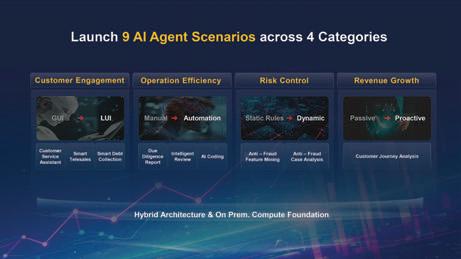
Built on a hybrid on-premises and cloud architecture with open-source foundation models, these scenarios are engineered for the data governance and regulatory requirements that financial institutions demand.
Building the foundation for AI-era finance
Deeply rooted in the financial industry for over 16 years, Huawei has served more than 7,100 financial institutions across over 80 countries and regions. Looking ahead, Huawei remains committed to serving as the trusted strategic partner for global financial institutions in their digital and intelligent transformation. By collaborating with global ecosystem partners, Huawei aims to go beyond digital, advance to Agentic Banking, and co-create infinite possibilities in the era of financial intelligence.
As financial institutions accelerate toward AI-driven operations, resilience becomes the precondition for innovation. AI adoption, real-time analytics and digital ecosystems all depend on one factor: uninterrupted, high-quality data flows. At Huawei, we work with financial institutions to build architectures that integrate infrastructure, cloud, data, AI and cybersecurity into a unified resilience fabric.
Institutions that treat resilience as strategy understand that tomorrow’s success depends on uninterrupted, trusted, AI-powered digital banking.
*https://www.khaleejtimes.com/business/ uae-banks-use-ai-reduce-operationalcosts-finastra-study
Universal Interconnectedness
Praveen Sekar Chief Executive Officer, introduces Torus, an AI-first, lowcode application development platform built for regulated banking — and the foundation on which Veracious Global Payment Hub and Veracious Open Finance deliver end-to-end compliance with the mandates of the Central Bank of the UAE. Founded by Mr. Sekar Ponniah, the creator of Torus, it is a vertical agnostic, AI-first low-code application development platform engineered, developed and brought to market by Torus Innovations FZCO, a UAE-registered company
The Torus Low code application development platform offers Enterprise Grade, Citizen Scale, Source Code available Web and mobile applications that follow a highly scalable In Memory, Event Driven, Microservices architecture that is source code available and can be deployed on any On premise, public / private cloud or hybrid environment.
Leveraging the Torus 9.x platform, comprehensive compliance platforms such as the Veracious Payment Hub and Veracious Open Finance / API Banking platform have been created. These platforms form a highly configurable, easily maintainable set of solutions that are purpose built to ensure compliance to the regulatory mandates of the Central Bank of the UAE.
These platforms are built and IP owned by Chennai, India headquartered Global

Software Solutions (TVL) Pvt Ltd which has delivered more than two decades of payments and banking systems, and has been the proving ground for Torus that hardened it through production use. Every capability is tested in live banking environments before being generalised into the product, so the platform and the company that built it have matured together.
The Torus Way of Application Development:
Torus belongs to the same category as enterprise low-code platforms such as OutSystems, Mendix, Appian and ServiceNow, but was engineered first for regulated finance, where auditability, data residency and accountability are not optional. What the product and platform arms describes as the Torus way is a model-driven approach
Praveen Sekar, Chief Executive Officer of Torus
to building software: processes are modelled rather than hand-coded, services are composed from reusable components, and applications are assembled as event-driven microservices deployable on any kind of environment. The platform being API-first and source-code-available ensure future proofing and removes the risk from the institutions that choose to adopt it. The applications built from the platform carries governance natively — every step traceable, every decision attributable and every change versioned.
The consequence is significant. Because compliance logic, audit and control are built into the platform rather than bolted on afterwards, Torus delivers bespoke applications that are compliant by construction. An institution need not choose between a tailored solution and a governed one: the Torus way produces software shaped to a bank’s specific requirements while ensuring, from the outset, that it satisfies the rules of its regulator.
One platform for every Central Bank Payment System and Open Banking need
This is most relevant in the United Arab Emirates, where the Central Bank of the UAE is rolling out an expanding agenda across payments and open banking. Torus’ focus is to serve as a single, end-toend compliance platform for that agenda — one place in which a bank can meet every Central Bank payment and openbanking obligation, each addressed by a purpose-built application yet governed through one common core, all built the Torus way.
The Veracious Global Payment Hub addresses the Central Bank’s payment mandates — Aani instant payments, UAEFTS, IPI, the Domestic Direct Debit System, the Wages Protection System, biller integration and the emerging Digital Dirham — from a single deployment. Veracious Open Finance and the API Banking platform address the other half
of the mandate: NEBRAS-aligned Open Finance and broader Open Banking — API exposure, consent management, third-party access and the surrounding controls. Both are configured to the precise specifications the Central Bank sets, and both can be tailored to an institution without leaving the governed environment. Run together, they give a bank one source of truth, one audit trail and one operational view across its entire payments and open-banking estate, rather than a patchwork of disconnected systems.
Proven in Production
These are not theoretical capabilities. The Veracious Global Payment Hub is the clearest demonstration of the Torus way of application development in production. Structured across three pillars — Acquisition, Orchestration and Execution
a month, with automation delivering millions in annualised savings pertaining to operational efficiency and ability to handle larger production volumes seamlessly . For a tier-one Abu Dhabi bank – client acquisition done along with local partner – VGPH’s real-time payments platform integrates with nine internal systems across 54 touchpoints and seven straight-through-processing flows, processing more than 5 Million transactions a month complying to Central Bank of the UAE specifications.
A Record of Delivery
That quality in delivery is underlined through numerous awards from global publications, NASSCOM Emerge 50, a Gartner Peer Insights listing and multiple payments-innovation honours, and is underpinned by ISO 27001:2022, ISO 9001:2015 and SOC 2 Type II certification.
EVERY CAPABILITY IS TESTED
IN LIVE BANKING ENVIRONMENTS BEFORE
BEING GENERALISED INTO THE PRODUCT, SO THE PLATFORM AND THE COMPANY THAT BUILT IT HAVE MATURED TOGETHER
— it normalises, orchestrates and executes payment instructions across whichever rails a bank operates, sustaining more than 200,000 transactions a day at 300 to 400 millisecond response times, secured to TLS 1.3, mutual TLS and PCIDSS standards.
For the Equity Bank Group — a 16-year relationship across ten African markets serving more than 23 million customers — a single deployment runs across Kenya, Uganda, Tanzania, Rwanda, South Sudan and Democratic Republic of Congo handling more than 8 currencies and millions of transactions
As the Central Bank of the UAE and regulators elsewhere expand their payments and open-finance frameworks, the collective proposition is a focused one: a single, accountable platform on which an institution can meet every compliance obligation through applications built precisely for its needs — bespoke where it matters, compliant by construction, and built the Torus way.
Contact: Praveen Sekar – CEO , praveensekar@gsstvl.com; +91 96779 48907 ( WhatsApp ), +971 54 799 4057 ; www.toruslowcode.com ; www.gsstvl.com

Accelerating Digital Growth While Strengthening Customer Trust
As digital banking channels become the primary touchpoint for customers, banks are facing increasing tension between delivering seamless experiences and combating ever-rising fraud and scam activity, and meeting regulatory requirements. As digital channels become the primary gateway to financial services, banks face a growing challenge: how to deliver seamless customer experiences while maintaining trust in an increasingly complex threat environment
Over the past decade, banking across the Middle East and North Africa has undergone one of the most significant transformations in its history. Digital technologies have fundamentally altered how customers engage with financial institutions, changing everything from account opening and payments to lending, wealth management and customer service. What began as a gradual migration toward online banking has accelerated
into a broader redefinition of the banking model itself, driven by rising smartphone penetration, increasingly sophisticated digital infrastructure, changing consumer expectations and government-led initiatives aimed at promoting digital economies and financial inclusion.
Across the GCC in particular, digital channels have evolved from supplementary service options into the primary point of interaction between banks and their customers. Consumers
increasingly expect banking services to be available whenever and wherever they need them, with account access, payments, transfers and financial management tools delivered seamlessly through mobile devices and digital platforms. The traditional branch remains important for certain activities, but for a growing proportion of customers, the banking relationship now exists predominantly through digital channels. Institutions across the region have

invested heavily to support this transition. Banks including First Abu Dhabi Bank, Emirates NBD, Abu Dhabi Commercial Bank, Mashreq Bank and Dubai Islamic Bank continue expanding digital banking ecosystems as customer engagement increasingly shifts toward mobile-first experiences. Similar developments are taking place across Saudi Arabia, Qatar, Kuwait and Bahrain, where institutions such as Saudi National Bank, Al Rajhi Bank, Riyad Bank, Qatar National Bank, National Bank of Kuwait and Bank ABC continue investing heavily in digital transformation programmes designed to improve customer experience while supporting broader national digitalisation agendas.
The benefits of this transformation have been substantial. Digital channels have reduced onboarding times, expanded financial inclusion, improved service accessibility and enabled institutions to operate more efficiently at scale. Real-time payment systems are reshaping customer expectations regarding speed and convenience, while open banking initiatives and digital ecosystem development are creating new opportunities for innovation and customer engagement. Customers increasingly expect banking services to operate with the same simplicity and responsiveness as the digital platforms they use in other areas of their lives.
Yet the success of digital banking has created a new strategic challenge for financial institutions. The same technologies that enable convenience and accessibility have also expanded opportunities for financial crime. As banking activity moves increasingly online, fraudsters are adapting their methods accordingly. The result is a threat environment that is becoming more sophisticated, more dynamic and increasingly focused on exploiting human behaviour rather than technological weaknesses alone.
Fraud Evolves
Historically, fraud prevention focused heavily on protecting payment cards, securing physical transactions and
THE DISTINCTION BETWEEN LEGITIMATE AND FRAUDULENT ACTIVITY IS BECOMING INCREASINGLY DIFFICULT TO IDENTIFY THROUGH CONVENTIONAL METHODS ALONE
defending banking infrastructure from unauthorised access. While these risks remain relevant, many of the most significant threats facing banks today are increasingly centred around identity, behaviour and trust. Account takeover attacks, credential theft, phishing campaigns, impersonation scams and social engineering schemes are becoming more prevalent across global financial markets, and MENA is not immune to these trends. Criminals are increasingly targeting customers directly, seeking to manipulate behaviour rather than breach systems.
This evolution reflects a broader shift within the financial crime landscape. Modern fraud often relies less on sophisticated technical attacks and more on convincing individuals to reveal information, authorise transactions or compromise their own security. Customers may unknowingly disclose credentials through phishing schemes. They may be persuaded to transfer funds as part of investment scams or impersonation fraud. They may grant access to devices or approve transactions under false pretences. In many cases, the attack succeeds not because technology fails, but because trust is exploited.
This creates a particularly difficult challenge for banks because many of these activities appear legitimate from a traditional security perspective. The correct credentials may be used. The correct device may be present. Authentication requirements may be satisfied. Yet fraud is still taking place. The distinction between legitimate and fraudulent activity is becoming increasingly difficult to identify through conventional methods alone.
Patterns of Behaviour
Banks are therefore beginning to explore a different approach to trust—one that focuses not only on validating credentials, but also on understanding behaviour. Rather than asking whether a customer successfully authenticated at the start of a session, institutions are increasingly seeking to understand whether the behaviour displayed throughout the customer journey remains consistent with what would be expected of that individual.
As a result, banks are beginning to rethink how trust is established and maintained within digital environments. Rather than focusing solely on whether a customer successfully authenticated at the beginning of a session, institutions are increasingly exploring how identity and risk can be assessed continuously throughout the customer journey. The objective is not simply to verify who a customer is, but to understand whether their behaviour remains consistent with what would be expected of a legitimate user.
This shift represents one of the most significant developments currently taking place within fraud prevention and digital identity management. As digital banking continues expanding across MENA markets and fraud techniques become increasingly sophisticated, banks are beginning to look beyond static authentication events toward a more dynamic understanding of customer behaviour, risk and intent. In doing so, they are laying the foundations for a new generation of security models designed not only to protect transactions, but also to preserve trust in the digital banking ecosystem itself.
The challenge facing banks today extends well beyond the traditional
definition of fraud. While financial institutions have always contended with criminal activity, the nature of modern digital fraud is fundamentally different from many of the threats that shaped earlier generations of banking security. Criminal organisations have become increasingly sophisticated, fraud techniques have become increasingly industrialised and scams have evolved into highly organised operations capable of targeting thousands of individuals simultaneously across multiple channels and jurisdictions.
For banks across the Middle East and North Africa, this evolution is occurring at precisely the same moment that digital banking is becoming the dominant channel for customer engagement. The result is a complex operating environment where institutions must simultaneously drive digital adoption, strengthen customer protection, satisfy regulatory expectations and preserve the seamless experiences that customers increasingly demand. What makes this challenge particularly difficult is that many modern fraud schemes no longer rely on defeating security controls directly. Instead, they focus on manipulating customer behaviour.
Across global financial markets, social engineering has become one of the most effective tools available to fraudsters. Criminals increasingly exploit trust, urgency and human psychology rather than technological vulnerabilities. Customers may be convinced they are communicating with legitimate institutions. They may be persuaded to approve transactions, disclose credentials or transfer funds voluntarily under false pretences. Investment scams, impersonation fraud, fake employment opportunities, romance scams and increasingly sophisticated phishing campaigns have all contributed to a broader shift in how financial crime is conducted.
Balancing Act
This challenge is amplified by changing customer expectations. Modern consumers expect security to operate largely in the background. They want fast
onboarding, frictionless payments and immediate access to financial services. Few customers are willing to tolerate lengthy authentication processes, repeated verification requests or cumbersome security procedures unless they perceive a clear reason for doing so. The result is a growing tension between customer experience and security.
Every additional authentication step has the potential to improve protection, but it may also introduce friction. Every verification request creates a potential interruption within the customer journey. Excessive friction can lead to abandoned applications, reduced digital engagement and lower customer satisfaction. Insufficient controls can increase exposure to fraud and regulatory risk. Banks therefore find themselves balancing two
The challenge does not end once the account is opened. Throughout the customer relationship, banks must continuously balance convenience and security across payments, transfers, account management and digital servicing interactions. As real-time payment environments continue expanding across the GCC and wider MENA region, institutions have less time than ever to assess risk before transactions are completed.
The economics of fraud are changing too. Financial losses remain an important concern, but the wider consequences often extend far beyond the transaction itself. Fraud can undermine customer confidence in digital channels, damage institutional reputations, increase operational costs and attract regulatory scrutiny. In an environment where digital
INCREASINGLY, FINANCIAL INSTITUTIONS ARE RECOGNISING THAT TRADITIONAL APPROACHES TO AUTHENTICATION MAY NOT BE SUFFICIENT ON THEIR OWN
objectives that can appear contradictory. On one hand, institutions are under pressure to simplify customer journeys. On the other, they must strengthen controls capable of identifying increasingly sophisticated threats.
This tension is particularly evident in digital onboarding. Across the region, banks continue investing heavily in remote account opening and digital acquisition capabilities. Institutions including First Abu Dhabi Bank, Emirates NBD, Saudi National Bank, Qatar National Bank, National Bank of Kuwait and Bank ABC continue expanding digital channels designed to improve accessibility and support customer acquisition. Yet onboarding remains one of the most heavily targeted stages of the customer lifecycle, making identity verification both critically important and increasingly complex.
adoption remains central to banking strategy, preserving trust becomes just as important as preventing losses.
The challenge facing banks is therefore becoming more complex. Customers expect frictionless experiences. Regulators expect stronger controls. Fraudsters continue evolving their methods. Institutions must satisfy all three realities simultaneously. Introducing excessive authentication requirements may frustrate legitimate customers and undermine digital adoption objectives. Reducing friction too aggressively may expose institutions and customers to greater risk. The balance between convenience and security has become one of the defining strategic challenges of modern banking.
Increasingly, financial institutions are recognising that traditional
approaches to authentication may not be sufficient on their own. Passwords, one-time passcodes, device verification and biometric authentication remain essential components of digital security frameworks, but many were designed around a simple principle: verify identity at a specific moment in time and then assume the user remains legitimate throughout the interaction. Modern fraud does not always conform to this assumption. Attackers may possess valid credentials, compromise sessions after authentication has occurred or manipulate customers into authorising fraudulent activity themselves.
This reality is attracting growing attention from regulators across the region who are responding accordingly . Authorities including the Central Bank of the United Arab Emirates, Saudi Central Bank, Qatar Central Bank, Central Bank of Bahrain and Central Bank of Kuwait continue strengthening expectations around cybersecurity, operational resilience, customer authentication and digital risk governance. Regulatory focus increasingly extends beyond technical security controls to encompass broader questions of customer protection, scam prevention and trust within digital financial ecosystems.
Regulators do however recognise that excessive friction can undermine financial inclusion and digitalisation objectives. The challenge is therefore not simply adding more controls. The challenge is deploying controls intelligently, proportionately and in a manner that supports both security and customer experience.
This reality is forcing banks to reassess some of the assumptions that have historically underpinned digital authentication. But nevertheless passwords, multi-factor authentication, one-time passcodes and biometric authentication all remain important safeguards.
Trust
For banks, these attacks create unique challenges because many occur
within otherwise legitimate customer journeys. The customer may successfully authenticate. The customer may pass every security check. The customer may willingly authorise the transaction. Yet the payment itself may still be fraudulent.
This distinction is becoming increasingly important within banking risk management. Historically, fraud prevention focused heavily on identifying unauthorised access. Today’s environment increasingly requires institutions to identify situations where authorised users may be acting under manipulation, deception or coercion. Detecting these scenarios is significantly more difficult because traditional authentication controls were never designed to assess customer intent.
This is one reason why scams are becoming a growing concern for regulators, banks and consumer protection agencies globally.
Unlike traditional cyberattacks, scams frequently exploit behavioural vulnerabilities rather than technological weaknesses. The fraudster’s objective is not necessarily to breach the bank’s security framework but to persuade the customer to bypass it themselves. The criminal succeeds not by defeating the authentication process but by convincing the victim to participate willingly in the fraud and the implications are substantial.
Financial losses remain an obvious concern, but the wider consequences often extend far beyond the transaction itself. Customers who become victims of scams frequently lose confidence in digital channels. Financial institutions may face increased servicing costs, investigation requirements and reputational exposure. Regulatory scrutiny can intensify following highprofile incidents, while public trust in digital banking ecosystems can be affected if customers perceive that financial institutions are unable to protect them effectively. Trust therefore becomes a strategic asset.
The continued success of digital banking depends not only on convenience
and accessibility but also on customer confidence. Consumers must believe that digital channels are capable of protecting their financial interests without creating excessive complexity or inconvenience. If trust begins to weaken, the broader objectives of digital transformation become more difficult to achieve.
For banks throughout MENA, this creates both a challenge and an opportunity. The challenge lies in protecting customers against increasingly sophisticated fraud and scam activity while maintaining seamless experiences and satisfying regulatory expectations. The opportunity lies in using behavioural intelligence, continuous authentication and adaptive security frameworks to create safer and more trusted digital banking environments without introducing unnecessary friction. Ultimately, the evolution of fraud prevention reflects a broader transformation taking place within banking itself. Digital banking was initially focused on improving access. The next phase focused on improving convenience. Today, the focus is increasingly shifting toward trust.
As institutions continue navigating the complex relationship between customer experience, fraud prevention and regulatory compliance, trust is becoming one of the most valuable assets within modern banking. Maintaining that trust will require banks to move beyond static models of identity and embrace a more dynamic understanding of risk, behaviour and customer protection.
In that sense, behavioural biometrics and continuous authentication are not simply new security tools. They represent part of a broader shift in how financial institutions think about digital trust itself.
And as digital channels continue becoming the primary gateway to financial services across the Middle East and North Africa, the ability to understand behaviour, assess risk continuously and protect customers from increasingly sophisticated fraud may become one of the defining capabilities of the next generation of banking.
Patterns of Behaviour
As bad actors change their nefarious tactics, Jonathan Frost Director, Global Advisory at BioCatch explains how behavioural intelligence has brought a new and effective method to bear in the continuing battle against bank fraud and scams
Do customers appreciate or remain intolerant that drop-offs and some frictions result from fraud and security controls, are ultimately in their interest?
The short answer is that customers are neither uniformly tolerant nor uniformly resistant. Their response depends almost entirely on whether the friction they encounter feels intelligent, and that distinction matters more than most banks currently acknowledge.
A recent paper on the behavioural economics of authorised push payment (APP) fraud, produced for the UK’s Payment System Regulator, makes points that should prompt every digital banking team to pause and reflect.
The same cognitive tendencies that make customers vulnerable to scams, the preference for speed, the discomfort with deliberation, the desire to complete a task and move on, are the very tendencies that make indiscriminate fraud warnings counterproductive. Prelec and Loewenstein’s research on the ‘pain of paying’ captures this well. By the time

a customer reaches the payment screen, they are psychologically committed. A generic warning at that moment does not feel protective. It feels like an obstacle between them and something they have already decided to do.
What follows is not an argument against friction. It is an argument in favour of precision. The paper is explicit about the cognitive weariness and muscle memory effects that result from over-prompting. Customers who encounter the same warning on every transaction above a certain value will, within weeks, be clicking through it without reading it. The warning has not disappeared; it has simply become invisible. Its protective value has been fully eroded by its own ubiquity.
The positive path is one that behavioural intelligence makes possible. When interventions target transactions that exhibit the characteristics of fraud and appear selective rather than routine, customers notice them. They carry informational weight precisely because they are unusual. That is not a minor design preference. It is the difference between a fraud prevention programme that works and one that appears to work while quietly failing the customers it was built to protect.
How has fraud shifted from system compromise to customer manipulation, and why is that harder to detect?
A decade ago, the primary threat vector was technical: credential theft, malware and account takeover. The attack targeted the bank’s infrastructure or the
Jonathan Frost, Director, Global Advisory, BioCatch
customer’s device, and defences evolved accordingly: strong authentication, device intelligence, anomaly detection at login. Those investments have been broadly effective.
Fraud has adapted. The World Economic Forum’s Global Cybersecurity Outlook 2026, cited in the survey, reported a sharp increase in phishing and social engineering attacks in 2024, with 42% of organisations reporting incidents.
If technical defences are strong, the more efficient route is to use the customer to bypass them. Social engineering, impersonation of bank or government officials, investment and romance fraud, none of these require technical intrusion. The customer authenticates themselves, navigates their own application and authorises the payment. In some cases, the bank’s own security infrastructure is incorporated into the deception as a credibility prop.
This presents a detection challenge because the bank’s systems observe only the authenticated session. Everything they see is consistent with a legitimate transaction. What behavioural intelligence
IF TECHNICAL DEFENCES ARE STRONG, THE MORE EFFICIENT ROUTE IS TO USE THE CUSTOMER TO BYPASS THEM
Do current capabilities of AI allow banks to successfully combat
Authorised
Push Payment fraud?
The honest answer is that AI is a powerful and genuinely valuable tool in this fight, but only when deployed with a clear understanding of what distinguishes APP fraud. That distinction is not always well understood, and it matters enormously for how AI capability is directed.
Most fraud detection systems were built to identify unauthorised transactions, cases where someone other than the account holder is behaving unusually. APP fraud inverts that entirely.
The account holder is the one making the payment. Their behaviour may be entirely consistent with their own history. The fraud happened upstream,
BEHAVIOURAL INTELLIGENCE CAN SPOT SUBTLE SIGNS THAT CUSTOMERS ARE OPERATING UNDER DURESS OR MANIPULATION
can observe is whether the behaviour within that session is consistent with the customer’s established baseline (whether navigation is atypical, whether interaction with the payment screen differs from previous sessions, whether there are indicators of scripted rather than spontaneous behaviour). These sessionlevel signals are the primary means by which manipulated transactions can be distinguished from genuine ones when all other indicators point to an absence of risk.
in a phone call, a social media platform or a fake website that the bank never saw. AI working solely on transactional data cannot realistically identify when customers are being manipulated in those environments.
Behavioural intelligence can spot subtle signs that customers are operating under duress or manipulation, typically using hesitation patterns, navigation anomalies and typing rhythms that vary from a customer’s established baseline. Network-level intelligence can
identify receiving accounts exhibiting mule characteristics before a payment completes. Cross-institutional data sharing can surface emerging payee risk signals that no single bank’s data could reveal in isolation.
Such capabilities stretch the bank’s effective perimeter beyond the payment event and toward the social engineering environment where the harm originates. To understand their impact, we should look to Australia’s experience. Intelligent friction, driven by real-time data from sending and receiving banks, is causing customers to abandon tens of millions of dollars in high-risk transactions.
How should banks digital banking teams and their implemented AI technology combine roles to deliver the best anti-fraud outcomes for customers?
Fraud susceptibility differs materially across transactions, depending on payee characteristics, payment reason, transaction value and behavioural signals from the customer. Processing those variables at scale, in real time, drawing on network intelligence and crossinstitutional data, is not a human task. It is a pattern recognition challenge, and AI performs it with consistency and speed that no analyst team can replicate. That is where machine capability should be fully deployed.
Determining what you do with the signal once you have it is where innovative digital banking teams excel. Different fraud typologies exploit distinct psychological mechanisms, and for interventions to be effective, customer treatment needs to be varied. The corrective thinking required to protect a
customer from a purchase scam, where scarcity and the representativeness heuristic are the primary vulnerabilities, is genuinely different from what is needed to protect someone from an impersonation scam driven by manufactured urgency and misplaced trust. A single generic warning cannot serve both purposes well.
Designing interventions that speak precisely to the specific bias being exploited is a human task, one that requires behavioural science expertise applied through skilled digital product design. That is where digital banking teams should be investing their effort, working from the risk signals AI provides to deploy contextually intelligent responses that give customers the specific prompt their situation calls for.
The feedback loop between those two layers is where the real long-term value lies. Every customer response to an intervention, whether they proceed, pause or abandon the transaction, is outcome data. Returning that data systematically to both the AI model and the intervention design is what allows the combined capability to compound over time. Building that closed loop is not a technical afterthought. It is the architecture of a fraud prevention programme that actually learns.
Can post-transaction controls and accumulated analytics provide insight into or anticipate the nature of newly developing scams and frauds?
The simple answer is yes, Fraudsters may vary their scripts, platforms and target profiles, but the underlying psychological mechanisms they exploit remain stable. Scarcity, trust manipulation, representativeness and artificial urgency: these are not novel inventions. They are enduring features of human cognition, which is precisely why they remain effective.
That stability is useful. A cluster of transactions sharing characteristics consistent with scarcity exploitation,
payments to unfamiliar payees at atypical values, initiated after compressed decision timelines, represents a detectable pattern even before anyone has identified the specific scam driving it. Post-transaction analytics, rather than focusing solely on historical fraud labels, can surface those signals earlier and more precisely.
If transaction signals can be connected to customer-level characteristics, engagement patterns, demographic
The dominant model of customer fraud communication remains one of warning and disclaimer. Customers are advised that fraud exists, that their bank will never ask them to transfer money to a safe account, and that they should exercise caution. This is not without value, but it addresses only a narrow slice of the vulnerability landscape. Banks need to prepare customers for fraud and act decisively when their behaviour indicates heightened risk.
EVERY CUSTOMER RESPONSE TO AN INTERVENTION, WHETHER THEY PROCEED, PAUSE OR ABANDON THE TRANSACTION, IS
OUTCOME DATA
profiles and payment history, it becomes possible not only to identify an emerging threat but also to model which customers are most exposed to it.
This is exactly the approach BioCatch has taken, partnering with our customers to transform analytics from a retrospective function into a predictive one. Banks that build capability are not simply learning from fraud that has already occurred; they are empowering themselves to communicate with at-risk customers before the next transaction, rather than after the harm has occurred.
In your experience, are banks doing their best to enlist their customers in the battle against fraud and scams?
Yes and no. There are some excellent examples coming out of Australia, but these rely on behavioural insights that do not uniformly exist in other markets. Consequently, the gap between what is currently being done and what the evidence suggests is possible is wider than the industry generally appreciates.
Knowing in the abstract that scams exist is very different from being able to identify, in the moment, that the urgency you are feeling has been deliberately manufactured. Research suggests that preparing customers through a structured self-audit exercise can measurably reduce their susceptibility to fraud in subsequent experimental settings.
This helps customers understand their own vulnerability to fraud and ensures they are better placed to apply appropriate scepticism when the situation calls for it. It does not end there. Behavioural intelligence can help banks contextualise relevant fraudawareness communications, enabling them to deliver interventions when they’re most needed.
Customer engagement, designed to build the required reflective capacity, alongside well-timed interventions, brings benefits that generic warnings can never replicate. That is the close: prepare customers to recognise risk, then intervene when it matters most.


FINANCIAL CRIME IN THE GCC: TACKLING FRAUD
Confidence, Complexity and the Behavioural Gap
Haseeb Ahmad Ansari Chief Compliance Officer and Senior Executive Director at Emirates Islamic Bank, addresses increasingly important questions that regional banks have to face as bank fraud becomes more sophisticated
How do you ensure the board understands financial crime risk?
For a board to understand financial crime risk, the discussion must move beyond compliance metrics and become a strategic risk conversation. I believe, the board should not only know how many alerts were generated, how many suspicious activity reports were filed, or how many fraud cases occurred; it must understand what these indicators say about the institution’s exposure, customer behaviour, control effectiveness and reputation.
In the GCC, where banking confidence is closely linked to national economic ambition, financial crime risk must be presented in a way that connects regulatory expectations, customer trust, digital transformation and reputational resilience. This means giving the board a clear view of emerging typologies such as mule activity, scam proceeds, tradebased money laundering, sanctions evasion, cyber-enabled fraud and abuse of instant payment channels.
The most effective approach is to translate technical risks into board-level questions: Are we within our risk appetite?

Are our controls keeping pace with product innovation? Are we investing in the right capabilities? Are we detecting behaviour early enough, or only after losses and reputational damage occur?
The UAE’s rapid payments transformation is a useful example. “Aani”, the UAE instant payments platform, has become an important part of the national digital payments landscape, with instant transfers and large-scale adoption creating new expectations around speed, convenience and safety. That progress also reinforces the need for
banks to ensure financial crime controls are equally real-time, data-led and behaviourally intelligent. Ultimately, the board understands financial crime risk best when it is framed not as a compliance cost, but as a core component of institutional integrity, customer protection and long-term market confidence.
How do you balance fraud prevention investment with acceptable loss?
The concept of “acceptable loss” must be handled very carefully in financial crime. In pure credit or operational risk terms, some level of loss may be modelled and tolerated. But in fraud and scam prevention, the calculus is more complex because the visible financial loss is often only a fraction of the true impact.
A small fraud loss can still cause significant customer distress, regulatory concern, media attention and reputational harm. In the GCC, where trust in banks and digital financial services is central to economic transformation, the cost of underinvestment can be far greater than the amount lost in a specific incident. Therefore, I would not view fraud investment as a simple cost-versusloss equation. It should be assessed through a broader risk lens i.e. customer detriment, reputational impact, regulatory expectations, operational resilience and the potential for organised criminal exploitation. Investment should be riskbased, but also forward-looking. The right balance is achieved through layered controls such as strong onboarding, behavioural analytics, device intelligence, transaction monitoring, customer
Haseeb Ahmad Ansari, Chief Compliance Officer, Senior Executive Director
education, mule detection, real-time interdiction and close coordination between fraud, AML, cyber and digital banking teams. The objective is not to stop all transactions or create excessive friction, but to apply intelligent friction where the risk signals justify it.
In practical terms, the question should not be, “How much fraud loss can we absorb?” It should be, “What level of customer harm and institutional vulnerability are we prepared to defend?”
That is a very different conversation.
How does prioritising reputational risk over financial loss shape your strategy?
Prioritising reputational risk fundamentally changes the strategy. It pushes the organisation to think beyond immediate loss containment and focus on trust preservation. In financial crime, reputation is often damaged not only by the incident itself, but by the perception that the institution was slow, fragmented, reactive or indifferent to customer harm. This is especially relevant in scam cases, where the customer may have authorised the payment, but did so under deception, manipulation or social engineering.
When reputational risk is given priority, the strategy becomes more proactive. It encourages earlier detection, stronger escalation, faster customer engagement, better complaints handling and more decisive action against mule accounts and suspicious beneficiaries. It also drives investment in education and prevention, not merely investigation after the event.
In the GCC context, this is particularly important because banks are not only commercial institutions; they are part of the financial infrastructure supporting national confidence, digital adoption and economic growth. A reputationally mature strategy recognises that protecting the customer and protecting the institution are not separate objectives. They are closely connected. Therefore, I would say reputational risk acts as a discipline. It forces financial crime teams to ask:
even if the financial loss is small, would this incident undermine customer trust, regulatory confidence or our standing in the market? If the answer is yes, then the issue deserves senior-level attention.
Do you expect scam reimbursement models in the GCC to evolve and what would that mean for your organisation?
Yes, I do expect scam reimbursement models in the GCC to evolve over time, although the exact pace and form may differ across jurisdictions. Globally, there is a clear shift from viewing scams purely as customer responsibility towards a more balanced model of shared accountability across banks, payment providers, telecoms, digital platforms and customers.
The UK has already moved towards mandatory reimbursement for many authorised push payment scams, and similar debates are emerging in other markets. While the GCC may not simply replicate those models, the direction of travel is clear: regulators and society will increasingly expect financial institutions to demonstrate that they took reasonable steps to prevent, detect, delay or warn against scam activity before funds left the ecosystem.
For banks, this would have significant implications. It would require stronger realtime fraud detection, better beneficiary risk profiling, mule-account intelligence, customer warning mechanisms, evidence-based decisioning and robust post-incident investigation. It would also require clearer governance around liability, exception handling, customer vulnerability and conduct risk.
However, reimbursement cannot be the only answer. If poorly designed, it may create moral hazard or shift responsibility unfairly to one part of the ecosystem. The better model is prevention-led: stronger controls, shared intelligence, faster freezing of funds, customer education and cross-sector collaboration. For my organisation, the implication would be clear: we must prepare now. The future standard will not only ask whether a
customer authorised the payment; it will ask whether the bank understood the behavioural risk around that payment and acted responsibly.
How significant is mule activity in enabling fraud in your organisation?
Mule activity is one of the most important enablers of fraud and financial crime across the region. Even when the original scam occurs outside the bank through social media, impersonation, phishing, investment scams, romance scams or fake employment offers, the proceeds often need a bank account to receive, move, layer or cash out the funds.
This makes mule accounts a critical bridge between fraud and money laundering. They convert a customer scam into a broader financial crime event. In many cases, the mule account is not sophisticated on its own; what makes it dangerous is the speed, coordination and volume with which criminal networks use such accounts.
In the GCC, the risk is heightened by a young, digitally active population, large expatriate communities, rapid onboarding, instant payments, cross-border remittance flows and the use of social media and messaging platforms to recruit or manipulate individuals. Some mules may be complicit; others may be naïve, vulnerable or deceived. From a control perspective, both categories matter. The strategic response must therefore go beyond transaction monitoring. Banks need behavioural indicators i.e. sudden account dormancy followed by rapid inflows and outflows, unusual beneficiary patterns, device changes, multiple small credits followed by immediate transfers, mismatch between customer profile and transaction behaviour and connections to known scam clusters. Mule detection is no longer a back-office AML issue. It is a frontline financial crime priority.
How do customers with limited history affect KYC and monitoring?
Customers with limited history present
a genuine challenge because traditional monitoring models rely heavily on historical behaviour. If a customer is newly onboarded, recently arrived in the country, newly employed, financially excluded, young or digitally onboarded with a thin profile, the bank has fewer behavioural anchors against which to assess activity.
This does not mean such customers are inherently high risk. That would be the wrong conclusion and could undermine financial inclusion. The challenge is that limited history reduces the bank’s ability to distinguish between normal early-life account activity and actual suspicious behaviour.
The solution is not blanket de-risking; It is smarter risk segmentation. Banks should use a combination of onboarding data, declared purpose of account, expected income, employment or business profile, device and channel behaviour, transaction velocity, beneficiary relationships and early-life account monitoring. In the first 30, 60, or 90 days, the bank should be especially alert to rapid changes in behaviour i.e. immediate third-party credits, fast outward transfers, cash withdrawals inconsistent with profile, use of multiple beneficiaries, or sudden crossborder activity.
The FATF has also emphasised that financial inclusion and AML/CFT objectives should be managed through proportionate, risk-based measures rather than exclusionary approaches. That principle is highly relevant for the GCC, where diverse customer segments and digital access are both policy priorities. The aim should be to build confidence in the customer relationship over time, while applying enhanced monitoring during the period when the behavioural picture is still forming.
Is today’s AML framework adequate for instant payments and digital onboarding?
The core principles of today’s AML framework remain valid i.e. know your customer, understand the purpose of the relationship, monitor activity,
identify suspicious behaviour and report where required. However, the operating environment has changed dramatically. Instant payments and digital onboarding compress the time available for control intervention. A transaction can move in seconds. A customer can be onboarded without physical interaction. A mule account can be activated quickly. A scam victim can be manipulated remotely. This means that periodic review, batch monitoring and after-thefact investigation are no longer sufficient on their own.
In the UAE, “Aani” allows instant transfers on a 24x7 basis and supports proxy payments using identifiers such as mobile numbers, email addresses and
Closing Question: What is the most important change for GCC banks to stay ahead of financial crime?
The most important change is to move from a compliance-led model to an intelligence-led financial crime model.
Traditional compliance asks whether we completed the required checks? Intelligence-led financial crime risk management asks as to what the behaviour is telling us, what is changing, where is the threat moving and how quickly can we respond?
For GCC banks, this shift is critical. The region is becoming more digital, more connected, more globally relevant and more ambitious. That creates enormous opportunity, but also attracts
THE FUTURE STANDARD WILL NOT ONLY ASK WHETHER A CUSTOMER AUTHORISED THE PAYMENT; IT WILL ASK WHETHER THE BANK UNDERSTOOD THE BEHAVIOURAL RISK AROUND THAT PAYMENT AND ACTED
RESPONSIBLY
QR codes. This is a major advancement in convenience and financial infrastructure, but it also reinforces the need for risk controls that operate at comparable speed.
Therefore, the AML framework is directionally sound, but it must be operationally modernised. We need realtime or near-real-time monitoring, stronger digital identity assurance, behavioural analytics, network analysis, device intelligence, dynamic risk scoring and better information sharing across institutions.
FATF has recognised that technology can improve AML/CFT effectiveness, including through new tools that support better detection, analysis and risk management. The challenge for banks is to ensure that regulatory compliance does not remain analogue while criminal behaviour becomes digital and instant.
sophisticated criminal networks that exploit speed, customer trust, digital channels and cross-border complexity.
To stay ahead, banks need to combine strong governance with advanced analytics, real-time monitoring, publicprivate collaboration, typology sharing, customer education and closer integration between fraud, AML, cyber, sanctions and conduct risk.
The future will not be won by institutions that generate the most alerts. It will be won by institutions that understand risk behaviour the earliest, act with the greatest clarity and protect customer trust while supporting innovation. In simple terms, GCC banks must become faster than the criminal, smarter than the typology and more connected than the network they are trying to disrupt.
TACKLING FRAUD
The Changing World of Fraud
Jiten Nagda Head, Fraud Risk Management at Mbank highlights developing types and methods of fraud and the measures needed to confront its fast evolution and reduce its prevalence
% of banks see more fraud. Which types are growing fastest?
We are seeing the fastest growth in authorised push payment (APP) scams, particularly those driven by social engineering, i.e. impersonation of bank staff, law enforcement authorities, government entities, or investment advisors.
Investment scams and “quick return” schemes, often promoted via social media and messaging platforms have surged too, reflecting both digital adoption and cross-border fraud dynamics.
Additionally, Card Not Present fraudsFraudsters using card data sourced through deception or dark web to make unauthorised purchases or topping up e wallets or adding cards to mobile wallets are also frequently observed.
What makes micro-scams especially hard to detect?
Micro-scams are challenging because they involve low-value, high-volume transactions that often appear legitimate in isolation. Typically they fall below the traditional alert thresholds, mimic normal customer behaviour and occur across multiple accounts or channels
The real risk emerges only when these transactions are aggregated and analysed over time, which requires more

advanced behavioural analytics rather than rule-based monitoring.
Fraud losses rise despite strong controls. Where are current systems lacking?
Many legacy fraud controls are still rulebased and reactive, which limits their effectiveness against adaptive fraud tactics. Key gaps here include limited real-time intelligence sharing across institutions and ecosystems, insufficient behavioural context, systems focus on transactions, not intent, and fragmented customer risk views across channels (mobile, web, call centre).
As fraud becomes more sophisticated and coordinated, static controls struggle to keep pace with dynamic, multi-stage attack patterns.
How has more customer manipulation changed your prevention strategy?
Fraud has shifted from system exploitation to human exploitation. As a result, our strategy now places greater emphasis on customer protection and awareness alongside detection.
This includes:
• Real-time risk-based interventions (e.g., transaction warnings, step-up authentication).
• Enhanced customer education on scam typologies.
• Monitoring f or behavioural anomalies during transactions, not just before.
We are also investing in AI-driven models & Behavioural biometrics that can identify indicators of coercion or manipulation, such as unusual urgency or deviation from established patterns.
What is the main limitation of transaction monitoring today?
The primary limitation is that traditional transaction monitoring is too narrow in scope. It evaluates transactions in isolation rather than within the broader customer journey and behavioural context. This results in high false positives, missed detection of sophisticated scams and delayed response times
The future lies in holistic, real-time monitoring frameworks that combine transaction data with behavioural signals, device intelligence and network-level insights to better distinguish genuine activity from fraud.
Jiten Nagda, Head, Fraud Risk Management, Mbank

UAE E-INVOICING:
Why It Must Move from a Tax Task to a CFO Priority
As Phase 1 of the UAE’s mandatory e-invoicing Accredited Service Provider (ASP) October 30th, 2026 deadline nears, Archit Gupta Founder & CEO, ClearTax advises that organisations that treat it as a strategic priority, rather than a compliance task, will move beyond just meeting the mandate
and that selecting an Accredited Service Provider (ASP) is not optional. What I keep hearing, though, is some version of the same sentence: “We’ve handed it to the tax team” or “IT is managing the integration.” That is where the risk begins. E-invoicing is not a tax project with a technology component. It is a finance transformation with a compliance deadline.
The wrong person in the room
Six years ago, I watched India’s enterprises scramble to meet e-invoicing mandates they didn’t see coming. Then came Saudi Arabia. ZATCA didn’t just mandate e-invoicing, it introduced realtime clearance. What looked, at first, like a routine mandate has since evolved into one of the most technically demanding regulatory frameworks in the world, one that reshaped how finance teams, ERP systems and tax departments operate at scale.
Now I’m watching it happen again. In the UAE, October 30, 2026 is no longer a distant deadline. And in boardrooms across Dubai and Abu Dhabi, the conversations sound eerily familiar.
The awareness is there. Every CFO and tax head I speak to knows the mandate is real, that the Federal Tax Authority (FTA) will receive invoice data in near real-time,

When the tax team owns e-invoicing, the goal narrows to getting invoices to the authority in the right format by the due date. The vendor gets selected on price. The scope is drawn as tightly as possible. The business technically complies, and then, six months later, when the mandate evolves or a new entity needs onboarding, the whole thing has to be rebuilt.
When IT owns it, the focus shifts to ERP integration. That is a legitimate concern, ERP compatibility matters enormously. But IT-led selections tend to optimise for technical convenience rather than what the finance team actually needs from the data. The system works as designed, but often remains limited to meeting compliance requirements. As regulators evolve and audit scrutiny increases, even the teams it was built for can find themselves navigating gaps in flexibility, visibility and readiness.
Archit Gupta, Founder & CEO, ClearTax
Routing it to the Accounts Payable (AP) or Accounts Receivable (AR) team is perhaps the most common approach, and arguably the most limiting. These teams understand invoice workflows better than anyone. But they are rarely positioned to make decisions about platform architecture or what the business will need from this infrastructure in two years. They solve for today, which is understandable, but today is not the only thing that matters here.
What actually flows through an e-invoicing system
At its core, e-invoicing is not a narrow compliance workflow. Every sales invoice, purchase transaction and credit note flows through the system to the authority in near real-time. For large enterprises, this effectively becomes the financial data backbone of the organisation.
The difference lies in how this is recognised. When ownership is delegated, organisations tend to build minimum viable solutions and absorb the cost of rework later. When it sits with the CFO, the conversation shifts, from meeting current specifications to enabling real-time visibility, stronger VAT control and systems that can scale with regulatory change.
Research reinforces this distinction. Studies show that programmes with active CFO involvement are significantly more likely to succeed than those managed in silos. E-invoicing is no exception. The ownership model ultimately determines the value created.
The Saudi Arabia lesson the UAE can still use
Saudi Arabia’s e-invoicing rollout offers a useful preview of what lies ahead. When ZATCA introduced Phase 1 in 2021, many enterprises approached it as a compliance milestone, focusing on meeting immediate requirements with minimal disruption. As Phase 2 introduced real-time clearance and deeper integration from January 2023, some organisations found
themselves revisiting earlier systems and implementation choices as requirements evolved.
In contrast, organisations that had taken a longer-term view, asking early questions around scalability, data architecture and future regulatory direction, appeared better positioned to adapt as the framework matured. The difference was not necessarily capability, but how the mandate had been approached at the outset.
The UAE is likely to follow a similar trajectory. The Ministry of Finance has already positioned October 30, 2026
operations and procurement, with clear cross-functional ownership to ensure the outcome is aligned with business priorities, not just regulatory requirements. This also means asking harder questions during vendor selection: not just whether a provider can meet today’s FTA specifications, but whether they have a track record of keeping pace with regulatory change, and whether their roadmap aligns with where the UAE’s digital tax framework is headed. The right partner is not the cheapest one. It is the one best positioned to grow with the mandate.
E-INVOICING IS NOT A TAX PROJECT WITH A TECHNOLOGY COMPONENT. IT IS A FINANCE TRANSFORMATION WITH A COMPLIANCE DEADLINE
as an important milestone in a broader digital tax transformation journey, not the end state. Organisations that optimise only for current compliance requirements may need to revisit decisions as frameworks evolve. The advantage for UAE businesses is that this time, the lessons are already visible.
What CFO ownership actually looks like
Taking ownership at the CFO level does not mean the CFO manages implementation day-to-day. It means defining the strategic intent upfront, what data the organisation needs from the system, how it integrates with financial reporting and what success looks like beyond the compliance deadline.
It also changes how decisions are made. Vendor evaluation moves beyond meeting current specifications to assessing scalability, ERP compatibility and long-term reliability. Most importantly, it brings the right stakeholders together, tax, IT, finance
The Conclusion
The October 30 deadline may mark compliance, but it also signals the beginning of a more connected, realtime financial environment. The decisions made in the coming months will shape data integrity, audit readiness and financial visibility for years to come. This is not a moment to optimise for the minimum. The infrastructure businesses build now will define how quickly they can respond to regulatory updates, support audits and unlock the operational benefits that digital finance promises. Organisations that treat e-invoicing as a strategic priority, rather than a compliance task, will move beyond simply meeting the mandate. They will build a finance function that is more resilient, transparent and prepared for what comes next. In the UAE, that opportunity is still open. The mandate is approaching, but the strategic window has not closed. The CFOs who act with intent now will not just comply, they will lead.
Confidence and Continuity

Our region is once again navigating a period shaped by geopolitical uncertainty, supply-chain pressure, shifting trade dynamics and elevated security concerns. Yet the UAE’s institutional strength, financial infrastructure, sovereign stability and operational preparedness mean that the country’s banking system, financial markets, logistics infrastructure and investment ecosystem continue attracting capital, businesses, entrepreneurs and expatriate families seeking continuity, safety and long-term opportunity
The UAE is positioning itself not merely as a resilient economy within a volatile region, but as one of the Middle East’s most important stabilising economic ecosystems. Periods of geopolitical uncertainty have historically tested the operational and institutional maturity of economies across the Middle East. Regional tensions can influence capital
flows, investor sentiment, supply-chain continuity, commodity pricing and business confidence simultaneously, creating conditions where governments, regulators and financial institutions must balance stability, liquidity and public confidence while maintaining long-term economic momentum.
The current environment is no exception. Ongoing geopolitical
tensions across parts of the wider region continue affecting global markets, trade expectations, logistics planning and broader risk perception. Financial markets remain sensitive to developments linked to energy security, maritime trade routes, inflationary pressures and broader geopolitical alignment between major global powers. Yet despite these pressures, the UAE continues to project
an image of institutional continuity and economic stability that increasingly differentiates it within both regional and international markets.
This positioning is not solely the result of hydrocarbon wealth or fiscal strength alone. It reflects the cumulative development of financial infrastructure, regulatory governance, sovereign balance-sheet management, logistics capability, digital transformation and institutional confidence built over decades. The UAE’s ability to maintain economic activity, financial market functionality and population growth during periods of wider uncertainty is increasingly reinforcing its reputation as one of the region’s primary safe-haven economies for businesses, investors and expatriate communities alike. Confidence itself is becoming one of the UAE’s most strategically important economic assets.
Financial systems operate fundamentally on trust: trust in liquidity, institutional continuity, regulatory stability, operational resilience and political predictability. During periods of uncertainty, economies capable of preserving these conditions frequently become magnets for capital, talent and investment activity. The UAE has increasingly benefited from this dynamic over recent years as businesses, family offices, entrepreneurs and international professionals continue relocating operations and assets into the country.
This shift is visible across multiple layers of the economy. Population growth remains strong relative to many developed markets. Wealth migration into Dubai and Abu Dhabi continues attracting global attention. Real estate markets, private banking activity and family office expansion all continue reflecting elevated international interest in the UAE as a jurisdiction combining security, connectivity and business continuity within a region often perceived externally through the lens of volatility.
The financial sector sits at the centre of this positioning. UAE banking systems continue operating with comparatively
strong capitalisation, liquidity buffers and regulatory oversight relative to many emerging markets globally. Banks across the UAE and wider GCC entered the current period from positions considerably stronger than those that characterised earlier regional or global financial crises. Regulatory reform, enhanced risk management frameworks and stronger balance-sheet discipline implemented over recent years continue supporting operational stability within the banking sector.
The Central Bank of the United Arab Emirates continues playing a central role in maintaining monetary and financial stability through liquidity management, regulatory oversight and operational coordination across the banking system. The dirham’s peg to the US dollar continues providing monetary predictability and exchange-rate stability that remain highly important for investor confidence, cross-border trade and financial planning during periods of market volatility.
Sovereign fiscal strength continues providing an important macroeconomic stabilising mechanism. Abu Dhabi’s sovereign balance-sheet capacity and the UAE’s broader fiscal flexibility continue supporting confidence in the country’s ability to maintain infrastructure investment, economic continuity and institutional stability despite fluctuations in global energy markets or regional uncertainty.
This sovereign positioning increasingly differentiates the UAE from many economies facing elevated debt burdens or more constrained fiscal flexibility.
The country continues benefiting from substantial sovereign investment capacity through institutions including Abu Dhabi Investment Authority, Mubadala Investment Company and Investment Corporation of Dubai, all of which continue contributing to long-term investment diversification and broader economic resilience strategies.
Capital Markets
The UAE’s capital markets are similarly reflecting this environment of relative
stability. Despite periods of global volatility, GCC equity markets — particularly within the UAE and Saudi Arabia — continue attracting regional and international investor interest supported by strong banking profitability, sovereign backing and continued economic diversification programmes. IPO activity across the GCC over recent years has reinforced the region’s growing relevance within global capital markets, with UAE exchanges continuing to attract listings linked to infrastructure, utilities, logistics, energy and technology-oriented sectors.
Institutions including Abu Dhabi Securities Exchange and Dubai Financial Market continue benefiting from liquidity support linked to domestic institutional investors, sovereign participation and growing international market visibility. Capital market development is increasingly important not only for fundraising activity, but also for broader perceptions of economic confidence and institutional maturity.
Banking
The banking sector itself remains one of the strongest indicators of underlying economic continuity. UAE banks continue benefiting from comparatively strong profitability, liquidity positions and capital adequacy ratios relative to many international peers. Institutions including First Abu Dhabi Bank, Emirates NBD, Abu Dhabi Commercial Bank, Mashreq Bank and Dubai Islamic Bank continue expanding digital capability, treasury resilience and operational continuity frameworks as regional financial systems become increasingly interconnected and technology-intensive.
Importantly, the UAE’s banking environment also benefits from broader GCC financial strength. Saudi Arabia’s banking sector continues demonstrating strong liquidity and profitability supported by Vision 2030 investment activity, while institutions across Qatar, Kuwait and Bahrain continue contributing to wider regional financial stability. Banks including Saudi National Bank,
Qatar National Bank, National Bank of Kuwait and Bank ABC continue operating within relatively well-capitalised banking environments linked to sovereign-backed economic systems across the GCC.
Treasury resilience and operational continuity are becoming increasingly important within this environment. Banks in the UAE are placing greater emphasis on liquidity management, stress testing, cybersecurity resilience and crossborder operational continuity planning as geopolitical uncertainty and digital dependency increase simultaneously. Real-time payments systems, cloudenabled infrastructure and increasingly interconnected financial ecosystems require operational readiness extending beyond traditional banking risk management alone.
Logistics
The UAE’s role as a regional logistics and aviation hub is also becoming strategically important within broader economic continuity discussions. Global supply chains continue facing periodic disruption linked to geopolitical uncertainty, maritime security concerns and evolving trade patterns. Yet the UAE’s logistics infrastructure — including ports, airports and freezone ecosystems — continues functioning as one of the region’s most important stabilising commercial networks.
Operators including DP World and Emirates Group continue supporting trade connectivity, aviation activity and supply-chain continuity across global markets linked to Asia, Europe, Africa and the wider Middle East. This infrastructure capability increasingly strengthens the UAE’s attractiveness for multinational companies, regional headquarters and international investors seeking continuity within uncertain global environments.
Technology
Technology infrastructure is similarly becoming central to the UAE’s continuity strategy. Artificial intelligence, cybersecurity capability, cloud
infrastructure and digital government systems continue supporting operational resilience across banking, logistics, healthcare, telecommunications and broader economic activity. The UAE’s emphasis on digital transformation and AI integration is not solely linked to innovation ambition. Increasingly, it is also linked to institutional continuity, economic scalability and infrastructure resilience.
Cybersecurity has therefore become strategically important across both public and private sectors. Financial institutions, infrastructure operators and government entities continue investing heavily in cybersecurity operations, operational resilience and digital governance as regional economies become increasingly interconnected and dependent on realtime digital systems.
Confidence and Continuity
Confidence itself is becoming one of the UAE’s most strategically important economic assets and the country’s ability to maintain confidence among expatriate populations is equally significant.
The UAE’s economy depends heavily on international talent, entrepreneurs, professionals and business owners who increasingly view the country not only as a commercial centre, but also as a stable long-term living environment for families and wealth preservation.
This psychological dimension of economic performance is often underestimated. Confidence in physical safety, institutional predictability, educational infrastructure, healthcare systems and operational continuity all directly influence investment behaviour, population retention and private-sector expansion.
And during periods of wider uncertainty, economies capable of sustaining this confidence frequently strengthen their competitive positioning relative to surrounding markets.
The UAE’s ability to maintain economic confidence during periods of wider regional uncertainty is also closely connected to the depth of its institutional preparedness and operational continuity architecture.
Stability in modern economies is no longer determined solely by fiscal strength or energy revenues. Increasingly, it depends on how effectively governments, regulators, infrastructure operators and financial institutions coordinate across highly interconnected economic systems during periods of disruption or uncertainty.
This coordination has become one of the UAE’s defining structural advantages.
The country’s economic model increasingly functions through integrated ecosystems linking sovereign institutions, regulators, banks, logistics operators, digital infrastructure providers and private-sector platforms across multiple sectors simultaneously. This allows continuity planning and operational resilience to extend beyond isolated industries into broader economic infrastructure itself.
The UAE’s federal and emirate-level institutions continue placing significant emphasis on operational continuity, infrastructure redundancy and longterm economic planning. Banking systems, payment networks, aviation infrastructure, ports, telecommunications environments and digital government platforms increasingly operate within continuity frameworks designed to maintain functionality under a wide range of operational scenarios.
This level of preparedness is becoming increasingly important within a region shaped by evolving geopolitical risk, global trade fragmentation and growing digital dependency. Businesses and investors increasingly assess not only growth potential when selecting operational jurisdictions, but also infrastructure reliability, regulatory predictability and continuity capability during periods of volatility.
The UAE has increasingly benefited from this shift in investor psychology.
The country’s reputation for safety, continuity and institutional functionality continues attracting multinational corporations, regional headquarters, family offices and entrepreneurs seeking operational certainty within
an increasingly uncertain global environment. Dubai and Abu Dhabi in particular continue reinforcing their positions as regional command centres for businesses operating across the Middle East, Africa and South Asia. This trend is especially visible in wealth migration and private capital flows.
Wealth of a Nation
Global private wealth movement has increasingly favoured jurisdictions perceived as politically stable, internationally connected and operationally predictable. The UAE has become one of the principal beneficiaries of this dynamic. Wealth managers, private bankers and family office advisers continue reporting elevated interest from high-net-worth individuals and internationally mobile entrepreneurs seeking residency, business continuity and asset diversification through the UAE.
Private banking and wealth management activity continue expanding accordingly. Institutions including First Abu Dhabi Bank, Emirates NBD, Mashreq Bank and Dubai Islamic Bank continue strengthening wealth management, international banking and private-client capability as inflows of regional and international capital support broader financial activity across the UAE.
International financial centres within the UAE are similarly benefiting from these trends. The Dubai International Financial Centre and Abu Dhabi Global Market continue attracting financial institutions, asset managers, fintech firms, hedge funds and family offices seeking internationally recognised regulatory environments combined with regional market access and operational continuity.
This environment is contributing to broader economic diversification across the UAE. Capital inflows linked to wealth migration, business relocation and financial-sector expansion increasingly support activity across real estate, professional services, technology, education, healthcare and hospitality ecosystems. The impact therefore
extends well beyond banking or capital markets alone.
The expatriate dimension remains especially important within this broader economic narrative.
The UAE’s population structure is uniquely international, with expatriates forming the majority of residents and contributing across nearly every layer of the economy, from financial services and logistics to healthcare, construction, education and entrepreneurship. Maintaining confidence among expatriate communities is therefore directly connected to broader economic continuity and business activity.
decisions, workforce retention and broader perceptions of economic sustainability.
The UAE’s SME ecosystem also continues benefiting from this environment. Small and medium-sized businesses remain central to employment generation, entrepreneurship and broader private-sector expansion across the country. Freezones, digital licensing systems and increasingly streamlined business formation processes continue supporting startup activity and entrepreneurial continuity even during periods of wider regional uncertainty.
What is emerging across the UAE is therefore not simply an economy
BANKS ACROSS THE UAE AND WIDER GCC ENTERED THE CURRENT PERIOD FROM POSITIONS CONSIDERABLY STRONGER THAN THOSE THAT
CHARACTERISED EARLIER REGIONAL OR GLOBAL FINANCIAL CRISES
The country’s long-term residency reforms, business licensing flexibility and continued investment into healthcare, education and public infrastructure all contribute to this environment of stability.
Increasingly, expatriate professionals and business owners view the UAE not only as a temporary commercial base, but as a medium- and long-term living environment for families, wealth preservation and business expansion.
This evolution is significant because confidence among expatriate communities directly influences:
• property investment,
• entrepreneurial activity,
• SME formation,
• private consumption,
• talent retention,
• and wider economic momentum.
The psychological role of safety and predictability therefore extends far beyond social stability alone.
It increasingly influences investment
navigating geopolitical uncertainty. The country is gradually reinforcing a broader strategic identity built around continuity, institutional confidence and operational reliability within a volatile international environment. Its future influence may depend less on episodic growth cycles and more on its ability to remain trusted during periods where trust itself becomes one of the world economy’s most valuable assets.
And as geopolitical fragmentation, technological disruption and global competition for capital continue reshaping international markets, the UAE’s combination of sovereign strength, infrastructure capability, financial maturity and social stability may increasingly position the country not only as a regional financial centre, but as one of the most important stabilising economic ecosystems connecting the Middle East with the wider global economy.

Mutual Understanding
Makram Salloum newly appointed Regional Vice President for Backbase Middle East, at Backbase, with over 23 years of experience in financial services technology, helping regional banks navigate digital transformation and customer experience innovation, shares his perspective on why conversational banking will become the primary, and essential form of engagement between banks and their customers
As the newly appointed Regional Vice President for Backbase Middle East, why is conversational banking emerging as a defining trend for the next generation of banking experiences?
Because the interface is changing , for a decade the battleground was the app. Which banks had the cleanest mobile experience, the fastest onboarding, the slickest UI. That race is largely over. Most banks in the region have a decent app.
Customers no longer want to navigate eight screens to transfer money or apply for a loan. They want to describe what they need - in Arabic, in English, in plain language - and have it done. That is what conversational banking delivers.
Most deployments fail not because of the AI, but because of what the AI is connected to. A conversational interface
built on fragmented systems loses context, makes promises the bank cannot keep, and forces customers to repeat themselves - the exact problem it was meant to solve. The difference is what sits underneath: one unified view of the customer that every channel and every agent reads from the same source.
It translates natural language intent into policy-bound actions, real workflows, actual execution - all governed by the same rules and the same customer truth that every other channel operates on.
The Middle East makes this especially urgent. We have some of the world’s highest smartphone penetration. We have a young, digitally native population that expects Amazon and Uber-grade responsiveness from their bank. And we have regulators - CBUAE, SAMA - who are actively pushing AI adoption frameworks that create the conditions for this to scale.
What separates banks that are truly AI-ready from those that are simply digitised?
One word: architecture.
A digitised bank has invested in channels, mobile apps, online banking, digital onboarding. That work was necessary. But now most digitised banks still run their frontline across dozens of disconnected systems. None of these talk to each other in real time, which means humans act as the coordination layer - copying data between systems, making decisions with incomplete context, resolving exceptions manually.
That architecture worked when humans could absorb the coordination cost. AI cannot operate inside it.
An AI-ready bank has solved a different problem. It has a unified semantic layer, one shared model of who the customer is, what they hold, what they are trying to do, what they are eligible for - that every channel, every agent, every workflow reads from the same source. It has a decisioning layer that applies the same risk rules and policy constraints regardless of whether the decision is being made by a human in a branch, a CSR on a call or an AI agent in a conversational interface.
And critically - it has governance built in. Every action any agent takes carries a “decision token: a verifiable record of which policy was applied, under which authority, with what outcome. That is what regulators here are going to demand. That is what makes AI trustworthy at scale.
Can conversational banking become the primary channel for customer engagement, or will it remain complementary?
It will become primary. The question is only timing.
What conversational banking offers is also something the traditional digital channel never could: Assist and Coach in one surface. Assist mode handles the transactional, executes payment, retrieves a statement, updates an address. Coach mode handles the advisory : “help me understand my spending, guide me through a mortgage decision, tell me whether I can afford this”.
That combination, execution and guidance in natural language, is what makes conversational banking a primary channel, not a complementary one.
The banks moving fastest are not just letting customers ask questions - they are letting AI complete actions. Move money, flag an issue, prepare a case. Always within policy, always with a full audit trail. That is what turns a better interface into a fundamentally different way of serving customers.
In the Middle East context, where multigenerational households are common, where Arabic and English are both standard, and where a significant portion of the population is still underserved by traditional banking models, conversational interfaces remove friction that apps never fully solve.
One condition applies: it only becomes primary when it is built on the right foundation. A conversational interface that cannot execute real actions, that loses context between sessions, that cannot handle complex transactionsthat stays complementary.
How can banks strike the right balance between AI-driven automation and the human touch that customers still value?
The best banks are building what we call a Unified Frontline, a model where customers, employees and AI agents work together as a single coordinated team. Not AI replacing humans. Not humans limited

by AI. Three actors, each doing what they do best, on a shared foundation.
AI handles the high-volume, repeatable work. Routine queries, standard transactions, initial case preparation, document gathering, eligibility checks. It handles these instantly, at any hour, in any language, without a queue.
Humans handle what requires judgment, empathy and relationship. A customer going through financial difficulty. A business owner making their first major credit decision. A wealth client navigating an estate transfer. These interactions demand a human - but a human who has been given everything they need by AI: the full context of the customer’s situation, the recommended next action, the relevant policy constraints, already prepared.
What capabilities will define the next generation of banking experiences in the region?
Stateful intelligence - The next generation of banking experience has memory. Not just transactional history, but genuine context - what the customer has told the bank, what they are trying to achieve, where they are in a journey, what their financial life looks like today. When a customer calls about a mortgage, the bank already knows they inquired online three days ago and started an application. When a business owner asks about working capital, the bank already knows their seasonal cash flow pattern.
This is not personalisation as a feature. It is architectural continuity across every interaction.
Proactive engagement - The best banks have stopped waiting for customers to come to them. AI that can detect a customer’s upcoming cash shortfall and propose a solution before they experience the pain. An alert that a better rate is available on a product the customer already holds. A prompt that a business customer’s trade finance facility is about to expire. The shift from reactive to proactive is what turns banking from a utility into an advisor.
End-to-end execution - In the region, we still see too many journeys that begin digitally and end on paper. A customer starts a home finance application on their phone and ends up in a branch with a folder of documents. That seam is where relationships are lost. The next generation of experiences has no seam between intent and executionfrom expressing interest to receiving a decision to activating a product - fully orchestrated, fully digital, fully governed.
What should CEOs and bank boards be investing in today to prepare for the era of conversational banking?
Invest in a shared operational model - one version of the customer, one decisioning layer, one governance framework - that every channel, every agent, every workflow operates from. When that foundation exists, deploying conversational banking is fast. Without it, every conversational banking deployment re-pays the integration cost from scratch - and customers feel it.
Invest in governance infrastructure. The Central Bank of UAE’s AI governance frameworks are not a compliance burden. They are a competitive advantage for the banks that take them seriously. Building governance from the start means you can give AI agents real autonomy because you can prove to your regulator exactly how every decision was made. Banks that treat governance as an afterthought will be slower to scale AI than banks that built it into their architecture on day one.
Makram Salloum, RVP - Middle East, Backbase
CYBERSECURITY AND AI:
Banking’s New Security Frontier
Artificial intelligence is rapidly reshaping the banking industry, creating new opportunities to improve customer experiences, strengthen operational efficiency and enhance decision-making
Across the Middle East and North Africa, financial institutions are investing heavily in AI as part of broader digital transformation programmes designed to support increasingly sophisticated banking ecosystems. Yet as AI becomes more deeply embedded within financial services, it is also changing the cybersecurity landscape in ways that demand careful attention from banking leaders.
Cybersecurity has long been a strategic priority for financial institutions. Banks manage highly sensitive customer information, facilitate critical payment flows and operate infrastructure that underpins economic activity. As digital banking has expanded, so too has the complexity of securing these environments. Mobile banking, real-time payments, cloud adoption and digital onboarding have transformed how customers engage with financial services while simultaneously increasing the number of systems, devices and connections that require protection.
Artificial intelligence is emerging as a powerful tool in helping banks address these challenges. Modern banking environments generate enormous volumes of data, from transaction records and login activity to customer interactions and operational events. Analysing this information manually is increasingly

difficult. AI enables institutions to identify unusual patterns, detect anomalies and respond to potential threats more quickly than traditional methods alone. This capability is particularly important as cyber threats continue to evolve in sophistication and scale.
Leading institutions across the region, including First Abu Dhabi Bank, Emirates NBD, Saudi National Bank, Qatar National Bank and National Bank of Kuwait continue investing in digital resilience initiatives that combine cybersecurity, operational resilience and technology governance. These programmes reflect a growing recognition that cybersecurity is no longer solely an information technology concern. It is a business resilience issue closely linked to customer trust and institutional stability.
The challenge is that AI is influencing both sides of the cybersecurity equation. Security teams are using advanced
analytics and machine learning models to strengthen threat detection and improve response capabilities. Cybercriminals are exploring many of the same technologies to enhance phishing campaigns, automate attacks and create increasingly convincing forms of digital deception. As a result, the cybersecurity environment is becoming more dynamic and competitive, requiring institutions to continuously adapt their defences.
This evolution is driving greater focus on cyber resilience rather than cyber defence alone. While preventing attacks remains essential, banks must also ensure they can maintain critical operations, protect customers and recover quickly when incidents occur. Regulators across the region, including the Central Bank of the United Arab Emirates, Saudi Central Bank, Qatar Central Bank and Central Bank of Bahrain, continue strengthening expectations around cybersecurity governance, operational resilience and technology risk management as digital ecosystems become increasingly interconnected.
The future relationship between cybersecurity and AI will be defined by balance. Financial institutions must harness the advantages of AI while maintaining robust governance, strong oversight and effective risk controls. The most successful banks will not necessarily be those deploying the largest number of AI solutions, but those integrating them responsibly within broader resilience frameworks that support security, innovation and customer confidence.
As banking becomes increasingly digital, cybersecurity is evolving from a protective function into a strategic enabler of growth. Artificial intelligence will play an important role in that evolution, helping institutions manage complexity, improve visibility and respond to threats more effectively. The organisations that successfully combine technological innovation with resilience and governance will be best positioned to navigate an environment where cyber risk and digital opportunity continue to grow side by side.
Andrew Cover, Director, MEA Finance Magazine
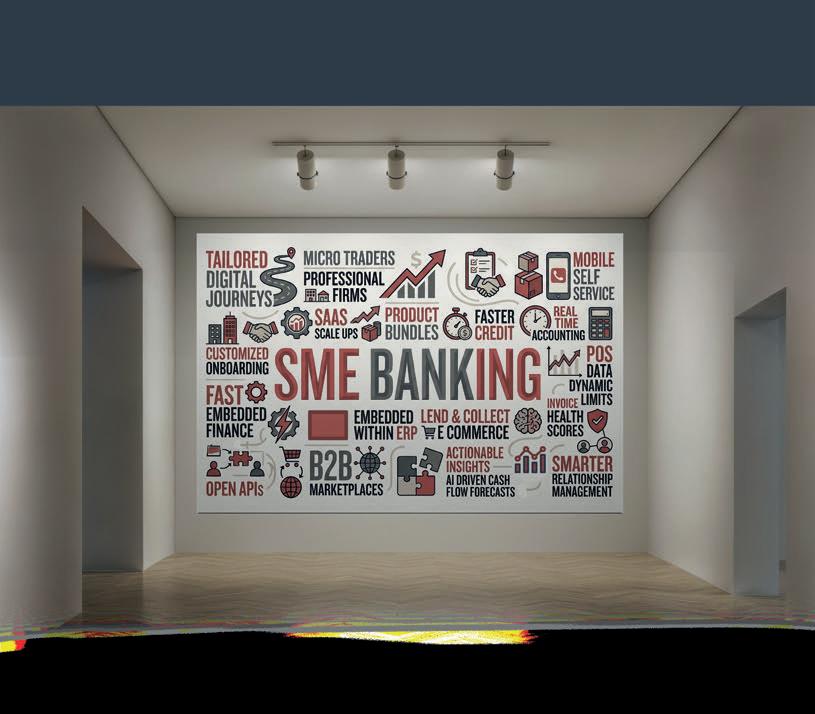
SMEs don’t need more banking; they need a bank that sees the big picture of growth.
With Finacle Business Banking, deliver a unified, insight-driven SME banking experience
End-to-end journeys
Onboarding to servicing across deposits, lending, payments, limits, and trade - on a unified, API-driven architecture.
Unified operational data
Real-time visibility into cashflows and exposures – accelerating credit decisions.
Multi-entity support
Multi-currency, multi-geo platform with configurable hierarchies and approvals.
Ecosystem-ready
Connected to brokers, accounting systems, e-commerce, FX, trade, and open-banking networks.
Expand your SME banking canvas with Finacle.
Breakthroughs rarely happen in the boardroom

We enable meaningful connections for the next chapter of your entrepreneurial journey. Drawing on our global network and expertise in over 50 markets, we connect you with the right partners and solutions to support every aspect of your life’s work.
Where your life’s work lives