August 2026
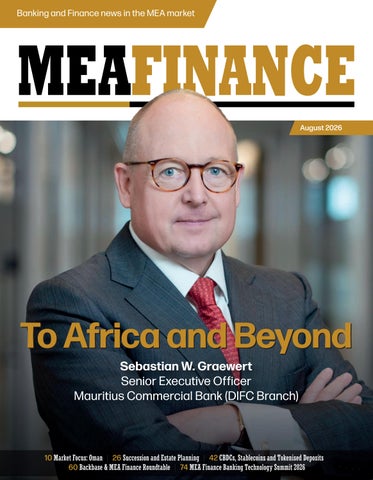
To Africa and Beyond Sebastian W. Graewert, Senior Executive Officer, Mauritius Commercial Bank (DIFC Branch)
August 2026
To Africa and Beyond Sebastian W. Graewert Senior Executive Officer Mauritius Commercial Bank (DIFC Branch) A MEA Finance Publication
10 Market Focus: Oman | 26 Succession and Estate Planning | 42 CBDCs, Stablecoins and Tokenised Deposits 60 Backbase & MEA Finance Roundtable | 74 MEA Finance Banking Technology Summit 2026
Futures
A
main title heading a page in a publication focused on banking and finance that is the word “futures”, will likely lead readers to expect in-depth content on trading, hedging and speculation. However, in the case of this issue of MEA Finance Magazine we are not interested in stock index futures or the forward price of Forastero cocoa beans. No. Here the word refers to key themes we are exploring this month that directly concern the concept of a future, or are clear harbingers of what is coming our way. Succession and estate planning, preparing for a future that you will not be a part of, but nevertheless will shape your legacy, is moving higher on the priority lists of both clients and their financial services providers. Inside you will see extensive coverage of this with contributors from a wide range of business and service providers acting in this increasingly important sector. “Many entrepreneurs have reached a stage where preserving what they have built for the next generation is just as important as creating it”, Samir Atitallah, CEO of Arab Bank, Switzerland (Middle East) Limited, remarks. The unavoidable future we will soon be steeped in, that of digital assets, is tackled with our look into stablecoins, CBDCs and tokenisation. In a world where in the popular vernacular, thermally inclined tubers denote keen levels of interest, this subject is most certainly a hot potato at this time. “Tokenisation in the region is increasingly moving beyond proof-of-concepts and toward tangible commercial outcomes”, says Akshika Gupta, Global Head of Product Sales and Solutions at Kinexys by J.P. Morgan. The future that we will experience in regional banking was discussed during our 2026 MEA Finance Banking Technology Summit, with this
year's event hitting a record level of attendance. A full account of this now eagerly anticipated regional industry occasion is inside. The Summit was then crowned by the MEA Finance, 2026 Banking Technology Awards, also showcased within. This annual celebration of excellence again underlined the ongoing innovation striven for and achieved by powerful collaborations between financial institutions, technology businesses and fintechs across our region. The awards, as well as bringing deserved recognition to the companies and leaders keeping our region at the forefront of banking advancement, also underscore the bright future that our region can achieve. The cover story this month features an interview with Sebastian Graewert, Senior Executive Officer at Mauritius Commercial Bank (MCB), DIFC Branch, detailing the enhancement of their already leading role as a key connector between the GCC and Africa, stating that, “ultimately, the expansion of our DIFC operations will reinforce MCB’s role as a bridge between Africa, the Middle East and international markets”. The Backbase and MEA Finance roundtable -The AI Powered Bank, held on site during our annual Banking Technology Summit, and also covered inside, brought key personalities and senior industry executives together to discuss the future of banking operations as AI models become further ingrained. In our market focus on Oman, we describe how the nation has arguably become one of the GCC’s most interesting economic narratives, and we also take a look into the future rise of Sharia compliant digital banks. In this feature Christoph Koster, CEO of Ruya points out that, “As digital adoption continues to increase across the GCC and wider Middle East, digital-only Shari’ah-compliant banks are likely to capture a growing proportion of new customer acquisition”. With all the above mentioned, and much more besides, we can confidently predict a packed and highly absorbing reading future for you.
mea-finance.com
3
CONTENTS
CONTENTS 38
MARKET NEWS
6
Standard Chartered Foundation launches 2026 ‘Women in Tech’ accelerator in Egypt in collaboration with Village Capital and Entlaq
8
Rakbank Islamic enables access to Bitcoin trading through its Islamic banking platform
MARKET FOCUS - OMAN
10 Steady Ascendency REGULATION TECHNOLOGY
14 Digital Guardrails SHARIA-COMPLIANT DIGITAL BANKS
18 Faith in the Future 22 Principally Digital TREASURY TECHNOLOGY Streaming to Cash Flow: What 24 From Daily Life Teaches Us About Treasury Transformation
SUCCESSION AND ESTATE PLANNING
26 Family Fortunes 30 Thinking Ahead 32 Future Management
MEA Finance WEB: www.mea-finance.com EMAIL: info@mea-finance.com PUBLISHED BY: Creative Middle East Media FZ LLC, M1 Floor, Twin Towers, PO Box 4422, Fujairah, UAE
4
Banking and Finance news in the MEA market
34 Preserving a Future 36 Generational Change
MEA FINANCE BANKING TECHNOLOGY AWARDS 2026 WINNERS
COVER STORY
the innovative 92 Celebrating excellence of our region’s banking
38 To Africa and Beyond CBDCS, STABLECOINS AND TOKENISED DEPOSITS
42 46 Virtual Realities 48 Digital Dependability 50 Fiat Accompli 52 Leading the Way 54 Programmable Progress No Token Gesture
OPINION PIECE Triad of Modern Banking AI: 58 The Explainability, Sovereignty and Shariah Alignment
BACKBASE & MEA FINANCE ROUNDTABLE
and financial technology leaders
a Resilient Future of Finance: 96 Shaping MEA Finance Banking Technology Awards 2026
Finance Banking Technology 98 Mea Awards 2026 Winners
30 8 92
AI-Powered Bank - Navigating the 60 The Next Phase of AI-Powered Operations
MEA FINANCE BANKING TECHNOLOGY SUMMIT 2026
74 Progress Innovation Impact EXECUTIVE DIRECTOR AND PUBLISHER Kenneth Mitchen ken.mitchen@mea-finance.com GROUP COMMERCIAL DIRECTOR Nap Estampador nap.estampador@mea-finance.com Tel : +971 50 100 5488 DIRECTOR Andrew Cover andrew.cover@mea-finance.com Tel: +971 50 931 3236
BUSINESS DEVELOPMENT OFFICER Geri Teniozo geri.teniozo@mea-finance.com Tel: +971 50 3036879
EVENT AND CONTENT DIRECTOR Natasha Cristi natasha@mea-finance.com Tel: +971 50 303 4235
EVENTS AND MARKETING MANAGER Cris Balatbat crissyb@mea-finance.com Tel: +971 58 594 4818
SENIOR DESIGNER Florante Magsakay Tel: +971 52 570 1811 design@mea-finance.com
EVENTS & MARKETING MANAGER Joy Baldenero joy@mea-finance.com Tel: +971 56 174 7426
ADMIN AND FINANCE MANAGER Marilyn Nainque marilyn@mea-finance.com Tel: +971 58 5025836
WEB ASSISTANT Marie Orayan web@mea-finance.com EDITORIAL editorial@mea-finance.com EDITOR-AT-LARGE Oscar Wendel oscar.wendel@mea-finance.com
Dubai office: Al Saaha Offices, Old Town Island Burj Khalifa District PO Box 487177, Dubai, UAE Email: info@mea-finance.com
mea-finance.com
5
MARKET NEWS
Standard Chartered Foundation launches 2026 ‘Women in Tech’ accelerator in Egypt in collaboration with Village Capital and Entlaq The second edition of the programme will support 12 technology start-ups led by women through specialised training, mentorship, investment readiness and grant funding
S
tandard Chartered Foundation, in partnership with Entlaq and Village Capital, announced the launch of the second edition of the Women in Tech Accelerator in Egypt. The 2026 cohort will support 12 technology start-ups led by women through investment readiness training, business development support and tailored mentorship, with three winners receiving equity-free grant funding totalling USD 35,000 at the end of the programme. The programme is designed for Women led technology enabled startups that have demonstrated market validation and are ready to scale. It will be delivered in Egypt by Entlaq, drawing on its expertise in entrepreneurship support and ecosystem building. Mohamed Gad, Chief Executive Officer and Head of Coverage, Standard Chartered Egypt, said, “Women-led technology businesses are playing an increasingly important role in Egypt’s innovation economy, bringing new ideas to market and creating new avenues for growth. The Women in Tech Accelerator is designed to help that potential scale by providing founders
6
Mohamed Gad, Chief Executive Officer and Head of Coverage, Standard Chartered Egypt
with access to the skills, networks and support needed to strengthen their businesses. In its first cohort, the Egypt programme attracted 240 applications and supported 11 start-ups through over 35 training sessions and more than 40 mentorship sessions and roundtables. With this second edition, we are building on that foundation by supporting more women-led technology startups. Our focus is on helping founders strengthen their capabilities, expand their networks and become more investment
Banking and Finance news in the MEA market
ready, giving them a stronger platform to grow their businesses and contribute to Egypt’s innovation economy.” Yazmin Jumaali, Senior Programme Manager, Village Capital, said, “The results from our 2025 Women in Tech cohort demonstrate the transformative impact of backing women entrepreneurs. Together, these founders reached nearly 16,000 new customers, created more than 430 jobs, and generated an additional USD 2.7 million in revenue. We are excited to welcome this new group of women founders into our growing community and support them as they build, scale and drive lasting impact.” Ay a I s m a i l , C o - F o u n d e r a n d Programmes Director at Entlaq, added, “We are proud to deliver the Egypt edition of the Women in Tech Accelerator in partnership with Standard Chartered Foundation and Village Capital. We believe that empowering women entrepreneurs requires an integrated ecosystem that combines capacity building, mentorship, investment readiness, and access to business and investment networks. T h i s p ro g ra m m e i s a n a t u ra l extension of Entlaq’s mission to build a more inclusive, evidence-based entrepreneurship ecosystem. Our Women in Entrepreneurship Report 2025, the first data-driven assessment of women entrepreneurship in Egypt, found that women-led start-ups continue to receive only a very small share of available venture funding while facing an estimated US$2.2 billion funding gap, alongside limited access to specialised mentoring and professional networks.
SCAN FOR MORE DETAILS AND REGISTER
SCAN FOR MORE DETAILS AND REGISTER
SCAN FOR MORE DETAILS
CONTACT US: Nap Estampador
nap.estampador@mea-finance.com +971 50 100 5488
MARKET NEWS
Rakbank Islamic enables access to Bitcoin trading through its Islamic banking platform Rakbank announces that Rakbank Islamic customers can buy, sell and hold Bitcoin through Bitpanda’s regulated virtual asset trading platform directly from the Rakbank mobile app
R
a kba n k a nno unced tha t Rakbank Islamic customers can buy, sell and hold Bitcoin through Bitpanda’s regulated virtual asset trading platform directly from the Rakbank mobile app. The new service combines the convenience of banking with the opportunities of virtual assets, allowing customers to access Bitcoin through Rakbank Islamic while transacting directly from their current or savings account in UAE dirhams. As interest in virtual assets continues to grow, customers are increasingly looking for ways to participate through trusted and transparent channels that align with their personal values. Rakbank’s new offering provides customers with a simple and convenient way to access Bitcoin through a trusted banking experience that aligns with their values and financial preferences. By removing the need to transfer funds to and from external exchanges, customers can fund transactions directly from their Rakbank Islamic account, creating a more seamless experience while avoiding foreign exchange conversion costs. Through the Rakbank app, customers can seamlessly access Bitcoin through the Islamic Banking platform, supported by
8
Vikas Suri, Managing Director, Wholesale Banking Group – Products, Rakbank
secure infrastructure and the confidence of banking with Rakbank. The service is delivered through Bitpanda Broker MENA DMCC, Bitpanda’s Dubai Virtual Assets Regulatory Authority (VARA)-regulated entity, while Rakbank facilitates seamless access through its mobile banking app in accordance with Shari’ah principles. Vikas Suri, Managing Director, Wholesale Banking Group – Products at Rakbank, said: “At Rakbank, our focus is on making innovation accessible in a way that reflects our customers’ needs, values and aspirations. “With this launch, Rakbank Islamic banking customers can access Bitcoin
Banking and Finance news in the MEA market
directly through the Rakbank mobile app, funded in UAE dirhams and supported by trusted, regulated infrastructure, while maintaining the Islamic values and principles that guide their financial decisions. “By combining the convenience of everyday banking with responsible access to virtual assets, we are giving customers greater confidence, clarity and control as they explore this emerging asset class.” The launch reflects growing customer interest in virtual assets and Rakbank’s commitment to delivering innovative financial solutions while maintaining the highest standards of customer protection, transparency and regulatory alignment. The milestone also positions Rakbank as the first conventional bank with an Islamic banking window to enable access to virtual asset trading through a regulated partner platform, further expanding access to virtual assets through a secure and trusted banking experience. Bitpanda is one of the world’s leading digital asset infrastructure providers and is regulated by multiple European financial authorities. Its institutional technology business, Bitpanda Enterprise, is trusted by leading global financial institutions. The launch builds on Rakbank’s strategic partnership with Bitpanda and reinforces the bank’s commitment to responsible innovation through trusted, regulated partnerships. By combining virtual asset innovation with the values and principles that underpin Rakbank Islamic, Rakbank continues to expand customer access to emerging financial technologies through a secure, transparent and customer-centric experience.
RIYADH EXHIBITION & CONVENTION CENTER, MALHAM
THE FASTEST
Hosted by:
Co-organised by:
MARKET FOCUS - OMAN
Steady Ascendency Among the Gulf’s economies, Oman has often been viewed as the quieter story. Yet, over the past several years, Oman has arguably become one of the GCC’s most interesting economic narratives, demonstrating how fiscal discipline, institutional reform and long-term strategic planning can gradually reshape an economy and restore confidence among investors, businesses and financial markets
T
Improving Outlook
h e S u l ta n a te e nte rs t h e second half of this decade in a considerably stronger position than many observers anticipated only a few years ago. During the pandemic and the accompanying collapse in global energy prices, Oman faced significant fiscal pressures, rising public debt and questions regarding the sustainability of its economic model. The country was among the GCC economies most exposed to lower oil prices because
10
Additionally, the Oman’s location remains one of its greatest economic advantages. Positioned outside the currently contested and geo-politically tense Strait of Hormuz and with direct access to the Indian Ocean, Oman occupies a strategic position connecting the Gulf with markets across Asia, Africa and Europe. At a time when businesses and governments are placing greater emphasis on supply chain resilience and diversification, this geographic advantage is becoming increasingly valuable.
hydrocarbons continue to represent a substantial component of government revenues and export earnings. Rating agencies and international institutions expressed concerns over fiscal balances, while policymakers faced the difficult challenge of implementing reforms without undermining economic activity or social stability. The response has been one of the most comprehensive reform programmes undertaken in the Gulf in recent years.
Banking and Finance news in the MEA market
At the centre of this transformation is Oman Vision 2040, a long-term strategy aimed at reducing dependence on hydrocarbons, diversifying the economy, strengthening the private sector and creating sustainable growth opportunities for future generations. The programme has sought to address not only economic diversification but also fiscal sustainability, institutional effectiveness and human capital development, recognising that long-term competitiveness increasingly depends
upon an economy’s ability to adapt to structural changes in global trade, technology and energy markets. The results are becoming increasingly visible. Higher hydrocarbon prices undoubtedly provided an important tailwind during the initial stages of reform, allowing the government to improve fiscal balances and accelerate debt reduction. However, the improvement in Oman’s economic position cannot be attributed solely to cyclical factors. Fiscal reforms, improved expenditure discipline and efforts to broaden sources of economic activity have all contributed to strengthening confidence in the country’s long-term trajectory. International financial institutions have increasingly acknowledged these improvements. The Sultanate has seen improvements in fiscal metrics, public debt indicators and investor sentiment, while sovereign credit profiles have strengthened in recent years. These developments have helped improve financing conditions and reinforced confidence in Oman’s ability to navigate future economic cycles from a position of greater stability. The country’s economic diversification efforts are also beginning to gain momentum. Non-oil sectors including logistics, tourism, manufacturing, fisheries, mining and renewable energy are becoming increasingly important components of economic activity. Oman possesses several structural advantages that support these ambitions. Its strategic geographic location at the crossroads of Asia, Africa and Europe provides natural advantages in trade and logistics, while access to the Arabian Sea and the Indian Ocean gives the country maritime significance that extends beyond the Gulf itself. The development of the Port of Duqm and the broader Special Economic Zone at Duqm exemplifies this strategy. The long-term vision for Duqm extends beyond the development of another industrial zone. It represents an effort to establish an integrated economic ecosystem
encompassing logistics, manufacturing, petrochemicals, renewable energy and international trade. Alongside investments in the Port of Sohar and the Port of Salalah, these initiatives are gradually strengthening Oman’s position within regional and international supply chains. This diversification strategy is taking place against a broader backdrop of economic transformation across the Gulf. All GCC economies are seeking to reduce dependence on hydrocarbons and develop new engines of growth. Competition for investment, talent and capital has therefore intensified considerably. In this environment, Oman has increasingly sought to differentiate itself through stability, strategic location and a measured approach to economic reform.
Governance The country’s political and institutional stability remains one of its greatest strengths. Oman has traditionally pursued a pragmatic and balanced approach to regional and international relations, allowing it to maintain constructive relationships across a broad range of partners. This reputation for stability and predictability is increasingly valuable in an environment characterised by geopolitical uncertainty and shifting economic dynamics. Investors and businesses place considerable value on stable operating environments, particularly when making long-term investment decisions in sectors such as infrastructure, manufacturing and logistics. Economic stability is equally important. Inflation in Oman has generally remained relatively moderate compared with many global markets during the recent period of heightened price pressures. The country’s currency peg to the US dollar continues to provide monetary stability and contributes to investor confidence. While the peg necessarily means that monetary policy broadly follows that of the United States, it also provides a stable and predictable framework that supports trade, investment and financial market confidence.
These factors are contributing to a more favourable investment environment. Foreign direct investment continues to play an important role in Oman’s economic ambitions, particularly in sectors associated with diversification and infrastructure development. The government’s efforts to improve the business environment, attract private sector investment and encourage p u b l i c - p r i va te p a r t n e rs h i p s a re gradually strengthening the country’s competitiveness and broadening opportunities for economic participation.
Economic Development The development of renewable energy also represents an increasingly important component of Oman’s long-term strategy. The global energy transition presents both challenges and opportunities for hydrocarbon-producing economies. Oman has recognised that maintaining competitiveness in a changing energy landscape will require investment in new industries and technologies. Consequently, the country is increasingly exploring opportunities in renewable energy, green hydrogen and associated industrial activities that could support future economic growth and reinforce its position within international energy markets. The emergence of green hydrogen projects is attracting growing international attention. Oman possesses natural advantages in this area, including favourable solar and wind conditions, significant land availability and strategic access to international shipping routes. While the sector remains in its early stages of development, ambitions surrounding green hydrogen illustrate the country’s willingness to position itself within future industries rather than relying exclusively on traditional sources of economic activity. The broader significance of Oman’s economic transformation lies not simply in individual projects or reforms but in the gradual reshaping of the country’s economic narrative. mea-finance.com
11
MARKET FOCUS - OMAN
Only a few years ago, discussions surrounding Oman often centred on fiscal vulnerabilities and the challenges a s s o c i a te d w i t h hyd ro c a r b o n dependence. Today, the conversation increasingly focuses on reform, diversification and long-term opportunity. The transformation remains a work in progress and significant challenges undoubtedly remain, including the need to create employment opportunities, accelerate private sector growth and maintain reform momentum in a changing global environment. Nevertheless, Oman increasingly appears to be entering a new phase of economic development.
The Banking Sector The evolution of the economy is also creating important implications for the country’s banking and financial sector. As diversification accelerates and investment activity broadens, financial institutions are increasingly being called upon to support new industries, finance infrastructure development and facilitate the growth of private enterprise. The strength and adaptability of Oman’s banking system will therefore play a critical role in determining whether the country’s broader economic ambitions can be fully realised. Financial institutions have long played a central role in supporting economic activity in the Sultanate, financing infrastructure development, facilitating trade and providing the liquidity necessary to sustain both government and private sector investment. As Oman embarks upon a new phase of diversification and structural reform, the banking system is increasingly being called upon to support sectors and industries that will ultimately define the country’s long-term economic future. The foundations of Oman’s banking sector remain relatively strong. The financial system is dominated by wellestablished domestic institutions that have historically demonstrated prudent risk management and conservative lending practices. This approach has contributed to a banking sector that has
12
generally maintained healthy capital positions and remained resilient through periods of economic volatility, including the sharp decline in oil prices during the previous decade and the challenges presented by the pandemic. The banking sector’s resilience has been particularly important because Oman’s economy has undergone significant adjustment in recent years. Fiscal consolidation measures, changes in government expenditure patterns and efforts to improve public finances
maintaining financial stability during this period of change. The regulator has historically adopted a prudent and measured approach to supervision, emphasising strong capitalisation, liquidity management and sound governance standards. This approach has helped create a banking environment characterised by stability and confidence, both of which are essential prerequisites for long-term economic development and investment. At the same time, the banking sector is undergoing structural change.
THE BANKING SECTOR’S RESILIENCE HAS BEEN PARTICULARLY IMPORTANT BECAUSE OMAN’S ECONOMY HAS UNDERGONE SIGNIFICANT ADJUSTMENT IN RECENT YEARS inevitably influenced liquidity conditions and credit growth across the economy. At the same time, banks have had to manage the broader implications of global economic uncertainty, higher interest rates and evolving customer expectations driven by digital transformation. Despite these challenges, the sector has remained stable and broadly profitable. The countr y ’s largest institutions, including Bank Muscat, National Bank of Oman, Bank Dhofar and Sohar International, continue to play critical roles in financing economic activity and supporting investment across the Sultanate. Their importance exte n d s we l l b eyo n d t ra d i t i o n a l banking activities. Increasingly, these institutions are becoming strategic partners in the country’s broader economic transformation by financing infrastructure projects, supporting private sector development and enabling investment into emerging sectors. The role of the Central Bank of Oman has also been instrumental in
Banking and Finance news in the MEA market
Digital transformation is reshaping customer expectations and altering how financial services are delivered. Oman’s banks are increasingly investing in mobile banking, digital onboarding, payments infrastructure and data analytics as they seek to improve operational efficiency and respond to increasingly sophisticated customer demands. Like their regional peers, Omani banks recognise that digital capabilities are becoming a critical component of competitiveness and an increasingly important driver of future growth. Islamic finance is also assuming a progressively more important role within the Sultanate’s financial landscape. Although Oman entered the Islamic banking sector later than several of its GCC neighbours, the industry has grown steadily and established itself as an important component of the financial system. Institutions such as Bank Nizwa and Alizz Islamic Bank, alongside Islamic windows operated by conventional banks, have contributed to increasing product
diversity and expanding access to Shariacompliant financial services. The growth of Islamic finance reflects broader trends across the GCC, where demand for Sharia-compliant products continues to increase among both retail and corporate customers. In Oman, Islamic banking has also contributed to greater competition and innovation within the financial sector, encouraging institutions to broaden their product offerings and enhance customer experiences.
The Private Sector This transformation is occurring alongside broader changes in the country’s economic structure. One of the principal objectives of Oman Vision 2040 is to increase the role of the private sector and reduce dependence on hydrocarbon-related activity. Achieving this ambition requires a banking sector capable of supporting entrepreneurship, financing small and medium-sized enterprises and facilitating investment into new industries. This presents both an opportunity and a challenge. Historically, government-related entities and large corporates have represented important segments for many banks across the Gulf. Economic diversification inevitably requires financial institutions to broaden their focus and develop capabilities that support a more diverse and increasingly entrepreneurial economy. Financing SMEs, emerging industries and innovation-driven enterprises often involves different risk profiles and requires new approaches to credit assessment and relationship management.The development of the SME sector is therefore becoming increasingly important to Oman’s banking system. Small and medium-sized enterprises are widely recognised as essential contributors to employment creation, economic diversification and private sector growth. However, access to finance remains a challenge for many businesses across the region. Oman’s financial institutions are increasingly working to improve financing options for SMEs and develop products and
services that support business growth and entrepreneurship. This evolution is particularly important because private sector expansion sits at the centre of the country’s long-term economic ambitions.
Capital Markets Capital markets are similarly evolving. The banking sector’s ability to mobilise capital efficiently and allocate resources to productive sectors of the economy will be a significant determinant of the success of the diversification agenda. Financial institutions are therefore becoming increasingly important facilitators of economic transformation rather than merely intermediaries of capital. The development of deeper and more diversified capital markets remains an important objective for the Sultanate as it seeks to broaden sources of financing and attract long-term investment. Equity and debt markets have increasingly important roles to play in supporting economic diversification and providing businesses with alternatives to traditional bank financing. The transformation of the Muscat Stock Exchange and efforts to improve market participation and attract investment form part of this broader agenda. While Oman’s capital markets remain smaller than some of their regional counterparts, initiatives aimed at strengthening market infrastructure and encouraging new listings could contribute to greater depth and liquidity over the longer term.
Challenges Nevertheless, challenges remain. Economic diversification is a longterm undertaking, and the banking sector continues to operate within an environment characterised by evolving economic conditions and changing global dynamics. Geopolitical stresses, interest rate cycles, competition, technological disruption and the pace of private sector expansion all present opportunities and risks that financial institutions must carefully navigate.
The need to finance new industries while maintaining prudent risk standards also requires careful balance. Sectors such as renewable energy, logistics, tourism and advanced manufacturing offer significant opportunities, but they also require longterm investment and often involve evolving business models and market dynamics. This makes the role of the banking sector increasingly strategic. Financial institutions are no longer simply financing economic activity as it exists today; they are increasingly financing the economy that Oman seeks to build over the coming decades. Their ability to support innovation, mobilise investment and facilitate private sector development will therefore be integral to the success of the country’s broader transformation agenda. The strengthening of public finances and the gradual improvement in investor confidence have created a more favourable environment for this transition. As economic diversification gathers momentum and new sectors continue to emerge, the banking and financial sector appears increasingly well positioned to play a central role in supporting the next chapter of Oman’s development. The combination of fiscal consolidation, improving investor confidence, strategic infrastructure investment and economic diversification is gradually strengthening the foundations of the economy. As the Gulf enters another period of transformation shaped by technology, sustainability and shifting global politics and trade patterns, Oman is positioning itself not as the region’s loudest story, but perhaps as one of its most quietly compelling ones. The real test, however, lies ahead. The ability of the financial system to adapt to structural change, embrace digital transformation and support increasingly diversified sources of economic activity may ultimately determine whether the Sultanate can fully realise the ambitions set out under Oman Vision 2040 and establish itself as one of the Gulf’s most positive long-term growth stories. mea-finance.com
13
REGULATION TECHNOLOGY
Digital Guardrails Few areas of banking have undergone as profound a transformation over the past two decades as regulatory compliance, and what was once viewed as a largely administrative and control function has evolved into a strategic discipline that sits at the heart of operational resilience, customer trust and institutional stability
T
he financial services industry is experiencing another profound shift. Artificial intelligence, advanced analytics, cloud computing and automation technologies are rapidly changing how institutions manage risk, process information and make decisions. The convergence of these developments is giving rise to one
14
of the most important trends in modern banking: the emergence of regulation technology, or Reg-Tech. For many years, the relationship between financial institutions and regulators was often characterised as one of continuous catch-up. Financial innovation frequently moved faster than supervisory frameworks, with regulators
Banking and Finance news in the MEA market
introducing new rules and controls after products, technologies or risks had already emerged. Increasingly, however, this dynamic appears to be changing. The rise of digital banking and artificial intelligence is encouraging greater collaboration between regulators and the financial services industry. Across the Middle East and North Africa, regulatory authorities are becoming increasingly engaged i n te c h n o l o g i c a l t ra n sfo r m a t i o n programmes, digital infrastructure initiatives and innovation frameworks designed to encourage responsible adoption of new technologies. Rather than simply responding to innovation after the fact, many regulators are increasingly seeking to shape how innovation develops and is governed. This evolution is particularly visible across the Gulf. Authorities including the Central Bank of the United Arab Emirates, Saudi Central Bank, Central Bank of
reporting obligations and strengthening risk detection. Regulators themselves are increasingly exploring data-driven supervisory capabilities, digital reporting frameworks and advanced analytical techniques designed to improve oversight and identify emerging risks more efficiently. As a result, the relationship between regulation and technology is becoming progressively more integrated. The question facing banks is therefore no longer whether technology should support compliance functions. Increasingly, the question is whether compliance can be effectively managed without technology. This issue is becoming particularly important as regulatory expectations continue to evolve. The Middle East’s financial sector has undergone a period of significant
Bahrain and Qatar Central Bank have all introduced initiatives supporting digital transformation, financial technology innovation and enhanced regulatory oversight. Regulatory sandboxes, digital banking frameworks and open finance initiatives increasingly demonstrate an approach in which regulators and industry participants engage more closely than in previous generations of financial innovation. Artificial intelligence is accelerating this process.
The Need for Technology The scale and complexity of modern financial systems make it increasingly difficult for either regulators or financial institutions to rely exclusively on traditional supervisory methods. Banks generate enormous volumes of data relating to transactions, customer behaviour, payments, onboarding and risk management activities. Monitoring these environments effectively requires increasingly sophisticated analytical capabilities. This reality is creating new opportunities for collaboration. Financial institutions are investing in technologies capable of improving compliance monitoring, automating
existing technology environments. While these approaches often delivered shortterm improvements, they also contributed to increasingly fragmented compliance architectures that can be difficult to scale and expensive to maintain. This has given rise to an important question across the industry: are current regulatory frameworks effectively encouraging banks to adopt Reg-Tech as a native capability rather than as an additional layer of technology? A compelling argument can be made that they are. Regulatory expectations increasingly emphasise operational resilience, realtime monitoring, effective governance and robust risk management. Meeting these requirements often demands integrated technology environments capable of processing large quantities of information
BEHAVIOURAL INTELLIGENCE THEREFORE HAS THE POTENTIAL TO BECOME AN INCREASINGLY IMPORTANT COMPONENT OF FUTURE COMPLIANCE FRAMEWORKS transformation over recent years. Financial crime prevention frameworks have strengthened considerably, sanctions compliance obligations have become increasingly sophisticated and expectations surrounding customer due diligence, transaction monitoring and operational resilience continue to expand. At the same time, digital banking, real-time payments and cross-border financial services are increasing both the scale and speed of financial activity. These developments are placing considerable pressure on traditional compliance operating models. Historically, many financial institutions addressed new regulatory requirements by adding additional systems, manual processes or standalone solutions to
efficiently and consistently. In practice, this is encouraging financial institutions to view compliance technology not as an optional enhancement but as an essential component of modern banking infrastructure. The challenge, however, is that not all institutions are progressing at the same pace and a noticeable Reg-Tech gap appears to be emerging across parts of the region.
The Reg Tech Gap Large banks with substantial technology budgets are often able to invest heavily in automation, advanced analytics and integrated compliance platforms. Smaller institutions and those operating within more complex legacy environments may face greater difficulties modernising mea-finance.com
15
REGULATION TECHNOLOGY
their compliance architecture. The result is an increasingly uneven landscape in which technological maturity varies significantly between institutions. This divergence is becoming more important because the regulatory e nv i ro n m e nt i ts e l f i s b e c o m i n g more demanding. Financial crime risks continue to evolve, sanctions regimes are becoming increasingly complex and cross-border compliance requirements require institutions to navigate multiple regulatory frameworks simultaneously. The scale of these obligations can place significant pressure on compliance functions that continue to rely heavily on manual processes and fragmented systems. Consequently, Reg-Tech is increasingly being viewed not simply as a means of reducing compliance costs but as an important enabler of operational resilience and long-term competitiveness. The institutions that can effectively integrate technology into their compliance frameworks may be better positioned to manage complexity, respond to changing regulations and support continued growth in increasingly digital financial markets. The next phase of this evolution may prove even more significant.
Behavioural intelligence If the first phase of Reg-Tech adoption was largely driven by the need to improve efficiency and manage growing regulatory obligations, the next phase is increasingly being shaped by complexity. Financial crime, sanctions compliance and crossborder regulation are evolving at a pace that is making traditional compliance operating models increasingly difficult to sustain. The scale of modern financial activity alone illustrates the challenge. Artificial intelligence, behavioural analytics and increasingly sophisticated monitoring technologies are beginning to reshape how financial institutions identify risk, interpret regulatory obligations and manage compliance activities. The implications extend far beyond efficiency alone and raise important questions
16
about how regulation, technology and human expertise will interact in the future of banking. Banks today process millions of transactions across payments, trade finance, treasury activities and digital channels. Real-time payments infrastructures, instant account opening and increasing cross-border connectivity have dramatically increased the speed at which financial activity occurs. At the same time, regulatory expectations surrounding anti-money laundering, sanctions screening, customer due diligence and transaction monitoring continue to become more sophisticated.
towards more sophisticated analytical capabilities that can identify unusual behaviours and patterns that may indicate elevated risks. This evolution is giving rise to one of the most significant trends in modern compliance: the increasing use of behavioural intelligence. Historically, transaction monitoring systems largely focused on predefined scenarios and thresholds. Transactions exceeding certain values, unusual payment patterns or deviations from expected customer activity would generate alerts for further review. While these systems remain important, they often produce large volumes of false positives and may
FINANCIAL INSTITUTIONS ARE INVESTING IN TECHNOLOGIES CAPABLE OF IMPROVING COMPLIANCE MONITORING, AUTOMATING REPORTING OBLIGATIONS AND STRENGTHENING RISK DETECTION The traditional approach of relying primarily on manual reviews and rulesbased systems is becoming increasingly difficult to maintain in such an environment. This is particularly evident in sanctions compliance. Over recent years, geopolitical developments have significantly increased the complexity of global sanctions regimes. Financial institutions now face an environment in which sanctions measures can evolve rapidly, requiring banks to update controls, screening procedures and risk assessments with increasing frequency. Cross-border banks operating in multiple jurisdictions frequently need to navigate differing legal requirements and overlapping regulatory expectations, creating additional layers of complexity. For many institutions, this has accelerated investment in advanced compliance technologies. Increasingly, banks are moving beyond simple rules-based monitoring systems
Banking and Finance news in the MEA market
struggle to identify more complex forms of financial crime. Behavioural intelligence offers a different approach. Rather than focusing exclusively on individual transactions, increasingly sophisticated systems seek to understand behaviour itself. Customer activity is analysed over time, relationships between transactions are examined and deviations from established behavioural patterns can be identified more effectively. The objective is not simply to detect individual suspicious events but to understand whether broader patterns of behaviour may indicate elevated risks. As financial crime becomes increasingly sophisticated, this capability is attracting growing interest across the region as banks recognise that financial crime risks no longer fit neatly within traditional categories. Fraud, money laundering, cybercrime and sanctions evasion are becoming increasingly interconnected. Criminal organisations
frequently exploit digital channels and complex transaction flows that may be difficult to identify using traditional monitoring techniques alone. Behavioural intelligence therefore has the potential to become an increasingly i m p o r ta nt c o m p o n e nt of f u t u re compliance frameworks. Its value extends beyond improving detection capabilities. More effective risk identification can reduce false positives, improve operational efficiency and allow compliance teams to focus attention on genuinely higher-risk activities. This is particularly important as compliance functions face growing pressure to manage increasing volumes of information with finite resources. AI has the potential to analyse large quantities of structured and unstructured information, identify re l a t i o n s h i p s t h a t m a y n o t b e immediately apparent and support more dynamic approaches to risk assessment. Within compliance environments, these capabilities may assist institutions in areas including transaction monitoring, sanctions screening, customer due diligence and regulatory reporting. The implications extend beyond financial crime prevention.
Cross-Jurisdictional Compliance Cross-jurisdictional compliance has become one of the defining challenges facing modern financial institutions. Banks increasingly operate across multiple regulatory environments, each with its own reporting obligations, supervisory expectations and legal requirements. As financial institutions expand internationally, the burden of maintaining compliance across multiple jurisdictions can become considerable. Reg-Tech is increasingly helping institutions manage this complexity. Digital reporting platforms, data aggregation tools and advanced analytical capabilities are enabling banks to improve visibility across regulatory obligations and reduce operational friction associated with compliance activities.
CONSEQUENTLY, REG-TECH IS INCREASINGLY BEING VIEWED NOT SIMPLY AS A MEANS OF REDUCING COMPLIANCE COSTS BUT AS AN IMPORTANT ENABLER OF OPERATIONAL RESILIENCE AND LONG-TERM COMPETITIVENESS This capability is particularly important in the Middle East. The region continues to deepen financial integration and expand crossborder economic relationships. Financial centres such as the Dubai International Financial Centre and the Abu Dhabi Global Market continue attracting international institutions, while banks across the GCC increasingly operate across multiple markets. Managing differing regulatory requirements while maintaining consistent risk standards is becoming a strategic priority. Technology is therefore becoming an essential enabler of international growth.
Human Evolution The increasing sophistication of Reg-Tech is also raising important questions regarding the future role of compliance professionals. For many years, compliance functions were heavily dependent upon manual reviews, administrative processes and repetitive tasks associated with data gathering and investigation. Artificial intelligence and automation have the potential to change this operating model significantly. However, the future of compliance is unlikely to be characterised by the replacement of human expertise. Regulation ultimately concerns j u d g e m e n t , i n t e r p re t a t i o n a n d accountability. Decisions relating to risk appetite, governance, customer relationships and regulatory obligations f re q u e n t l y re q u i re c o n text u a l
understanding that cannot easily be reduced to algorithms alone. The role of compliance professionals is therefore more likely to evolve than disappear. Routine and highly repetitive activities may increasingly become automated. At the same time, demand for skills relating to risk management, strategic analysis, governance and regulatory interpretation is likely to increase. Compliance teams may spend less time processing information and more time understanding it, challenging it and applying it within broader business and risk-management contexts. This transition mirrors the broader evolution taking place across banking itself. Artificial intelligence is not removing the need for expertise. It is changing where that expertise creates the greatest value. The future of Reg-Tech may therefore depend less on automation alone and more on the ability of institutions to combine technological capability with human judgement, strong governance and effective regulatory engagement. As financial systems become increasingly digital and interconnected, the relationship between regulators, institutions and technology appears set to become more collaborative than at any point in the industry’s history. The institutions that succeed in this environment are likely to be those that view regulation technology not as a compliance tool, but as a strategic capability that enables resilience, supports growth and strengthens trust within increasingly complex financial ecosystems. mea-finance.com
17
SHARIA-COMPLIANT DIGITAL BANKS
Faith in the Future The story of Islamic banking over the past half century has largely been one of steady expansion, increasing sophistication and growing international relevance, and now the rise of digital banking is reshaping how Islamic financial services are delivered, creating new opportunities for financial inclusion, operational efficiency and international growth
18
Banking and Finance news in the MEA market
T
he GCC continues to represent one of the world’s most dynamic markets for Islamic finance. Countries including Saudi Arabia, the UAE, Kuwait, Qatar and Bahrain have developed some of the most sophisticated Islamic banking ec osyste ms global ly, su ppor ted by strong regulatory frameworks, high levels of digital adoption and populations that remain highly receptive to Sharia-compliant financial products and services. At the same time, the region has become one of the world’s most active markets for digital banking innovation. Mobile-first banking, digital onboarding, real-time payments and cloud-based
banking infrastructure are increasingly becoming standard features across the financial services landscape. The convergence of these two trends— Islamic finance and digital banking—is creating a powerful opportunity that may fundamentally reshape the future of Sharia-compliant financial services.
Across the wider GCC, banks including Al Rajhi Bank, Kuwait Finance House and Qatar Islamic Bank continue expanding digital capabilities, reflecting a broader industry recognition that the future growth of Islamic finance will increasingly depend upon digital delivery channels.
Digital Leader
T h e c o m m e rc i a l o p p o r t u n i t y i s considerable. Islamic banking already represents one of the fastest-growing segments of global financial services. Digital-only Sharia-compliant banks remain a relatively small proportion of total Islamic banking assets today, but their potential addressable market is substantial. The GCC and wider MENA
This has naturally raised an important question: is the Middle East now the global leader in the development of Shariacompliant digital banking? A compelling case can certainly be made. The region already accounts for a significant proportion of global Islamic banking assets and hosts many of the world’s largest Islamic financial institutions. It is also home to some of the most advanced digital banking ecosystems among emerging markets. Governments across the Gulf have invested heavily in financial technology, digital infrastructure and regulatory innovation, creating an environment that supports both Islamic finance and digital transformation simultaneously. Saudi Arabia offers a particularly interesting example. The Kingdom possesses one of the largest Islamic banking sectors in the world, with Shariacompliant banking accounting for the majority of domestic banking assets. Combined with a young and increasingly digital population, high smartphone penetration and ambitious economic transformation programmes under Saudi Vision 2030, the market presents significant opportunities for digital Islamic banking models. The UAE has similarly established itself as one of the region’s leading centres for both Islamic finance and digital innovation. Institutions such as Dubai Islamic Bank and Abu Dhabi Islamic Bank have invested heavily in digital transformation, while the country’s broader financial ecosystem continues to attract fintech firms and technology investment supporting the evolution of Islamic financial services.
Business Prospects
broaden their product offerings and deepen customer relationships through technology-enabled channels. The evolution of customer expectations is another important driver. Today’s customers expect banking services to be available instantly, delivered seamlessly and accessible through digital channels. This trend is particularly pronounced among younger demographics, who often regard mobile banking not as an alternative channel but as the primary means of interacting with financial institutions. For Islamic banks, digital transformation is therefore becoming less about technological innovation and more about remaining relevant to changing customer behaviours.
FOR ISLAMIC BANKS, DIGITAL TRANSFORMATION IS THEREFORE BECOMING LESS ABOUT TECHNOLOGICAL INNOVATION AND MORE ABOUT REMAINING RELEVANT TO CHANGING CUSTOMER BEHAVIOURS region possess large populations of digitally engaged consumers, many of whom are under the age of forty and increasingly prefer mobile-first financial services. In markets with strong demand for Sharia-compliant products, digital banking provides an opportunity to extend services to customers who may have previously been underserved by traditional branch-based models. This opportunity extends beyond retail banking. Small and medium-sized enterprises increasingly seek digital banking solutions capable of supporting payments, financing and treasury management within Sharia-compliant frameworks. Wealth management and investment services are also becoming increasingly digital, creating opportunities for Islamic financial institutions to
The demographics of the region strongly support this transition. Our region is home to one of the world’s youngest populations, with high levels of smartphone penetration and increasing digital engagement across financial services. These factors create a favourable environment for the growth of digital Islamic banking and provide institutions with opportunities to engage new customer segments that may not have been effectively reached through traditional distribution models.
Streamlining and Growth Digitalisation also presents opportunities to address longstanding challenges within Islamic banking itself. Historically, some Islamic banking products have been perceived as mea-finance.com
19
SHARIA-COMPLIANT DIGITAL BANKS
operationally more complex than their conventional counterparts due to the contractual and documentation requirements associated with Shariacompliant structures. Digital technology has the potential to simplify processes, improve customer experiences and reduce operational costs, helping Islamic financial institutions scale more effectively. The implications extend beyond efficiency. Digital banking has the potential to broaden financial inclusion, improve accessibility and support the international expansion of Islamic financial services. Institutions are increasingly recognising that digital channels may provide one of the most effective mechanisms for extending Sharia-compliant products to new customer groups and potentially new markets. The next phase of Islamic banking may therefore be defined not only by the growth of Islamic finance itself, but by how effectively the industry embraces digital transformation. The convergence of these two forces is creating one of the most significant opportunities in modern financial services and raising important questions about the future shape of Sharia-compliant banking both within the region and beyond.
Tapping the Potential While our region has firmly established itself as one of the world’s most important centres for Islamic finance, the emergence of digital-only Sharia-compliant banking represents a comparatively new chapter in the industry’s evolution. Conventional digital banks have already demonstrated the ability to attract customers through simplified onboarding, lower operating costs and highly personalised digital experiences. The question increasingly confronting Islamic financial institutions is whether a similar model can unlock the next phase of growth in Shariacompliant banking, because the potential is significant. The global Islamic finance industry manages assets measured in trillions
20
of dollars, with the GCC accounting for a substantial proportion of Islamic banking activit y. Yet digital-only Islamic banks continue to represent a relatively small share of the market. This suggests considerable room for expansion, particularly among younger and digitally engaged populations whose expectations of financial services differ markedly from previous generations. The market opportunity is also supported by demographics.
demand from expatriate communities and internationally mobile professionals seeking convenient access to Islamic financial products without the constraints of physical branch networks. Small and medium-sized enterprises also represent a particularly attractive segment. SMEs increasingly require banking services that can be accessed quickly, integrated with digital business operations and delivered efficiently across multiple channels. Digital Islamic banks have the
DIGITAL ISLAMIC BANKS HAVE THE POTENTIAL TO PROVIDE FINANCING, TRANSACTION BANKING AND TREASURY SERVICES IN WAYS THAT ARE CONSIDERABLY MORE FLEXIBLE THAN TRADITIONAL OPERATING MODELS The GCC and wider MENA region possess one of the world’s youngest populations, with high levels of smartphone penetration and increasing digital engagement. Customers under the age of forty increasingly expect financial services to be delivered through intuitive digital channels rather than traditional branch networks. This trend is especially pronounced among younger professionals, entrepreneurs and small business owners who value convenience, speed and seamless customer experiences. These customer segments are becoming some of the most active users of digital Islamic banking services. Young professionals seeking simple savings products and financing solutions, entrepreneurs requiring efficient payment services and digitally engaged affluent customers interested in Shariacompliant investments all represent important growth opportunities for digital Islamic banks. There is also growing
Banking and Finance news in the MEA market
potential to provide financing, transaction banking and treasury services in ways that are considerably more flexible than traditional operating models. Given the importance of SMEs to economic diversification programmes across the Gulf, this segment could become an important driver of future growth.
Financial Inclusion T h e i m p l i c a t i o n s fo r f i n a n c i a l inclusivity are equally significant. In many markets globally, digital banking has demonstrated an ability to reach customer segments that may previously have been underserved by conventional financial institutions. Sharia-compliant digital banking has the potential to achieve similar outcomes, particularly among younger consumers and smaller businesses that may have had limited access to Islamic financial services in the past. The scalability of digital banking models also presents an important opportunity
for Islamic finance. Historically, one of the challenges facing Islamic banks has been balancing growth with the operational complexity associated with Sharia-compliant products and documentation requirements. Digital technologies have the potential to simplify onboarding, automate processes and improve customer experiences, helping institutions scale more efficiently while maintaining compliance with Sharia principles. This is particularly relevant because the Islamic finance industry itself continues to grow rapidly. The demand for Sharia-compliant financial services is expanding across both traditional and emerging markets. Islamic banking is increasing its share of domestic banking sectors in several countries, while interest in ethical and asset-backed financial products is also growing internationally. For digital Islamic banks, the challenge is therefore not one of market demand but of ensuring that technology infrastructure and operating models can support increasingly sophisticated customer requirements. The pace of technological development suggests that this challenge is becoming increasingly manageable.
Enabling Technology Cloud infrastructure, open banking frameworks, digital identity solutions and advanced analytics are enabling financial institutions to deliver increasingly sophisticated services through digital channels. These technologies are helping reduce barriers to entry and allowing banks to develop products and services more quickly than was possible in previous generations of banking technology. Artificial intelligence may prove particularly important in this regard. As Islamic banking expands across multiple jurisdictions, questions surrounding product interpretation, documentation re q u i re m e n t s a n d o p e ra t i o n a l consistency become increasingly significant. Differences in Sharia interpretation between jurisdictions and institutions have long been recognised
THE SCALABILITY OF DIGITAL BANKING MODELS ALSO PRESENTS AN IMPORTANT OPPORTUNITY FOR ISLAMIC FINANCE as one of the defining characteristics of the industry. While diversity of scholarly opinion remains an important strength of Islamic jurisprudence, there is growing interest in technologies capable of improving consistency and operational efficiency. Artificial intelligence has the potential to support this process. AI systems may assist in analysing large volumes of legal documentation, identifying similarities across products and supporting the standardisation of certain operational processes. The technology could also help financial institutions manage increasingly complex compliance requirements and improve the efficiency of product development and review.
HOWEVER, THE ROLE OF AI SHOULD NOT BE OVERSTATED However, the role of AI should not be overstated. Sharia governance ultimately remains a matter of human scholarship, interpretation and oversight. Artificial intelligence may become a valuable supporting tool, but it is unlikely to replace the role of Sharia supervisory boards or eliminate differences in interpretation between jurisdictions. Its greatest contribution may lie in improving efficiency, supporting consistency and helping institutions manage complexity as Islamic finance continues to expand.
This issue becomes increasingly important when considering the global ambitions of Islamic digital banking. One of the most compelling aspects of digital banking is its ability to scale beyond traditional geographic boundaries. Physical branch networks are no longer a prerequisite for serving customers across multiple markets. This creates significant opportunities for Islamic financial institutions seeking to extend their reach internationally. The Middle East is uniquely positioned to benefit from this trend. The region combines deep expertise in Islamic finance with sophisticated financial infrastructure and increasingly advanced digital ecosystems. Markets such as the UAE, Saudi Arabia and Bahrain have invested heavily in financial technology and regulatory innovation, creating environments capable of supporting the continued evolution of digital Islamic banking. For regional institutions, digital banking may therefore represent far more than a new distribution channel. It may become one of the most important mechanisms through which Islamic finance extends its global footprint. The convergence of Islamic finance and digital technology is creating opportunities to reach new customers, improve accessibility and develop more scalable operating models. Increasingly, the question is not whether Islamic banking can become digital, but whether digital banking may become one of the most important catalysts for the next phase of growth in Islamic finance and how large a role it will ultimately play in defining the future of Islamic finance itself. Our region is at the centre of this evolution. mea-finance.com
21
SHARIA-COMPLIANT DIGITAL BANKS
Principally Digital Highlighting the growth and unmistakable potential of digital Shari’ah banking, Christoph Koster CEO, Ruya outlines the factors that give our region a distinct advantage in this increasingly prominent global banking sector
I
s our region the global leader in the development of Shari’ahcompliant digital banking?
The Middle East, particularly the GCC, is well positioned to lead the next chapter of Shari’ah-compliant digital banking. What gives the region an exceptional advantage is the combination of a mature Islamic finance ecosystem, progressive regulators and governments that have made digital transformation a national priority and digitally engaged customers. The UAE, in particular, has invested heavily in digital infrastructure, fintech innovation and regulatory frameworks that encourage new banking models. However, leadership should not be measured by the number of apps launched or licences issued. The real test is whether the region can build customer experiences that make Islamic finance more accessible, transparent and relevant. The region also benefits from a young, digitally connected population that increasingly expects banking to be instant, intuitive and values driven. This creates a strong foundation for Shari’ah-compliant digital banks to innovate and scale. For me, the winning proposition is a bank designed from the outset around fairness, transparency and responsible finance; with technology making those principles easier to understand and use. If the GCC can combine world-class customer experience with robust Shari’ah
22
Christoph Koster, CEO, Ruya
governance and exportable technology, it will not merely lead the region but can instead set the global benchmark.
What is the potential market value and market share of digital-only Shari’ah-compliant banks in our region? The opportunity is significant because two major trends are converging: the continued growth of Islamic finance and the rapid shift towards digital banking. While digital-only Islamic banks still represent a relatively small share of the overall Islamic banking sector today, their growth rate is expected to outpace traditional banking models over the coming years. The Islamic Financial Services Board’s 2026 Stability Report places global Islamic
Banking and Finance news in the MEA market
financial services assets at approximately USD 4.4 trillion in 2025. Its previous report showed that the GCC alone accounted for 53.1% of global industry assets at the end of 2024. These figures do not translate directly into an addressable market for digital-only banks, but they show the scale of the ecosystem in which those banks are competing and why even modest capture of new balances and fee pools would be significant. Rather than focusing solely on market share, I believe the more important question is how digital banks expand the overall market. Digital-first models reduce operating costs, simplify onboarding and improve accessibility, allowing banks to reach customer segments that have traditionally been underserved. These include younger customers, freelancers, entrepreneurs, SMEs and individuals opening their first bank account. As digital adoption continues to increase across the GCC and wider Middle East, digital-only Shari’ah-compliant banks are likely to capture a growing proportion of new customer acquisition. More importantly, they will help accelerate financial inclusion and broaden access to ethical banking solutions. The long-term opportunity extends beyond replacing traditional banking channels. It is about creating entirely new customer relationships through better digital experiences and more personalised financial services.
Can digital technology keep pace with current regional and global growth in Shari’ah banking and finance? Absolutely. In fact, the greater constraint is often the institution’s operating model. Cloud infrastructure, APIs, digital identity, automation and real-time analytics already allow banks to launch and adapt services far faster than legacy environments.
The challenge is integrating that speed with risk, cyber resilience, consumer protection and Shari’ah governance. This is where digital Islamic banks can create a genuine advantage. Shari’ah compliance requirements should be embedded into product rules, workflows and controls from the design stage, not added as a final approval layer. A welldesigned platform can create a clear evidence trail from the approved product structure to the customer journey, contract, transaction and ongoing monitoring. Technology should not simply digitise existing banking models; it should help redefine how Islamic banks serve customers in a more connected and inclusive economy, offering more personalised financial guidance and enabling faster partnerships with fintechs. But speed is not the objective. The strongest digital bank will be the one that can innovate quickly while proving that every journey remains secure, fair, compliant and understandable to the customer.
Does AI have the potential to help standardise Shari’ah banking across jurisdictions? Artificial intelligence has significant potential to enhance consistency across Islamic finance; however, it should be regarded as a tool that supports human expertise rather than replaces it. Islamic finance has long recognised that jurisdictions and Shari’ah boards may interpret certain structures differently. This diversity reflects the depth and richness of Islamic jurisprudence and AI should not seek to eliminate it. AI can, however, promote greater consistency in the operational application of established Shari’ah standards. For example, AI can analyse large volumes of Shari’ah standards, regulatory guidance and contractual documentation to identify inconsistencies, support compliance reviews and improve governance processes. This can help reduce operational risk while improving transparency, efficiency and auditability.
AS DIGITAL ADOPTION CONTINUES TO INCREASE ACROSS THE GCC AND WIDER MIDDLE EAST, DIGITAL-ONLY SHARI’AH-COMPLIANT BANKS ARE LIKELY TO CAPTURE A GROWING PROPORTION OF NEW CUSTOMER ACQUISITION AI can also enhance customer understanding by translating complex financial concepts into simple language and delivering more relevant and personalised financial guidance. Ultimately, decisions on Shari’ah compliance will always require qualified scholars and strong governance. AI’s role is to enhance human judgement through better information, stronger analytics and greater operational consistency.
Which customer t ypes are engaging most with Shari’ahcompliant digital banks? Digital native is increasingly a behaviour, not an age group. Millennials and Generation Z are naturally early adopters, but the addressable market is much broader: busy professionals who want frictionless service, entrepreneurs and SMEs that need faster onboarding and cash-flow tools, first-time investors seeking accessible Shari’ah-compliant options and globally mobile customers who expect banking to work wherever they are. Digital banking is also helping improve financial inclusion by reaching customers who may previously have had limited access to banking services. Lower operating costs make it possible to serve more communities while maintaining sustainable business models. Perhaps most interestingly, ethical finance is becoming increasingly attractive beyond Muslim customers. Many consumers today are looking for transparency, responsible investment and long-term financial sustainability. These principles sit at the heart of Islamic finance, making Shari’ah-compliant
banking relevant to a wider audience seeking values-based financial services.
Does Shari’ah-compliant digital banking offer potential for regional banks to scale globally? Without question. Digital banking fundamentally changes how financial institutions expand into new markets. Historically, international growth required significant investment in physical branches, operational infrastructure and local distribution networks. Digital-first models allow banks to reach customers across multiple markets with far greater efficiency through cloud-based platforms, digital onboarding and remote customer verification. The GCC has developed considerable expertise in both Islamic finance and digital innovation, placing regional institutions in a strong position to export that knowledge internationally. That said, successful global expansion requires more t h an tec h n ology. Every market has its own regulatory environment, customer expectations and cultural context. Banks must combine scalable digital platforms with strong local partnerships, robust governance and a deep understanding of customer needs. I believe the greatest opportunity is not simply exporting Islamic banking products but demonstrating how ethical, purpose-driven banking can be delivered through world-class digital experiences. As digital infrastructure and crossborder regulation continue to evolve, regional Shari’ah-compliant digital banks have the potential to become global leaders in responsible, technologyenabled financial services. mea-finance.com
23
TREASURY TECHNOLOGY
FROM STREAMING TO CASH FLOW
What Daily Life Teaches Us About Treasury Transformation Rajashekara V. Maiya, Global Head - Business Consulting and Strategic Alliances, Infosys Finacle highlights how the day-to-day technology we take for granted in personal banking is enhancing daily treasury functions and optimising cash management
N
ot long ago, a treasury system that closed the books at the end of the day was considered perfectly adequate, and moving money in overnight batches passed for efficiency. Those assumptions no longer hold. The technology that now runs our personal lives has quietly rewritten the rulebook for enterprise operations, and the expectations it has created no longer stop at there. They have followed us into the boardroom, the cash management function and the treasury desk. Think about how a typical day now unfolds. A tap of the phone settles the morning coffee. A notification flags an unusual card charge before it is even queried. A streaming service suggests the next thing to watch before the credits roll. And the banking app opens to a single, live view of every account and currency, wherever they sit. Seamless, instant and intelligent has become the default, not the exception. Now shift that lens to the corporate treasurer. Why should the standard be any lower?
24
Rajashekara V. Maiya, Global Head - Business Consulting and Strategic Alliances, Infosys Finacle
The Consumerisation of Corporate Banking The convergence is real. The same frictionless, intelligent, real-time experiences that shape personal banking and enterprise operating realities are now reshaping treasury. In our latest research, we identified seven everyday digital behaviors that have quietly but decisively become benchmarks for modern cash management:
Banking and Finance news in the MEA market
1. Bank-in-Your-Pocket Always-On Cash Visibility Industry treasury surveys report that companies are maintaining excessive liquidity buffers of 15% to 20%, freezing capital that could otherwise drive innovation or strengthen customer initiatives. In the Middle East, where corporates are increasingly building regional treasury hubs across the GCC to connect the Europe, Asia and Africa corridors, this trapped liquidity is even more costly given the pace of expansion. Treasurers now expect the real-time, 24x7 access to global liquidity that consumers have for their personal accounts. The strategic importance? It enables faster, more confident funding, investment and risk decisions across entities, regions, and currencies. 2. Tap-and-Pay Instant Settlements Driven by a massive wave of global adoption, the real-time payments market is on a steep upward trajectory. Globally, real-time payment transactions are forecasted to reach 575.1 billion by 2028 with a compounded annual growth rate of 16.7%, with adoption currently at 70+ countries. Nowhere is this shift sharper than in the Middle East, now the fastest-growing real-time payments market in the world: regional transaction value is projected to climb from around US$230 billion in 2023
to US$903 billion by 2028, and with Oman, Kuwait and Qatar having gone live, all six GCC states now operate national real-time payment schemes. Just as consumers expect funds to transfer instantly, treasurers demand immediate disbursements and collections. Strategically, this reduces working capital drag and enhances operational responsiveness across supply chains. 3. Smart Alerts Predictive Guardrails Alerts that notify you after the fact are no longer sufficient. Treasurers need intelligent alerts that flag anomalies, risks or funding shortfalls before they occur. This shift is critical for preventing overdrafts, compliance breaches and missed opportunities. 4. Auto-Pay Intelligent Cash Automation J u st a s EM Is a nd b i l l s a re automatically paid from consumer accounts, treasury processes like pooling, sweeping and investing should run without manual intervention. This ensures accuracy, reduces operational load and enhances liquidity management. 5. Travel-Ready Cards Real-Time FX & Global Cash When consumers travel, they expect seamless currency conversions. Treasurers now want real-time FX management to monitor and optimise exposures dynamically, reducing conversion costs and hedging risk proactively. 6. All-in-One Apps Seamless Ecosystem Integration Consumer super-apps offer everything in one interface. Treasurers want the same with banking services embedded within their ERP, TMS or procurement systems. This strategic integration eliminates friction, improves control and streamlines decision-making. 65% of corporate treasurers are keen to expand leveraging open banking APIs with real-time cash balance visibility across multi-bank architectures.
7. Personalised Recommendations AI-Driven Treasury Insights Personalised suggestions in consumer platforms have set a new bar. However, over 60% of banks lack real-time forecasting capabilities, leaving more than half of corporate treasurers stuck in manual reconciliation. Treasurers now expect AI to suggest nextbest actions, flag liquidity risks and recommend optimisation strategies, turning treasury into a predictive, data-driven function. These are not just parallels. They are mandates.
Treasurers Are Tired of Excuses The question I often get from banking leaders is: “Do corporate clients really expect this?” Yes. And they are increasingly seeking out partners who can deliver. The rise of API-led architectures, cloud-native platforms and embedded finance is no longer hype. It is happening. And treasurers have noticed. They are benchmarking their bank’s digital offering not against another FI, but against their last 10 consumer app experiences. And banks globally are making this happen. Santander’ Global Connect, a unified multi-bank portal gives corporate treasurers always-on visibility and global cash control from a single authenticated session. A Premiere Bank in Southeast Asia has implemented a single multientity platform now covers cross-border sweeping and notional pooling across five Asian markets live in nine months, with open APIs integrated into corporate Enterprise Resource Planning. A leading US Banking Conglomerate launched the world’s first cloud-native global transaction banking platform. Accounts that took 30–60 days now open in under a day. Virtual accounts provision in seconds. A Leading French Bank offers investment sweeps, automating the entire lifecycle, surplus detection, fund subscription, redemption and reinvestment, with clientdefined rules executing in real time, delivering daily returns.
So, What Should Banks Do? First, acknowledge this convergence. Stop treating it like a future trend. It is a present reality. Second, invest in products that are not just digital but are embedded, intelligent and invisible. The best treasury experience is the one that feels like it is not there because it is seamlessly integrated into the client’s daily operations. Third, start thinking like modern platforms. Not in terms of entertainment, but in terms of anticipation. If you can recommend a show before I ask, why can you not nudge a treasurer before a shortfall? Fourth, take a comprehensive approach. Real-time cash management requires transformation across eight pillars: • A reimagined vision that positions banks as ecosystem orchestrators • Embedded intelligence within the product stack • Scalable, API-first technology infrastructure • Strategic partnerships with ERP, fintech and platform players • Operational agility to run 24x7 cash flow control towers • Dynamic data strategies and realtime liquidity personas • I n - s t re a m , p re d i c t i v e r i s k management • Compliance logic that’s embedded, programmable and invisible This is not about one shiny new portal or payment rail. It is about a full stack reset to deliver end-to-end, real-time value.
From Parallels to Priorities The seven parallels we mapped are not just a clever list. They are a blueprint for how treasury expectations are evolving. Real-time cash management is no longer a differentiator. It is the baseline. The real question is: will your institution meet the moment? For banks across the Middle East and Africa, where instant payment rails, sovereign digital agendas and a young, mobile-first population are converging faster than almost anywhere else, that moment is already here. mea-finance.com
25
SUCCESSION AND ESTATE PLANNING
Family Fortunes For much of the past two decades, wealth management discussions across the Middle East have been dominated by themes of wealth creation, business expansion and capital preservation but another conversation is moving to the forefront of family and private wealth management: what happens next?
S
uccession and estate planning are becoming some of the most important issues facing high-net-worth and ultra-highnet-worth families across the Gulf and wider Middle East. The transfer of wealth from first-generation wealth creators to their children and grandchildren is no longer a distant consideration. It is rapidly becoming an immediate strategic priority for families, family offices and private banks throughout the region.
26
Globally, wealth advisers increasingly refer to the coming decades as the “Great Wealth Transfer”, a period during which tens of trillions of dollars in assets are expected to pass between generations. While much of the international discussion has focused on North America and Europe, the implications for the Middle East are equally profound. The region has experienced extraordinary wealth creation over the past fifty years.
Banking and Finance news in the MEA market
While the growing importance of succession planning is becoming increasingly evident across the region, the reasons why families are engaging in the process are equally revealing. The preservation of wealth remains a central objective and so succession planning in the Middle East has evolved considerably beyond the preparation of wills or the allocation of assets among heirs. It is increasingly becoming a strategic exercise focused on protecting family
businesses, maintaining stability across generations and ensuring that wealth remains productive long after its original creators have stepped aside. Historically, succession planning was often viewed as a highly personal matter that remained largely within the family. Discussions regarding inheritance and wealth transfer could be delayed or avoided altogether, particularly where founders remained actively involved in their businesses well into later stages of life. In many instances, succession planning focused primarily on inheritance distribution rather than broader considerations relating to governance, business continuity, wealth preservation and intergenerational stewardship. That approach is beginning to change. Private banks, wealth managers and family office advisers across the region report increasing levels of engagement from wealthy families seeking more comprehensive succession solutions. The conversation is becoming considerably broader than the simple transfer of assets. Families are increasingly concerned with governance structures, business continuity, family constitutions, shareholder agreements, tax considerations, philanthropic legacies and the long-term preservation of family wealth.
Influencing Factors Several elements are contributing to this shift. One is demographics. The first generation of wealth creators who built many of the region’s leading enterprises are increasingly reaching an age where succession planning can no longer be deferred. Another factor is the growing sophistication of the region’s private wealth ecosystem. Family offices have become more professional, private banking capabilities have expanded significantly and specialist legal and advisory services have become increasingly available across financial centres such as the Dubai International Financial Centre and the Abu Dhabi Global Market. A third factor is the increasing internationalisation of regional wealth.
Many wealthy families now own assets spread across multiple jurisdictions. Businesses, investment portfolios, real estate holdings and private investments are frequently located across different countries and legal systems. Family members themselves often live, study and work internationally. As wealth structures become more global, succession planning becomes considerably more complex.
providing flexibility and resilience under different scenarios. There is little evidence to suggest that geopolitical developments have fundamentally altered the objectives of succession planning. However, they have undoubtedly heightened awareness of the importance of preparedness. Families are increasingly seeking structures that can accommodate changing circumstances
THERE IS LITTLE EVIDENCE TO SUGGEST THAT GEOPOLITICAL DEVELOPMENTS HAVE FUNDAMENTALLY ALTERED THE OBJECTIVES OF SUCCESSION PLANNING Questions surrounding jurisdiction, governance, legal enforceability and asset protection have therefore become increasingly important. The objectives of succession planning are also evolving. For many families, preserving wealth remains a fundamental priority. However, advisers increasingly observe a broader range of objectives emerging. Maintaining family harmony, preventing future disputes, ensuring business continuity and preserving entrepreneurial legacies are becoming equally important considerations.
Geopolitics The current geopolitical environment is also influencing how wealthy families think about succession and wealth preservation. Periods of geopolitical uncertainty often encourage greater attention to contingency planning, business continuity and asset diversification. The Middle East has experienced significant economic and geopolitical change over recent years, reinforcing the importance of long-term planning among many wealthy families. Cross-border asset ownership, international mobility and the global nature of family wealth have increased the importance of structures capable of
while protecting businesses and preserving wealth across generations. Taken together, these developments point to a broader transformation taking place within the region’s private wealth ecosystem.
Stewardship and Governance Many founders are also increasingly concerned with preparing the next generation to become responsible stewards of wealth rather than merely beneficiaries of it. This is an important distinction. The successful transfer of wealth is not simply a legal exercise. It is often a governance exercise and increasingly a human capital exercise. The next generation may inherit significant assets, but without effective preparation and governance structures, the long-term sustainability of family wealth can be undermined. Consequently, education, family governance and succession planning are becoming increasingly interconnected and the rise of family offices throughout the region reflects this evolution. Family offices are no longer focused solely on investment management. Increasingly, they are becoming institutional structures responsible for mea-finance.com
27
SUCCESSION AND ESTATE PLANNING
governance, succession, philanthropy and intergenerational planning. They are helping families formalise processes that may once have been managed informally and are introducing greater professionalism into areas that have historically been sensitive or difficult to discuss. The growing importance of succession planning is also being influenced by changing attitudes among younger generations. Millennials and Generation Z heirs often possess different expectations regarding wealth, investment and family enterprise than previous generations. Many are internationally educated, technologically literate and interested in themes such as sustainability, impact investing and entrepreneurship. Their expectations regarding governance and transparency can differ significantly from those of their parents and grandparents. This generational shift is influencing how families approach succession and creating new demands for structures c a p a b l e of b a l a n c i n g t ra d i t i o n with modernity. Private wealth advisers consistently report that one of the principal motivations behind succession planning is the desire to avoid future disagreements between heirs. Wealth creators frequently express concerns about preserving family unity and ensuring that differences in expectations do not develop into disputes that could ultimately undermine both relationships and businesses. This concern is particularly relevant in family enterprises where ownership and management responsibilities often overlap and where differing views regarding the future direction of a business can create tension across generations. As a result, governance is becoming a central component of modern succession planning. Family constitutions, shareholder agreements and structured decisionmaking frameworks are increasingly being adopted by wealthy families seeking to establish clear rules regarding ownership, leadership succession, voting rights and conflict resolution. These frameworks are
28
designed not only to provide legal certainty but also to create a shared understanding of how wealth and businesses should be managed in future generations. The region’s legal and regulatory environment is also evolving in ways that support more sophisticated estate planning. Jurisdictions across the Gulf have introduced new frameworks aimed at improving wealth management, trust structures and family business continuity. The establishment of foundations, trusts and dedicated family office frameworks within financial centres has provided wealthy families with an expanding range of planning tools that may not have been widely available in the region a decade ago.
Family Business Continuity The Middle East’s private sector landscape is dominated by family-owned enterprises, many of which are now in their second and third generations or are approaching significant ownership transitions. Many of the entrepreneurs
economic activity and employment. Their influence extends across banking, retail, construction, healthcare, logistics, manufacturing and increasingly into technology and digital businesses. Businesses established by entrepreneurial founders often remain heavily dependent upon a relatively small number of family members for leadership, strategic decision-making and relationship management. The eventual transfer of control therefore carries significant implications not only for the family itself but also for employees, customers, lenders, suppliers and wider economies. As businesses become larger and more international, succession planning has become increasingly complex. Family enterprises that once operated domestically may now have investments s p a n n i n g m u l t i p l e j u r i s d i ct i o n s , shareholders living in different countries and assets distributed across various legal and regulatory environments.
MANY FOUNDERS ARE ALSO INCREASINGLY CONCERNED WITH PREPARING THE NEXT GENERATION TO BECOME RESPONSIBLE STEWARDS OF WEALTH RATHER THAN MERELY BENEFICIARIES OF IT and business leaders who established today’s largest family businesses are now approaching retirement or are already in the process of considering how their wealth and enterprises should be transferred to future generations. Therefore, for many high-net-worth families, business continuity remains the primary concern. This transition is par ticularly important because family businesses continue to play an outsized role in the region’s economies. Across the GCC, family-owned enterprises account for a substantial proportion of private sector
Banking and Finance news in the MEA market
Determining how ownership should be transferred, how control should be exercised and how future disputes should be managed requires significantly greater planning than was necessary a generation ago. The rise of formal governance structures is closely connected to another important objective: preserving entrepreneurial legacy. Many founders are less concerned with the distribution of assets than with the long-term sustainability of the enterprises they have spent decades building. In numerous cases, succession planning is driven by a
desire to ensure that businesses continue to grow, employees remain protected and family values are preserved. This frequently requires careful consideration of leadership development and the preparation of future generations to assume greater responsibilities.
Great Wealth Transfer Preparing heirs has consequently become one of the most significant challenges facing family offices and private wealth advisers across the region. The next generation of wealth holders often possesses very different experiences and expectations compared with those who created the wealth. Many have been educated internationally, possess broader exposure to global financial markets and display strong interest in areas such as technology, sustainability, impact investing and entrepreneurship. They frequently seek greater transparency and more institutional approaches to managing wealth and family businesses. T h e q u e s t i o n of s u c c e s s i o n therefore carries implications that extend far beyond individual families. It is increasingly becoming an issue of economic continuity, business stability and long-term investment confidence. This generational shift is likely to have profound implications for the region’s private wealth landscape over the coming decades. The so-called Great Wealth Transfer is expected to influence not only how wealth is distributed but also how it is managed. Family offices are already evolving in response. Historically focused primarily on investment management and administrative functions, many are becoming considerably more sophisticated organisations responsible for governance, succession, education and long-term strategic planning. Across the GCC, family offices are increasingly institutionalising their structures and adopting practices that more closely resemble professional investment organisations. This trend
is particularly visible in the Dubai International Financial Centre and the Abu Dhabi Global Market, both of which have introduced legal and regulatory frameworks designed to support family businesses, foundations and wealth preservation structures. The increasing complexity of family wealth is also accelerating the adoption of technology within succession and estate planning.
Technological Inheritance Digitalisation is beginning to influence many aspects of wealth management, from document management and record keeping to portfolio reporting and governance processes. Family offices are increasingly adopting secure digital platforms that allow beneficiaries and advisers to access information more efficiently and improve transparency across complex structures and multijurisdictional assets. Technology is also beginning to influence how succession planning itself is administered. Digital vaults, electronic record systems and secure data-sharing platforms are becoming increasingly important as families seek to manage growing volumes of legal, financial and administrative information across different jurisdictions. More advanced technologies are also attracting interest, particularly in relation to digital assets and the future administration of estates. Questions surrounding digital inheritance have become increasingly relevant as wealthy families accumulate holdings that extend beyond traditional assets into private investments, digital businesses and, in some cases, cryptocurrencies and tokenised assets. The management and transfer of these assets raise new considerations regarding access rights, custody arrangements and legal enforceability. This has naturally led to discussions regarding blockchain technology and so-called smart contracts. Globally, selfexecuting code capable of automatically
implementing contractual instructions has attracted significant attention in areas such as financial services, trade finance and digital asset management. Within the context of estate planning, however, practical implementation remains limited. While smart contracts may eventually play a role in automating certain administrative functions or facilitating the transfer of specific digital assets, their use within mainstream succession planning across the Middle East remains relatively nascent. Estate planning involves legal, tax, family and jurisdictional considerations that frequently require discretion and human judgement. Questions surrounding guardianship, family disputes, changing circumstances and differing legal frameworks make fully automated distribution mechanisms difficult to implement in practice. Consequently, while technology is increasingly influencing wealth management and administration, succession planning remains fundamentally centred on governance, legal structures and personal decision-making. All of these developments point t o w a rd s t h e s a m e c o n c l u s i o n . Succession planning is no longer a niche consideration relevant only to a small segment of wealthy families. It is becoming a central pillar of private wealth management across the region. The transfer of wealth now underway is prompting families to think more st ra te g i c a l l y a b o u t g ove r n a n c e, continuity and the long-term preservation of assets and businesses. Succession planning is moving beyond inheritance and becoming exercises in governance and continuity. And increasingly, it is becoming an exercise in ensuring that family wealth, businesses and legacies remain resilient and relevant in a world that is becoming more interconnected. The most important question may no longer be whether succession planning is necessary, but whether families can afford to postpone it. mea-finance.com
29
SUCCESSION AND ESTATE PLANNING
Thinking Ahead Samir Atitallah CEO, Arab Bank Switzerland (Middle East) Limited, notes that while succession planning has moved higher up the agenda for prosperous families in our region, awareness of its importance has grown quicker than implementation, and is increasingly being influenced by values, with philanthropy, purpose and legacy becoming central considerations rather than just the transfer of wealth and its beneficiaries
I
s succession planning finally gaining traction among HNW families in our region?
Without a doubt, and far more than five or ten years ago. Families a re i n c re a s i n g l y sta r t i n g t h e s e conversations early, rather than waiting until circumstances change. The financial growth across the GCC countries has naturally brought succession planning much higher up the agenda. Many entrepreneurs have reached a stage where preserving what they have built for the next generation is just as important as creating it. At the same time, wealth has become increasingly international. Family members often live across multiple jurisdictions, while assets may include financial portfolios, private businesses, real estate and digital assets held through different structures. This makes succession planning more essential than ever and calls for a comprehensive approach that considers the family’s
30
objectives, the interests of future generations, and the legal and tax implications across jurisdictions. That said, awareness has increased more quickly than implementation. While most families recognise the importance of planning for the next generations, many have yet to formalise their arrangements. Ultimately, succession planning is not simply about passing on wealth. It is about preserving family cohesion, protecting a legacy built over decades, and creating the foundations for future generations to thrive.
What are the primary objectives of those making succession plans today?
Samir Atitallah, CEO, Arab Bank Switzerland (Middle East) Limited
Banking and Finance news in the MEA market
Long-term wealth preservation remains the primary objective. And, for business owners, ensuring the continuity of the family enterprise is equally important. Many families recognise the importance of establishing clear governance and decision-making frameworks early,
creating clarity before important decisions need to be made. There is also a growing emphasis on preparing the next generation to become responsible stewards of wealth rather than simply its beneficiaries. Appropriate structures, such as trusts, family foundations or holding companies, can provide a framework that allows future generations to participate in governance while helping preserve and grow family wealth over time. Succession planning is more and more shaped by family values, with philanthropy, purpose and legacy becoming central considerations. At the same time, tax planning is playing an increasingly important role, particularly as wealth becomes more international and the regulatory landscape across the Middle East continues to evolve. A growing number of countries in the region have entered into double taxation treaties or are negotiating similar agreements with neighbouring countries and other regions. This reflects the continued evolution of the regional tax landscape, making comprehensive, cross-border succession planning more important than ever.
How will the “Great Wealth Transfer” influence succession planning across the region? I believe the ‘Great Wealth Transfer’ will accelerate a transition that is already well underway. Younger generations are bringing a fresh perspective to wealth, placing greater emphasis on entrepreneurship, technology and sustainable investing. Estate planning is no longer viewed purely as a legal or financial exercise. It is more than ever about values, education and preparing future generations to manage their assets with a long-term perspective. This also broadens the role of advisors. Beyond designing appropriate legal and wealth structures, they are increasingly helping families navigate intergenerational conversations while bringing together expertise across legal, tax and wealth planning disciplines.
Families that begin planning early are better positioned to structure wealth efficiently, adapt to changing circumstances and preserve greater value for future generations.
Are we seeing more technology being used in regional estate planning? Indeed, we are, although primarily as a tool to improve efficiency rather than replace the adviser. Secure document sharing, digital asset management and artificial intelligence are streamlining document reviews, improving access to information and simplifying administrative processes. This allows advisers to dedicate more time to strategic discussions with clients. Succession planning, however, remains deeply personal. Technology can facilitate document management and information sharing, but it cannot replace judgement,
continue to rely on well-established legal structures that have stood the test of time. Looking ahead, blockchain has the potential to automate certain administrative processes or distributions under predefined conditions. However, l e g a l c e r ta i n t y a n d re g u l a to r y recognition will need to evolve before these technologies become more widely adopted. For the foreseeable future, they are best viewed as complementary tools rather than alternatives to traditional estate planning.
H a ve c u r re nt g e o p o l i t i c a l circumstances left any lasting mark on succession planning in the region? The context has encouraged many families to adopt a longer-term perspective. We are seeing greater diversification across
MANY ENTREPRENEURS HAVE REACHED A STAGE WHERE PRESERVING WHAT THEY HAVE BUILT FOR THE NEXT GENERATION IS JUST AS IMPORTANT AS CREATING IT trust or the deep understanding of a family’s objectives, values and aspirations. These remain the foundation of long-term advisory relationships, particularly for entrepreneurial families whose planning often spans across several generations. Large family groups place tremendous value on these qualities and on building trusted advisory relationships that can support multiple generations over time.
A re s m a r t c o n t ra c t s a n d blockchain being used in regional estate planning? There is certainly growing interest, although adoption remains relatively limited. Most high-net-worth families
jurisdictions, currencies and booking centres, reflecting a growing emphasis on resilience and flexibility in the way wealth is structured. Families are also placing greater importance on jurisdictions that offer stable legal frameworks and internationally recognised asset structuring solutions. At the same time, the Middle East continues to attract internationally mobile families, making cross-border succession planning increasingly relevant. In many respects, the evolving geopolitical context has accelerated conversations that were already taking place, rather than fundamentally changing what families are seeking to achieve. mea-finance.com
31
SUCCESSION AND ESTATE PLANNING
Future Management Leevyn Isabel Commercial Director for the Middle East at Ocorian, clearly outlines how HNW families across our region are managing and evolving their succession plans to match the needs of today and those of the near future
I
s the importance of succession planning finally making an impact with HNW families across our region?
Regional wealth advisers have long privately lamented about the reluctance of GCC High-net-worth (HNW) families to openly address estate planning. Conversations about mortality and wealth distribution were frequently deferred, bound by cultural taboos or a preference for informal, centralised decision-making by the family patriarch. However, recent market behaviour indicates that succession planning in the GCC has moved from being a sensitive family conversation to a strategic wealth management priority. A combination of factors has catalysed this shift. Most notably, the sheer complexity of multigenerational family trees has made informal arrangements untenable. When a business moves from the second to the third generation, the “cousin consortium” phase, the risk of intra-family disputes and litigation grows exponentially. The overriding priority now is no longer just wealth accumulation; it is wealth preser vation, institutionalisation and transfer. Regional governments have also recognised that the continuity of family businesses is a matter of national economic security. This realisation has driven landmark legislative reforms.
32
Leevyn Isabel, Commercial Director for the Middle East at Ocorian
The UAE’s family business law and the highly sophisticated UAE foundation regimes have provided families with world-class local tools.
In your experience, what currently are the primary objectives of those making succession plans? First and foremost is the prevention of asset fragmentation. Under traditional inheritance frameworks, assets can easily be fractured among dozens of heirs, leading to gridlocked decisionmaking in core operating family businesses and, eventually, to forced liquidation of business assets in the case of disagreements. To counter
Banking and Finance news in the MEA market
this, families are actively separating economic benefits from voting control. Using foundations and trusts, families can ensure that the family businesses remain intact under professional management, while beneficiaries can receive structured distributions tied to specific milestones, such as educational achievements or corporate participation, and/or aligned with the family religious obligations. Another increasingly important objective is managing exposure to international tax regimes. As families become more global, through crossborder marriages, second residencies or the acquisition of non-GCC citizenships, they are inadvertently falling within the scope of foreign inheritance, estate or wealth taxes. For example, a family with children holding US passports, or with assets located in jurisdictions such as the UK, France or the US, will face forced heirship rules, estate taxes or reporting obligations that do not exist in the GCC. Succession planning is therefore evolving to include proactive tax structuring, jurisdictional analysis and the use of appropriate holding vehicles to mitigate leakage and ensure alignment between different legal systems.
How will the “Great Wealth Transfer” influence succession planning across our region? The ongoing Great Wealth Transfer is doing far more than moving capital from one generation to the next; it is completely redefining how that capital behaves. Global research from Ocorian i underscores this shift: nearly 96% of family office professionals state that the priorities and approach of the next generation differ from their founders. Next-generation family members are not passive recipients; they have distinct investment priorities, a strong preference
for digital engagement and demand for personalised value-added servicesii. Where the founding generation focused on domestic real estate, local equities and traditional capital preservation, the incoming generation of principals is driving a sharp pivot toward international private markets, venture capital and sustainable investing. This evolution places intense strain on legacy structures. A framework designed thirty years ago to hold domestic real estate is completely unsuited for a portfolio that includes global private credit, tech start-ups and sustainable infrastructure across multiple continents. At the same time, the Great Wealth Transfer is unfolding against a backdrop of increasing legal and tax complexity, as well as a broader philosophical shift in how wealth is perceived. There is a growing introspection around the purpose of wealth and its role in society. Younger family members are placing greater emphasis on social responsibility, impact investing and ESG principles, seeking to align financial decisions with personal values and broader societal outcomes. Are we seeing an increasing inclusion of technology in regional estate planning? As the next generation takes the reins, their demand for digitisation is reshaping wealth management operations. However, a clear distinction must be made between the adoption of digital administrative tools and the use of decentralised, s e l f- exe c u t i n g m e c h a n i s m s l i ke blockchain and smart contracts for succession planning. On the administrative front, the use of technology is soaring . Families are demanding real-time transparency, m ov i n g a wa y f ro m f ra g m e nte d , m a n u a l wo r kf l ows a n d p hys i c a l document exchanges. Family offices are implementing integrated wealthtech platforms that offer consolidated
asset reporting, secure digital vaults for corporate constitutional documents and automated compliance onboarding. This is essential for managing the high volume of smaller, sophisticated private market deals that now characterise modern family portfolios.
Are smart contracts and the use of self-executing blockchain code being used in regional estate planning and distribution? Blockchain and smart contracts may eventually automate parts of
human discretion; code cannot evaluate qualitative parameters or resolve a nuanced family dispute.
Have the current geopolitical circumstances had any noticeable temporary or lasting effects on the succession planning in our region? Geopolitical volatility has always been a structural reality for Middle Eastern wealth, but recent global developments have transformed family structuring from a reactive shield into a permanent,
MOST NOTABLY, THE SHEER COMPLEXITY OF MULTI-GENERATIONAL FAMILY TREES HAS MADE INFORMAL ARRANGEMENTS UNTENABLE
distribution, but families will still need legal enforceability, identity verification, dispute resolution, tax analysis and for Muslim families, Sharia review. While the theoretical appeal of code that distributes wealth immediately upon a verifiable real-world event is immense, the practical implementation faces formidable hurdles; namely: • GCC courts and probate registries require recognised, compliant legal frameworks and institutional ove rs i g h t , n ot a u to n o m o u s decentralised code. • Most legacy businesses or multijurisdictional private equit y commitments cannot be tokenised or automatically transferred without heavy legal mediation. • Fiduciary duties inherently require
i Generational differences are starting to show in family offices ii World Wealth Report 2025 | Digital Strategies for Next-gen HNWIs iii Family offices go global as number of offices increase
proactive architecture. This is not a temporary reaction to headlines; it is becoming part of how families think about resilience. HNW families are actively creating multi-jurisdictional presences to insulate their wealth from external shocks. Ocorian’s researchiii indicates that 60% of family offices have opened additional offices across different jurisdictions over the past five years, driven by family members moving abroad, investment diversification and a desire to segregate geopolitical risks. We are seeing the rise of the “hub-andspoke” family office model. A family may anchor its core operating assets in a robust regional hub like Dubai, using local foundation regimes, while simultaneously esta b l i s h i n g s a te l l i te of f i c es i n Singapore, London or Switzerland to manage international liquid portfolios and provide geographic optionality for family members. mea-finance.com
33
SUCCESSION AND ESTATE PLANNING
Preserving a Future Bonnie Qiu CEO, Global High Net Worth at Manulife, underscores how coordination, governance and the wider role of insurance are key to successful succession and estate planning, in a world where families have interests, businesses and investments across multiple jurisdictions
Bonnie Qiu, CEO, Global High Net Worth at Manulife
I
n your experience, what currently are the primary objectives of those making succession plans?
Today’s succession planning is no longer simply about transferring wealth. It is about ensuring families can preserve, grow and deploy their wealth over multiple generations while adapting to increasingly global, longer and more dynamic lives. At Manulife, we are seeing longevity reshape customer needs. Families are planning for longer retirements, multiple life stages and more internationally connected lifestyles.
34
Recent research we conducted among affluent individuals across Asia found that more than half (52%) already hold assets or residency across multiple jurisdictions, while nearly two-thirds (65%) are actively developing contingency plans to prepare for geopolitical, regulatory and tax uncertainty. For many families in the Middle East, succession planning has traditionally focused on preserving family businesses and ensuring continuity across generations. Today we are increasingly seeing a more diverse clientele with the Gulf
Banking and Finance news in the MEA market
becoming a destination for globally mobile entrepreneurs, investors and professionals who choose the Middle East as a base while maintaining assets, businesses and family ties across multiple jurisdictions. As a result, succession planning increasingly needs to address not only family governance and wealth preservation, but ensure that the intended wealth transfer can be implemented across different legal and inheritance frameworks. That growing complexity is also changing what families expect from a succession plan. Preserving wealth remains a core objective, but customers are placing equal importance on preserving family purpose and legacy. Governance has become just as important as financial structuring, with families investing more time in defining decision-making frameworks and preparing future generations to manage wealth responsibly Insurance is also playing a much broader role within the UHNW wealth planning ecosystem. Rather than serving solely as protection, it is increasingly being used as a strategic tool to help families preserve opportunity, maintain continuity and transfer wealth with confidence. It can also provide liquidity when it is needed most, helping families
implement succession plans without disrupting businesses or forcing the sale of assets. We are seeing growing interest in bespoke solutions that help families safeguard not only their financial capital, but also the long-term vision, values and legacy they hope to pass on to future generations. Ultimately, customers want confidence that their wealth strategy will continue to support their family as circumstances change. They are looking for solutions that provide financial resilience, international portability, business continuity and flexibility to support future generations while preserving the family’s values and long-term vision.
How will the so-called “Great Wealth Transfer” influence succession planning across our region? The Great Wealth Transfer will be one of the defining forces shaping wealth management across the Middle East over the coming decades. As firstg e n e ra t i o n e nt re p re n e u rs b e g i n transferring businesses and wealth to the next generation, succession planning is becoming less about inheritance and more about preparing families for longterm continuity. We are seeing customers place greater emphasis on governance, communication and financial education well before any assets are transferred. Preserving wealth is only one part of the equation. Families also want to preserve the values, purpose and entrepreneurial spirit that created that wealth in the first place, while giving future generations the flexibility to pursue their own ambitions. This matters because the next generation often has very different lifestyles and priorities. Many have international careers, businesses and families spanning multiple jurisdictions. They need wealth structures that can adapt as their personal and business circumstances change, without compromising long-term family objectives.
Our research highlights a significant opportunity for more integrated advice. Only 17% of affluent individuals say they currently have a fully integrated wealth plan, while 72% say they would benefit from having a single trusted adviser coordinating investments, succession, governance and tax planning. This reinforces our view that customers increasingly value advice that connects every aspect of their financial lives rather than treating them separately. The research also found that only 24% of affluent families have deeply involved the next generation in key wealth decisions, highlighting the need to start governance, financial education and shared decisionmaking much earlier. In our experience, successful succession planning starts well before any assets are transferred. Giving families time to establish governance, involve the
internationally mobile and their wealth structures span different legal and regulatory environments. That’s where AI is making a difference for us. We are using it to help our specialists assess increasingly complex cases more efficiently, support underwriting for large and bespoke protection policies, and develop solutions that reflect each family’s unique circumstances – from international assets and complex ownership structures to multi-generational planning needs. It also enables us and our distribution partners to respond more quickly, while keeping expert judgement at the centre of every decision. We are also seeing customer expectations change. Increasingly, families want to have conversations that reflect the full picture of their financial lives, including investments, protection, succession and governance. Recent customer research
INSURANCE IS ALSO PLAYING A MUCH BROADER ROLE WITHIN THE UHNW WEALTH PLANNING ECOSYSTEM next generation in decision-making and align their wealth structures with longterm family and business goals can make a meaningful difference to preserving wealth and supporting continued growth across generations.
Are we seeing an increasing inclusion of technology in regional estate planning? Technology is becoming more important because wealth planning – including estate and succession planning – is becoming more complex. Many UHNW families today have businesses, investments and family members across multiple jurisdictions. Bringing all of that together requires more coordination than it did even a few years ago, particularly as families become more
found that 43% of affluent individuals want financial guidance tailored to their specific circumstances and goals, while 40% expect advisers to understand their financial situation across products and jurisdictions. Te c h n o l o g y h e l ps u s c o n n e ct those conversations, but it does not replace the judgement that is needed for complex wealth planning. Families still want advisers who understand their goals, their businesses and their family dynamics, and who can help them navigate change with confidence. Technology enables us to bring those conversations together more effectively, while ensuring customers continue to benefit from the judgement and experience of trusted advisers. mea-finance.com
35
SUCCESSION AND ESTATE PLANNING
Generational Change Defining control, continuity and conflict avoidance as key objectives, Ahmad Chahidi Senior Wealth Planner, Union Bancaire Privée (UBP) explains that families prioritising planning and governance will experience smoother intergenerational transfers
I
s the importance of succession planning finally making an impact with HNW families across our region?
Succession planning has always been a topic of interest for families in our region. Those that have taken action have indeed noticed a considerable improvement in their intergenerational wealth transfer dynamics. Going back ten years, succession planning was only a topic of discussion amongst first-generation family members – often delaying the process. Understandably, families prioritised growing their businesses rather than considering thereafter. What is driving the growing interest in succession planning is not sentiment; it is arithmetic. Family businesses built in the 1970s and 1980s are now sitting with second and third generations who number in the dozens of shareholders. Without governance, that many persons holding shares in one operating company is not a legacy, it is a liability. Another compelling reason is that family businesses have experienced rapid growth over the last 2 decades; the increasing internationalisation of assets and the greater mobility of family members have made informal
36
Ahmad Chahidi Senior Wealth Planner, Union Bancaire Privée (UBP)
arrangements less effective (and riskier) than they once were. The GCC region has also matured from a wealth management perspective. Families are now more familiar with concepts such as trusts, governance,
Banking and Finance news in the MEA market
c o n s t i t u t i o n s , fo u n d a t i o n s a n d structured estate planning. While there is still significant progress to be made, succession planning has clearly moved from being an exceptional discussion to becoming an essential component of
long-term wealth preservation across the GCC and the wider Middle East.
In your experience, what currently are the primary objectives of those making succession plans? To simplify it best: Control, Continuity and Conflict avoidance, in that order. Firstly, control. Almost every founder in this region built their business from nothing, and the instinct to retain a say in how the business is run, even after they step back, is firm. We see a great interest in holding structures, whether foundations, trusts or family investment companies, allowing founders to transfer economic value to the next generation while maintaining voting control for a defined period, until the next generation is ready to assume full control. Secondly, continuit y. This has shifted from being purely legal to genuinely operational. Families ask how the business survives the founder’s absence in year one, not just how the estate is distributed periodically. Leadership transitions must occur smoothly, with clearly defined roles, decision-making processes and governance structures. Having such transitions provides for the next generation to develop not only the experience but also the credibility to lead. Lastly, conflict avoidance. It is the topic least discussed openly, yet it is truly the greatest worry. A well-built plan is really an attempt to remove ambiguity before grief and money mix, because that combination is what destroys families and businesses. Many families want to preserve their values as much as their wealth. Succession planning requires a clear definition of the family’s vision, governance principles and objectives.
How will the so described “Great Wealth Transfer” influence succession planning across our region? The Great Wealth Transfer will likely become one of the defining trends shaping
private wealth in the region over the coming decades. As substantial fortunes pass from entrepreneurs to their children and grandchildren, succession planning will become considerably more sophisticated. We have noticed that the next generation often has a different outlook and asks the harder questions. Many have international education, global investment
The noticeable effect has been the increased focus on resilience. Families are reviewing the structures, governance arrangements and contingency plans to ensure that businesses can continue operating effectively under different scenarios. This supports the greater diversification of assets, jurisdictions and operating structures.
FAMILIES ARE NOW BUILDING GEOGRAPHIC AND STRUCTURAL REDUNDANCY INTO THEIR PLANNING AS A STANDARD FEATURE, NOT AN AFTERTHOUGHT exposure and broader professional experience. They are generally more familiar with governance frameworks and more willing to separate ownership from management. As a result, succession discussions are increasingly extending beyond inheritance to include leadership development, investment strategy and long-term family governance.
Have the current geopolitical circumstances had any noticeable temporary or lasting effects on the succession planning in our region? The GCC retains its position as a stable destination for private wealth.The underlying advantages haven’t gone anywhere: the tax treatment, the infrastructure, the position between East and West – the capital has kept flowing into the region despite the recent circumstances. The recent geopolitical circumstances have prompted some families to review their succession arrangements, although the underlying trend extends beyond a single event. Periods of uncertainty serve as reminders to business owners that any unexpected disruptions can occur and that important decisions should not be left unresolved.
Cross-border families, in particular, have paid closer attention to how their affairs are organised. Consideration of owning businesses, investments and real estate in several countries, makes it increasingly important to ensure that succession arrangements remain effective across different legal systems and regulatory environments. Our continued regulatory development, modern wealth planning frameworks and the expansion of family office services have reinforced confidence among both regional and international families. Families are now building geographic and structural redundancy into their planning as a standard feature, not an afterthought. Succession planning has to price in jurisdictional risk in a way it simply did not have to five years ago. Ultimately, geopolitical events will influence the timing of succession discussions, but they are not the primary driver. The more lasting forces are demographic changes, the growing complexity of family wealth and the increasing recognition that thoughtful succession planning is essential to preserving businesses, protecting assets and maintaining family unity across generations. mea-finance.com
37
COVER INTERVIEW
To Africa and Beyond Africa now attracts serious attention as a global growth market and Sebastian W. Graewert Senior Executive Officer, Mauritius Commercial Bank (MCB) - DIFC Branch, outlines how the bank is currently best positioned, and is indeed enhancing its role as a key financial connector between the continent and the GCC
Sebastian W. Graewert, Senior Executive Officer, Mauritius Commercial Bank (DIFC -Branch)
S
ince our last interview what developments or achievements have MCB experienced?
Since our last interview in January 2025, MCB has continued to make significant progress in executing its Africa-focused growth strategy, further strengthening its position as a specialist financial institution connecting capital, trade and investment flows across the continent. We have notably expanded our corporate banking franchise in the UAE and the wider Middle East, serving clients seeking a banking partner with
38
deep expertise across African markets. At the same time, we have enhanced our Private Wealth Management Capabilities, reinforcing our ambition to become a leading regional player serving both corporate and private clients. In Corporate Banking, we have made substantial strides in supporting companies operating along the Africa corridor. Our focus has been on helping clients finance trade and investment flows, optimise cross-border transactions and manage risks associated with African currencies and markets. Among our landmark transactions, we structured a
strategic financing package for Invictus to support the expansion of its agro-food operations across Africa, enabling further investment and growth in key markets. We also arranged the first syndicated facility for Karpowership’s African operations, delivering a tailored USD 400 million financing solution backed by a portfolio of power purchase agreements spanning multiple African jurisdictions. We h a ve a l s o d e e p e n e d o u r engagement with asset managers, including private equity firms, through bespoke fund financing solutions designed to support the full lifecycle of their funds, from fundraising to investment deployment. Notable examples include mandates with leading managers such as Gateway Partners and RMBV. In parallel, we have continued to strengthen our Commodity Trade Finance franchise from the DIFC, positioning MCB among the few banks with specialised expertise in supporting traders supplying Africa with energy products and African exporters participating in global commodity markets. Within Institutional Banking, we have further expanded our coverage activities from the DIFC and reinforced relationships with regional banking partners across the Middle East. These partnerships play a critical role in facilitating trade and investment flows between Africa and the Gulf region, while also contributing significantly to MCB’s diversified funding base. This strength is underpinned by the Group’s solid capital and liquidity position, demonstrated by the successful issuance of MCB Ltd.’s USD 400 million five-year Senior Eurobond in April 2026. The transaction marked our second issuance under the Global Medium Term Note Programme listed on the London Stock Exchange and attracted strong international investor demand. It was substantially oversubscribed, achieved meaningful pricing tightening and was
priced inside our inaugural 2023 issuance despite its larger size. We have pursued our ambition of positioning MCB as a leading regional Private Wealth Partner, leveraging Mauritius’ reputation as a trusted international financial centre for wealth preservation and structuring. Supported by strategic partnerships across Europe, the Middle East and Africa, we have enhanced our value proposition through the launch of innovative investment solutions, including the MCB Wealth Global Balanced Certificate and a range of structured deposits linked to fixed-income portfolios and gold-related investments. We have also expanded our wealth planning services to encompass tax, succession and family advisory solutions, while piloting crossborder wealth planning services for clients with assets spanning multiple jurisdictions. In addition, we have developed a sustainable investment framework that will guide the evolution of our future investment offering, in line with the Group’s broader sustainability ambitions. Overall, the past 18 months have been focused on deepening MCB’s specialist positioning across the Africa corridor. We have continued to connect clients, capital and opportunities across key markets, strengthened our relevance from the DIFC, and broadened our capabilities across corporate banking, institutional banking, commodity trade finance and private wealth management. As we look ahead, our objective remains clear: to become the preferred financial partner for clients investing, trading and building businesses across Africa and beyond.
How will the upscaling of your presence in the DIFC enhance the connections MCB has between Africa and other global markets? The scaling up of our presence in the DIFC marks the next phase of MCB’s growth journey and builds on the strong foundations we have established in one of the world’s leading financial centres, which presently ranks 7th in the Global Financial Centres Index (GFCI) 39 and 1st in the
Middle East & Africa region. Furthermore, the number of DIFC active registered companies rose to 10,018 at the end of the first half of 2026, having attracted 2,318 new active registered companies, representing organic growth of 30% over the past 12 months. In September, we will relocate to new premises in DIFC Square, occupying more than 5,000 square feet of office space. This expansion will provide the capacity to grow our teams, strengthen our capabilities across Corporate and Institutional Banking, Commodity Trade Finance, Private Wealth Management, and further enhance our support functions. More importantly, it positions us closer to our clients, partners and key talent pools. Our ambition is to attract and develop highly specialised professionals who can help us broaden our capabilities, enrich our product offering and explore new growth opportunities, including emerging areas such as digital assets. The DIFC offers a unique ecosystem where global capital, regional investors, African opportunities and financial expertise converge, creating an ideal platform to accelerate our development. For clients, an enhanced MCB’s DIFC presence translates into greater proximity, responsiveness and connectivity. A corporate client based in Nigeria, Kenya or elsewhere on the continent can engage directly with our DIFC team while seamlessly leveraging the broader capabilities of MCB across Mauritius and our strategic presence in other markets. This hub-andspoke model is highly complementary, with each location contributing distinct strengths and expertise to deliver the most relevant solutions, products and advisory services for our clients. Ultimately, the expansion of our DIFC operations will reinforce MCB’s role as a bridge between Africa, the Middle East and international markets. It will strengthen our ability to originate, structure and deliver sophisticated solutions across jurisdictions, connect clients with capital and expertise, and facilitate trade, investment and wealth flows into, out of and across Africa.
As trade and investment corridors between Africa, the Gulf and Asia continue to deepen, scaling up in the DIFC positions MCB even more strongly as a specialist banking partner for clients seeking trusted access to African opportunities and connectivity with global markets.
What prompted MCB to launch its $1 billion trade finance package to support intra-African trade and regional value chains earlier this year? Trade finance is one of the key pillars of our African Strategy because trade remains central to the continent’s longterm transformation. What prompted the launch of our USD 1 billion trade finance package was the profound transformation currently reshaping Africa’s trade landscape, coupled with the persistent trade finance gap, estimated at around USD 80-120 billion annually, that continues to constrain the continent’s growth potential. While Africa possesses immense economic opportunities, businesses across the continent still face significant challenges in accessing the financing required to support trade. According to international estimates, Africa accounts for one of the largest trade finance gaps globally, limiting the ability of many corporates and SMEs to participate fully in regional and international trade. Addressing this financing deficit is essential to unlocking the next phase of Africa’s economic development. At the same time, the African Continental Free Trade Area (AfCFTA) is creating unprecedented opportunities by bringing together a market of 1.3 billion people, reducing tariff and non-tariff barriers, and accelerating the development of regional value chains and local manufacturing ecosystems. Intra-African trade continues to gain momentum, creating growing demand for financing solutions that can support the movement of goods, unlock working capital and facilitate cross-border business activity. As per the Afreximbank, in 2025, total African trade mea-finance.com
39
COVER INTERVIEW
reached approximately US$1.4 trillion, with intra-African trade accounting for roughly 18 percent of total trade, supported by the ongoing implementation of the African Continental Free Trade Area. For MCB, this represents a compelling opportunity to support a new generation of trade and investment flows across the continent. Our USD 1 billion trade finance package, to be deployed over four years, is a direct response to both the opportunities created by greater African integration and the financing constraints that continue to hold back growth. The programme is designed to help corporates, traders and investors finance the movement of goods, strengthen regional supply chains, support local production and make investment across Africa more inclusive, resilient and scalable. From a Gulf perspective, the opportunity is even more compelling. The UAE has signed Comprehensive Economic Partnership Agreements (CEPAs) with countries including Mauritius, Kenya and Nigeria, creating an important bridge between Gulf capital and African markets. AfCFTA and CEPAs are not operating in isolation; they are highly complementary. While AfCFTA is driving integration and scale within Africa, CEPAs enhance external connectivity by providing preferential market access, greater regulatory clarity and stronger institutional frameworks between African economies and strategic trading partners. Together, these frameworks are reshaping how investors approach Africa. They create the conditions for larger, more scalable and more financeable investment platforms integrated into regional and global supply chains. African businesses are increasingly able to serve both domestic and export markets, improving revenue visibility and enhancing their attractiveness to investors and lenders. We are already witnessing this trend through significant Gulf investment into African infrastructure, logistics, energy and agricultural value chains, helping unlock trade corridors across the continent.
40
ULTIMATELY, THE EXPANSION OF OUR DIFC OPERATIONS WILL REINFORCE MCB’S ROLE AS A BRIDGE BETWEEN AFRICA, THE MIDDLE EAST AND INTERNATIONAL MARKETS This is where MCB sees its role. Beyond providing financing, we aim to act as a catalyst for trade and investment by connecting capital, clients and opportunities across the Africa corridor. Through our presence in key financial hubs such as Mauritius, the DIFC, Nairobi, Lagos and Johannesburg, we are uniquely positioned to support businesses navigating cross-border markets and to facilitate trade flows into, out of and within Africa. In essence, we launched this USD 1 billion trade finance package because Africa’s trade architecture is evolving rapidly, while the continent’s trade finance gap remains a critical challenge. Our objective is to help bridge that gap by converting policy momentum, investor interest and growing trade opportunities into bankable transactions that support industrialisation, regional integration and sustainable economic growth across Africa.
With the African Development Bank projecting growth of over 4% in 2027, what does this mean for MCB? For MCB, the African Development B a n k ’s p ro j e c t i o n t h a t Af r i c a ’s economic growth could exceed 4% in 2027 reinforces a conviction we have long held: the continent’s long-term fundamentals remain exceptionally compelling. Africa is home to the world’s youngest population, with a median age of around 20, possesses over 30% of global reserves of critical minerals, and is becoming increasingly integrated through the African Continental Free Trade Area (AfCFTA), which brings together a market of 1.3 billion people. These structural advantages are creating significant opportunities across trade,
infrastructure, energy, logistics, digital connectivity and industrial development. At the same time, we remain realistic about the challenges. Strong growth does not eliminate structural constraints. Many African economies continue to contend with inflationary pressures, currency volatility, constrained foreign exchange liquidity and public debt sustainability concerns. The continent also faces a substantial infrastructure financing gap, with annual investment needs estimated at over USD 100 billion. Addressing deficits in energy, transport, logistics and digital infrastructure will be critical to lowering the cost of doing business, enhancing competitiveness and unlocking sustainable economic growth. This is where we see a powerful c o n v e rg e n c e b e t w e e n A f r i c a ’s development needs and the strategic ambitions of the GCC. Gulf investors bring not only substantial pools of capital, but also deep expertise in sectors that are fundamental to Africa’s growth story, including ports, logistics, energy, food security and industrial infrastructure. From our vantage point, interest from GCC investors in Africa continues to deepen, becoming more strategic, longterm and sector focused. However, investor appetite alone is not enough. The real challenge lies in transforming interest into investable, bankable opportunities. That is precisely where MCB can play a distinctive role. Through our presence in the DIFC and our established footprint across Africa, we are uniquely positioned at the intersection of African opportunities and Gulf capital. We engage closely with regional investors, understand their strategic priorities and risk considerations, and connect them with opportunities that align with their objectives.
Equally importantly, our local market knowledge and execution capabilities enable us to navigate the complexities of African markets, whether through mitigating currency and political risks, structuring robust contractual frameworks, or mobilising the appropriate blend of debt, equity and risk-sharing solutions. Our role, therefore, extends beyond providing financing. We act as a facilitator, connector and structuring partner, helping investors deploy capital efficiently while enabling African businesses and projects to access the funding required to scale and grow. As trade and investment flows between Africa, the GCC and global markets continue to strengthen, this intermediary role becomes increasingly important. In summary, stronger African growth is highly positive for MCB because it broadens the universe of opportunities across the continent while increasing demand for specialist financial institutions capable of bridging capital and opportunity. Positioned at the crossroads of Africa, the GCC and international financial markets, MCB is well placed to connect investors, structure solutions and facilitate scalable transactions that contribute to Africa’s long-term development and economic transformation.
Please describe MCB’s recently unveiled Vision 2030 Vision 2030 is MCB Group’s strategic compass for the next five years. It translates our ambitions into a clear roadmap for growth, enabling us to navigate uncertainty, focus our efforts and align our teams around a shared ambition. The strategy is anchored on three pillars: leading in our home markets, building a top-tier African Corporate & Investment Banking (CIB) and Private Wealth Management Franchise, and winning in the workplace. Together, these priorities define where we seek to differentiate, how we create value for our clients and the type of organisation we aspire to become. A cornerstone of Vision 2030 is the ambition to expand MCB’s reach
as a specialist financial institution and strengthen its presence across Africa. To establish ourselves as a leading CIB and Private Banking partner on the continent, we will serve clients through a holistic, relationship-driven model, providing an integrated suite of solutions across financing, global markets, transaction banking, investment banking and wealth management. This approach is designed to address evolving client needs while supporting the Group’s long-term, sustainable growth. Our strategy is underpinned by three key priorities. First, differentiated expertise. We will continue deepening our sector and product specialisation in selected markets, delivering bespoke, integrated and competitive solutions tailored to clients’ ambitions and challenges. Second, greater proximity to clients and partners. We aim to strengthen MCB’s position as a trusted financial partner for trade and investment flows into, out of and across Africa by consolidating our presence in key commercial and financial hubs, including the DIFC, Johannesburg, Nairobi, Lagos and Paris. Third, we are an African bank, , and when we look at fossil fuels and our continent, our strategy is about sustainable growth. Less than 4% of global CO2 emissions come from Africa, yet 600 million Africans still lack access to electricity and energy. We are committed to supporting Africa’s development needs by facilitating access to sufficient and affordable energy while advancing sustainable finance solutions. This includes strengthening our value proposition for private equity and investment funds focused on ESG and impact-driven investments. Ultimately, one key fundamental of Vision 2030 is about transforming MCB into a leading Corporate & Investment Bank recognised for its sector expertise, sophisticated financing capabilities, broader product offering and enhanced advisory strengths. It is a bold yet disciplined roadmap to deepen our relevance, reinforce our African leadership
ambitions and deliver sustainable growth, while remaining firmly guided by our purpose and values.
What makes MCB a Great Place to Work? What makes MCB a great place to work is the central role our people play in shaping the future of the Group. Our employees are the driving force behind our success and are essential to delivering on Vision 2030, while helping translate our purpose “Success Beyond Numbers” into meaningful outcomes for our clients, communities and stakeholders. As our ambitions grow, so does the need to strengthen the depth, expertise and leadership capabilities across our workforce. Investing in our people is therefore a strategic imperative. We are committed to attracting, developing and retaining top talent while fostering a culture of continuous learning, collaboration, accountability and innovation. By empowering our employees to grow and perform at their best, we reinforce the foundations required to achieve our longterm objectives. Under the “Win in the Workplace” pillar of Vision 2030, our ambition is to create an environment where people feel empowered, supported and inspired to make a difference. This means enhancing the employee experience, strengthening leadership at all levels and cultivating an inclusive, high-performance culture where teams can thrive, succeed and grow together. Our efforts in this area have been recognised externally through MCB Group’s renewed Great Place to Work® certification, a distinction based on employee feedback and an independent assessment of workplace culture. This recognition reflects the trust, pride and sense of belonging experienced by our people, while reinforcing our commitment to building a workplace where everyone can contribute, develop and succeed. We are also pursuing efforts to maintain fairness and equality in our workplace, as reinforced by our EQUALSALARY certification maintained this year. mea-finance.com
41
CBDCS, STABLECOINS AND TOKENISED DEPOSITS
No Token Gesture The future of digital assets is becoming less about speculative investment and more about the infrastructure of money itself. Stablecoins, central bank digital currencies and tokenisation are emerging as technologies that could fundamentally reshape payments, capital markets and the way financial assets are created, transferred and owned
F
i n a n c i a l i n s t i t u t i o n s a re modernising core banking i n f ra st r u c t u re s , p a y m e n t systems are increasingly operating in real time and governments are investing heavily in digital economies and next-generation financial services.
42
Against this backdrop, distributed ledger technology and digital assets are increasingly being viewed not as alternatives to traditional finance but as technologies capable of improving the efficiency, accessibility and resilience of financial systems themselves.
Banking and Finance news in the MEA market
Global Hub Few regions appear more willing to embrace this transition than ours. Across the GCC and wider MENA region, governments and regulators have demonstrated a notable willingness to engage with digital asset technologies and establish frameworks that encourage innovation while maintaining regulatory oversight and financial stability. Unlike some markets where digital assets initially developed in regulatory grey areas, the Middle East’s approach has generally been characterised by an emphasis on creating regulated environments capable of supporting institutional participation and long-term economic development. The result is that the region is increasingly establishing itself as one of the world’s most dynamic centres for regulated digital assets. Financial centres throughout the Gulf are seeking to attract technology firms, digital asset providers,
institutional investors and financial market infrastructure participants through a combination of supportive regulation, sophisticated financial ecosystems and strong commitments to digital transformation. Rather than treating digital assets as a niche activity, policymakers are increasingly viewing them as part of broader economic strategies aimed at positioning the region at the forefront of future financial services. The UAE has emerged as perhaps the clearest example of this ambition. The country has invested heavily in financial innovation and digital infrastructure, while regulatory initiatives introduced by the Virtual Assets Regulatory Authority and frameworks developed within the Abu Dhabi Global Market and the Dubai International Financial Centre have helped establish one of the most comprehensive digital asset ecosystems in the region. The country’s objective increasingly appears to be not simply attracting digital asset firms but creating an environment in which regulated digital finance can develop alongside traditional financial services. Bahrain has also played an important role in this evolution. The Kingdom has long cultivated a reputation for financial innovation and was among the earliest regional jurisdictions to develop regulatory frameworks supporting fintech and digital assets. Its willingness to experiment with new technologies while maintaining a strong focus on governance and oversight has allowed it to establish itself as an important centre for financial technology development. Saudi Arabia is similarly investing heavily in digital transformation as part of broader economic diversification initiatives, while increasingly sophisticated financial market infrastructure and growing interest in digital assets suggest that the Kingdom may play an increasingly influential role in shaping the region’s digital financial future. Taken together, these developments raise an important question: is the Middle East becoming one of the world’s
leading hubs for regulated digital assets? A compelling case can certainly be made. The region combines several characteristics that are particularly supportive of digital asset innovation, including sophisticated banking sectors, high levels of digital adoption, ambitious economic transformation programmes and regulators that have generally sought to provide clarity rather than uncertainty. This combination of factors is increasingly attracting institutional participation and encouraging practical experimentation with digital asset technologies.
Theory to Practice The evolution of tokenisation provides perhaps the clearest illustration of how the digital asset conversation has changed. For many years, tokenisation was largely discussed in theoretical terms, with proponents highlighting
structures that could broaden investor participation. For regional capital markets seeking to attract investment and improve liquidity, these possibilities are becoming increasingly relevant. Stablecoins are also emerging as another important component of the digital asset ecosystem. Unlike earlier cryptocurrencies whose volatility limited practical applications, stablecoins seek to maintain relatively stable values, most commonly by referencing fiat currencies or reserve assets. Their potential significance therefore lies not in speculative investment activity but in their ability to support payments, settlement and cross-border transactions more efficiently. This is particularly relevant in the Middle East, a region characterised by extensive international trade, large expatriate populations and significant cross-border payment flows. Technologies capable of
THE SIGNIFICANCE OF TOKENISATION LIES IN ITS POTENTIAL TO IMPROVE EFFICIENCY THROUGHOUT FINANCIAL MARKETS the possibility of representing financial assets digitally and enabling faster, more efficient ownership transfers. Today, however, practical applications are beginning to emerge. Financial institutions globally are exploring the tokenisation of bonds, deposits, funds and a growing range of real-world assets, while market infrastructure providers are investigating how distributed ledger technologies might improve settlement, reduce operational complexity and increase market accessibility. The significance of tokenisation lies in its potential to improve efficiency throughout financial markets. By enabling assets to exist in digital form and potentially be transferred more seamlessly, tokenisation may reduce settlement times, improve transparency and support fractional ownership
improving the speed, cost and efficiency of payments therefore have potentially important economic implications. Stablecoins are increasingly attracting attention because they may offer new ways to move value more efficiently within increasingly digital economies. Alongside these developments, central banks around the world are exploring the concept of sovereign digital money through central bank digital currencies. While CBDCs, stablecoins and tokenised assets are often discussed together, they represent very different concepts and may ultimately perform very different functions within future financial systems. Understanding these distinctions is becoming increasingly important as digital asset ecosystems mature and as financial institutions seek to determine mea-finance.com
43
CBDCS, STABLECOINS AND TOKENISED DEPOSITS
how these technologies may influence the future of money, payments and capital markets. The next phase of digital finance is therefore unlikely to be defined by speculative enthusiasm or technological novelty alone. It is increasingly being s h a p e d by p ra c t i c a l q u e s t i o n s surrounding infrastructure, efficiency and economic value. In this respect, the Middle East’s willingness to engage with digital assets through regulation, institutional participation and long-term strategic planning may position the region to play an important role in defining how digital finance develops in the years ahead.
Tokenisation The growing interest in digital assets is also being driven by an increasingly important realisation: the technologies attracting the greatest attention today are not necessarily those that seek to replace existing financial systems, but rather those that have the potential to improve how those systems function. This is particularly evident in the evolution of tokenisation, which is increasingly moving beyond theoretical discussions and entering practical applications across
THE TECHNOLOGIES ATTRACTING THE GREATEST ATTENTION TODAY ARE NOT NECESSARILY THOSE THAT SEEK TO REPLACE EXISTING FINANCIAL SYSTEMS, BUT RATHER THOSE THAT HAVE THE POTENTIAL TO IMPROVE HOW THOSE SYSTEMS FUNCTION in conceptual terms, with advocates arguing that digital representations of assets could improve settlement efficiency, increase transparency and broaden investor access. Increasingly, however, practical experimentation and deployment are beginning to demonstrate that some of these promised benefits may indeed be achievable. Financial institutions globally are exploring how tokenised deposits and securities could simplify post-trade processes, reduce operational costs and improve liquidity management. Asset managers are examining how fractional ownership structures could broaden access to investments that have historically been available only to
THIS WILLINGNESS TO EXPERIMENT IS ONE OF THE REASONS WHY OUR REGION IS INCREASINGLY ATTRACTING ATTENTION AS A CENTRE FOR REGULATED DIGITAL ASSET DEVELOPMENT banking and capital markets. Tokenisation, at its simplest level, involves the digital representation of an asset on distributed ledger infrastructure. The concept can apply to a wide range of assets, from securities and investment funds to deposits, commodities and real estate. For many years, the potential benefits of tokenisation were largely discussed
44
institutional or high-net-worth investors. Market infrastructure providers are assessing how distributed ledger technologies may improve settlement processes that continue to rely upon multiple intermediaries and complex operational workflows. Our Region is beginning to participate actively in this evolution. Financial centres
Banking and Finance news in the MEA market
throughout are increasingly exploring digital asset initiatives and seeking to position themselves as centres for tokenised finance and digital capital markets. The growing sophistication of regional financial infrastructure, combined with supportive regulatory frameworks and strong commitments to innovation, suggests that the Middle East may become an important participant in the next phase of tokenisation’s development. The significance of tokenisation extends beyond efficiency alone. Capital markets throughout the region continue to evolve and diversify, while governments increasingly seek to broaden investor participation a n d d e e p e n f i n a n c i a l m a r ket s . Technologies capable of supporting greater accessibility, improving liquidity and reducing operational friction are therefore attracting growing attention. Tokenisation may not fundamentally alter the nature of financial assets themselves, but it has the potential to change how those assets are issued, transferred and managed.
Stablecoins Stablecoins are similarly attracting interest because of their practical applications rather than their novelty. Unlike traditional cryptocurrencies, whose price volatility has often limited their usefulness in everyday financial activities, stablecoins generally seek to maintain a relatively stable value by referencing fiat currencies or other reserve assets. This characteristic makes them potentially useful as
instruments for payments, settlement and the transfer of value. The distinction between stablecoins and fiat currencies, however, is important. Fiat currencies represent sovereign money issued and guaranteed by central banks and governments. They form the foundation of national monetary systems and derive their value from legal frameworks, monetary policy and public confidence in the issuing authority. Stablecoins, by contrast, are generally privately issued digital instruments designed to maintain value through reserve arrangements or other mechanisms. While they may seek to replicate some of the functions of money, they do not constitute sovereign currency in the traditional sense. Yet despite these differences, stablecoins offer a number of potentially important enhancements to modern financial systems. P a y m e n t s a n d c ro s s - b o rd e r transactions remain areas of considerable interest. The Middle East is one of the world’s most international regions, characterised by extensive trade relationships, large expatriate communities and significant remittance flows. Technologies capable of reducing the cost, increasing the speed and improving the efficiency of payments therefore have potentially significant economic value. Stablecoins are increasingly being explored within this context because they may support faster settlement and more efficient transfer of value, particularly where traditional cross-border payment processes remain fragmented or involve multiple intermediaries. Their programmability may also support new forms of financial services and increasingly automated transaction environments. The practical implications for regional economies could therefore be considerable. More efficient payment infrastructures can support trade, improve liquidity management and reduce operational costs for businesses and financial institutions. In economies pursuing
ALTHOUGH STABLECOINS AND CBDCS MAY UTILISE SIMILAR TECHNOLOGIES, THEY ARE FUNDAMENTALLY DIFFERENT INSTRUMENTS digital transformation and seeking to enhance international competitiveness, technologies capable of improving financial efficiency naturally attract growing attention. However, stablecoins should not be viewed as direct substitutes for sovereign currencies. This distinction becomes particularly important when considering the emergence of central bank digital currencies.
CBDCs CBDCs represent digital forms of sovereign money issued directly by central banks. Unlike stablecoins, they constitute a liability of the central bank itself and therefore carry the same legal status and monetary characteristics as traditional fiat currency. Their potential objectives are considerably broader than those typically associated with privately issued digital assets and may include improving payment efficiency, supporting financial inclusion, strengthening monetary sovereignty and enhancing the resilience of payment systems. Although stablecoins and CBDCs may utilise similar technologies, they are fundamentally different instruments. Stablecoins are generally marketdriven and privately issued, seeking to provide efficient mechanisms for payments and settlement within specific ecosystems. CBDCs are public instruments designed to support national monetary systems and public policy objectives. One is primarily a privatesector innovation; the other is a sovereign extension of money itself. The distinction is particularly relevant in the Middle East because several regional authorities have demonstrated
significant interest in exploring the future of digital money and cross-border payments. Regional participation in digital currency initiatives and experiments involving distributed ledger technologies suggests that policymakers increasingly recognise both the opportunities and challenges presented by digital assets.
Pragmatism This willingness to experiment is one of the reasons why our region is increasingly attracting attention as a centre for regulated digital asset development. Governments and regulators across the region have generally sought to approach digital assets pragmatically, focusing on practical applications and institutional participation rather than speculative enthusiasm. The result is an environment in which stablecoins, CBDCs and tokenisation are increasingly being considered as components of future financial infrastructure rather than isolated technological experiments. The next phase of digital finance in the region is therefore likely to depend less on the technologies themselves and more on how effectively they can deliver tangible economic value. The conversation surrounding digital assets is increasingly moving away from whether these technologies are possible and towards how they can be applied to improve payments, capital markets and financial services more broadly. In that respect, the Middle East’s growing role in digital assets may ultimately be defined not by speculation, but by its ability to transform promising technologies into practical, regulated and economically meaningful financial infrastructure. mea-finance.com
45
STABLECOINS, CBDCS AND TOKENISATION
Virtual Realities Kokila Alagh Founder, Karm Legal Consultants, gives a definitive account of the roles of virtual assets and explains why our region is a world leader in this sector of the financial ecosystem
H
ow does our region stand as a global hub for regulated digital assets?
The Middle East, particularly the UAE, has firmly established itself as one of the world’s leading jurisdictions for regulated digital assets. What distinguishes the region is not that it is “crypto-friendly”, but that it has created regulatory certainty for institutional adoption. Rather than attempting to fit digital assets into legacy financial services legislation, regional regulators have developed purpose-built frameworks that recognise the unique characteristics of virtual assets, stablecoins and tokenised financial instruments while maintaining robust standards of investor protection, governance and market integrity. Businesses are no longer searching for lightly regulated jurisdictions. They are looking for jurisdictions where the rules are clear, commercially practical and evolve alongside innovation. That is where the Middle East has a competitive advantage. Equally important is the level of engagement between regulators and industry. The region has fostered an ecosystem where innovation and regulation are developing together rather than in opposition. This has accelerated institutional confidence and positioned the UAE as a preferred destination for exchanges, custodians, payment providers, token issuers and financial institutions.
46
Kokila Alagh, Founder, Karm Legal Consultants
T h e n ext c h a pte r i s re g i o n a l coordination. Digital assets are inherently borderless, and greater harmonisation, interoperability and mutual recognition between regulatory frameworks will be critical in supporting cross-border adoption. If the past few years have been about building regulatory foundations, the next phase will be about connecting them.
Is tokenisation finally delivering on its promise? Yes, but perhaps not in the way the industry originally imagined. For years, tokenisation was largely associated with real estate. While it has undoubtedly attracted attention, I have consistently maintained that real estate is not
Banking and Finance news in the MEA market
the strongest example of real-world asset tokenisation. The real opportunity lies in financial assets such as money market funds, bonds, commodities, private credit and other regulated securities, where tokenisation can genuinely improve issuance, settlement, ownership transfer and operational efficiency. More importantly, tokenisation has moved beyond proof-of-concept. We are now seeing regulated products, institutional participation and clearer legal treatment across multiple asset classes. Regulators have provided muchneeded certainty around ownership rights, custody, disclosure, governance and investor protection, enabling institutions to move from experimentation to implementation. The next challenge is no longer creating tokens. It is creating markets. Successful tokenisation requires liquid secondary markets, regulated trading venues, institutional market makers, efficient custody and seamless settlement infrastructure. Fortunately, many of these regulatory building blocks already exist across the UAE. The conversation is therefore shifting from whether assets can be tokenised to whether they can be traded efficiently and at scale.
Q3. Which regional nations c u r re nt l y l e a d t h e wa y i n development and deployment of digital assets? The UAE remains the clear regional leader, largely because of the breadth and sophistication of its regulatory ecosystem. Unlike many jurisdictions that rely on a single regulatory framework, the UAE has developed a complementary multi-regulator model. The Central Bank oversees payment tokens and payment systems, the Capital Market Authority regulates virtual assets and investment
tokens at the federal level, while Dubai’s Virtual Assets Regulatory Authority has introduced one of the world’s most comprehensive frameworks dedicated exclusively to virtual assets. The financial free zones further strengthen the ecosystem through internationally recognised regulatory regimes in ADGM and DIFC. T h i s l a ye re d a p p ro a c h g i ve s businesses multiple regulated pathways depending on their products, customer base and commercial objectives, making the UAE one of the few jurisdictions capable of supporting the entire digital asset value chain. Beyond the UAE, Bahrain deserves recognition for its early regulatory leadership and continued evolution of its digital asset and stablecoin frameworks. Qatar has also made significant progress by introducing a comprehensive framework for digital assets and investment tokens, reflecting the broader regional commitment to responsible innovation. Collectively, the Middle East is no longer simply adopting international best practices. It is helping shape them. As institutional participation accelerates and regulatory frameworks continue to mature, the region is increasingly defining global benchmarks for how digital assets can be regulated without compromising innovation. That, in my view, is the Middle East’s greatest competitive advantage.
What are the key distinctions between stablecoins and fiat currencies? The distinction is about what they enable. Fiat currency is sovereign money issued by a central bank or government and recognised as legal tender. Stablecoins, by contrast, are privately issued digital assets designed to maintain a stable value by referencing an underlying asset, most commonly a fiat currency. The real innovation, however, is not the peg. It is the blockchain infrastructure on which stablecoins operate.
Unlike traditional fiat, stablecoins introduce programmability, near-instant settlement, 24/7 availability and greater transparency, making them significantly m o re ef f i c i e nt fo r c ros s- b o rd e r payments, treasury operations and digital commerce. They are transforming money from a payment instrument into programmable financial infrastructure. That said, trust remains fundamental. A stablecoin is only as credible as the reserves backing it, the governance supporting it and the regulator y framework overseeing it. Robust regulation ensures reserve quality, segregation of assets, redemption at par and operational resilience, converting a private promise of stability into an enforceable obligation. Ultimately, fiat provides the value. Stablecoins provide a more efficient mechanism for moving that value within an increasingly digital economy.
Q5. What practical enhancements do stablecoins offer regional economies? Stablecoins have the potential to modernise the underlying infrastructure of finance rather than simply improve payments. The Middle East sits at the center of some of the world’s largest trade and remittance corridors. Traditional cross-border payments often involve multiple intermediaries, higher costs and settlement delays. Regulated stablecoins reduce these frictions by enabling near real-time settlement, lower transaction costs and greater transparency. The opportunity extends well beyond remittances. For businesses engaged in international trade, stablecoins can facilitate 24/7 settlement, improve treasury management, reduce foreign exchange friction and automate payments through programmable smart contracts. This allows capital to move more efficiently across jurisdictions, improves liquidity management and reduces operational costs. Pe r h a ps t h e m ost s i g n i f i c a nt development is the emergence of
regulated local currency stablecoins. Until recently, much of the discussion centered on USD-denominated stablecoins. We are now seeing jurisdictions support local currency stablecoins that can strengthen domestic payment ecosystems while integrating seamlessly into cross-border financial networks. This represents an important evolution. Stablecoins are no longer viewed solely as crypto-native instruments. They are increasingly being recognised as regulated financial infrastructure capable of supporting payments, trade, capital markets and the broader digital economy.
Q6. What are the key distinctions between CBDCs and stablecoins? CBDCs and stablecoins are often presented as competing innovations, but I believe that is the wrong narrative. They are designed to solve different challenges and will ultimately serve complementary roles within the financial system. A Central Bank Digital Currency is sovereign money in digital form. Issued directly by a central bank, it carries legal tender status and represents a direct liability of the issuing monetary authority. As a result, it does not expose users to private issuer credit risk. Stablecoins, on the other hand, are issued by private institutions and represent a contractual claim against the issuer. Their credibility depends on the quality of their reserves, governance standards and the effectiveness of the applicable regulatory framework. The future is unlikely to be defined by one replacing the other. CBDCs are expected to strengthen sovereign monetary infrastructure, wholesale settlement and interbank payments, while regulated stablecoins are well positioned to drive innovation in retail payments, cross-border commerce, capital markets and programmable finance. As governments and regulators continue to shape the future of digital money, the most resilient financial ecosystem will be one that accommodates both public and private forms of digital value. mea-finance.com
47
STABLECOINS, CBDCS AND TOKENISATION
Digital Dependability Joseph Khair Head of Revolut Digital Assets FZE, UAE, describes the very real possibilities offered by digital assets and how the established guardrails for trust, the structured balance of innovation and specialist regulation regimes that have been established, position the UAE and the wider region as one of the most important digital asset markets
H
ow does our region stand as a global hub for regulated digital assets?
The Middle East, and particularly the GCC, has emerged as one of the world’s most dynamic regions for regulated digital assets. While many jurisdictions have spent years debating how to regulate the sector, several countries in our region have taken a pragmatic approach: encouraging innovation while establishing clear regulatory guardrails that promote trust, market integrity and consumer protection. The UAE has become a great example for this approach. Rather than regulating digital assets through existing financial frameworks alone, the country has developed specialist regulatory regimes tailored to the sector. Dubai’s Virtual Assets Regulatory Authority (VARA), alongside the Capital Market Authority (CMA) and regulatory frameworks within ADGM and DIFC, has created clear licensing pathways for firms seeking to provide virtual asset services. This has given both global companies and investors greater confidence to build long-term operations in the region.
48
Joseph Khair, Head of Revolut Digital Assets FZE, UAE
This regulatory clarity is increasingly attracting global financial institutions. At Revolut, we recently received in-principle approval from VARA to provide brokerdealer, exchange, and management and investment services, marking another important milestone in our long-term commitment to the UAE. It reflects the confidence that international firms have in the UAE’s regulatory approach and its ambition to become a global centre for responsible digital-asset innovation.
Banking and Finance news in the MEA market
Rather than remaining speculative a s s et s , a re t h e p ro m i s e d potentials of tokenisation being realised in our region? The industry is now moving beyond s p e c u l a t i o n t o w a rd s p ra c t i c a l applications of blockchain technology, and tokenisation is one of the most promising developments. Tokenisation refers to representing ownership of a real-world asset - such as property, securities or investment funds - as a digital token on a blockchain. The objective is not simply to digitise an asset, but to improve how assets are issued, traded and managed by making markets more accessible, transparent and efficient. The UAE has become one of the leading jurisdictions exploring these opportunities. Dubai’s real estate tokenisation initiative demonstrates how fractional ownership can lower barriers to investment by allowing individuals to purchase smaller stakes in property. Rather than requiring significant upfront capital, investors can gain exposure to real estate with much lower minimum investment amounts. We are also seeing growing interest in tokenised investment funds, digital bonds and blockchain-based settlement infrastructure. Financial institutions are increasingly exploring how tokenisation c a n st re a m l i n e p ro c e s s e s t h a t have traditionally relied on multiple intermediaries, manual reconciliation and lengthy settlement periods. That said, tokenisation remains at an early stage. The technology has demonstrated significant potential, but widespread adoption will depend on robust legal frameworks, interoperable infrastructure and continued regulatory clarity. The next phase will be less about
proving the technology works and more about integrating it into mainstream financial markets in a way that delivers tangible value for businesses and consumers.
What are the key differentiators between stablecoins and fiat currencies? Although stablecoins are often described as digital versions of traditional currencies, there are impor tant distinctions between stablecoins and fiat money. Fiat currency is issued by a sovereign central bank and recognised as legal tender. Its value is underpinned by the issuing government and forms the foundation of the country’s monetary system. Stablecoins, by contrast, are typically issued by private companies and are designed to maintain a stable value by referencing an underlying asset, most commonly a fiat currency such as the US dollar or UAE dirham. Their credibility depends on the quality of the reserves backing them, the governance of the
the potential to become an important component of the broader digital financial ecosystem.
What practical enhancements do stablecoins offer regional economies? Stablecoins have the potential to deliver meaningful efficiencies across regional financial systems, particularly in economies that are highly connected through international trade, investment and remittances. On a national macro-economic level, stablecoins offer higher velocity compared with traditional fiat, meaning money circulates through the economy faster. Instead of sitting idle in clearing systems, the money is freed-up instantly to be re-invested, effectively turbocharging the economy. One of their greatest advantages is improving cross-border payments. Traditional international transfers can involve multiple intermediaries, operate only during banking hours and take several days to settle. Stablecoins can
INCREASINGLY, REGULATORS AROUND THE WORLD ARE FOCUSING ON ENSURING THAT STABLECOINS OPERATE WITHIN ROBUST PRUDENTIAL AND CONSUMER PROTECTION FRAMEWORKS issuer and the regulatory framework under which they operate. Strong regulatory oversight helps ensure that reserves are appropriately managed, redemption mechanisms are reliable and consumers understand the risks associated with holding digital assets. Increasingly, regulators around the world are focusing on ensuring that stablecoins operate within robust prudential and consumer protection frameworks. As these standards continue to develop, regulated stablecoins have
significantly reduce settlement times while improving transparency throughout the payment process. Businesses operating across multiple jurisdictions may also benefit from improved treasury management, faster liquidity movement and more efficient settlement of commercial transactions. For consumers, stablecoins could eventually support faster international payments, lower transaction costs and improved acc ess to digital financial services.
What are the key distinctions between CBDCs and stablecoins? Central Bank Digital Currencies (CBDCs) and stablecoins are often discussed together because both represent digital forms of value. However, they serve fundamentally different purposes. A CBDC is digital money issued directly by a central bank. It carries the full backing of the sovereign and represents a digital form of national currency. In contrast, a stablecoin is generally issued by a private entity and maintains its value through reserve assets or other stabilisation mechanisms. CBDCs are primarily intended to m o d e r n i s e n a t i o n a l p a y m e nt infrastructure, improve settlement efficiency and strengthen monetary sovereignty. Stablecoins, meanwhile, are designed to facilitate digital payments, support blockchain-based financial services and enable activity across tokenised financial ecosystems. Rather than competing with one another, the two are likely to coexist. C B D C s c a n p rov i d e t h e t r u ste d s ove re i g n fo u n d a t i o n fo r d i g i ta l money, while regulated stablecoins can drive private-sector innovation by offering programmable payment capabilities, interoperability across b l o c kc h a i n n et wo r ks a n d n ew financial services. The UAE is already pursuing both approaches. Alongside the development of the Digital Dirham and participation in international initiatives such as mBridge, the country is also creating regulatory frameworks that support responsible innovation across privatesector digital assets. Ultimately, the region’s success will not be determined by adopting one technology over another, but by building a balanced ecosystem where innovation, regulation and consumer trust evolve together. That combination is what positions the Middle East - and particularly the UAE - as one of the most important digital asset markets to watch over the coming decade. mea-finance.com
49
STABLECOINS, CBDCS AND TOKENISATION
Fiat Accompli Explaining the role and potential of virtual assets Christiane El Habre Global Head of Family Offices and Regional Managing Director at Apex Group, also highlights how the GCC is emerging as a world leading region in the development of these increasingly important economic and financial instruments
H
ow does our region stand as a global hub for regulated digital assets?
The region did not stumble into this position. It regulated its way into it. While other jurisdictions debated whether digital assets deserved a framework, the Gulf built one. ADGM introduced a comprehensive virtual asset regime as early as 2018. Dubai established VARA, one of the world’s first standalone regulators dedicated to virtual assets. The DFSA developed its own digital asset framework in the DIFC, while the Central Bank of the UAE has moved decisively on payment tokens. The result is something global institutions rarely find elsewhere: clarity. Capital does not move towards the loudest jurisdiction. It moves towards the one where the rules are known, the licensing pathway is defined and the regulator answers the phone. Apex is present across the GCC, and each jurisdiction is developing according to its own economic priorities while together forming an increasingly interconnected regional ecosystem. Through our involvement with MESA and other industry associations, we also see the conversation extending beyond conventional stablecoins, with growing interest in Sharia compliant stablecoins, tokenised funds and other
50
Christiane El Habre, Global Head of Family Offices and Regional Managing Director, Apex Group
structures designed around Islamic finance principles. At Apex, we administer funds across these frameworks every day. Managers who once treated the Gulf primarily as a fundraising destination increasingly see it as a place to domicile, structure and operate. That is the true measure of a hub.
Rather than remaining speculative assets, are the promised benefits of tokenisation being realised in our region? Partially, and we say that as practitioners with skin in the game. There remains a gap between what is announced and what is live at scale.
Banking and Finance news in the MEA market
Every conference produces another tokenisation headline. Far fewer produce a product with real assets under administration, functioning transfer agency and investors who have successfully subscribed and redeemed. That distinction matters because tokenisation is not a press release. It is infrastructure. Where tokenisation solves a genuine operational problem, the benefits are becoming visible. Tokenised money market funds are among the clearest examples, compressing settlement, enabling near-instant subscription and redemption, and making cash m a n a g e m e nt m o re ef f i c i e nt fo r corporate treasurers. Dubai’s work on tokenised real estate through the Land Department is another, opening fractional access to an asset class the region understands deeply. Fund units, feeder structures and tokenised private credit are moving gradually from pilot to production. Family offices and family businesses are a particularly important part of this market. Many are no longer asking whether tokenisation is real, but how it can improve treasury, succession planning, private-market investment and cross-border ownership. Retail asks what a token is worth. Institutions ask what problem it solves. Our region is firmly entering that second conversation, and that is progress, even if the honest scorecard still reads “in development”.
Which regional nations currently lead the development and deployment of digital assets? The UAE currently offers the broadest combination of regulatory certainty, licensing depth and live institutional d e p l oy m e n t i n t h e re g i o n . F ew jurisdictions globally offer three distinct, functioning regulatory regimes
for digital assets alongside a central bank actively licensing dirham-backed payment tokens. Saudi Arabia is developing differently and deliberately. The Saudi Central Bank’s participation in Project mBridge signals where its priorities lie: wholesale financial infrastructure and cross-border central bank settlement first, with retail experimentation likely to follow. Given the scale of the Saudi economy and the ambition of Vision 2030, meaningful adoption could scale rapidly. Bahrain deserves recognition as an early mover, having licensed crypto asset activity before the sector became fashionable. Qatar has entered the market through the QFC’s digital assets framework, with a clear institutional focus. The most encouraging feature is that these markets are not simply copying one another. Each is building according to its own economic logic. That diversity makes the GCC ecosystem more resilient rather than more fragmented.
What are the key differentiators between stablecoins and fiat currencies? Strip away the technology and the distinction is straightforward: fiat currency is a claim on a sovereign, while a stablecoin is generally a claim on a private issuer. Everything else follows from that. Fiat carries the full faith of a central bank and the state. A stablecoin carries the quality of its reserves, the credibility of its attestations, the legal enforceability of its redemption promise and the strength of the regulatory framework surrounding it. These are commercial risks rather than sovereign ones, which is precisely why regulation matters. The Central Bank of the UAE’s payment-token framework converts an assumption of trust into a supervised obligation. What stablecoins offer in exchange is functionality that traditional fiat infrastructure was not designed to provide: continuous settlement, programmability and native movement a c ro s s b o rd e r s a n d p l a t fo r m s
without the same dependence on correspondent banking. A well-regulated stablecoin is therefore best understood not as a rival currency, but as fiat with better plumbing. The differentiator is not necessarily value. It is velocity, usability and the standing of the counterparty behind it.
What practical enhancements do stablecoins offer regional economies? Start with remittances. The Gulf is one of the world’s largest remittance corridors, and workers sending money home can
RETAIL ASKS WHAT A TOKEN IS WORTH. INSTITUTIONS ASK WHAT PROBLEM IT SOLVES lose meaningful percentages to fees and wait days for settlement. Regulated stablecoin rails can compress that to minutes and basis points. That is not primarily a crypto story. It is a household economics story. Second, corporate treasury. Regional businesses trading across Asia, Africa and Europe must manage time zones, cutoff times and pre-funded nostro accounts. Stablecoin settlement can release trapped liquidity and allow treasury functions to operate continuously rather than within banking hours. Third, capital-markets infrastructure. I n f u n d a d m i n i st ra t i o n , s et t l i n g subscriptions and redemptions through regulated stablecoins, particularly combined with tokenised fund units, can remove reconciliation delays that have defined the industry for decades. Because Apex administers regulated funds every day, these efficiencies are operational rather than theoretical for us.
Family offices are also increasingly exploring stablecoins and programmable money across treasury, investment, working capital and intergenerational wealth planning. The common denominator is the removal of financial friction. Regional economies built on trade, remittance flows, family enterprise and cross-border capital have more to gain from that than almost anywhere else.
What are the key distinctions between CBDCs and stablecoins? The distinction is who stands behind the instrument and why it exists. A central bank digital currency is a direct liability of the central bank. It is digital sovereign money, issued as a matter of public policy, designed to modernise payment infrastructure, preserve monetary sovereignty or, in projects such as mBridge, improve cross-border settlement between central banks. A stablecoin is a commercial product. It is issued by a private entity, backed by reserves and exists because the market has demanded it. Its strengths are speed of innovation and integration into commercial platforms. Its principal constraint is issuer risk, which regulation is intended to contain. We should resist framing them as competitors. The more likely future, and the one the Gulf appears to be building, is layered: CBDCs as the wholesale settlement backbone between institutions, regulated stablecoins as the commercial layer serving businesses and individuals, and tokenised assets moving across both. Islamic finance may add a further layer. Sharia compliant stablecoins and tokenised structures could allow the Gulf to combine its leadership in digital assets with its long-established expertise in Islamic finance. Regulators, banks, fund administrators, industry associations and family offices will all have a role in developing common standards. Sovereign trust at the core. Private innovation at the edge. mea-finance.com
51
STABLECOINS, CBDCS AND TOKENISATION
Leading the Way Akshika Gupta Global Head of Product Sales and Solutions, Kinexys by J.P. Morgan shows how our region has moved beyond simple adoption to emerge as a world leading regulated, institutionally driven digital financial ecosystem
H
ow does our region stand as a global hub for regulated digital assets?
The Middle East is emerging as one of the world’s leading hubs for regulated digital payments. We have seen the region distinguish itself through a pragmatic approach that combines innovation with regulatory clarity. Rather than pursuing tokenisation and digital assets as a speculative trend, leading jurisdictions across the Gulf Corporation Council (GCC) have focused on creating trusted frameworks that enable financial institutions to deploy blockchain technology in real-world use cases. The growing adoption of Kinexys’ network by major regional financial institutions – including eight of the top regional banks such as Arab Bank, Emirates NBD, First Abu Dhabi Bank, Qatar National Bank and Saudi National Bank – demonstrates how the region is prioritising institutional-grade infrastructure and regulated innovation to modernise cross-border payments, liquidity management and treasury operations.
Rather than remaining speculative assets, are the promised potentials of tokenisation being realised in our region? Tokenisation in the region is increasingly moving beyond proof-of-concepts and
52
Akshika Gupta, Global Head of Product Sales and Solutions, Kinexys by J.P. Morgan
toward tangible commercial outcomes. The conversation has evolved from “what is possible” to “what is being used today.” Financial institutions and corporates are leveraging tokenisation and blockchainbased infrastructure to address longstanding challenges around settlement speed, liquidity efficiency, collateral mobility and operational automation. At Kinexys by J.P. Morgan, we are seeing growing demand for digital payment rails,
Banking and Finance news in the MEA market
programmable payments and tokenised asset infrastructure because clients are focused on measurable business outcomes rather than experimentation alone. The strong adoption by leading regional banks reflects a broader market recognition that tokenisation can deliver real value when integrated into regulated financial workflows. For example, Qatar National Bank (QNB) was the first Qatar-based bank to go live on Kinexys’ Blockchain Deposit Account network for all no-deduct outbound USD clearing and settlement. Leveraging Kinexys’ industry-leading blockchain infrastructure, QNB can now process U.S. Dollar (USD) payments with faster settlement times, delivering improved speed, reliability and predictability of USD flows. The blockchain-based payment rails are designed to be no-deduct and aim to ensure full preservation of payment amount until reaching the final beneficiary. As such, QNB’s clients can benefit from faster, smoother and more transparent transactions, while near realtime updates and clearing confirmations can provide added peace of mind, ensuring reliability at every step. This marked a major milestone in QNB’s cross-border payments modernisation journey and aligns with QNB’s long-term objective of enhancing global payments capabilities and clearing efficiency, reducing reliance on multi-leg settlement paths. It also reinforces the bank’s commitment to improve client satisfaction with faster and more reliable settlements through its participation i n a m o d e r n , b l o c kc h a i n - b a s e d correspondent banking ecosystem. Saudi National Bank (SNB) is also leverages Kinexys’ Blockchain Deposit Account network to bring near real-time programmable payments to its Treasury.
Leveraging blockchain-based payment rails, SNB can programmatically move funds across its various branches, as well as discharge treasury payment obligations without cut-offs on a 24/7 basis. SNB intends to roll out the capability to select large corporate clients in a phased manner, providing the optionality to leverage the state-of-theart blockchain platform for cross-border money movement.
What are the key differentiators between CBDCs, fiat currencies, d e p os i t to ke n s , to ke n i s e d deposits and stablecoins? Tokenised financial infrastructure is no longer theoretical. It is restructuring liquidity, settlement and digital asset workflows at increasing speed. However, the future financial system is unlikely to be defined by a single form of digital money. Instead, we expect to see an increasingly interconnected ecosystem where central bank money, commercial bank money, stablecoins and tokenised assets interact through common blockchain-based infrastructure. The most important consideration is ensuring these systems are interoperable, scalable and compliant with regulatory requirements so that institutions can move money, information and assets efficiently across global markets. Fiat currencies are sovereign money issued and backed by central banks and form the foundation of the global monetary system. Central Bank Digital Currencies (CBDCs) are digital forms of sovereign money issued directly by central banks on public blockchain rails and represent a digital extension of central bank money. A d e p o s i t to ke n i s a d i g i ta l representation of commercial bank money that operates on public blockchain rails. A deposit token, like JPM Coin, enables institutional clients to send and receive money near-instantly and securely 24/7 on public blockchain rails. This is particularly appealing to parties who want to bring and manage
a commercial bank deposit position on public blockchain ecosystems, or those who want to participate on public blockchain but prefer to do so with a base liquidity layer that has a familiar balance sheet profile. Institutional clients can treat deposit tokens in the same way they would treat a traditional bank deposit on their balance sheet; it can be interest bearing and is subject to the same protections as traditional bank deposits. This means they can be more scalable and better integrated into existing institutional f i n a n c i a l syste m s a n d t re a s u r y
However, the convergence of traditional finance and decentralised finance will not disrupt correspondent banking; we will continue to see commercial bank money (M1) find finality in central bank money (M0) as correspondent banking is not just about moving a payment to a specific corridor, it plays a critical role in maintaining the singleness of money. Looking forward, stablecoins could become privately issued money (M2), good for a subset of payment use cases such as retail, fractional and low value payments as M2 money. Stablecoins will off-ramp and find their finality into
TOKENISATION IN THE REGION IS INCREASINGLY MOVING BEYOND PROOFOF-CONCEPTS AND TOWARD TANGIBLE COMMERCIAL OUTCOMES
management, as there is no distinction (subject to a client’s auditors) between a deposit token and a bank deposit on their balance sheet. In contrast, stablecoins are typically issued by non-banks and backed 1:1 by cash or high-quality equivalent assets and designed to maintain a stable relationship to a reference asset, most commonly the U.S. Dollar fiat currency. Unlike fiat currency, CBDCs and deposit tokens (commercial bank money on public blockchain), stablecoins are not subject to the same regulations or protections as traditional bank deposits and there are questions around how the singleness of money can be maintained. From an institutional perspective, the difference extends beyond technology. Financial institutions require clarity a ro u n d re g u l a t i o n , g ove r n a n c e, reserve management, transparency, settlement finality and risk management.
commercial bank money, which allows for flexibility of privately issued money, while maintaining a strong financial stability profile as M0-M1 money remain anchored. Then commercial bank money as deposit tokens (M1) would find finality into central bank money such as CBDCs. This is how we continue to see the space evolving. What we are witnessing in the Middle East is not simply digital money adoption – it is the emergence of a regulated, institutionally driven digital financial ecosystem. Through collaborations with leading regional institutions such as Arab Bank, Qatar National Bank, Saudi National Bank and others, Kinexys by J.P. Morgan is helping build the next generation of financial infrastructure, enabling real-world applications of blockchain technology that improve payments, liquidity management and the movement of assets at scale. mea-finance.com
53
STABLECOINS, CBDCS AND TOKENISATION
Programmable Progress Rene Michau, Global Head of Digital Assets at Standard Chartered says that the role of commercial banks engaging with them will deliver significant economic velocity for the Gulf
H
ow does our region stand as a global hub for regulated digital assets?
The region has established itself as one of the world’s leading centres for digital assets. What distinguishes it is not simply the pace of innovation, but the recognition that digital assets need to develop within trusted financial systems if they are to achieve institutional scale and the economic growth which this transformation of financial services is bringing to the region. The Gulf is particularly well positioned because of its role in connecting trade, investment and capital flows across Asia, Africa, the Middle East and Europe. The opportunity is to combine regulated digital capabilities with established banking infrastructure so that clients can move, safeguard and deploy capital more efficiently across borders. As a superconnector, Standard Chartered sees digital assets as an additional capability through which we can strengthen crossborder connectivity and support our clients operating across multiple markets.
Are the promised potentials of tokenisation being realised in our region, rather than remaining speculative? With Tokenisation, there is a clear end state: more liquid markets, broader distribution, faster settlement and ultimately more efficient financial market infrastructure. However, to truly achieve this, we need
54
Rene Michau, Global Head of Digital Assets, Standard Chartered
a holistic development of digital assets across cryptocurrencies, stablecoins, tokenised assets and new asset classes, but we also need commercial banks to be a core part of all of these to ensure a stable financial infrastructure in which tokenisation can flourish. Tokenisation adoption remains modest at around $35bn of tokenised assets today, largely driven by equities and money market funds. SC Research anticipates this could reach $2tn by the end of 2028 but this does need the whole industry, not just the new entrants, to move together and at pace. The traction we are seeing through platforms like Libeara, who have tokenised
Banking and Finance news in the MEA market
money market funds and tokenised gold products live in the market, VARA providing the world’s first regulatory framework for tokenised real estate, and NYSE moving to tokenised equities is promising. The most credible use cases are those that address genuine market friction. These include the issuance and servicing of financial instruments, collateral mobility, fund administration and settlement using tokenised money. In each case, the value lies not in digitising an asset for its own sake, but in improving how it is issued, held, transferred and settled throughout its lifecycle. That could reduce the number of disconnected systems and manual processes involved in many financial transactions. It could also make assets easier to mobilise, shorten settlement cycles and improve the use of collateral and liquidity. The most successful applications will be those that integrate with established financial infrastructure and deliver measurable value for clients. That is where tokenisation becomes significant: not as a parallel system or an experiment, but as a practical enhancement to the way markets operate.
Which regional nations currently lead the way in the development and deployment of digital assets? Leadership in digital assets is shaped by a combination of regulatory maturity, institutional participation, market infrastructure and the development of realworld use cases, with different markets demonstrating leadership across different dimensions. To be a market leader the nation’s central bank, prudential, market and conduct regulators need to be deeply connected and working in a coordinated way to enable the significant economic benefits of digital assets whilst protecting integrity and stability.
The UAE has established itself as an important commercial hub for regulated digital asset activity, supported by dedicated regulatory frameworks and a growing ecosystem of financial institutions, technology firms and market participants. Meanwhile, Saudi Arabia has focused on the modernisation of financial market infrastructure, including initiatives exploring wholesale digital currencies and cross-border settlement; while the Kingdom of Bahrain has continued to build on its reputation for regulatory innovation, including its framework for crypto-asset services and more recent stablecoin regulations. As a super-connector bank, this diversity is a strength rather than a weakness. The Gulf’s role has long been to connect international trade, investment and capital flows, and the same principle applies to digital assets. The long-term opportunity lies not in which market moves first, but in building trusted, interoperable financial market infrastructure that enables institutions to operate confidently across borders.
What are the key differentiators between stablecoins and fiat currencies? The distinction extends beyond simple digital representation. Whilst most money already exists in digital form in banks and there is trust and security in the financial system that supports this, the more fundamental difference lies in the source of trust and the nature of the holder’s claim. Fiat currency is sovereign money issued by a central bank and supported by a country’s monetary framework. Stablecoins are privately issued digital tokens designed to maintain a stable value against a reference asset, usually a fiat currency. Their credibility therefore depends on the issuer, the quality and liquidity of the reserve assets, the redemption mechanism and the regulatory framework governing them. For our clients and other financial institutions, these are not technical details.
They determine whether a stablecoin can be used confidently for payments, settlement, treasury and liquidity management. Institutional adoption requires transparency, sound governance, legal certainty and effective supervision. For example, our recently announced partnership with Circle made Standard Chartered the first Global Systemically Important Bank (G-SIB) to provide institutional clients with integrated access to USDC minting and redemption through a bank-led service. It demonstrates how regulated stablecoin capabilities can be connected to established banking infrastructure, leveraging that trust context, and used to support real institutional activity.
What practical enhancements could stablecoins offer regional economies? The strongest case for stablecoins is not simply that they can make payments faster. It is that they can improve how money, liquidity and assets move across the entire transaction lifecycle and with higher certainty and more transparency. For businesses operating across multiple markets, cross-border payments often involve several intermediaries, different operating hours and extensive reconciliation. Stablecoins can provide a programmable form of value that moves on digital platforms, creating the potential for more direct settlement and greater transparency over the status of a transaction. The implications extend into treasury and working-capital management. Faster settlement can reduce the amount of liquidity that needs to be held in different locations, while greater visibility can help businesses manage cash positions more effectively. Stablecoins can also support the settlement of tokenised assets, collateral transfers and transactions in which payment and asset delivery occur together. The value is therefore cumulative. Better settlement, improved liquidity management and reduced reconciliation
can make cross-border financial workflows simpler and more efficient. For regional economies that are deeply connected to global trade and investment, these capabilities could support the movement of capital at greater speed and scale, provided they are implemented within robust regulatory and risk-management frameworks.
What are the key distinctions between CBDCs and stablecoins? Central bank digital currencies (CBDCs) and stablecoins are both digital forms of value, but they are designed to serve different roles within the financial system. A CBDC is sovereign money and a direct liability of the issuing central bank. A stablecoin is privately issued and typically linked to a reference asset, most commonly a fiat currency. The distinction therefore lies not only in who issues it, but also in the governance, legal framework and mechanisms that underpin trust. That difference in design determines how each is used. CBDCs are intended to strengthen sovereign monetary infrastructure, while stablecoins are increasingly being developed to support commercial applications such as payments, settlement and treasury. Rather than competing, they address different needs within the financial system and are likely to evolve alongside one another. At Standard Chartered, we believe the future is unlikely to be defined by one mode replacing the other. Public and private forms of digital money are more likely to coexist, each serving a distinct role. Our role as a super-connect bank is ensuing seamless interoperability across public blockchains, private blockchains, private networks and central bank infrastructure – the goal being to remove complexity and provide our clients with a seamless interoperable experience, The future is therefore unlikely to be defined by one model replacing the other. Public and private forms of digital money are more likely to coexist, each serving a distinct role. mea-finance.com
55
SUCCESSION AND ESTATE PLANNING
The Same, But Different Arguing that succession has always been present in the minds of regional HNW families, Leo Charitos Senior Wealth Planner, LGT (Middle East) Ltd., points out that key initiatives and developments in recent years, plus the appropriate adoption of technology have provided opportunities to enhance and refine their plans to suit a world facing frequent change
I
s the importance of succession planning finally making an impact with HNW families across our region?
I would contend that succession planning has always been a very important topic amongst HNW families in the region. Thousands of international trusts and foundations set up by private banks for the benefit of GCC families decades ago are ample evidence of this. What has changed in recent years is the combination of local legislative initiatives and the increasing availability of comprehensive planning techniques, giving families the opportunity to “supercharge” their succession plans with the addition of more efficient international tax planning and more transparent asset consolidation. An excellent example of this is the UAE’s Business Law, passed in 2022. HNW families in the UAE now have legislative underpinnings to help prevent family businesses from disintegrating after one generation, and can also avail themselves of either local or international fiduciary structures, including family investment
56
Banking and Finance news in the MEA market
funds, that are designed to serve these families for generations.
In your experience, what currently are the primary objectives of those making succession plans? Stabilit y and flexibilit y. Families throughout the region want to ensure that subsequent generations are aware of the values that led to each family’s success without assuming that past successes guarantee future wealth. Keeping next generation family members involved in family businesses is a key objective, but successful governance includes giving family members enough leeway to pursue completely different paths, including being bought out of their family business shares. These succession plans also include the scope to provide financial backing to family members who are motivated to help diversify the family’s business. This is backed by a recent LGT/Tharawat Business Forum survey whereby 59.3% of “Next-Gen” Leo Charitos, Senior Wealth Planner, LGT (Middle East) Ltd.
members in the region want to join their family’s business, but 66.7% prefer to establish their own businesses, often within the context of diversifying the family business.
How will the so described “Great Wealth Transfer” influence succession planning across our region? It is very easy to get caught up in the massive headline number of USD one trillion passing to the next generation in our region by 2030, according to the DIFC. This is not a static number, however. The most interesting question is what the new asset owners plan on doing with their family assets. When two-thirds of them show a clear preference for diversification, it means that the asset mix resulting from the “Great Wealth Transfer” will likely be very different from today. This then requires family governance and technological infrastructure to keep pace with the changing asset mixes whilst also requiring local legislatures and administrative bodies to continue facilitating this diversification. Some diversification will take place within the context of the region’s strategic priorities (PwC lists these as trade and investment, supply chains, technology adoption, labor markets and public finances), but it will be interesting to see how the asset mix will look after 2030.
Are we seeing an increasing inclusion of technology in regional estate planning? What started with asset and liability aggregation initiatives backed by cuttingedge technology is now joined by similar offerings covering both the strategic and tactical aspects of family governance. Technology permits family businesses to value estates (and contingent liabilities thereto) on an almost daily basis and track all aspects of an estate plan’s execution to a level of detail that would have been unheard of a generation ago. Dedicated family business apps can send messages
to specific individual family members who have not signed resolutions, submitted tax returns or completed other actions that could affect the overall estate plan. As promising as this technology appears, it is important to note that families in the region still need to take a step back and ensure that any family conflicts do not derail the estate plan, effectively neutralising the technological benefits.
Are smart contracts and the use of self-executing blockchain code being used in regional estate planning and distribution? HNW families in our region are using these technologies and logic, whether they realise it or not. Leaving aside the blockchain’s financial aspects, it is important to note that a truly secure blockchain environment can serve as a
characteristics that cannot (yet) be translated into a binding estate planning document.
Have the current geopolitical circumstances had any noticeable temporary or lasting effects on the succession planning in our region? Before COVID, it was often challenging to broach the topic of death throughout the region, so direct conversations about succession planning tended to be supplanted by generic discussions and fiduciary structures that punted on the key aspects of a cogent plan. In a similar vein, the current circumstances encourage HNW families in our region to review the robustness of their succession plans whilst also running risk analyses of the underlying assets that may have been impacted by
THE MOST INTERESTING QUESTION IS WHAT THE NEW ASSET OWNERS PLAN ON DOING WITH THEIR FAMILY ASSETS
boon for any family business involved in, for example, supply chain management. Ac c o rd i n g to t h e C FA I n st i t u te, blockchain technologies can also serve to engender communications within family businesses and with business partners via Appchains. Similarly, blockchain logic can be used to bolster the custody relationships that play an important part in the aforementioned aggregation technologies. Smart contracts are similarly useful in reducing time spent on mundane tasks, although I would be very hesitant to recommend them for estate planning components like wills or family constitutions. The reason for this is that each family ’s has unique personal and geographic
the events in 2026. Families need to assess how effectively family members communicated and made decisions under their succession plan, especially if there was disagreement about underlying assets. Although it would be flippant to downplay the serious shortterm dislocations and risks posed by the current situation, it is still too early to say that family business asset mixes and the corresponding planning surrounding any potential changes in this mix have changed fundamentally. In most cases, however, these reassessments will serve to strengthen families’ succession plans and give them a basis for better decisionmaking about governance processes and investments in the long run. mea-finance.com
57
OPINION PIECE
THE TRIAD OF MODERN BANKING AI
Explainability, Sovereignty and Shariah Alignment Pramod Srinivas Co-Founder & CEO and Ashwani Garg – Chief AI Officer, at Aura AI highlight that as financial institutions strive to integrate AI into their businesses, they encounter fundamental Shariah tenets that cannot be met by it, and note that without incorporating key imperatives, innovation gives way to risk
Pramod Srinivas, Co-Founder & CEO, Aura AI
58
Ashwani Garg – Chief AI Officer, Aura AI
Banking and Finance news in the MEA market
T
here is a fundamental flaw in how the tech industry talks about artificial intelligence in banking. We are constantly promised speed, hyper-automation and effortless customer journeys. Yet, in executive boardrooms from Mumbai to Riyadh, and London to Jakarta, the real conversations around enterprise AI are not about how fast a model runs—they are about trust, jurisdiction and ethics. As financial institutions attempt to integrate Generative AI into their core infrastructure, they run into three immovable requirements that off-theshelf, black-box AI models simply cannot meet: 1. E xplainabilit y (Can we mathematically and logically prove why a decision was made?) 2. Sovereignty (Does this model respect local jurisdictional borders and strict data locality laws?) 3. Ethical Alignment (Can the AI natively handle complex, rules-based
financial models like Traditional vs. Shariah-compliant banking?) When platforms attempt to skip these three imperatives, they do not create innovation—they create operational and regulatory risk. 1. Explainable AI: Beyond the “Black Box” Shortcut Traditional Loan Origination Systems (LOS) and Core Banking Systems (CBS) are, by design, completely deterministic. They operate on hard rules: if a credit
it must point back to the exact paragraph, table, or calculation that triggered the inference. 2. Sovereign AI: Data Boundary as a Core Feature The second major misstep in banking AI is the assumption that cloud-hosted, global public models can freely ingest sensitive banking data. With strict data protection laws (such as GDPR, India’s DPDP Act, and national banking data localisation mandates
A GENERIC AI WRAPPER TRAINED PRIMARILY ON WESTERN INTERESTBEARING CREDIT PRODUCTS WILL COLLAPSE WHEN EVALUATING ISLAMIC BANKING AGREEMENTS score drops below a threshold, the system flags it. Generative AI, however, is inherently probabilistic. When a raw Large Language Model (LLM) evaluates a multi-page balance sheet or assesses a borrower’s creditworthiness, it operates inside a “black box.” In regulated banking, a decision you cannot explain is a decision you cannot make. Central bank auditors and risk managers do not accept “the neural network outputted a 0.82 confidence score” as a valid reason to deny credit or alter a risk rating. Platforms focused on enterprise financial architecture—such as Aura AI—tackle this by building Explainable AI (XAI) frameworks into the model layer. Every extracted line item, credit score recommendation, or compliance risk warning must maintain explicit data lineage. When an AI agent highlights a discrepancy in a financial statement,
across the GCC and Southeast Asia), financial data cannot simply be routed to offshore data centres for processing. Sovereign AI is no longer optional for Tier-1 banks and regional NBFCs. It requires: Local Model Deployment: The ability to run domain-specific models fully on-premises or within localised, private bank clouds. Zero Model Pollution: Ensuring that a bank’s proprietary customer data and credit risk models are never used to train global public models. Jurisdictional Compliance: Dynamically adapting AI reasoning to regional banking frameworks without exposing raw payload data across international borders. 3. Traditional vs. Shariah Compliance: Dual-Engine Ethics Perhaps the clearest test of an AI’s domain depth is its ability to handle both
Traditional interest-based banking and Shariah-compliant (Islamic) finance without conflating the two. I s l a m i c f i n a n c e o p e ra te s o n fundamental principles that prohibit Riba (interest), Gharar (excessive uncertainty or speculation), and investment in nonhalal sectors. Structuring a Murabaha (cost-plus financing), Ijara (leasing), or Sukuk (Islamic bond) is fundamentally different from calculating a standard compound interest loan. A generic AI wrapper trained primarily on Western interest-bearing credit products will collapse when evaluating Islamic banking agreements. It risks misclassifying profit-sharing structures as interest rates or failing to spot subtle Gharar clauses in complex financing contracts. By embedding specialised Shariahcompliance engines alongside traditional credit workflows, modern financial AI can: • Automate contract parsing to ensure alignment with AAOIFI (Accounting and Auditing Organisation for Islamic Financial Institutions) standards. • Dynamically verify that underlying assets in Murabaha or Ijara transactions are real, verified and free of prohibited elements. • Run parallel audit trails for institutions operating dual windows (both traditional and Islamic banking arms). The Path Ahead: Architecture Over Hype The future of digital finance will not be won by models that simply generate fluent text or operate at hyper-speed. It will belong to architectures that respect the strict boundaries of financial regulation. Whether deploying AI to streamline loan origination, automate regulatory circular processing, or run ethical debt collection workflows, true innovation in banking happens at the intersection of mathematical explainability, regional data sovereignty and deep ethical alignment. Without these three pillars, AI in banking is merely a high-speed engine running without a steering wheel. mea-finance.com
59
BACKBASE & MEA FINANCE ROUNDTABLE
The AI-Powered Bank Navigating the Next Phase of AI-Powered Operations Held on the 24th of June 2026 at the Jumeriah Emirates Towers Hotel, by Dubai’s DIFC, the panelists taking part in the Backbase and MEA Finance Roundtable, explored how our region’s banking leaders are facing the challenges and progressing in the move beyond AI experimentation towards AI-native operations
B
ringing together senior banking executives, digital transformation leaders, operations specialists, and technology strategists, the discussion provided a rare opportunity for practitioners to openly exchange experiences, challenges and lessons learned as financial institutions across the UAE continue their transition towards increasingly AI-enabled operating models.
60
Unlike many industry discussions that focus heavily on theoretical applications of artificial intelligence, the conversation deliberately concentrated on operational reality, with the discussion built around an exclusive survey commissioned by Backbase and conducted in collaboration with MEA Finance. Marwan Abouzeid, Principal Strategy Consultant at Backbase, positioned
Banking and Finance news in the MEA market
the conversation within the broader context of the UAE’s reputation for embracing technological innovation at national scale. “The UAE has always been recognised for achieving firsts, whether it is infrastructure, technology or innovation, the country has consistently demonstrated a willingness to lead. Artificial intelligence is no different.” Abouzeid noted that AI adoption a c ro s s t h e UA E wo r k fo rc e n ow significantly exceeds global averages, reflecting both government ambition and widespread private-sector investment. While artificial intelligence has become deeply embedded in many aspects of everyday life, banking represents one of the sectors where its long-term impact could prove most transformative. To illustrate this changing landscape, Abouzeid outlined how Backbase increasingly views artificial intelligence through the lens of operational transformation rather than customerfacing innovation alone. Historically, he explained, banks have been built around two principal actors: the customer and the employee. Customers initiate requests, employees execute processes, while technology largely facilitates communication between the two. Artificial intelligence, however, introduces an entirely new participant into that relationship. “What we’re increasingly seeing is the emergence of a third participant within banking operations — the AI agent”, he explained. Intelligent agents have the potential to coordinate activities across multiple systems, automate decision pathways
and complete increasingly sophisticated operational tasks with minimal human intervention. Their greatest value, Abouzeid argued, lies in eliminating the countless manual hand-offs that occur between disconnected systems throughout a bank’s operational architecture. “If you think about any onboarding journey,” he explained, “the customer only sees the front-end experience. Behind the scenes, however, there are numerous systems communicating with one another, documents being processed, approvals being generated and information moving between departments. Every one of those hand-offs introduces time, cost and operational complexity”. Abouzeid also stressed that the industry’s attention is now shifting beyond experimental use cases towards measurable business outcomes”. The ultimate prize,” he said, “is understanding the return on investment from AI adoption”. Equally important, however, is knowing where not to invest. “We’re spending significant amounts on AI initiatives. The challenge is identifying which projects genuinely make sense, learning how to fail quickly when necessary, and focusing investment on initiatives capable of delivering the strongest returns.” AI+KYC When sur vey respondents were asked to identify the most labourintensive operational activities within their organisations, one result stood significantly above all others. 78 per cent of respondents identified Know Your Customer (KYC) processes, particularly customer onboarding and account opening, as the single largest source of manual operational effort within their institutions. Commercial and SME lending followed as the second most labourintensive area, highlighting that many of banking’s highest-value customer journeys continue to depend upon significant manual intervention despite years of digital transformation investment. Rather than accepting the findings at face value, however, participants
immediately began challenging both the interpretation of the results and what they revealed about the industry’s broader transformation journey. The responses that followed demonstrated that although banks broadly agreed on the importance of onboarding, there was far less consensus regarding the underlying causes of its complexity. One of the earliest contributions came from Chaitra Krishnaiah, who emphasised that discussions such as these derive much of their value from exposing institutions to different approaches rather than reinforcing existing assumptions. For Krishnaiah, benchmarking against peers remains an essential component of transformation. “I’d like to hear the different perspectives across banking divisions,” she observed. “It’s important to understand not only what others are doing well, but equally what we’re not doing ourselves. If there
supporting wider adoption. His ambition, he explained, was to understand how Agentic AI could ultimately contribute towards resolving operational issues in a structured manner across banking organisations. Attention turned towards regulation—a reminder that operational transformation within financial services can never be separated from supervisory expectations. Ali AlHaddad argued that the regulatory landscape itself has undergone a noticeable evolution over a remarkably short period. “Before March, many would have described the regulator as conservative. After March, the regulator became far more innovation focused, encouraging institutions to adopt new solutions and becoming increasingly open towards modern approaches rather than insisting everything remain on-premises.” His comments highlighted that regulators are no longer viewed solely as guardians of prudential oversight; they
IT’S IMPORTANT TO UNDERSTAND NOT ONLY WHAT OTHERS ARE DOING WELL, BUT EQUALLY WHAT WE’RE NOT DOING OURSELVES – Chaitra Krishnaiah
are best practices already emerging elsewhere, those are the opportunities we can all learn from.” Her comments established an important tone that continued throughout the roundtable. Rather than positioning individual banks as competitors, the discussion increasingly reflected a shared recognition that AI adoption represents a collective industry challenge, with institutions benefiting from the practical experiences of their peers. Anup Bhatnagar similarly viewed the conversation through a practical lens, suggesting that the objective should not merely be identifying isolated AI use cases but beginning to develop repeatable operational frameworks capable of
are increasingly acting as enablers of responsible innovation. Yet AlHaddad was equally clear that regulatory openness alone does not simplify customer due diligence. KYC, he argued, extends well beyond verifying identity documents. “The real challenge is customer due diligence,” he explained, “AI has the potential to support everything from customer screening and eligibility assessments to decision-making systems and even the preparation of legal documentation that allows banks to serve customers appropriately”. Srinivasan Sampath approached the discussion from another perspective altogether. In his view, the greatest obstacle no longer lies within internal mea-finance.com
61
BACKBASE & MEA FINANCE ROUNDTABLE
processing but in acquiring accurate customer information at the beginning of the journey. “The real challenge is obtaining the information from customers in the first place. Once that information has been received, the back-end processes have evolved considerably”, he explained. Looking ahead, however, Sampath questioned whether today ’s KYC processes would even resemble those of the future. “As data ecosystems continue to mature,” he observed, “many of today’s customer identification processes will fundamentally change. Increasingly, authorities themselves are providing richer, more reliable information. Rather than continually asking customers to submit passport copies and supporting documentation, banks will increasingly rely upon trusted digital sources”. Xi Liang briefly added an intriguing observation that broadened the debate even further. “It may no longer simply be KYC for customers. In future it could equally become KYC for AI agents”. The remark captured one of the emerging governance questions now facing financial institutions globally. As autonomous AI agents begin participating directly in operational workflows, institutions will inevitably need mechanisms to establish trust, accountability and verification—not only for customers, but increasingly for the intelligent systems acting on their behalf. Building upon Sampath’s observations, Barid Neogi argued that KYC has naturally become one of the earliest beneficiaries of AI precisely because the underlying data already exists. “KYC,” he explained, “is one of the areas where banks possess structured information that allows screening and verification to be automated”. Neogi also highlighted how intelligent automation could fundamentally reshape periodic customer reviews. Today, many institutions continue to conduct scheduled KYC refreshes based upon predefined risk classifications. AI, however, opens the possibility of continuous monitoring rather than periodic reassessment.
62
“When information is available in real time,” he noted, “you no longer need to wait one year, two years or even seven years before reviewing a customer.” Seeking to understand how far institutions had already progressed, Abouzeid posed a direct question to the room. “How many of your organisations have actually started embedding AI into KYC operations or into commercial lending?” The responses revealed that while widespread deployment remains uneven, few institutions now regard AI as optional. Mohamed Muhajir described KYC as one of the most promising areas for intelligent automation, particularly as
intelligence should assume responsibility within the customer lifecycle. Bryan Stirewalt, drawing upon his regulatory background, cautioned against assuming that regulators should lead the industry’s technological evolution. “Speaking as a regulator,” he began, “I’d be careful what you wish for. I don’t believe the regulator should be leading on this front”. Throughout the morning, regulation h a d l a rg e l y b e e n p o r t ra ye d a s either an enabler or a constraint on innovation. Stirewalt instead argued that responsibility for transformation ultimately rests with financial institutions themselves. Regulators establish guardrails, expectations and supervisory
THE REAL CHALLENGE IS OBTAINING THE INFORMATION FROM CUSTOMERS IN THE FIRST PLACE. ONCE THAT INFORMATION HAS BEEN RECEIVED, THE BACK-END PROCESSES HAVE EVOLVED CONSIDERABLY – Srinivasan Sampath
banks move beyond traditional rule-based systems. “For many years,” he explained, “everything depended upon predefined rules. Whenever regulations changed, systems had to be manually updated. Today, AI allows us to interpret far larger volumes of information and distinguish far more effectively between what is relevant and what is not”. Importantly, he cautioned that AI should complement, not compromise critical risk functions. “Fraud management remains different,” he observed. “But KYC and customer due diligence are areas that remained relatively untouched for many years. Those are precisely the opportunities where AI can now make a significant difference.” As the discussion progressed, it became increasingly evident that while banks shared many of the same operational challenges, they did not necessarily agree on where artificial
Banking and Finance news in the MEA market
frameworks, but the strategic decisions surrounding AI adoption, operational redesign and investment priorities remain the responsibility of each institution. Equally important, he challenged participants to consider the nature of KYC itself. “KYC”, he explained, “is effectively an endless sequence of questions. You receive one document, which creates four more questions. Those answers generate additional requests, and the investigation continues”. Artificial intelligence, he argued, has the potential to transform the early stages of this journey, but its role inevitably becomes more limited as investigations become increasingly complex. “I can see AI eliminating much of what we would call Level One KYC, perhaps even much of Level Two. But when you reach the more complex investigations, the genuinely difficult cases, that remains the domain
of experienced human judgement”, he observed. The future, participants increasingly acknowledged, is unlikely to involve fully autonomous compliance functions. Instead, artificial intelligence will progressively assume responsibility for routine analysis, allowing experienced specialists to concentrate their expertise on genuinely complex investigations requiring contextual judgement. Barid Neogi strongly supported this perspective, highlighting one of the most immediate operational benefits already emerging from AI-enabled compliance. “The biggest opportunity is reducing false positives”, he explained “historically, banks have devoted enormous operational resources to
simultaneously seeking greater efficiency, this represents one of the clearest business cases currently available for AI investment. Marwan Abouzeid observed that KYC therefore offers something many AI projects continue to struggle with: measurable return on investment. “I think that’s one of the reasons so many institutions are focusing here,” he reflected. “The return on investment can actually be measured.” Yet not everyone around the table accepted the survey findings quite so readily. Dr. Joseph George questioned whether KYC deserved to rank so highly at all. “For me,” he began candidly, ”this seventy-eight per cent result is actually quite worrying”. He suggested that if banks genuinely viewed KYC as their greatest
Abouzeid acknowledged the differing opinions while reminding participants that the survey simply reflected current market sentiment rather than prescribing best practice. The conversation then progressed towards the next survey finding, one that explored precisely why financial institutions are investing so heavily in artificial intelligence in the first place. When respondents were asked what ultimately motivated their AI initiatives, more than half identified improving customer outcomes as their primary objective, ahead of operational cost reduction. Rather than viewing artificial intelligence principally as a mechanism for removing costs, banks increasingly see it as a strategic capability capable of strengthening customer
reviewing alerts that ultimately prove to present no genuine risk. This is where AI can make a significant difference”. Neogi said, “If institutions can dramatically reduce false positives, then the human capital advantage becomes immediately visible. You need fewer people reviewing unnecessary alerts, while your specialists can concentrate on cases that genuinely require investigation.” Stirewalt agreed, illustrating how dramatically expectations have changed. “Banks used to celebrate reducing false positives from ninety-five per cent to ninety-four per cent,” he remarked. “Today we’re talking about reductions from ninety-five to sixty-five. That’s a completely different scale of improvement.” For institutions facing growing compliance obligations while
operational struggle, the issue might lie less with the process itself and more with institutional maturity. “If an organisation is still struggling to this extent with onboarding,” he argued, “then something much more fundamental needs attention”. His attention then shifted towards revenue generation. “When you’re talking about lending, understanding customer behaviour ultimately becomes much more valuable than simply processing documentation”, he explained. Artificial intelligence, in his view, should not merely automate existing compliance procedures. Its far greater opportunity lies in helping banks understand customers more comprehensively, incorporating behavioural patterns, historical information and broader contextual insights into lending decisions.
relationships, improving engagement and delivering more intelligent, responsive banking experiences. Improved Customer Relations Introducing the next discussion, Marwan Abouzeid reflected on what this revealed about changing executive priorities. He observed, “Yes, organisations still want to reduce costs, but increasingly they’re asking how these technologies help them understand customers better, provide more relevant products and ultimately deliver better experiences.” The emerging AI era appears increasingly focused on creating institutions capable of making better decisions, delivering more personalised services and strengthening long-term customer relationships through intelligence. mea-finance.com
63
BACKBASE & MEA FINANCE ROUNDTABLE
That shift would become the focus of the next phase of discussion as participants explored whether customer experience had genuinely overtaken operational efficiency as banking’s principal AI objective. When respondents were asked to identify the principal objective behind their AI programmes, customer success ranked significantly ahead of direct cost savings. More than half of participants indicated that improving customer outcomes represented the primary motivation for AI investment, suggesting that banks increasingly view artificial intelligence as a strategic enabler of long-term customer relationships. Executives appear increasingly convinced that sustainable competitive advantage will come from delivering superior customer experiences. Not everyone, however, believed that the distinction between customer outcomes and cost reduction was as clear-cut as the survey might initially suggest. Xi Liang argued that timing plays an important role in interpreting the findings. In her view, customer benefits have emerged as the immediate priority not because institutions have abandoned cost reduction, but because the financial returns from AI remain at an earlier stage of maturity. “If we had asked this question at a different point in time,” she reflected, “the answers might have been different. At the moment AI still requires significant investment. Banks are spending considerably more before they begin to realise operational savings. Customer outcomes are something institutions can see much earlier. Cost reduction comes later, once these capabilities begin to scale”. Her observation highlighted one of the defining characteristics of enterprise AI implementation. Unlike many conventional technology investments, artificial intelligence often demands substantial upfront expenditure in infrastructure, governance, integration, talent and experimentation before meaningful financial returns become visible. Srinivasan Sampath approached the discussion from a similarly pragmatic
64
IT MAY NO LONGER SIMPLY BE KYC FOR CUSTOMERS. IN FUTURE IT COULD EQUALLY BECOME KYC FOR AI AGENTS – Xi Liang
perspective, that banks are currently concentrating on a more immediate objective—improving organisational productivity. “The initial focus for most institutions,” he explained, “is understanding how these technologies help us work faster, improve accuracy and increase productivity. Those are the areas where organisations can demonstrate tangible value relatively quickly. Customer outcomes will naturally follow, but they require greater organisational confidence before institutions become comfortable placing AI closer to the customer interface”. Sampath also returned to a theme that had surfaced repeatedly throughout the morning—governance. Artificial intelligence, he noted, still requires careful human oversight, particularly where decisions affect customers directly. “Human judgement remains part of the process”, he said. “Governance today is still about understanding how decisions are being made, ensuring those decisions can be explained and maintaining confidence in the outcomes.” Explainability continues to represent one of the defining challenges for enterprise AI adoption. Even as AI models become increasingly sophisticated, regulators and boards continue to expect organisations to demonstrate how decisions have been reached and who ultimately remains accountable for them. Barid Neogi suggested that customer-focused AI initiatives often fulfil another important function beyond their operational objectives. They demonstrate visible progress, both internally and externally. “Sometimes banks deliberately choose customer-facing use cases because they allow the organisation to demonstrate that something meaningful is happening”, he commented.
Banking and Finance news in the MEA market
His remark reflected the competitive realities of today’s banking landscape. Artificial intelligence has rapidly become a strategic differentiator, and institutions increasingly recognise the reputational value associated with demonstrating visible progress. Over time, Neogi suggested, these investments are likely to produce broader commercial benefits. The discussion moved from theory to organisational reality. While survey findings illustrate strategic intent, every transformation programme ultimately depends upon executive sponsorship, governance approval and institutional w i l l i n g n e s s to c o m m i t f u n d i n g . Understanding how those decisions are actually made therefore provides valuable insight into the maturity of AI adoption across the sector. Mohamed Muhajir described a distinction familiar to many organisations embarking on emerging technology initiatives. “Pilots,” he explained, “are relatively straightforward. Moving into production is where the real challenge begins”. Experimental projects often attract enthusiasm and executive curiosity. Scaling those initiatives into production environments, however, introduces a far broader range of stakeholders. “Risk , compliance, cybersecurity—everyone becomes involved,” he continued. “They’re not there to block innovation. They’re acting as gatekeepers, ensuring that what moves into production is appropriate, secure and compliant.” His comments reflected a recurring theme emerging throughout the roundtable. C ontrar y to popular perception, governance functions are rarely viewed as obstacles to AI adoption.
Instead, they increasingly serve as critical enablers, helping organisations distinguish between promising innovation and unacceptable operational risk. Artificial intelligence cannot simply be deployed because technology allows it. Every implementation must satisfy prudential expectations, regulatory requirements, cybersecurity standards, operational resilience frameworks and institutional risk appetite. As AI begins influencing increasingly important banking decisions, those governance functions become even more central to successful implementation. The discussion made one point abundantly clear. Artificial intelligence is no longer being evaluated solely through the lens of efficiency. Banks increasingly recognise that sustainable competitive advantage will depend upon their ability to combine intelligent automation
If the previous discussion established why banks are increasingly prioritising customer outcomes over short-term efficiency gains, the next survey finding addressed an equally significant question confronting every executive responsible for AI strategy. Should banks build proprietary platforms internally, maintaining full control over data, governance and intellectual property, or should they partner with specialist technology providers capable of accelerating implementation? While the question appears deceptively straightforward, the conversation that followed revealed a far more nuanced reality. The survey identified the decision between building internally and acquiring external solutions as one of the most significant barriers delaying AI adoption across financial institutions. The responses suggested that organisations remain
Xi Liang suggested that the challenge often depends upon perspective. What appears to be a barrier for one business unit may simply reflect broader enterprise priorities that are not immediately visible to individual project teams. “I think it depends who you ask,” she observed. “A particular team may want to implement a solution immediately because it addresses a specific operational problem. But at enterprise level, that initiative still has to align with the bank’s wider strategy”. Her comment highlighted one of the defining characteristics of enterprise AI implementation. Unlike isolated technology projects, artificial intelligence increasingly affects multiple functions simultaneously. Xi also challenged another assumption frequently associated with AI deployment—that governance itself inevitably slows innovation. “We have
with stronger customer engagement, improved decision-making and more adaptive operating models. This strategic perspective naturally led the conversation towards another question confronting almost every financial institution beginning its AI journey. Even once an organisation has decided to invest, should those capabilities be developed internally, or should banks rely upon external technology partners to accelerate implementation?
divided over the most effective path towards implementation. Artificial intelligence has simply brought that long-standing strategic debate into sharper focus. Introducing the finding, Marwan Abouzeid explained that the responses had been particularly revealing because they highlighted how strategy itself can become an obstacle to progress. “Many of the respondents identified the decision between building and buying as one of the biggest blockers,” he explained. “Before organisations even begin implementation, they find themselves asking whether these capabilities should be developed internally or acquired from the market. That strategic decision alone is delaying many AI initiatives.”
governance policies,” she explained, “but our governance teams are not there to prevent implementation. Their role is to enable projects while ensuring they remain compliant”. Rather than asking whether artificial intelligence should be deployed, governance determines how it can be deployed responsibly. Dharmesh Bhatia expanded upon this theme by focusing on the unprecedented pace of technological change. In his view, the challenge lies less with technology itself than with organisations attempting to adapt quickly enough. “The technology is evolving extraordinarily fast,” he explained. “The people responsible for implementing it are not evolving at the same pace.” Every implementation decision, he noted,
Build, Buy or Adopt That dilemma, whether to build, buy or adopt some combination of both, would prove one of the most animated discussions of the entire roundtable.
mea-finance.com
65
BACKBASE & MEA FINANCE ROUNDTABLE
introduces further questions around credibility, infrastructure, security and investment. Building internally requires substantial capability development, while acquiring external solutions raises equally important questions around integration, vendor trust and long-term ownership. “Management ultimately has to determine which approach creates the greatest value,” he observed. His remarks reflected a challenge facing institutions globally. Mohamed Muhajir illustrated how t h e s e s t ra te g i c c o n s i d e ra t i o n s i n c re a s i n g l y i n f l u e n c e p ra ct i c a l decision-making inside banks. “Our view,” he explained, “ is that we don’t necessarily need to build ever y capability ourselves.” His organisation has increasingly focused on leveraging external partners where those partners possess deeper experience and can
“You can have an excellent strategy,” he remarked, “but if the mindset isn’t open to change, nothing happens”. Digital transformation has often demonstrated that organisational culture determines success at least as much as technological capability. Institutions willing to challenge longestablished operating assumptions frequently progress far more quickly than those attempting simply to overlay new technologies onto existing organisational behaviour. The significance of that observation became even more apparent when Jamal Saleh into the discussion. Having listened carefully to the preceding debate, Saleh immediately challenged one of the survey’s central conclusions. “I actually disagree with this finding,” he began candidly. “I don’t think strategy or governance is the primary blocker.”
cleanse, standardise and restructure enterprise data before ar tificial intelligence can be deployed effectively. “I know organisations that have invested enormous sums simply standardising data fields,” he said. “Something as basic as mobile phone numbers can become a challenge. One system stores seven digits, another expects ten. Before AI can deliver value, all of that has to be corrected.” Artificial intelligence does not eliminate poor data quality. If anything, it amplifies it. Models trained on inconsistent, incomplete or inaccurate i n fo r m a t i o n i n ev i ta b l y g e n e ra te unreliable outcomes regardless of their technical sophistication “Strategy and governance,” Saleh continued, “can often be prepared relatively quickly. But securing funding for extensive data transformation
accelerate implementation. “There are areas where specialist vendors simply have stronger competencies,” he said. “By working with them we can move much faster, and speed has become extremely important for our business.” Artificial intelligence is evolving so rapidly that relatively few organisations can realistically expect to maintain worldclass expertise across every discipline. Strategic partnerships therefore become less about outsourcing innovation and more about accelerating institutional capability while allowing internal teams to focus on areas of greatest competitive importance. Dr Joseph George argued that organisations risk overlooking a far more fundamental issue altogether.
Drawing upon his experience across numerous financial institutions, he argued that executive ambition frequently exceeds institutional readiness. Chief AI Officers may develop ambitious transformation programmes and boards may enthusiastically endorse innovation strategies, but implementing those ambitions requires confronting a much less glamorous reality—the condition of the underlying data. “The first conversation every Chief AI Officer must have with the CEO and the Board concerns funding,” he explained. “And before you can talk seriously about AI, you have to deal with what you already have.” For many institutions, that means undertaking extensive programmes to
programmes, that’s where organisations encounter the real challenge.” His comments shifted the discussion decisively away from software selection towards institutional readiness. The greatest obstacle to AI adoption may not be choosing between internal development and external vendors at all. Instead, it may be preparing organisations to exploit whichever solution they eventually choose. Mar wan Abouzeid readily acknowledged the point. “I completely agree,” he responded. “The success of any AI initiative is only ever as good as the quality of the data supporting it.” The discussion, however, was far from over. Jamal Saleh’s observations around
66
Banking and Finance news in the MEA market
data quality fundamentally changed the direction of the discussion. Until that point, much of the conversation had revolved around technology selection, governance structures and implementation strategies. His intervention shifted attention towards a more uncomfortable truth confronting many financial institutions: artificial intelligence cannot outperform the quality of the information upon which it depends. AI remains constrained by the integrity, consistency and accessibility of enterprise data. Banks have spent decades digitising processes, yet relatively few have invested the same energy in ensuring that the data flowing through those processes is sufficiently structured to support intelligent decision-making at scale. The discussion therefore moved beyond the familiar question of whether organisations should build or buy AI capabilities. Increasingly, participants recognised that both approaches become largely irrelevant if the underlying data estate is fragmented, inconsistent or poorly governed. In many respects, artificial intelligence is exposing challenges that have existed within banking technology architectures for decades but were previously masked by human intervention. AI forces organisations to confront the quality of the operational foundations upon which they have been built. Barid Neogi acknowledged that strategy and governance remain important considerations, but cautioned against viewing them in isolation. Successful AI adoption, he argued, depends upon a carefully balanced combination of governance, strategic direction and operational readiness. “I still believe strategy and governance are important,” he explained. “Every organisation needs clear guardrails. You need to understand how much you’re prepared to invest, where you intend to go, how quickly you want to progress and what level of maturity you’re trying to achieve”.
I CAN SEE AI ELIMINATING MUCH OF WHAT WE WOULD CALL LEVEL ONE KYC, PERHAPS EVEN MUCH OF LEVEL TWO. BUT WHEN YOU REACH THE MORE COMPLEX INVESTIGATIONS—THE GENUINELY DIFFICULT CASES—THAT REMAINS THE DOMAIN OF EXPERIENCED HUMAN JUDGEMENT – Bryan Stirewalt
Rather than contradicting Saleh’s argument, Neogi expanded it. Good governance, he suggested, provides the framework within which organisations can address more fundamental issues such as data quality, operational controls and longterm capability development. Institutions that attempt to accelerate implementation without establishing those foundations risk creating isolated AI initiatives that ultimately struggle to scale beyond individual pilot projects. Equally important, Neogi observed that many organisations naturally gravitate towards compliancerelated use cases precisely because the necessary data already exists. “When we move into areas such as customer engagement or internal decision-making,” he noted, “the challenge becomes much greater because organisations are relying on their own internal data. If that data isn’t accurate or complete, then AI simply magnifies those weaknesses.” His remarks reinforced one of the most consistent themes emerging throughout the roundtable. Artificial intelligence is not replacing good operational discipline. Instead, it is making that discipline significantly more important. Xi Liang broadened the discussion further by suggesting that data quality represents only one dimension of organisational preparedness. In her experience, many institutions underestimate the extent to which successful AI adoption requires banks to redesign operational processes rather than simply inserting intelligent technology into existing workflows.
“Another challenge,” she observed, “is changing the process itself. Initially many organisations try to plug AI into the existing way of working. Over time they realise that the process itself needs to be redesigned. That becomes a much bigger organisational change”. H e r c o m m e n t s re f l e c t e d a n increasingly important distinction between automation and transformation. T h ro u g h o u t p rev i o u s wa ve s of digitisation, many banks focused on making existing processes more efficient while leaving the underlying operating model largely unchanged. Artificial intelligence increasingly challenges that philosophy. Rather than simply accelerating established workflows, AI creates opportunities to rethink how work should be organised in the first place. That observation resonated strongly with Srinivasan Sampath, who argued that organisations often repeat the same mistake made during earlier automation programmes by attempting to preserve legacy processes instead of redesigning them. “ W h e n p re v i o u s a u t o m a t i o n technologies arrived,” he reflected, “many organisations simply automated w h a t a l re a d y ex i ste d . A r t i f i c i a l intelligence presents an opportunity to think differently, but that requires both process change and mindset change. We are asking organisations to trust systems that increasingly perform tasks previously completed by experienced employees. That requires a very different way of thinking”. mea-finance.com
67
BACKBASE & MEA FINANCE ROUNDTABLE
Sampath also returned to the earlier discussion surrounding organisational scale. Larger institutions, he suggested, are increasingly pursuing hybrid strategies in which core AI capabilities are developed internally while specialist functionality is sourced from trusted technology partners. “ The larger organisations,” he explained, “will generally prefer to establish their own foundational AI platforms because they want to retain control over governance, data and security. On top of that foundation they can integrate specialist capabilities from external providers where appropriate.” His remarks illustrated how the build-versus-buy debate is itself becoming more sophisticated. Rather than choosing exclusively between proprietary development and commercial solutions, many financial institutions are beginning to adopt layered architectures that combine internally governed AI platforms with carefully selected external services. Such an approach allows organisations to retain strategic control while continuing to benefit from rapid innovation occurring throughout the wider technology ecosystem. Bryan Stirewalt then introduced another perspective that shifted the discussion away from technology and towards institutional leadership. Throughout the morning, participants had frequently referred to “using AI” as though artificial intelligence represented a single capability. Stirewalt challenged that assumption directly. “One of the most overused expressions today,” he remarked, “is simply saying that an organisation uses AI. The obvious question is—AI for what?” His point highlighted the extraordinary diversity of AI applications now emerging across financial services. Institutions may deploy artificial intelligence within customer service, fraud detection, software engineering, compliance, credit risk, operations, treasury or financial crime, each involving different governance requirements, different risk profiles and
68
WHEN YOU’RE TALKING ABOUT LENDING, UNDERSTANDING CUSTOMER BEHAVIOUR ULTIMATELY BECOMES MUCH MORE VALUABLE THAN SIMPLY PROCESSING DOCUMENTATION – Dr. Joseph George
different business objectives. Treating AI as a single strategic initiative therefore risks oversimplifying what is in reality a portfolio of highly specialised capabilities. S t i rewa l t a l s o o b s e r ve d t h a t implementation decisions need not be binary. “An organisation may choose to build one capability while buying another,” he explained, “Different business functions have different requirements, and the same institution can adopt multiple approaches simultaneously.” That flexibilit y, he suggested, is increasingly characteristic of mature AI strategies. Rather than pursuing ideological positions around proprietary development or outsourcing, successful institutions evaluate each opportunity on its own strategic merits. His attention then turned towards a challenge that extends beyond technology altogether— the preparedness of corporate boards. Making the Case The conversation shifted from technology towards business cases, capital allocation and return on investment. How do executives convince boards to commit the necessary resources? More importantly, how should they demonstrate that investments measured in hundreds of millions can generate returns worthy of board approval? D ra w i n g u p o n h i s ow n b o a rd experience, Stirewalt noted that directors are increasingly enthusiastic about artificial intelligence but frequently lack sufficient familiarity with its practical implications. “Boards hear about AI,” he observed, “and naturally they ask management to do more of it.” The reality, however, is considerably more complex.
Banking and Finance news in the MEA market
Ideas often originate within specialist technology teams before gradually moving upwards through executive management to the board itself. Directors therefore become enthusiastic supporters of AI while simultaneously relying upon management to explain which investments genuinely deserve prioritisation. “The board isn’t necessarily the blocker,” he explained, “Very often they simply don’t yet know what’s possible.” That obser vation reflected an increasingly common experience across financial institutions. Artificial intelligence has become a board-level strategic priority remarkably quickly. Yet many directors built their careers long before today’s AI revolution and understandably continue developing their own understanding of emerging capabilities. Executive teams therefore face the dual responsibility of delivering transformation while simultaneously educating the very leadership responsible for approving investment. Stirewalt concluded with a light-hearted observation that nevertheless carried an important message. “Everything works perfectly until management asks the board to approve three hundred million dollars.” Picking up directly from Stirewalt’s remarks, Makram Salloum questioned whether organisations were perhaps framing the investment discussion incorrectly altogether. “Is the real challenge actually the budget,” or is it demonstrating the business case that justifies the budget?”, he asked. B a n ks h a ve i nve ste d i n d a ta management, data warehousing and process automation for decades. Artificial intelligence has not suddenly
created the need for better information; rather, it has dramatically increased the value that high-quality information can generate. Consequently, organisations s h o u l d p e r h a p s fo c u s l e s s o n requesting investment for “AI” and more on demonstrating how AI improves measurable business outcomes. “If we’re asking for hundreds of millions,” Salloum continued, “ we also need to explain how that investment improves customer experience, enhances sales conversion, increases operational efficiency or creates measurable returns. The business case has to come first.” His remarks encapsulated the broader conclusion, that Artificial intelligence
readiness towards the operational reality of customer journeys themselves. Smoothing the Path Having established that artificial intelligence is fundamentally an o rg a n i s a t i o n a l t ra n s fo r m a t i o n , participants turned their attention towards where those strategic decisions ultimately become visible: the customer journey itself. Banks have invested heavily in digitisation programmes designed to simplify interactions with customers. Yet despite those advances, customers continue to encounter unnecessary delays, duplicated requests for information and fragmented service experiences.
distinguished between unavoidable complexity and unnecessary complexity. What concerned the room far more were delays created not by regulation itself, but by fragmented operational design. Barid Neogi observed that institutions no longer speak simply about operational processes; increasingly they design around customer journeys. “Processes have effectively become customer journeys”. They’re no longer isolated activities. They’re end-to-end experiences, and the challenge is ensuring that every transition throughout that journey remains as seamless as possible.” Earlier automation initiatives often focused on individual operational tasks—
is not fundamentally a technology programme, it is an enterprise-wide business transformation requiring changes to organisational design, governance, operational processes, investment philosophy, leadership capability and institutional culture. As the discussion moved towards the next survey insight, one conclusion had become unmistakably clear. Banks are no longer asking whether artificial intelligence will reshape financial services. The far more important challenge now lies in preparing institutions themselves— through stronger data, clearer governance, more adaptive operating models and better-informed leadership—to ensure they are capable of realising the opportunities AI now presents. That conclusion would provide a natural bridge into the next phase of discussion, where attention shifted from organisational
Introducing the next survey finding, Marwan Abouzeid explained that respondents had been asked to identify where customer journeys most frequently break down after a process has already begun. While credit appetite naturally emerged as the single largest reason for customers being declined, it was the second finding that attracted the greatest interest around the table. One in every three respondents identified manual hand-offs between departments, systems or operational teams as the principal source of customer drop-off, with delays introduced during those transitions frequently causing customers either to abandon applications or to seek alternative providers. The discussion that followed revealed broad agreement that friction remains inevitable within banking operations. However, participants repeatedly
automating document verification, accelerating credit scoring or digitising customer onboarding. AI, by contrast, offers the possibility of orchestrating entire journeys, coordinating multiple systems simultaneously while intelligently managing exceptions as they arise. Neogi never theless cautioned that exceptions remain the defining characteristic of modern banking. “The real challenge begins when exceptions occur. Every bank deals with them, and the institutions that manage those exceptions most effectively are the ones that ultimately deliver the strongest customer experience.” Artificial intelligence, he suggested, should therefore not be judged solely on its ability to automate routine cases. Its greater value lies in determining when human expertise becomes necessary, ensuring that complex scenarios receive immediate mea-finance.com
69
BACKBASE & MEA FINANCE ROUNDTABLE
attention without unnecessarily slowing every other customer journey. Mohamed Muhajir developed that argument further by focusing on how institutional knowledge itself remains concentrated within individuals rather than systems. “When exceptions arise,” he explained, “ the decision frequently depends upon the experience of a particular underwriter or credit manager. The knowledge sits with the individual.” Artificial intelligence creates an opportunity to capture that accumulated expertise more systematically. Today’s technology, he argued, is increasingly capable of identif ying historical decision patterns, analysing previous exceptions and presenting contextual recommendations that support future decision-making without removing human accountability. Rather than replacing experienced professionals, AI can progressively transform individual expertise into institutional capability. Dharmesh Bhatia offered a practical illustration of how operational friction can quickly become visible to customers. Referring to recent regional market uncertainty, he described lending transactions that had progressed successfully through documentation before requiring last-minute changes to valuations and pricing. From the customer’s perspective, the journey appeared fundamentally inconsistent. Documentation had been completed, expectations established and approvals anticipated, only for revised assessments to emerge later in the process. His example reinforced an important p o i n t t h a t s u r fa c e d re p e a te d l y throughout the morning. Customers rarely distinguish between operational complexity and institutional inefficiency. Regardless of the reasons behind delays or changing decisions, they judge the experience according to its consistency, transparency and predictability. If banks wish to maintain customer confidence, operational excellence must therefore extend towards the overall coherence of the customer journey itself.
70
At this point the discussion moved beyond operational execution altogether, as Somu Roy challenged one of the central assumptions underpinning many digital transformation programmes. In his view, the industry’s difficulties cannot simply be attributed to outdated technology. “The technology already exists. The data exists. What remains broken is the process”, he remarked. Joining the Dots Drawing upon practical examples from merchant acquiring, point-of-sale lending and consumer banking, Roy argued that customers continue to be asked repeatedly for information banks already possess. Emirates IDs, salary details, passport copies and transaction histories are frequently requested multiple times despite existing elsewhere within the institution. The consequence is not merely operational inefficiency but organisational fragmentation. Banks have successfully digitised individual functions, he suggested, without adequately connecting them. He illustrated the point through point-of-sale lending. Merchants may already have years of transaction history, comprehensive KYC information and verified customer records held elsewhere within the institution. Yet loan applications
Banking and Finance news in the MEA market
frequently require the same information to be collected again because different systems, departments and product lines continue operating independently. His argument represented a significant departure from earlier discussions around data quality. While previous participants had emphasised improving data itself, Roy suggested that many organisations already possess the necessary information. The greater challenge lies in making that information available across organisational boundaries. Rather than lacking intelligence, banks often lack integration. Somu Roy’s assertion that “the technology is already there” fundamentally altered the direction of the conversation. The greatest obstacle, he argued, is no longer technological capability but organisational execution. His remarks reflected a growing consensus emerging across the global banking industry. Digital transformation has been remarkably successful in modernising channels and improving accessibility, but many institutions continue to operate beneath those digital interfaces using organisational structures designed for a very different era. Artificial intelligence now exposes those structural weaknesses far more visibly because intelligent automation depends upon continuity across the entire customer journey rather than excellence within isolated functional silos.
Roy illustrated the problem through a series of practical examples that immediately resonated with many around the table. A merchant applying for point-of-sale financing may already have several years of verified transaction history, comprehensive KYC records and established relationships with the acquiring bank. From a customer’s perspective, the necessary information already exists within the institution. Yet the lending process frequently begins almost from scratch because individual product teams continue operating independently, requesting identical documentation, repeating verification procedures and recreating customer profiles that already exist elsewhere within the organisation. Barid Neogi broadly agreed with Roy’s assessment while introducing an important qualification. Process deficiencies, he suggested, often arise precisely because supporting technology has not evolved alongside customer expectations. “I don’t think I agree completely,” he responded. “Yes, some processes are broken, but in many cases the technology itself hasn’t evolved sufficiently to support what the business now expects.” Legacy systems originally developed to support individual product lines often lack the integration capabilities necessary to enable genuinely end-toend customer journeys. Consequently, technology teams and business teams must jointly redesign both systems and operating models rather than assuming either alone can resolve the problem. Neogi returned to an idea that had surfaced repeatedly throughout the discussion—the concept of the customer journey as the organising principle of the
modern bank. “The entire objective,” he explained, “is creating a genuine end-toend journey.” Artificial intelligence becomes valuable not because it performs isolated operational tasks more efficiently but because it has the potential to orchestrate activities across multiple business functions simultaneously. Credit assessment, compliance, operations, c u s to m e r s e r v i c e a n d p ro d u c t management increasingly become interconnected components of a single intelligent workflow rather than separate departmental responsibilities. That shift represents one of the most profound organisational implications of AI adoption. Historically, banks optimised individual departments. Artificial intelligence increasingly encourages institutions to optimise customer outcomes instead. The discussion then moved beyond technology architecture altogether as Sayyed Shabbir Naqvi described how Emirates NBD had approached many of the issues now being debated. He explained that Emirates NBD had consciously moved away from organising technology and operations around traditional departmental boundaries several years earlier. “One of the things we’ve done,” he said, “is structure ourselves around customer journeys.” Rather than maintaining separate ownership across front-end channels, operational processing and supporting technologies, the bank established multidisciplinary teams responsible for entire customer experiences from beginning to end. Those teams collectively own the customer interface, operational processes, technology platforms and
THE TECHNOLOGY IS EVOLVING EXTRAORDINARILY FAST. THE PEOPLE RESPONSIBLE FOR IMPLEMENTING IT ARE NOT EVOLVING AT THE SAME PACE – Dharmesh Bhatia
business outcomes associated with each journey. “We own the customer journey end-to-end. That means we own the front end, the back end and the business decisions necessary to improve that experience,” Naqvi said. His comments illustrated a significant evolution in banking operating models. Traditional organisations typically separate responsibility across technology, operations and business functions, requiring extensive coordination before changes can be implemented. Journeybased organisations instead bring those capabilities together within integrated teams capable of making faster, more informed decisions while remaining directly accountable for customer outcomes. Although Naqvi acknowledged that significant work still remains, he suggested that this organisational model had enabled Emirates NBD to address many of the challenges being discussed around the table more effectively. Listening to Naqvi’s explanation, Mohamed Muhajir observed that organisational maturity itself often determines how effectively banks can exploit emerging technologies. “Your systems have evolved because your processes have evolved”, he remarked, recalling earlier transformation initiatives undertaken within the organisation. Decision management platforms, credit engines and customer onboarding capabilities had gradually become more integrated over time, enabling products to share information rather than operating independently. He contrasted that experience with many institutions where lending platforms, mortgage systems, retail banking applications and operational processes continue functioning separately despite serving the same customer. “The customer is still one individual”, he observed. “But internally the processes remain disconnected.” His remarks reinforced one of the strongest themes emerging from the discussion. Artificial intelligence cannot create seamless customer journeys within organisations that continue thinking in mea-finance.com
71
BACKBASE & MEA FINANCE ROUNDTABLE
terms of isolated products rather than unified customer relationships. Ali AlHaddad expanded upon this organisational perspective by suggesting that structural design itself has become a competitive advantage. “ What you’ve really focused on”, he observed, addressing, “is not simply process but organisational structure. “He pointed to Emirates NBD’s merchant acquiring transformation as an example of this philosophy in practice. Through closer collaboration across business units and stronger integration between internal teams and strategic partners, the bank had substantially reduced many of the operational issues discussed earlier. His remarks demonstrated that artificial intelligence alone is rarely the defining factor behind successful t ra n s fo r m a t i o n . O rg a n i s a t i o n a l design determines whether intelligent technologies become isolated capabilities or enterprise-wide enablers of customer experience. Recognising the significance of the discussion, Neogi offered what became one of the clearest summaries of the entire session. “Friction will always exist”, he concluded. “The objective isn’t to eliminate every challenge. The objective is to ensure artificial intelligence helps us resolve that friction more intelligently”. He argued that as institutions redesign customer journeys, they should resist the temptation simply to digitise existing legacy processes once again. Instead, banks should treat AI implementation as an opportunity to rethink those journeys entirely, creating new operating models in which intelligent agents continuously learn from previous decisions while progressively reducing the need for repetitive manual intervention. “The first time an exception occurs it may require human judgement. The second time, the organisation should already have learned from that experience.” By this stage of the discussion, it had become increasingly apparent that participants were no longer debating the future of digital banking.
72
The conversation had shifted towards the emergence of the AI-native bank—a financial institution organised not around legacy systems, functional departments or individual products, but around intelligent, continuously learning customer journeys capable of adapting dynamically as circumstances evolve. If artificial intelligence is to become embedded within the very fabric of banking operations, participants agreed, institutions must begin rethinking not only how work is performed but how banks themselves are fundamentally organised. New Bank Age As the discussion entered its final stages, the focus moved decisively beyond today’s operational challenges towards a much broader question: if artificial intelligence continues to mature at its current pace, what will the bank itself look like in five or even ten years’ time? Earlier conversations had explored governance, customer journeys, organisational design and data quality, all of which participants a g re e d re p re s e n t e d e s s e n t i a l prerequisites for successful AI adoption. Yet those individual themes increasingly appeared to converge around a single conclusion. Artificial intelligence is not simply introducing another layer of technology into financial services; it is gradually redefining the operating model of the modern bank. T h ro u g h o u t t h e d i s c u s s i o n , participants repeatedly returned to one obser vation. Banks have historically optimised for functional exc e l l e n c e . C o m p l i a n c e t e a m s improved compliance. Lending teams refined lending. Operations focused on operational efficiency, while technology departments modernised infrastructure. Customers, however, experience none of those departments individually. They experience only a single institution. Consequently, the success of AI will ultimately depend less upon how effectively individual business units deploy intelligent technologies than upon how successfully those technologies
Banking and Finance news in the MEA market
connect the organisation into one coherent customer experience. One of the most revealing exchanges of the afternoon centred on the implications this carries for organisational design itself. Makram Salloum returned to an issue that had quietly emerged throughout the discussion, questioning whether the organisational structures that served banks well during previous waves of digitisation would remain appropriate as AI becomes embedded throughout banking operations. “If AI agents increasingly become part of how work is performed”, he asked, “do today’s organisational structures still make sense, or do banks need to begin thinking differently about how they organise themselves?” The question resonated because it extended far beyond technology. It challenged participants to consider whether the next phase of banking transformation is fundamentally organisational rather than digital. Barid Neogi responded without hesitation. “The current organisation, as we know it today, will not work”. Rather than incremental adjustments to existing departments, he envisaged operational environments increasingly coordinated through multiple intelligent agents supported by relatively small teams of highly specialised process engineers responsible for supervising, refining and continuously improving automated workflows. “If we were designing a new bank today,” he explained”, this would probably be the ideal moment to build operations differently from the ground up.” His remarks captured one of the defining opportunities now facing the banking sector. Established financial institutions possess scale, customer trust and decades of operational expertise, but they also carry the weight of legacy infrastructure and deeply embedded organisational structures. Digital-native entrants, by contrast, frequently begin with significantly simpler technology estates, allowing them to design operations around contemporary
customer expectations from the outset. Artificial intelligence may therefore represent not simply another competitive tool but an opportunity for incumbent institutions to rethink many of the assumptions that have shaped banking for generations. Although much of the discussion naturally concentrated on technological capability, Andrew Cover repeatedly steered participants back towards the practical realities of banking t ra n sfo r m a t i o n . T h ro u g h o u t t h e session he encouraged contributions from executives representing different disciplines, recognising that artificial intelligence cannot be understood solely through the perspective of technologists. Operations leaders, regulators, product specialists, strategists and customer experience professionals each brought distinct insights into the challenges institutions continue to face. The diversity of those perspectives perhaps became one of the roundtable’s greatest strengths, demonstrating that AI has now become a genuinely enterprise-wide conversation rather than the responsibility of technology departments alone. S i m i l a r l y, M a r w a n A b o u z e i d consistently returned discussion to the broader purpose of the survey itself. The objective had never been to produce definitive rankings or identify universally applicable solutions. Instead, the findings were intended to stimulate honest dialogue between practitioners confronting remarkably similar challenges despite representing different organisations. The sur vey demonstrated that institutions continue to devote significant operational effort towards customer onboarding and KYC. It highlighted g row i n g e m p h a s i s o n c u sto m e r outcomes over immediate cost reduction, uncertainty surrounding build-versus-buy strategies, continuing friction across customer journeys and the importance of organisational alignment. Yet perhaps its greatest contribution lay in revealing that AI adoption across the banking sector is becoming increasingly pragmatic.
Equally significant was the recurring recognition that successful AI programmes cannot be measured solely through technological sophistication. Throughout the afternoon, participants consistently identified leadership, organisational culture, governance, process redesign and data quality as equal partners in transformation. T h e c o nve rs a t i o n re p e a te d l y demonstrated that institutions capable of integrating these elements coherently are likely to progress substantially faster than those focusing exclusively on technology implementation. Perhaps the clearest conclusion emerging from the discussion is that banking has entered a new phase of digital evolution. The first generation of transformation connected customers to banks through digital channels. The second digitised products, streamlined workflows and improved operational efficiency. The next phase appears likely to redefine the institution itself, introducing intelligent systems that increasingly coordinate activities across the enterprise while enabling employees to concentrate on higher-value judgement, relationship management and strategic decision-making. For banking leaders across the Middle East and Africa, the discussion also carried broader strategic implications. The region has already established itself among the world’s most ambitious adopters of digital banking, supported
by progressive regulators, significant investment and national strategies that continue encouraging innovation. Artificial intelligence now presents an opportunity not merely to maintain that momentum but to shape how the next generation of banking operating models evolves globally. Institutions capable of combining technological innovation with disciplined governance, operational excellence and customer-centric design may ultimately define international best practice rather than simply following it. As participants concluded the session, there was little sense that the discussion had produced definitive answers. Instead, it achieved something arguably more valuable. It highlighted that while every institution may currently be travelling at a different pace, the direction of travel has become increasingly clear. Artificial intelligence is no longer an emerging technology waiting for practical application. It is steadily becoming embedded within the operational fabric of banking itself. The conversation hosted by Backbase demonstrated that the next chapter of banking transformation will not be defined solely by algorithms, models or intelligent agents. It will be defined by leadership. By institutions prepared to question longestablished assumptions, redesign how work is performed and recognise that technology alone has never transformed an industry. Organisations do. mea-finance.com
73
MEA FINANCE BANKING TECHNOLOGY SUMMIT 2026
MEA FINANCE BANKING TECHNOLOGY SUMMIT 2026
Progress Innovation Impact Once again, the region’s premier and most anticipated one day conference focused on the vital role of technology, brought together many of the region’s most influential banking leaders, technology providers and innovators to debate the technologies that are reshaping financial services across the Middle East and Africa
T
he MEA Finance Banking Technology Summit & Awards 2026 was held on 24 June at the Jumeirah Emirates Towers in Dubai. Now firmly established as one of the industry’s leading annual gatherings, the summit provided a comprehensive platform for open dialogue on the opportunities, responsibilities and practical realities surrounding the next
74
generation of banking transformation, for the almost 1,100 delegates who were present at this busy event during the day. The day began with a welcome address from Jamal Saleh, Director General of the UAE Banks Federation. Saleh reflected on the remarkable pace of transformation taking place across the UAE banking sector, the collaboration between regulators and industry,
Banking and Finance news in the MEA market
customer trust, digital innovation, cybersecurity, talent development and the shared responsibility of ensuring that technological progress continues to serve both financial institutions and the communities they support. Then taking to the stage, Jonathan Holman, CEO, Nebras Open Finance challenged delegates to look beyond today’s digital banking landscape and
consider a more profound transition— one in which artificial intelligence moves beyond generating information to becoming an active participant in financial decision-making. His keynote would set the intellectual framework for the day’s discussions, introducing the concept of Agentic AI not simply as another technological innovation, but as the next evolutionary stage of banking itself. Panel 1: The Age of Agency – How Agentic AI will change regional banks and open new routes to growth Moderated by Sandeep Shrivastava, Head of IBM Business at GBM, the discussion assembled a diverse cross-section of the regional financial ecosystem, with perspectives from Ahmed Khidhir, Regional Director – Middle East at Finshape; Arun Mehta, Head of Data Analytics and AI (CDAO) at First Abu Dhabi Bank; Haishan Wu, Head of AI at Zand; Dr Joseph George, Chief Technology Officer at Ajman Bank; Gyan Srivastava, Group Head of Data Analytics at Mashreq; and Somu Roy, Managing Director and UAE Country Head at Network International. Rather than beginning with implementation, Shrivastava challenged the panel to establish a common understanding of the technology itself. Somu Roy argued that genuine value emerges when intelligent reasoning works alongside robotic process
Jamal Saleh, Director General, UBF
Jonathan Holman, CEO, Nebras Open Finance
automation, core banking platforms and payment infrastructures to produce measurable business outcomes rather than simply generating information. “The right use case comes when Generative AI is coupled with Agentic AI and powered by all our operational models and the core engine of the bank,” he said. Gyan Srivastava challenged delegates to reconsider how they currently engage with artificial intelligence. Asking how many members of the audience regularly relied upon ChatGPT or similar tools to summarise information, almost every hand in the room was raised. Yet when he asked how many had already automated multiple real business processes through intelligent agents, comparatively few responded. The contrast perfectly illustrated the industry’s current position.
For Srivastava, Agentic AI, he suggested, enables these specialised capabilities to evolve into interconnected digital skills operating collectively through multi-agent orchestration, significantly reducing operational complexity whilst preserving governance. Rather than replacing organisational expertise, intelligent agents begin connecting expertise already distributed throughout the institution. Dr Joseph George deliberately moved beyond technical terminology to illustrate the distinction through a live banking example. Referencing the launch of the UAE’s first trade Sukuk, he explained that Generative AI can readily describe what Sukuk is and how it operates. Agentic AI, however, goes considerably further. By understanding customer behaviour, analysing investment preferences and identifying suitable high-networth individuals, intelligent systems can proactively recommend relevant investment oppor tunities before seamlessly guiding customers through the investment journey itself. Arun Mehta perhaps offered the most succinct definition of Agentic AI, reducing a complex technological debate into a distinction immediately understandable to both bankers and business leaders alike, stating that, “Generative AI is about generating content, and Agentic AI is about acting on top of those contents.” At the same time, he cautioned a g a i n st a l l ow i n g g ove r n a n c e to mea-finance.com
75
MEA FINANCE BANKING TECHNOLOGY SUMMIT 2026
become an excuse for organisational inertia. Artificial intelligence is evolving at a pace unlike previous technology cycles, with new capabilities emerging almost monthly. Waiting for complete certainty before acting risks leaving institutions permanently behind the innovation curve. “ F a i l fa s t ,” M e h ta re m a r ke d , “recover faster.” That operational perspective was expanded further by Gyan Srivastava, whose focus shifted from individual business processes towards the wider organisational transformation that Agentic AI could enable. Rather than replacing relationship managers, intelligent agents could assume responsibility for much of the underlying administrative coordination, assembling financial analysis, payment histories, risk assessments, portfolio performance and external market intelligence into comprehensive client briefings before meetings even take place. “The role becomes stronger,” S r i va s ta va ex p l a i n e d , re j e c t i n g suggestions that Agentic AI should
be viewed primarily as a workforce replacement technology. Haishan Wu, whose experience leading artificial intelligence at Zand, one of the UAE’s newest digital banks, provided an insight into how AI can be embedded from the very foundations of an organisation rather than retrofitted onto existing infrastructure. Shortly after launching, Zand made the strategic decision to establish its own in-house AI engineering capability rather than relying exclusively upon third-party productivity platforms.
76
“GENERATIVE AI ANSWERS QUESTIONS, WHILE AGENTIC AI WORKS TOWARDS PROCESSES AND OUTCOMES – Ahmed Khidhir
That investment has since evolved into internally developed enterprise platforms supporting employees across the organisation, including proprietary conversational environments and increasingly sophisticated agentic workspaces capable of interacting directly with operational systems. Artificial intelligence, therefore, has not been positioned as an isolated innovation initiative but as part of the bank’s everyday operating model. Responding to Wu’s observations, Arun Mehta acknowledged the agility naturally enjoyed by newer organisations but argued that incumbent banks possess an equally significant strategic asset— one that cannot easily be replicated by recent market entrants. That asset is data.
effectiveness of downstream analytics and intelligent decision-making. Agentic AI cannot operate at its full potential where information itself remains constrained by batch processes and legacy architectures. Against this backdrop, Roy introduced one of the discussion’s most compelling concepts: Agentic Commerce. Where traditional digital commerce requires customers to navigate websites, compare products and complete transactions manually, Agentic Commerce envisages intelligent assistants capable of managing entire purchasing journeys on behalf of consumers. Yet Roy was equally realistic about the practical barriers still facing such ambitions, pointing out that successful Agentic Commerce depends not only
“The AI,” he remarked, “is only as good as the data.” Somu Roy, whose perspective from Network International extended the conversation beyond banking operations into the wider payments ecosystem. Despite the industry’s enthusiasm for AI, he noted that a significant proportion of financial institutions continue to operate without comprehensive realtime data streaming capabilities. Transaction information often remains fragmented across multiple systems, introducing delays that limit the
upon technological capability but upon commercial alignment across multiple industries. The question was addressed by Ahmed Khidhir, whose perspective deliberately shifted the discussion away from technology and back towards customers. Agentic AI, Khidhir argued, offers banks an opportunity to reorganise themselves around those moments rather than the products supporting them. “Generative AI answers questions, while Agentic AI works towards processes and outcomes”, said Khidhir.
Banking and Finance news in the MEA market
SPONSORS
EVENT PARTNERS
LEAD SPONSOR
STRATEGIC TECHNOLOGY PARTNER
EXECUTIVE ADVISORY DIALOGUE SPONSOR
GOLD SPONSORS
SILVER SPONSORS
OFFICIAL LANYARD PARTNER
BADGE SPONSOR
SUPPORTING PARTNERS
MEA FINANCE BANKING TECHNOLOGY SUMMIT 2026
Drawing upon Finshape’s own work within digital banking, Khidhir described how behavioural intelligence and personal financial management capabilities are already enabling banks to identify these “financial moments” as they emerge. Rather than simply responding to customer requests, financial institutions begin supporting customers before those requests are even made. Bringing the discussion to a close, Sandeep Shrivastava concluded that Agentic AI is not simply another automation technology but an instrument of augmentation, capable of amplifying human capability rather than replacing it. Success, however, will depend on that most valuable currency, Trust.
China’s Digital Banking Revolution: Lessons in Scale, Resilience and Intelligent Infrastructure. I s m a i l Ya v u z S a ka o g l u , C h i ef Technology Officer for the Financial Industry at Huawei, Sakaoglu started, “We would like to discuss a little bit about these topics that we are having—AI, resilience and the things that are happening in the UAE,” he told delegates as he opened his presentation.
communications networks, cloud platforms and data architecture capable of supporting billions of secure financial interactions every day. For banking leaders throughout the Middle East and Africa, the message was particularly relevant. Across the region, institutions are investing heavily in artificial intelligence, Open Finance, real-time payments and increasingly personalised customer experiences. Yet each of these initiatives introduces exponentially greater demands upon the underlying technology estate. Every intelligent recommendation, every fraud
digital ecosystem. Without modern infrastructure, AI remains limited to isolated demonstrations. Only when supported by scalable computing platforms does it become capable of transforming enterprise banking. China’s experience, he suggested, illustrates precisely this progression.
Using China as a reference point, Sakaoglu encouraged delegates to look beyond impressive transaction volumes or the rapid adoption of digital payments and instead consider the technological ecosystem supporting such transformation. Financial innovation on this scale does not emerge simply because institutions introduce mobile applications or artificial intelligence. It depends upon decades of sustained investment in computing infrastructure,
detection model, every API call and every autonomous workflow depends upon resilient infrastructure capable of processing enormous quantities of information with minimal latency whilst maintaining the levels of security, availability and regulatory compliance expected of financial institutions. In Sakaoglu’s view, artificial intelligence should therefore be regarded not as a standalone technology but as one component within a much broader
a panel bringing together expertise from banking, payments, fintech, product innovation and financial infrastructure. Joining him were Jonathan Holman, Chief Executive Officer of Nebras Open Finance; Dr. Abdulla AlTaee, Chief Operating Officer at United Arab Bank; Enaz Ebrahim, Senior Vice President and Head of Consumer Payments at Network International; Praveen Sekar, Chief Executive Officer of Torus Innovations; Talga Capri, Head
HUAWEI Presentation
78
Banking and Finance news in the MEA market
PANEL 2: Making It Happen – How far has Open Finance progressed in the region? Moderating the discussion was Richard Parsons, Director and Financial Services Leader at PwC, who welcomed
of Product at Mal; and Sivakumar Rajakkannu, Chief Business Officer at Yubi. Opening the discussion, Parsons reflected on the remarkable progress achieved across the UAE in recent years. Open Finance had evolved from an ambitious regulatory concept into a functioning ecosystem supported by banks, licensed third-party providers and increasingly sophisticated digital infrastructure. Yet while considerable attention has been devoted to APIs, interoperability and technical standards, he argued that the industry’s real measure of success will be determined by customer outcomes. Jonathan Holman began the discussion, observing that the market had already moved beyond theoretical discussions. Open Finance is no longer solely about sharing data securely between institutions. Increasingly, it is about enabling trusted collaboration across an ecosystem where banks, fintechs, payment providers and technology partners work together to solve customer problems in ways that no single organisation could achieve independently. Enaz Ebrahim, described Open Finance as the natural progression from Open Banking towards a far more connected financial ecosystem. Rather than limiting access to traditional bank accounts, Open Finance enables customers to securely connect multiple financial relationships, creating a holistic view of their financial lives regardless of where individual products or services are held. “What Open Finance means to me,” he explained, “is providing access to
CTO for the Financial Industry, Ismail Yavuz Sakaoglu’s audience presentation for Huawei
a user with all financial instruments that he’s got, connecting all his financial banks and non-financial instruments.” Recognising that Open Finance must ultimately be implemented within highly regulated banking environments, Parsons turned to Dr. Abdulla AlTaee, to explore how incumbent financial institutions are approaching this transformation. He explained that banks increasingly recognise collaboration as an essential component of future growth. Historically, financial institutions have developed many services internally, maintaining ownership of both customer relationships and product delivery. Open Finance introduces a different model, one in which banks become participants within a much broader ecosystem of specialised providers, each contributing
WE STARTED WITH THE EVOLUTION OF OPEN BANKING. NOW WE ARE IN THE EVOLUTION OF OPEN FINANCE. AND THE FUTURE IS OPEN DATA – Dr. Abdulla AlTaee
d i st i n ct c a p a b i l i t i es to i m p rove customer outcomes. Success therefore depends not simply upon adopting new technologies but upon developing the governance, culture and partnerships n e c es s a r y to s u p p o r t t h i s n ew operating model. Turning to Praveen Sekar, Parsons asked how emerging technology companies view the opportunities being created by Open Finance. Sekar explained that the industry is entering a period where innovation can develop far more rapidly than under traditional banking models. Innovation is no longer driven by competition alone. Increasingly, it is being accelerated through collaboration, where each participant contributes specialist expertise within a shared ecosystem. Open Finance therefore provides an environment in which banks retain the trust and customer relationships they have established over many years while technology companies contribute agility, innovation and new ways of solving customer challenges. The greatest opportunities, he suggested, will emerge where those capabilities are combined rather than developed independently. Building upon this theme, Richard Parsons invited Talga Capri, to share the perspective of an organisation focused on designing products for the next generation of digital financial services. Capri observed that Open Finance fundamentally changes the way financial products should be developed. Historically, products have often been designed around the capabilities of individual institutions. Open Finance reverses that thinking by placing customer needs at the centre, enabling organisations to combine data, services and partnerships in ways that create far more intuitive and personalised financial experiences. Re c o g n i s i n g t h a t e c o sy s te m collaboration must ultimately translate into scalable commercial models, Parsons then turned to Sivakumar Rajakkannu, whose organisation operates at the mea-finance.com
79
MEA FINANCE BANKING TECHNOLOGY SUMMIT 2026
intersection of digital lending and financial infrastructure. Rajakkannu argued that Open Finance should not simply be viewed as another technology initiative. Instead, it represents a structural shift in how financial markets connect borrowers, lenders and service providers across increasingly digital ecosystems. As the discussion entered its closing stages, Richard Parsons observed that one message had consistently emerged from every contribution. Open Finance is no longer an aspirational concept or a regulatory ambition waiting to be realised. The question facing the panel was how quickly it would evolve and what form that future would ultimately take. Ref l e ct i n g o n t h e d i s c u s s i o n , Jonathan Holman argued that while the industry’s progress has been remarkable, it should also remain conscious of how rapidly technology itself is changing. He suggested that the rapid advancement of Agentic AI may fundamentally reshape how financial systems communicate with one another. Rather than relying upon fixed interfaces designed for today’s applications, future intelligent agents may increasingly create, negotiate and manage interactions autonomously
while maintaining appropriate security, governance and customer consent. From the perspective of incumbent banking, Dr. Abdulla AlTaee, viewed the industry’s evolution as only just beginning. “We started with the evolution of Open Banking. Now we are in the evolution of Open Finance. And the future is Open Data.”
GBM Presentation
T h e Ag e nt i c Wo r kfo rc e – H ow Autonomous AI is redefining the future of banking operations As artificial intelligence becomes increasingly capable of reasoning, orchestrating workflows and making autonomous decisions, what becomes of the people working inside banks themselves? The answer, according to Ahmad Jishi, Data and AI Squad Leader at GBM, is neither widespread workforce replacement nor the wholesale automation often portrayed in public discussions surrounding artificial intelligence. Instead, banking is entering a new era in which humans and intelligent software increasingly operate alongside one another, each contributing capabilities the other cannot easily replicate.
Jishi encouraged delegates to move beyond many of the misconceptions that continue to surround AI. For much of the past two years, public attention has understandably focused upon increasingly capable conversational systems capable of generating text, writing software and answering complex questions. While impressive, these developments represent only one stage in the evolution of enterprise artificial intelligence. “The conversation today,” he explained, “is no longer just about AI. It’s about Agentic AI.” As intelligent agents become more capable and enterprise orchestration platforms continue maturing, banks will increasingly shift their focus away from isolated automation initiatives towards enterprise-wide operating models in which people, software and artificial intelligence collaborate continuously across every stage of the customer journey. The organisations that embrace this philosophy early are likely to enjoy significant advantages, not simply through lower operating costs but through faster decisionmaking, greater organisational agility and the ability to deliver consistently superior customer experiences. He therefore reinforced an idea that had quietly united every session of the morning programme. Progress in banking has never been driven by technology in isolation. Lasting transformation occurs only when innovation is accompanied by institutional readiness, operational discipline and a willingness to rethink how organisations themselves create value. Artificial intelligence undoubtedly represents one of the most powerful technological developments the financial sector has witnessed in decades, yet its long-term success will ultimately depend upon the people responsible for guiding, governing and applying it responsibly.
Infosys Finacle Presentation
Data and AI Squad Leader, Ahmad Jishi’s audience presentation for GBM
80
Vice President and Global Head of Sales at Infosys, Sriranga Sampathkumar’s presentation for Infosys Finacle
Banking and Finance news in the MEA market
Products to Platforms: Composable Banking for the Next Phases of Banking Transformation with Sriranga Sampathkumar, Vice President and Global Head of Sales at Infosys Finacle
Sampathkumar invited delegates to reflect on the remarkable pace of change that has already reshaped banking over the past two decades. Each transformation has undoubtedly improved customer experience and operational efficiency, yet most banks have pursued these innovations by continuously extending technology stacks originally designed around individual banking products and organisational silos. That approach, he suggested, is becoming increasingly difficult to sustain. “We wanted to address it in two ways,” he explained. “One is internally, when we are building our own products, how can we bring AI in the front? And secondly, provide that value add or advantage to the customer.”
THIS IS A NEW ERA OF CREDIT – Tamás Erni
This approach has culminated in Topaz, Infosys’ AI-native platform upon which the latest generation of Finacle components is being developed. Moving beyond earlier low-code and no-code development paradigms, Topaz integrates artificial intelligence directly into the software engineering process, allowing new platform capabilities to be designed with AI embedded from inception rather than added retrospectively. More importantly, it enables financial institutions to tailor AI-driven use cases
according to the unique operational requirements of individual markets rather than relying upon generic global models. “You don’t need a teller using Finacle to be well versed with the entire banking functionality,” Sampathkumar observed. “The AI... is able to throw up those suggestions in terms of how to address a customer, how to service a customer, and what kind of sales can be done to that particular customer.” Composable banking is not simply about decomposing monolithic systems into smaller technical components. It is about creating an architecture capable of continuously absorbing new technologies—including artificial intelligence—without requiring institutions to repeatedly redesign the foundations of their business. Flexibility therefore becomes a strategic capability rather than merely a technological characteristic, enabling financial institutions to innovate with greater confidence while preserving the resilience, governance and operational stability expected of modern banking.
PANEL 3: The Future of the Nexus - How the Technology Trio of Banks, Fintechs and Technology Vendors will evolve. Moderating the discussion was Rajesh Nagpal, Vice President of Sales, UAE Enterprise Business at Huawei, who welcomed a panel bringing together perspectives from global banking, international payments, financial technology, enterprise banking and technology innovation. Joining him were Giovanni Everduin, Chief Strategy and Innovation Officer at Commercial Bank International; Naman Kapoor, Managing Director and Head of Payments for the Middle East and Africa at Citi; Sagar Chandiramani, Chief Financial Officer at Virtuzone; Cem Soydemir, Regional Lead, Payment Market Development at Swift; Osama Al Rahma, Head of Business Development at Emirates Investment Bank; and Tamás Erni, Managing Partner at Loxon. Opening the discussion, Nagpal posed what he described as the “million-dollar question”. As technology companies, fintechs and banks become increasingly
mea-finance.com
81
MEA FINANCE BANKING TECHNOLOGY SUMMIT 2026
interconnected, is the future of financial ser vices defined by competition or collaboration? Naman Kapoor, argued that the financial services industry has already begun moving decisively away from the competitive narrative that dominated earlier phases of digital transformation. “I think we are moving more and more towards collaboration,” he observed. Kapoor explained that modern financial ecosystems require different organisations to perform complementary roles rather than attempting to deliver every capability independently. Banks contribute trust, regulatory experience and extensive global networks developed over decades. Fintechs bring speed, creativity and the ability to solve emerging customer challenges through innovative products, while technology providers supply the digital infrastructure necessary to connect increasingly
From Swift’s perspective, today’s payments ecosystem comprises banks, fintechs, technology companies, money transfer operators, digital wallets, central bank initiatives and a growing number of instant payment schemes operating simultaneously. Each delivers value within its own area of expertise, yet each also faces limitations. Rather than expecting a single technology to replace every existing payment rail, Soydemir suggested that the industry’s future lies in connecting these increasingly diverse networks. To explore how this changing landscape is influencing strategy within incumbent banks, Nagpal turned to Giovanni Everduin. “The whole notion of fintechs are going to disrupt banks; I think we’ve kind of seen that’s not going to happen”, he observed. Instead, he suggested that the greater challenge may actually lie with fintechs themselves. As collaboration between
IF AN AGENT IS FINDING FRICTION WHEN THEY COME TO YOU AS A RETAILER, THEY MIGHT CHOOSE ANOTHER RETAILER – Mohit Aery
complex financial ecosystems. Kapoor argued that these capabilities are becoming increasingly interdependent. Nagpal observed that Kapoor’s perspective reflected a noticeable shift in industry thinking. Only a few years ago, banks, fintechs and technology firms were frequently portrayed as competitors seeking to displace one another. To explore how that collaborative model is evolving across global payment infrastructure, he next turned to Swift for an international perspective. Cem Soydemir argued that no single platform or technology would emerge as a universal solution for every payment scenario. “I think the near future is going to show us a structured cooperation,” he remarked.
82
banks and fintech companies deepens, successful innovators increasingly become integrated into larger banking ecosystems. While often described as partnerships, these relationships can eventually resemble absorption, with banks contributing regulatory strength, customer relationships and balance sheet capacity, while fintechs provide specialist innovation. Osama Al Rahma observed that financial institutions are no longer facing isolated technology decisions. Instead, they are navigating an environment where customer expectations, competitive pressures and technological capabilities are evolving simultaneously, making longterm strategic clarity more important than ever before.
Banking and Finance news in the MEA market
H e ex p l a i n e d t h a t t h e f u t u re can no longer be shaped by a single organisation or a single technology. There is no universal solution capable of addressing every institution’s priorities. Collaboration, he argued, has become a strategic necessity rather than simply another commercial option. To e x a m i n e w h e t h e r t h e s e collaborative models are delivering the outcomes customers actually expect, Nagpal next invited Sagar Chandiramani to offer a different perspective. “As Virtuzone,” he explained, “we open approximately 200 bank accounts for our clients each month.” Occupying this unique position between financial institutions and end users, Chandiramani argued that customers are rarely concerned with which technologies operate behind the scenes or how partnerships between banks and fintechs are structured. Businesses expect seamless onboarding, efficient payments, integrated financial services and consistently reliable customer experiences. Ultimately, he suggested, customers judge every participant within the financial ecosystem by a single measure: the quality of the outcome they receive. Nagpal turned to Tamás Erni, whose organisation specialises in credit risk, collections and lending transformation. Erni explained that one of the most significant structural changes taking p l a c e a c ros s f i n a n c i a l s e r v i c es is the rapid evolution of unsecured retail lending. Across the Middle East, traditional salary-backed financing and secured lending models are gradually being complemented by cash loans, Buy Now, Pay Later solutions and expanding credit card portfolios. While these developments create new opportunities for financial inclusion and customer convenience, they also introduce fundamentally different forms of credit risk. “This is a new era of credit,” he observed. Unlike traditional lending, unsecured finance requires institutions to reassess
how they evaluate borrowers, monitor portfolio performance and manage collections throughout the customer lifecycle. Banks entering this market cannot simply apply historical lending methodologies to entirely new customer behaviours. Instead, underwriting, behavioural analytics and collections must operate together as an integrated r i s k m a n a g e m e nt f ra m ewo r k capable of adapting continuously as portfolios mature. Nagpal observed that Erni’s comments highlighted another recurring theme emerging throughout the afternoon. Every technological advancement creates new commercial opportunities, but it also requires financial institutions to develop new governance capabilities. Giovanni Everduin offered the final thought of the session, capturing the spirit of the discussion with a simple but memorable observation. “Innovation happens at the edges. Scale happens at the centre.” The future of financial services, he suggested, will belong neither exclusively to banks nor to fintechs, but to those organisations capable of combining innovation with scale, agility with trust and technological ambition with disciplined execution. PANEL 4: Technology and Payments: The challenge of payments technology growth in the Middle East and Africa Moderating the discussion, Finali Fernando, Managing Director, Regional Head of Products, CCO and Business Management, HSBC welcomed a panel representing every major component of the payments value chain. Joining her were Hasan Jaber, Deputy Chief Executive Officer at Al-Fardan Exchange; Roland Brandli, Global Strategy Director
at SmartStream; Mohit Aery, Senior Vice President, Acceptance and Merchant Solutions at Mastercard; Sandeep Dhawan, Regional Head of Products – Payments at JP Morgan; Paul Carey, Executive Vice President, Payments and Fintech at Al-Futtaim; and Huny Garg, Country Head for the Kingdom of Saudi Arabia at Swift. Fernando highlighted an important distinction that would continue to shape the discussion. While the financial industry frequently measures progress through technology, customers evaluate payment experiences according to entirely different criteria. They care less about the technologies operating beneath the surface than about whether money arrives immediately, securely and transparently. Hasan Jaber reflected on one of the most significant opportunities currently reshaping financial services across the region. As an organisation operating at the heart of remittances and crossborder payments, Al-Fardan Exchange has witnessed first-hand how customer expectations have evolved. Individuals
sending money internationally increasingly expect the same immediacy, transparency and convenience they experience when making domestic digital payments, placing considerable pressure upon payment providers to rethink both infrastructure and service delivery. Technology, he argued, has become an umbrella term encompassing multiple complementary capabilities that together enable modern payment ecosystems. Real-time settlement infrastructure, application programming interfaces (APIs), artificial intelligence, advanced data analytics and cloudnative platforms all contribute to improving the movement of money, but none alone defines the future of payments. Turning to Roland Brandli, Fernando invited him to examine the operational challenges facing financial institutions as payment volumes continue to accelerate and transaction complexity grows. Brandli argued that operational excellence has become one of the industry’s most important competitive
mea-finance.com
83
MEA FINANCE BANKING TECHNOLOGY SUMMIT 2026
differentiators. As payment ecosystems become progressively interconnected, institutions can no longer rely upon fragmented operational processes or manual intervention to sustain increasing transaction volumes. Automation, intelligent data management and artificial intelligence are steadily becoming essential capabilities that enable organisations to manage complexity without compromising control. T h e c o nve rs a t i o n p ro g re s s e d from banking operations to customer interaction as Mohit Aery examined how rapidly changing consumer behaviour is reshaping merchant expectations. Commerce, he observed, is becoming increasingly digital, increasingly contextual and increasingly intelligent. Customers no longer perceive payments as separate events occurring at the conclusion of a transaction. Instead, payment has become an integrated component of the overall purchasing experience, expected to occur seamlessly. Mohit emphasised that as commerce becomes progressively more intelligent, payment experiences must become correspondingly invisible. Customers should not be required to think about payment methods, authentication processes or transaction routing unless exceptional circumstances demand it. Instead, the technology should quietly orchestrate the most appropriate payment experience while maintaining robust security, regulatory compliance and customer protection beneath the surface. Convenience, however, should never come at the expense of trust. Fernando then turned to Sandeep Dhawan, whose organisation has been at the forefront of institutional blockchain initiatives globally. Rather than asking whether tokenisation represents the future of payments, she focused on a more practical question. What tangible use cases are emerging today for institutional clients, and how should financial institutions distinguish between the growing range of digital asset models now entering the market?
84
“The underlying technology,” he explained, “which is enabling payments of any type, including tokens... is the blockchain.” The real objective, however, is not blockchain for its own sake. It is to “unblock the blockchain” by making payments and value transfer faster, m o re t ra n s p a re nt , o p e ra t i o n a l l y efficient and commercially viable for regulated financial institutions. This means creating infrastructure capable of supporting real-time movement of value while simultaneously providing the visibility, governance and institutional
THERE IS NO ‘RIP AND REPLACE – Sudarshan Seshadri
resilience demanded by large corporate and financial clients. For institutional clients, the implications are considerable. Treasury functions increasingly require liquidity to move continuously across multiple jurisdictions, legal entities and operating platforms. By enabling regulated commercial bank deposits to move
Banking and Finance news in the MEA market
across blockchain infrastructure, institutions can significantly improve settlement efficiency while maintaining the operational certainty expected within wholesale banking environments. Fernando recognised that these developments naturally extend beyond financial institutions themselves. She invited Paul Carey to share the perspective of one of the region’s largest retail and commercial groups. Carey argued that, from a merchant’s perspective, success is rarely measured by the sophistication of payment technology itself. Customers simply expect every interaction to be effortless. The challenge for merchants is therefore not introducing more payment options, but orchestrating an increasingly complex ecosystem behind the scenes while presenting consumers with an experience that feels intuitive, immediate and consistent. Building upon observations made earlier by Mohit Aery, Carey suggested that autonomous commerce has the potential to transform customer interaction far beyond traditional online shopping. Intelligent agents may increasingly assist consumers in identifying products, comparing options and ultimately completing purchases on their behalf. I m p o r t a n t l y, h o w e v e r, C a re y emphasised that technological capability
alone will not determine success. Intelligent agents, like human customers, must be able to transact confidently within trusted environments. “If an agent is finding friction when they come to you as a retailer, they might choose another retailer”, he observed. Finali Fernando turned to Huny Garg. With initiatives such as Swift Ledger now moving from concept towards practical implementation, Fernando posed one of the panel’s most forward-looking questions. As value increasingly moves on-chain and settlement begins to converge with messaging, how might responsibilities across the payments ecosystem evolve? Garg argued that the fundamental responsibilities within the financial system remain remarkably consistent. Banks will continue to own customer relationships, KYC obligations and
PANEL 5: Working in Harmony: How composable banking enhances both banks and customer experiences Moderating, Amol Bahuguna, Financial Services Expert at EY, welcomed a panel representing both established banking leaders and organisations building new banking models from the ground up. Joining him were Shoaib Rizvi, Group Head of Digital Products at Emirates NBD; Sudarshan Seshadri, Head of Retail Banking at National Bank of Umm Al Quwain; Sandro Schmid, Managing Director, EPAM Advisory for EMEA at EPAM; Mohammed Khayata, Chief Executive Officer at MBank; and Mohamed Roushdy, Chief Technology Officer at Reem Bank. Bahuguna turned first to Shoaib Rizvi, inviting him to explain one of the industry’s most frequently discussed but
Sudarshan Seshadri cautioned against assuming that composable banking requires institutions to abandon everything that has been built over previous decades. “There is no ‘rip and replace’,” Seshadri observed. Instead, successful transformation depends upon evolving existing capabilities intelligently while gradually introducing new components where they create the greatest value. Banks must preserve the resilience, trust and operational maturity developed over many years while simultaneously introducing the flexibility required to compete within an increasingly digital marketplace. Composability therefore represents evolution rather than revolution. This distinction also highlights one of the industry’s most persistent misconceptions. Composable banking
compliance responsibilities. Settlement providers will continue to ensure liquidity and settlement finality. What changes is not the distribution of responsibility, but the speed and proximity with which these functions operate. The rapid emergence of stablecoins, central bank digital currencies, tokenised deposits and other forms of digital value inevitably creates multiple new payment ecosystems. Left unchecked, these developments risk replacing today’s fragmented payment landscape with an even larger number of isolated digital networks. Earlier sessions had explored artificial intelligence, composable banking and embedded finance as distinct areas of innovation. Panel 4 demonstrated that payments now sit at the centre of all three.
often least clearly understood concepts. What does composable banking actually mean in practice? Responding Rizvi deliberately avoided technical terminology. “Composable banking is like building with Lego”, he said. Unlike traditional banking platforms, where every capability is tightly interconnected within a single monolithic environment, composable banking allows institutions to assemble individual services as independent building blocks. Each component performs a specific function, yet can be connected, replaced or enhanced without requiring the entire banking platform to be redesigned. This enables banks to innovate far more rapidly while significantly reducing the disruption traditionally associated with major technology programmes.
is often portrayed as a technology destination, when in reality it is better understood as a framework for managing continuous change. That transition provided a natural bridge into the next stage of the discussion, where attention would move beyond architectural philosophy towards the operational realities of implementing composable banking in live production environments. To examine that challenge, Bahuguna invited Sandro Schmid, to share the perspective of an organisation working with financial institutions across multiple international markets. Unlike banks implementing transformation internally, EPAM has the advantage of observing a broad range of programmes at different stages of maturity, providing valuable insight into both successful strategies and common pitfalls. mea-finance.com
85
MEA FINANCE BANKING TECHNOLOGY SUMMIT 2026
Schmid began by observing that discussions surrounding composable banking often focus heavily on technology while overlooking the organisational transformation required to support it. Although modular architectures undoubtedly provide greater flexibility, simply replacing one technology platform with another rarely delivers the desired outcome. Instead, institutions must fundamentally reconsider how they develop products, manage data, govern technology and organise teams if they are to unlock the full benefits of composability. Mohammed Khayata, brought a uniquely practical dimension to the discussion. Khayata has experienced several distinct generations of banking evolution firsthand, beginning with traditional branch-centric banking before helping to lead digital transformation programmes and, most recently, building a fully composable digital bank. Reflecting upon that journey, he traced the industry’s evolution through three distinct phases. “I started my first digital banking project... in 1994,” he recalled, before describing the progression from “banking 1.0”, centred around physical branches and traditional operations, to “banking 2.0”, characterised by online and digital banking, and ultimately towards “banking 3.0”, where MBank itself has been built upon composable principles. For Khayata, this evolution illustrates an important point. Composable banking should not be regarded simply as another stage of digital transformation. It represents a fundamentally different o p e ra t i n g p h i l o s o p h y i n w h i c h technology is designed from the outset to evolve continuously alongside customer expectations. Amol Bahuguna shifted the focus away from the mechanics of composable architecture and towards a question occupying boardrooms across the banking industry. If modular banking provides greater agility, how should institutions balance that agility with the responsibilities that have always defined
86
financial services—security, resilience, governance and regulatory compliance? Mohamed Roushdy, reflected on this balance from the perspective of a digital-native institution. Unlike incumbent banks modernising decades of legacy infrastructure, Reem Bank has had the opportunity to design its technology estate around contemporary architectural principles from the outset. Even so, Roushdy emphasised that composability should never be mistaken for unlimited freedom to assemble technology without discipline. From his perspective, the success of composable banking depends upon disciplined integration rather than architectural novelty. Artificial intelligence, cloud-native services and specialist fintech solutions undoubtedly accelerate innovation, but unless they operate within clearly governed frameworks, institutions risk creating fragmented ecosystems that become increasingly difficult to secure, manage and scale. The objective is therefore to simplify banking, not to multiply complexity behind the scenes. Composability succeeds only when customers experience a more intuitive service while operational resilience remains uncompromised. Supporting this perspective, Sandro Schmid returned to the relationship between technology architecture and organisational capability. Composable
Banking and Finance news in the MEA market
banking, he argued, should never become an objective in itself. “We don’t do composable for composable,” he observed. Summarising the debate, Bahuguna offered what proved to be the panel’s defining conclusion. “The banks that will be successful in the next decade,” he observed, “will not be the biggest banks. They will be the most adaptable banks.” Pa n e l 6 : S a fet y i n N u m b e rs C y b e rs e c u r i t y a n d Re g u l a to r y Compliance Moderating, Mohamed Roushdy, Chief Technology Officer at Reem Bank, immediately established the discussion within this broader strategic context. Rather than approaching cyber security, compliance and governance as separate disciplines, he invited the panel to consider how they are increasingly converging into a single organisational responsibility. To explore these issues, Roushdy welcomed distinguished discussion partners representing regulator y leadership, cyber security, governance and financial crime expertise. Joining him were Bryan Stirewalt, Executive Advisor at Grant Thornton and former Chief Executive of the Dubai Financial Services Authority (DFSA) and Zsombor Brommer, Chief Compliance Officer at United Arab Bank.
Inviting Bryan Stirewalt to open the discussion, Roushdy asked how boards and executive leadership should approach this rapidly evolving environment. Looking at the issue from both an advisory perspective and through the lens of corporate governance, Stirewalt occupies a unique position, helping organisations understand not only emerging risks but also the questions that boards themselves should be asking as artificial intelligence and digital banking continue to reshape financial services. Stirewalt began by obser ving that technological disruption has fundamentally changed the responsibilities of corporate leadership. Cybersecurity can no longer be delegated exclusively to technology teams, nor can compliance remain confined to specialist departments operating independently from broader business strategy. Every major technology decision now carries governance implications that ultimately require board-level oversight. Speaking from his own experience serving on corporate boards, he explained that directors increasingly have a responsibility to challenge management not simply on technology investment, but on organisational preparedness. Boards are no longer expected merely to approve digital transformation programmes; they are expected to understand the risks accompanying them and ensure a p p ro p r i a te g ove r n a n c e ex i s t s throughout the organisation. T h i s o b s e r va t i o n p ro m pte d Zsombor Brommer to reflect on how the compliance function itself has transformed. Historically, compliance has often been perceived primarily through the lens of regulation and financial crime prevention. Today’s operating environment, however, requires a much broader perspective. As banking ecosystems become increasingly digital, compliance professionals participate directly in product development, technology governance and strategic transformation initiatives, ensuring innovation is designed with appropriate
controls rather than retrospectively constrained by them. For Brommer, this shift represents an impor tant cultural evolution. Institutions achieve stronger outcomes when governance is embedded into transformation from the outset rather than introduced as a final approval stage. Compliance therefore becomes a strategic partner supporting responsible innovation rather than simply monitoring regulatory adherence. B u i l d i n g u p o n B ro m m e r ’s observations, Stirewalt challenged one of the industry’s most persistent
customer behaviour changes constantly. Financial institutions must therefore regard resilience as a continuous organisational capability rather than a project with a defined end date. Roushdy posed a question familiar to almost every financial institution. Compliance functions today operate under relentless pressure. Regulatory expectations continue to expand, shareholders demand sustainable growth, customers expect increasingly seamless digital experiences and business leaders naturally seek to accelerate innovation. Against that backdrop, how can compliance evolve from being perceived as an organisational constraint into becoming a genuine strategic partner supporting transformation? Brommer chose to illustrate the scale of the challenge facing modern banks. “I don’t know if the audience is aware,” he began, “how many regulations an average
misconceptions—that cybersecurity should still be viewed primarily as a technology issue. “It isn’t an IT problem,” he argued. “It’s a business problem.” It has direct implications for customer confidence, institutional reputation, regulatory accountability and financial stabilit y itself. C yber resilience should consequently be viewed as an enterprise-wide responsibility shared by every function within the organisation. Importantly, Stirewalt also cautioned against believing that cyber resilience can ever be considered complete. “You’re never finished,” he remarked. Threat actors evolve continuously, technologies mature rapidly and
commercial bank is subjected to today.” A commercial bank operating under the supervision of the Central Bank of the UAE must actively monitor around 300 banking-related notices, even before considering wider obligations relating to operational safety, taxation or other legislative requirements. For Brommer, however, the growing volume of regulation should not be viewed as evidence that compliance is becoming more restrictive. Instead, it reflects the expanding responsibilities banks now carry within increasingly digital financial ecosystems. Artificial intelligence, cloud computing, Open Finance and embedded financial services all create
IT ISN’T AN IT PROBLEM, IT’S A BUSINESS PROBLEM – Bryan Stirewalt
mea-finance.com
87
MEA FINANCE BANKING TECHNOLOGY SUMMIT 2026
new opportunities, but they also require governance frameworks capable of protecting customers, preserving market integrity and maintaining confidence in the financial system. He therefore challenged one of the industry’s most persistent misconceptions—that compliance exists primarily to prevent innovation. “We should not be blockers,” Brommer argued. “We should be business partners.” Bryan Stirewalt supported this perspective, observing that institutions consistently achieve better outcomes when governance is integrated into strategic decision-making rather than operating independently from it. The discussion also highlighted the increasingly dynamic nature of regulation itself. Modern financial institutions operate within an environment where expectations continue to evolve alongside technological advancement. Artificial intelligence, digital assets, Open Finance and cross-border data sharing all require regulators and industry participants to learn together, creating an environment where continuous dialogue has become just as important as formal supervision. Roushdy reflected that banking leaders now face a fundamentally different challenge from previous generations. Success is no longer determined simply by satisfying today’s regulatory requirements, but by building organisations capable of adapting continuously as those requirements evolve. Compliance therefore becomes an exercise in organisational agility as much as regulatory interpretation. Mohamed Roushdy steered the conversation away from governance theory and towards one of the most
88
practical challenges facing banks across the region. Earlier sessions throughout the summit had celebrated the rapid rise of Open Banking, Open Finance and Banking-as-a-Service, presenting them as powerful catalysts for innovation, customer choice and ecosystem collaboration. Yet, from the perspective of a Chief Technology Officer responsible for operating a regulated financial institution, Roushdy reminded delegates that every new partnership, every API and every external integration inevitably introduces new operational responsibilities that customers rarely see. “Open banking, Banking-as-aService and Open Finance,” he observed, “are great business models... but they bring lots of compliance, operational work and risk behind the scenes.” Bringing the discussion to a close, Mohamed Roushdy reflected on the practical reality confronting modern banking. As institutions become increasingly connected through Open Finance, Banking-as-a-Service and
Banking and Finance news in the MEA market
digital ecosystems, the responsibility carried by regulated banks inevitably becomes greater rather than smaller. “That’s why the burden is quite high,” he remarked with a smile, acknowledging the complexity that accompanies modern financial innovation. Panel 7: Special Effects - What have been the standout banking technologies of the past five years? M o d e ra t i n g t h e d i s c u s s i o n wa s Bryan Stirewalt, Executive Advisor at Grant Thornton, and to explore these developments from multiple perspectives, were Nicoleta Remmlinger, Director at 4most; Sajeev Kumar, Head of Corporate Banking and Enterprise Risk Technology at Mashreq Bank; Suraj Jadhav, Vice President of Solutions and Consulting at QualityKiosk and Samy Nizami, Executive Director and Head of Deposits, Digital and Payments at Standard Chartered Bank. Stirewalt invited delegates to reflect on how quickly banking has evolved within a remarkably short period. Recently, the
COVID-19 pandemic accelerated digital adoption at a pace few institutions had anticipated, compelling banks and customers alike to embrace digital channels as their primary means of engagement. Those developments, he suggested, laid the foundations for the next major leap now unfolding across the industry. “When ChatGPT came along,” he remarked, “everything changed.” Unlike earlier phases of digital transformation generative artificial intelligence has introduced the possibility of fundamentally changing how institutions make decisions, engage with customers and leverage organisational knowledge. The conversation, therefore, is no longer simply about digitising banking. It is increasingly about creating banks capable of learning, adapting and delivering more intelligent financial services. Stirewalt posed the opening question to the panel. Looking back across the technologies that have emerged during recent years—from cloud computing and advanced analytics to artificial intelligence, automation and intelligent digital platforms—which innovations have genuinely transformed banking, and which capabilities will ultimately define the industry’s next chapter? Artificial intelligence, Nicoleta Remmlinger explained, has become a powerful catalyst for change, but only because banks have spent years improving the quality, governance and accessibility of their data. Organisations increasingly recognise that algorithms alone do not create value. Instead, competitive advantage emerges when trusted data, analytical capability and business expertise are brought together to support faster, better-informed decision-making. Artificial intelligence remains only as effective as the information upon which it is built. Stirewalt invited Samy Nizami to share the perspective of an international banking institution serving customers across multiple markets. While new technologies continue to reshape banking operations,
Nizami observed that customers themselves have become the industry’s greatest catalyst for innovation. Digital transformation, he suggested, should never be measured by the sophistication of the underlying technology alone. Customers rarely distinguish between cloud platforms, artificial intelligence or advanced analytics operating behind the scenes. Instead, they judge their bank by how effectively it understands their needs, simplifies financial interactions and delivers consistent experiences across every channel. Technology therefore succeeds only when it
ONE OF THE BIGGEST RISKS IS BECOMING TOO MUCH RELIANT ON AI – Suraj Jadhav
becomes almost invisible to the customer, enabling relationships that feel more intuitive, personalised and responsive than ever before. Stirewalt turned to Sajeev Kumar to examine how these expectations are influencing technology strategy inside financial institutions. From the perspective of a bank responsible for balancing innovation with resilience, Kumar explained that one of the most significant changes of recent years has been the industry’s transition from technology-led transformation towards business-led technology. Earlier digital programmes often concentrated on replacing legacy infrastructure or introducing new digital channels. Today, however, technology initiatives increasingly begin with clearly defined business objectives and customer outcomes. Artificial intelligence, cloud-native platforms and modern digital architectures are therefore not pursued simply because
they represent the latest technological trends. They are implemented because they enable institutions to respond more quickly to customer needs, accelerate product development and improve operational agility while maintaining the resilience expected of regulated financial institutions. Returning to Nicoleta Remmlinger, Stirewalt invited her to consider what she regarded as the greatest risk associated with the accelerating adoption of artificial intelligence within financial services. “I believe losing the human intervention or the human supervision is one of the biggest risks”, she remarked. Stirewalt recognised that this observation reflected a broader theme emerging across the summit. He therefore turned to Suraj Jadhav, whose work focuses on helping organisations maintain quality and operational resilience within increasingly complex technology environments. Jadhav agreed that one of the greatest risks facing financial institutions is becoming overly dependent upon artificial intelligence without fully understanding its limitations. “One of the biggest risks is becoming too much reliant on AI.” While foundation models continue to evolve at extraordinary speed, he explained, they should not be treated as autonomous decision-makers. Artificial intelligence remains a technology that continuously learns from data, adapts to changing conditions and generates different outcomes as new information becomes available. Financial institutions must therefore retain robust statistical methodologies, governance frameworks and validation processes capable of measuring the accuracy, consistency and reliability of AI-generated decisions. “AI,” he explained, “has to be continuously monitored and observed.” Stirewalt encouraged the panel to look further ahead. If banks successfully establish the right governance, trusted data and operational discipline, what will the customer experience actually look like five years from now? More importantly, mea-finance.com
89
MEA FINANCE BANKING TECHNOLOGY SUMMIT 2026
how will financial institutions need to redesign themselves to meet those changing expectations? Offering the commercial perspective, Samy Nizami, observed that the future of banking will ultimately be determined not by technology vendors or software platforms, but by customers whose expectations continue to evolve at extraordinary speed. Building upon this customer-centric perspective, Bryan Stirewalt invited Sajeev Kumar to consider how those changing expectations would influence the design of future banking platforms. Sajeev argued that the industry is approaching a point where traditional digital channels themselves may need to be fundamentally reimagined. “I think the next five years the major change is going to happen in how you look at your propositions and the channels. You don’t need a channel. Mobile banking has to be reimagined.” Returning to Nicoleta Remmlinger, Stirewalt asked whether financial institutions were only beginning to understand the long-term implications
90
of artificial intelligence. Remmlinger suggested that although generative AI has accelerated the industry’s ambitions, organisations should recognise that intelligent banking will develop through continuous evolution rather than overnight disruption. The institutions that achieve sustainable success will be those that invest equally in governance, data quality, analytical capability and professional expertise, ensuring artificial intelligence becomes an integrated component of everyday banking rather than a standalone technology initiative. Reflecting on the discussion from an enterprise technology perspective, Suraj Jadhav observed that the future of intelligent banking will depend just as much upon operational excellence as technological innovation. Artificial intelligence, advanced analytics and increasingly autonomous customer journeys inevitably introduce greater complexity across banking environments. Institutions must therefore continue investing in observability, intelligent monitoring and quality engineering,
Banking and Finance news in the MEA market
ensuring that every digital interaction performs consistently regardless of how sophisticated the underlying technology becomes. Offering the final commercial perspective, Samy Nizami reflected that the banking industry should remain focused on the outcomes customers ultimately value most. While artificial intelligence, cloud computing and intelligent automation will undoubtedly continue to transform financial services, customers will measure success in far simpler terms. They expect their bank to understand their financial needs, provide trusted advice, remove unnecessary complexity and deliver secure, intuitive experiences whenever and wherever they choose to engage. Summarising the discussion, Bryan Stirewalt observed that every major technological shift in banking has followed a remarkably similar pattern. Initial attention inevitably focuses upon the technology itself before gradually shifting towards the value it creates for institutions and customers. Artificial intelligence appears to be following the same trajectory.
BANKING TECHNOLOGY AWARDS 2026
THE MEA FINANCE BANKING TECHNOLOGY AWARDS 2026
Celebrating the innovative excellence of our region’s banking and financial technology leaders
The 2026 MEA Finance Banking Technology Awards, with yet another highest number of nominations received to date from banking technology providers and financial institutions across the Middle East and Africa, put their market changing achievements centre-stage at these most coveted of regional financial technology awards
92
Banking and Finance news in the MEA market
T
he winners of the MEA Finance Banking Technology Awards 2026, held in the Jumeriah Emirates Towers Hotel, were presented on the 24th of June in a ceremony attended by almost 300 senior executives and their valued guests from the region’s banking services and financial technology providers. These prestigious annual awards mark another year of innovative achievements and industry building developments led
by businesses and leaders across the banking, finance, fintech and financial technology sectors. Organised and hosted by MEA Finance Magazine, and widely considered as the annual high point of recognition for banking technology excellence across the region, the awards underscore the innovations and stand-out performance of institutions in the banking, fintech and financial technology space in our increasingly competitive market.
With nominations for the awards continuing to exceed those of all previous years - a particular achievement in the wake of the challenges facing the region earlier in this year, they emphasised the rapid pace of growth and competition in the regional financial technology market. As always evaluation of the awards was arduous, given the increasing expertise and quality work in our market with the judging panel exerting focused consideration and scrutiny of the nominees’ entries.
Here follows the full list of the MEA Finance Banking Technology Awards 2026 winners: Best Islamic Fintech Solutions Provider - DDCAP Group
Best Fraud Prevention and Detection AI Provider - i2c Inc.-
Digital Banking Provider of the Year - Avaloq
Best Regulation Technology Solution Provider - 4most Reporting Centre for their Central Bank of UAE BRF Automation
Best Cybersecurity Provider - Trend Micro Best Core Banking Solutions Provider - Avaloq
Best Composable Banking Solutions Provider of the Year - Finshape
Best Data Management Solution Provider - Huawei
Best Testing, Consulting & Managed Services Provider - Testhouse
Best Risk Management Solutions Provider - The winner is 4most
Digital Banking Innovation of the Year - Mbank
Best Retail Payment Provider - Instant Cash
Best Digital Innovation - Abu Dhabi Islamic Bank
Best AML/KYC Solution Provider - Signzy
Best Digital Modernisation and Restructuring Award - United Arab Bank
Best Open Banking & API Solutions Provider - Infosys Finacle
Best Neobank - Liv by Emirates NBD
Most Innovative Payment Solutions Provider - ACI Worldwide
Best Cybersecurity and Risk Management Implementation - National Bank of Fujairah
Best Payments Innovation Award - Network International Best Integrated Payments Systems Provider - Salispay Technology LLC Best Wealth and Investment Technology Provider - Profile Software Best Corporate Taxation Technology Initiative in the UAE -Naqood Best AI Provider to Banks and Financial Institutions - Thumba.AI Best Managed Services and Enterprise Consolidation Provider - SR Intelligent Technologies Consultancy Best Regulatory Compliance AI Provider - MOZN
Best Core Banking Technology Implementation - Emirates Investment Bank & Infosys Finacle Best Data Management - Emirates NBD & Huawei Best Analytics System - Mashreq Best Mobile Banking Services - First Abu Dhabi Bank Most Innovative Emerging Technology Implementation - Mashreq & GBM Outstanding Emerging Technology Initiative - RAKBANK Best Cloud Implementation - National Bank of Fujairah mea-finance.com
93
BANKING TECHNOLOGY AWARDS 2026
Best Hybrid Cloud Implementation - United Arab Bank & GBM
Best Retail Payment Implementation - Emirates NBD
Best Innovation in User Experience - First Abu Dhabi Bank
Best Treasury Management Implementation - First Abu Dhabi Bank
Best AI-Driven User Experience Innovation - Mashreq
Best Overall AI Strategy - Mashreq
Best Core Banking Infrastructure Implementation - National Bank of Fujairah & GBM
Best AI Use in Regulatory Compliance - Mashreq
Best Financial Services Digital Platform - Mashreq
Best Use of AI for Fraud Prevention and Detection - Mashreq
Best Innovation in Retail Banking - Emirates NBD
Best Testing, Consulting & Managed Services Implementation - Commercial Bank of Dubai & QualityKiosk Technologies
Best Innovation in Retail Banking, Qatar - Qatar International Islamic Bank Best Innovation in Corporate Banking and Finance - Mashreq & GBM Best Innovation in Investment Banking - CBIx, Commercial Bank International’s Innovation Lab and Ventures Company
Best Financial Sector Portal in the Middle East - Instant Cash Digital Services Portal Most Innovative Payment Solutions Implementation - Gulf International Bank - GIB Best Corporate Payments Solution - Mashreq
Best Innovation in Trade Finance - Mashreq
Best Regional Digital Payment Contributions - Mastercard Merchant Cloud
Best Regulation Technology Solution - Mashreq
Excellence in Global Payments Innovation - Swift
Most Innovative Trading Platform - Standard Chartered
Best Accounting and Tax Solutions for SMEs - Virtuzone
Trade Finance Technology Excellence Award - Mashreq
Banking Transformation Executive of the Year - Dr. Abdulla AlTaee, Chief Operating Officer, United Arab Bank
Best AML/KYC Integration - Liv by Emirates NBD
Technology Leadership Award - Shoaib Rizvi, Group Head of Digital Products Technology, Emirates NBD
Best Islamic Fintech Solutions Implementation - GFH Bank Best AI Technology Implementation - First Abu Dhabi Bank Best Financial Analytics System - RAKBANK & GBM Best Open Banking & API Implementation - Zand & Infosys Finacle Best Open Banking & API Initiative - Abu Dhabi Islamic Bank Best Branch Digitisation Implementation - Ajman Bank Best Corporate Payment Service - First Abu Dhabi Bank Best Risk & Compliance Implementation - Kuwait Finance House (KFH) Best AML/KYC Solution Implementation - Mashreq
94
Banking and Finance news in the MEA market
Financial Services Technology Executive Award - Sasi Nair, Head of Information Technology, Commercial Bank of Dubai Leadership Excellence in AI Transformation - Arun Mehta, Head of Data Analytics and Artificial Intelligence, First Abu Dhabi Bank Technology Excellence Award in Financial Services - Ali Rey, Group Head of Technology Platforms, Emirates NBD Chief Digital and Information Officer of the Year - Miguel Rio-Tinto, Group Chief Digital and Information Officer, Emirates NBD Digital Transformation Leader of the Year - Mohamed Abdel Hamid Abdel-Razek, Group Chief Information Officer & Head of Transformation, Mashreq
Hosted by:
24 Nov
2026
Event Partner:
MENA INVESTMENT CONGRESS 2026 UAE 8TH EDITION
Ritz Carlton, JBR Dubai, UAE
REGISTER NOW
MEA FINANCE BANKING TECHNOLOGY SUMMIT 2026
SHAPING A RESILIENT FUTURE OF FINANCE:
MEA Finance Banking Technology Awards 2026
W
elcome to the winners’ e d i t i o n of t h e M E A Finance Banking Te c h n o l o g y Awa rd s 2026, where we celebrate the institutions, technology providers, innovators and industry leaders whose achievements continue to advance banking and financial services across the Middle East and Africa. This year marked another important milestone for the awards, with the highest number of nominations received in their history. The exceptional level and breadth of participation reflect not only the growing stature of the MEA Finance Banking Technology Awards, but also the remarkable pace of innovation, transformation and resilience demonstrated across our region’s financial sector. Congratulations to all the winners of the MEA Finance Banking Technology Awards 2026. Your achievements represent the ambition, expertise and determination that are shaping a new generation of financial services. We also extend our sincere appreciation to every organisation that participated in this year’s awards and to our partners, speakers, delegates and supporters whose continued involvement makes the MEA Finance Banking Technology Summit and Awards an important meeting point for our industry. The significance of resilience has become particularly evident over the past year. Our region continues to navigate
96
Nap Estampador Group Director, MEA Finance an increasingly complex geopolitical environment, with ongoing conflicts and uncertainty creating challenges that extend across economies, markets, trade, transportation, supply chains and business operations. For financial institutions, these circumstances have reinforced the importance of being able not only to respond to disruption, but to continue serving customers, protecting financial infrastructure and maintaining confidence through periods of considerable uncertainty. Against this backdrop, the strength demonstrated by the region’s banking and financial services sector deserves particular recognition. Banks and their technology partners have continued
Banking and Finance news in the MEA market
to invest, innovate and transform while simultaneously strengthening the resilience of their operations. Business continuity, cybersecurity, d a ta p ro te c t i o n , i n f ra s t r u c t u re availability, liquidity, risk management and operational preparedness are no longer separate considerations from digital transformation; they have become fundamental components of it. The 2026 awards demonstrated just how rapidly this technology landscape is evolving. Artificial intelligence is moving deeper into banking operations and customer experiences; financial institutions are modernising core infrastructure and embracing cloud technologies; Open Banking and APIs are enabling new forms of connectivity; p a y m e n t s c o n t i n u e to b e c o m e faster and more intelligent; while cybersecurity, regulatory technology, data management and fraud prevention have become increasingly central to institutional strategy. Yet te c h n o l o g y i s n ow b e i n g measured against more than its ability to create efficiency or improve customer experience. Increasingly, its value lies in its ability to help institutions remain secure, responsive and resilient when circumstances change unexpectedly. This is an important evolution. Innovation and resilience should no longer be viewed as competing priorities. The most effective financial technologies are those that allow institutions to move faster while becoming stronger — enabling
banks to innovate without compromising security, scale without sacrificing stability and provide increasingly sophisticated digital services while ensuring continuity when they are needed most. What makes these developments particularly significant is that innovation across the Middle East and Africa is no longer simply about adopting technologies developed elsewhere. Banks, fintechs and technology companies across our markets are increasingly developing, implementing and scaling solutions that respond directly to the needs and realities of the region, while establishing standards of excellence that can stand alongside those of leading financial markets globally. The MEA Finance Banking Technology Awards were created to recognise this progress. They provide a platform for celebrating the organisations and individuals turning technological possibility into tangible p ro g res s — i mp rovi ng custo mer experiences, strengthening financial infrastructure, enhancing security and resilience, increasing operational efficiency and creating new opportunities for businesses and consumers. The extraordinary response to the 2026 awards also made the judging process increasingly demanding. As the quality, sophistication and diversity of nominations continue to rise, determining the winners requires ever greater scrutiny. This is itself an encouraging reflection of a market where innovation is becoming broader, competition stronger and excellence increasingly difficult to distinguish. This year’s winners represent that diversity. From established regional banks and international financial institutions to fintech innovators and global technology providers, the achievements recognised across the awards demonstrate that transformation is taking place throughout the financial services ecosystem. Just as importantly, the awards recognise the people behind that transformation. Technology may be
changing banking at extraordinary speed, but progress ultimately depends upon leadership — individuals with the vision to challenge established models, the confidence to invest in new capabilities and the ability to guide their organisations through both opportunity and uncertainty. The MEA Finance Banking Technology Awards 2026, held on 24 June at Jumeirah Emirates Towers in Dubai and attended by almost 300 senior executives and distinguished guests, brought this community together to recognise another exceptional year of achievement across banking, fintech and financial technology.
technology community continues to grow in scale and sophistication, our commitment remains the same: to recognise excellence, encourage innovation and provide a forum where the ideas, technologies and leaders shaping the future of finance receive the recognition they deserve. The record participation in this year’s awards gives us tremendous confidence in what lies ahead. Technology will continue to advance at extraordinary speed. New risks and challenges will emerge, and the expectations placed upon financial institutions will become greater. The ability to innovate will remain essential,
WHAT MAKES THESE DEVELOPMENTS PARTICULARLY SIGNIFICANT IS THAT INNOVATION ACROSS THE MIDDLE EAST AND AFRICA IS NO LONGER SIMPLY ABOUT ADOPTING TECHNOLOGIES DEVELOPED ELSEWHERE
The gathering carried particular significance in a year when the region has been reminded of the importance of continuity and resilience. Despite a challenging external environment, the financial community continues to move forward. Investment continues, transformation programmes progress and institutions remain focused on building the infrastructure and capabilities required for the future. That determination speaks strongly about the confidence and long-term ambition that continue to characterise banking and finance across the Middle East and Africa. For MEA Finance Magazine, it is a privilege to provide a platform that brings these accomplishments to the forefront. As our region’s banking and financial
but equally important will be the ability to withstand disruption, adapt quickly and continue delivering when circumstances are at their most challenging. Resilience, ultimately, is not simply about enduring uncertainty. It is about having the strength, technology and leadership to continue progressing through it. To every winner of the MEA Finance Banking Technology Awards 2026, congratulations once again. Your a c h i eve m e n t s d e m o n st ra te t h e innovation, resilience and ambition that continue to define our region’s financial sector. Together, these qualities are helping shape a banking industry that is not only ready for the future, but increasingly capable of navigating whatever that future may bring. mea-finance.com
97
MEA FINANCE BANKING TECHNOLOGY AWARDS 2026
Best Islamic Fintech Solutions Provider DDCAP Group
The Best Islamic Fintech Solutions Provider award went to DDCAP Group in recognition of its ETHOS Platform. ETHOS AFP delivers an array of benefits and efficiencies to their clients’ front, middle and back offices, the key functional elements of which comprise trade execution, post-trade services, risk management, governance and compliance, financial control, availability, security and business continuity. The London-based firm unveiled ETHOSTerminal in 2021, bringing additional integration functionality to its clients via an open market environment that enables users’ full discretion in choosing trade counterparts. They work with Shariah-compliant banks globally and aspire to connect to the global Islamic financial market responsibly while promoting awareness of the business.
Digital Banking Provider of the Year Avaloq
Avaloq’s digital banking offering stands apart in a competitive market through its ability to combine enterprise grade core banking strength with modern, digital first capabilities. At the heart of their proposition is a single, end to end platform that unifies digital channels, core banking, wealth management and data services. The platform eliminates the challenges of fragmented architectures arising from multiple implementations with inconsistent client experiences, high operational complexity and slow innovation cycles. Their unified architecture supports both day-to-day transactional excellence and long-term strategic transformation, making Avaloq uniquely valuable for banks operating in highly regulated and competitive environments.
Best Core Banking Solutions Provider Avaloq
Avaloq win in this category for their fully integrated core banking platform, designed to support all of the most critical functions of a bank. A defining strength of Avaloq’s core banking solution is its ability to support a wide range of banking models on a single platform, the foundation of which is a fully integrated core banking platform designed to support the most critical functions of a bank including transaction processing, account management, asset servicing, payments and financial recordkeeping. This single, coherent system ensures consistency, transparency and control across all core operations, unlike many fragmented architectures built around loosely connected components.
98
Banking and Finance news in the MEA market
Best Data Management Solution Provider Huawei
Huawei win for their robust, tailored data management services to user bases, including enterprise-grade cloud platforms and data centre management services. Their core data management solutions are centred around the Huawei iMaster DME (Data Centre Management Engine), an intelligent operations and maintenance platform that centrally manages Huawei and third-party storage devices, switches and hosts, and also their OceanStor Storage Portfolio, a highperformance, scale-out all-flash storage systems designed for enterprise core databases and mission-critical applications. These tools provide intelligent, AIOps-driven lifecycle management, automated service provisioning and tiered storage optimisation across diverse enterprise data centres.
Best Risk Management Solutions Provider 4most
4most win for their adeptness in solving complex data, risk and regulatory problems to help clients manage their model landscape and align with evolving regulatory requirements. The qualities setting them apart in this field are their specialists focus - with all team members being hands-on risk specialists; a deep regulatory knowledge - Including CBUAE Supervisory Technology programme support; AI governance leadership - as trusted advisors to globally significant financial institutions, and their proprietary AI enabled tools - to enhance analytical rigour, improve efficiency and speed the delivery of complex risk engagements.
Best Retail Payment Provider Instant Cash
Instant Cash provide multiple ways to receive money with a variety of secure payment methods that bring fast, simple and easy transfers whenever needed. Instant Cash’s value proposition is not simply that it moves money across borders, it is that its technology platform enables partner institutions to do so more efficiently, more accessibly and more reliably than they could independently. It provides multi-channel payout routing infrastructure that supports bank account credits, cash pickup location networks and mobile wallet integrations, with compliance-controlled settlement and regulatory reporting and a digital partner portal providing real-time transaction visibility, service activation, corridor management and operational support.
mea-finance.com
99
MEA FINANCE BANKING TECHNOLOGY AWARDS 2026
Best AML/KYC Solution Provider Signzy
Signzy wins for their range of advanced liveness detection and biometric matching that ensures the authenticity of the person behind the ID. Covering key identification documentation from passports to national IDs, they can verify authenticity in more than 50 languages, with precision. Their AI analyses over 10,000 document formats across more than 150 countries, detecting forgeries and synthetic. Additionally, their AI-driven AML suite help banks and financial institutions with everything they need to stay compliant including real-time sanctions and PEP screening, adverse media and watchlists and ongoing monitoring, meaning fewer false positives and higher-accuracy alerts.
Best Open Banking & API Solutions Provider Infosys Finacle
Infosys Finacle win this award for their Open Banking Solution. This end-to-end Digital banking suite with multiple API services, enables seamless integrations and helps to create opportunities for greater automation and innovation. It is a comprehensive, enterprise-grade platform that empowers banks to embrace open banking at scale. Built on a cloud-native, API-first architecture, the solution enables financial institutions to seamlessly integrate with ecosystems, unlock new revenue streams, and deliver superior digital experiences while maintaining robust security, governance and compliance.
Most Innovative Payment Solutions Provider ACI Worldwide
Their win in this category reflects that for the first time in the industry, ACI Worldwide launched a solution bringing together account-to-account, card payments and AI-driven fraud prevention on a unified cloud-native platform. This key innovation has made it simpler, faster and more cost-effective for banks and financial institutions to modernise their payments infrastructures. Built for scalability, intelligence and resilience, their solution - ACI Connetic, empowers banks to reduce complexity, accelerate product innovation and deliver new solutions to their customers in a completely new way and at record speed.
100
Banking and Finance news in the MEA market
Best Payments Innovation Award Network International
Network International’s grounded and proven achievements and strategy of innovation, operational resilience and measurable market impact demonstrate a fintech leader shaping the future of the region’s digital commerce across the Middle East and Africa. In this year they built a Unified, Future-Ready Fintech Platform, evolving from a traditional payments’ processor into a unified, fullstack fintech platform. They also delivered intelligent, inclusive and flexible payment solutions with examples such as Slice by Network, being a first-of-itskind instalments solution in the UAE that brings flexible payments directly into the point-of-sale experience.
Best Integrated Payments Systems Provider Salispay Technology LLC
Summit & Awards 2026
SalisPay are a regional integrated payments powerhouse fostering innovation that delivers a unified, futureready platform empowering banks, neobanks, merchant acquirers and fintechs to scale. Their onestop solution for acquiring, multichannel payment processing and connected banking, brings together the technology, infrastructure and expertise essential to accelerate digital transformation across our region’s financial ecosystem. This proven solution is built for performance, designed for flexibility, offering secure, certified and highly scalable deployment models — SaaS, PaaS, or fully Managed Services — that enables their partners to choose the commercial and operational framework that best fits their strategy.
Best Wealth and Investment Technology Provider Profile Software
Profile Software win for their Axia Suite wealth management solution which delivers a wealth model uniting personalisation and seamless digital client engagement for mass affluent, private and institutional segments. Their solution delivers a next-generation wealth model that unites AI-enabled personalisation, advisor productivity and seamless digital client engagement across retail, mass affluent, private and institutional segments. Axia Suite’s latest evolution introduces advanced wealth management capabilities specifically designed to better serve retail and mass affluent investors, extending the reach of sophisticated wealth tools while maintaining the standards expected in private and institutional servicing.
mea-finance.com
101
MEA FINANCE BANKING TECHNOLOGY AWARDS 2026
Best Corporate Taxation Technology Initiative in the UAE Naqood
Naqood’s wins this award for their ground up design that offers a platform providing SMEs with a simple and affordable way to manage accounting, bookkeeping and financial reporting without relying on disconnected spreadsheets or expensive legacy software. Their solution, unlike international accounting systems that were adapted for the UAE market, was designed around local business requirements, including VAT, Corporate Tax readiness and UAE compliance workflows. Importantly, this helps SMEs maintain accurate financial records throughout the year, rather than attempting to prepare for compliance retroactively at year-end.
Best AI Provider to Banks and Financial Institutions Thumba.AI
Thumba’s win was based on their demonstration of exceptional capability in transforming banking outcomes through applied artificial intelligence, as evidenced by their impactful implementations in the financial services sector. Through their engagement with a leading banking institution they successfully addressed a critical industry challenge: improving customer conversion, engagement and lifecycle value in an increasingly competitive and digital-first environment. Their AI-powered platform leveraged advanced machine learning models and real-time data processing, enabling the bank to identify high-intent customers with precision and target them with highly relevant, personalised offers.
Best Managed Services and Enterprise Consolidation Provider SR Intelligent Technologies Consultancy
SR Intelligent Technologies Consultancy are recognised as a distinguished and trusted, outcome-driven technology partners across the region with their technical capabilities and commitment to quality and measurable business impact in the complex business of enterprise consolidation and managed services. SRIT has established itself as a trusted partner with a distinguished track record of serving over 50 banks across the GCC countries and India. Leveraging their expertise and deep industry insights, the company stands as a beacon of innovation and reliability in the IT services sector offering a comprehensive suite of services tailored to address the evolving needs of modern financial institutions.
102
Banking and Finance news in the MEA market
Best Regulatory Compliance AI Provider MOZN
Their success in this category is for MOZN FOCAL. This win recognises that the current regulatory compliance environment in financial services has never been more demanding and that sanctions lists can and do change quickly. FOCAL provides a best-in-class AI-native financial crime and compliance platform, definitively delivering regulatory compliance service flexibility across AML, KYC, transaction monitoring, screening and customer due diligence for multiple institution types and geographies, achieving deep adaptability to regulatory requirements in the many different and disparate markets they serve.
Best Fraud Prevention and Detection AI Provider i2c Inc.
Summit & Awards 2026
Receiving the Best Fraud Prevention and Detection AI Provider award, i2c’s AI-driven transaction fraud risk management solution operates in real time stopping fraud before funds are released while maintaining approval rates for legitimate customers. It is embedded directly within its unified banking and payments platform and operates in real time at the point of transaction authorisation, allowing financial institutions to evaluate risk as payments are initiated, not after funds are approved. This helps to halt fraud before funds are released while maintaining approval rates and minimising friction for legitimate customers. Importantly, unlike bolt-on fraud tools that can add latency and integration complexity, i2c’s solution was engineered as a core capability of its unified platform.
Best Regulation Technology Solution Provider
4most & Reporting Centre for their Central Bank of UAE BRF Automation Their success in this category recognises a strategic partnership creating synergies, optimising resources and delivering success through a combination of financial services expertise and banking intelligence. Together they prove to be a formidable team combining experts in credit risk, insurance and regulation from financial services with a focus on engineering flexible-by-design reporting systems solutions that ably accommodate the frequently evolving banking regulation environment of today.
mea-finance.com
103
MEA FINANCE BANKING TECHNOLOGY AWARDS 2026
Best Composable Banking Solutions Provider of the Year Finshape
Finshape, the winner in this category have nearly 35 years of experience across 44 countries, helping financial institutions to harness leading-edge technology to accelerate digital transformation, improve operational efficiency, maintain competitiveness and enrich digital customer interactions. Their composable architectures and implementations have enabled predictive personalisation, omnichannel continuity, consent-driven open banking and faster innovation cycles and so successfully delivered better experiences for both clients and their customers.
Best Testing, Consulting & Managed Services Provider Testhouse
Testhouse has consistently delivered measurable value across some of the most complex banking technology engagements in the region and globally. Operating as a consulting-led organisation, they are distinguished within this award category by the quality of thought applied before, during and after each of their engagements. This approach has consistently translated into outcomes that go beyond defect detection: reduced transformation risk, accelerated time to market, lower total cost of quality and stronger regulatory positioning for its banking clients.
Digital Banking Innovation of the Year Mbank
Mbank gain this recognition for redefining digital banking in the region through a customer-centric, technology-led approach that goes beyond standard online banking offerings. Their innovation lies not only in the technology they have deployed, but in how they use data, automation and digital integration to deliver personalised, efficient and secure services at scale. By continuously evolving their digital capabilities and challenging traditional banking models, Mbank has introduced solutions that are meaningfully different from what is currently available in the market.
104
Banking and Finance news in the MEA market
Best Digital Innovation in Islamic Banking Abu Dhabi Islamic Bank
ADIB win for their launch of Cashback+ which represents a meaningful step forward in how Islamic banking delivers everyday value through digital transformation. Through their partnership with mimojo, ADIB implemented Card Linked Offers (CLO) technology at scale. This is an emerging capability in the region that connects card transactions directly to automated rewards. By adopting this infrastructure early, ADIB has transformed routine card usage into a seamless value proposition embedded within its digital ecosystem.
Best Digital Modernisation and Restructuring Award United Arab Bank
United Arab Bank successfully delivered a major technology transformation, digitising their entire application landscape, launching new digital capabilities and modernising their core technology infrastructure. Several key transformation initiatives that were delivered included enterprise digitisation of applications, digital banking expansion, data centre modernisation and digital branches incorporating electronic banking units with full digital and self- service capabilities. The outcome of all this transformational action was UAB’s strengthened ability to serve customers through modern digital channels, expanded self-service and mobile access, plus enhanced technology foundations through infrastructure modernisation.
Best Neobank
Liv by Emirates NBD The Best Neobank award was presented to Liv by Emirates NBD. Launched in 2017 as the UAE’s first digital-only lifestyle bank, it achieves note for its paperless account setup, high-earning cashback credit cards and gamified savings goals. They also gain recognition for their Investment and development of digital financial products and distribution capabilities, with their suite of innovative, first-in-the-region products, many of which have been truly groundbreaking, going on to be adopted by the wider Emirates NBD group.
mea-finance.com
105
MEA FINANCE BANKING TECHNOLOGY AWARDS 2026
Best Cybersecurity and Risk Management Implementation National Bank of Fujairah
National Bank of Fujairah are recognised for their strategic treasury risk management and digital defence model anchored on three core pillars: identity protection, data protection and security culture. Their continued investment in modern infrastructure, cloud-enabled technologies and core banking modernisation, has enhanced their operational resilience, improving efficiency, strengthening risk management and delivering faster, more seamless banking experiences for their corporate and commercial clients. These initiatives are part of the bank’s broader strategy to build a future-ready technology platform capable of supporting evolving customer needs and sustainable business growth.
Best Core Banking Technology Implementation
Emirates Investment Bank & Infosys Finacle Emirates Investment Bank (EIB) and Infosys Finacle’s successful partnership, lead EIB’s core banking transformation to stand out not just for what was implemented, but for how it was delivered. Breaking from traditional high-risk approaches, EIB pioneered a non–big bang, modular implementation strategy. So rather than a single, disruptive transition, the bank executed the transformation in short, controlled bursts, with each module independently designed, built, tested and deployed into production sandbox environments, fundamentally redefining core banking execution by minimising operational and regulatory risk, enabling early business validation and allowing iterative learning and continuous improvement.
Best Data Management
Emirates NBD & Huawei The winning combination of Emirates NBD & Huawei addressed the bank’s data management challenges by deploying a fully modernised data management architecture built on Huawei storage platform across both primary and disaster recovery sites. Some key elements of the solution included All-Flash Performance, Active-Active Data Centres, Container Platform, End-to-End Data Resilience and Intelligent Data Management. These all combined for a measurable impact with the transformation has delivered significant business and operational outcomes including enhanced customer experience, zero data loss and minimal downtime, operational efficiency and scalability for growth.
106
Banking and Finance news in the MEA market
Best Analytics System Mashreq
Mashreq were presented with the award in this category based on their suite of advanced artificial intelligence and big data capabilities that have been designed to transform both retail and corporate banking. Their system is built on scalable enterprise data lakes and is geared to provide personalised financial insights, real-time engagement prompts and custom reporting across their platforms such as Mashreq NEO and Mashreq NEO CORP. Their analytics and AI systems represent a robust digital ecosystem blending machine learning with customerfacing tools, risk management and operational automation, maintained in order to provide a forward looking and customer centric enterprise.
Best Mobile Banking Services First Abu Dhabi Bank
Banks customers often contend with fragmented journeys, unclear information and time-consuming processes. FAB addressed these issues by focusing on utility and clarity, ensuring that key services are simple, relevant and easy to repeat. FAB Mobile succeeds in this category because it clearly demonstrated that it reduces effort, saves time and helps customers manage their finances with confidence, with customers returning because it helps them understand spending, discover value and take action quickly, all from one place.
Most Innovative Emerging Technology Implementation Mashreq & GBM
Mashreq & GBM, partnered to reduce AI integration complexity to a single federated gateway, creating a manageable model for enterprise AI deployment. Together they overcame critical integration challenges arising from the expansion of AI across customer service, fraud detection and risk analysis. The challenges included fragmented controls, duplicated security policies and governance that became increasingly difficult to scale. The solution came by the implementation of IBM ContextForge — IBM’s open-source, productionready Model Context Protocol gateway — as a centralised AI gateway layer that federates MCP servers, A2A agents, and REST/gRPC APIs behind a single governed endpoint.
mea-finance.com
107
MEA FINANCE BANKING TECHNOLOGY AWARDS 2026
Outstanding Emerging Technology Initiative RAKBANK
RAKBANK won for their Intelligent Document Processing Platform (IDPP) initiative, an AI-enabled solution automating document intake, classification, indexing and retrieval processes across banking operations. The initiative addressed operational challenges associated with processing large volumes of unstructured customer and KYC documentation while improving information accessibility and operational efficiency. The implementation improved document handling consistency and reduced reliance on manual processing activities by enabling automated workflows and improved searchability across document repositories. One key differentiator of the platform was the integration of AI-enabled extraction and contextual search capabilities within a scalable operational framework designed to support multiple business use cases.
Best Cloud Implementation
National Bank of Fujairah NBF win in this category for their cloud strategy that focuses on wholesale banking, transaction banking and AI-driven capabilities, so as to further enhance their services to UAE businesses. As key component of their comprehensive digital transformation, NBF have actively modernised their corporate and digital banking infrastructure. And through a major cloud-native data and software implementation, they have been determinedly moving core operations onto cloud environments, notably deploying wholesale banking and data systems on Microsoft Azure’s managed service, providing robust security, scalability and performance for cash management, payments and trade finance.
Best Hybrid Cloud Implementation United Arab Bank & GBM
During their strategic infrastructure modernisation initiative to support its digital transformation roadmap United Arab Bank (UAB) faced agility limiting challenges that constrained the bank’s ability to rapidly deploy and scale modern applications across its technology landscape. So, to deal with these issues UAB partnered with GBM to implement the Nutanix Kubernetes Platform, establishing the bank’s first enterprise-grade Kubernetes platform. The end result is that UAB now operates on a secure, resilient and scalable hybrid cloud foundation that accelerates innovation, improves operational efficiency and positions the bank for sustained future growth.
108
Banking and Finance news in the MEA market
Best Innovation in User Experience First Abu Dhabi Bank
First Abu Dhabi Bank succeed in this category with their demonstration of how they have reduced effort, confusion and friction from everyday interactions. This was achieved this by redesigning how customers understand, engage with and experience banking, rather than simply requiring them to interact according to how banking is formatted. Their user experience is built around three initiatives: Personal Finance Management, wearable payments through the Active Card and Payment Ring and the McLaren Pass. Together, these experiences simplify complex financial behaviour, reduce steps in everyday payments and intuitively connect banking to customers’ real lives.
Best AI-Driven User Experience Innovation Mashreq
Mashreq win for their Digital Onboarding via Mobile. This one-of-its kind mobile-first, AI-powered corporate onboarding capability, transforms traditional onboarding into a real-time, in-meeting experience embedded within Relationship Manager (RM) client interactions. While Corporate Digital Onboarding was available through web-based channels, RMs still needed to rely on desktops or laptops to initiate onboarding, limiting flexibility during in- person client engagements or on-the-move sales interactions. Digital Onboarding via Mobile compresses onboarding into under two minutes while maintaining full compliance and existing workflows. The result is a seamless “selling-on-themove” experience that boosts conversion, productivity and client satisfaction.
Best Core Banking Infrastructure Implementation National Bank of Fujairah & GBM
Seeking to modernise its infrastructure while ensuring uninterrupted service continuity for critical business operations NBF required, as the foundation for its core banking operations, a technology platform capable of supporting future growth, increasing performance demands and maintain the high levels of resilience expected within the banking sector. As the solution, NBF upgraded its core banking infrastructure from IBM Power9 to IBM Power11, leveraging IBM Live Partition Mobility to execute the migration with zero downtime. The implementation introduced IBM’s latest enterprise computing platform, providing significantly enhanced processing capabilities, greater scalability and a modernised infrastructure foundation designed to support evolving business requirements.
mea-finance.com
109
MEA FINANCE BANKING TECHNOLOGY AWARDS 2026
Best Financial Services Digital Platform Mashreq
Mashreq NeoCorp is a next-generation digital banking platform that has been created for modern enterprises to help simplify complexity and accelerate decision-making by empowering CFOs and treasurers with intelligent liquidity, faster trade finance processing, as well as payments and collections, all with complete around-the-clock oversight. It has been designed as an all in one secure, data-driven platform, which since rollout has processed payment transactions valued at AED 874.6 billion. NeoCorp now handles almost 100% of corporate payments, a clear indicator of execution strength and platform stability.
Best Innovation in Retail Banking Emirates NBD
Emirates NBD are recognised in this category for their SHARE co-brand credit card. This was launched with two clear goals, the first being to offer simplicity via convenience of use and easy to understand value proposition, and the second to deliver a frictionless earn-and-redeem experience powered by technology. This card, designed with customer service excellence at its core, delivers a payments product which significantly improves customer service through a flawless end-toend experience with its cobranding connecting customers to Majid Al Futtaim’s (MAF) vast ecosystem of more than 5,000 stores spread across retail, luxury, grocery, dining and entertainment categories.
Best Innovation in Retail Banking - Qatar
Qatar International Islamic Bank - QIIB Qatar International Islamic Bank - QIIB are awarded in this category in recognition of their pioneering lifestyle banking, with services such as the Avios Savings Account, Next-Generation Contactless & Digital Payments, Sustainable Retail Financing - highlighting just some of their service innovations. They demonstrate a clear determination to anticipate evolving customer needs by integrating latest technologies into their retail banking platform, and maintain top performance levels with a consistent desire to redefine the retail banking experience through highly efficient and innovative digital solutions.
110
Banking and Finance news in the MEA market
Best Innovation in Corporate Banking and Finance Mashreq & GBM
The win in this category recognises Mashreq API Marketplace Portal for Corporate Clients, powered by IBM API Connect. This is actively redefining corporate banking distribution by giving clients a single digital marketplace to discover, evaluate, subscribe to and scale banking APIs through a self-service, enterprise-ready platform. Mashreq describes the platform as its API marketplace and positions it as a central hub for clients, developers and partners, while IBM API Connect’s Developer Portal supports discovery, exploration, testing and subscription to API products in an integrated web-based environment.
Best Innovation in Investment Banking
CBIx, Commercial Bank International’s Innovation Lab and Ventures Company Commercial Bank International wins for their launch of CBI Innovation Banking, a purpose-built corporate banking proposition designed for fintechs, startups and digital platforms. It was launched in 2025, to address a clear market requirement - the growth of digital businesses’ need for more than standard corporate banking and a financial partner that understands speed, scale, regulatory complexity, platform-based business models and the challenges of building in fast-moving and competitive sectors. CBI Innovation Banking provides this through a focused suite of future-ready banking solutions, with products giving fintechs, startups and digital platforms access to the banking infrastructure they need to manage client funds, support capital requirements and scale more effectively.
Best Innovation in Trade Finance Mashreq
Mashreq take this award for their TITAN program. TITAN was implemented as a next generation, inhouse Data & Analytics platform, transforming trade finance analytics along with payments, liquidity management and virtual accounts modules. The initiative addressed the long-standing challenges of fragmented reporting, vendor dependency, data quality gaps and delayed insights by delivering a scalable, governed and self-service analytics ecosystem. TITAN enabled trade finance teams to move from manual, query-based reporting to enterprise-grade analytics which in turn supported improved operational efficiency, regulatory readiness, risk visibility and faster business decision-making.
mea-finance.com
111
MEA FINANCE BANKING TECHNOLOGY AWARDS 2026
Best Regulation Technology Solution Mashreq
Mashreq succeed for their innovative solution that was purpose-built for multi-jurisdictional compliance. Their next-generation Regulatory Submission Automation Platform seamlessly transforms fragmented, manual processes into a unified, intelligent and governed solution, empowering business and operation teams with agility, precision and audit readiness through a scalable, reusable data architecture. The platform incorporates a configurable adjustment and enrichment model, enabling seamless regulatory submissions while accommodating evolving requirements. Additionally, its robust, unified data model delivers accelerated time-to-market for both changes to existing reports and the rollout of new submissions, ensuring compliance remains both efficient and future-ready.
Most Innovative Trading Platform Standard Chartered
Standard Chartered advanced their trading proposition by building a single, integrated digital ecosystem enabling clients to discover opportunities, execute transactions and monitor positions across key asset classes. The platform successfully reduces friction and creates a seamless experience for clients by bringing multiple capabilities into a cohesive journey, giving them more control, transparency and speed when carrying out trades and portfolio enhancements. The platform is innovative not because it is digital, but because it connects multiple trading components into one platform experience.
Trade Finance Technology Excellence Award Mashreq
Since rollout Mashreq NeoCorp has achieved 100% customer migration from Matrix to Mashreq across five countries. It has been designed as an all in one secure, data-driven platform and has processed almost 1.5 million payment transactions valued at over AED 874.6 billion, a clear indication of execution effectiveness and platform stability. Its next-generation digital platform was created to help simplify complexity and accelerate decision-making. It brings CFOs and treasurers intelligent liquidity with faster trade finance processing, as well as improved payments and collections, all with complete around-theclock oversight.
112
Banking and Finance news in the MEA market
Best AML/KYC Integration Liv by Emirates NBD
Recognising their end-to-end paperless and uncomplicated digital onboarding KYC processes for retail customers with 100% of new account onboarding sourced through the LivX app. The journey they provide is intuitive, enabling customers to complete onboarding in less than eleven minutes. Once initiated, the process is fully straight-through, eliminating manual intervention and unnecessary delays. But behind the simplicity of the interface is a robust control framework with verification through the Emirates facial recognition system, combined with automated screening and real-time validation, ensuring robust and effective KYC, AML and fraud controls without compromising on speed or user experience.
Best Islamic Fintech Solutions Implementation GFH Bank
GFH Bank’s, successful fintech solutions implementation strategy has focused on integrating AI, blockchain and crypto gateways providing Shariah-compliant, frictionless digital wealth management and retail banking. Exemplified by their groundbreaking Wakala campaign, a Shariah compliant investment portfolio, launched through its innovative app, itself a cornerstone of their comprehensive digital transformation strategy that has streamlined client onboarding and enhanced access to high-value investment opportunities. GFH’s shows consistent commitment to continuously improving their app by incorporating advanced AI and machine learning features to optimise user experience and ensure that it leverages the latest technological innovations, keeping it competitive and relevant.
Best AI Technology Implementation First Abu Dhabi Bank
FAB win here for their implementation of their AI driven letter of credit document scrutiny through TRADE AI AGENT, a key transformation in trade finance operations. Developed as an inhouse AI capability, it fundamentally reengineers one of the most complex, time consuming and risk sensitive processes in banking - document checking under letters of credit. Through TRADE AI AGENT, this process has been reimagined using artificial intelligence to deliver a stepchange in speed, scalability, consistency and customer experience, all while maintaining the integrity of regulatory and trade rules compliance.
mea-finance.com
113
MEA FINANCE BANKING TECHNOLOGY AWARDS 2026
Best Financial Analytics System RAKBANK & GBM
RAKBANK sought to enhance its financial planning and analytics capabilities by addressing fragmented reporting processes, improving visibility into financial performance and enabling faster access to trusted business information. They upgraded their financial analytics environment from IBM Cognos to IBM Planning Analytics, creating a unified platform for financial reporting, planning and analysis. The implementation established a single source of truth across the organisation, reducing reliance on manual processes and disconnected data sources while providing finance and business stakeholders with enhanced analytical capabilities and greater visibility into business performance.
Best Open Banking & API Implementation Zand & Infosys Finacle
This win recognises a successful partnering that underlines a visionary approach with tangible business impact. Zand Bank exemplifies excellence in open banking and API-led transformation through a combination of vision, innovation, execution and impact. Significant measurable outcomes that reinforce its leadership in Open Banking included a 30% reduction in manual interventions, driven by automation and streamlined workflows. A 50% faster product launches rate, enabled by modular, API-based capabilities. A 25% reduction in IT costs, achieved through cloud efficiencies and reduced complexity and 99.9% system uptime, ensuring reliability and continuity of services
Best Open Banking & API Initiative Abu Dhabi Islamic Bank
ADIB’s achievement is becoming the first bank in the UAE to be licensed as a third-party provider under the Central Bank’s framework, bringing marketshaping impact and setting a practical benchmark. The impact for customers is simplified financial management, improved visibility across accounts and the enablement of better-informed financial decision-making through one seamless mobile journey. More broadly, their win reflects the agility of their leadership by converting an emerging regulatory opportunity into a tangible, secure and customer-centric digital proposition. Through their pioneering this first-of-itskind implementation in the UAE, ADIB is not only advancing its own innovation agenda, but also helping shape the future of Open Finance in the region.
114
Banking and Finance news in the MEA market
Best Branch Digitisation Implementation Ajman Bank
Ajman Bank’s branch digitisation implementation initiative successfully focused on simplifying complex banking journeys while crucially maintaining full alignment with Shari’ah principles and regulatory standards. This represents a transformative leap in digital Islamic banking by delivering a seamless, intuitive and customer-centric mobile experience. The successful branch digitisation embodied a decisive shift towards frictionless onboarding, intelligent navigation and enhanced customer engagement.
Best Corporate Payment Service First Abu Dhabi Bank
First Abu Dhabi Bank succeeded with a deliberate approach to corporate payments by focusing on infrastructure level enablement combined with flexible client access models across domestic, regional and crossborder payments. By embedding multiple settlement rails into a unified payments architecture and exposing them through a broad range of client channels, FAB enables corporates to execute payments efficiently while maintaining control, visibility and regulatory alignment.
Best Risk & Compliance Implementation Kuwait Finance House (KFH)
Their success in this category reflects their group-wide compliance transformation across scale, governance, risk-based implementation, digital enablement, regulatory engagement, quality management and strategic execution. Importantly this landmark implementation was just not limited to a single system launch or to a narrow process improvement, but has been embedded as a practical operating capability that protects the organisation, supports regulators, strengthens customer trust and also enables responsible innovation.
mea-finance.com
115
MEA FINANCE BANKING TECHNOLOGY AWARDS 2026
Best AML/KYC Solution Implementation Mashreq
Mashreq win in this category for their compliance AML Data Analytics Program (CoDAP) which can successfully streamline compliance operations by consolidating transactional and non-transactional data under a unified platform. CoDAP’s uniqueness arises from its one stop solution for all compliance data elements, with end-to-end data for compliance in a curated format bringing faster access and decision making. Key qualities include self-service automated solution for regulatory submission, a constructive and productive compliance data platform, an automatic data quality dashboard and governance frameworks and correspondent banking interactive analytics for monitoring payments.
Best Retail Payment Implementation Emirates NBD
Emirates NBD remains a leader in payment products that move money efficiently and cost-effectively. Direct Remit, one of their flagship products, was launched originally to support Indian expats in the UAE send money to India. The product now supports more than 40 countries with near instant transfers backed by zero fees and real time tracking. Its network was expanded in 2025 with transformation of its direct remittance capability. The initiative involved expanding the bank’s direct remittance corridor reach from 6 to over 40 countries, representing one of the most strategically significant and operationally complex retail payment implementations in the UAE in recent years.
Best Treasury Management Implementation First Abu Dhabi Bank
FAB win in this category for their White label Treasury Management System launched as a ‘SaaS’ model in collaboration with leading fintech. The FAB Treasury Management System has helped its clients with expedited implementation, without any significant capex and nominal fees to be charged per user. FAB Treasury Management System is a unique proposition and first by a GCC bank with FAB providing the complete suite of treasury services. In addition to treasury, the benefits brought include efficiency, automation and governance in financing, foreign exchange, bank account management, working capital management, risk management and inter-company financing.
116
Banking and Finance news in the MEA market
Best Overall AI Strategy Mashreq
Mashreq stand out for their AI operating model based on forward planning by combining enterprise governance, scalable platforms, talent enablement and outcome-driven execution. Across the enterprise, they manage a large AI portfolio with clear maturity tracking and they have progressed to roughly 20 production-grade AI assets with additional capabilities in active build. Their AI strategy demonstrates innovation and forward planning by combining enterprise governance, scalable platforms, talent enablement and outcomedriven execution. This approach is designed to make AI a durable, bank-wide capability, thus positioning Mashreq to lead in responsible, scalable AI adoption.
Best AI Use in Regulatory Compliance Mashreq Winning this this category, Mashreq clearly demonstrated their regulatory risk and compliance has actively mitigated risk and assisted with maintaining and updating its regulatory compliance requirements to the highest levels. Their utilisation of AI to automate anti-money laundering, sanctions screening and transaction monitoring ensures compliance continuity and eliminates human oversight. By leveraging purpose-built AI platforms, the bank adjudicates compliance alerts in real-time, significantly reduces resolution times and limits manual data handling across wholesale and corporate banking. Key elements of their AI led compliance include alert adjudication, cross-border transaction monitoring and KYC automation.
Best Use of AI for Fraud Prevention and Detection
Mashreq
Mashreq take this category for their Real Time Data Streaming Platform for Contextual Banking & Fraud Awareness Initiative. Their NEO and Cards product owners needed a comprehensive solution to provide them with real time insight of transaction events. So they developed a solution which provided them with a financial transactions data stream and capabilities to enrich this with customer 360 data, to segment them by an advanced analytics model and to trigger marketing notifications via SMS/in-app. The benefits include the enhancement of overall customer experience, increased cross-selling and upselling opportunities, and a distinct competitive advantage.
mea-finance.com
117
MEA FINANCE BANKING TECHNOLOGY AWARDS 2026
Best Testing, Consulting & Managed Services Implementation
Commercial Bank of Dubai & QualityKiosk Technologies Their win is for their partnership that successfully delivered a bank-wide quality engineering transformation. Commercial Bank of Dubai (CBD) partnered with QualityKiosk Technologies (QK) to execute a bank wide quality engineering transformation through a centrally governed Testing Centre of Excellence. The partnership combined consulting led operating model design, industrialised testing implementation and managed services delivery across functional testing, test automation, performance engineering and data testing. This approach enabled CBD’s delivery teams to focus on strategic business and customer initiatives, while QK assumed responsibility for scalable quality controls, reusable assets, execution governance and measurable outcomes.
Best Financial Sector Portal in the Middle East Instant Cash Digital Services Portal
Instant Cash, the winning business in this category has built a multi-stakeholder digital services portal that serves over 160 partner organisations in 75 countries while delivering through a single secure digital platform. They are an exemplar for what a financial sector portal should be in 2026, which is not a digital brochure, but a live operational and commercial platform through which an organisation delivers measurable value to its stakeholders. Their digital services portal is a foundational pillar of Instant Cash’s transformation from traditional remittance network to a full digitally enabled financial services ecosystem.
Most Innovative Payment Solutions Implementation Gulf International Bank - GIB
GIB win in this category for their redefinition of B2B payments, achieved by embedding payment facilitator capabilities directly into the enterprise spendmanagement workflow using this model. Their corporate clients can now leverage card payments as a strategic enabler of procurement, accounts payable, supplier management and working-capital optimisation. They can also utilise existing credit lines, turning them into live B2B supplier payment rails with no new infrastructure or behaviour change required from the supplier. Following the corporate’s approval of the payment transaction in XSquare platform, funds are credited to the supplier bank accounts the next day.
118
Banking and Finance news in the MEA market
Best Corporate Payments Solution Mashreq
Mashreq win in this category for their Host-to-Host and API Banking solutions which replaced manual processes with automated, real-time banking integrations, thus streamlining corporate operations. They increased straight-through processing rates by minimising manual intervention and enhanced client experience through faster, real-time payment execution. The solution also supports corporate clients’ digital transformation with scalable integration options, strengthening operational efficiency and risk controls and enabling 24/7 processing capabilities aligned with evolving payment infrastructures. The solution stands out for delivering fully integrated payment orchestration with high-level automation and data validation layer that significantly reduce failure rates.
Best Regional Digital Payment Contributions Mastercard Merchant Cloud
The winner, Mastercard Merchant Cloud enables customers to integrate once and configure what they need, when they need it, with services that can be consumed together or independently. As Mastercard’s next generation acceptance platform, it is designed to simplify the complexity of global commerce. It provides merchants, PSPs, ISVs, PayFacs and acquirers with a single-entry point to access a dynamic, modular ecosystem of merchant services—from gateway connectivity and payment methods to fraud protection, authentication, tokenisation, approval optimisation, data and emerging agentic capabilities, rather than forcing businesses to build and integrate services one by one.
Excellence in Global Payments Innovation Swift
Swift are recognised here for their unique role in the global economy, maintained by continual innovation, service excellence and inclusivity enablement. As the world’s leading provider of secure financial messaging services, Swift’s platform, products and services connect over 11,500 members across more than 200 countries and territories. Their innovations, such as 20022 not only enables them to communicate securely and reliably while exchanging standardised financial messages, but it has the important effect of enhancing and encouraging the growth of global commerce and the follow-on result of benefitting economies.
mea-finance.com
119
MEA FINANCE BANKING TECHNOLOGY AWARDS 2026
Best Accounting and Tax Solutions for SMEs Virtuzone
Virtuzone’s systems and solutions are noted as considerable contributors to the financial well-being success of their huge client community. This award recognises their TaxGPT platform, launched as the world’s first AI-powered corporate tax assistant programmed to help UAE-based businesses navigate the processes and regulations of corporate tax. TaxGPT is trained to provide instant, specific and complete answers to questions related to UAE corporate tax, and is capable of learning over time, allowing it to provide up-to-date answers to corporate tax-related questions as updates and changes to the legislation are enacted.
Banking Transformation Executive of the Year
Dr. Abdulla AlTaee, Chief Operating Officer, United Arab Bank
Dr. Abdulla is recognised here for leading their program of combined enterprise level digitisation, digital customer capabilities, infrastructure modernisation, rebranding and ESG contributions all as one integrated story. Dr. Abdulla is a seasoned banking executive and the Chief Operating Officer of United Arab Bank (UAB), reporting directly to the CEO and entrusted with end-to-end operational leadership across central operations, trade finance operations, IT, Enterprise PMO, administration and facilities, internal controls, records management, and branch banking. In 2025, under his leadership and guidance, UAB delivered a major enterprise-wide technological transformation - digitising the application landscape, launching new digital capabilities for retail and corporate customers, and modernising core technology infrastructure. Dr. Abdulla sponsored and was responsible for driving these enterprise-wide transformation programs. This award recognises Dr. Abdulla’s role in successfully translating strategy into execution, enabling a measurable enhancement in customer experience, operational agility and resilience.
Technology Leadership Award
Shoaib Rizvi, Group Head of Digital Products Technology, Emirates NBD Shoaib Rizvi, Group Head of Digital Products Technology at Emirates NBD, one of the leading banks in our region, is an exceptional leader in the technology space who has shaped the bank’s digital banking landscape and made remarkable contributions to the fields of technology and financial services. He has been a cornerstone of Emirates NBD’s digital transformation, shaping the bank’s journey from its early digital foundations to a fully scaled, enterprise-wide digital ecosystem. He played a defining role in building modern digital platforms, transforming delivery from waterfall to Agile at scale, and establishing a true omnichannel banking model. His leadership has fundamentally reshaped both how digital products are built and how they are delivered across retail, wealth, business banking, corporate and institutional banking, and data & analytics. He now leads a technology organisation of over 1,500 engineers and is widely recognised as the driving force behind Emirates NBD’s endto-end digital platform transformation across Mobile, Online, Tablet, CRM, ATM, API Banking, Data analytics and core-integrated channels.
120
Banking and Finance news in the MEA market
Financial Services Technology Executive Award
Sasi Nair, Head of Information Technology, Commercial Bank of Dubai Sasi Nair has led transformational technology functions within global and regional financial institutions, and at CBD, has spearheaded large-scale enterprise transformation that introduced next-generation technologies at speed and scale. He is an industry veteran with over 30 years of experience leading and transforming the technology landscapes of some of the world’s most respected financial institutions, including Commercial Bank of Dubai (CBD), Mashreq Bank and Standard Chartered Bank. As a visionary technology leader, he brings deep and balanced understanding of both the evolution and current realities of the technology industry, enabling him to design transformation roadmaps that are not only innovative, but sustainable and business‑centric. Sasi passionately believes that technology is the backbone of any modern business, and that it must function as a true extension of business strategy rather than a support capability. Under his stewardship, technology has progressively evolved from a support function into a strategic growth engine, driving innovation, resilience, regulatory confidence and sustainable business expansion across the financial services landscape of our region.
Leadership Excellence in AI Transformation
Arun Mehta, Head of Data Analytics and Artificial Intelligence, First Abu Dhabi Bank Arun Mehta is a globally experienced Chief Data and AI executive with more than twenty-five years of experience in leading enterprise data transformation, including digital monetisation and agentic AI strategy across Teir-1 banks in the UAE, USA, UK, India and Singapore, working with institutions such as HSBC, Capital One and Morgan Stanley. He has transformed AI strategy, scaling AI driven value creation, enterprise AI lead growth and delivering high value via scaling AI for operational efficiency, enhanced customer experience and generating AI led innovative revenue streams Mehta has become widely known for building high-performing global data organisations, for leading cross-border delivery models for large-scale transformations and the modernising of complex data estates. As a wellrespected industry figure, he is frequently requested as, and been a keynote speaker at key global conferences and also plays an industry shaping role serving as an executive member of the UBF AI Committee which is responsible for AI adoption and innovation at scale.
mea-finance.com
121
MEA FINANCE BANKING TECHNOLOGY AWARDS 2026
Digital Transformation Leader of the Year
Mohamed Abdel Hamid Abdel-Razek, Group Chief Information Officer & Head of Transformation, Mashreq Mohamed Abdel Hamid Abdel-Razek is a seasoned board-level IT executive operating as a board-level architect of Mashreq’s future. He has accumulated more than 30 years of international experience in global IT management, strategy, operations and large-scale business transformation. His expertise spans cost optimisation, operational efficiency, innovation leadership and elevating the strategic value of enterprise technology. He has consistently been at the forefront of customer management, business development and leading high-performing, cross-functional teams.
Chief Digital and Information Officer of the Year
Miguel Rio-Tinto, Group Chief Digital and Information Officer, Emirates NBD Miguel Rio-Tinto, Group Chief Digital and Information Officer at Emirates NBD, is a visionary leader who has spearheaded one of the most ambitious and impactful digital transformation journeys in the Middle East banking sector. With a proven track record across global financial institutions and consulting, he has successfully transformed Emirates NBD into a digital-first, data-driven and innovation-led organisation operating at scale. Under Rio-Tinto’s leadership Emirates NBD has embraced a “digital-from-the-inside-out” strategy, modernising core systems and architectures. He has driven the shift toward cloud-native, real-time, and API-enabled platforms and championed embedding banking into everyday life through open banking and ecosystem integration His vision positions digital as the foundation of how modern banks operate, scale and innovate, while his leadership has delivered measurable transformation outcomes that include digital adoption at scale, enhanced customer experience, faster products and services timeto-market and regional leadership for Emirates NBD as a benchmark digital bank in our region.
Technology Excellence Award in Financial Services
Ali Rey, Group Head of Technology Platforms, Emirates NBD Ali Rey is a highly accomplished technology leader at Emirates NBD, recognised for driving large-scale digital transformation, cloud adoption and next-generation platform engineering within one of the Middle East’s leading banks. With over two decades of experience in banking technology and digital innovation, he has consistently demonstrated the ability to translate strategic vision into scalable, resilient and future-ready technology platforms. As a senior leader within the technology platforms function, Rey has been instrumental in shaping Emirates NBD’s modern IT landscape with his leadership reflecting a strong focus on cloud-first and platform-driven transformation, a deep commitment to innovation, agility and engineering excellence plus a proven ability to lead high-performing, cross-functional teams in complex environments. Among his more notable achievements are cloud and platform innovation where he led initiatives such as private cloud platforms and API ecosystems, enabling scalable and flexible digital services.
122
Banking and Finance news in the MEA market
lA eve id
Always-on Banking, even during global disruptions.
trgtS nertS b dyrcebyc rsp ircsisirc enneigne
Strengthen operational resilience across cyber defense, platform continuity, and crisis preparedness with a banking platform engineered for always-on operations.
Cyber resilience Proactive defense against evolving threats.
Platform robustness High availability, scale, and dependable performance.
Continuity assurance Prepared for extreme events and operational shocks.
Regulatory alignment Support evolving resilience expectations.
eeiR liseR lev diled
Resilience that goes beyond just recovery to deliver always-on banking!
Breakthroughs rarely happen in the boardroom
We enable meaningful connections for the next chapter of your entrepreneurial journey. Drawing on our global network and expertise in over 50 markets, we connect you with the right partners and solutions to support every aspect of your life’s work. Where your life’s work lives
Learn More