News, Reviews and Analysis. News, Reviews Reviews and andAnalysis. Analysis. News,
November Issue 2026
May - June Issue September Issue2021 2023
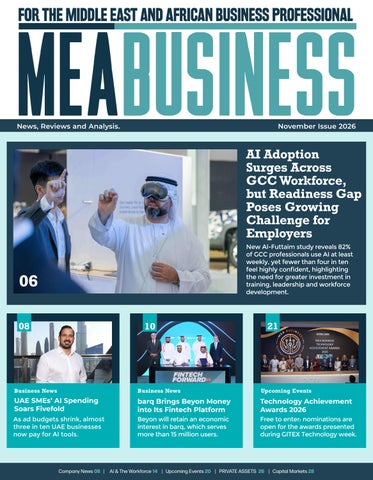
AI Adoption Surges Across GCC Workforce, but Readiness Gap Poses Growing Challenge for Employers
Unemployment Insurance and Emiratisation Law a Landmark Step to Boost Business in UAE
24 068
6
08
10
New Al-Futtaim study reveals 82% of GCC professionals use AI at least weekly, yet fewer than four in ten feel highly confident, highlighting the need for greater investment in training, leadership and workforce development.
15
21
Middle East News
Middle East News
Logistics
Leading British digital logistics company Zencargo launches operations in the UAE to expand in MENA
Aldar partners with Nikki Beach Global to bring branded waterfront residences to Ras Al Khaimah
Hotpack celebrates milestone achievement of reaching 50 retail stores across the MEA
NURTURING THE BUSINESS AND STARTUP ECOSYSTEM
Business News
Business News
UAE SMEs’ AI Spending Soars Fivefold
18
Upcoming Events
barq Brings Beyon Money Technology Achievement Spotlight on: Imad Kazzaz 20 into Its Fintech Platform Awards 2026
NEIL PETCH / GEORGE HOJEIGE / GEOFF RAPP Free to enter: nominations are
As ad budgets shrink, almost Beyon will retain an economic three in ten UAE businessesTrade and Development interest in barq, which serves now pay for AI tools. more than 15 million users.
World Forum to mobilize investments for climate, energy, health and food
Company News 08 |
open for the awards presented during GITEX Technology week.
AI & The Workforce 14 | Upcoming Events 20 | PRIVATE ASSETS 26 | Capital Markets 28
Hosted by:
24 Nov
2026
Supported by:
Event Partner:
Distinction Partner:
MENA INVESTMENT CONGRESS 2026 UAE 8TH EDITION
Ritz Carlton, JBR Dubai, UAE
BOOK YOUR TICKETS NOW!
Introduction Introduction
W
elcome to this special issue of MEA Business. At MEA Business, we are committed to delivering comprehensive business news across the Middle East and Africa. Our mission is to provide a dynamic platform where business leaders can share ideas, engage in meaningful debates, and forge strategic partnerships that will shape the future of the region. Our goal is to equip business leaders and professionals with the skills and insights they need to thrive in these dynamic regions. By focusing on positive news stories, detailed case studies, and inspiring interviews, we aim to foster a narrative of growth and success. MEA Business magazine offers clear and concise information through various sections, including up-to-the-minute news, market updates, and exclusive CEO interviews. Our readers benefit from a comprehensive blend of our printed magazine, e-magazine, and social media content, providing coverage on the latest developments in the Middle East and Africa. Additionally, MEA Business proudly features several sector specials throughout the year, tailored to coincide with major industry exhibitions and events. We hope you find this issue both informative and inspiring.
Kenneth Mitchen
Publisher, MEA Business
Kenneth Mitchen
Publisher, MEA Business
mea-biz.com
3
CONTENTS CONTENTS
NEWS MIDDLE EAST 6
Aldar partners with Nikki Beach NEWS Global to bring BUSINESS branded waterfront 08 H olcim and 44.01 Turn residences to Ras Al Cement Plant CO2 into Khaimah Rock
British 087 U Leading AE SMEs’ AI digital Spending logistics company Soars Fivefold Zencargo launches operations in the
10 M UAE AHY KhooryinPlans to expand MENA AED 1 Billion-Plus Paper AVIATION Project ANNUAL GALA
10EVENING b arq Brings Beyon Money Its Fintech Platform 9 into The Aviation Annual Gala AI
Evening is Back
12AVIATION F rom AIACHIEVEMENT Ambition to AWARDS Business Results Aviation Achievement AI12& THE WORKFORCE Awards 2023
14 A I Adoption Surges Across GCC Workforce, LOGISTICS but Readiness Gap Poses 14 Growing Emirates SkyCargo Challenge for advances Employersits digital customer experience with CargoAi
08 24 MEA Business WEB: www.mea-biz.com MEA Business www.mea-hr.com WEB: www.mea-biz.com EMAIL:www.mea-hr.com info@cme-media.com EMAIL: info@cme-media.com PUBLISHED BY: Creative Middle East Media FZ LLE, 19th Floor, Creative Tower, Fujairah PO East Box 4422, UAE th PUBLISHED BY:Creative CreativeCity, Middle MediaFujairah, FZ LLE, 19 Floor, Creative EXECUTIVE DIRECTOR AND PUBLISHER : Kenneth Mitchen Tower, Fujairah Creative City, PO Box 4422, Fujairah, UAE Email: ken.mitchen@mea-finance.com EXECUTIVE DIRECTOR AND PUBLISHER : Kenneth Mitchen Email: ken.mitchen@mea-finance.com
EVENT NEWS
14 Hotpack celebrates milestone
18 G achievement lobal Technology of reaching 50 CEOs Join ADIPEC 2026 retail stores across the MEA as AI Reshapes Energy
14 Etihad Cargo ramps up cargo capacity for China
Demand and Operations UPCOMING EVENTS 20 ADIPEC 2026 20 CFA Society Emirates MENA Investment Congress 21 Technology Achievement Awards 2026 21 Aviation Annual Gala Evening: 10th Anniversary
10
22 MEBAA Show 2026 22 Events Calendar: November – December 2026 ISLAMIC FINANCE 24 GCC Sukuk and Fixed Income: Locking in Yield as Rates Stay Elevated PRIVATE ASSETS 24 Why Private Assets are Gaining Ground with Middle Eastern Investors
12
CAPITAL MARKETS 28 DIP Holding Sets Price Range for Its Dubai Financial Market IPO CBDCS, STABLECOINS AND TOKENISED DEPOSITS 30 No Token Gesture FINANCIAL INCLUSION 34 Win-Win Scenario
14
AAGE 2026
10
AVIATI ON ANNUAL GAL A EVENI NG
YEARS
BRINGING THE AVIATION INDUSTRY TOGETHER TABLES , HOSPITALITY AND SPONSORSHIP Kenneth Mitchen - Executive Director & Publisher ken@cme-media.com - +971 55 289 1739 www.aviationgala.com
THE AWARDS
Aviation Innovation Awards 2026 Presented on the night as part of the AAGE 2026 programme, the Aviation Innovation Awards recognise exceptional innovation across the sector: technology, sustainability, operations, product development, services, engineering and leadership. Winners collect their awards on stage before 500 of the industry’s most senior leaders, in front of the sponsor wall and the cameras.
NOMINATIONS CLOSE
10 November 2026 Entries of up to 500 words, stating category and industry, to info@cme-media.com
A A G E 2 0 2 6 · W W W . AV I AT I O N G A L A . C O M
Business News
Holcim and 44.01 Turn Cement Plant CO2 into Rock The UAE’s first live-condition pilot captures CO2 from cement production and stores it underground.
H
olcim UAE and carbon storage innovator 44.01 have officially commissioned the UAE’s first live-condition carbon capture and underground mineralisation pilot for the cement industry, at the Holcim Emirates Cement Plant in Fujairah. The pilot is designed to capture 4 to 4.5 tons of CO2 a day from the plant’s active flue gas. Rather than relying on lengthy transportation or temporary sequestration, the captured carbon is injected deep underground into Fujairah’s naturally occurring ultramafic rock formations, where it mineralises into solid rock within months to years, permanently locking it away. Having operated under live industrial
Industrial decarbonisation works in practice, not just on paper. — Ali Said, CEO, Holcim UAE & Oman
conditions since July 2026, the plant has shown that carbon capture and mineralisation can run alongside heavy manufacturing without compromising production efficiency or product quality. The partners describe it as a repeatable template for the cement sector and wider heavy industry across the GCC.
O pening ceremony at the Holcim Emirates Cement Plant in Fujairah.
The ribbon-cutting was attended by Guest of Honour H.E. Ali Qasim, the Ambassador of Switzerland and representatives of MoIAT, MoEI, MOCCAE, MOET and
DECCA. The project is supported by the Fujairah Natural Resources Corporation, the Fujairah Environment Authority, NT Energies and Gulf Cryo.
UAE SMEs’ AI Spending Soars Fivefold As ad budgets shrink, almost three in ten UAE businesses now pay for AI tools.
5×
AI spend vs Q3 2025
29%
of businesses pay for AI
U
AE businesses spent five times more on AI in Q3 2026 than in the same quarter last year, according to the first Pemo SME Spend Index. The new quarterly index from Pemo, a spend management platform used by more than 10,000 UAE businesses, is built on nearly 3.5 million anonymised card transactions worth nearly AED 2 billion, made between October 2025 and September 2026. Almost three in ten businesses paid for at least one AI tool, more than paid for hotel stays (17%) or flights (16%). AI was the fastest-growing spending category, while advertising spend fell by a third. AI is still only 1% of card spend, but already makes up about a quarter of all software spend.
08 MEABUSINESS
AED 268
typical monthly AI spend
−1/2
advertising spend
AI has moved from a talking point to a line in the budget for a growing number of businesses. — Ayham Gorani, Pemo
Technology companies lead, with half paying for AI at a typical AED 880 a month. Marketing agencies follow at 46%, and AI makes up 6% of their card spend. Adoption is rising in real estate (38%) and professional services (35%). The index reflects spend by Pemo customers on Pemo cards, who are not a representative sample of all UAE SMEs, and excludes AI bundled into Microsoft or Google software suites.
Business News for the MEA region
A yham Gorani, Co-founder and CEO, Pemo
WHERE ENERGY OPPORTUNITY TAKES SHAPE
Energy is entering a new era.
ADIPEC in numbers:
Rising demand, new technologies and intensifying competition are reshaping global energy markets – creating unprecedented opportunities to expand supply, attract investment and strengthen economic competitiveness. From 2–5 November in Abu Dhabi, ADIPEC 2026 brings together leaders, capital and capability to turn opportunity into action – advancing the partnerships, projects and technologies that will shape how energy is produced, traded and delivered.
JOIN THE GLOBAL ENERGY COMMUNITY
239,000+
2,250+
Exhibition attendees
Exhibiting companies
16,500+
1,800+
Conference delegates
Conference speakers
Supported by
Partners
TOTAL TOT_21_00008_TotalEnergies_Logo_CMYK JFB
30-34 Rue du Chemin Vert 75011 Paris +33 (0)1 85 56 97 00 www.carrenoir.com TONS RECOMMANDÉS
8385C
2756C
Pantone Medium Blue C
Platinum sponsors
CYAN
RGB:20/40/160 CMYK:100/80/0/0
ARAB DEVELOPMENT
Technical Conference organised by
ADIPEC brought to you by
MAGENTA
Ce fichier est un document d’exécution créé sur Illustrator version CS6.
Date : 26/05/2021
TECHNIQUE
YELLOW
Business News
MAHY Khoory Plans AED 1 Billion-Plus Paper Project The PM4 project in Al Dhafra will move Union Paper Mills into higher-value papers.
O
ne of the longestestablished diversified groups in the UAE and the region, M.A.H.Y. Khoory Group has announced plans to develop PM4, a paper manufacturing project at the Al Dhafra plant of Union Paper Mills (UPM), the Group’s operational and manufacturing arm, in Abu Dhabi. The investment exceeds AED 1 billion. Incorporating the latest global technologies, PM4 will enhance production capabilities and operational efficiency while enabling UPM to diversify into higher-value products, including premium containerboard grades and specialised paper for
This is not simply an expansion; it is a bold investment in the future of our business. — Salahaldin Sharafi, Chairman of the Board
gypsum plasterboard applications. The Group says this will strengthen its competitive position in regional and international markets. The project aligns with the UAE’s Operation 300bn industrial strategy and the Make it in the Emirates
Salahaldin Sharafi Chairman of the Board
AbdelRhman Obaid Group CEO
initiative, with sustainability, resource efficiency and circular economy principles integral to its development. “Our ambition is to build a future-ready industrial platform that is smarter, more agile and more diversified,” said AbdelRhman Obaid, Group CEO.
barq Brings Beyon Money into Its Fintech Platform Beyon will retain an economic interest in barq, which serves more than 15 million users.
B
eyon and barq Group (Technologies Union), the parent company behind Saudi Arabiabased digital financial platform barq, have signed an agreement bringing Beyon Money’s operations into barq’s fast-growing fintech platform. Under the agreement, Beyon Money will become part of barq and Beyon will retain an economic interest in barq, subject to final documentation, regulatory approvals and customary closing conditions. The deal was signed at FinTech Forward 2026 in Bahrain in the presence of H.E. Shaikh Abdulla bin Khalifa Al Khalifa, Chairman of Beyon Group, and Ahmed Alenazi, Founder and CEO of barq. Described as the region’s fastestgrowing digital platform, barq offers payments, cards, local and international
10 MEABUSINESS
S igning ceremony at FinTech Forward 2026 in Bahrain.
transfers and other financial services to individuals and businesses. Beyon Money customers can continue to use their accounts and services as usual and, over time, will benefit from barq’s
Business News for the MEA region
platform, capabilities and reach. Mohamed Alsabea, Chief of Staff and Chief Strategy Officer, added that the transaction “marks an important step in barq’s growth.”
An AI Ambition without the right Architecture, Is like a Race car without an Engine. Win the AI-Native Banking Race, with Finacle's fully Composable, Enterprise-wide Intelligence Platform
Compose AI-Native Banking with Finacle Open and interoperable API-first architecture that connects systems, ecosystems, and intelligence. Powered by Microservices Independent capabilities that evolve continuously without large-scale disruption.
Event-driven Real-time responsiveness across customer journeys and operational workflows.
Intelligence enabled Embed AI across products, channels, and processes where it creates value.
Agentic-orchestration Leverage MCP-enabled domain capabilities to power intelligent banking journeys.
Talk to us about how Next-Gen Composability can fuel your bank's AI ambitions.
Inspiring Better Banking www.finacle.com
AI
From AI Ambition to Business Results
Adrian Pickering, Regional General Manager, Middle East and North Africa, Red Hat, on where AI is delivering returns, modernising ageing IT and why open source fits the region’s digital agenda.
use every week. Healthcare and energy teams are applying it where uptime, safety, and scale matter. The common thread is less about chasing every new model, and more about tying AI to processes that already run the business. With companies investing heavily in AI, there is growing pressure to demonstrate returns. Are businesses in the Middle East seeing tangible results, or is there still a gap between ambition and execution?
A drian Pickering Regional General Manager, Middle East and North Africa, Red Hat
The UAE has positioned itself as a major hub for AI and emerging technologies. How much of this momentum is translating into meaningful changes within businesses, and which sectors are leading the way? A lot of the regional energy around AI is real, and you can see it showing up in day-to-day operations, not only in strategy decks. The sectors moving fastest are usually those with clear operational pressure: financial services, public sector and government, healthcare, and energy. Banks and insurers are using AI to sharpen risk decisions and customer journeys. Public bodies are digitising services that citizens and businesses 12 MEABUSINESS
Both. Ambition and budgets are easy to spot. Consistent returns are harder, and a gap still exists between pilots and production use. Where results do appear, AI is usually tied to a defined business outcome: faster decisions, lower operating friction, better service quality, or stronger risk control. Where it stalls, the issue is often unclear ownership, weak data readiness, or AI treated as a side project instead of part of how the organisation works. Leaders who pick fewer use cases, measure them against business KPIs, and bring security and operations in early are the ones closing that gap. As organisations introduce new technologies, many are still dependent on ageing IT systems. How can businesses modernise without disrupting existing operations or making costly investments that may become obsolete? Start with the outcome the business needs, then modernise in stages that protect continuity. Keep critical services running while you refresh
Business News for the MEA region
The goal is not a perfect architecture on day one. It is a steady path that reduces technical debt. — Adrian Pickering
the layers underneath: applications, data paths, and the infrastructure that supports them. Avoid big-bang replacements that put revenue or citizen services at risk. Favour approaches that leave room to change models, clouds, and vendors over time, especially as AI and virtualisation estates evolve. The goal is not a perfect architecture on day one. It is a steady path that reduces technical debt, improves resilience, and keeps options open as priorities shift. Governments across the region are increasingly focused on building local digital capabilities. How is this influencing the way enterprises choose their technology partners and manage their critical infrastructure? As public sector programmes invest in local skills, sovereign infrastructure, and national digital agendas, enterprises that work with or sell into government are expected to meet a higher standard on control, transparency and continuity. That means choosing technology partners
R ed Hat Summit Connect: delegates gather in Dubai for the regional event.
East, and where does Red Hat fit into this evolving landscape?
Leaders who pick fewer use cases and bring security and operations in early are closing the gap. — Adrian Pickering
O n Stage: Adrian Pickering at Red Hat Summit Connect.
who can operate within local requirements, help grow regional talent and keep critical systems
flexible across hybrid environments. Open source approaches fit that shift because they support inspection, portability, and long-term capability building, not only short project delivery. Looking ahead to 2027, what do you see as the biggest challenges and opportunities for enterprise technology adoption in the Middle
The biggest challenge is keeping security, AI, and infrastructure change aligned with real business objectives while organisations modernise virtualised and hybrid estates. Automated threats are raising the stakes: discovery alone is not enough, and teams need usable fixes that reach the software they already run. IBM and Red Hat recently reported remediating more than 400 previously unknown vulnerabilities in widely used open source Java libraries, a reminder that shared components need ongoing attention and that fixes must travel through the ecosystem. The opportunity is to modernise with business goals in the lead, using open source and hybrid flexibility for AI, security and infrastructure change. mea-biz.com
13
AI & The Workforce
AI Adoption Surges Across GCC Workforce, but Readiness Gap Poses Growing Challenge for Employers New Al-Futtaim study reveals 82% of GCC professionals use AI at least weekly, yet fewer than four in ten feel highly confident, highlighting the need for greater investment in training, leadership and workforce development.
T
he GCC workforce has embraced ar tificial intelligence at remarkable speed, with more than four in five professionals now using AI at least weekly and one in three using it every day. However, while adoption is accelerating across the region, workforce readiness is struggling to keep pace, according to a new study released by Al-Futtaim. Titled Unlocking AI for the GCC Workforce, the report represents Al-Futtaim’s largest study of AI adoption across the GCC consumer economy. Based on a survey of 1,143 professionals across six GCC markets, the research explores how employees are adopting AI, where confidence and capability gaps remain, and what organisations need to do to unlock the technology’s full potential. The study includes professionals working across sectors including technology, automotive, healthcare, retail, consumer goods, hospitality and electronics. In addition to the research findings, the report features expert perspectives from IBM, Microsoft and Inception42, a G42 company, on the opportunities and challenges shaping AI adoption across the region. The findings suggest that the GCC faces not only an AI adoption challenge, but also a workforce readiness challenge. While 82% of professionals surveyed use AI daily or at least weekly and 73% report improved productivity, only 39% describe themselves as 14 MEABUSINESS
H ands-on with new technology: AI is fast becoming part of everyday working life across the GCC.
highly confident using the technology. More than half of organisations actively encourage AI use, yet only around one in five employees report receiving extensive AI training, creating what the research identifies as an “AI Readiness Paradox”, where organisations are accelerating adoption faster than they are building workforce capability. AI Training Emerges as a Critical Factor The study identifies AI training as the single strongest predictor of successful adoption. Employees who have received extensive training are 2.5 times more likely to feel highly confident using AI than untrained
Business News for the MEA region
colleagues, report significantly greater productivity gains and are almost twice as likely to save four or more hours each week through AI. Yet one in four professionals say they have received no formal AI training from their employer, highlighting a significant opportunity for organisations to strengthen workforce capability and ensure employees can translate AI adoption into meaningful business outcomes. Beyond training, the research highlights leadership as one of the strongest drivers of AI adoption. Organisations with a formal AI strategy report significantly higher workforce
Key findings
82%
73%
39%
~1 in 5
1 in 4
47%
use AI daily or at least weekly
report receiving extensive AI training
confidence and clearer role-specific guidance, while workplaces where senior leaders actively use AI see employee adoption rates three times higher than those where leadership engagement is limited. Data Security and Uneven Access Remain Key Challenges
report improved productivity
have had no formal AI training
reach employees at every level of an organisation. Industry Leaders Call for Greater Focus on Workforce Readiness Commenting on the findings, Moza Al Futtaim, Chief AI Officer, Al-Futtaim, said:
Another significant finding is that AI capability is not being developed evenly across the workforce. Nearly half (47%) of professionals aged 45 and above report receiving no formal AI training from their employer, the highest rate of any age group. Frontline employees and workers in smaller organisations are also significantly less likely to receive structured AI development, despite playing critical roles in customer experience and day-to-day operations. These disparities point to the importance of ensuring AI training and development opportunities
of professionals aged 45+ have had no formal AI training
must be not only on keeping pace with change, but also on equipping people to lead and influence it. The report also highlights the importance of moving beyond technology adoption to fundamentally rethink how organisations operate and how employees work alongside AI. Lula Mohanty, Managing Partner, IBM Middle East & Africa, said:
The study also uncovers one of its most unexpected findings: while training improves almost every aspect of AI adoption, it does little to reduce concerns around data security. Around a third of respondents identify data security as their biggest barrier to using AI, regardless of age, seniority, industry or training level. The findings suggest that organisations must strengthen governance and responsible AI frameworks alongside workforce skills to build greater trust in the technology.
describe themselves as highly confident
Moza Al Futtaim Chief AI Officer, Al-Futtaim
Across the GCC, organisations are adopting AI with real momentum, and the opportunity now is to match that momentum with readiness. Organisations that succeed are those investing in their people alongside technology, equipping employees at every level with the skills and confidence to use these tools, and fostering a culture of continuous learning. As AI transforms the way we work, we want to ensure our people are actively shaping that change. Our focus
L ula Mohanty Managing Partner, IBM Middle East & Africa
Many of the themes highlighted in the report are consistent with what we are seeing across organisations in the region: AI adoption alone does not create business value. Success comes when organisations mea-biz.com
15
AI & The Workforce
redesign how work gets done, equip their people with the right skills and build trust alongside technology. At IBM, our own AI transformation experience has demonstrated the importance of combining technology with process redesign and workforce enablement to realise business value.” Similarly, Ibrahim AlJallaf, COO, Inception42, emphasised the need for organisations to rethink existing workflows rather than simply introduce AI tools into established processes.
workflows are re-imagined with AI and the human at the center of it. That kind of change doesn’t come from technology; it comes from the people who know the processes well enough to question it. This is what makes AI deployment effective and brings about adoption at scale.” Turning AI Adoption into Measurable Business Impact The white paper concludes that the next phase of AI transformation across the GCC will not be determined by access to technology alone, but by how effectively organisations turn adoption into meaningful business impact.
Ibrahim AlJallaf COO, Inception42
Most companies drop AI into workflows designed for people, then wonder why the gains are marginal. Real impact comes when
This requires a shift from investing in more technology to building the right skills, organisational structures and data foundations, while rethinking
1,143
professionals surveyed
6
GCC markets
7 sectors
technology, automotive, healthcare, retail, consumer goods, hospitality and electronics Report: Unlocking AI for the GCC Workforce, Al-Futtaim
how AI is integrated into everyday operations and measuring its impact beyond productivity gains. With AI already becoming part of everyday working life across the
Employees who have received extensive training are 2.5 times more likely to feel highly confident using AI than untrained colleagues. 16 MEABUSINESS
Business News for the MEA region
region, the findings underline the growing importance of workforce readiness, leadership engagement, responsible continuous
governance learning
in
and
ensuring
organisations can fully realise the benefits of AI transformation.
Event News
Global Technology CEOs Join ADIPEC 2026 as AI Reshapes Energy Demand and Operations Senior executives from Siemens, Honeywell, AVEVA, Cognite and Schneider Electric will join industry leaders in Abu Dhabi to examine how artificial intelligence is transforming energy infrastructure, operations and investment.
G
lobal technology CEOs from Siemens AG, Honeywell, AVEVA, Cognite, Siemens Energy, AIQ, Schneider Electric and SandboxAQ are among the leaders confirmed for ADIPEC 2026, as the energy industry looks to embed artificial intelligence (AI) across critical infrastructure and operations. Taking place in Abu Dhabi from 2–5 November, the event will connect technology innovators with the energy operators, investors and policymakers responsible for putting intelligent solutions to work at scale. According to the International Energy Agency (IEA), widespread adoption of existing AI applications could deliver up to US$110 billion in annual power generation savings by 2035, while unlocking as much as 175 gigawatts (GW) of additional transmission capacity from existing power lines. At the same time, the rapid expansion of AI and data centres is placing new demands on electricity systems, reinforcing the growing interdependence between the energy and technology sectors. AI will be a central theme across ADIPEC 2026, spanning its Strategic and Technical Conferences, exhibition and Leadership Roundtables. From improving upstream productivity and optimising industrial operations to strengthening grid resilience and addressing the power demands ofdata centres, discussions will examine how intelligent technologies can improve energy system performance, supported by the investment, infrastructure and
18 MEABUSINESS
A I in action: immersive technology on show at ADIPEC.
partnerships needed for wider adoption. Global technology leaders to address the next phase of AI deployment Across ADIPEC’s Strategic Conference, executives from some of the world’s leading industrial and technology companies will address how AI is influencing energy security, infrastructure investment, industrial performance and digital transformation. Confirmed speakers include Roland Busch, President and CEO of Siemens AG; Caspar Herzberg, CEO of AVEVA; Dr Christian Bruch, President and CEO of Siemens Energy; Girish Rishi, CEO of Cognite; Vimal Kapur, Chairman and CEO of Honeywell; Dennis Jol, CEO of AIQ; Uljan Sharka, Founderand CEO of Domyn; Dr Olivier Oullier, CEO of
Business News for the MEA region
Inclusive Brains; Tim Bawtree, Chairman and Founder of Quantum Switch; Olivier Blum, CEO of Schneider Electric; and Jack Hidary, CEO of SandboxAQ. Roland Busch, President and CEO of Siemens AG, said: “Industrial AI delivers the most value for energy systems when intelligence is engineered into infrastructure at its core, including the grids, industrial systems and buildings that keep economies running day to day. These systems need to perform reliably under pressure, whether they were built decades ago or are under construction today. Scaling that requires sustained investment, deep engineering expertise and closer collaboration between the energy and technology sectors. ADIPEC brings those partnerships together, turning
239,000 expected attendees
2,250+ exhibiting companies
Industrial AI delivers the most value for energy systems when intelligence is engineered into infrastructure at its core. — Roland Busch, President and CEO, Siemens AG technological progress into resilient, real-world performance.”ADIPEC’s dedicated AI, Digital & Technology Innovation Strategic Conference programme will examine the practical and commercial priorities shaping AI adoption, from automation, predictive analytics and asset optimisation to cybersecurity, data infrastructure and measurable returns on investment.
technical category.
It will also address the infrastructure requirements created by AI’s own growth, including how energy and technology companies can work together to meet rising power demand while improving system efficiency and reliability.
From strategy to application: AI innovation across the exhibition floor
Christopher Hudson, President of dmg events, organiser of ADIPEC, said: “AI is opening up significant opportunities for the energy industry. The priority now is identifying which applications are worth backing and how to deploy them securely at scale. That takes more than technology; it requires engineering expertise, investment and commercial discipline. ADIPEC connects the people setting strategy and committing capital with those responsible for delivery, helping turn AI’s potential into measurable improvements across energy systems.” The growing importance of AI is also reflected in ADIPEC’s Technical Conferences, which attracted a record 7,261 abstract submissions this year. AI & Digital Transformation received 1,296 submissions, the highest of any
Across more than 200 sessions and 1,100 expert speakers, the TechnicalConferences will explore the engineering innovations and practical solutions needed to improve performance, strengthen reliability and accelerate technology adoption across energy operations.
On the exhibition floor, ADIPEC’s expanded AI Zone, co-hosted by AIQ, will bring the practical application of intelligent technologies into focus. Exhibitors will demonstrate how AI, robotics and digital technologies are moving into real-world energy and industrial operations, from reservoir modelling and autonomous control to infrastructure inspection, grid management and subsea robotics. Among the new technologies being unveiled, Stone Ridge Technology will launch what it describes as the first AI-native pre- and post-processing and workflow orchestration layer built around its GPU-based ECHELON reservoir simulation software. Honeywell will showcase AI-driven autonomous upstream operations through Honeywell Forge Upstream. Robotics will provide some of the Zone’s most tangible demonstrations. EY, in partnership with Gecko Robotics, will showcase robots that can climb,
1,800+
speakers across 13 conference programmes
crawl, swim and fly to inspect assets such as pipelines and power plants, combining high-fidelity physical data with AI analytics to predict failures, extend asset life and inform investment decisions.Sinaha will exhibit the Autonomous Mobile Robots already deployed in its intelligent warehouses, supported by its proprietary Robotics Management System, with the robots due to be manufactured at its UAE factory from the first quarter of 2027. By connecting technology innovators directly with energy operators, customers and project owners, the Zone aims to create opportunities to advance commercial relationships, forge new partnerships and move market-ready solutions closer to implementation. Complementing the conference and exhibition, the invitation-only ADIPEC AI Leadership Roundtables will provide a private forum for senior decisionmakers from across energy and technology to address the investment, infrastructure, governance and regulatory considerations shaping AI adoption. Together, these platforms reinforce ADIPEC’s focus on translating technological progress into practical outcomes, connecting the people, capital and capabilities needed to build a more intelligent, resilient energy system capable of supporting longterm growth. Hosted by ADNOC and held under the patronage of His Highness Sheikh Mohamed bin Zayed Al Nahyan, President of the UAE, in his capacity as Ruler of Abu Dhabi, ADIPEC 2026 is expected to welcome 239,000 attendees, more than 2,250 exhibiting companies and over 1,800 speakers across 13 conference programmes mea-biz.com
19
Upcoming Events ENERGY
ADIPEC 2026
Energy and technology leaders gather in Abu Dhabi, with AI at the centre of the agenda. ADIPEC 2026 takes place in Abu Dhabi from 2 to 5 November, connecting technology innovators with the energy operators, investors and policymakers responsible for putting intelligent solutions to work at scale. Hosted by ADNOC and held under the patronage of His Highness Sheikh Mohamed bin Zayed Al Nahyan, President of the UAE, the event is expected to welcome 239,000 attendees.
the expanded AI Zone, co-hosted by AIQ, will show how AI, robotics and digital technologies are moving into real-world energy operations
WHEN
2–5 November 2026 WHERE
ADNEC Centre Abu Dhabi H OST
ADNOC ON L IN E
Global technology CEOs from Siemens AG, Honeywell, AVEVA, Cognite, Siemens Energy, AIQ, Schneider Electric and SandboxAQ are among the leaders confirmed, with AI a central theme across the Strategic and Technical Conferences, the exhibition and the invitation-only ADIPEC AI Leadership Roundtables. The Technical Conferences attracted a record 7,261 abstract submissions, and
EVENT DETAILS
adipec.com
ADIPEC returns to ADNEC Centre Abu Dhabi from 2 to 5 November.
INVESTMENT
CFA Society Emirates MENA Investment Congress Investors meet in Dubai, with the MEA Investment Awards the same evening. The eighth edition of the CFA Society Emirates MENA Investment Congress takes place at The Ritz-Carlton, JBR, Dubai, on 24 November 2026 under the theme “Navigating Global Shifts: Unlocking New Investment Pathways”, preceded by a gala dinner on 23 November.
excellence across wealth management, family offices, private banking, asset management and other sectors, including aviation. Nominations are free and close on 5 November 2026.
23–24 November 2026 WHERE
C ON G R E S S
mea‑finance.com/ menainvestmentcongress/2026 AWA R D S D E A D L IN E
5 November 2026 AWA R D S D E A D L IN E
MEA Investment Awards
20 MEABUSINESS
WHEN
The Ritz-Carlton, JBR, Dubai
The Congress is being promoted to the CFA global network of approximately 200,000 members, bringing together an international audience of asset managers, family offices, institutional investors, private banks and other senior investment professionals. The Congress now incorporates the MEA Investment Awards, presented on the evening of 24 November. The awards cover Investment Industry Awards and Sector Investment Awards, recognising
EVENT DETAILS
investment‑awards.mea‑business.com
ENA Investment Congress 2025 M at Abu Dhabi Global Market.
Business News for the MEA region
TECHNOLOGY
Technology Achievement Awards 2026
Free to enter: nominations are open for the awards presented during GITEX Technology Week. The MEA Business Technology Achievement Awards 2026 are linked to GITEX Technology Week, taking place from 8 to 11 December 2026, and nominations are now open. Entry is free, with no nomination fee, and sponsorship is not required to enter or to win. Regional and international companies can win, and nominees do not need to exhibit at GITEX. An agency can submit on a brand’s
behalf with the client’s permission. Entries are reviewed and scored by an expert panel and editors, and every winner receives a free winners’ listing. Trophy presentations take place during GITEX Technology Week, on the winner’s exhibition stand or at a dedicated awards area on the show floor. New for 2026, a winners’ party will be held on board a mega yacht on 10 December.
EVENT DETAILS WHEN
8–11 December 2026 WHERE
GITEX Technology Week, Dubai N OMIN AT ION D E A D L IN E
10 November 2026 E N T RY
Free, no sponsorship required ON L IN E
tech‑awards.mea‑business.com
Winners at the 2025 awards during GITEX.
AVIATION
Aviation Annual Gala Evening: 10th Anniversary Awards, a gala dinner and a night cruise on a mega yacht in Dubai Marina. The Aviation Annual Gala Evening marks its 10th anniversary on 10 December 2026, bringing together senior leaders from across business and commercial aviation aboard a luxury mega yacht in Dubai Marina. The evening combines awards, a gala dinner and a night cruise, with the chance to connect with industry colleagues, entertain clients and celebrate achievement.
Aviation Innovation Awards Part of the gala programme, the Aviation Innovation Awards recognise exceptional innovation across the aviation industry. Organisations can submit their achievements for consideration and give their teams the recognition they deserve. Tables, hospitality and sponsorship opportunities are available; contact ken@ cme-media.com
EVENT DETAILS WHEN
10 December 2026 WHERE
Luxury mega yacht, Dubai Marina CONGRESS
10 November 2026 GA L A
aviationgala.com AWA R D S
aviationgala.com/awards
S cenes from the 2025 gala evening in Dubai Marina.
mea-biz.com
21
Upcoming Events BUSINESS AVIATION
MEBAA Show 2026
Business aviation returns to Dubai World Central as the association marks 20 years. The 11th edition of the MEBAA Show takes place from 8 to 10 December 2026 at the DWC Dubai Airshow Site, coinciding with the 20th anniversary of the Middle East and North Africa Business Aviation Association. The show is held under the patronage of His Highness Sheikh Ahmed bin Saeed Al Maktoum, President of the Dubai Civil Aviation Authority, Chairman of Dubai Airports, and Chairman and Chief
Executive of Emirates Airline and Group, with this edition placing renewed focus on the value of business aviation. Organisers say more than 100 exhibiting companies have confirmed their participation. Key exhibitors to date include Bombardier, Dassault Aviation, Jet Aviation, Harrods Aviation, Universal Aviation, AEG Fuels and Lufthansa Technik, and the event is expected to attract more than 10,000 visitors from over 100 countries.
EVENT DETAILS WHEN
8–10 December 2026 WHERE
DWC Dubai Airshow Site ORGA N IS E R
MEBAA ON L IN E
mebaa.com
The DWC Dubai Airshow Site, venue for the MEBAA Show 2026.
DIARY DATES
Events Calendar: November – December 2026 Date
Event
Venue
Online
2–5 Nov 2026
ADIPEC 2026
ADNEC, Abu Dhabi
adipec.com
11 Nov 2026
MEA Finance Wealth & Investment Summit and Industry Awards
Dubai
mea‑finance.com
23–24 Nov 2026
CFA Society Emirates MENA Investment Congress and MEA Investment Awards
The Ritz-Carlton, JBR, Dubai
mea‑finance.com/ menainvestmentcongress
7–10 Dec 2026
Abu Dhabi Finance Week
Al Maryah Island, Abu Dhabi
adfw.com
8–10 Dec 2026
MEBAA Show 2026
DWC Dubai Airshow Site
mebaa.com
8–11 Dec 2026
GITEX Technology Week and Technology Achievement Awards
Dubai
tech‑awards.mea‑business. com
10 Dec 2026
Aviation Annual Gala Evening (10th anniversary)
Dubai Marina
aviationgala.com
22 MEABUSINESS
Business News for the MEA region
Islamic Finance
GCC Sukuk and Fixed Income: Locking in Yield as Rates Stay Elevated ARAM Capital Partners’ Vikas Maheshwari on the US rate cycle, regional demand for sukuk and how investors should position their fixed-income portfolios.
W
ith US long-term yields held up by structural forces and GCC credit spreads widening, Vikas Maheshwari, Head of Investment Advisory and Fixed Income at ARAM Capital Partners, explains why he sees fixed income as the better risk-adjusted asset class today and why GCC sukuk issuance could cross USD 100bn a year by 2030. How is the evolving US interest-rate cycle shaping the outlook for GCC fixed-income markets, particularly in terms of sukuk yields and valuations? At ARAM Capital we believe that the US rate cycle is at an interesting pointfor investors. Short-term rates will keep following the Fed’s action and what the market expects it to do. Long-term yields are a different story. Several structural forces are holding them up. The usual ones are the fiscal deficit, a geopolitical risk premium and Fed policy. Besides these, a few other structural factors are at work, such as competition from highly rated AI and hyperscaler bond issuance, leveraged basis trades by hedge funds, Japan’s currency defence and global growth resilience. These factors will remain in play for a while. We also expect Treasury volatility, as measured by the MOVE Index, to stay high around current levels, as we see less communication from the Fed and more hedge fund involvement through leveraged basis trades. In the regional market, Saudi credit is under some pressure, with CDS moving from 55 to 70 basis points since the end of August. We have taken a tactical overweight in Saudi credits across sovereigns, GREs and corporates. Qatar CDS has also risen, and we are looking to add exposure there.
24 MEABUSINESS
V ikas Maheshwari Head of Investment Advisory and Fixed Income, ARAM Capital Partners
Business News for the MEA region
USD 100bn+
annual GCC sukuk issuance expected by 2030
6–7%
yield on an A- to BBB+ rated portfolio
We see fixed income as the better risk-adjusted asset class today. — Vikas Maheshwari, ARAM Capital Partners What are the key factors driving investor demand for GCC sukuk, and how is appetite evolving among regional and international investors? Middle East investors are under-allocated to fixed income, at around 14% of their portfolios against a global average of about 17%. With yields andcredit spreads higher, our client meetings indicate that they want to raise their fixed income allocation to capture higher yields. We consider GCC credits as very strong. Spreads have widened, but far less than what we feared when the war started earlier this year. Demand for sukuk from both regional and international investors remains high and is still growing. That said, sukuk issuance has slowed in 2026 while conventional issuance has stayed strong. How do you expect sukuk issuance across the GCC to develop over the coming year, and what trends are emerging in the primary market? Sukuk usually trade tighter than conventional bonds, which works in the issuer’s favour. More issuers are coming to the market, and ESG funds are adding to demand. There is inherent demand from Islamic banks, insurers, endowments and pension funds. The primary market for sukuk has been trending strong. New issuance averaged around USD 80bn a year in 2024 and 2025, compared with about USD 50bn a year over 2021 to 2023.2026 has been softer so far, with an annual run rate of around USD 60bn, because GCC issuers have used conventional offerings
to reach a wider set of international investors. We at ARAM Capital stay positive on the sukuk issuance outlook and expect annual GCC sukuk issuance to cross USD 100bn by 2030. How do you assess the relative investment opportunities across sovereign, government-related and corporate sukuk in the GCC? Saudi sovereigns and governmentrelated entities (GREs) offer good relative value compared with their GCC peers. Corporate sukuk from Saudi banks and UAE real estate names also look attractive. We are overweight these segments in our flagship Horizons GCC Sukuk Fund and Model Portfolio. How should investors position their fixed-income portfolios to balance yield opportunities, credit quality and interest-rate risks? At ARAM Capital, our approach is to protect, preserve and grow capital. With so many risks around, we advise investors to keep duration at about five years and lock in today’s high yields. If yields rise further, the higher accruals should absorb the hit from duration. We will not compromise on creditquality. We would not go below investment grade even for a high single-digit or low doubledigit yield, as we believe the high-yield segment is the most exposed to the current crisis. Fixed income should take a larger share of the asset allocation model now. A diversified portfolio of sovereigns, GREs
14%
Middle East allocation to fixed income, vs 17% globally
and corporates with average portfolio ratings of A- to BBB+ is giving us a 6–7% yield. The recent widening in credit spreads has also helped us lock in those levels. Looking ahead to 2027, what are the key opportunities and risks that could influence the performance of GCC sukuk and fixed-income markets? Cash and fixed income are getting a fresh look at these levels, after falling out of favour following the pandemic. Middle East institutions and family offices have been investing globally, with a growing tilt towards alternatives such as private equity and private credit. We expect rates to stay elevated. Shortterm rates should ease a little from here while long-term rates hold firm, which points to a bull steepener. Long-term yields will stay high, and the short end will depend mostly on what the Fed does. We could see some spread tightening by mid-2027 if geopolitical risks fade. This is why we see fixed income as the better risk-adjusted asset class today. A five-year duration investment grade portfolio can deliver 6–7% with singledigit volatility, while global equities are expected to return 8–9% with volatility in the mid to high teens. We are advising clients at ARAM Capital to increase their fixed income allocation, and we think 2027 will be a good year to hold it. On fundamentals, corporate balance sheets and cash flows of big companies remain strong even eight months into the regional crisis. We do not see any major default risk or rating downgrades at this point. The main risks are an escalation in geopolitical tensions and sticky inflation that forces the Fed to stay tighter than expected. mea-biz.com
25
Capital Markets
DIP Holding Sets Price Range for Its Dubai Financial Market IPO The owner of Dubai Investments Park is offering 20% of its shares at AED 1.10–1.15 each, valuing the business at up to AED 10 billion with a dividend yield of more than 7%.
D ubai Investments Park: the 23 million sqm park offers long-term ground leases across logistics, industrial, residential and commercial uses.
D
IP Holding Plc, the owner of Dubai Investments Park, has announced the offer price range for its initial public offering (IPO) on the Dubai Financial Market (DFM) and opened subscription to investors. The shares are being offered at between AED 1.10 and AED 1.15 each, implying a market capitalisation at listing of between AED 9.5 billion (US$2.6 billion) and AED 10.0 billion (US$2.7 billion). Subscription opened on 27 October 2026 and closes on 3 November 2026, with the final offer price expected to be announced on 4 November. Admission to trading on the DFM is anticipated on or around 11 November 2026.
26 MEABUSINESS
A subsidiary of Dubai Investments PJSC, DIP Holding is a DIFC-incorporated public company and the sole shareholder of Dubai Investments Park Development Company, which operates the 23 million sqm park. Dubai Investments Park is an infrastructure-like ground rent and services platform, providing long-term, infrastructure-enabled ground leases across logistics, industrial, residential and commercial uses. A sale of existing shares A total of 1,735,243,300 shares, equal to 20% of DIP Holding’s issued share capital, are being offered, giving a total offering size of between AED 1.9 billion (US$520 million) and AED 2.0 billion (US$543 million).
Business News for the MEA region
All of the shares on offer are existing shares sold by Dubai Investments PJSC, which will receive the proceeds. Assuming no change to the offering size, it will retain an 80% stake in DIP Holding. The selling shareholder may amend the size of the offering or any tranche before subscription closes, subject to UAE law and approval by the Capital Market Authority. Dividends at the centre Under the dividend policy set out in its UAE Prospectus, DIP Holding expects to pay annualised cash dividends of AED 700 million, AED 725 million and AED 750 million for the financial years 2026, 2027 and 2028 respectively, paid semi-annually. Based on the expected
Key facts PRICE RANGE
AED 1.10 – 1.15 per share
MARKET CAP AT LISTING
AED 9.5 – 10.0bn US$2.6 – 2.7bn
OFFERING SIZE
AED 1.9 – 2.0bn 20% of issued share capital
IMPLIED DIVIDEND YIELD
7.27% – 7.60%
based on expected FY2027 dividend of AED 725m
FY2027 dividend of AED 725 million, the price range implies a dividend yield of approximately 7.27% at the top of the range and 7.60% at the bottom. The first post-IPO distribution of AED 350 million, covering the full second half of 2026, is expected to be paid in April 2027, meaning eligible shareholders will receive a dividend for the whole of H2 2026 rather than only the period after listing. AED 362.5 million is then expected in October 2027 and again in April 2028. From 2029 onwards, the company expects to maintain annualised dividends in line with, or above, the FY2028 level Four tranches The offering is split into four tranches. Professional investors are allocated 92% of the offer shares, and the final offer price will be set through a book-
building process based solely on their orders. Individual subscribers holding a DFM National Investor Number receive 5%, with a guaranteed minimum allocation of 2,000 shares each. Eligible employees of the Dubai Investments group receive 1%, and eligible Dubai Investments shareholders as of the 28 October 2026 record date receive 2%, each with a guaranteed minimum of 5,000 shares, subject to the terms of the prospectus. Shariah compliance and stabilisation The Internal Shariah Supervision Committees of Emirates NBD Bank and Dubai Islamic Bank have issued pronouncements confirming that, in their view, the offering complies with Shariah principles. xCube LLC has been appointed stabilisation manager. Some
EXPECTED LISTING
11 November 2026 Dubai Financial Market
173,524,330 shares, 10% of the offering, will be used to support the share price for up to 30 days after trading begins if it falls below the final offer price. The company and the selling shareholder will each be subject to a 180-day lock-up following admission. Citi, Emirates NBD Capital and HSBC are joint global coordinators, with ADCB, Arqaam Capital, Dubai Islamic Bank and EFG Hermes as joint bookrunners. Al Mal Capital is financial advisor, Emirates NBD Capital is listing advisor and Emirates NBD Bank is lead receiving bank. Full details are available at ipo. dipark.com.
IPO timeline Event
Date
Subscription opens & price range announced
27 October 2026
Subscription closes, all tranches
3 November 2026
Final offer price announced
4 November 2026
Final allocation & refunds (tranches 1, 3 and 4)
10 November 2026
Expected DFM listing
11 November 2026
mea-biz.com
27
PRIVATE ASSETS
BEYOND TRADITIONAL MARKETS:
Why Private Assets are Gaining Ground with Middle Eastern Investors Tim Haywood Managing Director, Middle East at GRT Capital Management Limited, discusses the changing priorities of Middle Eastern investors, opportunities across private markets and real assets, the growing relevance of Shariahcompliant investing, and why MEASA is central to GRT’s next phase of international growth
G
RT has recently established a presence in DIFC. How would you describe the firm and its investment philosophy?
GRT Capital Management Limited is a Hong Kong-based specialised asset manager, licensed by the Securities and Futures Commission of Hong Kong to conduct Type 4 (Advising on Securities) and Type 9 (Asset Management) regulated activities. Our focus is on private markets, particularly real assets and asset-backed private credit. What differentiates our approach is the combination of family-office investment discipline with institutional assetmanagement capability. That heritage shapes how we think about capital: preservation comes first, and we look for opportunities where value is underpinned by tangible assets, contractual cash flows and disciplined structuring. For us, the question is not simply whether an investment can generate a return. We want to understand where that return comes from, what could go wrong,
28 54 MEABUSINESS
and how downside risks are managed if conditions change.
Why has ME ASA become st ra te g i c a l l y i m p o r ta nt to GRT, and why establish a DIFC Representative Office now? What has struck us about the Middle East is not simply the scale of capital in the
region, but how sophisticated that capital has become. The conversation has moved beyond whether investors should allocate to private markets. Increasingly, the questions are where within private markets they should allocate, what role those investments should play in a portfolio, and which managers have genuine specialist capabilities. We are also seeing regional allocators become more comfortable evaluating private credit and real assets directly. Dubai is at the centre of that evolution. The DIFC combines an internationally recognised regulatory environment with a concentrated ecosystem of financial institutions, family offices, advisers and investment professionals. For GRT, establishing a Representative O f f i c e wa s t h e refo re a n a t u ra l progression. The timing reflects both the maturity of regional demand for privatemarket strategies and the importance of being physically present as investors become more selective in their manager relationships. Having people on the ground allows us to deepen our engagement with professional investors and strategic partners and demonstrate that our commitment to the region is long term.
How are the investment priorities of Middle Eastern investors changing?
Tim Haywood, Managing Director, Middle East, GRT Capital Management Limited
Business Banking News for the MEA region and Finance news in the MEA market
We see a clear shift towards greater selectivity and specialisation. As allocations to alternatives mature, investors are looking beyond broad assetclass labels. They increasingly want to understand the underlying source of
return, the quality of collateral, duration, alignment with the manager and how an investment may behave under different market conditions. That environment favours specialist managers with genuine origination capabilities, sector expertise, disciplined underwriting and a clear understanding of risk.
Where do you see opportunities within private markets today? We are seeing opportunities where traditional financing have become more difficult, and specialist private capital can address structural needs. More broadly, real assets and assetbacked strategies can offer identifiable investment characteristics, including tangible collateral, defined sources of repayment and clearer investment durations. One market development illustrating this broader trend is the evolution of the U.S. residential land market. The U.S. continues to face a housing supply shortfall, while many homebuilders have increasingly adopted land-light business models. Together, these trends have contributed to greater demand for third-party capital within the land development ecosystem. For investors, the broader lesson is that understanding how you get your capital back can be just as important as the headline return. That is particularly relevant in private markets, where investment structure, collateral and the quality of counterparties can materially influence outcomes.
What role can real assets and asset-backed strategies play within portfolios? Their underlying economic drivers can differ from those of listed equities and bonds.
In certain asset-backed strategies, cash flows are linked to contractual obligations and underlying assets rather than daily public-market pricing. Some structures can also return capital progressively as assets are realised, allowing capital to be redeployed rather than waiting for a single exit. These assets are not isolated from broader economic conditions. Interest rates, liquidit y, asset valuations and counterparty behaviour can all influence outcomes. Private assets are not inherently defensive or low risk. The quality of the counterparty, collateral, structure, underwriting and ongoing asset management all matter. This is why we believe specialist expertise is particularly important in private markets.
Shariah-compliant investing is an important part of the regional landscape. How is GRT approaching it? A meaningful pool of capital in the Middle East requires Shariah-compliant investment options, yet historically the private-markets universe available to Islamic investors has been narrower than the conventional one. Certain real-asset and asset-backed structures can lend themselves to Islamic finance principles because they are grounded in tangible underlying assets and real economic activity. We consider Shariah requirements from the strategy-design stage rather than treating them simply as an overlay. In practice, that means considering the nature of the underlying assets, contractual structure, cash-flow mechanics, documentation and ongoing monitoring from the outset. Independent Shariah expertise and ongoing oversight are also important parts of that process.
Regulatory Information: GRT Capital Management Limited (DIFC Representative Office) is regulated by the Dubai Financial Services Authority (DFSA) as a Representative Office. GRT Capital Management Limited is licensed by the Securities and Futures Commission of Hong Kong (SFC) to conduct Type 4 (Advising on Securities) and Type 9 (Asset Management) regulated activities. The DIFC Representative Office does not provide investment advice, arrange or execute transactions, or provide investment management services in or from the DIFC. Disclaimer: This article is provided for general information purposes only and does not constitute, and should not be construed as, investment advice, an offer, solicitation or recommendation to buy or sell any financial product or to engage in any investment activity. The views expressed are general in nature and should not be relied upon in making any investment decision.
For GRT, this is a long-term capability rather than something developed simply because we have established a presence in the DIFC.
GRT talks about combining familyoffice discipline with institutional asset-management expertise. What does that mean in practice? One lesson from our family-office heritage is patience: capital does not have to be deployed simply because it is available. We would rather wait for an opportunity that meets our underwriting criteria than make the pace of deployment itself the objective. That discipline extends throughout the investment lifecycle— from sourcing opportunities directly and underwriting downside scenarios to monitoring investments after they are made. At the same time, the institutional side is equally important. Investors rightly expect robust governance, independent administration, valuation and reporting. Our aim is to combine that institutional infrastructure with the mindset of a principal investor: understand the asset, understand the downside and remain actively engaged throughout the investment.
What role will the Middle East play in GRT’s next three to five years? MEASA is one of a small number of priority growth markets for GRT. That is a deliberate strategic decision rather than an opportunistic one. The establishment of our DIFC Representative Office is the starting point: our presence and building relationships first, deeper capability over time. We expect private-market allocations across the region to continue developing, alongside greater demand for specialist managers and Shariahcompliant private-market strategies delivered to institutional standards. Our focus now is straightforward: establish our team, invest time in relationships and build credibility over the long term. We see opportunities not only in the UAE but across the wider MEASA region as its private-market ecosystem matures. mea-biz.com mea-finance.com
2955
CBDCS, STABLECOINS AND TOKENISED DEPOSITS
No Token Gesture The future of digital assets is becoming less about speculative investment and more about the infrastructure of money itself. Stablecoins, central bank digital currencies and tokenisation are emerging as technologies that could fundamentally reshape payments, capital markets and the way financial assets are created, transferred and owned
F
i n a n c i a l i n s t i t u t i o n s a re modernising core banking i n f ra st r u c t u re s , p a y m e n t systems are increasingly operating in real time and governments are investing heavily in digital economies and next-generation financial services.
30 42 MEABUSINESS
Against this backdrop, distributed ledger technology and digital assets are increasingly being viewed not as alternatives to traditional finance but as technologies capable of improving the efficiency, accessibility and resilience of financial systems themselves.
Business Banking News for the MEA region and Finance news in the MEA market
Global Hub Few regions appear more willing to embrace this transition than ours. Across the GCC and wider MENA region, governments and regulators have demonstrated a notable willingness to engage with digital asset technologies and establish frameworks that encourage innovation while maintaining regulatory oversight and financial stability. Unlike some markets where digital assets initially developed in regulatory grey areas, the Middle East’s approach has generally been characterised by an emphasis on creating regulated environments capable of supporting institutional participation and long-term economic development. The result is that the region is increasingly establishing itself as one of the world’s most dynamic centres for regulated digital assets. Financial centres throughout the Gulf are seeking to attract technology firms, digital asset providers,
institutional investors and financial market infrastructure participants through a combination of supportive regulation, sophisticated financial ecosystems and strong commitments to digital transformation. Rather than treating digital assets as a niche activity, policymakers are increasingly viewing them as part of broader economic strategies aimed at positioning the region at the forefront of future financial services. The UAE has emerged as perhaps the clearest example of this ambition. The country has invested heavily in financial innovation and digital infrastructure, while regulatory initiatives introduced by the Virtual Assets Regulatory Authority and frameworks developed within the Abu Dhabi Global Market and the Dubai International Financial Centre have helped establish one of the most comprehensive digital asset ecosystems in the region. The country’s objective increasingly appears to be not simply attracting digital asset firms but creating an environment in which regulated digital finance can develop alongside traditional financial services. Bahrain has also played an important role in this evolution. The Kingdom has long cultivated a reputation for financial innovation and was among the earliest regional jurisdictions to develop regulatory frameworks supporting fintech and digital assets. Its willingness to experiment with new technologies while maintaining a strong focus on governance and oversight has allowed it to establish itself as an important centre for financial technology development. Saudi Arabia is similarly investing heavily in digital transformation as part of broader economic diversification initiatives, while increasingly sophisticated financial market infrastructure and growing interest in digital assets suggest that the Kingdom may play an increasingly influential role in shaping the region’s digital financial future. Taken together, these developments raise an important question: is the Middle East becoming one of the world’s
leading hubs for regulated digital assets? A compelling case can certainly be made. The region combines several characteristics that are particularly supportive of digital asset innovation, including sophisticated banking sectors, high levels of digital adoption, ambitious economic transformation programmes and regulators that have generally sought to provide clarity rather than uncertainty. This combination of factors is increasingly attracting institutional participation and encouraging practical experimentation with digital asset technologies.
Theory to Practice The evolution of tokenisation provides perhaps the clearest illustration of how the digital asset conversation has changed. For many years, tokenisation was largely discussed in theoretical terms, with proponents highlighting
structures that could broaden investor participation. For regional capital markets seeking to attract investment and improve liquidity, these possibilities are becoming increasingly relevant. Stablecoins are also emerging as another important component of the digital asset ecosystem. Unlike earlier cryptocurrencies whose volatility limited practical applications, stablecoins seek to maintain relatively stable values, most commonly by referencing fiat currencies or reserve assets. Their potential significance therefore lies not in speculative investment activity but in their ability to support payments, settlement and cross-border transactions more efficiently. This is particularly relevant in the Middle East, a region characterised by extensive international trade, large expatriate populations and significant cross-border payment flows. Technologies capable of
THE SIGNIFICANCE OF TOKENISATION LIES IN ITS POTENTIAL TO IMPROVE EFFICIENCY THROUGHOUT FINANCIAL MARKETS the possibility of representing financial assets digitally and enabling faster, more efficient ownership transfers. Today, however, practical applications are beginning to emerge. Financial institutions globally are exploring the tokenisation of bonds, deposits, funds and a growing range of real-world assets, while market infrastructure providers are investigating how distributed ledger technologies might improve settlement, reduce operational complexity and increase market accessibility. The significance of tokenisation lies in its potential to improve efficiency throughout financial markets. By enabling assets to exist in digital form and potentially be transferred more seamlessly, tokenisation may reduce settlement times, improve transparency and support fractional ownership
improving the speed, cost and efficiency of payments therefore have potentially important economic implications. Stablecoins are increasingly attracting attention because they may offer new ways to move value more efficiently within increasingly digital economies. Alongside these developments, central banks around the world are exploring the concept of sovereign digital money through central bank digital currencies. While CBDCs, stablecoins and tokenised assets are often discussed together, they represent very different concepts and may ultimately perform very different functions within future financial systems. Understanding these distinctions is becoming increasingly important as digital asset ecosystems mature and as financial institutions seek to determine mea-biz.com mea-finance.com
3143
CBDCS, STABLECOINS AND TOKENISED DEPOSITS
how these technologies may influence the future of money, payments and capital markets. The next phase of digital finance is therefore unlikely to be defined by speculative enthusiasm or technological novelty alone. It is increasingly being s h a p e d by p ra c t i c a l q u e s t i o n s surrounding infrastructure, efficiency and economic value. In this respect, the Middle East’s willingness to engage with digital assets through regulation, institutional participation and long-term strategic planning may position the region to play an important role in defining how digital finance develops in the years ahead.
Tokenisation The growing interest in digital assets is also being driven by an increasingly important realisation: the technologies attracting the greatest attention today are not necessarily those that seek to replace existing financial systems, but rather those that have the potential to improve how those systems function. This is particularly evident in the evolution of tokenisation, which is increasingly moving beyond theoretical discussions and entering practical applications across
THE TECHNOLOGIES ATTRACTING THE GREATEST ATTENTION TODAY ARE NOT NECESSARILY THOSE THAT SEEK TO REPLACE EXISTING FINANCIAL SYSTEMS, BUT RATHER THOSE THAT HAVE THE POTENTIAL TO IMPROVE HOW THOSE SYSTEMS FUNCTION in conceptual terms, with advocates arguing that digital representations of assets could improve settlement efficiency, increase transparency and broaden investor access. Increasingly, however, practical experimentation and deployment are beginning to demonstrate that some of these promised benefits may indeed be achievable. Financial institutions globally are exploring how tokenised deposits and securities could simplify post-trade processes, reduce operational costs and improve liquidity management. Asset managers are examining how fractional ownership structures could broaden access to investments that have historically been available only to
THIS WILLINGNESS TO EXPERIMENT IS ONE OF THE REASONS WHY OUR REGION IS INCREASINGLY ATTRACTING ATTENTION AS A CENTRE FOR REGULATED DIGITAL ASSET DEVELOPMENT banking and capital markets. Tokenisation, at its simplest level, involves the digital representation of an asset on distributed ledger infrastructure. The concept can apply to a wide range of assets, from securities and investment funds to deposits, commodities and real estate. For many years, the potential benefits of tokenisation were largely discussed
32 44 MEABUSINESS
institutional or high-net-worth investors. Market infrastructure providers are assessing how distributed ledger technologies may improve settlement processes that continue to rely upon multiple intermediaries and complex operational workflows. Our Region is beginning to participate actively in this evolution. Financial centres
Business Banking News for the MEA region and Finance news in the MEA market
throughout are increasingly exploring digital asset initiatives and seeking to position themselves as centres for tokenised finance and digital capital markets. The growing sophistication of regional financial infrastructure, combined with supportive regulatory frameworks and strong commitments to innovation, suggests that the Middle East may become an important participant in the next phase of tokenisation’s development. The significance of tokenisation extends beyond efficiency alone. Capital markets throughout the region continue to evolve and diversify, while governments increasingly seek to broaden investor participation a n d d e e p e n f i n a n c i a l m a r ket s . Technologies capable of supporting greater accessibility, improving liquidity and reducing operational friction are therefore attracting growing attention. Tokenisation may not fundamentally alter the nature of financial assets themselves, but it has the potential to change how those assets are issued, transferred and managed.
Stablecoins Stablecoins are similarly attracting interest because of their practical applications rather than their novelty. Unlike traditional cryptocurrencies, whose price volatility has often limited their usefulness in everyday financial activities, stablecoins generally seek to maintain a relatively stable value by referencing fiat currencies or other reserve assets. This characteristic makes them potentially useful as
instruments for payments, settlement and the transfer of value. The distinction between stablecoins and fiat currencies, however, is important. Fiat currencies represent sovereign money issued and guaranteed by central banks and governments. They form the foundation of national monetary systems and derive their value from legal frameworks, monetary policy and public confidence in the issuing authority. Stablecoins, by contrast, are generally privately issued digital instruments designed to maintain value through reserve arrangements or other mechanisms. While they may seek to replicate some of the functions of money, they do not constitute sovereign currency in the traditional sense. Yet despite these differences, stablecoins offer a number of potentially important enhancements to modern financial systems. P a y m e n t s a n d c ro s s - b o rd e r transactions remain areas of considerable interest. The Middle East is one of the world’s most international regions, characterised by extensive trade relationships, large expatriate communities and significant remittance flows. Technologies capable of reducing the cost, increasing the speed and improving the efficiency of payments therefore have potentially significant economic value. Stablecoins are increasingly being explored within this context because they may support faster settlement and more efficient transfer of value, particularly where traditional cross-border payment processes remain fragmented or involve multiple intermediaries. Their programmability may also support new forms of financial services and increasingly automated transaction environments. The practical implications for regional economies could therefore be considerable. More efficient payment infrastructures can support trade, improve liquidity management and reduce operational costs for businesses and financial institutions. In economies pursuing
ALTHOUGH STABLECOINS AND CBDCS MAY UTILISE SIMILAR TECHNOLOGIES, THEY ARE FUNDAMENTALLY DIFFERENT INSTRUMENTS digital transformation and seeking to enhance international competitiveness, technologies capable of improving financial efficiency naturally attract growing attention. However, stablecoins should not be viewed as direct substitutes for sovereign currencies. This distinction becomes particularly important when considering the emergence of central bank digital currencies.
CBDCs CBDCs represent digital forms of sovereign money issued directly by central banks. Unlike stablecoins, they constitute a liability of the central bank itself and therefore carry the same legal status and monetary characteristics as traditional fiat currency. Their potential objectives are considerably broader than those typically associated with privately issued digital assets and may include improving payment efficiency, supporting financial inclusion, strengthening monetary sovereignty and enhancing the resilience of payment systems. Although stablecoins and CBDCs may utilise similar technologies, they are fundamentally different instruments. Stablecoins are generally marketdriven and privately issued, seeking to provide efficient mechanisms for payments and settlement within specific ecosystems. CBDCs are public instruments designed to support national monetary systems and public policy objectives. One is primarily a privatesector innovation; the other is a sovereign extension of money itself. The distinction is particularly relevant in the Middle East because several regional authorities have demonstrated
significant interest in exploring the future of digital money and cross-border payments. Regional participation in digital currency initiatives and experiments involving distributed ledger technologies suggests that policymakers increasingly recognise both the opportunities and challenges presented by digital assets.
Pragmatism This willingness to experiment is one of the reasons why our region is increasingly attracting attention as a centre for regulated digital asset development. Governments and regulators across the region have generally sought to approach digital assets pragmatically, focusing on practical applications and institutional participation rather than speculative enthusiasm. The result is an environment in which stablecoins, CBDCs and tokenisation are increasingly being considered as components of future financial infrastructure rather than isolated technological experiments. The next phase of digital finance in the region is therefore likely to depend less on the technologies themselves and more on how effectively they can deliver tangible economic value. The conversation surrounding digital assets is increasingly moving away from whether these technologies are possible and towards how they can be applied to improve payments, capital markets and financial services more broadly. In that respect, the Middle East’s growing role in digital assets may ultimately be defined not by speculation, but by its ability to transform promising technologies into practical, regulated and economically meaningful financial infrastructure. mea-biz.com mea-finance.com
3345
Financial Inclusion BUILDING INCLUSIVITY
Win-Win Scenario Inclusivity is moving beyond the traditional boundaries of financial inclusion and corporate responsibility to become an increasingly important consideration in how banks design products, deploy technology, develop talent, manage customer relationships and identify future sources of growth. The ability to serve broader and more diverse markets can create advantages that are both measurable and less easily quantified
W
hat value remains uncaptured because an institution does not understand, re a c h o r s e r ve p a r t i c u l a r customers effectively? Few banking markets have transformed as rapidly as those of the Middle East over the past decade. Across the GCC in particular, financial institutions have entered the current period from a position of considerable strength, supported by resilient economies, healthy capital positions, expanding non-oil activity and national transformation programmes
34 16 MEABUSINESS
that are reshaping the commercial landscape around them. At the same time, the competitive environment has become considerably more demanding. Digital banks and fintech companies are challenging conventional assumptions about distribution and customer acquisition, artificial intelligence is moving deeper into banking operations, instant payments are changing expectations around transactions, Open Banking and Open Finance are creating new possibilities around data and financial services, and customers increasingly expect the convenience, personalisation
Business Banking News for the MEA region and Finance news in the MEA market
and responsiveness they encounter elsewhere in the digital economy. The region’s banks are therefore not confronting inclusivity from a position of weakness; they are considering it while many are profitable, well-capitalised and investing heavily in the future. This makes the timing of the inclusivity debate particularly important.
The Inclusivity Questions Banking has become exceptionally good at discussing how technology can make institutions faster, more efficient and increasingly intelligent, but the next
stage of transformation raises another question: are regional banks also capable of serving more of the economies and societies around them? The answer requires a broader examination of who can obtain finance, who can use increasingly digital banking services effectively, which businesses are adequately served by existing credit models, whether products reflect the circumstances of increasingly diverse populations and whether the technologies now being embedded into banking expand opportunity or inadvertently create new barriers. Inclusivit y in regional banking should consequently be understood as something considerably broader than the conventional definition of financial inclusion. Financial inclusion remains a fundamental component, particularly across the wider Middle East and Africa, where access to formal financial services remains uneven. Across low and middleincome Arab economies in Africa and Asia, around 90% of adults own a mobile phone, yet that high level of connectivity has not translated automatically into equally high financial inclusion. The implication for banking is significant. Much of the physical infrastructure required to reach customers increasingly exists; the challenge is converting connectivity into meaningful and sustainable participation in formal finance. For senior banking executives, however, the strategic relevance goes much further than bringing the unbanked into the system. Inclusivity concerns whether a bank can understand and commercially serve customers whose needs do not conform neatly to the assumptions around which traditional banking models were constructed. It includes, for example SMEs that may be commercially viable but lack long credit histories, younger customers whose first meaningful relationship with finance may begin through a mobile device rather than a branch, lower-income workers for whom transaction costs and remittance functionality have particular importance and customers who may technically
have access to digital banking but lack the confidence or financial literacy to participate fully in an increasingly complex financial system. It also extends internally to the ability of banks to recruit, retain and advance people with different backgrounds and experiences, because the institution attempting to understand a diverse marketplace is ultimately dependent upon the people making decisions inside it.
Diversity vs Inclusion This broader interpretation matters particularly in the Middle East because diversity is not an abstract characteristic of the regional marketplace; it is one of its defining commercial realities. GCC banks operate in economies containing citizens and large expatriate populations, with a customer range from HNWIs through to lower income workers. The economic
institution effectively, obtain products appropriate to their circumstances, progress into a deeper financial relationship and participate in the opportunities created by the financial system. A customer with an account but no realistic pathway towards savings, investment or responsible credit may be banked without being fully financially included. An SME repeatedly rejected because conventional underwriting cannot interpret its business model may possess a corporate account while remaining inadequately served. A diverse workforce may satisfy representation targets while contributing little additional perspective if decision-making remains concentrated among a narrow leadership group. Inclusion is therefore less about simply opening doors than examining what happens after customers and employees pass through them.
THIS IS WHERE THE DISTINCTION BETWEEN ACCESS AND INCLUSION BECOMES COMMERCIALLY IMPORTANT transformation occurring across the GCC is broadening this marketplace as governments seek greater privatesector participation, entrepreneurship, investment, innovation and workforce development. An institution capable of understanding these changing constituencies has access to a progressively larger opportunity set, while an institution that continues to design around a narrower historical definition of the banking customer risks overlooking precisely the segments from which future growth may emerge. This is where the distinction between access and inclusion becomes commercially important. Access asks whether a customer can obtain a bank account, enter a branch, download an application or apply for credit. Inclusion asks whether that customer can use the
Regional regulators are increasingly making this distinction explicit. The Central Bank of the UAE’s Consumer Protection Standards provide one of the clearest examples. The framework defines vulnerable consumers broadly, including low-income groups and People of Determination, and requires licensed financial institutions to ensure access, incorporate anti-discrimination principles, make information suitable for vulnerable customers and consider accessibility throughout product design, business operations, premises and processes. Importantly for bank leadership, responsibility is not confined to frontline customer service: the standards explicitly place responsibility upon boards and senior management to ensure that products, operations and processes are suitable and accessible. The framework mea-biz.com mea-finance.com
3517
BUILDING INCLUSIVITY
also requires institutions to review retail operations to identify unreasonable barriers faced by People of Determination and to train relevant employees to assist vulnerable groups. The UAE’s updated central-bank legislation, effective from September 2025, reinforces this direction by establishing access to suitable banking and financial products as a principle of financial inclusion and providing for nationwide financial-literacy programmes developed collaboratively by the Central Bank and licensed financial institutions. Inclusivity, in other words, is moving closer to governance, product management and conduct rather than remaining solely within CSR or sustainability departments. This is particularly important because representation and inclusion are not interchangeable. Diversity measures who is present; inclusion determines whether those people participate meaningfully in the organisation. A bank may recruit employees from many nationalities, achieve stronger gender representation or meet nationalisation targets without necessarily changing how strategic decisions are made. The potential commercial value appears when a broader range of experiences contributes to product development, risk discussions, technology design, customer service and leadership. A bank serving customers across different income groups, nationalities, generations and business segments has an obvious reason to understand those constituencies deeply, and some of that understanding can come from the composition and experience of its own workforce. For boards and executive committees, this raises a more substantive issue than headline diversity statistics. The question is whether organisational inclusivity improves the quality of challenge and decision-making. Financial institutions are increasingly making choices about technologies and customer behaviours that are difficult to understand through historical experience alone. AI models are influencing fraud detection, customer service, marketing, credit assessment
36 18 MEABUSINESS
and compliance; digital channels are replacing interactions once handled by branch employees; and new forms of customer data are being used to personalise services at increasingly granular levels. As these systems become more influential, the range of customers affected by decisions made through technology becomes enormous.
Technology Inclusivity therefore acquires a new technological dimension. The issue is no longer simply whether a bank’s application is available to everyone, but whether digital journeys work effectively for different customers; whether authentication methods are accessible; whether algorithms trained on historical data unintentionally perpetuate historical patterns; and whether the pursuit of frictionless banking for the majority creates friction for customers whose circumstances fall outside standardised digital journeys. An institution can possess an outstanding digital platform and still leave particular groups underserved if accessibility and customer variation were not considered during its design. This is not a theoretical concern when customer experience has become one of the principal battlegrounds in GCC banking. PwC Middle East’s 2025 GCC Banking Sentiment Index, produced with DataEQ, analysed approximately 2.8 million public digital conversations across all six GCC markets between September 2024 and February 2025. Service quality accounted for more than 35% of negative mentions, while digital experiences generated almost one in four negative posts, with mobile application crashes, login failures and payment errors among the recurring frustrations. Fraud concerns were another major source of anxiety. PwC concluded that institutions capable of responding effectively to these issues have an opportunity to transform trust into competitive advantage. Although the study is not specifically an inclusivity survey, its findings are highly relevant to the discussion because they demonstrate how
Business Banking News for the MEA region and Finance news in the MEA market
easily the promise of digital convenience can break down when customer journeys fail. A digital channel that works brilliantly for most customers but repeatedly fails particular types of interaction is not delivering universal convenience. This becomes particularly significant when considering younger and lowerincome customers. Strategy&, part of the PwC network, has previously identified the GCC as fertile ground for digital banking partly because of its large, young and digitally native population, while also highlighting an underbanked segment that can struggle to access conventional services because of factors including self-employment and lower incomes. Digital banks can address some of these barriers by operating with different cost structures and onboarding models, but they also introduce a competitive challenge for incumbents. If established institutions do not design effectively around customer groups historically considered less attractive or more difficult to serve, technology-enabled competitors have an incentive to do so.
The Business Case This is one of the reasons the business case for inclusivity deserves greater attention. The discussion is often framed as though serving underserved groups necessarily involves sacrificing profitability in exchange for social impact. In practice, the commercial question is more nuanced. Some segments may indeed be uneconomic for particular products or risk appetites, and responsible inclusion cannot mean lending indiscriminately or ignoring the economics of customer service. But technology, alternative data, automation and more precise segmentation can change the cost and risk calculations that previously made some customers difficult to serve. A segment that was uneconomic through a branch-heavy model may become viable through digital distribution; a small business difficult to assess through collateralbased underwriting may become more
understandable when transaction and cash-flow data are available; and a customer who initially generates modest revenue may develop substantial lifetime value as income, wealth or business activity grows. SME banking is perhaps the clearest regional illustration. Small and mediumsized enterprises are central to economic diversification throughout the Middle East because they contribute to employment, entrepreneurship and private-sector development, yet financing constraints have historically limited their growth. Saudi Arabia’s regulatory direction illustrates the strategic importance attached to the sector: the Saudi Central Bank has instructed finance entities to develop periodic financial-awareness programmes tailored to SMEs, explicitly connecting this with the Financial Sector Development Program’s objectives of enabling financial institutions to support private-sector growth and improving financial literacy. The message is significant because it recognises that access to capital is only part of the relationship; customers also need sufficient understanding to use financial products effectively. The commercial opportunity for banks extends far beyond the initial SME loan. A small company that survives and expands can become a substantial user of increasingly sophisticated products and services, while its owners and employees may generate additional retail and wealth-management relationships. The value of inclusion should therefore be measured across the lifecycle of a customer rather than at the point of entry. A bank that identifies viable emerging businesses earlier than competitors can potentially grow alongside them, while one whose processes systematically exclude businesses lacking conventional histories may surrender future corporate relationships before they have had the opportunity to mature. Eg y pt p rov i d es a p a r t i c u l a r l y useful example of how an institution c a n a p p ro a c h a n u n d e rs e r ve d business segment more deliberately.
THE VALUE OF INCLUSION SHOULD THEREFORE BE MEASURED ACROSS THE LIFECYCLE OF A CUSTOMER RATHER THAN AT THE POINT OF ENTRY Banque Misr ’s ZA AT programme, developed with IFC support, was designed around entrepreneurs and particularly women entrepreneurs, combining financing with advisor y support, mentoring and training. IFC’s work with the bank included research into the needs of women in business and the development of a sustainable banking model around those findings. A subsequent IFC financing partnership with Banque Misr included $234 million intended to expand access to finance for privately owned micro and small enterprises, with half earmarked specifically for women-owned MSMEs. The importance of the example is not simply that money was allocated to a particular demographic. It is that the proposition began with an attempt to understand why an economically active customer group remained underserved and then designed financial and nonfinancial support around those barriers. Fo r re g i o n a l b a n ks , t h i s i s a fundamentally different proposition from corporate philanthropy. Philanthropy can generate social value without necessarily creating a direct commercial return. Inclusive banking, when properly designed, seeks areas where customer need and commercial opportunity overlap. A woman-owned SME requiring finance is not valuable to a bank because the owner is a woman; it is valuable if the business is viable and capable of developing into a deeper financial relationship. Inclusivity matters because conventional structures may have prevented the institution from recognising or capturing that opportunity. The objective is therefore not to suspend commercial judgement but to improve it. The same reasoning applies to People of Determination. Making branches,
ATMs and digital channels accessible undoubtedly fulfils an important social objective, but accessibility also means enabling customers to interact independently with the bank, reducing avoidable service barriers and enlarging the population capable of using products effectively. Emirates NBD’s experience shows how this can be embedded across infrastructure and employee training rather than treated as a standalone initiative. The UAE regulator’s approach goes further by making the identification and removal of unreasonable barriers an explicit responsibility for licensed financial institutions. Accessibility consequently sits at the intersection of customer experience, regulation, technology and market reach.
Beyond ESG This intersection is important because it begins to explain why inclusivity cannot be contained neatly within the social component of ESG. There is undoubtedly a strong ESG dimension: fair access, workforce representation, financial literacy and support for vulnerable customers clearly relate to social impact, while governance determines whether commitments translate into accountable institutional practice. Yet inclusivity increasingly reaches beyond ESG reporting into the mechanics of banking itself. SME inclusion is part of commercial banking strategy; digital accessibility is part of technology and customer-experience strategy; responsible lending is part of risk; financial literacy intersects with conduct; workforce inclusion affects talent and succession; and the treatment of data in automated decision-making belongs mea-biz.com mea-finance.com
3719
BUILDING INCLUSIVITY
increasingly within AI and model governance. The ESG relationship is therefore real, but defining inclusivity exclusively through ESG may ultimately make the concept narrower than the business reality. Deloitte’s regional work on financial inclusion captures this commercial convergence directly, describing the opportunity to combine profit and purpose by identifying populations whose access to financial products remains constrained. Its Middle East consumer-protection work similarly argues that increasingly complex products and technological change, combined with low financial literacy and limited access in some jurisdictions, increase the importance of consumer protection, financial education and financial inclusion. The broader implication is that inclusivity is becoming part of the architecture through which trust is maintained as financial services become more sophisticated. Trust may ultimately prove to be one of the most valuable elements of the entire argument. Banking is unusual among industries because the relationship between institution and customer depends upon confidence at virtually every stage. Customers entrust banks with salaries, savings, investments, personal information and increasingly detailed behavioural data. Businesses depend upon banks for liquidity, payments and access to capital. As artificial intelligence and automation make financial services less visibly human, institutions must preserve trust while decisions become faster and more technologically mediated. An inclusive bank is not automatically a trusted bank,
but an institution that understands different customer circumstances, communicates clearly, designs accessible services and demonstrates fair treatment has more opportunities to build that trust than one whose systems repeatedly leave customers feeling unseen or misunderstood.
Missed Opportunities The competitive implications become clearer when these elements are considered together. Regional banks are investing billions across technology, data, cybersecurity, digital channels and new business models because they recognise that future growth will not be secured by balance-sheet strength alone. PwC’s work on intelligent automation describes GCC banks as facing rising customer demands alongside operational pressures, with automation increasingly positioned not simply as an efficiency tool but as a route towards better customer experience and long-term resilience. The same logic should apply to inclusivity. If technology enables a bank to process more customers at lower cost but the institution does not understand which customers remain excluded by its processes, part of the potential value of that technology is lost. For boards and senior executives, the central question is consequently becoming less philosophical and considerably more strategic. What value remains uncaptured because an institution does not understand, reach or serve particular customers effectively? The answer may appear in abandoned digital journeys, viable SMEs financed elsewhere, customers using only a
References: • PwC Middle East, GCC Banking Sentiment Index 2025, analysis of customer conversations and sentiment across the six GCC banking markets. • Strategy& Middle East, part of the PwC network, Banks’ ESG Opportunities and analysis of ESG integration within GCC bank business strategies. • International Finance Corporation and Banque Misr, ZAAT programme and financing initiatives supporting Egyptian entrepreneurs and women-owned MSMEs. • Emirates NBD Group, ESG Report 2025, including accessibility, People of Determination and financial-inclusion initiatives. • Deloitte Middle East, Beyond Balance Sheets: The ESG Imperative for GCC Banks’ Future, benchmarking ESG maturity among GCC and international banks.
38 20 MEABUSINESS
Business Banking News for the MEA region and Finance news in the MEA market
fraction of the products appropriate to them, employees whose capabilities never reach senior decision-making positions, or new entrants building propositions around segments incumbents considered too small or complicated. These are not necessarily visible losses because they rarely appear as a specific line item in an income statement. They represent revenue, relationships and institutional capability that never materialise. This is where inclusivity begins to move decisively from obligation towards opportunity. The strongest regional institutions will still need disciplined credit standards, rigorous risk management and clear commercial objectives; inclusivity does not diminish any of those requirements. What it can do is challenge banks to examine whether historical assumptions are preventing them from seeing economically viable customers and talent more clearly. In a region where economies are diversifying, populations are highly varied, women’s economic participation is expanding, entrepreneurship is being actively encouraged and technology is reducing the cost of serving increasingly specialised segments, that ability can become materially important. The future competitive question may therefore not be which regional bank can serve everyone indiscriminately, because no institution can or should attempt to do so. It will be which institutions can understand more of the market, identify viable opportunities earlier and remove unnecessary barriers without compromising risk discipline. That is a much more commercially demanding definition of inclusivity, but it is also one far more relevant to the executives determining the future of regional banking. Inclusivity, viewed through this lens, is not simply about who enters the financial system. It is about how much economic value banks can create when more customers, businesses and employees are able to participate in it effectively—and how much potential value institutions leave behind when they cannot.
Discover Distinction
with Mashreq Private Banking
Our cutting-edge technology offers you a one-stop solution for all your wealth management and daily banking needs.
Bonds
Mutual Funds
Wealth Lending Solutions
Thematic Investments
UAE and International Equities
Mashreqbank PSC is regulated by the Central Bank of the United Arab Emirates.
Scan to discover more
MA
FAIRJETS Flexible to your choice
INNOVATION VANGUARD IN PRIVATE AVIATION
UAE | KSA | EGYPT | UK | GERMANY | ITALY | SPAIN | INDONESIA sales@mayfairjets.com | +971 4 424 3387
www.mayfairjets.com 40 MEABUSINESS
Business News for the MEA region