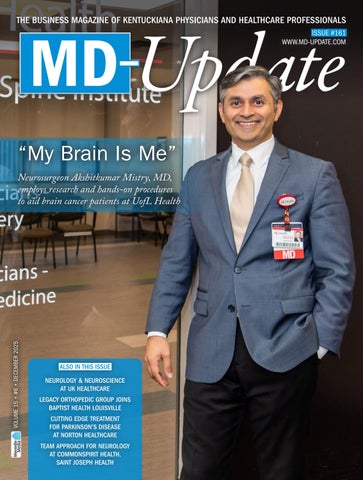
THE BUSINESS MAGAZINE OF KENTUCKIANA PHYSICIANS AND HEALTHCARE PROFESSIONALS ISSUE #161 WWW.MD-UPDATE.COM
“My Brain Is Me”
VOLUME 15 • #6 • December 2025
Neurosurgeon Akshitkumar Mistry, MD, employs research and hands-on procedures to aid brain cancer patients at UofL Health
ALSO IN THIS ISSUE NEUROLOGY & NEUROSCIENCE AT UK HEALTHCARE LEGACY ORTHOPEDIC GROUP JOINS BAPTIST HEALTH LOUISVILLE CUTTING EDGE TREATMENT FOR PARKINSON’S DISEASE AT NORTON HEALTHCARE TEAM APPROACH FOR NEUROLOGY AT COMMONSPIRIT HEALTH, SAINT JOSEPH HEALTH
THE BUSINESS MAGAZINE OF KENTUCKIANA PHYSICIANS AND HEALTHCARE PROFESSIONALS
2026 Editorial Calendar Editorial topics and dates are subject to change
ISSUE #162 (February) HEART & LUNG HEALTH Cardiology, Cardiothoracic Medicine, Cardiovascular Medicine, Pulmonology, Sleep Medicine, Vascular Medicine, Bariatric Surgery
ISSUE #163 (April) INTERNAL & EXTERNAL SYSTEMS Bariatric/General Surgery, Dermatology, Endocrinology, Gastroenterology, Geriatric Medicine, Internal Medicine, Infectious Disease Medicine, Lifestyle Medicine, Nephrology, Urology
ISSUE #164 (June) WOMEN & CHILDREN’S HEALTH OB-GYN, Women’s Cardiology, Oncology, Urology, Pediatrics, Radiology
ISSUE #165 (September) MUSCULOSKELETAL HEALTH Orthopedics, Physical Medicine & Rehabilitation, Sports Medicine, PT/OT
ISSUE #166 (October) CANCER CARE Hematology, Oncology, Plastic Surgery, Radiology, Radiation
ISSUE #167 (December) IT’S ALL IN YOUR HEAD ENT, Mental Health, Neurology, Neuroscience, Ophthalmology, Pain Medicine, Psychiatry
To participate, please contact
Gil Dunn, Publisher GDUNN@MD-UPDATE.COM 859.309.0720 (direct) • 859.608.8454 (cell) Send press releases to gdunn@md-update.com
LETTER FROM THE EDITOR/PUBLISHER
Welcome to the “It’s All in Your Head!” issue of MD-Update! KENTUCKY RANKS HIGH nationally in brain cancer tumors, probably because Kentucky has a high
rate of other forms of cancers and those often metastasize to the brain. Our cover story profiles Dr. Akshitkumar Mistry, neurosurgeon at UofL Health, who sheds light on the topic along with his passion for research, teaching, some unique instances of neurosurgery, and the value of the clinical trials that his patients participate in. It begins on page 12. I believe you will enjoy getting to know Dr. Mistry and his story; I did. I also invite you to read our story on Dr. Larry Goldstein, chair of Neurology Department at UK HealthCare and co-director for the Kentucky Neuroscience Institute. He’s a busy man whose department is focused on treating all types of neurological conditions in Kentucky. Our story on Dr. Nicole Everman talks about her expansive neurology practice including multiple sclerosis at Saint Joseph Health. Our story on Drs. Justin Phillips and Jason Crowley at Norton Healthcare talks about a new subcutaneous pump for administering treatment for controlling movement disorders.
CATCH 22 - Yossarian Lives! I’m re-reading Catch 22, the classic American novel from 1962. I found it at the free library at my YMCA. It practically jumped off the shelf to me. It’s still hilarious. If you’re familiar with the story, you know that it is as relevant today as when it was written. If you haven’t read it, you’re missing out. I asked a 30-year-old friend if he knew what the phrase “Catch 22” meant. He said, “It’s kind of an inconvenience, right…?” I replied, “It’s a lot more than an inconvenience. It’s an irreconcilable dilemma, where two positions are in direct contradiction with each other, and both are more, or less, valid. No matter which one you choose, you’ve got a problem. There’s no good answer or choice.” Catch 22 explores and exposes absurdity, hypocrisy, self-delusion, and self-justification. Does that sound familiar? What’s your Catch 22?
Golf Pictures and Other Events The Lexington Clinic Foundation’s Golf Tournament was back in the warmer, sunnier days of October, and we promised to share the photos. They remind me that we’ve passed the winter solstice and that longer, brighter days are coming our way. I hope we got all the names correct in the captions. If not, I’m sorry about that. I tried my best. Other events we covered include a Bourbon Barrel Tasting hosted by P&C Labs, a symposium on international mission work presented by the Lexington Medical Society, and the UofL Depression Center’s annual conference. The 2026 MD-Update editorial calendar is on the preceding page. When you see your specialty and you have a story to tell, contact me. If your specialty isn’t included, that’s another reason to reach out to me. I’m looking forward to hearing from you. Until next time, all the best,
Gil Dunn Editor/Publisher MD-Update
2 MD-UPDATE
SEND YOUR LETTERS TO THE EDITOR TO: Gil Dunn, Publisher gdunn@md-update.com, or 859.309.0720 phone and fax
MD-UPDATE MD-Update.com Volume 15, Number 6
ISSUE #161
EDITOR/PUBLISHER
Gil Dunn gdunn@md-update.com GRAPHIC DESIGN
Laura Doolittle, Provations Group COPY EDITOR
Amanda DeBord
CONTRIBUTORS:
Jan Anderson, PSYD, LPCC Madeleine B. Loeffler, JD Cory Meadows Scott Neal, CPA, CFP Emily Schott, KMA
CONTACT US: ADVERTISING AND INTEGRATED PHYSICIAN MARKETING:
Gil Dunn gdunn@md-update.com
Mentelle Media, LLC
38 Mentelle Park Lexington KY 40502 (859) 309-0720 phone and fax Standard class mail paid in Lebanon Junction, Ky. Postmaster: Please send notices on Form 3579 to 38 Mentelle Park Lexington KY 40502 MD-Update is peer reviewed for accuracy. However, we cannot warrant the facts supplied nor be held responsible for the opinions expressed in our published materials. Copyright 2025 Mentelle Media, LLC. All rights reserved. No part of this publication may be reproduced, stored, or transmitted in any form or by any means-electronic, photocopying, recording or otherwise-without the prior written permission of the publisher. Please contact Mentelle Media for rates to: purchase hardcopies of our articles to distribute to your colleagues or customers: to purchase digital reprints of our articles to host on your company or team websites and/or newsletter. Thank you. Individual copies of MD-Update are available for $9.95.
ISSUE #161
CONTENTS 4
HEADLINES
8
LEGAL
10
FINANCE
12 “My Brain Is Me” Neurosurgeon Akshitkumar Mistry, MD, employs research and hands-on procedures to aid brain cancer patients at UofL Health
COVER PHOTOGRAPHY BY ALEXANDRA ROGERS
SPECIAL SECTION 20
NEUROSCIENCE
22
NEUROLOGY
28 MENTAL WELLNESS 30
NEWS
32
EVENTS
20 NEUROSCIENCE
22 NEUROLOGY
24 NEUROLOGY
24 NEUROLOGY
ISSUE #161 3
Headlines
Baptist Health Medical Group Expands Orthopedic Services Louisville Orthopaedic Clinic joins Baptist Health
LOUISVILLE Baptist Health Medical Group
has acquired Louisville Orthopaedic Clinic, adding more than two dozen providers who focus on all facets of orthopedic care. This is one of the largest acquisitions for the Baptist Health Medical Group and became official November 1, 2025. The newly formed Baptist Health Louisville Orthopedic Clinic—along with Baptist Health Pain & Spine and Baptist Health Physical Therapy—offers a full range of services, from patient consultations for orthopedic conditions to helping individuals stay active, recover from injuries or chronic conditions, and manage pain. The expanded orthopedic specialty group
will treat patients across Baptist Health’s service areas with the goal of overcoming their orthopedic injuries or conditions from start to finish—all under one umbrella. “This expansion brings together some of the region’s most experienced orthopedic specialists under one coordinated system,” said Jonathan Velez, MD, president of Baptist Health Louisville. “Patients will benefit from a seamless experience supported by the full resources of Baptist Health.” Baptist Health Louisville Orthopedic Clinic & Baptist Health Pain & Spine currently operate at two locations: 4130 Dutchmans Lane in Louisville, which includes multiple suites for
patient care, orthopedic, pain management, neurosurgery, imaging, physical therapy, and occupational therapy services, and 1425 State Street in New Albany, which houses orthopedic, pain management, neurosurgery, and physical and occupational therapy services. “Integrating Louisville Orthopedic Clinic into Baptist Health Medical Group strengthens our ability to deliver comprehensive care across the region,” said Shelley Shaughnessy, chief operating officer of Baptist Health Medical Group. “We’re proud to welcome this talented team and align their expertise with our mission to provide exceptional, connected care.”
FRONT ROW: Nicholas Foeger, MD, Michael Doyle, MD, Ty Richardson, MD, Robert Goodin, MD. SECOND ROW: Katie Harrell, APRN, Amanda Maum, APRN, Rebecca Kostyo, APRN, Melissa Parshall, PA-C, Carly Bell, PA-C, Lori Edmonds, APRN, Kate Hamilton, PA-C, Dawn Michels, DPN, Remy Lamphere, PA-C, Amanda Allison, APRN. THIRD ROW: Aaron Compton, MD, John Lewis, Jr, MD, Kondra Kijewski, MD, J. Bryce Fitzgerald, AGACNP, Jordan Tinnell, PA-C, Ryan Eads, MD. BACK ROW: Travis Parkulo, MD, Richard “Alex” Sweet, II, MD, Chris Pircher, MSN, APRN, NP-C. 4 MD-UPDATE
PHOTO BY JESSICA EBELHAR
Headlines
Current patients of Louisville Orthopaedic Clinic will continue to see their physicians, but now those patients have access to the expanded resources and technology of Baptist Health’s network of hospitals, surgery centers, and physical therapy facilities.
Embracing the Future and Growth In an interview with MD-Update, Scott Kuiper, MD, president of Louisville Orthopaedic and senior member of the medical group, stated that “Louisville Orthopaedic Clinic was an independent practice for 51 years, and by becoming part of Baptist Health, we gained the ability to grow and expand our orthopedic service lines further, so we can continue the highest level of care and innovation for our patients.” Kuiper continued, “Every practice needs to grow, and in the current landscape within orthopedics, we can grow more effectively with a system, which means bringing additional specialists into our practice. We'd like to continue expanding some of our service lines, like foot and ankle and spine and some other areas, and to bring in those new physicians and providers. If we work with a system, we can do that more effectively.” Kuiper said that Louisville Orthopaedic has been exploring the market over the past two years, looking at all options, and Baptist was the clear best option for their practice. “Baptist Health is a well-respected, established healthcare system that wants to continue to grow with us. So, we felt a real partnership with them, and we feel that was going to be the best solution, to allow us to accomplish the long-term goals that we want to accomplish,” said Kuiper. Louisville Orthopaedic Clinic is home to twelve physicians and thirteen advance practitioners. The physicians include Scott Kuiper, MD, Ty Richardson, MD, Robert Goodin, MD, John S. Lewis Jr, MD, Aaron Compton MD, Richard Alex Sweet II, MD, Nicholas Foeger, MD, PhD, Michael Doyle, MD, Konrad Kijewski, MD, Ryad Eads, MD, Travis Parkula, MD, and Dawn Michels, DPM. “The Clinic’s established physician team will remain in place, providing continuity of care while gaining access to Baptist Health’s broader network and technology,” said Isaac J. Myers II, MD, Chief Health Integration Officer of Baptist Health and President of Baptist Health Medical Group. “It’s the same expert care—enhanced with greater access to imaging, surgery, and rehabilitation resources all under one roof.” “There's no immediate plans for anybody to exit, absolutely not. I can confirm that, and I'm the senior member,” said Kuiper. “We have really exciting projects that we are going to be working on with Baptist, like expanding sites of service and surgical centers. We're going to be rolling up our sleeves and working on things. We want to create a robust sports medicine coverage program that would be exciting to work on as we move forward over the next number of years.” “We're in the game excited. I love what I do. I love caring for patients. It's a joy, and God willing, if I'm healthy, we're going to keep working,” said Kuiper. Baptist Health Medical Group has grown rapidly over the years, now encompassing more than 1,800 providers offering care in 78 specialties. ISSUE #161 5
Headlines
Preparing for a Defining Legislative Session What Kentucky physicians need to know before the 2026 General Assembly
BY CORY MEADOWS AND EMILY SCHOTT, KENTUCKY MEDICAL ASSOCIATION FRANKFORT As Kentucky physicians pre-
pare for the new year, elected officials are gearing up for another legislative session in Frankfort—and so is the Kentucky Medical Association (KMA). The General Assembly will convene on January 6, and healthcare will once again dominate the agenda. The KMA has been actively engaging with lawmakers, state agencies, and healthcare partners to ensure the physician perspective is front and center.
Expected Issues in 2026 Reducing administrative hurdles—especially prior authorization—remains a top priority for physicians. Delays, denials, and excessive documentation continue to interfere with timely patient care, often forcing patients to wait for medically necessary treatments or procedures. KMA has spent several years working to increase transparency, streamline requirements, and to reduce the number of prior authorizations required. Those efforts will continue as KMA advocates for reforms that return physicians’ time and attention to where it belongs: caring for patients. Public health will also be in the spotlight. KMA will continue promoting initiatives that ensure major health decisions are guided by sound science, clinical expertise, and data-driven policy. These efforts help Kentuckians stay healthy and reduce longterm healthcare costs. With public health challenges constantly evolving, Kentucky must remain prepared with policies that protect community well-being and promote healthier lifestyles. Physician wellness is another core concern. A strong healthcare system depends on a strong workforce, and today’s physicians face unprecedented demands that affect their mental and physical well-being. KMA will remain a strong voice for programs and policies 6 MD-UPDATE
KFMC President Shawn Jones, MD, testified before the Make American Healthy Again Kentucky Task Force
that create healthier practice environments, reduce unnecessary stressors, and support the well-being of those who care for others. Ensuring physicians can receive help without stigma is essential to sustaining access and quality across the Commonwealth. Scope of practice will again be a key area of debate, driven by continued efforts to expand the autonomy of non-physician providers. KMA values the contributions of all members of the care team. However, physicians’ extensive education and clinical training uniquely prepare them to lead diagnosis and treatment, especially for patients with complex medical needs. Any changes must include clear guardrails that preserve physician-led oversight, maintain accountability, and ensure expanding access never comes at the cost of quality or patient safety.
Small STEPS, Big Impact KMA is proud of one of the most visible examples of physician leadership: its Small STEPS, Big Impact campaign. This two-year initiative, in partnership with the Kentucky Foundation for Medical Care (KFMC), encourages Kentuckians to make small, meaningful lifestyle changes that can add up to a big improvement in their overall health. The program focuses on five key areas—Screenings, Tobacco use, Exercise and Nutrition, Physician visits, and Stress—and has already reached millions of Kentuckians. In November, KFMC President Shawn Jones, PHOTO PROVIDED BY KMA
MD, testified before the Make American Healthy Again (MAHA) Kentucky Task Force on the success of the campaign so far. Efforts like Small STEPS, Big Impact improve the health of our communities and reinforce the essential role of physicians as trusted leaders in care. The 2026 legislative session will present challenges and opportunities. It will require a coordinated advocacy strategy and active engagement from physicians across specialties. KMA stands ready to lead that effort. As the debates unfold, one thing is clear: when physicians speak with a unified voice, the Commonwealth is better served. And with the leadership of thousands of KMA members, Kentucky’s patients will continue to receive the highest standard of care, no matter what changes lie ahead.
Legal
How Privileged Is “Physician/Patient” Privilege? BY MADELEINE B. LOEFFLER, JD
ONE OF THE most critical aspects of the physi-
cian/patient relationship is the understanding that the patient’s health information will not be disclosed outside the scope of that relationship. The notion that a patient’s medical information will be protected from disclosure is the hallmark of HIPAA—referred to as “Protected Health Information.” If patients wish to have their treatment information disseminated to a third party, the patient must sign an authorization agreeing to that disclosure. But, despite this notion of protection, is there actually a legally protected physician/ patient privilege? The answer, perhaps counterintuitively, is no. There is no general physician/patient privilege in Kentucky’s statutory law or the Kentucky Rules of Evidence. In other words, no testimonial privilege exists in Kentucky for communications made between a patient and physician for the purposes of medical treatment. [See Caldwell v. Chauvin, 464 S.W.3d 139, 155 (Ky. 2015).] 8 MD-UPDATE
This does not mean that information shared by a patient can be readily shared; physicians can be disciplined by the Kentucky Board of Medical Licensure for willfully violating a confidential communication. [KRS 311.595(16).]
Lack of Privilege in a Lawsuit Context The practical consequences of this lack of physician/patient privilege are highlighted in the context of a lawsuit. For instance, in a lawsuit filed by a plaintiff for medical malpractice, the plaintiff is directly placing his or her physical health at issue. Accordingly, attorneys are permitted to request and obtain copies of medical records for purposes of reviewing and analyzing a plaintiff ’s prior health history, as well as the relevant treatment at issue in the lawsuit. A court order is not required to obtain general medical records. Likewise, Kentucky Courts generally permit the use of ex parte communications between attorneys and the treating providers of a plaintiff. This means that, with express
permission from a Kentucky Court, attorneys may request to speak with a physician who has treated the plaintiff. It is important to note that these ex parte orders do not require you to speak to the requesting attorney. Further, it is often the case that treating providers, particularly those whose treatment is relevant to the issue in the lawsuit, can be and often are identified as treating expert witnesses. Expert witnesses are subject to depositions and may be asked to testify at trial about their treatment of a patient. In these instances, physicians cannot claim “privilege” over conversations with a patient, as no such privilege exists.
Exception – The Psychotherapist/ Patient Privilege Despite the lack of physician/patient privilege, Kentucky does recognize a psychotherapist/patient privilege. Kentucky Rule of Evidence 507 recognizes this privilege and protects communications made between a patient and his or her “psychotherapist” for the purpose or treatment of a mental con-
Legal
dition. Under KRE 507, the definition of “psychotherapist” includes licensed physicians engaged in the diagnosis or treatment of a mental condition, psychologists, licensed clinical social workers, or registered nurses or advanced practice registered nurse practitioners who practice psychiatric or mental health nursing. The reason for the existence of a psychotherapist/patient privilege as opposed to a physician/patient privilege historically goes to the need for candor, confidence, and trust between psychotherapist and patient. Where physical medicine may be successful with a physical exam or other objectively supplied information, “effective psychotherapy, by contrast, depends upon an atmosphere of confidence and trust in which the patient is willing to make frank and complete disclosure of facts, emotions, memories, and fears…” Jaffee v. Redmond, 518 U.S. 1, 10 (1996). Accordingly, accessing mental health records of a plaintiff in a medical malpractice
case is often more difficult than accessing general medical records, as a showing must be made that an exception to the psychotherapist/patient privilege is met for dissemination of those records. One such exception is “if the patient is asserting that patient’s mental condition as an element of a claim or defense.” KRE 507(c)(3). This again becomes relevant in the context of a medical malpractice lawsuit. In the context of medical malpractice litigation, the Supreme Court of Kentucky has ruled that when a plaintiff puts his or her mental condition at issue or makes a claim for mental anguish, that effectively amounts to a waiver of the psychotherapist/patient privilege. [See Dudley v. Stevens, 338 S.W.3d 774, 777 (Ky. 2011).] The reasoning behind this holding is that it would be fundamentally unfair to permit a plaintiff to rely upon his or her mental health records to prove a claim of mental anguish while simultaneously denying the opposing party the opportunity to review those same records. Id.
Be Aware of Privilege Law In sum, Kentucky law varies substantially in its rules about privileges for medical providers. As discussed, physicians (other than those engaged in the practice of mental health) do not enjoy a testimonial privilege in communications with their patients for the purpose of providing medical treatment. On the other hand, mental health professionals, or “psychotherapists” as they are recognized under the Kentucky Rules of Evidence, enjoy a robust privilege. Regardless of privilege status, you should always be aware that what you document about a patient may not necessarily be kept between you and the patient, but between you, the patient, several attorneys, and a jury. Maddie Loeffler is a medical negligence defense and healthcare law attorney with Sturgill, Turner, Barker & Moloney, PLLC. She can be reached at mloeffler@sturgillturner.com or 859.255.8581.
AT T O R N E Y S KENTUCKY | T E NNE SSE E
YOU CARE FOR EVERYONE♦ WE TAKE CARE OF YOU♦ From the business of health care to compliance to litigation defense, Sturgill Turner’s experienced health care and medical negligence defense attorneys provide comprehensive legal services to health care providers, hospitals and managed care organizations across the Commonwealth.
Put our experience to work for you. Sturgill, Turner, Barker & Moloney, PLLC ♦ Lexington, Ky. ♦ 859.255.8581 ♦ www.SturgillTurner.com ISSUE #161 9
Finance
Tax Planning Under the OBBA To do in 2025 and 2026
BY D. SCOTT NEAL, CPA, CFP®, CEPA THE ONE BIG Beautiful Bill Act (OBBBA),
passed in 2025, is one of the most wide-ranging tax laws in years. For relatively high earners, the law creates planning opportunities, introduces new limits, and changes the value of certain deductions you may be used to taking. Perhaps most importantly, the tax changes do not all take effect at the same time. Some begin in 2025, while several bigger shifts start on January 1, 2026. That opens the opportunity to save but you need to plan ahead for the full effect.
What Changes in 2025 The 2025 tax year is the first full year affected by the OBBBA, and a few important updates start immediately.
payers. However, there is a catch: high-income households see a phaseout of this benefit based on modified adjusted gross income. Planning move: Estimate your 2025 property taxes and state income taxes to see how much of the higher cap you can actually use. If you are near a phaseout threshold, adjusting income timing—such as deferring bonuses— might preserve some of the SALT benefit.
Starting in 2025, taxpayers age 65 or older may claim a new $6,000 deduction, subject to income phaseouts that many high-income households should review carefully. Planning move: If you or your spouse is 65 or older, incorporate this deduction into your estimated tax payments for 2025.
OBBBA permanently raises the standard deduction beginning in 2025. Although many high-income taxpayers itemize, the larger standard deduction is now big enough that it’s worth comparing the two options instead of assuming itemizing is best. In some cases, especially for married filers with relatively modest deductible expenses, the standard deduction may simplify things and lower your tax bill. Planning move: Run a 2025 projection comparing itemizing versus taking the standard deduction. With 2026 bringing limits on how valuable itemized deductions can be for those in the top bracket, it’s smart to understand your baseline now.
Charitable Giving: Consider Front-Loading in 2025
Much Higher 2025 SALT Cap (With Phaseouts)
While the estate tax exemption doesn’t increase until 2026, 2025 is the year to plan. The exemption will jump to $15 million per person, giving wealthy households more room to transfer assets tax-free. Planning move: Use 2025 to update trusts,
10 MD-UPDATE
Check Your AMT Exposure Alternative Minimum Tax rules remain taxpayer-friendly in 2025 but grow tougher in 2026. Knowing ahead of time whether you’re approaching AMT territory can help you manage timing of capital gains, deductions, and business income.
New Senior Deduction (If You’re 65+)
Higher Standard Deduction (Now Permanent)
State and local taxes (SALT) have been a major pain point since the $10,000 limit went into effect years ago. For 2025, OBBBA boosts that cap to $40,000, which can offer meaningful relief to homeowners and high-income tax-
gifting plans, and coordinated strategies among family members.
Because OBBBA changes how itemized deductions work in 2026 (especially for top-bracket taxpayers), some households may get more value from contributions made in 2025 than in later years. Planning move: If you make large charitable gifts, talk to your advisor about “bunching” charitable contributions into 2025. It might be to your benefit to setup a DonorAdvised Fund this year and get it funded. This may help you maximize the deduction before 2026’s new limits reduce its impact.
Get Ready for Bigger Estate and Gift Changes in 2026
Prepare for 199A Deduction Expansion (Starts in 2026) If you own a pass-through business (like an LLC or S-Corp) or receive qualified business income, note that the deduction increases from 20% to 23% in 2026. Planning move: Use 2025 to model how your business income should be structured— salary distributions, guaranteed payments, or capital allocations—so you’re positioned to capture the expanded deduction.
What Changes in 2026 The biggest transformation arrives in 2026. These shifts can reduce the long-term value of deductions, change the rules around business income, and reshape charitable giving strategies.
Estate and Gift Tax Exemption Increases Sharply Beginning January 1, 2026, the lifetime exemption for estate and gift taxes rises to $15 million per person, indexed for inflation. This allows high-net-worth taxpayers to transfer larger pools of wealth during their lifetimes or at death without incurring federal estate tax. Planning move: If you’ve been waiting for a favorable estate-planning window, 2026 anticipates significant changes. Consider large lifetime gifts, spousal trusts, or family wealth transfer structures.
Finance
New Caps on Itemized Deductions for High-Income Taxpayers Starting in 2026, taxpayers in the top tax bracket face a new limit: itemized deductions can reduce tax only down to the equivalent of the 35% bracket. This means high-income filers may not get full value from certain deductions they’re used to. Additionally: • Charitable contributions only count above 0.5% of AGI. • The 60% of AGI limit on charitable cash gifts becomes permanent. Planning move: Re-evaluate your itemizing strategy. Some deductions, even sizable ones, may have less impact in 2026.
definition of qualifying income expands, and the income thresholds at which limits kick in are raised. This helps some high-income passthrough business owners capture more of the deduction. Planning move: If you have business income, review your compensation structure to optimize your deduction for 2026 and beyond.
Mortgage Insurance Premiums Become Deductible Beginning in 2026, mortgage insurance premiums count as qualified residence interest. For high-income households with large mortgages or recent refinances, this may slightly shift the balance between itemizing and taking the standard deduction.
New Above-the-Line Charitable Deduction For tax years starting in 2026, even taxpayers who do not itemize may deduct up to: • $1,000 if single • $2,000 if married filing jointly This does not replace larger charitable strategies, but it offers a modest benefit to households using the standard deduction.
QSBS (Qualified Small Business Stock) Becomes More Attractive
199A Deduction Becomes More Generous
AMT Thresholds Shrink
In addition to the increase to 23%, the
For stock issued after July 4, 2025, the capital-gains exclusion rises to $15 million and the required holding period shortens to three years. Investing in startups can lead to potential opportunities in your portfolio.
2026’s AMT rules hit high-income house-
holds more easily. If you have substantial deductions or capital gains, AMT planning becomes more important.
Putting It All Together The takeaway: 2025 is a year for positioning, while 2026 is a year for applying the new rules. For high-income households, timing really matters. Strategic decisions about charitable giving, deductions, business income, estate planning, and mortgage structure can significantly change your tax outcome over the next two years. Working with a CPA or advisor to model 2025 and 2026 side-by-side is one of the smartest moves you can make. Scott Neal of Lexington, KY is a Senior Wealth Advisor of Mercer Advisors, a Denver-based financial advisory firm. He can be reached by calling 1-800-344-9098. Any opinions expressed by the author are his own and not necessarily those of Mercer Advisors. The information is believed to be accurate but is not guaranteed or warranted by Mercer Advisors. The content provided should not be construed as personalized financial advice. Readers are cautioned not to place undue reliance on forward-looking statements as actual results will vary. Mercer Global Advisors Inc. is registered with the Securities and Exchange Commission.
Your Source for Graphic Design since 2003
www.provationsgroup.com GRAPHIC DESIGN • INTERACTIVE PUBLICATIONS • PROJECT MANAGEMENT and more... ISSUE #161 11
Cover Story
“My Brain Is Me”
Akshitkumar Mistry, MD, employs research and hands-on procedures to aid brain cancer patients at UofL Health BY JIM KELSEY
Figure 1. Central Nervous System Cancer Burden Across US States, 2021
LOUISVILLE When someone hears the words
“You might have a brain tumor,” their life changes in an instant. Decisions must be quick, treatments precise, and outcomes—good or bad—often arrive faster than anyone would like. For Akshitkumar Mistry, MD, a neurosurgeon at UofL Health, that urgency is exactly what drew him to this work. “There are no known causes for most brain cancers,” Mistry says. “I see people who haven’t engaged in the lifestyle habits that we normally link to cancer. They didn’t smoke, they ate well, they avoided drugs, sun damage, and known carcinogens, and they often have no family history. Yet, they still find themselves suffering from one of the most serious and grave cancers. Most people don’t realize that Kentucky has one of the highest brain tumor rates in the country.” “I am a person who responds to instant gratification. If I were to, for example, transplant a liver into a patient who needs it, it may take months for me to know if my patient is feeling better. I don’t like that,” Mistry says. “But, if I manipulate the nervous system, I know instantly if I am helping or hurting my patient. That immediate feedback is very appealing to me.”
A Calling Built on Fast Decisions and Instant Feedback Many doctors wait weeks to months to see whether a treatment helped. Neurosurgeons often get answers in seconds to days. The instant nature of the nervous tissue, the nervous system, the brain, the spinal cord, and the nerves appealed to Mistry and led him to pursue a career in neurosurgery. This appeal came early for him. His parents were blue-collar workers who experienced periods of unemployment when factories or businesses closed or laid off workers. Mistry wanted a degree that would offer him flexibility and the ability to find employment quickly. 12 MD-UPDATE
https://jamanetwork.com/journals/ jamaneurology/fullarticle/2841027 (Citation: Global Burden of Disease 2021 US CNS Cancer Collaborators, JAMA Neurology, Nov 2025.)
“I wanted to obtain an education that would allow me to find jobs easily and quickly. A medical degree seemed very versatile and would make me employable,” he says. Born in India and raised in Zambia, Mistry moved with his family to rural southwest Virginia as a teenager. He volunteered everywhere—hospitals, clinics, even the morgue. He liked the medical environment, even when it didn’t like him. He’s a neurosurgeon today, but back when he stepped in to his first operating room visit, he fainted! “I also threw up,” he admits, laughing. That didn’t stop him from graduating from the University of Virginia and earning his medical degree at Vanderbilt University’s School of Medicine in 2013. He completed his neurological surgery residency at Vanderbilt University Medical Center and performed a brain tumor research fellowship at Vanderbilt. Upon completing his fellowship, Mistry joined UofL Health and University of PHOTOS BY GIL DUNN
Louisville as an assistant professor in the Department of Neurological Surgery—drawn by its academic mission. “I’m truly happiest in academia—teaching, researching tumor and treatments, and helping patients who need surgery,” Mistry says of his decision to come to UofL Health. The move also reunited him with Joseph Neimat, MD, chair of the Department of Neurological Surgery at the University of Louisville School of Medicine, who had been his training mentor during his neurosurgical training at Vanderbilt.
Surgery to Protect Humanity, Not Just the Brain “There are a few things that make our brain tumor program special,” Mistry says. Mistry gives the example of operating on patients who are fully awake during surgery. This allows Mistry to test the different functions of the patient. He recalls a patient who wanted to be able to keep reading sheet music.
Dr. Mistry uses a precision drill to create a tiny opening in the skull, through which he will pass a needle with pinpoint accuracy toward a deep-seated tumor, using advanced navigation to safely obtain a biopsy.
ISSUE #161 13
Cover Story
Dr. Mistry collects a tiny biopsy sample from a precisely guided needle placed deep within the brain, using careful technique to ensure accuracy and safety. 14 MD-UPDATE
To ensure that the surgery did not interfere with this ability, the surgical team provided music sheets for the patient to read during the procedure to remove the tumor. “It was successful,” says Mistry. “The patient read sheets of music while we removed his brain tumor.” “One family feared that brain tumor surgery might take something essential from their loved one—his wit, his personality, his spark. So during the awake surgery, he cracked fresh jokes and fired playful digs at every one of his family members—and there were many—as I removed his brain tumor. After the surgery, as I relayed the jokes and jabs to the family one by one, they laughed with happy tears. Each jab at them convinced them that despite the brain surgery, their old wisecracker was still very much the rascal they loved.” Most of Mistry’s patients are between the ages of 55 and 75 with no strong bias toward male or female. His patients present with headaches, seizures, weakness on one side or the other, difficulty speaking, discoordination, and imbalance. “These symptoms are acute,” Mistry says. “Most often, they come to the emergency room because they think they are having a stroke or a seizure. The majority of my patients come because of an acute problem.” For those patients who are diagnosed with a malignant brain cancer, it is an acute problem with a likely tragic outcome. For Mistry, the challenge is to comfort them while being open and honest about their condition. “They are seeing me at a time of vulnerability. They are scared, and they have been told that they may have a brain tumor,” Mistry says. “One of the first things I do is try to make the moment as calm, controlled, and clear for them as possible. I show them their brain and where the lesion is and what is and is not concerning.” Mistry outlines the patient’s options, which range from doing nothing to nonsurgical methods of testing such as blood tests, brain fluid analysis, and secondary imaging. Other options are to biopsy the brain or to perform surgery in an attempt to remove as much of the tumor as possible. “We talk through the risks and benefits of everything,” Mistry says. “They deserve the truth, even if it’s hard.” He also discusses the
Cover Story
possibility of participating in research and clinical trials. “The patients have the choice of participating in research, which can be empowering,” Mistry says. “They can donate their time or brain tumor for research. With this act of courage and generosity, my patients become partners in the mission to understand brain cancer, find therapy, and advocate. They feel empowered knowing they at least helped others. Even in the last months of their lives, they often continue to participate in research. You know, survival stories are powerful, but what often goes untold are the stories of patients who pass away, leaving gifts—in form of their time, brain tumor tissue, and reports on how they did—in the most difficult time of their lives—gifts that quietly advance medicine.” Mistry says that 90 percent of his patients participate in the research which he and his team conduct. Many also participate in clinical trials testing new drugs, new types of radiation, or new surgical approaches as part of the Cancer Trials Program at UofL Health—Brown Cancer Center. “Most of the patients are looking to see if they are eligible for a new cutting-edge treatment,” Mistry says.
“I’m truly happiest in academia—teaching, researching tumor and treatments, and helping patients who need surgery.,” — Akshitkumar Mistry, MD, neurosurgeon at UofL Health
Research and Teaching The research is essential because little progress has been made in the treatment of malignant brain cancers. The majority of Mistry’s patients have cancers in other parts of the body that spread to the brain. The second most common group of patients he sees—about 30 to 40 percent—has glioblastoma, which is the most common malignant brain cancer. “For most cancers, there have been great scientific advances that have translated to people living longer,” Mistry says. “But for glioblastoma, there hasn’t been anything groundbreaking since radiation for 50+ years. Yes, there is chemotherapy and something called tumor-treating fields, but studies show they improve survival by weeks or a few months on average. Glioblastoma is a cancer that has been sort of left behind. It is very similar to pancreatic cancer in that it doesn’t have many great treatment options that meaningfully extend survival beyond six months on average.
That’s why surgery remains essential—and, in my opinion, the most impactful therapy we have.” While Mistry has a passion for research and a desire to find better treatment options and cures, he is also passionate about his teaching and preparing the next wave of providers to maintain the balance between treatment and research. “We are in the screen era,” he says. “When smartphones and tablets compete with the human touch, holding on to genuine humanity is more important than ever in medicine. That’s the first lesson I try to teach. The second is about research. The next generation should question everything and always ask where the evidence is for any treatment or decision.” Another aspect of that human connection with the patient is that robotic surgery is not frequently used for brain surgery, and Mistry does not expect that to change.
“I don’t think the robot or robotic-guided surgery gives you the fine millisecond dynamic adjustment the human hand is able to make in critical locations in critical time,” he says. “I don’t think a robot is going to be able to remove a brain tumor anytime soon. Robotic movements are not as complex as a human hand.” Robots are not as complex as human interaction, either. Mistry understands that he has a responsibility not only to treat his patients to the best of his ability but also to be with them as a supporter and source of comfort. “When somebody has a problem in their brain, it’s almost like they have a problem in the seat of their soul,” he says. “We tend to think of every other organ as something we have: ‘my stomach,’ ‘my arm.’ But we don’t talk about the brain that way. We don’t say, ‘my brain is moving my arm,’ because deep down we know that ‘My brain is actually me.’” ISSUE #161 15
Know A Good Doctor? We Do.
.com
YOUR RESOURCE FOR THE BEST IN KENTUCKY HEALTHCARE Now available online OVER 150,000 visits!
www.md-update.com
Alan R. Brain Tumor, 2000
Cancer
Free.
The Power of Expert Care At UofL Health – Brown Cancer Center, you’ll find inspiring stories like Alan’s, where being cancer-free is a reality thanks to our collaborative approach, early detection and pioneering treatments. Here, hope comes to life with our expert second opinions, advanced technology and personalized holistic care. We harness the power of academic research and groundbreaking clinical trials, only found here, to help survivors make more memories and keep living their stories. Now your patients can experience the power of world-class care, close to home at our three locations. Call 502-562-HOPE (4673) to refer your patient today.
To find Alan’s story THAT’S THE POWER OF U
and other survivor stories, visit UofLHealth.org/BCCStories.
The Area’s Most Preferred for Cancer Treatment — NRC HEALTH
Oncology Services are Expanding!
FUTURE MIDDLESBORO ARH CANCER CENTER
ARH has a team of providers who specialize in medical oncology, radiation oncology, and surgical oncology that work alongside a staff of highly qualified oncology nurses, social workers, pathologists, and radiologists. Collaboration is a vital part of our approach to excellent care. Our staff’s expertise, combined with advanced technology, and state of the art Oncology centers provide our patients with the highest quality care. To learn more about Oncology services at ARH visit arh.org/cancer-care.
Join our team • Great Base Pay with Signing Bonus • Starting Bonus • Student Loan and Relocation Assistance • Collegial Work Environment • Integrated Physician Lead Network • Work Life Balance To learn more about open Oncologist positions at ARH go to arhphysiciancareers.com
SPECIAL SECTION
Neuroscience
Getting Out of the “Stroke Belt” Larry B. Goldstein, MD, wears many hats as he works to expand neurologic care in Kentucky.
centers have their academic homes in neurology. KNI closely integrates faculty from neurology and neurosurgery for specific neurological conditions. Examples include stroke, medically refractory epilepsy, and movement disorders. “What we’re trying to do is focus on the problems, focus on the patients, focus on the research areas, and focus on the educational programs,” he says.
BY SHELLEY ROBERTS BENDALL LEXINGTON Kentucky is among the southeast-
ern states known as the “Stroke Belt,” a section of the country that sees the highest numbers of stroke-related deaths in the country. Larry Goldstein, MD, chair of the University of Kentucky’s Department of Neurology, is trying to change that. In addition to his faculty duties, Goldstein serves as co-director of the Kentucky Neuroscience Institute (KNI) and the UK Neuroscience Research Priority Area (NRPA), and is the co-chair of the Kentucky Heart Disease and Stroke Prevention Task Force, medical director for the UK-Norton Healthcare Stroke Care Network, and a member of the board of directors of the American Academy of Neurology. When Goldstein came to the University of Kentucky from Duke in 2015, people told him, “Oh, you’re from Duke. You know we don’t like Duke.” Luckily, in this case, Duke’s loss is UK’s gain.
It All Started with Goldfish Goldstein’s interest in neuroscience began in a high school AP biology class where an article in Scientific American about memory in goldfish piqued his interest. To further explore the subject, he converted an old storage room into a lab, installed 50 tanks filled with goldfish, and designed an experiment to test their memory. The experience stayed with Goldstein. “It informs a lot of the things that we do now at UK because I really believe that starting and planting seeds early sets people on tracks, sometimes for the rest of their lives.” Goldstein grew up on Long Island, New York, before attending Mt. Sinai School of Medicine in New York City where he also completed a neurology residency followed by a stroke research fellowship at Duke, where he then joined the faculty and eventually became the stroke center director. 20 MD-UPDATE
Disease Is Complicated in Kentucky
Larry B. Goldstein, MD, FAHA, FANA, FAAN
After 30 years at Duke, Goldstein began looking for opportunities to broaden his contributions. At the same time, UK was searching for a department chair in neurology. Goldstein wanted to build a unique program, one that didn’t currently exist in the country. Recognizing that UK had the resources and the will to build that program, he made the move to Lexington.
Multidisciplinary Approach Critical to Neurologic Care The mission of KNI is to “provide care for patients with complex neurological disorders so they don’t need to leave the Commonwealth of Kentucky for care.” Neurology is a very large, complex field. Goldstein has about 70 full-time faculty as well as close to 50 residents, 25 advanced practice providers, either physician assistants or advanced practice nurses, and 10 fellows. It’s very subspecialty divided. In addition to the College of Medicine, the University, and UK HealthCare, neurology faculty also collaborate with the Markey Cancer Center and the Sanders-Brown Center on Aging. Many of the faculty who work in those PHOTO BY GIL DUNN
For decades, Kentuckians have had multiple comorbidities including heart disease, diabetes, obesity, and cancer. Many hypotheses have been put forward to explain the causes, but no one reason explains the rates of chronic disease in the state. It’s probably partly environmental, but also based on diet, nutrition, lack of exercise, smoking, and limited access to healthcare. “Our social determinants of health in Kentucky are major drivers of pretty significant chronic diseases,” Goldstein says. There is reason for optimism, though. Goldstein points to a recent study from UK that compared counties in the state that have the highest morbidity rates from stroke against those that have the lowest. Accounting for social and lifestyle factors in those counties, the study found that patients living in counties with high stroke mortality rates who have access to high-quality stroke care have outcomes that are similar to those in low-mortality counties. Simply put, “Access to good healthcare makes a difference,” Goldstein says.
Leading the Way in Multidisciplinary Research Goldstein and his associates research topics focused on the core missions of KNI: clinical care, education, innovation, developing new knowledge, and service to the people of Kentucky. There are currently 52 trials at var-
SPECIAL SECTION
ious stages being conducted out of neurology alone. Clinical research is being carried out in stroke, epilepsy, headache medicine, multiple sclerosis, movement disorders, Alzheimer’s disease and other dementias, neuromuscular diseases, sleep, neuro-oncology, and neuro-imaging, among others. These trials benefit current patients too. Goldstein says, “It really allows us to bring new therapies or new potential therapies to patients and offer them the chance of participating in the studies that are trying to develop new knowledge and make a difference. Usually, those trials are in areas where we don’t know what the right thing to do is.” Neuroscience is one of the Research Priority Areas (RPA) at UK. Around 330 faculty from nine colleges and 42 departments are doing neuroscience-related research at the university. The Neuroscience RPA (NRPA) provides broad-based support for neuroscience research campus wide. One of the programs under the NRPA is the NeuroBank. This program collects blood, tissue, and cerebrospinal fluid, most of which were set to be discarded, from current patients. The samples are linked to the patient’s medical records, so if scientists are looking for material needed for a study, they can go to the NeuroBank first instead of having to start from scratch.
Expanding Healthcare across the State In order to spread high-quality healthcare to other parts of the state and region, UK, in conjunction with Norton Healthcare, set up a Stroke Care Network. Currently, 41 hospitals from Kentucky, southern Indiana, and western West Virginia are members of the network with the goal of optimizing stroke-related outcomes. This allows patients to stay in their home communities unless they require advanced services that aren’t available locally. Artificial intelligence (AI) provides another resource to promote community-based care. Another UK program uses software installed on the CT scanners in emergency departments to identify stroke patients who might benefit from physical removal of a blood clot closing a brain artery. Physicians at UK receive an alert on their smartphone if the AI detects a possible closed
brain artery. They then can contact the local hospitals and consult with the physicians treating that patient using the same software. If the patient might benefit from an advanced procedure not available locally, they can expedite the transfer of that patient to UK. Child neurology is another example of providing advanced care beyond UK’s Lexington campus. Robert Baumann, MD, from UK’s Department of Neurology, worked with the state (the Kentucky Office for Children with Special Healthcare Needs) to establish child neurology clinics in rural Kentucky. Faculty, residents, and students go to those locations on a rotating basis to provide care that would otherwise have required patients to travel to Lexington or Louisville, where all of the state’s child neurologists are based. It goes back to the university’s service mission, dating to its establishment as a landgrant institution in 1865, Goldstein says. “We’re doing all these things to improve the care and health of patients across the state by partnering with local hospitals, partnering with the state, and developing programs to get patients the care that they need, when they need it, and where they need it, but keeping as many in the state as we can.”
The Future of Neurology Neurological care is advancing rapidly and is becoming increasingly sub-specialized. Progress requires coordinated health care systems to be in place for the right patient and at the right time. For stroke, for example, Goldstein points to the use of statins and PCSK9 inhibitors to lower LDL levels below even 70 mg/dL as a recent research breakthrough. “It reduces the risk of stroke, cardiovascular disease, and other cardiovascular complications without any major complications or side effects. Combined with lifestyle interventions, blood pressure control and other new preventive therapies, and the use of clot-busting drugs and physical clot removal for those who have had a stroke, we have the opportunity to reduce the burden of stroke across the state. “It’s really pretty amazing,” he says. As Goldstein sees it, “the biggest challenge facing neurology at the moment is a workforce issue. There is a 25% gap between the demand
Neuroscience
for neurologic care and the supply of neurologists to provide that care. Combine that with all of these new, but very complicated therapies that are becoming available and that need providers with particular expertise to be able to use them and use them safely in the right patients.” When Goldstein arrived in 2015, neurology had 18 faculty members at UK. That’s now up to 70 with many more recruitments in process. Our educational programs are key. If we give medical students a good experience in neurology, many will want to dedicate their careers to our field. By attracting outstanding residents and fellows, many will want to stay in the state to provide care. His mantra is “Train and retain,” in support of the UK HealthCare and KNI missions: to be of service to the college, the university, the state, and the people who live here. Our strength is our ability to integrate our educational, research, clinical care, and service missions – the true advantage of having an academic medical center integrated into a university with a college of medicine. Patient volumes are also increasing under Goldstein’s watch. According to the 2024 KNI annual report, outpatient visits by fiscal year were: Child Neurology 2024: 7,701 2023: 5,793 2022: 5,224 2021: 4,645
Multiple Movement Sclerosis Epilepsy Disorders 1,637 6.353 4,596 1,171 6,025 4,411 1,495 5,613 4,174 1,392 5,448 3,982
For stroke patients in Kentucky in 2024, UK HealthCare performed 40% of all acute interventions with an average of 35 minutes in “Door-to-needle” time. The KNI was awarded the designation of Comprehensive Stroke Center by The Joint Commission, rated “High-Performing in Stroke” by U.S. News & World Report for 2024/2025, and Get with the Guidelines Gold Plus and Target Stroke Honor Roll Elite Plus by the American Heart Association.
In Conclusion And if you’re wondering if Goldstein’s alliance leans toward the Wildcats or the Blue Devils, he says, “Being a department chair and diplomatic, the answer is clearly, I root for the blue team.” ISSUE #161 21
SPECIAL SECTION
Neurology
A Career Path Guided by Passion and Purpose
At Saint Joseph Medical Group, neurologist Nicole Everman, MD, is renewing function and hope for those with some of the most complex conditions. BY DONNA ISON LEXINGTON The trajectory of Nicole Everman,
Nicole Everman, MD, medical director at the MS Multidisciplinary Center at Saint Joseph Health
22 MD-UPDATE
MD’s life shifted with a single college course—neuroanatomy. She grew up in Clay City, Kentucky, graduated high school at Powell County High School, and went to undergrad at the University of Toronto, where she studied forensic science and anthropology. She entered medical school at the University of Kentucky (UK) planning on a career in forensic pathology, but was soon drawn to a future in clinical neurology. “I just fell in love with neurology. Neuroanatomy fascinated me,” she states. That interest deepened as she worked as an EMT during her training, which gradually reshaped her sense of purpose. This led Everman to complete her neurology residency, also at UK, where she served as chief neurology resident. Today, Everman has taken on the role of medical director at the MS Multidisciplinary Center at Saint Joseph Health, a member of Commonspirit Health, and practices at Saint Joseph Medical Group-Neurology in Lexington where she sees a broad range of neurological disease in patients ranging in age from adolescent to geriatric. Although neuroimmunology remains her central passion, she maintains a full general neurology practice, treating seizures, dementia, Parkinson’s disease, neuropathy, stroke, movement disorders, myasthenia gravis, chronic inflammatory demyelinating polyneuropathy (CIDP), and headache disorders. “I still do general neurology, even though neuroimmunology is one of my passions,” she explains, emphasizing that breadth strengthens her ability to approach complex multisystem cases. PHOTOS BY MAHAN MEDIA
Her chosen clinical focus is on neuroimmunology—conditions in which the immune system drives neurological injury. She defines this further: “Neuroimmunology includes diseases like multiple sclerosis as well as other diseases such as myasthenia gravis and CIPD—conditions where the immune system is causing the neurologic disease. That’s one of my passions.” To remain current, she attends national conferences, participates in case-based learning with colleagues across the country, and has served as a principal investigator in phase IV clinical trials, including a study examining patient response to Briumvi, an intravenous infusion medication used to treat relapsing forms of multiple sclerosis (MS) in adults.
Crossing Miles for an Accurate Diagnosis As medical director of the MS Center, Everman oversees a program designed to integrate the many elements required for high-quality MS care. The center includes advanced neuroimaging, electroencephalogram (EEG) and electromyography (EMG) capabilities, an infusion suite, and coordinated access to physical therapy, neuropsychology, and rehabilitation services. Patients travel from across Kentucky—and from Tennessee, Virginia, and Ohio—to seek care from the center’s team of three neurologists and four advanced practice providers. The volume is significant, with Everman personally seeing more than eighty patients per week. She states, “We see patients from the moment the door opens to the moment it closes.” Many of these patients arrive due to wordof-mouth. Everman says, “It is very rewarding when people come and say, ‘So and so told me about you and said that I needed to drive
SPECIAL SECTION
Darcy Taddeo, PA-C
Deana Underwood, APRN, FAAN
and travel and see you, because they know I would get great care here.’ I think as a provider, there's no better compliment.” “I work with a big team, there are other doctors in the office, Dr. Alam Khan and Dr. Amjad Bukhari serve Lexington and London, but the nurse practitioners and PAs work with me. We really see every neurologic disease,” says Everman. Given the number of patients seeking second or third opinions, Everman devotes substantial time to reviewing prior records, clarifying diagnoses, and streamlining workups. She views the first visit as a critical period for organization and clinical reasoning to localize exactly where the disease state lies: “So the first visit is really just about collecting all that information and trying to make sure you know what’s been done, but also try to classify.” She also emphasizes the importance of recognizing that neurological disorders extend beyond the brain. “A lot of people think neurologists just treat the brain, but we don’t. Neurologists are not only doctors of the brain and the spinal cord, which is your central nervous system; they’re the doctors of your nerves and muscles too, which is your peripheral nervous system.” This understanding is especially critical for neuro-immunologic diseases that often present subtly and require careful synthesis of clinical history, examination, and testing.
Even with Evolving Therapies, Lifestyle Matters Everman is candid about the rapidly evolving landscape of MS and neuroimmunology treatments and the responsibility that comes with it. From the first oral MS medication available when she finished training to nearly thirty therapies today, progress is continu-
Kristina Cassmeyer, APRN
ous—and demands an equally forward-looking approach. “There are breakthroughs every day in medicine, which is fantastic,” she notes, reflecting on advances including newly approved myasthenia gravis therapies and, more recently, the first dementia infusion aimed at amyloid reduction.
“I think one of the saddest parts with MS is the doctor not being aggressive enough because the drugs are complicated and risky. But if you’re not aggressive enough, those patients are losing brain control.” — Nicole Everman, MD But new therapeutics also require confidence and appropriate risk management. “I think one of the saddest parts with MS is the doctor not being aggressive enough because the drugs are complicated and risky. But if you’re not aggressive enough, those patients are losing brain control.” For her, early intervention and sustained monitoring are essential components of preventing long-term disability. To that end, her team frequently collaborates with physical therapists to help patients maintain function and mobility across the disease course. While pharmacologic treatment is essential, Everman underscores that neurological health is inseparable from overall wellness. Kentucky’s high prevalence of cardiovascular disease, diabetes, smoking, and vitamin deficiencies makes lifestyle counseling a routine—and indispens-
Neurology
Megan Collett, APRN
able—part of her practice. In addition, her team routinely screens for other risk factors to determine if there is an increased chance for developing certain conditions. She uses dementia as an example: “We know if patients have high blood pressure and uncontrolled diabetes, they’re at a higher risk of dementia.” Realizing this connection, her philosophy of care incorporates a holistic approach. “I’m a big believer that a healthy lifestyle and exercise is the cheapest and most effective therapy and preventative medicine,” Everman states.
The Reward Is in the Results Among the many patients she has treated, one individual—with a very rare autoimmune condition that affects the muscles and nerves—remains especially meaningful to Everman. Early in her career, a rapidly declining young man presented for treatment, barely able to walk. At the time he had an infant daughter and was understandably worried about his future. Everman recognized the signs of the condition quickly, initiated the appropriate treatment, and saw him begin to recover strength and stability, allowing him to regain mobility, return to work, and build a life that had once seemed out of reach. As autoimmune diseases demand, he has regular follow-ups with Everman. His daughter is now fifteen. The family is thriving. For Everman, though this is just one of many instances where quality of life has been saved by appropriate diagnosis and treatment, this case embodies the privilege of long-term neurological care: “I was able to recognize the disease, and I was able to diagnose it and make a difference in his life when he was really scared. But I've also been able to watch him and his family grow up together.” ISSUE #161 23
SPECIAL SECTION
Neurology
Pumping a Breakthrough in Parkinson’s Disease
Using new delivery methods for levodopa may help with symptoms of Parkinson’s disease, but fighting biases against using the drug early is a first step in treatment. BY LIZ CAREY LOUISVILLE Justin Phillips, MD, medical
director of movement disorders at the Norton Neuroscience Institute in Louisville, says the use of a subcutaneous pump can help regulate the flow of levodopa for patients and address their motor symptoms more effectively. Although there are some misconceptions, even in the medical community, that patients can develop an immunity to levodopa, Phillips says it continues to be the most effective treatment for motor symptoms in Parkinson’s disease, and the subcutaneous pump can help address fluctuations in the drug’s effectiveness. Phillips, who grew up in Danville, Kentucky, understands the impact of movement disorders. While he says it didn’t influence his decision to go into neurology, he has a family history of essential tremor. Phillips himself, his father, his grandfather, and his great-grandfather all have been diagnosed with essential tremor. When his best friend’s sister was diagnosed with myasthenia gravis, he developed an interest in autoimmune neurology. Ultimately, however, he decided to pursue movement disorders. Phillips received his undergraduate degree from Centre College in psychobiology and philosophy before attending the University of Louisville School of Medicine. He did his internship in internal medicine and a residency in neurology at UofL, then a fellowship in movement disorders at the University of Kentucky College of Medicine. “When I was heading to medical school, I was planning on being a general practitioner, maybe even going back to a small town like my hometown,” he says. “But as I got into medical school, I discovered a real interest in 24 MD-UPDATE
“Within the last year, both apomorphine and levodopa have been approved by the FDA for a subcutaneous pump.” — Justin Phillips, MD.
neurosciences, which is what I had majored in and had interest in as an undergraduate.” Phillips says he was not exposed to specialists in his hometown and that once he realized there were physicians who specialized on the brain, the nervous system, or other parts of the body, it dawned on him that he could focus his career where his passions lie. “Once I got into medical school and started those courses, I was drawn into the neurosciences again and decided that's where I wanted to focus,” he says. When Phillips started working in the field, he found that he had a passion for working with geriatric patients, particularly those with tremors and Parkinson's disease. After working at Norton Healthcare for a decade, Phillips says as sub-specialist in movement disorders, he sees patients with everything from dystonia to Huntington’s disease, to essential tremor like his own. Nearly 75 percent of his patient base has Parkinson’s disease. “On average, those patients tend to be in PHOTOS PROVIDED BY NORTON HEALTHCARE
the 60s and older, although we have diagnosed patients as young as in their 20s at Norton,” he says. “Other than Parkinson’s disease, I would say the bulk of patients are probably essential tremor, and those are fairly even male to female. Their age can vary, but they tend to still be older, at least in their 50s.” Phillips says while Parkinson’s is a movement disorder, not all movement disorders are Parkinson’s disease. “The term ‘movement disorder’ generally is reserved for disorders that affect the basal ganglia part of the brain and the part of the brain called the cerebellum,” he says. “Parkinson's disease is really the primary diagnosis. That's what we call a hypokinetic movement disorder, meaning, rather than extra movements, patients with Parkinson's disease have a lack of movement or a difficulty initiating movement. And so, it is really the primary hypokinetic movement disorder.” One of the most effective treatments of the disease is the administration of levodopa, he says. But some physicians hesitate to use it too soon after a diagnosis. “Unfortunately, there's some fear about starting medications for Parkinson's, particularly levodopa. Some of that persists in the medical community, particularly physicians who trained years prior to now. There was some belief that if you started medication on the patient too soon, they could essentially become immune to it, or that it would cause progression of the disease faster. So, the previous approach was that you shouldn't start the medicine on your patient until it was absolutely necessary to,” he says. But the current science just doesn’t support that, he says. There is no disease modification of starting the medicine early, and no virtue in waiting to start using it.
SPECIAL SECTION
“It doesn't slow down progression of the disease, so it's neither important to start early, nor is it important to delay start,” he says. “The time to start medication for Parkinson's disease is when the patient is bothered enough by their symptoms to start the medication, knowing that the symptoms may become more disabling. Interventional types of treatments are reserved for more advanced disease.”
Meet Jason Crowell, MD Jason Crowell, MD, a neurologist and movement disorders specialist at Norton Neuroscience Institute who works with Phillips, says getting patients on medication can dramatically impact their quality of life. “It is not rare for people to eventually get on the right dose of a Parkinson's medicine and then say that it had a had a dramatic effect in their quality of life, because oftentimes the symptoms of Parkinson's are so slow that people can live with this for months or even years without being aware of a diagno-
sis,” he says. “By the time that you get them on the right treatment, they benefit so much that it can be dramatically helpful.” Crowell received his MD from the University of Alabama School of Medicine, then completed his residency in neurology at the University of Virginia and did fellowship training in movement disorders at the University of Alabama-Birmingham. He was also a Grossman Graduate Fellow in Healthcare Policy at Harvard’s Kennedy School, where he received a master’s degree in public administration. Crowell was named a Fellow of the American Academy of Neurology (FAAN) in 2025, signifying a high level of expertise and contribution to the field of neurology. Growing up, Crowell says he thought he was going to be a surgeon, but in medical school his first rotation was in neurology, and he fell in love with the power of the neurological exam. “I thought it was really cool that doctors could walk in a room and make a diagnosis by
Neurology
“It is not rare for people to eventually get on the right dose of a Parkinson’s medicine and say that it had a dramatic effect on their quality of life.” — Jason Crowell, MD
just examining patients and getting so much information, whereas so many other specialties require all sorts of tests,” he says. “I wasn't sure if it was just because it was my first rotation and I was just excited to be in the clinic,
ISSUE #161 25
SPECIAL SECTION
Neurology
or if it was actually specific to neurology. As I rotated through other specialties, I realized this was really the fit for me.” At the same time, his grandfather, a smalltown physician in Crowell’s hometown in Florence, Alabama, developed Parkinson’s disease-related dementia. His interest in neurology grew as he saw how the disease affected his grandfather. He says he was attracted to Norton Neuroscience Institute because the position allowed him to be a sub-specialist in movement disorders. “I wasn't interested in being a general neurologist. I felt like that wasn't my skill set, trying to see patients with all different types of diagnoses,” he says. “I really wanted to focus in on this area with neurology. Here, I'm able to just do movement disorders, patients with Parkinson's and tremor and these types of diagnoses.” Crowell says for Parkinson’s patients, the medication must sometimes be tweaked to get to the right dosage. “We know the medicines that can help the symptoms of Parkinson's, but I can't predict the dose. Finding the right dose is variable from person to person, and certainly their response to it is variable,” he says. “It takes some trial and error, because there's no way to predict what response people will have.”
The Advantages of the Subcutaneous Pump That’s where the subcutaneous pumps come in, Phillips says. The pumps can help address the challenges of using levodopa for treatment. While the medication is the most effective treatment for Parkinson’s motor symptoms, he says, as the diseases progresses, the brain cells that handle dopamine begin to die off, leaving it less able to buffer the effectiveness of the medication. Taking the medicine can have side effects, including extra movements or dyskinesia. When the effectiveness of the medicine wears off, the patients have a return of the motor symptoms. “Much of the research and treatment for Parkinson's over the last several decades has focused on ways to overcome those fluctuations, so the patients get a smoother, 26 MD-UPDATE
steadier response,” Phillips says. “There have been other medications that have come out that have been less effective for treatment of symptoms, but didn't fluctuate as much, like dopamine agonists.” To combat this, Phillips says treatment now focuses on a subcutaneous pump that delivers the levodopa. A small patch with a needle on it is placed on the patient’s abdomen, while a pump the size of an old VHS cassette delivers the medication. “Within the last year, both apomorphine and levodopa have been approved by the FDA for a subcutaneous pump,” he says. “We have now had patients with Parkinson's disease receiving both of those pumps at Norton to treat motor fluctuations and dyskinesias. That allows them to have a smoother delivery of this medicine subcutaneously.” Their work with the pumps, and as movePHOTO PROVIDED BY ABBVIE
The Vyalev pump by Abbvie
ment specialists, puts them in big demand. “There are not many movement disorder specialists in the state,” Phillips says. “One of the things patients realize when they're diagnosed with Parkinson's is they go to the (Michael J.) Fox Foundation website or the Parkinson's Foundation website, and it immediately talks about the importance of seeing someone who's a movement disorder specialist,” he says. “They basically need to see somebody who knows about Parkinson’s and who does this every day because they’re going to have more expertise. Immediately they start looking for a specialist, and they realize there's just not many,” says Phillips. Drs. Philips or Crowell can be reached at 502-394-6460.
Mental Wellness
Ready to Start Lighter This Year? What to keep, what to let go, and what to grow BY JAN ANDERSON, PSYD, LPCC THE END OF the year has a way of sharpening
your awareness in that clear, practical way high achievers appreciate. The pace shifts just enough for you to step out of the noise, look at what’s actually been driving your year, and make deliberate choices about what deserves to come with you into the next one. Most high achievers don’t need a bigger push—they need a clearer sense of what’s supporting them, what’s quietly weighing them down, and what deserves more of their time, energy, and attention.
Jan Anderson, PsyD, LPCC
Counseling with a Coaching Edge Executives & Professionals Couples Family Estrangement
LifeWise@DrJanAnderson.com DrJanAnderson.com 502.426.1616
28 MD-UPDATE
The Year End Reflection Worksheet I created for my clients and myself isn’t about pressure or performance. It’s about noticing what feels aligned, what doesn’t, and what’s ready to evolve. That’s the foundation for moving into the next year feeling lighter, clearer, and more grounded. Here’s how it works:
Part 1: REFLECT What’s Working? (And Why You Need to Protect It) High achievers are excellent at identifying and tackling problems. They know how to use their strengths to drive results—but they’re far less practiced at actually savoring their successes. When you’re constantly scanning for the next challenge, the next deliverable, the next fire to put out, you often skip the most vital question of this season: What’s actually helping me feel or function better? Maybe it was a shift in thinking—catching yourself before spiraling into defensiveness or blame. Maybe it was choosing rest before you hit a wall. Maybe you softened an edge with someone—or held a boundary that needed to be there. Maybe you noticed a moment of compassion that came more easily than it used to. These are not small things. These are signs of emotional growth—the kind that lasts longer than any resolution. And this is exactly where neuroscience offers a useful reminder: The brain has a negativity bias, which means it naturally locks onto what’s wrong or unfinished. Wins, progress, and positive shifts don’t register automatically. They have to be noticed and felt.
When you acknowledge your wins, you’re not being self-congratulatory. You’re helping your brain encode the felt sense of success. That felt sense is what allows the brain to compare relative rewards and decide, “Yes, this is worth doing again.” It builds sustainable effort—from the inside out. Not by pushing harder, but by reinforcing what’s already working. Before you decide what needs to change in 2026, start with what deserves to stay. Your mind may push you to focus on what’s wrong. But your nervous system is quietly asking, “Can we please acknowledge what’s working? Can we build from there instead of starting from scratch?” This is where the Reflect section of the worksheet comes in—questions designed to help you see what your brain has been too busy to notice. Take a breath. Look back with honesty and appreciation—a clear-eyed look at what truly supported you. What helped you succeed this year—emotionally, mentally, or relationally— is the foundation for what comes next.
Part 2: REFOCUS What’s Not Helping (Even If It Used To) Now let’s talk about the less comfortable side of reflection: the patterns, roles, expectations, and emotional habits that quietly drain you. Not because you’re doing anything wrong. But because something that once served you… doesn’t anymore. High achievers tend to keep outdated strategies long after their usefulness expires. The belief that pushing harder will fix everything. The reflex to hold things together for everyone else. The emotional self-sufficiency that helped you survive—but now keeps you isolated.
Mental Wellness
This is where the ability to reevaluate becomes a form of liberation. Ask yourself: What no longer fits the person I’m becoming? What responsibilities or emotional weight am I taking on that doesn’t actually belong to me? Where am I defaulting to keeping the peace at the expense of clarity or healthy boundaries? Letting go doesn’t mean giving up or losing something. It’s creating space for a different experience—one you may not even realize is possible yet. As you move into the Refocus part of the worksheet, treat this moment as a clearing. A release of what’s outdated, heavy, or simply no longer aligned with the life you want in 2026.
What Deserves Your Attention Now?
better habits, less stress, stronger boundaries. Nothing wrong with those—but they’re often based on pressure rather than desire. A better question is: What do I want more of? More calm? More connection? More energy? More confidence? More clarity? Your nervous system moves toward what feels rewarding, not what feels obligatory. When you identify what you genuinely want more of, your behavior begins to shift from the inside out. Not through force, but through resonance. This is where high achievers often feel the first internal exhale. Because it’s not about doing more—it’s about creating the emotional conditions that allow you to thrive. Let your answers here guide your next steps. They’re not resolutions. They’re your direction for what comes next.
Once you’ve named what’s helping and what’s not, the fog starts to lift. You can see your inner landscape more clearly—what feels settled, what feels stretched thin, and what’s quietly asking for your attention. This is where the work shifts from reflection to intentional focus. Ask yourself: What most needs my energy right now? Not what’s loudest. Not what others expect. Not what you “should” care about. What genuinely matters to you? Maybe it’s repairing a relationship that’s been hanging in limbo or setting a boundary you’ve been avoiding. Maybe it’s reinvesting in a part of yourself you sidelined amid the year’s busyness. Maybe it’s committing to a habit that stabilizes your mood or upgrades your capacity. Clarity isn’t about narrowing your life—it’s about freeing your energy from everything that doesn’t belong to you anymore. This is the essence of the Refocus section of the worksheet. It’s where you reclaim agency and move from emotional autopilot to conscious leadership of your inner world.
Part 3: RESET
What Do You Want More Of in 2026?
When you take these steps with intention—not intensity—you create a reset that lasts.
Most people set resolutions based on what they think they should want: more discipline,
Reset — Start Smaller Than You Think Here’s the part most people get wrong: They try to reset their lives with intensity. They overhaul everything at once, fueled by a brief spike of motivation that inevitably fades. Sustainable change doesn’t work that way. Your brain and nervous system respond best to what’s small, repeatable, and rewarding. That’s why the Reset section of your worksheet ends with three simple questions: 1. What’s one bold move I’m ready to make? Not dramatic—just meaningful. A shift that signals, “I’m serious about moving differently.” 2. What one new action, practice, or tool will I experiment with? Experimentation is key. It bypasses perfectionism and keeps your nervous system curious and open to change. 3. What’s one thing I’m ready to let go of or do differently? This is the release valve. It frees up emotional bandwidth so your effort has somewhere to land.
Begin Again Without Burning Out You don’t have to transform your personality before the clock strikes midnight. You don’t need a perfectly organized plan. You don’t need superhuman willpower. You just need to know what’s worth carrying forward… and what’s not. What matters most right now is alignment — between how you want to feel and how you actually live. This is how high achievers create sustainable progress—by continually getting clear on what matters and recalibrating from the inside out. Not the frantic push, not the forced reinvention. If you’re ready to enter 2026 feeling lighter, clearer, and more connected to yourself, that’s the kind of work I can help you do. Not with a formula. Not with a one-sizefits-all plan. But with a strategic, psychologically grounded process that meets you exactly where you are—so you can move forward with confidence and capacity. Ready to build momentum? Download the Year-End Reflection Worksheet at DrJanAnderson.com/Blog. Want expert input as you put it into practice? Schedule a 15-minute consultation at DrJanAnderson.com/Contact. We’ll talk about what 2026 can feel like when you’re not carrying the weight of the past year.
.com
md-update.com YOUR RESOURCE FOR THE BEST IN KENTUCKY HEALTHCARE ISSUE #161 29
News
New Physicians at Baptist Health Louisville LOUISVILLE Baptist
Health Medical Group welcomed Carmen Tugulan, MD, to its cardiac surgery team. Tugulan specializes in performing a wide Carmen Tugulan, MD range of complex cardiac and thoracic surgical procedures, including surgical revascularizations, valve replacements, surgical ablation, left atrial appendage exclusion, combined cases, and ECMO initiations and maintenance. Tugulan earned her medical degree from Wayne State University School of Medicine in Detroit and completed her general surgery residency at Maricopa Integrated Health System in Phoenix. She completed a thoracic surgery residency at Ochsner Health System in New Orleans and a structural heart and minimally invasive mitral fellowship at Baylor Scott & White The Heart Hospital in Plano, Texas. She is board certified by the American Board of Thoracic Surgery and the American Board of Surgery and holds basic life support and advanced cardiovascular life support certifications from the American Heart Association. Tugulan is also a member of the International Society for Heart & Lung Transplantation, the Society of Thoracic Surgeons, and the American College of Surgeons.
Baptist Health Medical Group Welcomes Simranjit Kaur, MD Simranjit Kaur, MD, brings advanced training and a compassionate, patient-centered approach to the diagnosis, treatment, and management of diseases affecting the Simranjit Kaur, MD muscles, bones, and joints. Kaur specializes in rheumatology, offering
30 MD-UPDATE
expertise for patients seeking care for complex autoimmune and musculoskeletal conditions. She is board certified in internal medicine and board eligible in rheumatology and is now accepting new patients. Kaur completed her medical education at Kasturba Medical College, Manipal University in Manipal, India, graduating with distinction. She went on to complete an internal medicine residency at MedStar Health Georgetown, Washington Hospital Center, followed by a rheumatology fellowship at
MedStar Georgetown University Hospital. Kaur holds certifications from the American Board of Internal Medicine, the U.S. Educational Commission for Foreign Medical Graduates, and the Karnataka Medical Council in India. She is also certified in ultrasound for rheumatologists through the Rheumatism Society of the District of Columbia, as well as advanced cardiac life support and basic life support through the American Heart Association. Additionally, she has completed training in basic newborn care and resuscitation through the Indian Academy of Pediatrics. Kaur is an active member of several professional organizations, including the American College of Rheumatology, the Rheumatism Society of the District of Columbia, the American College of Physicians, and the Indian Red Cross Society.
Expanding Our Commitment to Kentucky’s Medical Community See why Mercer Advisors has been named the top RIA in the nation for two years straight.
Scan the QR code to schedule an appointment.
3292 Eagle View Lane, Suite 290, Lexington, KY 40509 | 800.344.9098 | 859.254.3036 D. Scott Neal Inc. is a tradename. All services are provided by D. Scott Neal Inc. investment professionals are provided in their individual capacities as investment adviser representatives of Mercer Global Advisors Inc. (“Mercer Advisors”), an SEC registered investment adviser principally located in Denver, Colorado, with various branch offices throughout the United States doing business under different tradenames, including D. Scott Neal Inc. Mercer Advisors was ranked #1 for nonmega RIA firms. The Barron’s top RIA ranking is based on a combination of metrics – including size, growth, service quality, technology, succession planning and others. No fee was paid for participation in the ranking, however, Mercer Advisors has paid a fee to Barron’s to use the ranking in marketing. Please see important information about the ranking criteria methodology at https://www.barrons.com/advisor/report/top-financial-advisors/ria?page=1&. 20251024 830592
PHOTOS PROVIDED BY BAPTIST HEALTH
SEND YOUR NEWS ITEMS TO MD-UPDATE > gdunn@md-update.com
Saint Joseph Health Names Wayne Lipson, MD, as New Market Chief Medical Officer LEXINGTON Wayne Lipson, MD, MBA, is the new chief medical officer (CMO) for Saint Joseph Health. He joined Saint Joseph Health on December 15, Wayne Lipson, MD, MBA 2025. “Dr. Lipson has a wealth of experience in both clinical practice and physician leadership and brings a unique perspective on clinical excellence, patient safety and physician collaboration that will be instrumental in enhancing our operations across Saint Joseph Health,”
said Matt Grimshaw, MBA, president, Saint Joseph Health, the Kentucky market for CommonSpirit. A board-certified thoracic surgeon, Lipson has physician leadership experience in both ambulatory and inpatient enterprises. He comes to Saint Joseph from Methodist Le Bonheur Healthcare in Memphis where he has been serving as senior vice president/system chief medical officer since 2021. Previously, Lipson worked for Baptist Health Systems, where he served as vice president/CMO for Baptist Health Madisonville from 2016-2021. Throughout his time with Baptist Health Madisonville, Lipson co-led Cardiothoracic/Vascular Services. “I’m excited to be part of CommonSpirit Health,” Lipson said. “CommonSpirit and Saint Joseph represent the highest quality
care, driven by a mission to improve the health of the people we serve, especially those who are vulnerable. The organization aligns with my very strong beliefs and values, which is very important to me. Lipson earned both a BS in mechanical engineering and a MS in biomedical engineering from Worcester Polytechnic Institute, then earned his medical degree at the State University of New York at Stonybrook, School of Medicine. He completed his general and thoracic surgery residence at Brigham and Women’s Hospital/Harvard Medical School. He earned his MBA from the Massachusetts Institute of Technology, Sloan School of Business. He and his wife, Kristi, a native of western Kentucky, have three children, all of whom live in Lexington or close by.
Saint Joseph Health Debuts New High-Tech Surgical Robot LEXINGTON Saint Joseph Hospital
and Saint Joseph East have a new advancement in surgical technology. The hospitals received the new da Vinci 5 surgical robots in October 2025. This state-of-theart system represents a significant leap forward in minimally invasive surgery. “As CommonSpirit continues to make investments in Kentucky, we are thrilled to be the first in Lexington to offer this latest technology in minimally invasive surgery,” said Matt Grimshaw, MBA, president, Saint Joseph Health/CommonSpirit Kentucky. “While our surgeons have been using robotic-assisted surgery for some time, the advanced capabilities offered by the DV5 is a game-changer for our surgeons and our patients.” The da Vinci 5 (DV5) is designed to enhance surgeon precision with the goal of improving patient outcomes. More than 150 new enhancements have been developed to support surgeon autonomy and care team efficiency. Intuitive, the maker of da Vinci surgical robots, calls the DV5 “the most
advanced and integrated platform we’ve ever created—designed to enable better outcomes, efficiency and insights for the future of minimally invasive care.” This system enables surgeons to feel more and see more during procedures with a next-generation 3D display and image processing. The da Vinci 5 provides new surgeon controllers, making their movements smoother and more precise. In addition, the new system has innovative features that help streamline surgeon and care team workflow with an optimized user interface. “The DV5 will elevate the entire OR,” said David Swedler, DO, director of bariatric surgery at Saint Joseph East. “The PHOTOS PROVIDED BY SAINT JOSEPH HEALTH
newest tech updates, which are upgrading an already excellent robotic machine in the previous version, give the surgeon even more feedback at the console. Better visualization, haptic feedback and several new software updates ensure we are delivering the best possible surgery for our patients in 2025.” Rebecca Douglass, DO, a general surgeon at Saint Joseph Hospital, agrees. “The Da Vinci 5 robotic system represents a major leap forward in minimally invasive surgery. Having performed robotic procedures for over nine years using the da Vinci Si, X, and Xi systems, I can say the DV5 offers truly transformative advancements for both surgeons and patients,” she said. “The system is designed to enhance a surgeon’s senses, combining touch, vision, and data to enable even greater precision and control in the operating room. I’m proud to work at an institution that invests in leading-edge technology like the da Vinci 5 to help us provide the best possible care for our patients.” ISSUE #161 31
Events
Lexington Medical Society: Past-Presidents and Medical Mission Volunteerism LEXINGTON The Wednesday, November 19,
2025, meeting of the Lexington Medical Society at the Signature Club in Lexington featured two events: an International Medical Missions Symposium and the annual PastPresidents gathering. Speakers at the symposium included LMS president Hope Cottrill, MD, Thomas Young, MD, and symposium panel members Joathan Barko, MD, Ryan Huchow, MD, and Melody Ryan, PharmD, MPH. Young related the history of US-based global volunteerism starting with health camps in South America for over half a century, beginning as early as the 1900s. Then began government- supported outreach in the 1960-80s, followed by non-government organizations (NGOs) from 1990-2000s with the modern, community-based, sustainable models now dominant in both South America and Africa. Missionary fervor was peaking 1925 with more than 1,000 missionary-physicians from America and Europe. In the aftermath of the Nigerian Civil War in 1967-70, the organization Doctors Without Borders was founded and worked with the Red Cross and World Health Organization. Services offered on the global missions include medical and dental brigades, oral surgery, plastic surgery, ophthalmology, and orthopedic care, said Young. He described the many motivations underpinning global volunteerism such as: service to others, a shared community, making a difference, mentoring a new generation of medical providers in the U.S. and globally, and enhanced cultural understanding and humility, plus the adventure of challenging oneself and joy.
Young talked about Shoulder to Shoulder Global (STSG), an organization he founded in 2009, which is part of UK’s International Center that according to its website, “integrates academic and community partners both at home and abroad to improve the health and well-being of underserved communities in Ecuador and near Nairobi, Kenya. With 17 years of patient care in Ecuador, Shoulder to Shoulder volunteers have provided 113,000 medical consultations, 25,000 dental consultations, and 46,000 patients attended.” Global opportunities for STSG mission trips in 2026 include March 14-21 in Tena,
LEXINGTON MEDICAL SOCIETY Physicians taking care of the community since 1799
For more information visit
lexingtondoctors.org or call (859) 278-0569
32 MD-UPDATE
Ecuador; May 16-23 in Santo Domingo and Ecuador; June 6-13 in Kenya; and August 8-15 in Santo Domingo and Cotopaxi, Ecuador. The cost per person is $1,695, excluding air fare. Medical liability and evacuation insurance is provided by STSG. Young said that all providers are welcome, but a special need is for primary care physicians, certain specialists, nurses, pharmacists, and physical therapists. For more information on Shoulder to Shoulder Global, contact the UK International Center at 859.323.2106 and www.international.uky.edu/stsg.
The principal voice & resource for Central Kentucky physicians LMS DINNER SOCIAL
Presidential Transition & Legislative Review January 13, 2026 The Signature Club 6pm
Outgoing 2025 President
Incoming 2026 President
Hope Cottrill, MD
Christine Ko, MD
Events
LMS president Hope Cottrill, MD, with symposium panel members Jonathan Barko, MD, Ryan Huchow, MD, Melody Ryan, Pharm D, MPH, and Thomas Young, MD.
Lexington Medical Society past-presidents: FRONT ROW Terry Grimm, MD, James Beam, MD, Allen Grimes, MD, Charles Papp, MD. BACK ROW Lisle Dalton, MD, Emery Wilson, MD, Angela Dearinger, MD, Khalil Rahman, MD, Mamata Majmundar, MD, Bruce Brody, MD, Gregory Osetinsky, MD, Terry Clark, MD.
LMS president Hope Cottrill, MD, with her daughter Asha and husband Ari Padmanabhan, MD, joined by Uday Shankar, MD, Khalil Rahman, MD, and Mamata Majmundar, MD. PHOTOS BY JOE OMIELAN
The November meeting of the Lexington Medical Society was co-sponsored by ProAssurance and WesBanco. Pictured here is Miller DeWeese with ProAssurance. ISSUE #161 33
Events
Lexington Clinic Foundation Golf Outing LEXINGTON The Lexington Clinic Foundation’s Golf Outing on
October 15, 2025, was a major success, said Andrew Hnderson, MD, chair of the Lexington Clinic Foundation. Twenty-nine teams competed. The Briggs Commercial Construction came in first place. The UK Transplant team of Tom Waid, MD, John Webb, Drew Waid, and Ron Evans finished in second place. The tournament sponsors included Athena Health, Stites Harbison, PLLC, BIM Group, Brett Construction Company, Briggs Commercial Construction, Diamond Landscapes, Flagship Healthcare Properties, Metronet, and UK Healthcare.
Lexington Clinic’s Robert Bratton, MD, CMO, Stephen Behnke, MD, president/ CEO, and Curt Neikamp, enjoyed supporting the Clinic’s Foundation.
Lexington Clinic specialists David Charles, MD, EP, Andrew Fink, MD, ophthalmologist, Chase Thorton, MD, internal medicine, and Andrew Todd, MD, urologist, took a day to support the Foundation.
Playing for the Lexington Legends were Justin Ferrarella, Ales Lyman, Josh McCurran, and J. T. Riddle.
Playing for Brett Construction were Kevin Beall, Jared Frey, Clay Elliott, and Steve Brooks.
Playing for BIM Group were Kyle Roe, Elyse Bandy, Jake Gregory, and Jennifer Hurst.
The UK Healthcare team was J.J. Housley, Jeff Milward, Bryan Wehrman, and Justin Campbell.
34 MD-UPDATE
PHOTOS BY GIL DUNN
Events
The Metronet team included John Farris, Bart Hufnagel, Jared Prickett, and Matt Sears.
The UK Healthcare Transplant team, which came in 2nd place, was Tom Waid, MD, John Webb, Drew Waid, and Ron Evans.
Friends Ty King, Zachery Smith, Dillon Tabor, and Brett Trusty supported the Lexington Clinic Foundation with a round of golf.
The TEK Systems team was Curtis McCombs, Gillian Puscha, Chris Walters, and Chad Aull.
The Step Communications Group team was Clint Vaughn, Russ Boyd, Mark Vaughn, and Colby Walters.
Athena Health’s Tim Borcherding and Scott Travis teamed up with Adam Caswell and Jordan Kelsey from Gravity Diagnostics.
The McKesson Medical Surgical team was Corey Richter, Ryan Maxwell, Ryan Cheong, and Tom Dailey.
Playing for Radon Medical Imaging were Josh Burnett, Bret Stephenson, Joe Sands, and Ted Adams.
Foundation member Dr. John Sartini sponsored the team of Carrie Graves, Ben Graves, Drew Nardiello, and Joseph Rugg.
ISSUE #161 35
Events
Playing for CDW, Inc., were David Durham, Jeremy Lawniczak, Julie Gadd, and Spencer White.
Athena Health’s Joshua Billing and Willy Warren teamed up with Christine Stanley and Sarah Angelucci from the law firm of Sturgill, Turner, Barker & Moloney.
T-Mobile fielded the team of Paul Black, Lee Kiper, Alex Spears, and Eric Miller.
Diamond Landscaping hit the greens and fairways with Andrew Cropper, Shane Kolb, Brent Hourigan, and Sheridan Sims.
Briggs Commercial Construction supported the Foundation and came in first place with the team of Tanner Perkins, Bryan Clontz, Trey Shirley, and Shawn Tipton.
MedPro Associates fielded the team of Charlie Pritchard, Lane Shatley, Craig Riley, and Alex Cannon.
The Flagship Healthcare Properties team was Dev Gregg, Rex Noble, Jason Ladd, Lexington Clinic CFO, and Lee Faust.
The Bank of the Bluegrass team was Chris Boaz, Tom Greinke, and Marcus Miller.
The Fifth Third Bank team was Scott Hermann, Michael Schachleiter, Zach Brien, and Grady Shiflet.
36 MD-UPDATE
Events
The Lexington Clinic ASC team was Kelly Miller, John Rush, Mike McDermott, and Wayne Roberts.
The Lexington Clinic Orthopedics and Pain Management team was Brandon Devers, MD, Brandon Gish, MD, Benjamin Schneider, DPM, and James Gardiner, MD.
The Lexington Clinic Women in Medicine team was Elizabeth Lehman, MD, Jordan Prendergast, DO, Maris Belcastro, MD, and Kim Hudson, MD.
ISSUE #161 37
Events
Taking part in the bourbon tasting were: Front row, l-r: Brad Gibson, MD, P&C Labs, Tommy Haggard, CEO Bourbon County Community Hospital, Lifepoint Health, Rob Gabbert, VP, business development, P&C labs. Back row: Greg Giles, VP operations, CHI Saint Joseph Health, Carrie Rudzik, VP ancillary services, ARH, Rick Lozano, MD, president, P&C Labs, Matt Grimshaw, market president, CHI Saint Joseph Health, and Todd Horn, MD, chief of staff, Lake Cumberland Regional Hospital, Lifepoint Health.
A Bourbon Barrel Pickin’
How to bottle and send bourbon to friends and colleagues LEXINGTON Sending a holiday or year-end gift to a business associate is a
long-held tradition. For years Pathology & Cytology Labs, Inc., has sent a gift bottle of a premium bourbon to its business partners. The bottles were engraved and had custom personalized labels. "It's definitely a time when the hospital CEO is happy to see me," said Dr. Rick Lozano, president of P&C labs. This year Lozano and P&C Labs decided to change it up a little bit. In addition to sending the customized bourbon, P&C Labs held a smallbatch bourbon barrel tasting to choose which one of the Barrel House bourbons they would bottle. A random drawing of administrators from the hospitals and physician practices that P&C Labs serves brought eight of them to The Barrel House in the Manchester Street Bourbon District in Lexington on Wednesday, October 22, 2025, to taste bourbons from barrels that had won double gold medals at the San Francisco bourbon competition, a prestigious annual bourbon tasting competition. The Barrel House Distillery is on the site of one of the original bourbon distilleries in Lexington, founded by the James Pepper family 38 MD-UPDATE
in the pre-Civil War era. Jeff Wiseman, founder of The Barrel House, opened the distillery complete with the Elkhorn Tavern, a gift shop, a visitor center, and tasting room in 2008. The venture was one the first to open and is now a local hotspot and tourist destination. “Bourbon brings people together,” said Wiseman. P&C Labs, founded in 1967, is locally owned and operated by Kentucky physicians with 19 board-certified pathologists. It provides pathology and cytology services to over 40 hospitals and medical clinics from Pikeville to Paducah. “We wanted to do something for our customers that would be memorable and fun and also be extremely local,” said Lozano. “You can’t get any more local than giving a bottle of bourbon that was distilled, barreled, tasted, and bottled right here in Lexington.” "Barrel House Distillery has an exceptional operation. From their water source to final bottling, they have stayed true to Kentucky bourbon heritage,” said Brad Gibson, MD, pathologist at P&C. "It's like Christmas in October" said Tommy Haggard, CEO of Bourbon Community Hospital.
PHOTOS BY GIL DUNN
Events
OPTIMIZE ONCOLOGY DIAGNOSTICS & HOSPITAL PATHOLOGY ACCELERATE DIAGNOSES. IMPROVE PATIENT OUTCOMES. MAXIMIZE OPERATIONAL EFFICIENCY. s Distillers Mark Hoddinott and Kali Strickland extract samples of bourbon for tasting. t Jeff Wiseman, owner of The Barrel House.
FOR ONCOLOGISTS: Clinical Excellence. Rapid, accurate results for treatment planning. Advanced molecular testing & board-certified expertise. FOR ADMINISTRATORS: Operational Efficiency. Eliminate capial lab costs. Seamless integration, reduced turnaround times, and scalable solutions. TRUSTED PARTNERSHIP: Since 1967. Reliable, highquality diagnostics. Dedicated support for your cancer center’s growth and success.
TRUSTED PARTNERS SINCE 1967
800-264-0514 • WWW.PANDCLAB.COM • LEXINGTON, KY ISSUE #161 39
Events
Insights You Can’t Google
Seven mental health truth bombs from the 2025 UofL Depression Center Conference BY JAN ANDERSON, PSYD, LPCC LOUISVILLE Even the best clinicians need spac-
es to learn, unlearn, and keep growing. That’s why I attended the UofL Health 19th Annual Depression & Mood Disorders Conference on October 31, where the brightest minds in psychiatry and psychology gathered in Louisville to share what’s really going on behind the buzzwords. I had the opportunity to sit down with this year’s speakers, cut through the noise, and ask the questions my patients would ask. In a world of silver-bullet promises, here’s what stuck for me:
1. Cannabis & Today’s Teens: Not Your Parent’s Weed Think cannabis is “natural” and harmless—especially for teens? “That’s dangerously outdated,” according to Timothy Yff, MD. “Today’s THC levels are 10 to 100 times higher than in decades past.” Today’s cannabis isn’t just stronger—it’s riskier—and not just for “munchies.” “We’re seeing a rise in teen psychosis, catatonia, and brain change,” reports Hira Waseem, MD. The culprit? Unregulated THC = unknown doses = serious neurotoxicity.
2. When Weed Makes You Sick: Vomiting from Marijuana? It’s a Thing. Cannabis has a complicated relationship with the body—and for long-term users, the effects can turn severe. If you’re nauseous and using cannabis, it might be the cause—not the cure. “Most patients don’t know they’re making it worse by using more cannabis to ‘relieve’ their symptoms of vomiting or abdominal pain,” according to John Gallehr, MD. “It’s often misdiagnosed in ERs, delaying effective treatment.”
3. Cannabis & Sleep: Not the Miracle You Think It’s tempting to reach for cannabis when you can’t sleep. And yes, it might work— 40 MD-UPDATE
temporarily. “CBD may be more effective than high-THC strains,” according to Umair Bhutto, MD. But getting real sleep means more than knocking yourself out. It means quality rest. Unfortunately, longterm cannabis use reduces REM sleep, Dr. Jan Anderson speaks with Umair Butto, MD, during a break in the UofL which degrades sleep Depression Center Conference quality. “That’s why getting the diagnosis right mat4. Prescription Amphetamines = ters.” There’s no gene test (yet) for what treatPerformance Enhancers? ment works, so clinical judgment matters. Think again. What helps one brain can hurt another. College students and profession- 7. What Makes a Great Therapist? als commonly misuse them for “performanIt’s Not Just CBT ce.” But sometimes what seems like a shortcut “Cognitive Behavioral Therapy is great— to success actually hijacks it. “The perfor- but it’s not the only evidence-based route to mance boost is largely a myth for neurotypical healing. Other approaches like ACT, DBT, individuals,” says Chris Stewart, MD. “If you and interpersonal therapy work just as well,” don’t have ADHD, these drugs can backfire according to Tracy Eells, PhD. What matters and actually dull your performance.” most? The relationship. Research shows that the connection between client and therapist 5. Psychedelics & PTSD: Helpful, But Overis the strongest predictor of success. Beyond Hyped and Not FDA Approved (Yet) that, a good therapist brings flexibility— Psychedelics are hot—but that doesn’t knowing when to stick to the plan and when mean they’re ready for clinical prime time. to adjust it for the real person sitting across Despite the buzz, MDMA for PTSD treat- from them. ment just got rejected by the FDA, based on concerns about drug study design and bias. Conference Capsule “It’s an overstatement that psychedelics can Mental health treatment is complex: knock out depression and even cure it.” says • Drugs that start helpful—like cannaGreg Fonzo, PhD. “Psychedelics help some, bis—can turn harmful over time. not all.” Emerging evidence suggests the psy• Psychedelics aren’t predictable. One chedelic experience may not even be required person’s miracle is another’s disappoint— you may simply need the medication. ment. • There’s no one-size-fits-all fix, wheth6. Two Types of Depression: Naming er it’s for performance, depression, or it Right Is Half the Treatment. anxiety. Treat bipolar depression like regular depres• Therapy works best when it’s both evision, and you might make it worse. “Some dence-based and flexible. anti-depressants worsen bipolar depression Better input = better care. That’s why I’ll be or trigger mania,” says Leslie Citrome, MD. here next year.
BRIGHT FUTURES EXPERT NEUROLOGICAL CARE FOR GROWING BRAINS At the UK HealthCare Child Neurology Program, innovation and expertise melds with compassionate care for our patients. With immediate access to leading specialists, we offer advanced diagnostics and advanced treatments ensure your patients receive the highest level of care — within ten days, often sooner. Our compassionate providers — including specialists in child neurology, epilepsy, neuro-immunology, headaches, movement disorders, neonatal neurology, neurooncology, neuromuscular disorders, and stroke — provide expert care tailored to your littlest patients’ unique needs. Together, we’re here to support the health and development of Kentucky’s kids every step of the way. Let’s work together For more information or to refer a patient, call 859-323-5661 or visit ukhealthcare.uky.edu/providerportal