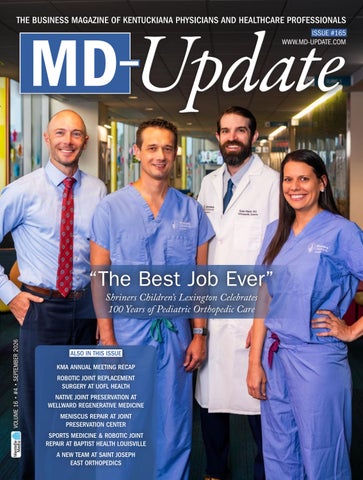
THE BUSINESS MAGAZINE OF KENTUCKIANA PHYSICIANS AND HEALTHCARE PROFESSIONALS ISSUE #165 WWW.MD-UPDATE.COM
“The Best Job Ever” VOLUME 16 • #4 • September 2026
Shriners Children’s Lexington Celebrates 100 Years of Pediatric Orthopedic Care
ALSO IN THIS ISSUE KMA ANNUAL MEETING RECAP ROBOTIC JOINT REPLACEMENT SURGERY AT UOFL HEALTH NATIVE JOINT PRESERVATION AT WELLWARD REGENERATIVE MEDICINE MENISCUS REPAIR AT JOINT PRESERVATION CENTER SPORTS MEDICINE & ROBOTIC JOINT REPAIR AT BAPTIST HEALTH LOUISVILLE A NEW TEAM AT SAINT JOSEPH EAST ORTHOPEDICS
LETTER FROM THE EDITOR/PUBLISHER
Welcome to the Orthopedics & Sports Medicine issue of MD-Update. WHEN I SPEAK with Kentuckiana doctors for stories in MD-Update, I always ask them, “When and
why did you know you wanted to be a doctor?” Their answers always include variations on three themes. “I wanted to help people. I liked science in school. I wanted to be like the doctor in my family, or in my childhood.” Orthopedists and surgeons often add that they like working with their hands and enjoy seeing immediate results in their patients’ well-being. For all the doctors that I speak with, their patients’ gratitude is a common motivation for why they do what they do. When I spoke with the Shriners Children’s pediatric orthopedic surgeons for this issue’s cover story, I heard the same responses, but with a level of enthusiasm and passion that was remarkable. Maybe it’s because they work with children and there’s so much joy, resilience, and optimism that comes from helping the youngest of patients. All four Shriners Children’s pediatric orthopedic surgeons basically said the same thing, “This is the best job I could hope to have.” I hope you enjoy reading the story about Shriners Children’s Lexington as much as we enjoyed putting it together. It starts on page 8.
Joint Replacement, Rehabilitation, or Preservation? We cover multiple options for worn-out joints in our Special Section stories with Drs. Malkani, Chattha, Puckett, Hughes, Eades, Mazloomdoost, and Hunt. Repair, replace, preserve, or rejuvenate. We have options and doctors who can do what needs to be done.
Loss of Consortium and Boundaries Our legal columnist Andrew DeSimone discusses a changing environment in the medical malpractice claim of “loss of consortium” as it relates to child and parents. Dr. Jan, our resident mental wellness expert, takes on “Boundaries.” If you’ve encountered the question of “Is This Mine to Decide—or Ours to Negotiate?,” Dr. Jan has some helpful strategies.
Big Person Toys I’m not a big fan of car shows, but my experience at the Concours d’Elegance at Keeneland in August was fun. The restored classic automobiles were truly amazing to see. Nowadays, when all the sedans and SUVs look so similar, it was a delight to see the craftsmanship and artistic design of the early models of the machines that changed the USA. Plus, it was for a great cause, benefitting UK Golisano Children’s Hospital. Drop me a line if you have a story to tell. Until next issue in October, all the best,
Gil Dunn Editor/Publisher MD-Update
2 MD-UPDATE
SEND YOUR LETTERS TO THE EDITOR TO: Gil Dunn, Publisher gdunn@md-update.com, or 859.309.0720 phone and fax
MD-UPDATE MD-Update.com Volume 16, Number 4
ISSUE #165
EDITOR/PUBLISHER
Gil Dunn gdunn@md-update.com GRAPHIC DESIGN
Laura Doolittle, Provations Group COPY EDITOR
Amanda DeBord
CONTRIBUTORS:
Jan Anderson, PSYD, LPCC Andrew DeSimone, JD, ESQ. Jason Hunt, DO Emily Schatt, KMA Danesh Mazloomdoost, MD
CONTACT US: ADVERTISING AND INTEGRATED PHYSICIAN MARKETING:
Gil Dunn gdunn@md-update.com
Mentelle Media, LLC
38 Mentelle Park Lexington KY 40502 (859) 309-0720 phone and fax Standard class mail paid in Lebanon Junction, Ky. Postmaster: Please send notices on Form 3579 to 38 Mentelle Park Lexington KY 40502 MD-Update is peer reviewed for accuracy. However, we cannot warrant the facts supplied nor be held responsible for the opinions expressed in our published materials. Copyright 2026 Mentelle Media, LLC. All rights reserved. No part of this publication may be reproduced, stored, or transmitted in any form or by any means-electronic, photocopying, recording or otherwise-without the prior written permission of the publisher. Please contact Mentelle Media for rates to: purchase hardcopies of our articles to distribute to your colleagues or customers: to purchase digital reprints of our articles to host on your company or team websites and/or newsletter. Thank you. Individual copies of MD-Update are available for $9.95.
ISSUE #165
CONTENTS 4
HEADLINES
6
LEGAL
8 “The Best Job Ever” Shriners Children’s Lexington Celebrates 100 Years of Pediatric Orthopedic Care COVER PHOTOGRAPHY BY PAUL MARTIN
SPECIAL SECTION 16 20 22 24 26 28
ORTHOPEDICS/ROBOTIC JOINT REPLACEMENT GENERAL ORTHOPEDICS & SURGERY SPORTS MEDICINE ROBOTIC ORTHOPEDIC SURGERY REGENERATIVE MEDICINE/JOINT PRESERVATION ORTHOPEDIC SURGERY/TENDON REPAIR
30
MENTAL WELLNESS
32
NEWS
38
EVENTS
16 ORTHOPEDIC SURGERY
20 ORTHOPEDICS
22 SPORTS MEDICINE
22 SPORTS MEDICINE
26 REGENERATIVE MEDICINE
28 ORTHOPEDIC JOINT PRESERVATION ISSUE #165 3
Headlines
At the Heart of Impact
KMA Annual Meeting celebrates leadership, service, and a vision for the future BY EMILY SCHOTT, KMA COMMUNICATIONS DIRECTOR LOUISVILLE Kentucky physicians gathered in
Louisville in August for the 2026 Kentucky Medical Association (KMA) Annual Meeting, where members celebrated another year of accomplishments, recognized outstanding physician leaders, and looked ahead to a future focused on supporting those who dedicate their lives to caring for others. Centered around the theme “Kentucky Physicians: At the Heart of Impact,” this year’s meeting highlighted the many ways physicians improve the health of Kentuckians—not only through exceptional patient care, but also through advocacy, education, leadership, and service. The weekend also marked the culmination of President Jiapeng Huang, MD, PhD’s successful Small STEPS, Big Impact initiative while ushering in a new chapter under incoming KMA President Christine Ko, MD, whose presidential theme, Your KMA, will focus on caring for Kentucky’s physicians as they continue caring for their communities.
A New President, a New Vision During the House of Delegates, members installed Christine Ko, MD, a Lexington internal medicine physician, as the 176th president of the KMA. Members also elected Ishmael Stevens, MD, of Ashland, as president-elect, along with Christopher Jones, MD, of Louisville, as vice president, Aneeta Bhatia, MD, of Louisville, as secretary, and Marisa Belcastro, MD, of Lexington, as treasurer. In her installation address, Ko reflected on the tremendous impact of outgoing president Huang’s leadership before introducing a vision centered on supporting physicians throughout every stage of their careers. “For two years, we asked physicians to help Kentuckians take better care of themselves,” she told attendees. “Now, it’s our turn to take better care of our physicians.” 4 MD-UPDATE
Incoming KMA president Christine Ko presents award to outgoing president Jiapeng Huang, MD, PhD, whose successful Small STEPS, Big Impact initiative ushered in a new chapter of physician engagement.
That philosophy serves as the foundation for Your KMA, a year-long initiative built around the message “Physicians Caring for Kentucky. KMA Caring for YOU.” The initiative seeks to elevate and expand the many resources KMA offers while strengthening physicians’ connection to one another and to organized medicine. Throughout the coming year, Your KMA will focus on five pillars: Caring for Your Health, Caring for Your Voice, Caring for Your Growth, Caring for Your Future, and Caring for Each Other. Together, these areas are designed to address many of the challenges physicians face today, from wellness and advocacy to leadership development, financial planning, mentorship, and professional connection. Ko also shared how participating in the Kentucky Physicians Leadership Institute (KPLI) transformed her own career. “KPLI taught me that leadership is learned. It is practiced. It is strengthened through relationships, self-awareness, and a willingness to grow,” she said. “That experience changed the PHOTOS BY EMILY SCHOTT
trajectory of my professional life, and it is one of the reasons I stand before you today.”
Celebrating Small STEPS, Big Impact Ko also used her remarks to recognize the tremendous accomplishments of outgoing president Huang whose Small STEPS, Big Impact campaign has become one of KMA’s most successful public health initiatives. “Through the Small STEPS, Big Impact campaign, you helped KMA reach millions of Kentuckians with trusted, physician-led health information while reminding our members that even the smallest actions can create meaningful change,” she said. “That campaign earned national recognition, but perhaps more importantly, it has made a real difference for patients across Kentucky.” The Annual Meeting theme, “At the Heart of Impact,” reflected the campaign’s philosophy, celebrating the countless ways Kentucky physicians influence the health of their patients and communities every day through clinical excellence, advocacy, education, and leadership.
Headlines
individuals whose careers exemplify leadership, service, education, and dedication to Kentucky physicians. Short videos were produced to honor each individual and are available to view at kyma.org. The Association’s highest honor, the Distinguished Service Award, was presented to Stephen Toadvine, MD, of Cynthiana. Throughout his career in family medicine and healthcare administration, Toadvine has demonstrated an unwavering commitment to patient care, physician leadership, and community health. His extensive service to KMA—including leadership as chair of the Board of Trustees—and his mentorship of future physician leaders through KPLI have left a lasting mark on organized medicine in Kentucky. The Community Service Christine Ko, MD, a Lexington internal medicine physician, is the Award was presented to Philip 176th president of the KMA. Hurley, MD, of Owensboro, in recognition of decades of Education Designed for service to his community. A Today’s Physician respected orthopedic sports medicine physiEducational programming throughout the cian, Hurley has devoted countless hours to meeting highlighted KMA’s continued com- caring for student-athletes, mentoring future mitment to providing timely, practical learning physicians, and strengthening partnerships that opportunities for physicians. improve community health. Among the featured offerings were KMA’s The Educational Achievement Award rec“Meet the Mandates” sessions, designed to ognized Jennifer Koch, MD, of Louisville, for help physicians complete all required con- her extraordinary contributions to medical tinuing medical education credits before the education. Through her work at the University conclusion of the current three-year reporting of Louisville School of Medicine, Koch has cycle. The meeting also featured sessions helped shape generations of physicians through on physician wellness, leadership, and other innovative teaching, mentorship, and curricutopics aimed at helping physicians navigate lum development while advancing educational today’s increasingly complex healthcare envi- excellence both in Kentucky and nationally. ronment. Finally, the Debra K. Best Outstanding Layperson Award was presented to Pat Honoring Excellence in Medicine Padgett, of Louisville, KMA’s executive vice One of the highlights of the weekend was president, who will retire in November after the annual President’s Celebration Reception, nearly three decades of dedicated service. where KMA recognized four outstanding Throughout his tenure, Padgett has provided
visionary leadership and steadfast advocacy while helping shape KMA into the strong and respected voice for physicians that it is today. His commitment to organized medicine has left an enduring impact on healthcare throughout the Commonwealth.
Investing in Kentucky’s Future Leaders The Annual Meeting also celebrated the graduation of the 2026 Kentucky Physicians Leadership (KPLI) Institute class. Ten physicians completed the award-winning leadership program, which prepares physicians to become more effective leaders within their practices, hospitals, communities, and organized medicine. Throughout the year, participants engaged in a series of leadership development sessions focused on communication, advocacy, governance, emotional intelligence, and professional growth. Graduates of the 2026 class are Rebecca Chatham, MD, of Danville; Alexander Hou, MD, of Edgewood; John Frandina, MD, of Lexington; Manikya Kuriti, MD, of Louisville; Stephanie McGee, MD, of Louisville; Rejith Paily, MD, of Louisville; Melonie Proctor, DO, of Union; Ishmael Stevens, MD, of Ashland; Tina Simpson, MD, of Louisville; and Allison Yoder, MD, of Louisville.
Looking Ahead As one presidential year concluded and another began, the 2026 KMA Annual Meeting offered an important reminder that the Association’s greatest strength has always been its members. Over the past year, physicians demonstrated the power of education and prevention through the Small STEPS, Big Impact campaign. Looking ahead, Your KMA will build upon that momentum by turning the focus inward— ensuring physicians themselves have the resources, connections, and support they need to thrive. As Ko reminded attendees in her closing remarks, “When physicians invest in one another, we all become stronger. When we strengthen our profession, we strengthen patient care. And when we care for the people who care for Kentucky every single day, everyone benefits.” ISSUE #165 5
Legal
Beyond the Patient: Understanding Loss of Consortium Claims BY ANDREW DESIMONE IN MANY MEDICAL malpractice lawsuits, one of
the largest claims is for loss of consortium. For doctors and medical providers, loss of consortium claims can feel especially personal because they focus on the human relationships affected by a bad result. A spouse might claim the loss of companionship, help around the home, or the everyday support that existed before an injury or death. The loss of a parent’s guidance and nurturing can have a profound effect on the growth and development of minor children. In Kentucky, these claims have traditionally been limited to certain relationships, including spouses, parents of minor children in wrongful death cases, and minor children who lose a parent. Plaintiffs are now beginning to argue that adult children should also be able to bring claims for the loss of a parent, and in several states, these claims have begun to be permitted. Legally and historically, consortium focuses on losses in the immediate household, intimate spousal relations, or the basic and critical care a minor child needs while growing up. Thus, when a parent who is older passes away, the surviving independent adult children generally cannot recover damages for the loss of that relationship under current Kentucky law. However, it is an issue being raised more often in litigation and one that providers should recognize as part of the damages picture. Loss of consortium is a claim that allows the injured party’s spouse or minor child to recover damages for the injury to the relationship. In other words, the loss of consortium, which is defined in KRS 411.145, to mean “the right to the services, assistance, aid, society, companionship and conjugal relationship” of the spouse. While the conjugal relationship is part of the claim, it is not often the focus for juries; instead, they are largely concerned with the intangibles of relationships such as loss of companionship, friendship, and assistance. 6 MD-UPDATE
money related to loss of consortium claims. If a lawsuit is filed, physicians are unable to prevent a loss of consortium claim also being brought by the surviving family. Juries are often very protective of children who lose a parent, recognizing that this relationship is irreplaceable and the impact on the dependent child’s future is significant. Additionally, juries can also be very protective of the loss of a spouse, particularly if they view the death as preventable. So what can medical providers do to prevent or mitigate against these types of damages? The best thing to do is to communicate fully and extensively with the patient and family members before beginning treatment options. Additionally, document, document, document! That way, when a bad result occurs, the medical chart fully supports that the patient was aware of the risks and benefits of treatment, and contains the information needed to possibly forestall or mitigate the effects of a lawsuit. Parents can also recover for loss of consortium under KRS 411.135 when a minor dies from the negligence of a third party. This statute provides recovery for loss of affection and companionship “that would have been derived from such child during its minority.” In other words, the law allows recovery for the mental distress and anguish a parent suffers when a child dies. The last type of recoverable loss of consortium concerns the claim by a minor child when a parent dies from the negligence of a third party. This claim was not created by statute, but is a court created claim. In Giuliani v. Guiler, 951 S.W.2d 318 (Ky. 1997), the Kentucky Supreme Court recognized that minor children may recover for the loss of a parent’s “love, care and protection” because those things are essential to a child’s development. Over the years, juries in Kentucky have become more likely to award large sums of
Andrew DeSimone is an award-winning medical malpractice defense attorney at Sturgill, Turner, Barker & Moloney, PLLC. He may be reached at 859.255.8581 or adesimone@sturgillturner.com. This article is intended as a summary of state and/or federal law and does not constitute legal advice.
md-update.com YOUR RESOURCE FOR THE BEST IN KENTUCKY HEALTHCARE
AT T O R N E Y S
YOU CARE FOR EVERYONE♦ WE TAKE CARE OF YOU♦ From the business of health care to compliance to litigation defense, Sturgill Turner’s experienced health care and medical negligence defense attorneys provide comprehensive legal services to health care providers, hospitals and managed care organizations across the Commonwealth.
Put our experience to work for you. Sturgill, Turner, Barker & Moloney, PLLC ♦ Lexington, Ky. ♦ 859.255.8581 ♦ www.SturgillTurner.com
THE BUSINESS MAGAZINE OF KENTUCKIANA PHYSICIANS AND HEALTHCARE PROFESSIONALS
2026-27 Editorial Calendar Editorial topics and dates are subject to change ISSUE #166 (October) CANCER CARE Hematology, Oncology, Plastic Surgery, Radiology, Radiation
ISSUE #167 (December) IT’S ALL IN YOUR HEAD ENT, Mental Health, Neurology, Neuroscience, Ophthalmology, Pain Medicine, Psychiatry
ISSUE #168 (February 2027) HEART & LUNG HEALTH Cardiology, Cardiothoracic Medicine, Cardiovascular Medicine, Pulmonology, Sleep Medicine, Vascular Medicine, Bariatric Surgery
ISSUE #169 (April 2027) INTERNAL & EXTERNAL SYSTEMS Dermatology, Endocrinology, Gastroenterology, Geriatric Medicine, Internal Medicine, Integrative Medicine, Infectious Disease Medicine, Lifestyle Medicine, Nephrology, Urology
To participate, please contact GIL DUNN, PUBLISHER
859.309.0720 (direct) • 859.608.8454 (cell) Send press releases to gdunn@md-update.com
Shriners Hospital for Children was a freestanding 50-bed hospital which opened in 1955. It included on-site nursing quarters, where nurses lived while caring for children.
The Bluegrass State’s Shriners Hospital for Children location was funded entirely by Oleika Shriners, the Lexington-based chapter of Shriners International, through a $2 annual assessment from each Shriner.
“The Best BY JIM KELSEY, MIKE CALDWELL, & GIL DUNN
Shriners Children’s Lexington is celebrating 100 years of state-of-the-art pediatric orthopedic care. 8 MD-UPDATE
LEXINGTON While children still sleigh down the snow-covered hill in front of the former Shriners Children’s Hospital building on Richmond Road on snow days, the legacy of Shriners Children’s Lexington extends far beyond that cherished landmark. For the past 100 years, the organization has helped children overcome extraordinary challenges. Now in its new home for nearly a decade, the world-class pediatric orthopedic provider is creating even more life-changing stories in the century ahead. As an example of the unique care that they provide, Shriners Children’s Lexington orthopedic surgeon Vince Prusick, MD, recalls a complex patient who was born with significant scoliosis, which is curvature of the spine. The standard course of treatment was to insert a magnetized steel rod next to the child’s spine and slowly bend the spine into a normal, vertical alignment. The complicating factor was that this child had numerous other unique medical conditions that required use of a flexible spine that would be limited by traditional rod constructs. Prusick consulted with surgeons at one of the other Shriners facilities and was able to employ vertebral body tethering, a newer technique that maintains flexibility and still controls the curve. That’s just one of thousands of patient stories that have come from Shriners Children’s Lexington over the past 100 years. Where do we begin? At the beginning, of course.
Cover Story In 2017, Shriners Children’s Lexington relocated to the UK HealthCare campus and transitioned to an ambulatory care model. Inpatient care is provided at Golisano Children’s at UK by Shriners Children’s physicians who hold dual privileges.
Job Ever” The Start of a National Mission for Children The Shriners Children’s system was founded in September 1922, when physicians treated their first pediatric polio patient in Shreveport, Louisiana. At a time when children with orthopedic conditions had few treatment options, members of the Shriners International fraternal organization recognized the overwhelming needs created by the polio epidemic and committed to build hospitals dedicated entirely to children, to provide care regardless of a family’s financial resources. That national mission quickly reached Kentucky. The Bluegrass State’s Shriners Hospital for Children location opened in Lexington on November 1, 1926, as a 20-bed wing connected to the children’s ward at Good Samaritan Hospital. The facility was funded by Oleika Shriners, the Lexingtonbased chapter of Shriners International, part
Shriners Children’s Lexington celebrates 100 years of pediatric orthopedic care
of a network that today spans more than 200 chapters and thousands of clubs across the United States and the world. The Lexington hospital was among the first Shriners hospitals opened in the United States, and from the very beginning, its mission was clear: specialized orthopedic care for children, provided regardless of a family’s ability to pay or insurance status. In those early years, the hospitals were funded entirely through a modest $2 annual assessment from each Shriner — a model rooted in shared responsibility and service. It soon became evident that the original 20-bed wing could not meet the growing demand. In October 1951, Shriners Children’s purchased 27 acres on Richmond Road, formerly part of the Henry Clay Estate. A new freestanding 50-bed hospital opened in 1955, built at a total cost of $1.1 million, including land, construction, and furnishings.
The facility included onsite nursing quarters, where nurses lived while caring for children who often remained hospitalized for months at a time. During the 1950s and early 1960s, Shriners Hospitals for Children expanded its mission beyond treatment alone. The organization committed to education, research, and broader clinical advancement. During this era, Shriners Children’s hospitals became nationally known for delivering expert, compassionate care to patients and families — an identity that continues today.
Growth Soon Followed As surgical volumes increased in the 1980s, the Lexington facility once again outgrew its space. In 1988, a new hospital was constructed in front of the 1955 building, which was later demolished. The updated facility spanned 180,000 square feet and included
PHOTOS BY PAUL MARTIN AND PROVIDED BY SHRINERS CHILDREN’S LEXINGTON
ISSUE #164 9
Cover Story
two operating rooms, expanded support services, and physician exam rooms — designed to accommodate up to 50 inpatients. From 1988 through 2017, families from across Kentucky and the surrounding states of Tennessee, West Virginia, Indiana, and Ohio increasingly sought care in Lexington. The medical staff expanded to include multiple pediatric orthopedic surgeons, a pediatric hand specialist, pediatric anesthesia specialists, and consulting experts in rehabilitation, plastics, rheumatology, and sports medicine. During this period, care gradually shifted from long inpatient stays to an outpatient-focused model, reflecting national healthcare trends. In 2011, Shriners Children’s looked to evolve without losing the mission, culture, or identity that set the care apart. For Lexington, that meant deepening its partnership with the University of Kentucky and planning a modern, outpatient medical center near Kentucky Children’s Hospital, which is now known as Golisano Children’s at UK. That vision became reality in 2017, when Shriners Children’s Lexington relocated to the UK HealthCare campus and officially transitioned to an ambulatory care model. The new medical center includes a specialty outpatient clinic, rehabilitation center, and surgery center, while inpatient care is provided seamlessly across the street at Golisano Children’s at UK by Shriners Children’s physicians who hold dual privileges. The 60,000-square-foot facility features advanced clinical upgrades — including Kentucky’s first EOS low-dose imaging system, expanded clinic space, and two state-ofthe-art surgical suites designed with family convenience in mind. Within just three years of the move, active patient numbers grew from 11,000 to over 16,000.
Nationally Ranked In partnership with Golisano Children’s at UK, Shriners Children’s Lexington has been consistently ranked among the top 50 in the country for pediatric orthopedic care by U.S. News and World Report, including in 2026. Although the two organizations are separate entities, they collaborate closely to deliver seamless, high-quality care. These rankings are 10 MD-UPDATE
among the most comprehensive evaluations of pediatric hospitals in the country, measuring outcomes, patient safety, clinical resources, and adherence to best practices. Patient volumes, once carefully examined to determine if the new inpatient model was sustainable, now exceed capacity. In 2025, Shriners Children’s Lexington: • Served more than 12,000 children • Had 50,487 patient visits • Performed 854 surgeries • Logged 40,923 occupational and physical therapy visits • Conducted 20,378 radiology exams • Provided 3,906 custom prosthetic and orthotic devices • Served patients from 25 states • Raised $5.4 million to help make all of this care possible Seventy percent of the medical center’s operating budget is funded through philanthropy, allowing the organization to uphold the promise it made 100 years ago — to treat every child who needs care, regardless of a family’s ability to pay or insurance status.
Expanded Service Lines of Care Today, Shriners Children’s Lexington provides a full spectrum of pediatric orthopedic care, treating everything from fractures and sports injuries to complex, lifelong conditions such as spine disorders, cerebral palsy, and limb differences. In addition to clinical care, the center serves as a hub for leadingedge research and pediatric medical education, all within a family-centered environment designed to reduce stress and support healing. In 2026, Shriners Children’s Lexington marked its milestone 100th anniversary with a year-long centennial celebration — honoring the generations of physicians, nurses, therapists, staff, Shriners, and donors whose commitment has shaped a legacy of wraparound, family-centered care. A new generation of pediatric orthopedic surgeons have taken up the work from previous Shriners Children’s physicians such as David Stevens, MD, Todd Milbrandt, MD, Henry Iwinski, MD, chief of staff for 13 years, longtime physicians Scott Riley, MD, and Janet Walker MD, who continue to prac-
tice there, and many others who have taken care of kids over the years. Vishwas Talwalkar, MD, is currently the chief of staff at Shriners Children’s Lexington. He started his career at the Lexington facility and has been there nearly 30 years. “What truly sets Shriners Children’s Lexington apart is our history and our culture of wraparound care for both rare and routine conditions,” Talwalkar says. “Over the last century, we have had amazing people who have worked every day and care deeply for our patients and families. Thanks to the ongoing generosity and commitment of the Shriners organization and millions of donors, we can continue to provide the highest level of complex care for patients regardless of their ability to pay. It’s medicine in its purest form.”
Meet Ryan Muchow, MD A native of Green Bay, Wisconsin, Ryan Muchow, MD, has been a pediatric orthopedic surgeon at Shriners Children’s Lexington since 2012. He says it is the first, best, and only job he’ll ever have. After attending the University of Wisconsin for his undergraduate, medical school, and orthopedic surgery training, Muchow went to the Texas Scottish Rite Hospital for Children in Dallas for his pediatric orthopedic fellowship. The next stop after that was Shriners Children’s Lexington.,
Ryan Muchow, MD, pediatric orthopedic surgeon, father, husband, coach, and athlete, is missiondriven to serve.
PHOTOS BY PAUL MARTIN AND PROVIDED BY SHRINERS CHILDREN’S LEXINGTON
Cover Story
Ryan Muchow, MD, and wife Claire, who serves as an interpreter, do volunteer mission work.
A basketball and tennis player in high school, Muchow credits his sports background with drawing his attention to pediatric orthopedic surgery. Even during his residency, he spent his free time coaching high school tennis and volunteering with a high school youth ministry. “My personal life and my professional life kind of meet up here with pediatric orthopedic surgery,” says Muchow, who lives in Lexington with his wife and four children. “It is super cool how you can’t plan the best things in your life — we didn’t really know Lexington would be our forever home, but after a few years it becomes pretty clear that God’s got you here for a purpose and a reason, and we’re excited to keep living that mission out.” Part of that mission has become Muchow’s expertise in the areas of adolescent hip disorders and scoliosis. Both of those conditions have exciting new advancements and surgical techniques that are beneficial for children. One of the newest, for children with scoliosis, is the vertebral body tethering surgery that Prusick used on his patient. “That’s our newest and most promising advancement,” he says. “Traditionally, the main treatment for scoliosis has been to make the spine straight and fuse the spine to keep it from
curving, which is still the gold-standard option. The most recent advances, though, are trying to maintain spinal motion while correcting the deformity. VBT is really cool because it uses a fancy rope, essentially, to tether the spine and allow the child’s growth to correct the scoliosis. We are excited about the future advancements that will have motion preservation as a key component of the deformity correction.” Conditions such as these are difficult not only for the child, but also the parents and family as a whole. Muchow keeps that front of mind as he consults with the family, explains the treatments and procedures, and answers their questions. “It’s always the best to focus on the patient, even if they’re of the youngest age. They are so much fun — to get down on their level, play and laugh with them, it allows you to engender trust with the child and the parents. That sets the stage for conversations regarding what is best for their kiddo, and the family understands that is the primary goal.” Muchow stresses that he is not alone in devoting his time and attention to the care of these patients and their families. It’s pervasive throughout Shriners Children’s Lexington. “When we are working with the family, my nurse care manager is just as important
with addressing and handling the needs of the family. Shriners is a magical place. From the person first greeting them when they check in, to the radiology tech, to the medical assistant rooming the patient in the hallway. Each of these people are so important to welcoming the families to this most special place to receive orthopedic care,” Muchow says. “Further, in our clinical workroom, we’ve specifically designed it so all the docs are in one room, making it very collegial and allowing us access to expert opinions when caring for challenging diagnoses so we can put our heads together and present a cohesive plan to the families. Everything about this physical space was designed to reflect the excellence in care and service that we aim to provide to the families.” As part of their relationship and role as faculty with the University of Kentucky, Muchow and the rest of the physician team are educators and researchers as well as clinicians. He is a professor in the Department of Orthopedic Surgery at UK and loves to educate orthopedic surgery residents and medical students. “There’s not a greater way to have impact in our field than to teach young physician surgeons the art and science of orthopedics, and the professionalism to be an excellent servant leader in your space.”
Meet Vince Prusick, MD Vince Prusick, MD, has been a pediatric orthopedic specialist at Shriners Children’s Lexington since 2018. He is also an assistant professor of pediatric orthopedic surgery and pediatrics at the University of Kentucky. Prusick grew up in northern Michigan and earned his medical degree from Michigan State University College of Human Medicine. He then completed his residency at the University of Kentucky followed by a fellowship at Vanderbilt Children’s Hospital. He officially joined the team at the medical center in 2018, but he also served as a resident at the medical center before that. Areas of special interest to Prusick include spinal deformity, hip dysplasia, and trauma. His interest in medicine came naturally from his father, who recently retired after more than 30 years as a general orthopedic surgeon. ISSUE #164 11
Cover Story
Vince Prusick, MD, pediatric orthopedic surgeon, says his “work at Shriners Children’s Lexington is a labor of love.”
“My father never pushed me towards medicine. I tell people I didn’t really know there were other jobs. From a young age I knew that dad fixes bones, so that’s what I guess I’m going to do. Here I am 40 years later, and I wouldn’t change anything about it. I honestly never really considered anything else.” While in medical school, Prusick watched a scoliosis surgery that led him to where he is today at Shriners Children’s Lexington. “I was fascinated by the surgery itself, the correction,” Prusick says. “We had the ability to impact a child’s life. That really just stuck with me from that moment.” Prusick performs a variety of surgeries, including hip, spine, foot and ankle, and trauma. “You never know each day what’s going to come through the door. There’s a lot of variety in pediatrics, which kind of makes it exciting each day.” One of the most common procedures he performs is spinal fusion surgery. It involves placing screws, which act as anchors, throughout the affected levels of the spine and then attaching two rods to correct the curve and provide support while the spine is fusing. In the past, patients would require a fouror five-day stay in the hospital, but today that has been trimmed to just one or two days. Additionally, the Shriners Children’s team use “growing instrumentation” for skeletally immature patients, a procedure that involves implanting magnetic rods. 12 MD-UPDATE
“We place anchors at the top of the spine at a few levels and at the bottom of the spine at a few levels,” Prusick says. “Every three months, the child comes to the clinic, and we put a device on their back that spins a magnet, and it cranks a motor, which lengthens it about five millimeters every few months. This has greatly decreased the need for repeat surgeries, and we’re able to do it in the clinic setting as opposed to in the operating room.” But surgical procedures are only a portion of the care that Prusick provides his patients and their families. “I always try to be very friendly, especially to the child, to make them feel comfortable but then equally the family and the parents and get to know who’s there with the patient. It’s all about listening to your patients because, most of the time, they’ll tell you the answer to what’s wrong with them.” Prusick continues, “What most people want is to know that they felt heard. You have to have buy-in from the family but equally from the child because we are talking with them, not about them. I think that’s key. You have to guide them into what you think is the best of options, but ultimately you want everyone to feel comfortable with whatever decision we make at the end of the day.” As challenging as it can be at times, Prusick’s work at Shriners Children’s Lexington is a labor of love. “If you can make things a little bit better, at the end of the day, you feel like you’ve done something good for the world. That’s probably the biggest thing. Sometimes you have super thankful families, and you have a moment of pride, but I don’t do it for the acknowledgements or anything like that. It’s more of a responsibility.”
gratifying. Walking the halls at Shriners, you see people who have been here for 15 or 20 years or longer because they are all committed to the same goal, which is trying to make sure that we are doing the right thing for each patient.” After growing up in Boulder, Colorado, Kluck graduated from UC Berkeley and then went to medical school at Washington University Medical Center in St. Louis. He completed an orthopedic surgery residency at UC San Diego and then did a pediatric fellowship at Scottish Rite for Children in Dallas. “I enjoy working with kids because there is an incredible opportunity to impact them in a positive manner for the rest of their lives,” says Kluck, who also serves as a pediatric orthopedic surgeon at the University of Kentucky. “By addressing a significant lower extremity deformity or some of these bigger problems that we treat, a pediatric orthopedic surgeon can have a huge impact on a child’s quality of life. Even with something like a fracture, kids are motivated and want to get back to doing the things that they love to do. Being able to participate in that process is rewarding.” Kluck’s patients are often children born with congenital deficiencies such as a missing, deformed, or shortened bone. The task is to try to figure out how to reconstruct the bone as the child gets older to make it function as normally as possible. In the past, a common treatment was the use of an external fixator,
Meet Dylan Kluck, MD Much like his colleagues, fellow pediatric orthopedic surgeon Dylan Kluck, MD, was drawn to Shriners by the opportunity to help children in ways that may not be possible elsewhere. “The mission of Shriners has always resonated with me,” says Kluck, who joined Shriners Children’s Lexington in 2022. “Being able to help the families that really need us is incredibly
Dylan Kluck, MD, pediatric orthopedic surgeon, says, “It’s our responsibility to be that calming presence who can help that family in that moment.”
Cover Story
Meet Anne Marie Dumaine, MD
Drs. Muchow and Kluck on a mission surgery trip to Guatemala in 2025.
which is a brace that goes on the outside of the leg. That approach, however, has changed over the past decade. “When possible, we try to do limb lengthening and reconstruction techniques with devices that are internal,” Kluck says. “I’ve definitely had an increase in the number of patients that I’m using internal motorized lengthening nails for. In general, these are devices that go inside of the bone and have a small motor to allow the inner portion of the nail to telescope out of the outer portion of the nail. The patient then uses an external device that controls the motor and elongates the nail, and that’s how the bone lengthens. That technology is one of the biggest innovations in pediatric orthopedics and it has totally changed the world of limb lengthening.” Kluck sees approximately 60 patients per week, but most of them are nonsurgical patients. For example, patients with clubfoot typically are treated via other options such as casts. He estimates that he performs an average of four to six surgeries per week, and they are typically lengthy procedures.
It can be a grueling experience for surgeon, patient, and the family, but Kluck says it is all worth it to help people on one of the worst days of their lives. “It’s our responsibility and our job to show up and be that calming presence and that person who can help that family in that moment,” Kluck says. He shared the story of a girl who suffered a femur fracture caused by a benign tumor and the note that he received from her that he keeps on the corkboard by his desk. The note reads:
Northern Kentucky native Anne Marie Dumaine, MD, is a pediatric orthopedic surgeon who joined Shriners Children’s Lexington in 2025. A graduate of Transylvania University in Lexington, she attended the University of Cincinnati College of Medicine and completed a pediatric orthopedic fellowship at Texas Scottish Rite for Children in Dallas. Having been briefly exposed to Shriners Children’s during her medical training, Dumaine hoped to one day work there. Despite her high expectations, she says that her experience at Shriners Children’s has been even better than expected. “Shriners Children’s is just an amazing organization. Regardless of financial ability, we are able to provide care for patients. That was something that really resonated with me.” At Shriners Children’s, Dumaine’s primary areas of focus are on neuromuscular disorders such as cerebral palsy as well as lower extremity conditions like clubfoot, hip dysplasia, and trauma. “I really like taking care of that patient population because you can have a big impact,” Dumaine says. “Not only are you getting kids
“My hero is Dr. Kluck. He’s special because he did surgery on my leg. He also kept my nerves calm by telling me I am brave. Dr. Kluck told me exactly what was going to happen. Lastly, he healed my leg so now I get to walk.” “That’s why we all do this,” Kluck says. “I mean, she certainly didn’t have to do that, but she brought that to me, and, you know, I hang on to stuff like that because that’s why we do what we do.”
Anne Marie Dumaine, pediatric orthopedic surgeon. Her primary areas of focus are neuromuscular disorders such as cerebral palsy as well as lower extremity conditions like clubfoot, hip dysplasia, and trauma.
PHOTOS BY PAUL MARTIN AND PROVIDED BY SHRINERS CHILDREN’S LEXINGTON
ISSUE #164 13
Cover Story
Shriners Children’s Lexington provides a full spectrum of pediatric orthopedic care, including physical therapy and custom prosthetic and orthotic devices.
back to what they love to do, such as sports, but in this particular patient population, you’re helping them to maintain function. That’s a really awesome thing to be able to provide to kids.” Dumaine’s neuromuscular patients come to Shriners Children’s either because they already have been diagnosed or because they have yet to be diagnosed, but are experiencing difficulties or delays. “Maybe they’re not sitting up on time or they’re not pulling to stand,” Dumaine says. “That triggers a workup with ourselves, with neurology and the physical medicine doctors to figure out the cause. We continue to follow them throughout their childhood because we know their timeline for development looks different.” In addition to Dumaine’s care, additional assistance provided by Shriners Children’s includes physical and occupational therapy, and the orthopedics department can make braces for the patients as needed. 14 MD-UPDATE
“My goal and the reason I got into pediatric orthopedics is one, I love kids and, two, I want to get kids back to everything that they want to do,” Dumaine says. “As a mom, it’s really easy to put yourself in the family’s shoes and see exactly what they’re going through that day. I want to maximize their function. On those worst days, keeping those goals in mind is really helpful.” Dumaine acknowledges that delivering bad news results in some difficult conversations with families, but she is also in awe of their resilience. “You can’t completely remove yourself from the emotion,” she says. “But remembering why we do what we do, and what our guiding principles are, makes that a little bit easier. You go through the highs and the lows together. Making yourself available and allowing yourself to be a little vulnerable and a little emotional is all part of it. That relationship is a two-way street. I’m grateful to get to take care of them, but they teach me a lot, too.” PHOTO PROVIDED BY SHRINERS CHILDREN’S
One thing that Dumaine has certainly learned is that Shriners Children’s is the place for her. Far more than a career, it is her passion. “It’s really an amazing place to work. Everyone buys into the mission. We are all here for the same reason, which is providing excellent care to children. People come to work excited to work and excited to help take care of kids, which just makes it an awesome and really fun place to work. It has exceeded my expectations. I’ll never get a better job.”
In Conclusion Pediatric orthopedic care is a responsibility that all the physicians, staff and caregivers at Shriners Children’s Lexington have been living up to for 100 years… and counting. Children and their parents have found hope and healing at Shriners Children’s Lexington for the past century because it stands as a trusted name in Kentucky and beyond— delivering what families have found as “the most amazing care anywhere.”
SPECIAL SECTION
Orthopedics
Jewish Hospital Celebrates Over 6000 Robotic-Assisted Total Joint Replacements UofL Health Orthopedic Total Joint Surgeons focus on improved patient outcomes with robotics BY LIZ CAREY LOUISVILLE The first time Arthur Malkani, MD, requested a
robot in his operating room, he showed his hospital board the difference robotics would make. Using images of joint replacement operations, he showed not only how the joints were placed, but how much better the outcome could be with robotic assistance. “I had to present my case, in order to get approval to purchase a total joint robotic system, to the board of the Jewish Hospital in Louisville at that point and explain why we needed a million-dollar robot,” he recalls. “So several years ago, I showed them slides of how we were doing total knee replacements by drilling a hole in the femur and inserting a rod towards the hip to help align the knee implants along with some eyeballing. I told them we can improve the quality of our patients’ lives and actually showed intraoperative pictures of surgeries that I was doing.” With photos from his latest hip and knee replacements, he explained how he had to make decisions on the best placement of orthopedic implants during surgery, which at times involved some guesswork. Later, he discussed how the robotic platform takes the guesswork out of surgery by providing the surgeon with real time intraoperative data on the individual patient’s unique native hip or knee joint anatomy based on the preoperative 3D CT scan. “I told the board we can perform surgery with more accuracy and precision to minimize human errors to match the patient’s native anatomy and get better results for our patient,” he says. And it worked, with a caveat. “That night I got a call saying, ‘You got your robot, but don’t ever show pictures of surgeries again. One of the members of the board fainted!’” Malkani says. Lucy O’Sullivan, MD, orthopedic surgeon, assists Malkani in placing an optical tracking array to the patient’s pelvic bone, which communicates with the robotic systems camera array. This allows real-time 3D information on the position of the hip implant, within millimeters, when Malkani inserts it, making the patient’s leg lengths as equal as possible.
16 MD-UPDATE
Doctor/Fixer-Upper Malkani is the chief of adult reconstruction at UofL Health, focusing on knee and hip replacements. He also serves as the co-director of the Adult Orthopedics Residency Training at Jewish Hospital and as a clinical professor at the University of Louisville School of Medicine. After more than 30 years in the field, he
SPECIAL SECTION
Arthur Malkani, MD, chief of adult reconstruction at UofL Health, co-director of the adult orthopedics residency training at Jewish Hospital and clinical professor at the UofL School of Medicine
continues to be impressed by the difference technology, especially robotics, has made in improving the clinical results in patients undergoing total joint hip and knee replacement. Born in Mumbai, India, Malkani came to the U.S. at the age of ten. Told by his mother he should go into healthcare, he knew his passion was in fixing things. “I had no idea what I wanted to do, but your mother knows you best. She said, ‘You’re better suited for healthcare. Why don’t you become a doctor?’ I said, “Okay, mom.” “When I was in medical school, there was a patient in a car accident with a broken bone. It was two in the morning, and they were putting a rod in his thigh bone to fix the fracture. I saw that these surgeons were enjoying doing this type of work, and they were happy. I said to myself, I want to be happy at two in the morning if I have to work.” From there on, Malkani decided to marry his love for fixing things and using his hands to improve his patients’ quality of life. “I enjoyed orthopedics a lot because you’re fixing something that the patient needs in order to walk; the patient in most cases can get right up and start walking, which is very gratifying,” Malkani says. “My dad was an engineer and always asked me, ‘What can you do to make the house more efficient?’ He
always wanted things better and better, so I got into orthopedics, and I wanted to make things better.” Malkani attended Columbia University in New York, to obtain his BA before receiving his medical degree from Columbia’s College of Physicians and Surgeons. After an orthopedic residency at the University of Connecticut Hartford Hospital, he did a fellowship at the Mayo Clinic for Adult Reconstruction and then another fellowship for orthopedic trauma at the Hospital for Special Surgery (HSS) at Cornell University in New York City. “Back in the 1990s, we had problems with first-generation polyethylene in total joint replacements due to increased wear debris, which would lead to particles that would destroy the bone, a condition called osteolysis,” he says. “A lot of patients with hip replacements had this massive osteolysis in the hip area when I first started orthopedics. I did my training at the Mayo Clinic on how to reconstruct the hip and knee in cases of bone loss. There was a well-known doctor at HSS in New York City, Dr. David Helfet, who was restoring bone loss in the pelvis in patients with failed hip replacements. So, I did another fellowship with him, mainly focusing on pelvic and acetabular reconstruction, and how to manage those patients.”
Welcome to Kentucky After Malkani’s fellowship at Cornell, he was recruited by UofL in 1993. “My first response was, ‘Excuse my ignorance, where’s Kentucky?’” he says. “I grew up in New York City and my folks moved to California, so it was New York or California for most of my career. When I came here, there was no one doing some of the things I was trained to do, so I was busy from day one.” When he started, most of his work was level one trauma — car accidents, gunshot wounds, the usual. Now, his career focuses on total joint replacements, something he says he really enjoys. While the majority of his patients are older, some are younger with conditions like juvenile rheumatoid arthritis or trauma injuries from car accidents. The majority of his older patients are female, he PHOTOS BY GIL DUNN
Orthopedics
says, because they live longer. While his adult patients in their 40s tend to be male, his octogenarian patients tend to be female. Advancements in robotics help him ensure even better outcomes for his patients. With the assistance of computer technology, which helps put implants in the best position with less trauma. Most patients feel like the joint replacement isn’t even there. “If the implants are not in the ideal position, the ligaments about the knee may not function properly and you may feel some discomfort while walking. We call this the ‘forgotten joint score.’ A high forgotten joint score means you don’t even know the knee is there. For years, hips had a higher or better forgotten joint score. Hips are a weight-bearing joint, but the knee is a lot more intricate and a lot more involved, and so the forgotten joint score following knee replacement wasn’t as good,” he says. “Now it’s a lot better because of robotic technology. More patients don’t realize they have a knee replacement when doing activities.”
Patient Satisfaction Is Up Patient satisfaction for the procedure has gone up as well. Historically, he says, orthopedic surgeons used their best judgement to place parts in the idea position for that patient during surgery using the manual cutting guides, but patient satisfaction was approxi-
Jeffrey Yunkun, MD, with Arthur Malkani, MD. Yunkun is part of the robotic total replacement anesthesia team. ISSUE #165 17
mately 80 percent for total knee replacement, which was not good enough. Now with the introduction of robotics technology, the individual patient’s 3D CT scan of their knee or hip goes into a computer software platform and during the surgery, the surgeon can determine the ideal placement of the implants and use the robotic system to execute their plan precisely. The use of robotic surgery has led to patient satisfaction of approximately 94.6% in total knee replacements, which is a significant improvement from the past. “Every patient is different in their shape, angles, size — each one is so unique. For 30 years, we were doing the same operation for every patient — the same kind of knee alignment, no matter who they were or what their individual alignment was because we did not have the tools for precise surgery,” he says. “Robotic-assisted surgery can help me determine what the individual alignment is, what the gap numbers are that you have to match to achieve a stable knee replacement… I can get to within millimeters of where the implants need to be.” Prior to surgery, joint replacement patients need to be medically evaluated to ensure the best outcome. “We have the best preoperative nurses, anesthesia team, and postoperative 18 MD-UPDATE
nurses,” Malkani says, “But we have to medically optimize patients prior to surgery.” That means cardiac clearance, lower BMI, an acceptable A1C level, and other indicators. Some levels can prevent him from scheduling surgery until patients are in the better shape. “There are a lot of risk factors in some of our patients in Kentucky, but over the past 20 years I’m seeing fewer patients who come in as smokers… but the obesity has skyrocketed.” About 22 percent of the patients he sees are morbidly obese with a BMI of more than 40, which can impact the surgery’s success. Another 30 percent are on psychotropic medications for conditions like anxiety or depression, which may cause negative interactions with the pain medications. Another 20 percent may be at risk because they live alone, which can negatively affect the surgery’s outcome. All these factors have to be considered so they can ensure the best results for their patients. “If you’d asked me 10 years ago, ‘Are you going to operate on an 88-year-old patient?’ I’d say, ‘Are you out of your mind?’ Now, it’s a routine, because that 88-year-old patient wants to go to the bathroom on their own without pain; they want to visit the grandkids,” he says. But the tools used a decade ago also didn’t
Tonia Porter, RN, Emily Derthick, RN, Vicki Desilets, CRNA, Maci Mouser, CST, Chelsea Oaks, CRNA, Arthur Malkani, MD, Lucy O’Sullivan, MD, Hassan Mouzaihem, MD, Angelica Kats, RN.
involve robotics, either, he says. Technology has changed how he does his job now. It allows him to place implants in the best position for that individual patient. This has resulted in improved patient satisfaction following hip and knee replacements. The move towards robotics is helping to take orthopedics to the next level, he says. The Robotic Total Joint Orthopedic group at University of Louisville Health System has several champions who contributed to the over 6,000 robotic-assisted total joint replacements. These doctors include Dr. Madhu Yakkanti, Dr. Logan Mast, Dr. Rodolfo Zamora, Dr. James Baker, Dr. Andrew Swiergosz, and Dr. Jarod Richards. Each of them has their own stories about how robotic-assisted surgery has improved outcomes in the lives of their patients. With their expertise, they have built a robotic-assisted total joint center at several of the University of Louisville hospitals throughout our community to provide the best care for patients undergoing total joint replacement.
We get patients back in the game of life faster. The UofL Health Orthopedic team are the go-to experts for advanced, tailored treatment plans with less recovery time. In fact, we lead the state in robotic surgical procedures that can minimize pain and improve quality of life in record time. We are renowned for high-level care and customized surgeries that treat everything from the most complex fractures and joint replacements to minor injuries. Patients receive the highestlevel orthopedic care from shoulders to toes, including spines. Our specialties include: Robotic Joint Replacement Hip Preservation Trauma Back & Spine Procedures Shoulder & Elbow Injuries Foot & Ankle Injuries Orthopedic Oncology Specialized Orthopedic Care for the Whole Body At the forefront of minimally invasive surgery, our surgeons train other doctors, and are professors and researchers at the University of Louisville School of Medicine. We don’t just practice the latest leading techniques; we innovate and teach cutting-edge medical advancements. Arthur Malkani, MD Orthopedics, Joint Replacement
As the official health care provider for UofL Athletics, we will provide that same expert VIP care to every one of your patients. Visit UofLHealth.org. Call 502-588-4888 to refer your patient today.
THAT’S THE POWER OF U Official Health Care Provider of the Louisville Cardinals
SPECIAL SECTION
Orthopedics
Fixing Bones & Joints. Changing Lives.
CommonSpirit Medical Group - Orthopedic Surgery - East Lexington has a robust new team of orthopedic surgeons and providers. ‘This knee is completely worn out. We’re going to replace the knee.’ And then I saw that patient back in the office a few weeks later, and they were so happy with the result. I said, ‘That’s what I’m going to do. That’s where you can actually solve a patient’s problem.’”
BY LIZ CAREY LEXINGTON Anup Chattha, MD, grew up
tinkering with things to fix them. Choosing orthopedics was a natural move, he says. “I’m really good with my hands. I’ve always loved woodworking, Legos, Lincoln Logs, erector sets—stuff kids don’t play with anymore because everything’s digital The Road to Lexington these days,” he says. “Healthcare, mediIt was during his third year of residency cine—it’s been on my radar since I was a that Chattha rotated through Lexington at little kid. But the orthopedic light bulb the Shriners Children’s Hospital. After four didn’t go off until my second year of medmonths living here, he and his wife fell in love ical school.” with Central Kentucky and knew this was an That lightbulb was the ability to shape area they wanted to come back to live in. and mold a joint to fix a patient’s problem, After his residency ended in 1999, there he says. Being able to see almost instantly was an open position in Mt. Sterling at how the work he’d done had helped some- Anup Chattha, MD, orthopedic surgeon, CommonSpirit Mary Chiles Hospital. Chattha took a posiHealth and his practice manager Debbie Johnson, RT, CMA. one, secured orthopedics as his passion. tion as a general orthopedic surgeon. He Chattha, with CommonSpirit Medical knew the need was huge and that he could Group - Orthopedic Surgery, was born in New he says he found his calling. come here and make a difference. Orleans, but grew up in Michigan, where his “He gave a lecture to our whole mediIn 2004, he set up a two-doctor orthopedic father worked in research and development at cal school class about putting two bones group with James Rollins, MD, that operated the Ford Motor Company. His father’s drive together; how to put in a lag screw across the until 2016. Changes in healthcare left them spurred him to study and reach further. bones, completely perpendicular,” Chattha doing more work on administration than on “My father was from Punjab in Northern says. “The engineering and physics were going orthopedics, he says. While the medical pracIndia. He was the first of his family to get a off in my mind. He was talking about the tice was successful, it left less time for the two higher education and go to college, getting his satisfaction of tightening it and seeing a thin doctors to spend time on actual orthopedics. PhD in chemistry here in the U.S.,” Chattha line of blood squeeze out between the bones. At the same time, CommonSpirit says. “At one point, he was second only to I was like, ‘Oh my gosh, this sounds amazing!’ Kentucky, formerly CHI Saint Joseph Health, Henry Ford in the number of patents at Ford It took me back to the garage with my drill bought the hospital and built a new facility, Motor Company.” and putting wood together.” Saint Joseph Mount Sterling. Chattha and After earning his bachelor’s from the That summer, Chattha did orthopedic Rollins approached the hospital about buying University of Michigan, Chattha attended medi- research and worked on cadaver knees, where their practice. cal school there. Later, he did his residency at the he compared the accuracy of MRI scans to “Within 24 hours, we were getting phone University of Toledo’s Medical College of Ohio arthroscopic evaluation when comparing how calls because orthopedics is a necessity for and spent five years training in orthopedics. much arthritis was in them. During his third both the community and the hospital. So, we He knew orthopedics was his passion during year, he saw a total knee replacement and was joined Saint Joseph in 2016, and have been his second year in medical school. Listening hooked. here 10 years now,” he says. to Larry Matthews, MD, professor emeritus “I saw how the surgeons geometrically After the 2020 COVID-19 pandemof orthopedic surgery at the University of reshaped the end of the bone and put every- ic, things changed in medicine again, he Michigan Medical School, during a lecture, thing in. They took a specific problem of says, and Saint Joseph East approached him 20 MD-UPDATE
PHOTO BY GIL DUNN
SPECIAL SECTION
The team pictured together at open house and ribbon-cutting for newly renovated office suite on the CommonSpirit - Saint Joseph Medical Center - East Lexington campus. Left to right: Anup Chattha, MD; Daniel Hackett, MD; Samuel Coy, MD; Shawn Milburn, MD; Vincent DePalma, DO; David Hamilton, MD; Matthew Eads, MD; Frank Taddeo, MD; Margaret Napolitano, MD.
about moving his practice to Lexington. After careful consideration and discussions with his staff, he decided to make the move to Lexington full time. “I have had 27 years in Mount Sterling and have a loyal patient following,” he says. “But the more I thought about it, I thought, I’m 58 now, I can practice another 10 years at the pace I’m going and with the support I’ll have through the system here. The timing just made sense.”
New Orthopedic Focus at CommonSpirit Medical Group Orthopedics - East Lexington CommonSpirit Health, the new name for the Saint Joseph Health system, recently renovated its orthopedic suite on the refreshed CommonSpirit - Saint Joseph Medical Center - East Lexington campus with a new refurbished waiting room, expanding the number of treatment and exam rooms, and adding more space for larger staff. It’s not just the practice space that’s expanding; earlier this summer, the team welcomed seven new surgeons and more than a dozen advanced practice providers, including specialists in hip and knee replacement, foot and ankle care, complex shoulder and elbow issues, and interventional pain management. The growing team is expanding the breadth of convenient and comprehensive orthopedic care options in the east Lexington area and surrounding communities.
“We quickly went from just one orthopedic surgeon to nine physicians and multiple physician assistants in six months,” Chattha says. Those new surgeons include Sam Coy, MD, sports medicine surgeon; David Hamilton, MD, specializing in foot and ankle surgery; Daniel Hackett, a shoulder and elbow specialist; Margaret Napolitano, MD, hand surgeon; Vincent DePalma, DO, spine surgeon, Frank Taddeo, DO, family practice sports medicine, Matthew Eads, MD, hand surgeon, and Shawn Milburn, MD, interventional pain and spine. Chattha also relies heavily on his practice manager, Debbie Johnson, RT, CMA. “I couldn’t do this without her. We have worked together since 1999,” he says. Still, orthopedics has changed a lot, he says. Where once surgeons would have measured mechanically and worked to replace a joint, now advances in implant design and manufacturing, new anesthesia techniques and blocks, changes in therapy protocols, and even new medications for postoperative pain have allowed surgeons to replace joints that can last decades. “Twenty-seven years ago, when I started, we were trying to line up the implants mechanically. We would drop a bar down the tibia and kind of line it up. Say we’re pretty close, kind of dial it in, cut the bone, cement the thing in place, put the plastic in, which at that point would last eight to twelve years, and hope we had it balanced pretty well,” he says. “Now with robotics and advances in implants PHOTO BY MAHAN MULTIMEDIA
Orthopedics
where it’s 3D printed titanium that requires no cement, the bone actually grows into the metal. That takes one failure point away… the durability goes from eight years to 10 years up to potentially 30 to 40 years.” Advances in anesthesia have turned joint replacement from a major surgery to an outpatient surgery where blood loss is limited. Sodium channel blockers block pain before the patient feels it, helping them get off of narcotics in days instead of months. “It’s advanced tremendously, and we’re always trying to stay up to date with research and on the cutting edge of technology to provide the best possible care for our patients,” Chattha says.
Biologics or Surgery New technologies will continue to change the field, he says. “Now that we have DNA sequencing, CRISPR, we’ve got quantum computing coming with AI, there are going to be some real advances, not on the surgical side, I think, but on the biologic side,” he says. “I think you’re going to have medicines come out that will be able to target specific cancers and eliminate those. You’ll see it in heart disease, and you’ll see it in orthopedics as well. I think Stanford’s making some breakthroughs right now, where eventually we’ll be able to regenerate cartilage. So, if the patient’s cartilage is worn out, we don’t have to replace it with a mechanical implant. Terrible for orthopedic surgeons… but really good for patients. Pretty exciting if you can avoid total knee replacement at all and just take a pill and regrow cartilage over time.” One thing Chattha doesn’t think will change, or should change, is the doctor-patient relationship. While advancements like artificial intelligence can tell a patient when they should get a replacement, addressing patient emotional needs is something only a doctor can do, Chattha says. “I never tell patients this is the only way to do it. I give them the option. I let them be a partner in the decision making, and I never discourage them from getting a second or a third opinion because ultimately, it’s their body, and I want them to understand what they’re getting into,” he says. ISSUE #165 21
SPECIAL SECTION
Sports Medicine
Calling All Athletes!
Physicians at Baptist Health Sports Medicine utilize a variety of nonsurgical methods to treat patients and athletes with musculoskeletal pain BY SHELLEY ROBERTS BENDALL LOUISVILLE Baptist Health Sports Medicine
in Louisville provides a wide variety of orthopedic care, including surgery. Mark Puckett, MD, and W. Michael Hughes, DO, help patients find nonsurgical options that can alleviate the need for surgery. “Our primary role is to serve as another resource for care of musculoskeletal pain for our patients and to give a perspective outside of traditional orthopedic surgery. We don’t compete with our surgeons, we partner with them. We provide a different way of looking at problems,” Puckett says. Puckett came to Baptist Health in 2012 after receiving his medical degree from the University of Louisville, followed by residency and fellowship at Self Regional Healthcare in Greenwood, South Carolina. Hughes arrived at Baptist in 2016. He obtained his medical degree from the West Virginia University School of Osteopathic Medicine and completed his residency at Floyd Medical Center in Rome, Georgia. A sports medicine fellowship at U of L followed.
Puckett and Hughes each see about 100 patients per week. These patients range in age from a nine-year-old seeking care for a fractured growth plate to “someone who has had knee pain for years and just wants to get it checked out. That’s the breadth of it,” says Hughes. The doctors encounter professional, college, and high school athletes, amateurs training for marathons or cycling events, and weekend warriors, but they assess all these patients in the same manner, no matter the fitness level or end goal. “When someone comes in with a complaint, our task is to determine what’s the source of the pain or dysfunction and what’s
the best way to manage that,” says Puckett. “If someone comes in with a torn ACL, they need a surgeon, but many times there are nonsurgical options available for an injury and it’s up to the patient to determine how aggressive they want to be with treatment,” says Puckett. A professional athlete might be in a time crunch and want to move as quickly as possible because their livelihood depends on it, whereas a weekend warrior might prefer to take things slowly due to family and job commitments. “There’s not a lot of difference in what we would offer to them or the intentionality that we would give them. The difference is in their expectations and the amount of resources, including time and finances, that they may want to invest in that problem. But we will treat them the same way,” Puckett says. Puckett and Hughes see this as one of the strengths of their program; they have the resources to treat these injuries within the framework and timeline that works best for the patient.
22 MD-UPDATE
PHOTO BY GIL DUNN AND PROVIDED BY BAPTIST HEALTH
Active Retirees to Weekend Warriors to Professional & Student Athletes
Mark A. Puckett, MD, and W. Michael Hughes, Jr., DO, work with patients to determine the best options to alleviate pain.
Nonsurgical Services Orthopedists are well known for providing injections to relieve pain, but the scope of services Baptist Health Sports Medicine offers is much broader. Baptist Health Sports Medicine offers X-ray services to diagnose broken bones and ultrasound diagnostics for guided injections. Hughes performs osteopathic manipulative treatment (OMT) when appropriate to help with conditions such as acute neck or back pain. The practice sees many patients for regenerative medicine, including platelet-rich plasma (PRP) therapy, when a patient’s own blood growth factors are used to treat a soft-tissue problem. Puckett and Hughes also encounter patients who present with comorbidities often found in Kentucky and Indiana, such as heart dis-
SPECIAL SECTION
ease, diabetes, obesity, and smoking. Because they are also family medicine practitioners, they understand how those comorbidities may influence a patient’s health issues.
Growth of Sports Medicine Puckett and Hughes have seen the awareness of their practice, and the services they offer, grow substantially in the last decade. Puckett says they are currently the busiest they have ever been. “A lot of folks didn’t understand what we were willing and capable of managing, and it took a little time to build that confidence, but we’ve been able to earn trust with our colleagues and with patients. We’re able to give good, compassionate care for people; we’ve grown on both sides because of that, by earning the trust of our colleagues and understanding the role of our specialty. Truly, earning trust from patients as well as providing good care makes them come back to us or tell their friends about us,” Puckett says. As far as the growth of sports medicine as a whole, both physicians believe PRP and other regenerative procedures will continue to increase in number and popularity.
“When PRP first came out, it was kind of science fiction, a last-ditch effort to see if it works, but now it’s become commonplace,” Puckett says. Now, says Hughes, “People come in requesting it.” The doctors also believe the practice will continue to see growth in nonsurgical, minimally invasive, office-based procedures. These include tendon debridement for scar tissue, radiofrequency ablation, and nerve blocks around the knee. These procedures can “supplement or even offload surgical volume. In-office surgical procedures are getting smaller and more out-patient all the time,” says Puckett.
The Whole Community Benefits Both originally from Louisville, Puckett and Hughes are involved in local sports. Puckett is the team physician for Ballard High school. Hughes works with Atherton High School. Both physicians assist Spalding University, where Hughes serves as the medical director for their athletic training program. Along with other physicians in the area, they work with the Louisville Kings, a new professional football organization.
Sports Medicine
This partnership has led to networking opportunities where Puckett and Hughes are able to spread the word about the nonsurgical services they provide at Baptist Health. “I think a lot of times there was ‘Those guys do injections.’ Now there is a lot more recognition from the hospital and the community as a whole regarding what our specialty involves,” says Hughes. Sports medicine is exactly where both physicians want to be. Hughes says, “I felt this calling to provide a care and a service to people and to be thankful for the gifts I’ve been given. I’m reminded of that daily. It’s rewarding to hear patients say they are no longer in pain and are able to do what they want to do again.” For Puckett, his motivation is 100% founded in his faith. “I believe fundamentally that I serve the God who made people in His image, and that I was given the opportunity to treat patients as God’s means of caring for them. It’s a core belief that determines why I do what I do and brings a great deal of joy,” Puckett states. The community is lucky to have them both.
Baptist Sports Medicine team at Louisville Kings game (l-r) Dave Ritchie, MD, ER physician; Sam Klein, athletic trainer; Ty Richardson, MD, orthopedic physician; Chris Mudd, athletic trainer; Michael Hughes, DO, sports medicine; Greg Rakers, PT, sports medicine director. ISSUE #165 23
SPECIAL SECTION
Orthopedics
The CORI XT monitor displays a 3D rendering of the patient’s humerus as the team begins removal
A First at Baptist Health
New robotic shoulder surgery at Baptist Health in Jeffersonville, IN and the burr essentially won’t let me cut where it’s not supposed to cut,” Eads LOUISVILLE According to a press release from explained. “The device will burr where the healthcare system, Baptist Health was you need to, and as soon as you try to go one of the first healthcare providers in the somewhere else, it just pulls the blade in world to perform a shoulder joint replaceand stops.” ment utilizing the advanced CORI XT Hospital officials say that bringing surgical robotic system. CORI XT to the Baptist Health orthoThe procedure was performed on August pedic team provides patients with a fit 13th, 2026 at Baptist Health’s River Ridge tailored to their exact joint structure and Surgical Suites in Jeffersonville, Indiana, a smoother path to recovery whether they by Ryan Eads, MD, an orthopedic surgeon have surgery in the hospital or an outpaDr. Ryan Eads (right) and the surgical team using robotic-aswith Baptist Health Sports Medicine. tient center. sisted technology with the CORI XT Surgical System during a Created by Smith+Nephew, the tech- shoulder replacement procedure. “I just love that Baptist Health supports nology gives surgeons real-time 3D mapthis new technology and made sure that we ping and handheld robotic precision to help exact joint mechanics while physically safe- were some of the first people to get it, the first place implants more accurately. guarding surrounding tissue. in the region and I think fifth in the world. I The CORI XT system uses ultra-precise “There’s a screen at the foot of the bed that really appreciate the support. Now everyone is optical tracking and real-time intraopera- has the CT scan of the patient’s shoulder. The able to see what kind of benefit this would be tive data to allow the surgical team to tailor robotic device is attached to the burr [saw]. for patients, so that we can deliver this kind of implant fit and alignment to the patient’s I’m looking at the screen and at the patient, cutting-edge care,” Eads said. BY JOHN LEWIS
24 MD-UPDATE
PHOTOS PROVIDED BY BAPTIST HEALTH LOUISVILLE
SPECIAL SECTION
Regenerative Medicine
Preserving the Native Joint A shared vision between Wellward Regenerative Medicine and The Joint Preservation Center
BY DANESH MAZLOOMDOOST, MD, MEDICAL DIRECTOR, WELLWARD MEDICAL LEXINGTON Wellward Regenerative Medicine
and The Joint Preservation Center now share more than a building. We share a fundamental question: How can we help patients keep their native joints functioning well for as long as possible? The Joint Preservation Center’s recent relocation into the Wellward building brings two independent practices with complementary expertise together around that goal. The collaboration is not about making every patient surgical or nonsurgical. It is about expanding the space between “live with it” and “replace it”—and finding better opportunities to preserve native anatomy before, during, and after surgery. The companion article from The Joint Preservation Center illustrates this philosophy through the meniscus: When possible, preserve and repair native tissue rather than remove it. At Wellward, we often meet the same problem earlier—asking what contributed to a structure failing, what else may be involved, and whether those contributors can be addressed before the joint progresses.
The Knee as a Mechanical Ecosystem A knee functions less like a collection of isolated parts and more like a mechanical ecosystem. The meniscus, ligaments, capsule, tendons, muscles, cartilage, bone, and alignment all help control how force travels through the joint. When one component carries less of its share, the rest compensates—and the structure that eventually tears may not be where the process began. Consider the meniscotibial, or coronary, ligaments. These small structures connect the peripheral meniscus to the tibia and help control its movement under load. Cadaveric biomechanics research has shown that dis26 MD-UPDATE
rupting these attachments can meaningfully alter knee mechanics. In practice, we frequently encounter tenderness, tissue abnormality or laxity here in patients with joint-line symptoms, including some without an evident meniscal tear on MRI. We cannot always know whether this precedes later injury or is another component of the same mechanical process, but it deserves attention. Collateral ligaments, capsular structures, posterolateral stabilizers, and tendons can contribute similarly. Think of an architectural arch: If one support shifts, the arch may remain standing, but forces redistribute. Repeated thousands of times through walking, stairs, running and sport, small mechanical inefficiencies can become consequential.
Active and Passive Stability Physical therapy is essential to joint preservation. Skilled rehabilitation retrains maladaptive movement, improves proprioception, and strengthens the muscles providing the knee’s active stability. Ligaments, capsule and other connective tissues provide much of its passive stability, restraining unwanted movement without waiting for a muscle to respond. When those restraints are chronically injured or degenerated, the neuromuscular system may compensate remarkably well—but it has a harder job. Our role at Wellward is often to identify passive-structure damage that may make rehabilitation less efficient and determine whether addressing it can provide a better mechanical foundation for recovery.
The Patient Who Is Not “Bad Enough” Yet Consider a representative younger patient who enjoys jogging and hiking but gradually develops intermittent medial knee discomfort and a subtle sense of instability. There was
no dramatic injury, but attempts to increase mileage repeatedly bring symptoms back. He gradually stops jogging and limits longer hikes. MRI shows no significant meniscal tear or advanced arthritis. Corticosteroid injections provide meaningful but temporary relief. Repeating them remains an option, but it does not answer the question he increasingly cares about: Why can this knee no longer tolerate what it used to? He does not want surgery, but neither does he want to suppress symptoms while waiting for something identifiable to fail. Each available test may be showing only one part of a larger mechanical story.
Pain Mapping: Extending Diagnosis Beyond the Image At Wellward Regenerative Medicine, Pain Mapping is the process we use to connect those pieces. It combines history and physical examination with structural imaging, dynamic ultrasound, movement and load assessment, and— when needed—targeted diagnostic injections. MRI provides an exceptional structural overview of the menisci, cartilage, cruciate ligaments, bone marrow and deeper intra-articular anatomy. Dynamic ultrasound complements that view by allowing selected superficial ligaments and tendons to be followed along their natural anatomy, examined at the patient’s point of tenderness, and observed while the joint is moved or stressed. Cadaveric work from Massachusetts General Hospital has shown that dynamic ultrasound under valgus loading can quantify medial knee ligament injury through changes in compartment gapping. The broader principle is simple: Some mechanical abnormalities become more apparent when a structure is challenged. Pain Mapping then asks whether those findings relate to the patient’s symptoms. A painful squat, step-down or rotational load can guide the examination. A suspicious
SPECIAL SECTION
structure can be palpated under ultrasound. If uncertainty remains, a small amount of local anesthetic can temporarily isolate a structure and test whether reducing pain there changes familiar symptoms or movement. The goal is not to find more abnormalities. It is to determine which structures contribute to the problem, how they interact, and which deserve treatment.
Regenerative Medicine Is a Tool; Specificity Is the Strategy Once the mechanical problem has been mapped, treatment becomes more rational. PRP, bone marrow aspirate concentrate and other regenerative strategies are increasingly familiar. But “Should this patient get PRP?” is rarely the best first question. A better question is: What structure are we treating, what role does it play in the mechanical ecosystem, and what are we trying to accomplish? Broadly injecting a painful knee is different from targeting a specific ligament, tendon or meniscocapsular attachment implicated through Pain Mapping.
At Wellward, regenerative treatment follows diagnosis. Some patients need rehabilitation, bracing, biomechanical correction or time. Some may benefit from targeted regenerative treatment. Others ultimately need surgery. The treatment follows the problem.
Extending Preservation Before and After Surgery This is where our collaboration with The Joint Preservation Center becomes practical. JPC focuses on preserving and repairing structures requiring operative treatment. Wellward Regenerative Medicine can evaluate the surrounding mechanical and biologic environment, including periarticular passive stabilizers outside the surgical repair itself. Before surgery, rehabilitation can optimize strength, movement and neuromuscular control while selected passive-structure problems may warrant additional treatment. Afterward, persistent pain does not automatically mean a repair has failed; another component of the mechanical ecosystem may remain overloaded.
Regenerative Medicine
The question becomes larger than “Can we repair this structure?” It becomes: “What environment are we asking that repaired structure to function in?”
A Shared Continuum Sharing a building allows Wellward and The Joint Preservation Center to consider that question together. No single discipline constitutes joint preservation by itself. Surgery, rehabilitation, regenerative treatment, advanced imaging and diagnostic specificity form a continuum organized around preserving native anatomy and optimizing the environment in which it must function. Sometimes the greatest orthopedic success is an excellent operation. Sometimes it is helping that operation succeed. And sometimes it is connecting the smaller dots early enough that the operation is never needed. That is the shared aspiration behind Wellward Regenerative Medicine and The Joint Preservation Center: Not simply treating the knee that hurts today, but finding better ways to preserve the native joint for decades to come. ISSUE #165 27
SPECIAL SECTION
Regenerative Medicine
Rethinking the Torn Meniscus: From Resection to Repair Advances in suture technique have shifted the central question from whether a meniscus can be saved to how precisely it is repaired.
as a disqualifier: systematic reviews examining age-dependence in meniscal repair outcomes, including ten-year data comparing patients under 40 with those 40 and older, have not established age as an independent contraindication. Existing arthritis, alignment, and tissue quality are the meaningful gating factors.
BY JASON HUNT, DO LEXINGTON Approximately one million menis-
cus procedures are performed in the United States each year. More than 90 percent of them remove tissue rather than restore it — an operation patients hear described as a partial meniscectomy, a trimming, a debridement, or a clean-up. Its appeal is intuitive: The procedure is brief, well tolerated, requires no bracing, and returns most patients to activity within weeks. What has become increasingly difficult to reconcile is the gap between that shortterm appeal and what the long-term literature demonstrates. The 2013 New England Journal of Medicine trial comparing arthroscopic partial meniscectomy to sham surgery for degenerative tears, along with its two-year follow-up in the Annals of the Rheumatic Diseases, found no meaningful advantage for resection over non-operative management. Subsequent cohort and claims-based analyses have associated meniscectomy with accelerated compartment degeneration and a higher rate of eventual arthroplasty when compared with repair. At the Kentucky practice of The Joint Preservation Center, located within Wellward Regenerative Medical in Lexington, this discrepancy is the organizing premise of care. The group — with additional locations in Denver, San Diego, Los Angeles, Westerville, Huntingdon Valley, and Driggs, Idaho— is built around the position that the patient’s native joint is nearly always worth preserving, and that resection should be a documented exception rather than a default pathway.
Why Technique, Not Biology, Often Determines Outcome
Jason Hunt, DO
The meniscus is a wedge-shaped fibrocartilage structure interposed between the femur and tibia, and its function is mechanical.
It absorbs shock, distributes load across the articular surface, contributes to joint stability, and reduces friction. Hoop stress generated within its circumferential collagen fibers is what allows compressive force to be dispersed rather than concentrated. Removing even a portion of that structure alters contact pressure on the articular cartilage beneath it, and the alteration is permanent. Symptom relief following resection is often genuine; the biomechanical consequence is separate from, and outlasts, the symptomatic benefit. Viewed this way, a meniscus tear is less a pain generator to be silenced than a load-transmitting structure to be restored. Traditional treatment models have tended to sort tears into repairable and unrepairable categories based largely on location — the assumption being that only the vascular peripheral third can heal. Second-look arthroscopy series, much of it predating modern suture technique, report healing rates in avascular and red-white zone repairs ranging from roughly 54 to 100 percent depending on series and tear pattern. Age has been similarly overstated
28 MD-UPDATE
IMAGES PROVIDED BY THE JOINT PRESERVATION CENTER
Reframing the Target: From Symptom Relief to Load Transmission
The more common explanation for a failed repair is technical rather than biologic. Conventional vertical and horizontal mattress sutures placed with earlier arthroscopic devices capture the superior surface of a tear effectively while leaving the tibial-side edges under-compressed. Incomplete apposition produces incomplete healing, and the resulting re-tear rates shaped a generation of surgical judgment around the conclusion that meniscal tissue simply does not heal reliably. The easier deployment of the circumferential compression stitch was developed to address that specific mechanical shortfall. Conceived by Justin Saliman, MD, founder of The Joint Preservation Center’s clinical model, the technique and its associated instrumentation were refined through five years of cadaveric work before receiving FDA clearance in 2012 as the NovoStitch system. The platform received an Edison Award in 2015 and was acquired by Smith & Nephew in 2019. The group now holds more than 25 patents covering meniscus repair technique and instrumentation. Rather than passing suture across the tear, circumferential stitches wrap around the meniscal tissue and deliver uniform, anatomic compression through the full thickness of the lesion. Two consequences follow. First, tear morphologies previously written off — horizontal cleavage, radial, oblique,
SPECIAL SECTION
intrasubstance, flap, and complex multi-plane patterns — become technically repairable. Second, the technique avoids driving needles posteriorly through the capsule toward the neurovascular bundle, a recognized risk of traditional inside-out repair.
Matching Repair Strategy to Tear Morphology No single technique is correct for every tear, and the operative plan follows the morphology. All-inside anchor constructs are minimally invasive, spare surrounding soft tissue, and carry a low complication profile, though anchor pull-out remains a concern in large tears and high-load patients. Inside-out suture repair remains durable and well validated for large vertical and bucket-handle tears, at the cost of an accessory incision and longer recovery. Outside-in repair suits peripheral anterior horn tears but demands precise suture placement. Root repair — reattaching the meniscal root to the tibial plateau — restores hoop stress and is among the highest-yield preservation procedures available; an unrecognized root tear is functionally equivalent to a total meniscectomy. Meniscal allograft transplantation is reserved for the meniscus-deficient but not yet arthritic knee, frequently a patient in their thirties presenting with compartment pain years after tissue was removed. Partial meniscectomy retains a legitimate role in the central third and for genuinely non-salvageable tissue. The distinction that matters clinically is whether resection was selected after repair was considered and excluded, or selected by default.
Clinical Vignette A recreational athlete in her forties presented with medial joint line pain and mechanical symptoms after a twisting injury, with MRI reporting a complex degenerative medial meniscus tear and mild chondral change. She had been counseled elsewhere that the tear was not repairable and that arthroscopic debridement was the reasonable option. Diagnostic arthroscopy demonstrated a horizontal cleavage component with a displaced flap and preserved peripheral tissue. The tear was repaired with circumferential
Intraoperative image of a complex tear of the posterior horn and body of the meniscus.
Intraoperative image of a completed circumferential stitching technique for meniscus repair. Note the extensive stitching and compression of the meniscus.
compression stitches placed at approximately five-millimeter intervals, supplemented with PRP to improve the biologic environment. She was mobilized immediately in a hinged brace locked in extension for weight-bearing, began isometric quadriceps work the same week, entered formal therapy at six weeks, and returned to unrestricted recreational activity by month six with her native meniscus intact. The relevant point is not the individual result but the decision node: The tissue was declared unrepairable before it was visualized.
The Ideal Repair Candidate Repair is most appropriate for patients with mechanical symptoms attributable to an identifiable tear, adequate tissue quality, and a compartment not yet substantially arthritic — and for younger and active patients in whom the long-term cost of resection is highest. It is equally important to identify where repair is not the answer: Diffuse tricompartmental arthritis, severe malalignment without concurrent correction, and tissue too degenerate
Regenerative Medicine
to hold a construct are settings in which preservation is unlikely to change trajectory. Repair also asks more of the patient. Musculoskeletal tissue requires roughly six weeks of protection to heal. Radial and root repairs are typically non-weight-bearing during that interval; other patterns weightbear immediately in a locked brace. Return to cutting sports falls between four and nine months. Patients unwilling or unable to accept that protocol are poorly served by a repair that will not be protected. Reimbursement remains a structural obstacle. Repair consumes substantially more operative time and implant cost than resection while reimbursing at a fraction of the relative value, and implant expense per stitch can influence how many stitches a facility supports. Patient-reported pain, function, and knee-related quality of life are tracked before and after surgery for up to five years through OutcomeMD, an independent, HIPAAcompliant outcomes platform used across all Joint Preservation Center sites.
Conclusion The question surrounding the torn meniscus is no longer whether the tissue can heal, but whether it was given a construct capable of holding it while it does. For referring clinicians, the practical implication is narrow and actionable: Before a patient consents to resection, it is worth a second opinion on repairability. Symptom relief can be revisited. Meniscal tissue cannot be returned once it is removed. Jason Hunt, DO, is a board-certified orthopedic surgeon and sports medicine specialist serving Lexington and Central Kentucky. He specializes in meniscus repair and joint preservation surgery — repairing torn menisci instead of removing them to protect patients from arthritis and knee replacement. Hunt has 15+ years of experience treating knee, shoulder, elbow, foot, ankle, hand, and wrist injuries. He is team physician for local high schools and collegiate athletic programs and founder of OrthoLinks Performance Center and Hypercharged Healing Foundation. He is chair of the division of surgery at the Kentucky College of Osteopathic Medicine. The Joint Preservation Center in Lexington is located in the Wellward Regenerative Medical Building,101 N Eagle Creek Lexington, KY 40509 ISSUE #165 29
Mental Wellness
Why Boundaries Fail – And What Actually Creates Connection The revolution that broke Benjamin Franklin’s family BY JAN ANDERSON, PSYD, LPCC BOUNDARIES HAVE BECOME a buzzword in pop psychology and main-
stream culture. We’re encouraged to set them with demanding colleagues, difficult family members, overreaching friends, rude people in public—and even with healthcare providers. And for good reason. Boundaries can help you protect your time and energy, stop taking responsibility for things that don’t belong to you, and get clear about what you will and won’t participate in. But lately, I’ve been wondering whether our enthusiasm for setting boundaries has exceeded what they can actually deliver. Could all this focus on setting boundaries actually be getting in the way of what you really want? In my work with individuals, couples, and families, I sometimes see people successfully set a boundary—and end up with a relationship that’s even more strained. You held your ground. You said no. You stopped accommodating. And yet the outcome you really wanted—less conflict, more understanding, a better relationship—didn’t materialize. Maybe the problem isn’t the boundary. Maybe you’re using a boundary to solve the wrong problem.
When “I Count” Is an Important Discovery You may understand intellectually that staying connected to another person shouldn’t mean losing yourself—and still find yourself living by that exact script. You may have done it for so long that you don’t even realize it’s running on your brain’s autopilot. If you’ve spent years accommodating others, learning to set boundaries can be transformative. If you routinely say yes when you mean no, avoid difficult conversations because you don’t want to upset anyone, or feel responsible for keeping everybody happy, giving yourself permission to set some limits helps you recognize something that may have gotten lost along the way: I count, too. That’s an important psychological achievement. It just may not be the last one.
Standing Your Ground Without Pushing Someone Away Once you learn to hold your ground, another challenge appears: What happens when the other person doesn’t like where you’re standing? Maybe your spouse is disappointed by your decision. Your colleague thinks you’re being unreasonable. Your parent keeps offering advice you don’t want. Your adult child wants more distance than you do. Often nobody is behaving terribly. Two people simply want different things. This is where a boundary can quietly turn into an attempt to control the other person. There’s an important difference between saying, “If 30 MD-UPDATE
you keep yelling, I’m going to end the conversation and we can try again later,” and saying, “You can’t talk to me that way.” The first tells you what I will do. The second tells you what you must do. Of course, real conversations aren’t grammar exercises. The more useful question is: Does my well-being depend on the other person complying with my boundary? If the answer is yes, you may be using boundary-setting to try to control something you can’t actually control.
Whose Side of the Line Is It On? Sometimes the easiest way to tell whether you’re setting a boundary or trying to control someone else is to look at what you’re actually asking to change. When I’m trying to control you
When I’m deciding what I will do
“I want you to stop saying anything about this.”
“I don’t want to keep discussing this.”
“I want you to agree with my decision.”
“I can make this decision even if you disagree with it.”
“I want you to approve of my choice.”
“I can accept that you may not approve of my choice.”
“I want you to stop being disappointed.”
“I can let you be disappointed without changing my decision.”
“I want you to see this the way I do.”
“I can listen to how you see it without giving up how I see it.”
“I need you to respect my boundary.”
“I need to decide what I’ll do if this continues.”
Notice that the difference isn’t simply how the sentences are worded. In the first column, the solution depends on something changing in the other person. In the second, you’re taking responsibility for what you can actually control—your choices, your participation, and your response. That second column can be surprisingly hard. The other person may still disagree with you, disapprove of your choice, be disappointed, or see the situation very differently than you do. You don’t have to make them wrong in order to hold your ground.
Holding Your Own AND Staying Connected If you’ve spent years people-pleasing, learning to do what’s in the second column is a major accomplishment. You’re no longer making someone else’s approval the price of doing what’s right for you. You’ve learned something important: I count. But relationships introduce another question: What happens to us while I’m holding my ground?
Mental Wellness
As a society, we seem to have gotten much ferent ideas about how responsibilities should better at learning how to hold our own. be divided. Those aren’t necessarily boundary Maybe it’s time to get equally good at learnviolations. It’s simply two people in a relationing how to hold onto the relationship while ship who want different things. we do it. Calling something “my boundary” can be Holding onto the relationship doesn’t mean appealing because it creates a certain kind agreeing, giving in, or making sure the other of clarity: It’s either you or me. But if the person is happy with your decision. It means outcome involves both of you, declaring a their experience matters even when it doesn’t boundary may prematurely stop the conversadetermine what you do. You can say no and tion when what you actually need is to stay at still care that they’re disappointed. You can the table a little longer. Jan Anderson, PsyD, LPCC hear their version without surrendering yours. A boundary answers, “What will I do?” A You can make the decision that’s right for you negotiation asks, “What can we do?” and remain interested in why they wanted Negotiation doesn’t mean splitting everysomething different. thing 50/50 or giving up something importThis opens up a Door #3 between two ant just to keep the peace. It means lookfamiliar extremes: ing for a mutually satisfying solution before • Door #1: I give up too much deciding that one person has to give in—or of myself for you. that the relationship has to give out. • Door #2: I expect you to give up Counseling with a Coaching Edge too much of yourself for me. What Are You Actually • Door #3: How can we Trying to Accomplish? Executives & Professionals accommodate each other? Before drawing the next line in the sand, it Couples Door #1 is familiar to anyone who has may help to ask three questions: Family Estrangement spent years people-pleasing or over-accommo• What am I actually trying to LifeWise@DrJanAnderson.com dating. You count, so I accommodate you. accomplish? What’s the outcome I want? DrJanAnderson.com Door #2 is the understandable correction: • Is this mine to decide— 502.426.1616 I count, so I want you to accommodate me. or ours to negotiate? Often the person choosing Door #2 isn’t • How can I hold my own without thinking, I don’t care what this costs you. unnecessarily damaging or They’re thinking, I finally learned to stand up losing the relationship? for myself—and may not notice that the pendulum has swung all the Sometimes the outcome really is distance. Some relationships are way to the other side. Door #2 isn’t villainy. It’s an understandable unsafe or chronically destructive, and preserving connection isn’t overcorrection. always the right goal. But when a relationship matters to us, success Door #3 is what comes next: I count. You count, too. How can isn’t measured only by whether we held the boundary. It also matters we accommodate each other? Now the question isn’t which one of what happened to the relationship while we were holding it. us wins. It’s whether I can take my own needs seriously while continuBoundaries helped many of us learn an important lesson: I count. ing to take yours seriously, too. Sometimes that allows us to discover Maybe the next lesson is equally important. a both/and solution—one that’s mutually satisfying. Sometimes it I count. You count, too. Now what can we do with that? doesn’t, and my answer may still be no. Holding your own is important. So is knowing how to hold Either way, I don’t have to erase your side of the equation in order onto the relationship while you do it. If you’re struggling to do both, to honor mine. I can help. My Counseling with a Coaching Edge approach helps high-achieving professionals navigate differences and find better ways Is This Mine to Decide—or Ours to Negotiate? forward in work, love, and life. To learn more or schedule a consultaSometimes what looks like a boundary problem is actually a nego- tion, visit DrJanAnderson.com. tiation problem. If I decide I’m not answering work emails after 7:00 PM, that’s largely mine to decide. If I won’t remain in a conversation where someone YOUR RESOURCE FOR is screaming at me, that’s mine to decide, too. THE BEST IN KENTUCKY But suppose my spouse wants more time together than I do. My HEALTHCARE adult child wants less contact than I want. My colleague and I have dif-
md-update.com
ISSUE #165 31
News
Norton Medical Group Adds New Physicians Justin Adams, MD, is a family medicine physician with Norton Community Medical Associates. He earned his medical degree from the Saint Louis University School of Medicine and completed his internal medicine residency at the Medical College of Wisconsin in Milwaukee. He is board certified in internal medicine and a member of the American College of Physicians. Justin Adams, MD Adams is a native of Belleville, Illinois. He enjoys spending time with his wife and three boys, running, biking, gardening, and cooking. Ashley Merritt, MD, is a board-certified internal medicine physician with Norton Hospitalists. She earned her medical degree from the UofL School of Medicine and completed her residency training in internal medicine at the University of Cincinnati College of Medicine. As a hospitalist, Merritt helps patients and their families navigate changes in health while providing support and guidAshley Merritt, MD ance during what often can be a challenging time. She believes the strongest patient care is built on collaboration, communication, and trust, and views medicine as a partnership among physicians, patients, and families. Her goal is to ensure patients feel heard, understand their treatment options, and make informed decisions that align with their medical needs and personal values. Outside of medicine, she enjoys spending time with her family and dogs, reading, and exploring creative hobbies, including embroidery, fiber arts, and painting.
32 MD-UPDATE
Jose O. Vazquez-Vicente, DO, is an obstetrician/gynecologist with Norton Hospitalists. He earned his medical degree from Ohio University Heritage College of Osteopathic Medicine, Athens, and completed his residency at the San Antonio Uniformed Services Health Education Consortium at Fort Sam Houston, Texas. He is board certified by the American Jose O. Vazquez-Vicente, DO Board of Obstetrics and Gynecology. As an OB-GYN hospitalist, VazquezVicente provides immediate access to physician care for obstetric and gynecologic emergencies in the hospital setting. His patient care philosophy is simple: Treat others the way he would want to be treated. Outside of work, he enjoys traveling. Aaron C. Benge, MD, is a pediatric hospital medicine physician with Norton Children’s Inpatient Care. He earned his medical degree from the UofL School of Medicine. He is completing his pediatrics residency at the University of Louisville School of Medicine and will remain for an additional year as chief resident. Benge provides care for patients from birth through age 18. He believes every Aaron C. Benge, MD patient should feel heard and have equal access to health care and support. Outside of work, he enjoys traveling, hiking, reading, exploring new places around the city, and spending time with family and friends. Jennifer O. Hockenbury, MD, is a pediatric emergency medicine physician with Norton Children’s Emergency Medicine. She earned her medical degree from the UofL School of Medicine. She completed her pediatrics residency at Monroe Carell Jr. Children’s Hospital at Vanderbilt University Medical Center and her fellowship in pediatric emergency medicine at Norton Children’s Hospital. She is Jennifer O. Hockenbury, MD board certified by the American Board of Pediatrics and is a Pediatric Advanced Life Support (PALS) instructor. Hockenbury provides care for infants, children, and adolescents who come to the Emergency Department with urgent or unexpected medical needs. She treats a wide range of conditions, from minor injuries and illnesses to serious emergencies. She works closely with nurses, specialists, and families to quickly understand what is happening and provide safe, timely care. Hockenbury believes great emergency care includes supporting the child and their family during stressful
PHOTOS PROVIDED BY NORTON HEALTHCARE
SEND YOUR NEWS ITEMS TO MD-UPDATE > gdunn@md-update.com
moments. She focuses on clear communication, evidence-based care, and helping children feel safe and respected, and works to reduce pain and fear whenever possible. Her special interests include pediatric pain management, point-ofcare ultrasound, medical education, and quality improvement. She helps lead new approaches that use nonmedication methods to improve comfort for children in the Emergency Department. Outside of work, she enjoys staying active, traveling, cooking, and spending time with her family. She also is the cofounder of ABCs of Disease, a children’s health and safety education company that creates books and resources to help families learn about health in an age-appropriate way. Nicholas P. Hoffmann, PsyD, is a clinical psychologist and board-certified behavior analyst with Norton Children’s Behavioral & Mental Health. He earned his doctorate in clinical psychology from EKU in Richmond and then completed his doctoral internship and postdoctoral fellowship at Devereux Advanced Behavioral Health in Philadelphia, Pennsylvania. Hoffmann provides therapeutic assessNicholas P. Hoffmann, MD ment services for children. He works with children and their families to better understand emotional, behavioral, and developmental needs, using evidence-based testing along with a warm, child-centered approach to identify each child’s strengths and challenges. His goal is to provide clear answers and practical guidance that help families support their child’s growth and well-being. Hoffmann believes in providing thoughtful evaluations that recognize each child’s strengths. He has a special interest in creating intervention approaches that respect neurodiversity while working within today’s health care systems. He uses neuro-affirming language and clear feedback to help families understand diagnoses and feel confident advocating for their child, and focuses on developing helpful supports for families who are waiting for services. Outside of work, he enjoys cycling, swimming, playing tennis, and PC gaming when the weather keeps him indoors.
Katie A. Isch, DO
Katie A. Isch, DO, is a pediatric hospitalist with Norton Children’s Emergency Medicine. She earned her medical degree from Marian University Wood College of Osteopathic Medicine in Indianapolis and completed her pediatric residency at the UofL School of Medicine and Norton Children’s Hospital. Isch provides care for children from infancy through adolescence. She works
closely with patients, families, and the healthcare team to care for acute and chronic illnesses. She believes the best care comes from teamwork, open communication, compassion, and evidence-based medicine. Outside of work, she enjoys walking at Charlestown State Park in Indiana, exploring new coffee shops, reading, and spending time with her book clubs. Sarah A. Mahonski, DO, is a pediatrician with Norton Children’s Inpatient Care. She earned her medical degree from Kansas City University College of Osteopathic Medicine in Missouri. She plans to pursue a fellowship in pediatric hematology and oncology following her chief resident year. Mahonski provides care for children from birth through the teenage years. She Sarah A. Mahonski, DO is committed to providing each patient with comprehensive, evidence-based care. Outside of work, she enjoys spending time outdoors and traveling. Charles K. McQuaide, MD, is a board-certified pediatrician with Norton Children’s Inpatient Care. He earned his medical degree from the UofL School of Medicine, where he also is completing a two-year pediatric hospital medicine fellowship and a master’s degree in health professions education. McQuaide provides care for children admitted to the inpatient pediatric units Charles K. McQuaide, MD and newborn nursery. He focuses on patient-centered care and helping parents and families feel informed and supported during their child’s hospital stay. His special interests are teaching, learning assessment, and curriculum design to help train the next generation of pediatricians. Outside of work, he enjoys spending time with his wife, playing board games, cooking, and bass fishing.
Maxwell C. Tague, MD
Maxwel C. Tague, MD, will be practicing family medicine with Norton Community Medical AssociatesFincastle. Tague received his medical degree at the University of Cincinnati College of Medicine. He did an internship at HCA Florida Bayonet Point Hospital and his residency in family medicine at the University of Louisville Glasgow.
ISSUE #165 33
News
Saint Joseph Health Welcomes New Physicians Todd Horn, MD, has joined Saint Joseph Medical Group – Gastroenterology in Lexington. Horn says treating his patients like family yields the greatest outcomes for Todd Horn, MD patient care. “I deliver compassionate, high-quality, patient-centered care. I listen carefully to my patients and build trusting relationships with them, while guiding them through their care,” said Horn. Horn earned his medical degree from the UK College of Medicine in 2002, graduating with high distinction. He then advanced his training through an accelerated internal medicine residency at the UK Medical Center, completing it in 2004, followed by a specialized gastroenterology fellowship from
2005 to 2008, with an emphasis on endoscopic retrograde cholangiopancreatography (ERCP). David Hamilton, MD, has joined Saint Joseph Medical Group – Orthopedics in Lexington. Hamilton enjoys making seemingly impossible soluDavid Hamilton, MD tions and results possible. “The most rewarding part of being a caregiver is getting to know the patients and their families over time, while achieving successful outcomes in difficult situations,” he said. “I focus on the patient, providing individualized care, surgery when needed, with the goal of preserving and restoring mobility.” Hamilton completed his orthopedics residency and fellowship at the Department
of Orthopaedics and Sports Medicine at the University of Kentucky, where he also earned his MD degree. Hamilton also holds an MBA from the Carol M. Gatton College of Business and Economics at UK, where he also received his Bachelor of Arts in Economics. He is affiliated with leading professional organizations, including the American Academy of Orthopedic Surgeons, the American Orthopaedic Foot & Ankle Society, the Eastern Orthopaedic Association, and the Southern Orthopaedic Association. Hamilton volunteers as a flag football coach and the chess team coach at Christ the King School, reflecting his passion for mentorship and developing young minds.
Lace up your shoes for a good cause. October 10 Health Expo
Food Trucks
Celebrate with us by raising funds for the Yes, Mamm! Yes, Cerv! programs to help those battling with cancer. Your support provides free mammography and cervical cancer screenings, diagnostic testing, and program support to underinsured and uninsured patients across Kentucky.
Host Sponsor
R. J. Corman Railroad Group Headquarters 101 RJ Corman Drive • Nicholasville, KY 40356
Kids’ Zone
Face Painting Cotton Candy
Race Start: 9 a.m. Gates Open: 7:30 a.m.
Registration Information Adults: $40 | Kids: $20 | Students: $25 Under 12
Middle/High School
Early bird registration with a $35 registration fee until August 31. If you are a cancer survivor and do not plan to run or walk in the race, but would like to participate in the Cancer Survivor Celebration, please register using the code HOPE2026.
Scan QR code to register.
New this year! Cancer Survivor Celebration Survivor celebration and festivities will take place immediately following the race start. We encourage runners and anyone impacted by cancer to join the fun festival activities. Please note that there is no admission fee for the Cancer Survivor Celebration.
34 MD-UPDATE
SEND YOUR NEWS ITEMS TO MD-UPDATE > gdunn@md-update.com
Baptist Health Medical Group Welcomes New Physicians L O U I S V I L L E Ba p t i s t Health Medical Group announced Timothy Jones, MD, a board-certified family medicine physician, has joined its primary care practice at Timothy Jones, MD 3607 Fern Valley Road, Suite 102. Jones brings comprehensive training in family medicine from the UofL School of Medicine, where he completed his residency in family medicine. He served as chief resident and was recognized as a participant in the Medical Student Outreach and Leadership program through the Kentucky Medical Association. Jones maintains certification in Advanced Cardiovascular Life Support from the American Heart Association. At Baptist Health Medical Group, Jones will provide a full range of primary care services, including preventive care, wellness visits, disease management, and treatment of acute conditions.
L O U I S V I L L E Ba p t i s t Health Medical Group has added gastroenterologist Michael Hogg, MD, to its physician network in Louisville. Hogg provides patient-centered digesMichael Hogg, MD tive care, specializing in the diagnosis and treatment of medical conditions affecting the esophagus, stomach, intestines, and colon. He earned his medical degree from the University of Louisville School of Medicine, where he also completed his internal medicine residency and gastroenterology fellowship. Additionally, Hogg holds Advanced Certified Life Support certification from the American Heart Association. Hogg is accepting new patients at Baptist Health Medical Group Gastroenterology, located at 3950 Kresge Way, Suite 207, in Louisville.
L O U I S V I L L E Ba p t i s t Health Medical Group has added pain management specialist Blake Farrar, DO, to its clinical medical team. Farrar provides comprehensive care ranging Blake Farrar, DO from the diagnosis and treatment of new pain concerns to the management and control of chronic, long-term pain. He earned his medical degree from the West Virginia School of Osteopathic Medicine. He completed a residency in physical medicine and rehabilitation at Madonna Rehabilitation Hospitals through the University of Nebraska Medical Center, followed by a fellowship in pain management at the University of South Florida. Farrar is a member of several professional organizations, including the American Academy of Pain Medicine, the American Society of Regional Anesthesia and Pain Medicine, the American Society of Pain & Neuroscience, the Association of Academic Physiatrists, and the American Academy of Physical Medicine and Rehabilitation. Farrar is accepting patients at Baptist Health Medical Group Pain Management locations at 2400 Eastpoint Parkway, Suite 410, in Louisville, and 1031 New Moody Lane in La Grange.
HMH Welcomes Pediatrician Faith Louthan to HMH Primary Care Main Pediatrics CYNTHIANA Harrison Memorial Hospital (HMH) welcomed pedia-
trician Faith Louthan, MD, to HMH Primary Care Main Pediatrics, expanding access to comprehensive pediatric care for children from birth through adolescence. Louthan joins Anne Goho, MD, in HMH’s dedicated pediatric office. Louthan earned her medical degree from the UK College of Medicine and completed her pediatric residency at UK where she trained in the care of infants, children, and adolescents. “We are excited to welcome Dr. Louthan to our pediatric team,” said Kathy Tussey, CEO, Harrison Memorial Hospital. “With the
addition of Dr. Louthan, this strengthens HMH’s ability to provide exceptional pediatric services for families throughout our region.”
ISSUE #165 35
News
SEND YOUR NEWS ITEMS TO MD-UPDATE > gdunn@md-update.com
UofL Health Welcomes Four New Physicians to the Neurology, Neuroscience, and PM&R Departments Michael Keough, MD, PhD, is a neurosurgeon with UofL Physicians – Neurosurgery, part of UofL Health – Brain & Spine Institute. He earned his medical degree Michael Keough, MD, PhD from the University of Calgary in Calgary, Canada. Keough completed his residency at the University of Alberta in Edmonton, Canada, and then his fellowship in neurosurgical oncology at Mayo Clinic in Rochester, Minnesota. He is certified by the Royal College of Physicians and Surgeons of Canada. Keough specializes in brain tumor surgery, using advanced mapping techniques to treat patients with tumors in eloquent parts of the nervous system. He is also the principal investigator of the Brain Tumor Neuroscience Laboratory at the University of Louisville School of Medicine Department of Neurological Surgery. His clinical areas of interest include brain tumors, functional neurosurgery, general neurosurgery, and spine oncology. Joel Sequeiros-Chirinos, MD, is a neurologist with UofL Physicians – Neurology, part of UofL Health – Brain & Spine Institute. He earned his medical degree from the Universidad Nacional San Antonio Abad in Cusco, Peru. He complet
ed his neurology residencies at the Universidad Nacional Mayor de San Marcos in Lima, Peru, and then at the University of Tennessee. He has also completed two Joel Sequeriosfellowships, first at Chirinos, MD the University of Iowa in vascular neurology and then at the University of Louisville in neuro-endovascular surgery. He is board-certified by the American Board of Psychiatry and Neurology. Sequeiros is passionate about cutting-edge treatments for cerebrovascular diseases and has clinical interest in cerebral venous diseases, hemorrhagic stroke, intracranial aneurysms, and ischemic stroke. Nathan LambertCheatham, DO, is a neurologist trained in neuro-ophthalmology with UofL Physicians – Neurology, part of UofL Health – Brain & Spine Nathan LambertInstitute. He earned Cheatham, DO his medical degree from Marian University. He completed a fellowship in Neuro-Ophthalmology at Michigan
State University. Most recently, he completed his residency in neurology at the University of Louisville. His clinical interests are in diplopia, idiopathic intracranial hypertension, optic neuritis and optic neuropathy. He focuses on up-to-date, evidence-based medicine to help patients with specialized conditions involving the eyes, nerves, brain and vision. Andrew Woods, DO, has joined UofL Physicians – Physical Medicine & Rehabilitation (PM&R), part of UofL Health – Brain & Spine Institute. He Andrew Woods, DO received his medical degree at Lincoln Memorial University - DeBusk College of Osteopathic Medicine. Woods completed his PM&R residency at the University of Louisville. During his training, he also completed an MBA with a certificate in the business of healthcare, complementing his clinical training with a deep interest in systems-based care. His professional journey is shaped by his service in the U.S. Army Reserve, where he earned multiple Army Achievement Medals. Woods has clinical interests in acute care PM&R consults, healthcare delivery reform, electro-diagnostics, and general neurorehabilitation.
Your Source for Graphic Design since 2003
www.provationsgroup.com GRAPHIC DESIGN • INTERACTIVE PUBLICATIONS • PROJECT MANAGEMENT and more... 36 MD-UPDATE
PHOTOS PROVIDED BY UOF L HEALTH
Events
Lexington Medical Society Foundation Awards Grants Lexington area medical and health-oriented non-profits receive funds from annual LMSF Golf Tournament
LEXINGTON The Lexington Medical Society
Foundation’s annual golf tournament on May 20, 2026 raised over $24,500. On August 10, Foundation board members evaluated grant requests and distributed $25,000 to 15 Central Kentucky nonprofit health care organizations. In other news, LMS Foundation Golf Tournament chair Tom Waid, MD, was elected the new Foundation chair, replacing John Collins, MD, who had served in that role for over 30 years. Waid affirmed the Foundation’s mission “to improve the health of our community through support of Lexington-area medically related, non-profit organizations, medical students and physician leadership and wellness programs.” Organizations that received funds were Baby Health Services, which provides medications and immunizations at no cost to uninsured children in Fayette and surrounding counties; Camp Horsin’ Around, a camp for children with compromised health or special needs; Children’s Advocacy Center, which provides comprehensive medical and mental health examinations for child victims of sexual abuse in Fayette County; Chrysalis House, which assists women recovering from substance abuse with residential aid and oral health programs; The Lexington Children’s Museum, which provides educational activities for children while teaching about the human body; LMS Physician Wellness Program, which provides counseling services for active LMS physicians, UK residents, and medical students; McDowell House Museum, which hosts a summer camp for children that teaches health and medical procedures; Radio Eye, which addresses the information needs of people who are blind or disabled by providing 24/7 audio services such as reading local and regional newspapers, health 38 MD-UPDATE
LMS Foundation board members include (l-r) back row Bill Farmer Jr., John Roth, MD, front row: Gil Dunn, John DeWeese, Christine Ko, MD, LMS president, Hunt Ray, treasurer, John Collins, MD, Tom Waide, MD, board chair. (Board members not in picture: David Bensema, MD, Jane Chiles)
periodicals, magazines, and programs on health; Lexington Hearing & Speech Clinic, which provides care for children 0-3 years old with hearing loss; Ronald McDonald House, which provides housing for families whose children are being treated in local medical facilities; Mission Health & Faith Pharmacy, which offers medical treatment such as insulin for low income and uninsured adults; Surgery on Sunday, which provides free outpatient surgery for uninsured or low income patients; Bluegrass Council of the Blind, which provides health services to the blind
LEXINGTON MEDICAL SOCIETY Physicians taking care of the community since 1799
or visually impaired; KY Diabetes Camp for Children, Camp Hendon, a summer camp for children with Type 1 diabetes; and Yes MAMM!, Yes CERV!, the 5K race put on by Saint Joseph Foundation, which provides free mammograms and cervical exams to uninsured and underinsured women throughout Kentucky. Stock Yards Bank & Trust was the 2026 presenting sponsor of the LMS Foundation’s Golf Tournament. For information on the Lexington Medical Society visit www.lexingtondoctors.org.
The principal voice & resource for Central Kentucky physicians LMS DINNER SOCIAL
Longevity and Brain Health Symposium
at the Signature Club CME available Tuesday, October 13 • 6pm
Health Cooking Class
at theUK Teaching Kitchen, the Food Connection Saturday, October 24 • 5–6:30pm LMS DINNER SOCIAL
LMS Presidential Transition, KMA Legislative Update, and Past President’s Dinner For more information visit
lexingtondoctors.org or call (859) 278-0569
at the Signature Club CME available Tuesday, November 17 • 6pm
Events
LMS Team Joins the 2026 Ironcology Survive the Night Marathon Relays BY CHRISTOPHER HICKEY, LMS EVP/CEO LEXINGTON The Lexington Medical Society
fielded its first-ever marathon relay team at the 2026 Ironcology Survive the Night event, held overnight July 18–19 at Baptist Health Hamburg. The team gathered the night before for a relaxed carb-fueled dinner before taking on the 26.2mile challenge, divided into 20 out-and-back laps. The LMS team included UK GME residents Lauren Rose, MD, and Margaret Stull, MD, her father Howard Stull, medical student Mary Baxter, Grace Ruiz, Lauren Nieman, Chase Bockman, Beth Hickey, and me. Our participation reflected LMS’s commitment to wellness, camaraderie, and community service. The event was organized by Ironcology’s enthusiastic staff and volunteers and energized
by DJ-led music. Teams ranged from elementary-school children to seasoned adult athletes, all united by a shared purPHOTO PROVIDED BY LEXINGTON MEDICAL SOCIETY pose: helping Kentucky cancer patients afford the travel costs required to reach Lexington, Ironcology has grown from a sinLexington hospitals for treatment. gle fundraiser into a 501(c)(3) nonprofit that Ten current or former cancer patients partic- has raised nearly $4 million to support cancer ipated, underscoring the heart of Ironcology’s patients. Feddock, who received the 2026 Jack mission. I was one of those ten, having com- Trevey Award for Community Service, often pleted my last immunotherapy infusion last describes Survive the Night as a place where month. I was so happy to race again. When I elite athletes, survivors, and families share the crossed the finish line with my teammates, my same course, creating a community defined by thoughts were to the doctors, nurses, physical compassion and strength. and occupational therapists, and family memLMS plans to field a team in 2027. To bers who enabled me to be there. participate, support, or donate to Ironcology, Founded in 2014 by Jonathan Feddock, go to ironcology.org/donate or contact me at MD, a radiation oncologist at Baptist Health cmhickey@lexingtondoctors.org.
ISSUE #165 39
Events
Concours d’Elegance Raises Funds for UK Golisano Children’s Hospital BY CECELIA HOUSER, KEENELAND CONCOURS D’ELEGANCE COMMITEE MEMBER LEXINGTON July 18, 2026 brought the twen-
ty-third running of the Keeneland Concours d’Elegance to Lexington, benefitting UK Golisano Children’s Hospital. For over two decades, this event has grown richer in tradition every year, with collectors, enthusiasts, and friends throughout the Commonwealth and across the country, gathering together in celebration of automotive artistry, heritage, and innovation.
One of the top three Concours nationally, the other two being Pebble Beach, California, and Ault Park in Cincinnati, the Keeneland Concours brings together the rich tradition of the seventeenth-century French aristocracy and a prestigious event where rare, vintage, and classic vehicles are displayed and judged on historical accuracy, technical merit, presentation, and cleanliness. This year, the Ferrari was the featured marque, with its iconic emblem of the prancing horse, bringing together thoroughbred racing and automotive excellence. Additionally, in celebra-
A fan favorite, an authentic 1953 Good Humor Truck came loaded with ice cream bars of all types and flavors. Seen here is Good Humor Truck owner, Rod Wheeler, with Concours judge Kenny Keeling in his 23rd year judging Concours entries.
Twin 1951 Ferrari Barchettas. Ferrari’s iconic racing edition was introduced in 1948.
A 1929 Packard 640 Custom Eight Roadster with the iconic “Goddess of Speed” radiator hood ornament took Best of Class in Coach Built Classics and the most prestigious award, 2026 Best of Show. 40 MD-UPDATE
tion and honor of America’s semi-quincentennial, several car classes were added: Studebakers, Military Class, and Truck Class, bringing the total to twenty-one classes of nine cars each. This event embraces a broad swath of enthusiasts from carriage collectors to traditional Concours participants to “the new breed of young timers who will inherit the mantle of car collectors. It’s wonderful to share the artistry of the automobile, the Bluegrass, and Keeneland for such a great cause,” said Tom and Connie Jones, co-chairs of the event.
The 1931 Cadillac Convertible Coupe was Cadillac’s assault on the luxury car market, which coincided with the Great Depression. A three-speed manual V-12 engine with 135 HP, and a top speed of 80 mph. The original cost was $3,795.
PHOTOS BY GIL DUNN AND GARY KESSLER
KIDS COME FIRST. THAT’S WHY FAMILIES COME HERE. With more than 30 specialties and a staff of experts dedicated to the needs of children, providing the best care for Kentucky’s kids and their families is at the heart of everything we do. Learn more at ukhealthcare.com/kidsfirst.