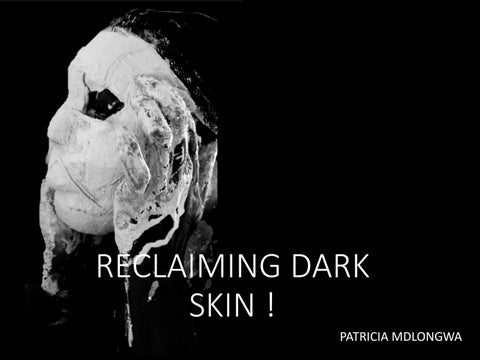
RECLAIMING DARK SKIN ! PATRICIA MDLONGWA
CONTENTS
Artist Statement Introduction Research Process Conclusion Endnotes List of Illustrations List of Sources CV
1
ARTIST’S STATEMENT My work is to recognise and celebrate the versatility of dark skin toned women and their innate beauty, while empowering them to embrace the natural dark skin that they are in. Reclaiming Dark Skin concerns an exploration of my traumatic, disadvantaged childhood and the tensions that surrounded my dark skin tone. I use yellow throughout my works, as a way of speaking to the light skinned who are normally referred to as “yellow bones�, and to echo the fact that in all essence, we are all the same beyond the surface facades of skin tones.
2
INTRODUCTION I have been subjected to all kinds of cruel remarks from my family and fellow black sisters who are light skin toned. The root of my personal experiences stems from my mother who was a ‘yellow bone’, a colloquial term used to refer to a light skin toned black person. Having married herself to a very dark man, it meant that her children were of mixed skin tones. My brother and I were the ‘unfortunate’ ones being dark skin toned. This obviously did not go down well with my ‘yellow bone’ mother who would have preferred all her children to resemble her skin tone. This caused her to develop resentment towards her dark children and develop favouritism towards my light skin toned siblings. She allowed them to get away with so many things, and they got little favours too. She called them ‘my Magkoas’, a Sotho word meaning my white people while we were called ’mnyamane’,
• a Zulu derogative term for someone who is very dark. My siblings also did not receive whippings from my parents as punishment, in fear that the whip marks would show on their skin. They got the best treatment which made us the dark one’s selfhating, and secretly desiring for that light skin tone and to be called ‘white ones’ too.
• As a negative racial stereotype of colonial history which had a significant role in shaping attitudes of black people at those times, a lot of current beauty standards are based on a particular type of beauty which prefers a type of white race femininity, hence the use of long straight artificial hair pieces, ironing or straightening of hair or features or the preference of features that conform to Western beauty norms which encourage the use of plastic surgery or nose jobs. 3
RESEARCH
• I am influenced by Kerry James Marshall whose works concern the throughout art history. tradition of Western painting and erasure of black bodies. Although he differs in that his experiences and works is often related to race were he addresses black beauty, black power movements, politically & socially invisibility of blacks. My works focuses on the celebration and embracing of dark skin tones within the ‘black’ ethnic community. The main characteristic of Marshall’s work is the extreme blackness of his figures in which he depicts negative connotations associated with darkness. My use of the extreme blackness in some of my works is my way of visually representing the dark skin in awe, celebrating and being comfortable in it.
• Marshall mostly uses paint and installation as a media for his works, while I’ve negotiated my childhood trauma and the present by means of installation and photography, of dark skin toned black women. • I also relate to Zanele Muholi’s works and her use of the photography media, using extreme dark figures. Muholi’s works is of similar thematic concern on discrimination, although hers is on race, gender and sexuality while I focus on discrimination by fellow ‘blacks’ over skin tones.
4
PROCESS I wish to tell my family story of favouritism shown to my siblings through an installation which will include the use of photography as my medium which will allow me to use Photoshop and to play with light and dark effects to subvert the snap chat filters, by creating photos of dark skin toned people darker than the expected normal tones, as a way of reclaiming dark skin. My work is a photo series to reclaim beauty standards for dark skinned women who have been marginalised by society. The series feature my dark skinned friends, neighbours, cousins and myself. 5
Part of my experimental processes where I’ve used various media and surfaces
6
8
• Process A collage of Images, of my exhibition installation ,experimental processes and of my photograph manipulation processes
1
9
CLICK
Figure 1. UNAPOLOGETICALLY… (2020) Sugar paper. Heavy weight 330gsm matt coated 297X420mm 7
Figure 2. MELANIN GODDESS(2020) sugar paper heavy weight 330 gsm matt coated 297 X 420MM
8
CLICK
Figure 3. No such thing as ‘ TOO BLACK ’2020) Sugar paper .heavy weight 330gsmmatt coated 297X420mm 9
10
11
Figure 4. SISTERHOOD.(2020) Sugar paper, heavy weight 330gsm Matt coated 420 X 594mm
Figure 5. Dark girls rock.(2020) Sugar paper. Heavy weight 330gsm Matt coated 420 X 594 mm 12
CLICK
Figure 6. That Melanin Though! (2020) sugar paper Heavy weight matt 330gsm 594841 mm
13
CLICK
Figure 7. MOCHA (2020) Sugar paper. Heavy weight 330gsm Matt coated 420 X 594 mm
14
CLICK
Figure 8. Medium Roast (2020) Sugar paper. Heavy weight 330gsm Matt coated 420 X 594 mm
16
CLICK
Figure 9. Black Brew.(2020) Sugar paper. Heavy weight 330gsm Matt coated 420 X 594 mm 17
CLICK
Figure 11. DIPPED IN CHOCOLATE (2020) Sugar paper heavy weigh 330gsm Coated in matt 297 X 542mm
Figure 10. BRONZED IN ELEGANCE (2020) Sugar paper heavy weight 330gsm Coated in matt 297 X 542 mm 18
Figure 12 Enamelled with grace…(2020) Sugar paper. Heavy weight 330gsm Coated in matt 297 X 420 mm
Figure 13. PHENOMENAL WOMEN (2020) Sugar paper. Heavy weight 330 gsm Coated in matt 297 X 420 mm 19
ACKNOWLEDGEMENTS
• I wish to thank my sons and dearest friends Nonhlanhla Maganga, David Chinyama, Lee-Ann Jurgens and Hammond Sibanda who constantly supported and believed in my vision and my dream. Without them this exhibition would not have been possible. To my guardian angels, thank you too.
• SPECIAL THANK YOU TO:
• • • • • • • • • • • •
My lecturers for mentoring me Dr Gwen Miller Kabelo Maja Andrew Smith Graphic Design & Layout Mathias Vinyu-3rd Edge Creative www.3rdedge.co.za|Tell:073090068 Photography Printing Credits Dorette Labutte-Outdoor Photo Waterkloof Glen, PTA 0127613700 Models Effiel Sibanda, Primrose Kaope, Doris Kaunda, Nonhlanhla Maganga, Lilet Ndlovu, Monalisa Phiri, Charity and Zodwa
20
ENDNOTES https://www.google.com/amp/s/www.teglobeandmail.com/amp/life/fashion-and beauty
http://www.nytimes.com/the racial bias built into photography
http://www.documentjournal.com/kerry James Marshall created comic strip with black characters to show “it can be done”. BIBLIOGRAPHY Irvin N.2010.The History of White people .W.W.Norton and Company, United States
21
CV PROFFESSIONAL EXPERIENCE NAM[JOB TITLE, COMPANY E] Grade 12 Visual Art teacher, Grades 8 &9 Creative Arts teacher, Dinwiddie High School [Dates from 2004 -to Date] COMPANY NAME] ‘Acting HOD Art ‘ O’ & ‘A’ Level Art Teacher, Orion Private College COMPANY NAME] Teacher/HOD, Magwegwe Secondary School Job responsibilities: Teaching Cambridge “O” Level Art and English. COMPANY NAME] Teacher/ Acting HOD(English) Tsheli Secondary School EDUCATION UNISA-BVA Studies (Third Level) Hillside Teachers’ College- -Diploma in Education 1. Art and Design (First major) 2. English (second major)
22
LEADERSHIP
Lead Teacher in Creative Arts:GDE (Ekurhuleni District)- Facilitator on the implementation of the new CAPS Curriculum Mentoring of Creative Art student teachers
EXHIBITIONS 2019 : Thami Mminyele Fine Art Awards Listed as one of The Top 100Final Artists: Title : JOURNEY OF A SINGLE MOTHER Media : Installation ,clay 2020 : BVA Third Level Examination Exhibition Title : RECLAIMING DARK SKIN UNISA Pretoria Main Art Gallery
23
Patricia Mdlongwa Email | mdlongwapatz@gmail.com | mobile:+27603138135 26