
LEGISLATIVE REPORT 2026
INTRODUCTION

Dear Members,
This year marks more than the close of a legislative session — it marks the end of a four-year cycle and a pivotal moment for Maryland’s future. The decisions made in November will shape the direction of our state for years to come. But no matter the outcome, one thing remains constant: our commitment to building a stronger, more competitive Maryland. And over the past four years, that work has made an impact.
Together, we have strengthened the voice of Maryland’s business community, elevated the conversation around competitiveness and ensured that policymakers better understand what it takes for businesses — and the communities they support — to succeed. This past legislative session is a clear example of that progress in action.
Our team actively engaged on more than 150 bills, working alongside members and partners across the state to influence outcomes on the issues that matter most to your bottom line. In many cases, that engagement led to meaningful changes — improving proposals, stopping harmful measures and ensuring the business perspective was part of the conversation from the start. That matters. And it’s working.
But this session also reflected a broader trend: too often, policy discussions continue to focus on one-off solutions rather than the full picture of Maryland’s economic competitiveness. At the center of that conversation is affordability. And affordability doesn’t start at the household level — it starts with the cost of doing business.
If Maryland is not a place where businesses can operate competitively, invest with confidence and grow sustainably, we cannot expect to see strong job growth, rising wages or thriving communities. That’s why our focus is clear. Business is not at odds with our communities — it is foundational to them. When businesses succeed, they create jobs, support local economies and strengthen the very communities we all depend on. And increasingly, we are not just responding to proposals, we are helping shape what comes next.
Through efforts like the Accelerate Maryland Economic Forum and our continued work with members, policymakers and partners, we are driving a more forward-looking conversation, one focused on solutions, competitiveness and longterm growth.
This report highlights the work of this past session — the issues we engaged on, the progress we made and what it means for your business. But it also reflects something bigger. Momentum. And a growing alignment around what it will take to move Maryland forward.
Sincerely,
Mary D. Kane President & CEO
Session 2026 for the Maryland Chamber
Your Chamber Works on Every Issue That Affects Your Bottom Line
• 390 bills tracked and analyzed — so you don’t have to
• 126 harmful business-critical bills defeated — from liability caps to regulatory reform
• 30 local chambers engaged in advocacy — amplifying your voice statewide
• 690 business leaders shaping policy through our committees — your seat at the table
• 495 business leaders, policymakers and administrative leaders involved in Meet the State, Chamber Advocacy Day and Maryland Business Outlook — direct influence and advocacy during session
2026 Vetoed Bills
While the Maryland Chamber was successful in advocating against and defeating numerous proposals that would have negatively impacted Maryland’s business climate, we also submitted veto requests to Governor Moore on two pieces of legislation following the 2026 legislative session.
The first, House Bill 862/Senate Bill 156 – Railroads – Required Crew for Movement of Freight, would have required freight trains operating in Maryland to maintain a minimum two-person crew. The Chamber raised concerns that the legislation could increase costs, disrupt interstate freight operations, undermine investments in Maryland’s transportation infrastructure, and conflict with federal authority over rail safety and operations. Governor Moore ultimately vetoed the legislation, citing federal preemption concerns, legal issues surrounding the bill’s contingency provision, and costs to the State.
The second, House Bill 413/Senate Bill 417 – Maryland Worker Freedom Act, prohibits employers from taking adverse action against employees who decline to attend meetings concerning religious or political matters. The Chamber requested a veto due to concerns that the bill’s broad definition of political matters could restrict employers’ ability to communicate with employees about legislation, regulations, and public policy issues affecting their businesses, while also creating legal uncertainty and increased litigation risk. Governor Moore signed the legislation into law on April 28.
1,008
1,646
Tracked by the Chamber
Supported by the Chamber
Business Regulations & Operations
This policy committee looks at issues that benefit the employer-employee relationship and allow businesses to be competitive with their workforce. They address regulatory issues affecting daily operational activities and support legislation that allows market force principles to work in the state’s economy.
House Bill 103
Consumer Protection – Consumer Contracts – Prohibited Waivers
MD Chamber Position: Support with Amendment
MD Chamber Policy Committee: Business Regulations & Operations
Final Status: Approved by the Governor – Chapter 308
House Bill 103 (HB 103) prohibits consumer contracts from including provisions that waive, limit, impair, or disclaim certain remedies available under federal or Maryland law, including statutory damages, punitive damages, declaratory relief, and injunctive relief. The bill also expands existing protections against contractual provisions that shorten the period for consumers to bring legal claims. A violation may constitute an unfair, abusive, or deceptive trade practice under Maryland’s Consumer Protection Act. The bill applies prospectively to consumer contracts entered into on or after the effective date.
The Chamber initially opposed HB 103 due to concerns that the bill could create additional legal uncertainty for businesses by restricting commonly used contractual provisions and increasing litigation risk, but the Chamber ultimately shifted to a “favorable with amendments” position after working with the bill sponsor to secure amendments that alleviated members’ concerns.
HB 103 was passed out of the House and Senate with amendments and signed by Governor Moore.
House Bill 179
Business Regulation – Department of Commerce – Complaint Portal and Annual Report
MD Chamber Position: Support
MD Chamber Policy Committee: Business Regulations & Operations
Final Status: Failed
House Bill 179 (HB 179) would have required the Maryland Department of Commerce to establish a portal on the Department’s website to receive complaints from businesses and individuals who have waited longer than 60 days to receive licenses, forms, certificates, permits, or registrations.
The Maryland Chamber consistently hears from businesses across the state that have experienced prolonged waiting periods for building permits and licenses. Slow permitting and licensing times restrict development and drive investment to other states.
HB 179 did not progress out of the Economic Matters Committee.

Business Regulations & Operations (cont.)
House Bill 193/Senate Bill 213
State Procurement - Transparency and Procedures
MD Chamber Position: Support
MD Chamber Policy Committee: Business Regulations & Operations
Final Status: Approved by the Governor – Chapters 395 & 396
House Bill 193/Senate Bill 213 (HB 193/SB 213) update Maryland’s procurement laws to increase transparency and improve procurement procedures. The legislation requires timely debriefings for unsuccessful offerors upon request, helping businesses better understand procurement decisions and strengthen future proposals.
The legislation also clarifies conflict-of-interest standards for vendors involved in drafting procurement specifications and establishes provisions for equitable contract adjustments when changes in law affect contract performance. HB 193/ SB 213 promotes a more transparent, competitive, and business-friendly procurement environment while maintaining appropriate accountability measures within the state’s procurement system.
HB 193 and SB 213 passed and were signed into law by Governor Wes Moore on May 12.
House Bill 905/Senate Bill 547
Recipients of State and Local Government Funding – Reporting (Buy Maryland Reporting Requirements)
MD Chamber Position: Oppose
MD Chamber Policy Committee: Business Regulations & Operations
Final Status: Failed
House Bill 905/Senate Bill 547 (HB 905/SB 547) would have required state and local governments, and businesses that receive public funds, to submit detailed annual reports to the Comptroller on how those funds are used, including information on contractors, subcontractors, and employment characteristics. The bill also aimed to tie certain reporting requirements to individual and corporate income tax filings, significantly expanding existing disclosure obligations.
The legislation would have imposed new and duplicative reporting obligations on businesses that contract with State and local governments. The expanded disclosures, particularly those linked to tax filings, would have added administrative complexity and compliance costs for employers, especially small and mid-sized businesses, without clear evidence that the additional data collection would meaningfully improve oversight or policy outcomes.
HB 905 and SB 547 were both heard in their respective committees but were not brought up for a vote.

Business Regulations & Operations (cont.)
House Bill 1079
Office of Regulatory Management and State Government Authorizations
MD Chamber Position: Support
MD Chamber Policy Committee: Business Regulations & Operations
Final Status: Failed
House Bill 1079 (HB 1079) sought to establish an Office of Regulatory Management within State government and outlined responsibilities for a director and staff to oversee regulatory activity across agencies. The bill required certain State units to provide regular reports on regulatory actions and permitting processes and directed agencies to develop strategies to simplify applications for permits, licenses, certifications, and registrations. The goal was to improve coordination, transparency, and efficiency in Maryland’s regulatory processes while ensuring agencies regularly review how regulations and permitting systems operate.
This legislation aimed to promote greater transparency by ensuring that information about regulatory actions and processes is regularly reported. When regulatory systems function efficiently, they benefit not only the regulated community but also the agencies responsible for administering them.
HB 1079 was heard in the House Government, Labor, and Elections Committee but did not advance.

House Bill 1596/Senate Bill 763
Maryland Technology Development Corporation – Maryland Growth Initiative – Established
MD Chamber Position: Oppose
MD Chamber Policy Committee: Business Regulations & Operations
Final Status: Approved by the Governor – Chapter 381
House Bill 1596/Senate Bill 763 (HB 1596/SB 763) establishes the Maryland Growth Initiative and a dedicated fund within the Maryland Technology Development Corporation (TEDCO).This legislation will help identify and support promising early-stage technology and life science companies in Maryland as they move from seed-stage development to scaling operations. By focusing on companies that have already received prior support through TEDCO programs, the bill builds on proven investments and ensures that state resources are deployed strategically to maximize return and impact.
HB 1596 and SB 763 were heard in their respective committees. SB 763 passed and was signed into law by Governor Moore on May 12.
Business Regulations & Operations (cont.)
Senate Bill 232
State Procurement – Preferences – Historically Underutilized Business Zone Businesses
MD Chamber Position: Support
MD Chamber Policy Committee: Business Regulations & Operations
Final Status: Failed
Senate Bill 232 (SB 232) aimed to improve Maryland’s state procurement system by aligning state contracting procedures with established federal standards for engaging Historically Underutilized Business Zone (HUBZone) businesses. The bill required units to structure procurement procedures to meet certain federal procurement standards and set overall percentage goals for the proportion of state procurement dollars to be directed to HUBZone certified firms.
Maryland’s business community continues to support inclusive economic growth and equitable access to government contracting opportunities. By expanding participation in state procurement for HUBZone businesses, the Chamber believed that SB 232 would have created a more diverse supplier ecosystem—supporting small and locally-based companies that contribute to job creation, community investment, and long-term economic resilience.
SB 232 was heard in the Senate Budget and Taxation Committee but did not advance.
Senate Bill 905
Maryland Technology Development Corporation
Maryland Advanced Manufacturing Grant Program – Established
MD Chamber Position: Support
MD Chamber Policy Committee: Business Regulations & Operations
Final Status: Approved by the Governor – Chapter 379
Senate Bill 905 (SB 905) establishes the Maryland Advanced Manufacturing Grant Program within the Maryland Technology Development Corporation (TEDCO) to provide capital grants that will assist Maryland companies in expansion within advanced manufacturing capacity through facility upgrades, infrastructure improvements, and specialized equipment.
CHAMBER SUPPORTED PASSED
Programs that support advanced manufacturing not only help individual companies grow but also strengthen the broader innovation ecosystem by encouraging collaboration among researchers, entrepreneurs, and investors. These investments generate significant economic returns and create high-quality jobs that support additional employment throughout the community.
SB 905 was signed into law by Governor Moore on May 12.

Civil Liability
We believe the civil law system should not punish lawful commerce. Issues related to tort reform and civil liability are of interest, including opposing efforts to expand liability and damages that weaken businesses’ defenses.

House Bill 385/Senate Bill 269
Courts and Judicial Proceedings – Evidence – Rebuttable Presumption of Medical Bills
MD Chamber Position: Oppose
MD Chamber Policy Committee: Civil Liability
Final Status: Failed
House Bill 385/Senate Bill 269 (HB 385/SB 269) sought to provide that medical bills from a healthcare provider are authentic, fair, and reasonable based solely on the bill being introduced into discovery, which undermines longstanding evidentiary and burden of proof laws that protect against false or inflated claims. As a result, HB 385 would increase insurance costs, reduce affordability, and further contribute to Maryland’s slow economic growth.
By creating this presumption, the legislation improperly shifts the burden of proof onto defendants, forcing them to disprove of the reasonableness of charges that often do not reflect actual economic harm. This undermines established evidentiary standards and makes inflated or inaccurate claims more difficult to challenge, encouraging higher billed amounts and increasing litigation of abuse.
HB 385 was heard in the House Judiciary Committee and SB 269 was heard in the Senate Judicial Proceedings Committee but neither advanced.
House Bill 466
Civil Actions – Motor Vehicle Accidents Involving Vulnerable Individuals – Comparative Negligence
MD Chamber Position: Oppose
MD Chamber Policy Committee: Civil Liability
Final Status: Failed
House Bill 466 (HB 466) sought to alter Maryland’s current standard of contributory negligence by creating a separate comparative fault standard for motor vehicle accidents if the plaintiff was a vulnerable road user at time of the accident.
The Maryland Chamber has consistently stated its strong support for retaining the common law doctrine of contributory negligence because of the significant, negative economic effects a shift away from this doctrine would have on Maryland’s economic climate. A shift to comparative fault would result in more lawsuits, higher costs, and higher insurance premiums for Maryland’s employers and employees.
HB 466 was heard in the House Judiciary committee and did not receive a vote.
Civil Liability (cont.)
House Bill 476/Senate Bill 474
Civil Actions – Noneconomic Damages – Personal Injury and Wrongful Death
MD Chamber Position: Oppose
MD Chamber Policy Committee: Civil Liability
Final Status: Failed
House Bill 476/Senate Bill 474 (HB 476/SB 474) sought to remove the current cap on noneconomic damages in civil actions in specified personal injury or wrongful death incidents, which would expose businesses to untenable liability.
For employers, this legislation would have caused property and casualty insurance rates and premiums to increase due to the greater liability exposure this higher limit on noneconomic damages would bring. This would have been especially problematic for small businesses with razor-thin revenue margins. The bill would have resulted in more frequent and excessive verdicts, lengthier appeals, and greater financial strain on small businesses and vulnerable communities. The current limits on noneconomic damages help maintain a stable business environment.
HB 476 and SB 474 were heard by their respective committees but did not advance.
Victory Spotlight: Protecting Maryland’s Liability System
The Threat: Lawmakers again proposed eliminating Maryland’s caps on non-economic damages — exposing every business to unlimited financial liability.
The Impact:
• Significantly higher liability exposure for Maryland employers
• Increased insurance premiums
• Larger jury awards and settlement demands
• Higher costs passed on to consumers through increased prices
• A less competitive business climate
Our Response: The Maryland Chamber worked with coalition partners, employers, insurers, healthcare providers, and legislative leaders to educate policymakers on the economic consequences of removing Maryland’s liability protections. The Result: The bill was defeated.
Why This Matters: Maryland’s cap on noneconomic damages remains an important safeguard against excessive liability costs and unpredictable jury awards. Preserving these protections helps maintain a stable legal environment and protects employers and consumers from higher costs.
While this proposal was unsuccessful, efforts to expand liability exposure continue to emerge in Annapolis. The Maryland Chamber remains committed to defending a balanced civil justice system and Maryland’s economic competitiveness.

Civil Liability (cont.)
House Bill 526
Civil Actions – Settlement Agreements – Payment and Release
MD Chamber Position: Oppose
MD Chamber Policy Committee: Civil Liability
Final Status: Failed
House Bill 526 (HB 526) would have required a defendant who agrees to settle a tort claim to provide the plaintiff with a proposed release document within 10 days after the settlement agreement is reached. It would have also required the defendant to pay the settlement amount within 15 days after the settlement agreement is finalized and established the accrual of interest on settlement funds when payment is not made within the required timeframe. The Chamber opposed HB 526 due to the inflexible deadlines and additional penalties and interest obligations that may be beyond a defendant’s control.
HB 526 was heard in the House Judiciary committee but did not receive a vote.
House Bill 712
Civil Actions – Product Liability
Artificial Intelligence Systems
MD Chamber Position: Oppose
MD Chamber Policy Committee: Civil Liability
Final Status: Failed
House Bill 712 (HB 712) would have established a new civil liability framework for artificial intelligence (AI) developers and deployers, creating a cause of action for certain harms allegedly caused by AI systems and authorizing enforcement by the Attorney General.
The bill would have imposed broad and uncertain liability standards on businesses that develop, deploy, or utilize AI technologies, even where existing product liability and consumer protection laws already apply. By creating additional litigation risks and expanding potential legal exposure, HB 712 could have discouraged the adoption and development of AI technologies, increased compliance and insurance costs, and made Maryland less competitive in attracting technology investment and innovation.
HB 712 did not receive a vote following its hearing in the House Judiciary Committee.
House Bill 906
Civil Actions – Punitive Damage Awards Surcharge
MD Chamber Position: Oppose
MD Chamber Policy Committee: Civil Liability
Final Status: Failed
House Bill 906 (HB 906) aimed to lower the standard for imposing punitive damages in Maryland, replacing the “malice” requirement with a “gross negligence” standard, which could allow for punitive damages in cases of simple negligence. This change contradicts Maryland Supreme Court precedent, potentially leading to higher and more frequent punitive damage awards. Additionally, the bill introduced a 50% surcharge on punitive damages, with the funds allocated to public schools, creating an incentive for jurors to award punitive damages for financial gain rather than justice. This could have resulted in excessive awards and negative consequences for Maryland businesses and residents, disrupting the legal system’s balance.
HB 906 was not voted out of the House Judiciary Committee.
Civil Liability (cont.)
House Bill 1105/Senate Bill 979
Statute of Limitations – Civil Suits to Enforce Local Consumer Protection Codes
MD Chamber Position: Oppose
MD Chamber Policy Committee: Civil Liability
Final Status: Failed
House Bill 1105/Senate Bill 979 (HB 1105/SB 979) sought to increase the statute of limitations for prosecuting or enforcing of local consumer protection codes from one year to three years, with the time frame beginning from when local authorities knew or should have reasonably known of a violation.
Extending the statute of limitations, particularly with the clock starting upon local authorities’ awareness of the violation, would lead to prolonged uncertainty for both individuals and businesses, potentially subjecting them to criminal and civil liability for alleged actions that occurred years earlier.
SB 979 did not advance out of committee. HB 1105 passed the House and crossed over to the Senate, where it was amended to apply only to Baltimore City. The bill ultimately ran out of time before the legislative session concluded.
House Bill 1298/Senate Bill 894
Third-Party Litigation Financing – Licensing and Regulation
MD Chamber Position: Support
MD Chamber Policy Committee: Civil Liability
Final Status: Failed
House Bill 1298/Senate Bill 894 (HB 1298/SB 894) would have established a licensing and regulatory framework for third-party litigation financing companies operating in Maryland. The bill included consumer protection provisions related to disclosures, contracts, and oversight by the Office of Financial Regulation.
As third-party litigation financing continues to expand, the bill sought to provide greater transparency and oversight of these arrangements while ensuring they are subject to Maryland’s consumer lending laws. The Maryland Chamber supported amendments to clarify that the bill applied only to consumer litigation financing and would not inadvertently extend to commercial litigation financing arrangements.
HB 1298 and SB 894 were heard in their respective committees but did not advance.

Civil Liability (cont.)

Senate Bill 871
Civil Actions – Punitive Damage Awards – Surcharge
MD Chamber Position: Oppose
MD Chamber Policy Committee: Civil Liability
Final Status: Failed
Senate Bill 871 (SB 871) would have lowered Maryland’s longstanding standard for awarding punitive damages by replacing the existing “actual malice” requirement with a broader gross negligence standard. The bill also would have imposed a 50% surcharge on punitive damage awards, with proceeds directed to Maryland public schools.
By expanding the circumstances under which punitive damages could be awarded, SB 871 would have increased liability exposure and litigation risk for Maryland employers. The bill’s surcharge provision also raised concerns about using punitive damages, which are intended to punish and deter wrongful conduct, as a funding source for state programs. This approach could have encouraged larger punitive damage awards while creating additional legal and constitutional concerns regarding excessive penalties.
SB 871 was heard in the Judicial Proceedings Committee but did not advance.
Cyber & Technology
This policy committee works to promote the development of policies that encourage and facilitate growth, entrepreneurship and innovation within the cyber and technology sectors, an important and growing industry area of Maryland’s economy.
House Bill 120
Moratorium on Construction of New Data Centers – Co–Location and Generation Contingency
MD Chamber Position: Oppose
MD Chamber Policy Committee: Cyber & Technology
Final Status: Failed
House Bill 120 (HB 120) would have prohibited the construction of new data centers in Maryland unless the General Assembly enacted separate legislation governing the co-location of data centers with certain energy generation facilities, including natural gas, nuclear, or small modular reactor facilities.
The bill would have created significant uncertainty for businesses, investors, utilities, and local governments by conditioning new data center development on the enactment of future legislation. Data centers are increasingly mobile investments, and the resulting uncertainty could have redirected capital investment, infrastructure development, and associated job creation to neighboring states with more predictable regulatory environments. The legislation also raised concerns about predetermining future energy policy decisions by linking data center development to specific generation technologies rather than Maryland’s established energy planning and regulatory processes.
HB 120 failed to advance out of the House Environment and Transportation Committee.
House Bill 148
Consumer Protection and Labor Law and Employment – SurveillanceBased Price and Wage Setting
MD Chamber Position: Oppose
MD Chamber Policy Committee: Cyber & Technology
Final Status: Failed
House Bill 148 (HB 148) would have unnecessarily regulated the use of automated systems that are responsibly used to support marketing, pricing, and business practices that enhance consumer experience and market competition.
The bill also sought to establish a private right of action, which would have created untenable liability exposure for businesses and diverted resources from meaningful consumer protection.
HB 148 was heard in the Economic Matters Committee but did not advance.
House Bill 145/Senate Bill 141
Election Law – Election Misinformation, Election Disinformation, and Deepfakes
MD Chamber Position: Support with Amendment
MD Chamber Policy Committee: Cyber & Technology
Final Status: Passed
House Bill 145/Senate Bill 141 (HB 145/SB 141) prohibits a person from knowingly, or with reckless disregard using or disseminating a specified “deepfake” to produce materially false information relating to elections. The Chamber worked with the bill sponsors to secure amendments that removed the concerns of members.
SB 141 was signed by the Governor on May 12.
Cyber & Technology (cont.)
House Bill 152
Consumer Protection – Electronic Funds and Transfers – Regulations (Elder Fraud Prevention Act)
MD Chamber Position: Oppose
CHAMBER OPPOSED FAILED
MD Chamber Policy Committee: Cyber & Technology
Final Status: Failed
House Bill 152 would have authorized the Commissioner of Financial Regulation to adopt consumer protection regulations for financial institutions initiating domestic electronic funds transfers, consistent with protections outlined in 15 U.S.C. § 1693(a)(7).
The Chamber was concerned the bill would alter the treatment of wire transfers under a federal statutory scheme that has produced inconsistent court rulings and remains the focus of ongoing regulatory scrutiny and litigation.
House Bill 152 was heard in the Budget and Taxation committee but did not advance.
House Bill 468
House Bill 382/Senate Bill 571
Commercial Law – Broadband Access Low-Income Consumer Programs (Maryland Broadband)
MD Chamber Position: Oppose
CHAMBER OPPOSED FAILED
MD Chamber Policy Committee: Cyber & Technology
Final Status: Failed
House Bill 382/Senate Bill 571 (HB 382/SB 571) would have placed artificial price controls on the broadband market, resulting in unintended negative consequences. Studies show that price floor, ratesetting types of policies often hurt the consumers they are intending to help. Examples include gasoline price mandates in Hawaii resulting in higher costs for consumers; rent-control markets across the country seeing reduced investment and a lack of housing options; and price caps on interchange fees leading to higher costs and fewer low-income benefits.
HB 382 and SB 571 failed to advance in their respective committees.
Health and Taxation – Digital Social Media Services and Mental Health Care Fund for Children
MD Chamber Position: Oppose
MD Chamber Policy Committee: Cyber & Technology
Final Status: Failed
House Bill 468 (HB 468) would have imposed a digital social media gross revenues tax on annual revenues derived from digital social media services and require the Comptroller to distribute revenue from the tax in a certain manner.
The Chamber was concerned the bill would be difficult to implement for both taxpayers and governments, as well as creating sourcing, privacy, and data storage capacity concerns.
HB 468 was heard by the Ways and Means committee but did not advance. CHAMBER OPPOSED FAILED

Cyber & Technology (cont.)

House Bill 560
Sales and Use Tax and Property Tax – Exemptions for Data Centers – Repeal
MD Chamber Position: Oppose
MD Chamber Policy Committee: Cyber & Technology
Final Status: Failed
House Bill 560 (HB 560) would have repealed Maryland’s existing sales and use tax exemption for qualifying data center equipment, effectively removing a tax incentive that was enacted in 2020 to attract data center investment to the state. Maryland is competing aggressively with neighboring and peer states for data center investment. HB 560 risks positioning Maryland as hostile or uncertain toward data center development at a moment when demand for digital infrastructure is accelerating nationwide. Repealing an incentive shortly after it begins producing results undermines predictability and raises concerns well beyond the data center sector.
HB 560 failed to advance out of the Ways and Means committee.
House Bill 985/Senate Bill 528
Consumer Protection
Video Streaming Services
Loudness of Commercial Advertisements
MD Chamber Position: Support with Amendment
MD Chamber Policy Committee: Cyber & Technology
Final Status: Failed
House Bill 985/Senate Bill 528 (HB 985/SB 528) would have prohibited video streaming services from transmitting commercial advertisements to Maryland consumers at a volume level that is louder than the accompanying video content. The Chamber worked with the bill sponsors to secure important amendments for members that aligned the bill with similar laws in other states.
HB 985 did not advance out of committee. SB 528 advanced out of the Senate but did not advance in the House.
House Bill 992/Senate Bill 655
Electronic Device Producer Responsibility Program – Established
MD Chamber Position: Oppose
MD Chamber Policy Committee: Cyber & Tech
Final Status: Failed
House Bill 992/Senate Bill 655 (HB 992/SB 655) would have imposed significant regulatory, financial, and administrative burdens on companies operating in Maryland. The bill would have established a new producer responsibility framework that shifted the operational and financial obligations for the collection and recycling of electronic devices directly onto manufacturers and sellers. As a result, the bill would have created uncertainty, increased compliance costs, and risked undermining Maryland’s competitiveness in the technology and retail sectors.
HB 992 and SB 655 did not advance out of their respective committees.
Cyber & Technology (cont.)
House Bill 1037/Senate Bill 605
Public Service Commission – Broadband and Voice Over Internet Protocol Service – Study
MD Chamber Position: Oppose
MD Chamber Policy Committee: Cyber & Technology
Final Status: Failed
House Bill 1037/Senate Bill 605 (HB 1037/SB 605) raised serious federal preemption concerns. The Communications Act of 1934, as amended, grants the Federal Communications Commission exclusive authority over interstate and international communications by wire and radio, including satellite communications. State-level utility regulation of satellite broadband operations directly conflicts with long-established federal primacy in this area.
HB 1037 and SB 605 failed to advance out of their respective committees.
House Bill 1089
Consumer Protection – Data Broker Registry – Establishment
MD Chamber Position: Oppose
MD Chamber Policy Committee: Cyber & Technology
Final Status: Failed
House Bill 1089 (HB 1089) attempted to impose sweeping new regulatory burdens on a wide range of companies without delivering meaningful privacy benefits to Maryland residents. Specifically, HB 1089 defined “data brokers” using an overly broad and ambiguous definition that would capture numerous legitimate businesses that maintain direct relationships with customers and use data for routine operational purposes, such as fraud prevention, analytics, and service improvement.
HB 1089 was heard in the Economic Matters committee but did not advance.

House Bill 1100/Senate Bill 782
Telecommunications Infrastructure – Protections
MD Chamber Position: Support
MD Chamber Policy Committee: Cyber & Technology
Final Status: Approved by the Governor – Chapter 546
House Bill 1100/Senate Bill 782 (HB 1100/SB 782) provided practical and targeted safeguards to address risks, by strengthening registration and recordkeeping requirements for certain dealers purchasing telecommunications equipment. Additionally, the bill established meaningful deterrents against the trafficking of stolen infrastructure.
HB 1100 was signed by Governor Wes Moore on May 12.
Cyber & Technology (cont.)
House Bill 1128/Senate Bill 826
Income Tax – Angel Investor Tax Credit for Investments in Emergent Technologies
MD Chamber Position: Support
MD Chamber Policy Committee: Cyber & Technology
Final Status: Failed
House Bill 1128/Senate Bill 826 (HB 1128/ SB 826) directly addressed the gap in capital growth by incentivizing private investment in innovative Maryland companies at a critical stage of development. Additionally, the bill provided clear eligibility criteria and oversight mechanisms to safeguard taxpayer resources, making it a bill that would strengthen business investment throughout Maryland.
HB 1128 and SB 826 failed to pass out of their respective committees.
House Bill 1220/Senate Bill 616
Business Regulations
Data Broker Registry
MD Chamber Position: Oppose
MD Chamber Policy Committee: Cyber & Tech
Final Status: Failed
House Bill 1220/Senate Bill 616 (HB 1220/SB 616) included an overly broad definition of “data broker” that would have created significant unintended consequences for Maryland employers and the broader economy. The bill’s definition of “Data Broker” was overly expansive and risked sweeping in companies that are not data brokers. As drafted, the bill would have applied to a wide range of ordinary businesses that collect or share data as a routine part of providing products and services. As a result, the bill would have effectively subjected many Maryland businesses to new regulatory and fee requirements
HB 1220 and SB 616 failed to pass out of their respective committees.
House Bill 1179
Consumer Protection
Application Store Accountability Act
MD Chamber Position: Support
MD Chamber Policy Committee: Cyber & Technology
Final Status: Failed
House Bill 1179 (HB 1179) would have required app store operators and app developers to undertake certain verification of users and restrict app stores and developers from enforcing certain contracts. The Chamber opposed HB 1179 due to concerns related to the collection of sensitive personal information that could create privacy and cybersecurity risks. HB 1179 was heard in the Economic Matters committee but failed to advance.
House Bill 1250/Senate Bill 827
Consumer Protection and Product Liability – Chatbots
MD Chamber Position: Oppose
MD Chamber Policy Committee: Cyber & Tech
Final Status: Failed
House Bill 1250/Senate Bill 827 (HB 1250/SB 827) would have held the providers of chatbots automatically liable for user injuries—even when the provider did not directly supply the chatbot to the individual user. That standard would have effectively created boundless liability for unpredictable interactions with general-purpose technology. In practice, this framework may have pushed providers to withdraw from Maryland or significantly curtail features, limiting residents’ access to AI tools that support education, accessibility, productivity, and access to information.
HB 1250 and SB 827 failed to pass out of their respective committees.
Cyber & Technology (cont.)
House Bill 1261
Consumer Protection
Artificial Intelligence Toys
MD Chamber Position: Oppose
MD Chamber Policy Committee: Cyber & Tech
Final Status: Failed
House Bill 1261 (HB 1261) attempted to moderate that AI toys must incorporate age-appropriate filters and content moderation tools. However, numerous content filtering and blocking solutions — both free and subscription-based — are already available to consumers. These tools, offered as standalone services or integrated features across various technologies, provide families with meaningful options to manage access to inappropriate or unlawful content.
The chamber found that the proposed definition of “Artificial Intelligence Toy” is too expansive. By including “any toy, device, or product sold to a consumer in the state that employs artificial intelligence, machine learning…,” the language risks capturing a far broader range of products than was likely intended.
HB 1261 failed to pass out of the House Economic Matters committee.
House Bill 1584
Delivery Network Companies and Svcs.
Regulations and Transparency
MD Chamber Position: Oppose
MD Chamber Policy Committee: Cyber & Tech
Final Status: Failed
House Bill 1584 (HB 1584) would have created unnecessary and unprecedented barriers for Maryland residents who rely on flexible delivery work to supplement their income. Additionally, the bill would have created new bureaucratic hurdles by requiring individuals who facilitate app-based deliveries to obtain licensing through the Maryland Public Service Commission.
HB 1584 failed to pass out of the House Economic Matters committee. CHAMBER OPPOSED FAILED
House Bill 1317
State Government
Data-Sharing Agreement and Personal Identifying Information
Prohibition and Reporting (Maryland
Data Privacy and Federal Shield Act)
MD Chamber Position: Oppose
MD Chamber Policy Committee: Cyber & Tech
Final Status: Failed
House Bill 1317 (HB 1317) would have prohibited state agencies, local governments, and their employees generally from providing personal identifying information to the federal government, including federal law-enforcement agencies. The Chamber opposed HB 1317 due to concerns with the bill’s broad scope.
HB 1317 failed to pass out of the Government, Labor, and Elections committee.
House Bill 1475
Consumer Protection
Dynamic Pricing Disclosure and Prohibition on Rent-Setting
MD Chamber Position: Oppose
MD Chamber Policy Committee: Cyber & Tech
Final Status: Failed
House Bill 1475 (HB 1475) would have broadly regulated the use of algorithmic or data-driven pricing by merchants selling goods or services to Maryland consumers by requiring businesses to provide a conspicuous disclosure when a price is set using an algorithm that relies on a consumer’s personal data. The bill as drafted would have imposed sweeping new requirements and created significant unintended consequences for Maryland businesses and consumers alike.
HB 1475 failed to pass out the House Economic Matters committee.
Cyber & Technology (cont.)
CHAMBER
House Bill 1562
Consumer Protection Telecommunications Service Outage Automatic Credit (Auto. Telecomm. Service Outage Act)
MD Chamber Position: Oppose
MD Chamber Policy Committee: Cyber & Tech
Final Status: Failed
House Bill 1562 (HB 1562) would have required providers to automatically issue credits to customers during service outages and would have classified any failure to do so as a violation of the Maryland Consumer Protection Act. Telecommunications networks are complex infrastructure systems that are vulnerable to a wide range of disruptions outside the control of service providers, including severe weather, utility power failures, construction damage to fiber lines, equipment vandalism, and other third-party actions. As a result, HB 1562 would have effectively punished companies for circumstances they did not cause and could not reasonably prevent.
HB 1562 failed to pass out of the Environment and Transportation committee.
Senate Bill 932
Consumer Protection – Social Media Platforms Display of User Location
MD Chamber Position: Support with Amendment
MD Chamber Policy Committee: Cyber & Tech
Final Status: Failed
Senate Bill 932 (SB 932) would have required social media platforms to display the general geographic location of adult users to other users in Maryland. Although described as a “general” location, this requirement would have nonetheless compelled platforms to publicly disclose sensitive information about individuals who may have legitimate reasons to keep their location private.
SB 932 failed to advance out of the Senate Finance committee.
House Bill 1595/Senate Bill 427
Property Taxes – Authority of Counties to Establish a Subclass and Set Special Rate for Personal Property of Data Centers
MD Chamber Position: Oppose
MD Chamber Policy Committee: Cyber & Tech
Final Status: Failed
House Bill 1595/Senate Bill 427 (HB 1595/SB 427) would have authorized counties to raise special subclasses of taxes on data center personal property, which would disincentivize investment. The bill would have reduced the state’s competitiveness for data centers and created uncertainty in Maryland’s tax climate by reducing competition, fragmenting county subclasses, and discouraging development.
HB 1595 and SB 427 failed to pass out of their respective committees.
Senate Bill 569
Commercial Law - Online Data Privacy Limits on Data Collection
MD Chamber Position: Oppose
MD Chamber Policy Committee: Cyber & Tech
Final Status: Failed
Senate Bill 569 (SB 569) would have amended Maryland’s existing online privacy framework to impose stricter requirements on data collection practices. Additionally, the bill would have required consumer consent before data could be used for advertising purposes. The Chamber opposed the bill due to concerns with compliance costs for businesses and the unintended negative consequences for business and consumers stemming from changes to Maryland’s existing regulatory framework that already provides consumers with robust protections.
SB 569 failed to pass out of committee.
Maryland Chamber of Commerce
Cyber & Technology (cont.)

Senate Bill 697
Election Law – Actions to Influence an Election – Social Media Platform Algorithms and Bots Purchased by Foreign Nationals
MD Chamber Position: Support with Amendment
MD Chamber Policy Committee: Cyber & Technology
Final Status: Failed
Senate Bill 697 (SB 697) would have established a rebuttable presumption that a social media platform has made an independent expenditure to a certain candidate if the social media platform knowingly and purposefully alters its algorithm to amplify certain political content for the benefit of the candidate; prohibiting a foreign national from using a bot to publish, distribute, or disseminate campaign material or artificially amplify political content to users of an online platform for a certain purpose. The Maryland Chamber requested the alteration of certain definitions such as “social media platform”.
SB 697 passed out the Senate but did not advance in the House.
Education & Workforce Development
The Education and Workforce Development policy committee promotes policies that foster an educational and vocational system focused on developing, retaining and attracting a more globally competitive workforce.
House Bill 297/Senate Bill 70
Adult Education – High School Diploma Pathways – MDiplomaWorks Pathway
MD Chamber Position: Support
MD Chamber Policy Committee: Education & Workforce Development
Final Status: Approved by the Governor – Chapters 168 & 169
House Bill 297/Senate Bill 70 (HB 297/SB 70) established the MDiplomaWorks program, creating a fourth pathway for adult learners to earn a Maryland high school diploma by demonstrating proficiency through a combination of workforce experience, industry-recognized credentials, and academic achievement.
The legislation expands opportunities for Maryland adults who have not earned a high school diploma to obtain a credential valued by employers while building on skills and experience gained in the workforce. By creating an additional pathway to a diploma, HB 297 helps strengthen Maryland’s workforce pipeline, supports economic mobility, and increases access to career advancement opportunities.
HB 297 and SB 70 were signed by Governor Moore on April 28.
House Bill 360/Senate Bill 483
Criminal Procedure – Automated Expungement (Clean Slate Act of 2026)
MD Chamber Position: Support
MD Chamber Policy Committee: Education & Workforce Development
Final Status: Failed
House Bill 360/Senate Bill 483 (HB 360/SB 483) would have established an automated process to expunge eligible criminal records, reducing administrative barriers for individuals seeking employment and other opportunities.
By streamlining the expungement process, the bill would have expanded access to employment opportunities for eligible individuals while helping employers address workforce shortages through a larger pool of qualified workers. The legislation maintained public safety protections by limiting automatic expungement to eligible cases, balancing workforce participation and economic opportunity with public safety considerations.
HB 360 did not advance out of the House Judiciary Committee. SB 483 passed the Senate with amendments but did not advance after crossing over to the House.

Education & Workforce Development (cont.)

House Bill 461/Senate Bill 300
Economic Development – Rural Readiness Program and Rural Maryland Capacity Building Fund Establishment
MD Chamber Position: Support
MD Chamber Policy Committee: Education & Workforce Development
Final Status: Approved by the Governor – Chapter 543
House Bill 461/Senate Bill 300 (HB 461/SB 300) established the Rural Readiness Program and the Rural Maryland Capacity Building Fund to help rural communities strengthen their ability to pursue economic development opportunities, strategic planning initiatives, and state and federal grant funding.
Many rural communities face staffing and resource constraints that can make it difficult to compete for economic development funding and undertake long-term planning efforts. By investing in local capacity and regional collaboration, HB 461 helps support job creation, infrastructure improvements, business growth, and economic competitiveness in rural regions of Maryland.
HB 461 was signed by Governor Moore on May 12.
House Bill 507/Senate Bill 305
Qualifying Nonprofit Organizations – Incarcerated Individual Training and Reentry Grant Fund – Extension
MD Chamber Position: Support
MD Chamber Policy Committee: Education & Workforce Development
Final Status: Approved by the Governor – Chapter 403
House Bill 507/Senate Bill 305 (HB 507/SB 305) extended funding for the Incarcerated Individual Training and Reentry Grant Fund through Fiscal Year 2029. The program supports qualifying nonprofit organizations that provide workforce training, credentialing, and reentry services to formerly incarcerated individuals.
The legislation helps address workforce shortages by expanding access to job training and employment opportunities for individuals reentering the workforce. By supporting programs that connect participants with in-demand skills and career pathways, SB 507 helps strengthen Maryland’s talent pipeline while promoting successful reentry and economic mobility.
SB 305 passed and was signed by Governor Moore on May 12.
Education & Workforce Development (cont.)

House Bill 1070/Senate Bill 539
Department of Social and Economic Mobility – Workforce Opportunities Grant
MD Chamber Position: Support
MD Chamber Policy Committee: Education & Workforce Development
Final Status: Failed
House Bill 1070/Senate Bill 539 (HB 1070/SB 539) would have established a Workforce Opportunities Grant Program within the Department of Social and Economic Mobility to support job fairs and other workforce engagement initiatives that connect job seekers with employment opportunities across Maryland.
At a time when workforce access remains a significant challenge for employers, the bill sought to strengthen connections between businesses and job seekers by supporting local workforce events and employment outreach efforts. The Maryland Chamber has seen firsthand the value of these initiatives through successful job fairs and workforce engagement events that have connected employers with qualified candidates and, in some cases, resulted in same-day hiring. By helping individuals access available jobs and employers identify qualified workers, HB 1070/SB 539 aimed to support workforce participation, economic mobility, and business growth throughout the state.
HB 1070 passed out of the House but did not advance once it reached the Senate. SB 539 was not brought up for a vote in the Finance Committee.
House Bill 1259
Zoning Authorities – Operation of Family Child Care Homes – Prohibitions and Requirements
MD Chamber Position: Support
MD Chamber Policy Committee: Education & Workforce Development
Final Status: Failed
House Bill 1259 (HB 1259) would have clarified existing law to ensure that local zoning authorities could not impose additional prohibitions or requirements on licensed family child care homes beyond those established by the State. The bill sought to reinforce legislation enacted in 2025 that removed barriers to the operation of family child care homes and expanded access to child care in Maryland. Access to reliable and affordable child care remains critical to workforce participation and economic growth. By providing greater certainty for family child care providers, HB 1259 would have helped support the availability of flexible child care options for working families and employers across the state.
HB 1259 passed the House and was heard in the Senate Education, Energy, and the Environment Committee, where an amendment was adopted to establish a quarter-mile separation requirement between family child care homes. The bill subsequently passed the Senate as amended and was sent to a conference committee two calendar days before Sine Die. HB 1259 ultimately failed to receive final passage before the conclusion of the legislative session.
Education & Workforce Development (cont.)
Senate Bill 869
Economic Development – Maryland Workforce Launch Pilot Program – Establishment
MD Chamber Position: Support
MD Chamber Policy Committee: Education & Workforce Development
Final Status: Approved by the Governor – Chapter 535
Senate Bill (SB 869) established the Maryland Workforce Launch Pilot Program within the Department of Commerce to provide customized, no-cost workforce training through partnerships with community colleges and support the recruitment and expansion of strategic industries in Maryland.
The program aligns workforce training with employer needs by helping businesses access tailored training solutions and a skilled talent pipeline. By leveraging Maryland’s community college system and coordinating efforts through the Department of Commerce, SB 869 helps address workforce shortages, support business growth, and prepare Marylanders for in-demand careers.
SB 869 was signed by Governor Moore on May 12.
Energy & Environment
This policy committee advocates for energy and environmental policies that support a reliable, affordable and diverse energy portfolio, promote sustainability and innovation, and preserve Maryland’s natural resources. The committee works to ensure that environmental and climate goals are advanced in tandem with the state’s economic and competitiveness needs.
House Bill 66/Senate Bill 373
Environment – Regional Greenhouse Gas Initiative – Withdrawal (Restoring Energy Freedom Act)
MD Chamber Position: Support
MD Chamber Policy Committee: Energy & Environment
Final Status: Failed
House Bill 66/Senate Bill 373 (HB 66/SB 373) would have required the Governor to withdraw Maryland from participation in the Regional Greenhouse Gas Initiative (RGGI).
Participation in RGGI has placed Maryland under a multistate carbon cap-and-trade regime, limiting state flexibility over energy and environmental policy while imposing compliance costs that ultimately affect consumers and businesses. Withdrawing from RGGI would allow Maryland to prioritize locally tailored solutions to meet environmental goals without ceding control to a regional compact. This is especially important for ensuring that energy reliability and affordability remain at the forefront of policy discussions for families, employers, and ratepayers across the state.
HB 66 and SB 373 failed to advance out of their respective committees.
House Bill 331/Senate Bill 342
Maryland Beverage Container Recycling Refund and Litter Reduction Program
MD Chamber Position: Oppose
MD Chamber Policy Committee: Energy & Environment
Final Status: Failed
CHAMBER OPPOSED FAILED
House Bill 331/Senate Bill 342 (HB 331/SB 342) would have established the Maryland Beverage Container Recycling Refund and Litter Reduction Program to increase the reuse and recycling of beverage containers. A producer would be prohibited from selling, offering for sale, or distributing or importing into the State a redeemable beverage container unless the producer is registered with the Maryland Department of the Environment, pays a fee, and is part of a beverage container stewardship organization.
HB 331/SB 342 would have imposed significant new costs and operational burdens on producers, distributors, retailers, and consumers while duplicating recycling reforms that Maryland recently enacted through its Extended Producer Responsibility (EPR) program. The legislation would have required many retailers to serve as redemption locations, creating additional space, equipment, staffing, and administrative requirements. Concerns were also raised regarding implementation costs, fraud prevention, and the potential impact on small businesses and underserved communities.
HB 331 and SB 342 failed to advance out of their respective committees.

Energy & Environment (cont.)
House Bill 79
Climate Solutions Affordability Act of 2026
MD Chamber Position: Support
MD Chamber Policy Committee: Energy & Environment
Final Status: Failed
House Bill 79 (HB 79) would have specified that requirements under the Climate Solutions Now Act of 2022 (CSNA) must be carried out to the extent economically practicable. The CSNA established the most stringent climate goal in the nation – a 60% reduction in greenhouse gas emissions below 2006 levels by 2031 and net-zero by 2045. Since it’s passage, Maryland businesses have faced significant compliance challenges related to the standards established in the CSNA.
HB 79 introduced necessary economic practicability considerations into climate and energy requirements for businesses and public entities.
HB 79 failed to advance out of the Environment and Transportation committee.
House Bill 345/Senate Bill 341
Public Utilities – Solar Energy Generating Systems and Solar Renewable Energy Credits (Affordable Solar Act)
MD Chamber Position: Letter of Information
MD Chamber Policy Committee: Energy & Environment
Final Status: Failed
House Bill 345/Senate Bill 341 (HB 345/SB 341) would have significantly restructured Maryland’s Renewable Portfolio Standard and Solar Renewable Energy Credit (SREC) program by expanding compliance obligations, modifying how solar renewable energy credits are valued, and establishing new procurement and compliance requirements for certain electric utilities. The legislation would have replaced key marketbased components of the existing SREC program with a more administratively driven framework, granting the Public Service Commission greater authority over incentive structures and credit pricing. Questions were raised regarding the bill’s implementation, its potential impact on electricity costs, and whether the proposed changes would improve affordability for Maryland households and businesses while maintaining a competitive market.
HB 345 and SB 341 failed to advance out of their respective committees.
House Bill 395/Senate Bill 371
Water Pollution Control – Discharge Permits – Concentrated Animal Feeding Operations
MD Chamber Position: Support
MD Chamber Policy Committee: Energy & Environment
Final Status: Approved by the Governor –Chapters 253 & 254
CHAMBER SUPPORTED PASSED
House Bill 395/Senate Bill 371 (HB 395/SB 371) repeals a requirement that a person obtain a concentrated animal feeding operation (CAFO) general discharge permit before beginning construction of a new CAFO facility.
The legislation addresses an unintended consequence of delays in the renewal of Maryland’s general CAFO permit, which had effectively prevented the construction of new or replacement facilities. The bill allows construction and financing activities to proceed while permit applications are pending, provided that no operation may begin and no animals may be placed until all required permit coverage has been issued. Environmental standards, public participation requirements, and regulatory oversight remain unchanged.
HB 395 and SB 371 were signed into law by Governor Moore on April 28.
Energy & Environment (cont.)
House Bill 517
Emission Standards, Ambient Air Quality Standards, and Solid Waste Management – Local Authority
MD Chamber Position: Letter of Information
MD Chamber Policy Committee: Energy & Environment
Final Status: Failed
House Bill 517 (HB 517) would have altered the authority of political subdivisions to adopt ordinances, rules, or regulations related to emission and ambient air quality standards under certain conditions.
The Maryland Chamber believes that policies affecting infrastructure and environmental standards should be managed at the state level to maintain a consistent and predictable regulatory framework for both businesses and residents. A statewide approach prevents the complexity and uncertainty of varying local regulations that could increase costs, cause delays, and hinder the development of critical infrastructure.
HB 517 was heard in the House Environment and Transportation Committee but was not given a vote.
House Bill 540
Investor-Owned Electric, Gas and Gas and Electric Companies – Utility Rate Changes (Public Service Company Transparency Act)
MD Chamber Position: Oppose
MD Chamber Policy Committee: Energy & Environment
Final Status: Failed
House Bill 540 (HB 540) would have required investor-owned electric and gas utilities to provide advance notice to customers before initiating certain rate proceedings, include additional rate-related disclosures in customer communications, and distribute an annual rate report developed in consultation with the Public Service Commission and the Office of People’s Counsel.
While intended to improve transparency for ratepayers, the bill would have imposed significant new administrative and mailing requirements on utilities, the costs of which would ultimately be borne by customers. Questions were also raised regarding the bill’s implementation, including whether it would apply to a broad range of rate adjustments beyond traditional base rate cases and whether certain notice requirements could be met under existing Public Service Commission procedures.
HB 540 failed to advance in the Environment and Transportation Committee.
Energy & Environment (cont.)

House Bill 572/Senate Bill 432
Attorney General Actions and Climate Crimes Accountability Fund (Climate Crimes Accountability Act)
MD Chamber Position: Oppose
MD Chamber Policy Committee: Energy & Environment
Final Status: Failed
House Bill 572/Senate Bill 432 (HB 572/SB 432) would have authorized the Attorney General to investigate and pursue legal actions against certain entities for conduct alleged to have contributed to climate change and established a Climate Crimes Accountability Fund.
The legislation raised significant concerns regarding liability for the lawful production and sale of energy products, particularly where emissions result from the actions of third parties. Additional concerns were raised regarding federal preemption, the potential for costly and prolonged litigation, and the economic impact of imposing climate-related liability on a limited group of companies while Maryland continues to rely on those industries for energy production, transportation, manufacturing, and economic activity. The bill also could have increased costs for Maryland households and businesses through higher energy and consumer prices.
HB 572 and SB 432 failed to advance out of their respective committees.
House Bill 674/Senate Bill 270
Public Service Commission – Full Costs and Benefits Analysis of Sources of Electricity Generation
MD Chamber Position: Support with Amendment
MD Chamber Policy Committee: Energy & Environment
Final Status: Failed
House Bill 674/Senate Bill 270 (HB 674/SB 270) would have directed the Maryland Public Service Commission (PSC) to conduct a comprehensive analysis of the costs and benefits associated with various electricity generation sources and report its findings and recommendations to the General Assembly. The bill required the evaluation of specified generation resources using a full system cost methodology designed to assess impacts on reliability, affordability, and the system’s overall performance.
The legislation would have supported a more data-driven approach to energy policy by providing policymakers with additional information regarding the costs, benefits, and tradeoffs associated with different generation resources. The Chamber sought an amendment to ensure the analysis included solar energy, providing a more complete assessment of generation options and their impacts on Maryland ratepayers, businesses, and the electric grid.
HB 674 did not pass out of committee. SB 270 passed out of the Senate but failed to advance out of the House Environment and Transportation Committee.
Energy & Environment (cont.)
House Bill 723/Senate Bill 598
Electric Companies – Cost Containment Plans – Requirement (Securing Affordable, Valuable Investments in Next Generation Grid Solutions) (SAVINGS Act)
MD Chamber Position: Oppose
MD Chamber Policy Committee: Energy & Environment
Final Status: Failed
House Bill 723/Senate Bill 598 (HB 723/SB 598) sought to require electric companies to develop cost containment plans designed to reduce peak electric system load by 20% by 2030 through the use of non-wires alternatives, distributed energy resources, and other advanced grid technologies.
HB 723/SB 598 would have established aggressive load reduction requirements while relying on factors that are often outside the direct control of electric utilities, including electrification trends, population growth, and regional transmission planning decisions. Concerns were also raised that the bill could increase compliance costs, create additional financial risks for utilities, and place upward pressure on electric rates at a time when Maryland businesses and residents are already facing rising energy costs.
Neither HB 723 nor SB 598 received further action following their committee hearings.
House Bill 796
Recycling – Prohibition on the Chemical Conversion of Plastic
MD Chamber Position: Oppose
MD Chamber Policy Committee: Energy & Environment
Final Status: Failed
House Bill 796 (HB 796) would have altered Maryland’s definition of recycling to exclude certain chemical conversion processes and prohibited the construction of facilities that convert plastic into fuel or feedstock using those technologies. The legislation effectively would have banned advanced recycling technologies, which convert post-use plastics into new products and support sustainability goals.
HB 796 conflicted with recommendations from the Extended Producer Responsibility Advisory Council to expand technologies that improve recycling rates and compliance. The legislation would have limited innovation, investment, and economic opportunities associated with advanced recycling technologies while reducing Maryland’s ability to achieve its waste reduction and circular economy objectives.
HB 796 was heard in the House Environment and Transportation Committee but did not receive a vote.
HB 958 did not advance out of the House Environment and Transportation Committee. CHAMBER
House Bill 958
Natural Gas – Connection and Line Extension Discounts and Payment Plans
MD Chamber Position: Support
MD Chamber Policy Committee: Energy & Environment
Final Status: Failed
House Bill 958 (HB 958) would have prohibited the Maryland Public Service Commission from restricting natural gas utilities from offering discounts or payment plans, commonly known as line extension allowances, to customers seeking to connect to the natural gas distribution system. The legislation would have preserved a long-standing ratemaking practice that allows the costs of certain infrastructure extensions to be recovered over time rather than requiring customers to pay the full cost upfront. By maintaining access to line extension allowances, the bill would have helped reduce barriers to energy infrastructure connections for businesses, housing developments, and communities while preserving customer choice and state regulatory flexibility.
Energy & Environment (cont.)
House Bill 970
Renewable Energy Portfolio Standard – Nuclear Energy and Renaming
MD Chamber Position: Support
MD Chamber Policy Committee: Energy & Environment
Final Status: Failed
House Bill 970 (HB 970) would have renamed Maryland’s Renewable Energy Portfolio Standard as the Clean Energy Portfolio Standard and expanded eligible compliance options by recognizing nuclear energy as a qualifying clean energy resource.
The legislation would have broadened the range of carbon-free resources available to meet Maryland’s existing clean energy and emissions reduction requirements. By including nuclear energy as an eligible compliance resource, the bill would have increased flexibility within the State’s clean energy framework while supporting grid reliability and helping to moderate the costs associated with achieving Maryland’s energy and climate goals.
HB 970 did not advance out of the House Environment and Transportation Committee.
House Bill 1022/Senate Bill 868
PFAS Chemicals – Product Phase Out and Registration Requirements
MD Chamber Position: Oppose
MD Chamber Policy Committee: Energy & Environment
Final Status: Failed
CHAMBER OPPOSED FAILED
House Bill 1022/Senate Bill 868 (HB 1022/SB 868) would have prohibited the sale of a wide range of products containing intentionally added per- and polyfluoroalkyl substances (PFAS) and established new registration, reporting, and fee requirements for manufacturers selling covered products in Maryland.
The proposal adopted a broad, one-size-fits-all approach to PFAS regulation by treating thousands of distinct PFAS chemistries the same regardless of their risk profile or intended use. The bill also imposed aggressive compliance timelines, significant reporting obligations, and substantial penalties, creating challenges for manufacturers navigating complex global supply chains. Maryland has already enacted targeted PFAS regulations, and this approach would have expanded compliance costs and regulatory complexity without a corresponding risk-based framework.
HB 1022 and SB 868 did not receive a vote following their hearings.
House Bill 981
Investor-Owned Public Service Companies – Base Rate Proceeding Equity Market Return
MD Chamber Position: Oppose
MD Chamber Policy Committee: Energy & Environment
Final Status: Withdrawn by Sponsor
CHAMBER OPPOSED FAILED
House Bill 981 (HB 981) would have required the Public Service Commission to use a projected 10year U.S. equity market return when determining an investor-owned utility’s authorized return on equity in base rate proceedings.
The legislation would have replaced the Public Service Commission’s case-by-case evaluation of utility rates with a formula tied to projected equity market returns. Because market forecasts fluctuate based on broader economic conditions that may be unrelated to utility operations or the cost of providing service, the bill could have introduced volatility into the rate-setting process and reduced regulatory certainty. HB 981 also limited the Commission’s ability to consider the full evidentiary record when determining just and reasonable rates.
HB 981 did not advance out of the House Environment and Transportation Committee.
Energy & Environment (cont.)

House Bill 1476/Senate Bill 966
Net Energy Metering – Successor Program
MD Chamber Position: Support
MD Chamber Policy Committee: Energy & Environment
Final Status: Failed
House Bill 1476/Senate Bill 966 (HB 1476/SB 966) would have directed the Public Service Commission (PSC) to establish a successor program to Maryland’s existing net energy metering framework through a comprehensive regulatory proceeding. The bill would have transitioned key program design decisions from statute to the PSC while establishing parameters on customer participation, compensation, and reliability. The measure would have provided an opportunity to evaluate the long-term sustainability of Maryland’s net metering program as participation continues to grow and existing statutory caps are approached. By directing the PSC to examine issues such as cost allocation, rate design, grid impacts, and compensation structures through a stakeholderdriven process, HB 1476 sought to create a more predictable framework for future distributed energy investments while balancing affordability, reliability, and fairness for all ratepayers.
HB 1476/SB 966 failed to advance out of committee.
House Bill 1253
Infrastructure Investments – Cost Recovery and Customer Notification (Break STRIDE Act)
MD Chamber Position: Oppose
MD Chamber Policy Committee: Energy & Environment
Final Status: Failed
House Bill 1253 (HB 1253) would have repealed key provisions of Maryland’s Strategic Infrastructure Development and Enhancement (STRIDE) program, which allows natural gas utilities to develop longterm infrastructure replacement plans and recover associated costs through an established regulatory process.
The proposal would have disrupted a framework used to support the systematic replacement of aging natural gas infrastructure, including projects intended to improve safety, reliability, and system performance. Removing this planning and cost-recovery mechanism could have delayed infrastructure upgrades, increased long-term costs, and created uncertainty for utilities, businesses, and consumers that rely on reliable natural gas service.
HB 1253 did not advance out of the House Environment and Transportation Committee.
Energy & Environment (cont.)
House Bill 1199/Senate Bill 590
Study on Greenhouse Gas Emissions Economy-Wide Cap-and-Invest Program (Maryland Climate Crisis Equity Act)
MD Chamber Position: Letter of Information
MD Chamber Policy Committee: Energy & Environment
Final Status: Failed
House Bill 1199/Senate Bill 590 (HB 1199/SB 590) would have required the Maryland Department of the Environment and other state agencies to study the potential design and impacts of an economy-wide cap-and-invest program and report their findings to the General Assembly. The study was intended to evaluate how such a program could support Maryland’s greenhouse gas emissions reduction goals and generate revenue for climate-related initiatives.
An economy-wide cap-and-invest program could have significant implications for energy costs, business operations, and Maryland’s economic competitiveness. Expanding emissions compliance obligations across multiple sectors of the economy could increase costs for employers and consumers, create uncertainty for long-term investment decisions, and require substantial new regulatory and administrative infrastructure. The study highlighted the importance of fully evaluating these potential impacts before considering such a policy framework.
HB 1199 and SB 590 did not receive a vote following their hearings.
House Bill 1217/Senate Bill 479
Environment – Local Building Energy Performance Standards – Authorization
MD Chamber Position: Support
MD Chamber Policy Committee: Energy & Environment
Final Status: Failed
House Bill 1217/Senate Bill 479 (HB 1217/SB 479) would have delayed compliance with Maryland’s Building Energy Performance Standards (BEPS) for certain covered buildings until major building systems, such as HVAC, lighting, or other equipment, reached the end of their useful life and required replacement.
While Maryland businesses support feasible emissions reductions efforts, mandating costly electrification retrofits without consideration of cost impacts, technological advancements, grid reliability, or economic impact is not practicable or sustainable. HB 1217/SB 479 would have allowed market-driven innovation and strategic investment to guide the transition toward decarbonization. This bill aimed to reduce the significant costs applied to covered building owners related to compliance with the BEPS regulations and extend the equipment lifespan.
HB 1217 and SB 479 failed to advance out of their respective committees.

Energy & Environment (cont.)
House Bill 1268/Senate Bill 781
Environment Permits – Requirements for Burden Analysis, Issuance and Renewal, and Public Participation
(Cumulative Harms for Environmental Restoration for Improving Shared Health
CHERISH Our Communities Act)
MD Chamber Position: Oppose
MD Chamber Policy Committee: Energy & Environment
Final Status: Failed
House Bill 1268/Senate Bill 781 (HB 1268/SB 781) would have established a new environmental justice review process for certain permits issued by the Maryland Department of the Environment. The bill required cumulative burden analyses, expanded public participation requirements, and additional review standards, including a denial-first framework, for facilities located in or near designated environmental justice communities.
The proposal would have significantly expanded environmental permitting requirements for both new and existing facilities, including permit renewals and routine modifications. By requiring permit denials when an activity was found to contribute to environmental or public health stressors, the bill created substantial regulatory uncertainty for businesses operating in compliance with existing environmental laws. The measure also could have increased permitting timelines, administrative burdens, and project costs while discouraging investment and facility upgrades in affected communities.
HB 1268 and SB 781 did not advance beyond the committee process.

House Bill 1287/Senate Bill 780
Certificate of Public Convenience and Necessity – BURDEN Analysis (CHERISH Our Communities Act)
MD Chamber Position: Letter of Information
MD Chamber Policy Committee: Energy & Environment
Final Status: Failed
House Bill 1287/Senate Bill 780 (HB 1287/SB 780) would have required additional environmental justice analyses for certain electric generating stations seeking a Certificate of Public Convenience and Necessity (CPCN) and authorized the Public Service Commission to consider those findings when evaluating permit applications.
The proposal would have added new review requirements and procedural steps to the approval process for electric generation projects, potentially increasing permitting timelines, project costs, and regulatory uncertainty. At a time when Maryland faces growing energy demand and relies heavily on imported electricity, additional barriers to new generation development could have made it more difficult to expand in-state energy capacity, support grid reliability, and attract investment in critical energy infrastructure.
HB 1287 and SB 780 did not receive a vote following their hearings.
Maryland Chamber of Commerce 2026 Legislative Report
Energy & Environment (cont.)

House Bill 1411
Data Center Planning and Transparency Act
MD Chamber Position: Oppose
MD Chamber Policy Committee: Energy & Environment
Final Status: Failed
House Bill 1411 (HB 1411) would have required large-scale data center developers to submit extensive pre-application disclosure reports containing operational, environmental, and financial information before seeking permits or state financial assistance. The bill also imposed a 60-day pre-application waiting period and required certain local jurisdictions to develop data center planning frameworks.
The public disclosure requirements could have exposed proprietary business information, infrastructure planning strategies, and site selection considerations. HB 1411 also tied eligibility for certain state incentives to the adoption of local data center plans, creating uncertainty for projects based on actions outside a developer’s control. In addition, requiring local jurisdictions to develop their own planning frameworks risked creating a patchwork of standards that could complicate project development and discourage investment in Maryland.
HB 1411 did not advance out of the House Environment and Transportation Committee.
House Bill 1534
Data Centers – Standards for Operation Siting
MD Chamber Position: Oppose
MD Chamber Policy Committee: Energy & Environment
Final Status: Failed
House Bill 1534 (HB 1534) would have established extensive operational standards and siting requirements for data centers in Maryland. The bill directed the Maryland Department of the Environment to adopt requirements related to noise, vibration, generator emissions, battery storage systems, and other operational activities, while also imposing new restrictions on where data centers could be located.
HB 1534 established prescriptive operational mandates and siting restrictions that could have increased development costs and created additional regulatory uncertainty for data center projects. The measure included stringent sound and vibration standards, authorized stop-work orders and penalties for certain violations, restricted development on prime agricultural land, and required consideration of brownfield sites before development could proceed on previously undeveloped property. Collectively, these provisions could have limited the number of viable development sites and made Maryland less competitive in attracting data center investment.
HB 1534 did not advance out of the House Environment and Transportation Committee.
Energy & Environment (cont.)
Senate Bill 622
Maryland Strategic Energy Investment Fund – Required Uses – Building and Transportation Electrification
MD Chamber Position: Support
MD Chamber Policy Committee: Energy & Environment
Final Status: Failed
Senate Bill 622 (SB 622) would have required the Maryland Strategic Energy Investment Fund (SEIF) to provide loans and grants for building electrification and transportation electrification projects.
The measure sought to direct additional financial resources toward electrification investments as Maryland implements policies such as the Building Energy Performance Standards (BEPS). By making SEIF funding available for these projects, SB 622 would have helped offset some of the upfront costs associated with building upgrades, energy efficiency improvements, and electrification efforts, providing additional support for businesses and property owners working to comply with evolving state energy and climate requirements.
SB 622 did not advance out of the Senate Education, Energy, and the Environment Committee; however, similar provisions directing SEIF resources toward building and transportation electrification projects were ultimately incorporated into the Utility Relief Act (HB 1532).

House Bill 1532
Utility RELIEF (Reducing Energy Load Inflation for Everyday Families) Act
MD Chamber Position: Monitor
MD Chamber Policy Committee: Energy & Environment
Final Status: Approved by the Governor – Chapter 353
House Bill 1532 (HB 1532) was a comprehensive energy package intended to address rising utility costs, improve energy affordability, support electric grid reliability, and accelerate the development of new energy resources in Maryland. The legislation included provisions related to utility ratemaking, data center energy requirements, net energy metering, building electrification, energy assistance programs, solar permitting, energy efficiency programs, and electric system planning. Many energy and utility bills considered during the 2026 legislative session were ultimately incorporated into the final Utility RELIEF Act rather than advancing as standalone measures.
The Maryland Chamber did not take a formal position on HB 1532 as the bill evolved significantly throughout the legislative process and incorporated provisions affecting a wide range of industries and stakeholders represented by the Chamber. While members held differing views on individual components of the legislation, the final package incorporated a broad range of energy and utility policies that emerged throughout the 2026 legislative session as lawmakers sought to address rising energy costs, resource adequacy, and reliability, though questions remain regarding the legislation’s impact on long-term energy affordability and reliability.
HB 1532 passed the General Assembly on the final day of the legislative session and was signed into law by Governor Moore on May 12.
Health Care & Biopharma
We believe in meaningful health care reform that allows employers to best meet the needs of their employees. We oppose mandated health benefit demands, as well as regulatory oversight and requirements. We also address issues in legislative interaction in the pharmacological discovery and development processes.
House Bill 400/Senate Bill 247
Biotechnology Investment Tax Credit – Conversion to Grant Program
MD Chamber Position: Support
MD Chamber Policy Committee: Health Care & Biopharma
Final Status: Failed
House Bill 400/Senate Bill 247 (HB 400/SB 247) would have converted Maryland’s existing Biotechnology Investment Incentive Tax Credit into a grant program administered by the Maryland Department of Commerce, allowing the State to provide more timely and flexible support to investors and early-stage biotechnology companies.
HB 400 would have improved the competitiveness of Maryland’s life sciences sector by providing timely and predictable funding rather than post-investment tax relief. This approach helps attract greater investment capital, particularly for biotechnology startups that may not yet have sufficient revenue to fully utilize tax credits. The bill also supports innovation ecosystems across the State, strengthening both urban and rural biotech hubs, while aligning with Maryland’s broader economic development strategies to grow high-impact, scalable industries that create jobs and expand the State’s tax base.
HB 400 failed to advance out of the House Ways & Means Committee. SB 247 passed out of the Senate with amendments, crossed over, passed third reading in the House, but ran out of time to pass prior to Sine Die.
House Bill 484
Corporate Income Tax – Addition Modification – Direct-to-Consumer Pharmaceutical Advertising
MD Chamber Position: Oppose
MD Chamber Policy Committee: Health Care & Biopharma
Final Status: Failed
House Bill 484 (HB 484) would have eliminated the deductibility of certain direct-to-consumer pharmaceutical advertising expenses for purposes of Maryland’s corporate income tax, effectively increasing the tax burden on affected businesses.
The Maryland Chamber opposed HB 484 because it would have imposed a targeted tax increase on a specific industry, added complexity to Maryland’s tax structure, and undermined the state’s efforts to attract and retain private-sector investment. At a time when states are competing for business growth and innovation, Maryland should focus on improving its economic competitiveness rather than adopting industry-specific tax policies.
HB 484 failed to advance out of the Ways and Means committee.

Health Care & Biopharma (cont.)

House Bill 883
Consumer Protection – Artificial Intelligence – Behavioral Health Care Prohibitions
MD Chamber Position: Oppose
MD Chamber Policy Committee: Health Care & Biopharma
Final Status: Failed
House Bill 883 (HB 883) would have prohibited certain artificial intelligence systems from representing themselves as behavioral health care providers or providing certain behavioral health care-related services. The bill also established disclosure requirements for certain AI systems and made violations enforceable under Maryland’s Consumer Protection Act.
As drafted, the bill’s expansive definitions could have captured a wide range of general-purpose AI products, including customer service, productivity, and other consumer-facing technologies. HB 883 also created significant compliance, operational, and liability challenges by subjecting businesses to broad disclosure requirements and enforcement under Maryland’s Consumer Protection Act. These requirements could have discouraged innovation, limited the availability of AI-enabled products in Maryland, and placed the state at a competitive disadvantage in attracting technology companies.
HB 883 advanced out of the House Health and Government Operations Committee and passed, but did not advance out of Senate Finance Committee.
House Bill 737/Senate Bill 416
Health Maintenance Organizations Payments to Nonparticipating Providers – Reimbursement Rate
MD Chamber Position: Oppose
MD Chamber Policy Committee: Health Care & Biopharma
Final Status: Failed
CHAMBER OPPOSED FAILED
House Bill 737/Senate Bill 416 (HB 737/SB 416) proposed to amend the reimbursement rates at which health maintenance organizations (HMOs) are required to pay nonparticipating health care providers, specifically adjusting the payment to 125% of the average rate as of January 31, 2019, with adjustments based on the Medicare Economic Index. Currently, HMOs reimburse nonparticipating providers at either 140% of the Medicare rate or 125% of the previous year’s average rate.
The bill would have substantially raised the rates nonparticipating emergency service providers could bill HMOs, without offering any corresponding benefits to consumers. Additionally, there is already a formula for what an HMO must pay out of network, and patients are protected under federal law from unexpected costs of emergency services. This bill would have led to increased health care costs to employers and their employees without any increase in the quality of health care services.
HB 737 and SB 416 failed to advance out of their respective committees.
Health Care & Biopharma (cont.)
House Bill 624/Senate Bill 411
Hospitals – Clinical Staffing Committees and Plans – Establishment (Safe Staffing Act 2026)
MD Chamber Position: Oppose (later changed to Monitor)
MD Chamber Policy Committee: Health Care & Biopharma
Final Status: Approved by the Governor – Chapters 235 & 236
House Bill 624/Senate Bill 411 (HB 624/SB 411) requires Maryland hospitals to establish clinical staffing committees composed of hospital management and frontline clinical staff and develop hospital-specific staffing plans. The legislation requires hospitals to implement and annually review staffing plans, establish processes for addressing staffing concerns, and provide greater transparency regarding staffing levels and practices. The bill does not establish mandatory nurse-topatient staffing ratios but instead creates a collaborative framework for staffing plan development and oversight.
As introduced, the Chamber had concerns that the legislation would create duplicative staffing oversight requirements and impose additional administrative burdens on hospitals already operating under extensive federal and state staffing regulations. The Chamber also raised concerns about the impact of new operational mandates at a time when hospitals continue to face workforce shortages, financial pressures, and significant health care system reforms.
The legislation was amended significantly during the legislative process. The final version does not establish mandatory staffing ratios and instead creates a hospital-specific staffing planning process through clinical staffing committees composed of hospital management and frontline clinical staff, which changed the Chamber’s position from unfavorable to monitor.
This legislation was signed by Governor Moore on April 28.
House Bill 944/Senate Bill 494
Maryland Health Care Commission – Certificates of Need and Material Change Transactions
MD Chamber Position: Oppose
MD Chamber Policy Committee: Health Care & Biopharma
Final Status: Failed
House Bill 944/Senate Bill 494 (HB 944/SB 494) would have expanded the oversight authority of the Maryland Health Care Commission by establishing new notification and review requirements for certain “material change transactions” involving health care entities, including mergers, acquisitions, and other changes in ownership or control. The legislation also would have modified existing Certificate of Need exemptions and authorized the Commission to assess whether covered transactions are consistent with the public interest.
The bill would have created a new and expansive regulatory review process that extended beyond private equity activity and could have applied broadly to a wide range of health care transactions. The additional oversight requirements could have introduced uncertainty, delays, and costs for health care providers and other entities operating in Maryland, potentially discouraging investment and impeding transactions needed to maintain access to care, modernize facilities, and respond to changing market conditions.
HB 944 and SB 494 failed to advance out of their respective committees.
Health Care & Biopharma (cont.)
Senate Bill 987
Corporate Income Tax – Addition Modification – Direct-to-Consumer – Pharmaceutical Advertising
MD Chamber Position: Oppose
MD Chamber Policy Committee: Health Care & Biopharma
Final Status: Failed
Senate Bill 987 (SB 987) would have required corporations to add back to their Maryland taxable income the amount deducted under federal law for expenses related to direct-to-consumer pharmaceutical advertising, effectively increasing the tax burden on affected businesses. Unlike very similar legislation introduced in the House (HB 484), SB 987 also dedicated the resulting tax revenue to specified health care programs.
Like HB 484, this legislation would have imposed a targeted tax increase on a specific industry while increasing the cost of advertising and business operations in Maryland. The bill also raised concerns about broader economic impacts, as advertising supports a wide range of businesses, including media outlets, marketing firms, creative services, and other employers that rely on advertising revenue.
SB 987 failed to advance out of the Budget and Taxation committee.
House Bill 1426/Senate Bill 778
Clinical Research Pharmacies and Clinical Trials – Permits and Ownership
MD Chamber Position: Support
MD Chamber Policy Committee: Health Care & Biopharma
Final Status: Approved by the Governor – Chapter 206
House Bill 1426/Senate Bill 778 (HB 1426/SB 778) establishes a distinct permit category for clinical research pharmacies and clarifies the legal and regulatory framework governing their operation in Maryland. The legislation aligns state law with the operational realities of modern clinical trials while maintaining appropriate regulatory oversight and patient protections.
By providing greater clarity and reducing regulatory uncertainty, the bill supports Maryland’s life sciences ecosystem, strengthens the state’s clinical trial infrastructure, and helps attract research investment and innovation. The legislation also makes it easier for research institutions and sponsors to conduct clinical trials in Maryland, expanding opportunities for economic growth and patient access to emerging therapies.
SB 778 passed and was signed into law by Governor Moore on April 28.

Health Care & Biopharma (cont.)

House Bill 1472/Senate Bill 779
Better Small Business Employee Benefit Act of 2026
MD Chamber Position: Support
MD Chamber Policy Committee: Health Care & Biopharma
Final Status: Failed
House Bill 1472/Senate Bill 779 (HB 1472/SB 779) would have exempted health benefit plans offered through Professional Employer Organizations (PEOs) to small business clients from certain state requirements in Maryland. PEOs provide a suite of services such as payroll, HR, workers’ compensation, and healthcare benefits, helping small businesses manage these tasks who often do not have the resources to administer employee benefits themselves. Maryland is one of three states that does not allow PEOs to offer aggregated healthcare plans to their clients, unlike 47 other states and the District of Columbia.
HB 1472/SB 779 would have provided businesses the flexibility to explore PEO-provided health benefits, without mandating participation. The Maryland Chamber supported this legislation, recognizing its potential to improve access to affordable health benefits. By allowing PEOs greater flexibility to offer health coverage, the bill would have given businesses an additional option to provide competitive employee benefits. This would not only help reduce administrative burdens but also strengthen employers’ ability to attract and retain talent. We also supported ensuring appropriate regulatory safeguards for businesses that chose to partner with PEOs, striking a balance between increased access and market stability.
HB 1472 was heard in the House Health and Government Operations Committee, and SB 779 was heard in the Senate Finance Committee. The committees did not vote on the legislation.
Housing & Development
This policy committee evaluates legislation and regulatory proposals affecting the pace, cost, and feasibility of commercial and residential development in Maryland. The committee advocates for policies that reduce barriers to building, support housing and commercial development and promote a predictable, efficient and cost-effective development environment that strengthens Maryland’s economic competitiveness.
House Bill 104/Senate Bill 49
Unhoused Individuals
Rights and Affirmative Defense
MD Chamber Position: Oppose
MD Chamber Policy Committee: Housing & Development
Final Status: Failed
House Bill 104/Senate Bill 49 (HB 104/SB 49) would have established broad rights for unhoused individuals and broadly prohibited certain governmental entities, officials, or agents from regulating the activities of unhoused individuals. Additionally, the bill established affirmative defenses against trespass and disturbing the peace for unhoused individuals. The Chamber opposed the bill because the creation of broad affirmative defenses for criminal and civil offenses like trespassing and disturbing the peace would have risked weakening the consistent enforcement of laws that exist to protect public safety and shared public spaces.
Both bills failed to advance out of their respective committees.
House Bill 239/Senate Bill 36
House Bill 235/Senate Bill 47
Housing and Community Development –Neighborhood Business Development Program
Local Approval Requirement
MD Chamber Position: Support
MD Chamber Policy Committee: Housing & Dev. Final Status: Approved by the Governor –Chapter 597
House Bill 235/Senate Bill 47 (HB 235/SB 47) was a departmental bill that allows the Department of Housing and Community Development to approve an application for financial assistance under the Neighborhood Business Development Program in situations where a local jurisdiction does not respond to an application. The Chamber supported the bill as a practical and important step toward improving access to economic development resources for small businesses, nonprofits, and community-based organizations across Maryland.
HB 235 passed and was signed into law on May 26.
Land Use – Zoning – Limitations (Starter and Silver Homes Act of 2026)
MD Chamber Position: Support
MD Chamber Policy Committee: Housing & Development
Final Status: Failed
House Bill 239/Senate Bill 36 (HB 239/SB 36) would have established consistent statewide standards for zoning and land use in single family residential areas. The Chamber supported the bill as an important step toward increasing housing options and addressing the growing need for affordable and accessible homes across Maryland.
HB 239 and SB 36 failed to advance out of committee.
Housing & Development (cont.)
House Bill 432/Senate Bill 463
Municipalities – Vagrancy
Repeal of Authority to Prohibit
MD Chamber Position: Oppose
MD Chamber Policy Committee: Housing & Development
Final Status: Failed
CHAMBER
House Bill 432/Senate Bill 463 (HB 432/SB 463) would have repealed the authority of a municipality to prohibit vagrancy. The Chamber opposed the bill due to the unintended negative consequences that could result from the State enacting a law to prohibit municipalities from prohibiting vagrancy.
HB 432 Passed out of the House and crossed over to the Senate where it was not scheduled for a hearing in the Senate Judicial Proceedings Committee. SB 463 was passed out of the Judicial Proceedings Committee, but the bill was special ordered on the Senate Floor, and did not advance further.
House Bill 434
Residential Leases – Use of Algorithmic Device by Landlord to Determine Rent, Occupancy, and Lease Terms – Prohibition
MD Chamber Position: Oppose
MD Chamber Policy Committee: Housing & Development
Final Status: Failed
House Bill 434 (HB 434) would have prohibited landlords from using certain algorithmic tools to help determine residential rents and would have classified violations of the law as unfair or deceptive trade practices under the Maryland Consumer Protection Act. The Chamber opposed the bill because algorithmic tools do not set rents - they provide recommendations that housing providers may accept, modify, or reject, and because restricting access to nonpublic lease data would have produced unintended negative consequences.
HB 434 did not receive a vote in the Economic Matters Committee.
House Bill 433/Senate Bill 589
Business Regulation – Collection Agencies and Property Managers
MD Chamber Position: Support
MD Chamber Policy Committee: Housing & Dev.
Final Status: Failed
House Bill 433/Senate Bill 589 (HB 433/SB 589) would have made a simple statutory fix to allow property managers to collect rent payments without the need to be licensed as a debt collector. Under Maryland law, property managers are already subject to strict regulations regarding tenant relations, maintenance, leasing, and daily operations, all of which are governed by the Real Property Article. Further, a well-reasoned Montgomery County Circuit Court case (Smith v. Bozzuto, Case No. C-15CV-25000340) has already established that property managers are not “debt collection agencies” under the Maryland Collection Agency Licensing Act.
HB 432 did not advance out of committee. SB 589 passed out of the Senate after it was amended to prohibit enforcement of Title 7 of the Business Regulation Article until the final resolution of the Montgomery County Circuit Court case, but the bill failed to advance out of the House Committee.
House Bill 1460
Investor-Owned Single-Family Rental
Property – Landlord Req.
MD Chamber Position: Oppose
MD Chamber Policy Committee: Housing & Dev.
Final Status: Failed
House Bill 1460 (HB 1460) would have broadly restricted the rent, utilities, and additional mandatory fees that a landlord of an “investorowned single-family rental property” could charge. The Chamber opposed HB 1460 because it was effectively a statewide rent control measure, a policy that has consistently exacerbated housing shortages, deterred investment in existing properties, and worsened housing affordability over time. HB 1460 did not move out of committee.
Housing & Development (cont.)
House Bill 548/Senate
Bill 325
Land Use – Permitting Development Rights (Maryland Housing Certainty Act)
MD Chamber Position: Support
MD Chamber Policy Committee: Housing & Development
Final Status: Approved by the Governor –Chapters 590 & 591
CHAMBER SUPPORTED PASSED
House Bill 548/Senate Bill 325 (HB 548/SB 325) establishes that a housing development project application approval or denial is governed only by laws and regulations in effect when a complete application was submitted. Additionally, the bill prohibits a county or municipality from collecting development impact fees or excise taxes imposed on a residential real estate project until after construction is complete.
Both bills passed were signed into law by Governor Wes Moore on May 26.
Senate Bill 267
Land Use – Residential Housing Oversight and Approval (Building Affordability in My Back Yard Act)
MD Chamber Position: Oppose
MD Chamber Policy Committee: Housing & Dev.
Final Status: Failed
Like HB 1175, Senate Bill 267 (SB 267) would have imposed complex administrative requirements on real estate development and would have authorized local governments to adjust taxes and development fees in ways that would have substantially increased costs for projects that did not meet the “affordable housing” definition set forth in the bill.
SB 267 was heavily amended to remove the tax and fee provisions the Chamber opposed in the bill and was voted favorable with amendments by the Senate Education, Energy, and the Environment Committee. The bill then passed out of the Senate but failed to advance in the House.
House Bill 1175
Land Use – Residential Housing Oversight, Regulation, and Taxation (Building Affordability in My Back Yard Act)
MD Chamber Position: Oppose
MD Chamber Policy Committee: Housing & Dev.
Final Status: Failed
House Bill 1175 (HB 1175) would have imposed complex administrative requirements on real estate development and authorized discretionary tax and fee increases that would have posed significant risks to housing development and the broader Maryland economy. Further, the bill would have authorized local governments to adjust taxes and development fees in ways that would have substantially increased costs for projects that did not meet the “affordable housing” definition set forth in the bill.
HB 1175 did not advance out of committee.
House Bill 1213
State Transfer Tax – Rate – Alterations (Housing Affordability for Buyers and Sellers)
MD Chamber Position: Oppose
MD Chamber Policy Committee: Housing & Dev.
Final Status: Failed
House Bill 1213 (HB 1213) would have restructured and increased the State transfer tax, which would have significantly raised transaction costs on many commercial real estate sales across Maryland. The Chamber opposed the bill because the increased costs would have directly affected businesses that buy, sell, lease, and develop property, including small and mid-sized companies that rely on commercial real estate to grow and operate.
HB 1213 did not advance out of committee.
Labor & Employment
This policy committee focuses on all issues pertaining to the relationship between employees and employers within the state. This committee promotes policies ensuring fairness and reducing excessive mandates.

House Bill 45/Senate Bill 417
Labor and Employment – Mandatory Meetings on Religious or Political Matters
Employee Attendance and Participation (Maryland Worker Freedom Act)
MD Chamber Position: Oppose
MD Chamber Policy Committee: Labor & Employment
Final Status: Approved by the Governor – Chapter 221
House Bill 45/Senate Bill 417 (HB 45/SB 417) prohibits a Maryland employer from exercising its constitutional and statutory right to speak to its employees about “political issues,” which the bill defines to include “the decision to join or support any labor union.” The bill presented significant constitutional, statutory, and economic concerns. In fact, a letter of advice from an Assistant Attorney General indicated the bill is likely preempted by federal law or unconstitutional. The Chamber continues to hold the position that this legislation is preempted and places unconstitutional restrictions on employers’ freedom of speech.
SB 417 was signed by the Governor on April 28.
House Bill 299/Senate Bill 60
Fraud Prevention, Prevailing Wage, and Living Wage – Prohibition, Penalties, and Enforcement
MD Chamber Position: Oppose
MD Chamber Policy Committee: Labor & Employment
Final Status: Failed
House Bill 299/Senate Bill 60 (HB 299/SB 60) would have made substantial changes to Maryland’s regulatory framework for worker classification. Specifically, the bill would have held general contractors joint and severally liable for the actions of subcontractors, regardless of contractual privity, and substantially increase penalties related to worker classification. Effectively, the bill would have untenably expanded liability for good faith actors and created an overly complex investigatory process that would have resulted in industry confusion, project delays, and compliance issues.
HB 299 passed the House before being amended in the Senate and failing to pass prior to sine die. SB 60 was amended to conform with the amended version of HB 299 and passed out of committee but was laid over on second reader and not taken up again prior to sine die.
Labor & Employment (cont.)
House Bill 203
Labor and Employment – Training Repayment Agreements – Prohibition
MD Chamber Position: Oppose
MD Chamber Policy Committee: Labor & Employment
Final Status: Failed
House Bill 203 (HB 203) would have prohibited employers from requiring employees or prospective employees, as a condition of employment, to enter into a training repayment agreement. The bill would have disproportionately impacted industries that rely on structured training pipelines, including the skilled trades. Apprenticeships and employer-sponsored training are essential for transforming non-skilled workers into licensed, skilled professionals. Restricting these arrangements would have reduced access to training and worsened workforce shortages.
HB 203 failed to advance out of the Government, Labor and Elections committee.

House Bill 314
Automation Technology Deployment Assessment and Displaced
Employee Retraining Fund
Established
MD Chamber Position: Oppose
MD Chamber Policy Committee: Labor & Employment
Final Status: Failed
CHAMBER OPPOSED FAILED
House Bill 314 (HB 314) would have effectively assessed a tax on employers for utilizing AI in the workplace when the employers also reduced the size of their workforce. For many businesses—especially small and mid-size employers—this added cost would have limited subsequent hiring, delayed expansion, or encouraged relocation to states with more supportive business environments.
HB 314 failed to be voted on in the Economic Matters committee.
House Bill 317
Recipients of Economic Development Assistance or State Contracts
Certification of Compliance with State Labor Laws
MD Chamber Position: Oppose
MD Chamber Policy Committee: Labor & Employment
Final Status: Failed
House Bill 317 (HB 317) would have required certain state contractors and recipients of state economic assistance to certify annually, by July 1, that they are in compliance with specified State labor laws. As a result, HB 317 would have created scenarios where general contractors would be subject to a pause in payment for the actions of one subcontractor, which would ultimately leave many subcontractors and workers without payment.
HB 317 failed to pass out of the Economic Matters committee.
Labor & Employment (cont.)
House Bill 334
State Procurement – Constitutional Violations – Prohibited
MD Chamber Position: Oppose
MD Chamber Policy Committee: Labor & Employment
Final Status: Failed
CHAMBER OPPOSED FAILED
House Bill 334 (HB 334) would have required businesses bidding on State procurement contracts to certify that they, and their affiliates, do not and will not engage in any actions that violate the U.S. or Maryland Constitutions. State procurement standards appropriately require certifications only from the specific entity entering into the contract. By extending liability to affiliates and creating potential joint and several liability, the bill would have exposed businesses to unreasonable risk for conduct unrelated to the contract and beyond their control.
HB 334 failed to advance out of the Government, Labor and Elections committee.
House Bill 724
Employment Discrimination – Caregiver Status
MD Chamber Position: Oppose
MD Chamber Policy Committee: Labor & Employment
Final Status: Failed
House Bill 516
Maryland Department of Labor Investigation of Complaints –Requirements (Worksite Enforcement Act of 2026)
MD Chamber Position: Oppose
MD Chamber Policy Committee: Housing & Dev.
Final Status: Failed
House Bill 516 (HB 516) would have required Maryland’s Department of Labor to set up formal complaint-investigation procedures and hire regional investigators funded by the state to carry out enforcement of workplace and regulatory violations. The Chamber opposed the bill due to concerns with establishing a separate, stand-alone investigative unit that would have created an overlapping regulatory framework that unnecessarily expended state funds with no benefit to the state.
HB 516 failed to pass out of the Government, Labor and Elections committee.
House Bill 724 (HB 724) would have added “caregiver status” as a protected characteristic under Maryland’s employment discrimination law using a broad and subjective definition. As drafted, the bill would have reasonably been interpreted to include virtually any parent of a minor child, regardless of the nature or extent of caregiving responsibilities.
Maryland employers already operate under a comprehensive framework of federal and state laws that prohibit discrimination and provide protections related to family and medical responsibilities. The addition of caregiver status as a protected class would have created overlap and confusion with existing requirements, while offering little guidance on how employers should balance caregiving considerations with essential job functions.
HB 724 failed to pass out of the Government, Labor and Elections committee.

Labor & Employment (cont.)
House Bill 905/Senate Bill 547
Recipients of State and Local Government Funding – Reporting (Buy Maryland Reporting Requirements)
MD Chamber Position: Oppose
MD Chamber Policy Committee: Labor & Employment
Final Status: Failed
House Bill 905/Senate Bill 547 (HB 905/SB 547) would have required state and local governments and businesses that receive public funds, to submit detailed annual reports to the Comptroller on how those funds are used, including information on contractors, subcontractors, and employment characteristics. As a result, the bill would have imposed new and duplicative reporting obligations on businesses that contract with State and local governments. These expanded disclosures, particularly those linked to tax filings, would have added administrative complexity and compliance costs for employers, especially small and mid-sized businesses, without clear evidence that the additional data collection would meaningfully improve oversight or policy outcomes.
HB 905 and SB 547 failed to advance out of their respective committees.

House Bill 1016/Senate Bill 900
Labor and Employment – Noncompete and Conflict of Interest Clauses – Employer Workforce Relocation and Out-of-State Employers
MD Chamber Position: Support with Amendment
MD Chamber Policy Committee: Labor & Employment
Final Status: Approved by the Governor – Chapter 301
As introduced, House Bill 1016/Senate Bill 900 (HB 1016/SB 900) would have voided noncompete clauses for employees when businesses make certain relocation or restructuring changes. The Chamber worked with the bill’s sponsors to amend the bill. As amended, the bill only applies to noncompete clauses for licensed architects who, on their first day of employment, were employed by an employer that had more than thirty employees in Maryland, the majority of whom reported to a work site in Maryland, and on the enforcement date, does not have its principal place of business or the majority of its employees report to a work site in Maryland. The bill was also amended to only apply to noncompete clauses entered into after the effective date of the bill.
HB 1016 was signed by Governor Moore on April 28. SB 900 passed out of the Senate but did not advance in the House.
Labor & Employment (cont.)
House Bill 1108/Senate Bill 887
Labor and Employment – Greenhouse Workers – Collective Bargaining and Heat Protection
MD Chamber Position: Oppose
MD Chamber Policy Committee: Labor & Employment
Final Status: Failed
CHAMBER
House Bill 1108/Senate Bill 887 (HB 1108/SB 887) would have created collective bargaining rights for workers employed by controlled-environment agricultural operations. Specifically, the bill would have required the Maryland Department of Labor to set up procedures by regulation for how collective bargaining would work, provided the Department with authority to investigate and enforce those provisions, and required employers in those operations to provide certain rest breaks and other heat-related protections to employees.
The bill raised serious concerns regarding federal preemption under the National Labor Relations Act (NLRA) and the scope of the agricultural worker’s exemption. The NLRA has created a comprehensive federal framework governing collective bargaining and vested exclusive jurisdiction in the National Labor Relations Board. The U.S. Supreme Court has consistently held that state laws regulating conduct arguably protected or prohibited by the NLRA are preempted.
HB 1108 passed the House but did not advance in the Senate. SB 887 failed to advance out of committee.
House Bill 1229/Senate Bill 886
Consumer Protection and Labor and Employment – Food Service Facilities and Minimum Wage
MD Chamber Position: Oppose
MD Chamber Policy Committee: Labor & Employment
Final Status: Failed
House Bill 1229/Senate Bill 886 (HB 1229/SB 886) would proposed a constitutional amendment for approval by voters that, if approved by the voters at the next general election, would have established that every person employed in Maryland would have a right to be paid the state minimum wage rate without regard to tips received and phased in an increase in the State minimum wage to $25.00 per hour by January 1, 2030, and indexed the minimum wage to inflation beginning January 1, 2033. The bill’s elimination of the tip credit—combined with steep minimum wage increases—would have resulted in job losses, reduced employment opportunities, higher consumer prices, and business closures, especially among small and independent employers.
HB 1229 and SB 886 failed to advance out of their respective committees.
House Bill 1241
Labor and Employment – Bereavement Leave and Leave for Family Illness
Qualifying Relationships and Type of Leave
MD Chamber Position: Support with Amendment MD Chamber Policy Committee: Labor & Employment
Final Status: Failed
House Bill 1241 (HB 1241) would have authorized employees to use paid leave under Maryland’s existing bereavement leave provisions not just for traditional immediate family members, but also for the death of someone with whom the employee has a qualified relationship, which would include a “de facto” relationship under the bill.
HB 1241 was amended and passed out of the House, but the bill did not advance in the Senate.
Labor & Employment (cont.)
House Bill 1336/Senate Bill 671
Procurement Contracts and Construction Contracts – Payments
MD Chamber Position: Support
MD Chamber Policy Committee: Labor & Employment
Final Status: Failed
House Bill 1336/Senate Bill 671 (HB 1336/SB 671) attempted to improve Maryland’s procurement framework while safeguarding the contractors and subcontractors who carry out public work. Reliable, on-time payment is far more than an administrative concern — it is fundamental to sustaining a strong construction industry, uplifting small and minorityowned businesses, and keeping public projects on track and within budget.
In practice, many contractors and subcontractors — especially smaller firms — experience significant financial pressure when payments are delayed or when funds are withheld without clear justification. HB 1336 would have addressed these challenges by establishing straightforward and enforceable standards.
HB 1336 and SB 671 failed to advance out of their respective committees.
House Bill 1307
State Finance and Procurement
Employers Receiving State Public Funds – Unfair Labor Practices
MD Chamber Position: Oppose
MD Chamber Policy Committee: Labor & Employment
Final Status: Failed
House Bill 1307 (HB 1307) would have required large state contractors to certify compliance with labor protections as a condition of receiving public funds, with enforcement powers including state clawbacks and Attorney General investigations.
The Chamber opposed the bill due to concerns with the negative impacts of attaching eligibility for the State’s procurement process to broad labor-related certifications and enforcement mechanisms.
HB 1307 failed to advance out of the Government, Labor and Elections committee.
House Bill 1356/Senate Bill 857
Labor and Employment – Civic and Related Activities – Protection (Maryland Employee Civic Activity and Lawful Expression Protection Act)
MD Chamber Position: Oppose
MD Chamber Policy Committee: Labor & Employment
Final Status: Failed
House Bill 1356/Senate Bill 857 (HB 1356/SB 857) would have broadly prohibited employers for taking a disciplinary action against an employee for the employee’s speech or conduct that is conducted outside of work hours. The bill would have created sweeping and ambiguous new liabilities that would have significantly disrupted workplace management, increased litigation exposure, and created conflicts with other areas of law.
HB 1356 and SB 857 failed to advance out of their respective committees.

Labor & Employment (cont.)
House Bill 1480/Senate Bill 831
Labor Law – Child Labor Penalties, Private Sector Employee Labor Relations, and State Employee Labor Standards
MD Chamber Position: Support with Amendment
MD Chamber Policy Committee: Labor & Employment
Final Status: Approved by the Governor – Chapter 167
As introduced, House Bill 1480/Senate Bill 831 (HB 1480/SB 831) would have granted Maryland’s Public Employee Relations Board (PERB) concurrent jurisdiction over private-sector labor disputes. The bill raised serious concerns about regulatory overlap, legal uncertainty, and the disruption of the longstanding framework governing labor relations in the United States. As introduced, the bill would have substantially increased compliance costs for Maryland employers, especially small businesses that often lack in-house legal counsel or human resources departments.
The bill was heavily amended, but even as amended, the bill still raises significant questions regarding the employee and employer relationship, including meet and confer situations that are common in the workplace.
SB 831 passed with amendments and was signed into law by the Governor on April 28.
House Bill 1512
Business Regulations – Rounding Cash Transactions – Remittance to Comptroller
MD Chamber Position: Oppose
MD Chamber Policy Committee: Labor & Employment
Final Status: Failed
House Bill 1512 (HB 1512) would have required businesses that round cash transactions upward to remit the difference between the original purchase price and the rounded amount to the Comptroller of Maryland. While the amounts involved may appear small, the policy and administrative implications of this legislation are significant and deeply concerning. Rounding practices are typically designed to operate neutrally, with some transactions rounded up and others rounded down so that neither the consumer nor the merchant consistently benefits. By requiring remittance only when rounding increases the price, the bill would have disregarded the current balance and unfairly targeted businesses for what is otherwise a routine transactional adjustment.
HB 1512 failed to advance out of the Economic Matters committee.
House Bill 1524
Labor and Employment – Paid Leave Attendance at School Functions
MD Chamber Position: Oppose
MD Chamber Policy Committee: Labor & Employment
Final Status: Failed
House Bill 1524 (HB 1524) would have required mid-sized employers and government agencies in Maryland to provide up to 20 hours of paid leave per year for parents to attend school events. The Chamber opposed the bill due to concerns with creating a new paid leave requirement that would result in additional labor costs and the fact that Maryland already offers a broad range of protected leave categories that would cover the intent of the legislation.
HB 1524 failed to advance in the Government, Labor and Elections committee.
Labor & Employment (cont.)
House Bill 1634/Senate Bill 995
Cannabis Licensure – Labor Peace Agreements and Collective Bargaining
MD Chamber Position: Oppose
MD Chamber Policy Committee: Labor & Employment
Final Status: Failed
House Bill 1634/Senate Bill 995 (HB 1634/SB 995) would have imposed unnecessary and burdensome labor requirements that would have hindered business growth, discouraged investment, and undermined Maryland’s competitiveness in the emerging cannabis market. Specifically, the bill would have required licensees and applicants for a cannabis license to produce information, documentation, and assurances to establish, by clear and convincing evidence, that the applicant or licensee has entered into a labor peace agreement with each labor organization that represents or is attempting to represent cannabis industry workers in the State. As a result, employers in the cannabis industry would have lost flexibility to manage their workforce in compliance with existing federal and state labor laws and been compelled to adopt agreements that may not reflect the preferences of their employees or the operational realities of their business.
HB 1634 and SB 995 failed to advance out of their respective committees.
Senate Bill 804
Labor and Employment
Occupational Safety and Health
Revisions to Heat Stress Standards
MD Chamber Position: Support with Amendment
MD Chamber Policy Committee: Labor & Employment
Final Status: Failed
Senate Bill 804 (SB 804) would have superseded the Maryland Department of Labor’s current heat stress standard, which has been unworkable for many employers and employees across the State. The Chamber supported the bill sponsor’s amendments to make changes that would have created a balanced regulatory framework, ensured worker safety, and provided flexibility to the benefit of both employers and employees.
SB 804 failed to advance out of Finance committee.
Senate Bill 889
Consumer Protection and Labor and Employment – Electronic Shelving Labels and Surveillance-Based Price and Wage Setting – Prohibitions
MD Chamber Position: Oppose
MD Chamber Policy Committee: Labor & Employment
Final Status: Failed
Senate Bill 889 (SB 889) would have imposed sweeping restrictions on electronic shelving labels, which are commonly used technologies that are essential to modern retail operations and workforce management. As drafted, the bill would have prohibited the use of electronic shelf labels in food retail establishments and restricted the use of datadriven systems to assist in price setting and wage determination. These provisions would have created significant operational challenges for businesses, increased compliance costs, and ultimately harm consumers and workers alike.
SB 889 failed to advance out of Finance committee.
Labor & Employment (cont.)
Senate Bill 853
Economic Development Activity – Nondisclosure Agreements
MD Chamber Position: Oppose
MD Chamber Policy Committee: Labor & Employment
Final Status: Failed
Senate Bill 853 (SB 853) would have created a sweeping prohibition on nondisclosure agreements (NDAs) in connection with economic development activities that would significantly undermine Maryland’s competitiveness in attracting and retaining private investment. The bill’s prohibition on NDAs would have discouraged companies from considering Maryland for major investments, and placed Maryland at a competitive disadvantage compared to neighboring states.
SB 853 failed to advance in the Education, Energy, and Environment committee.
Taxation
This policy committee evaluates all policies relating to business tax. They support tax policy reform that reduces the cost of doing business. It is our goal to strengthen the state’s competitive tax climate to help attract and retain businesses, talent and investment.

House Bill 78/Senate Bill 457
Property Taxes - Authority of Counties to Establish a Subclass and Set Separate Rates for Land Improvements to Land
MD Chamber Position: Oppose
MD Chamber Policy Committee: Taxation
Final Status: Failed
House Bill 78/Senate Bill 457 (HB 78/SB 457) would have allowed local governments to set divergent property tax rates, leading to inequitable taxation across counties and placing Maryland businesses at a competitive disadvantage compared to states with simpler, more predictable property tax structures.
HB 78 and SB 457 failed to advance out of their respective committees.
House Bill 90/Senate Bill 224
Property Taxes – Authority or Counties to Establish a Subclass and Set a Special Rate for Commercial and Industrial Property
MD Chamber Position: Oppose
MD Chamber Policy Committee: Taxation
Final Status: Failed
House Bill 90/Senate Bill 224 (HB 90/SB 224) would have authorized counties to establish, by law, a subclass of real property consisting of certain commercial and industrial property and to set a special property tax rate for certain commercial and industrial property. The Chamber was concerned that counties could utilize the authority established under HB 90/SB 224 to levy large tax increases against specific types of commercial property, which would have further disincentivized investment and limited economic growth.
HB 90 and SB 224 failed to advance out of their respective committees.
House Bill 392/Senate Bill 284
Budget Reconciliation and Financing Act of 2026
MD Chamber Position: Support with Amendment
MD Chamber Policy Committee: Taxation
Final Status: Approved by the Governor –Chapter 6
The Maryland Chamber closely monitored House Bill 392/Senate Bill 284 (HB 392/SB 284) to ensure no new taxes were amended into the legislation. Additionally, the Chamber requested an amendment to allow phased or partial conformity with § 168(n) for qualified production property, recognizing Maryland’s revenue considerations while balancing the importance of encouraging further manufacturing investment.
SB 284 was approved by the Governor on April 8.
Taxation (cont.)
House Bill 690
Corporate Income Tax – Rate Reduction (Economic Competitiveness Act of 2026)
MD Chamber Position: Support
MD Chamber Policy Committee: Taxation
Final Status: Failed
House Bill 690 (HB 690) would have reduced the corporate income tax rate from 8.25% to 7.75% for tax year 2025, 7.25% for tax year 2026, 6.75% for tax year 2027, and 6.25% for tax year 2028 and beyond. Virginia recently put forward an agenda to decrease its rate from six to five percent, paid for by their revenue windfall from the federal Tax Cuts and Jobs Act. This bill would have strengthened the Maryland economy for businesses and constituents alike.
HB 690 failed to advance out of the Ways and Means committee.
House Bill 761
Income Tax – Subtraction Modification for Military Retirement Income (Keep Our Heroes Home Act)
MD Chamber Position: Support
MD Chamber Policy Committee: Taxation
Final Status: Failed
House Bill 761 (HB 761) would have increased the amount of a subtraction modification from $20,000 to $40,000 over a period of two years under the Maryland income tax for military retirement income for individuals, regardless of age. Supporting veterans is of utmost importance to the Maryland Chamber, and this would have ensured more veterans remain in Maryland.
HB 761 failed to advance out of the Ways and Means committee.

House Bill 801
Income Tax – Addition, Modifications Business Stock Gains, Fines, Penalties, and Bonus
MD Chamber Position: Oppose
MD Chamber Policy Committee: Taxation
Final Status: Failed
CHAMBER OPPOSED FAILED
House Bill 801 (HB 801) would have required taxpayers to add back certain federally excluded gains and deductions when calculating Maryland taxable income. As a result, the bill would have effectively increased state tax liability for many businesses without lowering tax rates or offering offsetting relief.
HB 801 failed to advance out of the Ways and Means committee.
House Bill 840/Senate Bill 767
Property Tax – Credit for Commercial Buildings Rented to Small Businesses
MD Chamber Position: Support
MD Chamber Policy Committee: Taxation
Final Status: Approved by the Governor –Chapter 603
House Bill 840/Senate Bill 767 (HB 840/SB 767) provides counties, municipalities, and Baltimore City with the authority to establish a local property tax credit for commercial buildings rented to small businesses in designated Arts and Entertainment Districts. As a result, HB 840 encourages private investment while strengthening neighborhood business corridors.
SB 767 was signed by the Governor on May 26. CHAMBER
Taxation (cont.)
House Bill 880
Maryland Income Tax – Decoupling From Amendments to the Internal Revenue Code – Depreciation and Business Interest Expenses
MD Chamber Position: Oppose
MD Chamber Policy Committee: Taxation
Final Status: Failed
House Bill 880 (HB 880) would have required taxpayers to modify their federal taxable income so that depreciation is calculated using prior versions of Internal Revenue Code §167 and §168 and reject updated federal rules under §163(j) that govern the deduction of business interest expenses. The Chamber opposed the bill due to concerns that HB 880 would have created new tax policy by reducing available deductions in Maryland and ultimately increasing state tax liability for businesses.
HB 880 did not advance out of the Ways and Means committee.
House Bill 983
State Tax Credits, Modifications, and Exemptions
Alterations and Repeal
MD Chamber Position: Oppose
MD Chamber Policy Committee: Taxation
Final Status: Failed
CHAMBER OPPOSED FAILED
House Bill 983 (HB 983) would have effectively subjected REIT income to double taxation by decoupling Maryland from federal policy. As a result, the bill would have forced REITs to reevaluate their investments in Maryland. The Chamber opposed the bill due to concerns with the bill’s negative impact on housing investment as Maryland continues to grapple with a 100,000+ housing unit shortage.
HB 983 failed to advance out of the Ways and Means committee.
House Bill 926
Income Tax – Individual Itemized Deductions – Alterations
MD Chamber Position: Oppose
MD Chamber Policy Committee: Taxation
Final Status: Failed
House Bill 926 (HB 926) would have modified individual itemized deductions and would have generated negative economic consequences beyond personal tax returns. By reducing the deductibility of real property taxes for Maryland taxpayers, the bill would have effectively increased state income tax liability for many residents — including small business owners, entrepreneurs, and investors whose business income flows through their personal tax returns.
HB 926 failed to advance in the Ways and Means committee.

CHAMBER
House Bill 933/Senate Bill 644
Sales and Use Tax – Certificate Indicating Multiple Points of Use
Alterations
MD Chamber Position: Support
MD Chamber Policy Committee: Taxation
Final Status: Approved by the Governor –Chapters 197 & 198
House Bill 933/Senate Bill 644 (HB 933/SB 644) made a practical improvement to how Maryland administers sales and uses tax for transactions involving multiple points of use (MPU). Specifically, HB 933 adopts a more streamlined approach seen in other states by treating MPU certificates in the same manner as resale or exemption certificates — as routine administrative documents issued to vendors.
HB 933 was signed by Governor Moore on April 28.
Taxation (cont.)
House Bill 1080
Income Tax – Addition Modification
Excluded Opportunity Fund
Gains, Foreign – Derived Deduction
Eligible Income, and Interest
MD Chamber Position: Oppose
MD Chamber Policy Committee: Taxation
Final Status: Failed
CHAMBER OPPOSED FAILED
House Bill 1080 (HB 1080) would have prohibited the Governor from nominating a census tract for designation as a federal qualified opportunity zone (QOZ) after July 4, 2025, and required an income tax addition modification for the amount of gain excluded from federal income tax as a result of amendments to the federal QOZ program. As a result, the bill would have negatively impacted Maryland’s economic competitiveness, discouraged investment, and created long-term structural disadvantages for businesses operating in our State.
HB 1080 did not advance out of the Ways and Means committee.
House Bill 1271
Reparations – Board, Fund, and Excise Tax on Endowments – Establishment
MD Chamber Position: Oppose
MD Chamber Policy Committee: Taxation
Final Status: Failed
CHAMBER OPPOSED
House Bill 1271 (HB 1271) would have imposed an annual excise tax potentially exceeding $1 billion on a targeted number of institutions based in Maryland. This new tax would have created untenable operational challenges for these institutions and ultimately created a negative impact on Maryland’s economy.
HB 1271 failed to advance out of the Ways and Means committee.
House Bill 1238
Taxation – Ultra-High-Net-Worth Individual Surtax and Wealth Tax
MD Chamber Position: Oppose
MD Chamber Policy Committee: Taxation
Final Status: Failed
House Bill 1238 (HB 1238) would have imposed a new tax structure targeting ultra-high-net-worth individuals, including a one-time wealth tax and an additional surtax. The Chamber opposed the bill because such a policy would place Maryland among a very small number of jurisdictions pursuing this approach, which would send a concerning signal to entrepreneurs, investors, and business leaders that Maryland is prepared to adopt unpredictable and punitive tax policy.
HB 1238 failed to advance out of the Ways and Means committee.
House Bill 1518
Property Tax Assessments
5-Year Assessment Cycle
MD Chamber Position: Support
MD Chamber Policy Committee: Taxation
Final Status: Failed
House Bill 1518 (HB 1518) would have transitioned the State’s real property tax assessment cycle from a triennial schedule to a five-year schedule. The bill would have created more predictability and stability that are essential to maintaining a competitive business environment. Under the current three-year reassessment cycle, commercial property owners are subject to frequent valuation adjustments that can result in sharp and sometimes unexpected increases in property tax liability.
HB 1518 failed to advance out of the Ways and Means committee.

Taxation (cont.)

Senate Bill 600
Sales and Use Tax – Definition of Retail Sale – Alterations
MD Chamber Position: Support
MD Chamber Policy Committee: Taxation
Final Status: Failed
Senate Bill 600 (SB 600) would have clarified and modernized Maryland’s sales and use tax laws by refining the definition of “retail sale” as it applies to certain technology services that are now subject to the sales and use tax. The bill also sought to exempt companies that are a part of an affiliated group from the Tech Tax, which was later amended into the Budget Reconciliation and Financing Act.
SB 600 failed to advance out of the Budget and Taxation committee.
Transportation & Infrastructure
This policy committee supports improved state infrastructure that boosts economic opportunity. They work to advance short- and long-term answers to statewide transportation and transit needs.
House Bill 68/Senate Bill 352
Motor Vehicles – Special Registration Plates – Old Line Plates (Old Line Plate Program Act of 2026)
MD Chamber Position: Support
MD Chamber Policy Committee: Transportation
Final Status: Failed
House Bill 68/Senate Bill 352 (HB 68/SB 352) directed the Maryland Motor Vehicle Administration to develop and make available an Old Line Plate with a numeric-only registration number for qualifying vehicles, establish a public auction program for registration number rights, and authorize the transfer of those rights under specified conditions. Revenues from fees and auctions would be credited to the Transportation Trust Fund.
HB 68/SB 352 proposed a voluntary, market-based mechanism to generate additional revenue for Maryland’s transportation infrastructure without imposing new taxes or fees on businesses. Similar specialty plate programs in other states have generated millions of dollars annually, demonstrating strong public demand and long-term revenue potential. The bill would have provided an innovative funding source to help support Maryland’s roads, bridges, and transit systems while enhancing the financial stability of the Transportation Trust Fund.
HB 68 and SB 352 failed to advance out of their respective committees.

Transportation & Infrastructure (cont.)
House Bill 437/Senate Bill 59
Transportation – Major Highway Capacity Expansion Projects and Impact Assessments
(Transportation and Climate Alignment Act of 2026)
MD Chamber Position: Oppose
MD Chamber Policy Committee: Transportation
Final Status: Failed
House Bill 437/Senate Bill 59 (HB 437/SB 59) would have required the Department of Transportation to establish a process for performing major highway capacity expansion project impact assessments and develop and implement a corresponding multimodal transportation program to identify investments in transit and pedestrian and bicycle facilities to offset an increase in greenhouse gas emissions associated with a highway expansion project.
Imposing the mandates outlined in HB 437/SB 59 could bring highway capacity expansion to a halt, effectively eliminating many expansion projects. Highway congestion would impose significant costs on businesses due to increased transportation time and delays in the delivery of goods and services. These delays could have disrupted supply chains, leading to increased operational costs and decreased efficiency. Maryland ranks in the bottom third nationally for per capita transportation infrastructure investment. As Maryland continues to grapple with persistent transportation infrastructure challenges that impact commute times and business operations, this legislation would have further negatively impacted our highway system.
HB 437 passed out of the House with amendments, passed out of the Senate Budget & Taxation Committee with significant amendments, but failed to advance past second reader on the Senate floor. SB 59 did not advance.
House Bill 916/Senate Bill 674
Transportation – Regional Transportation Authorities
MD Chamber Position: Letter of Information
MD Chamber Policy Committee: Transportation
Final Status: Failed
House Bill 916/Senate Bill 674 (HB 916/SB 674) would have established three regional transportation authorities serving the Baltimore Region, Capital Region, and Southern Maryland to coordinate transportation planning, infrastructure investment, and project development across jurisdictional boundaries. The legislation also would have created dedicated regional transportation funds and authorized new local revenue sources, including sales, hotel, and property transfer tax surcharges, to support transportation projects and related bonding authority. The bill sought to improve regional transportation coordination, address shared mobility and infrastructure challenges, and provide new funding mechanisms for transportation investments across participating jurisdictions.
We recognize the value of a more coordinated regional approach to addressing transportation challenges that extend beyond jurisdictional boundaries, including congestion, freight movement, workforce access, and infrastructure modernization. However, the bill’s proposed funding mechanisms, including new local taxes and surcharges, warranted further discussion and analysis to better understand their impact on businesses, consumers, regional competitiveness, and cumulative tax burdens. HB 916/SB 674 also highlighted the need for transparency, accountability, and equitable implementation when establishing new transportation funding structures and regional authorities.
HB 916 and SB 674 were not brought to a vote in their respective committees.
Transportation & Infrastructure (cont.)

House Bill 862/Senate Bill 156
Railroads – Required Crew for Movement of Freight
MD Chamber Position: Oppose
MD Chamber Policy Committee: Taxation
Final Status: Vetoed by the Governor*
House Bill 862/Senate Bill 156 (HB 862/SB 156) would have prohibited a freight railroad train from operating in Maryland unless it has at least two crew members and established penalties of up to $25,000 if the law is violated. It also included a contingency provision stating that it would only take effect if New York, Pennsylvania, and Virginia enacted substantially similar legislation.
Maryland’s freight rail network is a critical component of the state’s economy, supporting the movement of goods, reducing transportation costs, and strengthening Maryland’s competitiveness. HB 862 would have imposed a state crew size mandate that could disrupt interstate rail operations, increase costs, and undermine the efficient movement of freight. The bill also raised concerns about conflicting with longstanding federal policies promoting uniform rail regulation across states and could have jeopardized the benefits of significant public and private investments in Maryland’s freight and port infrastructure, including the Howard Street Tunnel project and Trade Point Atlantic. Additionally, the legislation raised concerns regarding federal preemption, as rail crew size requirements are governed at the federal level.
Following passage of HB 862/SB 156, the Maryland Chamber requested a veto due to concerns regarding increased costs, operational impacts on interstate freight rail, and potential federal preemption. Governor Moore vetoed the bill on May 22, citing likely federal preemption, legal concerns surrounding the bill’s contingency provision, and the potential for significant unbudgeted costs to the State’s transportation system.

*Governor’s veto may still be overridden by Maryland General Assembly in a special session.
Workers’ Compensation & Unemployment Insurance
This committee covers workers’ compensation and unemployment insurance issues impacting employers and supports policies that promote a fair and equitable balance between employee and employer concerns.
House Bill 188/Senate Bill 3
Unemployment Insurance Modernization Act of 2026
MD Chamber Position: Oppose
MD Chamber Policy Committee: Workers’ Compensation & Unemployment Insurance
Final Status: Failed
This legislation sought to make significant changes to Maryland’s Unemployment Insurance (UI) program, including increasing the taxable wage base used to calculate employer contributions and increasing weekly unemployment benefit amounts and allowances by tying them to statewide wage growth.
Specifically, HB 188/SB3 would have raised the taxable wage base used to determine employer contributions into the Unemployment Insurance Trust Fund from $8,500 to 16% of the state average annual wage (~$12,630) - an increase of 49%. Additionally, it would have raised the minimum and maximum weekly benefit amounts to 15% (~$228 per week) and 40% (~$607 per week) of the state average weekly wage, respectively. This represented a 41% increase in the maximum weekly benefit and a 356% increase in the minimum weekly benefit.
Under the proposed changes, Maryland would likely move into the top third of states for maximum weekly benefits and among the top five states for minimum weekly benefits. In addition to increasing the amount employer’s pay in UI taxes, HB 188 would have fundamentally altered Maryland’s UI system by shifting it from a fixed model (an approach shared by many states) to an indexed model, tying both employer contributions and benefit levels to statewide wage growth.
HB 188 and SB 3 failed to advance out of their respective committees.
House Bill 1510
Unemployment Insurance – Fraud Prevention, Detection, and Enforcement
MD Chamber Position: Support
MD Chamber Policy Committee: Workers’ Compensation & Unemployment Insurance
Final Status: Failed
House Bill 1510 (HB 1510) sought to strengthen Maryland’s unemployment insurance system by enhancing fraud prevention and detection tools, improving identity verification processes, and providing the State with additional mechanisms to recover improperly paid benefits.
Fraud within the unemployment insurance system places unnecessary strain on the trust fund and ultimately increases costs for employers through higher payroll taxes. By modernizing verification processes and strengthening enforcement tools, this legislation would have helped prevent improper payments, improve accountability, and safeguard the resources intended to support individuals who are legitimately unemployed.
HB 1510 failed to advance out of the Economic Matters committee.
Workers’ Compensation & Unemployment Insurance (cont.)
House Bill 346
Workers’ Compensation – Vocational Rehabilitation Services – Retroactive Compensation
MD Chamber Position: Oppose
MD Chamber Policy Committee: Workers’ Compensation & Unemployment Insurance
Final Status: Failed
House Bill 346 (HB 346) would have required an employer or its insurer to retroactively pay workers’ compensation benefits to a covered employee as if the employee were temporarily totally disabled during the period between the date the employee reaches maximum medical improvement and the date vocational rehabilitation services begin, even if the employee did not receive compensation during that period.
The proposal would have created wage replacement benefits without a finding of temporary total disability, undermining the structure of the workers’ compensation system. HB 346 would have incentivized delays in requesting vocational rehabilitation services, rewarding poor claims management practices and increasing costs for employers. Because the proposal created retroactive liabilities without clear disability standards and could result in significant additional lostwage payments, the Chamber argued it would have increased system costs without improving outcomes for injured workers.
HB 346 failed to advance in the Economic Matters committee.
House Bill 366/Senate Bill 993
Workers’ Compensation – Exemption From Exclusivity of Remedy
Action for Wrongful Death by Nondependent Child
MD Chamber Position: Oppose
MD Chamber Policy Committee: Workers’ Compensation & Unemployment Insurance
Final Status: Failed
House Bill 366/Senate Bill 993 (HB 366/SB 993) would have prohibited the Maryland Workers’ Compensation Act from being interpreted to prevent a nondependent child of a covered employee from bringing a civil wrongful death action against an employer when the employee dies as a result of a workplace injury.
The Maryland Chamber opposed the legislation because it would have created a significant exception to the workers’ compensation system’s longstanding exclusivity of remedy provision. Maryland’s workers’ compensation system is built on a longstanding “grand bargain” that provides employees and their families with prompt, no-fault benefits while protecting employers from civil liability for workplace injuries and fatalities. HB 366/SB 993 would have created a significant exception to the system’s exclusivity of remedy provision by allowing wrongful death lawsuits from nondependent children, exposing employers to additional tort liability even when workers’ compensation benefits had already been provided. The legislation also raised concerns about setting a precedent for future exceptions, increasing litigation costs, uncertainty, and instability within Maryland’s workers’ compensation system.
HB 366/SB 993 failed to advance in the House Economic Matters and Senate Finance committees.
Governor Moore’s Legislative Priorities That We Weighed In On
Governor Moore introduced nine bills as part of his legislative package. Of the bills introduced, the Maryland Chamber supported the following:
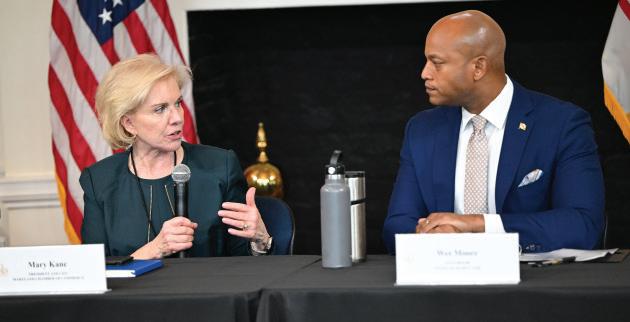
House Bill 894/Senate Bill 389
Land Use – Transit-Oriented Development – Alterations (Maryland Transit and Housing Opportunity Act)
MD Chamber Position: Support with Amendment
MD Chamber Policy Committee: Transportation
Final Status: Approved by the Governor – Chapter 592
House Bill 894/Senate Bill 389 (HB 894/SB 389) expands opportunities for housing and mixed-use development near rail transit stations by reducing zoning, parking, and financing barriers that can delay or discourage development. The legislation is intended to increase housing supply, improve workforce mobility, encourage private-sector investment, and maximize the use of transit infrastructure and underutilized land near transit hubs.
The Maryland Chamber supported the legislation because it helps address housing affordability challenges, promotes economic growth, and creates additional opportunities for transit-oriented development. The Chamber sought amendments to remove a preference for Project Labor Agreements (PLAs), citing concerns that the provision could increase project costs, limit contractor participation, and reduce flexibility for developers, potentially undermining efforts to encourage timely and cost-effective development near transit stations. The PLA preference was removed during the legislative process, helping to ensure broader contractor participation and greater flexibility for future transit-oriented development projects.
HB 894 was signed by Governor Moore on May 26.
Governor Moore’s Legislative Priorities (cont.)
House Bill 895/Senate Bill 387
Consumer Protection – Price Setting of Consumer Goods and Services and Use of Protected Class Data (Protection From Predatory Pricing Act)
MD Chamber Position: Oppose
MD Chamber Policy Committee: Education & Workforce Development
Final Status: Approved by the Governor – Chapter 154
House Bill 895/Senate Bill 387 (HB 895/SB 387) prohibits certain food retailers and third-party delivery service providers from using a consumer’s personal data to set individualized prices for food products. The legislation also prohibits the use of protected class data in a manner that results in discriminatory pricing or access to goods and services. Violations are enforceable under Maryland’s Consumer Protection Act. The bill was narrowed significantly during the legislative process and applies primarily to large grocery retailers and food delivery platforms.
The Maryland Chamber opposed HB 895 due to concerns that the bill would restrict legitimate pricing and marketing practices, create compliance challenges for businesses, and establish broad regulatory standards that could lead to uncertainty and unintended consequences. The Chamber worked with legislators and stakeholders throughout the session to secure amendments that narrowed the bill’s scope and addressed several business community concerns. While the final legislation is significantly narrower than originally introduced, concerns remain regarding its implementation and the potential impact on common business practices used to respond to market conditions and consumer demand.
HB 895 passed and was signed into law by Governor Moore on April 28. SB 387 passed out of the Senate but did not move out of the House Economic Matters Committee.
House Bill 898/Senate Bill 388
The DECADE Act
MD Chamber Position: Support
MD Chamber Policy Committee: Taxation
Final Status: Approved by the Governor – Chapter 352
CHAMBER SUPPORTED PASSED
House Bill 898/Senate Bill 388 (HB 898/SB 388) extends several economic development programs, including the Build Our Future Grant Program through 2030, the Research and Development Tax Credit through 2031, and the Employer Security Clearance Cost Tax Credit through 2032.
These programs support innovation, investment, and job creation by encouraging research and development activities, helping businesses expand operations, and supporting infrastructure projects in high-growth sectors of Maryland’s economy. At a time when Maryland continues to face challenges related to business growth, job creation, and economic competitiveness, these programs provide important tools to attract and retain investment in the State. The legislation also incorporated provisions from Senate Bill 600 to establish an affiliated group exemption to Maryland’s information technology services tax (“Tech Tax”), addressing concerns raised by the business community regarding the application of the tax enacted in 2025 to certain affiliated entities.
HB 898 was signed by Governor Wes Moore on May 12.
CONCLUSION
THE FIGHT CONTINUES
This legislative session — and the past four years — have shown what is possible when Maryland’s business community is engaged, aligned and leading. We have moved the needle. We have strengthened our collective voice. We have influenced policy outcomes. And we have helped shift the conversation toward competitiveness, growth and long-term economic strength. But we also know the work is far from finished.
The challenges we face — from affordability to long-term fiscal pressures — require more than short-term fixes. They require a sustained, thoughtful approach that looks at the full picture of what it takes for Maryland to compete. And that is exactly where we are focused. As we look ahead to the next legislative cycle — and the leadership decisions that will shape it — our role remains the same. To advocate. To engage. And to lead. To ensure that business is part of the solution — because it always has been. To continue bringing forward the real-world perspective of employers across this state. And to help build an environment where businesses, workers and communities can succeed together.
Because Maryland’s future will not be defined by a single election or a single session. It will be defined by the choices we make — and the consistency of our commitment to getting it right. And we are committed for the long term.
Sincerely,
Mary D. Kane President & CEO
WHAT THESE VICTORIES REALLY MEAN
Make no mistake: the wins we achieved in 2026 were critical, but they were defensive victories in what remains a challenging business environment. We successfully stopped minimum wage proposals, defeated bills that would have enabled counties to raise new taxes on businesse, halted bills that would have established joint and several liability for general contractors, prevented proposals that would have significantly increased the cost of critical road and bridge projects, stopped bills that would have added costly regulatory burdens and delayed permitting, and blocked bills that would have removed the non-economic damages cap, expanded civil liability and created untenable liability scenarios for businesses.
But let’s be clear about what we’re still up against. While we stopped the worst proposals, Maryland businesses will continue to face:
• Some of the highest tax rates in the region
• A regulatory environment that too often treats businesses as problems to be managed rather than partners in prosperity
• A growing structural budget deficit that makes future tax increases nearly inevitable
• A competitiveness gap that’s driving businesses and jobs to neighboring states Every victory matters, but each one is a step in a much longer journey.

Policy Committees
OVERVIEW
The Maryland Chamber of Commerce’s subject matter committees bring expertise and experience to the Chamber’s advocacy efforts. These committees help guide the Chamber’s agenda for policy areas including health care, civil liability and business law.
During Maryland’s legislative session, our government affairs team reviews recently introduced bills and resolutions and identifies specific pieces of legislation of particular interest to our members. Our team then compiles these bills and distributes them to the relevant policy committee chair(s) to review and approve for consideration. The list of bills for consideration is then sent to the full committee for review before the committee’s scheduled conference call. During this conference call, members weigh each issue and decide which position the Chamber should take, if any, and make recommendations to the larger Chamber’s Legislative Committee. The Chamber’s Legislative Committee will ultimately vote on and approve each of the Chamber’s positions. Chamber positions can include: Support, Support with Amendment, Letter of Information, Oppose, Hold/Monitor.
For more information or to join a committee, please visit mdchamber.org or email Senior Director of Government Affairs Hannah Allen at hallen@mdchamber.org, for more information.
LEGISLATIVE COMMITTEE
By invitation only
This committee develops the Chamber’s position on legislation affecting the business community.
BUSINESS REGULATION & OPERATIONS COMMITTEE
This committee was first introduced for the 2018 session, and addresses legislative and regulatory issues affecting daily operational activities of businesses.
CIVIL LIABILITY COMMITTEE
This committee covers all issues related to tort reform and civil liability of businesses, including opposing efforts to expand exposure to liability and damages (including punitive and non-economic damages) and weaken defenses available to businesses.
CYBER & TECHNOLOGY COMMITTEE
This committee covers issues related to growing and retaining biotechnology, cybersecurity, and other high-tech business innovators, including a focus on industry infrastructure needs.
EDUCATION & WORKFORCE DEVELOPMENT COMMITTEE
This committee covers issues addressing education and workforce development and the need for Maryland’s students to have affordable access to quality educational and skills-training systems that prepare them for college or a career, as well as the need for Maryland’s trades and businesses to hire and retain qualified workers.
ENERGY & ENVIRONMENT COMMITTEE
This committee covers all energy and environmental issues impacting Maryland’s business community. Areas include energy diversity and reliability, climate and greenhouse gas emission policies, stormwater and waste management, pollution control, chemical regulation and land use.
Policy Committees (cont.)
HEALTH CARE & BIOPHARMA COMMITTEE
This committee covers all healthcare issues, including cost factors, mandated health benefit demands, and regulatory oversights and requirements relative to improving Maryland’s current marketbased health care system to control costs and improve affordable access to coverage. Additionally, this committee will address issues regarding legislative interaction in the pharmacological discovery and development processes and related areas.
HOUSING & DEVELOPMENT
This committee evaluates legislation and regulatory proposals affecting the pace, cost and feasibility of commercial and residential development in Maryland. The committee advocates for policies that reduce barriers to building, support housing and commercial development and promote a predictable, efficient and cost-effective development environment that strengthens Maryland’s economic competitiveness.
LABOR & EMPLOYMENT COMMITTEE
This committee covers all Maryland employment law and workplace regulation issues including mandatory paid leave, paid sick leave insurance, pre-emption of local laws on labor issues, public accommodation laws, noncompete agreements, minimum wage, predictive and restrictive scheduling and more.
TAXATION COMMITTEE
This committee covers all taxation issues impacting Maryland’s tax climate with the goal of strengthening that climate to help attract and retain businesses, workers, and investment.
TRANSPORTATION COMMITTEE
This committee covers all transportation issues, coordinating a broad-based coalition of businesses, trade groups, and associations to advance short- and longterm solutions to statewide transportation and transit needs.
WORKERS’ COMPENSATION & UNEMPLOYMENT
INSURANCE COMMITTEE
This committee covers all workers’ compensation and unemployment insurance issues impacting businesses.
YOUR VOICE MATTERS
Lend your voice to shape the future of Maryland’s economy. As an advocate with the Maryland Chamber of Commerce, you join a 7,000+ member-strong grassroots collective of business thought leaders and a full-time, dedicated government affairs team with strong relationships in Annapolis and on Capitol Hill. Through our 10 policy committees, you can have an active role in influencing the public policy that affects your business — with a partner that protects your interests. For more information about membership, contact Executive Vice President Whitney Harmel at wharmel@mdchamber.org or 410-269-0642.