ADVOCACY 2026 PLAYBOOK
A guide to Session 2026 and the advocacy for a pro-business Maryland

A guide to Session 2026 and the advocacy for a pro-business Maryland
I am delighted to extend a warm welcome to each of you as we embark on another year of advocacy and collaboration within the Maryland business community. It is with great enthusiasm and a sense of shared purpose that I reach out to you through this introduction to the Maryland Chamber of Commerce ‘s 2026 Advocacy Playbook.
As the President & CEO of the Maryland Chamber of Commerce, I am honored to lead an organization that champions the interests of businesses across our state, fostering an environment conducive to growth, innovation and economic prosperity. Your commitment to advocating for policies that support a thriving business ecosystem aligns seamlessly with the Maryland Chamber of Commerce’s mission, making this partnership truly valuable.
In the pages of this Advocacy Playbook, you will find an overview of the key legislative priorities undertaken by the Maryland Chamber of Commerce. You will also find strategic ways to be involved in the advocacy efforts undertaken by our organization. It is designed to serve as a valuable resource for our members, providing insights into the advocacy process necessary to support a more competitive business environment in Maryland.
As we navigate the dynamic landscape of business and policy, it is crucial for us to stand together, leveraging our collective strength to shape a business-friendly environment that enables success. Our Advocacy Playbook not only outlines the challenges we face but also offers a roadmap for engagement and collaboration. Your active involvement in these advocacy initiatives is essential, and I encourage you to explore this guide thoroughly, identify areas of interest, and join us in shaping the future of Maryland’s business landscape.
Together, we can influence positive change, drive economic growth and create a prosperous future for all Maryland businesses. I am confident that, with your support and active participation, the Maryland Chamber of Commerce will continue to be a powerful advocate for our shared interests.
Sincerely,

Mary D. Kane President & CEO
The Maryland Chamber is Maryland’s business advocacy organization, and we are committed to working with our alliance of partners on critical public policy issues. With a focus on economic development and grassroots advocacy, we impact policies that directly affect Maryland business. Business makes Maryland better, let’s make Maryland better for business.
The mission of the Maryland Chamber of Commerce is to advance inclusive partnerships for a Maryland where all businesses and their communities thrive.
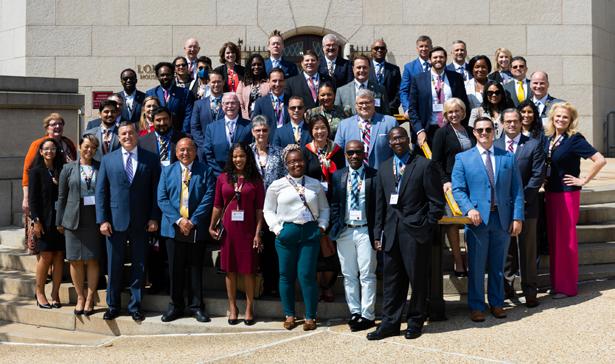
The Maryland Chamber’s subject matter policy committees bring expertise and experience to the Chamber’s legislative efforts. These committees help guide the Chamber’s agenda for a wide range of policy areas including health care, civil liability and business law.
During Maryland’s legislative session, our government affairs team reviews recently introduced bills and resolutions and identifies specific pieces of legislation of particular interest to our members. Our government affairs team compiles these bills and distributes them to the relevant policy committee chair(s) to review and approve for consideration. The list of bills for consideration is then sent to the full committee for review before the committee’s scheduled meeting. During this meeting, members weigh each issue and decide which position the Chamber should take, if at all, and make recommendations to the larger Chamber’s Legislative Committee. The Chamber’s Legislative Committee will ultimately vote on and approve each of the Chamber’s positions. Chamber positions can include: Support, Support with Amendment, Oppose, Information, Hold/Monitor.
For more information or to join a committee, go to mdchamber.org/advocacy, or email our team at governmentaffairs@mdchamber.org.
By invitation only
This committee develops the Chamber’s position on legislation affecting the business community.
BUSINESS REGULATION & OPERATIONS
This committee addresses legislative and regulatory issues affecting daily operational activities of businesses.
CIVIL LIABILITY
This committee covers all issues related to tort reform and civil liability of businesses, including opposing efforts to expand exposure to liability and damages (including punitive and non-economic damages) and weaken defenses available to businesses.
This committee covers issues related to growing and retaining biotechnology, cybersecurity and other high-tech business innovators, including a focus on industry infrastructure needs.
This committee covers issues addressing both education and workforce development that seek to address the need for Maryland’s students to have affordable access to quality educational and skills-training systems that prepare them for college or career, and the need for Maryland’s trades and businesses to hire and retain workers with the right skills and qualifications.
This committee covers all energy and environmental issues. Interest areas include renewable energy sources, stormwater and waste management, pollution control, land use and judicial review.
This committee covers health care issues, including cost drivers, mandated health benefit requirements, regulatory oversight and requirements relative to improving Maryland’s market-based health care system to control costs and improve affordable access to coverage. Additionally, this committee addresses legislative involvement in the pharmacological discovery and development processes and other related industry areas.
This committee covers issues addressing both commercial and residential development and evaluates legislation and regulatory proposals that influence pace, cost, feasibility, and affordability of development across the state.
This committee covers all employment law and workplace regulation issues including mandatory paid leave, paid sick leave insurance, pre-emption of local laws on labor issues, public accommodation laws, non-compete agreements, minimum wage and predictive and restrictive scheduling.
This committee covers all taxation issues impacting Maryland’s tax climate with the goal of strengthening the state’s competitive tax climate to help attract and retain businesses, workers and investment.
This committee covers all transportation issues, coordinating a broad-based coalition of businesses, trade groups, and associations to advance short- and long-term solutions to statewide transportation and transit needs.
WORKERS’ COMPENSATION & UNEMPLOYMENT INSURANCE
This committee covers all workers’ compensation and unemployment insurance issues.

Maryland Chamber of Commerce 2026 Advocacy Playbook
BECOME AN ADVOCATE WITH EASE
Receive email and text alerts to connect with your representatives on critical issues.
It is vital that Maryland job creators make their voices heard to lawmakers during the 2026 legislative session. Now more than ever, your voice can be the driving force to make Maryland the best place to live, work and own a business. Become an advocate for businesses across Maryland. Learn more at mdchamber.org/Alerts.

Take action now to influence issues that matter to you
Take action now to influence Maryland’s policy landscape. Sign up for the Maryland Chamber’s legislative Advocacy Alerts to:
• Get email and text notifications on urgent advocacy issues
• Stay informed on bills that affect the business community
• Receive our weekly Friday Five newsletter featuring top stories in local business and government
• Contact lawmakers instantly and give feedback on how proposals will impact you
• Amplify the voice of Maryland employers in critical debates
With our updates, making your voice heard is easy. You’ll get email and text notifications on urgent advocacy issues and can contact key representatives with just one click.
If you prefer to send your own correspondence to your legislators outside of our Action Network, we’ve got you covered.
The following letters are samples to give you ideas about how to correspond with members of the Maryland General Assembly. Samples 1 and 2 are general letters, while Sample 3 is written for a specific piece of legislation. When you are writing regarding specific legislation, make sure you are signed up for the Maryland Chamber of Commerce’s legislative update emails, which will provide you with the necessary information you need on each piece of legislation that requires action. Sign up for Maryland Chamber emails at mdchamber.org/stay-connected.
SAMPLE 1 Business letter
The Honorable [Legislator’s Name] [Legislator’s office address]
[Date, if sending by mail]
SUBJECT: [Appropriate subject]
Dear [Del.] [Sen.] [Legislator’s Last Name]:
Thank you for your support of jobs in the 2026 Legislative Session. As your constituent and a business owner, I know the General Assembly’s favorable treatment of businesses and the reduction of regulations are a major contributor to the success of Maryland’s economy. I am looking forward to your continued support of jobs and the businesses that create them.
Thank you for the important work you do for the citizens of Maryland.
Sincerely, [Your Name] [Your Title]
SAMPLE 2 General letter
The Honorable [Legislator’s Name] [Legislator’s office address]
[Date, if sending by mail]
SUBJECT: [Appropriate subject]
Dear [Del.] [Sen.] [Legislator’s Last Name]:
Thank you for your continued support of jobs and economic development. As your constituent, I am most interested in the General Assembly’s willingness to enhance the business climate in Maryland by reducing the number of regulations my business faces, and ensuring that the legislature does not pass other onerous mandates this session. The business community is a vital part of our state, creating jobs and expanding our economy. As such, it deserves your support.
Thank you for the important work you do for the citizens of Maryland.
Sincerely, [Your Name] [Your Title]
SAMPLE 3 Specific policy or concern letter
The Honorable [Legislator’s Name] [Legislator’s office address]
[Date, if sending by mail]
SUBJECT: [Appropriate subject]
Dear [Del.] [Sen.] [Legislator’s Last Name]:
I own a [number of employees] business in [location(s) of operation(s)]. I ask you to [support or oppose] [Legislation Name/Number] concerning [issue(s)]. This is an issue that has significant [positive or negative] impacts on my business and my employees, and greater implications for Maryland’s economy.
This bill, if enacted, would [explain effects]. Thank you for your consideration and all the important work you do on behalf of your constituents.
Sincerely, [Your Name] [Your Title]
Elected officials bear the “Honorable” address. Cabinet members are appointed and therefore do not bear the “Honorable” address. Note: Former officeholders and secretaries retain their honorifics after serving. Refer to them by the last office or position they held
Governor The Honorable (full name) Governor of Maryland
Lt. Governor
Attorney General
Cabinet Secretary
State Senator
State Delegate
The Honorable (full name) Lt. Governor of Maryland
The Honorable (full name) State of Maryland OR Attorney General, State of Maryland
Mr./Ms. (full name) Secretary of (department)
The Honorable (full name) Maryland Senate
Dear Gov. (last name) Governor (last name)
Dear Lt. Gov. (last name) Lt. Governor (last name)
Dear Mr./Madam Attorney General Attorney General (last name)
Dear Mr./Madam Secretary Secretary (last name)
Dear Sen. (last name) Senator (last name)
The Honorable (full name) Dear Del. (last name) Delegate (last name)
Mayor The Honorable (full name) Mayor of (city)
City Council
U.S. Senator
U.S. Representative
Dear Mayor (last name) Mayor (last name)
The Honorable (full name) Dear Councilman/woman (last name) Councilman/woman (last name)
The Honorable (full name) United States Senate
The Honorable (full name)
U.S. House of Representatives
Dear Sen. (last name) Senator (last name)
Dear Rep. (last name) Congressman/woman
EXECUTIVE LEADERSHIP GOVERNOR
TREASURER
Dereck E. Davis 80 Calvert St.
SENATE MAJORITY LEADER
Senator Nancy King (D-36) 120 James Senate Office Bldg.

Brooke Lierman, Esq. 80 Calvert St. Annapolis, MD 21404 brooke@marylandtaxes.gov (410) 260-7801
201 Lowe House Office Bldg. 6 Bladen St. Annapolis, MD 21401 jason.buckel@house.maryland.gov (410) 841-3404
6 Bladen St. Annapolis, MD 21401 kris.valderrama@house.maryland.gov (410) 841-3210
Leadership directory
ECONOMIC MATTERS, VICE CHAIR
Delegate Lorig Charkoudian (D-20) 231 Taylor House Office Bldg. 6 Bladen St. Annapolis, MD 21401 lorig.charkoudian@house.maryland.gov (410) 841-3423
ENVIRONMENT AND TRANSPORTATION, CHAIR
Delegate Marc Korman (D-16) 251 House Office Bldg. 6 Bladen Street Annapolis, MD 21401
marc.korman@house.maryland.gov (410) 841-3649
ENVIRONMENT AND TRANSPORTATION, VICE CHAIR
Delegate Michele Guyton (D-42B)
251 Taylor House Office Bldg. 6 Bladen Street Annapolis, MD 21401
michele.guyton@house.maryland.gov (410) 841-3793
GOVERNMENT, LABOR AND ELECTIONS, CHAIR
Delegate Melissa Wells (D-40) 142 Lowe House Office Bldg. 6 Bladen Street Annapolis, MD 21401 melissa.wells@house.maryland.gov (410) 841-3545
GOVERNMENT, LABOR AND ELECTIONS, VICE CHAIR
Delegate Kenneth Kerr (D-3) 209 Lowe House Office Bldg. 6 Bladen Street Annapolis, MD 21401
ken.kerr@house.maryland.gov (410) 841-3240
HEALTH, VICE CHAIR
Delegate Bonnie Cullison (D-19) 241 Taylor House Office Bldg. 6 Bladen St. Annapolis, MD 21401
bonnie.cullison@house.maryland.gov (410) 841-3883
RULES AND EXECUTIVE NOMINATIONS, CHAIR
Delegate Anne Healey (D-22)
361 Taylor House Office Bldg. 6 Bladen Street Annapolis, MD 21401
anne.healey@house.maryland.gov (410) 841-3961
RULES AND EXECUTIVE NOMINATIONS, VICE CHAIR
Delegate Marvin Holmes (D-23)
364 Taylor House Office Bldg. 6 Bladen Street Annapolis, MD 21401 marvin.holmes@house.maryland.gov (410) 841-3310
JUDICIARY, CHAIR
Delegate Sandy Bartlett (D-32)
101 Taylor House Office Bldg. 6 Bladen St. Annapolis, MD 21401
sandy.bartlett@house.maryland.gov (410) 841-3370
JUDICIARY, VICE CHAIR
Delegate Debra Davis (D-28) 101 Taylor House Office Bldg. 6 Bladen St. Annapolis, MD 21401
debra.davis@house.maryland.gov (410) 841-3337
WAYS AND MEANS, CHAIR
WAYS AND MEANS, VICE CHAIR
Delegate Jessica Feldmark (D-12A) 131 Taylor House Office Bldg. 6 Bladen Street Annapolis, MD 21401
jessica.feldmark@house.maryland.gov (410) 841-3205

HEALTH, CHAIR
Delegate Heather Bagnall (D-33C) 241 Taylor House Office Bldg. 6 Bladen St. Annapolis, MD 21401 heather.bagnall@house.maryland.gov (410) 841-3406
Delegate Jheanelle Wilkins (D-20)
131 Taylor House Office Bldg. 6 Bladen St. Annapolis, MD 21401
jheanelle.wilkins@house.maryland.gov (410) 841-3493
SENATE COMMITTEE CHAIRS & VICE CHAIRS
BUDGET AND TAXATION, CHAIR
Senator Guy Guzzone (D-19) 3W Miller Senate Office Bldg. 11 Bladen St. Annapolis, MD 21401
guy.guzzone@senate.maryland.gov (410) 841-3572
BUDGET AND TAXATION, VICE CHAIR
Senator Jim Rosapepe (D-21) 101 James Senate Office Bldg. 11 Bladen St. Annapolis, MD 21401
jim.rosapepe@senate.maryland.gov (410) 841-3141
EDUCATION, ENERGY AND ENVIRONMENT, CHAIR
Senator Brian Feldman (D-15) 2W Miller Senate Office Bldg. 11 Bladen St. Annapolis, MD 21401 brian.feldman@senate.maryland.gov (410) 841-3169
EDUCATION, ENERGY AND ENVIRONMENT, VICE CHAIR
Senator Cheryl Kagan (D-17)
2W Miller Senate Office Bldg. 11 Bladen St. Annapolis, MD 21401 cheryl.kagan@senate.maryland.gov (410) 841-3134
Leadership directory
EXECUTIVE NOMINATIONS, CHAIR
Senator Benjamin Brooks (D-10)
303 James Senate Office Bldg. 11 Bladen Street
Annapolis, MD 21401
benjamin.brooks@senate.maryland.gov (410) 841-3606
EXECUTIVE NOMINATIONS, VICE CHAIR
Senator Anthony Muse (D-26) 422 Miller Senate Office Bldg. 11 Bladen St. Annapolis, MD 21401
anthony.muse@senate.maryland.gov (410) 841-3092
FINANCE, CHAIR
Senator Pamela Beidle (D-32)
3E Miller Senate Office Bldg. 11 Bladen St. Annapolis, MD 21401
pamela.beidle@senate.maryland.gov (410) 841-3593
FINANCE, VICE CHAIR
Senator Antonio Hayes (D-40)
223 James Senate Office Bldg. 11 Bladen St. Annapolis, MD 21401
antonio.hayes@senate.maryland.gov (410) 841-3656
JUDICIAL PROCEEDINGS, CHAIR
Senator Will Smith (D-20)
2E Miller Senate Office Bldg. 11 Bladen St. Annapolis, MD 21401 will.smith@senate.maryland.gov (410) 841-3634
RULES, CHAIR
Senator Katie Fry Hester (D-9)
304 James Senate Office Bldg. 11 Bladen St. Annapolis, MD 21401
katiefry.hester@senate.maryland.gov (410) 841-3671
JUDICIAL PROCEEDINGS, VICE CHAIR
Senator Jeff Waldstreicher (D-18)
2E Miller Senate Office Bldg. 11 Bladen St. Annapolis, MD 21401
jeff.waldstricher@senate.maryland.gov (410) 841-3137
RULES, VICE CHAIR
Senator Arthur Ellis (D-28)
301 James Senate Office Bldg. 11 Bladen St. Annapolis, MD 21401
arthur.ellis@senate.maryland.gov (410) 841-3616
The House of Delegates Office Building will be open to the public during the 2026 legislative session. Full committee work will be conducted in person in committee rooms in a hybrid format, as witnesses may choose to testify either in person or online. Subcommittees will generally meet virtually.
There will be no receptions or large gatherings in the House Office Building during the 2026 legislative session. Space is severely limited due to the reconstruction of the Department of Legislative Services building. Visitor sections on both sides of the House gallery will be open and available on a first–come, first–served basis for the public. Face masks are not required on the State House campus. Masks will be widely available for anyone who wishes to wear one while visiting.
All House committee work will be conducted in a hybrid format for the 2026 legislative session. While in–person testimony is encouraged, an opportunity to testify virtually is available to all witnesses. The following framework for House standing committees remains subject to change. You can find each committee’s individual guidelines on their webpages on the Maryland General Assembly website.
• Bill hearings will begin as soon as possible on pre–filed bills.
• Every on–time bill (filed with the Chief Clerk’s office by 5:00 p.m. on Friday, Feb. 13) will receive a hearing. The standing committee chairs have full discretion over the length of hearing.
• Schedule for each committee will generally be posted during the week before hearing is scheduled.
• Witness sign–up will be open online from 10:00 a.m. to 6:00 p.m. through the Maryland General Assembly website two business days before the bill hearing. The sign–up schedule is as follows:
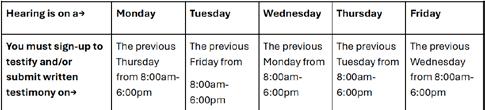
• The specific bill order will be posted on the Maryland General Assembly website the day before the hearing. If a bill hearing is scheduled for a Monday, the hearing order will be posted on Friday.
• The House standing committees may cap the maximum number of in–person and virtual witnesses that can testify on a bill.
Maryland Chamber of Commerce 2026 Advocacy Playbook
• The witness sign-up software does not allow witnesses to sign up as a panel. The sponsor may communicate with the committee staff to testify together with other witnesses, and the chairs will make every effort to accommodate these requests.
• On the day of a bill hearing, witnesses may not alter their witness status from providing testimony in–person to virtual, or from virtual to in–person.
SUBCOMMITTEES
While subcommittees are not subject to the Maryland Open Meetings Act, subcommittee work will generally be livestreamed through the Maryland General Assembly website for the 2026 legislative session. Subcommittees will generally meet virtually, except for the subcommittees of the House Appropriations Committee which will generally meet in–person but will be livestreamed.
All standing committee voting sessions will be livestreamed through the Maryland General Assembly website for the 2026 legislative session. The vote lists will generally be available on the Maryland General Assembly website 24–48 hours prior to the voting session.
CO-SPONSORS
For the 2026 legislative session, co-sponsors will be listed on the blue backs.
• Electronic copies of the bill files will be available by request to any member of the public after the bill hearing by contacting the standing committee.
• Bill files will be available through the MGA website when the bill is on the House floor for second reader. For bills that do not pass out of the standing committee, the bill file will be available on the website after the legislative session.
• All bill hearings will take place in person in the applicable committee room and will be streamed live via the Maryland General Assembly website.
• Committees traditionally hear bills on Tuesdays, Wednesdays and Thursdays at 1:00 p.m.
• All scheduled bill hearings will be posted in the MGA hearing schedule. Please check the schedule periodically for the most up-to-date information.
• The bill order will be posted in the MGA hearing schedule by 12:00 p.m. on the day of the scheduled bill hearings. The committee chair will announce the bill order at the beginning of each bill hearing.
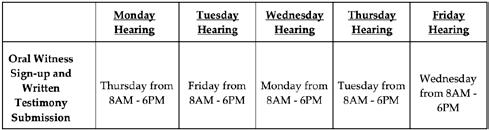
• To register to provide oral testimony or submit written testimony, individuals MUST create a MyMGA account through the MGA website. See here for a tutorial Please note: the MGA website does not support Internet Explorer. Please use another web browser to upload your written testimony.
• Oral testimony sign-up and written testimony submission will open two (2) business days in advance of the scheduled bill hearing and will be open from 10:00 a.m.–6:00 p.m.
Protocols for committees 2026 Senate
• While witnesses are strongly encouraged to provide in-person oral testimony, to include as many citizens as possible in the legislative process, up to 14 members of the public may provide virtual oral testimony via Zoom per bill.
• Committees may limit oral testimony based on the number of bills being heard and the number of witnesses signed up to testify. If that situation arises, committees will notify witnesses.
• Witnesses must designate whether they will testify in person or by Zoom. Witnesses may not change their oral testimony designation (virtual or in-person) after the sign up system closes, even if they are not selected for virtual testimony.
• Witness testimony via pre-recorded video will not be allowed.
• Late witness sign-up will not be allowed.
• Witness testimony will be timed. Witnesses should plan to conclude their testimony at the twominute (2:00) mark, but the allotted time will be at the discretion of the committee chair.
• Witnesses who provide in-person oral testimony will be called to testify before witnesses providing testimony via Zoom. Any changes to this format will be at discretion of committee chair.
• Witnesses who wish to share an audio-visual presentation with the committee are strongly encouraged to upload the presentation as written testimony. For witnesses providing in-person testimony, showing the audio-visual presentation during the bill hearing will be at the discretion of the committee chair. Please check with the committee manager for each committee’s policy. Witnesses providing testimony via Zoom will not be permitted to show an audio-visual presentation during their testimony.
• Typically, committee members will ask questions after the conclusion of a witness’s testimony.
ZOOM INSTRUCTIONS
• Zoom links will ONLY be sent to witnesses selected to testify who chose “virtual oral” or “virtual both” when they signed up to testify on a bill.
• Zoom links will be sent from noreply@mga.maryland.gov by 12:00 p.m. on the day of the scheduled bill hearing. If a witness is NOT selected to testify, the witness will receive an email from noreply@mga.maryland.gov to inform the witness they were not selected.
• The Zoom link is confidential and should not be shared.
• Witnesses must log into Zoom with their first and last names so committee staff are able to quickly identify the user and admit them into the meeting at the appropriate time. Witnesses who do not log into Zoom with their first and last name may miss their opportunity to testify.
Protocols for committees 2026 Senate
• Zoom witnesses should follow the hearings via the MGA website to know when the bill they are testifying on is going to be called by the committee chair and should log into Zoom when the bill before their bill is called.
• When testifying, witnesses must have their camera turned on.
• After the committee chair indicates that there are no further questions, the witness should exit the Zoom meeting or they will be logged out by committee staff.
• Any written testimony submitted to a committee is public testimony and therefore accessible to the public and cannot be removed.
• Written testimony MUST be in a PDF format to be uploaded.
*For committee specific procedures, please review each Committee’s Witness Guidelines and Committee FAQs:
• Budget and Taxation Committee
• Education, Energy and the Environment Committee
• Finance Committee
• Judicial Proceedings Committee
Bills can be requested by anyone for any reason; however, only a current legislator can introduce a bill.
Once a bill is drafted and ready for introduction, it is presented to whichever chamber the legislator belongs. The Office of the Senate President or House Speaker will assign the bill a committee (or committees) where it will be heard.
The chair of the committee where the bill is assigned sets a hearing date where the sponsor will present and be met with proponents and opponents of the bill. (Not all bills are heard in committee).
After the hearing, the committee debates and votes on the bill. During this time, legislators can request amendments and vote to either issue a favorable report, allowing the bill to advance, or an unfavorable report, killing the bill. They may also do nothing, which will hold the bill in committee.
If the bill receives a favorable report, it advances to the floor of its respective chamber where it will be read again and thus becomes a “second reader.” Here, legislators can propose amendments, which must be approved by either the sponsor of the bill or a majority of legislators present.
Barring any procedural motions, the bill is ordered to be printed for third reader. Once the bill hits third reader, no amendments can be made, and it can only be voted in favor (yea) or against (nay).
If the bill passes third reader, it moves to the opposite chamber, where the whole process resets. If the bill is voted down, it dies and cannot be revised.
The procedure is generally repetitive, except that when the bill is heard in the opposite chamber’s committee, testimony is generally restricted to the sponsor and, depending on committee, one opponent. Amendments can be made in committee or second reader in this opposing chamber.
If the bill passes third reader in the opposite chamber and there are no differences from the version that passed the first and second chambers, then the bill has passed. It is sent to the governor, who can sign the bill into law, veto the bill (sending it back to the General Assembly), or allow the bill to become law without his signature. If the bill is vetoed, the General Assembly can override it with 3/5 margin in both chambers. If there are not enough votes to overturn the veto, the veto is sustained and the bill dies.
If the bill passes both chambers, but has incurred amendments in the second chamber, a compromise bill is required. The leaders of the House and Senate assemble a conference committee. Once the conference committee issues its report, the compromise bill is presented to both chambers for a vote. If the chambers concur with the conference committee, the bill is passed and presented to the governor. If the chambers do not concur with the conference committee, the bill fails.
To approve an action (i.e., an amendment, committee report, motion).
To make a change in a bill or a law.
The letters that examine the legal sufficiency of the bills passed by the General Assembly. The Attorney General’s Office prepares the letters and submits them to the governor before the approval or veto of bills.
A proposed law presented for approval to a legislative body.
The number the secretary of the Senate or the chief clerk of the House of Delegates assigns to a bill at the time of introduction. The bill retains the same number if it moves to the opposite chamber.
The current standing of a bill.
The presiding officer of a chamber or of a specific committee.
The number the secretary of state assigns to a bill after the governor signs the bill. Chapter numbers are issued in the numerical order in which bills are signed.
CODE
The Annotated Code of Maryland, the codified statutory laws of Maryland.
The report a committee submits to the chambers listing actions taken on bills (i.e. favorable, favorable with amendments, unfavorable, re-referred, or referred for interim study).
The date by which each chamber’s committees report their bills to the floor.
The reprinting of a bill to include a committee’s amendments.
One chamber approves an action taken by the other chamber.
Legislative terms
Three members from each chamber, or five in the case of the budget conference committee (appointed by the presiding officers), who work to resolve the differences in a bill passed by both chambers. A bill does not pass the General Assembly unless each chamber passes the bill in identical form.
The report the conference committee submits to the chambers for final passage of a bill. The report may consist of adopting, rejecting, or adding amendments. Each chamber must adopt the report and then vote for final passage of the bill.
CROSSOVER DATE
Each chamber sends to the other chamber those bills it passes favorably by this date.
ENACTED
A bill is enacted when it becomes a law (i.e. is signed by the governor) and takes effect.
ENROLLED (PASSED ENROLLED)
A bill is an enrolled bill if it was amended in the opposite chamber.
FAILED
A bill’s status after failing to receive a majority vote on the chamber floor.
FIRST READER
A bill as printed and assigned a bill number.
FIRST READING
Introduction of a bill in its presenting legislator’s chamber, where it is “read across the desk” for the first time and assigned to a standing committee.
An analysis prepared by the Department of Legislative Services of a bill’s impact on state and local revenues and expenditures. It also identifies any mandated appropriations in the state budget and any mandates on local governments; describes the impact on small businesses; describes current law; and, if relevant, outlines the background relating to the proposal. Beginning with the 2017 session, a fiscal and policy note is “revised” when an adopted amendment necessitates a change; a fiscal and policy note is also “revised” if it is changed for any other reason.
For Maryland’s government, July 1–June 30.
That portion of the chamber reserved for members and officers of the assembly or other persons granted access.
Bag in which gubernatorial appointments requiring legislative approval are delivered to chamber floors. Such appointments are submitted to General Assembly by 40th day of session (Art. II, Sec. 13, MD Constitution).
Legislative terms
GUARANTEE DATE
The cutoff date for a bill to be guaranteed a committee hearing in its chamber of origin.
JOINT RESOLUTION
A resolution passed in both chambers as a statement on a public issue, a request of the governor or a government office, or establishment of a task force. With certain exceptions, joint resolutions do not have the effect of law.
LAID OVER
Postponement of floor action on an amended bill for one legislative day.
LEGISLATIVE DAY
Length of time from convening a session in the chamber until adjournment; may be longer or shorter than a calendar day (e.g. a session that continues into a second calendar day without adjourning is one legislative day). If a chamber adjourns and reconvenes on the same day, that constitutes two legislative days.
MOVE THE PREVIOUS QUESTION
Ending debate and returning to the question on the floor.
PASSED
The status of a bill receiving a favorable vote by the majority of legislators.
PREFILED
The status of a bill drafted, by request, by the Department of Legislative Services prior to a legislative session for introduction in that session. Prefiling dates set by law.
QUORUM
The minimum number of members of a chamber or committee required for the transaction of business.
QUORUM CALL
Action used to establish the presence of the majority required to transact business.
REASSIGNED
Assignment of a bill from one committee to another.
An identifying number given by the Department of Legislative Services to a bill request until the bill is introduced and assigned a bill number. A bill becomes public only when assigned a bill number.
LR MOTION
Proposal of an action.
REFERRED
The action of assigning a legislative measure to a committee or committees.
REFERRED FOR INTERIM STUDY
The status of a bill when a committee asks to study it during the nine-month interim.
Legislative terms
RE-REFERRED
The status of a bill reassigned to a different committee after the original referral.
The power of the registered voters, under certain conditions, to petition an act of the last General Assembly, with certain exceptions, for approval or disapproval at the next general election.
REJECT
The voting down or failing of an action (e.g. an amendment).
RETURNED PASSED
The voting down or failing of an action
The status of a bill passed in its chamber of origin and returned by the opposite chamber without amendments.
ROLL CALL
The recording of names of members present in the chamber to establish a quorum or to take a vote on an issue before the body.
SECOND READING
The status of a bill reported out of committee and brought to chamber floor for preliminary approval. Committee and floor amendments may be added to bill at this time. (Bill not reprinted for second reading).
SESSION LAWS
The compilation of all chapters (the bills the governor signs) from a legislative session.
SIMPLE RESOLUTION
A form of legislative measure introduced in only one chamber of the General Assembly and used for the regulation of business only within the chamber of origin.
SINE DIE
The final adjournment of session, without adjourning to a specific time or date. Informally, the last day of legislative session.
SPECIAL ORDER
Postpones floor action on a bill until a definite date or time.
SUNSET PROVISION
Provides that a provision of a law is automatically repealed on a specific date, unless the General Assembly reenacts it.
SUSPEND THE RULES
To temporarily set aside the rules by a twothirds vote to allow for a certain action.
THIRD READER
A bill that is printed after second reading in the chamber of origin with amendments.
THIRD READING
The final vote on a bill in each chamber. The third reading vote is recorded.
VETO
Action governor takes to prevent bill enactment passed by General Assembly.
As we continue to strengthen partnerships with Governor Moore, his administration and the Maryland General Assembly, we anticipate a number of critical issues to take center stage for the Maryland business community. In addition to new issues, we also anticipate that several long-standing concerns will require our attention.
2026 legislative priorities
Business Taxes: Tax policies that promote business creation and retention generate critical economic opportunities for all Marylanders. As Maryland addresses future budget deficits, the Maryland Chamber stands ready to work with the legislature and administration to achieve solutions that prioritize economic growth, responsible government spending and job creation. Policies that promote business creation and retention expand Maryland’s tax base and ensure sustainable revenue streams that support vital public services. We urge Governor Moore and the General Assembly to develop well-balanced fiscal strategies that promote economic stability and foster job creation without disproportionately impacting Maryland’s business community. Tax policies that reduce Maryland’s competitiveness with surrounding states constrain economic opportunities for all Marylanders and risk long-term fiscal challenges for the State. Policymakers must carefully consider the trade-offs between generating new revenue and enhancing Maryland’s economic competitiveness.
Transportation Funding Solutions: As Maryland continues to incentivize electric vehicle adoption and the use of fuel-efficient vehicles grows, it is imperative the General Assembly take steps to address the sustainability of the Transportation Trust Fund (TTF) and its reliance on the gas tax as a key funding source. The TTF serves as Maryland’s primary source of funding for infrastructure and transportation needs. Enhanced and sustainable long-term funding solutions are essential to support Maryland’s economy and ensure the safe and efficient movement of people and goods. The Maryland Chamber looks forward to being a collaborative partner in discussions with the legislature and administration to identify solutions that secure Maryland’s transportation future.
Business-Driven Data Privacy & AI Solutions: The Maryland Chamber supports the development of a regulatory framework that addresses both data privacy and artificial intelligence in a manner that balances innovation with consumer protection. Maryland’s current data privacy law, passed in 2024, contains inconsistencies and compliance challenges compared to other states. It is crucial to address issues with the current law to provide businesses with clarity and reduce the burden of navigating a patchwork of regulations. Additionally, as AI continues to evolve, policymakers and business leaders must collaborate to ensure a flexible and balanced regulatory approach that fosters innovation while safeguarding privacy and ensuring ethical use and fair competition. Such an approach will enable Maryland businesses to harness the potential of AI while maintaining consumer trust and integrity.
2026 legislative priorities
Climate Tax Policies & Energy Reliability: The Maryland Chamber advocates for a balanced approach to achieving the state’s climate goals that fosters economic growth. As Maryland strives to meet the ambitious goals established under the Climate Solutions Now Act, it is imperative that we pursue strategies that do not impose undue financial burdens on our businesses and consumers. Proposed measures to raise revenue to pay for climate mitigation threaten to introduce over $1 billion in additional taxes annually, undermining the state’s economic stability amid growing budget deficits and slow economic growth. The Maryland Chamber of Commerce urges policymakers to prioritize cost-effective solutions that enhance grid reliability, embrace an all-of-the-above energy strategy that advances the development of a diversified and inclusive energy portfolio and foster innovation.
Job Creation & Workforce Devlopment: The Maryland Chamber supports legislation and budget initiatives that create jobs and expand economic opportunity for every Marylander. Policies that incentivize job creation and workforce development generate growth and economic mobility. Expanding apprenticeship ratios, improving access to childcare, and investing in programs that directly connect Marylanders with job opportunities create direct pipelines to success for Maryland’s businesses and workers. The Maryland Chamber of Commerce will continue to support legislative and budget initiatives in the 2026 session that create jobs and promote workforce development for all Marylanders.
We will continue to keep a pulse on anticipated issues, legislation and efforts that will be of critical importance to the Maryland business community, and to work with our network of partners, members and stakeholders to advocate for the current and future success of our state’s employers.
2026 anticipated critical issues
• Business Regulations & Operations: Regulatory Reform, Procurement Reform, Permitting Reform, Antitrust
• Civil Liability: Non-Economic Damages, Punitive Damages, Contributory Negligence
• Cyber & Technology: Broadband Expansion and Connectivity, Data Privacy, Net Neutrality, Artificial Intelligence
• Education & Workforce Development: Apprenticeship and Intern Tax Credits and Reform, Apprenticeship Statutory Definition, Second Chance Employment, Military Retirement Relief
• Energy & Environment: Climate Change and Greenhouse Gas Emissions, Chemical Regulation, Recycling, Permitting Reform
• Health Care & Biopharma: Pharmaceutical Pricing and Availability, Drug Dispensing Fees, Employee Development, Professional Employer Organizations
• Housing & Devlopment: Commercial and Residential Development, Reduce Barriers to Building, Zoning and Land Use Modernization, Workforce Housing, Permitting Reform
• Labor & Employment: Pre-Emption, Paid Family Leave Benefits, Cannabis - Adult Use Legalization
• Taxation: Business Tax Environment, Combined Reporting and Throwback Rule, Expanding the Sales Tax on Services, Evaluation of Maryland’s De-coupling Provisions, Growing Maryland’s Economy
• Transportation & Infrastructure: 5G, Small Cell and Broadband Expansion, Transportation and Infrastructure Funding, Vehicle Emission Reductions
• Workers’ Compensation & Unemployment Insurance: Solvency of the Maryland Unemployment Trust Fund, Unemployment System Reform
Read our priorities and anticipated critical issues in greater detail: mdchamber.org/advocacy/legislative-priorities.
Final date for Governor to introduce budget bill
Final date for Governor to introduce capital budget bill
10th Day — Final date for submission of Executive Orders reorganizing Executive Branch of State Government; either Chamber may disapprove by resolution within 50 days.
13th Day — Administration bills introduced in the Senate after this date referred to Senate Rules Committee.
Governor delivers State of the State Address (noon)
In order to meet the bill introduction date, House bills must be filled with the Chief Clerk’s office by 5:00 p.m.
(delivered Feb. 14) 9 55th Day — Final date for introduction of bills without suspension of Rules
63rd Day — Committee Reporting Courtesy Date. Each Chamber’s committees to report their own bills by this date.
th Day — OPPOSITE CHAMBER BILL CROSSOVER DATE. Each Chamber to send to other Chamber those bills it intends to pass favorably. Opposite Chamber bills received after this date subject to referral to Rules Committees.
May
June 1
June 2
July 1
th Day after adjournment — Final date for presentment of bills to the Governor
than emergency bills/otherwise provided, earliest date for bills to take effect
th Day after presentment — Governor to sign/veto bills by this date
tax and revenue bills to take effect
Oct. 1 Typical effective date for bills